New Dawn – World's Most Unusual Magazine

Category: Secret History

  • The Ties That Bind – Spies & the Occult: The Connections Between Aleister Crowley, a Rocket Scientist, a Priest, & a British Spymaster

    The Ties That Bind – Spies & the Occult: The Connections Between Aleister Crowley, a Rocket Scientist, a Priest, & a British Spymaster

    This article was published in New Dawn Special Issue Vol 13 No 3 (June 2019)

    Dr Richard Spence, a history professor and author of Secret Agent 666: Aleister Crowley, British Intelligence and the Occult (published by Feral House), is an expert on intelligence and the occult.

    In this interview with New Dawn magazine, Spence details his years of research into the little known connections between intelligence agencies, spies, and occult activity. Dr Spence explains the ties between occultist Aleister Crowley, rocket scientist and dissident Jack Parsons, British spymaster Maxwell Knight, along with author and priest Montague Summers.

    Crowley, described by the British press of the time as “the wickedest man in the world,” founded the spiritual philosophy Thelema and led the occult fraternal organisation Ordo Templi Orientis (OTO). He remains at the centre of conspiracies.

    CHARLIE NASH (CN): You’ve written a book about Aleister Crowley and his connections to British intelligence, but for readers of New Dawn who haven’t read the book, could you tell us a bit about Crowley’s alleged intelligence connections and what you found from your research?

    RICHARD SPENCE (RS): Aleister Crowley would make allusions, or in some cases direct comments, about being involved with intelligence. He would mention specifically the admiralty’s intelligence and the name of a particular official who had been connected to that during the First World War, a fellow by the name of Captain Guy, or earlier, Commander Guy Gaunt. Gaunt, whenever asked about this, would waffle on the question or say that he knew nothing about what Crowley was talking about. And it’s fairly easy considering his dubious reputation and lack of any kind of documentary evidence, like a spy card, or something to back that up. Most people would dismiss that as an act of either desperation or a fantasy he had.

    Dr Richard Spence

    I was actually working on a subject about another person, another spy, who was active in and around New York City during the First World War, and one of the things that I was looking for was any possible cross-pollination. It’s always interesting to see who’s put in the same place at the same time, or even the same room. 

    In the States, you can get through the Freedom of Information Act older FBI files, which at the time was called the Bureau of Investigation. You can also access a kind of semi-defunct agency that functioned at the time, as part of the US Army – the Military Intelligence Division. One of the interesting things is that the Military Intelligence Division in the United States during the First World War was the agency that handled domestic counter-intelligence. Handily, for us historians, all of the MID’s pre-1941 records were declassified many years ago, and they’re available in the national archives.

    Keep in mind here we’ve got this guy Crowley running around New York at the same time, and he’s claiming to have been connected to British intelligence, and the guy I’m looking at has some connections in the same period… Is there a possibility? Is there anything to it? I decided, partly out of curiosity, to send off to the national archives to see if the MID files had anything on Crowley, and lo and behold they did, and I got the file. This is from July 1918, and it deals with Aleister Crowley, English subject. The key elements say, “Subject has been camping on Esopus Island, Hudson River, and was brought to the attention of this office by subject’s connections with Madeleine George, an actress in New York City, who had been formally investigated by the Department of Justice on charges of being a German spy.” Now the key part is what follows: “It was determined that Aleister Crowley was an employee of the British government but at present in this country on official business of which the British Counsel, New York City has full cognisance.” Skip down a couple of lines, “It was found that the British Government was fully aware of the fact that Crowley was connected with German propaganda and received money for writing anti-British articles.”

    That was kind of interesting… The British Consulate was reluctant to say anything about it because they wanted to prevent the Americans from arresting him. They said, “Leave him alone,” and they did. 
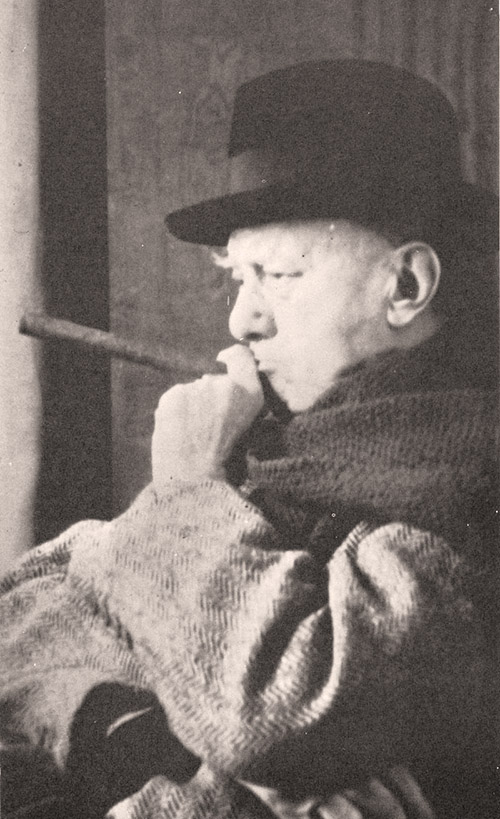
    A war time photo of Aleister Crowley imitating Britain’s Prime Minister Winston Churchill, for whom he claimed to have invented the “V for Victory” hand sign.

    CN: That proves Crowley had a connection with intelligence?

    RS: One of the things you’ll find if you’re looking for people dealing with intelligence, almost never is that ever explicitly stated. No, people don’t carry spy cards, people don’t walk around with cards saying, “I am a spy,” that would be a bad thing to do. In the entire realm of intelligence, the single guiding principle, at least in terms of any kind of active operations, is secrecy. These are agencies which are essentially dedicated to concealing their own secrets and discovering other people’s secrets, so they do not operate openly. There’s no sort of general list of everybody who is an agent for this agency or another one. 

    The other thing which goes along with secrecy is the compartmentalisation of information, which means only people with an important and legitimate reason to know what this person is doing would be aware of that. In a sense, this is the closest thing you’re ever going to get to an admission from any kind of official that, ‘This person is an agent for us’. He’s an employee of the British government, and in this country on official business, which is known to us, and this official business is connected to him writing what appears to be treasonous propaganda, and we want you to leave him alone. When Crowley eventually returns to the UK, after the war, there’s not the slightest indication of any problems. He waltzed through the whole thing. He came back and went about his business. It was just before Christmas, and he went to his aunt’s house. He had a Christmas dinner and everything was fine until the British press caught on he was in the country, raised a stink about what he had been doing in New York, and then he very quickly left for France.

    Here’s the type of thing you have to imagine. You have an individual who arrived in America on the Lusitania on Halloween, in 1914, and he spent the entire war in the States, returning again in late 1919, and during that time he had indeed worked quite openly as a German propagandist. He had written articles, rather scathingly and insulting anti-British articles, for a publication in New York called the Fatherland. You might figure that when Crowley returned home there would’ve been some issue. But there’s none. The other thing is that to get back home in 1919 he had to go to the same British consulate that a year before said, “He’s okay leave him alone,” and he essentially had to get his passport renewed, because the passport that he carried with him when he came in 1914 was no longer valid. If a British official in New York simply wanted to keep him out of the country, they could’ve done so. They could’ve arrested him when he arrived. Instead, he goes to the consulate, they give him a new passport, and he goes home. There’s no problem until it becomes a public issue that he’s there, in which case he quietly moved across the channel until things died down. 
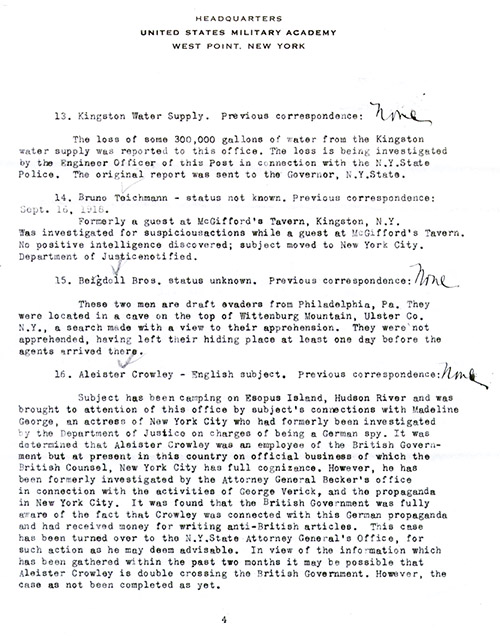
    Page of the US Army Military Intelligence Division file obtained by Prof. Richard Spence that discusses Crowley’s activities in America.

    Crowley was a controversial figure, he was a lousy businessman, he always seemed to be short of money, yet one of the things to notice is that he’s never without some money to live, and he’s never without food, and he’s never without associates. He’s not just lucky. There are people looking out for him, and some of those are his followers, and some of them I think were mysterious forces at work in that case. But he tends to get in trouble if he starts talking about these things because another rule in intelligence is that you keep your mouth shut. Basically works this way: You never say what you did for us, and we’ll never talk about what you did for us, and that’s the way the situation ought to be. The British consulate in New York is saying this guy is doing official business. What official business? If you look at Crowley’s visible activities, he’s going camping on Esopus Island, he’s up at Montauk Point, or he’s consorting with his ‘Scarlet Woman’, and seems to be doing a lot of nothing, other than travelling around, consorting with some other occultists. And yet he’s on official business from the British government. So, the mere fact that you cannot visibly see that business gives you an idea.

    CN: Interesting…

    RS: After a while you learn what to look for, and remember you’re dealing with a realm which is not intended to be obvious. None of this should be apparent to someone who is looking from the outside. That is the last thing a spy is supposed to do, to act like a spy. That defeats the entire purpose. I think people get these ideas very often from films in which spies tend to be quite obvious, but there’s always supposed to be some sort of cover to what it is that they’re doing. Anyone who is an intelligence operative in the field needs some reason to be where they are, other than the fact that they’re a spy. You have to have an excuse to be in this particular place at the time. That’s why journalist is a great cover, missionary is a great cover, explorer is a great cover, and in the same way, occultist can be a great cover. I think it even works well in this case because people say, “Aleister Crowley can’t be an intelligence asset because he’s just too weird, he’s too controversial in some way.” Well actually, in that way, it almost qualifies him for the job. “This person cannot possibly be a spy” is the very thing that qualifies them to be a spy.

    CN: Crowley wasn’t the only occultist who was alleged to have connections with intelligence. There are allegations that Jack Parsons was also connected to an intelligence agency. What do you think about Parsons?

    RS: For anyone who’s not acquainted with him,Jack Parsons is generally known for two things. Most commonly he is known as a rocket scientist. He was a kind of natural genius in the area of propulsion and explosives, and responsible for the creation, pretty much, of solid fuel rocket engines. He was one of the daddies of the American space program. That’s why he has a crater named after him on the dark side of the Moon. He was also connected to the Jet Propulsion Laboratory, GALCIT [Caltech Aerospace] – the whole background to American rocketry in the space program. But simultaneously he was a devoted practitioner of the occult, in particular as defined and refined by Aleister Crowley. The two of them, of course, were associated for a period of time. Parsons came to believe that he was Crowley’s successor. The other thing about Parsons that people would know is he’s blown up in his lab in the early 1950s. 
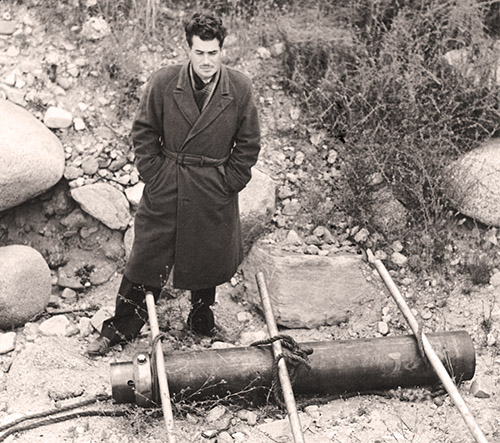
    Jack Parsons standing above a canister at the Jet Propulsion Laboratory (JPL), June 1943.   

    One of the things that began to intrigue me, and it started with Crowley, but then the more I began to look around the number of people you run across who were connected to intelligence in one form or another and had some sort of interest or connection to the occult… This isn’t just one of those things that’s an oddity. It’s almost commonplace. There is a serious overlap between the two realms, and I will admit that I’m not sure why that overlap exists. I can only tell you that it is there. You tend to find occult is all over the place.

    Consider the context of that period. You’ve got Parsons, who is connected with JPL and the aerospace industry. He has a security clearance because he’s working on classified projects, and he’s working side by side with other people who are involved in classified projects. And in his spare time he is trying to encourage these people to join him in his occult activities. Would it be insane to imagine that Jack Parsons was working for someone in an effort to compromise and recruit American scientists, or people working in classified areas of aerospace? It’s a reasonable suspicion. 

    Parson’s association with Crowley’s OTO is the thing that lost him his first security clearance. He was eventually able to get it back, which is fairly interesting, and then he lost it again. He lost it the second time – I think he was working for Hughes Aircraft – because for inexplicable reasons he decided to take home classified documents from a project he was working on, and that’s just one of those things you don’t do. Anybody in that circumstance would have been terminated from the project. I can’t see Parsons ever came up with a good explanation as to why he did that. Was it to take home for his own satisfaction? Was it with the intent to deliver them to somebody else? 

    In 1938, Jack Parsons’ testimony as an explosives expert helped convict the Los Angeles police intelligence chief, Earl Kynette, for the attempted murder of private investigator Harry Raymond. In court, Parsons reconstructed the bomb Kynette had planted, establishing his expertise in the public eye.

    Afterwards, he’s become unemployable in the aerospace field. There’s talk he’s going to Mexico to set up a fireworks factory, and the idea he had been invited by the Israeli government to come to Tel Aviv and help them develop their missile program. I’ve seen that stated, I’ve never seen anything from the Israeli end that might support it. Of course, you’re not going to get Mossad or someone to say, “Yeah we tried to recruit this guy.” Those are the type of things you don’t talk about. 

    There’s a third possibility. Are all those really blinds for the fact that what you’re going to do is go to Mexico, then pretend you’re going to Israel, but end up in Moscow? That is what I think some people on the American end were afraid of. You’ve got a guy who’s certainly a religious and social dissident… I mean Parsons had penned this thing called Manifesto of the Antichrist, in which he stated that he was opposed to all existing governments and wouldn’t submit to their authority. That makes him a problematic employee. And then you have someone who had briefly flirted with the Communist Party back in the late ‘30s, and at the JPL was associated with people who were past or present members of the Communist Party. This, by the way, was also a period, the late ‘40s and ‘50s, when a secret program known as the Venona Project was becoming increasingly aware that it was infested with Soviet agents. Lots of them. I mean the Manhattan Project was infiltrated. You have to place the whole thing with Parsons and his activity in that time frame to understand how people saw it. Their fears were not entirely irrational. They might have been wrong, but it wasn’t irrational to have those suspicions. 

    Parsons was a genius. He would have been the perfect guy to go after if I was a Soviet agent or recruiter operating in California at that time. There would be great advantage to that, and I would be very much surprised if no Soviet approached him… It’s a possibility that has to be considered.

    CN: What do you personally think happened?

    RS: His wife believed he was murdered. She believed it wasn’t an accidental explosion. I’m an agnostic on that point because while Parsons knew his way around explosives probably better than most people, maybe anybody, accidents happen. That to me would still seem to be the most likely explanation. But, it’s an interestingly timed accident, and if someone, let’s say, wanted to make sure their opponents can’t use him, well there’s only one way to be sure of that. I don’t think it’s the most likely explanation that Parsons was murdered, but again, I think it is a possibility that can’t be ruled out.

    CN: Where does British spymaster Maxwell Knight fit into things?

    RS: Maxwell Knight. Here’s another guy also involved with intelligence, and that’s what connects him to Crowley. Aside from whatever may have connected them in terms of intelligence work, they also shared a common personal interest in the occult sphere. I think that’s often important to draw people together. Knight’s a strange character. He’s a guy that starts out in the ‘20s, ostensibly as a kind of fascist. I think at one point he’s the chief of intelligence for one of the fascist organisations. By the ‘30s his organisation is infiltrating and spying on the Right in Britain. That’s one of the things he tends to be quite successful at, putting his eyes and ears inside things like the Right Club. These were essentially pro-fascist organisations in Britain that were suspected, and quite rightly in most cases, of being vehicles for German, and to some degree Italian, intelligence operations. A place where the Nazis could find fellow travellers who could be recruited for one purpose or another. 
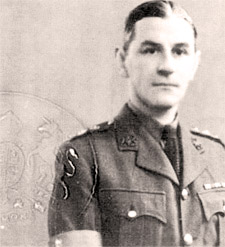
    Maxwell Knight’s official file photograph. 

    You’ve got a guy who essentially starts out apparently working for these organisations, who then a decade or so later is now spying on very similar organisations. This always brings up the fascinating point about where their true loyalties actually lie. Do they have any? 

    The codename Maxwell Knight used, or one of them, was ‘M’, and there is a connection in the ‘30s. Someone using the codename M was supplying information to the Vatican about Crowley and other people’s activities. They’re supplying it to a fellow by the name of Father Joseph who was attached to the Vatican in the late ‘30s and essentially ran a kind of minor intelligence operation that was very interested in keeping track of certain individuals and occult activities. He was very interested in Crowley and other people, and he was getting these reports from England, from a British source. There’s some discussion about who this M actually was… the first conclusion you would jump to is that it must be Maxwell Knight. Why? Because Maxwell Knight was known to use the cover name or identifier M, and it would make sense that Knight had some acquaintance through Crowley, through interest in the occult… Crowley might have been someone he was keeping track of. Maxwell Knight seemed to be the kind of logical candidate for this particular M because the connections were there. The occult connections, his involvement with intelligence, the fact that Crowley was connected to unsavoury characters, or appeared to be, on both the left and the right… So he could have been M. I’d give you a 95 percent assurance, however, that it wasn’t Maxwell Knight.

    CN: Who do you think M was?

    RS: Montague Summers. Montague Summers was also British, and a man with a fascination with the occult, but apparently from the other side. Montague Summers wrote a series of popular books on occult subjects like werewolves, vampires, and witchcraft. Montague Summers was a peculiar character. He at one point had been ordained in the Anglican church and then had been defrocked for the reasons that priests often get defrocked. He apparently had an acute interest in young boys, and that got him kicked out of the Church of England. But then he was re-ordained, if my memory serves me correctly, in one of those kind of fringe… Not the regular Roman Catholic Church, but the Old Catholic Church, one of these semi-dissident bodies that still maintains connections to Catholicism.
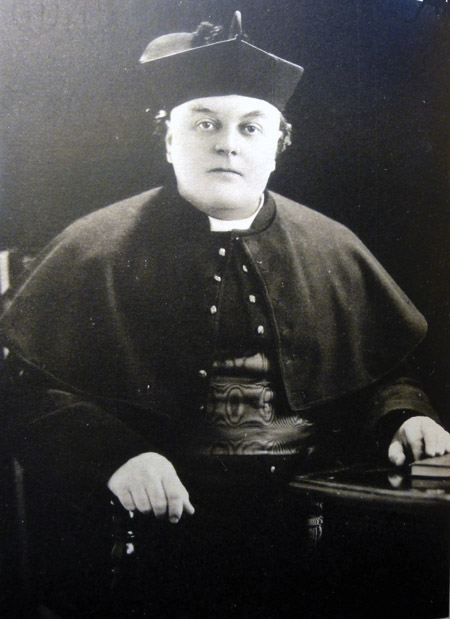
    The English author and clergyman Montague Summers (1880–1948)

    From the standpoint of Montague Summers, witches, vampires, werewolves, and that kind of thing are bad. He doesn’t see anything positive in them. But notice there’s still this common interest. His interest in the occult may be from exposing its negativity, whereas Crowley is more of a proponent in some respects of its positive aspects, but outside their stage personas they hung out together. You have people who can indeed put Montague Summers and Crowley in the same room together. They don’t seem to have been fast friends, but they would talk. There was a common bond between them, and that’s why I think Montague Summers was M.

    Here you have another occultist or someone who was immersed in it, serving another purpose. The other thing that tends to reinforce this, and I got this from a fellow who was the descendant of Montague Summers’ personal secretary: When Summers died, which was around the same time or a little after Crowley did in ‘47, the story goes that after Summers’ death some men showed up and took a bunch of his papers, and when the secretary asked, “Who are you, and why are you taking these papers?” the answer was, “We’re from the government.” That’s a little interesting anecdote.

    I think that Maxwell Knight is the most obvious candidate for M, but sometimes the most obvious answer is not the correct one. 

    [alert type=”general” dismiss=”no”]This article was published in New Dawn Special Issue Vol 13 No 3.[/alert]

    [alert type=”success” dismiss=”no”]If you appreciate this article, please consider subscribing to help maintain this website.[/alert]

    © New Dawn Magazine and the respective author.
    For our reproduction notice, click here.
  • In Search of the Lost Gospels

    In Search of the Lost Gospels

    This article was published in New Dawn Special Issue Vol 8 No 3 (June 2014)

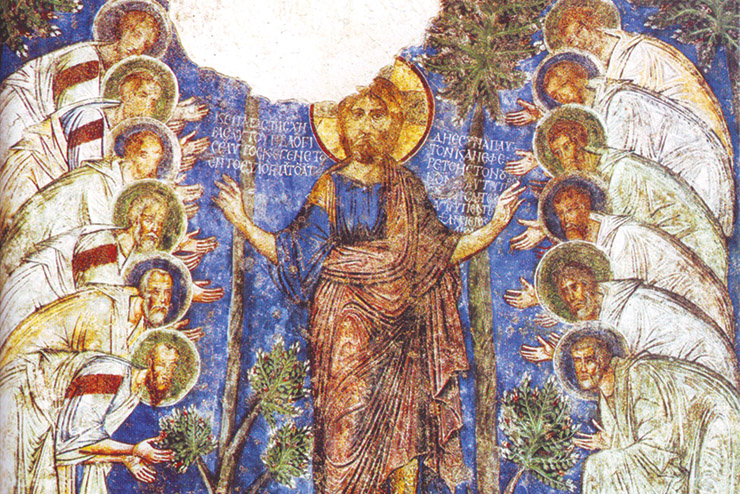
    Slowly the public has learned that the Gospels in the Bible are not the only ones that were written. Some of these other half-forgotten texts have survived in whole or in part; some have vanished, known only by their names and, perhaps, by a few quotations in the works of other writers. Of some of them we do not even know the names.

    Were these Gospels suppressed and kept secret because they contain knowledge about Jesus that the established church did not like? Do they tell us any more about the life of Jesus than do the texts in the Bible? Is there any value to them at all?

    To try to answer these questions, it may be best to start by defining just what a Gospel is. The English word is a translation (via the Latin evangelium) of the Greek word euaggelion (euangelion), meaning “good message” or “good news.” The original word in Old English, godspell, or “good tale,” had much the same meaning.

    Thus a Gospel is an attempt to convey the “good news” about Jesus Christ. It presents his teachings and as much of his life as is relevant to those teachings. It is not a biography. The genre of biography was known in the ancient world, but the Gospels do not try to fit into it. Hence we know very little about the life of Jesus apart from his public ministry.

    The Gospels all share another striking feature. None of them – or, for that matter, any of the texts in the Bible – were written by anyone that knew Jesus personally. Nor do they claim to be. The Gospel of John has a curious statement at the end: “This is the beloved disciple which testifieth of these things, and wrote these things; and we know that his testimony is true” (John 21:24). This verse seems to start by saying that this Gospel was written by Jesus’s mysterious “beloved disciple” (usually identified with John), but then it says, “we know that his testimony is true.” No one who had been an eyewitness to Jesus’s life, or who had written the text himself, would have any reason to say this. The other Gospels are even more elusive about their connection to their subject. They were written by people who knew of Jesus only at second or third hand. It’s useful to remember this fact when looking at Gospels of any kind.

    In order to piece through the enormous amount of scholarship that the Gospels have inspired, we might start with some basic hypotheses that are accepted by most reputable (i.e., non-fundamentalist) scholars, although they are little known to the public.

    Marcan & Q Hypotheses

    The first is the Marcan hypothesis. This refers to the idea that Mark was the first of the New Testament Gospels to be written (one widely accepted date is c.70 CE). By intense textual analysis carried out over many decades, scholars have shown that Matthew and Luke are familiar with Mark and base their works on his, rather than the other way around. Because of their similarities, these three are called the synoptic Gospels. While they differ in important ways, their stories more or less parallel one another. The last, John, differs in many more ways from these three than they do from one another.

    The second is the Q hypothesis. Q, taken from the German Quelle, meaning “source,” is a document, now lost, that most scholars believe was used as source material by both Matthew and Luke – meaning they share elements with each other that they don’t share with Mark (including the Lord’s Prayer, the Golden Rule, and a number of the parables). Q did not have a narrative; it did not tell a story. Instead, it appears to have been a simple collection of Jesus’s sayings. 

    If this is true, it is very strange. What would have almost certainly been the first Gospel has been lost. Even its name has been forgotten; the nickname “Q” is just a scholarly appellation. Did this work contain material that the later church tried to suppress? Or was it lost simply because everything in it was duplicated in Matthew and Luke? We simply don’t know.

    Notice one other fact about this widely accepted theory. It holds that the earliest writings about Jesus were one, possibly more, collections of his sayings. They did not contain any narrative whatsoever.

    The Gospel of Thomas

    This fact is extremely interesting to consider in light of the most important and exciting of all the secret and suppressed Gospels: the Gospel of Thomas (not to be confused with another surviving Gospel of Thomas, which deals only with Jesus’s infancy). Until the mid-twentieth century it was known only by name and from a few scattered fragments of the Greek original. But in 1945, a cache of texts was discovered in Egypt. They have become known as the Nag Hammadi scriptures, and they contain a complete copy of the Gospel of Thomas, translated from the original Greek into Coptic.

    The Gospel of Thomas strikingly resembles the early lost collections of Jesus’s sayings that scholars had posited. It has no narrative. There is no nativity, no crucifixion or resurrection story. It is simply a collection of Jesus’s utterances, some of them familiar from the other Gospels, others previously unknown (“Cleave a [piece of] wood, and I am there. Raise up a stone, and you will find me there.” Note: bracketed and parenthetical material in this and other quotations have been inserted by the translators).

    Many of the sayings in Thomas resonate with the teachings of the so-called heresy of Gnosticism. Like the Gnostics, the Gospel displays a deep contempt for the world – “He who has known the world has found only a corpse” – and an emphasis on gnosis or spiritual awakening: “He who knows the all, (but) fails (to know) himself, misses everything.” 

    It is difficult to fit this Gospel into what was hitherto believed about early Christianity. The usual claim is that Gnosticism did not arise until the second century CE and that all Gnostic texts date from that time or later. But Thomas does not resemble these other works in some crucial respects – for example, it does not show any familiarity with the synoptic Gospels or any other Christian writings, so it cannot be proved to be later than these. As the scholar Beate Blatz concludes, “This collection is to be regarded as a phenomenon parallel to Q, and belongs to the early history of the formation of the Gospels.”

    Parallel to Q? But Q is usually dated to around 40-50 CE, very soon after Jesus’s lifetime. If the Gospel goes back that far, then Gnosticism in some form must go back that far as well. This fact poses problems for the old-fashioned view that the apostles all held to the same teaching, which would later be christened the “apostolic faith.” Rather it suggests that Jesus’s own disciples understood his teachings in very different ways right from the outset, and that these differences would give rise to what were later described as heresies – including Gnosticism – as well as to proto-catholicism.

    What about gnosis? Did the apostle Thomas make this up? Was he distorting the teachings of Jesus? Or did Jesus instruct individual disciples differently according to their interests and capacities? The Gospel of Thomas alludes to this possibility: “And he [Jesus] took him [Thomas], withdrew, (and) spoke to him three words. Now when Thomas came (back) to his companions, they asked him: What did Jesus say to you? Thomas said to them: If I tell you one of the words which he said to me, you will take up stones (and) throw them at me; and a fire will come out of your mouth and burn you up.”

    It may be the case, then, that the disciple Thomas understood or wanted to understand Jesus’s teaching in a deeper, more mystical way, and that Jesus taught him accordingly. Since the Gospel of Thomas is (for various reasons) thought to have been written in Syria, where the apostle was held in particularly high esteem, we may guess that soon after Jesus’s death Thomas found his way to Syria and started an esoteric school (or church, if you like) emphasising gnosis. Another tradition has Thomas going to India and starting churches there, some of which survive to this day; a cathedral in Chennai claims to have been built over his tomb. We could thus posit that Thomas went first to Syria and then to India, where he died.

    [alert type=”success” dismiss=”no”]If you appreciate this article, please consider subscribing to help maintain this website.[/alert]

    Other Secret Gospels

    I’ve dwelt at length on the Gospel of Thomas because it alone, of all the secret and suppressed Gospels, could be as old or older than the ones in the New Testament. But it is far from the only other Gospel that survived. Someone who peruses the New Testament apocrypha (meaning quasi-scriptural works that were excluded from the final canon) will find a wild farrago of texts: Gospels allegedly by each of the twelve Apostles (even a recently discovered Gospel of Judas); Gospels ascribed to female disciples (such as the Gospel of Mary); a Gospel of Nicodemus, which is mostly about Pontius Pilate; even a Gospel of Eve, whose only certain surviving fragment reads: “I stood upon a high mountain and saw a tall man, and another of short stature, and heard as it were a sound of thunder and went nearer in order to hear. Then he spoke to me and said, I am thou and thou art I, and where thou art there am I, and I am sown in all things; and whence thou wilt, thou gatherest me, but when thou gatherest me, then gatherest thou thyself.” The mystical nature of this passage – with motifs such as “I am thou and thou art I” – suggests a Gnostic context for this mostly forgotten Gospel of Eve.

    Except for Thomas, all the apocryphal Gospels are acknowledged to be later than, and often based on, the four that made their way into the Bible. Some were accepted as scripture by various faith communities, some never commanded much allegiance. Many of them are known only through quotations (often contemptuous) in the works of the early church fathers.

    But it would be mistaken to believe that the apocryphal Gospels did not leave their mark on Christianity. To begin with, they left a deep mark on Christian art and iconography. To take perhaps the best-known example, one of the most charming details of the nativity story is the adoration of the infant Christ by the ox and the ass. This detail does not appear in any of the four canonical Gospels. It was inspired by a passage in a second-century text called the Protevangelium (“first Gospel”) of James, which describes not only the birth of Jesus but the birth and childhood of Mary. The first direct reference to this motif appears in an early medieval compilation of infancy stories, known as the Gospel of Pseudo-Matthew: “On the third day after the birth of our Lord Jesus Christ holy Mary went out from the cave, and went into the stable and put her child in a manger, and an ox and an ass worshipped him.” This detail has been reproduced in countless depictions of the nativity of Christ down to this day.

    Other major issues with these suppressed Gospels cannot be covered here. Some of the most difficult are connected with various Gospels written in Aramaic and used in the early Jewish-Christian communities. (None of these have survived in their original language.) It is not clear even how many of these Gospels there were – the church fathers often seem to know them only by hearsay – and they have been preserved only in quotations. But their existence attests to the fact that in the earliest days of Christianity, there was a wide overlap between Christians and Jews, and they were not always easily distinguished. There have been Jews for Jesus from the very beginning.

    How the New Testament Came To be

    All this granted, how were the canonical Gospels selected? This subject has attracted an astonishing amount of misinformation, reproduced by such authors as the actress Shirley MacLaine in her New Age-inspired books, and in Dan Brown’s The Da Vinci Code, in which one of his characters asserts, “The Bible, as we know it today, was collated by the pagan Roman emperor Constantine the Great.”

    This statement is false. Constantine the Great, who reigned from 306 to 337 CE, is best known for issuing an edict of tolerance for Christianity in 313. He also convened the Council of Nicaea in 325 to enable the squabbling bishops to decide once and for all whether Jesus was coequal with God the Father or merely another of his creations (they decided that the Father and the Son were equal). Constantine converted to Christianity soon before his death. But he had nothing to do with the creation of the biblical canon.

    The canon of the Hebrew Bible, or Old Testament, was more or less established by the Jews by the end of the first century CE. The New Testament canon was created by, and grew up organically with, what later came to be known as the Catholic Church. Fundamentalist Protestants thus are wrong when they say the church was based on the Bible: the two came together and are inextricably intertwined.

    In the first century, when most of the New Testament texts were written, there was no established canon of Christian scripture. Many Christian communities had only one of the Gospels, or none, relying instead on oral tradition. Only during the second century did certain texts come to be accepted as scripture. These included the epistles of Paul (not all of which were actually written by him) as well as a collection of Gospels that came more and more to be narrowed down to the three synoptic Gospels, which were, as the church acknowledged, among the oldest and the most authentic. The Gospel of John was written later than the synoptics. It is dated between 80 and 110 CE, whereas the composition of Matthew, Mark, and Luke is generally placed between 60 and 95. John also came to be accepted later, partly because it differed so much from the other three.

    One of the first church fathers to insist upon the canonicity of the four Gospels was Irenaeus of Lyons (c.130-c.200), whose work Against the Heresies also gives a detailed, though vitriolic, account of the Gnostics. In this text Irenaeus writes: “The Gospels could not possibly be either more or less in number than they are. Since there are four zones of the world in which we live, and four principal winds, while the Church is spread over all the earth, and the pillar and foundation of the Church is the gospel, and the Spirit of life, it fittingly has four pillars, everywhere breathing out incorruption and revivifying men.”

    It would be hard to overemphasise Irenaeus’s importance on the development of the Catholic Church; he is sometimes regarded as its first real theologian. His delineation of four canonical Gospels – no more, no less – would eventually be accepted as authoritative, although the process of acceptance was long and spanned two centuries.

    The first complete list of the twenty-seven New Testament books as we have them now appears in an Easter letter from Athanasius, bishop of Alexandria, in 367. “These are the springs of salvation,” Athanasius wrote, “in order that he who is thirsty may refresh himself with the words contained therein. Let no one add anything to them or take anything away from them.”

    Note that this letter was written by Athanasius. It was he who led the victorious party at the Council of Nicaea in 325, when Christ was proclaimed as equal to God the Father. This is the only real connection that the Council of Nicaea has to the New Testament canon, and it is an extremely thin one. Contrary to what some have said, the Council of Nicaea did not throw many texts out of the canon (it did not deal with this subject at all), nor did it mention or condemn the doctrine of reincarnation, as it is sometimes also said to have done. Reincarnation has, contrary to the beliefs of many, never been a significant doctrine in mainstream Christianity.

    Athanasius’s letter may have some connection with the Nag Hammadi texts, which, as we have seen, were found in Egypt, where Athanasius had his diocese. Although he wanted the heretical texts to be burned, it is possible that a Christian community defied him by burying them instead. If so, then we ironically have Athanasius to thank for the preservation of these scriptures.

    Controversial Passages

    Now that we have some idea of these despised Gospels and how they came to be cast out, it’s time to ask what we can learn from them. Do they tell us anything about the historical Jesus? No: they are all much later than the Gospels in the Bible, except for Thomas, and Thomas has practically no biographical information about Jesus. The rest of these Gospels are much later, dating to between the second and fourth centuries. They may represent some genuine snatches of truth here and there, but at this point there is no way of telling which snatches those might be. The value of these Gospels lies chiefly in what they tell us different Christian sects and schisms believed.

    To take one example, let’s turn to the Gnostic Gospel of Philip, dated to the second or third century. It includes this tantalising passage: “The S[aviour] loved [Ma]ry Mag[da]lene more than [all] the disciples, and kissed on her [mouth] often. The other [disciples]… said to him: ‘Why do you love her more than all of us?’ The Saviour answered and said to them []: ‘Why do I not love you like her?’”

    This passage, along with some legends that have long circulated orally, led some to claim that Jesus had some kind of sexual or romantic relationship with Mary Magdalene. Some even argue that she was his wife, a theory reinforced by a newly discovered papyrus fragment, of disputed authenticity but probably dating to eighth-century Egypt. This fragment has the words “Jesus said to his wife…” The text breaks off, so we don’t know who his wife was supposed to have been or what he is supposed to have said. 

    By all accounts, both this papyrus fragment, recently dubbed “The Gospel of Jesus’s Wife,” even if it is genuine, and the Gospel of Philip date to much later than the time of Christ. What does this mean? While this evidence suggests there was some belief that Jesus had a wife, who could have been Mary Magdalene, we cannot go further and say he actually did. The evidence shows nothing more than there was a later tradition to this effect. It could be handing down an authentic piece of fact, but the best we can say is that we simply don’t know. We could say much the same thing about practically everything we learn about Jesus from the apocryphal Gospels.

    The quest for the historical Jesus – the obsession of theologians for some two hundred years – remains unfulfilled. Apart from the Gospels in the Bible and the Gospel of Thomas, there is little contemporary evidence about him. One of very few references that are even remotely contemporary appears in the Antiquities of the Jews by the first-century Jewish historian Flavius Josephus, and it is not about Jesus, but about his brother James. Actually it is about one Ananus, the high priest of Jerusalem in 62 CE, who, we learn, “called the Sanhedrin to judgment and brought before it the brother of Jesus the so-called Christ, James by name, and some others, and accusing them of transgression of the law had them stoned.”

    Another passage in Josephus, the so-called Testamentum Flavianum, also mentions Jesus. It goes as follows:

    At that time lived Jesus, a wise man, if indeed may one call him a man. For he was a doer of incredible deeds and a teacher of men, who with joy received the truth. And he attracted many Jews, and also many of the Greek sort. This was the Christ. And although Pilate at the insistence of our leading men punished him with crucifixion, those who loved him at first did not cease loving him. For he appeared to them on the third day living again, as the divine prophets had prophesied this and a thousand other wonderful things about him. And even to this day the tribe of the Christians which is named after him has not vanished away.

    Few scholars take this passage at face value. Some see it as the work of a later Christian apologist who inserted it into Josephus’s text. But most scholars believe that Josephus actually wrote some parts of this passage, although they by no means agree about which parts those are. Some look very much like interpolations (“This was the Christ”); others may belong to Josephus’s original.

    These passages, along with the four canonical Gospels, Thomas, and other parts of the New Testament (notably Paul’s epistles), constitute the sum total of the surviving material that was written about Jesus in the first century CE. While it would be excessive (as some have done) to conclude from this that Jesus was a fictional creation based on motifs of dying and resurrected gods, the evidence about him remains skeletal. It is even more so if – to reveal another scholarly secret that has not really made its way to the public – we concede that even the earliest Gospels contain some admixture of fact and legend. (Scholars for the most part agree about this point, but they differ wildly about how much is myth and how much is legend.)

    To sum up, someone approaching the secret and suppressed Gospels for knowledge about who Jesus was and what he did will probably go away disappointed. These texts are valuable more for what they say about early Christianity than for what they say about Christ. Others, however, going to these Gospels – particularly the Gnostic texts – for inspiration and illumination about the spiritual path may be better rewarded. As the Gospel of Thomas says, “He who seeks, let him not cease seeking until he finds; and when he finds he will be troubled, and when he is troubled, he will be amazed, and he will rule over the All.” 

    Quotations from the New Testament apocrypha and from Josephus have been taken from Wilhelm Schneemelcher, ed., The New Testament Apocrypha, volume 1, translated by R.McL. Wilson, Cambridge, UK: James Clarke, 1991.

    [alert type=”general” dismiss=”no”]This article was published in New Dawn Special Issue Vol 8 No 3.[/alert]

    [alert type=”success” dismiss=”no”]If you appreciate this article, please consider subscribing to help maintain this website.[/alert]

    © New Dawn Magazine and the respective author.
    For our reproduction notice, click here.

  • The Secret World of Pamela Travers

    The Secret World of Pamela Travers

    This article was published in New Dawn 170 (Sept-Oct 2018)

    The masterfully told stories of a magical nanny that held adults and children alike spellbound for decades might incline readers to think that Australian author Pamela (P.L.) Travers merely had an over-active imagination. The truth is that her talent blossomed out of a fertile garden of occult teachings and paranormal experiences, nurtured and inspired by some real-life, exceptionally gifted personalities. 

    The movie Saving Mr Banks and the documentary The Real Mary Poppins treated the public to insights into her relationship with her father, the influence of the Auntie she called Sass, and her tumultuous association with Walt Disney. Of equal gravity was her lifelong attraction to mystical pursuits and the guidance of the philosopher and mystic George (G.I.) Gurdjieff.

    Travers was born in Maryborough, Queensland, as Helen Lyndon Goff in 1899. Her father, Travers Robert Goff, whom she adored, moved the family to the small community of Allora on the Darling Downs in 1905, where he died of tuberculosis at the age of 43. It was then that Christina Saraset, or Aunt Sass as she liked to be called, came on the scene to help out, and Pamela and her family moved once again, this time to Bowral in New South Wales. 

    It is now common knowledge that the character of Mr Banks in her novels was based on her father, Travers Goff, while Aunt Sass, who ‘flew in from the east’, would serve as the model for Mary Poppins herself, who famously blew in from the east with her parrot umbrella and magical carpetbag. The real-life Aunt Sass was a strong, no-nonsense presence in her niece’s life, as well as her work. Travers described her as a “bulldog with a ferocious exterior” but with a “heart tender to the point of sentimentality.”

    Pamela Travers has been described by some observers as “mysterious and prickly,” and one could form the opinion, based on Emma Thompson’s portrayal of her – as praiseworthy as it was from an artistic point of view – that the writer was full of herself, close-minded and perhaps even emotionally cold. And this notion might be further reinforced by the fact that she never married, bore children of her own or formed a family unit in the conventional sense. Yet such an impression would be completely false.

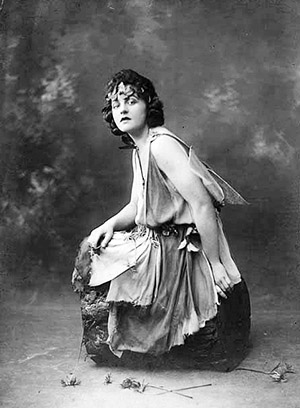
    P.L. Travers in the role of Titania in a production of A Midsummer Night’s Dream, c. 1924

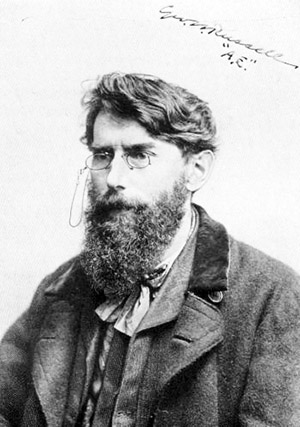
    As a young woman Helen Goff was an actress, dancer and a poet before turning her hand to journalism. She toured Australia and New Zealand as a member of Allan Wilkie’s Shakespearean Company, adopting the stage name Pamela Lyndon Travers. At the age of twenty-four she travelled to Ireland, where the Irish poet and mystic George (A.E.) Russell became her mentor. As editor of the Irish Statesman, Russell, whose kindness towards younger writers was legendary, initially accepted some of her poems for publication. From 1925 onward she was introduced to Theosophical thought and literary figures familiar with the Theosophical Society, including T.S. Eliot, Oliver St. John Gogarty and William Butler Yeats, the latter being one of the leaders of the Golden Dawn.

    Gurdjieff, Mysticism & Spirituality

    Travers studied the Gurdjieff system under Jane Heap, and in March 1936, with the help of Jessie Orage (widow of The New Age editor Alfred Richard Orage), she met the mystic George Gurdjieff, who in turn introduced her to the paths of Sufism and Zen. He encouraged her to explore Eastern religion and, during her thirties and forties, she delved into Buddhism, later gravitating to Jiddu Krishnamurti.

    The successful writer travelled to New York City during World War II while working for the British Ministry of Information. At the invitation of her friend, the US Commissioner of Indian Affairs, John Collier, Travers spent two summers living among the Navajo, Hopi and Pueblo Indians, studying their mythology and folklore.1 Episodes such as these reveal something of Pamela Travers’ true character and her perpetual thirst for occult knowledge. She had no qualms about lodging at a reservation and formed a close bond with the Navajo people in Arizona who did the honour of bestowing an Indian name on her, although it was one that she always kept secret.2 After the war, she remained in the USA and became Writer-in-Residence at Radcliffe College and Smith College, Massachusetts. 

    Journalist and critic Jerry Griswold, in an essay tribute to Pamela Travers after her death, asserted that she had “lived for several years” with the Navajos and, during another period, had “studied for several years” in Kyoto under a Zen master,3 although in his recollections he probably exaggerated the time spans somewhat. After her American sojourn, she returned to England, making only one brief visit to Sydney in 1960 while on her way to Japan to study Zen mysticism.

    Jiddu Krishnamurti, c. 1920s

    Arcane Influences & Didactic Writings

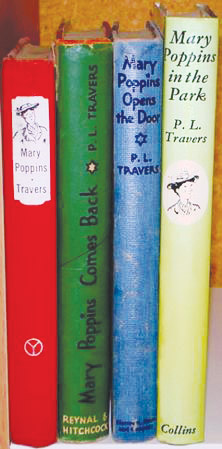
    The question arises as to what degree the writings of Pamela Travers were influenced, guided or even manipulated by her spiritual masters? She met George Gurdjieff some years after the first edition of Mary Poppins had been published (in 1934), followed by the equally well-received Mary Poppins Comes Back (1935). Any direct influence by Gurdjieff is more likely to be found in the later Mary Poppins books, particularly Mary Poppins Opens the Door (1944) and Mary Poppins in the Park (1952).

    In 1970 Pamela Travers authored a contribution on Gurdjieff for Richard Cavendish’s encyclopedia Man, Myth & Magic (see page 48), then went on to publish an insightful ten-page booklet George Ivanovich Gurdjieff three years later. In that tract she reflects on the various traditions that were woven into Gurdjieff’s work and, by extension, her own thought and philosophy: 

    What was the source of his teaching? True to his role, Gurdjieff never openly disclosed it. By examining his writings and the numerous commentaries upon them it might be possible to discover parallels in various traditions: Tantric Buddhism, Hinduism, Sufism, Greek Orthodoxy – possible, but hardly profitable. For the fundamental features of his method cannot be traced to any one source. Ouspensky quotes him as admitting, I will say that, if you like, this is esoteric Christianity. There seems no reason to reject this when one remembers that Christianity, as Gurdjieff knew it, was the heir of the ages and must have drawn to itself elements from very early pre-Christian traditions, Hittite, Assyrian, Phrygian, Persian; and there is nothing so explosive as old ideas restated in contemporary terms as the Western world was to discover when Gurdjieff burst upon it.4

    In the same publication she lists several celebrated editors and writers of the day who socialised with Gurdjieff:

    Great feasts where, under the influence of good food, vodka and the watchful eye of the Master, opportunities were provided, for those who had the courage, to come face to face with themselves. The hardiest among them, those who could rise to the level of being serious, were allowed to transmit something of the teaching to newer pupils.5

    This issue of the transmission of the teachings poses the further question as to whether the novels penned by Travers carried veiled arcane messages intended only for the more astute, esoterically inclined among her audience. We should, nevertheless, resist the temptation to read too much of Gurdjieff into the Mary Poppins’ stories. In an interview which appeared in the Paris Review in 1982, the interviewers asked Travers whether “Mary Poppins’ teaching – if one can call it that – resemble that of Christ in his parables.”6 Travers replied: “My Zen master, because I’ve studied Zen for a long time, told me that every one (and all the stories weren’t written then) of the Mary Poppins stories is in essence a Zen story. And someone else, who is a bit of a Don Juan, told me that every one of the stories is a moment of tremendous sexual passion, because it begins with such tension and then it is reconciled and resolved in a way that is gloriously sensual.” The answer is clarified by the following question (posed by the interviewer): “So people can read anything and everything into the stories?” Travers’ response: “Indeed.”

    In Man, Myth & Magic, Pamela Travers wanted to make it clear that the work of her Master in no way constituted Black Magic. She wrote: 

    It is clear from Gurdjieff’s writings that hypnotism, mesmerism and various arcane methods of expanding consciousness must have played a large part in the studies of the Seekers of Truth. None of these processes, however, is to be thought of as having any bearing on what is called Black Magic, which, according to Gurdjieff, “has always one definite characteristic. It is the tendency to use people for some, even the best of aims, without their knowledge and understanding, either by producing in them faith and infatuation or by acting upon them through fear. There is, in fact, neither red, green nor yellow magic. There is ‘doing’. Only ‘doing’ is magic.” Properly to realise the scale of what Gurdjieff meant by magic, one has to remember his continually repeated aphorism, “Only he who can be can do,” and its corollary that, without “being” nothing is “done,” things simply “happen.”7

    Travers insisted that the Mary Poppins stories had not come from herself but that there are “ideas floating around that pick on certain people.” She believed that her books were gifts of God, “given” to her, and quoted C. S. Lewis saying, “There is only one Creator, we merely mix the ingredients He gives us.”8 She declared that she was not a creator, simply a vessel, and never wrote specifically for children but was “grateful that children have included my books in their treasure trove.”

    [alert type=”success” dismiss=”no”]If you appreciate this article, please consider subscribing to help maintain this website.[/alert]

    What the Bee Knows

    The Irish poet and mystic George (A.E.) Russell.

    In addition to her well-known collection of novels, Pamela Travers wrote numerous non-fiction essays and books, especially in her later years. What The Bee Knows is a collection of spiritual essays. The back of the book describes it as “a honeycomb of essays pointing to the truth-of-things handed down in the great popular stories of cultures around the world.” And that is just what it is, a labyrinth of brief dissertations covering a range of esoteric, myth-based and biographical themes. She shares tales of her friendships with literary figures such as W.B. Yeats and A.E. Russell, of her studies among many religions of the world, of her early experience with fairy tale and folklore which shaped her character.

    The Sphinx, the Pyramids, the stone temples are, all of them, ultimately, as flimsy as London Bridge; our cities but tents set up in the cosmos. We pass. But What The Bee Knows, the wisdom that sustains our passing life – however much we deny or ignore it – that for ever remains.9

    Why did Pamela Travers choose the Bee as her metaphor? She wrote: 

    I thought of Kerenyi – “Mythology occupies a higher position in the bios, the Existence, of a people in which it is still alive than poetry, storytelling or any other art.” And of Malinowski – “Myth is not merely a story told, but a reality lived.” And, along with those, the word “Pollen,” the most pervasive substance in the world, kept knocking at my ear. Or rather, not knocking, but humming. What hums? What buzzes? What travels the world? Suddenly I found what I sought. “What the bee knows,” I told myself. “That is what I’m after.”

    But even as I patted my back, I found myself cursing, and not for the first time, the artful trickiness of words, their capriciousness, their lack of conscience. Betray them and they will betray you. Be true to them and, without compunction, they will also betray you, foxily turning all the tables, thumbing syntactical noses. For – note bene! – if you speak or write about What The Bee Knows, what the listener, or the reader, will get – indeed, cannot help but get – is Myth, Symbol, and Tradition! You see the paradox? The words, by their very perfidy – which is also their honourable intention – have brought us to where we need to be. For, to stand in the presence of paradox, to be spiked on the horns of dilemma, between what is small and what is great, microcosm and macrocosm, or, if you like, the two ends of the stick, is the only posture we can assume in front of this ancient knowledge – one could even say everlasting knowledge.”10

    An Esoteric and Occult Bequest

    Toward the end of her life Travers became increasingly interested in Sufism, a form of Islamic mysticism, particularly the Persian branch of it, through meetings with members of the fraternity and their publications in Britain. We can assume that she continued her search for life’s meaning among the world’s mystical and spiritual traditions right until the end. Perhaps she never felt she had reached the ultimate aim of Gurdjieff’s Work or ‘Fourth Way’, which held the goal of shattering one’s pretensions and ego, the stripping away of the personality and awakening to a higher consciousness.

    It is no secret that the great success of author J.K. Rowling with that other fictional champion of magic in book and film, Harry Potter, owes something to Pamela Travers. Rowling was an admirer of Travers and adopted both her enigmatic disguise in initialling her first names and also her theme of flight, just as Travers had herself been inspired by J.M. Barrie’s ‘Peter Pan’. Rowling now ranks highly in the tradition of authors of youth fantasy classics, joining C.S. Lewis, J.R.R. Tolkien, J.M. Barrie and, of course, P.L. Travers. She also borrowed the name when she created the character of the Death-Eater wizard called Travers in her novels, portrayed by actor Tav MacDougall in the film adaptation of Harry Potter and the Order of the Phoenix.

    In 1977 Pamela Travers was made an Officer of the Order of the British Empire and in 1978 received an honorary degree from Chatham College, Pittsburgh, USA. She would spend the final years of her life in London’s Chelsea district, dying from the effects of an epileptic seizure, on 23 April 1996 at the age of ninety-six. What she contributed to literature is now legendary. What she bequeathed us in the way of mystical knowledge ought not be underestimated either. Her lifelong pursuit of spiritual wisdom significantly enriched the storehouse of esoteric teachings available to all those she called the ‘Seekers of Truth’.

    [alert type=”general” dismiss=”no”]This article was published in New Dawn 170.[/alert]

    [alert type=”success” dismiss=”no”]If you appreciate this article, please consider subscribing to help maintain this website.[/alert]

    Footnotes

    1. https://en.wikipedia.org/wiki/P._L._Travers
    2. www.biography.com/people/pl-travers-21358293
    3. Revealing Herself to Herself: REMEMBRANCES by Jerry Griswold, Los Angeles Times, 16 June 1996
    4. www.gurdjieff.org/travers1.htm
    5. Ibid.
    6. As quoted by Massimo Introvigne at: www.academia.edu/29792559/Mary_Poppins_goes_to_Hell_Pamela_Travers_Gurdjieff_and_the_Rhetorics_of_Fundamentalism
    7. “Gurdjieff” in Man, Myth and Magic: Encyclopedia of the Supernatural (1970)
    8. www.independent.co.uk/news/people/obituary-p-l-travers-1306698.html
    9. What the Bee Knows: Reflections on Myth, Symbol, and Story by P.L. Travers (1989)
    10. “What the Bee Knows” in Parabola: The Magazine of Myth and Tradition, Vol. VI, No. 1 (February 1981); later published in What the Bee Knows: Reflections on Myth, Symbol, and Story (1989)

    © New Dawn Magazine and the respective author.
    For our reproduction notice, click here.
  • Nicholas Roerich & the Sacred Union of the East

    Nicholas Roerich & the Sacred Union of the East

    New Dawn Special Issue Vol 8 No 3

    “The East has said that when the Banner of Shambhala encircles the world, verily the New Dawn will follow.”
    – Nicholas Roerich

    Late in the summer of 1934, a peculiar sage-looking European appeared in Manchuria and then proceeded to Chinese Mongolia. Plump with a round face and a short neatly trimmed beard, this strange man moved around like a high dignitary and spoke English with a heavy Slavic accent. He announced to local officials that he was on a special mission sent by the United States Department of Agriculture to collect drought-resistant plants. Yet, the behaviour of this “botanist” (who in reality was a painter) raised the eyebrows of Japanese intelligence – the entire north-eastern portion of China was occupied by Japan in 1931. 

    The head of the botanical expedition was not so interested in herbs. Rather he became involved in exploring the political situation and in studying local religious prophecies. He was especially concerned with a Buddhist prophecy called Shambhala. Very popular in the Mongol-Tibetan world, Shambhala was viewed as a legendary land of spiritual bliss – a Tibetan Buddhist paradise – that the faithful believed would arrive after a world-wide battle between the forces of light, the proponents of the “true” Buddhist faith, and the forces of darkness (lalo), the people of alien beliefs. The legend, which emerged in the early Middle Ages when Buddhists had to fight Muslim advances into northern India, eventually became a potent spiritual force in the Tibetan-Mongol world. The name of the man who tried to step into the world of this prophecy was Nicholas Roerich, a Russian émigré painter from New York City. The person who commissioned him to embark on this strange expedition was Henry Wallace, then President Franklin Delano Roosevelt’s secretary of agriculture and subsequently his vice president.

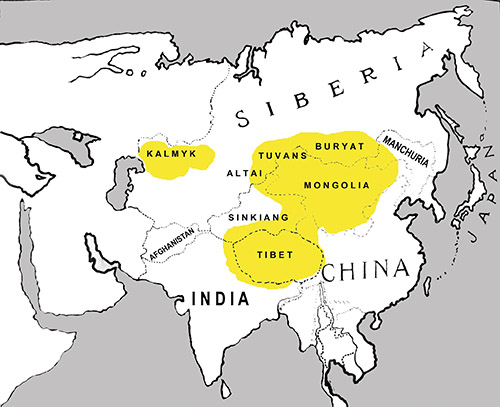
    Recent research into this and Roerich’s other Asian ventures in the 1920s and the 1930s1uncovered that his ultimate plan was to establish what he called the Sacred Union of the East, uniting the people of the Mongol-Tibetan world and Siberia. Shambhala and related Inner Asia prophecies would be used to rally the people in all these areas. Roerich contemplated the Sacred Union of the East as an ideal state with cooperatives as its economic foundation and with a universal religion based on reformed Tibetan Buddhism and his version of Theosophy. In his correspondence and in the circle of his acolytes this project was also referred to as ‘Kansas’, the ‘New Country’, or simply as the ‘Great Plan’. 

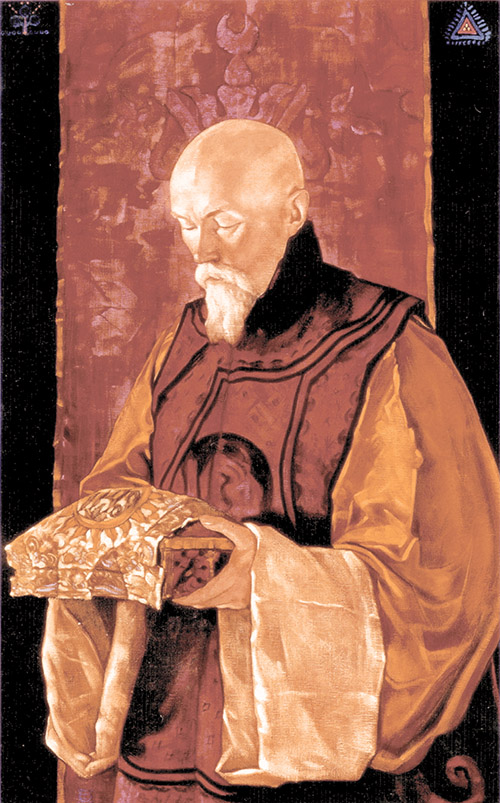
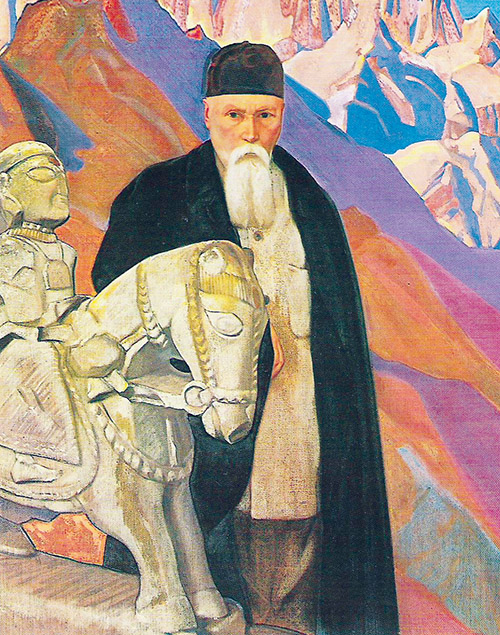
    Portrait of Nicholas Roerich holding a chest with the sacred Chintamani stone.

    It appears the Shambhala prophecy caught Roerich’s attention as early as 1909 when a group of Tibetan Buddhists living in Russia and headed by Agvan Dorzhiev, a Buryat Buddhist monk and the envoy of the Dalai Lama to the Russian court, received Tsar Nicholas II’s blessing to erect a Tibetan Buddhist Kalachakra temple in St Petersburg. Roerich, who helped to design stained glasses for the temple, became fascinated with Dorzhiev’s stories about Shambhala. No less captivating was the Buryat lama’s dream of bringing all Tibetan Buddhist people together in a united state under the protection of the Russian tsar, whom Dorzhiev declared a reincarnation of the Shambhala king.2 The knowledge received from the learned lama sank deeply in Roerich’s mind, and the painter eventually came to the conclusion that, along with his wife Helena, he was destined to bring the knowledge of the legendary kingdom to humankind. 

    Simultaneously, Nicholas and Helena Roerich read Helena Blavatsky’s works, frequented occult and Spiritualist salons, and finally set up their own offshoot of Theosophy – Agni Yoga (Fire Yoga). A year before the 1917 Bolshevik Revolution, they left Russia for Europe and eventually settled in the United States, where they acquired a number of loyal followers. By the early 1920s Nicholas and Helena came to believe that the Great White Brotherhood, the hidden masters of Shambhala, acting through their virtual teacher Master Morya, chose them to speed up human spiritual evolution by establishing a great Buddhist theocracy in the heart of Asia.3

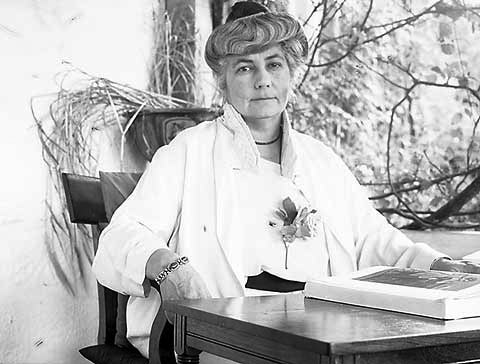
    Helena Ivanovna Roerich (1879-1955) was in her own right an accomplished philosopher, writer and public figure. She created, in cooperation with Teachers of the East, a philosophic teaching of living ethics called Agni Yoga.

    Between 1924 and 1928, they had already made a first abortive attempt to use the Shambhala prophecy to jump-start the Sacred Union of the East by trying to penetrate Tibet and dislodge the 13th Dalai Lama by using the conflict between His Holiness and the Panchen Lama, the spiritual leader of Tibet. In pursuit of their goal of the Sacred Union of the East, they attempted to solicit the support of Red Russia, which at that time was interested in spreading the gospel of communism to Asia. Nicholas and Helena journeyed to Moscow, where they met several Bolshevik dignitaries, including foreign intelligence chief Meer Trilisser, and commissar for foreign affairs, Georgy Chicherin, who promised some logistic support to the Roerich’s expedition in exchange for gathering information about Tibet. But they refused to give direct back-up.4 Despite this, with a group of friends and relatives, Roerich boldly ventured to Tibet, where he was blocked by the Dalai Lama and a local British spy master, Colonel Frederick Bailey. Bailey was worried about the throngs of Red pilgrims pouring into the forbidden kingdom from Red Mongolia. Roerich, whose expedition was held up for several months in freezing mountain weather, promptly denounced the Lhasa ruler as the “Yellow Pope” who betrayed the noble truth of original Buddhism and indulged instead into dark shamanic superstitions.5 

    Cultivating Henry Wallace

    The stubborn Roerichs did not give up. From their headquarters in New York City, they continued searching for a powerful sponsor. In fact, they already had one named Louis Horch, a currency speculator, who agreed to throw his money into Roerich’s projects. Marked by a horrible facial trauma, this man and his wife were in a deep emotional crisis and found spiritual comfort in the Roerich circle. The Roerichs tried to acquire political back up, befriending senators, congressmen, and governmental officials. Their biggest coup was making friends with Henry Wallace, a rising politician from Iowa, the secretary of agriculture and later vice president in Franklin D. Roosevelt’s administration.6 Wallace entered the political spotlight during the Great Depression. Like many on the FDR team, the Iowa politician was disgusted with the free market. Yet unlike his comrades, Wallace looked beyond social and economic change, contemplating a spiritual transformation of mankind. A deeply spiritual man, he attributed many social evils to the materialism of Western civilisation. Thus, he joined the growing tribe of Europeans and Americans who searched for redemption in Native American, Oriental, and Western esoteric traditions. 

    This quest drew him to Indian shamans and Theosophy, and led him to explore cosmic influences on Iowa cereal crops. In the early 1930s, Wallace was still looking for his spiritual niche. Dmitri Borodin, a plant physiologist from Columbia University, who acted as Roerich’s liaison with the Bolsheviks,7helped the seeker find the ‘correct’ path. Sharing with Wallace a common interest in drought-resistant plants, this shady character with possible links to Red Russia’s intelligence services had courted the future secretary of agriculture since the end of the 1920s. Having learned about Wallace’s spiritual side, Borodin revealed that in New York City there lived a man who would be able to quench his spiritual thirst. Thus, Wallace was drawn into Roerich’s circle. 

    Nicholas Roerich immediately saw that Henry Wallace could be very useful for his plan and began gently cultivating this valuable contact. Massaging Wallace’s ego, Roerich prophesised that the Iowan was destined to become the next US president. Soon Wallace was admitted into the inner circle, receiving a ring and the esoteric name ‘Galahad’ – a reference to the legendary hero who, along with Parsifal, took the Holy Grail to the Orient. Fascinated with Roerich’s stories about travels to Buddhist areas, Wallace withdrew from the mainstream Theosophical Society and took up the Roerichs’ cause. Through Wallace, Nicholas and Helena were able to reach out to US President Roosevelt, who already knew about the painter through his mother Sara, a woman with occult leanings.

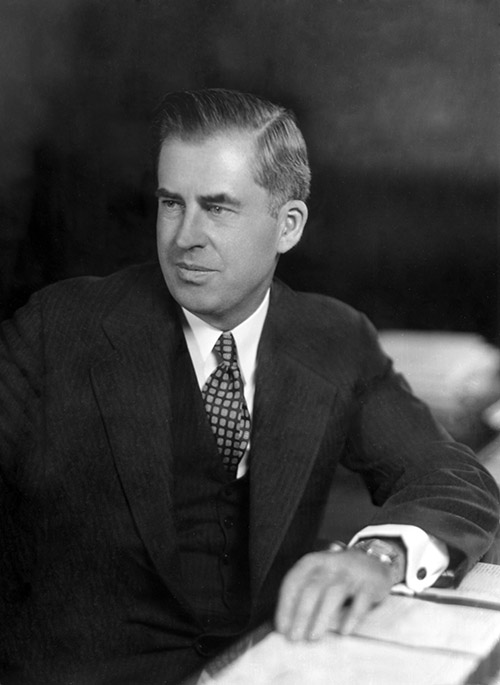
    Official photo of Henry A. Wallace, as Vice President of the United States (1941-1945).

    Soon Helena corresponded directly with the president, sending FDR her “fiery messages” peppered with advice about domestic and international politics. In February 1935, she finally felt comfortable enough to reveal to the chief executive the details of the Great Plan, hinting that the United States might help this noble project: “Thus, the time for reconstruction in the East has come, and let us have friends of the Orient in America. The Union of Asian peoples is envisioned. The unification of the tribes and nationalities will proceed gradually. They will have their own federation. Mongolia, China, and the Kalmyk will counterbalance Japan. Mr. President, in this project of unification we need your good will.”8

    [alert type=”success” dismiss=”no”]If you appreciate this article, please consider subscribing to help maintain this website.[/alert]

    “Now we have reached the future!”

    Meanwhile, rubbing shoulders with Wallace, Roerich suddenly saw an opportunity to use this friendship for his occult geopolitics. In the wake of the horrible drought that hit America’s Central Plains, the US Department of Agriculture started looking for drought-resistant grasses and cereals, sending out its people to various parts of the globe, including Central and Inner Asia. When Roerich discovered this, he was quick to offer himself as an expert on Asian plant life. According to the painter’s occult calendar, it was a good time for him to step out of the shadows and attempt to launch again the Sacred Union of the East. On 17 December 1933, the 13th Dalai Lama died. To his circle of the elect, Roerich announced, “Now we have reached the future!”9

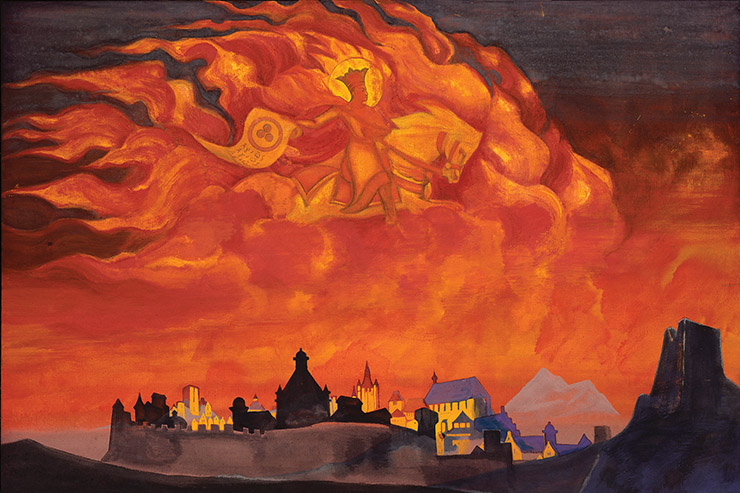
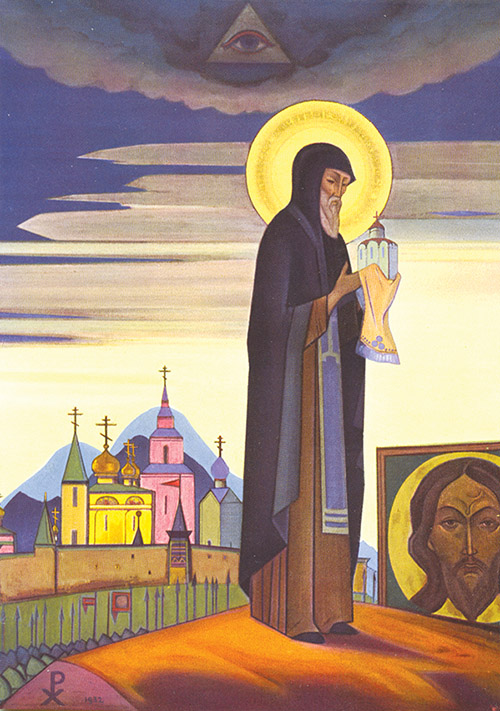
    On the eve of the “botanical expedition” Nicholas Roerich painted an image of himself as St. Sergius (the patron saint of the Russian military) in charge of a mighty army and under protection of the all-seeing eye of his otherworldly spiritual guide Master Morya. Graphic courtesy of Andrei Znamenski

    By the end of December, Wallace was already in Roosevelt’s office, trying to sell his boss on the idea of an Asian botanical expedition that would include Roerich and his son George. The president, who took a personal interest in Roerich’s cause, liked the project and gave permission to proceed. At the same time, Wallace indirectly tried to prepare FDR for something bigger than simply a botanical venture, vaguely hinting that the political situation in Asia was always quite intriguing because of various ancient prophecies and legends. Yet, instead of going to Tibet and Western China, the areas that earlier were so dear to Roerich’s heart, the painter now rushed to north-eastern China: Manchuria and Inner Mongolia. Why such a sudden change of itinerary? 

    Although the death of the Dalai Lama was surely an important occult sign, bringing instability to Lhasa, Tibet was not in revolt. In contrast, Manchuria, Chinese (Inner) Mongolia, and Red Mongolia were all on fire. In 1931, Japan, a rising imperialist giant, suddenly invaded China and occupied her north-eastern part (Manchuria). From there, imperial Japan now threatened the Soviet Far East, Mongolia, and Central China. During the same year, Mongol shepherds and lamas revolted against communism and linked their hopes to the advancing Japanese troops, which they viewed as the army of legendary Shambhala that would deliver them from Russian and Chinese oppressors.10

    Map of Tibetan-Buddhist areas of Inner Asia. Graphic courtesy of Andrei Znamenski

    This was the explosive situation Roerich craved to step into. It was time to set in motion his great plan. With fire in his eyes, the painter exclaimed, “Imagine, suddenly an invincible Mongolian army shows up and begins to win and to act – amazing!”11

    Moreover, Roerich imagined himself as the head of the future Shambhala army. On one of his canvases he portrayed himself as St. Sergius, an Orthodox military patron saint, with Mongol features surrounded by an army of warriors with spears ready for an attack. Helena fed her husband’s geopolitical ambitions by constantly declaring that theirs was a time for assertive politicians. She pointed out that all over Asia, Europe, and even in the United States, people were opting for strong-willed leaders. 

    Yet, troubles pursued the Shambhala warrior from the very beginning. In August 1934, on their way to Manchuria, the painter and his son stopped in Japan. There, without any official credentials, Nicholas began to act as a high American dignitary, meeting the Japanese secretary of war and praising him for the job the Japanese occupation army was doing in China. Three years earlier, the United States had condemned Japan for invading China, and Roerich’s behaviour now looked very embarrassing.

    As soon as the “botanical expedition” stepped on Chinese soil, George Roerich got in touch with a representative of the Panchen Lama. But, surrounded by a tight ring of intelligence agents from various countries, the spiritual leader of Tibet exercised extreme caution and refused to get involved in any grand scheme. Accompanied by several armed guards recruited from the ranks of Russian émigrés, the Roerichs then made a blitz visit to the Manchurian Mongols, mingling with local princes and lamas. From Manchuria, Roerich and his son drove to Inner Mongolia, where they met Teh Wang, leader of the Mongol national liberation movement against the Chinese, promising him American support – another reckless step that further raised the eyebrows of US diplomats in China and Japan. 

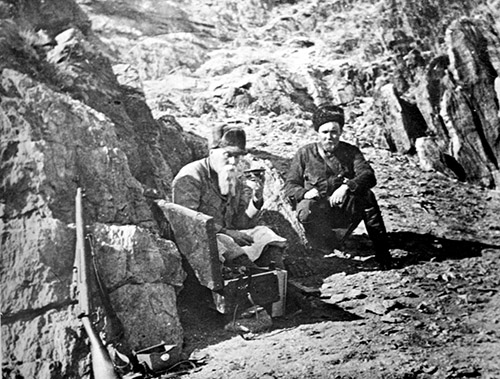
    Nicholas and his son George Roerich during their “botanical expedition” into parts of Inner Asia. This photo taken near Manchuria, Inner Mongolia, 1934-35. Photo courtesy of Andrei Znamenski

    En route, George kept a detailed diary, which resembles more of a military journal than travel notes. He carefully scanned the topography of places they visited, measured hills and distances between various sites and towns, noted major intersections, and provided detailed information about the Japanese military transportation system. In short, this was a blueprint for developing future defensive and offensive plans.12 

    Who was to benefit from this intelligence? Roerich with his Sacred Union of the East project or somebody else as well?

    Smears & Intrigues Beset Roerich

    Concerned about Roerich’s suspicious movements, Japanese intelligence unleashed a smear campaign against him in the press. The press wrote that Roerich was a Freemason, which was not true, who sought to establish a great Siberian state – which did contain elements of truth. Several newspapers drew attention to his brief romance with the Bolsheviks in 1926, wondering if it was still going on. Meanwhile, the American press raised hell, speculating about some hidden US government agenda linked to the Roerich Manchurian expedition. The painter was caught in the crossfire of diplomatic, espionage, and media games. 

    Still worse, the US State Department informed Roerich’s patron Wallace that the Soviets had sent a confidential protest to the American government, complaining that the dangerous émigré Roerich was wandering along the borders of Red Mongolia. The Bolsheviks were worried that “the armed party is now making their way toward the Soviet Union ostensibly as a scientific expedition but actually to rally former White elements and discontented Mongols.”13To the last moment, Wallace backed up Roerich and dismissed all insinuations against his “botanist.” Only when he realised the painter was a diplomatic embarrassment and that his own career was now on the line did the secretary of agriculture call off the expedition, cutting funding and terminating all his contacts with his former guru. Eventually, along with Louis Horch, another sponsor who dropped Roerich, Wallace turned against the painter, initiating a tax-evasion lawsuit against him and seizing his properties in the United States. FDR, embarrassed by the whole situation, personally intervened, promising Horch and Wallace to call the judge who handled the case in order to guarantee the “correct” verdict. Sure enough, Roerich, who trusted Horch to handle his finances, was indicted. Betrayed and humiliated by his partners, Roerich never returned to the United States, wisely choosing to settle in India.

    The artist and mystic Nicholas Roerich. Self portrait (1937). Courtesy of Nicholas Roerich Museum, New York, www.roerich.org

    Red Russia & Boris Roerich

    What went unnoticed at the time was that in January 1933 in Leningrad, right on the eve of the Manchurian expedition, Boris Roerich, a brother of the painter who remained in Red Russia, was suddenly released by the Bolshevik secret police (OGPU). In May 1931, the secret police had set up and then arrested Boris. There is an interesting twist here. Boris’ two-year sentence seems more a house arrest. An architect by profession, he was confined to work at the secret technical bureau, designing the Big House, which headquartered the Leningrad branch of the secret police. Here Nicholas Roerich’s brother worked under Nikolai Lansere, the Soviet architectural star who received a similar sentence.14

    From Boris’ recently declassified secret police file, it is clear that OGPU was using him as a tool in some sophisticated game that most certainly involved Nicholas Roerich. As early as February 1929, the secret police searched Boris’ apartment, trying to find materials that might implicate him in espionage. Two months later, he was recruited by OGPU and began working as a secret informer. Yet, as mentioned above, two years later, OGPU suddenly framed and arrested him for smuggling, sentencing him to three years in a concentration camp. However, hardly had two months passed before this draconian sentence was miraculously waived and replaced by benevolent confinement in the golden cage of the secret technical bureau.15 But this strange story does not end here. From 1936 to 1937, now in Moscow and again with Lansere, Boris Roerich began working on the monumental project of the All-Union Institute of Experimental Medicine (VIEM), a notorious “new age” Stalinist research centre. What followed was even more stunning. From 1937 to 1939, during the period of The Great Purge, Boris continued his career as if nothing happened and even improved his material conditions by moving from Leningrad to an elite neighbourhood in Moscow, where he quietly died a natural death in 1945.16 

    The facts of Boris Roerich’s biography are revealing. Even without having such a “dangerous” brother, Boris, simply as a former White officer who fought against the Bolsheviks during the Civil War, was a prime candidate if not for execution then at least for a twenty-five-year sentence in a concentration camp. Still, by some providential force, the Bolsheviks’ vengeance never reached him. How to explain this miracle? What was the magic shield that protected Boris Roerich? The most obvious answer is that this magic guardian was his adventurous brother. Remembering that the use of relatives to guarantee the cooperation of victims and the loyalty of OGPU agents was standard practice for Stalin’s secret police, all pieces of the puzzle fall in place. 

    It is quite possible that Boris was a bargaining chip in some devious and sophisticated spy game that involved Nicholas Roerich. I will not repeat here the far-fetched argument made by Moscow writer Oleg Shishkin17 that after 1919 or 1920 the painter was always a paid Bolshevik spy and that his Master School in New York City at 310 Riverside Drive was a cover for a Soviet spy ring. There is simply no credible evidence to support such a statement. At the same time, one cannot totally exclude the possibility that at some point Roerich was simply blackmailed by the Soviet secret police and forced to perform occasional clandestine assignments, especially during his Manchurian venture. These assignments might not have necessarily contradicted his Sacred Union of the East project. They could include monitoring Japanese military activities near Red Mongolia’s border, the location of their troops and military hardware, the status of Manchuria as a puppet state, and the general geopolitical situation in the area, a major concern for the Soviet Union in the 1930s. Bolshevik intelligence threw a tremendous amount of resources and workers into the Far East, recruiting hundreds of unemployed White émigrés to spy on the Japanese. Besides, restraining the possible Soviet agent of influence who worked to unite White Russians and Mongols in a sacred crusade against communism was not a bad idea. Viewed from this angle, the protest quietly delivered by the Soviets to the United States in 1935 regarding Roerich’s “armed and dangerous party” might have simply been a good smokescreen to smooth the mission of the reluctant agent. As long as Boris remained in the hands of the Soviet secret police, the painter’s cooperation could be safely solicited anytime. 

    After his second attempt to launch the Sacred Union of the East from Manchuria failed and after Horch seized his Master Building in New York City, Nicholas and Helena along with their two sons settled in India in the picturesque Kulu Valley, right next door to Tibet. Immersing himself in painting local landscapes and entertaining occasional visitors, Roerich finally laid to rest his grand dream. In Kulu, the painter peacefully died in 1947 from prostate cancer. His wife followed him eight years later. 

    Nicholas and Helena along with their two sons eventually settled in India in the picturesque Kulu Valley, right next door to Tibet. In Kulu, the painter peacefully died in 1947 from prostate cancer. His wife followed him eight years later. 

    Before he died, during the Second World War when Nazi Germany attacked Russia, Roerich suddenly became openly pro-Soviet and patriotic. Moreover, after the war ended, he approached the Soviet government, asking permission to return to Russia. Did the old man expect some special treatment from Stalin for occasional services he might have provided to the Bolshevik regime? Or was he simply an old, naïve idealist who felt nostalgia for his motherland? Who knows? Fortunately for him, Red Russia refused to issue such permission. Roerich, who did not know anything about real life in the Bolshevik utopia, was certainly unaware how lucky he was. What could await him in Stalinist Russia in case he returned? The atmosphere of total suspicion, suffocating propaganda, and possibly a prison sentence more likely. 

    In 1957, after the death of Stalin, following in his father’s footsteps, George Roerich, a linguist and Tibetan scholar who was always part of his parents’ Sacred Union of the East project, asked and did receive permission to immigrate to the Soviet Union. The Soviets not only let him in but also awarded him a prestigious job as a senior research fellow at the Moscow Institute of Oriental Studies. Three years later he died from natural causes. The younger son, Svetoslav, an architect, lived a long life and died in 1993 at his estate in Bangalore, India. 

    For a detailed examination of the subjects discussed in the above article, read Andrei Znamenski’s 2012 book Red Shambhala: Magic, Prophecy, and Geopolitics in the Heart of Asia.

    [alert type=”general” dismiss=”no”]This article was published in New Dawn Special Issue Vol 8 No 3.[/alert]

    [alert type=”success” dismiss=”no”]If you appreciate this article, please consider subscribing to help maintain this website.[/alert]

    Footnotes

    1. The two-volume biography of Roerich by Rosov (2002, 2004) is the most comprehensive and complete account of his life: Rosov, Vladimir. Nikolai Rerikh vestnik Zvenigoroda [Nicholas Roerich: Messenger of Zvenigorod], vol. 1. St. Petersburg: Aleteiia, 2002; Rosov, Vladimir. Nikolai Rerikh vestnik Zvenigoroda [Nicholas Roerich: Messenger of Zvenigorod], vol. 2. Moscow: Ariavarta-Press, 2004, 79-80; also Andreev, Alexandre, Gimalaiskoe bratstvo: teosofskii mif i ego tvortsy [Himalayan Brotherhood: Theosophical Myth and its Creators]. St. Petersburg: iz-vo St. Petersburgskogo universiteta, 2008. For a good general overview of Roerich’s activities, see: McCannon, John. “By the Shores of White Waters: The Altai and Its Place in the Spiritual Geopolitics of Nicholas Roerich,” Sibirica: Journal of Siberian Studies 2, no. 3 (2002): 166–89; Spence, Richard. “Red Star over Shambhala: Soviet, British and American Intelligence & the Search for Lost Civilization in Central Asia,” New Dawn 109, July-August (2008); Osterrieder, Markus. “From Synarchy to Shambhala: The Role of Political Occultism and Social Messianism in the Activities of Nicholas Roerich,” in The New Age of Russia: Occult and Esoteric Dimensions, eds. Birgit Menzel, Michael Hagemeister, Bernice Rosenthal. Munchen and Berlin: Kuban & Sagner, 2011. 
    2. Meyer, Karl Ernest and Shareen Blair Brysac. Tournament of Shadows: The Great Game and the Race for Empire in Central Asia. New York: Basic Books, 2006, 454.
    3. Roerich, Nicholas. Shambhala. New York: Frederick A. Stokes Company, 1930, 11; Roerich, Helena, Vysokii put’ [High Path], vol. 1 (1920–1928). Moscow: Sfera, 2006, 45, 51, 65.
    4. Fosdick, Zinaida. Moi uchitelia: vstrechi s Rerikhami (po stranitsam dnevnika, 1922–1934) [My Teachers: Meetings with the Roeriches (Pages from the 1922-1934 Journal)]. Moscow: Sfera, 1998, 206 265; Brachev, Viktor. Okkultisty sovetskoi epokhi [Occultists of the Soviet Age]. Moscow: Bystrov, 2007, 234-35; Rosov, Vladimir. Nikolai Rerikh vestnik Zvenigoroda [Nicholas Roerich: Messenger of Zvenigorod], vol. 1. St. Petersburg: Aleteiia, 2002, 180.
    5. Roerich, 1930, 5, 47, 61.
    6. For more about relationships between Roerich and Wallace, see Meyer and Brysac 1999: 474–91;Williams, Robert C. Russian Art and American Money, 1900–1940 (Cambridge, MA: Harvard University Press, 1980, 136-43;Culver, John C. and John Hyde. American Dreamer: The Life and Times of Henry A. Wallace. New York: Norton, 2000.
    7. Fosdick, 1998, 242.
    8. Roerich, Helena, Pis’ma [Letters], vol. 3. Moscow; MTR, 2001, 351.
    9. Fosdick, 1998, 609.
    10. Bowden, C.R. Modern History of Mongolia. New York: Praeger, 1968, 205.
    11. Fosdick, 1998, 659.
    12. Rosov, 2004, 79-80.
    13. Meyer, Karl Ernest and Shareen Blair Brysac, 2006, 488.
    14. Rosov, Vladimir. “Arkhitekhtor B. K. Rerikh: Rassekrechennoe arkhivnoe delo N. 2538 [Architectural Designer B. K. Roerich: Declassified File No. 2538],” Vestnik Ariavarty [Messenger of Aryavarta] 10 2008, 43.
    15. Rosov, 2008, 46.
    16. Yudin, Andrei. Tainy Bol’shogo doma [Secrets of the Big House]. Moscow: Astrel, 2007, 15.
    17. Shishkin, Oleg. Bitva za Gimalaii: NKVD, magiia i shpionazh [Fight for the Himalayas: NKVD, Magic, and Espionage]. Moskva: Olma-Press, 1999, 27-40, 51-63, 72-75, 105-123.

    © New Dawn Magazine and the respective author.
    For our reproduction notice, click here.
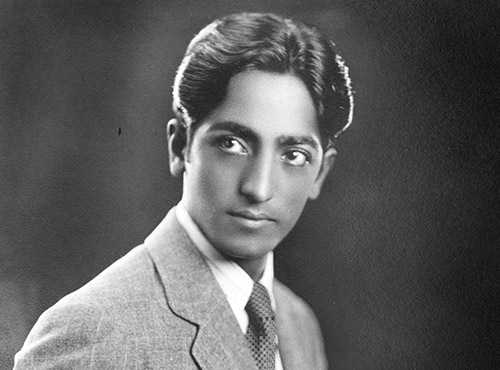
  • Agarttha: Taking the Lid Off the Underground Kingdom

    Agarttha: Taking the Lid Off the Underground Kingdom

    In 1884 the French occultist Saint-Yves d’Alveydre (1842-1909) decided to take lessons in Sanskrit. Having just published his definitive work on the secret history of the world, called Mission des Juifs (“Mission of the Jews”),2 he was anxious to deepen his understanding of the sacred languages which, he felt sure, concealed the ultimate mysteries. Hebrew had already revealed much to him; now it was time to tackle the even more ancient language of Sanskrit, parent of all the Indo-European tongues.

    Saint-Yves’ Sanskrit teacher, who called himself Hardjji Scharipf, was a character of hazy origins and the subject of various rumours. Born on December 25, 1838, he supposedly left India after the Mutiny of 1857 and set up in the French port of Le Havre as a bird-seller and professor of Oriental languages. His name may have been a pseudonym; he may have been an Afghan; some called him Prince. But whatever his story, the manuscripts now in the Library of the Sorbonne in Paris show that Hardjji was a learned and punctilious teacher, and the source of two still unsolved enigmas: the underground kingdom of Agarttha, and its sacred language.

    Three times a week, Hardjji would come to Saint-Yves’ luxurious home with a beautifully scripted lesson of grammar and a reading from some Sanskrit classic. But his diligent pupil became more and more fascinated by Hardjji’s mysterious hints, which began when he signed the very first lesson as “Teacher and Professor… of the Great Agartthian School.”

    Saint-Yves must have asked him what this “Great Agartthian School” was. He might already have read in the books of the popular travel writer and historian Louis Jacolliot of an “Asgartha,” supposedly a great city of the ancient Indian priest-kings, the “Brahmatras.”3 Does such a place still exist, then? Apparently Hardjji gave him to believe so, and, what is more, that it preserves a language and a script, known as “Vattan” or “Vattanian,” that are the primordial ones of mankind. For someone in quest of the secret and sacred roots of language, the mention of such things must have been unbearably exciting.

    Curiosity overcame him on Christmas Day, 1885, when he asked Hardjji to write out his own name in Vattanian characters. The guru obliged, writing it on the back of the lesson sheet and adding wryly: “Here, according to your ardent desire; but really you are not yet sufficiently prepared for Vattan. Slowly and surely!” Later he must have taught Saint-Yves the Vattanian alphabet and the principles behind its 22 letter-forms, which Saint-Yves would correlate with the Hebrew alphabet and with the zodiacal and planetary symbols.

    By the end of the course of lessons, Agarttha and Vattanian had evidently become regular topics of conversation, while Saint-Yves’ interests shifted from Sanskrit to a kind of comparative Hermeticism. With Hardjji’s approval, he created a splendid manuscript in red and gold ink containing invocations, sigils, many alphabets, designs and arabesques made from Sanskrit and Vattanian letters; a list of Vedic and Biblical names encoded in a so-called “Hermetic or Raphaelic Alphabet”; eighty “Vedic” symbols representing the development of the cosmos; a passage on the “Hermetic Significance of the Zodiac” encoded in planet and zodiac signs; correlations of these signs with the names of angels and with Vattanian, Sanskrit, Hebrew, and Hermetic characters; breathing exercises for the hearing of the inner sound “M” and for soul-travel; notes on the properties of herbs; alchemical recipes.4

    Saint-Yves Writes a Book About Agarttha

    And this was not all. Did Hardjji know that Saint-Yves was writing another book – The Kingdom of Agarttha: A Journey into the Hollow Earth – under the influence of his Oriental studies? It seems doubtful, but in 1886 the book was finished, typeset, and printed by his regular publisher (Calmann Lévy).

    To put it bluntly, this book takes the lid off Agarttha. The reader will learn that it is a hidden land somewhere in the East, beneath the surface of the earth, where a population of millions is ruled by a Sovereign Pontiff, the “Brahatmah,” and his two colleagues the “Mahatma” and the “Mahanga.” This realm, Saint-Yves explains, was transferred underground and concealed from the surface-dwellers at the start of the Kali Yuga (the present dark age in the Hindu system of chronology), which he dates to about 3,200 BCE. Agarttha has long enjoyed the benefits of a technology advanced far beyond our own, including gas lighting, railways, and air travel. Its government is the ideal one of “Synarchy,” which the surface races have lost ever since the schism that broke the Universal Empire in the fourth millennium BCE, and which Moses, Jesus, and Saint-Yves strove to restore. (This was the theme of Mission des Juifs.) Now and then Agarttha sends emissaries to the upper world, of which it has a perfect knowledge. Not only the latest discoveries of modern man, but the whole wisdom of the ages is enshrined in its libraries, engraved on stone in Vattanian characters. Among its secrets are those of the true relationship of body to soul, and the means to keep departed souls in communication with the living. When our world adopts Synarchical government, the time will be ripe for Agarttha to reveal itself, to our great spiritual and practical advantage. In order to speed this process, Saint-Yves includes in the book open letters to Queen Victoria, Emperor Alexander III of Russia, and Pope Leo III, inviting them to join in the great project.

    Perhaps the oddest thing about this book is Saint-Yves’ own stance. Far from presenting himself as an authorised spokesman for Agarttha, he admits that he is a spy. Dedicating the book to the Sovereign Pontiff and signing it with his own name in Vattanian characters (just as Hardjji had written it out for him), he expatiates on how astounded this august dignitary will be to read the work, wondering how human eyes could have penetrated the innermost sanctuaries of his realm. Saint-Yves explains that he is a “spontaneous initiate,” bound by no oath of secrecy, and that once the Brahatmah gets over the shock, he will admit the wisdom of what Saint-Yves has dared to reveal.

    How did Saint-Yves obtain this information? Already in his first book, Clefs de l’Orient (1877), he was writing with the confidence of an eyewitness of the psychic phenomena accompanying birth, death, and the relation between the sexes.5 In the present work he seems to have extended his psychic vision, to say the least, and one can glean from here and there an idea of his methods.

    There is, for instance, a passage here describing in detail how the Agartthian initiates travel in their souls while their bodies sleep. Then there is the passage in the notebook already mentioned, on yogic exercises for separating the soul from the body. Thirdly, there is a snippet of occult gossip in a conversation with Saint-Yves recorded on August 16, 1896, by a psychical researcher, Alfred Erny:6

    “He has talked to Papus and [Stanislas de] Guaïta, but did not tell them what they wanted to know: the method of disengaging and re-engaging oneself in the astral body. It is dangerous: ‘I don’t want (he said) to put a loaded revolver into your hands which you don’t know how to use.’

    “A magnetiser, he said, runs less danger than others in duplicating himself, because he is more trained.

    “When one goes out of one’s body into the Astral, another evil spirit may replace you.”

    Saint-Yves presumably possessed the secret of this “somnambulistic” faculty, and used it to gather the information he presents in this book. But did he gather it, as he claims, from spying on a physical Agarttha beneath the surface of the earth? Or was it the result of his own projected fantasies or hallucinations? Or, again, did it come from some non-physical location or state which can be accessed under certain conditions, but which then merely supports the psyche’s own subjective expectations and prejudices? We will return to these questions at the end.

    No sooner was the book printed and ready for the bookshops than Saint-Yves withdrew it, destroying every copy but one. The work narrowly escaped oblivion, but this one copy passed after Saint-Yves’ death to Papus, who published it in 1910, with some omissions, under the auspices of a group of disciples, the “Friends of Saint-Yves.” Decades later, it turned out that the printer, Lahure, had secreted another copy.7 The late Jean Saunier, biographer and chief authority on Saint-Yves, used this as the basis for the complete French edition of 1981, now translated into English.

    Whatever reasons and motives were responsible for the sudden withdrawal of the book, there is no doubt that Saint-Yves remained true to his vision. For instance, he mentions Agarttha and names its three rulers in his epic poem of 1890, Jeanne d’Arc victorieuse. In his conversations with Erny in 1896, he stated outright that there exists a secret “Superior University” with a “High Priest” who is currently an Ethiopian, and other details just as they appear in this book. Finally, he mentions Agarttha in veiled terms in L’Archéomètre, the major work of his last years.

    Ossendowski Revives “Agharti”

    After the trauma of World War I, the very name of Agarttha might have been forgotten, as Saint-Yves himself was. But in 1922, a Polish “scientist” named Ferdinand Ossendowski (1876-1945) published a sensational travel and adventure book.8 It told of his flight through Central Asia in the aftermath of the Russian Revolution. While in Mongolia, he heard tell of a subterranean realm of 800,000,000 inhabitants called “Agharti”; of its triple spiritual authority “Brahytma, the King of the World,” “Mahytma,” and “Mahynga,” of its sacred language, “Vattanan,” and many other things that corroborate Saint-Yves. The book ended on a dramatic note of prophecy from one of Ossendowski’s informants: that in the year 2029, the people of “Aghardi” will issue forth from their caverns and appear on the surface of the earth. The prophecy was attributed to the King of the World when he appeared before the lamas in 1890. The King had then predicted that there would be 50 years of strife and misery, 71 years of happiness under three great kingdoms, then an 18-year war, before the appearance of the Agarthians.9

    An unprejudiced reader, finding in three chapters of Ossendowski’s book a virtual outline of Saint-Yves’ Agarttha, not omitting the most improbable details, would conclude that the author had capped an already good story with a convenient piece of plagiarism, altering the spellings so as to make his version, if challenged, seem informed from an independent source. At first Ossendowski denied this indignantly. When he was introduced to the esotericist René Guénon (1886-1951), he said that if it were not for the evidence of the daily journal he had kept, and of certain objects he had brought back, he would have thought that he had dreamed parts of this story, adding: “I’d much prefer that!”10

    Back in 1908, the young Guénon had taken part in automatic writing séances in which Agartthian matters had come up, though whether through the questioners or the channelled entity is now unclear.11 Now his interest was rekindled, and in 1925 he wrote about the striking parallels between Saint-Yves’ Agarttha and the Agharti of Ossendowki, whose sincerity, according to Guénon, there was no reason to doubt.12

    Two years later, Guénon took the matter into his own hands. In his most controversial book, Le Roi du Monde, he announced: “Independently of the evidence offered by Ossendowski, we know from other sources that stories of this kind are widely current in Mongolia and throughout Central Asia, and we can add that there is something similar in the traditions of most peoples.”13 Unfortunately Guénon does not support his claim to privileged access by telling us what these sources are, nor what degree of similitude is meant by “stories of this kind.”

    Near the end of Le Roi du Monde, Guénon faces the question of whether Agarttha really exists:

    Should its setting in a definite location now imply that this is literally so, or is it only a symbol, or is it both at the same time? The simple answer is that both geographical and historical facts possess a symbolic validity that in no way detracts from their being facts, but that actually, beyond the obvious reality, gives them a higher significance.14

    So Guénon at the very least did not deny a geographical Agarttha. To his way of thinking, if one were found to exist beneath the surface of the earth, it would only corroborate the superior reality of the symbolic one.

    Ossendowski’s account was later investigated by Marco Pallis (1895-1985), the traveller, writer on Buddhism, and translator of Guénon, with the advantage of his own contacts with highly-placed Indians, Tibetans, and Mongolians.15 One of the latter, now very old, had been the head lama of a monastery at the time of Ossendowski’s visit there. He testified that the latter’s stories of the King of the World and of Agarttha bore no relation to any authentic legend or doctrine whatsoever, and that Ossendowski’s command of the Mongolian language had not been nearly sufficient to understand what he claimed to have heard. Pallis’s Hindu friends, similarly, disclaimed any Sanskrit source for Agarttha. The inevitable conclusion was that the credulous Guénon had been misled by Saint-Yves’ fantasy, and that promoting belief in Agarttha in Le Roi du Monde had been a foolish mistake.

    Ossendowski himself had back-pedalled in November 1924 when pressed to appear before a group of prominent intellectuals and scholars. He confessed to this hard-boiled audience that Beasts, Men and Gods was not “scientific” but “exclusively a literary work,” and stated the same in a letter to the Royal Geographical Society.16 Never mind: once his best-seller had brought the Agarttha myth out of the esoteric closet, it began to enjoy a new lease on life. Often confused or contrasted with Shambhala, the spiritual city of Tibetan Buddhism, it became a recurrent theme of popular occult writers.17

    If we set aside Saint-Yves and Ossendowski, for reasons already explained, there remain only two independent witnesses to an Indian Agarttha tradition. Louis Jacolliot was led to place it in the past, as the ancient Brahmanic capital. For Hardjji Scharipf it was a living initiatic school with its own secret script. Until a reputable scholar comes forward with data on the myth of Agarttha, and especially on the Vattanian alphabet,18 my working hypothesis is that these were part of a mythology belonging to a restricted and obscure Indian school, which has only surfaced to Western notice on these two occasions.

    However, Saint-Yves wanted more than the tantalising taste that his Sanskrit teacher allowed him. He therefore decided to use his gift for astral travel to explore Agarttha further, and was rewarded by visions of an underground utopia and its Sovereign Pontiff, the spiritual Lord of the World. What is the source, and the ontological status, of such visions?

    The Astral World and Delusions of Grandeur

    There are, one gathers, definite places or complexes in the Astral World (also known as the “Inner Planes” of magic), which present to the clairvoyant visitor certain invariable features. But the incidental circumstances of such a place vary, according to the visitor’s own cultural conditioning and expectations. Some find themselves, for example, in what they believe to be the Alexandrian Library, or in Atlantis, i.e., a place of the past. To others, it seems current and contemporary, though preferably in an inaccessible location like the Himalayas. The décor is a trivial matter, of course, in comparison to the philosophical truths to be discovered there, but the glamour of it sometimes overwhelms the traveller. Then his attention fixates on irrelevant details, and an inflated sense of self-importance may result. Thus Saint-Yves, convinced that he has penetrated to the realm of the world’s spiritual ruler, writes about four-eyed tortoises, two-tongued men, levitating yogis, and ends up addressing pompous letters to Queen, Emperor, and Pope.

    I can accept that in some state of altered consciousness he saw what he claims to have seen. But like many who habitually indulge in altered states, he was not able to situate his visions, nor himself as witness to them, with the requisite philosophical detachment. The result is a classic case of the occupational hazard of occultists: misplaced concretism.

    Yet there is a grandeur to this book. Its vivid and elegant prose lift it far above the tedious wordiness of visionary and channelled writing. In sheer weirdness of imagination it rivals the fantasy fiction of H.P. Lovecraft or Jorge Luis Borges, while in deadpan seriousness and titanic self-confidence it compares to prophetic works like the Book of Ezekiel or the various Apocalypses. And it reminds us that the earth is a very strange place, with many unexplored corners, many enigmas, and many surprises in store for us surface-dwellers.

    [alert type=”general” dismiss=”no”]This article was published in New Dawn 109.[/alert]

    [alert type=”success” dismiss=”no”]If you appreciate this article, please consider subscribing to help maintain this website.[/alert]

    Footnotes

    1. Abbreviated from the author’s Introduction to Saint-Yves d’Alveydre, The Kingdom of Agarttha: A Journey into the Hollow Earth, trans. Jon Graham, Rochester, Vt.: Inner Traditions International, 2008.
    2. Saint-Yves d’Alveydre, Mission des Juifs (Paris: Calmann Lévy, 1884; reprinted Paris: Editions Traditionnelles, 1971, 2 vols.).
    3. See especially Louis Jacolliot, Le Fils de Dieu (Paris: Lacroix, 1873), 263-266, quoted in Jean Saunier, Saint-Yves d’Alveydre, une Synarchie sans énigme (Paris: Dervy, 1981), 350-353.
    4. Sorbonne, Ms. 1423, page 118 onwards. Some of this material would appear in the posthumously published work L’Archéomètre (Paris: Dorbon, 1911); English translation by Ariel Godwin as The Archeometer: Key to All the Religions and Sciences of Antiquity. Synthetic Reformation of All Contemporary Arts (n.p.: Sacred Science Institute, 2008).
    5. Saint-Yves d’Alveydre, Clefs de l’Orient (Paris: Didier, 1877; reprinted Nice: Belisane, 1980).
    6. Sorbonne, Ms. Carton 42, fragment G, pp. [7-8]. Erny was the author of Le Psychisme experimentale (Paris: Flammarion, 1895). His notes on conversations with Saint-Yves, dated August, 1896, are divided between the Sorbonne and the Bibliothèque Municipale de Lyon, Ms. 5493.
    7. See Introduction by Jean Saunier to Saint-Yves d’Alveydre, Mission de l’Inde (Nice: Bélisane, 1981).
    8. Ferdinand Ossendowski, Beasts, Men and Gods (New York: Dutton, 1922). The book was written in English, with assistance from Lewis Stanton Palen.
    9. Beasts, Men and Gods, 413.
    10. Quoted in Paul Chacornac, La Vie simple de René Guénon (Paris: Editions Traditionnelles, 1958), 77n.
    11. See Robert Amadou, “L’Erreur spirite de René Guénon,” in Sphinx (Beaugency), no. 3/4 (Autumn 1978), 21 unpaginated pages; no. 5 (Spring 1979), 45-60; no. 7/8 (Autumn/Winter 1979), 83.
    12. René Guénon, “Le Roi du Monde,” in Les Cahiers du Mois, 9/10: Les Appels de l’Orient (Paris: Emile Paul Frères, 1925), 210. This statement was modified in Guénon’s Le Roi du Monde (Paris: Bosse, 1927); see next note.
    13. René Guénon, The Lord of the World, trans. Anthony Cheke (Ellingstring: Coombe Springs Press, 1983), 2-3.
    14. The Lord of the World, 66.
    15. See Marco Pallis, “Ossendowski’s Sources” in Studies in Comparative Religion, vol. 15, no. 1/2 (1983), 30-41.
    16. See the anonymous review, “The Ossendowski Controversy,” in The Geographical Journal, 65/3 (1925), 251-254, which reproduces Ossendowski’s statements in French and English.
    17. See my Arktos: The Polar Myth in Science, Symbolism, and Nazi Survival (Grand Rapids: Phanes Press/London: Thames & Hudson, 1993; reissued Kempton, IL: Adventures Unlimited Press, 1996), 79-104, and the references given there.
    18. On Vattanian, see Mike Jay and Joscelyn Godwin, “Licked by the Mother Tongue,” in Fortean Times, 97 (April, 1997).

    © New Dawn Magazine and the respective author.
    For our reproduction notice, click here.