New Dawn – World's Most Unusual Magazine

Category: Secret Wisdom

  • An Introduction to Western Sexual Mysticism

    An Introduction to Western Sexual Mysticism

    From New Dawn 109 (Jul-Aug 2008)

    Very few people are aware that there are long-standing traditions of sexual mysticism in the West. During the last quarter of the twentieth century, many in the West became aware of Hindu and Buddhist forms of Tantra, but Tantric traditions were often distorted in the process of transmission or transference to the modern West, where they often became commodified and trivialised. This never happened to esoteric Western traditions of sexual mysticism, primarily because they were entirely unknown. Even today, The Secret History of Western Sexual Mysticism is the first book to outline the hidden history and nature of Western sexual mysticism.

    Of course, we should begin by outlining what we mean by ‘sexual mysticism’ in the first place. After all, the very term ‘mysticism’ is ambiguous, for some even synonymous with ‘woolly-minded’. The word ‘mystic’ derives from the Greek word mustein, meaning ‘silent’ or ‘closed-lips’, and has the same origin as the word ‘mystery’. The words ‘mysticism’ and ‘mystery’ are associated with the ancient Greek Mystery (revelatory and initiatory) traditions of antiquity, which, as we shall see, certainly had sexual dimensions. As far back as we can trace, the word ‘mysticism’ refers to religious traditions that point us toward inexpressible transcendence of the apparent division into subject and object, or self and other, and toward realisation of the Divine.

    When we look back into Greek and Roman antiquity, we see that the Mystery traditions almost always had sexual dimensions, and there is good reason for this. The Mystery traditions, be they Bacchic, Dionysiac, Eleusinian, or Orphic, were closely bound up with the cosmic cycles, and in particular with the cycles of agricultural and human fertility. In fact, the earlier forms of the Mystery traditions, including during the Hellenistic period, were in the domain of women. Only later were men allowed to be priests in many of the traditions, and the orgia (orgiastic celebrations) took place under the auspices of women. What we are looking at, in the ancient Mystery traditions, corresponds to something quite different from the modern stereotype of femininity as demure, coquettish, or ‘passive’. The women described in some of the ancient Mystery traditions seem to our eyes (as to those of their contemporaries) frenzied, wild, and dangerous, but this authentic wildness expresses a dimension of nature itself that we moderns often fail to recognise.

    We should recognise the profound connection between nature and the Mystery traditions during the entire period of antiquity and late antiquity. The Dionysiac rites and the Bacchanalia took place outdoors, and often at night; and while the rites were associated with the fertility of nature, that is not their only dimension. The Mysteries entailed direct contact with the transcendent forces of the cosmos, which although they are expressed in the natural world, have their origins in pagan divinity. There is a fierceness in the Mystery traditions, and a dissolution of civilisation, that is very important in understanding both their power and their dangers.

    When we turn to the appearance of Christianity within the declining pagan world, we see something quite different and in many respects new. There really is a changing of the age represented by the shift from the ancient Mysteries to the mysteries of Christianity. It is true that there were Stoic and other ascetic or semi-ascetic traditions within Greco-Roman antiquity, but there is a very real and profound shift that took place from the orgiastic traditions of antiquity to the extreme asceticism of Christianity as emblematised in the Desert Fathers.

    Consider on the one hand the bacchanals of antiquity, and on the other Origen’s self-castration – it would seem that we are observing a shift from one pole to the other. Admittedly, there were Mystery traditions that involved emasculation too, but those underscored the primacy of the feminine powers, whereas Origen represents those who are ‘eunuchs for the sake of heaven’. Hence even the apparent similarities between the two broad traditions turn out to be differences.

    And yet there is a notable kind of continuity in one respect. Although it is almost never discussed except in the works of specialists, early Christianity also entailed a sexual dimension. As we shall see, one should not simply dichotomise between, on the one hand, the orgiastic traditions of Greco-Roman antiquity, and Christian asceticism on the other. Christianity, after all, was not a single movement or sect, but a whole series of phenomena that emerged in the midst of late antiquity and that included a whole gamut of possibilities, all the way from asceticism to license. And even within what later became known as ‘orthodox’ Christianity, there was a mysterious tradition of subintroductae, in which men and women lived and slept together, but without male ejaculation. Thus there was a Christian tradition from very early on – it is mentioned by Paul himself – of sexual mysticism: that is, of drawing on sexual tension and power, but harnessing it to spiritual transcendence.

    There is, of course, much more also to discuss in the Christian traditions of late antiquity. One cannot consider Christianity as a single entity, but rather as a group of very different currents of thought and practice, which we see exemplified both in the Apocrypha and in the various Gnostic traditions and compendia. In fact, a good case could be made that ‘pagan’ orgiastic traditions did not disappear, but were subsumed into some forms of Christianity, sometimes called ‘gnostic’.

    At the very least, one has to recognise that Christianity was never a monolithic single tradition. What I have been sketching are only tendencies. Nor was it the case that pagan traditions totally vanished, as if someone had flicked a switch. History does not work that way. Rather, pagan traditions fed into the currents of Christianity in Northern and Southern Europe, as in Russia and in England, often in subterranean ways. What is more, the various currents of Christianity – including Gnostic streams – did not vanish entirely, but also went underground or were transmitted through Judaism, Islam, or other traditions, only to re-enter Christianity again later on. And above all, Western Christianity included a whole series of recurrent ‘heretical’ religious traditions that kept reappearing. But the most important of these recurrences is during the modern era.

    As I discussed in my book Restoring Paradise, Western esoteric traditions are transmitted mostly via books or manuscripts – that is, via the written word and image. This means that a given spiritual possibility or even initiatory line may be dormant within a particular work for centuries, even millennia, only to reappear in a new era when the conditions are ripe for its restoration and reawakening. Hence, while it is true that Gnosticism ‘died out’ in late antiquity, it is also true that Gnosticism as a range of spiritual possibilities within Christianity remained latent until being periodically rediscovered in one form or another, whether by medieval ‘heretics’ or by modern seekers.

    The nineteenth century is the period when sexual mysticism re-emerges into broader consciousness in the West, as we see not only in figures like the poet and artist William Blake, but also in American utopian communities like Oneida, under the direction of John Humphrey Noyes (1811–1886), and Fountain Grove, under the direction of Thomas Lake Harris (1823–1906). Another important figure during what we may call the American renaissance of sexual mysticism is Alice Bunker Stockham (1833–1912). Suddenly, as if out of nowhere, one finds numerous practitioners and advocates of sexual mysticism in the West.

    At this point, it becomes necessary to distinguish between sexual mysticism and sexual magic. For during the nineteenth and twentieth centuries, one also sees various currents of sexual magic emerge, most having inception with Paschal Beverly Randolph. Randolph himself had travelled across the Atlantic, and the currents of sexual magical traditions moved back and forth across from Europe and England to North America and back again. There is much yet to be written about sexual magical traditions of the nineteenth and twentieth centuries. But here we distinguish clearly between sexual mysticism and sexual magic, because whereas sexual magical practices are focused on particular worldly gains or, to put it another way, on the acquisition of power to achieve particular ends, sexual mysticism is strictly gnostic in the sense that its adherents aim not for power but for inner or spiritual union and realisation. While there may be magical dimensions to a mystical practice, or mystical dimensions to a magical one, in general one can distinguish one from the other without too much trouble.

    Of course, the twentieth century was marked by a new syncretism, and by the end of the century it was no longer possible to strictly divide Western and Eastern traditions or currents because each had taken on some properties of the other. Asian traditions, including Tantric traditions both Hindu and Buddhist, had Western adherents and were also subject to New Age commodification, while at the same time Western currents had also made their way around the globe via printed works and electronic communication media. One could find hybrid forms of virtually every tradition imaginable, and furthermore, the intrinsic hybridisation that takes place when, for example, Westerners draw from Asian Tantric traditions. This syncrasis (from the Greek krasis, or ‘mixing’) is also, and increasingly, part of the secret history of Western sexual mysticism.

    Modernity’s unprecedented secular environment, and the dissolution of previous cultural norms, makes possible new ways of seeing and understanding sexuality or eros in relation to the religious impulses of humanity. Christianity opens up into an array of possibilities – a pluralistic world exists once again, just as it did in late antiquity before the vanquishing of the Gnostics. It is true that there are traditionally warnings about the dangers of sexual mysticism – indeed, this is arguably why erotic practices were condemned by some of the early Church Fathers and saints, especially as the Church became institutionalised and at the same time, more and more ascetic. But one also has to wonder whether it is really a matter of only one or the other – whether it might also be possible to find a balance between the poles of license and ascesis, and whether the traditions of erotic mysticism may have important things to offer us today.

    In any case, it is important at least to know about and to understand the range of possibilities for erotic mysticism that has always existed within the Western traditions more broadly. By understanding the hidden erotic traditions within the West, we have a richer, more profound range of perspectives to draw from; history becomes more multidimensional. But it is also possible that, as we uncover these secret erotic traditions of the West, they will in turn feed into new movements and generate new ways of understanding. Each era draws upon the past in its own way, and perhaps it is time for us – at least those who are interested and who feel some calling to do so – to reconsider the Western currents of erotic mysticism.

    Broadly speaking, there are four main characteristics of sexual mysticism in the West:

    1. Nature and Magic

    Why is it that so many groups and individuals to whom history attributes one or another form of sexual mysticism, also were said to prefer the wilderness to urban society, deserts and forests to towns? The opposition to such teachings tended to arise in cities, host to bureaucratic institutions and to those busybodies who, from papal Rome to Calvin’s Geneva, sought to manage the personal lives of others. On the other hand, the reach of bureaucracy is generally weaker, the further from urban concentrations of power one goes, and it peters out altogether once one passes over into the wilderness. Hence it is perhaps not surprising that, from the ancient Mysteries to the early Christian encratic groups, from medieval groups like the Brethren of the Free Spirit, the Waldensians, and the Cathars to more recent proponents of sexual mysticism like Thomas Lake Harris or those influenced by Taoism, wild nature is an inevitable refuge and home.

    Where the cultural memory of the Mystery traditions survived – particularly in rural and tribal regions – one also often finds folk magical traditions that appear to be of great antiquity. These magical traditions are intimately bound up with the currents and rhythms of nature, upon which they draw and which they seek to augment or divert. The arts of encouraging or discouraging rain, of making or keeping livestock fertile, of planting at the proper time, and of nurturing proper growth in plants and orchards, these are closely allied with the arts of erotic magic and of procreation, of averting or finding thieves, and of protecting one’s land, crops, livestock, and family. Both the Mysteries on a macro level, and folk or natural magic on a micro level, served to sustain and augment human life with the larger natural and cosmic rhythms, and the advent of Christianity represented a new overlay on these existing and continuing traditions.

    It is not surprising, therefore, that ancient Gnosticism and numerous subsequent ‘heresies’ like Bogomilism were said to carry on magical practices: the attitudes toward nature, the cosmos, and cosmic powers was closer to those found in earlier Mystery traditions than to Pauline and Augustinian Christianity. Through such practices, one comes into direct contact with and draws upon cosmic powers rather than broadly rejecting or dismissing them as is implicitly or explicitly the case in many forms of ascetic ‘orthodox’ Christianity. It is not a coincidence that the victims of the Inquisitions were alleged to be heretics or magicians. These two categories do not entirely overlap, to be sure, but where they do, one often also finds an unorthodox embrace of nature or wildness, and of the powers of nature.
    2. Egalitarianism, Spiritual Marriage, and Spiritual Hierarchy

    When we look back over the history of sexual mysticism, we also see that women take on particularly strong roles as spiritual guides, leaders, and sometimes prophets. Among the Gnostics in antiquity, among numerous medieval groups, and in early modern groups and individuals associated with sexual mysticism, we find consistent emphasis not on male authority or, for that matter, female authority, but rather on a paradoxical union of egalitarianism and what we may term spiritual aristocracy, both of which in turn derive from the experience of the spiritual marriage.

    As we will recall, the operative dimension of sexual mysticism is supraphysical, from great antiquity onward: throughout the history of Western sexual mysticism, what matters is vertical or transcendent union, that is, union of the two individuals not as individuals, but as transcendent beings. This transcendent union is often described in the ‘pagan’ Mysteries, as in Valentianian and some other forms of Gnosticism, as the spiritual marriage or sometimes later as the mystical wedding. The spiritual marriage as a symbolic term describes the reunion of humanity with the divine, and as the term ‘marriage’ implies, this reunion could hardly be restricted as an experience only to one gender.

    Authority within small mystical circles thus accrues to those who have experienced the inner or spiritual marriage, and the most experienced are the elders or guides within the tradition. By and large, it is a matter of indifference whether that individual is male or female, a perspective that irritated Church Fathers like Irenaeus or Tertullian just as much as it subsequently irritated the representatives of the Inquisition who set about investigating groups like the Brethren of the Free Spirit who held similar views during the medieval period. What matters to adherents of such mystical teachings is the extent to which an elder has direct inner knowledge of the spiritual marriage, for that, in their view, is the sole origin of authentic authority.

    It would seem that the various adherents of sexual mysticisms in the past seem chiefly to have lived before their time. So many of their beliefs and even some practices may have seemed outlandish in their own time, but are not so any longer in the wake of modernity (and in particular, feminism), with its widespread dissolution of previous socio-cultural inhibitions. During the modern period, perhaps for the first time in Western history, sexual mysticism either as theory or as practice was not likely to get one imprisoned or killed, and, at least in outward aspects, was not even all that far from latitudinarian mainstream thought.

    3. Secret Teachings and Gnosis

    But there is one critical aspect of sexual mysticism, and indeed, mysticism more generally, that remains entirely alien from modern perspectives. And that is the idea of gnosis, or direct inner spiritual knowledge. The notion of secret teachings of Jesus, given to the disciples and transmitted from them into subsequent initiates – this is comprehensible because it refers to history. Such an initiatic transmission exists on an historical horizon, even if we aren’t quite certain what knowledge was transmitted. Both such a secret history and the knowledge transmitted exist in the world of subject/object duality: there is alleged to be a secret history of a particular kind of knowledge, and, schooled in the premises of modern scientific rationalism, we naturally think of that secret knowledge as information or as technical in some rarified way. But gnosis is not like the kinds of knowledge with which we are familiar.

    There are two kinds of gnosis, broadly speaking, in Christian tradition. These two kinds of gnosis correspond to the terms of Dionysius the Areopagite: via positiva, and via negativa. The via positiva or via affirmativa is usually defined as perception of higher realities via symbols or images, but those symbols or images are like passageways or portals into visionary worlds, into what Henry Corbin termed the mundus imaginalis, or “imaginal world.” The visionary sphere of the mundus imaginalis is not imaginary, or a mere reflection of this world – it is, rather, an archetypal revelatory sphere akin to lucid dreaming, in which we encounter divine or angelic beings and visionary oneiroscapes, exactly what we find in many of the Nag Hammadi gnostic writings. But we also find there the via negativa, that is, the path of transcendence of all symbols or analogies.

    What the secret history of sexual mysticism suggests is that sexual union or communion can open out into a via positiva experience in which through intimate communion we begin to perceive and even enter into the archetypal sphere that Corbin termed the mundus imaginalis, or imaginal world. Sexual union is potentially conducive to such an experience because in it a man can become an archetypal man encountering archetypal woman – angel or god unites with angel or god (depending on whether one is drawing on Christian or pagan language).

    What we see, in the Mystery traditions and again in gnostic traditions of the inner or gnostic marriage, as again in gnostic visionary works – in other words, in the foundational period of Western history – is the possibility of an inner or divine union of which sexual union between a man and a woman is the sign or symbol. The key here is the inner or archetypal union between above and below, which is in fact the touching and intermingling of another, archetypal, revelatory divine world with this mundane, earthly one. The horizontal sexual union between man and woman is consummated not in their union with one another, but inasmuch as this horizontal union has a vertical or transcendent dimension.

    4. Realisation of the Transcendent

    Clearly, sexual union, as the most intimate mingling of two people, represents a potential opening into kinds of consciousness that transcend our ordinary individuality. We each intuitively know this; we understand that sexual union – and especially those moments when a couple’s union is an opening for a new life to begin to take form – itself is a rare and mysterious union not only of man and woman, but, in principle, of humanity and nature with the divine.

    Sexual union becomes sexual mysticism not when two individuals join, but when each lover becomes for the other an opening into the transcendence of I and thou, an entry into a new dimension beyond selfhood. In this new dimension, one encounters not only another individuality, but also the powers behind and beyond nature, the principles that inhere in the cosmos. The Mystery traditions of Greco-Roman and Egyptian antiquity become comprehensible when we begin to understand why in those traditions sexuality – including orgiastic sexuality – is so intimately linked to seasonal cycles, wilderness, fields, and orchards.

    And perhaps we also begin to glimpse the multivalences of sexual mysticism in the age-old and always-present, always-renewed font of romantic love. It may be that when we fall in love, we find ourselves engulfed in a monsoon of hormonal intoxication that inexorably fades away into the cold, long day of routine life – yet if this happens, perhaps it was not inevitable, but the result of not entering into a unitive alchemical process. Erotic mysticism no doubt may be dangerous. Obsession, immersion in a world of fantasy, sexual manias – who knows how many detours and pitfalls there are? Very probably it is indeed better to follow the path of asceticism.

    Nonetheless, there are those who feel drawn toward an erotic mysticism, or who find themselves in a relationship that becomes a spiritual path. For them, it may be useful to know that there are very long and very rich Western traditions of sexual mysticism that can be traced back before the origins of Christianity, and that for all the efforts of the ‘orthodox’ to extirpate it, erotic mysticism still recurs time and again, perpetually renewed like the phoenix.

    [alert type=”general” dismiss=”no”]This article was published in New Dawn 109.[/alert]

    [alert type=”success” dismiss=”no”]If you appreciate this article, please consider subscribing to help maintain this website.[/alert]

    © New Dawn Magazine and the respective author.
    For our reproduction notice, click here.
  • Revisiting Joseph Campbell: The Power of Myth

    Revisiting Joseph Campbell: The Power of Myth

    From New Dawn 144 (May-June 2014)

    Perhaps myth first arose out of the answers parents give to their children’s questions. Many of these are unanswerable: Why is water wet? Why is fire hot? Where does everything come from? Who is God? Because people like to tell stories, it makes sense that parents would make up tales, far-fetched, elaborate, but sometimes beautiful, to satisfy this curiosity. The best of these would be passed down from generation to generation to form the body of worldwide myth.

    Even so, this explanation does not tell us why myths are so powerful. Why should these stories have continued to be told for thousands of years? What meaning do they have and what role do they play in our lives?

    The modern study of myth, and its close cousin, religion, began around the Enlightenment, when polymaths began to compile the traditions of non-Western peoples. They also tried to find common elements in these traditions. Most of their answers today look naïve and simplistic.

    The mid-nineteenth-century British author Hargrave Jennings, for example, saw the origins of all the world’s religions in “phallicism,” a worship of the sexual force as well as of the sun and fire. J.G. Frazer, author of The Golden Bough and revered as one of the founders of the discipline of anthropology, said that myths, particularly of the death-and-resurrection variety, were merely recapitulations of the yearly vegetative cycle of growth, death, and renewal (a view known to, and derided by, Plutarch in the first century CE).

    In the twentieth century, Émile Durkheim, one of the founding fathers of sociology, held that religion was nothing more than a primitive abstraction and internalisation of social forces: “Society in general, simply by its effect on men’s minds, undoubtedly has all that is required to arouse the sensation of the divine. A society is to its members what a god is to its faithful.” For the Swiss psychiatrist C.G. Jung, myth and religion expressed a deep layer of the mind that he called the collective unconscious.

    All these views are true. There are many sexual motifs in myths and religion. Societies do unite themselves by means of common myths. There are underlying patterns of myth that seem universal, even among peoples who are far-flung and isolated. But these are only partial truths.

    One of the most comprehensive – and best-known – discussions of myth appears in the writings of the American scholar Joseph Campbell (1904-87). Campbell’s view, expressed in books such as The Hero with a Thousand Faces and the Masks of God series, and in a famous series of televised interviews with the journalist Bill Moyers entitled The Power of Myth, is probably the most influential of all twentieth-century attempts. In many ways it is also the most wide-ranging and comprehensive.

    Unlike his predecessors, who tended to see myth in one-dimensional terms (the product of social pressures, the expression of the collective unconscious, and so on), Campbell acknowledged that myth filled all of these functions. In Creative Mythology, the last volume of his Masks of God series, he writes:

    The first function of a mythology is to reconcile waking consciousness to the mysterium tremendum et fascinans [the terrifying and fascinating mystery] of this universe as it is: the second being to render an interpretative total image of the same, as known to contemporary consciousness. Shakespeare’s definition of the function of his art, “to hold, as ’twere, the mirror up to nature,” is thus equally a definition of mythology. It is the revelation to waking consciousness of the powers of its own sustaining source.

    A third function, however, is the enforcement of a moral order, the shaping of the individual to the requirements of his geographically and historically conditioned social group. [Emphasis here and in other quotes is in the original.]

    These sentences summarise the mythological theories up to Campbell’s time, but they do not complete the picture. He goes on: “The fourth, and most vital, most critical function of a mythology… is to foster the centring and unfolding of the individual in integrity, in accord with d) himself (the microcosm), c) his culture (the mesocosm), b) the universe (macrocosm), and a) that awesome ultimate mystery which is both beyond and within himself and all things.” For Campbell, this fostering of individual potential is the most important function of myth. It is also the one to which he devotes the greatest part of his work.

    The Hero

    Following C.G. Jung, Campbell closely links dream and myth, emphasising how mythic themes appear in the dreams of ordinary people, even those who have never heard the original tales. Every man is a hero, living out these themes in the trials of daily life. “The latest incarnation of Oedipus, the continued romance of Beauty and the Beast, stand this afternoon on the corner of Forty-second Street and Fifth Avenue, waiting for the light to change.”

    This quotation comes from The Hero with a Thousand Faces, published in 1949 and certainly the most influential of Campbell’s works. Its outline of the hero’s journey, drawing upon myths and lore from around the world, has inspired any number of books and films, including George Lucas’s Star Wars series. Broadly sketched, the journey proceeds thus: A person, usually an ordinary and undistinguished individual, is roused from the routine of his or her daily life by a call. This call may take the form of a dream, an animal, a god, or even a predicament: the journey in Dante’s Divine Comedy begins when the narrator, wakened from a stupor, finds himself in a dark wood from which he must escape.

    The hero has free will, however, and may refuse the call. The punishment is an ossification of the self, sometimes symbolised by turning to stone: as Campbell writes, “Lot’s wife became a pillar of salt for looking back, when she had been summoned forth from her city by Jehovah.” In psychological terms this means fixation, which represents “an impotence to put off the infantile ego, with its sphere of emotional relationships.” We can see examples of this all around us: the eternal momma’s boy; the student who cannot leave university, taking degree after degree; the high-school football hero who dwells forever on a few moments of vanished glory on the field.

    For those who accept the call, some kind of supernatural aid appears. In the Inferno, Dante, lost in the dark wood, is saved from wolves by a greyhound (a medieval symbol of Christ) and then meets with Vergil, for Dante’s age the greatest poet of classical antiquity. Thus this spirit guide can be masculine or feminine, animal or fairy. Among the American Indians of the Southwest one favourite figure is Spider Woman, and in many Christian myths the Virgin appears as this helper. In the hero’s journey of everyday life, the help may come in a subtler form: the appearance of a teacher or master, or even a book that serves as the perfect guide for this precise juncture.

    Armed with this help, the hero is ready to cross the first threshold, the boundary between the known and the unknown, the everyday world and the underworld. The shadowy realms of this underworld are, Campbell tells us, “free fields of the projection of unconscious content.” They can be populated by demons, ogres, or other menacing creatures; the hero may also encounter alluring figures that will tempt him to destruction, like Circe or the Sirens in the Odyssey. If he fails to kill the ogre or master his desire for the voluptuous spectre, he is annihilated.

    If he succeeds and goes past this threshold into what Campbell calls “the belly of the whale,” he is annihilated nonetheless. But here the annihilation is the very point of the endeavour. The image of the belly of the whale comes from the biblical book of Jonah, in which the protagonist flees his destiny as a prophet only to be swallowed by a “great fish,” in whose belly he stays for three days. During this time Jonah prays to the Lord and agrees to accept his mission: “I will pay that that I have vowed” (Jonah 2:9). The fish then vomits him up onto dry land.

    Death & Resurrection

    Campbell, like many commentators, underscores the death-and-resurrection motif in this part of the journey. The prophet dies to his old identity and is reborn with a new one. Quoting the esotericist Ananda K. Coomaraswamy, Campbell writes, “No creature can attain a higher grade of nature without ceasing to exist.” The same holds true for the most famous death-and-resurrection myth of them all – that of Christ. The Gospels stress that Christ is to go up to Jerusalem for the specific purpose of being crucified so that he may die and rise again. In this myth, Jerusalem, supposedly the spiritual pinnacle of humanity, is the underworld, and the ogres are the priests and scribes and Pilate. Christ is put to death in an excruciating and humiliating way, but after three days he rises again.

    Before the hero can be resurrected, however, he usually has to undergo a series of trials in the underworld – tasks to be performed, some monster that must be overcome. In Christian myth, this corresponds to the “harrowing of hell,” in which Christ before his resurrection descends to the nether world and defeats Satan, liberating the righteous souls imprisoned there.

    The hero does not always win this conflict, but either way he cannot lose. Even if he dies, he is restored to life in a new and glorified form.

    Once the ordeals have been passed, the hero encounters the Goddess. This is not a desirable fate for those who are unprepared. Campbell recalls the Greek myth of Actaeon, a hunter who stumbles upon a glade where he sees the goddess Diana bathing naked. Because this is an accidental encounter, Actaeon must pay the price: Diana changes him into a stag, and he is torn to pieces by his own hounds.

    This tale highlights two aspects of this part of the hero’s journey: the need for purification from his flaws (including his desires) and the dual nature of the Goddess. She is beautiful, she is infinitely tender, but she is also baleful. The hero cannot encounter one aspect without the other. Campbell recounts a vision of the nineteenth-century Hindu saint Ramakrishna, in which he sees a beautiful pregnant woman arising from the Ganges. She gives birth, but as soon as she does, she turns into a monster, seizes the baby in her jaws, crushes it, and chews it. The Goddess gives birth to all, but having given birth she will take it back again.

    Once the hero faces and accepts this ambiguous and awesome nature of the Goddess, he marries her in a hieros gamos or sacred wedding, signifying the unification of the ambisexual nature that exists in every man and woman.

    Having assimilated the force of the Goddess, the hero must undergo atonement with the father. Campbell expresses it thus:

    The problem of the hero going to meet the father is to open his soul beyond terror to such a degree that he will be ripe to understand how the sickening and insane tragedies of this vast and ruthless cosmos are completely validated in the majesty of Being. The hero transcends life with its particular blind spot and for a moment rises to a glimpse of the source. He beholds the face of the father, understands – and the two are atoned.

    As the quintessential example of this encounter, Campbell cites the book of Job. Job, a “simple and upright man, and fearing God, and avoiding evil,” is nonetheless plunged – for reasons he does not understand – into a maelstrom of suffering in which his fortune, his home, and his children are all annihilated. Most of this book consists of a poetic dialogue between Job, who insists upon his own righteousness, and his so-called comforters, who keep trying to persuade him that he must have done wrong to merit such treatment from the Lord. In the end the Lord himself appears to answer Job “out of the whirlwind,” demanding that he explain the inscrutable workings of the universe: “Where wast thou when I laid the foundations of the earth? declare, if thou hast understanding” (Job 38:4). Job cannot answer; in the end he can only say, “I repent in dust and ashes” (Job 42:6).

    The book of Job remains to this day perhaps the most profound exploration of theodicy, the question of divine justice. But it is still an enigmatic and perplexing work. Jung, in his Answer to Job, saw the manifestation of the Lord as a kind of appeal to power – divine might makes right – but Campbell, as the passage above suggests, views this issue in a deeper and more nuanced way. There is no answer to this question in any conventional sense. The source of which Campbell speaks gives rise both to justice and injustice, as it says elsewhere in the Bible: “I form the light and create darkness: I make peace and create evil: I the Lord do all these things” (Isaiah 45:7). The Old Testament God is frequently mocked – as he is by Jung – for being childish and temperamental, but the Hebrew Bible is great in part because it acknowledges the unfathomable truth that good and evil both arise out of the One. Hence, too, the dual benign and maleficent nature of the Goddess.

    Having faced and overcome these challenges, the aspirant becomes a master, with the power to move between the worlds of magic and of ordinary life. He then undergoes the process of return. And when he does return, he comes bearing the elixir – the boon that can bring healing to the world.

    How the World Works

    More could be said about the hero’s journey, as well as many other forms of myth that Campbell explores in his work. But it may be best to move on to some reflections. To begin with, Campbell is in his way a more profound, or at any rate a less ambivalent, thinker than his predecessor Jung. Jung, a conventionally trained psychiatrist, tended to stop short when he had to face the metaphysical implications of his thought. He was willing to say that his archetype of the Self – the psyche in a whole and integrated form – was an image of God, but he was reluctant to move on and say whether God did or did not exist outside of the psyche. Campbell is less equivocal:

    The mythological figures that have come down to us… are not only symptoms of the unconscious… but also controlled and intended statements of certain spiritual principles, which have remained as constant throughout the course of human history as the form and nervous structure of the human physique itself. Briefly formulated, the universal doctrine teaches that all the visible structures of the world – all things and beings – are the effects of a ubiquitous power out of which they rise, which supports and fills them during the period of their manifestation, and back into which they must ultimately dissolve.

    It would be hard to formulate a clearer or more concise summation of the spiritual teachings of humanity than this. Campbell is telling us these myths do not speak only to our psyches; they are also telling us how the world works.

    This consideration brings up a perplexing issue. Because myth has cosmic implications, it must incorporate a vision beyond a person’s own narrow interests if it is to have any genuine meaning. It is easy to see how the hero’s journey corresponds to the trials of different phases of life. But if there is no more, then the journey speaks to the individual only. That is not enough. As the myths tell us, in the end the hero has to bring some boon to society. His journey has to have collective, if not universal, meaning and value.

    While Campbell acknowledges this fact, at times it sounds as if he still prizes the individual vision above the collective.

    Today, more fortunately, it is everywhere the collective mythology itself that is going to pieces, leaving even the non-individual (sauve qui peut!) to be a light unto himself. It is true that the madhouses are full; psychoanalysts, millionaires. Yet anyone sensible enough to have looked around somewhat outside his fallen church will have seen standing everywhere on the cleared, still clearing, world stage a company of mighty individuals: the great order of those who in the past found, and in the present too are finding, in themselves all the guidance needed.

    But in fact Campbell is aware of the problem: “In the fateful, epoch-announcing words of Nietzsche’s Zarathustra: ‘Dead are all the gods’.” We are in a late phase of Christian civilisation, when the central myth of the faith has lost much of its power and many can no longer believe in it literally. While the passion of Christ mirrors the journey of the hero, it is not so easy to believe that it really happened as recorded. The Gospels offer many problems if taken as straight historical texts, and none of them (or any other surviving Christian text) was written by people who knew Jesus personally. The problem becomes still more acute when we turn to the myth of Genesis.

    We are thus thrown back upon ourselves, as Campbell acknowledged: “In the absence of an effective general mythology, each of us has his private, unrecognised, rudimentary, yet secretly potent pantheon of dream.” The hero’s journey is not something that contemporary society can undergo collectively, as it did with the old mystery religions. Because of this isolation, “one does not know toward what one moves. One does not know by what one is propelled. The lines of communication between the conscious and unconscious zones of the human psyche have all been cut, and we are split in two.”

    Campbell argues that we will need to unearth a new set of symbols to enact this reintegration. Moreover, “this is not a work that consciousness itself can achieve… The whole thing is being worked out on another level, through what is bound to be a long and very frightening process.”

    Up to this point Campbell is right, but in a way he does not go far enough. The best way to see this is by taking another look at the word “myth.” Campbell does not use it as a term of disparagement: he does not, as a rule, say things like “The Genesis story is a mere myth” as opposed to something that is true. In fact “myth” does have this dual meaning. It goes back to the ancient Greeks, from whom we got the word and who frequently used it in a disparaging sense: “Myths [mythoi] deceive, embroidered by elaborate lies,” as the poet Pindar wrote in the early fifth century BCE.

    This is a striking fact, and it reflects and influences our usage to this day. Whether employed by Jung or Campbell or anyone else, “myth” is never applied to anything that is believed to be factually true. When the Greeks and Romans started to think of their stories as myths, it meant they had ceased to believe in them. When we regard the Christian myth in the same way, it means the same thing. The modern rediscoverers of myth do not try to persuade us that it tells us how the world works physically, even if they regard it is true psychologically or metaphysically.

    Thus the renovation of myth to which Campbell points cannot merely involve another set of symbolic images. We have catalogued the great mythic images of world culture, and we will probably not be able to add much that is new. Instead this symbolic renascence must also encompass a worldview in which we genuinely believe, much as a Christian of the year 1300 believed that the Earth really was the centre of the universe, surrounded by the spheres of the planets and stars. This was not a myth to that individual; it was the way things are.

    Our myth today, though few dare call it such, is the scientific worldview. The Big Bang, the limitless expanses of galaxies, the evolution of species – this is how we believe things are in reality. Here we confront a problem. While this grandiose new scientific knowledge has furnished us with an unprecedented degree of technical mastery, it offers no sense of meaningful purpose. Quite the opposite: it seems remorselessly bent on proving the utter futility and triviality of human life. It tramples on any suggestion that anything could possibly exist that is not made of tiny particles moving about in some determinate yet curiously arbitrary pattern.

    Hence the split between the conscious and the unconscious zones of the Western psyche. The conscious mind, educated in a precise but narrow framework, can accept this materialistic worldview; many people cannot accept anything else. But the unconscious revolts at the loss of meaning and will not stand for it. Common consequences include anomie and drug addiction as well as pathological greed and a mania for power.

    This need for meaning and purpose, and for a connection to a reality that is larger than the sum total of material phenomena, indicates this reality exists. You would never feel thirst if there were no such thing as water. But at the same time we still feel the need to connect this higher reality with the universe that we know from sensory experience. We need a worldview that not only discovers distant galaxies but remind us of what Campbell calls the “ubiquitous power” out of which these galaxies arise. Such a worldview, if it can be found, will command the allegiance of humanity for a long time to come. Those who bring it will be the next generation of heroes. They may not have been born yet.

    [alert type=”general” dismiss=”no”]This article was published in New Dawn 144.[/alert]

    [alert type=”success” dismiss=”no”]If you appreciate this article, please consider subscribing to help maintain this website.[/alert]

    Sources

    Joseph Campbell, The Hero with a Thousand Faces, 2d ed., Princeton University Press, 1968.
    Joseph Campbell,  The Masks of God: Creative Mythology, Viking, 1968.
    Émile Durkheim, The Elementary Forms of Religious Life, Translated by Karen E. Fields, Free Press, 1995.

    © New Dawn Magazine and the respective author.
    For our reproduction notice, click here.

  • Spirituality in Today’s Vietnam

    Spirituality in Today’s Vietnam

    From New Dawn 148 (Jan-Feb 2015)

    The Vietnamese Buddha I have a great reverence for is Di Lac Phat, the Maitreya Buddha, the fat, laughing Buddha of the future. It is impossible to gaze upon his form for even a moment and not feel slightly amused, slightly more hopeful. Di Lac represents hope for the future, the wealth and abundance of which is represented in his bodily form. As such, he is a worthy symbol for the new Vietnam, a forward thinking, vastly energetic nation with a huge population and a great thirst for renovation and renewal. As depicted in Vietnam, Di Lac Phat is always smiling and often carries a mysterious sack which most say is filled with gold. The Maitreya hasn’t arrived yet, but his day is just around the corner.

    The spirit realm is ever-present in Vietnam, in homes, businesses, temples and busy intersections. On street corners, even in sophisticated downtown Ho Chi Minh City (old Saigon), you can come across small shrines dedicated to the wandering ghosts and the spirits of place. These shrines are actively tended by people in the community who offer fruit and incense every day. They speak to an ancient animist tradition that still holds great sway in Vietnam.

    Streets and suburbs are possessed of their own protective spirits, but even more so are mountains, old trees and waterfalls. There is a shrine atop Nui Ba Den, the Black Lady Mountain that rises up out of the plains of Tay Ninh that stretch from Ho Chi Minh City to Cambodia. It is a place of immense mystical significance, said to house a Black Goddess whose power is so great that all around the mountain is a mystically obsessed Holy Land that was and is something of a spiritual powerhouse in Vietnam.

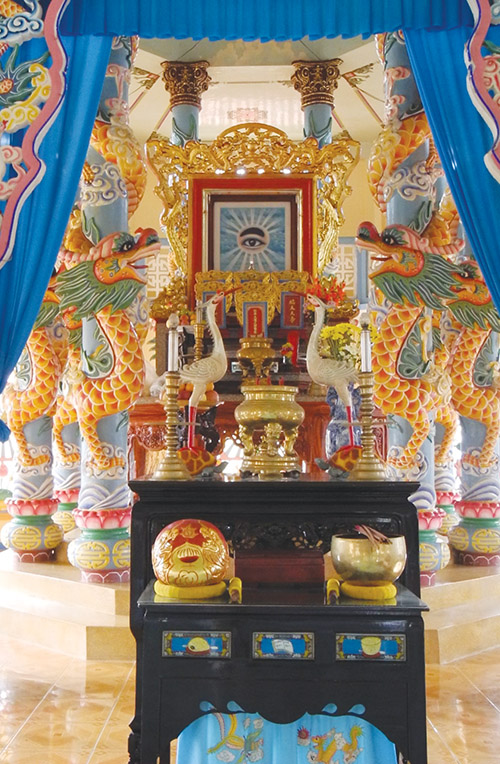
    Cao Dai altar

    The Black Lady Mountain dominates the landscape in Tay Ninh City, about two hours drive from Ho Chi Minh City. Perhaps it is no accident that from this extraordinary place emerged the Cao Dai religion, Vietnam’s greatest indigenous religious experiment and one that has fascinated authors and observers ever since it first emerged in the 1930s.

    Cao Dai means High Tower, which is one of their names for God. This extravagantly colourful, hierarchically structured religion was founded by a group of men experimenting with automatic writing. It has always captured the imaginations of visitors, and Graham Greene wrote about it in his book about Vietnam, The Quiet American. The Cao Dai Holy See at Tay Ninh sits in the shadows of Nui Ba Den, and the population of this city of over one million people is almost exclusively of that religion.

    The Cao Dai faith reveres all religions and hopes that one day humanity will be united. Their shrines feature a central image of a single eye, which represents the all-seeing eye of a universal God. Followers of Cao Dai are strict vegetarians, and the Cao Dai elder priests wear brilliantly coloured robes that signify the branch in which they are reincarnated – Buddhist, Taoist or Confucian. The Cao Dai religious structure is based on the Catholic Church, with popes, cardinals, a holy city and saints – some of their saints include Victor Hugo, Sun Yat Sen, the Virgin Mary and Kuan Yin. There is only one God in Cao Dai, and he/she overlooks all people, regardless of what religion they profess. Their scriptures say: “we all know there is something over our heads.”

    But, of course, Buddhism is the principal religion of Vietnam, and is represented in a surprising number of varieties. The Buddhist nuns and monks of Vietnam are a huge unpaid workforce that is the spiritual powerhouse of the nation. Almost alone they represent the only social welfare structures that exist in the country. They care for the orphaned, the sick, the elderly and the disabled, and temples operate as community welfare and meeting centres.

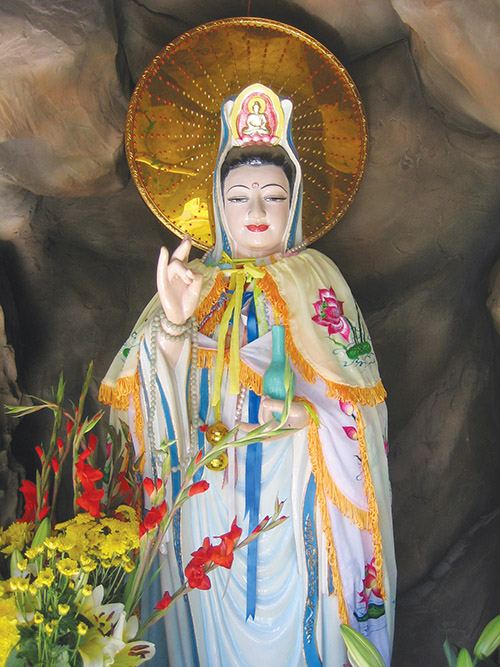
    Kuan Yin

    Vietnamese Buddhism, noteworthy for its laid-back character, has become something of a successful religious export. The second-most-famous Buddhist in the world is Vietnamese Zen Master Thich Nhat Hanh, and he has established monasteries and meditation groups across the Western world. He has also written numerous best-sellers and has appeared on Oprah.

    There is, too, a very old reverence for Confucius and the Confucian tradition in Vietnam. The Temple of Literature in Hanoi – constructed in 1070 – was an early Confucian University. It is evidence of the Vietnamese reverence for learning, and the grounds of the temple feature carved stone turtles with steles on their backs recording the names of graduates from 1484–1788. These were recently declared special objects of protection by UNESCO.

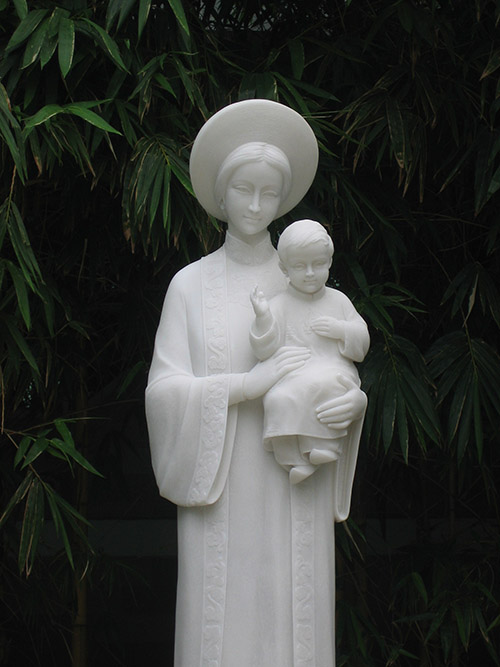
    Our Lady of La Vang

    Kuan Yin, the Buddhist Goddess of Mercy, or Bodhisattva of Compassion, is one of the most popularly revered religious figures in Vietnam. Indeed, her images are so ubiquitous that she might seem to be the great patron saint and protector of the Vietnamese people. Her name (Quan The Am in Vietnamese) means “The Hearer of All the World’s Cries.”

    Shrines to her are to be found everywhere, in people’s houses, on streetsides and, of course, at temples. She embodies the qualities of compassion and unconditional love. Vietnam’s culture has a great reverence for the mother, and people indulge in a great deal of devotion directed toward this Divine Mother – one of her appellations is Me Hien, the Gentle Mother.

    Interestingly, for Vietnamese Catholics (a sizeable minority, particularly in the South), there is another Vietnamese mother who is greatly revered. This is Our Lady of La Vang, an apparition of the Blessed Virgin Mary that appeared to the Vietnamese Catholic faithful during a period of religious repression during the 18th century. Her beautiful form – representing the Madonna and Child as entirely Vietnamese, in traditional dress and often rendered in white marble or plaster, just like Kuan Yin – is to be seen all over Vietnam.

    [alert type=”general” dismiss=”no”]Image credits: Di Lac Phat, Kuan Yin & Our Lady of La Vang by Walter Mason; Cao Dai altar Franzfoto[/alert]

    [alert type=”general” dismiss=”no”]This article was published in New Dawn 148.[/alert]

    [alert type=”success” dismiss=”no”]If you appreciate this article, please consider subscribing to help maintain this website.[/alert]

    © New Dawn Magazine and the respective author.
    For our reproduction notice, click here.
  • Windows to the Sacred: Occult Art in Australia

    Windows to the Sacred: Occult Art in Australia

    From New Dawn 133 (Jul-Aug 2012)

    I think contemporary art is a myth. It’s like a fashion, there’s only ever been one idea in art, all the arts deal with it, and you have to look beyond fashion to see it…. The question of life and death?… Exactly, Gauguin’s old question.
    – An interview with Damien Hirst, 20061

    For most people, the term ‘occult art’ tends to conjure up images of devils, demons, pentagrams, and obscure and shocking imagery far removed from what many see as acceptable and valid contemporary art. In an industry which prides itself on being cutting edge, the mainstream art world remains largely distrustful and reasonably uneducated on occult art and all that comes with it, yet when one looks at its origins, one is actually looking to the origins of art itself.

    The term ‘occult’ means simply ‘hidden’, and is derived from the Latin, occullere, meaning to cover over, to hide, or conceal, and essentially occult art is Man’s search for hidden knowledge of himself and his place in the universe. Removed from the usual commercial modes of contemporary art, it has heavily influenced major movements including Symbolism and Surrealism, and often the process of creating work is more important than the result.

    Occult art is an exploratory practice for divining, decoding, re-visioning, and re-reading the human condition and takes us beyond the screen of our everyday senses to evoke a dimension of creativity operating powerful archetypal images and symbols. Hidden deep in the psyche are concepts which can be both enlightening and terrifying, and many artists have been able to uncover these worlds via trance, meditation or comparable methods, gaining an insight into the unbounded potential of human creativity and the range of positive and negative impulses which dwell within us all.

    Origins

    Art as a pure spiritual pursuit has its origins in early human evolutionary prehistory. Scientists have put forward that along with various forms of rhythmic expression such as dancing and singing, visual art developed very early in human evolution by the forces of natural selection in order to reach an altered state of consciousness.2 Researcher Joseph Jordania wrote recently that in this state, early humans lost their individuality, and acquired a “new collective identity, where they were not feeling fear or pain, and were religiously dedicated to the group interests, in total disregards of their individual safety and life.”3

    Ritualistic actions involving heavy rhythmic music and movement coupled with body painting, were universally practiced in traditional cultures before hunting or military sessions in order to induce specific altered states of consciousness and raise the morale of participants.4 From the outset, art served a dual purpose of recording life, as in Palaeolithic cave drawings, and also as a spiritual and ritual practice reserved to achieved a specific end.

    With the invention of writing, along with the rise of the great civilisations of Egypt and Mesopotamia, the pictorial and ideographic system found an expression in the cuneiform script, which emerged circa 3500 BCE. In ancient Egypt hieroglyphic writing developed, with one of the earliest examples appearing on the Narmer Palette, circa 3100 BCE. Here the practice was formalised under the direction of the High Priest, the only one charged with commissioning the creation of artwork for the land, and often the only one allowed to read and write the sacred hieroglyphic symbols inscribed on ritual objects and public monuments. The high arts of writing, painting and magic were inextricably linked and presided over by the same deity, Tahuti or Thoth (the Greeks later equated Thoth with Hermes). Tahuti maintained the balance of good and evil within the universe, stood with Maat as one of the two deities on either side of Ra’s boat, was the judge of godly disputes, judge of the dead and keeper of all secrets of arts and magic.5

    Artistic practice during this period was a function reserved for the initiate as a communion with the sacred. This line of practice continued throughout the following period into the classical era where temples and divinatory statues were designed in keeping with universal geometry based on star patterns, earth lines and the movement of the Sun.

    Modern Manifestations

    Occult art provided windows to the sacred for both the initiate and the non-initiate to reach the divine, but never entered the public gallery system until the Salon of the Rose-Croix, a series of six art and music salons hosted by Joséphin Péladan in 1890s Paris. These were followed by various underground exhibitions throughout Germany and Europe in the 1930-1940’s.

    The genre entered the domain of the critic during the 1960’s when art historians began looking deeper into this forgotten spiritual and mystical explanation for the modern art avant-garde. In Germany, Otto Stelzer looked to the early Symbolist origins of abstract art, while Sixten Ringbom researched how occultism had inspired painters such as Wassily Kandinsky.6 In America, Robert P. Welsh presented the theosophical influences of Piet Mondrian7 and Rose-Carol Washton Long illustrated hidden images within Kandinsky’s greatest works.8 In 1984, Robert Rosenblum drew his own conclusions from these new discoveries in proposing a Northern Romantic tradition leading directly from Caspar David Friedrich to Mark Rothko, taking in on the way the cosmogonies of William Blake and Philipp Otto Runge, Vincent Van Gogh’s quest for religious truth and Mondrian’s transcendental abstraction.9

    Over the following years, major exhibitions devoted to the spirituality of the artistic avant-garde were organised in Germany, the Netherlands and the United States, with the best-known and most important of these – directly inspired by these new art-historical researches – being The Spiritual in Art: Abstract Painting, 1890-1985. Opening in November 1986, the exhibition presented 257 works by 95 artists, and inaugurated the new wing at the Los Angeles County Museum of Art. Taking its title from a famous essay by Kandinsky, the curator, Maurice Tuchman, proposed that Abstract Art be reviewed through the modes of occultism, mystical thought, Theosophy and Anthroposophy. The exhibition opened with a substantial selection of Symbolist works including works by Gauguin, Redon and Ranson, along with occult and mystical books from the 17th to the 20th century, leading on to the principal rooms devoted to five pioneers of abstraction: Kandinsky, Kupka, Malevich, Mondrian and Hilma af Klint.

    The staging of such a major exhibition in a high profile museum achieved a great deal in bringing the occult roots of contemporary art to public awareness, and paved the way for the innovative and highly attended 2008 exhibition at the Pompidou Centre in Paris entitled, Traces du Sacre. Its aim was to address more than a hundred years of art’s response to what Max Weber diagnosed as “the disenchantment of the world,” and what the curators call the “irrepressible need for spirituality.” A broad selection of paintings, sculptures, installations and videos brought together some 350 major works by almost 200 artists of international renown.

    Across twenty four thematic sections, the exhibition looked at art history from the late nineteenth century to the present day, showing contemporary pieces alongside Romantic and Modern works and so bringing out the continuing importance of the question of the sacred in the art of the present day.10 The exhibition included works by de Chirico, Brancusi, Caspar David Friedrich, and Eduard Munch alongside spiritual works by Wassily Kandinsky, Frantisek Kupka, Piet Mondrian, and those by iconic magicians Aleister Crowley and Austin Osman Spare. A highlight of this exhibition was the satellite showing of The Nightmare Paintings by Aleister Crowley at the Palais de Tokyo. Sixteen never before seen works were exhibited to the public, all of which were painted during the artist’s creation of the infamous Abbey of Thelema in Sicily.

    Australian Manifestations

    The fascination of Australian culture with the occult is something unique and enduring. The writer Keith Richmond wrote,

    In the late nineteenth century Australians welcomed Theosophy and Spiritualism with a zeal surpassing that of most other nations, and during the First World War local interest in the occult reached such a level that for nearly two years one Sydney newspaper was able to run a column in which it satirised a different occult group (and sometimes a number of them) every week.11

    Along with Richmond, writers such as Neville Drury did much to create a dialogue on occult art in Australia during the seventies and eighties. Drury is credited with the first serious overview of occultism in Australia with his 1980 book co-authored by Gregory Tillet, Other Temples, Other Gods, that featured, in particular, the forgotten Sydney artist Rosaleen Norton.

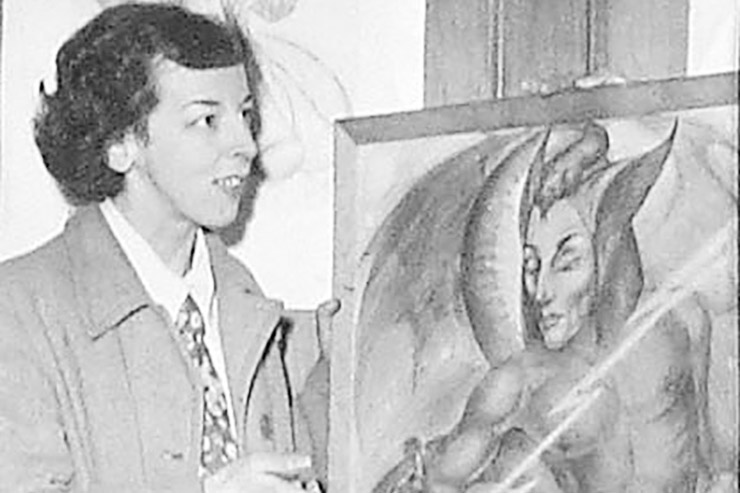
    Dubbed the “Witch of Kings Cross” by the popular press, she remains without doubt the most famous Australian occult artist. Born in Dunedin, New Zealand in 1917, Norton moved with her family to Sydney in 1924, where they established themselves in the middle-class suburb of Lindfield. Norton was expelled from the Church of England Girls’ School, Chatswood, at the age of 14 for producing ‘depraved’ drawings of vampires, ghouls and werewolves thought likely to corrupt the other girls. She later studied for two years at East Sydney Technical College.

    A key influence on the young Norton was her lecturer George Rayner Hoff. A skilled sculptor, he is credited as transforming the face of Australian sculpture in his adoption of art deco principles and redirecting monumental statuary in Sydney towards classicism. In 1919, Hoff began studies at the Royal College of Art, London, under the professor of sculpture Francis Derwent Wood. He exhibited two sculptures at the Royal Academy Summer Exhibition in 1920 and one in 1922. He won the Prix de Rome scholarship in 1921 and was awarded the Royal Society of British Sculptors’ diploma in 1923. After meeting the Australian architect Hardy Wilson at Naples, and discussions with Derwent Wood in London, he accepted appointment as teacher of drawing, modelling and sculpture at East Sydney Technical College in May 1923 and reached Sydney in August.

    Joining the Society of Artists, Sydney, in 1924, Hoff served on its executive and became a force for liberal ideals combined with stylistic moderation in art. The medal for the Society of Artists was created by Hoff in 1924. Later he produced, among others, the Sir Peter Nicol Russell memorial medal for the Institution of Engineers, Australia (1927), the Sir John Sulman medal for the Institute of Architects of New South Wales (1932) and the contentious Victorian centenary medallion (1934). He showed sculpture regularly with the Society of Artists, the Victorian Artists’ Society and the Australian Sculptors’ Society. He entered various official and prize exhibitions, and was awarded the Wynne prize in 1927.

    The most significant contribution Hoff made was his large-scale sculpture for various buildings and public memorials: he produced the large reliefs of the war memorial at Dubbo, New South Wales, in 1925, the figures for the National War Memorial, Adelaide, in 1927-31, and the more numerous and controversial sculptures for the Anzac Memorial, Sydney (made with the aid of students and assistants) in 1930-34. Hoff was also responsible for fine decorative reliefs in the now demolished Liberty Theatre (1934) and Hotel Australia (1934-35). He began work on the King George V Memorial, Canberra, in 1936, which was completed posthumously by John Moorfield. He also interestingly created the famous “lion and stone” logo for Holden Motors in 1928, based on a prehistoric fable, in which observations of lions rolling stones led to the invention of the wheel.

    At East Sydney Technical College Hoff taught drawing and sculpture, and amongst his students were Norton, James Gleeson and many others who both revered and imitated him – and were particularly inspired by his openly pagan approach to creation. Along with Norman Lindsay and Kenneth Slessor, Hoff pioneered the pagan movement known as “heroic vitalism” which was entering the mainstream of early twentieth century Australian art. The early works of James Gleeson shows elements of this approach in depicting an overtly sensual and writhing landscape dotted by idealised male figures.

    Norton no doubt would have seen first hand the vilification of Hoff’s friend Norman Lindsay and his flight from Australia in 1931 under the continual backlash against what were considered his “pornographic and occult artworks.” In response, Lindsay wrote in 1920:

    To whom does one offer the gift of a thought? To him who already thinks it. The mission of the thinker is not to enlighten, but to confirm. The material for enlightenment is already there, like a piled-up beacon; the new thought is but a spark that sets it alight. Anger at the stupidity of common minds is foolish, save in youth, when it is a stimulus. Yet all high minds wish to offer the gift of thought to mankind, and because it is rejected they become bitter. But gold is no use to a savage. He prefers iron, which is useful to him. And here the savage is wise. One cannot blame the common mind, because it seeks common thoughts – vulgar utilities – for these things help it. If the common man is also able to catch a little at higher thoughts, so much the better; but he has caught something in passing not addressed to him. The message of the Creative Effort is to him whose mission is to carry on the Creative Effort.12

    Hoff’s sculpture in contrast, while remaining robustly erotic, was never prurient, embodying a neo-paganism different in quality and kind from Lindsay. His work, Idyll: love and life in the collection of the Art Gallery of NSW, “might be described as chaste, despite the languor of its poses.”13 His work was softer and less obvious but held the same ideals. For many years he managed to avoid public outcry until later in his years. In 1932, he was embroiled in controversy with the Catholic Archbishop Kelly, the Master Builders’ Association of New South Wales, and the local chapter of the Royal Australian Institute of Architects over the morality of the form and symbolism of the Anzac Memorial Group ‘Sacrifice’, ‘Crucifixion of Civilisation’ and ‘Victory’. He was also attacked over his design of the Victorian centenary medal in 1934 for its depiction of a Ram’s head as the central motif.

    Rosaleen Norton

    Amongst the basics of art technique, Hoff would have shown Norton that art has the potential to make the artist a significant target to the public, a warning most likely lost on the young artist at the time. Despite her admiration for Hoff, Norton generally found it hard to take direction and preferred to follow her own path rather than the set college curriculum.

    In December 1933, whilst still at college, she submitted the first of three short stories to Smith’s Weekly that immediately drew the admiring attention of the editor Frank Marien. He saw promise at the author’s “vivid imagination” that was “quite beyond the ordinary,” and offered Norton a cadetship as a writer and illustrator. However, her graphic illustrations were deemed too controversial, and soon she lost the job. From there, Norton’s life took many turns, punctuated with high profile legal cases and often vehement vindication by the media.

    Her focus throughout her time remained on the core principle of developing and exhibiting her art and magical practice. However, the art world in Australia was generally far from responsive to Norton, and she found it all but impossible to have work accepted by any serious galleries. The dubious honour of being the first Australian artist to have her work seized by the government did little to help, and the book on her art, The Art of Rosaleen Norton, was also banned. Unable to reach a wider audience and forced to find some sort of income, Norton had to rely on selling her paintings to friends and acquaintances, and found it impossible to rid herself of the ‘Witch’ image. She died on 5 December 1979, at the age of sixty-two, having spent the last few years of her life as a semi-recluse. In 2000, an exhibition of Norton’s paintings was held in Kings Cross, Sydney, organised by writer Keith Richmond, and artist/curator Barry William Hale.

    It was not until the early 1940s that Norton began to seriously study the occult, starting with Eastern and theosophical texts, and slowly moving to the Western esoteric tradition, practicing Ritual Magic, and studying the texts of Aleister Crowley, Eliphas Levi and Dion Fortune. She became an active proponent of sex magick, and made regular use of drugs in her ceremonies, all of which contributed to Norton’s true lasting legacy, the techniques she developed to heighten her artistic perception. Through self-hypnosis she learned how to transfer her attention at will to inner planes of awareness in what could be termed “astral projection.” She wrote in her diaries that this practice “produced a number of peculiar and unexpected results… and culminated in a period of extra-sensory perception together with a prolonged series of symbolic visions.”

    In an interview conducted with Norton at the University of Melbourne in 1949, she explained further:

    I decided to experiment in self-induced trance, the idea being to induce an abnormal state of consciousness and manifest the results, if any, in drawing. My aim was to delve down into the subconscious mind and, if possible through and beyond it. I had the feeling (intuitional rather than intellectual) that somewhere in the depths of the unconscious, the individual would contain, in essence, the accumulated knowledge of mankind; just as his physical body manifests the aggregate of racial experience in the form of instinct or automatic reaction to stimulus.

    In order to contact this hypothetical source, I decided to apply psychic stimulus to the subconscious: stimulus that the conscious reasoning mind might reject yet which would appeal to buried instincts as old as man, and which – I hoped – cause psychic ‘automatic reflexes’. (Religious cults use ritual, incense etc for the same reason.) Consequently, I collected together a variety of things such as aromatic leaves, wine, a lighted fire, a mummified hoof etc… all potent stimuli to the part of the unconscious that I wished to invoke. I darkened the room, and focusing my eyes upon the hoof I crushed the pungent leaves, drank some wine, and tried to clear my mind of all conscious thought. This was a beginning (and I made many other experiments which were progressively successful).

    Following a surge of curious excitement, my brain would become emptied of all conscious thought: my eyes would shut, and I was merely aware that I was drawing on the blank sheet of paper in front of me… I seemed while experiencing a great intensification of intellectual, creative and intuitional faculties, to have become detached in a curiously timeless fashion from the world around me, and yet to be seeing things with a greater clarity and awareness than normally…

    Through these practices, Norton came to have a special reverence for the pagan deity Pan, regarding him as, “Totality of All Being and the true God of the World and Overlord of the Balance of Nature.” Various manifestations of Pan became a regular feature of her painting from the late 1940’s to the time of her death. While she also depicted Lucifer, Baphomet, Hecate and other similar deities, Pan was a regular visitor to her trances and held a special place in her consciousness.

    According to Norton, the other gods only appeared to her in trance visions if it pleased them – they could not be conjured. Some of the magical entities appearing in her artistic works seem to be atavistic hybrids – half-human, half-animal and often naked – revealing the primeval aspects of humanity’s spiritual evolution. Neville Drury saw great similarities between Norton and the English occult artist Austin Osman Spare:

    There are distinctive parallels between Austin Spare and Rosaleen Norton. Both were influenced by witchcraft and the occult traditions of western magic, both utilised trance states, and both believed that the realm of the gods had its own intrinsic existence – the artist simply serving to manifest these archetypal energies by acting as an inspired channel. It is also interesting that both employed mental focusing techniques – using sigils or specific physical objects to induce a state of trance. As in the Eastern forms of meditation which utilise “one-centredness of mind,” it seems that the focusing of intent is a valuable way of unleashing stored psychic energy.14

    Perhaps the most widely known occult artist, Austin Osman Spare died in 1956, similarly a recluse like Norton. In his younger days his work was applauded by the artistic establishment, until in the 1920’s he ceased showing commercially and returned to his native East End and created works almost entirely as part of his magical practice. He is particularly noted for his automatic drawing where images manifest through the artist, rather than being consciously devised. This was a practice inspired by the Surrealists of the early 1920’s who believed that art accessed through the unconscious or subconscious was more “real” or “true” than rationalist art works.

    Surrealism’s initial proponent was Andre Breton, who during World War I, served in a neurological hospital where he used Freud’s psychoanalytic methods with soldiers suffering from shell shock. After returning to Paris to find many of the local writers and artists scattered, he joined the anti-art movement, Dada, and started the literary journal Litterature. Along with other writers, he began experimenting with automatic writing, which was essentially a trance inspired form of spontaneous writing without self-censoring. He also started recording dreams in the same way and published them alongside the automatic writings in the journal. These works became the pointers for writers and artists across Europe to start looking to the unconscious and trance practice to create ‘true art’. Freud’s work with free association, dream analysis, and the unconscious became of utmost importance to the Surrealists in developing methods to liberate imagination and unlock the true creative mind. As Salvador Dali explained it: “There is only one difference between a madman and me. I am not mad.”15

    Get the issue this article appears in

    The Australian Surrealist James Gleeson

    While not considered an esoteric or occult art form, Surrealism is saturated with occult ideals and practices all of which manifested openly in the work of its practitioners, and has maintained a central conceptual association between fine art and occult dialogues. The Australian father of surrealism, James Gleeson, was a skilled practitioner of trance technique in creating his unique landscapes, and influenced a great deal of contemporary occult and esoteric artists locally including Barry William Hale.

    Gleeson said that as a young artist, he caught the idea, “there existed a whole world behind what we see with our eyes, and my artwork became a way of finding and understanding that world.”16 At its heart Surrealism was an exploratory process demanding a level of mental discipline unlike any other of its day. The automatic drawings of James Gleeson remain full of insight, and up until his passing in 2008, he was at the height of his powers channelling the unconscious.

    A student at East Sydney Technical College around the same time as Rosaleen Norton, and also under Hoff, he discovered Dalí, De Chirico, Ernst and Magritte, but also Freud and Jung’s theories on the unconscious mind. His most famous work features writhing nightmarish landscapes, full of sometimes violent and disturbing imagery, ranging to serene and soft humanoid forms. The early paintings, it is said, made women faint, and at least one hysterical girl had to be escorted from an exhibition. The middle period of his life saw Gleeson better known as an art critic, author, poet and curator, until the age of 65, when he devoted himself to art full-time, and went on to produce more than 400 canvases. Unlike his contemporaries, who merely dabbled in Surrealism, Gleeson remained true to its philosophy until his death at the age of 92, securing his place as the Father of Australian Surrealism.

    This last phase of his artistic life is widely regarded as his most brilliant, yielding some truly monumental paintings, which Gleeson called “psychoscapes.” A key work, entitled Icons of Hazard, drew further dark inspiration from the atmosphere generated by 9/11 and the war in Iraq. One critic wrote of these works: “Representing an ineffable world in the furthest recesses of the human mind, these form an imaginary coastline, not of water, rock and sand, but a disturbing, organic morass of muscle, sinew, carapace, shell, hair and dripping membrane.”

    Another work that Gleeson suggested was amongst his most successful, The Wheel Has Come Full Circle, is a major study in what the artist described as the “great return.” A pure unconscious journey back to the source of life. Another entitled, A Moment in the Process depicts the glimpse “behind the curtain” to the world behind the world we see around us. An exceptionally talented draughtsman and painter, Gleeson never received the recognition he deserved, and his major 2004 retrospective, Beyond the Screen of Sight, was belated. Some blame his subject matter. While near-contemporaries such as Sidney Nolan and Russell Drysdale focused on Australian themes, Gleeson described the world of the imagination. On his passing, the director of the Art Gallery of NSW, Edmund Capon, said: “James saw into our inner soul.” More than any other Australian artist, Gleeson successfully mapped the unconscious and opened the doors for local curators, critics and museums to consider esoteric and occult art.

    This article includes a range of artwork, including a spread of Aleister Crowley paintings, courtesy of Buratti Fine Art. To view this, purchase the digital version of this magazine.

    Part 2 of this article, published in New Dawn 134, examines The contemporary Australian artists working in the occult tradition, including the work of Wolfgang Grasse, Norman Lindsay and Barry William Hale.

    [alert type=”general” dismiss=”no”]This article was published in New Dawn 133.[/alert]

    [alert type=”success” dismiss=”no”]If you appreciate this article, please consider subscribing to help maintain this website.[/alert]

    Footnotes

    1. Damien Hirst, The Death of God, Conversation Between Damien Hirst and Hilario Galguera, 2006, 11
    2. Joseph Jordania, Why do People Sing? Music in Human Evolution, 2011, 98-102
    3. Ibid.
    4. William McNeil, Keeping Together in Time: Dance and Drill in Human History, 1995, Cambridge: Harvard University Press
    5. Budge, The Gods of the Egyptians Vol. 1
    6. Sixten Ringbom, Occult Elements in the Early Theory of Abstract Painting, 1966; Sixten Ringbom, The sounding cosmos: a study in the spiritualism of Kandinsky and the genesis of abstract painting, 1970
    7. Robert P. Welsh, PIET MONDRIAN 1872-1944, 1966
    8. Rose-Carol Washton Long, doctoral thesis on the hidden images in Kandinsky, 1972
    9. R. Rosenblum, Modern Painting and the Northern Romantic Tradition, 1984
    10. Traces du Sacre, Editions du Centre Pompidou, Paris 2008
    11. K. Richmond, The Occult: An Exhibition of material from the Monash University Library Rare Book Collection, Monash University, 1998
    12. N. Lindsay, Creative Effort: An Essay in Affirmation, 1920, Art in Australia, Sydney
    13. Art Gallery Handbook, 1999, Art Gallery of NSW
    14. N. Drury, Three Magical Artists: Austin Spare, Rosaleen Norton & H.R. Giger, 1984
    15. S. Dali, Diary of a Genius, quoted in The Columbia World of Quotations, 1996
    15. R. Buratti, Interview with James Gleeson, 2006

    © New Dawn Magazine and the respective author.
    For our reproduction notice, click here.
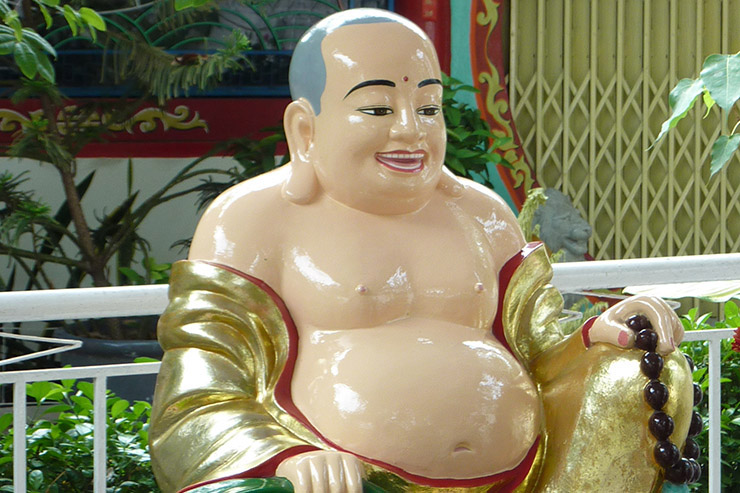
  • A Lucid Look at Lucifer

    A Lucid Look at Lucifer

    From New Dawn Special Issue 10 (Dec 2009)

    We have to literarily, philosophically and theologically deconstruct certain concepts before we can really understand them. This is a process where we look beneath and beyond the commonly assumed folklore.

    Some readers may think Lucifer is a clearly designated biblical character, the same figure as Satan. Lucifer is the fallen angel in the Bible, in the Book of Genesis. Right? Of course, the answer is no on all counts.

    Surprisingly, the word Lucifer appears only once in the Bible in Isaiah 14:12, translating the Hebrew word helel meaning shining one. In the Greek Septuagint translation, it was rendered as heosphoros (Ηωσφόρος) or light-bearer. This word comes from Hesperus, a Greek goddess of the dawn. When the Romans took over the Christian scriptures in the 300s, Jerome translated helel and heosphoros as Lucifer in his Latin Vulgate Bible. Whether in old Hebrew, Greek or Latin, the word was the common name for Venus, the brightest planet, the Morning Star, the Light-Bearer, the Day Star. So in the real meaning of Isaiah 14:12, Lucifer merely describes the vainglorious image that the arrogant King of Babylon would seek to affect.

    Some Protestant translations from John Wycliffe and others followed the Vulgate. But the respected Protestant biblical exegete Matthew Henry (Matthew Henry’s Commentary, 1721) says nothing about Lucifer being Satan, focusing on the real meaning of the text, which has to do with the nation of Babylon and its rulers who oppressed the Old Testament Hebrews.

    It goes without saying that a simple internet search will bring up mountains of material to the contrary, supporting the “traditional” view that Lucifer is the fallen angel, the Devil, the same as the Satan cited in Luke 10:18. But in truth, the very same term, Day Star, is also applied to the Christ himself in II Peter 1:19, Revelation 22:16, and in the ancient Latin Easter hymn, the Exultet.

    In an interesting coincidence, an early Christian theologian and bishop back in the 300s was named Lucifer, so it was obviously not a negative name back then. What’s more, I’m pretty sure Jerome would have known of him since they were contemporaries in the early Church.

    In some ways, the personification of Lucifer as Satan is crucial to certain versions of Christianity. Otherwise, if the so-called Fall of Lucifer does not account for the origin of Satan, then the Old Testament is silent on the matter. Regardless of that, only a few Bible versions follow Jerome’s translation. Early Protestants differed. The English King James version used Lucifer, but Martin Luther’s German translation did not. When Luther was in seminary, he studied the Vulgate, so he purposefully differed from Jerome by not using Lucifer. We begin with the King James version:

    “How art thou fallen from heaven O Lucifer, son of the morning? How are thou cut down to the ground which didst weaken the nations!” (Isaiah 14:12, King James version)

    “Quomodo cecidisti de caelo Lucifer, qui mane oriebaris corruisti in terram qui vulnerabas gentes?” (Jerome’s Latin Vulgate)

    “O Lucifer who didst rise in the morning! How art thou fallen to the earth, that didst wound the nations!” (Douay Rheims English translation of the Vulgate)

    “Du schöner Morgenstern.” (You beautiful morning star.) (Luther Bible)

    “O morning star, son of the dawn!” (New International)

    “O Day Star, son of the morning.” (Revised Standard)

    “Bright morning star.” (New Revised Standard)

    “O Day Star, son of Dawn!” (New English Bible)

    “O star of the morning, son of the dawn!” (New American Standard)

    Lucifer or Dawn or Venus is also a figure in ancient Canaanite mythology, having nothing to do with Satan or an evil.

    The dwelling of the gods and the riding of the clouds are both known to us from the Ras Shamra texts at Ugarit in N. Syria, and so too is Dawn a deity, of whom this figure is described as a son. The most high is Elyon, the title so often used of God…. All these elements may be paralleled in the Old Testament, suggesting how richly Canaanite religion and mythology have influenced Old Testament thought. (Interpreters One Volume Commentary of the Bible, 1971)

    Old and new reference sources tell us more:

    Lucifer Isa. 14:12. This word, signifying light bearer, occurs but once in our Bible, and then applies to the king of Babylon to indicate his glory as a morning star, or figuratively, a son of the morning. Tertullian and some others suppose the passage to relate to the fall of Satan; and hence the term is usually applied in that way; though, as it seems, without specific warrant. (The Union Bible Dictionary, 1842)

    Its application, from St. Jerome downwards, to Satan in his fall from heaven, arises probably from the fact that the Babylonian Empire is in scripture represented as the type of tyrannical and self-idolizing power, and especially connected with the empire of the Evil One in the Apocalypse. (Smith’s Bible Dictionary, 1884)

    In spite of this rendering, the proper name ‘Lucifer’ is not in the original Hebrew text. In Hebrew ‘Lucifer, son of the morning’ is helel ben shachar. It could be translated ‘shining one, son of the dawn.’ It is not a proper name, but an epithet for the king of Babylon. (Bryan Knowles, ‘Who Is Lucifer?’, www.godward.org)

    Hence, Jerome’s use of Lucifer as a capitalised proper name is not correct. The Roman Church concocted the Lucifer-as-Satan myth after they took over emergent Christianity in the early 300s, as evidenced by references to both Tertullian and Jerome.

    If Lucifer is so important, why is nothing else ever said? Light Bearer, Morning Star; nothing negative about that. Lucifer not only does not mean anything negative, as a matter of fact, it doesn’t really seem to mean anything at all, biblically speaking. Out of the over 800,000 words in the Bible and the Apocrypha, Lucifer appears once, and then in an ambiguous reference. Whatever the word means to certain Christian sects, theosophical and metaphysical groups, or secret societies, as you can clearly see it does not come from the Bible!

    The Pagan Origins of Satan

    Satan (Hebrew ha-Satan, in Arabic Shaitan) translates as adversary or accuser. In all three Semitic religions, Satan refers to the opposite of the good god, or the so-called Devil. This is, of course, a direct transplant from Persian Zoroastrianism into the ancient Hebrew religion and then into the Talmud, Kabala, the New Testament and lastly in the Qur’an. Zoroastrianism poses two gods, one responsible for good and another responsible for evil. The polyglot god traditions found in Genesis reflect this Persian pagan influence.

    For some, the image and persona of the Satan is quite fascinating, indeed, perhaps even noble. As readers of English literature know, John Milton addressed this theme in his famous 1667 poetic magnum opus, Paradise Lost. Consider the following hypothesis, based on the multiple Semitic deities portrayed in Genesis.

    El in Egyptian is also the Child, who in the early Sabean age, was Sut, the planetary type, Saturn. Later El was transformed into Satan, whom Job introduces as one of the sons of god. Satan was accounted a son and an Angel of God by all Semitic nations. The learned Kabalist, Eliphas Lévi, speaks of Satan thus:

    ‘It is the angel who is proud enough to believe himself god; proud enough to buy his independence at the price of eternal suffering and torture; beautiful enough to have adored himself in full divine light; strong enough to reign in darkness amidst agony, and to have built himself a throne on his inextinguishable fire.’

    He further says that the true name of Satan is that of Jehovah reversed, for Satan is not a black god but the negation of Deity. The Devil of the early Christians, with horns, hoofs and tail was introduced from Babylon through the Jewish Talmud. The Christian religion transforms Satan into an enemy of God, whereas in reality by Satan the highest divine spirit or Occult Wisdom on earth is meant. (E. Valentia Straiton, Celestial Ship of the North)

    Eliphas Lévi explains the symbolism of Lucifer:

    What is more absurd and more impious than to attribute the name of Lucifer to the devil, that is, to personified evil. The intellectual Lucifer is the spirit of intelligence and love; it is the Paraclete, it is the Holy Spirit, while the physical Lucifer is the great agent of universal magnetism. To personify evil and exalt it into an intelligence which is the rival of God, into a being which can understand but love no more – this is a monstrous fiction. To believe that God permits this evil intelligence to deceive and destroy his feeble creatures is to make God more wicked than the devil. By depriving the devil of the possibility of love and repentance, God forces him to do evil. Moreover a spirit of error and falsehood can only be a folly which thinks, nor does it deserve indeed the name of spirit. The devil is God’s antithesis, and if we define God as He who is we must define His opposite as he who is not. (Eliphas Lévi, The Mysteries of Magic)

    Alexander S. Holub in his The Gospel Truth: The Heresy of History (2004), notes:

    The Yahwists and Elohists reflected a very early stage of the Israelite religion. This is when it was still essentially a nature/fertility religion much the same as the other pagan religions of the same time and region. It contained things like angels (in the text called Elohim), talking animals, dreams, and the idea of an anthropomorphic deity. This deity brought forth both good and evil as any anthropomorphic deity does. There was no Satan to bring the natural disasters. It was God. It was God also when (he was) displeased with someone simply ‘removed’ him by taking his life. So it was necessary to propitiate and worship this deity in order not to anger him in any way. It was later, after the Babylonian ‘captivity’, that this God became patient, just, and merciful, just like [the Zoroastrian good god called] Ahura Mazda.

    When we deconstruct the words, symbols and images, it turns out that Lucifer-Satan-Devil, the source of all evil, is originally neither a Hebrew, Christian nor a Muslim concept, springing directly from much earlier Persian pagan roots. Naturally, all this biblical revisionism is not popular with the priests and preachers. If they couldn’t scare you with Lucifer, the Devil and visions of burning with Satan in Hell, there might be fewer donations. We can’t have that!

    Lucifer in Theosophy and Secret Societies

    Now that we understand more about the real origins of the word as misused in the Vulgate Bible, we see that various metaphysical groups, Illuminati orders and secret societies essentially created their own deity centred on the image of Lucifer as Light Bearer. Madame Blavatsky, like Eliphas Lévi, said the Holy Spirit and Lucifer are the same entity.

    Lucifer, or Luciferus, is the name of the angelic Entity presiding over the light of truth as over the light of day… to the profane [the uninitiated] the Astral Light [universal Soul, the Matrix of the Universe] may be God and Devil at once…. Lucifer is divine and terrestrial light, the “Holy Ghost” and “Satan” at one and the same time…. The Fall was the result of man’s knowledge, for his “eyes were opened.” Indeed, he was taught Wisdom and the hidden knowledge by the “Fallen Angel”…. And now it stands proven that Satan, or the Red Fiery Dragon, the “Lord of Phosphorus,” and Lucifer, or “Light-Bearer,” is in us: it is our Mind – our tempter and Redeemer, our intelligent liberator and Saviour from pure animalism. Without this principle – the emanation of the very essence of the pure divine principle Mahat (Intelligence), which radiates direct from the Divine mind – we would be surely no better than animals. (Helena Petrovna Blavatsky, The Secret Doctrine, 1888)

    For those wanting to explore beyond this, all the sources cited, and lots more, are not hard to find. Neither have we dealt with the myriad of modern belief systems called Satanism, yet another complex and diverse topic, but that will have to be at another time. For now, read the quotes on page 63 and see what the secret initiatic orders and their high adepts have to say about their god/demigod/demon-god/holy spirit.

    Get the issue this article appears in

    Lucifer in Summary

    Several conclusions present themselves. Firstly, the Lucifer of the Bible is a minor character at best, mentioned only once, not really standing out or signifying much of anything. The real character portrayed in the Isaiah text is an arrogant Babylonian monarch who oppressed the Hebrew people. Secondly, the mystical interpretations about Lucifer as Satan were added by Kabalistic rabbis, Catholic priests, Islamic mullahs, and Protestant preachers, all with clearly vested self-interests. Thirdly, various occult philosophers and metaphysicians explored and enlarged the Lucifer paradigm, creating an odd sort of god-demigod figure. Lastly, on the outer fringes of this magic and mysticism are the secret societies and Illuminati initiatic orders, especially Freemasons of one kind or another.

    Remember, there are secret lodges, degrees and rituals, unknown outside the upper level adepts of the Illuminati orders. Their peculiar Luciferian doctrines and dogma always have had and still do have a significant impact on world history and geopolitical affairs. Not so much because of the rituals themselves, but because of the people who practice this strange cultic religion. Like any belief system, its dogma and doctrines, its morals and values, colour the decisions made by its truly devoted believers. Certain ones are in very high positions in government, the churches and the social order.

    I hope some of you will continue your explorations into the occult underground and its impact on the world around us. If my deconstruction of the Lucifer legends and lore has been a literary Light Bearer, then let it be!

    [alert type=”general” dismiss=”no”]This article was published in New Dawn Special Issue 10.[/alert]

    [alert type=”success” dismiss=”no”]If you appreciate this article, please consider subscribing to help maintain this website.[/alert]

    © New Dawn Magazine and the respective author.
    For our reproduction notice, click here.