New Dawn – World's Most Unusual Magazine

Category: Secret Wisdom

  • The Magic & Mysticism of Eliphas Lévi: The Father of Modern Occultism

    The Magic & Mysticism of Eliphas Lévi: The Father of Modern Occultism

    From New Dawn Special Issue 10 (Dec 2009)

    The most influential figure in the centuries old story of Western magic and the Judaic Kabala (“the receiving”) was neither a Jew by birth or conversion. That being said and further contributing to the confusion, he learned Hebrew in order to master Kabala and adopted a Hebraic name.

    The famous philosopher, metaphysician and sorcerer has a magical seal containing his name. Seals are a vital part of ceremonial magic rooted in the Kabala, and greatly popularised through the works of our protagonist. Those who follow Kabalistic numerology and gematria see that his name is spelled differently on the seal, thus changing its magical meaning.

    Eliphas Lévi is one of the most important figures in magical theory and practice during the nineteenth century metaphysical literary renaissance. He probably coined and certainly popularised the modern usage of the word occult.

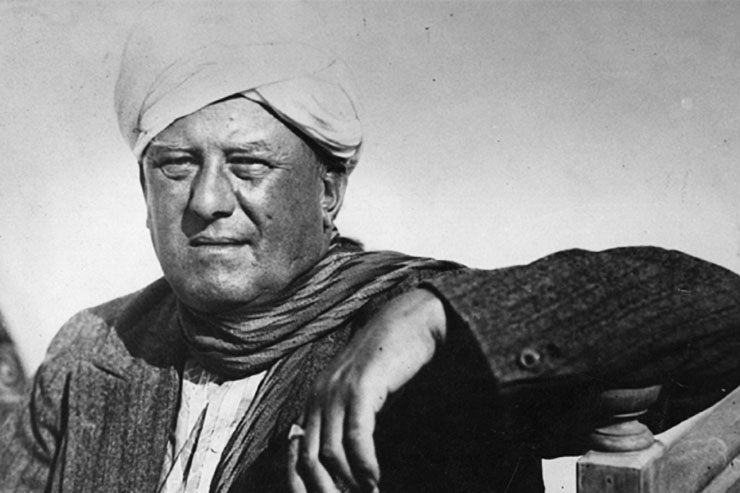
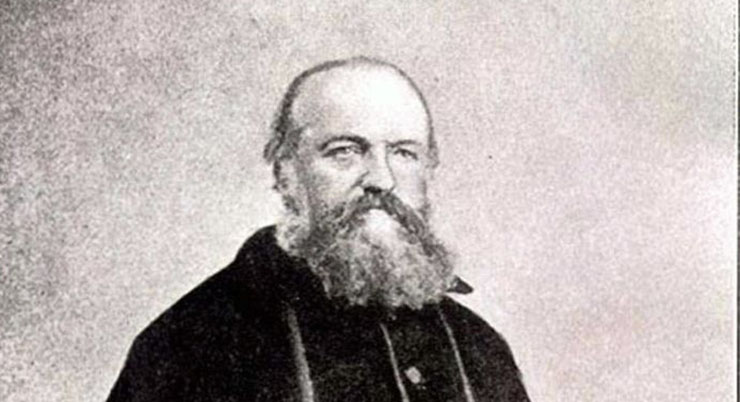
    While some say he was a Roman priest who became a Jew (or vice versa), they are mistaken. Born a French Catholic and son of a modest shoemaker, Alphonse Louis Constant (1810–1875) trained to be a priest. But the precocious young man fell in love while in seminary. As a matter of fact, he had almost graduated, having already been ordained a celibate deacon. Because of this amorous affair, he was never ordained to the priesthood. Further confusing the issue, French newspapers often referred to him as Abbe Constant, since he spoke of spiritual matters and often wore black robes reminiscent of Catholic clerical garb. Even though rejected by the church, he did not give up Catholicism, writing Christian books and tractates.

    In 1846 at age 36, he married a girl half his age. They had a child who died shortly after birth, but produced no other offspring. The couple separated in 1853 when the younger woman fell in love with another man. Constant, apparently still observing some Catholic dogma, later had the marriage annulled.

    During the revolutionary era around 1848, he wrote some rather radical leftist political works, and spent two short terms in jail. It was only after this that he fully turned his mind and life toward spiritual and esoteric matters. New Age was not a term in vogue in his era, but through his work, the great majority of the teachings coming under this genre today have their roots in his writings.

    His esoteric and occult interests began when he was in seminary. One of his professors was quite interested in Mesmerism, Animal Magnetism and Spiritualism, and the young seminarian began exploring metaphysical literature and connecting with French occultists and mystics of the day.

    The intelligent young Parisian not only discovered and deeply adopted both European occultism and Hebraic Kabalism as his own faith, in a rather short time he became a major voice and influence. While he learned Hebrew and mastered Kabala as well as most of the mystical Hasidic rabbis, he did not formally convert to Judaism. But, as some converts do, Alphonse Louis changed names. His new moniker and nom de plume was a somewhat loose translation of his two birth names into Hebrew.

    His influence is still quite pervasive. Eliphas Lévi’s writings on mysticism and magic as well as his personal magnetism spoke boldly. His books are sometimes a bit arcane, but always thoroughly organised and presented in a clear and honest way, without the pretensions often found in such literature.

    After his marriage failed, he visited England in 1854. He quickly connected with British authors and occultists, being accepted into their social circles. While in the company of these spiritual and literary comrades, he wrote a profound work of higher metaphysics. His classic two volume Dogme et Rituel de la Haute Magie came out in 1855, but it was not until 1896 that it was translated by leading English occultist and writer Arthur E. Waite as Transcendental Magic, Its Doctrines and Rituals. Here is a short selection from the Introduction. As Lévi says, all magic utilises similar forces and rituals from primordial archetypal origins.

    Behind the veil of all the hieratic and mystical allegories of ancient doctrines, behind the darkness and strange ordeals of all initiations, under the seal of all sacred writings, in the ruins of Nineveh or Thebes, on the crumbling stones of old temples and on the blackened visage of the Assyrian or Egyptian Sphinx, in the monstrous or marvellous paintings which interpret to the faithful of India the inspired pages of the Vedas, in the cryptic emblems of our old books on alchemy, in the ceremonies practised at reception by all secret societies, there are found indications of a doctrine which is everywhere the same and everywhere carefully concealed.

    Who/What is Baphomet?

    Haute Magie is perhaps most famous for the image and hypothesis about the occult entity called Baphomet. This is exemplary of Lévi’s metaphysical revisionism. Before making a decision based on your immediate reaction to the graphic image, please read what Lévi said and my short comments.

    The goat on the frontispiece carries the sign of the pentagram on the forehead, with one point at the top, a symbol of light, his two hands forming the sign of hermetism, the one pointing up to the white moon of Chesed, the other pointing down to the black one of Geburah. This sign expresses the perfect harmony of mercy with justice. His one arm is female, the other male like the ones of the androgyn of Khunrath, the attributes of which we had to unite with those of our goat because he is one and the same symbol. The flame of intelligence shining between his horns is the magic light of the universal balance, the image of the soul elevated above matter, as the flame, whilst being tied to matter, shines above it. The ugly beast’s head expresses the horror of the sinner, whose materially acting, solely responsible part has to bear the punishment exclusively; because the soul is insensitive according to its nature and can only suffer when it materialises. The rod standing instead of genitals symbolises eternal life, the body covered with scales the water, the semi-circle above it the atmosphere, the feathers following above the volatile. Humanity is represented by the two breasts and the androgyn arms of this sphinx of the occult sciences.

    All of this had a direct effect on the symbology of modern occultism. It was Eliphas Lévi who wrote about the pentagram as a symbol for both good and black magic. The goat god Baphomet was incorporated into the inverted pentagram, making it a symbol of evil. Some neo-pagans disagree, pointing to the inverted pentagram as an earlier and more ancient Indo-European symbol. According to my understanding, they are correct. But even so, this does not distract from the brilliance of Lévi’s Baphomet paradigm and symbology, yet another major development in modern ceremonial magic (thaumaturgy) and occultism. As to any evil spirits or diabolic developments, in most cases we “magically” create our own reality. Hence, we create our own possessive demons as well! It seems Lévi understood this quite well.

    When one creates phantoms for oneself, one puts vampires into the world, and one must nourish these children of a voluntary nightmare with one’s blood, one’s life, one’s intelligence, and one’s reason, without ever satisfying them.

    Kabala and Tarot

    One of his major accomplishments was recreating and reinvigorating not only Western interest in the Judaic mysticism of the Kabala, but combining this with the powerful Tarot symbolism.

    Lévi proposed a close relationship between Tarot and Kabala. Some occultists and scholars of magic scoffed at this, saying he imagined the relationships he wrote about. Whatever the case, his speculation was prolific, well written, ongoing and long-lasting. In Haute Magie he wrote 22 chapters based on the 22 Major Arcana of the Tarot, matching each to one of the 22 letters of the Hebrew alphabet and all the accompanying myriad of Kabalistic symbolism. This was supplemented by a later work, Magical Rituals of the Sanctum Regnum. Many readers found all of this to be quite profound and intriguing, and as a result of his writings and teachings Tarot became an important tool in divination, Western magic and occultism.

    Both Tarot and Kabala are ubiquitous topics for New Age devotees of all sorts, not to mention a host of books, magazines, websites, DVDs, seminars and workshops. This did not just spontaneously pop up. Today’s fascination with Kabala and Tarot and all the accompanying symbolism is largely due to the groundwork of Eliphas Lévi.

    Eliphas Lévi and Christianity

    While many of his critics love to characterise him as evil, Luciferian and Satanic, a close reading shows that, in some ways, he never really turned all that far away from the basic Christian faith. This may surprise some readers, both Christians and occultists. Read from the Sanctum Regnum, beginning with words from its editor in the first paragraph below.

    The very curious manuscript volume, from which the preceding pages have been translated, concludes with a passage which appears to retract the whole of the foregoing instruction. It is a very notable illustration of the second mind of its author. Mr. Waite, who published an English translation of much that Lévi has written, has in his Preface called especial attention to the evidence that Lévi was drawn in a most mysterious fashion in two different directions by opposing forces. From his early training he tended to be a devout Catholic; from his Hebrew studies he became a Kabalist and a Magician. So even in this short occult treatise we find him, after carefully giving magical instruction through twenty-two chapters, making at its end a solemn recantation, and pointing out that the duty of a Christian is to the Church of Christ, which is the best and highest aim to which a man can attain….

    You will now need to learn the last secret of magical force and the final grade of human will power. It is Resistance to the Universal Attraction; this is the conquest of nature, it is the Royal Authority of Soul over Body – it is Continence. To have the power and opportunity to do what give pleasure, yet to abstain because one wills it; this shows the Royal power of Soul over body. Happy is the man who can be so placed, and yet so act: thus it is that the most sublime use of liberty is absolute obedience. Without obedience no society can continue to exist. This is why the Magi worshipped the Christ in the stable at Bethlehem. Christ, that son of God, greatest of initiates, and the last initiator.

    But Christ had, as all great teachers have had, one teaching for the people and also an esoteric doctrine. To John, the beloved disciple, he confided the deepest mysteries of the Holy Kabalah; and John in after years revealed or re-veiled them in his Apocalypse, which is indeed a synthesis of all earlier magical, prophetic, and Kabalistic works.

    The beauty of self-sacrifice is taught in the Church of Christ, Catholic and Roman; and it is an article of faith, that anyone who denies himself and takes up this cross, and follows the Mediator to the Altar, assumes at once the offices both of Priest and Victim.

    Glory be to the Christ, who has brought to their completion the symbols of the Ancient Mysteries, and who has prepared the reign of knowledge by faith. Will you now be greater than all Magi? Hide away your science in the recesses of your mind. Become a Christian, simple and docile; be a faithful servant of the Church, believe, mortify yourself, and obey.

    Well, if you’re feeling a bit confused, don’t feel alone. These are truly deep thoughts, whether you are a professed Christian or not.

    The Passing of a Sage and Savant

    The great magus and mystic passed away at age 65. It is said that he reconciled with the Roman Church while on his deathbed, and this may be so. Catholicism, especially when including a seminary education, does have a lifelong effect. Under a different set of circumstances, Alphonse Louis Constant might have become yet another happy and satisfied parish priest or perhaps even an important Catholic theologian. From a psychological standpoint, one might speculate that after he was alienated from the Roman Church, he then created his own religion in response.

    While quite influential during his lifetime, he was even more so after his departure. Eliphas Lévi was both an inspired and very inspiring writer, motivated by a strong inner spiritual force combined with a scholarly mind working to provide knowledge for those willing to receive it. While he did earn a living from his writings and his work as a consultant and ceremonial magician, he never earned a great fortune. Indeed as the case was, he died in poverty. As has been shown year after year, his readers are his sons and daughters, his successors and heirs. Their writings and speculations based on his groundwork have projected his philosophy well into the future.

    Maxims and Aphorisms

    If you have not yet read this author, rest assured there are many more jewels to be found. These are compiled from his various works.

    Every idle word is a fault.

    Show your learning by your actions.

    The Word is Life, and the First Principle of Life.

    The quality of a life is shown by its actions.

    An idle word is either without meaning or is of the nature of a lie.

    An idle word in religious matters is a sin.

    He who is content with idle words is as if he were dead.

    He who does not make his worship manifest has no religion.

    Better is superstition than impiety.

    God judges actions rather than vain thoughts.

    He who is religious will do works which accord with the Word of his religion; he who has no religion and believes not in any word, yet he also must be judged by his actions, for to every man shall it be according to his works.

    True religion is that which showeth a form of worship which is pure and living; the perfection of worship, however, lieth in self-sacrifice, which is complete and enduring.

    No man has ever seen the Light; but we see by reason of it those objects which reflect the light.

    There is nothing occult which shall not be known: there is nothing concealed which shall not be revealed.

    The Word is the garment of the Truth.

    To tell the Truth to those who cannot understand it is to lie to them. To unveil the Truth to such persons is to profane it.

    [alert type=”general” dismiss=”no”]This article was published in New Dawn Special Issue 10.[/alert]

    [alert type=”success” dismiss=”no”]If you appreciate this article, please consider a contribution to help maintain this website.[/alert]

    Bibliography

    Lévi was a very productive and prolific author. Below is a partial listing of his many works; some publication dates may vary. Almost all his books are in print or available online. A simple internet search will produce a myriad of results.

    Des Moeurs et des Doctrines du Rationalisme en France (Of the Moral Customs and Doctrines of Rationalism in France), 1839.

    L’Evangile du Peuple (The Gospel of the People) 1840.

    La Mère de Dieu (The Mother of God), 1844.

    Le Testament de la Liberté (The Testament of Liberty), 1848.

    Dogme et Rituel de la Haute Magie, 1855. A. E. Waite translation, Transcendental Magic, its Doctrine and Ritual, two volumes, 1896.

    Histoire de la Magie, 1860.

    La Clef des Grands Mystères (The Key to the Great Mysteries), 1861.

    Fables et Symboles (Stories and Images), 1862.

    La Science des Esprits (The Science of Spirits), 1865.

    Magical Rituals of the Sanctum Regnum, c.1870.

    Le Grand Arcane, ou l’Occultisme Dévoilé (The Great Secret, or Occultism Unveiled), posthumous, 1898.

    © New Dawn Magazine and the respective author.
    For our reproduction notice, click here.

  • The Vedic Literature of Ancient India and Its Many Secrets

    The Vedic Literature of Ancient India and Its Many Secrets

    This article was published in New Dawn Special Issue 8 (June 2009)

    Secrets of ancient humanity and lost civilisations can be found all over the world. Yet they are perhaps most common in India, where even today the spiritual practices of the ancient world continue with its characteristic regard for the sacred. The same type of temples with similar forms of ritual worship that were known in ancient Egypt, Babylonia, or Greece thousand of years ago still occur throughout India today from Badrinath in the Himalayas to the north to Kanyakumari in the south. Indeed, it seems that the ancient world never ended in India but has continually maintained and, at times, reinvented itself.

    Spiritual and occult arts such as abounded in the ancient world – including Yoga, Vedic astrology, Ayurvedic medicine and the use of rituals (Yajnas) to improve all aspects of our lives – remain commonly used and are honoured by the culture of India as a whole. We could say that India is a living museum of the ancient world and its lost civilisations.

    To understand the ancient world, it may be better to visit the holy places of India where the ancient traditions are still unbroken, rather than try to interpret ancient ruins through bricks and pottery shards, which scholars today usually do so according to their own modern mindsets, not recognising the all-pervasive regard for the sacred that was the basis of ancient life and culture.

    Most notably, ancient India presents us with by far the largest literature that has survived from the ancient world. The Vedic literature of India, by all accounts dating from well before the time of the Buddha (500 BCE) and by traditional accounts extending back well over five thousand years (3100 BCE), covers several thousand pages. This is with the four Vedas (Rig, Yajur, Sama and Atharva), their various Brahmanas, Aranyakas and Upanishads.

    The Vedas contain many ancient poems, commentaries, dialogues and teachings, of which the famous Upanishads and Bhagavad Gita – the bedrock of Indian philosophy and Yoga – represent only the last layer or a late summation. There is no comparable ancient literature remaining from any other country, much less an ongoing tradition of its interpretation and application according to both ritual and meditation.

    The Vedas are not directly concerned with history or with the mundane aspects of culture. Yet a mentioning of these does occur in a peripheral way in the texts. In the Vedas, we can find references to the names of peoples, places and to certain events. Beside the deep spiritual knowledge, there are indications of astronomical, mathematical and medical knowledge of a profound order. There are also indications of natural disasters like floods, earthquakes, the melting of glaciers and the shifting of rivers, with a cataclysmic sense of life based upon a long experience of Nature’s changes.

    Yet, even by way of understanding their spiritual side, it requires a deeper vision to appreciate the Vedas. The Vedas are composed in a cryptic ‘mantric code’ that cannot be understood without the proper orientation and right keys. Vedic mantras were said to have been cognised by great yogis and seers from the cosmic mind. They reflect a different type of language in which the higher truth is deliberately hidden in a veil of symbols, sacred sounds and correspondences. What may appear outwardly as a seeking of cows and horses, for example, can inwardly refer to a development of higher powers of the senses (cows) and pranas or vital energies (horses). In fact, Vedic words have many layers of meaning, of which the surface appearance can be misleading, particularly to the modern mind not used to such a multidimensional language. This is also a phenomenon that we find throughout the ancient world. The ‘Egyptian Book of the Dead’, for example, abounds in similar symbols that unless we can grasp the spiritual meaning, which few may be willing to look for, can appear quite superstitious.

    The Vedas say, “The Gods prefer the cryptic and dislike the obvious.” The higher powers speak in symbols, riddles, paradoxes or conundrums. The Vedas speak of four levels of speech, of which ordinary human beings only know and speak with one (Rig Veda I. 164.45). They refer to a Divine Word or imperishable syllable on which they are based (Rig Veda I. 164.39). They reflect a pattern of cosmic sound that underlies all the laws of the universe and has its counterparts on all levels of both individual and cosmic manifestation. For this reason, the Veda was called the Shruti, or ‘revelation’ behind the Hindu tradition.

    The Vedas speak of secret meanings to their mantras that were veiled to protect the teaching from its application by the spiritually immature. To receive the key to the Vedic mantras required years of work of ascetic practices, mantras, yoga, meditation, special initiations and the special favour of a teacher who knows the tradition and has realised the teaching in his own deeper consciousness. We cannot expect such cryptic mantras to unlock their secrets to a casual reading, particularly done in limited or bad translations in a language and mindset quite alien to the Vedic or ancient world view.

    Modern scholars, particularly from the West, have not been able to decipher this Vedic code. Most have not even recognised that it exists. This is not surprising because scholars have largely failed to understand the deeper meaning of the symbols of ancient Egypt, Sumeria, Mexico and other ancient cultures.

    Ancient cultures like India and Egypt were carrying on great traditions of spiritual and occult knowledge, not just the rudiments of technology, trade or empire building.1 Since modern scholars have little background in that spiritual knowledge, with its recognition of higher states of consciousness extending into the Infinite and Eternal, naturally they cannot find it in symbols in which it is specially encrypted.

    Scholars look upon the Vedas, just like the Egyptian religion, as little more than primitive nature worship, though the nature symbols like Fire in the Vedas have a vast cosmic symbolism and connect to the fire of the breath, the fire of the mind, the fire of consciousness and the Cosmic Fire through which the entire universe exists.2

    This failure to understand the ancient literature is often related to a failure to understand ancient archaeological ruins and their implications. Ancient sites abound in artefacts that reflect the same type of spiritual symbolism of the ancient literature. These are usually dismissed as fetishes rather than looking for any deeper meaning.

    Once we have decoded the mantric and symbolic nature of the Vedic language, Vedic literature can help us understand the ancient world and the ancient mind, its symbols, rituals and aspirations, as well as the legacy and heritage that it has left for us. But it requires that we approach the ancient teachings with an honouring of the sacred, a respect for our elders and gurus, a regard for our ancient human spiritual heritage and a devotion to the cosmic powers of the greater Conscious Universe.

    The Living Vedic Tradition

    The Vedic tradition remains alive and many great modern yogis have given their comments on the Vedas and have revealed some of the Vedic secrets in the modern world. Sri Aurobindo (1872-1950), perhaps modern India’s greatest philosopher, among his voluminous writings wrote several books on the Vedas and translated many Vedic hymns according to an inner yogic meaning.3 Many of his disciples like Kapali Shastri, M.P. Pandit and R.L. Kashyap have expanded this work.

    Ganapati Muni (1878-1936), the chief disciple of the great Indian guru Ramana Maharshi, left a number of important Sanskrit works on the Vedas, as did his disciple Brahmarshi Daivarata.

    Swami Dayananda (1828-1886), founder of the Arya Samaj, the largest modern Hindu sect, based his entire movement on a return to the Vedas and a recognition of a deeper spiritual and scientific knowledge in Vedic texts, a task which many of his disciples have expanded in a number of books, teachings, research and schools.

    Maharishi Mahesh Yogi (founder of the Transcendental Meditation or TM movement), based his work on the Vedic mantras and through them promoted a renaissance of all the Vedic sciences including Ayurveda, Vedic astrology and Vastu.

    Other great modern Yogis like Paramahansa Yogananda, author of Autobiography of a Yogi, have spoken of the greatness of the Vedas, their antiquity and the Vedic culture as the one of the main sources for ancient civilisation and world spirituality, though they have not written specifically on the Vedic texts themselves.

    The Theosophical Society, also, particularly in the writings of H.P. Blavatsky, similarly affirmed the deeper meaning of the Vedas. She wrote of the Vedas as having been composed by the rishis mainly when they resided by the Manasarovar Lake by Mount Kailas in Tibet.

    Such a view of the Vedas as a great spiritual treasure house of great antiquity remains at odds with dominant academic views that regard the Vedas as a primitive product of invading nomads into India around 1500 BCE, the so-called ‘Aryan Invasion theory’. This theory proposed the Vedic people, whom they called Aryans, were a white skinned racial group from Central Asia who invaded and destroyed the native cultures of India, bringing in the Vedic literature along with them. Though this theory has never been proved or linked to any conclusive evidence on the ground, it has not been abandoned by textbooks either. It has been reduced from an invasion to a migration and now to largely only a language change but still seems to persist in one form or another.

    This theory of the Vedic culture as originally based outside of India was first proposed by western scholarship a few centuries ago to explain connections between languages of India and Europe, the Indo-European family of languages that show many connections of grammar and etymology. An equally valid theory, however – and one which agrees more with both the literary and archaeological data – would have such linguistic influences derive from India and its nearby regions.4 But during the colonial era, when the Aryan Invasion idea was formed, India as a source of western culture or languages was not such an appealing idea!

    The Vedic tradition, we should note, has its own view of history. While the Vedas themselves as religious works do not contain specific or complete historical accounts, the Puranas, another set of ancient Indian literature, has a list of over a hundred kings going back before the time of the Buddha and a delineation of many dynasties from throughout greater India going back to Manu, the primal king at the time of a great flood.

    More importantly, Vedic and Puranic literature speaks of previous world ages called yugas and kalpas, extending back many tens of thousands of years and connected to astronomical cycles of various types going back millions of years. They hold that our current civilisation is neither the first, nor the highest. In fact, they regard it as a fallen materialistic culture of low spiritual development. Vedas and Puranas also speak of contact with beings of other worlds, both in subtle realms and other physical planets, regarding true human civilisation as linked to the greater universe. Such ideas of human history as determined by cosmic time cycles are shared by many other ancient cultures like Egypt, Babylonia, Greece and Mexico and are characteristic of ancient thought as a whole.

    Sri Yukteswar, guru of Paramahansa Yogananda, in his Holy Science relates the fifth and last Manu or founder of Indian civilisation to a period that ended around 6700 BCE. This information is similar to what the Greeks found in India at the time of Alexander circa 300 BCE. Megasthenes in his Indika, still available in fragments, recorded a tradition of 153 kings in India going back over 6,400 years, to a date around 6700 BCE. The king lists of Egypt are not as long as these.

    This Vedic view of the Yugas or world ages, particularly the 24,000 Great Year, such as Yukteswar describes, is important for understanding Vedic thought and its antiquity, as well as its outlook for the future.5 It tells us that we cannot put the Vedas in an historical time line of three thousand years as scholars would still like to do.6

    My Work as a Vedic Scholar and Vedic Practitioner

    In my personal work, I have spent more than thirty years studying, translating and writing on the Vedas and connected Vedic sciences including Yoga, Ayurveda and Vedic astrology. I have written several books on the Vedic view of ancient history as well as translated over a hundred of the Vedic hymns. This has resulted in more than thirty books and over a hundred articles on these topics.

    I learned traditional Vedic Sanskrit and have gone through the Vedic texts repeatedly in the original language with recourse to Sanskrit commentaries and the works of modern yogis like Ganapati Muni. I approached the Vedas according to an inner vision born of poetry, study of symbolism and a practice of Yoga and meditation. I received a training in the Vedic tradition itself, studying with gurus, pandits and yogis in India. For this reason my views of the Vedas can be different than those of scholars writing on the subject from training outside of the Vedic tradition and usually unaware of its views.

    My views, therefore, will be from ‘inside the tradition’, noting also such ancient traditions still have their own voices. Hopefully, they will at least provide a good alternative to the outside the tradition and non-spiritual approach to Vedic texts which is what is usually presented in universities today. Early on in my studies it was obvious to me that what we find in existing historical accounts and translations only touch the surface of the Vedic teachings.

    Vedas and Ancient Yogic and Occult Knowledge

    The Vedas contain spiritual, occult and cosmic secrets that we are just beginning to become aware of. The great India based religions of Hinduism, Buddhism, Jainism and Sikhism may represent only later aspects of ancient enlightenment traditions that were probably more common during the Vedic era. The Vedas represent the remains of these early traditions, of which there were no doubt many more.

    Vedic literature portrays an ancient solar religion of Yoga and enlightenment, such as was once common throughout the entire world. The Sun is a symbol of the higher Self, the Atman or Purusha of yogic thought. This Vedic religion of light is a religion of consciousness, which is the supreme form of light.7

    The Vedic teaching centres on a worship of the sacred fire, called Agni, through which we can connect to the cosmic powers. It details many yajnas or ‘fire sacrifices’ that can help attune us to the blessings of the universe and which remain the foundation of yogic and Hindu rituals to the present day.8

    The Vedic teaching used special sacred plants, called Somas. These were powerful plants and plant preparations to help promote longevity, counter disease, aid in rejuvenation and help us access higher states of consciousness. Vedic doctors are mentioned in Vedic texts along with special herbs, oils (ghees), and Soma mixtures of great power.

    Yet Soma was not just an outer plant but also an inner practice. The Vedic science of Soma included ways of accessing our own sacred plant or inner set of energies through the spine, brain and nervous system. Indeed the original Soma was not a single plant but an entire science of inner and outer healing, with outer Soma plants having their correspondence in the inner yogic Somas of mantra, Pranayama and meditation. Such yogic Somas are more important than the plant Somas and more crucial for not only accessing but remaining in higher states of awareness.9

    Outer Vedic ritualistic practices mirror inner Yoga practices balancing the fire and water, Agni and Soma within us. Vedic literature contains the secrets of the practice of Yoga, including the ascending of the Kundalini-fire force and the descent of the Soma nectar that open all the chakras. The practice of Yoga itself arose from the inner Vedic sacrifice in which speech, mind and prana were offered to the immortal Divine Fire present within our own hearts.10 Vedic deities reflect a profound psychological and spiritual symbolism relative to the practice of Yoga and meditation, not just outer ritualistic concerns.

    The Vedas may hold in their mantras the keys to the yogic and shamanic secrets of ancient humanity. The Vedic rishis describe in their hymns various higher states of consciousness including Self-realisation, like the great sage Vamadeva (Rig Veda IX.26.1) who proclaims “I was Manu and I am the Sun,” a statement quoted in the Upanishads (Brihadaranyaka Upanishad I. 4.10) relative to the realisation of Brahman or the Absolute.

    Vedic mantras have been described as a kind of universal language. Classical Sanskrit, which evolved out of Vedic Sanskrit, remains the most scientific language in the world. The Vedic language is the oldest of all Indo-European languages and the best preserved language that we have from the ancient world. As language itself is the best repository of culture, the Vedic language is perhaps our best key not only to ancient culture but to the ancient mind, which is very different in its world view and orientation than the modern mind.

    Mathematical secrets of the universe are mentioned in the Vedas like a time cycle of 4,320,000,000 years and names for numbers from one to ten, to ten followed by twelve zeroes (1,000,000,000,000,000). The zodiacal number 360 and its divisions and derivatives are common in Vedic texts. Vedic mantras are said to be inherent in the rays of the Sun. Noted Vedic scholar Subhash Kak has found a planetary code in the numbering of the books of the Rig Veda.11

    Vedic astrology contains an extensive knowledge not only of the planets, signs and houses but of the 27 Nakshatras or lunar constellations going back to the Vedas.12 The Vedas relate the Nakshatras to various deities and rishis and states that after death the soul can travel to the star it is most connected to in life. The mythology of the Nakshatras is quite profound and helps us understand the ancient star lore of many cultures.

    Vedic astrology divides the lunar month of twenty nine and a half solar days into thirty equal lunar days or tithis. This amounts to 371 tithis in a solar year of 365 days. The number of deities in the Rig Veda are 3339, or 371 X the mystic number 9, reflecting the importance of the influence of the Moon. The Vedas were oriented to astronomical influences of a profound order and at perhaps a much earlier date than that of Babylonia.13

    Vedic Vastu, its architectural and directional science, shows how the great forces of the universe impact us through the orientation of our rooms, houses, building and the direction that we face. Ayurvedic medicine preserves many Vedic secrets of herbs, foods, subtle physiology and keys to rejuvenation. It is still widely practiced in India and becoming recognised worldwide.

    Vedic mantras themselves have a tremendous power to change the psyche and bring in higher cosmic influences into our minds and hearts. Vedic mantras like Gayatri (Rig Veda III.62.10) to the Sun God are still practiced by millions in India and now being taken up by many in the West as well.

    Ancient History and the Vedas

    Besides the knowledge side of the Vedas, there are also important historical implications of the Vedic literature. Vedic literature along with the current state of archaeology and genetics suggests a much longer history for the Vedas in India, perhaps extending into the Ice Age Period. It suggests that the Vedic idea of previous cycles of civilisation may indeed reflect Ice Age cultures. For example, the Puranas regard agriculture the creation of Manu Chakshusha, the fourth Manu, before the fifth Manu Vivasvan of the flood. We do note that agriculture began already in the late Ice Age period more than ten thousand years ago.

    Many of these points have been mentioned in Underworld: Flooded Kingdoms of the Ice Age, where Graham Hancock quotes my work and that of other Vedic scholars like N.S. Rajaram on several issues, particularly on his sections relative to India.

    Ancient India of the third millennium BCE presents us with the largest urban civilisation of the ancient world and the most uniform, with hundred of sites from Afghanistan in the northwest to across the Ganga in the north east, to the coast of Iran in the southwest and nearly to Mumbai in the southeast. This civilisation is usually called the Indus Valley civilisation, as the main initial sites were found by this river or the Harappan civilisation after its major site.14

    Mohenjodaro and Harappa are the two most famous and best excavated of the Harappan sites. Today there are five sites larger in size than Mohenjodaro and Harappa, though not as well excavated, and over two thousand smaller sites, the largest being Rakhigari in the Kurukshetra region west of Delhi. The Harappan or Indus Civilisation is the largest in size and the greatest in uniformity of all ancient civilisations, and India at the time, as India today, hosted a much larger population than the arid regions of the Near East.

    However, modern scholars portray this Harappan culture as a civilisation without a literature, a mysterious civilisation that arose and disappeared with little connection to the later history and peoples of India. Meanwhile the Vedas, which as we have already noted represent the largest literature from the ancient world, are portrayed by scholars as a literature without a civilisation. In other words, the largest urban civilisation of the ancient world is portrayed as civilisation without a literary record, while the largest literary record of the ancient world is regarded as a literature without a civilisation, though both come from the same part of the world and are traditionally linked together.

    If we simply combine these two, the Harappan ruins and the Vedic literature, we end the mystery on both sides. Both the Harappan ruins and Vedic literature speak of the same region and reflect many of the same artefacts and practices. For example, the most common symbol found in Harappan ruins is the swastika, which is the most sacred symbol of Hindu and Buddhist thought. Indus sites also contain fire altars, sacred water tanks, images of figures seated in meditation (proto-Shiva) or performing Yoga postures, such as Vedic and Hindu thought has always given prominence to.

    Moreover, the so-called Indus Valley civilisation is not located on the banks of the Indus River. The great majority of ancient urban ruins in ancient India have been discovered on the dried banks of the river traditionally called the Sarasvati, that flowed to the east of the Indus, which Landsat satellite photography reveals as having been a huge river system, up to five miles wide, in northwest India, east of the Yamuna River, that dried up around 2000 BCE.

    Vedic literature is also placed on the Sarasvati River, the most revered of all the Vedic rivers and the great mother of the Vedic people. The Sarasvati, not only in the Vedas but in later literature is located east of the Yamuna as the Vedic River hymn that starts with the rivers as Ganga, Yamuna, Sarasvati and then other rivers to the West. The sacred land of the Vedic people in Vedic literature (Rig Veda III.23.4) and Manu Samhita is placed between the two Divine rivers Sarasvati and Drishadvati in the Kurukshetra region west of Delhi where the Mahabharata War was fought at the time of Krishna. Both Sarasvati and Drishadvati were great rivers in ancient times before largely disappearing around four thousand years ago except as occasional run off streams. That the Vedas speak of these rivers as their immemorial homeland is strong evidence of their antiquity.

    Moreover, the Rig Veda speaks of the Sarasvati as the largest river of the region, pure in its course from the mountains to the sea (Rig Veda VII.95.2). Later texts like the Mahabharata speak of the Sarasvati as a broken stream drying up in a series of lakes in what are now Rajasthan and Haryana.15 In other words, the stages of the drying up of the river are mentioned. Disasters along nearby rivers like the Shutudri (Sutlej) are mentioned in the Mahabharata, with the river breaking into a hundred streams, reflecting such changing of rivers in the region.

    The Vedas as a lost civilisation rest upon these lost rivers. After the Ice Age ended, the melting of glaciers kept the river flows in north India much higher, until the bulk of the glaciers melted.

    Most notably, to date there is no archaeological evidence of any Aryan invasion or migration into India. No one has ever been able to locate the so-called Aryans in the archaeological records. The attempts to do so, like that of Mortimer Wheeler and his proposed massacre at Mohenjodaro, have proven erroneous and are no longer accepted. There are no Aryan skeletons, no Aryan horses or chariot remains, no Aryan encampments or any identifiable special Aryan artefacts, no cities found destroyed by the Aryans, and no memory or literary records of any such invasion in the history of India, whether in the Vedas, Puranas or Buddhist and Jain literature. In other words, apart from linguistic speculation, which itself has many variant opinions, there is nothing in the archaeological record to show any incoming Aryans at all.16

    The whole idea of an Aryan race has been discredited, along with most nineteenth century views it was connected to. The Aryan race idea was a product of European nationalism anyway, not of Vedic thought for which Aryan was a term of nobility only, not ethnicity. It is much like the swastika, which is a Hindu and Buddhist symbol of the wheel of dharma, that was perverted by the German Nazis.

    The Indus or Harappan culture came to an end owing to geological and climate changes along with the drying up of the Sarasvati River. The decline of the river began by 3000 BCE before ending around 1700 BCE. But the same peoples remained and continued the same types of arts, crafts and customs until the next urban phase began on the Ganga a few centuries later.

    Relative to natural history and genetics, it is now known that the people of India are more than fifty thousand years old in their own country. They have endured there with its subtropical climate throughout the Ice Ages, unlike Europe and Central Asia, which became largely uninhabitable through the Ice Age glaciations. There is to date no genetic record of any incoming Aryans. The main genetic markers are of a movement of peoples outside of Southeast Asia after the Ice Age ended and displaced the populations there. The so-called incoming Aryans have failed to turn up in the genetic record as well. Rather we see the continuity of the same peoples in India going back into the Ice Age period.17

    Curiously the Vedic and Puranic view is that the Vedic people hailed from the south of India after a great flood. The Puranas relate Vedic Manu the great yogi as having come from Kerala (Malaya) in the south (Matsya Purana I.13-14). Vedic rishis and sages like Vasishta and Agastya are connected to the south. In fact, the Bhrigus, one of the two main families of Vedic rishis, are descendants of Varuna, the God of the ocean. The Rig Veda itself has over 150 references to the ocean (samudra) as well as to ocean travel and crossing oceans and rivers, though western scholars claim it is a product of land locked nomads from Central Asia! The Vedic people likely came from the south of India, perhaps connected to the fabled Kanya Kumari continent that was once said to have existed before the waters rose at the end of the Ice Age submerging it.

    Implications

    If the Vedas do contain such spiritual and yogic secrets, this affirms the idea found in Vedic literature and throughout the ancient world that in early times people were more spiritually evolved than today. We find such a myth of a primordial spiritual Golden Age in the Taoist literature of China, Greek and Babylonian ideas of earlier ages, Hopi literature, Maya literature and so on. What this would mean is that the Vedas could preserve for us a direct record from such sages.

    If Vedic civilisation is indigenous to India, then we would need to rewrite world history, particularly the history of the Europeans. We would find that the Indo-European groups of Europe, which includes Greeks, Romans, Celts, Germans, Slavs and others, must have had a great cultural affinity with India prior to their connections to the Near East or their dispersal throughout Europe.18 This would be just one aspect of connecting ancient cultures with yet older cultures extending perhaps back into the Ice Age.

    Clearly there are many secrets of lost civilisations and in seeking these out we cannot forget the role of India where the ancient world still lives. The history and literature of India, reflecting a knowledge of lost civilisations, should be given greater attention, not only the Vedas but also the Puranas and various yogic texts.

    Conclusion

    Finally, I want to conclude not with the idea that the Vedas are the origins of everything, though they are certainly much more important than our current historical accounts indicate. Probably, all the main ancient cultures in the world are much older, more evolved and more spiritually based than what modern history has afforded them. Similarly, ancient populations and languages may be much older in the lands that we find them in than current estimates indicate. This would include the Proto-Europeans and the Persians, also regarded as products of nomadic invasions from the north and east.

    Our current human history of 5,000 years makes little sense if our species is over 150,000 years as current science estimates. The destructive effects of the end of the Ice Age, which saw huge land masses and coastlines submerged, the influence of long periods of time, and the lack of attention by modern scholars used to a brief historical time line may explain why such ancient and pre-Ice Age cultures have not been better discovered or recognised, even though in the case of India, they are still alive among us.19

    True history, not as mere technology, but as the development of enlightened cultures likely goes back tens of thousands of years on all the continents. The great civilisations of the early ancient world that we find like the Sumerians, Egyptians, Mayas or ancient Hindus are more likely the remnants or survivors of yet earlier great cultures that our history has so far failed to uncover. Indeed, all the great ancient cultures that we find at the beginning of history do not present themselves as the founders of something new but as connected to earlier cultures going back into the Ice Age and before.

    To go forward as a species into a real planetary age, we need to reclaim this spiritual and yogic heritage of ancient humanity. It provides much of the wisdom we need to help us deal with our global challenges. Our great gurus, elders and ancestors can still be called upon. A few remain. Their voices can be heard. Their words have been recorded. But unless we approach them with respect and seek to uncover the deeper meanings behind their mantras, symbols and myths, we will not be able to access their wisdom or gain their blessings, and the blessings of the greater universe that they carry.20

    [alert type=”success” dismiss=”no”]If you appreciate this article, please consider subscribing to help maintain this website.[/alert]

    Footnotes

    1. David Frawley article, ‘The Vedas and Ancient Egypt’.
    2. For the role of Fire in ancient religions and as a cosmic symbol, see David Frawley, Yoga and the Sacred Fire: Self-Realization and Planetary Transformation.
    3. Notably Secret of the Veda and Hymns to the Mystic Fire.
    4. David Frawley article, ‘Sanskritization: A New Model of Language Development’.
    5. ‘Secrets of the Yugas or World-Ages’ from the book Astrology of the Seers by David Frawley.
    6. Relative to the Vedic view of the Yugas, I would agree with the views of Yukteswar who places us in the early stages of an ascending Dwapara (Bronze) age of 2,400 years, which has given humanity knowledge of and control over subtle forces of electricity and nuclear energy. According to this view, we will not get out of the darker phase of this beginning cycle until around 2100 CE. See article ‘Keys to the Yugas or Cycles of the Ages’ by David Frawley at www.vedanet.com.
    7. For a discussion of Vedic deities and their meaning see David Frawley, Wisdom of the Ancient Seers.
    8. For the role of Fire in ancient religions and as a cosmic symbol, see David Frawley, Yoga and the Sacred Fire: Self-Realization and Planetary Transformation.
    9. David Frawley article, ‘The Secret of the Soma Plant’.
    10. David Frawley article, ‘Vedic Yoga, the Oldest Form of Yoga’; see also Frawley book Yoga, the Greater Tradition.
    11. Subhash Kak article, ‘Knowledge of the Planets in the Third Millennium BCE’. See also book In Search of the Cradle of Civilization (Feuerstein, Kak and Frawley).
    12. David Frawley, Astrology of the Seers.
    13. David Frawley article, ‘Vedic Origins of the Zodiac: the Hymns of Dirghatamas in the Rig Veda’.
    14. Feuerstein, Kak and Frawley, In Search of the Cradle of Civilization.
    15. David Frawley, Gods, Sages and Kings; see Part I, Chapter 2 for a discussion of the Sarasvati River and Vedic references to it.
    16. David Frawley, Myth of the Aryan Invasion of India.
    17. N.S. Rajaram article, ‘History in Our Genes: the Situation in Ancient India’.
    18. David Frawley article, ‘Vedic Origins of the Europeans: The Children of Danu’.
    19. For a good discussion of these issues, read Frawley and Rajaram’s book Hidden Horizons: Unearthing 10,000 Years of Indian Culture. Note also the displaces at the Swami Narayan temples (www.swaminarayan.org), particularly the London Neasden Temple and the Delhi Akshardham and Ten Minute Boat ride down the Sarasvati River.
    20. David Frawley, Yoga and the Sacred Fire, Part IV, A Call for a New Sacred Fire.

    © New Dawn Magazine and the respective author.
    For our reproduction notice, click here.
  • “Nothing is Impossible”: Rediscovering The Kybalion

    “Nothing is Impossible”: Rediscovering The Kybalion

    From New Dawn 165 (Nov-Dec 2017)

    And with the wish the energy was born…
    – Corpus Hermeticum, book I

    I once regarded The Kybalion as little more than a novelty of early twentieth-century occultism. I considered the book a faux-antique work of mind-power philosophy, dressed up in pseudo-Hermetic language and offering a handful of serviceable but not greatly significant ideas of practical spirituality.

    I was wrong.

    This enduring work, which appeared on the American occult scene in 1908 under the mysterious byline “Three Initiates,” has earned its posterity. The book serves as something close to what it claims to be: a “Great Reconciler” of metaphysical, transcendental, and New Thought philosophies.

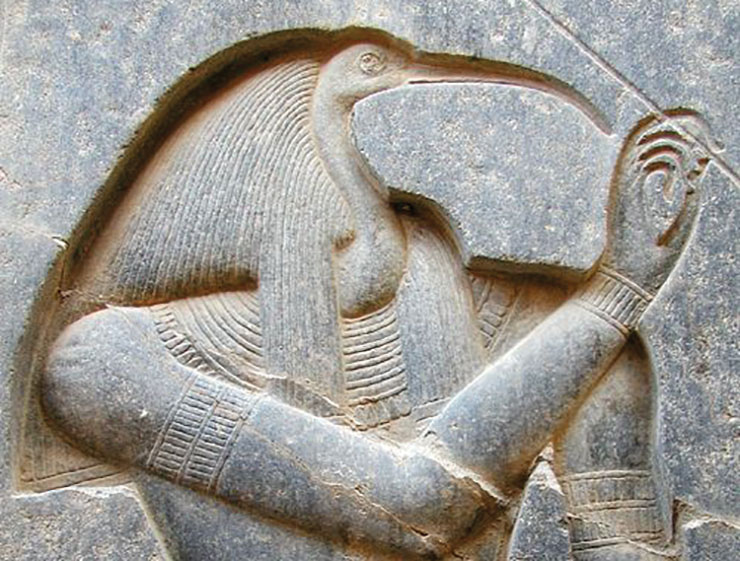
    Although some of The Kybalion’s reference points and formulations are plainly modern, the book can justly be defended as an authentic retention of certain ancient Hermetic ideas. Its author – about whom I’ll say more in a moment – drew upon elements of the Hermetica, a late-ancient collection of Greek and occasional Latin writings attributed to the mythical man-god Hermes Trismegistus, or “thrice-greatest Hermes.” This was a Greek appellation for Ancient Egypt’s god of writing and intellect, Thoth, whom the Greeks venerated above their own Hermes or Mercury. Using Greek literary form, the various and unnamed authors of the Hermetic tracts, not always agreeing among themselves, codified fragments of immeasurably old oral precepts from Ancient Egypt.1

    I should have listened more closely when, almost twenty years ago, a respected religious philosopher, who himself had translated some of the core Hermetic writings, told me of The Kybalion, with his voice low and a gleam in his eye: “There are some good ideas in that little book.”

    Indeed there are – and it took me a long time to rediscover them. It is not always easy to say exactly what brings us back to a book or an idea. I had always orbited around The Kybalion, albeit tentatively; I admired or grew friendly with some of its acolytes and with cultural figures influenced by it; and, finally, in 2017, I returned to the book in full. It was as though a light went on. Maybe my journey is an example of the book’s dictum: “When the ears of the student are ready to hear, then cometh the lips to fill them with wisdom.”

    Before saying more about the value of The Kybalion, let me address the question of its authorship. The identity of the “Three Initiates” has long been a source of speculation and drama; this can serve as a distraction from the book’s greater significance. The Kybalion was written by New Thought philosopher William Walker Atkinson (1862–1932), a remarkably energetic Chicago publisher, writer, lawyer, and spiritual seeker, who deserves to be remembered for this, his greatest work. Atkinson was one of the most incisive New Thought voices of the twentieth century.

    Among the many pieces of evidence, both literary and documentary, that demonstrate Atkinson’s authorship, he acknowledged himself as the sole writer in a 1912 entry in Who’s Who In America. Historical scholars, including Philip Deslippe and Richard Smoley (I also take up the matter in my Occult America), have amply demonstrated that there is no reason to argue with him. This prolific and thoughtful man was the Three Initiates. It should also be noted that in the traditional literature, Hermes Trismegistus addresses himself to three disciples: Tat, Ammon, and Asclepius, which may have been a source of inspiration for Atkinson’s byline.

    Atkinson was also the book’s original publisher at his Chicago-based Yogi Publication Society. The press published its owner’s many influential and not infrequently pseudonymous works, including books under the names of Yogi Ramacharaka and Theron Q. Dumont, as well as Atkinson’s self-bylined works. For generations, the writer-publisher’s diminutive blue hardcovers were a well-loved mainstay of New Age bookstores and served to influence a wide range of occult and metaphysical seekers.

    More important than The Kybalion’s byline is how the book highlights ideas about mind, matter, and thought-creativity, some of which demonstrate authentic resonance with Hermetic antiquity. This is no small matter. The Kybalion is not merely, or at least not only, modern New Thought clothed in ancient garb; rather, the book connects us, however tenuously, to ideas that once motivated seekers from a vastly removed era.

    Deslippe and Smoley have admirably tracked some of Atkinson’s sources; to their work I would add only that Atkinson was a capable surveyor of Victorian-era and Theosophically based translations of Hermetic literature, which is how the corpus was available to early twentieth-century readers. In particular, he would have encountered the translations of G.R.S. Mead (1863–1933), a scholar of ancient mysticism and one-time secretary to Madame H.P. Blavatsky (1831–1891), a figure whom Atkinson revered. The influence of Blavatsky’s 1888 occult opus The Secret Doctrine is evident at several points in Atkinson’s writings. Mead’s 1906 translation of the Hermetica, published two years before Atkinson’s effort, while turgidly worded in late-Victorian prose, and sometimes almost purposely written as if to assume an antique affect, was then one of the few sources of Hermetic ideas in English. With a skilled and discerning eye, Atkinson identified and distilled insights that corresponded to the sturdiest aspects of New Thought, or what William James had contemporaneously called “the religion of healthy-mindedness,” a field in which Atkinson was deeply steeped. The seeker-writer used his considerable curatorial abilities to produce a marriage of ancient and modern psychological insights.

    Atkinson focused primarily on the veritable Hermetic principle that Mind is the Great Creator. According to Hermetic literature, a supreme Mind, or Nous, uses as its vehicle a threefold process consisting of, 1) subordinate mind (demiurgosnous); 2) word (logos); and 3) spirit (anthropos), concepts that echo, albeit distantly, in Atkinson’s work. The Kybalion is structured around “Seven Hermetic Principles,” which follow from the Hermetic concept of “seven rulers” of nature. Man, we are told in book I of the Corpus Hermeticum, the body of work translated during the Renaissance, “had in himself all the energy of the rulers, who marvelled at him, and each gave him a share of his own nature.”2

    Atkinson is particularly supple in adapting the Hermetic conception of gender, in which the masculine (conscious mind, in Atkinson’s terms, and original man in the Hermetica) impregnates the feminine (subconscious mind to Atkinson, and nature in the Hermetica), to create the physical world.

    Further still – and this is vital to the book’s power and usefulness – The Kybalion ably ventures a theory of mind causality. The book explains why, from a metaphysical perspective, our minds seem to possess formative, creative abilities, and yet, even as we evince powers of causation, we are also subject to limits of physicality, mortality, and daily mechanics.

    As beautifully articulated in Atkinson’s chapter “‘The All’ in All,” the individual may wield traits of a higher manifesting Force – but that does not make the individual synonymous with that Force. Man, the book counsels, may accomplish a great deal within given parameters, including transcendence of commonly presumed limitations, influence over the minds of others, and co-creation of certain circumstances; but the book reminds the idealistic reader that we bump against physical parameters even as we are granted the capacity, within a given framework, to imitate the Power that set those parameters. In this, The Kybalion honours the views of the ancients.

    Atkinson offers compelling philosophical definitions of concepts of rhythm, polarity, paradox, compensation, and “Mental Gender.” In a sense, the philosophy found in The Kybalion is an application of Hermeticism, Neo-Platonism, Transcendentalism, and New Thought. The book also attempts, however fitfully, to correspond its ideas to the early-twentieth century’s nascent insights into quantum mechanics and the “new physics,” which gained currency in the decades immediately following its publication. In this sense, the author exaggerates only slightly when he writes: “We do not come expounding a new philosophy, but rather furnishing the outlines of a great world-old teaching which will make clear the teachings of others – which will serve as a Great Reconciler of differing theories, and opposing doctrines.”

    Get the issue this article appears in

    The overall spirit of The Kybalion can be traced to book XI of the Corpus Hermeticum, in which Hermes is told by Supreme Mind that through the uses of imagination he can discover the workings of Higher Creation: “If you do not make yourself equal to God you cannot understand Him. Like is understood by like.”3 Hermes is told to use his mind to travel all places, to unite opposites, to know all things, to transcend time and distance: “Become eternity and thus you will understand God. Suppose nothing to be impossible for yourself.” Hermeticism teaches that we are granted a Divine birthright of boundless creativity and expansion within the imagination. This teaching is central to the Hermetic philosophy, and its modern re-sounding in The Kybalion.

    Brief in length yet epic in ideas, The Kybalion should be read repeatedly by anyone with an interest in New Thought or practical metaphysics. For the modern seeker, the book can, as its author promises, serve as a source of coherence among various, and sometimes conflicting, modern mystical philosophies.

    Does life grant us second chances? I believe that it does. One of mine arrived in rediscovering this meaningful book. As you enter its pages, I wish you the highest of discoveries and discernment.

    The above is slightly adapted from the Introduction to the Italian edition of The Kybalion.

    [alert type=”general” dismiss=”no”]This article was published in New Dawn 165.[/alert]

    [alert type=”success” dismiss=”no”]If you appreciate this article, please consider subscribing to help maintain this website.[/alert]

    Footnotes

    1. Some historical scholars dispute this notion and posit the Hermetica strictly as an expression of late-Greek philosophy with an Egyptian overlay; today’s consensus view, however, tends toward the Hermetica as a syncretic work, intermingling Hellenic and Egyptian thought. See The Egyptian Hermes by Garth Fowden (Princeton University Press, 1986, 1993).
    2. Hermetica (Far West Undertakings, 1977).
    3. The Way of Hermes translated by Clement Salaman, Dorine van Oyen, and Jean Pierre-Mahé (Inner Traditions, 1999, 2000).

    © New Dawn Magazine and the respective author.
    For our reproduction notice, click here.
  • Aleister Crowley & The Book of the Law: A Magical Encounter in Egypt

    Aleister Crowley & The Book of the Law: A Magical Encounter in Egypt

    Aleister Crowley (1875–1947) is remembered as a libertine, philosopher, mountaineer, magician, and supposedly the “wickedness man in the world.” He wrote bad poetry, pornographic books, novels and a vast array of literature.

    He is best known as being an infamous occultist and the scribe of The Book of the Law, which introduced ‘Thelema’ to the world. Crowley was an influential member of several occult organisations, including the Golden Dawn, the A.’.A.’., and Ordo Templi Orientis.

    One of the most enigmatic aspects of Crowley’s life was his receipt of what he believed to be a document dictated by a ‘praetor human intelligence’ known as Aiwazz.

    Crowley studied ceremonial magic for many years, but he felt he had not found the success he was searching for. He and his wife Rose travelled to Egypt where they spent a night in the King’s Chamber of the Great Pyramid. Rose became clairaudient and began to repeat the phrase “They are waiting for you.” Crowley was bemused as Rose was not known for her interest in magic or occultism, and hitherto had shown no signs of psychic ability. But she was insistent, and perhaps more to humour his young wife Crowley invoked the god Thoth and asked a number of test questions.

    Surprisingly, the answers were way beyond his wife’s understanding and showed a level of sophistication that piqued Crowley’s interest, to say the least. The final test involved an image of Horus at a local museum. He asked the communicating being to identify it. Rose very quickly identified various images of Horus, but it was the stele of Ankh-ef-en-Khonsu that she was most drawn to, an artefact known as inventory number 666 (Crowley’s personal number as ‘The Master Therion’). The being not only identified Horus on the stele but caused Rose to explain that the ‘intelligence’ attempting to communicate was not Horus himself but his representative Aiwazz.

    On 8 April 1904, between noon and early in the morning, Crowley experienced a dark and overwhelming presence behind him. It communicated through him a bit like automatic writing and dictated over three days what became known as Liber AL vel Legis or The Book of the Law. The Book of the Law offers a new revelation and the revival of the Egyptian cult of Nuit, Hadit and Horus, of which each of its three chapters are dedicated. It is a sophisticated work with many hidden meanings, numerical codes, and deep insights. Even today it is studied with diligence, and commentaries have been written on it since its first appearance. The Book of the Law heralds a New Aeon beginning in 1904, the ‘Aeon of Horus’; preceding this had been the Aeon of the dying God (Osiris) and that of the mother (Isis). The Aeon following Horus is that of Maat, or truth, and will mark the completion of one great cycle of cosmic time.

    The term Aeon is a little different from the terms ‘age’ or ‘cycle’. Originating within Gnosticism, Aeons were seen as emanations of the divine that mediate between man and the spiritual hierarchy. Using that understanding, we can appreciate that each Aeon is not simply a period of time but a time period under the governance of a certain spiritual force (the current under Horus) and comes with a specific spiritual formula and practice, and its own prophet. In this case, Crowley saw himself as the prophet of the New Aeon of which the religion was Thelema.

    At first, Crowley was unsure how to evaluate the document he had received and left it locked away for quite a period of time. He vacillated between seeing Aiwazz as his personal unconscious or some aspect of his own higher self. Over time Crowley became convinced of the significance of its message and wrote various commentaries as well as ‘receiving’ other ‘Class A’ documents, a term he used for documents received from ‘praetor human intelligences’.

    The Book of the Law calls for the abandonment of all previous religious philosophies, especially taking aim at the three monotheistic religions. It is brutal when it comes to Judeo-Christianity in that it rejects the formula of the dying god with its emphasis on pain, suffering, sexual suppression and guilt. This is replaced with the formula of the divine child Horus whose innocence brings with it sensuality and openness. At the same time Horus is related to the Greek god Mars, the god of war, hence Crowley believed there would be a great period of violence after the start of the New Aeon which would continue until the declaration of the final ‘Aeon of Maat’ at a future date. In Egyptian mythology, Horus also has a dark brother called Set (or Seth) and he represents the soul of the Aeon of Horus: brooding, unpredictable, cold and volatile.

    On a political level, The Book of the Law proposes a form of anarchy with total freedom for the individual but this is matched with total responsibility. When The Book of the Law states “Do What Thou Wilt Shalt be the Whole of the Law” (Liber AL 1:40), it is not exclaiming do whatever pleases you or do what you want, it is saying to follow your true destiny. This destiny comes from finding who you really are; this true self is known as the Will or the Star and the relationship between stars is known as “love,” hence “Love is the Law, Love under Will” (Liber AL 1:57).

    The concepts of Thelema (Will) and Agape (Love) are central to The Book of the Law and both via gematria add to the number 93, hence the significance of this number within the teachings. (The Hebrew spelling of Aiwazz also adds to 93).

    In Ancient Egypt the night sky was considered to be the afterlife, and when someone died they became ‘a star’; each star had its own unique place in the cosmos, its own orbit and its own destiny. These ideals are central to the politics of Thelema where “Every Man and Every Woman is a Star” (Liber AL 1:3).

    It has been claimed the philosophy of The Book of the Law is in many ways elitist. It is based around the concept of ‘Arete’, or excellence, which could be interpreted as meritocracy. While the individual has the potential for total freedom, he must exercise it in the pursuit of finding himself, or as Liber AL (1:42) states “thou hast no right but to do thy will.”

    Kenneth Grant (1924–2011) was one of the most influential and controversial representatives of Thelema during the last century. His publications were prodigious including a series of nine volumes expounding his deep and insightful view of Thelema. Grant came to realise that the rather indulgent hippy view of Thelema so popular in the Sixties and Seventies (Crowley was pictured as one of the people on the Beatles’ Sgt. Pepper’s album cover) sold the vision of Thelema short. He took seriously the non-terrestrial origin of The Book of the Law and began to investigate its antecedents in earlier cultures. He found that the teachings regarding sexuality in Liber AL were not simply calls to ‘have a good time’ but were part of an age old Tantric or yogic tradition demanding great discipline and perseverance. While the general teachings of Liber AL may offer some level of guidance for the average man and women, its inner teachings could be aligned to the esotericism of the Tantras, India and Sumer. Such a teaching continued unseen in the inner chambers of alchemists, magicians, sorcerers and Docteurs of Voudoun.

    This new understanding saw Thelema as a re-instatement of the ancient Typhonian cult of Egypt, and brings us to its significance in any consideration of Egyptian spirituality. Thelema is, in any ways, a unique form of Egyptian polytheism with a highly developed social, political and spiritual philosophy. At its core was a revelation for the New Aeon through a communication with a non-terrestrial representative Aiwazz (among others). This teaching includes both a general and esoteric form, the esoteric showing a clear continuity from the earliest known forms of Tantra (Shaivism) and into Sumer, Egypt and beyond.

    Whatever we are to make of Crowley’s private life – and to be honest even the most sympathetic biographer would suggest his treatment of others left a lot to be desired – The Book of the Law and Thelema represents a fascinating glimpse into the adaptation of an ancient Egyptian ‘religion’ for the modern period.
    [alert type=”general” dismiss=”no”]This article was published in New Dawn Special Issue Vol 8 No 6.[/alert]
    [alert type=”success” dismiss=”no”]If you appreciate this article, please consider a contribution to help maintain this website.[/alert]

    © New Dawn Magazine and the respective author.
    For our reproduction notice, click here.
  • Egypt in the Western Occult Tradition

    Egypt in the Western Occult Tradition

    This article was published in New Dawn Special Issue Vol 8 No 6 (December 2014)

    O Egypt, Egypt, of your reverent deeds only stories will survive, and they will be incredible to your children! Only words cut in stone will survive to tell your faithful works, and the Scythian or Indian or some such neighbour barbarian will dwell in Egypt.

    This haunting passage comes from the Corpus Hermeticum, the celebrated ‘Hermetic’ body of writings, believed to go back to Hermes Trismegistus himself, a semidivine figure associated with the Greek god Hermes and his Egyptian equivalent, Thoth.

    These texts go back no further than the early centuries of the Common Era. The passage above hints at their purpose: to preserve something of the knowledge of Ancient Egypt as its civilisation began to decay. Here is a good place to start when looking at Egypt’s role in the Western occult tradition.

    The Corpus Hermeticum was brought to Italy in the mid-fifteenth century by Greeks fleeing the collapsing Byzantine Empire. The great patron of the arts, Cosimo de’ Medici, had these texts translated into Latin almost immediately. Because scholars thought they went back to Hermes Trismegistus, believed to be a contemporary, and perhaps a teacher, of Moses, they were held in the highest esteem for almost two centuries. When their true date was discovered, they lost much of their prestige, and they have never quite regained it. Nevertheless, they have shaped the Western esoteric tradition in innumerable ways.

    Consider Athanasius Kircher, a seventeenth-century Jesuit who, in the subtitle of Joscelyn Godwin’s recent book about him, was “the last man to search for universal knowledge.” Part of the knowledge he sought was the meaning of the hieroglyphs. Kircher’s interpretation, created out of his own imagination, was almost entirely wrong. But his mistakes are instructive.

    The symbol that he regarded as the key to this knowledge is a human-headed scarab from a bronze tabletop known as the Bembine Table of Isis. The body of the scarab, Kircher says, is the Earth; its wings are the airy sphere; several concentric ovals set in the place of the shoulders are the planetary orbs; the head is Horus, or the Sun; and a crescent above the head is a moon. A winged disk floating nearby is the anima mundi, the “soul of the world.”

    Kircher’s representation reflects, not some genuine knowledge of Egyptian religion, but the system of the Corpus Hermeticum. The Hermetic texts were seen as the embodiment of Egyptian teaching. Their actual relationship to what the Egyptians taught is a much harder issue to sort out, if only because Egyptian religion was multifarious. Scholars used to think they were a mishmash of Neoplatonism, Gnosticism, and early Jewish and Christian mystical teaching. But the title of the main treatise is the Poimandres, a bewildering name that has inspired many fanciful etymologies. Today scholars believe it is a Grecised version of the Egyptian p-eime-n-re or “mind of sovereignty.” At the outset, Poimandres – who is described as an “enormous being” in the Corpus – announces he is the “mind of sovereignty.” There may well be more of Egypt in these texts than people used to think.

    The Corpus Hermeticum was not the only attempt to preserve Egyptian knowledge. Another is a Greek text dating to the fifth century CE, and attributed to Horapollo, a priest of Isis and Osiris. The Horapollo, as it is called, explains the meaning of the hieroglyphs.

    Here is one example. One passage (in a nineteenth-century translation) reads: “When they would represent the universe, they delineate a SERPENT bespeckled with variegated scales, devouring its own tail; by the scales intimating the stars in the universe.” And in fact the image of a snake devouring its tail – the ouroboros – does go back to Ancient Egypt, the first instance being found in a text going back to the fourteenth century bce.

    Whether or not the ouroboros had the meaning given by Horapollo may be moot; it has sometimes been said to symbolise, not the universe per se, but the formless disorder that encircles the universe. In any case, the Horapollo probably reflects some real, though garbled, knowledge of the hieroglyphs. In any event, its interpretation has echoed down through the centuries. Like the Corpus Hermeticum, it shows how Egypt has operated on the Western occult imagination.

    Egypt touched the minds of occultists in other ways as well. The renegade seventeenth-century Italian monk Giordano Bruno harked back to Egypt as a way of reviving and purifying the degenerate Christianity of his time. Bruno’s Egyptian religion has little to do with the Egyptian religion dug up by archaeologists in the last two centuries. Rather it is, again, the doctrine of the Corpus Hermeticum, which in Bruno’s time was still believed to date back to the great age of Egypt. That Bruno wanted to revive the Egyptian religion wholesale may seem eccentric, but it’s understandable in light of the history of the seventeenth century, with its appalling religious warfare. For Bruno, Egyptian Hermeticism was a means of rising above these petty conflicts, a means of fostering tolerance and awakening a higher awareness.

    The Catholic church, which did not see things quite the same way, burned Bruno at the stake in Rome in 1600.

    But in no way has the allure of Egypt waned throughout the centuries. In 1781, the French polymath Antoine Court de Gébelin, in a work entitled Le monde primitif (‘The Primitive World’), said that the Egyptian priests had encapsulated their knowledge in a book of Thoth consisting of visual images. According to Court de Gébelin, this book made its way to Rome and into the hands of the church. When the papal court was removed to Avignon in the fourteenth century, the book was recast into a deck of playing cards, known today as the Tarot. Scholars today are not, for the most part, convinced by this argument.

    The influence of Egypt on the Tarot remains. The Ryder-Waite deck, created in 1910, by far the most popular deck in the English-speaking world, abounds with Egyptian images: sphinxes with breasts; Isis with her crescent moon; the jackal-headed figure of the god Anubis. This is no accident: the deck’s creators, A.E. Waite and Pamela Colman Smith, were both members of the Hermetic Order of the Golden Dawn, an occult order whose symbols and rites were replete with Egyptian imagery.

    By the time of the Golden Dawn, which in its original form lasted from 1888 to 1900, the hieroglyphs had been deciphered by the French Egyptologist Jean-François Champollion, so the Golden Dawn’s picture of Egypt was much more accurate than had been available during the Renaissance.

    One of the most resonant evocations of Egypt came with the 1877 publication of the two-volume Isis Unveiled by the Russian occultist H.P. Blavatsky. Although it took its title from the name of the great Egyptian goddess, Isis was not principally about Egypt. Instead, it argued there was an ancient but unified wisdom tradition that underlay all religions.

    In its way, Isis does present an updated Hermeticism, describing the human makeup in the tripartite fashion of body, soul, and spirit that goes back to the Corpus Hermeticum, the ancient Gnostics, and indeed primitive Christianity. Curiously, in light of Blavatsky’s later teaching, the book denies reincarnation. She would later change or recast her views to support reincarnation. She excused her inconsistency on the (not entirely convincing) grounds that reincarnation was a secret teaching that she had not been allowed to disclose before a certain point.

    Reincarnation itself occupies an ambiguous place in the Western esoteric tradition. Christianity (at least in its conventional forms) has always avoided or repudiated it. In Judaism it is part of the esoteric tradition of the Kabbalah, although until recently it was almost unknown to ordinary Jews.

    Did the Egyptians teach reincarnation? If you ask mainstream Egyptologists, they will generally say no. But Herodotus, the Greek historian from the fifth century bce, says exactly the opposite. In a comprehensive picture of Egypt that can be considered the first anthropological study in human history, Herodotus writes: “The Egyptians were the first to teach that the human soul is immortal, and at the death of the body enters into some other living thing then coming to birth.” He goes on to say: “Some of the Greeks, early and late, have used this doctrine as if it were their own; I know their names, but do not here record them.”

    Here Herodotus probably means Pythagoras, who studied in Egypt and may have learned the doctrine of reincarnation (as well as the geometrical theorem that bears his name) from them. The Corpus Hermeticum speaks of reincarnation as well. Possibly reincarnation was taught among the Egyptians – but only as an esoteric secret passed down orally.

    Reincarnation was an issue that divided the Western esoteric tradition from that of the East. So claimed the founders of an occult order called the Hermetic Brotherhood of Luxor (or H.B. of L.). In 1884 it made its presence known with an ad reaching out to those disaffected with ‘Hindoo Mahatmas’ – an allusion to the hidden Masters that, Blavatsky claimed, were guiding her. The central teachings of the H.B. of L. include a denial of reincarnation, the use of magical and ritual work to attain higher consciousness, and the use of sexual magic as well. The lodge’s use of the name ‘Luxor’ indicates its claim of an Egyptian lineage.

    The H.B. of L. dissolved after only a couple of years because of internal dissention, but it had an influence out of all proportion to its size or lifespan. Its teachings live on in C.C. Zain’s still-extant Church of Light. Some of the H.B. of L.’s sexual magic techniques may have also found their way into Aleister Crowley’s Ordo Templi Orientis.

    Probably the best-known occult order of the twentieth century also traces itself back to Egypt: the Ancient and Mystical Order Rosae Crucis, founded by H. Spencer Lewis in 1915. AMORC has a strong and heavily emphasised Egyptian flavour; Lewis said that it went back to an esoteric lodge founded by Pharaoh Thutmose III in the fifteenth century bce. Today AMORC’s headquarters – Rosicrucian Park in San Jose, California – contains a temple designed with Egyptian motifs as well as an Egyptian museum.

    I could go on much longer. I could, for example, mention the Temple of Set, which in 1975 broke off from Anton Szandor LaVey’s notorious Church of Satan when some members of LaVey’s organisation decided that he was not serious enough about his Satanism. The Temple identifies Satan with Set or Seth, the slayer of Osiris in Egyptian myth. (Despite the similarity of names, scholars do not think the names ‘Satan’ and ‘Set’ are connected, ‘Satan’ coming not from the Egyptian, but from a Hebrew word meaning ‘opponent’.) The Temple of Set does not promote evil per se but advocates “creating an individual, powerful essence that exists above and beyond animal life” (in the words of its website).

    Apart from organisations, there are the many people who are drawn to the mystical side of Egypt through some encounter with its art and architecture. Writers such as John Anthony West, author of The Traveler’s Key to Ancient Egypt, and Normandi Ellis frequently lead tours to Egypt that focus on its mystical and occult aspects. As Ancient Egypt recedes further and further away from us in time, it remains vividly alive in the memory and imagination of the West.

    [alert type=”success” dismiss=”no”]If you appreciate this article, please consider subscribing to help maintain this website.[/alert]

    Sources

    Brian P. Copenhaver, ed. and trans., Hermetica: The Greek Corpus Hermeticum and the Latin Asclepius in a New English Translation with Notes and an Introduction, Cambridge University Press, 1992

    Joscelyn Godwin, Athanasius Kircher’s Theatre of the World: The Life and Work of the Last Man to Search for Universal Knowledge, Inner Traditions, 2009

    Wouter J. Hanegraaff et al., eds., Dictionary of Gnosis and Western Esotericism, Two volumes, Brill, 2005

    Herodotus, Translated by A.D. Godley, Four volumes, Loeb Classical Library, 1931

    The Hieroglyphics of Horapollo Nilous, Translated by Alexander Turner Cory, http://sacred-texts.com/egy/hh/index.htm; accessed Oct. 30, 2014

    David Reigle, “Isis Unveiled: A Perspective”, www.easterntradition.org/isis%20unveiled-a%20perspective.pdf; accessed Oct. 30, 2014

    Richard Smoley, Forbidden Faith: The Secret History of Gnosticism, Harper San Francisco, 2006

    © New Dawn Magazine and the respective author.
    For our reproduction notice, click here.