New Dawn – World's Most Unusual Magazine

Category: Secret Wisdom

  • Alchemy – The Art of Transformation: An Interview with Cherry Gilchrist

    Alchemy – The Art of Transformation: An Interview with Cherry Gilchrist

    Cherry Gilchrist’s book on the history and interpretation of alchemy has remained a classic since its first publication in 1984. Alchemy, the Great Work: A History and Evaluation of the Western Hermetic Tradition was published in a new edition by Weiser Books, with an introduction by Mark Booth, in June 2015.

    Her book on alchemy as a system of self-development, drawing on the Twelve Gates of George Ripley and alchemical imagery, is Everyday Alchemy, published by Rider in 2002.

    She has appeared on radio and TV on various occasions to discuss alchemy, most notably on ‘Stephen Hawking’s World’, in an episode filmed in Owlpen Manor in Gloucestershire, UK, home and haunt of an eighteenth-century alchemist.

    Cherry also draws on her knowledge of the Tree of Life, astrology, and divination in her writings on alchemy. She has studied these subjects since her student days at Cambridge, from which she graduated with a degree in English literature and anthropology. Following the line of oral traditions and wisdom, she has also written about Russian folk traditions, ancestry, personal life stories, and myths and legends from different cultures. Cherry is at present writing a book on the traditional Tarot trumps for Quest Books. For details of her work, see http://www.cherrygilchrist.co.uk.

    Other interests include singing early music, and travel. Places visited such as Easter Island, Siberia, and the Silk Road have given her inspiration for her books, and insight into ancient cultures.

    Cherry’s own philosophy is that the Hermetic work can be passed down through a genuine line of teaching, and that it needs to find different forms in new generations. She was a founder member of Saros, the Foundation for the Perpetuation of Knowledge, an organisation headquartered in the UK which took on those aims.

    Cherry lives in Exeter, UK, with her husband, artist Robert Lee-Wade.

    Richard Smoley (RS): Maybe we could start by a brief definition of what you think alchemy is.

    Cherry Gilchrist (CG): Alchemy is about transformation. In its most basic definition, it’s the transformation of base material or metal into gold. However, that is too simplistic, according to the ways in which the tradition of alchemy has been practised and understood over hundreds, even thousands, of years. In a way, alchemy is about the process of creation itself: how does one thing become another? How do things change state? How can we change our state of being? And can we, as so-called conscious human beings, learn how to make those changes? So another way to put it is that alchemy is a way of using the life force to effect transformation, whether that’s on the physical, external level, or in a spiritual way. I hesitate to say that the alchemical process can work either on the material or on the spiritual level, because in one sense, in alchemy, they are completely integrated!

    RS: Most people would say that alchemy is just an old and outmoded form of chemistry. Why should we interest ourselves in it today?

    CG: I think this old chestnut comes up because of the way historians have dealt with alchemy in the last hundred years or so. That has formed the belief we’re fed. I use the word ‘belief’ because I really do think our perception of what is true and false, what is reliably scientific and what is non-scientific and therefore superstitious – in some people’s eyes – is moulded by the way history has been interpreted. Anyone who reads my book will, I hope, have that view changed. The evidence from the history of alchemy alone, when explored more fully, shows just how seriously it was taken, and how it can’t be just cast on the scrapheap as a well-meaning but deluded forerunner to enlightened science. Isaac Newton himself was an alchemist, and funnily enough, scholars have recently begun to pay a lot more attention to that fact.

    I myself make no claims that alchemy is effective when judged by the standards of modern chemistry. I am not a scientist, and clearly we’re not going to go backwards in time and revert to what now seem very primitive methods for working with chemical elements. I think the point is more that alchemy has had many applications over its history, and that the way it led into chemistry as we know it was just one feature of the whole spectrum of alchemy. Maybe it still has more to teach us about how to work with physical materials, though – and with the whole area of interaction of mind and materials opening up in science, it could offer views and approaches which breathe new life into scientific development. But whatever the case, alchemy still has much to impart in terms of psychology, spiritual development, and our relationship with the natural world. In one form or another, it’s still a path to knowledge.

    RS: Could you say a little bit about the origins of alchemy?

    CG: Well, again here we are somewhat constrained by the degree of research and scholarship available to us. This suggests, to put it briefly, that the metal workers of ancient Egypt may have kicked off the interest in the transformation of one material or metal into another. And that this came to early fruition in the Hellenistic, Alexandrian period, which began about three hundred years before the Christian era. But I suspect that if a few scholars really dig into the roots of alchemy, they will find a much wider realm of alchemical endeavour, particularly if they broaden the definition of alchemy. In the Far East, alchemy also had ancient origins, but the focus there was more on how the human body worked. Just as shamanism has extended its definition in recent years – it was once considered to be exclusively Siberian, and now is traced almost worldwide – so alchemy may have a broader historical lineage than we at present suspect. Perhaps this is beginning to happen. It has been suggested for instance that the discovery of charcoal burning is linked to a historical peasant tradition of alchemy as practiced by the Basques, one of the most ancient peoples of Europe.

    RS: Some writers describe alchemy as a physical process – actual working with minerals and plants and so on. Others see it as a psychological process. How do you see these different roles? Are they both valid?

    CG: I used to hold firmly to the view that true alchemy must be applied across the levels, having both a physical and a mental component. Its magic, if I can call it that, is that it is neither purely material or purely spiritual. However, I’ve come to see this in a different light, and I think now that alchemy has an incredible spectrum of application, and can be applied at different levels of creation. The most extreme examples of selective application are perhaps the old-fangled ‘puffers’ who spent all their time trying to work out how to concoct gold and get rich. And also the purely spiritual alchemists among whom we can count Jacob Boehme. I consider now that both of these are valid in their way; they are both participating in an alchemical process. However, if the get-rich-quick alchemists ignored the bigger scale of the creative process and limited their goals to financial reward, they were likely to end up dirty, disappointed, and broke! Alchemical laboratories weren’t pretty, fragrant places to work in.

    The other way round, I suppose, can have more significant results – I mean alchemy as a metaphor for spiritual development does work. But perhaps it will peter out as a way forward, or be very particular to one person, because it is treated then as a set of symbols which could be replaced by another set at will. If you sever the connection between material process and our sense of creation as a whole, or between spiritual and material understanding, then that approach to alchemy can’t flourish for long. There’s much to ponder on here, and I doubt that my own views will ever reach a complete and final conclusion!

    RS: Your book title links alchemy with the Hermetic tradition. How does that work? Does Hermes come into this too?

    CG: Hermes is very important in alchemy, as a kind of patron saint – except that he isn’t very saintly! He’s more of a shape-shifter or trickster figure. Hermes and Mercury meld to a certain extent, so that we have the guiding spirit of Hermes who might or might not lead you to enlightenment through your alchemical practice, and we also have mercury the metal, with its indwelling mercurial spirit, as it were. Hermes is more than a figurehead – his name is associated with a body of literature which has influenced both alchemists and the Western esoteric tradition. Hence the broad term ‘Hermetic tradition’. Nicholas Goodrick-Clarke, in his excellent study The Western Esoteric Traditions, points out that the cult of Hermes was founded on the Egyptian traditions associated with Thoth, and that Hermes evolved into a kind of ‘syncretic god’ who had a profound influence on the whole development of esoteric work up until the Renaissance period. I would say it goes further than that, actually. Walter Scott and G.R.S. Mead, for instance, were keen to plumb the wisdom of the so-called Hermetic texts, and to translate them for others to read in the nineteenth and early twentieth centuries. They have left us a legacy that we value today.

    So we can see Hermes/Mercury as a kind of guide in individual practice of alchemy. But also as a mischievous creature, apt to lead us astray. Michael Sendivogius, in his alchemical treatise The New Chemical Light, which was published around 1608, addresses his readers as “the Sons of Hermes” and includes a wonderful dialogue between the alchemist and Mercury. Here Mercury is the trickster spirit who plagues the alchemist with his cunning ways – the alchemist decides to invoke Mercury himself to shed light on what’s going wrong with his experiments. Mercury appears to him, but laughing his head off! Then they engage in a clever battle of words, at the end of which the alchemist is none the wiser, and demands that Mercury tells him how to make the Philosopher’s Stone, which is another term for Alchemical Gold or the Elixir. Mercury neatly wraps up the repartee with, “Mr Philosopher, if you know, you can make it, and if you don’t, you can’t.” That one gets me laughing too! Suddenly, it’s like the tales of Hodja Nasreddin, or a lesson from Gurdjieff. I prepared a version of this dialogue, and we performed it – perhaps for the first time in nearly 400 years? – at an alchemical conference in Prague. Not many people think of alchemy as being a source of humour, but it’s there, if you dig for it. And we can probably attribute it to the Hermetic influence.

    Anyway, the role of Hermes and his sidekick Mercury make for a fascinating study, one that I want to continue with. But as far as I’m concerned, it’s more than something on the page. On three occasions, Mercury a.k.a. Hermes has actually turned up in my life. Laugh if you will! The first was when I was still a student, in 1970. My boyfriend and I were in Amsterdam, and it was just at the start of my interest in the Kabbalistic Tree of Life and astrology. We met a man in a bar – as you do – and I think I’ll find it easier just to quote from an account that I wrote about this meeting a few years later, if you’ve got the space to include it:

    The streets were dark, and the bar where we went was dimly lit. I recall nothing of his face, or how we began to talk to him. But there cannot have been much small talk before we were all into the realms of psychic and esoteric knowledge. Then I mentioned the Kabbalistic Tree of life, which we had just learned to draw out and name. He showed interest, and asked us what it was. One of us sketched out the diagram and we described the significance of the different sefirot to him. He nodded, and replied, ‘I just wanted to see how much you knew about it’.

    We all exited the bar together, and made our way up to Central Station. It is only from this point that I have a vague recollection of a friend who accompanied him. On the way, we learned more about him, or rather his identity became even less certain as he professed dual if not triple nationality, spoke alternately in French and English, admitted to being known by more than one name, was not keen to be noticed by the police, and mentioned that he had several countries of residence. At the station he fetched a large rucksack, full of books from a left luggage locker. He couldn’t travel round without books, he said, but these were weighing heavy on him and he wanted to give us a number to lighten his load. We took an armful from him, and said our goodbyes.

    Only later did I remember that Mercury, planetary lord of the sephira Hod, and the neophyte’s entry point on the Kabbalistic Tree, is represented as an elusive, shadowy figure, speaker of many tongues. He is coexistent with Hermes, himself a symbol of the ‘Hermetic work’. He is a traveller of no fixed abode, a trickster, and a bringer of books and knowledge. It’s said that he is also fond of a joke now and then.

    RS: That’s a fascinating story. It strikes me as an example of the way the mythical and the occult actually do manifest in daily life – as opposed to the ridiculous clichéd forms you see in horror movies. To go on: why did the old alchemical texts rely so heavily on symbols and emblems rather than verbal descriptions?

    CG: I think it’s clear that you couldn’t really explain alchemy in normal, so-called rational terms. Alchemy doesn’t work as a collection of recipes, as many practitioners have found to their cost. It was considered important too that each alchemist should work it out in their own way. Alchemy has to speak to the spirit; it isn’t just an assemblage and processing of materials. So the symbols can do that. They really stirred the spirit of the historical alchemists, and still resonate for many of us today. Some are very complex, and also very beautiful. Dragons, kings and queens, water and fire, serpents, lovers, lions – a rich panoply of imagery. Colours were very important too, as I discuss in my book. They had their own validity and presence in the alchemical process, and the stages of transformation were marked by colour changes in the vessel. Also the imagery poses problems and questions, which the alchemist must wrestle with. Why was the king sick in bed? What were the dragons fighting about? What do the steps on the mountain represent? This would generate insight and stimulate the imagination.

    It’s also recorded that the secrets of alchemy came to certain practitioners through dreams and visions too – and dreams, as we know, deal in paradoxical, powerful images. The place of dreams in alchemy is a whole topic in itself, which again I discuss in the book. There’s evidence that alchemists deliberately cultivated visionary states, and practiced what today we might call ‘visualisation’.

    RS: Carl Jung found much of value in alchemy. Do you find the hooking up of alchemy with psychology and archetypes of interest? Or is it just one particular slant that doesn’t reflect the real body of alchemical work?

    CG: Jung found himself mesmerised by alchemical imagery, and used it to illuminate his psychological theories and indeed to help him towards new insights into the human psyche. I think he has done us a huge favour by reinvestigating the writings and symbols of alchemy, in one sense. It means you can have a conversation with a psychologist about alchemy, and that it’s crept back into our vocabulary again, at least to an extent. There’s much in Jung’s writings on alchemy that those with a modern education, and little time for prescientific theory, can relate to.

    On the other hand, I also believe Jung done us a disfavour by cutting off the main body of practical alchemy, where laboratories, equipment, and materials were involved. He actually said that the alchemical operations of old were ‘senseless’ and never led to the desired goal. As I said earlier, if you slice off just one layer of alchemy, you may produce something with a kind of one-off value, but you also divorce yourself from the evolving path of alchemy. I do think it’s time that we moved on from Jung’s interpretations.

    RS: How does alchemy work as a spiritual path?

    CG: This is something that has to be done within a context. If you are a Christian believer, it’s perfectly possible to use the symbols of alchemy to represent stages of mystical attainment, and understanding of Christ’s teachings. Boehme did it, and so did the poet Henry Vaughan. I think that if you meditate on the symbols, and you embed the imagery in your consciousness, it will work there, to release your own limitations and expand your awareness in an intuitive, even cosmic way. That’s the power of symbols, and alchemical ones aren’t random – they form a kind of graded teaching system.

    However, we can also use the symbolism in the context of everyday life, if we’re prepared to be attentive, observant, and aim to increase our conscious awareness. This has much in common with Kabbalistic or Gurdjieffian practice. I have written about it in Everyday Alchemy. You can actually start with very simple things – it needn’t be too high-flown or complicated. There’s a talk that I give which begins with the statement, “I’m an alchemist. I cook supper every night.” There’s a moment’s puzzled pause, then laughter, as the audience gets it! I explain that cooking is a process of transformation very much akin to alchemy, and that in our own kitchens we have the materials and the method to start to understand transformation. And that’s just the start. My own path, I would say, is a Hermetic one, and about accessing greater knowledge. Alchemy is a way to do that, and part of the job is reinventing the approach to have relevance to us today.

    RS: Can you say more about alchemy and the creative process? Is it a model which could be used in any sense nowadays for creative work?

    CG: Writers and artists have used alchemy as inspiration for their work for a very long time. Studies of Shakespeare, for instance, as I relate in the book, reveal that he was almost certainly using alchemical templates to plot some of his plays. This is not wild conjecture, but has scholarly backup. Therefore, I think those working creatively can dig into the symbolism, read about traditional forms of alchemy, and find inspiration for their work. I have talked to several artists about this, including one or two highly successful ones, who find that the framework of alchemy is a wonderful source for their creative work. One of the key points that strikes me again and again – with my writing too – is that alchemy is ‘hermetic’. It’s sealed, it’s private up to a certain point. The creative process must ‘cook’ in the vessel, and you must shield it from prying eyes. Too often nowadays we’re expected to talk about artistic or literary work in progress. No, says alchemy! Wait until the time is right, or you risk prematurely wrecking your material. It could all just evaporate. So you have to have courage and patience, and be your own guide for a lot of the time as well. All lessons which I think we could profit from today.

    RS: Alchemy seems to imply there is some kind of consciousness latent even in inanimate matter. Would you agree with that view? If so, what do you think its implications are?

    CG: I do agree, and have struggled for many years to try and understand and perceive that. I think alchemy was way ahead of its time in this respect. Once you start to break out of the dead end of the worldview of the material/mind split, you realise just what a grip it has on you. By that I mean me – and probably many of us. Whether or not the alchemical view of consciousness is really ‘true’ in a scientific sense, I think it’s incredibly important to see just how our values and outlook are shaped by religious, cultural, and scientific thinking. We tend to assume them as the norm, whether we like them or not. And we desperately need new models to go forward. And as far as I can tell, there is progress on the scientific or biological front too in accepting a broader definition of consciousness. According to the biologist Rupert Sheldrake, we do have “species mind,” for instance. I think it will also improve our care of the environment if we even concede the possibility that consciousness of some kind is within everything. And restrict the waste, for instance, of food and resources. I’m not one for saying that all yoghurt in the world cries when you eat a pot of yoghurt! Seriously, I have heard that said! But I can’t bear the waste of life forms, both of plants and animals and probably mineral too, which taints human culture now.

    And, after all, what is consciousness? I don’t mean that as a clever-clever question. But it strikes me there is much further to go in unravelling its mysteries. For instance, how come we are apparently ‘unconscious’ at night, and yet we can create the most amazing dreams? We may generate insights, and even when not dreaming, our identity remains during sleep. How do we often know exactly what time it is when we wake up, if some form of consciousness has not been operating? If we take a broader view of consciousness, rebrand it if you like, we can go much further in our discoveries.
    [alert type=”general” dismiss=”no”]This article was published in New Dawn Special Issue Vol 9 No 2.[/alert]
    [alert type=”success” dismiss=”no”]If you appreciate this article, please consider a contribution to help maintain this website.[/alert]
    „ Alchemy, the Great Work: A History and Evaluation of the Western Hermetic Tradition (Weiser Books) by Cherry Gilchrist is on sale at all good bookstores. For updates and more about her work, visit http://www.cherrygilchrist.co.uk.

    © New Dawn Magazine and the respective author.
    For our reproduction notice, click here.
  • The Dawning Aeon of the Child: Personal Thoughts & Reflections

    The Dawning Aeon of the Child: Personal Thoughts & Reflections

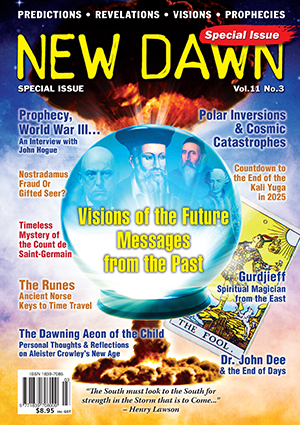
    From New Dawn Special Issue Vol 11 No 3 (June 2017)

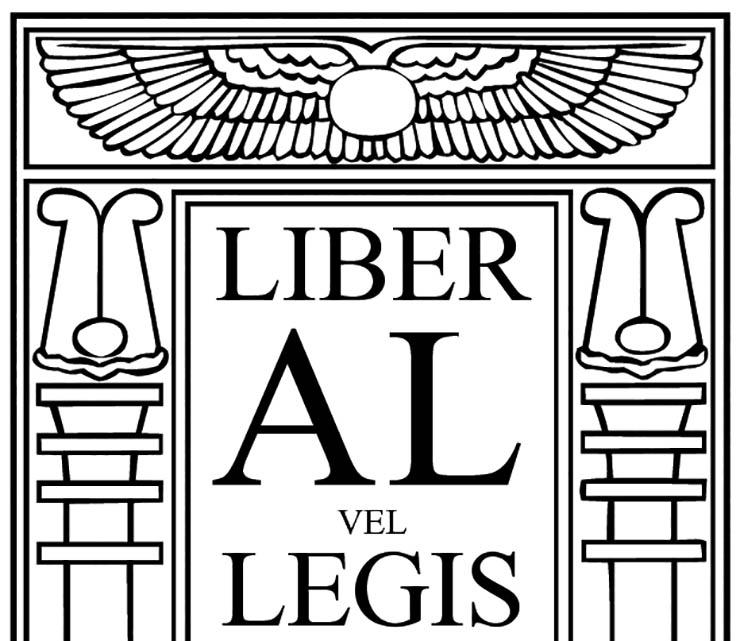
    In 1904, while visiting Cairo with his wife Rose, the English occultist Aleister Crowley received a text known as The Book of the Law via direct voice transmission. He described its author as “a messenger from the forces ruling this earth at present.” Three one-hour sessions over a three-day period resulted in 220 verses announcing a New Aeon with a New Law for mankind – a changing of the guard of the spiritual hierarchy ruling the planet. The Book of the Law proclaims a new era in ethics, morality, culture, and science.

    Crowley insisted The Book of the Law proved the first postulate of religion, the existence of Higher Consciousness independent of the human brain and body. He would spend the next 43 years of his life explaining and proclaiming its message and significance in all his writings.

    An inspiring, mysterious, and poetic text, devotees of The Book of the Law interpret its message as the sole rule and guide of their lives. Many have found it fulfils that role admirably, never failing to provide insight and direction when called upon.

    We must then ask ourselves: What does the inauguration of a New Aeon mean? I remember a cynical comedian from my childhood. He called himself “the Old Philosopher” and had recorded a funny rant on a 45rpm record, mocking the celebrations of the New Year. His pitch was something like, “New what? New worries, new problems? I’d rather have out with the New and in with the Old because I am familiar with the Old!” I remember laughing with my parents as I first became aware of the irony of the dual-edged nature of progress. Looking at the New Aeon from my perspective today, I am acutely conscious of that irony in a manner that I was not when I took my first steps on this path a half century ago.

    This new Aeon of the Child (Horus) follows that of the Father (Osiris) and the Mother (Isis). While Crowley spoke of these aeons as 2,000-year periods – seemingly corresponding to the astrological divisions of the Precession of the Equinoxes – I think they may best be understood as longer term symbolic constructs rather than calendrical dating systems. The aeons appear to be indicators of larger cultural and historical trends by which human progress and evolution may be understood and identified.

    The Aeon of the Mother (Isis) is characterised as a time of unity with Nature, the ascendant Priestess, intuition over intellect, before the widespread use of writing and even language, the Palaeolithic period. Hunter-gatherers searching throughout the land, moving where directed by the patterns of rainfall, weather and soil fertility, maintaining a synchronous and harmonious relation with the environment that bespoke a oneness and lack of separation. Cave dwelling and the building of rudimentary shelters, individual and communal skirmishes, the fears of the night assuaged by the introduction of fire, the opening of the sciences by the charting of the heavens. Paganism reigned as the spiritual answer to the questions of existence. The many gods who controlled the world were appealed to with intention and sincerity that embodied the fervour, fear, and gratitude of a dependent human being, the Babe sustained at the Breast of the All.

    The Aeon of the Father (Osiris) introduced the formula of self-sacrifice, the religion of the Dying God. From Osiris and Adonis to Christ, the community was ‘saved’ by the courage of the Chosen One, willing to plunge into Death at the command of a Greater Destiny whose impersonality demanded an abrogation of self-interest to the wider needs of his fellows. At the same time, mankind began to exercise dominance over Nature. Building a more dependable food supply with the mass herding of pastoral animals and land and crop cultivation. The taming of rivers with dams, the massive construction of edifices that towered above the landscape and celebrated the power of the mind and our species. Language, writing, philosophy, measurement were all aspects of this purposeful rearrangement of the natural world, the shaping and sculpturing of reality as if man were a co-creator working with the Heavenly Father to root out chaos and leave his personal stamp on existence.

    At the same time, suffering was conceived as the norm. Massive armies raged through continents sweeping aside civilisations with their swords and arrows and the armoured steeds on which they rode. Life was cheap. Individuality and personal rights were unknown. Sin was a constant nagging force whose instinctual power and insistence must be rejected and triumphed over at all costs. Salvation was to be sought in the after-death state and was based on obeying dictated ethical and religious principles, unquestioning adherence to the teachings of those who knew better, those who made the rules. Expect no satisfaction in the here and now. This is the testing ground of humanity, the place of Trial and Tribulation. These challenges would temper the soul with hardship. Their mastery would open the joys of the next world to the acolyte who listened.

    The current Aeon of the Child (Horus) represents a more confident period of self-awareness, as the Babe bursts forth fully-armed to confront the world in which he or she is launched. The legitimate birth of the rightful claimant of existence, one who participates without restriction in the natural order of the universe, cognizant, questing, and entitled. Just watch kids at play. Crowley calls this period that of “the recognition of the individual as the unit of society.”

    On the other hand, there are the terrors of the Child contradicting this unity, the fears and insecurities as it navigates its way through the darkness of uncertainty. The natural and optimistic self-assertion of the soul freed from oppression is opposed by the demanding irrationality of the squalling baby – absolutely shameless in its own self absorption. As a parent himself, Crowley was well aware of this dual nature and had no hesitation about expressing it.

    In his Introduction to the first popular publication of The Book of the Law in 1938, Crowley wrote the following:

    Observe for yourselves the decay of the sense of sin, the growth of innocence and irresponsibility, the strange modifications of the reproductive instinct with a tendency to become bisexual or epicene, the childlike confidence in progress combined with nightmare fear of catastrophe, against which we are yet half unwilling to take precautions.

    Consider the outcrop of dictatorships, only possible when moral growth is in its earliest stages, and the prevalence of infantile cults like Communism, Fascism, Pacifism, Health Crazes, Occultism in nearly all its forms, religions sentimentalised to the point of practical extinction.

    Consider the popularity of the cinema, the wireless, the football pools and guessing competitions, all devices for soothing fractious infants, no seed of purpose in them.

    Consider sport, the babyish enthusiasms and rages which it excites, whole nations disturbed by disputes between boys.

    Consider war, the atrocities which occur daily and leave us unmoved and hardly worried.

    We are children.

    These words could have been written this morning rather than nearly eighty years ago. Perhaps if we substitute “Facebook” for “the wireless” we can feel totally up-to-date.

    Crowley wrote further of the fraudulent political constructs of democracy, fascism, and communism from which we still suffer. He described them as “cavort[ing] crazily all across the globe.” He pegged them for what they are: “abortive births of the Child, the New Aeon of Horus.” A sobering characterisation that the purveyors of Fake News might contemplate as they work to inflame the passions of their historically-illiterate flocks.

    In contrast with the common tendency to over-idealise progress and modernity, one cannot help but compare Genghiz Khan of the Aeon of Osiris with Kim Jong Un, his pathetic alter-ego in the Aeon of Horus.

    As an admirer of Thomas Jefferson, I believe his writings in the Declaration of Independence were the opening doctrinal pronouncement of the politics of the New Aeon:

    We hold these truths to be self-evident, that all men are created equal, that they are endowed by their Creator with certain unalienable Rights, that among these are Life, Liberty and the pursuit of Happiness.

    Jefferson wrote further that government must not be trusted to be the arbiter of human conduct. “In questions of power, then, let no more be heard of confidence in man, but bind him down from mischief by the chains of the Constitution.” Imagine if the chains of the Constitution and its Bill of Rights were wrapped around the necks of the violent thugs raging through the streets of Berkeley, California as I write – transforming a town noted as the birthplace of the modern “Free Speech Movement” into a bastion of the tyranny of the mob and the triumph of censorship and intimidation.

    Get the issue this article appears in

    • • •

    With all that said, Crowley did not waver in his faith in this new stage of the evolution of human consciousness. He acknowledge a balance in all things. He was specifically singled out as the Prophet of the New Aeon and he wrote this glowing tribute in that same Introduction, “Liberty stirs once more in the womb of Time.”

    When I become discouraged by life’s hard experiences – or the caterwauling of our modern Anarchists, Snowflakes and Social Justice Warriors – I can turn for solace and inspiration to the words that express my fondest hopes for the future of humankind in the New Age. Words that celebrate a new day coming – words that help me learn to gaze with wisdom, patience, and tolerance at the birth pangs of the New Aeon.

    Among the Class A writings of Thelema (those that must not be changed inasmuch as the style of a letter because, as Crowley indicated, they originate from the highest level of Truth) is Liber Tzaddi. It is one of my favourites, an optimistic description of the transition to this New Age of Horus. Here is a long extract. If I may be forgiven for presuming to speak for Crowley, I imagine these words may have sustained him as well.

    1. In the name of the Lord of Initiation, Amen.
    2. I fly and I alight as an hawk: of mother-of-emerald are my mighty-sweeping wings.
    3. I swoop down upon the black earth; and it gladdens into green at my coming.
    4. Children of Earth! rejoice! rejoice exceedingly; for your salvation is at hand.
    5. The end of sorrow is come; I will ravish you away into mine unutterable joy.
    6. I will kiss you, and bring you to the bridal: I will spread a feast before you in the house of happiness.
    7. I am not come to rebuke you, or to enslave you.
    8. I bid you not turn from your voluptuous ways, from your idleness, from your follies.
    9. But I bring you joy to your pleasure, peace to your languor, wisdom to your folly.
    10. All that ye do is right, if so be that ye enjoy it.
    11. I am come against sorrow, against weariness, against them that seek to enslave you.
    12. I pour you lustral wine, that giveth you delight both at the sunset and the dawn.
    13. Come with me, and I will give you all that is desirable upon the earth.
    14. Because I give you that of which Earth and its joys are but as shadows.
    15. They flee away, but my joy abideth even unto the end.
    16. I have hidden myself beneath a mask: I am a black and terrible God.
    17. With courage conquering fear shall ye approach me: ye shall lay down your heads upon mine altar, expecting the sweep of the sword.
    18. But the first kiss of love shall be radiant on your lips; and all my darkness and terror shall turn to light and joy.
    19. Only those who fear shall fail. Those who have bent their backs to the yoke of slavery until they can no longer stand upright; them will I despise.
    20. But you who have defied the law; you who have conquered by subtlety or force; you will I take unto me, even I will take you unto me.
    21. I ask you to sacrifice nothing at mine altar; I am the God who giveth all.
    22. Light, Life, Love; Force, Fantasy, Fire; these do I bring you: mine hands are full of these.
    23. There is joy in the setting-out; there is joy in the journey; there is joy in the goal.
    24. Only if ye are sorrowful, or weary, or angry, or discomforted; then ye may know that ye have lost the golden thread, the thread wherewith I guide you to the heart of the groves of Eleusis.
    25. My disciples are proud and beautiful; they are strong and swift; they rule their way like mighty conquerors.
    26. The weak, the timid, the imperfect, the cowardly, the poor, the tearful – these are mine enemies, and I am come to destroy them.
    27. This also is compassion: an end to the sickness of earth. A rooting-out of the weeds: a watering of the flowers.
    28. O my children, ye are more beautiful than the flowers: ye must not fade in your season.
    29. I love you; I would sprinkle you with the divine dew of immortality.
    30. This immortality is no vain hope beyond the grave: I offer you the certain consciousness of bliss.
    31. I offer it at once, on earth; before an hour hath struck upon the bell, ye shall be with Me in the Abodes that are beyond Decay.
    32. Also I give you power earthly and joy earthly; wealth, and health, and length of days. Adoration and love shall cling to your feet, and twine around your heart.
    33. Only your mouths shall drink of a delicious wine – the wine of Iacchus; they shall reach ever to the heavenly kiss of the Beautiful God.

    (Full text of Liber Tzaddi at www.sacred-texts.com/oto/lib90.htm)

    [alert type=”general” dismiss=”no”]This article was published in New Dawn Special Issue Vol 11 No 3.[/alert]

    [alert type=”success” dismiss=”no”]If you appreciate this article, please consider subscribing to help maintain this website.[/alert]

    © New Dawn Magazine and the respective author.
    For our reproduction notice, click here.
  • The Black Arts after Fifty Years

    The Black Arts after Fifty Years

    From New Dawn Special Issue Vol 11 No 4 (Aug 2017)

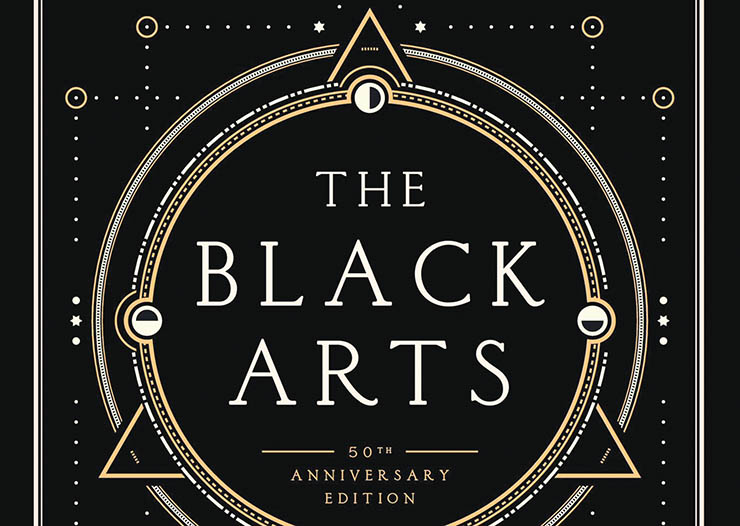
    This year marks the 50th anniversary of Richard Cavendish’s classic study of the occult, The Black Arts. The year of Cavendish’s book – 1967 – could be seen as a banner moment for the rebirth of occult and esoteric spirituality in the modern West.

    In 1967, the toy giant Parker Brothers relaunched the Ouija Board, having bought rights the prior year from descendants of manufacturer William Fuld, and sold a record two million talking boards, surpassing sales of its leading game Monopoly, and installing the mediumistic device into playrooms across America.

    As governor-elect of California, Ronald Reagan in January 1967 raised eyebrows by scheduling his inauguration at the perplexing hour of 12:10 A.M., prompting persistent questions – which ran throughout his presidency – over the extent of his and wife’s dedication to astrology. Reagan would admit only that “Nancy and I enjoy glancing at the daily astrology charts in our morning paper.” At that time, about 1,250 out of 1,750 daily papers featured daily horoscope columns, a post-war high.

    In 1967, The Beatles learned Transcendental Meditation (TM) from the Maharishi Mahesh Yogi, indelibly marrying the youth culture to the pursuit of Eastern and esoteric wisdom. The following year, The Beatles’ famous sojourn to the Maharishi’s northern Indian ashram in Rishikesh resurrected the ideal of the Westerner seeking wisdom in the Far East, a template laid in the late 1870s by Russian-born occult explorer Madame HP Blavatsky, who left behind the relatively cushy environs of New York City to move to India, a place then as alien to most Westerners as the surface of another planet.

    Also in 1967, the bestselling biography of psychic Edgar Cayce, Edgar Cayce: The Sleeping Prophet by tabloid journalist Jess Stearn, brought renewed attention to the early twentieth-century medical clairvoyant. Cayce’s popularity was followed by a wave of “channelled” literatureCayce first used the term channel in the mystical sense – under the names of such other-dimensional entities as Seth, Ramtha, and Abraham.

    This ferment of occult and mystical enthusiasm soon exploded across the culture as Americans were urged to “be here now,” try psychedelics to “tune in” to higher energies, use new practices in yoga and Zen, rediscover native shamanism (or variants of it) in the books of Carlos Castaneda, and shiver over evils, new and ancient, with the shock of the Manson murders, and the popularity of movies like The Exorcist and Rosemary’s Baby.

    Into this atmosphere, British historian Cavendish (1930–2016) launched his enduring and influential study of occult history and practice, The Black Arts. The book won immediate popularity, gaining the affections of Mick Jagger, author Isaac Bashevis Singer, and, well, me, when I first began seriously studying the occult about twenty years ago. I discovered the book on the backlist of the publisher for which I now work, and was immediately enchanted with the green-blue-black psychedelic-goth graphics of the original cover art. At a later date, the book was redesigned in the more ordinary style of a heavy-metal album cover, which hyped up the sinister (serpents coiling from eye sockets of skulls), and played down the mysterious, alluring, and mature. For its 50th anniversary edition, TarcherPerigee has restored the mood of the original, and returned a few missing images to the interior. Mercury, rejoice.

    • • •

    In the minds of many modern people, the occult stands for the sinister and satanic. This is a mistake, historically and spiritually. The term occult comes from occultus, Latin for hidden. Classically speaking, occult philosophy posits the existence of an unseen dimension of life, whose forces are felt on and through us. In the late ancient world, when the temple orders of Egypt, Greece, and Rome, and the folk beliefs and nature-based religions of Europe, were losing appeal to Christianity, the church fathers did what we as humans have always done: labelled the other side, i.e., the historical and theological losers, in terminology of our own liking, in this case as demon worshippers and purveyors of dark sorcery, a characterisation that pre-Christians and pagans had never claimed for themselves. Indeed, for readers who were or are put off by Cavendish’s malevolent-sounding term “black arts” in the title, he quickly explained his choice: “No one is a black magician in his own eyes, and modern occultists, whatever their beliefs and practices, think of themselves as high-minded white magicians” – yet they are driven, as we all are, by the “titanic attempt to exalt the stature of man… this gives it [magic] a certain magnificence.”

    Isaac Bashevis Singer, in a shrewd and admiring critical essay on The Black Arts in Book Week on April 9, 1967, agreed with Cavendish noting: “We are all black magicians in our dreams, in our fantasies, perversions, and phobias.”

    And, to this I would add, in the pursuit of our highest ideals. As Cavendish and Singer detected, we are not very different from the classical magician when we strive, morally and materially, to carry forth our plans in the world – to ensure the betterment of ourselves and our loved ones; to heal sickness; to create, sustain, and, above all, to generate things which bear our markings, ideals, and likenesses. All of this is the expenditure of power, the striving to physically establish our inner drives and images.

    I do not view the search for individual power, including through supernatural means, as necessarily maleficent, and neither, I think, did Cavendish. Historically and psychologically, it is a fundamental human trait to evaluate, adopt, or avoid an idea based upon whether it builds or depletes our sense of personal agency. “A living thing,” Nietzsche wrote in Beyond Good and Evil, “seeks above all to discharge its strength – life itself is will to power…” The difficulty is in making our choices wisely.

    We sometimes deny or overlook this power-seeking impulse in ourselves, associating it with the tragic fate of Faust or Lady Macbeth. It can be argued, however, that all of our neuroses and feelings of chronic despair, aside from those with identifiably biological causes, grow from the frustrated expression of personal power. We may spend a lifetime (and countless therapy sessions) ascribing our problems to other, more secondary phenomena – without realising that, as naturally as a bird is drawn to the dips and flows of air currents, we are in the perpetual act of trying to forge, create, and sustain, much like the ancient alchemist or wizard.

    The ultimate frustration of life is that, while we seem to be granted godlike powers – giving birth, creating beauty, spanning space and time, devising machines of incredible might – we are bound to physical forms that quickly decay. “Ye are gods,” wrote the Psalmist, adding “but yet shall die as princes.” Immortality and the reversal of bodily decline is the one magic no one has ever mastered. The wish to surpass the boundaries of our physicality is behind some of our most haunting myths and parables, from the Trojan prince Tithonus, to whom the gods granted immortality but trapped in a shell of misery and decay for failing to request eternal youth, to the doomed scientist Victor Frankenstein, who sought the ultimate alchemy of creating life only to bring destruction on everyone around him.

    • • •

    In The Black Arts, Cavendish captures the human striving and universality behind the magical search. He also demonstrates virtuosity for explaining ancient and more recent rituals, rites, and esoteric philosophies with splendid clarity. Although he casts a critical eye toward some of the customs he explores, Cavendish never places himself above or in opposition to them. The historian realises that these practices, whether they are to his or your private liking, reflect a basic human need. Nor does the author evaluate his facts from a distant remove. Cavendish, as Singer noted, “does discreetly hint that there may be a kernel of truth in the magicians’ fantastic assertions.”

    First appearing in 1967, The Black Arts narrowly predated (and helped foresee) the explosion of mainstream interest in New Age and spiritual-therapeutic philosophies. The book also arrived just as the modern world was experiencing the rebirth of Wicca or witchcraft, a nature-based religion now officially recognised within the US military (whose service members and veterans may select the pentagram from among more than 65 “emblems of belief”). By many accounts, Wicca is one of the fastest-growing religions in the Western world today. It is not difficult to imagine a cohort of aspiring teen witches among Cavendish’s earliest readers (some of whom probably graduated to his magisterial 24-volume encyclopedia Man, Myth & Magic, which he edited in 1970).

    To learn more about the current occult scene, in its popular and esoteric variants, you can select among dozens of twenty-first century books. Indeed, you will get much more from recent books for having read Cavendish’s. But make no mistake: The Black Arts is much more than a well-timed period piece. It stands nearly alone as a simultaneously comprehensive and inviting guide to the world of pre-modern esoterica. Cavendish performed an epic feat of distillation in this well-sifted compendium. He created vivid descriptions of philosophies that many writers botch, such as Kabbalah (an area where Singer felt the book displayed distinction), European spellcasting, and the messy topic of Satan worship, which is not exactly a tradition so much as a patchwork of historical experiments, foibles, and, not infrequently, frauds.

    Cavendish’s descriptions are so clear that the intrepid reader can use his book, as I admittedly once did, not only as a historical work but also as a guide to practice. If you are bold enough (and I hope it’s boldness and not fickleness or venom) you can try your hand at variants of numerology, astrology, and divination. I believe strongly that to understand the meaning and ideas behind any faith or spiritual practice (by spiritual I mean belief in extra-physicality), a participatory approach is necessary, even if only temporarily. Whether you view the occult critically or sympathetically, and there are grounds for both responses, you will never understand the pull of the religious or occult appeal without getting involved in it. Messy hands are the fee of entry.

    Soon after Cavendish published his study, another writer and journalist, Lewis Lapham, followed The Beatles to the Rishikesh ashram for a firsthand view of their encounter with the Maharishi. Lapham was a progenitor of the “New Journalism” (not a term he claimed for himself), an approach to reportage that included an expressly participatory element. In this vein, Lapham took measure of the charismatic, bearded guru’s influence on The Beatles in a two-part 1968 article for The Saturday Evening Post, “There Once Was a Guru from Rishikesh.” The journalist viewed the Maharishi and his flowered acolytes with immediate suspicion, and regarded them from a sardonic remove. Yet it never occurred to Lapham, who sat in on rap sessions, group meals, and other events, to use the easiest and plainest means available to test his instinct that there was something fishy about the robed man selling bliss: Namely, placing his bottom on a cushion and trying the TM technique. A mantra, if you desire one, is about as easily attained as a learner’s permit to drive – and, indeed, at that particular time and place was much easier.

    In 2017, almost fifty years after his visit, I asked Lapham, a gentlemanly and approachable man, whether he had learned TM in Rishikesh or another time. His reply: “Even in Rishikesh I didn’t practice Transcendental Meditation. The Maharishi furnished me with a mantra, but I failed to employ it as a stairway to the stars.” There was no discernible curiosity toward the thing being judged. This is the opposite of Cavendish’s approach. That intellectual quality in Cavendish – to place his hands (and yours) on the driver’s wheel – is what has given his book its posterity, and won it unlikely dedication from both mainstream literary voices and contemporary occult seekers.

    • • •

    As I have written in my Occult America and elsewhere, occult philosophy is the kernel that gave rise to most of today’s modes of therapeutic and self-help spirituality. Indeed, the idea of an individual spiritual search today now seems like a birthright. This was not always so. During the Renaissance, when occult forms of worship and magic were being rediscovered, translators, artists, and religious scholars began to enunciate the first modern conception of a personal spiritual search, located beyond the parameters of any one congregation or faith. That impulse pulled Thoreau into the woods, set Blavatsky on her globe-spanning search, drew The Beatles to Rishikesh – and lured many readers to this book.

    In the closing pages of Occult America, I identified five spiritual principles with which most modern people agree, even those who are disinclined toward religion. These beliefs came into vogue – and have grown only stronger – in the years of occult ferment immediately following Cavendish. These principles found their earliest sounding in Western life through occult and mystical practices. They are:

    • Belief in the therapeutic value of spiritual and religious ideas.
    • Belief in a mind–body connection in health.
    • Belief that human consciousness is evolving to higher stages.
    • Belief that thoughts, to some greater or lesser measure, determine reality.
    • Belief that spiritual understanding is available without allegiance to any specific religion or doctrine.

    The encounter between modern people and occultism, including many of the practices explored in this book, resulted in a vast morphing and reframing of arcane beliefs from the Old World into the new, boundary-free spiritual culture of our own era. This new spiritual culture is often called the New Age – a term critics use derisively but that I use with respect. New Age spirituality is, quite simply, therapeutic spirituality, and the seeking of self-potential through metaphysical understanding. The New Age extols religious egalitarianism and has, in my view, responded more fully than any other movement in history to the inner needs and personal search of the individual.

    In reading The Black Arts you will discover much more than magical systems from the past; you will also discover ideas that have shaped us as a culture – and that likely reflect aspects of your interior life.

    This article is adapted from Mitch Horowitz’s introduction to the 50th anniversary edition of The Black Arts: A Concise History of Witchcraft, Demonology, Astrology, and Other Mystical Practices Throughout the Ages, available in all good bookstores.

    [alert type=”general” dismiss=”no”]This article was published in New Dawn Special Issue Vol 11 No 4.[/alert]

    [alert type=”success” dismiss=”no”]If you appreciate this article, please consider subscribing to help maintain this website.[/alert]

    © New Dawn Magazine and the respective author.
    For our reproduction notice, click here.
  • From the Many to the One:  A Short Guide to Complete Awakening

    From the Many to the One: A Short Guide to Complete Awakening

    From New Dawn Special Issue Vol 8 No 2 (Apr 2014)

    Complete awakening happens on all levels. This includes the realisation there are some very serious enemies to personal/spiritual liberty who will work against you. They might say they are looking out for your best interest, or that of the greater good, but it is really always about control.

    Thanks to archaeology and anthropology, we have been given some very clear information of the characteristics of each age of human societal development. For thousands of years, the glue that held societies together was conformity as well as the judgment that ensues when this conformity was not met. Conformity to accepted cultural, religious, racial, and economic norms held together the collective identity pretty well. This worked just fine as long as populations were relatively small and homogeneous. If wealth is concentrated and accessible only to the very smallest portion of such a society, then dependence is a natural survival instinct that proves successful in most cases. If the group is small and each member procures food, shelter, and clothing in the same way, then the instinct of perceived fairness aids in the preservation of justice. In these societies positions of power are usually inherited by birth or military skill.

    As a nation grows in size, population, and wealth however, new ways to relate and understand each other are needed. The old glue of conformity is just not flexible or elastic enough to hold together groups of individuals with widely differing views on almost every issue. Our sense of fairness that we developed in our early stages of evolution actually starts working against us. The very things that would actually create more wealth and leisure time can seem as a threat to our perception of fairness, such as specialisation, contractual agreements, as well as the risks inherent in a marketplace.

    Our palaeo-brains are hardwired to think that in order for one person to have, another must go without. In a free-market society, this is not necessarily so. The pie is not limited. Due to profit motive that rewards risk taking and competitive pricing, the entrepreneur is free to add to the pie rather then just redistribute a fixed portion of it.

    The new glue must be independence. This glue takes longer to set, yet it is much stronger. It relies not upon conformity, but upon respect, love, and the potential loss of sovereignty for those who would thwart the rights of others.

    Communism/Statism/Progressivism is a re-emergence of outdated stone age communal instincts wrapped in the garments of post structuralism (discipline and therefore structure is essential to liberty; the anti-structuralist is a peddler of the worst kind of lies and superstitions as he is promising the ignorant person an impossibility) and political correctness, defended from any real scrutiny by the professed pure intentions of the enviro-marxist-radical.

    I am a MAN and I will not COMPLY

    The collectivists/Statists don’t like to be challenged. They demonise their opponents because the truth about their plans would expose them as the radical enemies of liberty they know themselves to be. People should speak up and defend positions as long as they genuinely believe them. It is when we begin defending ourselves rather then debating ideas that who is right no longer matters as much as who is left. This degeneration puts us back.

    The collectivists want the revolution of one so called class against another, rather then the transmutation of the entire culture. Positive societal evolution happens best when it arises from within people as an entire cultural shift, not as a protest group or one class against another. Equal justice first requires the acknowledgement of all being equal before it, otherwise it’s just another empty phrase.

    Every single mass murder has been produced by people using the government to enforce their will upon others. The government, especially in a society that has become as complacent about REAL civil liberties as ours, can do these things and has done these things in the past. The inquisition was big government, as was the holocaust perpetrated by Nazi Germany, the Native American tragedy, the Soviet murders and planned starvation, the Taliban, Iran, etc.

    The foundation of future civilisations will rely upon the supreme sovereignty of the individual. The defence of the rights of humankind must be the only occupation of the state, any other function being a siren calling the ship of culture to ruin.

    The ethic of liberty is a royal ethic, its morality is that of enlightened self-interest and non-interference. “Do what thou wilt shall be the whole of the Law.” And also “Love is the law, love under will.” These must become the essential core ingredients of society’s new glue if we are to continue to grow and advance the well-being of the race.

    What must we learn?

    In birth a human being arrives to this world with no knowledge or understanding. He possesses nothing; not even that which he will some day come to call “himself.” The newborn is, if anything, a mass of tendencies. His plight would be completely hopeless if among these tendencies were not also the capacity for growth. Our ability to learn, to mature, and to change is truly the strongest of our natural gifts. Yet, even this great virtue of our race, unguided by the star of inspiration can produce terrible and destructive engines that perpetuate darkness, dependency, and tyranny.

    Our lives are terribly brief. The truth is that what we believe ourselves to be as natural beings will spend almost eternity in death. We might want to imagine that it may be otherwise, or that there may be a spiritual existence where we may partake in permanence. According to what stares us in the face day after day, however, these desires are at best a convenient way of coping with the brutality of impermanence, and at worst a gorgon knot of unresolved infantile psychological complexes.

    Of course, you may have heard about or even studied the writings and sayings of the great sages and saints who teach about transcendence, salvation, deliverance, cessation or some other equivalent suitable to the culture in which their respective ideologies emerged. But unless you have experienced the states of consciousness or heavenly realms they claim to have attained or visited, this knowledge will, if you are lucky, do little more than comfort you. If you are unlucky then you will be haunted by guilt, inadequacy, or a host of other side effects that come with the dissonance produced by what you perceive directly and the message of authority not lining up very well.

    So what is the answer to life’s uncertainty, its impermanence, its sheer lack of meaning? Is there a way up the mountain of being that will give us a better view?

    The Mystery Tradition offers us a technology for healing the wounds sustained by the infinite universe limiting itself to the consciousness of a finite, disconnected, and impulsive vehicle. The goal is union with one’s own Holy Guardian Angel, a concept similar to what has been called Christ, Buddha, or Atman. One way of achieving this union is by seeking the transcendental in every single thing we do.

    The Mystic Path

    We must learn how to unite ourselves with everything. At first our untrained minds will only acquiesce to union with ideas or phenomenon that it considers pleasurable. This must eventually be overcome before we move unto the real work, but in the early stages it will help you stick to the practice. Try to make it easier on yourself by focusing on something with little or no emotional value to you. A button, stone, or some other harmless inanimate object will do just fine. Avoiding excitement will help you get the results that cause a lasting shift and evolution of the mind. This is how we may come to the direct perception of Truth, that is, the agreement of knowledge with experience (agreement without premeditation). This direct line will not come easily.

    Our tendencies are inherited by parents, society, or maybe even past incarnations (if you believe these exist, your deductions concerning them will affect you. If not, then your lack of such a belief will also affect you). Starting at the ground floor, the seeker must reconstruct his mechanism for sensing and interacting with the world around him.

    Mind Control

    Perfect union is produced by the interaction of perfect opposites. The operative word here is “perfect.” We unite parts of ourselves with ideas all the time. Every thought we have is, in this way, an act of Union. Putting this general definition aside, the Mystic Path is that of gaining the kind of control over the mind that will allow us to unite it in every sense to that one idea that will come to encompass the totality of existence.

    Our mind, like all things, is made up of a substance proper to its healthy functioning. The stuff of our minds, the Hindu yogis call Chitta, which literally means “mental stuff” (at this point it should be pretty obvious that the terms used in true spiritual practice are utilitarian and must be as simple as language may allow; there is enough confusion inherent in the dismantling and reordering of one’s self without needing any help from mysterious words or concepts). The sum total of our minds includes various functions such as discrimination, desire, or our sense of self.

    In controlling these mental faculties and contents, we take direct command of our own perceptions and therefore happiness. Everything a person thinks or encounters is done so through the medium of the nervous system. When we are successful in our subjugation of mental activity and function, uniting all thoughts into a singular one that may then be extinguished, we experience the bliss of total freedom. Freedom from fear, from doubt, from sorrow, yes, but also freedom from the fleeting emotional ups that accompany superficial distractions from their less desirable counterparts.

    The Magical Path

    It will not be long until you begin to realise that your own mental state can influence what most have been taught to regard as the “outer world.” You focus the mind on a certain thing, and a phenomenon – which corresponds with the nature of that thing – begins to occur. Now, it must be stated that what you should do is ignore these happenings. You should stick to your meditation. But you won’t. You can’t. Because although you are striving to become the unconditioned, un-manifested ONE, you still need to do things like pay bills, clean dishes, and ask that attractive co-worker out to dinner and a movie. In short, you are a real person who cannot rest in inaction, but must live a very active and exciting life!

    Where most would see the above as an obstacle, the aspirant to the Invisible College sees another opportunity for growth. What if you could make every act an invocation of the Most High? Just as we seek to bring our minds under complete control by first mastering a few basic exercises, so may we begin to train ourselves in the complete transformation of our lives by understanding and performing the elementary rituals of Magick.

    Magick is the Science and Art of causing Change to occur in conformity with Will.
    – Aleister Crowley

    In the practice of Magick, you will begin to learn about how thoughts, words, and deeds channel the will to create your reality. You will encounter things that are so profoundly wonderful and terrible that they will evade all attempts at description. Ultimately, what you are doing is sanctifying your entire existence. Every act becomes a holy service and not a moment goes by in which you are not focused entirely on the transcendental.

    This process is made possible by the theory of correspondence so elegantly communicated to us by the Qabalah. The student begins to understand that when he sees a house that he is witnessing a manifestation of the Hebrew letter Beth, which corresponds to the planet Mercury, and the Lord of Magick. The Entrance to the house is its door, literally Daleth in Hebrew, a letter corresponding to Love. By way of his training he can see in a simple house that the path into true magical power and mystery is love, or union. Crowley taught this principle as the central tenet of his spiritual system, “Do what thou wilt shall be the whole of the Law.” “Love is the law, love under will.”

    Introducing Yourself to Your SELF

    One of the greatest delusions at the heart of human suffering is the belief that we are our minds. Yes, our minds are part of the complex blend of forces, drives, tendencies, and materials that we call “I.” But, ultimately, we are none of these things. What we truly are is beyond description. Many have learned of this label and gone on in endless metaphysical speculation about whether or not there is a self, soul, or God.

    This, in my opinion, completely misses the point and is a colossal waste of time. Our lives are brief. In the path of unification, it does not matter what you think or believe about a thing, because all thoughts must be melted down to the one essence. However, when you find your mind in regards to these ideas, there is no need to change them, only to unite them to every other thought through the practice of concentration.

    When the mind is well controlled, then this Truth can fully manifest. This state is not truly a state, but the true form of ourselves, the “I am that I am.” Whenever the mind is not focused and unified, our understanding of truth is bent and twisted, like light reflecting off a dirty, broken mirror.

    The matter of consciousness, like all matter, is subject to changes. These can be pleasurable or painful, but at their root, they are all undesirable if we believe they have some meaning or importance. This is a great superstition that is very easy to fall into. We feel something unpleasant, and so this is “bad” while other more pleasant experiences are labelled “good.” The whole cycle of experience, label, and judge is based on the belief that our meaning and purpose can be derived from the right combination or manifestation of these changes.

    This is why materialism is generally acknowledged as an unskilful value system, as most can agree that material things are not where one should derive self-worth. A more unorthodox view would also say that spiritualism, emotionalism, or any other “ism” where we look to a set of circumstances for importance would all be equally inadequate in satiating our thirst for the supreme state of being.

    The universe does not suffer as we do. It is what it is. It creates and destroys itself without tremor, it is cold and hot, light and dark, containing all opposites and yet transcending them completely. Existence is the reality of nature just as non-existence is. They do not compete nor are they estranged. Galaxies whirl about in both harmony and violence. Stars collide, rivers flow and crash, and lovers dance. It is almost as though our own mental state is really the problem. The stories we believe become our religion, and our fundamentalism has robbed us of our royal place in the greatest party ever thrown.

    [alert type=”general” dismiss=”no”]This article was published in New Dawn Special Issue Vol 8 No 2.[/alert]

    [alert type=”success” dismiss=”no”]If you appreciate this article, please consider subscribing to help maintain this website.[/alert]

    © New Dawn Magazine and the respective author.
    For our reproduction notice, click here.
  • What Are Humans Made Of?

    What Are Humans Made Of?

    The figure seems to hover around 95 percent. That’s the proportion of the universe that consists of dark matter and dark energy – entities that are only dimly and indirectly perceived by scientific apparatus.

    This fact has gotten wide attention lately, but one implication has gone unnoticed: if this is the case for the physical universe, it must also be the case for our own bodies. Therefore 95 percent of your body is made up of matter and energy about which nearly nothing is known.

    This makes the ancient dictum “Know thyself” somewhat harder to satisfy than one might have thought.

    What, then, is the body made of? It is a question that conventional thought cannot answer and for the most part cannot contemplate. This leads us to consider views of the body in the world’s esoteric traditions. As in most areas, they don’t agree on all points, but the similarities are more striking than the differences.

    The first thing we have to acknowledge is that the body, taken as a purely physical entity, has no structure or coherence whatsoever. This is a strange claim to make, but we can see the truth of it simply by contemplating the difference between a living body and a corpse. The living body has coherence; it is capable of motion and activity, and can sustain itself for several decades. The corpse lacks all such features. It will rot to pieces in a very short time.

    There must, then, be an organising structure that holds the physical body together during earthly life. One common name for this, which comes out of early twentieth-century Theosophy, is the etheric body, sometimes known as the etheric double. (I will be mostly using Theosophical terms in this article not because they are necessarily any better, but because they are the most commonly used ones in New Age contexts.)

    Thus, for our discussion, we have to redefine the word body. From an esoteric point of view, a body can be described as a vehicle for structuring experience at a particular level of existence.

    So what is this etheric body? Here is a firsthand observation. The American writer Rosanne Daryl Thomas describes the death of her cat:

    He was leaving us. I held him. He pushed his head under my arm, purring as I stroked him and spoke softly, wanting to fill him with love. And then suddenly his face grew sharper and thinner. His life had gone. I faced his death with grief and unexpected wonder. What I saw was this: that the life force, the spirit, is a thing unto itself, and when it leaves, when it left old Ruffy, his form lost his fullness. Something had clearly gone. What was left once held his old beloved self, but the self which had been present one moment had departed as if on a breeze. I understood what a soul was. It was this self. And I understood that, if energy never dies, that bit of self that was not in him was now elsewhere: where, I could not say, but I had seen it, and seen it go.

    This passage suggests that this organising principle, this “bit of self,” inheres not only in humans but in animals as well.

    Very likely this etheric body is no more immortal than the physical body. One common tradition holds that the etheric body survives for three days or so after physical death. This seems reasonable: it would explain why most encounters with dead loved ones occur a few days after the loved one’s death. The number drops off greatly after that point.

    The etheric body is made up of energy, though of an extremely subtle kind. This energy is known variously as prana, chi or qi, or simply the life force. (Note that Rosanne Thomas uses the phrase life force in the passage above.) The etheric body has its own structure, although this differs radically from the physical object that is studied in anatomy classes. Nevertheless, many traditions describe the patterns of this body, as we see with the meridians of traditional Chinese medicine and the chakras of Hinduism.

    The etheric body is not the whole story. There is also what is called the astral body, a term that can be traced back to the Neoplatonic philosopher Proclus, who lived in the fifth century CE. Man, he said, was composed of an okhēma, literally “vehicle,” made of starry or “astral” material. According to esoteric theory, it is affected and shaped by the configurations of the stars and especially the planets. This idea may explain an ancient Orphic verse, which instructs the recently deceased person to say, “I am the child of earthy and starry heaven.” This astral body is thought to be made up of a subtle, starry stuff sometimes called the astral light. Subjectively, the astral body corresponds to the congeries of thoughts, emotions, and images that surround an individual.

    Why call this a body? Because it is, as said above, a vehicle for structuring experience – in this case, at what we may call the psychological level. This vehicle does not resemble the physical entity – at least not in any detail – but it possesses its own consistency and organisation. Through their clairvoyant investigations, the Theosophists Annie Besant and C.W. Leadbeater described the astral bodies of various individuals and the colours and shapes associated with certain emotions and desires.

    Proclus believed this astral vehicle was immortal, but this is not a universal view. Some say the astral body survives the death of the physical body for around forty days. This would explain why, for example, the Eastern Orthodox tradition says prayers particularly intensely for an individual for the first forty days after his death, and why the period stipulated for reading for the deceased in The Tibetan Book of the Dead is forty-nine days.

    Beyond the astral level, there seems to be less agreement among the traditions, no doubt because these are increasingly remote from earthly experience. The Theosophists posit a mental body, as Kurt Leland observes in his interview, which in this case would consist of the structure of ideas and thoughts that surround the individual. But it is also possible to view the astral (emotional) and mental bodies as essentially the same entity.

    One curious feature of Theosophy is its concept of permanent atoms. As we’ve seen, all of these subtle bodies disintegrate after death. Given this and given the fact that Theosophy teaches reincarnation, we could ask, what reincarnates? The Theosophical answer is that literally one atom (obviously not an atom of the sort known to science) remains of each of the bodies: etheric, astral, and mental. These atoms are linked to the reincarnating Self and are the vehicles of karma: they are where your karma is stored.

    I don’t know of any other traditions that speak of permanent atoms per se, but the idea resembles the concept of the luz in the Kabbalah. Luz, in Hebrew, means “almond.” The French esotericist René Guénon writes that luz is “the name given to a specific, indestructible body, symbolically represented by an extremely hard bone, to which the body, after death, remains attached until its resurrection. As the kernel contains the germ and the bone contains the marrow, so luz contains those elements necessary for a restoration of an individual being.” (Guénon did not believe in reincarnation, so he spoke instead of resurrection.)

    Beyond the astral body are levels that are immortal, or relatively so. The Theosophists speak of a causal body that persists between incarnations, as well as progressively higher levels that are extremely different to picture through the lens of earthly experience.

    All this said, what knowledge can we have of these subtle bodies? Those who can see them clairvoyantly are rare, and, more often than not, have had this ability since birth.

    To experience your own etheric body, the key is proprioception: the subjective, conscious attention to the sensations of the body. This practice is found as a type of meditation both in the Work of G.I. Gurdjieff and Buddhist vipassana meditation. Kum Nye, a Tibetan movement practice taught by the lama Tarthang Tulku, works with it as well. With sufficient practice, you will eventually come to experience sensations as a kind of flow of currents of energy within the body. I would suspect these currents have some relation to the meridians of Chinese medicine and other anatomies of subtle energy.

    To have a sense of the astral body, you may find it helpful to sit or lie quietly and imagine yourself surrounded by light. Allow yourself to choose the colour of light that is most satisfying to you. You may have some preconceptions of certain colours as “higher” or “more spiritual” than others, but set these ideas aside as much as possible and focus on exactly which colour or colours feel the most appropriate, and then focus on visualising these. Pay attention to whatever feelings these colours arouse in you. If they produce some discomfort or irritation, it may be best to find another colour.

    As for sensing the subtle bodies in others, as I’ve said, clairvoyant vision of auras can and does occur (I have sometimes seen them myself), but the majority of people are more aware of these presences kinaesthetically rather than visually. That is, you go into a room and suddenly feel a chilly dread, or, on the other hand, it gives you a feeling of well-being inside. The same holds true when we encounter certain people.

    These kinaesthetic perceptions are, I believe, much more useful avenues of exploration of the subtle realms than attempts at clairvoyance per se. So if you want to cultivate your awareness of these levels, the best way is to focus on what you are feeling rather than on what you might see.

    Causal, mental, astral, etheric bodies – how absurdly mystical they sound! At least to some ears. And yet when we look at these new concepts of dark matter and dark energy, we can legitimately ask if these have something to do with the subtle bodies that have been spoken of for so long and so universally. Could it be that our subtle senses – known under such names as telepathy and clairvoyance – are perceiving these unknown substances? And could it be that science has scoffed at such things because its instruments have been too primitive to detect them?
    [alert type=”general” dismiss=”no”]This article was published in New Dawn Special Issue Vol 10 No 3.[/alert]
    [alert type=”success” dismiss=”no”]If you appreciate this article, please consider a contribution to help maintain this website.[/alert]

    Sources

    René Guénon, The Lord of the World, Translated by Carolyn Shaffer et al., Coombe Springs Press, 1983

    Philip S. Harris, ed., Theosophical Encyclopedia, Theosophical Publishing House, 2006

    Daryl Thomas Rosanne, Beeing: Life, Motherhood, and 180,000 Honeybees, Globe Pequot Press, 2002

    Tulku Tarthang, Kum Nye Relaxation, Two volumes, Dharma Publishing, 1978

    © New Dawn Magazine and the respective author.
    For our reproduction notice, click here.