New Dawn – World's Most Unusual Magazine

Category: Secret Wisdom

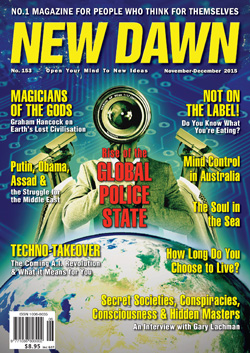
  • Freemasons, Secret Societies, Conspiracies, Consciousness & the Hidden Masters: An Interview with Gary Lachman

    Freemasons, Secret Societies, Conspiracies, Consciousness & the Hidden Masters: An Interview with Gary Lachman

    From New Dawn 153 (Nov-Dec 2015)

    An overlooked but powerful current is flowing in our time. It’s found in a small group of writers and thinkers who are trying to overcome the materialism and rationalism of the present age and rediscover the perennial truths that lie behind all religion. These writers are grappling with the occult and esoteric paths of the past and present. They’re trying to explore these movements without falling into either credulity or blinkered scepticism. They include Jay Kinney, founder of Gnosis magazine and author of The Masonic Myth; Mitch Horowitz, a New York book editor whose own works include Occult America and One Simple Idea: How Positive Thinking Reshaped Modern Life; and Erik Davis, author of TechGnosis and Nomad Codes: Adventures in Modern Esoterica.

    In this small but distinguished company is Gary Lachman. He started out in the 1970s in the New York rock scene as one of the original members of the groundbreaking New Wave band Blondie. In 1996 he moved to London, where he established himself as a full-time writer, contributing to publications such as Fortean Times, The Guardian, and The Times Literary Supplement.

    Since 2001 Gary has produced a steady stream of books, including Turn Off Your Mind: The Mystic Sixties and the Dark Side of the Age of Aquarius; The Secret History of Consciousness; A Dark Muse: A History of the Occult; and Politics and the Occult: The Right, the Left, and the Radically Unseen. In recent years he has published biographies of major esoteric figures including P.D. Ouspensky, Emanuel Swedenborg, Rudolf Steiner, Carl Jung, and H.P. Blavatsky (see his interview in New Dawn 137).

    Gary’s latest work, published in December 2015 by Tarcher/Penguin, is The Secret Teachers of the Western World, a monumental work that unveils the esoteric masters who have shaped the intellectual development of the West, from Pythagoras and Zoroaster to little-known twentieth-century figures such as Jean Gebser and René Schwaller de Lubicz.

    In June 2015 I conducted an e-mail interview with Gary about secret currents in the Western tradition.

    RICHARD SMOLEY (RS): Many people have a sense, however dim, that what is going on in the news is only the thinnest skin upon a sea of struggles and forces that we can barely conceive of. Would you agree with this assessment?

    GARY LACHMAN (GL): I suspect that at most times what we are aware of is only a selection of what is actually taking place. I mean this in the broadest sense possible. In terms of the media, it’s reasonable to assume there are a variety of filters in place that result in an edited version of things getting to us. But then there are people who devote their energies to ‘uncovering’ the truth and ‘revealing’ the facts about this or that event. It does strike me that one could get lost in attempting to track down the ‘truth’ about things, in terms of the political, economic, social situation. I mean conspiracy theorists who pursue an elusive solution to the mystery of who ‘really’ is in power and what ‘really’ happened in this or that situation.

    I think it is important to be discriminating about what we accept from our sources and to be aware that every source has its bias. Personally, I am more interested in the kind of things that are outside this kind of ‘hermeneutics of suspicion’, in the philosopher Paul Ricoeur’s phrase. I mean philosophy, thought, etc. I think it’s always a good time to pursue the good, the true, and the beautiful, whoever is running the show. I also think there is less covert control than some people believe, but it seems de rigueur nowadays to feel that everything we see on the news is false. The show itself is ultimately unimportant. It is an unavoidable nuisance that we nevertheless need to be aware of in order to pursue our aims.

    RS: Novelist Ishmael Reed wrote, “Beneath or behind all political and cultural warfare lies a struggle between secret societies.” How much truth do you think there is in this statement?

    GL: Well, I don’t know. I first came across it, as many people did, in Robert Anton Wilson and Bob Shea’s conspiracy fantasy Illuminatus. Are there really secret societies at work, manipulating events and controlling the world? If there are, they don’t seem to be doing a particular good job of it.

    I think that at different times there have been societies or groups of people who have worked together to effect some change or introduce some idea into the societies of their time. I talk about some of them in my new book, The Secret Teachers of the Western World. But these were relatively small groups who were active at a certain time, and when you look at what they were doing, the aura of mystery and sensation around them being ‘secret’ dissolves. That isn’t what is important about them. Take the Fedeli d’Amore of Dante’s time and of whom Dante was a member. They weren’t secret in the way that we think of Skull and Bones or that kind of thing (and I should say here that my book isn’t about that kind of secret group). But they were a relatively private group of poets who wanted to introduce ideas about the divine feminine or Sophia into the consciousness of their time. They were more like what G.I. Gurdjieff and P.D. Ouspensky mean when they talk about the ‘inner circle of humanity’ or ‘esoteric school’. I’m not saying the Fedeli d’Amore were agents of esoteric schools, but that their objectives and practice were like theirs, rather than some cabal of powerful individuals directing events from behind the scenes, which is how secret societies are popularly imagined to be.

    In one sense I think conspiracy consciousness is a good sign, in the way that Jung said neuroses were, as an attempt by the psyche to deal with a problem. It shows that we have a hunger for meaning. We prefer feeling that someone is in charge, even if we don’t know who that is, to feeling that no one is and that everything is chance and arbitrary. The hunger for meaning is good; it’s the means of satisfying it that I find questionable. We are purposive beings who seek out patterns and meanings. The mainstream narratives – religion, progress – no longer satisfy our appetite for meaning, and so we seek it elsewhere. One of the ideas of the book is that the meaning is there, but we won’t find it by looking for it outside ourselves.

    RS: One period in which occult orders were especially influential was the eighteenth century, in which lodges like the Freemasons played a crucial role in transforming the old feudal and ecclesiastical order into the modern world. Do you have any thoughts or insights about this development?

    GL: Freemasonry was a very important means for some fundamental ideas about modernity to be disseminated. I mean ideas about tolerance, social justice, democracy, individual worth regardless of social or economic rank. It was the spread of these ideas through different lodges that helped prepare the eighteenth-century zeitgeist for the radical changes that happened with the American and French revolutions. It is a mistake, though, to think, with Abbé Barruel and more recent writers on the Masonic influence on these events, that Freemasonry arranged or stage-managed them. There were Masons on both sides of the American Revolution, and the Illuminati – the real society, not the popular romanticised idea of it that’s present on the Internet – wasn’t ‘responsible’ for the French Revolution. The ideas that informed Adam Weishaupt’s short-lived and ineffective Masonic offshoot certainly were active forces in the revolution, and they were spread through Masonic lodges. But I think we have to credit the zeitgeist more than Weishaupt and Co. for the storming of the Bastille. In fact in one sense we could say Freemasonry itself was a product of the shift in consciousness that began around that time.

    RS: Your new book is entitled The Secret Teachers of the Western World. If they were secret, how have they been able to have such influence?

    GL: Well, again, my secret teachers aren’t necessarily secret in the sense that no one knows about them. I mean, if they were that secret, how could I know about them? One can be a secret teacher by teaching secrets, or one can be a secret teacher in the sense that the influence and importance of your ideas haven’t been recognised or have been misunderstood. Or you can be secret in another sense, as with several important thinkers who have been marginalised or don’t fit into the standard model of Western consciousness. It’s a broad term referring to a variable status rather than specific group of people. Jesus Christ, for example, is one of my secret teachers, and most people know about him. But there is a whole school of thought that argues that what we have accepted as Christianity really has little to do with the original teachings associated with Jesus. The Gnostics, for example, are thought to be more in line with what Jesus actually taught then the Petrine church of Rome.

    Or take Madame Blavatsky. If people know about her at all, she is chalked up to be an entertaining but fraudulent nineteenth-century spiritualist with a lot of chutzpah. But she was enormously influential on the modern world, in everything from art, religion, and science to what became known as the ‘counterculture’. I am not saying that everything she said about science or religion is ‘true’. That’s not the point. True or not – and she is more often on the ball than you might think – her ideas were tremendously influential, and I am amazed that feminists haven’t appropriated her. I suspect the occult connotations put them off. She isn’t secret, but her influence is not generally recognised.

    I should say the central idea of my book is that the whole Hermetic, esoteric tradition is the victim of a war going on inside our heads. I mean the rivalry between our two cerebral hemispheres. One of the inspirations for the book came from reading Iain McGilchrist’s very important work The Master and His Emissary, which is about the left and right brain and the differences between them. Briefly put, McGilchrist revamps the left/right brain discussion by showing that the difference between them is not in what they do – as was originally believed – but in how they do it. They respond to the world in very different ways, and the way they present the world is also very different. In the simplest sense, the right brain presents a total picture of the world. Its mode of consciousness is relational, connective, holistic. It presents what McGilchrist calls the ‘big picture’, the overall pattern, but its picture is fuzzy, vague. It works with metaphor, symbols, and is focused on the living character of being. It is aware of implicit meanings, meanings that we know and feel but cannot express explicitly. (Think of our appreciation of music: we know a Beethoven string quartet means something, but we’d be hard pressed to say exactly what.)

    The left brain is aimed at breaking up the big picture into smaller bits and pieces that it can manipulate. Its main function, as Henri Bergson said long ago, is to help us survive. It reduces the living, flowing whole presented by the right brain to a kind of map that allows us to manoeuvre through the world effectively. It’s interested in the trees; the right brain is interested in the forest. One looks through a microscope, the other at a panorama.

    Both are necessary, and for the most part each gets along with the other in a system of checks and balances, each inhibiting the other’s excesses. But McGilchrist argues – convincingly, I believe – that in the last few centuries the left has increasingly gained an upper hand against the right and has, in a sense, gone on a smear campaign against it. One expression of right brain thinking that the left brain targeted was the Hermetic, esoteric tradition, which was cast into disrepute with the rise of mechanical science – itself an exemplar of left brain thinking. With the dismissal of the esoteric tradition it was transformed into what the historian James Webb called ‘rejected knowledge.’ What my secret teachers teach is this rejected knowledge.

    [alert type=”info” dismiss=”no”]If you appreciate this article, please consider a subscription to New Dawn magazine.[/alert]

    RS: Of the figures that you would include among these secret teachers, which do you consider the most influential?

    GL: That’s difficult to say, and I should point out that the book isn’t a ‘top ten’ or ‘ten best’ list or something like that. Plato is certainly one of the most influential; in many ways the esoteric, Hermetic roads all lead to him. He is believed to have ‘gone to school’ in Egypt, and whatever he learned there is supposed to inform his philosophy. But whether Plato studied in Egypt or not, his ideas about the Forms, the ideal essences of which the physical realities of time and space are merely shadows, is certainly at the heart of the esoteric tradition. And Platonism informed Christianity, Hermeticism, Gnosticism, and other esoteric teachings. We can argue with and reject or accept different aspects or elements of his philosophy, but I would say that for the West, Plato is certainly one of, if not the most, significant source of esoteric thought, or thought in general. Alfred North Whitehead said long ago that all Western philosophy is but a series of footnotes to Plato.

    In saying this I’m not saying I think Plato is the ‘best’. My own philosophical background is more in Nietzsche, Bergson, Whitehead, William James, and existentialism. But Plato is still there too.

    RS: Which of these figures do you admire the most?

    GL: I’m not quite sure how to answer that. There are plenty of admirable figures in the book, as well as more questionable ones, and also some martyrs, like Hypatia the Neoplatonist, and the Persian theosopher Suhrawardi, both of whom fell victim to religious persecution, as well as truly secret teachers like the so-called Dionysius the Areopagite who welded Neoplatonism to Christianity. We do not know who he really was, just as we have no names for the Hermeticists of ancient Alexandria.

    I can say who has been an influence on me. One of first writers on esotericism that I read was P.D. Ouspensky. His books Tertium Organum and A New Model of the Universe made a big impact on me, even before I read In Search of the Miraculous and became interested in Gurdjieff. I first read these books forty years ago, and Ouspensky seemed a model of the kind of thinker I wanted to be: he combined a romantic openness to ideas, and poetry and art with a rigorous critical mind and he remains the best writer from what I call the ‘golden age of modern esotericism’, which took place during the 1920s, when people like Ouspensky, Gurdjieff, Rudolf Steiner, Jung, Crowley, and others were all active. Again, I’m not saying Ouspensky is the ‘best’ – that’s as pointless as arguing about who’s the best guitarist. But reading his books excited me and made me want to learn more. I tend to like figures that combine imagination with critical thinking, which we can see as the right and left brain working together, which is another theme running through the book.

    RS: One theme that you advance in your new book is that the cosmos is a living, conscious being, and that we need to rediscover that fact. To what extent do you think this rediscovery is actually happening in the world today?

    GL: It seems some form of that idea has been revived and presented in a variety of different ways throughout the last century and into our own. Bergson argued a form of it as did Whitehead. In the nineteenth century we have Gustav Fechner, who wrote about the Earth as a living being well in advance of James Lovelock. The philosopher David Chalmers has argued for a kind of panpsychism, meaning that in some sense, the entire universe is conscious. What headway this idea has made in altering our ‘standard model’ of the cosmos is unclear. We’d have to interview lots of scientists, I guess, and go through the numbers. I think more people today have some sense of it than, say, in the nineteenth century – at least the kind of mechanistic picture of the world popular then is less so now. Of course, any scientist who takes the idea literally and talks about it is subject to the scorn of his peers. But that too is an expression of the rivalry between the two modes of thinking. The ‘hard’ left brain makes fun of the ‘soft’ right brain’s ‘need’ to see a nice, cozy universe that cares about him, while he shows how ‘tough’ he is by saying that he doesn’t need that and prefers the ‘truth’ about the cold, indifferent cosmos. I write about this in an earlier book, The Caretakers of the Cosmos, where the idea of a living cosmos is a central theme.

    RS: Thirty or forty years ago, it seemed possible to believe that we were on the verge of a new age of rising consciousness and compassion. It’s a little harder to believe this now. How do you personally respond to hopes and dreams of a coming new age (however imagined)?

    GL: I’m not that keen on predicting a new age. Western history is littered with them. I think the current pessimism, or, more accurately, nihilism is a kind of ‘sound barrier’ that our culture, our civilisation, has to break through. Nietzsche predicted it at the end of the nineteenth century. I think we have somewhat naïve ideas about a new age. I believe there are shifts in consciousness. One of the thinkers I refer to in the book and in others is the little-known German philosopher Jean Gebser, who talks about different ‘mutations’ of consciousness happening throughout history. But these come about through our own participation in them; I mean we are active players, not passive recipients of something happening in the stars or according to some ancient teachings.

    The real new age will come round when we learn how to master our own consciousness. This means coming to understand it. This takes hard, determined work. I don’t think the new age will come about because of nice thoughts or fun raves or because of a conference or a festival. It will start to appear in individuals who have an obscure hunger for some purpose higher or more demanding than what our ordinary life can provide. These types embody in embryonic form a new consciousness that demands a new kind of inner freedom.

    We tend to think of freedom as liberation, as being free from something. The new types want a more significant freedom, the freedom for some purpose greater than just fulfilling their individual needs. In The Caretakers of the Cosmos I borrow a term from the Russian existential philosopher Nikolai Berdyaev and talk of a ‘creative minority’. These are the individuals who quietly and solitarily confront the demands of the new consciousness emerging within them. We tend to think that a new form of consciousness will be lots of fun and full of ecstasy. But more often people experiencing a different kind of consciousness, with different needs and appetites, tend to feel like misfits and have to go through a long struggle to actualise their possibilities. I have a very evolutionary way of thinking. I feel that any important development at first makes life more difficult for those in whom it occurs. Those who can get through the initial difficulties develop a strength that will help them impose the new vision on the world around them.

    RS: Which living people do you consider to be most important and impressive in fostering this higher awareness?

    GL: The most important one for me has been Colin Wilson, who sadly died at the end of 2013 at the age of eighty-two. I have been a dedicated Wilson reader since 1975, when I first read The Occult. After that I tracked down and read as many of his books as I could find. I am in fact preparing to write a book about his work and ideas, which more or less form the basis for much of my own writing. Wilson spent a lifetime in a determined analysis of consciousness and developed what I find to be a very convincing argument for why our consciousness is how it is and what we can do to intensify it. It isn’t for everyone, but I personally have got the most out of following his leads.

    Gary Lachman’s The Secret Teachers of the Western World (Tarcher/Penguin) is available from all good bookstores and online retailers.

    [alert type=”general” dismiss=”no”]This article was published in New Dawn 153.[/alert]

    [alert type=”success” dismiss=”no”]If you appreciate this article, please consider subscribing to help maintain this website.[/alert]

    © New Dawn Magazine and the respective author.
    For our reproduction notice, click here.

  • What Happened to the New Age? Sorting Truth from Nonsense

    What Happened to the New Age? Sorting Truth from Nonsense

    This article was published in New Dawn 147 (Nov-Dec 2014).

    Not long ago I was walking through the aisles of a New Age fair in the suburbs of Chicago. All the usual suspects were there: booths for Baha’i and Eckankar; ladies selling essences and fragrances; bodyworkers offering ten minutes of chair massage; psychics inspecting the etheric fields of their subjects. Like most New Age events I have gone to over the past decade, the fair had a tired quality to it.

    I could simply be jaded. I’ve been going to such gatherings for over thirty years now, and at this point they hardly impress me with their novelty. But I may not be alone. One has the sense that for many, the energy that gave rise to the New Age has ebbed.

    Even the term “New Age” has come to sound stale, harking back to the ’80s and the Harmonic Convergence, and, still further, to the spirituality of the 1960s counterculture. Commercial interests have backed away from the name, preferring the term “mind-body-spirit” or “MBS.” In January 2012, New Age Retailer, the primary trade magazine for this field in the US, changed its name to Retailing Insight.

    Was the New Age a fad? Was it a noble but misguided hope that the world was ready for an enlightenment to which it now seems indifferent or hostile? Probably neither. More likely this is the case: much of what the New Age pioneered, including yoga, meditation, and organic foods, has become mainstream. Thus you could say the New Age won out in many ways – but at the cost of seeming fresh.

    What about its ideas? Many of them too entered the mainstream and have even become clichés. At this point it may be useful to step back and look at some of the clichés of the New Age and see how well they stand up.

    The New Age

    Let’s start with the phrase “New Age” itself. It goes back far beyond the ’60s, even beyond the turn of the twentieth century. It first started being used in 1864, when an American clergyman, Warren Felt Evans, published a book entitled The New Age and Its Messenger.

    Evans was propounding the ideas of the great Swedish visionary Emanuel Swedenborg (1688-1772). In the 1740s Swedenborg underwent a series of spiritual awakenings that, he said, gave him access to the invisible realms and to the hidden meanings of Scripture. One of his most remarkable claims was that the Last Judgment of the Bible had no resemblance to the way it was seen by conventional Christianity. It was never meant to mean Christ’s second coming on earth. In fact it took place entirely in the world of spirits, a realm which, in Swedenborg’s theology, occupies a middle place between heaven and hell and serves as a clearinghouse for the newly deceased. This spirit realm had accumulated a great deal of debris, such as base and mean entities, and it needed a housecleaning. The Lord accomplished this in the year 1757.

    This Last Judgment, according to Swedenborg, had no immediate consequences for life on earth. Its only effect would be to weaken the power of spiritual tyranny and oppression (notably on the part of the Catholic Church, but also among the Protestants). New horizons on the spiritual world would therefore open. This was the New Age that Evans proclaimed, and Swedenborg was its messenger.

    In his way Swedenborg was right. Many of the religious shackles that seemed solid in the eighteenth century have been broken. There is still a great deal of nonsense, deception, and crime in religion, but there is also much more freedom of inquiry – even the freedom not to believe if you don’t want to.

    Since the nineteenth century, Swedenborg has faded into comparative obscurity, and Evans, once a best-selling author, has been almost completely forgotten. But the term “New Age” was given new life in the twentieth century by figures such as the British esotericist Alice Bailey, and, as we have seen, the New Age as an ideal reached its own peak in the late twentieth century.

    To go back to the initial question: how much truth is there in this idea of a New Age?

    In a trivial sense, every age is a new age. Today we face unprecedented dangers and opportunities. So did our fathers; so did our grandfathers. So will our children and grandchildren. Thus it has been since the beginning of history.

    But I don’t believe the human condition is going to change in any radical way in the future. Whatever wonders and disasters we may engender, we will still be born, love, experience pleasure and pain, and die as humans have since the beginning of time. As Anton Chekhov said in his play Three Sisters, written in 1900: “When we’re dead people will fly around in balloons, there will be a new style in men’s jackets and a sixth sense may be discovered and developed, but life itself won’t change, it will still be as difficult and full of mystery and happiness as it is now.”

    Paradigm Shift

    This phrase is often connected to the idea of the New Age. “Paradigm” means a scientific model. The Ptolemaic view of the solar system, which put the earth at the centre, was one such paradigm. It was replaced by another: the Copernican paradigm, which puts the sun at the centre.

    How did the new view replace the old one? The historian of science Thomas Kuhn asked this question in his influential book The Structure of Scientific Revolutions. His answer goes something like this: A scientific model inevitably has some flaws. It explains the data, but not quite perfectly. There are anomalies. For a long time these are set aside and either explained away or simply ignored. But after a certain point too many anomalies accumulate and can no longer be set aside. Science must then find another model – another paradigm.

    In the case of astronomy, the Ptolemaic view explained the movements of the planets quite well in light of the observations that could be made at the time (up to the sixteenth century). This even included the retrograde motion of the planets. If the planets moved around the earth, why did they sometimes move backwards in the sky? The Ptolemaic theory replied by positing epicycles – meaning that the planets not only revolved around the earth, but moved in small cyclical orbits as they did.

    Eventually the epicycle theory, which still did not match the data entirely, began to break down. Astronomers responded by positing epicycles within epicycles, but there was a point when this model seemed implausible. Another one had to be found. The theory of Copernicus, modified by Kepler, accounted for the planets’ motion much better. This was a scientific revolution, also known as a paradigm shift.

    The paradigm shift that the New Age speaks of is more vague. To some degree it has to do with another scientific revolution – from Newtonian to quantum physics. Newtonian physics is mechanistic and materialistic: it is a universe of ricocheting billiard balls. The quantum universe is much stranger, and some of its most brilliant theorists have stressed how bizarre and counterintuitive it is. But one idea from quantum theory has captured the public imagination: the observer affects the results of an experiment simply by the process of observation. This theory seems to place consciousness, rather than matter, at the centre of the universe.

    This idea fascinates people who dislike the meaningless, materialistic Newtonian universe. Some physicists, such as Amit Goswami, author of The Visionary Window and other works, say quantum theory proves that consciousness is the ground of all being. This is a step many other scientists are not willing to take, largely because quantum theory talks about the behaviour of submolecular particles; they are very reluctant to say quantum effects occur on greater scales. Quantum physics is sometimes defined, in fact, as “the science of the very small.”

    What does this all amount to? There is certainly a new scientific paradigm (although it is well to remember that much of quantum theory was in place by 1930, making it nearly a hundred years old). But this new paradigm, as understood and applied by physicists themselves, does not prove consciousness is the ground of all existence. Nor is it leading toward a more holistic and satisfying view of the universe. In fact the trend is going in the opposite direction.

    A generation ago there was much excitement, at least in the popular mind, about the connections between quantum physics and mysticism. But the majority of scientists, rightly or wrongly, have never bought it. They remain firmly materialistic in their outlook.

    Other disciplines have also moved backward. The psychology of the ’60s and ’70s embraced humanistic and transpersonal perspectives, but to all appearances this process has been turned around. Neuroscience has had so much luck modifying behaviour through pharmaceuticals that now scientists seem to assume more or less universally that consciousness is a mere side-effect of brain states. (Never mind that this claim has never been proved or even explained in any kind of coherent way.) Computer science, for its part, has made such progress in simulating brain processes that some people now believe it will soon be possible to download your consciousness into a computer, allowing cognition to go on through the operation of a machine rather than a brain. You will no longer need your body to be you. Minds are machines, whether they are made of carbon-based protein or silicon.

    In short, the paradigm that was so fondly expected to bring about a new, satisfying, and holistic view of man’s place in the universe failed to arrive. Conventional science, for all its accomplishments, is as drearily materialistic as it was in the days of Queen Victoria.

    That is not to say change will never come. Trends reverse themselves without warning, and fashions in science come and go almost as arbitrarily as the ones in couture. But that is how it looks now.
    [alert type=”info” dismiss=”no”]If you appreciate this article, please consider a subscription to New Dawn magazine.[/alert]

    You Create Your Own Reality

    In a trivial sense, this is certainly true. Your senses and nerves and brain filter the data from the outside world (whatever this “outside world” ultimately is) and create a picture of reality that enables you to function.

    But some New Agers go further. They say that all you have to do is change your thinking and the world will change automatically.

    To some degree this is true as well. Say you are having money trouble. Try this mental experiment. Believe, as fully as you can, that a cheque for a million dollars is coming to you next week. Suddenly your problems will seem to vanish. You will have no worries.

    Your thinking certainly changes the way you feel. But the claim that you create your own reality is a little stronger than this. It is saying that if you believe hard enough that this cheque will be coming, it will come: the universe will manifest it for you. And this idea is harder to swallow. At best, it can motivate you to strive to bring more money into your life; at worst, it is nothing more than daydreaming.

    Some people practice creative visualisation. By this method you formulate a vivid mental picture, and you concentrate on it so that the energy you are directing will make it appear in the physical world. This can and sometimes does work. But it very often brings unwanted consequences in its wake. You can visualise a cheque for a million dollars, and the cheque may appear. But you didn’t count on the fact that you would get into a crippling accident, and the cheque is to compensate you for the fact that you will never walk again. Granted, this is an extreme example. Another more likely outcome is that you will find that you really didn’t want what you were asking for and were disappointed when you got it.

    A few weeks ago, for no reason that I can discern, a file suddenly opened up on my computer. It said, “Please, God, protect me from everything I have been praying for.” I wrote it several years earlier and had completely forgotten about it. Evidently I needed to hear it again.

    Another thing is often overlooked: You are not the only one creating your own reality. There are others like you. All of them have the same power over reality that you do. And you are part of their reality as well.

    This fact raises a large but unexamined question: if we create our own reality, it must be a collective creation. And what is the effect of all these minds creating and cocreating together? How do the thoughts of your neighbours, your countrymen, your fellow humans as a whole, affect you? How do the minds of many engender a collective reality?

    This is, I believe, one of the most important questions facing humanity today. There is a collective imagination – psychologist Charles Tart called it “consensus trance” – that shapes our reality as much as, and probably more than, our own private thoughts do.

    As far as I can tell, psychology has not dealt with this question or even acknowledged it. It is true that the psychiatrist C.G. Jung spoke of the collective unconscious. He touched upon collective mentalities in some of his articles, such as “Wotan,” which discussed the resurgence of an old Germanic archetype in the Nazi ideology, and “The Complications of American Psychology,” which related the American psyche to the nature of the land in which it found itself. From another angle, the Russian psychologist V.M. Bekhterev explored mass and mob behaviour in his book Collective Reflexology. Bekhterev, who saw the Russian Revolution firsthand, had plenty of observations to work from. Even so, the science of collective psychology is embryonic.

    Thus up to a point it is true you create your own reality. But so does everyone else, and you are part of that reality too. The question for the twenty-first century is how we create our reality.

    Be Here Now

    Let’s turn to one of the most famous artefacts of the New Age. A squarish, large-format paperback book, with a purple cover, its contents printed on rough brown paper that looks like wrapping material. Its title: Be Here Now. Its creator: the beloved American guru Richard Alpert, best known as Ram Dass. The words, pasted down clumsily with letterpress as if to simulate the visual distortions caused by LSD, urge you to awaken:

    What are you doing?

    Planning for the future?

    Well

    IT’s ALL RIGHT NOW

    But later?… Forget it baby

    That’s later

    Now is

    NOW

    Are you going to

    BE HERE or not?

    IT’S AS SIMPLE AS THAT!…

    If you get so efficient…

    If you’ve got to turn off all the vibrations of the scene…
    because you’re so busy

    about the future

    or the past

    or time has caught you…

    IT COSTS TOO MUCH!

    No message from the New Age has burned itself into the collective mind as deeply as this command: Be here now. The past is an artificial construct. The future is an equally artificial construct. There is only the present moment. There is always only the present moment. This is the way to liberation.

    The idea still reverberates. Just as its effect was starting to fade, Eckhart Tolle came out with a booster shot: the best-selling Power of Now, published in 2004.

    No one could possibly refute this idea. It is always now, and, it would seem, the atomic moments felt through meditative awareness – an endless chain of nows, each one inexorably strung upon its predecessor – bring us as close to ultimate reality as we are likely to come in this world.

    As a mental discipline, what has sometimes been called “the doctrine of the present” has no peer. Every moment – or, rather, every moment you are aware of it – you bring your attention to the present; you sense your feet on the floor and feel the breath go in and out. The welterings of your mind subside. You are centred and at peace.

    How could anyone question this?

    In essence, I could not hope to. But in practice, another view arises.

    There is the sensation of my foot on the floor. This is direct, immediate, real. There are, on the other hand, the thoughts and fantasies and daydreams in my head, flowing before my mesmerised eyes like the scenes of a thriller. By contrast, they seem unreal.

    But maybe this is not the whole picture. Am I not, after all, experiencing all these supposedly delusory thoughts in the present as well? Why should one experience be held up as real and genuine, while the other is despised as false?

    Someone who goes to a few of the innumerable talks given by Tibetan lamas in the West will sometimes hear them denigrate the conceptual mind – the ‘monkey mind’ that must be suppressed, or even killed, if enlightenment is to occur. But I once heard the Dalai Lama speak, and he criticised this point of view. Although I don’t remember his exact words, I do remember that he said this contempt for the conceptual mind was unjustified, that this part of the mind too has its place, and one must not try to uproot or kill it.

    And sometimes this conceptual mind will take you out of the present.

    The present, then, that magic moment that discloses God, is only one of innumerable types of experience. It is well, of course, to be able to recognise and rest in it. But it may not be wise, and it certainly seems impossible, to stay there all the time.

    R.H. Blyth, in his celebrated collection of essays Zen and Zen Classics, writes: “Where Buddhism makes its great mistake is in asking for eternity without time. As Blake said, ‘Eternity is in love with the productions of time’.”

    Peace

    Peace. If there is one word that encapsulates the New Age, it is this one. In its day, it was more than a word. It was a gesture (the fingers forming a V, the palm facing out in an exact reversal of Churchill’s ‘V for victory’ gesture). It was an ideograph, the circle bisected vertically, with two other lines extended down from the centre – a combination of two letters in semaphore code standing for ND or “nuclear disarmament.”

    But peace – a cliché? That is a harsh verdict. And if it is, you will say, we need more of such clichés. And badly.

    In the ’60s the peace movement was the result of a genuine collective impulse. It was not only the recent memory of the horrors of the Second World War. It was also an aftershock from the Cuban missile crisis of 1962, when the world came the closest it has ever come to nuclear war. In the US, the peace movement was also a response to the Vietnam conflict and to the real likelihood that, like the states in Orwell’s 1984, the superpowers would maintain a permanent state of war.

    Events turned out differently from the expectations, as events always do. The threats to world peace that seemed so menacing during the Cold War are gone, but they have been replaced by others, and when these are gone, there will be others still.

    Do we need a peace movement to turn ourselves around? I think we do, but I also think we have never had a genuine peace movement. What we have had are antiwar movements. And to be against war is not the same thing as to be for peace.

    Earlier in this article I talked about the possibility that thoughts play a part – a major part – in shaping reality. And I think this is the case. In this light what are we to make of today’s mentality, which projects so much hatred toward its leaders? Do they deserve it? Maybe – but you are not making them any better or their work any easier by directing hatred and vituperation at them. Not if there is the dimmest bit of truth to the idea that your thoughts create reality. And of course this goes double for any collective feelings of hatred.

    In this light I find myself thinking about the possibility of a peace march – a genuine peace march. Such an event would be aimed not at stopping the latest war but at offering peace and blessings to the leadership of the nation, of any and all ideologies, without any agenda whatsoever. This would be a real peace march, because it would be offering peace rather than opposition, blessings rather than grievances. I wonder what effect it would have.

    A cliché, of course, could never become a cliché unless it is widely disseminated. And it would never become widely disseminated if it did not have much truth, and even wisdom, in it. So it is with the clichés of the New Age. Many of them are rooted in ancient and indeed perennial truths. That these truths need to be recast and restated in the language of a particular time and place is hardly a flaw; it is a way of adapting them to the needs of a generation. They will be restated and recast in many ways in the generations to come.

    [alert type=”general” dismiss=”no”]This article was published in New Dawn 147.[/alert]

    [alert type=”success” dismiss=”no”]If you appreciate this article, please consider subscribing to help maintain this website.[/alert]

    Sources

    V.M. Bekhterev, Collective Reflexology: The Complete Edition, translated by Eugenia & Alissa Lockwood, Transaction, 2001

    R.H. Blyth, Zen and Zen Classics, vol. 5, Hokuseido, 1962

    Amit Goswami, The Visionary Window: A Quantum Physicist’s Guide to Enlightenment, Quest, 2006

    Ram Dass, Be Here Now, Lama Foundation, 1971

    C.G. Jung, Civilizations in Transition: Collected Works, vol. 10, 2d ed., translated by Gerhard Adler & R.F.C. Hull, Princeton/Bollingen, 1970

    Emanuel Swedenborg, True Christianity, translated by Jonathan S. Rose, 2 vols, Swedenborg Foundation 2006-2012

    © New Dawn Magazine and the respective author.
    For our reproduction notice, click here.

  • What is Alchemy?

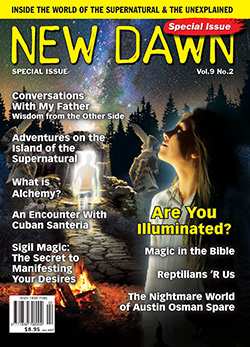
    What is Alchemy?

    From New Dawn Special Issue Vol 9 No 2 (June 2015)

    It is a remote location in China in the early 1960s. A young man, Wang Liping, is studying with three Taoist masters. After preliminary training, they give him a grain of “gold elixir.”

    Wang sits in a cross-legged position. The masters tie up his legs so that he will stay seated. He then goes into a deep state of trance. On the first day, he feels as if his insides are burning, and he passes out. But thanks to the ropes, he remains immovable in the cross-legged position.

    On the second day, Wang’s skin changes colour from sallow to ruddy to dark. The masters judge that the toxins in his body have been pushed to the surface.

    At this point he has been pushed to the limits of his endurance, but he keeps on meditating. His skin experiences all kinds of sensations from burning to itching and aching.

    Finally on the third day, Wang’s body becomes comfortable again. His skin colour has changed to a healthy rosy white and glistens. The gold elixir has been completely expelled from his body. The operation is a success.

    This account, taken from a book called Opening the Dragon Gate, describes Wang Liping’s training as a Taoist master. Its mention of a gold elixir – which the text does not otherwise describe – evokes images of alchemy. It leads one to wonder exactly what alchemy is.

    Superficially, everyone knows what alchemy is. It is an outmoded practice for changing base metal to gold. Although it was in its way an important precursor to present-day chemistry, today it is little more than a discarded superstition.

    Accounts like Wang’s tell another story. They suggest there are other dimensions to alchemy than simply heating and cooling metals in the hope they turn into gold. And of course the old alchemists themselves said, “Our gold is not the gold of the vulgar.”

    Moreover, to say alchemy is outmoded may be jumping to conclusions. One of the few practicing alchemists I know in the US is a former chemistry professor. At one point he found conventional chemistry too boring, gave it up, and turned to alchemy. Even so, I see from his website that he does metallurgic consulting for the Smithsonian Institution in Washington.

    To understand alchemy in more than a simplistic way, one needs to take into account several strands of the alchemical tradition. They interconnect and interpenetrate, and to the outsider, the noninitiate (such as me), their relations are impossible to sort out in any kind of complete way.

    The first is the best-known kind: practical transformation of natural substances. Metals are not necessarily the best place to start. One of the best-known alchemical schools of the twentieth century, the Paracelsus Research Society, was operated by the German magus Albert Riedel, known as Frater Albertus, in Salt Lake City, Utah, in the US, until his death in 1984. (Some of his students continued his work in Australia as Paracelsus College: http://homepages.ihug.com.au/%7Epanopus/).

    Frater Albertus’s students started out by making a “plant stone” – taking a plant and subjecting it to certain operations to crystallise its essential nature. Plant stones apparently have any number of uses, including healing. Hans Nintzel, a pupil of Frater Albertus, writes:

    So, we have killed the plant to enable it to give up its soul and spirit. Then we have reunited them and thus resurrected them in a new and glorified body. This product is the highest form of the plant attainable. Philosophically speaking, note that the plant could not do it for itself. It needed a “higher power” (in this case, man) to accomplish this highest transmutation. The plant stone can not only perform interesting physical phenomena, but is an extremely powerful medicine. Depending on what plant or herb it was made from, it can provide a variety of cures.

    Working with metals is a later, more advanced process. But Nintzel adds, “metals, having long absorbed planetary influences, are far more powerful than herbs in healing.”

    Nintzel’s description casts some light on the meaning and purpose of making gold. Alchemy considers gold to be the highest form of metal, just as the plant stone is considered to be the highest form of the plant. Gold is, alchemically, the part of the mineral kingdom that has evolved to the highest stage possible for it. By making gold, the alchemist is helping the mineral kingdom to evolve.

    Nintzel also says that according to alchemy, all things are composed of three essential substances: sulphur, mercury, and salt. “These are consciousness (sulphur), a vivifying life force (mercury), and the vehicle in which the latter two are housed (salt).” Clearly these substances are defined differently than they are in ordinary language.

    And of course if sulphur, in this sense, is present in everything, it naturally follows that consciousness too is present in everything. It is this consciousness even in apparently inanimate matter that the alchemist is trying to develop.

    Unlike conventional chemistry, this is not a practice that takes place entirely outside the operator. The French alchemist François Trojani says:

    The physical world is shown to be far more malleable than science imagines. But this malleability is not some power attained by the alchemist as a separate being, a human subject, to be then replicated on equivalent material objects by other human subjects. The separation of subject and object is revealed as illusion. The Work accomplishes the worker: experiment and experimenter are an inseparable whole.

    Here we can see how this first type of alchemy may intersect with the second kind. This is the kind we glimpsed in the story of Wang Liping. It is not a matter of transforming metals, but of transforming certain substances and energies in the human body. One occasionally hears mention of “Taoist inner alchemy,” which often involves certain visualisation practices as well as the circulation of chi energy within the body (something that can be done with a small amount of training and practice).

    Curiously, sometimes this process seems to involve ingesting certain types of metal preparations. It’s hard to say what the Chinese gold elixir was made of, but very likely it did include gold. Cinnabar (mercury sulfide) is also sometimes ingested, and supposedly has therapeutic properties – when taken the right way. Mercury itself, as is well known, is poisonous.

    The third type of alchemy is a twentieth-century innovation, created by the Swiss psychologist Carl Jung. It involves an engagement with certain energies called archetypes as manifested in symbols. Jung himself called it active imagination. It is a type of visualisation in which the practitioner engages with images and characters taken from dreams. Because these can resemble the bizarre and mysterious figures in alchemical art, Jung saw this as a form of inner alchemy. He himself collected alchemical books, and much of his impenetrable late work Mysterium Conjunctionis deals with alchemical symbols.

    But Jung’s alchemy is not held in the highest regard by at least some practicing alchemists. François Trojani says:

    Jung was not a real alchemist because he attempted to reduce alchemy to its psychological aspect. His understanding of that aspect was excellent as far as it went, but there is much more to alchemy than psychology. It was reductionistic of him to treat laboratory work as a collection of symbols of psychological work. Of course it is rich in symbols, but true symbols are much more powerful and alive than they are considered to be in modern thought, even Jung’s.

    In any case, there are these three versions of alchemy – one involving materials such as minerals, the second having to do with the subtle energies of the body, the third having to do with energies and symbols in the psyche. And although these practices overlap to a certain degree – after all, you would need to do alchemy with metals to make a gold elixir for the body – it would seem to be a mistake to confuse one with another. Or to assume that an alchemical practitioner of one kind necessarily has knowledge of the others.

    If there is any single thread connecting all of these practices, it has to do with consciousness. Alchemy is an attempt to make practical use of the fact that consciousness, in some form and to some degree, is present in all things. One form seeks to refine the consciousness of plants and minerals to the highest degree possible. Another seeks to do the same with the processes of the human body. The third, Jung’s, tries to bring unconscious parts of the mind to awareness, where they can be integrated.

    Maybe we could go still further and say that consciousness is the true gold of the alchemists. As they said, it is not the gold of the vulgar.

    [alert type=”general” dismiss=”no”]This article was published in New Dawn Special Issue Vol 9 No 2.[/alert]

    [alert type=”success” dismiss=”no”]If you appreciate this article, please consider subscribing to help maintain this website.[/alert]

    Sources

    Opening the Dragon Gate: The Making of a Modern Taoist Master by Chen Kaiguo and Zheng Shunchao, Translated by Thomas Cleary, Tuttle, 1996

    The Hermetic Tradition: Symbols and Teachings of the Royal Art by Julius Evola, Translated by E.E. Rehmus, Inner Traditions, 1995

    “Alchemy Is Alive and Well” by Hans Nintzel, Gnosis 8 (summer 1988), 11–15

    “The Quintessence of Alchemy: The Gnosis Interview with François Trojani” by Joseph Rowe, Gnosis 40 (summer 1996), 34–40

    © New Dawn Magazine and the respective author.
    For our reproduction notice, click here.

  • The Mystery of Christian Origins: Hail the Solar Kristos

    The Mystery of Christian Origins: Hail the Solar Kristos

    An innate knowledge of the Gods is coexistent with our very existence; and this knowledge is superior to all judgement and deliberate choice, and subsists prior to reason and demonstration.
    –  Iamblichus, 4th Century Neoplatonist, On the Mysteries of the Egyptians, Chaldeans and Assyrians

    The first Nazarene communities established in the first centuries C.E. by Jesus’ own disciples and inspired Master Teachers knew no birthday for their saviour. Only with the triumph of the Constantinian (Christian) church in the 4th century did the adoption of a date become an issue. The Roman Church Fathers pushed for the adoption of the Mithraic winter-solstice festival called Dies Natalis Solis Invictus, Birthday of the Unconquered Sun.

    In fact most of the ancient Mysteries celebrated the nativity of the solar deities Attis, Osiris, and Dionysus, in the form of the Divine Child, at the northern hemisphere’s winter solstice on or near 25 December. As Charles King explains:

    the old festival held on the 25th day of December in honour of the ‘Birth-day of the Invincible One,’ and celebrated by the Great Games of the Circus… was afterwards transferred to the commemoration of the Birth of Christ, of which the real day was, as the Fathers confess, totally unknown: Chrysostom, for example, declares that the Birthday of Christ had then lately been fixed at Rome upon that day, in order that whilst the heathen were busied with their own profane ceremonies, the Christians might perform their holy rites without molestation.1

    The Roman church adopted 25 December as the nativity of Jesus the Christ because the people were used to celebrating it as the birthday of a solar deity, the Son of Man who bore such titles as Light of the World, Sun of Righteousness, Liberator and Saviour.

    The Eastern branch of the Christian church, still influenced by the earliest Nazarene precepts, placed no significance on a fixed date for the birth of Jesus the Christ. For them the birthday of the Galilean Master Jesus was of little importance compared with his life and sacrifice on the tree of matter. Only late in the 4th century did they agree to honour it. The church of Jerusalem continued to ignore the Roman date of 25 December until the 7th century. Within the Eastern Orthodox churches holy Easter, the commemoration of Jesus’ sacrifice and resurrection, is held to be the high point of the Orthodox calendar and is celebrated with more pomp than Christmas.

    The distinguished Orientalist Alain Danielou says that in India the winter solstice is celebrated as the birth of the god Shiva, who was worshipped in Greece under the name Dionysus. Danielou remarks that the birth of Shiva’s son Skanda (the god of transcendent Knowledge or Gnosis) and Krishna (held to embody the supreme personality of the Absolute) are also celebrated at the winter solstice. Krishna and Skandar, both portrayed as the Divine Child, share numerous similarities with Dionysus.

    In the words of one scholar:

    In the fixing of the dates for the feasts of the Christian year… it is possible to glimpse the memory of many of the ceremonies belonging to a previous era. At Delphi in Winter, the Thyades, the Bacchantes of Parnassus, used to awaken a baby in a cradle, the liknites, or infant Dionysus, whose reappearance was celebrated about the time of the Winter solstice [25 December]… The establishing of the feast of the Christian Nativity (starting from the fourth century of our era) on a date close to it in the calendar… accounts for the mechanism by virtue of which a new god is inserted at a liturgical period which existed before the spread of his own cult.2

    Mystery of the Solar Kristos

    Essene communities in the Holy Land and other pre-Christian, Jewish, and Pagan Gnostics welcomed the Christian revelation, finding in its teachings a familiar echo of their own ideas. Christian Gnostics became part of the rich religious tapestry of the area, which was also influenced by the growth of the Mithraic religion throughout the Roma Empire. The Neoplatonists were the first to protest the exclusivity and increasing militancy of Christianity. Intolerance of other beliefs was introduced largely by St. Paul and grew progressively worse as Christianity assumed greater political power in the Roman Empire. Constantine declared it the state religion in 325.3

    The Ancient Tradition, upheld by all the Secret Schools since the dawn of time, finds its outward expression in the universal message of a past Golden Age when Man was free from care and evil non-existent; to the subsequent ‘fall’ of Man and the loss of oneness with the Divine; and finally to a revelation received from heaven foretelling the reparation of this loss and the coming of a Redeemer who should save humanity. We find this message, in a multitude of forms, within the great pre-Christian pagan traditions.

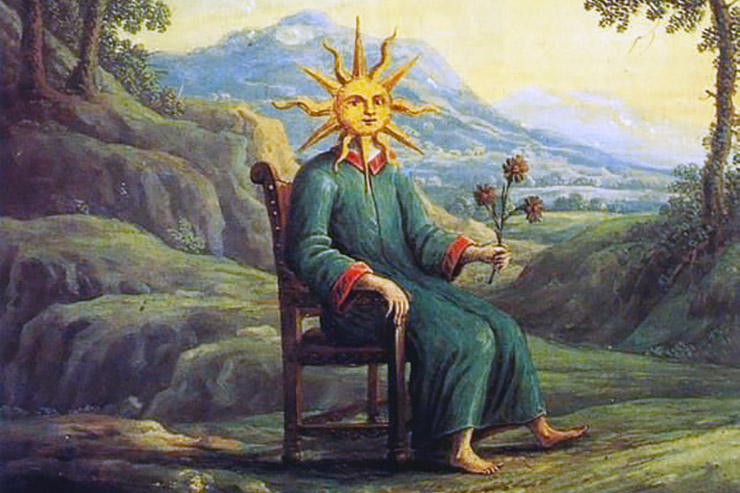
    Everywhere, in Persia, as in Egypt, in Sumeria as in Greece, all the legends associated with divine saviours told of the voluntary sacrifice of a youthful deity, embodying the Solar Kristos or Logos, the manifested emanation from the one omnipotent, ever concealed, infinite and unknown Father. Each of these saviours may be compared to a ray of the Solar Kristos incarnate in human form.

    The triumph of the Roman church as a political power witnessed the corruption and debasing of many of these venerable motifs, myths, legends and principles, as well as their absorption into what became Christianity. At the same time in its dogmatic form the Church portrayed itself as the sole repository of truth, slandering the noble pre-Christian traditions as the ‘work of the devil.’ Driven on by their need to discredit the entire true and good in the previous religions, Christian zealots sacked the temples of other saviours, burned ancient sacred books, and attacked initiates of the Mystery Schools. Their crimes knew no bounds as they built their own churches on the same foundations as the old ‘pagan’ temples. In 415, an enraged Christian mob, incited by the Church bishop, captured Hypatia, the famed female leader of the Alexandrian Neoplatonic school. She was then tortured, killed, and dismembered.

    When confronted with the remarkable similarity between the Christian Jesus and the saviour deities of the ancient world, the Church Fathers retorted that the devil himself had – centuries before – caused the pagans to adopt certain beliefs and practices. Justin Martyr for instance describes the institution of the Lord’s Supper as narrated in the Gospels, and then goes on to say: “Which the wicked devils have imitated in the mysteries of Mithra, commanding the same thing to be done.” Tertullian also says:

    the devil by the mysteries of his idols imitates even the main part of the divine mysteries… He baptises his worshippers in water and makes them believe that this purifies them from their crimes… Mithra sets his mark on the forehead of his soldiers; he celebrates the oblation of bread; he offers an image of the resurrection, and presents at once the crown and the sword; he limits his chief priest to a single marriage; he even has his virgins and ascetics.

    The Spanish explorer Cortez, too, it will be remembered, complained that the devil had positively taught to the indigenous peoples of the Americas the same things the Christ had taught to Christendom.

    The Master Teachers of the Gnostic Secret Schools maintained that throughout history Saviours, Avatars, Messiahs and Christs appeared in all lands and to diverse peoples. These Kristed-beings brought a message of liberation to mortals trapped in the darkness of mundane existence. As a modern scholar of Gnosticism, Professor Hans Jonas, explains:

    The savior does not come just once into the world but that from the beginning of time he wanders in different forms through history, himself exiled in the world, and revealing himself ever anew until, with his gathering-in complete, he can be released from his cosmic mission.4

    Examining ancient history we discover these Kristed ones, embodiments of the First Emanation (Logos) of the Heavenly Father, described in a number of ways. Of nearly all these saviours it was widely believed:

    (1) They were born on or very near the winter solstice (Christmas day).

    (2) They were born of a Virgin-Mother.

    (3) And in a Cave or Underground chamber.

    (4) They led a life of toil for Mankind.

    (5) And were called by the names of Light-bringer, Healer, Mediator, Saviour, Deliverer, Shepherd.

    (6) They were however temporarily vanquished by the Powers of Darkness.

    (7) And descended into Hell or the Underworld.

    (8) They rose again from the dead, and became the pioneers of mankind to the Heavenly world, the Realm of the Father.

    (9) They founded communities of believers, and Orders into which disciples were received by baptism.

    (10) And they were commemorated by sacrificial Eucharistic meals.

    Jesus the Christ can be said to be the last in a long line of Avatars and Christs who came to earth to bring humanity knowledge of the True God. Let us briefly review the similarities between some of these saviours and the Gospel Jesus.

    Mithra

    The French scholar Renan once wrote: “If Christianity had succumbed to some deadly ‘disease’, the world would have become Mithracized.” In other words, it would have adopted the religion of Mithra. Mithraism arrived in Rome during the first half of the first century B.C.E. By 307 the Roman emperor officially designated Mithra “Protector of the Empire.”

    The Christian Church Fathers incorporated many details of the Mithraic mystery religion into their Church ceremonies and doctrine. The influence of Mithraism on the emerging Christian church is obvious in the Church’s adoption of the Mithraic feast of 25 December. Some resemblances between Christianity and Mithraism were so close that even St. Augustine had to grudgingly confess that the priests of Mithra worshipped the same deity as he did. Dr. Martin Larson says:

    The fact is that the parallel between Mithraism and apostolic Christianity was actually far more extensive than any of the early Fathers implied. Both taught almost identical doctrines concerning heaven and hell, the last judgement, and the immortality of the soul. Both practiced the same sacraments, those of baptism and the communion of bread and wine. Regeneration through the second birth was a basic doctrine of both, and each had the same conception concerning the inter-relationship of their members – that all were mystical brethren. Each believed that its founder was mediator between God and Man, that through him alone was salvation possible, and that he would be the final judge of all. Both taught the doctrine of primitive revelation. Both emphasised the constant warfare between good and evil, required abstinence and self-control, and accorded the highest honour to celibacy. We need not be surprised at these similarities, since we know that Mithraism and Christianity were alike based upon ubiquitous doctrines and practices already hoary with age before these cults appeared.5

    The Persian saviour deity Mithra embodied the Solar Kristos, the Maintainer of the Universe. The Zoroastrian holy scripture the Zendavesta declares Mithra to be the First Emanation of Ahura Mazda, the Supreme Lord of Wisdom and Goodness, and the manifestation of Himself unto the world. From Ahura Mazda emanated a number of hierarchies of good and beautiful divine beings (angels and archangels).

    It is worth recalling the admission of the Judean historian Josephus that the highest principles of the Jewish religion, in the time of Jesus, were all drawn from the Zoroastrian scheme.

    The apostle Paul, who came from Tarsus a stronghold of Mithraism, uses the language of the Mithraic mysteries in explaining that Jesus the Christ is the “Brightness (or reflection) of his glory, the express image of his person, upholding all things by the word of his power.” Thereby testifying to the truth that Jesus the Christ is a reflection of the Invisible Supreme One in his First Emanation (as the Kristos or Logos).

    Horus & Osiris

    Osiris, you have gone away, but you have returned; you were asleep, but you have been wakened. You died, but you live again.6

    Horus, the son of the Egyptian deities Isis and Osiris, was born at the winter solstice. To the ancient Egyptians the visible terrestrial sun was a mere representation of the invisible spiritual Central Sun of Divine Wisdom. The solar deity Osiris manifests as the infant Horus in the hearts of mankind; becoming “regenerated” within the souls of the pure by the power of the eternal Mother, Isis, the ever immaculate virgin, the blessed Queen of Heaven. By his own power Horus, son of Osiris, vanquished Set the Evil Principle, just as Jesus the Christ overcame Satan. In the words of the 19th century author Gerald Massey:

    The Christian dispensation is believed to have been ushered in by the birth of a child, and the portrait of that child in the Roman catacombs as the child of Mary is the youthful Sun-God in the mummy image of the child-king, the Egyptian Karast, or Christ. The alleged facts of our Lord’s life as Jesus the Christ, were equally the alleged facts of our Lord’s life as the Horus of Egypt.

    Images of the goddess Isis and her infant son Horus were sacred objects in every Egyptian home, resembling Mary and the Christ-child, both in appearance and in veneration.

    Osiris, the father of Horus, was human, like us, and thus able to take upon himself all our sorrow, but also divine, and therefore able to confer divinity upon mortals. He brought the divine bread from heaven for humanity; he taught justice and practiced mercy; he died, was buried, and rose from the grave; he gave to all who became members of his mystical body his flesh to eat and his blood to drink so that this divine sacrament might then transfigure them into celestial gods; he went before to prepare mansions for his initiates.7

    Of all the saviour deities worshipped by the ancients as personifications of the First Emanation of the Father, it is Osiris with whom Jesus the Christ is most associated. Osiris was called Lord of Lords, King of Kings, and God of Gods. He was the Resurrection and the Life, the Good Shepherd, Eternity and Everlastingness, the god who “made men and women to be born again.” The renowned Egyptologist Budge says, “From first to last, Osiris was to the Egyptians the god-man who suffered, and died, and rose again, and reigned eternally in heaven. They believed that they would inherit eternal life, just as he had done.”

    According to Egyptian scriptures, “As truly as Osiris lives, so truly shall his follower live; as truly as Osiris is not dead he shall die no more; as truly as Osiris is not annihilated he shall not be annihilated.” The flesh of Osiris was eaten in the form of communion cakes of wheat, the “plant of Truth.” Osiris was Truth, and those who ate him became Truth also, each of them another Osiris, a Son of God, a “Light-god, a dweller in the Light-god.”

    At death, every Egyptian had to appear before the judgment tribunal presided over by Osiris himself, and receive a new life. Osiris could search out the secret places of the heart, and before him no one could be perfect in his own right. Every aspirant to “Osiris-ship” (Khrist-hood) knew that if the law was enforced, he could never enter eternal life. Therefore he exclaimed: “Do ye away with my evil deeds, and put ye away my sin which deserved stripes on earth, and destroy ye any evil whatsoever that belongeth unto me.” Centuries before the Sermon on the Mount, the Egyptian suppliant implored: “bring ye not forward my wickedness… [for] I have given bread to the hungry man, and water to the thirsty man, and apparel to the naked man, and a boat to the shipwrecked mariner. I have made holy offerings to the gods… Be ye then my deliverers, be ye then my protectors… I am clean of mouth and clean of hands; therefore, let it be said unto me…’Come in peace; come in peace.’”

    Budge remarks that the Egyptians believed in “the resurrection of the body in a changed and glorified form, which would live to all eternity in the company of the spirits and souls of the righteous in a kingdom ruled by a being who was of divine origin, but who had lived upon the earth, and had suffered a cruel death at the hands of his enemies, and had risen from the dead, and had become the God and king of the world which is beyond the grave.”

    Many of the expressions and stories found in the Bible are drawn from the older ‘pagan’ traditions of Egypt and Sumeria. Sir Charles Marston concludes in The New Knowledge about the Old Testament:

    Before the time of Abraham, then, before any book of the Old Testament was written, and right down through the centuries after every book in the Old Testament had been written, there existed this belief in a Future Life and the presence of the bread and water of Eternal Life in Heaven. The possession of this knowledge enhances the significance of Christ’s statements in the New Testament: “I am the Bread of Life (John 6:35) and “I am the Living Bread which came down out of Heaven, if any man eat this Bread he shall live forever” (John 6:51) and again “The water that I shall give him shall become in him a well of water springing up in Everlasting Life (John 4:14).

    The 23rd Psalm in the Old Testament is taken from an Egyptian text appealing to Osiris the Good Shepherd to lead the deceased to the “green pastures” and “still waters”, to restore the soul to the body, and to give protection in the valley of the shadow of death. The Lord’s Prayer was prefigured by an Egyptian hymn to Osiris-Amen beginning “O Amen, O Amen, who art in heaven.” Amen was also invoked at the end of every prayer by the devotees of Osiris. The priests of Osiris, like the later Christian priests and Gnostic Elect, were celibates.

    Jesus’ words, “Except a corn of wheat fall into the ground and die, it abideth alone; but if it die, it bringeth forth much fruit” (John 12:24), reflect an Osirian doctrine that a dying man is like a corn of wheat “which falls into the earth in order to draw from its bosom a new life.” Jesus’ words, “In my Father’s house are many mansions” (John 14:2) is very similar to an Egyptian text telling of numerous Arits (“mansions”) in the blessed land of Father Osiris. Ancient legends about Osiris were ascribed by Christians to Jesus.

    Dionysus

    In ancient Greece Dionysus was the god-begotten, virgin-born Anointed One (Kristos). Some writers see the young god as a prototype of Jesus the Christ. Portrayed as seated on the Heavenly Father’s throne, brandishing his lightning-scepter, Dionysus was hailed as King of Kings and God of Gods, titles later applied to the resurrected Jesus. The crucified Jesus was referred to as hanging on a tree, in the same way the sacrificial Dionysus was titled the “Young Man of the Tree.”

    The Roman historian Tacitus said Dionysus had been the god of Jerusalem in an earlier period, but a different god had replaced him, a god with less attractive characteristics. Dionysus “established a festive and cheerful worship, while the Jewish religion is tasteless and mean.” According to Tacitus some of the old Israelite customs “were founded in honour of Dionysus”. Coins found near Gaza, dating from the 5th century B.C.E. show Dionysus on one side, and on the other his opposite the bearded figure labeled YHWH – Yahweh.

    Alain Danielou notes the numerous similarities between Dionysus and Jesus:

    The Christian myths appear to be closely linked to those of Dionysus. Jesus, like Skanda or Dionysus, is the son of the Father, of Zeus. He has no wife. The goddess-mother alone finds her place next to him. He is surrounded by his faithful, his bhaktas, who are of the people, fishermen. His teaching is addressed to the humble and the outcast. He welcomes prostitutes and those who are persecuted. His rite is sacrifice. It is in the Orphic tradition that the passion and resurrection of Dionysus occupy a central position. It is through Orphism that many of Dionysus’ “miracles” were attributed to Jesus. Several aspects of the Orphic legend of Dionysus are to be found in the life of Jesus. The parallel between the death and resurrection of the god and of Christ is self-evident.

    The myths and symbols tied to the birth of Christ, to his baptism, his following, his entry into Jerusalem on an ass, the Last Supper (banquet and sacrificial rite), his Passion, death and resurrection, the dates and nature of the various feast days, his power of healing and of changing water into wine, inevitably evoke Dionysiac precedents.8

    Tammuz

    The self-sacrifice of Christ has often been compared to that of Tammuz or Adonis but most resembles the young man, the fairest and the best, who sacrificed himself to absolve his people of their sins. This was part of the earliest sun-worship.9

    We find the same inner message in the stories of the Egyptian Osiris and the Greek Dionysos, in the saga of Tammuz of Mesopotamia. Elements of which are later reflected in the Gospel accounts of Jesus.

    Tammuz is the Babylonian version of the ancient Sumerian saviour-god Dumuzi, the “only-begotten Son”. Tammuz is a beautiful youth whose cyclical death and rebirth are associated with the cycles of nature. During summer Tammuz is united in love with his sister/mother Ishtar, the Queen of Heaven. At the end of summer Tammuz dies, and the heart-broken Ishtar goes down to Hades to rescue him. With his rescue he is reborn in the upper Realm of Light. He is called Healer, Saviour, and Heavenly Shepherd.

    Tammuz’s death and descent into Hades symbolises his fall into the spiritual darkness of the physical world. He is rescued from this gloomy realm by Ishtar, Heavenly Wisdom, symbolising his spiritual self or True Being. When Tammuz dies, he falls into a pit (Hades), and Ishtar (representing both the Divine Spirit and his spirit) mourns his fall and entrapment:

    The lord is exposed to the woe in the pit…
    My heart is sending wailing of flute to the steppe,
    to the place where the strong one is chained,
    to the place of the chains of Tammuz,
    to the lamb which is given in the power of the nether world…

    The Gospels relate the women coming to Jesus’ tomb were the first to see the risen Lord. Centuries before, women lamented the slain Tammuz, the sacrificial lamb, with the cry:

    Why have they slain him, him of the plains?
    The Shepherd, the Man of Wisdom,
    the Man of Sorrow why have they slain?
    The Lord, the Shepherd of the fold lives no more,
    the spouse of the Queen of Heaven lives no more.

    The women of Jerusalem still wept for Tammuz at the Feast of Unleavened Bread in Isaiah’s day and according to the Church Father Jerome he had a sacred grove at Bethlehem. The Hebrew prophets, in their preaching of the worship of Yahweh, condemned the popular cult of Tammuz. But this did not stop elements of the older tradition being incorporated into Israelite religion and later Christianity.

    Attis

    Happy is the man who is beloved of the gods. Happy is he who, instructed in the divine rites, sanctifies his life, whose soul makes its way to the mountains, for he will experience raptures by virtue of the holy purification.10

    Dr. Martin A. Larson says that “Attis became one of the most potent saviour gods of the ancient world, and left his heavy imprint upon Christianity.” Attis, like Jesus the Christ, was a personification of the Solar Kristos. The early Christian theologian Arnobius writes, “When we name Attis… we mean and speak of the sun.” An ancient Roman inscription declared: “To Attis the Most High God who holds the universe together.”

    The ancient Greeks envisioned the youthful virgin-born Attis as a solar saviour deity holding within himself “the incorporeal cause of the forms that are embodied in matter.” Attis had descended “even unto our earth… from the stars” so that he might, through self-sacrifice, teach mortals to prepare themselves for that spiritual journey that would bring them to the celestial throne. It was the purpose and destiny of Attis to demonstrate that “in all things the conversion to what is higher [spiritual development] produces more power… than the inclination to what is lower [carnal reproduction].” Following his act of self-sacrifice, Attis was “led upwards as though from our earth” to resume again “his ancient scepter.” The Roman Emperor Julian (332-363) wrote “the trumpet sounds for Attis and for all of us who flew down from heaven and fell to earth.” Attis, the Solar Kristos, is “the leader of all the tribes of divine beings”.

    The Gnostic Secret School known as the Naassenes identified Attis with Jesus the Christ, whose mission it was to show the way to pass “from the material condition… to the eternal essence.” The Naassenes insisted that if an individual wished to become enlightened and return to the Realm of Light at death (rather than be reincarnated) he or she must undergo a process by which they might become “neither male nor female, but a new creature… who reunites the two sexes [the primal androgynous Adamic state].” A Naassene poem praising Attis shows how the ancients envisioned the Solar Kristos embodied in numerous local deities and represented in an array of forms:

    Whether [Thou art of] the race of Saturn or happy Jupiter, or mighty Rhea, Hail Attis, gloomy mutilation of Rhea. Assyrians style thee thrice-longed-for Adonis, and the whole of Egypt [calls thee] Osiris, celestial horn of the Moon; Greeks denominate [thee] Wisdom; Samothracians, venerable Adam; Haemonians, Corybas; and the Phrygians [name thee] at one time Papa, at another time Corpse, or God… or green Ear of Corn that has been reaped.

    Jesus the Christ

    That the Christos represents the solar power reverenced by every nation of antiquity cannot be controverted. If Jesus revealed the nature and purpose of this solar power under the name and personality of Christos, thereby giving to this abstract power the attributes of a god-man, He but followed a precedent set by all previous World-Teachers. This god-man, thus endowed with all the qualities of Deity, signifies the latent divinity in every man. Mortal man achieves deification only through at-one-ment with this divine Self. Union with the immortal Self constitutes immortality, and he who finds his true Self is therefore “saved.” This Christos, or divine man in man, is man’s real hope of salvation – the living Mediator between abstract Deity and mortal humankind. As Atys, Adonis, Bacchus, and Orpheus in all likelihood were originally illumined men who later were confused with the symbolic personages whom they created as personifications of this divine power, so Jesus has been confused with the Christos, or god-man, whose wonders He preached. Since the Christos was the god-man imprisoned in every creature, it was the first duty of the initiate to liberate, or “resurrect” this Eternal One within himself. He who attained reunion with his Christos was consequently termed a Christian, or Christened, man.11

    Among the Essenes, a Kristos/Christos (Anointed One) was a priest, specifically designated as the Redeemer. Among the Slavic peoples, Kristos or Krstnik meant a sacrificial hero. The Khlysts, a 17th century Russian Gnostic community, taught that every man and woman was potentially capable of embodying the Krist/Christos, the Divine Word (Logos) of the Father.

    The true “Christ Principle,” the glorified Spirit of Supreme Truth, is universal. The Solar Kristos, embodied in Jesus and all the saviours and Avatars of the past, cannot be monopolised by any one person or group. The Kristos, the only genuine Christ, cannot be confined to any one creed or sect. The name “Christ” has been used in a manner so intolerant and dogmatic that Christianity is the religion of arrogance and ignorance. This is why many Gnostic Teachers prefer to use the spelling Kristos as opposed to the popular title Christ that is today applied to a fictionalised, corporal, carnalised Jesus of the Churches.

    Few Christians understand the ageless Mystery of the Kristos. The real truth of Krist is revealed by Divine Wisdom or Gnosis, which concerns itself with the essential reality behind the fleeting appearances of objects in nature.

    The Christian sacred books, especially the Gospels, Acts and Epistles contain fragments of Gnostic wisdom, very similar to the pre-Christian Mysteries of initiation. It is the corrupted, interpolated passages and distorted literalist presentation that makes of the Bible a book of falsehoods. The New Testament Gospels were not written in the time of the Galilean Master Jesus, some of the books compiled as late as the 2nd century C.E. The Nazarene writers of the Sayings or Logia of Jesus the Christ, of which the Gospels are a corrupted later compilation, knew the Truth, but those who came after them had only dogma and a quest for power. The Gnostic Nazarenes experienced the living spirit of the teachings of Jesus the Christ. The Church Fathers, lacking the guidance of the Spirit of Truth, could only grasp a very materialised and disfigured version of the story of Jesus.

    The early Gnostics viewed the drama of the New Testament crucifixion – regardless of history – as fundamentally an allegorical and philosophical symbol. As always the Gnostics look beyond mere words to connect with the timeless inner message. Read in their literal, dead letter meaning, the four gospels appear to the honest inquirer as simply slightly altered versions of the pre-Christian pagan Mysteries. This is because the Gospel accounts of Jesus’ birth, death and resurrection reflect the stories associated with previous manifestations of the Solar Kristos such Attis, Adonis, Tammuz, Osiris, Mithra and Dionysus.

    The early Gnostic Christians saw the Christ of the Gospels as a Manifestor and Revealer of the Unknown Father. A dozen times, according to Matthew, Jesus the Christ calls the Supreme Lord, “My Father.” In St. John’s Gospel, the Christ says, “I and my Father are one.” “I am come in my Father’s name.” “My Father hath sent me.” “I am in my Father.” Etc.

    The Galilean Master Yeshua (Jesus/Jason/Joshua) the Essene, who studied the Ancient Mysteries in Egypt, became one with the heavenly Logos or Solar Kristos at his baptism. This is why within the Gospels we find a mixture of Essene sayings, including direct quotations from Essene scriptures, together with a retelling in exoteric language of age old mysteries. Along the way we also encounter numerous interpolations and revisions, the work of later Church scribes. It is this Jesus the Christ, the Essene Master, who is credited as the inspirer of the first Nazarene communities that existed long before the era called ‘Christian’. They are the only original Christ-ians.

    But these separated communities, who were in the world but definitely not of the world, had their roots in the ancient Mystery schools, in the Mystic Brotherhoods of Egypt, and in the Essene Order. Many of the virtues associated with the Gospel Jesus and His followers were already present in the Essene communities. According to Philo Judaeus:

    Three things regulate all they learn and do – viz., love to God, love of virtue, love for man. A proof of the first is the matchless sanctity of their entire life, their fear of oaths and lies, and the conviction that God is only the originator of good, never of evil. They show their love of virtue by their indifference to gain, glory, and pleasure; by their temperance, perseverance, simplicity, absence of wants, humility, faithfulness, and straightforwardness. They exemplify their love for their fellow-creatures by kindness, absence of pretensions, and lastly by the community of goods.

    This helps us to appreciate the environment that gave birth to and nurtured the Nazarene communities and Gnostic schools. It is worth noting that in the Gospel of Matthew there are references to a widespread secret network that supported the disciples of the Master Jesus. Wherever they went in the land of Palestine they encountered the ‘worthy’, the ‘faithful’, or the ‘Brethren of the Lord’. “Peace be with you!” appears to have been the greeting or pass-word of the Essenes, the disciples of Jesus, and also of the Nazarenes.

    The mystery of the Kristos, presented in the life and words of Jesus, was identical with that which had been communicated to those who are ‘worthy’ since the dawn of time. From the Gospel according to Luke, we learn that the worthy are those who were initiated into the Mysteries or Truths of the Gnosis, and who were accounted worthy to attain that resurrection from the dead in this life. They were those who knew they could die no more. In other words, they are those initiates who strive to live the higher life and to attain spiritual illumination. Such individuals seek to realise the Krist within. This resurrection is the birthright of every human being endowed with soul and spirit. Such an individual becomes, and is a Christ-Man, a Kristed One, and a true Christ-ian.

    The Church Father Clement of Alexandria was familiar with the Mysteries of the kingdom preserved by the Nazarenes. He wrote:

    That man with whom the Logos dwells… is made like God and is beautiful… [T]hat man becomes God, for God so wills it…. [T]he Logos of God became man that from man you might learn how man may become God.

    This doctrine of deification was at the core of the pre-Christian Mysteries. The distinction between men and gods was that men died and gods did not. Thus, the object of the Mysteries was to become immortal, to become one with the Solar Krist. The initiates of Mithra declared, “I am thou and thou art I,” that is the same as Christ’s admonition, “Abide in me, and I in you” (John 15:4).

    The Christians later perverted this sacred truth by declaring the Man Jesus to be the only Christ, the only expression of the Divine Logos, the one Son of the Father, and even the eternal God in the flesh. Belief in the Man Jesus as the Messiah and Anointed One was taught by His first disciples, but adoration of Jesus as the one eternal God come in the flesh was not taught at all. Even in the heavily edited New Testament Gospels the words ascribed to Jesus are plain. Whenever occasion arose, the Man Jesus asserted his inferiority to the Eternal Father.

    He made himself inferior in knowledge when he said that of the day and hour of the day of judgment no one knew, neither the angels in heaven nor the Son; no one except the Father (Mark 13:32). He made himself inferior in power when he said that seats on his right hand and on his left in the kingdom of heaven were not his to give (Mark 10). He made himself inferior in virtue when he requested a certain man not to address him as “Good Master,” for there was none good but God (Mark 10:18).

    Should there be any further doubt about the nature of the Man Jesus, one only has to contemplate the words of his prayer at Gethsemane. “All things are possible unto thee,” imply that all things were not possible to him, while its conclusion “not what I will, but what thou wilt,” indicates submission to a superior power (Mark 14:36).

    The Gospel of Mark says not a word about Bethlehem or a miraculous birth. The Nazarene community at Jerusalem to which Mary and the brothers of Jesus belonged (Acts 1:14), and over which, James presided, knew nothing of the much-later Church doctrine of Jesus as “the one God come in human form”.

    The Nazarenes, faithful to the tradition of the apostles, saw Jesus as a Man, like other men, but that he was good and virtuous. The Gnostic Nazarene community established by the Master Teacher Cerinthus said Jesus was born altogether as other men are, but he excelled all men in virtue, knowledge and wisdom. At the time of his baptism, the Divine Word, the eternal Christ – Kristos – came upon him symbolised by a dove, and left him at the time of his crucifixion. This was also the position of St. Paul when he wrote how the heavenly Christ “made himself of no reputation” in coming to earth. The Christ as the Divine Word was far more significant to the disciples than Jesus as a flesh and blood being.

    The virulently anti-Gnostic Catholic Church Father Irenaeus, speaking of the Nazarene doctrine taught by Cerinthus, says:

    He represents Jesus as the son of Joseph and Mary, according to the ordinary course of human generation, and not as having been born of a virgin. He believed nevertheless that he was more righteous, prudent and wise than most men, and that the Christ descended upon, and entered into him, at the time of his baptism.

    The Nazarene doctrine, as propounded by Cerinthus, was that Jesus was a mortal, but as the best and wisest of the human race, he was selected as the worthy instrument to restore upon earth the authentic knowledge of the true and supreme Deity. When he was baptised – an outward symbol of inner transformation – in the Jordan, and not till then, he became more than man. At that time, the Solar Kristos, the Logos (Word) of the Father, the First Emanation from the Throne of Light, the Crown Prince of God, descended on Jesus symbolised by a dove, to inhabit his mind, and direct his actions during the allotted period of his ministry.

    The Solar Kristos has been made known by various Anointed Ones and Avatars since the dawn of time. In His earthly ministry Jesus the Christ taught the Path of Transformation, the way to self-mastery and spiritual enlightenment. At the crucifixion, the spirit and blood of Jesus were envisioned by the Nazarenes as having enlivened the earth, permeating it with His consciousness and the energy of His Being. Jesus’ life-experience became fused with the soul of the planet. They believed that through the communion rite they were imbued with the transcendent abilities of the Solar Krist, following in the footsteps of the Elder Brother. Jesus’ sacrifice made possible and guaranteed limitless potential attainment to the true Christ-ian disciple. When he was delivered into the hands of his enemies, the Kristos departed him and returned to the Realm of Light.

    Jesus the Christ declares in the Gospel of John, “Verily, verily, I say unto thee, except a man be born again he cannot see the Kingdom of God.” Here the Christ is referring to the birth from above, spiritual illumination. He who finds Kristos within himself and recognises it as his only Way becomes a follower of the Solar Krist/Christ. Kristos or the Christ consciousness is the realisation of the divine spirit within. To achieve the Kristos condition, one has to live in Christ, to obliterate one’s limited, conditioned personality and it’s separateness from the Eternal Father, the Absolute. Only by realising the divine spark within can one be united with the Life and Light of the Solar Kristos. In the words of Dr. Martin Larson:

    Each man is torn between the two contrary natures in his members, which always strive for mastery. But this conflict cannot end in victory for the higher without direct aid from the God of Light. The advent of Christ is the historic fact which makes the triumph for the spiritual aspect possible. God’s Nous descended upon the entirely human Jesus at His baptism; and He therefore proclaimed salvation to all those who are spiritual or will strive to become so.12

    Clearly there is a difference between the Man Jesus and the transcendent Christ/Krist revealed in the Gospels and in all the legends of the great Avatars and Saviours. Today, not possessing the key of Divine Wisdom, the Christian churches worship a man-made, carnalised Jesus. One early Gnostic school masterly illustrated the difference between the Cosmic Christ and the Man Jesus in the following account:

    Many of his [Jesus’] disciples did not recognise the descent of Christ into him; but when Christ descended into Jesus, then he began to work miracles and to heal and to proclaim the unknown Father and to confess himself openly as the Son of the First Man.

    At the crucifixion the Christ left Jesus but we are told:

    Christ did not forget what was his own, but from above sent into him a certain power which raised him in a body which was both psychic and spiritual; the worldly elements remained in the world. When the disciples saw that the transformed Jesus had risen again, they did not recognise him [Luke 24:34], nor did they recognise the Christ by whose grace he rose from the dead. And the greatest error of the disciples was this, that they thought he rose in a worldly [material] body, and did not know that “flesh and blood do not attain to the kingdom of God” [1 Cor. 15:50]. The descent and ascent of the Christ is confirmed by the fact that the disciples say that Jesus did nothing remarkable either before the baptism or after the resurrection. They are ignorant of the union of Jesus with the Christ… Jesus remained for eighteen months after the resurrection and from the perception which descended into him learned this teaching which is manifest. He taught these things to a few of his disciples who, he knew, could receive [Matt. 19:11] such great mysteries [Matt. 13:11], and thus was taken up into Heaven.

    The Gnostic Master Teacher Marcion (C.E. 85-160), in response to the corruption being advanced in the name of the Christ, established his own community early in the 2nd century. He denounced as fraudulent the notion that the Christ referred exclusively to a Man of flesh and blood. The Solar Krist has no genealogy or Jewish line of descent, no earthly mother, no mundane birthplace or human birth. Marcion preached that throughout human history the Supreme God, the Lord of Light and Love, sent His Word (Logos) to every tribe and nation. Thus the Solar Kristos manifested in the Messengers of Light who brought suffering humanity saving knowledge of their true origin, revealing the Heavenly Father. Marcion exposed the materialist – later Catholic – Christians who imagined that the Christ had risen in a physical body, not knowing that “flesh and blood do not attain to the kingdom of God.”

    Gerald Massey offers the following thoughts on the gulf between ‘Historic Christianity’ (from which modern day Christianity arose, be it Protestant or Catholic) and the Gnostic Nazarenes:

    Historic Christianity originated with turning the Gnostic and Esoteric teachings inside out and externalising the mythical allegory in a personal human history. All that was interior with the knowers [Gnostics] was made objective; all that was spiritual in significance was embodied to be made palpable for the ignorant. A corporeal Christ was substituted for the trans-corporeal man – a Christ whose advent was without, instead of the one that must be evolved within – a personal Saviour who died for all, instead of the Christ that was the living spirit working within all. It was remarked by Augustine that the Gnostics “promised eternal life to anybody” – that is, with the soul of man was an eternal principle, and the resurrection was not cunningly reserved for the elect who accepted the Historic belief. The Gnostic claimed to be illuminated by the presence of the Christ within; the Christian, according to Justin, by the name of the Christ without.13

    The story of the Christ, the Solar Kristos, is not limited to physical or historical events. The story of Jesus the Christ in the Gospels, complete with its miracles, is not to be understood as mere mundane history. It is a humanised retelling of a spiritual reality of the interior life.

    The cosmic message in the legends of Attis, Osiris, Dionysus, Tammuz, Mithra – indeed all the saviours of antiquity – find a dramatic restatement and fulfillment in the Gnostic Revealer Jesus the Christ. What counts in the various stories of divine incarnations are the inherent principles and not the legends with which they are surrounded in order to make them more readily understood. It is of no importance that these stories are legion, differing from one region to another. We should not lose sight of the fact that such accounts are only there to make abstract ideas and universal realities more comprehensible. To attribute to Jesus the Christ the miracles and legends of the saviour deity Dionysus does not distract from His message, but serves to make His divine nature more easily understood. A cosmic reality, an eternal symbol, is behind all the historical facts and the legends associated with Jesus the Christ. Jesus embodied the Solar Kristos and came to rescue the sparks of Light and show the way back home. He taught man how to resurrect the Krist within and be reunited with the unknown Father.

    A Gnostic scripture, the Apocryphon of John, compiled in the 2nd century and discovered in 1945 near the Egyptian town of Nag Hammadi, offers a revelation of the cosmic Christ. The writer tells how the Christ appeared to the disciples in multiple forms:

    Behold, the [heavens opened and the whole creation [which is] below heaven shone and [the world] was shaken. [I was afraid, and behold I] saw in the light [a youth who stood] by me. While I looked [at him he became] like an old man. And he [changed his] likeness (again) becoming like a servant. There was [not a plurality] before me, but there was a [likeness] with multiple forms in the light, and the [likeness] appeared through each other, [and] the likeness had three forms.

    He said to me, John, John, why do you doubt, or why [are you] afraid? You are not unfamiliar with this image, are you? – that is, do not [be] timid! – I am the one who is [with you] always. I [am the Father], I am the Mother, I am the Son. I am the undefiled and incorruptible one.14

    In celebrating the birth of Jesus the Christ we worship the Solar Kristos who has come to earth in numerous embodiments to deliver the eternal message of liberation. Hail the Solar Krist!

    Contributed by Universal Life Gnostic Fellowship (Australia), an extended version of the original article that appeared in New Dawn 22 (Nov-Dec-Jan 1993/1994) entitled “The Mystery of Christian Origins”. For further information visit www.gnostic.info.

    [alert type=”success” dismiss=”no”]If you appreciate this article, please consider subscribing to help maintain this website.[/alert]

    .

    Footnotes

    1. C.W. King, Gnostics & Their Remains

    2. H. Jeanmaire, Dionysos

    3. James Wasserman, Art and Symbols of the Occult

    4. Hans Jonas, The Gnostic Religion

    5. Dr. Martin A. Larson, The Story of Christian Origins

    6. Pyramid Texts, 1004

    7. Martin A. Larson, The Story of Christian Origins

    8. Alain Danielou, Gods of Love and Ecstasy

    9. James Bailey, The God-Kings & The Titans

    10. Euripedes, The Suppliants, 72

    11. Manly P. Hall, The Secret Teachings of All Ages

    12. Dr. Martin Larson, The Story of Christian Origins

    13. Gerald Massey’s Lectures

    14. Apocryphon of John

    © New Dawn Magazine and the respective author. For our reproduction notice, click here.
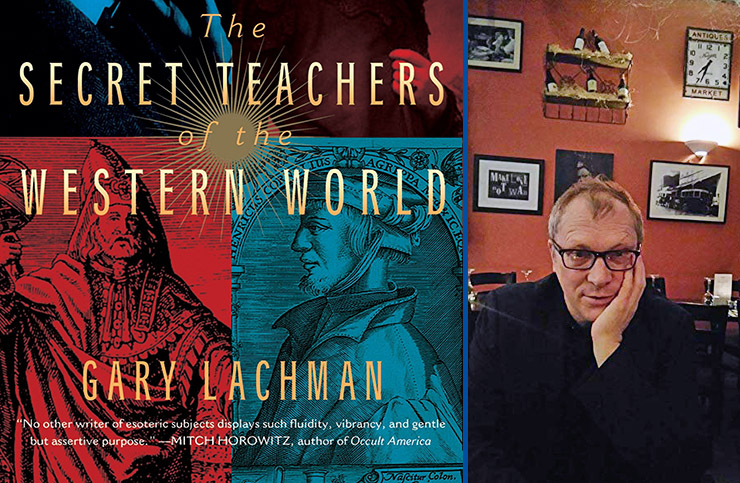
  • Kindling the Divine Spark: The Secret to Awakening

    Kindling the Divine Spark: The Secret to Awakening

    From New Dawn 100 (Jan-Feb 2007)

    Blessed is he who has a soul, blessed is he who has none, but woe and grief to him who has it in embryo.1
    – G.I. Gurdjieff

    The United States Declaration of Independence proudly proclaims the mystical truth that “all men are created equal.” What happens after that, though, is anybody’s guess. Once we’ve been created equally, does that mean all our lives are the same? Do the essential differences between us come from genetics, environment, free will, the soul? Do we all end up in the same place again when we die? These questions have excited the myth-making faculties of humankind from antiquity down through to the present day.

    Working for a Soul

    The esoteric teachings of G.I. Gurdjieff, in many ways, fly in the face of traditional Western religious thought. Whereas it is accepted as a given within Judeo-Christian tradition that each human is born with a soul, Gurdjieff does not let us off so easy. Active in the early part of the 20th century, this Greek-Armenian mystic travelled the world, synthesising spiritual disciplines into a unique path called The Fourth Way. He taught that human existence is a kind of waking sleep, in which we live more or less automatically, unconscious and unaware of ourselves. He even went to the extreme of suggesting that humans are not born with souls at all, and that we can only create one while alive through intense personal suffering and what he called “work.” If we are not successful in this venture, he taught that our identities would not survive the shock of death, that we would “die like dogs” and that the ever-hungry Moon would gobble up our energy as part of its own evolution of consciousness.

    It’s a teaching which sounds strange to most people today, but which was perhaps more common to the ancient world. Consider the words of the Gospel of Philip, an ancient Gnostic codex recovered at Nag Hammadi in 1945:

    Those who say they will die first and then rise are in error. If they do not first receive the resurrection while they live, when they die they will receive nothing.2

    Like the other Gnostic texts recovered at Nag Hammadi, this type of information was declared heretical, banned and except for in a few lucky cases, completely destroyed by the early Catholic Church in an effort to consolidate both its teachings and its power structure. The Catholic story-system pivots around the idea that we will be resurrected at the end of time, not transmuted to higher levels of understanding and awareness here in our lifetimes. The Gnostic texts, on the other hand, seem to teach that humans are born with a spark of divinity which can either be left undeveloped or guarded and fanned into a full-on blaze.

    With the popularity of books like the Da Vinci Code, and a renewed interest in Gnosticism, many people today are left wondering why these alternative esoteric Christian teachings were so viciously eradicated. Who benefits by suppressing this ancient gnosis, and what happens to those of us left in the dark as a result?

    If Gurdjieff and the Gospel of Philip are at all correct in their teachings, then it may be that by waiting for our reward in the afterlife, by not working feverishly on our souls like a life raft on Gilligan’s Island, then we are lost. We miss our chance. We remain soulless automatons, vanishing at death or being consumed by insidious forces (if not well before then).

    The Inauthentic Human

    Science-fiction writer Philip K. Dick saw something very similar to this scenario happening in today’s world. Through the lens of trashy sci-fi novels, he explored questions of what is ultimately real, and what constitutes the authentic human. He used outlandish and bizarre plot devices to fling his characters through inverted realities and distorted mindscapes. And from his explorations, he came to believe that:

    … [T]he bombardment of pseudo-realities begins to produce inauthentic humans very quickly, spurious humans – as fake as the data pressing at them from all sides.… Fake realities will create fake humans. Or, fake humans will generate fake realities and then sell them to other humans, turning them, eventually, into forgeries of themselves. So we wind up with fake humans inventing fake realities and then peddling them to other fake humans.3

    Similar themes appear in popular and fringe culture. In the movie The Matrix, we see a false reality maintained by mysterious agents who can slip in and out of the bodies of ordinary people as though they were clothing. The paranormal investigations of people like John Keel, Jacques Vallee and others also posit the existence of ultraterrestrials, a race of entities who evolved right alongside us on the planet Earth. They are thought to camouflage themselves, adapting imagery pulled from the human minds and cultures they interact with. In other words, they appeared to the ancients as angels and demons, to medieval people as fairies and goblins, and to us today as alien visitors.

    Others threaten that the soulless human can play host to these and other types of entities and energies, acting as a sort of empty vessel, or organic portal.4 Carlos Castaneda’s don Juan echoes this sentiment in The Active Side of Infinity, suggesting that malicious beings or “predators” seek to control us by “giving us their mind” which is filled with “covetousness, greed, and cowardice,” and which keeps us “complacent, routinary and egomaniacal.”5

    Unfortunately for us though, it is not just science fiction authors and occultists who have explored ideas like this. In “real life,” similar notions of humans as fundamentally without soul took root among psychologists who espoused the philosophies of Behaviourism and Eliminative Materialism in the middle part of the 20th century. In short, these thinkers (perhaps paradoxically) believed that internal human states were nothing but a fiction, a primitive “folk psychology,” and that only externally observable behaviour had any real significance. They saw concepts such as belief, desire, fear, love – even the mind and soul – as untenable, unscientific and therefore ultimately unreal and useless. Noted Behaviourist B.F. Skinner encapsulated the quest to abolish “inner man” in his book Beyond Freedom and Dignity, with this chilling passage:

    What is being abolished is autonomous man – the inner man, the homunculus, the possessing demon, the man defended by the literatures of freedom and dignity.

    His abolition has long been overdue. Autonomous man is a device used to explain what we cannot explain in any other way. He has been constructed from our ignorance, and as our understanding increases, the very stuff of which he is composed vanishes. Science does not dehumanise man, it de-homunculises him, and it must do so if it is to prevent the abolition of the human species. To man qua man we readily say good riddance. Only by dispossessing him can we turn to real causes of human behaviour. Only then can we turn from the inferred to the observed, from the miraculous to the natural, from the inaccessible to the manipulable.6

    At first glance, strong thematic similarities tie together the cores of Skinner’s and esoteric philosophies such as that of Gurdjieff. Both strip humans of any kind of inherent soul. Skinner, however, seems to revel in the thought, because it means that human behaviour may be controlled by those with the power and drive to do so. It is, in essence, the Holy Grail of scientifically-driven totalitarian systems of governance. Applied to world events, it may help explain the inhuman atrocities we see played out on the global scale every day. On the other hand though, we have folks like Gurdjieff who follow in the footsteps of the ancient Gnostics, and after introducing us to our fundamental dilemma rather than celebrating it, chart for us a way out of the shackles of an empty, automatic and manipulable existence.

    Is God Insane?

    In his ground-breaking 1967 book, The Politics of Experience, psychiatrist R.D. Laing put forward the still-revolutionary idea that mental illness is not illness at all. Instead, it is (or can be) a healing process whereby an individual overcomes the impossibility of their own situation, and the insanity of the culture at large. In his vision, it was not individual humans who were fundamentally disturbed, but the culture which was dangerous and insane, warping and distorting the natural human into the artificial confines of local cultural existence.

    Ancient Gnostics took this idea several steps further. Certain sects taught that this material world was created by the Demiurge, an insane creator god who was conceived in error, and who egotistically took himself to be the only true god. Tradition identifies him either as the angry Yahweh of the Old Testament (“Thou shalt have no other gods before me”), as Satan in his role as Prince of this world, or with more overtly Gnostic variants such as Yaldabaoth, Samael or Saklas.

    Philip K. Dick mythologised this hierarchy of institutional insanity into what he called the Black Iron Prison, which is ruled over by a never-ending, infinitely destructive Empire. In his Tractates Cryptica Scriptura,7 an esoteric addendum to his novel VALIS, he wrote, “The Empire is the institution, the codification, of derangement; it is insane and imposes its insanity on us by violence, since its nature is a violent one.” Thus it would seem that the only rational course for an individual to become and stay sane is to overcome his culture, his society, and maybe even God himself (or at least the deranged being which the Gnostics believed masquerades as God).

    “Against the Empire,” Dick continued, “is posed the living information, the plasmate or physician…” Dick identified this cosmic force with the Holy Spirit, the Christian concept of the Logos, or the divine Word (hence, living information) which was made flesh in the person of Jesus Christ. Like the ancient Gnostics, Dick believed that this divine entity – the plasmate – could fuse with, not just Jesus, but with potentially anyone who was worthy. There is no indication that Dick believed humans fundamentally lacked souls, but he seems to have believed that the plasmate healed and restored people to sanity, and to their natural whole state.

    The Secret Gray-Robed Christians

    Dick himself underwent a series of transformative spiritual experiences which formed the basis of his understanding of the human situation. In his novels VALIS and Radio Free Albemuth, he fictionalised these experiences, describing numerous encounters in dreams, hallucinations and waking life with a benevolent higher order entity which he variously described as a cosmic artificial intelligence, ancient alien beings, the living information of the plasmate, and of divinity itself. Both his fictional characters and he himself underwent extreme pain, personal turmoil and intense soul-searching, which perhaps could be correlated to what Gurdjieff meant as the “work” required to fashion oneself a soul or subtle body with which to escape the obliteration of death.

    The exact nature of that work seems to deal with cultivating an intense awareness and a sustained “presence” within oneself at all times – as opposed to absent-mindedness, or living on auto-pilot, which seems to be the natural state of affairs. Here we may once again turn to the ancient Gnostics for inspiration and amplification. From The Apocryphon of John, another text recovered at Nag Hammadi, we find:

    When the life-spirit increases and the illuminating power of the body strengthens the soul, no one can lead you astray into the lessening of your humanity. But those on whom the counterfeit spirit preys are alienated from humanity and deviated…8

    In Dick’s worlds, once you have crossed that threshold and reconnected to the universal soul (or created a soul, as Gurdjieff’s teachings might indicate), others who have done the same will be revealed to you, so that you may strengthen one another and work toward a common goal. In VALIS, Dick referred to these kindred spirits as Secret Gray Robed Christians (or homoplasmates – those who had “cross-bonded” with the living information of Christ or the Holy Spirit, thereby attaining eternal life). Upon their shoulders lay the immense task of nothing less than the overthrow of the Black Iron Prison itself:

    Who had built the prison – and why – he could not say. But he could discern one good thing: the prison lay under attack. An organisation of Christians, not regular Christians such as those who attended church every Sunday and prayed, but secret early Christians wearing light gray-coloured robes, had started an assault on the prison, and with success. The secret, early Christians were filled with joy.

    Fat, in his madness, understood the reason for their joy. This time the early, secret, gray-robed Christians would get the prison, rather than the other way around.9

    The idea that not all humans have souls is a fascinating line of thought which invariably leads to dangerous and even violent territory when employed by the agents of Empire. One need look no further than Nazi Germany’s wholesale execution of what they claimed were the “sub-human” Jews as vivid examples of the extravagant danger of these ideas. It is one thing to explore mystical truth for the purposes of personal development; it is quite another altogether to use it as an excuse and explanation for violent, thoughtless, and inhuman action.

    The choice, ultimately, seems to rest in the hands of the individual as to whether or not we develop our divine spark into a full-fledged soul, or if we let it languish in darkness. We may all be created equal, but what do we do after that? The 12th century Sufi, Farid ud-Din Attar, in his “Conference of the Birds,” offered the following:

    A Sufi woke one night and said to himself “It seems to me that the world is like a chest in which we are all put and the lid is shut down, and we give ourselves up to foolishness. When death lifts the lid, he who has acquired wings, soars away to eternity, but he who has not, stays in the chest a prey to a thousand tribulations. Make sure then that the bird of ambition acquires wings of aspiration, and give to your heart and reason the ecstasy of the soul. Before the lid of the chest is opened become a bird of the spirit, ready to spread your wings.10

    [alert type=”general” dismiss=”no”]This article was published in New Dawn 100.[/alert]

    [alert type=”success” dismiss=”no”]If you appreciate this article, please consider subscribing to help maintain this website.[/alert]

    Footnotes:

    1. G.I. Gurdjieff, Gurdjieff’s Aphorisms, www.gurdjieff.org/aphorisms.htm
    2. The Gospel of Philip, www.gnosis.org/naghamm/gop.html
    3. Philip K Dick, “How to Build a Universe That Doesn’t Fall Apart Two Days Later,” 1978, http://deoxy.org/pkd_how2build.htm
    4. http://montalk.net/matrix/62/matrix-agents-profiles-and-analysis-part-i
    5. Carlos Castaneda, The Active Side of Infinity
    6. B.F. Skinner, Beyond Freedom and Dignity, see also www.conspiracyarchive.com/Commentary/Global_Skinner_Box.htm
    7. http://deoxy.org/pkd_tcs.htm
    8. The Apocryphon of John, see also www.metahistory.org/GnosticCatechism.php
    9. Philip K. Dick, VALIS
    10. Farid ud-Din Attar, The Conference of Birds

    © New Dawn Magazine and the respective author.
    For our reproduction notice, click here.