New Dawn – World's Most Unusual Magazine

Category: Secret Wisdom

  • Manifesting Your Will

    Manifesting Your Will

    From New Dawn 103 (Jul-Aug 2007)

    Much of New Thought is about manifesting your will. It’s far more helpful to do this if your will is in alignment with your own higher nature. This exercise is designed to help you accomplish this aim. It may be read aloud and recorded, or one person may read it to another or to a group if that is helpful.

    Sit in a comfortable but erect position, free from disturbances, so that you can be as relaxed and alert as possible. You may want to begin with a prayer to God or to whatever Higher Power you find suitable for guidance in this particular situation (e.g., work, love, finances, etc.). Close your eyes and allow your attention to come to the breath. Simply let it flow in and out, without any desire to change it in any way.

    As the breath relaxes into a steady rhythm, allow your attention to come to the sensations of the body. Feel your feet on the floor, your back against the chair, your hands and arms – whatever part of the body presents itself to your attention. You may start to feel sensation as a kind of subtle current that flows where it wills throughout your body. (If not, however, that’s also fine.)

    Then allow yourself to sense your body as a whole, in a single moment. (This may require some concentration if you’re not an experienced meditator.) Let your attention rest for a moment on the solar plexus – the point at the centre of the body just below the rib cage.

    Now bring your attention to the heart. You may feel it beating, or you may not. What’s important is that you centre your attention there. As you continue to feel the heart, some emotions may come up. Allow your attention to come to these, and do your best to watch them attentively but dispassionately, even if they are somewhat intense. (Emotions, by the way, aren’t thoughts or physical sensations; they’re feelings like love or hate or fear or joy.) You may be surprised to see that pleasant and unpleasant emotions can follow one another quite quickly, without any apparent reason. Watch them but do not cling to them or push them away.

    Let your attention now come to the thoughts and images that are passing across the screen of the mind. Again, watch them alertly without either clinging to them or pushing them away. Whether they’re pleasant or unpleasant, simply let them come and go. After a few minutes of watching the thoughts, become aware of the watcher, the silent witness in you that is observing all this experience. Ask yourself where in you it is. For many people, this witness feels as if it is in the centre of the head, a couple of centimetres behind the eyes (which is why this is called the Third Eye). But you may have a sense of it elsewhere, such as in the heart or solar plexus.

    Pretend that this silent watcher is looking up through the crown of your head almost as if it were peering through the opening of an astronomical observatory. In your mind’s eye visualise a point of light, like a star in the night sky, say some four metres directly overhead. This point of light represents your higher Self. Rest your attention on this point of light for at least two or three minutes.

    Now turn your attention to the situation that concerns you. Ask, ‘What is my will in this situation?’ You can also look up (in your mind’s eye) at the point of light and ask, ‘What is thy will?’ Make a firm resolution in your mind to see the truth in the situation, not what you want or what you imagine it to be. If you’re feeling great fear or anxiety, breathe it out.

    Allow the answer to come as it will. Note your responses precisely and objectively. (You may find it helpful to make notes after the exercise is finished.) When you have received the information you need, let the exercise drop and return your attention to the sensations of the body for a minute or two. Then let the exercise drop completely and return to your ordinary state of consciousness. You may find it helpful to stamp your feet a little to ground yourself again. If you feel disoriented or ‘out of it’ as a result of the exercise, a bite of food or a beverage may be helpful.

    Make a conscious decision to remember what you have willed at least once daily, and also at least once daily take some action, large or small, to bring this will into realisation. You will know for yourself what the actions are to be.

    For more on this subject, read the author’s accompanying article The Real Secret of The Secret.

    [alert type=”general” dismiss=”no”]This article was published in New Dawn 103.[/alert]

    [alert type=”success” dismiss=”no”]If you appreciate this article, please consider subscribing to help maintain this website.[/alert]

    © New Dawn Magazine and the respective author.
    For our reproduction notice, click here.

  • Understanding the Traditionalists

    Understanding the Traditionalists

    From New Dawn 147 (Nov-Dec 2014)

    Traditionalists, for present purposes, means the loosely-constituted group inspired by René Guénon (1886-1951). Many of them also revere Ananda K. Coomaraswamy (1877-1947). Later Frithjof Schuon (1907-1998) became central to the group, while the work of Julius Evola (1898-1974) partly overlapped with the others. Any one of these four can serve as a gateway to the movement and its quest for the esoteric truth that transcends religious differences. That is their first mission. Secondarily, they invite one to realise this truth in oneself, and thirdly, they identify what furthers the process and what hinders it.

    The Traditionalist mission rests on the belief that in some prehistoric time, a “primordial tradition” was revealed to mankind. It taught in symbols the nature of the universe and of the human being, and the way to realise our divine potential. The different religious traditions sprung like branches from the primordial trunk, each one revealed at the appropriate time and place for a certain people or region. Each one contains a facet of the “perennial philosophy,” accommodating both simple believers and those who pursue an esoteric and initiatic path. However, owing to spiritual degeneration over time, some traditions have been lost, others polluted, and false religions have sprung up in their place. The third object is to discriminate between the true and the false.

    Given these principles, Guénon could write with equal authority on Hinduism, Taoism, Judaism, Christianity, Islam, Hermeticism, Druidism, and even Freemasonry, “believing” in all of them because he was able to discern their transcendent unity. He demonstrated this through what he called metaphysics, meaning the study of ultimate realities, beyond cosmology and beyond theology. Theologies differ (are there many gods, as in Hinduism, or only one, as in the Abrahamic religions?), but metaphysical principles do not. Eventually one hopes to know these principles directly, because we are microcosms and they are our own ultimate realities. Mystical experience and religious devotion may be intrinsic to the spiritual path, but the quest begins and ends with knowledge. Those who wish to follow Guénon into these rarefied realms will read Man and His Becoming According to the Vedanta, The Symbolism of the Cross, and The Multiple States of the Being.1

    Guénon cleared the way for his doctrinal work with two polemical books. Theosophy: History of a Pseudo-Religion (first published 1921), whose title says it all, and The Spiritist Fallacy (1923), which shows that whatever is contacted in séances, it is not the spirits of the dead. After settling in Egypt in 1930, Guénon made a scanty living by writing hundreds of articles and book reviews for his French publishers. Now collected by themes such as Freemasonry, initiation, Christianity, time cycles, symbolism, etc., they make excellent reading for their insights, their curious facts, and global purview. Guénon may pontificate and annoy, but he is never a pious bore. However, it is his books that remain the core of his work, for they set out the metaphysical and cosmological framework that needs to be kept in mind through all his digressions.

    One assumption, which goes entirely against modernist and scientific opinion, is a cyclical view of history. The cycle starts with the long Golden Age (Satya Yuga) and thence degrades in the quality of life and spirituality of mankind. Even the earth becomes more densely materialised until the low point of the Iron Age (Kali Yuga) is reached. Then the cycle ends in cataclysm, and above its ruins a new golden age dawns.2 Surveying the post-medieval period, Guénon sees the sacred giving way to the secular on every front: in religion, with the fragmentation of the Christian tradition, the driving of esoteric knowledge underground and its replacement by pseudo-traditions; in philosophy, with its denial of true metaphysics; in society, with the lower elements usurping the priestly and noble castes; and in the arts, a sure barometer of a civilisation’s soul. Ever since the Greeks, the West has been the leader in this process, but by now it has infected the entire earth.

    Guénon’s The Crisis of the Modern World and The Reign of Quantity and the Signs of the Times are the testament of his devolutionary theory and probably the best entry-point to his work. The latter title is his description of the tail-end of the cycle, in which quantity usurps quality in every walk of life. After a metaphysical introduction (better skipped and read later), he offers memorable examples and images such as the “Degeneration of the Coinage” and the “Cracks in the Great Wall.” Overshadowing the whole work is the notion of a “Counter-initiation,” a conspiracy of false or inverted spirituality whose goal is to block humanity’s path to authentic initiation.

    Some find Guénon’s approach too intellectual and even inhuman, but they cannot deny that it cuts like a razor through the sloppy thinking and sentimentality prevalent in religious and New Age types alike. It sets standards of integrity against which other spiritual teachings either stand or fall. It assumes that truth has always been there for the finding, so it has no use for the language-games of Western philosophy, nor for a science that thinks it is on track to discover the “God particle.” It also rejects cherished notions such as individualism, equality, and evolution. Instead, it teaches the impersonal Self, the hierarchy of beings (including humans), and the cyclic nature of time. In short, it turns the received world-view upside-down.

    [alert type=”info” dismiss=”no”]If you appreciate this article, please consider a subscription to New Dawn magazine.[/alert]

    Beyond Guénon: Traditionalism’s Founding Fathers

    Such was evidently the experience of those who were later grouped under the Traditionalist banner. Ananda Kentish Coomaraswamy (1877-1947) was an art historian whose writings on comparative religion, symbolism, and the critique of modernity paralleled Guénon’s own, though in a more scholarly style. Frithjof Schuon (1907-1998), a German convert to Sufism, made a stir with his first book, The Transcendent Unity of Religions,3 its English translation helped by a promotional blurb by T.S. Eliot – himself a Christian Traditionalist of sorts. In 1962 Schuon’s English friends took over a parapsychology magazine called Tomorrow and later retitled it Studies in Comparative Religion.4 The collaborators included Titus Burckhardt (1908-1984), a Swiss publisher; Marco Pallis (1895-1989), a musician and traveller to Tibet; Martin Lings (1909-2005), an English scholar who assisted Guénon in his last years; Whitall Perry (1920-2005), a Bostonian who compiled a global bible of traditional sources;5 and many others who are now easy to find and research.6 Schuon settled in Bloomington, Indiana, heading a community that combined his personal devotion to “Maryam” (the Virgin Mary, as revered in Islam) with Native American traditions. His most eminent admirer was Seyyed Hossein Nasr (1933-), a highly-placed Iranian academic forced out by Khomeini’s revolution. Nasr became the movement’s most visible representative in the US and, beside his authority on all things Islamic, tried to give a more spiritual direction to the environmental movement.7

    In order to put Guénon’s principles into practice, most of the Traditionalists joined one of the recognised religions, interpreting his critique as requiring an orthodox exoteric practice. Only that, they say, can provide a firm foundation for the higher flights of esotericism that many desire, but for which few are qualified. According to Federico González, the most faithful interpreter of Guénon in the Spanish language, Schuon’s influence betrayed the Perennial Philosophy by turning it into a Perennial Religion.8 Be that as it may, Schuon, Burckhardt, and Lings followed Guénon’s example by becoming Muslims. Those who remained within Christianity chose the Russian or Greek Orthodox churches, or isolated themselves on the extreme wing of traditional Catholicism. Protestantism was not an option, being by definition anti-traditional, though with the example of Eliot’s high-church Anglicanism, a chance was missed there. Orthodox Judaism would seem the obvious choice for Jews, but Leo Schaya, the only identifiable Jew in the group and author of a superb work on Kabbalah, converted to Islam.9 A fourth and last possibility was Buddhism, though Guénon considered it more as a heresy within Hinduism. Hinduism was excluded for Westerners on the grounds that one cannot be a traditional Hindu unless one was born into one of the castes and can follow its prescriptions. The traditions of Native Americans, Africa, and the Far East (Taoism, Shinto), though respected, were impracticable since living esoteric masters are almost impossible to find there. Moreover, in all cases only the most ancient and integral streams were acceptable: not the Sufism of Hazrat Inayat Khan, or the Hinduism of Vivekananda or Aurobindo. So the choice of an exoteric tradition was extremely limited.

    There are of course degrees of leniency among Traditionalists, but to the stricter variety, the vast majority of Christians are schismatics and heretics, cut off – maybe for no fault of their own – from any authentic tradition. Some, like Rama Coomaraswamy (son of Ananda) accuse the Catholic Church of having disqualified itself through the innovations of the Second Vatican Council. Consequently the current pope is an impostor, priestly ordinations invalid, and the sacraments ineffectual. I find this a strange and constrictive view. It is generous enough in allowing that God has revealed himself through different religions, yet it imagines him as only willing to funnel his grace through a very narrow channel in each case.

    Can one have the Traditionalist cake, as it were, without eating it? To judge by the careers of the founding fathers, the answer is yes. Not one of them practiced what the orthodox now preach. Guénon was supposedly initiated by Hindus, entered Islam secretly as a young man, and married a Catholic wife, but was not known as a devout practitioner of any religion until he moved to Cairo in middle age. Coomaraswamy, as the child of a Hindu (Tamil) father and an English mother was strictly speaking an “untouchable” within the Hindu tradition, which of course bothered no one during his life in England and the United States. Buddhism and Neoplatonism seem to have been closest to his heart, but if he had any orthodox practice, no one remarked on it. Schuon, nominally a Muslim, made up his own syncretic rituals, which greatly embarrassed his more orthodox admirers when they were made known.10 In short, they all enjoyed the latitude that Traditionalism allows to independent geniuses, but not to the rest of us.

    A broader concept of Traditionalism would recognise the value of some outsiders to the club. They include Alain Daniélou (1907-1994), who did convert to Hinduism (he was a Shaivite initiate) and lived for many years in Calcutta, corresponding with Guénon and writing fundamental works on Hindu polytheism and music. He also foresaw, and calculated, the inevitable end of the age.11 But this brilliant and charming scholar despised the monotheistic religions and was openly homosexual, so he does not figure on the approved roster. The absence of Henry Corbin (1903-1978) is more surprising, since he alerted the West to the richness of the Iranian philosophic tradition and its concept of the “imaginal world” as the locus of mysticism, symbolism, and art.12 Nasr recognised him as a great scholar and edited his Festschrift,13 but Corbin was a Protestant. Whether Julius Evola (1898-1974) should be included is a matter of dispute. He had a friendly correspondence with Guénon (though they never met), and wrote from a Traditionalist point of view on Taoism, Buddhism, Hermeticism, the Grail, paganism, esoteric sexology, metahistory, mountaineering, and to his lasting detriment, politics. But he rated the Kshatriya (warrior) caste superior to the priestly Brahmins, and had no time for exoteric religion. His work probably finds a wider readership than any other Traditionalist.14 To many he is the intellectual equal of Guénon and Coomaraswamy, and much more helpful with his practical advice on self-realisation in a hostile world.

    In the 1980s the poet and Blake scholar Kathleen Raine (1908-2003) set an example of “broad-church” Traditionalism with her London-based Temenos Academy. It presented lectures, concerts, occasional conferences, and published a journal, benefiting from the patronage of the Prince of Wales – another liberal Traditionalist. Raine had been a member of an occultist order descended from the Golden Dawn. She loved the Neoplatonists, the Renaissance, and Romanticism, was not averse to Theosophy, and greatly admired Corbin. Her mission was to promote the “arts of the Imagination” as against the ugliness, soullessness, and commercialism of modern life and art. I believe she was the only woman to have contributed to Studies in Comparative Religion, and that, too is telling. Women are conspicuously absent from Traditionalism, no doubt because they know how badly the orthodox religions have treated their sex.

    Traditionalism & Post-Modernity

    After the death of Schuon, widely revered as an enlightened master, the movement lost its magnetic pole. Its chief enemy, modernity, was also moribund. But instead of a return to Tradition, the post-modern wave, beginning in France and flooding the whole intellectual world, had extinguished any presumption of metaphysical certainty. Guénon and Evola were less newsworthy than the right-wing extremists reputedly inspired by reading them. The spread of Islamic fundamentalism cast Muslim conversion in an unfavourable light. Most of those who sought a spiritual path outside their Christian, Jewish, or agnostic heritage preferred Zen or Tibetan Buddhism. And the New Age was the exoteric haven for all the rest.

    As the post-Guénonian generation passed away, Traditionalism became ripe for the historians. The academic study of Western Esotericism, a relatively new discipline, took notice of it, though only as one current among many others. Mark Sedgwick’s Against the Modern World was the first attempt to encompass the whole Traditionalist phenomenon, and the first many academics had heard of it.15 Another is Setareh Houman’s From Philosophia Perennis to American Perennialism.16 (In the United States, home of the political euphemism, Traditionalists became “Perennialists.”) Houman explains how Guénon and his successors adapted the Renaissance concept of a perennial philosophy and a prisca theologia (primordial theology) as old as the human race, and supplies a wealth of historical details found nowhere else. Both books are essential to the dispassionate student of the movement.

    Needless to say, the blogosphere swarms with passionate opinions on both sides. It is much less demanding to hang out there, or shoot one’s mouth off, than to read Guénon’s or Coomaraswamy’s books from cover to cover. At the serious end of the spectrum, Mark Sedgwick maintains a website (www.traditionalists.org) with a moderated discussion board. So does James Wetmore (www.sophiaperennis.com), the heroic publisher of Guénon’s Collected Works. James Cutsinger is gradually doing the same for Schuon’s works (www.cutsinger.net). Charles Upton, an ex-beat poet turned Sufi, brings the Traditionalists’ critique up to date with a series of books on the Reign of Quantity’s further products, such as UFO cults, drug mysticism, postmodernism, neopaganism, and the New Age.

    Since the world failed to end or transmogrify in December 2012, the New Age dragons are hardly worth slaying, but Traditionalists are drawing on some of the apocalyptic energies that still hang in the air. One who claims, or is claimed, to be a Traditionalist is the Russian philosopher Alexander Dugin (b.1962). Is he the secret link through whom Guénon is influencing the political chess-game of Vladimir Putin?17 Some think so. Duginian geopolitics sees the Atlanticist hegemony as the tool of the Counter-initiation, and a united Eurasia under Holy Russia as the great hope of the future. Others, such as the Islamic eschatologist Imran Hosein, view the world situation through the myth of the Antichrist, whether they assign that role to the current pope, the US President, the State of Israel, radical Islam, or “Dajjal.” Like Jean Robin, author of “René Guénon, the Last Chance of the West”18 and many other books of occult history, they may actually cheer on the Counter-initiation for speeding the arrival of a post-apocalyptic golden age. Another French writer of Romanian origin, Jean Parvulesco (1929-2010), was apparently Dugin’s inspiration. Parvulesco’s books are like something imagined by Umberto Eco: convoluted, learned, hysterical, and infatuated with Guénon, necromancy, fascism, the cosmic destiny of France, and a collective death-wish.19

    Lastly I must mention the longest book yet written about Guénon.20 The author, who goes by the name of Louis de Maistre, admires him tremendously but suspects that he was partly under Counter-initiation control. That movement, in de Maistre’s view, stemmed from the Manichean heresy that gave an independent and equal existence to the evil power, and the temptation to ally oneself with it. Its main agents in the modern world were the Sabbatian and Frankist movements, to whose infiltrations Guénon himself was not immune. Hence his early involvement with mediumship and his embrace of the sinister myth of Agarttha. In the view of this earnest and erudite author, even Guénon needs to be purified from anti-traditional tendencies.

    Traditionalism for Seekers

    Apart from these extremes, what does Traditionalism have to offer? First, it puts our spiritual destiny first and foremost. We are on earth to fulfil it, though we may do so in very earthly ways (Traditionalists love the crafts!). In looking for guidance, we have the option of joining one of the authentic traditions and regulating our lives through it. For the esoterically-inclined, each tradition has symbols that give access to a metaphysical teaching. Lacking effective mystery-schools, to penetrate to this level is the best initiation we can hope for. To take examples from the Abrahamic traditions, one can recite the Nicene Creed, read the Quran or the Torah, and understand them in an esoteric sense that would be incomprehensible to one’s fellow believers. This is of course what Kabbalists and Sufis do, though Christianity has lost the structures that once facilitated it.

    But what if one has no attraction to religions which have so often brought out the worst in people, and continue to do so? There are, after all, other paths open. One might become a Bahai or a Mormon; join the A.M.O.R.C. or another Rosicrucian order; take up yoga and meditation, “transcendental” or otherwise; join an Anthroposophical (Rudolf Steiner) community or a Gurdjieff group; assert one’s ethnic roots in neopaganism; find a temple of the Hermetic Order of the Golden Dawn, or become a wiccan; join the OTO or some other group under Aleister Crowley’s influence; practice alchemy, physical or spiritual; try Chaos Magick; take an Ayahuasca vacation. The spiritual smorgasbord becomes so long that it is hard to choose from it.

    Traditionalism rejects the lot. One of the characteristics of the Kali Yuga is the psychic influences which, in Guénon’s picturesque image, sneak through the cracks in the Great Wall that once protected traditional civilisations. Hence the proliferation of phony sects, channelled teachings, exploitative cults, and other spiritual dead ends. These include fundamentalism, a modern phenomenon distinct from regular exoterism because its agenda, hidden or overt, is always political. One does well to ask: (1) Do these purported spiritual paths have any roots in an authentic revelation, or are they personal inventions? (2) Do they give access to metaphysical realisation? (3) Are claims of filiation from some extinct tradition, such as Egyptian or Celtic, believable? (4) Do they exist to benefit their members, or to benefit themselves and their leaders? I am not saying that this disqualifies all the offerings mentioned above, but it certainly shortens the list.

    After taking due notice of this negative and purgative side of Traditionalism, there remains the greater, positive side. It is the realisation through knowledge, which can come about without any institutional support, simply through reading and meditation. The Traditionalists’ books are themselves initiatic. If you are ripe for them, they hit like a bombshell. Part of you is blown out of the normal world, though other parts still have human feelings, desires, and faults. You pick up the newspaper the next day, and see everything in a different light, realising that a collective insanity has grasped the human race. Yet you are no longer entirely in its clutches, and there are allies across the centuries in those who have resisted the current. Art, poetry, literature, and music take on new meanings as gifts from an unpolluted source, and they may mean more to you than any religion. As you read on, you may discover the Hermetic, Gnostic, and Neoplatonic treasures hidden in the Abrahamic religions, and the philosophic teachings of the Far East (Vedanta, Taoism, Buddhism), interpreted with unprecedented clarity. If you are temperamentally suited to them, they bring an ineffable joy. In short, this is an adventure second to none, and also, as Plato promised, the ultimate love affair, for philosophy means the “love of wisdom.”

    Minor parts of this article appeared in “Facing the Traditionalists” in Gnosis Magazine no. 7 (Spring 1988), 23-28, reprinted in Jay Kinney, ed., The Inner West (New York: Tarcher/Penguin, 2004), 292-302.

    [alert type=”general” dismiss=”no”]This article was published in New Dawn 147.[/alert]

    [alert type=”success” dismiss=”no”]If you appreciate this article, please consider subscribing to help maintain this website.[/alert]

    Footnotes

    1. These and the rest of Guénon’s Collected Works are published in English translation by Sophia Perennis. See www.sophiaperennis.com
    2. See Joscelyn Godwin, “When Does the Kali Yuga End?” New Dawn 138 (May-June 2013).
    3. Frithjof Schuon, The Transcendent Unity of Religions, Faber & Faber, 1953.
    4. Just as Guénon had taken over an occultist journal, Le Voile d’Isis, and given it an academic-sounding title, Études traditionnelles.
    5. Whitall N. Perry, ed., A Treasury of Traditional Wisdom, George Allen & Unwin, 1971.
    6. Studies in Comparative Religion is now online at www.studiesincomparativereligion.com. A select anthology of articles from the journal, out of print but well worth finding, is Jacob Needleman, ed., The Sword of Gnosis, Penguin, 1974.
    7. See Seyyed Hossein Nasr, Religion and the Order of Nature, Oxford University Press, 1996.
    8. See Federico González Frías, Diccionario Simbólico-Iniciático y de Temas Misteriosos, Thot, 2013, and the special Guénon number of Symbolos: Revista Internacional de Arte, Cultura, Gnosis, nos. 9-10 (1995).
    9. See Leo Schaya, The Universal Meaning of the Kabbalah, tr. Nancy Pearson, George Allen & Unwin, 1971. Information on Schaya’s conversion is from www.sophiaperennis.com/frequently-asked-questions/.
    10. See Mark Sedgwick, Against the Modern World. Traditionalism and the Secret Intellectual History of the Twentieth Century, Oxford University Press, 2004, 170-77.
    11. See Alain Daniélou, While the Gods Play: Shiva Oracles and Predictions on the Cycles of History and the Destiny of Mankind, tr. Barbara Baker, Michael Baker, and Deborah Lawlor, Inner Traditions, 1987.
    12. See especially Henry Corbin, Spiritual Body and Celestial Earth from Mazdean Iran to Shi’ite Iran, tr. Nancy Pearson, Princeton University Press, 1977.
    13. S.H. Nasr, ed. Mélanges offerts à Henry Corbin, Teheran, Institute of Islamic Studies/Montreal: McGill University, 1977.
    14. See especially Julius Evola, Revolt against the Modern World, tr. Guido Stucco, Inner Traditions, 1995, and many other works from the same publisher.
    15. See note 11.
    16. Setareh Houman, From the Philosophia Perennis to American Perennialism, tr. Edin Lohja, Kazi, 2014
    17. See several articles in New Dawn 111 (Sep-Oct 2008).
    18. Jean Robin, René Guénon, la dernière chance de l’occident, Trédaniel, 1983. Also René Guénon, témoin de la Tradition, Trédaniel, 1986.
    19. See Jean Parvulesco, La spirale prophétique (Trédaniel, 1986), which was dedicated to Jean Robin. Also L’Étoile de l’empire invisible, Trédaniel, 1993.
    20. Louis de Maistre, René Guénon et les “Supérieurs Inconnus”: Contribution à l’étude de l’histoire mondiale “souterraine”, Arché, 2004. See my forthcoming review in Theosophical History.

    © New Dawn Magazine and the respective author.
    For our reproduction notice, click here.
  • The Rebirth of Gnosticism: An Interview with Dr. Stephan A. Hoeller

    The Rebirth of Gnosticism: An Interview with Dr. Stephan A. Hoeller

    From New Dawn 143 (Mar-Apr 2014)

    One of the most compelling themes of current times is Gnosis – the idea of a transcendental knowledge that, like enlightenment, liberates the individual from bondage to the world of suffering. While Gnosis and Gnosticism were long relegated to the archives of memory as heretical and obsolete aspects of early Christianity, over the last few generations their ideas have resurfaced, displaying an unforeseen power and resonance.

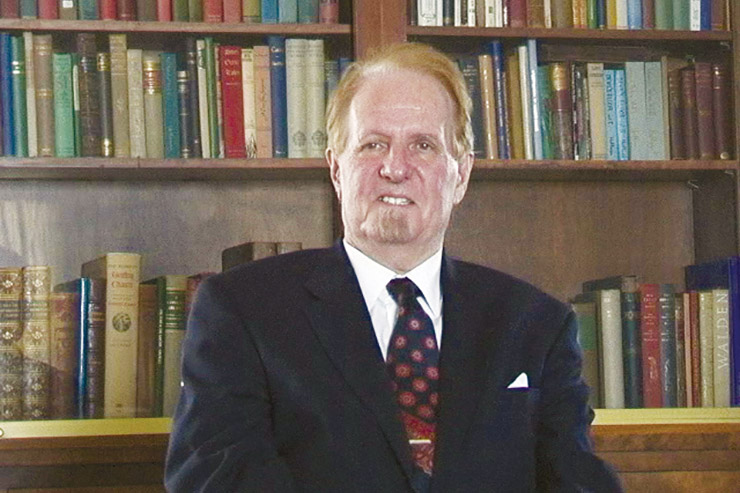
    Stephan A. Hoeller is among the leading proponents of this revitalised Gnosticism. Born a Hungarian nobleman in 1931, he was exiled from his native country after World War II. He came to the United States in the early 1950s and in the decades since has attracted a small but influential nucleus of students of esotericism. He has delivered scores of lectures to organisations such as the Theosophical Society and the Philosophical Research Society in a number of nations, including Australia and New Zealand.

    Hoeller is the author of several books, including Gnosticism: New Light on the Ancient Tradition of Inner Knowing (2002); The Fool’s Pilgrimage: Kabbalistic Meditations on the Tarot (2004); Jung and the Lost Gospels: Insights into the Dead Sea Scrolls and the Nag Hammadi Library (1989); and The Gnostic Jung and the Seven Sermons to the Dead (1982). Among other accomplishments, Hoeller’s work ties the Gnostic stream to the ideas of the Swiss psychologist C.G. Jung.

    Hoeller is also a major figure in the independent sacramental movement. This loose collection of churches and societies is based on the apostolic tradition as carried on by bishops, many of whom have left the Catholic Church or other Christian bodies and who have consecrated bishops and ordain priests on their own. Hoeller was ordained to the priesthood of the American Catholic Church by Bishop Lowell P. Wadle in 1958, and to the Gnostic episcopate by Richard, Duc de Palatine (born Ronald Powell) in 1967. Today Hoeller is presiding bishop of the Ecclesia Gnostica in Los Angeles. For more information on his work, including his lectures, visit his website www.gnosis.org.

    This interview, conducted by e-mail in November 2013, focuses on Gnosticism and Hoeller’s connection to the Australian born ‘wandering bishop’ Richard, Duc de Palatine.

    Richard Smoley (RS): You have been an eloquent spokesman for a revitalised Gnosticism in our time. Could you say briefly what the features of this Gnosticism are?

    Stephan Hoeller (SH): Gnosticism is not a belief system in the accustomed sense, and therefore it is not easy to describe its features as you ask. The Gnostic tradition has no single prophet or founding revelator; rather it is based in the mystical experiences of a number of visionary individuals. These mystical experiences were generally characterised by these seers as “Gnosis,” a concept denoting salvific knowledge arrived at by superintellectual means. Since those partaking of Gnosis were diverse in their individual backgrounds, it has occurred to some scholars that it might not be accurate to subsume them under the appellation of Gnostics. Still, as the late foremost scholar of this field, Professor Marvin Meyer, has proven, there were some mystic seers in the early centuries A.D. who called themselves by the name “Gnostic,” and this name became a description for the teachings they left behind.

    In reality, the teachings of the various Gnostic teachers have a great deal in common. It is therefore quite possible to perceive a body of recognitions that is generally present in all the Gnostic schools of past and present. In my book Gnosticism: New Light on the Ancient Tradition of Inner Knowing (2002) I presented a fourteen-point summary of such Gnostic tenets, which I shall repeat here in an abbreviated form:

    1. There is an original and transcendental spiritual unity from which emanated a vast manifestation of pluralities.
    2. The original spiritual unity (the Fullness) did not create anything; rather the creation of the manifest universe was accomplished by spiritual beings of limited power and moral stature. These entities have a vested interest in the separation of humans from the unity (God).
    3. The universe of matter and mind, while it emanated originally from the unity, has become alienated from its source and now largely serves the lower creators, or rulers (archons). The human being, in contrast to other creations, possesses a divine spark, which is capable of being awakened and liberated by Gnosis.
    4. The ultimate unity has not abandoned the sparks of its own essence but periodically sends forth messengers whose function it is to awaken the slumbering units of divine consciousness by stimulating the experience of Gnosis in humans. Among these messengers we find the Divine Sophia; Jesus Christ, the Logos of God; the holy prophet Mani; and others. The ultimate objective of these messengers is the arising of salvific knowledge (Gnosis) in human beings, who thus come to freedom from embodied existence and return to the ultimate unity.

    RS: The Gnostic worldview has often been criticised as pessimistic and world-denying. How would you respond to this claim?

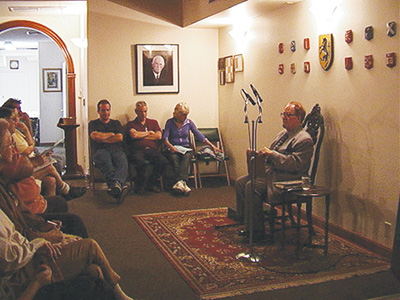
    Dr. Stephan Hoeller delivers a lecture at Ecclesia Gnostica, 3363 Glendale Blvd., Los Angeles, CA 90039, United States
    Dr. Stephan Hoeller delivers a lecture at Ecclesia Gnostica, 3363 Glendale Blvd., Los Angeles, CA 90039, United States

    SH: The accusation that Gnostics are world-hating pessimists was first voiced by the heresy-hunting church fathers of the early centuries A.D. It was false then, and it is false now. Most religious systems recognise that the world is imperfect, as indeed do Gnostics. The difference between the Gnostic position and others concerns the origins of this imperfect state of the world. Judeo-Christian orthodoxy places the blame on human beings: their original sin came to corrupt not only humans themselves, but all of creation. Gnostics, on the other hand, have always held that the world did not fall but was created in a grossly imperfect way to begin with.

    Professor Gilles Quispel, the late, great scholar, was wont to tell the tale that when observing the destruction of a British fighter plane over Holland in World War II, he had the sudden insight: “Valentinus the Gnostic was right: earthly life is tragic.” Gnostics, like Buddhists, recognise that earthly life is filled with suffering, cruelty, and impermanence. I have noted on occasions that we live in a gigantic slaughterhouse cum cafeteria – all forms of life kill and consume other forms to nourish themselves. Some creatures exhibit behaviour that is not related to stilling their hunger. Cats play cruelly with their prey. Some insects kill and eat their mates while copulating; indeed cannibalism is rampant among many species. Natural disasters bring much suffering and death in their wake. On the other hand, Gnostics have always felt that humans can attain to freedom from this suffering world by attaining to Gnosis, that is, a higher kind of consciousness, which allows the liberated Gnostic to soar above this tragic world.

    I must admit that many humans have a strong need to perceive life as in some sense benign and potentially happy. It is also evident that this need cannot be met if we do not experience a salvific change in consciousness, which allows us to perceive a greater, happier reality beyond the world of matter and sense. A secular person without access to such a liberating state of consciousness has one of two choices. The first involves looking the dark face of the world in the eye, while the second is what has been called “living in denial.” The Gnostic has a third possibility: being liberated by Gnosis.

    [alert type=”info” dismiss=”no”]If you appreciate this article, please consider a subscription to New Dawn magazine.[/alert]

    RS: In your book Gnosticism you cay that the Gnostic cosmology has meaning from both a psychological and a cosmic point of view. Could you explore this issue a little?

    SH: The cosmo-conception of the Gnostic tradition truly can be applied both externally and internally, and none of these interpretations need to cancel each other out. The Gnostic myth of the emanation of the divine essence, followed by the creation of physical and psychic reality by the lower creating entities, is to me a plausible explanation of the origin of the world. All such explanations – even the so-called scientific ones – are in reality mythical, and this myth is as meaningful as many others, and more meaningful than some.

    The modern depth psychologist C.G. Jung has come to the conclusion that the Gnostic cosmology may also be seen as a psychocosmology. The various regions of being such as the original unity (Fullness), the various aeonial regions, and ultimately the physical world with its malign archons can be seen as the collective and personal unconscious, the consciousness of the ego, and the functions of consciousness respectively, while the mighty messengers of light can be seen as archetypes proceeding from the collective unconscious. Once again, we may need to keep in mind that the external and internal applications of the Gnostic myth need not exclude each other.

    As noted, this understanding of the Gnostic myth comes to us chiefly from Jung, whom I see as the greatest Gnostic of our time, and about whose teachings I wrote my book The Gnostic Jung and the Seven Sermons to the Dead, which is regarded by many as a pioneering study of the relationship of Jung and Gnosticism.

    RS: From an esoteric point of view, what would you say is happening with humanity today?

    SH: Speaking of Jung, it is no doubt known to many that his mysterious and long-awaited book Liber Novus (The Red Book) has been published at last. One of the principal disclosures to be found in this work is Jung’s belief that the Age of Aquarius is upon us, that significant changes in the consciousness of humanity are taking place, and that more of the same may be expected in the future. The “Aeon of Aquarius,” as Jung calls it, will eventually bring great psychological changes in its wake, amounting to a new religious consciousness which will differ greatly from the religious consciousness of the Piscean Age. It will manifest primarily in a new God-image that was very important to the ancient Gnostics and that in various ways has made its appearance throughout history in the esoteric tradition.

    Two thousand and some years ago a new religion constellated itself in the Mediterranean region. With that religion came a new myth of redemption, centred in the image of Jesus, the Saviour God. Now Jung is telling us in The Red Book that the Aeon of Aquarius is upon us, and with it comes the new God-image of the God within. This image is of course none other than the God to whom St. Paul referred as “the Christ in you, our hope of glory.” It is also the indwelling Christ affirmed and venerated in the Gnostic tradition.

    There is no doubt that Jung saw in the new Gnostic Renaissance, which began with the discovery in 1945 of the Nag Hammadi library, a manifestation of his own prophecy in the then still secret Red Book. The connection of Jung’s prophecy with the tradition of Gnosis is unmistakable.

    In his Red Book, Jung stated clearly that the task of the present and near future was “to give birth to the ancient in a new time,” and he clearly meant the Gnostic tradition is in fact that ancient thing to which he and others were giving birth.

    I have spent a very large portion of my adult life studying and commenting upon the work of Jung and the Gnostic sacred writings. I should say, then, that humanity today is experiencing the rebirth of Gnosticism, and its principal God-image is being born in a new time. The esoteric as well as the exoteric implications of this process are momentous.

    RS: Unlike many figures in the world of alternative spirituality, you have been critical of the environmental movement. Could you discuss why?

    SH: The environmental movement, as I have come to observe it, is indeed a hybrid thing with many facets, some of which are not pleasing to me. If this movement would concentrate its attention on practical measures in improving the environment, I would look upon it with favour. I have resided for sixty years in one of the largest, and consequently greatly polluted, cities of the US, namely Los Angeles, California. In the early years of my residence here, the atmosphere was filled with an unwholesome mixture of smoke and fog, called “smog.” With the aid of various measures, the cooperative efforts of public agencies and private industry have improved the air in my city to a very great extent. Similarly, many helpful measures have been undertaken in the area of trash collection, recycling, and the like. These actions were performed as practical tasks to benefit humans in the city.

    We need to keep in mind that “environment” means “that which surrounds.” The next question is “Whom does it surround?” To which the answer is “Humans!” Here, I feel, is the crux of the issue. According to my understanding of the philosophy of Gnosticism, the human is a very important being on this earth because it is in the human that the divine spark resides, and it is this spark that is to experience Gnosis. Therefore it is important that we should have a fair environment for the human. On the other hand, the environment is not an all-important thing in and of itself. The material creation within which we live is a creation of the archons. When we begin to worship the environment, we worship a flawed creation. We need to cultivate our consciousness and with it make intelligent decisions about ourselves and about the environment. Large portions of the environmental movement have become pantheistic nature worshippers, often viewing humanity as a curse upon the world – a title I would like to reserve for crocodiles, bedbugs, and the AIDS virus, to mention but a few.

    There is much reverential talk in some esoteric circles about “the one life.” I would rather concentrate on “conscious life” and keep in mind that much life in this world is sordid, malign, unsavoury, and even evil.

    RS: Your spiritual lineage, I gather, comes from the “independent sacramental” line, sometimes called the line of “wandering bishops.” Could you tell us a little about this tradition and how it relates to your own work?

    SH: The lineage you refer to is that of the apostolic succession. As far as we can ascertain, most of the Gnostic schools in ancient times participated in the apostolic succession. They wrote, in the words of the Gospel of Philip, “The Lord anointed the Apostles and the Apostles anointed us.” Gnostic revival movements such as the French Gnostic Church, revived in the nineteenth century by Bishop Jules Doinel, all availed themselves of apostolic successions, mainly of Roman Catholic and Syrian Orthodox origin.

    I was a student and seminarian of the Cistercian order in Hungary. After I left my native land, I seriously considered further training for the Roman Catholic priesthood. What got in my way was Gnosticism, a secret tradition to which I became ever more attached.

    RS: I understand that you were consecrated as a bishop by a figure known as Richard, Duc de Palatine. Could you say a little bit about him, his teachings, and his own lineage?

    SH: Upon my arrival in the US in the early 1950s, I discovered there were a number of small denominations that were known as “independent Catholic churches.” A somewhat pejorative name that was sometimes applied to the bishops of these churches was “wandering bishops.” After a few years I became a cleric, and eventually a priest, in one of these churches, the American Catholic Church, which possessed a lovely church in Laguna Beach, California. The bishop was a very fine man, Dr. Lowell Paul Wadle.

    A number of years later, I met a British bishop, Richard, Duc de Palatine, who was on a lecture tour in the US. Unlike the bishop who ordained me a priest, who was an esotericist but not an outright Gnostic, Bishop de Palatine was a Gnostic and was in contact with the Gnostic churches in Europe. Thus I moved from one bishop to another, which proved prophetic, since my earlier bishop suddenly died a fairly short time thereafter. Thus my career as an openly Gnostic priest began.

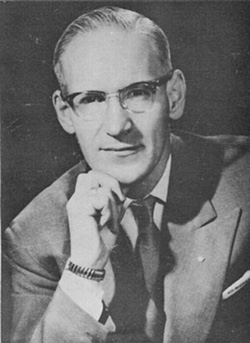
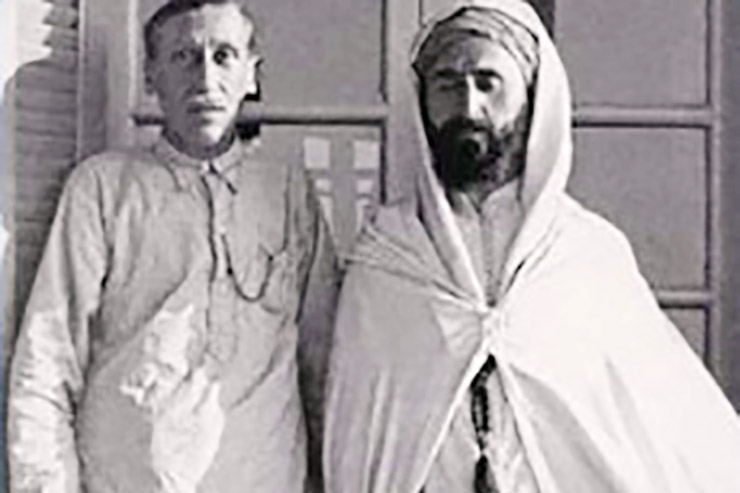
    Richard, Duc de Palatine, described by Dr. Stephan Hoeller as a learned and charismatic man, is regarded as restoring the Gnostic tradition in the English speaking world.
    Richard, Duc de Palatine, described by Dr. Stephan Hoeller as a learned and charismatic man, is regarded as restoring the Gnostic tradition in the English speaking world.

    This gentleman was an Australian by birth and upbringing. He studied at the University of Melbourne and during World War II served in the Australian armed forces. After the war he moved to London, where he became involved in various esoteric and ecclesiastical activities. Somewhat like me, he developed a great interest in Gnosticism quite early in his life. He joined the Theosophical Society in Australia, and I believe he belonged to the Melbourne Lodge, where, many years later, in the 1980s, I was a visiting lecturer myself. While some reference books claim that he had been a priest of the Liberal Catholic Church in Australia, he always denied this.

    Richard, Duc de Palatine’s clerical career began in London, shortly after he transferred his residence there. He became friendly with an English independent Catholic bishop, whose secular name was Hugh George de Willmott-Newman, and who was known as Mar Georgius I, bishop of Glastonbury. It was Mar Georgius who instigated that Richard should receive the title Duc (“duke”) de Palatine. There seems to have been a vogue among English independent bishops to receive titles of nobility at that time. Since these titles did not come from a reigning monarch of any country, they were considered somewhat spurious by some. Since I come from Austro-Hungarian nobility myself, with a title that dates back to the eighteenth century, I did not view this peculiar title-mongering with a great deal of favour, but I had more important concerns.

    Bishop de Palatine had a small organisation, headquartered in London, which possessed a certain membership in the US. He asked me to take charge of these members, and thus I became his personal representative for the US and the leader of the Los Angeles group of his members. This involved also starting up a Gnostic parish, which I did, and thus since 1959 I have headed a small Gnostic church in Los Angeles. I may say that this turn in my career was really a dream come true, for my great interest in Gnosticism now enabled me to serve this tradition in both a teaching and a priestly capacity.

    Thus Richard, Duc de Palatine became my teacher and superior formally in the early 1950s. He was an unusual person; charismatic, learned in certain areas, and – I am a bit reluctant to confess – I found him to be a person with unmistakable occult powers. He was what anciently was called a thaumaturge. I imagine there was a certain similarity between his powers and those of people like H.P. Blavatsky and G.I. Gurdjieff. Since these matters are somewhat private, no more shall be said of them. I served his church as a priest for ten years, after which he consecrated me a bishop.

    RS: There is a widespread teaching that speaks of a secret brotherhood that is constantly at work on behalf of human advancement and evolution. Do you personally believe in this concept, and if so, could you explain why?

    SH: The notion of such a brotherhood was chiefly publicised by H.P. Blavatsky and her followers, although some ideas of this nature existed in earlier esoteric traditions. The late nineteenth and early twentieth centuries saw much literature that exalted and exaggerated this concept. Names such as “Great White Brotherhood of Adepts” and even “the Hierarchy” came to be applied to it.

    As a student of esoteric history, I am aware of the presence of mysterious spiritual beings in the early Theosophical Society. Blavatsky often referred to her gurus, as did some of her successors.

    As to my own views on these matters, I freely accept the belief that esoteric teachers frequently have both embodied and also spiritual gurus. (For instance, Jung had a “ghostly guru” called Philemon.) But I draw the line at the idea that these gurus are organised in some sort of formal council that guides and advances the progress of humanity. In my view, this is a distortion of the data. One could also say that in view of the many frightful wars, holocausts, and gulags of recent history, the alleged beneficent efforts of such a brotherhood appear to have been singularly ineffective.

    RS: There seem also to be many forces that are working against human evolution and advancement. Could you comment a little on these? Do they have any relation to, say, the Gnostic concepts of the Demiurge and the archons?

    SH: The presence of forces that oppose human spiritual freedom was widely recognised by Gnostic teachers. Such forces are frequently personified as the archons, headed by the Demiurge of this world. Mythically, these beings are represented as entities who have been alienated from the ultimate divine source of the All, and who regard themselves as the proper overlords of creation and of humanity. A descriptive mythologem would be to see them as slave masters who wish to keep human souls in bondage, and who therefore try to prevent the liberation of human souls by Gnosis.

    It may be useful to mention that this view is not in the nature of a Gnostic demonology. The archons and the Demiurge are not so much evil as they are of limited consciousness; they do not recognise a reality superior to their own. (Gnostics stated that it was the Demiurge who exclaimed: “I am the only God and there are no other Gods beside me!”) These beings have fabricated a flawed creation and are determined to keep human souls confined therein.

    Fortunately, the domain of these beings is not universal. Mingled with the dark features of demiurgic creation, we find elements coming from the original Godhead, elements which have remained relatively free from corruption. Therefore, the manifest creation contains both light and dark. We walk on the checkerboard of the cosmos, which has been called the “tasselated pavement” in certain initiatory orders.

    As for myself, I believe neither in a great white brotherhood of benevolent adepts nor in a menacing assembly of evil black magicians, but rather in forces of unconsciousness opposed by forces of liberating consciousness. All of these may be personified or not. Among these forces we laboriously wind our way to the summit of salvific Gnosis.

    „You can learn more about Gnosticism and the work of Bishop Dr. Stephan A. Hoeller at the website of the Ecclesia Gnostica, www.gnosis.org/eghome.htm. Dr. Hoeller’s extensive library of lectures – on Gnosticism, Jung, Alchemy, Consciousness, Religion, & much more – are available for download from www.bcrecordings.net.

    [alert type=”general” dismiss=”no”]This article was published in New Dawn 143.[/alert]

    [alert type=”success” dismiss=”no”]If you appreciate this article, please consider subscribing to help maintain this website.[/alert]

    © New Dawn Magazine and the respective author.
    For our reproduction notice, click here.
  • Is Your God a Devil?

    Is Your God a Devil?

    From New Dawn 142 (Jan-Feb 2014)

    It is one of the most familiar and reassuring lines in scripture: “The Lord is my shepherd.” But when you think about it, the metaphor is a disturbing one.

    It’s true that a shepherd looks after his sheep. But he also shears them and kills them and eats them. Does the God we adore act totally with our best interests at heart, or are we a species of livestock that he uses for his own ends?

    Voices have occasionally uttered doubt, not about the existence of the gods, but about their beneficence. The ancient Gnostics said that the real god of this world was the Demiurge, a second-order being who mistook himself for the true God. The spiritual teacher G.I. Gurdjieff told a parable about a lazy shepherd who got tired of having his sheep run off, so he hypnotised them into thinking they were men or lions. Then they no longer ran off but stayed around so that he could shear or kill them as he liked. (Again we encounter a shepherd, this one more explicitly malevolent.)

    Gurdjieff does not say who this shepherd is. His main point is that man, in his state of waking sleep, is at the mercy of forces that may well not have his best interests at heart – forces that will extract energy from him regardless of his wishes.

    This parable is from an early period of Gurdjieff’s teaching; in his later period, epitomised in his magnum opus All and Everything: Beelzebub’s Tales to His Grandson, he portrayed the universe in a more beneficent light. But there are plenty of others who have cast doubts on the motives of the spiritual powers that control our lives.

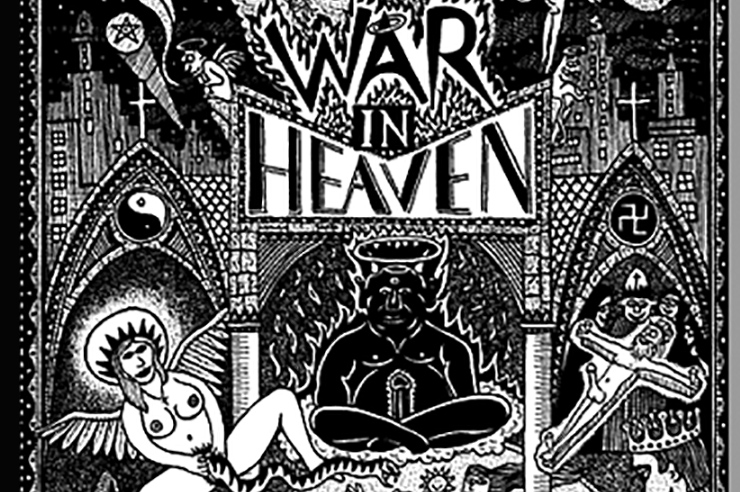
    One of the weirdest is found in a book called War in Heaven by Kyle Griffith. Originally it appeared in 1988. It has never been published in a conventional sense; I first read it years ago when I was editor of the esoteric journal Gnosis and there was a spiral-bound copy lying around the office. Today it can be downloaded for free at www.bibliotecapleyades.net/vida_alien/warinheaven/warheaven-III.htm.

    Comparatively little is known about Griffith himself. From my sources, I gather that he lived in the San Francisco Bay Area in the 1980s, the time when he put his book together.

    From a certain point of view, War in Heaven may look mad; from another, it is strangely compelling. I have read it three times over the years. While I’m not prepared to take its claims at face value, I find them both haunting and disturbing.

    Griffith’s vision allegedly derives from his telepathic communication with some spirits who say they are associated with the Invisible College. This was the name of a seventeenth century English coterie that was devoted to esotericism, philosophy, and the nascent discipline of science; it is usually seen as a precursor to the Royal Society. Unlike the scientifically minded gentlemen of Britain, the Invisible College of Griffith’s vision consists of disembodied spirits who claim to have inspired the Rosicrucian and Freemasonic movements of the early modern era; more recently, they were behind the civil-rights movement in America and the psychedelic revolution of the same period.

    All of these movements were designed with one end in mind: to break the hold of the Theocrats.

    The Theocrats, in the cosmology of War in Heaven, are parasitic astral entities who devour the souls of the recently deceased. The normal course of the soul’s evolution involves repeated reincarnations on earth. But these incarnations, as we well know, can be extremely unpleasant at times. The Theocrats have avoided this disagreeable option by maintaining a semiperpetual existence on the astral plane, fed by the souls they eat. Their strategy is simple. When a naïve soul has died, they greet it on the other side by proffering illusory welcomes into a fake heaven, populated with familiar religious figures and loved ones. When the soul has strayed into their trap, it is devoured.

    To make this vision even more disturbing, Griffith (or his guides from the Invisible College) contends that practically all of what we think of as religion is nothing more than a Theocratic ruse.

    The stages of this religious development, as portrayed in War in Heaven, bear some examination. The first stage was essentially shamanism. This is a crude and primitive form of religion – from the Theocrats’ point of view, that is, not from ours.

    Shamanism, we are told, fosters individual psychic development, and as such, it is of limited value to the predatory Theocrats, who benefit much more from the collective trance that conventional religious worship produces. As a result, the Theocrats had to refine and update their methods of mind control.

    Second-stage religion was a dead end. It involved large-scale human sacrifice. And history shows that civilisations that had such practices came to a bad end soon. Ancient Carthage, the great rival of Rome for domination of the Mediterranean, was one example. When the Romans decisively defeated Carthage, they razed the city and sowed the ground with salt. Salt is traditionally a substance used for purification, and some have said the Romans did this to cleanse the land from all the human sacrifice that had taken place there. Aztec civilisation, which in many ways was superior to its European contemporary, was another example: for all its might, it was destroyed by a few hundred Spanish adventurers on horseback.

    “The third stage of Theocratic religion,” Griffith writes, “involves mass animal sacrifices. Although they prefer human souls, Theocratic spirits can nourish themselves off the astral souls of lower animals to some extent.”

    If this were true, it would cast a weird but revealing light on what I have characterised in the accompanying article as the religions of the Age of Aries. They were so obsessed with animal sacrifice – which otherwise seems to be rather a pointless activity – because the Theocrats wanted it.

    “However,” Griffith adds, “the astral tissues of animal souls aren’t very compatible with the astral souls of the Theocrats, so they are not a good food source.” To solve this problem, the Theocrats invented fourth-stage religion – the religions that most of the world knows today. Here “Theocrats use religious mind control to delude souls into deliberately putting themselves under Theocratic control after death, thinking they are entering ‘eternal bliss in Heaven’ or ‘union with the Godhead’.” These religions are essentially those of what in the accompanying article I have called the Age of Pisces.

    By this view, the gods people worship – whether they are called Christ or Allah or Krishna – are nothing more than parasites on the astral plane who keep themselves nourished by souls of the innocents they prey on. Originally the Buddha was different; he experienced a genuine awakening and thus showed little respect for the traditional Vedic gods of his culture. But his later followers, who distorted his teaching into a religion based on faith in Buddha, became subservient to the Theocrats.

    Oh, and by the way: “The Theocrats want religious believers to feel guilty every time they feel sexual desire or enjoy any ‘pleasures of the flesh’. The guilt literally addicts them to attending church services that subject them to religious mind control.”

    There have been few more disturbing portraits of the religious history of humanity than this.

    To deliver the hapless beings of the human race from this dire situation, certain advanced souls from other planets came to the astral atmosphere of Earth a few centuries ago. They, along with some enlightened human souls who have managed to avoid the Theocrats, constitute the Invisible College. While the Theocrats have been sending telepathic suggestions to their unsuspecting followers on this plane, saying that all you have to do is believe in the Theocratic gods and trust them, the Invisible College has been transmitting the opposite message: to avoid worship and above all to think for yourself. They inspired the Rosicrucian and Masonic movements of the seventeenth and eighteenth centuries, as well as the accompanying impulses toward democracy, freedom of thought, and even atheism. After all, it is better to believe in no God at all than to open yourself up to a parasitic astral deity.

    According to Griffith, much of the 1960s counterculture was stimulated by the Invisible College. LSD, rock concerts, and similar gatherings were designed to create a different kind of trance – one that would telepathically open people to the idea they should think for themselves.

    But the story does not stop there. This effort has led to a reaction by the adversary – “fifth-stage Theocracy,” which “employs electronic mind control instead of religious mind control, and… can enslave people who subscribe to belief systems other than those of organised religion.” Some groups originally inspired by the Invisible College are co-opted by the adversary. Griffith writes, “Every new rock group starts out with a few normal protest or love songs. Then they get swallowed by a group mind controlled by fifth-stage Theocrats, and from that point on all their songs sound as if they were written by the same person.”

    It’s not possible here to go further into Griffith’s bizarre but fascinating vision. But there are some things that keep me from dismissing it entirely. The first is the collective madness of the human race – its pathological desire to rage and destroy, its hatred of its benefactors and its insane worship of its most vicious victimisers. There is a point beyond which we cannot explain this by mere mammalian aggression – which, as a matter of fact, does not have such destructive properties in other mammals. Psychology and sociology have no explanations for this mass insanity and show little interest in finding them. If there were such entities on the astral plane trying to control and manipulate us as Griffith says they are, this behaviour would at least be comprehensible.

    Another is the powerful collective urge toward what Gurdjieff called the “waking sleep” of man. It is true that, in the West at any rate, mass hypnosis by low-grade religion is losing its hold. But no sooner has this happened than we see a whole new series of mechanisms for putting people back to sleep – the “electronic mind control” that Griffith mentions. It is very hard to go into a public place and see people bewitched by their laptops and smartphones without wondering if something like this is going on.

    I don’t think War in Heaven offers a total explanation for the human condition, but I suspect that it has a measure of truth. There do seem to be invisible forces that, for reasons that are difficult to determine, benefit from the collective waking trance of humanity.

    Griffith concludes his work with a quasi-apocalyptic vision of the End Times. It is close enough to the End Times as portrayed by Christianity that I have trouble taking it at face value. And while I suspect there are low-grade spiritual entities that very much resemble the Theocrats described here, I am not so convinced that they explain everything about human religious aspiration.

    In any case, Griffith and his invisible mentors have some advice for keeping out of Theocratic control. In the first place, make a conscious effort to develop your own psychic powers during this life. In the second place, “read accounts of point-of-death experiences and learn to recognise the common tricks that the Theocrats use to enslave the unwary after death.” In other words, those accounts of near-death experiences are true – but they’re not to be taken at face value. That’s probably a sound rule of thumb for all spiritual experiences – no matter how good or bad they seem.

    [alert type=”general” dismiss=”no”]This article was published in New Dawn 142.[/alert]

    [alert type=”success” dismiss=”no”]If you appreciate this article, please consider subscribing to help maintain this website.[/alert]

    © New Dawn Magazine and the respective author.
    For our reproduction notice, click here.
  • The Dual Search for the Philosophers’ Stone

    The Dual Search for the Philosophers’ Stone

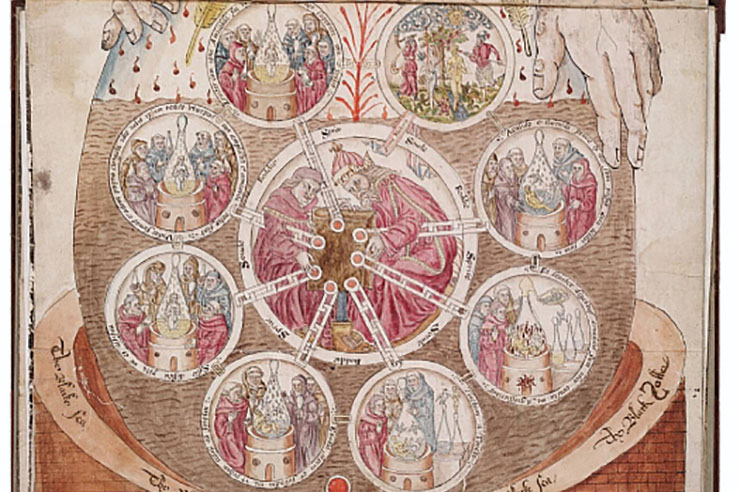
    To say what the Philosophers’ Stone – the great goal of alchemy – is, one has to know. And to know, one must have attained it. I cannot claim to have done this, so what follows must be speculation.

    The mystery grows deeper the closer one attempts to look. Even to say what alchemy itself is proves difficult. Of course, everyone knows what alchemy is – or thinks he knows: it is an outmoded form of science in which men in conical hats cooked and mixed various strange substances trying to make gold out of base elements. Or they sought to make the Philosophers’ Stone, a substance that was supposed also to produce gold – and to confer physical immortality besides. This project was totally deluded, but somehow gave rise to modern chemistry with all its wonders and curses.

    However cartoonish it may be, this picture has some truth to it. Or so the stories suggest. According to one, the seventeenth-century Flemish scientist Jean-Baptiste van Helmont once received a curious visitor to his laboratory. The stranger did not identify himself, but offered to give his host a piece of the Philosophers’ Stone. Van Helmont accepted on the condition that he be allowed to conduct his own experiments on it in the stranger’s absence. His guest readily agreed, asking nothing in return for the substance; the scientist’s conversion, he said, would be reward enough. The stranger left, never to be seen again.

    “I saw and handled the Philosophers’ Stone,” van Helmont wrote. “It was a saffron-coloured powder, very heavy, and it glittered like splinters of glass.”

    Van Helmont had his assistants melt eight ounces of mercury in a crucible. He then added the powder and sealed the vessel. Fifteen minutes later he opened it and was astounded to find a lump of gold.

    In 1666, the Dutch scientist Helvetius had a similar experience. Given the Philosophers’ Stone by a stranger, he was able to transmute a piece of lead pipe into gold that an assayer called the finest he had ever seen. Later, when the gold was melted down, mixed with silver, and separated out again, there was more gold than there had been at the beginning. Evidently some of the silver had been transformed by contact with this alchemical gold.

    Such stories abound in the literature of the early modern era. We read not only of mysterious strangers visiting early scientists, but of such figures as the fifteenth-century French alchemist Nicolas Flamel, who, having learned the secret of the Great Art (as alchemists call their practice), amassed a tremendous personal fortune and endowed many churches and hospitals. Another Frenchman, Jacques Coeur, allegedly used his alchemically created wealth to bail out his bankrupt nation after the Hundred Years’ War. Alchemists were particularly welcome at the Hapsburg court of Austria in the seventeenth century, where they would commemorate their feats by striking their transmuted gold into elaborate medallions, at least one of which still exists.

    Alchemy, then, appears to resemble chemistry to some degree. In fact one of the few practicing alchemists that I know in the US is a former chemistry professor who abandoned the conventional form of the science because he found it boring. But both the Stone and alchemy itself may offer greater mysteries still.

    A completely different perspective on the subject appears in a book called The Hermetic Tradition by the Italian esotericist Julius Evola (1898-1974). For Evola, alchemy is not about gold and metals and stones. These expressions are just blinds to cover the alchemist’s real goal – immortality in the true sense of the word.

    Evola distinguishes between immortality and mere survival after death. The latter is the lot of ordinary men. They go on to a shadowy netherworld like the Greek Hades or the Sheol of the Old Testament and lose all sense of personal consciousness. “In the eternal sleep, in the larval existence of Hades, in the dissolution – which is thought to be the destiny of all those for whom this life and the forms it takes constitute the beginning and end of everything human – in all this only those will escape who, while still in life, have learned how to focus their consciousness upon the higher world.” Evola goes on to criticise the conventional belief that “immortality is a certainty, not a problematical possibility.”

    It was, Evola contends, the goal of initiation in the mystery schools of antiquity to confer this immortality. He quotes Plotinus, the philosopher of the third century CE, who wrote, “As the gods must one be, not as good men. It is not that one must free oneself from sin, but that one must transform oneself into a god.” After the decline of paganism and the triumph of Christianity, which did not support this effort in the slightest, the alchemical path was created as a means of concealing it. From this point of view, Evola claims, it was “much better then to speak of Mercury and Sulfur, of metals and puzzling things and impossible operations” than to allow the pure teaching to be desecrated by religion.

    What, then, is the real alchemy? For Evola, it is the transformation of the body, especially in relationship to the spirit, to the life force. By this process the body goes from imprisoning the spirit to expressing it in a perfect way. “The corporeal principles are elevated to a higher plane, and ‘the two are made one’ in a spiritual corporeality; and the word that serves… to express that corporeality will be… the Philosopher’s Stone.” The symbol of the Stone is chosen because at this point “the body, as a completed, organised, and stable Nature is a ‘fixed’ thing as opposed to the instability of psychic principles and the volatility attributed to ‘spirits’.” This image evokes Christ’s parable that speaks of a man building his house upon rock rather than sand.

    This state, Evola emphasises, is the true goal of alchemy. Its attainment is difficult and uncertain, and particularly in its later stages is hard to grasp. But that is not surprising: one cannot be expected to grasp something that one has not experienced for oneself, particularly something that is so deeply at odds with ordinary understanding.

    In any event, much of Evola’s discussion, although it is far more lucid than we find in traditional alchemical texts, remains mysterious and puzzling. But there is one part of the process that is reasonably clear – the journey to the gates of death. By some process (which Evola does not describe) the candidate is brought into a kind of catatonic state that resembles death – except that he remains conscious during this process and then returns to life. This confrontation confers immortality – a stage that Evola equates with the alchemical term albedo or “whitening.”

    Evola does not talk much, or at all, about the actual experience that the candidate undergoes during this initiation. Indeed the only first-hand account of such a process that I know of can be found in a book called Opening the Dragon Gate, in which a Chinese wizard named Wang Liping tells of his initiation into Taoist alchemy under the guidance of two masters in the almost unimaginable setting of Mao’s Cultural Revolution of the 1960s. Wang undergoes a death and rebirth process that matches Evola’s description.

    There are other steps to the alchemical process as well. After the whitening stage, there is the rubedo, or “reddening,” in which the now-immortal spirit is reunited and reintegrated with the physical body. Does this confer physical immortality? The alchemical legends suggest that it does. Nicolas Flamel was reported to be seen hundreds of years after his lifetime in the fourteenth century; the eighteenth-century savant the Comte de St.-Germain, another heir to the alchemical legacy, was similarly said to be centuries old; and the Taoists have their legends of the Eight Immortals, whom author Victor H. Mair describes thus: “They are immune to heat and cold, untouched by the elements, and can fly, mounting upward with a fluttering motion. They dwell apart from the chaotic world of man, subsist on air and dew, are not anxious like ordinary people, and have the smooth skin and innocent faces of children.”

    Like practically all legends, these tales are unverifiable, although by the same tack, they are impossible to refute: we cannot go through all seven billion people on earth one by one and prove that none of them has lived for hundreds of years. The physical immortality to which alchemy points remains, as Evola says, a “problematical possibility,” waiting for us around a corner that may or may not exist.

    All this said, it is hard to entirely dismiss the more familiar version of alchemy. There are practicing alchemists who do work with metals, and, as we saw at the beginning of this article, there were even some who claimed to have attained the summit of this work. Again, these achievements remain elusive and legendary, but again negative proof is impossible.

    Thus we are left with a dual alchemy. One path attempts to transform the essence of a metal so that it reaches its most perfect form (which was always held to be gold). The other path is aimed at transforming human nature. In the end, do these goals converge? They can only do so if the principle of consciousness that dwells within us is fundamentally the same as that which dwells in all of nature, animate and supposedly inanimate. In that case the two would in the end be one.

    [alert type=”general” dismiss=”no”]This article was published in New Dawn Special Issue Vol 7 No 3.[/alert]

    [alert type=”success” dismiss=”no”]If you appreciate this article, please consider subscribing to help maintain this website.[/alert]

    Sources

    Titus Burckhardt, Alchemy: Science of the Cosmos, Science of the Soul, Translated by William Stoddart, Penguin, 1971

    Chen Kaiguo & Zheng Shunchan, Opening the Dragon Gate: The Making of a Modern Taoist Wizard, Translated by Thomas Cleary, Tuttle, 1998

    Julius Evola, The Hermetic Tradition: Symbols and Teachings of the Royal Art, Translated by E.E. Rehmes, Inner Traditions, 1985

    Fulcanelli, The Dwellings of the Philosophers, Translated by Brigitte Donvez and Lionel Perrin, Archive Press, 1999

    Cherry Gilchrist, Everyday Alchemy: How to Use the Power of Alchemy for Daily Change and Transformation, Rider, 2002

    Stanislas Klossowski de Rola, Alchemy: The Secret Art, Thames & Hudson, 1973

    Victor H. Mair, Wandering on the Way: Early Taoist Tales and Parables of Chuang Tzu, Bantam, 1994

    Mark Stavish, The Path of Alchemy: Energetic Healing and the World of Natural Magic, Llewellyn, 2006

    David Goddard, The Tower of Alchemy: An Advanced Guide to the Great Work, Samuel Weiser, 1999

    © New Dawn Magazine and the respective author.
    For our reproduction notice, click here.