New Dawn – World's Most Unusual Magazine

Category: Secret Wisdom

  • The World of Esoteric Orders: Secrets Within Secrets

    The World of Esoteric Orders: Secrets Within Secrets

    From New Dawn Special Issue Vol 7 No 3 (June 2013)

    It is noon on a summer morning in California, and I am sitting in a dimly lit auditorium that is decorated in an Egyptian style with Art Deco touches. A group of us have shuffled in and taken our seats on finely polished wooden benches, and we are led on a guided meditation.

    I don’t remember the exact content of the meditation, but I do remember the inner experience it generated in me. I had a strong sense of being in an Egyptian temple, seated on a stone chair on a stone dais in the centre of a room. The room had some kind of indirect lighting, and the only image I saw on the walls is a winged disk in front of me. Within me was a sense of coolness and centredness. I also had a slight glimpse, through a side entrance, of a bright blue sky with desert sand and some palms. I went into a deep meditative state and came out of it when the session ended.

    The setting I was in – I mean in the physical world – was the temple of the Ancient and Mystical Order Rosae Crucis (AMORC for short) in San Jose, California. It’s not surprising, perhaps, that I should have a sense of Egypt – the entire property, Rosicrucian Park, which occupies a city block, is designed in a quasi-Egyptian style – but it is surprising that the sense of Egypt should be so powerful. Later I realised I had had a much stronger feeling of being in ancient Egypt during that meditation than I had ever had when I visited the country itself.

    AMORC was founded in 1915 by an American ad man named Harvey Spencer Lewis, who received certain initiations in the Rosicrucian tradition in Europe around 1910. Using American marketing techniques (such as advertising in magazines), he built AMORC into one of the largest and most visible esoteric orders in the world. And, he insisted, the lineage of this tradition went back to Egypt itself.

    Does it? How could we possibly know? The amount of documentation that would be required to prove such a claim would be enormous, and anyway such materials would hardly be able to survive the assaults of the millennia.

    I am not a member of AMORC myself – I was present for that meditation, and a couple of others like it, while I was attending a conference sponsored by the organisation in July 2010. Moreover, I’ve never felt any great affinity for ancient Egypt. I have no way of knowing whether my experience arose from a contact with a thought-form built up by decades of Rosicrucian practice or whether it genuinely conveys a living tradition that goes back to the days of the pharaohs.

    A view of the temple of the Ancient and Mystical Order Rosae Crucis (AMORC for short) in San Jose, California. (Photo credit: AMORC)

    The “Upper Room”

    Perhaps it does not matter. In either case this experience suggests one characteristic of an esoteric order: it must have an “upper room.” The phrase goes back to the New Testament, which tells of Christ’s disciples gathering in an “upper room” after his ascension (Acts 1:13). The phrase also appears in Mark 14:15 and Luke 22:12, which speak of an “upper room” at which the Last Supper was to be held. The detail is striking: what difference does it make if you meet in a room that is on an upper storey rather than a lower one? In a literal sense, none; but in an inner sense, I believe that an “upper room” – that is, a place on an astral level, as it is sometimes called, or the realm of the psyche – is a necessary part of an esoteric order. This “room” can be created by the sustained work of visualisation by a group over a certain period of time, and after a certain point it can start to have a quasi-independent existence. The group can gather there in thought, if not physically. This kind of “upper room” may be what I glimpsed in my AMORC meditation.

    Curiously, one of the requirements given for the brothers in a seventeenth-century text known as the Fama fraternitatis (“Rumor of the Brotherhood”), a chief inspiration for the Rosicrucian movement, is “that every year, on the day C., they should meet together at the house Sancti Spiritus [of the Holy Spirit], or write the cause of his absence.” It is not clear which exactly is the “day C.,” but there is some evidence, at least in certain strains of the Rosicrucian tradition, that, despite the difference in initials, it is the feast of the Epiphany on January 6. (I do not know if this is the case for AMORC.) In any case, it seems likely that “the house Sancti Spiritus” is not a physical building, but the kind of upper room that I have been talking about here.

    None of this, of course, tells us exactly what an esoteric order is, so some explanation is needed. Let’s begin by assuming that there is a vast continuum of development in consciousness, from the most ephemeral subatomic particle to beings and dimensions greater than we can conceive. Let’s also assume that the realm of human life and consciousness forms a very narrow bandwidth on this enormous span. There are levels below us and above us. Moreover, these levels are not rigidly separate or discrete, but blend into one another, like the colours on the visible spectrum. That is, there is some communication among them. The most famous image of this process appears in Jacob’s dream in Genesis: “And behold a ladder set up on the earth, and the top of it reached to heaven: and behold the angels of God ascending and descending on it” (Genesis 28:12).

    We might go on to make another assumption – that the interaction that takes place among these levels involves a certain degree of responsibility, that the level above is required to help the one below rise to a higher degree of consciousness. Taking all these possibilities into account, we have a sense of what esoteric orders might mean for human development.

    By this view, there are beings who have a greater degree of awareness (and, we may hope, compassion) than we do. They are aware of us – dimly, perhaps, as we are aware of them – and are able to help us. But in fact we cannot see these beings on a physical level. They exist on some other plane, and we need to rise up to that plane in order to have some genuine communication with them.

    Hence the need for an upper room. Hence also the need for a group or community that can train people to rise to this upper room and have some communion with the beings there. (The Jewish Kabbalists sometimes refer to this as “the academy on high.”) These groups would constitute the esoteric orders – some of them known but many, perhaps most, unknown to any but their own members. The esoteric orders would exist on the physical level, but they would also have contacts on levels above. These are sometimes called “inner plane” contacts.

    To take another example – again from a group that I do not belong to – there is the little-known Esoteric School of Theosophy. The Theosophical Society (TS) itself is comparatively well-known. It was founded in 1875 by the Russian savant H.P. Blavatsky and several of her associates. Today it continues to function on a worldwide basis as a means of, among other goals, investigating the “unexplained laws of nature and the powers latent in humanity.” The TS is said to have been inspired by Blavatsky’s contact with certain Masters or adepts who possessed paranormal powers and whose mission was to elevate the spiritual state of humanity.
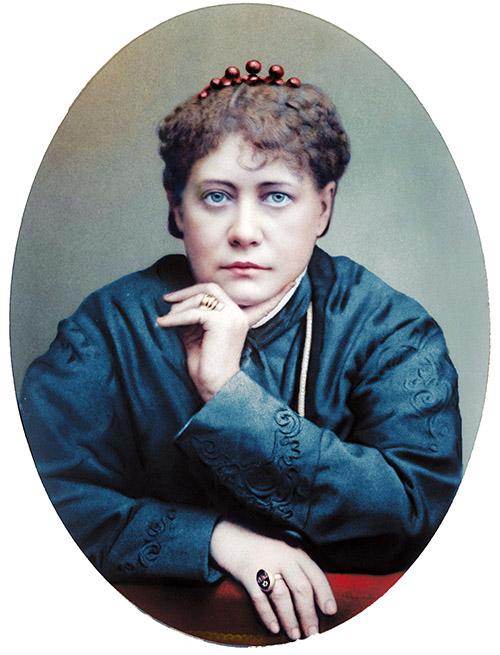
    H.P. Blavatsky

    As the TS grew and spread, its purpose became more diffuse, and it attracted many members who were interested in studying about but not necessarily pursuing the esoteric path. Consequently, in 1888 Blavatsky formed what she called the “Esoteric Section” of the TS, which was more oriented toward practice. Later the name was changed to the “Eastern School of Theosophy,” and finally to “the Esoteric School of Theosophy,” an organisation that exists to this day. It is not a secret society per se, but it is comparatively discreet about its existence and is only open to members of the TS. Those who want to join the Esoteric School must pledge themselves to a life of purity, eschewing meat, alcohol, and sexual license. (Not all esoteric orders have these requirements.) Members of the ES, as it is known for short, also devote themselves to lives of study, meditation, and service, although they do not withdraw from the world as monks or nuns.

    Part of the goal of the ES seems to be to maintain contact with the Masters or adepts of whom Blavatsky spoke. I do not myself know what the nature of this contact is, if it is genuine, or which Masters the members of the ES would claim to be in touch with. Nor do I know whether these Masters are believed to be living in physical bodies or exist only on the inner planes. I have occasionally put questions about these things to members of the ES but have only gotten vague and noncommittal responses. Nonetheless, this contact seems to be part of the task of the ES, and it helps illustrate the purpose of having an upper room. 

    Initiation
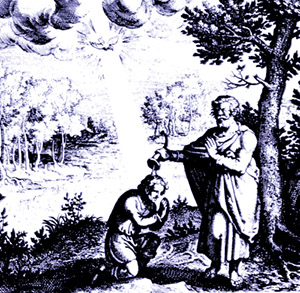
    Esoteric orders usually bring in new members through initiation. The word “initiate” is in some ways a misleading one. To some, it connotes someone who is highly advanced – as, for example, in Cyril Scott’s Initiate trilogy of occult novels from the 1920s and ’30s, whose hero, Justin Moreward Haig, displays astonishing paranormal powers. But the core meaning of the word is really “beginner” – an initiation is a beginning. Initiation can take many forms and can range from the extremely simple to the extremely complex, but often it contains a sequence of acts in which the initiate symbolically “dies” and then is resurrected in a new and transformed state. The most familiar version of this rite is Christian baptism, particularly in its original form, whereby the candidate is fully immersed in water. By this symbolic drowning and restoration, the new Christian takes part in the death and resurrection of Christ himself. (Christianity today, of course, is not an esoteric order, but there is some evidence that it began as an esoteric order and was later popularised.)

    The Catholic Church has traditionally taught that the rite of baptism leaves an indelible mark on the soul, removing all sin. Writing on the occult significance of the sacraments in the early twentieth century, the Theosophist and clairvoyant C.W. Leadbeater was more cautious in his assessment. While saying that it was “distinctly… an act of white [beneficent] magic, producing definite results which affect the whole life of the child,” he also pointed out that “a Sacrament is not a magical nostrum. It cannot alter the disposition of a man, but it can help to make his vehicles a little easier to manage. It does not suddenly make a devil into an angel, or a wicked man into a good one, but it certainly gives the man a better chance. That is precisely what Baptism is intended to do, and that is the limit of its power.”

    As this passage suggests, initiatic practices usually intend to transform the inner nature of an individual. The Freemasons sometimes claim that the aim of their secret initiations is “to make good men better.” This is generally a subtle process, and probably for most individuals the change they undergo is comparatively gradual and difficult to see unless you are looking for it. In some cases, however, initiation produces more dramatic effects.

    Over twenty years ago, when I was editor of Gnosis, a now-defunct magazine of the Western inner traditions, I entered into correspondence with a gentleman from Jordan named Dr. Jamal N. Hussain, who was researching deliberately caused bodily damage (DCBD) phenomena. He told me about the Tariqa Casnazaniyyah, a Sufi order whose name means “a path that is known by no one.” (For a discussion of the Casnazaniyyah order, see http://ashraf786.proboards.com/index.cgi?board=sufi&action=display&thread=23998.)

    This order, which traces its lineage back to the Prophet Muhammad, has a membership said to number in the millions, located chiefly in Iraq, Turkey, Iran, and Jordan. Its initiation process is quite simple. It consists of a brief two- or three-minute ritual in which the initiate recites a vow while exchanging a ritual handshake with the master of the order or one of his deputies. The initiate then requests permission to perform certain types of miracles. The master grants permission on the condition that the initiate will perform them only to attest to the greatness of the Casnazaniyyah order.

    After this initiation, the individual can pierce his body with sharp objects, swallow razor blades, eat poisonous scorpions, or handle fire, all without any apparent harm. Scientific explanations are difficult to come by. As Dr. Hussain pointed out, this effect cannot be explained by endorphins (the body’s natural painkillers), since the wounds heal spontaneously and immediately. Nor can it be explained by self-hypnosis, since the practitioners do not experience any altered state of consciousness. While I myself have never witnessed any of these phenomena, Dr. Hussain did send along a number of rather poor-quality Polaroid photos, which did not seem to be doctored. In one of them, a bare-chested man with a large belly was piercing himself with spikes. In another memorable image, a man was chomping down on a scimitar, which was cutting into his lips. Dr. Hussain invited me to a conference in Baghdad that was discussing DCBD phenomena, but I was unable to go.

    No matter how exotic their manifestations may be, esoteric orders have the task of making and maintaining contacts with higher levels of consciousness and being, and inducing a transformation within their members that make this possible. A complementary task is to carry out some function in the world – to do some kind of work that furthers human advancement. For example, the monastic orders that grew up in late antiquity had the function of preserving the essence of classical civilisation in the wake of its collapse. They also cleared land for agriculture in Europe and managed it in a careful and responsible way, creating the foundations of Western civilisation. “In a sense they determined the whole history of Europe,” writes historian Paul Johnson; “they were the foundation of its world primacy.” As the Dark Ages passed and medieval civilisation flowered, the monasteries, having fulfilled their purpose, fell into corruption. Today the monastic orders still survive, but for the most part only as dwindling vestiges.
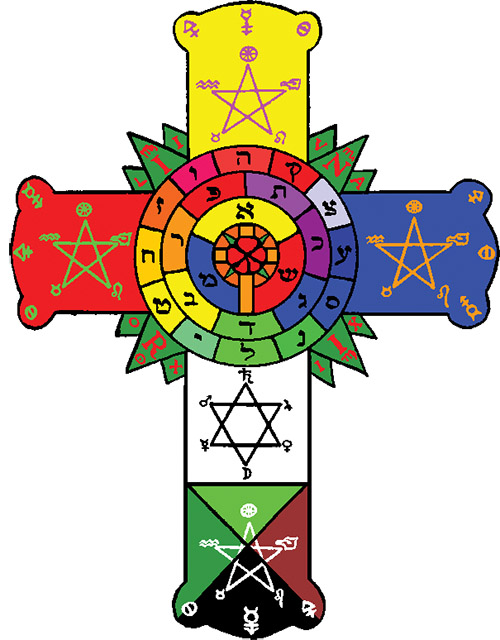
    Rosy Cross of the Hermetic Order of the Golden Dawn, ca. 1900

    Some have tried to classify esoteric orders on the basis of their functions. In the 1990s the British esoteric school known as Saros came up with a twelvefold division, inspired by the verse in Revelation that speaks of “twelve gates” to the holy city (Revelation 21:12). The Saros schema comprises Teachers, Prophets, Magicians, Lawgivers, Traders, Artists, Craft Workers, Life Tenders, Warriors, Perpetuators, Priests, and Explorers. One can easily find examples of these in world history: the schools of the prophets or “sons of the prophets” under such figures as Samuel, Elijah, and Elisha (1 Samuel 10:11; 19:19–20; 2 Kings 2:3, 5; 4:38; 6:1); the military orders of medieval times such as the Templars and Hospitallers; and the various magical orders that have arisen in the West over the past century or so, like the Hermetic Order of the Golden Dawn.

    System of the Seven Rays

    In fact one of the most illustrious pupils of the Golden Dawn, Violet Firth, writing under the pen name Dion Fortune, wrote what is probably the best introduction to the subject: The Esoteric Orders and Their Work, which was originally published in 1928. Dion Fortune categorises the orders of the West according to a system of the Seven Rays that is similar to the one found in Theosophical teaching. Her schema is worth looking at in some depth.
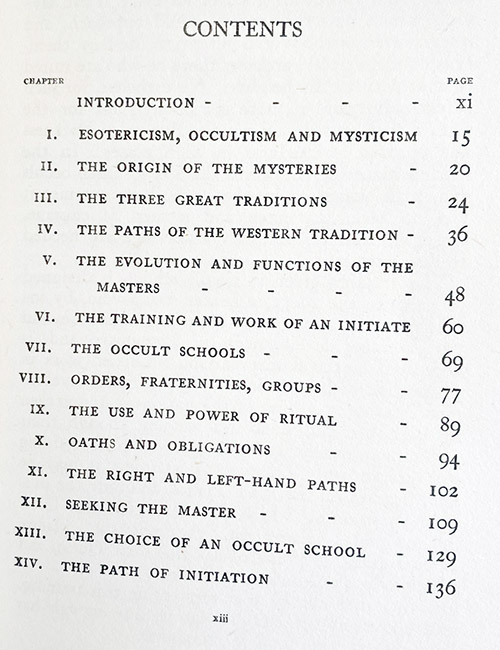
    Contents page of The Esoteric Orders and Their Work.

    Beginning with the seventh ray, Fortune contends that this, “the Plane of Abstract Spirit,” cannot be contacted while in the physical body. Instead the higher Self must withdraw, leaving the body in a trance. Fortune says that this seventh ray is not highly developed in the West, being characterised for the most part by mystics and ecstatics; Teresa of Avila is one of the principal sources on the subject. This ray is not to be developed prematurely, before the other, lower ones have been brought to fruition; otherwise it produces a kind of spiritual inertia. The school of the Quietist mystics in seventeenth-century France and Spain offer an example of this problem. Hence orders of the seventh ray are chiefly to be expected in the future.

    The sixth ray is connected with spiritual devotion, with what the Hindus call bhakti, and, Fortune says, “hereon are developed the spiritual qualities of Love, Truth, Goodness, Purity, and many others.” It is headed by the Master Jesus, she says, and hence is known as the Christian Ray. “It is the hidden power of Christianity which was taught to the disciples in the Upper Room whilst the multitude received but a rule of life – a rule, however, which if faithfully followed, would bring them to that Upper Room where they could receive the inner teaching.”

    The fifth ray is connected with the use of abstract reasoning. Fortune says it is called the Pythagorean Ray because it reached its heyday in the mystery schools of ancient Greece, among which the Pythagorean school was prominent. For the philosopher Pythagoras, who lived in the sixth century BCE, the universe was grounded in the principle of number and hence was knowable mathematically. 
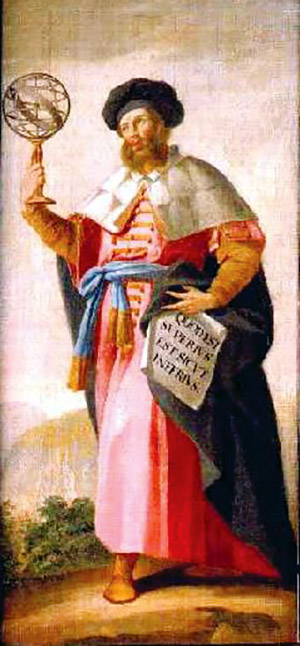
    Painting of the legendary Hermes Trismegistus, author of the Hermetic Corpus, a series of sacred texts important to many esoteric orders.

    The fourth ray is the ray of concrete, as opposed to abstract, mind; its quintessential master was the semimythical sage Hermes Trismegistus, and it bore fruit in the Egyptian and Chaldean mysteries of antiquity, as well as in its heirs, such as Gnosticism and the Jewish Kabbalah in late antiquity, as well as in the alchemists of medieval and early modern times. The Rosicrucians of AMORC, with their strongly Egyptian flavour, might come under this ray.

    The third is the ray of beauty and harmony; “being an initiation of the emotions, its standards of value are aesthetic, not ethical.” It was exemplified by some of the earlier Greek mystery schools, Fortune says, particularly those of the Dionysian cult. Later it gave rise to the “Celtic racial culture” and hence is known as the Celtic Ray. It seeks to embody beauty and harmony in the manifestations of physical reality, and as a result is also known as the artist’s ray.

    The second, “the Norse Ray,” is so called “because the purest contacts of this much-corrupted tradition which are available to us in the West are those of the Nordic mythology.” It deals with the plane of primitive instincts and the urge to overcome them; its ecstasy arises out of courage – the sublimation of fear in battle. Its dark side is cruelty, as can be seen from the ancient Viking practice of the “blood eagle,” in which a victim (usually a prisoner of war) had his rib cage cracked open from behind; his lungs were then ripped out and spread out on his back, producing a ghastly imitation of a pair of wings. Fortune suggests that this ray reached its zenith in remote primitive times.

    The first ray principally involves the mastery of the physical body. The Casnazaniyyah order forms a rather extreme example of this type. Dion Fortune says that this ray is not “worked” in the West in the present day; and it probably was not in her time (she died in 1946), but we can see its resurgence on the contemporary scene with the wide popularity of hatha yoga. Although Fortune does not say this, it can probably be connected with the health and fitness cults of recent generations.
    Get the issue this article appears in

    I must add here that Fortune’s picture of the seven rays is not quite identical with those of the classic Theosophical view (as outlined in, for example, Ernest Wood’s 1925 book The Seven Rays), but it remains comprehensive, particularly in trying to account for the different strains of the Western esoteric traditions. Again, it is easy to find examples of these different rays in many esoteric schools worldwide, whether we look at the way of the fakir or sadhu as practiced in the East (first ray) or at the schools of icon painters in Greek and Russian Orthodoxy (third ray). Other orders are more difficult to categorise. One would have to know more about the goals of the Esoteric School of Theosophy to be able to decide under which ray it fit.

    For this reason at least, I would not view Fortune’s schema, or any other, as fixed and absolute. As usual, they provide categories for classifying and thinking about a certain area that remain useful as long as they do not form rigid conceptual barriers in the mind.

    Coming to the end of this article, a reader may wonder about a number of things often associated with esoteric orders that I haven’t mentioned. What about the elaborate rites and costumes, the dazzling insignia, the extravagantly august titles often given to the leaders? Where do these fit in? They are external appurtenances – the hard shell around the order’s living core. At best they serve as reminders and confirmations of the ideals that it pursues. But if the members become too preoccupied with these appurtenances and they grow too cumbersome, this hard shell thickens and kills the living pith within. Thus when many people think of esoteric orders, they are often thinking of former esoteric orders that have died and are only going through the motions. If a seeker is only interested in these externals, most likely he will be drawn to groups of this kind, and may find them perfectly congenial. In most cases they are probably harmless enough.

    More than many other subjects in this field, esoteric orders retain an air of mystery about them. The vast majority are probably unknown to all but their own members, and the role they play in human history is subtle and hard to pin down. Some may focus heavily on their inner plane contacts, while for others these may be only felt as a vague and remote influence. But insofar as these groups foster human development and point us toward vistas that lie beyond the bounds of conventional reality, they continue to underpin civilisation in ways about which we can only guess.

    [alert type=”general” dismiss=”no”]This article was published in New Dawn Special Issue Vol 7 No 3.[/alert]

    [alert type=”success” dismiss=”no”]If you appreciate this article, please consider subscribing to help maintain this website.[/alert]

    Sources

    Paul Foster Case, The True and Invisible Rosicrucian Order, Samuel Weiser, 1985
    Dion Fortune, The Esoteric Orders and Their Work, Aquarian, 1982
    Paul Johnson, A History of Christianity, Atheneum, 1987
    C.W. Leadbeater, The Science of the Sacraments, 2nd ed., Theosophical Publishing House, 1929
    Richard Smoley, “Sufi Order Practices Way of the Fakir,” Gnosis 31 (Spring 1994), 8-9
    Ernest Wood, The Seven Rays, Theosophical Publishing House, 1925

    © New Dawn Magazine and the respective author.
    For our reproduction notice, click here.

  • William Walker Atkinson & His Legacy

    William Walker Atkinson & His Legacy

    From New Dawn Special Issue Vol 13 No 5 (Oct 2019)

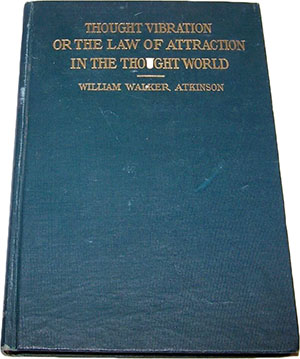
    William Walker Atkinson was one of the most influential and mysterious metaphysical writers of the twentieth century. Under an array of different pseudonyms, Atkinson authored over a hundred books and close to a thousand magazine articles in a prolific career that began later in his life after a breakdown pushed him out of a successful legal career. 

    While known during his own lifetime, Atkinson’s works continued to have a remarkable and widespread influence after his death and up to the present. His pen helped to shape everything from yoga and Reiki to the Prosperity Gospel and the Law of Attraction.

    William Walker Atkinson

    Atkinson was born in Baltimore, Maryland, USA in 1862 to a solidly middle-class family who had connections to some of the city’s more prestigious and established families. His father and grandfather both owned grocery stores, and as he grew up and worked in his father’s business, William Walker Atkinson seemed fated to join them. 

    When he was just twenty-one, Atkinson suffered a breakdown. Seemingly despondent from a case of unrequited love, the younger Atkinson disappeared from Baltimore and sent a series of suicide notes from a hotel in Philadelphia a few days later. Not long after, he started reading books on Theosophy and began a study of esotericism that not only seemed to stabilise him and give him direction in the moment, but for the next half-century.

    He then travelled throughout the eastern half of the United States for several years in search of a career that could be of his own making. Atkinson moved from one job to another and tried his hand in sales and office work without anything really taking hold, eventually finding his vocation as an attorney. In 1893, Atkinson began to study the law, serving first as an apprentice and then alongside a senior attorney in central Pennsylvania.

    Atkinson thrived as a lawyer, and not long after he moved to another city to start a practice of his own, and he was invited back to become a partner with his former mentor. The future seemed bright for Atkinson and his young family, but when the perfunctory transfer of his legal credentials from one county to another was unexpectedly denied, that future was thrown into doubt. Left with few options, Atkinson moved his family in with his brother-in-law in Philadelphia and promptly had another breakdown that saw him disappear for six weeks.

    His Great Work Begins 

    In later accounts of this time, Atkinson described being brought to the brink of collapse on all levels through overwork and anxiety. While he was coy about what exactly happened during the time of his absence, when he reappeared Atkinson quickly gathered up his family and moved to Chicago where he changed his occupation and became an enthusiastic author and proponent of New Thought – a web of beliefs and practices that hold that one’s thoughts affect health, well-being and circumstances – and he took to it with a convert’s zeal.

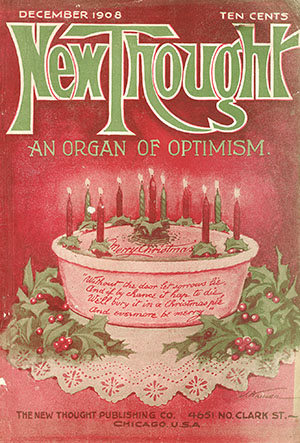
    Atkinson started in his new career by writing and serving as the associate editor for a magazine titled Suggestion, and by the end of 1901 he was the editor of another Chicago-based periodical titled New Thought. As he continued to write and give lectures, compilations of Atkinson’s work began to be published in book form.

    New Thought magazine, Dec 1908 edition.

    While Atkinson’s nascent life as a writer might seem to have been a dramatic shift, it brought together much of his past. His early interest in Theosophy appears throughout his works in direct references to Helena Blavatsky and use of the term “secret doctrine,” and in a worldview indebted to its perennial philosophy that saw a validity and interconnectedness in the different spiritual traditions of the world. Atkinson incorporated the works on self-help and physical culture he absorbed during his sojourns as a clerk and salesman, and from his time as an attorney he took a fondness for describing the universe as a set of laws, as well as the ability to eloquently argue a point.

    With Atkinson as editor and chief contributor, the readership of New Thought swelled, and its total circulation doubled and then doubled again. This was no accident. Many scholars have suggested that New Thought’s popularity is best understood in the context of swift and massive changes that were happening in American society as the Gilded Age transitioned into the Progressive Era and large numbers of Americans moved into the cities to work jobs in sales or inside offices. 

    With theories that were simultaneously scientific and magical, New Thought gave explanations for why some people were successful and others were not, and it offered the possibility for advancement and improvement to those who had little more than their thoughts and desires. 

    For his part, Atkinson wrote to his audience with a voice that was simultaneously clear, authoritative, sympathetic, and profoundly democratic. Always a champion of the individual and those who worked hard, he saw the workings of New Thought as easily in the empires of newly minted industrial magnates as in the hustle of the young newspaper hawkers he admired on the streets of Chicago. Atkinson also regularly invited readers to visit him in his office and answered their letters in a regular column in New Thought with counsel that was as kind as it was direct.

    Atkinson held a view of New Thought that was both generous in theory and practical in its application. He saw little that was “new” in New Thought but understood it as only the most recent manifestation of a long and varied line of systems that extended all the way back to ancient India. At the same time, Atkinson approached New Thought like a scientist and saw the everyday world as its proving ground that could test and refine its ideas, with its ultimate value in how it could help people in their daily lives.

    Unlike many of his contemporaries and those later influenced by New Thought, Atkinson never saw its teachings as just a magical way to manifest desires, but rather as a method of strengthening and clarifying one’s aims that always needed to be paired with hard work. One of Atkinson’s sayings was “Hold the Thought and Hustle.” He also refused to see material wealth as the sole worthy aim, but instead glorified those who were creative, productive, and felt at home in the world as themselves.

    ‘Yogi Ramacharaka’ 

    Yogi Ramacharaka, from an
    advertisement (1903).

    While he was at the helm of New Thought, Atkinson began to author monthly mail-order lessons on yoga under the name ‘Yogi Ramacharaka’ that soon developed into a series of books published by the Yogi Publication Society, housed in Chicago’s Masonic Temple skyscraper. Atkinson did not seem to be concerned with being a conduit for the pure ancient wisdom of India. For him, the yogi was an ideal type – energetic, efficient, and attuned with nature – and the yoga he offered the public as Yogi Ramacharaka was a mixture of physical culture, contemporary science, New Thought philosophy, and self-help techniques. 

    Yogi Ramacharaka was one of the earliest of over a dozen different pseudonyms Atkinson used during his writing career that would become a source of confusion and speculation after his death. Upon close inspection, his various pen names align with different publishers and distinct periods of time. The most likely explanation for them is that they allowed someone so prolific to publish with several companies simultaneously and to do so without flooding the market. 

    Importantly, Atkinson never distanced himself from any of his writing. In the biographical entries he submitted to reference books such as Who’s Who in America, he openly claimed authorship of all his pseudonymous works, and in the personal copies of his pseudonymous books that were left to his family, he personally inscribed “I Wrote This” next to his initials on their inside covers. 

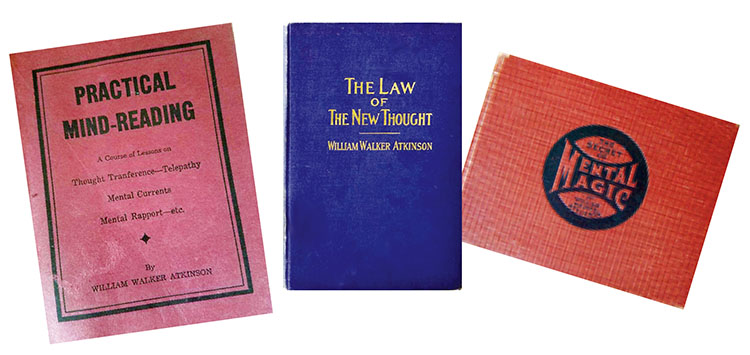
    William Walker Atkinson, one of the most influential and mysterious metaphysical writers of the twentieth century, authored over a hundred books including titles such as Practical Mind-Reading, The Law of the New Thought and The Secret of Mental Magic. He also wrote under a dozen different pseudonyms.

    As New Thought magazine became increasingly successful, its manager Sydney Flower used its pages to promote dubious products (including a health cigar) and investment schemes. Flower quickly became the target of mockery in several newspapers and ran afoul of federal postal authorities who halted New Thought magazine’s use of the mail as part of a fraud order just before Christmas in 1904. 

    Atkinson moved with his family to Southern California a few months later. It was a decision he claimed was for the climate and change of scenery, but as he had carefully distanced himself from Flower during this time – reminding readers in print that he was simply a writer and editor who had nothing to do with the “business side” of the magazine – the move undoubtedly had the added benefit of putting distance between himself and Flower’s legal troubles. 

    Relocating to Los Angeles established a pattern that would see Atkinson and his family move between Chicago and California a total of three times, staying in each city for several years at a stretch. Both cities were active hubs of metaphysical and esoteric activity, and were separately described by newspapers as claimants to the title of America’s “cult capital.” Atkinson’s presence in these locations – combined with his affable disposition and position as an author and lecturer – brought him into contact with an impressive list of important and influential figures in the metaphysical world. The heart of the Los Angeles scene was Blanchard Hall and for the next few years Atkinson regularly lectured to packed crowds in its large 800-seat auditorium and teach classes in its smaller meeting rooms. 

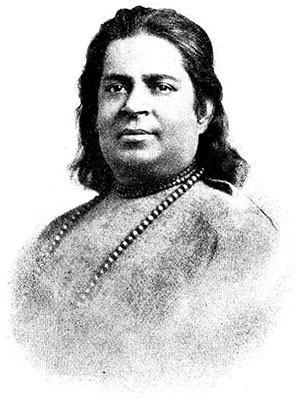
    Baba Bharati (circa 1904).

    One of the most important connections Atkinson made in Los Angeles was with Baba Bharati, a Bengali-born Krishna devotee who had recently arrived in the United States. Atkinson wrote a pair of articles for Bharati’s magazine, The Light of India, and warmly described their friendship. Bharati was also influenced by Atkinson, and after their meetings he began to describe yoga with the New Thought-inspired phrase “Thought Force.” It was likely through Bharati’s influence, if not direction, that soon after Atkinson left California and edited two volumes of Hindu sacred texts for a popular American audience – The Bhagavad Gita and The Spirit of the Upanishads – under his pseudonym Yogi Ramacharaka.

    When Atkinson returned to Chicago in late-1907 he entered into an astonishing five-year period in which he was at his most prolific and eloquent, publishing over forty books and one hundred magazine articles. One account of Atkinson’s writing process during this time claimed that he would immerse himself in the study of a topic and then, once “loaded up,” write in a rapid outpouring with the office assistant setting up the type for each page as soon as Atkinson was done writing it.1 This process not only explains Atkinson’s productivity but also the repetition of ideas and minor typos in his works during these years.

    The Kybalion

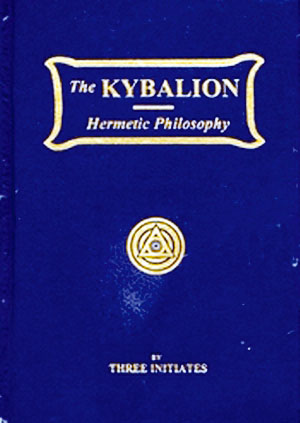
    Early in this period, Atkinson wrote a self-described “little volume” called The Kybalion under the cryptic pseudonym “Three Initiates.” At the core of The Kybalion were seven axiomatic laws – such as the Principle of Correspondence and the Principle of Vibration – that were described as originating with the mythic Hermes Trismegistus and carefully passed down through the ages from teachers to select students. While The Kybalion claimed to be ancient, Egyptian, and Hermetic, it was much more a product of modern American New Thought, one reason it resonated so strongly with its audience.

    Although he distanced himself from the business affairs of New Thought magazine, William Walker Atkinson never stopped contributing to it, and he faithfully discharged articles and regular columns to its readers as he moved around the country, and the magazine changed hands. For a short while in 1910, Atkinson even resumed his duties as editor for New Thought before the periodical dissolved. 

    Atkinson moved back to California in 1913 and settled just outside Los Angeles in the city of Pasadena for a few years. He took over noon weekday meetings in Blanchard Hall for Annie Rix Militz, the founder of the New Thought group known as the Home of Truth, at times with hundreds of people in attendance. 

    Even though Atkinson was not serving as the editor of a magazine during this time, he was a regular contributor to Elizabeth Towne’s Nautilus. Many of these pieces were reprinted in newspapers throughout the United States – from the San Francisco Chronicle and the Chicago Tribune to a host of smaller papers in the Midwest – and they were perhaps the greatest measure of visibility Atkinson received during his lifetime.

    When Atkinson returned to Chicago in 1916 he entered familiar work with old partners and took on the editorship of a new magazine titled Advanced Thought, owned by the same couple who ran the Yogi Publication Society. For four years, Atkinson was at the helm of Advanced Thought, and in many ways the magazine was a one-man operation. Atkinson served as not only its editor but through columns and articles under his own name and supplemental pieces under his various pseudonyms, he supplied nearly all of the non-advertisement copy for some issues.

    A few years before Atkinson’s return to the Midwest, the poet Carl Sandburg personified Chicago as a hard-working young man and gave it the moniker “City of Broad Shoulders.” Atkinson held Chicago in the same regard and was always at his most productive when he lived there. He fell in love with the activity and industry. He first lived there in 1900, and once told readers of New Thought that he “long(ed) to walk down State Street, seeing the native Chicagoan in all his glory,” while he was temporarily relocated in New York. 

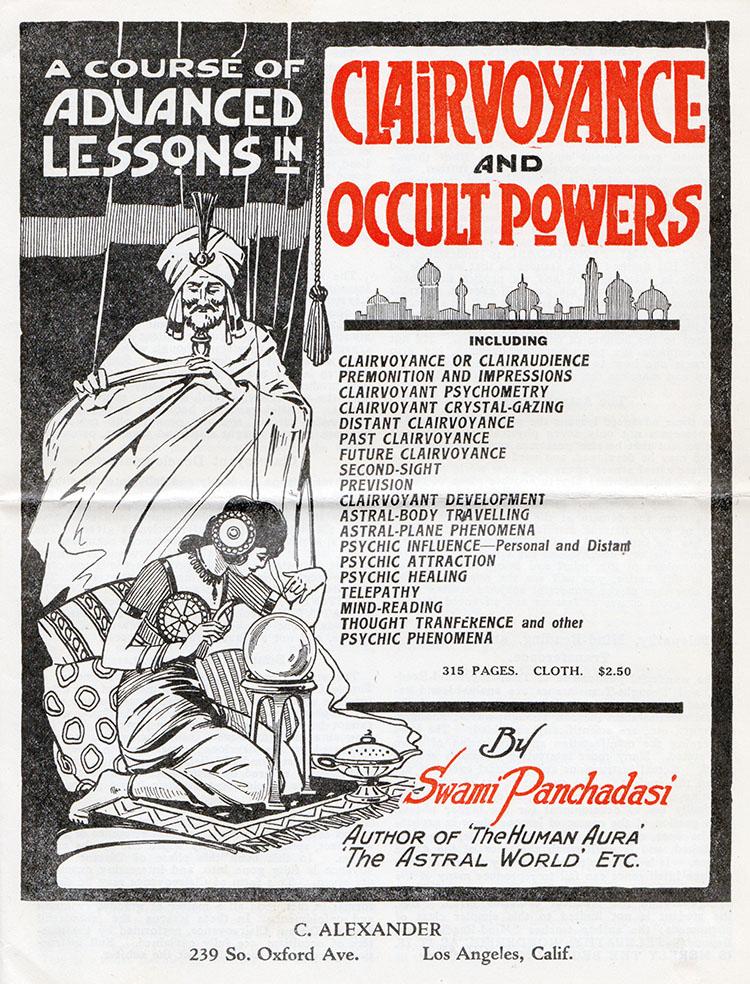
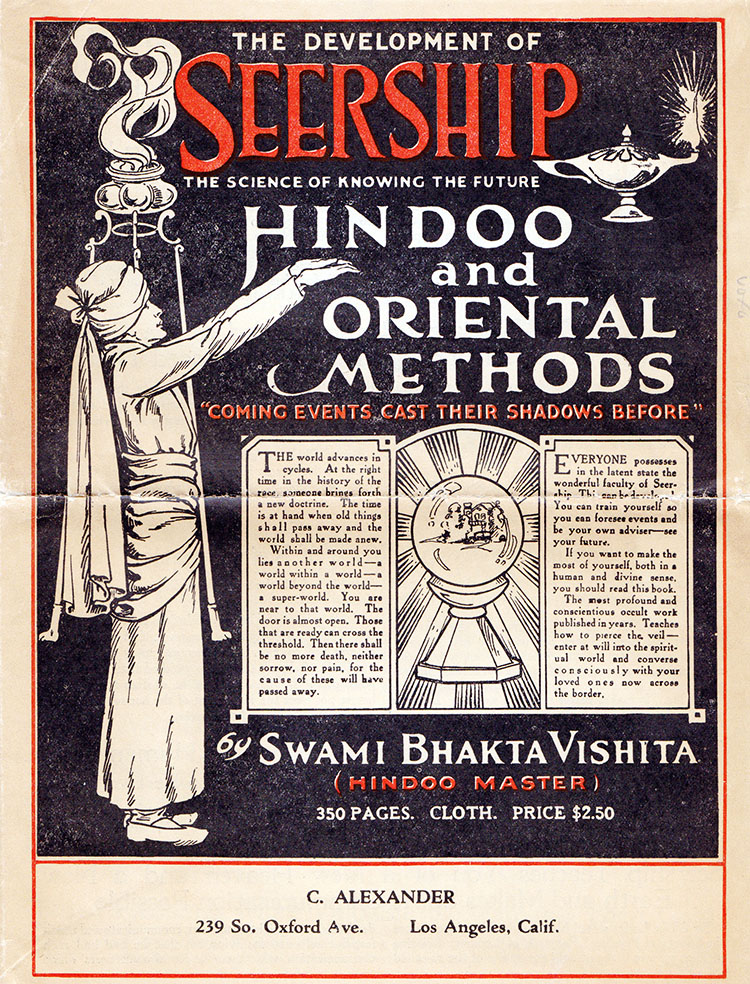
    As Swami Panchadasi and Swami Bhakta Vishita, Atkinson wrote on subjects such as the human aura, the astral world, and the development of seership and psychic powers. Advertisements such as these appeared in various publications.

    It was also during this period in Chicago that Atkinson authored the bulk of about fifteen different books under a trio of new pseudonyms. As Swami Panchadasi and Swami Bhakta Vishita, Atkinson wrote on subjects such as the human aura, the astral world, and the development of seership and psychic powers. While Atkinson frequently wrote about the dangers of the occult leading its students astray, he just as often made sense of occult phenomena through his understanding of the mind and its powers, and there is evidence that he worked with a crystal ball. The French-sounding pen name Theron Q. Dumont was used for more everyday application of mental powers: salesmanship, reading character, the development of memory, and increasing personal magnetism.

    Atkinson, ever the optimist, could find the good in other New Thought figures and often supported them by giving guest lectures for their organisations. He did the same at regional and national gatherings of the International New Thought Alliance until he chafed at the increasing “churchianity” of the organisation. 

    At their 1916 annual meeting in Chicago, the International New Thought Alliance appointed a committee of “leading New Thought workers” to consider drafting a formal declaration of principles to be shared the following year in Saint Louis. While everyone else dutifully wrote affirmative creeds and eloquent statements of belief, William Walker Atkinson gave four terse and sharp paragraphs. According to him, New Thought could not be organised or set to fixed principles, rather New Thought “takes its own wherever it finds it” and “all attempts to… institutionalise it result merely in dwarfing and stultifying it.” Unsurprisingly, the statement went over poorly and caused others to either critique Atkinson or apologise on his behalf. 

    Advertisement for advanced lessons in occultism by Swami Panchadasi (William Walker Atkinson).

    In 1922, Atkinson temporarily located to Detroit and published the twelve-volume Personal Power series of books with Edward Beals, largely a recapitulation of the main themes from Atkinson’s writing during the preceding two decades. From Detroit, Atkinson and his wife moved to Los Angeles where they remained until his death a decade later. Although age began to catch up with William Walker Atkinson during this time and his pace declined, he still gave regular lectures to New Thought congregations and lessons to small classes. 

    Atkinson only made sporadic efforts to publish his own work during the early part of his writing career and seemed to prefer leaving the business side of publishing for others to handle. While this decision left him and his heirs open to exploitation, and certainly cost him vast sums of money, it could also be seen as a reflection of his New Thought philosophy. Perhaps like his friend and mentor Helen Wilmans, Atkinson not only believed in the existence of a limitless potential supply of money and opportunity but regarded concern about money, even at the simple level of planning ahead for it in the future, to be erroneous and detrimental. For someone as prolific as Atkinson during the first decades of his career, this would have been a tenable strategy. But as his age increased and his health declined in the 1920s, it was no longer possible for him to write as he once did, and he only managed to produce a pair of unpublished manuscripts during the latter years of his life, The Seven Cosmic Laws and a primer on Theosophy. 

    In a tragic irony for the author whose words inspired so many to believe they could attain success and prosperity when William Walker Atkinson died in November of 1932 his family needed to borrow money for the funeral and burial.

    Get the issue this article appears in

    “The Other Side of Life”

    In one of his books written under the name Yogi Ramacharaka, Atkinson told his readers “that which we call death is but the other side of life.” There was no better example of this statement than his own life and legacy. After Atkinson’s physical death, his works took on remarkable lives of their own.

    William Walker Atkinson was deeply suspicious of any institution or system that would limit the freedom of the individual seeker. He was similarly distrustful of teachers who positioned themselves before the public as unquestionable authorities or objects of devotion. In his writings, Atkinson constantly counselled readers to test his teachings in their own lives, take what was useful for them, and discard what was not. In his career, Atkinson never made any serious efforts to establish his own church or institution like so many of his peers, preferring to simply write, lecture, and hold classes with small groups of students.

    These decisions, along with his liberal use of pseudonyms, profoundly affected Atkinson’s legacy. Paradoxically, they allowed for his ideas to spread widely around the world and become enormously influential in various realms, while at the same time obscuring William Walker Atkinson as their creator. 

    Even before Atkinson wrote the last of the Yogi Ramacharaka books in 1912, they began to be translated into numerous languages and disseminate around the world. Japan was particularly receptive to the works of Yogi Ramacharaka as it was in the midst of massive interest in mental healing and had recently endured a large epidemic of tuberculosis. Books like the Science of Breath and concepts like prana were translated into Japanese, finding their way into the healing system of Reiki and the work of the influential positive thinking guru Nakamura Tempu who claimed to have studied with Yogi Ramacharaka in India.

    Translations of the Yogi Ramacharaka books into Russian quickly became influential among artists and the intelligentsia, and were an important part of Konstantin Stanislavsky’s acting system which in turn influenced Lee Strasberg who trained generations of the most accomplished and celebrated actors in the United States with his ‘Method’ techniques. One young woman in Latvia, influenced by one of the Yogi Ramacharaka books translated into Russian, was Eugenie V. Peterson who would later travel to India and study with T. Krishnamacharaya. As Indra Devi, she became one of the most influential and well-travelled promulgators of yoga in the twentieth century. 

    During the interwar decades of the 1920s and 1930s, dozens of South Asian immigrants in the United States took up the profession of travelling yoga teacher and lectured to tens of thousands of people across the country after the American government declared them ineligible for citizenship. These newly-minted swamis and gurus found sets of yogic exercises and lessons lying in wait within the Yogi Ramacharaka books. In a confusing reversal, they presented the work of the American lawyer as ancient Indian wisdom to their audiences, some going so far as to sell, and even autograph, copies of the Ramacharaka books to their students.

    In the decades following his death, Atkinson’s books under his own name and several of his pseudonyms were widely distributed and republished by numerous mail-order companies. Bruce King – the man widely credited with popularising astrology under the moniker ‘Zolar’ – filled the pages of his official magazines Astrology and Horoscope during the late-Fifties to mid-Sixties with uncredited excerpts from Atkinson’s books while advertising several titles by Atkinson and Swami Panchadasi for sale directly from Zolar’s New York headquarters.

    By far, Atkinson’s most influential work was The Kybalion. The clear writing and organisation of The Kybalion made it accessible to a wide readership. The vague penname authorship by the “Three Initiates,” the name and location of the publisher (The Yogi Publication Society in the Masonic Temple Building of Chicago), and its claims to ancient Hermetic wisdom, gave the book an air of mystery and intrigue that allowed for endless speculation and for a diverse range of groups to see it as their own. 

    The hand of The Kybalion can be seen in the writings of Norman Vincent Peale, the author of The Power of Positive Thinking, and one of the key popularisers of positive thinking and the Prosperity Gospel, which holds for many Christians that God’s will is that they be physically healthy and financially well off. A 1995 article found that Peale likely took many central ideas for his best-selling work from The Kybalion, and did so by way of the metaphysical author Florence Scovel Shinn, citing among other things parallel uses of terms like “law” and “vibration” in Peale’s work and The Kybalion.2 

    William Walker Atkinson took on a new life in the late-Sixties as his books were widely rediscovered and his ideas became part of the spiritual backdrop of the era. For many Hippies who discovered yoga, the thirteen titles by Yogi Ramacharaka were a reference library in waiting. So many people wrote to the Yogi Publication Society during this time desperate for more information on Yogi Ramacharaka that the publisher produced a fallacious stock response to answer them. According to one critic, the Yogi Ramacharaka books were one of the many sources mined by Carlos Castaneda, the anthropologist whose alleged encounters with the Yaqui teacher Don Juan turned on innumerable Hippies to shamanism and ideas of magical apprenticeship.3

    The Kybalion also resonated deeply with Augustus Owsley Stanley, who mass-produced millions of doses of LSD, helped engineer the sound of the Grateful Dead, and was perhaps more responsible for the Hippie Counterculture of the 1960s than anyone else. Stanley described Atkinson’s book of Hermetic wisdom as “perfect… because it put into context all the things I had experienced on acid… Everything is connected, because it’s all being created by this one consciousness.”4

    As times changed, Atkinson’s Kybalion continued to have remarkable staying power with a wide array of seekers and aspirants. Many African American thinkers took the Egyptian origins of Hermes Trismegistus described in The Kybalion and cast it as distinctly African wisdom, using the seven Hermetic principles in works of fine art, literature, self-help, psychology, family therapy, and even bounty hunting. 

    Pagans, Wiccans, and other products of the modern revival of witchcraft also drew from The Kybalion. Figures like Laurie Cabot claimed that “the seven Hermetic Laws (were) the basis of Witchcraft.”5 One newspaper in 1989 began a multi-part series titled “Understanding the New Age” by elucidating The Kybalion’s teaching as “the basis of all esoteric principles,” and that Atkinson’s “little volume” served as an introductory and foundational text for a variety of occult groups and Freemasons.

    Some of the most striking examples of just how prolific and influential Atkinson was, and also how overlooked and under appreciated he is, come from cases in which people were influenced by several of Atkinson’s pseudonymous works without realising they came from the same hand. 

    The same overlap occurred in 2006 with the sudden and massive success of Rhonda Byrne’s self-help film turned book The Secret, which went on to sell over thirty million copies in over fifty languages and became a major cultural moment as it was feted and endorsed by Oprah Winfrey and other celebrities. While some critics and observers noted that The Secret was not much more than a repackaging of New Thought ideas, those familiar with the work of William Walker Atkinson would have seen his unspoken influence, both directly and indirectly, in Byrne’s creation through allusions to Hermetic wisdom and the constant use of “The Law of Attraction,” which Atkinson articulated over a century earlier.

    It was a testament to not only his influence but how fresh and vital William Walker Atkinson’s work has remained over time. For another author to be used and forgotten after such a prolific career would seem an insult. But for Atkinson – someone who valued placing constructive ideas into the world over constructing his own prestige and always encouraging others to use what worked for them as they found it – it was entirely fitting.

    [alert type=”general” dismiss=”no”]This article was published in New Dawn Special Issue Vol 13 No 5.[/alert]

    [alert type=”success” dismiss=”no”]If you appreciate this article, please consider subscribing to help maintain this website.[/alert]

    Footnotes

    1. From The Art and Practice of the Occult by Ophiel, Peach Publication Company, 1969
    2. “Peale’s Secret Source” by George D. Exoo and John Gregory Tweed, Lutheran Quarterly, 1995
    3. See Castaneda’s Journal: The Power and the Allegory by Richard de Mille, Capra Press, 1976
    4. “Owsley Stanley: The King of LSD” by Robert Greenfield, Rolling Stone, 2007
    5. The Power of the Witch by Laurie Cabot with Tom Cowan, Delacorte Press, 1989

    © New Dawn Magazine and the respective author.
    For our reproduction notice, click here.
  • The Strange Connection Between Science & the Occult

    The Strange Connection Between Science & the Occult

    From New Dawn 170 (Sept-Oct 2018)

    We like to think that modern science has developed as a result of rational enquiry; however, the history of science is littered with tales of bizarre experiments, eccentric characters and peculiar coincidences. 

    Many of the influential scientists responsible for the birth of modern science were not the conventional rationalists that they are often portrayed as. Although their discoveries are the result of complex mathematical workings and meticulous scientific experimentation, many of them were also heavily immersed in the esoteric world of the occult and pursued the mystical practices of alchemy, astrology and magic. 

    While the orthodox scientific community has denounced these practices as nonsensical pseudoscience, they are incredibly significant in the history of modern science. 

    This article examines three scientists who made exceptional contributions in their fields including the occult, showing the unusual and forgotten ideas that guided the course of scientific enquiry. 

    Sir Isaac Newton and the Philosopher’s Stone

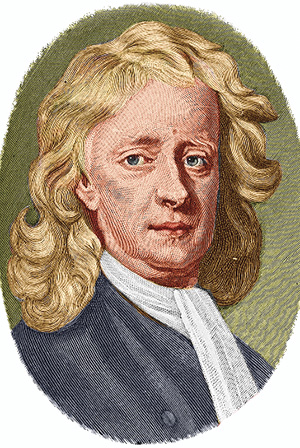
    Sir Isaac Newton is recognised as one of the most influential scientists to have ever lived and was a crucial figure in the scientific revolution during the Enlightenment period. Born in 1643, Newton is credited for developing the laws of modern physics; however, he also made discoveries in mathematics, optics, and other scientific disciplines. 

    Sir Isaac Newton, colourised engraving after Enoch Seeman’s 1726 portrait of Newton.

    His momentous book, Principia, brought him to international fame when published in 1687 and distinguished him as one of the most important scientific figures of the Renaissance. The manuscript contains information on the elementary principles of modern physics, such as the laws of motion and the theory of gravity. Newton is also credited for developing essential concepts of modern calculus, demonstrating his prodigal influence within both science and mathematics. 

    Newton’s historical legacy has come to symbolise the power of the scientific method in the development of Western civilisation, but many people are unaware that Newton was not a conventional scientist. He was a very curious individual who dabbled in the peculiar and unusual world of the occult, a realm antithetical to the narrow rationalism of science. In fact, after purchasing Newton’s manuscripts and studying his works, economist John Maynard Keynes famously stated that “Newton was not the first of the age of reason, he was the last of the magicians.”1

    An area of the occult that Newton extensively studied was alchemy. Alchemy was the medieval forerunner to chemistry and outwardly concerned the transmutation of base metals into gold and the discovery of a universal elixir that would bless its creator with immortality. Grounded in the discipline of hermeticism, alchemy was not only a method of chemical transmutation but also a spiritual practice by which the alchemist sought to purify their body and soul. 

    Since chemistry was in its infancy during Newton’s lifetime, many of his studies in chemical science contained language more typically associated with occultism than modern science. Unfortunately, a laboratory fire caused by his dog may have destroyed most of his works, and therefore our understanding of how much he knew about alchemy is somewhat limited. 

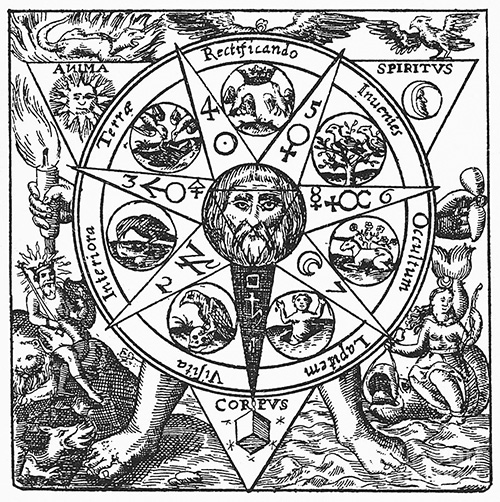
    Alchemical drawing rich in symbolism and hidden meaning.

    Existing works suggest Newton was heavily immersed in the hermetic discipline and his primary objective was to discover the philosopher’s stone, a mysterious substance that supposedly had the power to turn base metals into gold. The stone was central to the imagery of medieval hermetic philosophy and symbolised man’s attainment of spiritual perfection. 

    Newton’s writings suggest that he was interested in this mystical object and undertook many experiments to uncover its chemical composition. He also believed that ‘Diana’s Tree’, an alchemical process that produces a dendritic ‘growth’ of crystallised silver from a silver-nitrate solution, proved that metal “possessed a sort of life.”2

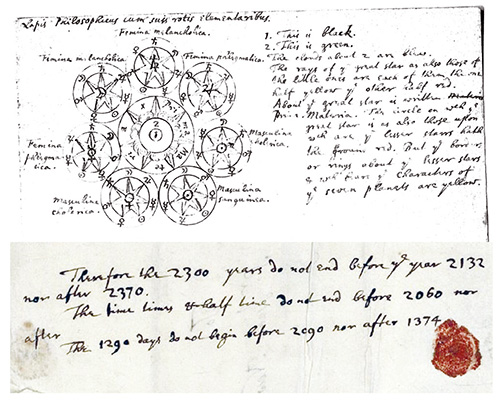
    Newton was not only interested in alchemy. He also believed the Bible contained hidden information about a future apocalypse. Unpublished documents, evidently written by Newton, indicate he thought the world would end by the year 2060 AD based on a series of mathematical calculations. It has been suggested the apocalypse he was talking about was a transformative stage in mankind’s spiritual evolution in which the human race would achieve a higher state of transcendental consciousness; however, this is mostly scholarly conjecture. 

    The original documents written by Newton are currently stored at the Jewish National and University Library in Jerusalem. It appears that they were written for personal use since Newton personally disliked date-specific biblical prophecies. This would make sense considering he provided no actual date as to when the world would end, merely predicting it would happen before the year 2060. Newton’s reasoning behind this particular date cannot be considered in cultural and historical isolation. It must be understood in the context of his antitrinitarian beliefs and Protestant views on the Papacy. His writings suggest he relied on the specific chronology of events described in the Bible, as well as the ominous prophecies described in the Book of Revelation, to calculate the date. The religious basis for his calculations is evident when he writes:

    Top:  Diagram of the Philosopher’s Stone drawn by Sir Isaac Newton, from his “Lapis Philosphicus.” Above:  Section  of the letter written by Newton where he predicts the world would end by 2060.

    “So then the time times & half a time are 42 months or 1260 days or three years & an half, recconing twelve months to a yeare & 30 days to a month as was done in the Calendar of the primitive year. And the days of short lived Beasts being put for the years of lived [sic for ‘long lived’] kingdoms, the period of 1260 days, if dated from the complete conquest of the three kings A.C. 800, will end A.C. 2060.”3

    As one can see, Newton was of the belief that biblical scripture contained encrypted knowledge about the future of humankind’s destiny; he carefully studied the chronological dates and events described in the Bible and performed complex mathematical calculations to determine the date of the apocalypse. Although he made various predictions during his lifetime, he was certain that a global cataclysm would destroy Earth before the year 2060 based on his interpretation of the Bible. 

    Although Newton’s legacy has become associated with the development of modern science, he was deeply immersed in the esoteric practices of alchemy, hermeticism and biblical prophecy. While modern science denounces these practices as irrational and absurd, Newton’s interest in the occult suggests they played a more significant role in the history of scientific enquiry than we have been led to believe. 

    Galileo and the Art of Astrology

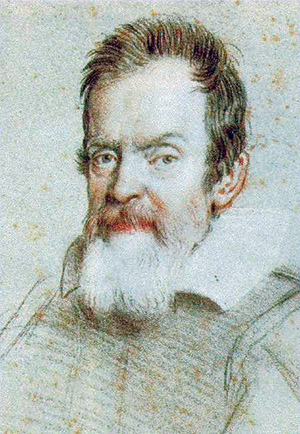
    Galileo Galilei was a mathematician, astronomer, physician and engineer during the Italian Renaissance; he is considered to have been a central figure in the transition from natural philosophy to modern science. 

    Galileo Galilei (1564–1642)

    Born in 1564, Galileo made a number of breakthrough discoveries in mathematics, optics and astronomy. In 1609, he heard about the invention of the spyglass, a device that made objects in the distance appear closer, and used mathematical knowledge to design the first working telescope. Galileo then made his first astronomical discovery when he cast the lens of his new invention upon the surface of the moon. He was also the first astronomer to observe the four moons of Jupiter, track the planetary phases of Jupiter and detect sunspots on the Sun. 

    Galileo faced fierce opposition from the Roman Inquisition since his writings promoted a heliocentric view of the universe in which the Earth rotates around the Sun. The Inquisition believed that this fundamentally questioned man’s central place within the cosmos and sentenced him on the grounds of heresy, resulting in indefinite imprisonment until his death in 1642. Ever since Galileo has become known as one of the most influential scientists to have ever lived. However, many people are unaware that he had an interest in mysticism and hermeticism as well as the mysterious world of the occult.4

    Like many scientists during the Italian Renaissance, Galileo was well practiced in the art of astrology. Although the idea of astronomers practising astrology seems alien to us in the modern age, during the Renaissance period many early scientists believed that the position of planets and stars influenced man’s destiny. In fact, it has been suggested that scepticism towards astrology only emerged during the Enlightenment period, when scientists like Rene Descartes emphasised the importance of scientific doubt. Before then, astrological beliefs were deeply embedded across European culture, and members of the aristocracy relied on its predictive power to make important political and economic decisions. 

    The Medici Family, who ruled over Florence during the 15th century, would often appoint astronomers to interpret their horoscopes. When Galileo discovered the four moons of Jupiter in 1609, he told the Medici Family that fate had reserved the planetary objects for them so each of the family’s four sons would have one to their name. In fact, when Galileo revealed knowledge of the discovery in his book, Sidereus Nuncius, he decided to name them “Medici Sidera,” meaning the Medician Stars.” When the Roman Catholic Prelate, Piero Dini, questioned how he could be so certain of the connection, Galileo replied in a letter arguing that the discovery of Jupiter’s four moons were inextricably connected with the family’s rising political and economic influence. Galileo also talks about how smaller planets might affect our destiny in ways that we are unaware and distinguishes between superior and inferior causes of planetary influence, writing:

    “If therefore, of the inferior causes, those which arouse boldness of heart are diametrically contrary to those which inspire intellectual speculation, it is also most reasonable that the superior causes (if indeed they operate on us) be utterly different from those on which courage and the speculative faculty depend; and if the stars do operate and influence principally by their light, perchance it might be possible with some probable conjecture to deduce courage and boldness of heart from very large and vehement stars, and acuteness and perspicacity of wit from the thinnest and almost invisible lights.”5

    It is easy to view Galileo’s interest in astrology as the result of social and historical circumstances. While it is undoubtedly true that astrological practice was common among the scientific elite during the Renaissance period, particularly among the aristocracy of Italian society, his writings suggest a sincere belief in the idea that planets and stars influenced humankind’s destiny. Moreover, there is evidence to indicate that he not only produced astrological readings for the Italian aristocracy but his close family as well, suggesting a personal belief in its predictive powers. 

    Although Galileo has come to symbolise the power of modern science to enhance our understanding of the cosmos and our place within it, many people forget he was deeply engaged in the mystical practice of astrology and its power to predict the economic, social and political destinies of people’s lives. Although many scientists denounce astrology as pseudoscience, there is no denying that it played an interesting and significant role in the history and development of science, particularly in regards to Galileo’s life. 

    Paracelsus and the Hermetic Tradition

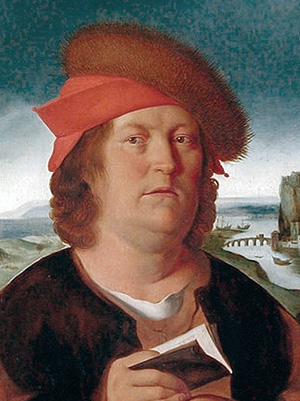
    Paracelsus, or Theophrastus von Hohenheim, was a Swiss-born physician, alchemist and astrologer. Born in 1493, Paracelsus was an influential figure in the ‘medical revolution’ during the German Renaissance and emphasised the importance of experimentation in medical science. He has been labelled the ‘father of toxicology’, one of his most notable phrases being, “The dose makes the poison.” 

    Paracelsus (1493–1541)

    Paracelsus was also one of the first people to suggest that physicians should receive an education in the natural sciences and study the basic principles of chemistry as part of their schooling. Interestingly, he is credited with giving the element ‘zinc’ its name as well as inventing chemical therapy, chemical urinalysis and early theories of digestion. 

    While the medical establishment opposed many of his ideas at the time, particularly his views on medical education, he is currently recognised as one of the most influential figures in the history of medicine. His discoveries contributed significantly to the development of natural science and transformed our understanding of chemistry and its application in relation to medicine. Saying this, however, many forget that Paracelsus was  immersed in hermetic philosophy and the mysterious world of the occult.6

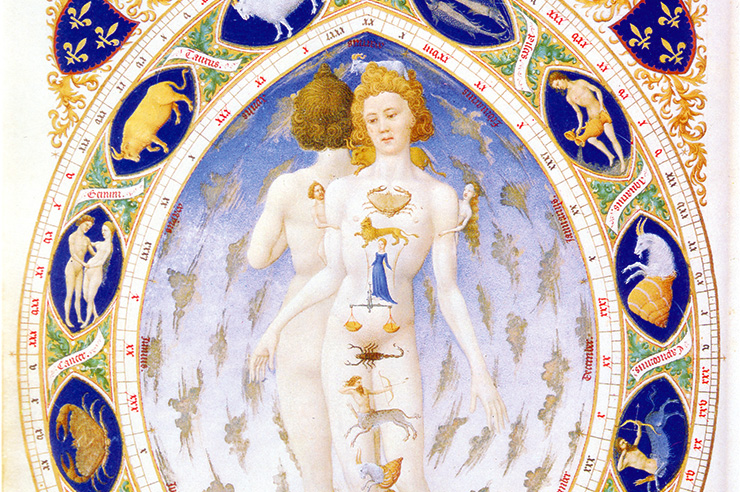
    Paracelsus had a profound interest in astrology, the art of prediction based on the position of stars and planets. Since medicine and astrology were closely connected during Paracelsus’s lifetime, he believed in the commonly held notion that each part of the body corresponds with a specific planet or zodiac sign, and therefore medical procedures should be undertaken according to the position of the solar system to ensure their effectiveness. 

    He also believed in the hermetic idea there are two worlds: the microcosm (which refers to the world of man and Earth) and the macrocosm (which is the heavenly universe or the spiritual world) and that these two worlds interact and influence each other. He states that:

    “Know that there are two kinds of stars – the heavenly and the earthly, the stars of folly and the stars of wisdom. And just as there are two worlds, a Little World [the Microcosm, man] and a Great World [the Macrocosm, the Universe] and just as the little one rules over the great one, so the stars of the microcosm rule over and govern the Stars of heaven.”7

    There has been much discussion about the historical sources of Paracelsus’s known magical beliefs. The Archidoxis Magica, for example,was supposedly written by Paracelsus in 1561 and contains information on magical talismans that can be used to cure illness and disease. Many historians dispute that he produced the manuscript since none of his other works discuss the use of talismanic objects; however, it is possible that he may have acquired a sudden interest in their magical potential. 

    While the authorship of Archidoxis Magica remains subject to scholarly debate, there is no denying that mysticism deeply influenced Paracelsus; in particular the belief that each organ corresponds with a planet and precious metal, which is central to the philosophy of hermeticism. During the medieval period, the Sun was thought to rule over the heart and its corresponding metal was gold. The Moon ruled the brain and its metal was silver. Mercury ruled the lungs and its metal was silver or quicksilver. Venus ruled over the kidneys and its metal was copper. Mars ruled over the bladder and corresponded with Iron. Jupiter governed the liver and corresponded with Tin, and Saturn ruled over the spleen and its metal was lead. Therefore, one can see that Paracelsus believed in the hermetic idea of microcosm and the macrocosm; that the body corresponds with the structure of the cosmos and that both spheres must exist in a state of harmony for man to attain earthly and spiritual perfection. 

    Saying this, however, Paracelsus was not a determinist astrologer and believed that while the planets and stars could influence human destiny, we still have some degree of free will, writing: 

    “Even if he is a child of Saturn and if Saturn has overshadowed his birth, he can still escape Saturn’s influence, he can master Saturn and become a child of the Sun.”8

    The life of Paracelsus highlights the blurred line between science and mysticism that secretly guided the history of modern science. Although he is credited with scientific innovations such as urinalysis, toxicology and chemical therapy, Paracelsus had a serious interest in the practices of astrology, alchemy and hermeticism. There is much scholarly debate regarding which manuscripts can be attributed to Paracelsus, but the evidence clearly suggests he was not a conventional scientist; he was an inquisitive mind, deeply immersed in the occult. 

    Get the issue this article appears in

    Conclusion

    The distinction between the occult and science has not always been as clear-cut as many of us like to think it is. Many of the influential scientists that we have come to associate with the birth of modern science were clearly involved in the study and practice of alchemy, astrology and biblical prophecy. Moreover, it would appear that many of these scientists believed in the power of these practices while simultaneously recognising the importance of scientific inquiry. 

    Galileo was a key figure in the transition from natural science to the scientific revolution, however, he also believed that planetary bodies could influence the destiny of humanity. Similarly, Newton used complex mathematical principles to outline his theory of gravity but also turned to biblical prophecy to predict the end of the world. Paracelsus made a number of discoveries in chemical science but also believed in hermeticism. 

    It is easy for modern science to portray its historical development as linear and coherent, but many of the individuals responsible for humanity’s greatest scientific achievements were inquisitive minds fascinated by the mysterious, peculiar and esoteric world of the occult.

    [alert type=”general” dismiss=”no”]This article was published in New Dawn 170.[/alert]

    [alert type=”success” dismiss=”no”]If you appreciate this article, please consider subscribing to help maintain this website.[/alert]

    Footnotes

    1. John Maynard Keynes (1946), ‘Newton, the Man’ [online] available at http://phys.columbia.edu/~millis/3003Spring2016/Supplementary/John%20Maynard%20Keynes_%20%22Newton,%20the%20Man%22.pdf
    2. Wikipedia (2018), Isaac Newton’s occult studies [online] available at https://en.wikipedia.org/wiki/Isaac_Newton%27s_occult_studies 
    3. Ken Ludden (2012), Mystic Apprentice Master Volume with Dictionary, lulu.com, page 413
    4. Britannica, Galileo: Italian Philosopher, Astronomer and Mathematician [online] available at www.britannica.com/biography/Galileo-Galilei 
    5. Nick Kollerstrom (2004), Galileo’s Astrology, skyscript.co.uk [online] (available) www.skyscript.co.uk/galast.html
    6. Wikipedia (2018), Paracelsus [online] available at https://en.wikipedia.org/wiki/Paracelsus 
    7. Nicholas Campion (2009), A History of Western Astrology Volume II: The Medieval and Modern Worlds, Bloomsbury, page 117
    8. www.renaissanceastrology.com/paracelsus.html

    © New Dawn Magazine and the respective author.
    For our reproduction notice, click here.
  • The Gnostic Revolt Against the God of the Old Testament

    The Gnostic Revolt Against the God of the Old Testament

    From New Dawn 98 (Sept-Oct 2006)

    They teach the insidious doctrine that there is another God besides the Creator.
    – Irenaeus, Against Heresies

    For many heretics have said that the God Of the Old Testament is one, and the God of the New Testament is another.
    – Ambrose, On the Holy Spirit, I, 4

    Gnostics attributed the work of creation to a lesser deity or demi­urge known as Ialdabaoth (also spelled Yaldabaoth or Jaldabaoth), but the notion of the demiurge was not a Gnostic invention. Nearly five hundred years before Christianity, Plato described a similar Creation scheme in his Timaeus. In fact, as we know from a number of pagan theogonies that have come down to us, the same formula existed throughout the ancient world.1

    The story goes something like this: In the beginning the unknowable and self-begotten first principle emerges from watery chaos and gives birth to the gods. This primal being first cleaves in two, and then consorts with itself, thus producing the next divine pair. And so it goes. Each successive generation of gods gives rise to the next until the full pantheon emerges. At some point the cosmic clock begins to tick. The various responsibilities attending Creation are delegated, after which heaven and the earth are formed along with the stars, day and night, and the elements air, fire, and earth. Very late in the game living things appear, including, almost as an afterthought, the human race.

    This grand Creation scheme was, with many variations, almost uni­versal throughout the ancient world – and this includes the Greeks, despite that remarkable flowering of speculation about man, God, and the universe known as Greek philosophy. Most of the Greek philoso­phers, of course, were monotheists. Yet, with some exceptions, they managed to coexist with polytheism. The great thinkers were not fooled. They understood that mythology was to be taken figuratively, not literally. The purpose of philosophy was to delve deeper – and the true foundation was obviously monotheism. The gods of Olympus were entirely derivative.

    The Gnostic Ialdabaoth has been translated as “begetter of Sabaoth,” which seems to have been a pejorative pun for YHWH Sabaoth, one of the names of Yahweh in the Old Testament. The demiurge, of course, was wholly foreign to Judaism. Whereas the monotheistic Greek philosophers often tolerated a proliferation of lesser deities, Judaism insisted on a single entity: Yahweh. By some accounts he was attended by a council of angels, but Yahweh remained the prime mover; he alone was responsible for Creation. Even today this remains one of Judaism’s distinguishing features.

    Origins Within Judaism

    Most scholars regard the demiurge as a Gnostic rebellion against Judaism.2 This may well be so, but it is important to realise that the demiurge was not a simple phenomenon. The rebellion involved a devaluation of the God of the Old Testament, which is partially explained by historical events – namely, the three failed Jewish revolts against Roman rule. The first and best known of these was the Jewish War of 66-73 CE. A second less well-known uprising was put down in 115-117 CE, during the rule of Trajan, and a third and final insurrection, the Bar Kokhba rebellion, was crushed in 135 CE.3 There is no doubt that these failed political revolts against Rome seriously undermined the prestige of Yahweh. And for this reason the inception of the Gnostic demiurge might date to as early as the period after 70 CE, the year of the cataclysmic destruction of the famous temple of Herod.

    But political history does not tell the full story. The devaluation of Yahweh was also rooted in a process of religious reform that had been underway within Judaism for centuries, and which only attained its full fruition in the person of Jesus. To understand this reform, and how it came about, we must look to the Old Testament, in particular, to the seminal book of Job. (Many scholars have sought answers in Genesis, which is understandable, given that the demiurge is associated with Creation, but with less satisfactory results.)

    Most Christians probably assume that the God of the Hebrews in the days of Abraham was the same as the God of Moses and, furthermore, that this God was also equivalent to the Father mentioned by Jesus with such love and devotion. Any such assumptions are false, however, but not because God changed. God’s nature, being absolute and eternal, never changes. What does change is human understanding. The human conception of God, the God concept, has changed many times over the course of history and will continue to evolve in the future. In a famous essay called “The God of the Fathers,” first published in 1929, the Old Testament scholar Albrecht Alt explored whether such a transformation had occurred at the time of Moses. Alt found clues in the Pentateuch suggesting that the Elohist scribe had amended the earliest accounts to bring the more archaic God-concept of the early Hebrews, the God of the patriarchs, in line with the later (and more pure) monotheism of Moses.4 Alt’s paper touched off a lively debate among biblical scholars that continues to this day.

    The reform that we are about to discuss is another example of the sort of evolution observed by Alt. The need for reform of the Old Testament God-concept was real enough. While some Old Testament passages describe Yahweh as merciful, loyal, forgiving, and benevolent, he is at least as often portrayed as jealous, grouchy, wrathful, irritable, proud, boastful, unforgiving, temperamental, cruel, vengeful, and even bloodthirsty, prepared to sanction cold-blooded murder or mass slaughter, including the annihilation of entire cities. Given the numerous examples of God-sanctioned mayhem in scripture, it is no wonder that discriminating readers have sometimes doubted whether this same Yahweh can inspire our confidence and trust, to say nothing of love, devotion, respect and emulation. Oftentimes, fear and trembling seems a more likely human response. And while fear of divine retribution can be a powerful force for good, and, at times, perhaps, a necessary motivator, if the goal is to uplift humanity from a moral standpoint, the example set by Yahweh in the Old Testament falls short of inspirational (to say the least).

    The Book of Job

    The Old Testament Book of Job, whose author is unknown, has two main themes: the question of evil, and the character of Yahweh. Many scholars rightly regard Job, along with Isaiah, Jeremiah, and Ezekiel, as representative of the high-water mark of the Old Testament.5 The central part of the book is a series of poems that was probably composed sometime in the fifth or sixth century BCE. Part folk tale, prophetic oracle, hymn, lamentation, didactic treatise, and epic, Job makes use of almost every genre in the Bible. The question it raises is no less pertinent today: Why does evil flourish while good people suffer? The answer the story provides broke sharply with Judaic tradition, and for this reason Job was surely controversial in its day. Tradition held that God would eventually reward the good man, regardless of his sufferings. Like the prophet Jeremiah, however (see Jeremiah 13:14, 24–25 and 15:6–7), the author of Job adopts a much more pessimistic outlook that probably reflects the bleak aftermath of the conquest and destruction of Judah by Nebuchadnezzar in the early sixth century BCE. Although the precise composition date of Job is not known, the book is obviously from the time of exile or later.6

    The story openly portrays Yahweh in league with Satan. God torments the good man (Job) despite the fact that he keeps the Law and lives a morally upright life. Job’s many trials are the work of Satan, Yahweh’s servant (or possibly his son), who whispers false accusations in God’s ear and receives permission to punish Job in order to test him and expose the wickedness allegedly concealed in his heart. Job’s flocks are stripped from him, his servants are slaughtered, and his sons and daughters are killed in a mighty whirlwind. He himself is stricken with a terrible wasting disease that causes great suffering and brings him to the edge of the grave. Job’s body literally becomes an open wound. To make matters worse, Job’s wife and his friends also turn against him: His wife urges him to curse Yahweh and to abandon all faith in God; meanwhile, his friends make superficial religious cant and castigate Job for having the temerity to maintain his innocence. One after another they admonish him, insisting that because Yahweh is punishing him, ipso facto, he must be guilty. They advise him to submit quietly to his sufferings, which obviously have been ordained by God. But Job will have none of it. Like a rock he holds fast to principle. Stubbornly he maintains his innocence and insists upon justice. Yet, at the same time, he remains faithful to Yahweh, refusing to condemn or even criticise the Almighty.

    What is shocking about the story is the ease with which Yahweh succumbs to Satan’s false witness about Job’s alleged faithlessness. Being omniscient, Yahweh should be able to easily verify Job’s goodness and constancy. But instead he hands Job over to Satan with a single proviso: “He is in your power,” Yahweh says. “But spare his life.” Though Job remains faithful throughout, before his terrible ordeal is done he curses the day of his birth. No less shocking is Yahweh’s failure to acquit Job even after his innocence has been established. There is to be no moment of truth and no justice under heaven. Instead of vanquishing Satan for making false accusations, Yahweh turns on the victim. Instead of offering solace and comfort to the innocent, he badgers Job and bullies him, sneers at him with rhetorical questions, and then confronts the hapless man with a mind-boggling display of divine wrath.

    In the end poor Job is beaten down and brought to his knees. But how can it be otherwise, given Yahweh’s overwhelming might? The rod of God is an awesome thing. In the end Job is reduced to a stuttering simpleton. He repents, even though he is innocent, and admits that he has been talking about things far beyond his ken. Having seen the omnipotence of Yahweh, he is prepared to eat dust. In this vein Job responds: “What reply can I give to you, I who carry no weight?” (Job 40:4; 42:2) In a final prose epilogue Yahweh shows a loving touch by restoring Job’s health and property, but there is no mention of restoring his dead servants and children. Indeed, the somewhat cheery conclusion feels out of step with the rest of the composition, as if a later scribe who was no less shocked than we by Yahweh’s repulsive behaviour added it to redeem God’s tarnished image. Indeed, so subversive is the Book of Job that it is remarkable the book was retained in the Bible. Probably the scribal “correction” saved it from being thrown out, this and the fact that Job is a literary masterpiece. Of course, even with its modified ending, the story is far from satisfactory. Job’s total submission in the face of brute force seems a lame solution to the problem of evil. Nonetheless, the book is momentous because the questions the story fails to resolve were to rebound over the centuries, as we shall see, and preoccupy the final books of the Old Testament.

    Yahweh’s Deficiency

    So what is the root of the matter in the story of Job? Carl Jung, the founder of analytical psychology, points out in his able commentary Answer to Job that for all of his infinite power Yahweh ultimately damns himself. By humiliating Job, by making him eat dust, God unwittingly reveals his own deep character flaw, brutishness, while at the same time elevating the impotent but righteous human. Job may be powerless before the Almighty, yet he remains free to choose, and by choosing well he shows impressive moral strength. Indeed, Job’s fortitude stands in marked contrast with Yahweh’s rage and reproaches the deity’s ratification of evil. To be sure, Yahweh carries the day. With infinite power at his disposal, the outcome is not in doubt. Yet, from a moral standpoint Yahweh’s display of heavenly fireworks and thunder fails to impress. This is the beautiful and terrible irony of the story: that Job, despite his relative impotence, comes to stand in righteous judgment over God himself. As Jung put it:

    We do not know whether Job realises this, but we do know from the numerous commentaries on Job that all succeeding ages have overlooked the fact that a kind of Moira… rules over Yahweh, causing him to give himself away so blatantly. Anyone can see how unwittingly he raises Job by humiliating him in the dust. By so doing he pronounces judgment on himself and gives man the moral satisfaction whose absence we [find] so painful in the Book of Job.7

    The word Moira refers to fate or destiny. In Greek religion Moira was one of the three personified seasons that accompanied Zeus, and were often pictured hovering just above his shoulder. The point is that Zeus was governed by them even though he was the most important Greek deity. The mere thought that such a thing might also hold in monotheistic Judaism is shocking. Surely the Godhead cannot be subject to fate. It is God, after all, who determines the destinies of others. Nonetheless, from the story it is clear that despite his omnipotence Yahweh is lacking in something. Job apparently intuits this because in his suffering he asks: “But tell me, where does Wisdom come from? Where is understanding to be found?” (Job 28:12) In the very next verse Job answers his own question. “Wisdom?” he says. “It is fear of the Lord.” Here, as Jung notes, Job shows that he is unaware of his own achievement. He does not seem to understand that in holding firm, standing on his innocence, and insisting on justice he has won a tremendous moral victory, not just for himself, but for all mankind. Job’s answer may seem unsatisfactory, but it is important because during the apocalyptic age it became the grist for the scribal mill, as we shall see.

    Now back to the problem raised by Jung, that Yahweh is ruled by fate: Even though Yahweh as God must have access to all knowledge, in the story of Job, as we have seen, he has neglected or forgotten, as Jung phrases it, “to consult his own omniscience.” It seems that Yahweh has been split off from a part of himself, which means that he is not fully conscious. Which is incredible! And what of his boasting? Indeed, what could possibly compel an all-powerful and all-knowing Being to stoop to bluster and threats in the first place? This discomfiting aspect of Yahweh’s behaviour, analysed long ago by the unknown author of the Secret Book of John, one of the Gnostic gospels found at Nag Hammadi, was the key Gnostic insight:

    …he [Yahweh] said to them, ‘I am a jealous God and there is no other god beside me.’ But by announcing this he indicated to the angels who attended to him that there exists another God, for if there were no other one, of whom would he be jealous?8

    Of whom, indeed? No scholar in the modern era has understood the theological question implicit in the Book of Job better than the Gnostic scribe of old. Nor has anyone stated it more succinctly. While the phrase “I am a jealous God…” does not appear in the text of Job, it is implied, and it does occur in Exodus 20:5 and Isaiah 14:5–6. In addition, numerous other passages in the Old Testament, eg., Deuteronomy 4:35; 6:15–16; and 32:19–21 and Isaiah 4:8; 44:6; 45:5, 21; and 46:4, convey a similar meaning. In fact, Yahweh’s jealous tantrums are a prominent feature of the Old Testament, running through scripture like the surly residue of the old Canaanite storm god, which is precisely the point. It is of interest that the famous heretic hunter Irenaeus, writing two generations before Hippolytus, quotes the very same line about the jealous Yahweh in his lengthy treatise, Against Heresies.9 Was it mere coincidence that Irenaeus devoted the largest portion of his five-volume opus to an attempted refutation of the Gnostic demiurge? Or was it an accurate indication of the historical importance of Yahweh’s character defect? There is no question that the controversy surrounding the demiurge was one of the major battle lines separating the Gnostics from orthodox Christianity.

    Let us now investigate why Yahweh would allow Satan’s experiment to be foisted on an innocent man. Jung was apparently intrigued by the same question, for he writes:

    It is indeed no edifying spectacle to see how quickly Yahweh abandons his faithful servant [Job] to the evil spirit and lets him fall without compunction or pity into the abyss of… suffering. From the human point of view, Yahweh’s behaviour is so revolting that one has to ask oneself whether there is not a deeper motive hidden behind it. Has Yahweh some secret resistance against Job? That would explain his yielding to Satan. But what does man possess that God does not have?10

    The psychologist goes on to suggest that Yahweh’s behaviour is driven by an ulterior concern, namely, the divine suspicion that our frail human consciousness is more keen than his own. The very idea is stunning! Consider, though, that driven by the ever-present knowledge of our own severe limitations as well as our relative impotence, we humans are required to cultivate consciousness simply to survive. We have little choice in the matter. Yahweh, on the other hand, has no such need for introspection because he is unchallenged, has no opposition, and encounters no obstacles; nothing requires him to reflect upon himself.

    Stranger still is the conclusion that follows from a related question: Why would Yahweh instruct Satan to spare Job’s life? Judging from Yahweh’s sadistic behaviour, the reason can have nothing to do with compassion. Yahweh is perfectly content to wreak mayhem on Job without regret or remorse. Nor can the reason involve a former loyalty, namely, the Mosaic covenant; for the Book of Job reflects the period following the destruction of the first temple, when the old covenant must have seemed a moot article. In fact, in Job there is not the slightest pretense of a covenant. Why then does Yahweh spare Job’s life? Is it possible that he likes having someone around to hear him boast? Does he enjoy having someone present to witness his thundering about heaven? Can it be that Yahweh actually needs Job? Quite probably he does, which would explain Jung’s purpose in mentioning Moira, the season of destiny.

    Here, an example from the Greeks may help. We know from the oldest extant account from Greek mythology, the Hymn of Demeter, that when Hades abducted Demeter’s beautiful daughter, Persephone, and took her to his realm of the dead, Demeter, the grain goddess, became so heartsick that she refused to extend her usual bounty upon the earth.11 Stricken by a year-long drought and resulting crop failures, humanity faced extreme privation, even mass starvation. In this dire circumstance mighty Zeus was compelled to intervene and arrange a compromise: Zeus ordained that henceforth Persephone would spend part of the year above ground with her mother, Demeter, and the rest below it with her new consort, Hades. And why would Zeus be concerned enough to intervene? Quite simply, something had to be done because a mass die-off of humanity would leave no human supplicants to perform the daily sacrifices and rituals in honour of the gods!12 Just as humankind needed the gods, so also did the Greek gods need humankind.

    In the story of Job we find hints of a similar phenomenon. Yahweh makes Job suffer, yes, but he dare not exterminate him because he needs a living and breathing Job to honour and glorify his divine name. It is Yahweh’s fate to require worship. Of course, the relationship between God and human is not between equals. An enormous gulf separates Yahweh from the puny and subservient Job. Nevertheless, it is a reciprocal relationship. Yahweh needs humans as much as humans need him. The deeper conclusion to which this leads is never openly stated in the Book of Job. But it is certainly implied, which explains why Job was (and remains) so controversial: If Yahweh is subject to fate and if he requires worship, how can he truly be the penultimate Godhead, the first without a second? Of course, he cannot. Yahweh as presented in Job is but a figurehead, a demiurge on a par with Zeus and the other pagan storm gods.

    Job’s query regarding Wisdom takes us to the heart of the matter, for Wisdom is the quality Yahweh lacks. The Greek word for her is Sophia. She is the Divine Mother, the feminine companion to God. She is well known in the East, where she is the active principle in the Godhead, with many names. In the various Hindu traditions she appears as Kali, Shakti, and Durga, among others. It is she who both manifests the world, sustains it, and transforms it. But, East or West, she is inseparable from the Godhead. In Judaism, however, awareness of her nature and importance was a late development. That it happened at all may have been due in no small part due to the anonymous scribe responsible for the Book of Job.

    The problem is how to reconcile her gentle and wise nature with the gruff and irritable Yahweh. The temperamental patriarch of old stubbornly resists the intrusion of her feminine presence. The Hebrew God prefers to stand alone, imperious in his majesty, bristling with archetypal wrath. Indeed, in his raging aspect Yahweh is almost the antithesis of Wisdom. It is no wonder that many of the Old Testament descriptions of Yahweh closely resemble the old Canaanite gods El and Baal, the raw matter for so much of his composite character.13 In the sixth century BCE these dross elements were still very much in evidence.

    The patriarchal storm God dies hard. Yet, change (i.e., evolve) God must, because from the moment the author of Job exposes Yahweh’s dark underside, his deficiency can no longer be ignored, neither on earth nor in heaven. Thus, we find her, Sophia, Wisdom, described in the eighth Proverb, where we are told that her presence is as old as Creation:

    The Lord possessed me in the beginning of his way,
    before his works of old.
    I was set up from everlasting, from the beginning,
    or ever the earth was.
    When there were no depths, I was brought forth;
    when there were no foundations abounding with water.
    When he established the heavens, I was there,
    When he marked out the foundations of the earth,
    then I was by him, as a master worksman,
    and I was daily in his delight,
    rejoicing always before him,
    rejoicing in his habitable earth;
    and my delights were with the sons of men.
    (Proverbs 8: 22–24, 27, 29–31)

    Parts of Proverbs are very old and may even date to the time of Solomon, but the chapters about Wisdom, including the ones cited above, were composed much later, although an exact date has never been established. Dating Proverbs has proved difficult. Jung interpreted the presence of Wisdom as evidence of Greek influence and dated the above passage to the third or fourth century BCE.14 While this has yet to be confirmed, there is no doubt about the very late date of a similar description of Wisdom in Ecclesiasticus 24:3–30:

    I came forth from the Most High,
    And I covered the earth like mist.
    I had my tent in the heights,
    and my throne in a pillar of cloud.
    Alone, I circled the vault of the sky,
    and I walked on the bottom of the deeps.
    Over the waves of the sea and over the whole earth,
    and over every people and nation I held sway.
    …From eternity, in the beginning, he created me,
    and for eternity I shall remain.

    Here she is the spirit of God who broods upon the waters in the moment of Creation. Thus, there is no doubt about her antiquity. Yet, Ecclesiasticus dates to no earlier than around 200 BCE. The description is meant to be taken retroactively, but the passage itself was a late addition to scripture, and is firm evidence of a process of reform of the Jewish God concept.

    The same theme also repeats in the Song of Songs, in Ecclesiastes, and again in the Book of Wisdom. All of these books are part of what is today known as the Wisdom literature. All were written after the time of Job, during the apocalyptic age, and all are heavily indebted to Job, again and again taking up themes that first appear in that book. For example, the preacher of Ecclesiastes 9:16-17 states: “Wisdom is better than might, but a poor man’s wisdom is never valued and his words are disregarded. The gentle words of the wise are heard above the shouts of a king of fools.” And in the Book of Wisdom 5:1–2 the scribe offers firm support for Job’s right to demand justice: “[T]he virtuous man stands up boldly to face those who have oppressed him, those who thought so little of his sufferings.”

    In the Wisdom literature we also learn more about the nature of the great feminine companion to the Deity. As it happens, she is a marvelous boon to mankind. Wisdom 10:17 waxes eloquent about her:

    To the saints she gave the wages of their labors;
    she led them by a marvelous road;
    she herself was their shelter by day
    and their starlight through the night.

    And in the Song of Songs, which pretends to be the composition of Solomon (but isn’t), we find details of the wondrous union, or syzygy, of both sides of God, male and female.

    The Wisdom Dialogue Continues

    In the centuries before Jesus, the scribal dialogue about Yahweh’s better half (his feminine side) was played out in the last books of the Old Testament. This was a positive and important development because it produced a deeper awareness of the sublime attributes of the Godhead. The process continued in the person of Jesus, who campaigned vigorously against every kind of superstitious nonsense, including society’s morally reprehensible treatment of lepers.15 At issue, time and again, was the old Judaic belief in a vindictive God. The affirmation of Wisdom by Jesus is evidenced also by his respectful treatment of women. That this new awareness of the Divine Mother was also absorbed into Gnostic Christianity is confirmed by the text of the Naassene Sermon, which was embedded en toto in the Refutation of Hippolytus. The Sermon quotes a hymn honouring the Mother as the companion to the Father: “From thee [comes] Father and through thee [comes] Mother, two names immortal, progenitors of Aeons…”16 (Refutation 5.6.5)

    We know from a lost scripture called the Gospel according to the Hebrews that Jesus made another extraordinary contribution to the Wisdom dialogue. Though this gospel was suppressed and thus did not survive, from the descriptions of early writers it seems that it closely followed the Gospel of Matthew, except that it was written in Hebrew or Aramaic instead of Greek; hence its name. The scripture was apparently so popular that it was referred to as the “fifth gospel.” Most important, it included the following key passage quoting Jesus, which was preserved (in two separate places) in the writings of Origen, and also in Saint Jerome: “Even now did my Mother the Holy Spirit take me by one of my hairs, and carry me away to the great Mountain of Tabor.”17 Here, the words of Jesus explicitly link the Holy Spirit with the Divine Mother; and virtually the same idea occurs in the Gospel of Thomas (Saying 101):

    [Jesus said,] Whoever does not hate his father and his mother as I do cannot become a disciple to Me. And whoever does [not] love his father and his mother as I do cannot become a [disciple] to Me. For my mother [gave me falsehood], but [my] true [Mother] gave me life.18

    The passage is also noteworthy for its use of the word life, a word specifically used by Jesus in reference to spiritual life. The idea that the Spirit (spiritual life) flows from the Divine Mother was unprecedented in Judaism, and thus was a momentous development in the West. But the idea had long been understood in the East. In the Hindu traditions the same Divine Mother who brings the world into existence and sustains it also makes available a very special form of her own divine Self: a divine grace that is the Eastern equivalent of the Holy Spirit. Hindus believe that by means of this extremely subtle energy, known as the Chitti Kundalini or the Shakti Kundalini, the Divine Mother brings about the dramatic reversal of the flow that leads to the heavenly source. Today, the living traditions of Hinduism describe this key concept of the reversal of the flow in almost exactly the same language used by Gnostics in the first centuries of Christianity. The only difference is that Hindus describe the “descent” of Spirit as an awakening from within. Either way, it is the decisive turning point in the spiritual life of the disciple.

    Get the issue this article appears in

    The Wisdom Dialogue Continues

    More than 1,900 years after the fact it is very difficult for us to comprehend the extent of the calamity that enveloped Judea during 66–73 CE, and again in 115 and 135 CE. From the riveting account of Josephus, the consequences must have been horrific, much worse than the damage wreaked by Nebuchadnezzar six centuries before. In the act of breaching the walls of Jerusalem and destroying the great temple, the Roman general Titus proved the prophecies of the apocalyptic age to be a colossal failure, indeed, a collective fantasy. Many Jews survived the siege, the famine, and the final battle only to be crucified. Tens of thousands of others were carried off into slavery, or were thrown to the lions in the great Coliseum of Rome. Traumatised by war, many Jews in its aftermath must have questioned their faith, including the darker attributes of Yahweh. In 1927 a scholar named A. Marmorstein found evidence of this in rabbinical texts.19 For Jews who had believed in the grand apocalyptic vision, there were only three possible options. According to scholar Robert Grant, they could rewrite the apocalypse and postpone history; they could explain the failed prognostications by trying to show that the sacred writings had been misinterpreted; or they could simply abandon their faith.20

    Little has been written about the war’s impact on the first Christian community of the Nazarenes. One scholar who did study the matter, S. G. F. Brandon, concluded that the impact was no less horrendous.21 The war scattered Jewish Christians far and wide. And if the followers of Jesus were as angry with their Jewish brothers as they were with the Romans, they had good reason: the zealots had hijacked Judaism and brought ruin upon the nation. For which reason Jewish Christians probably shared the conviction that if only more people had listened to Jesus, events might have turned out very differently. Anyone with an eye in his head, after all, could see that the zealots had been blind. The entire nation had been led off the cliff like a pack of lemmings. To think the fools had believed that Yahweh would come down out of the sky and destroy the Romans! Where was Yahweh? Was he sleeping? Or was something the matter with the national God concept?

    The scattered remnants of the original Jerusalem Church found it difficult to regroup. We know that Roman pursuit continued, and was intense.22 Eventually, Jewish Christian sects did emerge, including the Ebionites and Elchaisites, and held on in places like Alexandria. But Jews would never again dominate the Jesus movement. The war and the subsequent Jewish revolts had set in motion a great reshuffling of men and ideas, and out of the rubble emerged Gentile Christianity.

    So began a new phase of the Wisdom dialogue within the rich and diverse literature of Gnostic Christianity; and Alexandria was one of the primary cauldrons. Increasingly, the teachings of Jesus passed into Gentile hands. Probably for this reason, as time passed, there was less sympathy for Yahweh’s noisy tantrums, less tolerance for the residue of the old pagan storm god. There may also have been a feeling that the Wisdom literature did not go far enough. To many it probably seemed that events had completely discredited the Jewish God along with his people. Thus, the God of the Jews suffered the fate history has always accorded losers. Yahweh was demoted to the lesser status of a demiurge. To be sure, the Fathers of the Church vociferously resisted this trend. Irenaeus devoted much of his leaden prose, including the greatest portion of Against Heresies, to refuting the Gnostic “error.”23

    Notwithstanding the views of men like Irenaeus, the Gnostic repudiation of Yahweh was not apostasy. Indeed, to many Christians it must have seemed like an advance. Certainly the demotion of Yahweh was not the end of God or heaven. The Godhead, after all, had not changed. What had changed was the concept of God, which simply reconstituted itself in human understanding. Indeed, the sloughing off of the less desirable elements in Yahweh’s character surely helped many to clarify the nature of the Godhead, and thus was a positive development. Yahweh was rechristened Saklas, “the fool,” and Samael, “the blind.” Behind Yahweh, unseen by him, stood Wisdom (the Divine Mother, Sophia, Achamoth, the Ogdoad, Barbelo, and so forth), now recognised as the true boss. Yahweh was simply the hired man. Above Wisdom, indeed, over all, presided the incomprehensible Father about whom Jesus had spoken in such loving terms.24 It is interesting to note that although Wisdom was often ranked below the Father, their relationship was intimate: Wisdom was an integral part of the Godhead.

    The fate of the old Yahweh was not a happy one. Some of the more extreme Gnostics dealt harshly with him. In the Hypostasis of the Archons, one of the Gnostic scriptures found at Nag Hammadi, Ialdabaoth is cast down into dark Tartarus, the hellish realm beneath Hades where the Titans had been hurled after the defeat of Cronus.25

    Just as it is difficult for us moderns to understand the full measure of the destruction wreaked upon Judea by the Romans, so also it is difficult to apprehend the Gnostic resynthesis that occurred in the war’s aftermath, and why, especially from the perspective of places like Alexandria, that reform was so necessary.

    Reprinted with permission from ‘The Demiurge and the Wisdom Dialogue’, Chapter 8 of Mark Gaffney’s book Gnostic Secrets of the Naassenes: The Initiatory Teachings of the Last Supper, Inner Traditions, Bear & Co., Rochester, VT 05767, USA. Copyright 2004 by Mark H. Gaffney.

    [alert type=”general” dismiss=”no”]This article was published in New Dawn 98.[/alert]

    [alert type=”success” dismiss=”no”]If you appreciate this article, please consider subscribing to help maintain this website.[/alert]

    Footnotes

    1. For a detailed study of various Greek theogonies see M.L. West’s brilliant book, The Orphic Poems, Oxford, Clarendon Press, 1983; for a look at the Egyptian theogony see Robert Bauval and Adrian Gilbert, The Orion Mystery, New York, Crown Books, 1994; for a discussion of the Sumerian gods see Samuel Noah Kramer, The Sumerians, Chicago, University of Chicago Press, 1963, chapter 4.
    2. Most scholars have followed Hans Jonas, The Gnostic Religion, Boston, Beacon Press, 1958, pp. 92-93.
    3. For a good discussion see Yehoshafat Harkabi, The Bar Kokhba Syndrome, Chappaqua, NY, Rossel Books, 1983.
    4. Also see Albright, Yahweh and the Gods of Canaan, Garden City, NY, Doubleday, 1968, p. 168; also see Frank Moore Cross, Canaanite Myth and Hebrew Epic, Cambridge, Harvard University Press, 1973, pp. 3-75.
    5. For example, see Michael Grant, The History of Ancient Israel, New York, Scribners, 1984, p. 175.
    6. W.F. Albright noted the absence of references in Job to any of the prophetic books, and cited this as evidence that Job was composed before these books, i.e., in the seventh century BCE, or even earlier. Albright drew the same conclusion based on allusions in Job to Chaldea. But I take a very different view. Where Jeremiah criticises King and nation Job goes farther and critiques God himself, that is, the all male God concept that is pervasive even in the Books of Jeremiah and Isaiah. There was good reason for Job to stand apart! Allusions to Chaldea also point to a late (post-exilic) rather than an early date. The presence of the Son of Man in Ezekiel, Second Isaiah, and Job all points to a common eastern source. Albright, Yahweh and the Gods of Canaan, 1968, pp. 260-261.
    7. Carl G. Jung, Answer to Job, trans. by R.C. Hull, Princeton, NJ. Princeton University Press, 1958, p. 23.
    8. James M. Robinson, The Nag Hammadi Library, San Francisco, Harper and Row, 1977, p. 106.
    9. Irenaeus, Against Heresies, I, 29, 4; 30, 6.
    10. Jung, Answer to Job, p. 13.
    11. R. Gordon Wasson, Albert Hofman, and Carl A.P. Ruck, The Road to Eleusis, New York, Harcourt Brace, 1978, p. 59.
    12. Ibid, p. 67.
    13. Twentieth century archaeology established the prevalence of goddess worship in ancient Israeli folk religion. Which was in sharp contrast with the official state religion: the pure Yahwism of the temple priesthood. For some reason, although Yahweh assimilated to himself the various epithets and qualities of male Canaanite gods such as Baal and El, the same did not happen with the pagan goddess. Ephraim Stern, “Pagan Yahweism”, Biblical Archaeology Review, May-June 2001, p. 21. Also see Israel Finklestein and Neil Asher Silberman, The Bible Unearthed, New York, Free Press, 2001, pp. 241-241.
    14. According to W.F. Albright the eighth Proverb swarms with Canaanite words and expressions that refer to the pagan goddess. Albright dated it to as early as the seventh century BCE. Yet, as Albright notes, paeans to Wisdom can be found in the literature from Ugarit dating back well into the second millennium BCE. All of this is curious. If Wisdom entered into Judaism as early as Albright asserts, how then do we explain the all male character of Yahweh? Albright never explained this. The fact is that Yahweh did not assimilate aspects of Wisdom until very late. Albright, From the Stone Age to Christianity, Baltimore, Johns Hopkins U. Press, 1940, p. 368.
    15. If the late Israeli archaeologist Yigael Yadin is correct, the village of Bethany was a leper’s colony in the first century. Hershel Shanks, ed., Understanding the Dead Sea Scrolls, New York, Random House, 1992, p. 104. In which case Jesus surely defiled himself in the eyes of the Essenes and other strict Jews by spending time there. Matthew 21:17; 26:6; Mark 11:11; 14:3; Luke 24:50; John 11:1; 12:1. His visits were probably meant as a strong protest against the extremism of Jewish purity laws. The Jews were a superstitious people, as evidenced by the Old Testament, a people who regarded leprosy as a curse visited upon the wicked. II Kings 5:7; II Chronicles 26:20. Consider the case of Miriam, sister of Moses, who, we are told, was so stricken because she opposed her brother’s leadership during the wanderings in the wilderness. Numbers 12:9-10. That the incident is spurious, an obvious scribal attempt to inflate the image of the patriarch Moses, is attested by the Book of Jasher, which describes the same events in a very different light. (Jasher is mentioned in Joshua 10:12-13 and II Samuel 1:18-27.) Jasher was regarded as a lost book, until a copy turned up in England in 1721. It was first published in 1829. Albinus Flaccus Alcuinus, The Book of Jasher, Kessinger Publishing (reprint), Montana, 1829. The contrast with the Numbers version of events is remarkable. In Jasher 12-15 Miriam’s stature as a prophetess is so great that she overshadows even her brother. In Jasher 12 it is Miriam, not Moses, who finds water in the desert. Miriam’s importance is affirmed in the Talmud, which assigns her a status equal with Abraham, Isaac, Jacob, Aaron, and even Moses, the only woman so named. Raphael Patai, The Hebrew Goddess, New York, Avon Books, 1978, p. 117. Although Numbers 12:9-10 describes Miriam’s sudden attack of leprosy as an angry intervention by Yahweh, in Jasher leprosy is never mentioned. The punishment meted out to Miriam is more credible. Moses places his sister under house arrest for reasons of political expedience. Moreover, he is forced to release her when Miriam’s many supporters flock to her defense. Miriam is even credited with an important oral relic, the “Song of the Sea” (also known as the “Song of Miriam”), which established her unique place in Hebrew history. The song celebrates the Red Sea crossing, and is archaic, one of the oldest fragments of oral tradition in the Bible. All of this appears to have been understood by the Naassenes. The Sermon mentions Miriam and describes her as “the one who is sought after.” (Ref., 5.8.2). King Uzziah was another Old Testament figure cursed by leprosy. Uzziah was stricken for entering (and thus defiling) the temple sanctuary. II Chronicles 26:19-21. Curious that no such fate was visited upon Pompey, the Roman general who was despised for a similar offense.
    16. The hymn refers to the hermaphroditic Primal Man. But clearly his androgynous nature mirrors the Godhead. The very next line even states that, “the knowledge of him [Primal Man] is the originating principle of the capacity for knowledge of God.”
    17. Montague Rhodes James, The Apocryphal New Testament, Oxford, Clarendon Press, 1924, pp. 1-2.
    18. Robinson, 1977, pp. 128-129.
    19. Cited in Robert M. Grant, Gnosticism and Early Christianity, New York, Columbia U. Press, 1966, (chapter 6, n. 23), p.33.
    20. Grant, 1966, p. 35.
    21. S.G.F. Brandon, The Fall of Jerusalem and the Christian Church, London, S.P.C.K., 1951, chapter 9.
    22. In his history Eusebius reports that the Romans pursued the family of David for many years. The successor of James the Just was finally hunted down and executed during the reign of Trajan. Eusebius, Ecclesiastical History, chapters 11,12, and 32.
    23. Irenaeus, Against Heresies, 4, 4.
    24. For an abundance of detail see the Secret Book (Apocryphon) of John, Robinson, The Nag Hammadi Library, p. 98.
    25. Ibid, p. 158.

    © New Dawn Magazine and the respective author.
    For our reproduction notice, click here.
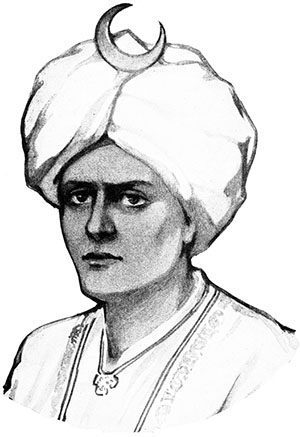
  • Meditations on Valentin Tomberg: Tarot, Spirituality, Mysticism, Hermeticism & the Occult

    Meditations on Valentin Tomberg: Tarot, Spirituality, Mysticism, Hermeticism & the Occult

    From New Dawn 184 (Jan-Feb 2021)

    The twentieth-century esoteric philosopher Valentin Tomberg was born in 1900 in St. Petersburg to a Russian father and an Estonian mother. Little is known about his early life; indeed, Tomberg seems to have gone out of his way to draw as little attention to his life as possible. As his editor and translator Robert Powell remarked, Tomberg himself “attached no significance whatever to the biographical details concerning him.”1 In fact, the main reason he is known today is that he is recognised as the author of a remarkable book, Meditations on the Tarot, that was and still is published anonymously. Ironically, the very steps Tomberg took to obscure his identity led to a great deal of interest in it.

    Valentin Arnoldevitch Tomberg (1900–1973). Photo: National Archives of Estonia

    What we do know about him is that by his late teens he had become deeply interested in Theosophy and the spiritual philosophy of Vladimir Soloviev, as well as in the more mystical aspects of the Russian Orthodox Church. 

    Russia in the early twentieth century was a remarkable time for a young man with spiritual interests to come of age. Soloviev, Russia’s first philosopher, who has found a new reader in Vladimir Putin, was one of the major philosophical and religious figures of a period in Russian history known as the Silver Age. This stretched from around 1890 to 1917, the year of the Bolshevik revolution, a historical eruption that devastated Tomberg’s family, as it did many others. 

    As I show in my book The Return of Holy Russia, the Silver Age was a time of deep interest in and almost obsession with religion, spirituality, mysticism and the occult, and it produced a powerful surge of creativity in literature, music, philosophy, and art. For a young man of Tomberg’s inclinations, having his spiritual awakening at this time no doubt made an impression on him that remained for the rest of his life.

    A New Cultural Epoch

    Although Madame Blavatsky, one of the founders of the Theosophical Society, was Russian, her focus on Eastern sources of wisdom, continued by her successors, alienated many Russians, who were deeply Christian. Tomberg was one of them, and soon after joining the Theosophical Society he left, turning his allegiance to the work of Rudolf Steiner. 

    Rudolf Steiner

    Steiner was immensely popular in Russia in the years leading up to the revolution, his highly Christianised version of Theosophy – which he would soon rechristen Anthroposophy – appealing to the generation of “God Seekers” that characterised the Silver Age. As I show in my book, both Steiner and the God Seekers had great hopes for a new “cultural epoch” to emerge from Russia at this time. In the view of Steiner and others, including Soloviev, Russia was charged with the mission of uniting the scientific knowledge of the west with the mystic intuition of the east, their integration giving birth, it was hoped, to a new creative consciousness that would transcend the limits of its parents.

    Sadly, this marriage between east and west was precluded by the revolution and, as we know, something radically different emerged from Russia. Lenin’s adamantly anti-spiritual ideology put paid to any notion of a new “cultural epoch,” and the chaos of the revolution cost Tomberg dearly. His family’s fortunes were lost, as were his father – who had a position in the czar’s government – mother, and brother. One story has it that during the chaos, Tomberg’s mother ventured into the streets. She never returned, and Tomberg later found her and their dog, both shot dead and tied to a tree. Like many who escaped the terror, Tomberg was unquestioningly anti-communist for the rest of his life.

    Upstart Anthroposophist

    In 1920, Tomberg made his way to Tallinn, Estonia. From there, he wrote several letters to Rudolf Steiner, asking if he could become his student. His letters went unanswered; it is unclear if Steiner ever read them or simply ignored them. Steiner’s silence evidently did not put Tomberg off Anthroposophy; in 1925, the year of Steiner’s death, Tomberg joined the Estonian branch of the Anthroposophical Society, eventually becoming its secretary-general. But friction soon appeared between Tomberg and the society; he was too individual a mind to remain merely a good anthroposophist. 

    Throughout the 1930s he wrote many articles for Anthroposophical journals, on a variety of subjects; many had to do with what Steiner called “the return of Christ in the etheric,” and the “mission” of different nationalities. Tomberg claimed that these articles were informed by an experience he had in 1931 when he was put in contact with the “angelic world.” This, no doubt, set him further apart from his fellows, and eventually he was asked to leave the society. At around this time he had also tried to find a place for himself at the Goetheanum, the society’s headquarters in Switzerland, but was denied this by Steiner’s widow.

    In 1938, Tomberg moved to Holland; after the Nazis invaded in 1940, he joined the resistance. His relations with the Anthroposophical Society in Holland ran into the same problems as before. It seems the essence of the trouble was that Tomberg’s esotericism was even more Christocentric than Steiner’s; if you know Steiner’s work, you’ll know this is no easy feat. After the war, Tomberg moved to Cologne where he earned a degree in jurisprudence and became deeply engaged with Catholicism. It is unclear if he actually converted, but he become alienated from the Russian Orthodox Church because its leadership had seemed sympathetic to Hitler.

    In 1948, Tomberg moved again, this time to England, where friends found him work with the BBC as a translator; he was a polyglot and would later monitor Soviet broadcasts. In 1960 he retired, devoting himself to study and writing. He died in 1973, from a heart attack while on holiday with his wife and their son in Majorca. Aside from his early essays, practically all his work appeared only after his death, and one work in particular was designed by Tomberg himself to appear in precisely that way.

    The work in question is Tomberg’s magnum opus, Meditations on the Tarot, subtitled “A Journey into Christian Hermeticism.” This was first published in French – the language in which it was written – in 1980, seven years after Tomberg’s death and nearly twice that long after the work’s completion, which Tomberg noted as 21 May 1967, the “Festival of the Holy Trinity.” German and English translations soon followed, but it was not until 2002 that a full English edition appeared through a mainstream American publisher, bringing Tomberg’s work to a wider reading public, albeit still a marginal one with a taste for the arcane and esoteric. It was also at this point that it became known Tomberg was the author of this work. And although by now his authorship is well known, as mentioned the book is still published anonymously, as was Tomberg’s wish.

    Letters From Beyond the Grave

    Meditations on the Tarot consists of twenty-two “letters to the Unknown Friend,” sent “from beyond the grave,” dispatched, that is, well after Tomberg’s death. The reason for these tardy communiques is that Tomberg wanted to mute any personal element in them, to have the reader of these letters focus on their message, not on the messenger. Tomberg himself insists that he has “said more about himself” in these letters than he “would have been able to in any other way.”2 The unknown friend to whom Tomberg is writing is the reader, and Tomberg’s letters are long, discursive, deeply pondered and occasionally meandering essays on the twenty-two trumps of the Tarot, filled with references to Steiner, Teilhard de Chardin, Bergson, Nietzsche, Gurdjieff, the Corpus Hermeticum, Catholic dogma, and many other writers, philosophers, mystics, and saints. (I should point out that the Meditations run to more than 600 pages.) Tomberg’s letters do not touch upon the divinatory character of the Tarot. Nor does he relate the trumps to the usual astrological or cabbalistic correspondences, as do most books on the Tarot, although both Cabbala and astrology make appearances.3 Instead, the Meditations are illuminating, insightful, and not infrequently baffling excursions into the meaning of the symbols presented in the trumps, which Tomberg tells his unknown friends are arcana

    Arcana

    Arcana, Tomberg tells us, are more than secrets, which are merely facts that are hidden from us, or allegories, which are figurative representations of abstract ideas. Arcana are “authentic symbols,” “magic, mental, psychic, and moral operations” that can awaken “new notions, ideas, sentiments and aspirations,” and which require more than an intellectual understanding for their power to be felt.4 

    One way of recognising authentic symbols, and of differentiating them from mere signs, Tomberg tells us, is that they have the power to “conceal and reveal their sense at one and the same time according to the depth of meditation” one reaches in their contemplation.5 A sign is nothing more than an indicator of what it points to. An arrow pointing to a door shows you the way out, but it does not share in you taking it. A symbol participates in the reality it presents, and its meaning, when grasped, should have an almost visceral effect on us. That is, it should affect us in such a way that it effects a change in our consciousness, our awareness, adding not only an intellectual knowledge but offering an existential encounter with hitherto unknown dimensions of Being. It introduces us to a bit of reality of which we were unaware.

    This “transformational” power of symbols lead Tomberg to speak of the trumps as “enzymes” that enable us to be “fruitful in a given spiritual domain.” The trumps “ferment” the knowledge necessary for spiritual experience. This is why Tomberg speaks of them as “spiritual exercises,” whose aim is “to awaken from sleep… deeper layers of consciousness.”6 They are definite encounters with esoteric realities, through which we, the unknown friends, are changed. 

    In this way, the trumps are similar to great works of art. According to Tomberg, the symbols of the Tarot should have the same effect on us as the “archaic torso of Apollo” had on the poet Rilke when he saw it while living in Paris. In its presence, Rilke knew that he “must change his life.”7 A true encounter with the Tarot’s symbolism, Tomberg tells us, should make us feel the same. His aim is to get us to think Hermetically, to allow the rich symbolism of the trumps to reach into our imagination and trigger our faculty for seeing connections between things which we would otherwise ignore. For Tomberg, the essence of Hermeticism is the ability to perceive “the totality of things,” “the One, the All,” as the ancient alchemists called it, the deep, underlying unity at the heart of the multiplicity of Being.

    The French Connection

    I should point out that Tomberg is writing in the French tradition of the Tarot – he bases his letters on the Tarot de Marseilles – and that this connection brings in the central theme of the book: to show how Roman Catholicism is an indubitable repository of Hermetic wisdom. Hence the subtitle, “A Journey into Christian Hermeticism.” Understandably, this may be sufficient reason for some unknown friends to forgo that journey. Yet we need not accept Tomberg’s thesis in order to profit from his book. 

    Valentin Tomberg used the Tarot de Marseilles, a pattern from which many subsequent tarot decks derive.

    I can respect the high regard Tomberg has for Catholicism, without agreeing with him that “the more one advances on the way of free research… the more one approaches the Church.”8 After much spiritual searching, the author of these meditations found a home in the Catholic church, but that does not mean that for us to learn from him we must take up residency there too. What strikes me as most important about the Meditations is not the arguments Tomberg makes for, say, the Ten Commandments as instructions in Hermetic philosophy or his belief that the fundamental virtues of the Christian faith – obedience, poverty and chastity – are the sine qua non of any esoteric pursuit, ingenious and thought-provoking as they are. We can embrace these dicta, take them with as many grains of salt as needed, or simply reject them. What strikes me as important about Tomberg’s Meditations for the non-Christian reader is the way Tomberg approaches the Tarot, his understanding of what we can call a Hermetic “way of knowledge.”

    Christ and Hermes

    Having said this, a look at history shows that Christ and Hermes are not such strange bedfellows as we may think. For a time during the Renaissance, Hermes Trismegistus, the legendary founder of the tradition which bears his name, was seen as a figure of equal importance with Christ, and vigorous attempts were made to incorporate the Hermetic teachings, found in the Corpus Hermeticum, into Catholic dogma.9 In France there is a long tradition of a kind of “Catholic occultism,” reaching back to the nineteenth-century French mage Eliphas Levi, and leading on to characters like the eccentric Saint-Yves d’Alveydre and his disciple Gérard Encausse, who wrote under the pseudonym Papus; all three turn up in the Meditations. It is also true that there is a long tradition of literature on the Tarot in French. Indeed, it was Levi himself who first hit on the idea of linking the twenty-two trumps with the twenty-two “paths” on the Cabbalistic Tree of Life, a correspondence that is at the heart of practically all modern magic. 

    Hermetic Syncretism

    This linkage has subsequently been discredited, and most modern historians of the Tarot accept that there is no historical connection between the Tarot and the Cabbala.10 Nor, for that matter, does there seem to be one with Egypt, which many occultists regarded as the Tarot’s source, seeing it as the so-called “Book of Thoth,” the Egyptian god of magic with whom Hermes Trismegistus is associated. 

    Yet for all his historical inaccuracy, Levi’s inspired howler has proved remarkably effective for the many occultists who have worked with his ideas. These include the members of the Hermetic Order of the Golden Dawn and its most notorious associate, Aleister Crowley, as well as their many epigone. This seems to suggest that purists, who eschew such “romantic” notions as Levi’s and reject much that has accreted around the Tarot as nonsense, ignore the syncretic, synthesising character of Hermeticism. This was with it from the start, ages ago, when Thoth met the Greek god Hermes in ancient Alexandria, their fusion creating the “thrice great” one. This syncretic approach continued during the Renaissance when figures like Pico della Mirandola and others developed the notion of a “perennial philosophy,” which allowed for a Christian Cabbala – “culturally appropriating” a radically Jewish tradition – and, as mentioned, even a Christian Hermeticism. In this light, Levi seems merely to have done what Hermetic thinkers had been doing all along.

    Analogy

    Although Tomberg is aware of the historical appearance of the Tarot in the late Middle Ages – he does argue, though, for a kind of “archetypal” link to an Egyptian source; Jung makes many appearances throughout the book – a similar syncretic approach is taken in his Meditations. This makes perfect sense. For Tomberg, Hermeticism itself is a synthesis of magic, gnosis, mysticism, and philosophy, and its aim is not to supplant science or to uncover new facts, but to perceive the facts we already possess from a different perspective, and to infuse them with an additional depth, the kind of depth we discover through our encounter with the arcana of the Tarot. 

    For Tomberg, analogy is the fundamental mode of acquiring knowledge in the Hermetic tradition, which proceeds through a process of synthesising the known and the unknown. The “open recognition of the relationship of all things and beings has engendered an exactly corresponding method of knowledge,” he writes.11 That method is analogy, through which the “sympathy of all things” becomes apparent, not as a concept, or an idea or belief, but through a perception of it “in action” as it were, through the “fermenting” effect of the symbolic “enzymes” produced by our meditations on the trumps.12

    This transformative effect is perhaps best seen in the Magician, the trump that Tomberg says is “the key to all the other Major Arcana.”13 By understanding and performing the “spiritual exercise” the Magician presents, Tomberg tells us that we will be able to work our way through to the knowledge and experience contained in the arcana that follow. As I do not have space to more than touch on some of the insights that the Magician presents, I trust the unknown friends that read this article will be encouraged to accept Tomberg’s invitation to journey with him and perform some of these spiritual exercises themselves. 

    Concentration Without Effort

    The Magician, Tarot of Marseilles

    The spiritual exercise of the Magician, Tomberg tells us, is aimed at developing two essential abilities, necessary for any successful Hermetic work. They are “concentration without effort” and “turning work into play.”14 

    “Concentration without effort” – what he also calls “active relaxation” – is achieved, Tomberg tells us, when we can direct our attention to whatever occupies us, without the constant chatter of the care-ridden ego leading our minds elsewhere. When we can achieve an inner silence, free from the distractions of thought – the basic requirement of any inner work – the kind of concentration that would usually cost strenuous efforts can be reached “effortlessly.” 

    As an example, Tomberg suggests a tightrope walker – an aptly symbolic choice. He is certainly concentrating on his actions; if he wasn’t, he would fall. But Tomberg asks: “Do you believe that his thought and his imagination are occupied with what he is doing?”15 The tightrope walker does not “calculate” or “plan” his next step because he has shifted his consciousness from his head – the worrying ego – to what Tomberg calls his “rhythmic system,” which possesses an intelligence of its own, the “intelligence of the heart” I have written about elsewhere.16

    This shift from head to heart, Tomberg says, is symbolised by the lemniscate, or horizontal 8, that is formed by the Magician’s hat. This is the symbol of infinity, but, Tomberg tells us, it is also the symbol of “eternal rhythm,” the natural “flow” – as the psychologist Mihaly Csikszentmihalyi calls it – that our ever-worrying mind interferes with. When we have quieted our inner monologue, we can enter this flow. If we think of the “concentration without effort” we achieve when we are deeply “into” a book we are reading, we can get an idea of what Tomberg means. Our concentration is so focused we forget our surroundings. Yet it requires no effort at all; in fact, we enjoy it.

    This is the arcanum of “transforming work into play,” which is a result of achieving this kind of concentration.17 When we enter the “zone of perpetual silence,” we can not only concentrate our consciousness “effortlessly;” any task we may be obliged to perform can become a source of delight.18 Because we can draw from a “secret and intimate respiration,” he “who finds silence in the solitude of concentration without effort, is never alone.”19 

    He or she is never alone, because the Magician who has achieved this has “attained harmony and equilibrium between the spontaneity of the unconscious… and the deliberate action of the conscious,” the “I” or ego.20 The Magician symbolises a state that is the “synthesis of the conscious and the unconscious,” or, as I have suggested, between our left and right brains.21 Tomberg says this is equivalent to what Jung speaks of as “individuation,” which can result in what Marie-Louise von Franz calls “conscious spontaneity,” a paradoxical state in which one is “consciously active and still spontaneous,” in which the conscious and unconscious minds have an equal say.22

    Get the issue this article appears in

    Tulpas and Egregores

    This brief account of Tomberg’s interpretation of the Magician should give the reader an idea of what he may find if he dips into the Meditations. One other trump that I should at least mention is the Devil, the theme of Letter XV. This trump, Tomberg tells us, introduces us to the secrets and dangers of what he calls “counter-inspiration.” It presents a warning about the “intoxication” we experience when we become aware of our own power to “engender demons.”23 The demon before whom the man and the woman stand enchained, Tomberg tells us, is one of their own making. It is a result of their misuse of the powers of will and imagination, the Magician’s tools in trade.

    The Devil, Rider-Waite Tarot

    The specific demons Tomberg speaks of are tulpas and egregores. Tulpas are part of the esoteric psychology of Tibetan Buddhism. They are thought-forms created by a single individual, through prolonged efforts of visualisation. Eventually, after much mental work, the tulpa can take on a life of its own, much to the dismay of its creator. As I point out in my book, Dark Star Rising: Magick and Power in the Age of Trump, both the traveller Alexandra David-Neel and the occultist Dion Fortune had experiences creating tulpas, and both write of their difficulties in regaining control of and eventually dissolving them.24 

    An egregore – which means “watcher” in ancient Greek – is a thought-form brought into existence by a group. As Tomberg tells us, there are no “good” egregores, only “evil” ones.25 They can be “engendered by the collective will and imagination of nations,” Tomberg writes, but the aims of an egregore are always selfish, centred exclusively on gaining power and growing stronger at the expense of its creators. Once brought into existence, an egregore is harder to “dissolve” than a tulpa, given that it is the work of a group. This can be a cabal of occultists, or a political party – hence their inclusion in Dark Star Rising, which looks at the resurgence of a kind of “occult politics” in recent times. This seems to have raised its head during the run-up to the 2016 US presidential election and has remained on the scene since. It has also been at work in Russia. 

    Should we take tulpas and egregores seriously? A good question. Tomberg certainly did, and as he tells us, the Devil is one trump we should clearly keep an eye on.

    [alert type=”general” dismiss=”no”]This article was published in New Dawn 184.[/alert]

    [alert type=”success” dismiss=”no”]If you appreciate this article, please consider subscribing to help maintain this website.[/alert]

    Footnotes

    1. Robert Powell, introduction to Valentin Tomberg, Lazarus Come Forth! (Great Barrington, VT: Inner Traditions, 2006) p. ix.
    2. Anonymous, Meditations on the Tarot (New York: Tarcher/Penguin, 2002) p. ix.
    3. The question of where and with whom Tomberg studied the Tarot is an interesting one. He speaks of a work, The Sacred Book of Thoth – The Major Arcana of the Tarot, by an “engineer” named Schmakov, published in 1916 which was “twice as large as Oswald Wirth’s” book on the Tarot (p. 590). He also says he read Ouspensky’s The Symbolism of the Tarot (1917). He tells his unknown friends that after the Bolshevik revolution, and presumably before going to Estonia, he became friends with members of a group of esoteric students that had been led by a mathematics professor, Gregory Ottonovitch Mebes. Mebes was the author of a book, The Course of Encyclopaedia of Occultism that is said to have influenced Tomberg. In 1926, Mebes was sent to a gulag, where he died. The group had been dispersed by the revolution, but the members he met “transmitted all they knew and recounted everything concerning the work of their group” to Tomberg. (Ibid.) The group seemed to have studied the Tarot in the traditional French way, relating it to Cabala, magic, astrology, etc. Tomberg says that through the “forty-five years” of his own study, he has “surpassed” what he learned from them and that throughout the Letters – aside for one exception – he does not draw on it. Another esoteric thinker who wrote about the Tarot, Mouni Sadhu, is said, like Tomberg, to have been in contact with members of this group, and influenced by Mebes’ book. Some have seen similarities between Sadhu’s The Tarot (1962) and the Meditations, which the link with Mebes may explain.
    4. Ibid. p.4.
    5. Ibid.
    6. Ibid. p. 91
    7. https://poets.org/poem/archaic-torso-apollo 
    8. Ibid. p. 283
    9. See my book The Quest for Hermes Trismegistus (Edinburgh: Floris Books, 2011) pp. 154-56.
    10. Robert M. Place, The Tarot (New York: Tarcher/Penguin, 2005) p. 73.
    11. Anonymous p. 12.
    12. Ibid. p. 4.
    13. Ibid. p. 3.
    14. Ibid. p. 8.
    15. Ibid. p. 9.
    16. Gary Lachman, Lost Knowledge of the Imagination (Edinburgh: Floris Books, 2017) pp. 52-53.
    17. Anonymous p. 11. This is an arcana evidently known to Mark Twain, who makes good use of it in Tom Sawyer. There the wily Tom convinces his friends to paint a fence because he pretends to be enjoying it. Yet the trick is really on Tom because his friends actually do enjoy it; they have transformed work into play, by telling themselves it is play.
    18. See my article “Getting Beyond the Robot” in New Dawn 182 (Sept–Oct 2020).
    19. Ibid.
    20. Ibid. p. 20.
    21. Gary Lachman, The Secret Teachers of the Western World (New York: Tarcher/Penguin, 2015). In this book I argue that such a harmony is at the heart of the western esoteric tradition.
    22. Marie-Louise von Franz, Alchemy (Toronto: Inner City Books, 1980) p. 238.
    23. Anonymous p. 401.
    24. Gary Lachman, Dark Star Rising: Magick and Power in the Age of Trump (New York: Tarcher Perigee, 2018) pp. 90-92.
    25. Ibid. pp. 419-20.

    © New Dawn Magazine and the respective author.
    For our reproduction notice, click here.