New Dawn – World's Most Unusual Magazine

Author: Jack Fox-Williams

  • The Strange Connection Between Science & the Occult

    The Strange Connection Between Science & the Occult

    From New Dawn 170 (Sept-Oct 2018)

    We like to think that modern science has developed as a result of rational enquiry; however, the history of science is littered with tales of bizarre experiments, eccentric characters and peculiar coincidences. 

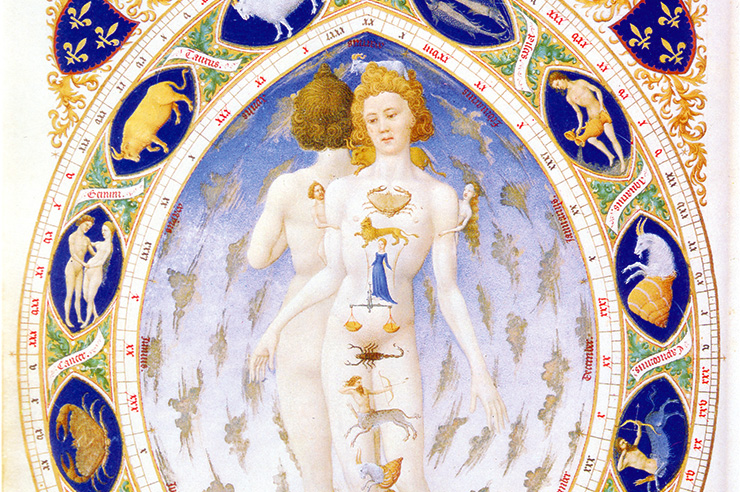
    Many of the influential scientists responsible for the birth of modern science were not the conventional rationalists that they are often portrayed as. Although their discoveries are the result of complex mathematical workings and meticulous scientific experimentation, many of them were also heavily immersed in the esoteric world of the occult and pursued the mystical practices of alchemy, astrology and magic. 

    While the orthodox scientific community has denounced these practices as nonsensical pseudoscience, they are incredibly significant in the history of modern science. 

    This article examines three scientists who made exceptional contributions in their fields including the occult, showing the unusual and forgotten ideas that guided the course of scientific enquiry. 

    Sir Isaac Newton and the Philosopher’s Stone

    Sir Isaac Newton is recognised as one of the most influential scientists to have ever lived and was a crucial figure in the scientific revolution during the Enlightenment period. Born in 1643, Newton is credited for developing the laws of modern physics; however, he also made discoveries in mathematics, optics, and other scientific disciplines. 
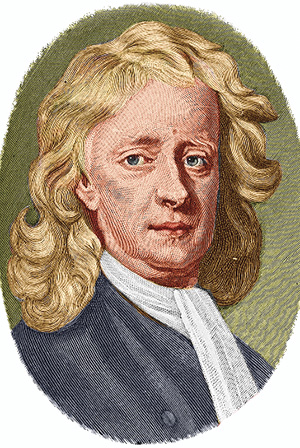
    Sir Isaac Newton, colourised engraving after Enoch Seeman’s 1726 portrait of Newton.

    His momentous book, Principia, brought him to international fame when published in 1687 and distinguished him as one of the most important scientific figures of the Renaissance. The manuscript contains information on the elementary principles of modern physics, such as the laws of motion and the theory of gravity. Newton is also credited for developing essential concepts of modern calculus, demonstrating his prodigal influence within both science and mathematics. 

    Newton’s historical legacy has come to symbolise the power of the scientific method in the development of Western civilisation, but many people are unaware that Newton was not a conventional scientist. He was a very curious individual who dabbled in the peculiar and unusual world of the occult, a realm antithetical to the narrow rationalism of science. In fact, after purchasing Newton’s manuscripts and studying his works, economist John Maynard Keynes famously stated that “Newton was not the first of the age of reason, he was the last of the magicians.”1

    An area of the occult that Newton extensively studied was alchemy. Alchemy was the medieval forerunner to chemistry and outwardly concerned the transmutation of base metals into gold and the discovery of a universal elixir that would bless its creator with immortality. Grounded in the discipline of hermeticism, alchemy was not only a method of chemical transmutation but also a spiritual practice by which the alchemist sought to purify their body and soul. 

    Since chemistry was in its infancy during Newton’s lifetime, many of his studies in chemical science contained language more typically associated with occultism than modern science. Unfortunately, a laboratory fire caused by his dog may have destroyed most of his works, and therefore our understanding of how much he knew about alchemy is somewhat limited. 
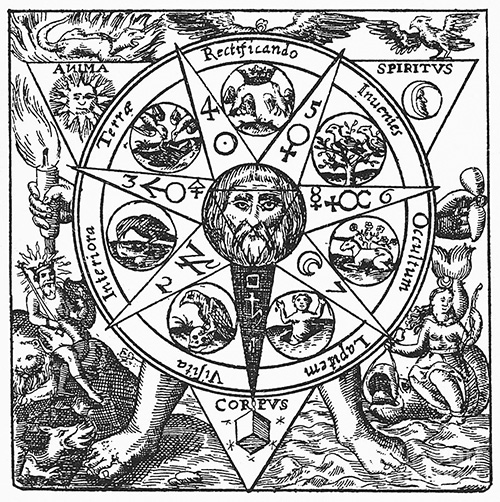
    Alchemical drawing rich in symbolism and hidden meaning.

    Existing works suggest Newton was heavily immersed in the hermetic discipline and his primary objective was to discover the philosopher’s stone, a mysterious substance that supposedly had the power to turn base metals into gold. The stone was central to the imagery of medieval hermetic philosophy and symbolised man’s attainment of spiritual perfection. 

    Newton’s writings suggest that he was interested in this mystical object and undertook many experiments to uncover its chemical composition. He also believed that ‘Diana’s Tree’, an alchemical process that produces a dendritic ‘growth’ of crystallised silver from a silver-nitrate solution, proved that metal “possessed a sort of life.”2

    Newton was not only interested in alchemy. He also believed the Bible contained hidden information about a future apocalypse. Unpublished documents, evidently written by Newton, indicate he thought the world would end by the year 2060 AD based on a series of mathematical calculations. It has been suggested the apocalypse he was talking about was a transformative stage in mankind’s spiritual evolution in which the human race would achieve a higher state of transcendental consciousness; however, this is mostly scholarly conjecture. 

    The original documents written by Newton are currently stored at the Jewish National and University Library in Jerusalem. It appears that they were written for personal use since Newton personally disliked date-specific biblical prophecies. This would make sense considering he provided no actual date as to when the world would end, merely predicting it would happen before the year 2060. Newton’s reasoning behind this particular date cannot be considered in cultural and historical isolation. It must be understood in the context of his antitrinitarian beliefs and Protestant views on the Papacy. His writings suggest he relied on the specific chronology of events described in the Bible, as well as the ominous prophecies described in the Book of Revelation, to calculate the date. The religious basis for his calculations is evident when he writes:
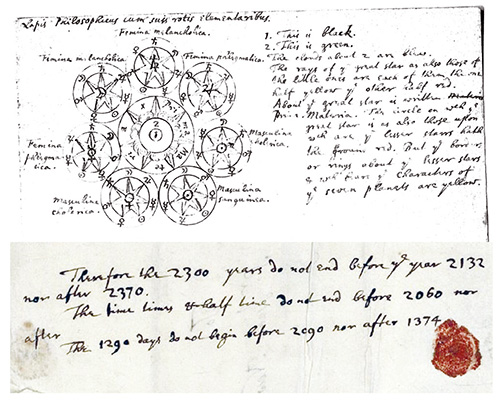
    Top:  Diagram of the Philosopher’s Stone drawn by Sir Isaac Newton, from his “Lapis Philosphicus.” Above:  Section  of the letter written by Newton where he predicts the world would end by 2060.

    “So then the time times & half a time are 42 months or 1260 days or three years & an half, recconing twelve months to a yeare & 30 days to a month as was done in the Calendar of the primitive year. And the days of short lived Beasts being put for the years of lived [sic for ‘long lived’] kingdoms, the period of 1260 days, if dated from the complete conquest of the three kings A.C. 800, will end A.C. 2060.”3

    As one can see, Newton was of the belief that biblical scripture contained encrypted knowledge about the future of humankind’s destiny; he carefully studied the chronological dates and events described in the Bible and performed complex mathematical calculations to determine the date of the apocalypse. Although he made various predictions during his lifetime, he was certain that a global cataclysm would destroy Earth before the year 2060 based on his interpretation of the Bible. 

    Although Newton’s legacy has become associated with the development of modern science, he was deeply immersed in the esoteric practices of alchemy, hermeticism and biblical prophecy. While modern science denounces these practices as irrational and absurd, Newton’s interest in the occult suggests they played a more significant role in the history of scientific enquiry than we have been led to believe. 

    Galileo and the Art of Astrology

    Galileo Galilei was a mathematician, astronomer, physician and engineer during the Italian Renaissance; he is considered to have been a central figure in the transition from natural philosophy to modern science. 
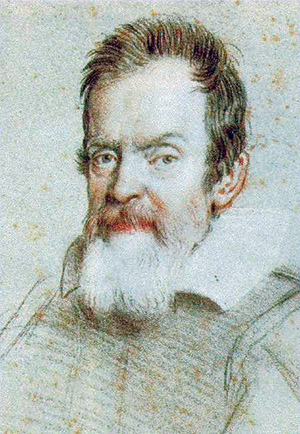
    Galileo Galilei (1564–1642)

    Born in 1564, Galileo made a number of breakthrough discoveries in mathematics, optics and astronomy. In 1609, he heard about the invention of the spyglass, a device that made objects in the distance appear closer, and used mathematical knowledge to design the first working telescope. Galileo then made his first astronomical discovery when he cast the lens of his new invention upon the surface of the moon. He was also the first astronomer to observe the four moons of Jupiter, track the planetary phases of Jupiter and detect sunspots on the Sun. 

    Galileo faced fierce opposition from the Roman Inquisition since his writings promoted a heliocentric view of the universe in which the Earth rotates around the Sun. The Inquisition believed that this fundamentally questioned man’s central place within the cosmos and sentenced him on the grounds of heresy, resulting in indefinite imprisonment until his death in 1642. Ever since Galileo has become known as one of the most influential scientists to have ever lived. However, many people are unaware that he had an interest in mysticism and hermeticism as well as the mysterious world of the occult.4

    Like many scientists during the Italian Renaissance, Galileo was well practiced in the art of astrology. Although the idea of astronomers practising astrology seems alien to us in the modern age, during the Renaissance period many early scientists believed that the position of planets and stars influenced man’s destiny. In fact, it has been suggested that scepticism towards astrology only emerged during the Enlightenment period, when scientists like Rene Descartes emphasised the importance of scientific doubt. Before then, astrological beliefs were deeply embedded across European culture, and members of the aristocracy relied on its predictive power to make important political and economic decisions. 

    The Medici Family, who ruled over Florence during the 15th century, would often appoint astronomers to interpret their horoscopes. When Galileo discovered the four moons of Jupiter in 1609, he told the Medici Family that fate had reserved the planetary objects for them so each of the family’s four sons would have one to their name. In fact, when Galileo revealed knowledge of the discovery in his book, Sidereus Nuncius, he decided to name them “Medici Sidera,” meaning the Medician Stars.” When the Roman Catholic Prelate, Piero Dini, questioned how he could be so certain of the connection, Galileo replied in a letter arguing that the discovery of Jupiter’s four moons were inextricably connected with the family’s rising political and economic influence. Galileo also talks about how smaller planets might affect our destiny in ways that we are unaware and distinguishes between superior and inferior causes of planetary influence, writing:

    “If therefore, of the inferior causes, those which arouse boldness of heart are diametrically contrary to those which inspire intellectual speculation, it is also most reasonable that the superior causes (if indeed they operate on us) be utterly different from those on which courage and the speculative faculty depend; and if the stars do operate and influence principally by their light, perchance it might be possible with some probable conjecture to deduce courage and boldness of heart from very large and vehement stars, and acuteness and perspicacity of wit from the thinnest and almost invisible lights.”5

    It is easy to view Galileo’s interest in astrology as the result of social and historical circumstances. While it is undoubtedly true that astrological practice was common among the scientific elite during the Renaissance period, particularly among the aristocracy of Italian society, his writings suggest a sincere belief in the idea that planets and stars influenced humankind’s destiny. Moreover, there is evidence to indicate that he not only produced astrological readings for the Italian aristocracy but his close family as well, suggesting a personal belief in its predictive powers. 

    Although Galileo has come to symbolise the power of modern science to enhance our understanding of the cosmos and our place within it, many people forget he was deeply engaged in the mystical practice of astrology and its power to predict the economic, social and political destinies of people’s lives. Although many scientists denounce astrology as pseudoscience, there is no denying that it played an interesting and significant role in the history and development of science, particularly in regards to Galileo’s life. 

    Paracelsus and the Hermetic Tradition

    Paracelsus, or Theophrastus von Hohenheim, was a Swiss-born physician, alchemist and astrologer. Born in 1493, Paracelsus was an influential figure in the ‘medical revolution’ during the German Renaissance and emphasised the importance of experimentation in medical science. He has been labelled the ‘father of toxicology’, one of his most notable phrases being, “The dose makes the poison.” 
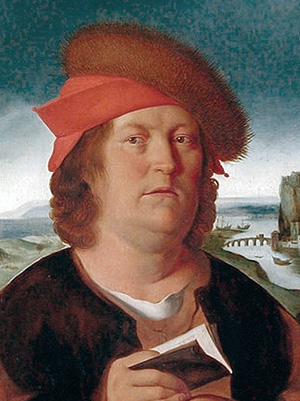
    Paracelsus (1493–1541)

    Paracelsus was also one of the first people to suggest that physicians should receive an education in the natural sciences and study the basic principles of chemistry as part of their schooling. Interestingly, he is credited with giving the element ‘zinc’ its name as well as inventing chemical therapy, chemical urinalysis and early theories of digestion. 

    While the medical establishment opposed many of his ideas at the time, particularly his views on medical education, he is currently recognised as one of the most influential figures in the history of medicine. His discoveries contributed significantly to the development of natural science and transformed our understanding of chemistry and its application in relation to medicine. Saying this, however, many forget that Paracelsus was  immersed in hermetic philosophy and the mysterious world of the occult.6

    Paracelsus had a profound interest in astrology, the art of prediction based on the position of stars and planets. Since medicine and astrology were closely connected during Paracelsus’s lifetime, he believed in the commonly held notion that each part of the body corresponds with a specific planet or zodiac sign, and therefore medical procedures should be undertaken according to the position of the solar system to ensure their effectiveness. 

    He also believed in the hermetic idea there are two worlds: the microcosm (which refers to the world of man and Earth) and the macrocosm (which is the heavenly universe or the spiritual world) and that these two worlds interact and influence each other. He states that:

    “Know that there are two kinds of stars – the heavenly and the earthly, the stars of folly and the stars of wisdom. And just as there are two worlds, a Little World [the Microcosm, man] and a Great World [the Macrocosm, the Universe] and just as the little one rules over the great one, so the stars of the microcosm rule over and govern the Stars of heaven.”7

    There has been much discussion about the historical sources of Paracelsus’s known magical beliefs. The Archidoxis Magica, for example,was supposedly written by Paracelsus in 1561 and contains information on magical talismans that can be used to cure illness and disease. Many historians dispute that he produced the manuscript since none of his other works discuss the use of talismanic objects; however, it is possible that he may have acquired a sudden interest in their magical potential. 

    While the authorship of Archidoxis Magica remains subject to scholarly debate, there is no denying that mysticism deeply influenced Paracelsus; in particular the belief that each organ corresponds with a planet and precious metal, which is central to the philosophy of hermeticism. During the medieval period, the Sun was thought to rule over the heart and its corresponding metal was gold. The Moon ruled the brain and its metal was silver. Mercury ruled the lungs and its metal was silver or quicksilver. Venus ruled over the kidneys and its metal was copper. Mars ruled over the bladder and corresponded with Iron. Jupiter governed the liver and corresponded with Tin, and Saturn ruled over the spleen and its metal was lead. Therefore, one can see that Paracelsus believed in the hermetic idea of microcosm and the macrocosm; that the body corresponds with the structure of the cosmos and that both spheres must exist in a state of harmony for man to attain earthly and spiritual perfection. 

    Saying this, however, Paracelsus was not a determinist astrologer and believed that while the planets and stars could influence human destiny, we still have some degree of free will, writing: 

    “Even if he is a child of Saturn and if Saturn has overshadowed his birth, he can still escape Saturn’s influence, he can master Saturn and become a child of the Sun.”8

    The life of Paracelsus highlights the blurred line between science and mysticism that secretly guided the history of modern science. Although he is credited with scientific innovations such as urinalysis, toxicology and chemical therapy, Paracelsus had a serious interest in the practices of astrology, alchemy and hermeticism. There is much scholarly debate regarding which manuscripts can be attributed to Paracelsus, but the evidence clearly suggests he was not a conventional scientist; he was an inquisitive mind, deeply immersed in the occult. 
    Get the issue this article appears in

    Conclusion

    The distinction between the occult and science has not always been as clear-cut as many of us like to think it is. Many of the influential scientists that we have come to associate with the birth of modern science were clearly involved in the study and practice of alchemy, astrology and biblical prophecy. Moreover, it would appear that many of these scientists believed in the power of these practices while simultaneously recognising the importance of scientific inquiry. 

    Galileo was a key figure in the transition from natural science to the scientific revolution, however, he also believed that planetary bodies could influence the destiny of humanity. Similarly, Newton used complex mathematical principles to outline his theory of gravity but also turned to biblical prophecy to predict the end of the world. Paracelsus made a number of discoveries in chemical science but also believed in hermeticism. 

    It is easy for modern science to portray its historical development as linear and coherent, but many of the individuals responsible for humanity’s greatest scientific achievements were inquisitive minds fascinated by the mysterious, peculiar and esoteric world of the occult.

    [alert type=”general” dismiss=”no”]This article was published in New Dawn 170.[/alert]

    [alert type=”success” dismiss=”no”]If you appreciate this article, please consider subscribing to help maintain this website.[/alert]

    Footnotes

    1. John Maynard Keynes (1946), ‘Newton, the Man’ [online] available at http://phys.columbia.edu/~millis/3003Spring2016/Supplementary/John%20Maynard%20Keynes_%20%22Newton,%20the%20Man%22.pdf
    2. Wikipedia (2018), Isaac Newton’s occult studies [online] available at https://en.wikipedia.org/wiki/Isaac_Newton%27s_occult_studies 
    3. Ken Ludden (2012), Mystic Apprentice Master Volume with Dictionary, lulu.com, page 413
    4. Britannica, Galileo: Italian Philosopher, Astronomer and Mathematician [online] available at www.britannica.com/biography/Galileo-Galilei 
    5. Nick Kollerstrom (2004), Galileo’s Astrology, skyscript.co.uk [online] (available) www.skyscript.co.uk/galast.html
    6. Wikipedia (2018), Paracelsus [online] available at https://en.wikipedia.org/wiki/Paracelsus 
    7. Nicholas Campion (2009), A History of Western Astrology Volume II: The Medieval and Modern Worlds, Bloomsbury, page 117
    8. www.renaissanceastrology.com/paracelsus.html

    © New Dawn Magazine and the respective author.
    For our reproduction notice, click here.
  • ‘All I Know is What is on the Internet’: The Emergence of the Post-Truth Age

    ‘All I Know is What is on the Internet’: The Emergence of the Post-Truth Age

    From New Dawn 199 (Jul-Aug 2023)

    It must be said that postmodern philosophy has not received the best PR. As soon as people hear the names Foucault, Deleuze, Derrida and Debord, they predictably roll their eyes, expecting some pretentious spiel about the relative nature of truth, knowledge and morality. 

    However, post-modern discourse provides valuable insight into the ‘high weirdness’ of contemporary culture, where nothing truly seems real and traditional systems of social order have begun to crumble away. 

    As the mainstream media ideologically distorts and occludes reality, and big-tech companies rigorously censor alternative information (while ‘hilarious’ videos of cats falling over accumulate millions of views), it appears that there is no reality beyond that which we see through our television screens, mobiles and tablets – a world of artificial simulation and dissimulation. 

    Even the politicians, in whom we blindly place our faith and trust, have no regard for the truth since the very concept of ‘truth’ has become redundant in an age of fake news, viral marketing and social algorithms. In a telling interview, when US presidential candidate Donald Trump was confronted about an error in the statistics he presented about race-based violent crimes, he merely replied, “all I know is what is on the internet.”1

    As Dr Kane X. Faucher observes, “This kind of chamber or echo-effect of selective exposure is highly problematic for a variety of reasons, not least of which being that confirmation bias has an impact on decision-making and the possibly narrow or distorted worldview one may embrace. When it comes to what people choose to believe, this may also be on account of the narrow selective process of hidden algorithms. The tautological nature of the spectacle’s ‘truth’ forecloses the possibility of seeking beyond it to mount a significant or resonant challenge.”2 

    As social media sites subtly manipulate our political opinions, biases and assumptions, recommending certain content based on algorithmic prediction and selection, it becomes increasingly difficult to distinguish fact from fiction, truth from illusion, particularly when information has become the most priceless commodity – a substitution for the real itself. 

    How did we find ourselves in this hallucinatory, post-truth world where representation has replaced reality? Can the very notion of truth ever be resuscitated in a technocratic society where the boundary between the real and the imaginary has dissolved into thin air? 

    By turning to the postmodern thinkers of the 21st century, we can better understand why we now find ourselves in an uncanny world of simulation and simulacra – a world where the map precedes the territory.3 

    Baudrillard, Debord & the Society of the Spectacle

    Since the late nineteenth century, with the rise of mass production and industrialism, the symbolic value of commodities has superseded their functionality as consumers invest in a particular identity or lifestyle. For example, when I purchase a Mercedes car, I am not only investing in a functional object which will transport me from one place to another but a status symbol associated with ideas of luxury, comfort and innovation. 

    As the French sociologist, philosopher and poet Jean Baudrillard observed, modern society is characterised by the emergence of a sign economy, in which commodities become increasingly disconnected from the physical world: 

    …use value is itself produced as a sign (and is not a fundamental truth) to help keep consumption going and the consumer society in business. In the fetishised realm of consumption, objects are misrecognised everywhere as being endowed with forces like “happiness, health, security, etc.” We see this so much that we forget that “what we are dealing with first is signs: a generalised codes of signs, a totally arbitrary code of differences, and it is on this basis, and not on account of their use values or their innate ‘virtues’, that objects exercise their fascination.”4

    In other words, a commodity only acquires value through its differential relation to other signs rather than its intrinsic usefulness. The Mercedes car is no more luxurious than other vehicles on the market, but the company has distinguished itself by creating a brand image of luxury, comfort and innovation – social concepts which have no existence beyond their symbolic differentiation. In this sense, the sign economy functions as an entirely self-referential (or tautological) system (similar to the structure of language, where words are defined by other words, in a prison of the referential) in which consumers exchange capital (which in itself has no intrinsic value) for a particular sign or symbol, which has no instrumental function beyond the symbolic system which produces it. 

    As Baudrillard explained in Simulation and Simulacrum (1981), ever since the emergence of photography, radio, cinema, television and other replicative technologies, reality has been incrementally replaced by the representational to the point that we can no longer distinguish between original and copy

    As modern consumers are force-fed images of violence, sex and celebrity, they become so divorced from the physical world that they enter a virtual reality – that which Baudrillard terms the hyperreal

    Today, the history that is “given back” to us (precisely because it was taken from us) has no more of a relation to a “historical real” than neofiguration in painting does to the classical figuration of the real. Neofiguration is an invocation of resemblance, but at the same time the flagrant proof of the disappearance of objects in their very representation: hyperreal.5 

    The German philosopher Walter Benjamin, in The Work of Art in the Age of Mechanical Reproduction, similarly suggests that mass production not only replicates the physical but replaces it, transforming reality into hyper-mimetic simulacra: 

    What shrinks in an age where the work of art can be reproduced by technological means is its aura. The process is symptomatic; its significance points beyond the realm of art. Reproductive technology… removes the thing reproduced from the realm of tradition. In making many copies of the reproduction, it substitutes for its unique incidence a multiplicity of incidences.6 

    The copy is duplicated so many times that we cannot even speak of an original since reality itself has become the reconstruction of a reconstruction, without beginning or end, existing in a timeless present. 

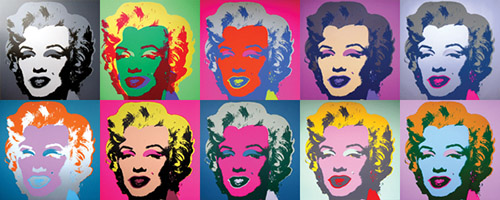
    Take Andy Warhol’s infamous Marilyn Monroe print. The public has a certain perception of the actress based on the iconography of cinema and television, and she was photographed in such a manner as to maintain this two-dimensional stereotype. This photograph is then transformed into an artistic (or aesthetic) image and sold for millions of dollars, never once leaving the realm of symbolic representation. In a sense, there is no Marilyn Monroe, only the replicated images we see of her plastered across posters, keyrings, coffee cups and other fetishistic memorabilia, where she becomes the copy of a copy, the replica of a replica, entirely disembodied from the real. 

    Andy Warhol, Marilyn Monroe (Marilyn) 1967 FS II.22-31

    However, in the age of post-modernity, where information is the most priceless commodity, the sign economy becomes uncannily spectral (and even phantasmagoric) in its non-being – an empty vacuum in which texts, images and videos endlessly circulate as if they were physical objects, even when they have no external phenomenality or dasein

    As the social media machine steadily encroaches upon our daily lives and so-called ‘influencers’ dominate the cultural zeitgeist, we become passive spectators, gawping over the latest Instagram image with 100,000 likes. While technology provides the illusion of active participation and social collaboration, in actuality, it turns us into informational consumers, entirely disconnected from the physical world. 

    As Faucher notes, “Digital representation becomes the active process and product of this milieu, a hyperreal environment that subordinates the now impoverished value of the non-digital to the production of images that are destined for digital re-production of images that are destined for digital re-production. The network spectacle is presented as unassailably good, perfect, and the primary source of the positively represented values decanted from neoliberalism such as efficiency, speed and connectivity. However, it is those very values that not only speak directly to issues of exchange value and commodity fetishism, but also physically impoverishes those who labour to support the spectacle.”7 

    As we docilely gaze at Instagram images of photoshopped models standing next to lavish sports cars with pseudo-philosophical quotes about ‘living your dreams’, we forget that a multinational infrastructure based on the exploitation of the poorest countries has been set up in order to feed our insatiable technological addiction. When we stare into the black mirror of our iPhones, we rarely think about the raw materials, sweatshop manufacture and precarious work required to keep this system in motion. The exploitation remains firmly hidden from view, keeping us ignorant as to its true economic and environmental effects. The Spectacle becomes the only knowable ‘reality’. 

    The French philosopher, film-maker and Situationist, Guy Debord, foresaw the emergence of spectacular society in which the general public passively consumes texts and images with detached fascination rather than actively participating in a vibrant culture. As he observes, in Society of the Spectacle (1967), everything “that was directly lived has moved away into representation.”8 

    Guy Debord: “When Poetry Ruled the Streets”

    In regard to political history, we remain barred from the past since time itself has entered the realm of the representational, and these representations are manufactured, designed and assembled by the Spectacle itself. The mainstream media functions as nothing more than a tautological system of informational input and output, continually referencing its own self-fabricated mythologies, narratives and constructions. 

    Debord stated: “The Spectacle proves its arguments simply by going round in circles: by coming back to the start, by repetition, by constant reaffirmation in the only space left where anything can be publicly affirmed, and believed, precisely because that is the only thing to which everyone is a witness.”9 

    Our understanding of the past has no existence outside the lens of the media, distorting, fabricating and occluding reality as we know it. Take a film like Apocalypse Now. Here, we see the cinematic representation (not to be mistaken for mere replication) of a historical event, manufactured for mass consumption, which in itself is the reconstruction of a reconstruction – a war that was televised, cinematised and narrativized to present a certain version (or model) of history. This is not to suggest that the Vietnam War never happened. On the contrary, it was a bloody and detestable conflict in which thousands upon thousands of innocent people were killed in the name of capitalist economics. But since the public’s perception of the war was always interfaced through the eye of the camera, it had no meaning beyond the screen and therefore could be replicated as replica without the real ever rearing its ugly head. 

    Online Petitions, Virtue Signalling & the Politics of the Spectacle

    In our societies of the Spectacle, political engagement becomes increasingly tokenistic, a way of providing the public with a false sense of autonomy, even as the techno-industrial machine subtly silences voices of dissidence, subversion and resistance. 

    Politics is nothing more than a theatrical drama in which public and private actors take to the stage, ‘looking good’ for the cameras, making reference to abstract ideals such as the ‘national interest,’ ‘international cooperation’ and ‘economic growth’ in order to win the hearts and minds of voters. 

    It is no coincidence that many politicians – including most famously the 40th president of the US, Ronald Reagan – have close ties to Hollywood. As Paul Virilio observes in War and Cinema, politics is now a form of entertainment and vice versa – a circus act designed to keep the masses in a state of docile complacency, with no real way of changing the system.10 

    Social media has ‘spectacularised’ political engagement in new and even more dangerous ways since it digitally empowers online users yet alienates them from the physical world, becoming nothing more than the simulation of a simulation. 

    Anyone can go on Twitter and post a 140-character tweet about Jeffrey Epstein’s ‘suicide’ or the Prince Andrew scandal, but what is the result of such anger and frustration? It merely exists inside an empty vacuum – an artificial reality – where information endlessly circulates, generating more and more content, while the dominant cultural paradigm remains untouched, unharmed and unscarred. 

    Thus, we now see the rise of the ‘virtue-signalling’ culture in which individuals openly criticise corporate exploitation, media misrepresentation and governmental corruption, even as they support the very institutional systems they verbally disparage. The proliferation of virtue signalling – in which people attempt to win praise for showing support for a social cause without actually doing anything meaningful to advance it – is a predictable outcome of the Spectacle.

    Of course, it would be inaccurate to suggest that online discourse has no impact on the real world. When the Black Lives Matter Movement urged disenfranchised minorities to take to the streets and protest against police brutality, the internet was key in organising local demonstrations, rallies and marches. Yet, even then, the movement became a mere spectacle – a televised form of entertainment – reappropriated by the mainstream media in order to maximise its informational output. 

    As Baudrillard astutely observed, that which begins in the world of simulacra inevitably ends in the world of simulacra since there is no external reality to even reference.

    This is why today we see the emergence of a ‘petition culture’ in which a disillusioned public tries to bring about meaningful change by signing online petitions, many of which never even reach the ears of the political establishment. 

    In the United Kingdom, Parliament is obliged to discuss a petition if it receives enough signatures, however these political processes are entirely theatrical – a psychodrama ritual – designed to give the illusion of democratic engagement (while the puppet masters pulling the strings remain occluded in the shadows). Thousands of people could sign a petition requesting a public inquiry into the many documents which have gone missing that implicate prominent British politicians in cases of child abuse and sex trafficking, but it would not make any difference – the game has ended before it even began. 

    Furthermore, many of the political issues which are brought before Parliament, such as the ‘energy crisis’ and the ‘cost of living’, are carefully engineered by the mainstream media in order to create problems to which the state has a solution, establishing a pretext for further governmental intervention and control. 

    Get the issue this article appears in

    Take the ‘living crisis’. Many people are urging national governments to take immediate action and implement a universal basic income, which supports the poorest in our society. However, while there is no denying that the global economy is in big trouble, the economy itself (which never leaves the hermetic realm of sign, symbol and simulation) is never brought under scrutiny – it remains a constant a priori. Moreover, there is no discussion on how a universal income would be implemented, who would control it, or whether it would lead to new forms of economic regulation (such as a social credit scoring system). 

    This is exactly how the simulacra functions – it provides ‘false’ solutions to ‘false’ problems within a ‘false’ system based on a ‘false’ currency, blurring the boundary between the real and the representational to the extent that the latter replaces the former. The modern Spectacle is so overwhelming in its hyper-mimetic power that we cannot even speak of an external reality where meaningful political change can be actualised – the medium has now become the message. 

    The profound sense of alienation, disillusionment and unreality that many of us experience in today’s ‘post-truth’ culture cannot be understood as a historically isolated phenomenon but an eschatological climax – a technological singularity – where the simulation has finally replaced the real. 

    Even a film like The Matrix does not encapsulate the hallucinatory nightmare of modern civilisation, since at least there was the possibility of escaping Plato’s cave, a division between reality and illusion; in today’s digital age, we awake from the simulacra only to find ourselves in another simulation, unable to break free from the prison of the referential. 

    Our culture will only become stranger once virtual reality technologies become increasingly advanced in their power to deceive and replace a world that never existed in the first place. As everything that is solid melts into thin air, all that remains is a dream inside a dream – a holographic universe where reality itself is but a spectral ghost of the past. 

    [alert type=”general” dismiss=”no”]This article was published in New Dawn 199.[/alert]

    [alert type=”success” dismiss=”no”]If you appreciate this article, please consider subscribing to help maintain this website.[/alert]

    Footnotes

    1. K. Faucher, (2018), Social Capital Online, University of Westminster Press, 115
    2. Ibid. 
    3. J. Baudrillard, (1994), Simulacra and Simulation, Michigan University Press
    4. J. Baudrillard, (2019), For a Critique of the Political Economy of the Sign, Verso, 90 
    5. J. Baudrillard, (1994), 45 
    6. Counterfeit Castles: The Age of Mechanical Reproduction in Bram Stoker’s “Dracula” and Jules Verne’s “Le Chateau des Carpathes”, Texas Studies in Literature and Language, Winter 2014, Volume 46, Issue 4, 428-471
    7. K. Faucher, (2018), 110
    8. G. Debord, (1970), The Society of the Spectacle, Black & Red 
    9. Ibid. 
    10. P. Virilio, (1989), War and Cinema: The Logistics of Perception, Verso

    © New Dawn Magazine and the respective author.
    For our reproduction notice, click here.
  • Reality Tunnels: How to Control & Re-Program Your Mind

    Reality Tunnels: How to Control & Re-Program Your Mind

    From New Dawn 187 (Jul-Aug 2021)

    When I was in secondary school, a teacher showed me an animated optical illusion in which a dancer appears to be spinning in one direction. I was adamant that the dancer was spinning clockwise, while my teacher insisted it was spinning counterclockwise. She then told me that you could change the direction of the dancer by focusing on the feet. I gazed with meditative fixation, and suddenly, to my amazement, the dancer started spinning counterclockwise! My teacher explained that since there are no visual cues for three-dimensional depth, your mind can determine what direction the dancer spins. 

    At that moment, I realised that reality is a construct of the mind, and we all potentially see the same world differently. I may have put it in less eloquent terms than that (considering I was only a teenager), but there was a fundamental shift in my understanding. The illusion made me realise that the notion of ‘objective truth’ was essentially arbitrary since our subjective beliefs mediate sensory experience. 

    My teacher and I could have argued for hours, days or weeks as to which direction the dancer was spinning; science couldn’t have proven either of us correct since it was a matter of perception rather than ‘truth’. In ‘reality’, the dancer was spinning in both directions, but since the brain has a natural tendency to classify, categorise and catalogue information in binary terms (up/down, left/right, black/white, clockwise/counterclockwise), the animated optical illusion appears monodirectional. 

    There are numerous examples of this in our day-to-day lives, like when we fail to appreciate other people’s viewpoints because we perceive the world differently. We believe we are right despite the multiple (if not infinite) interpretations about the nature of reality. 

    What are Reality Tunnels?

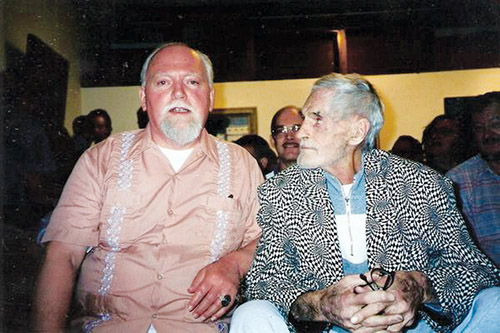
    Robert Anton Wilson (1932–2007) with Timothy Leary (1920–1996)

    The countercultural guru Timothy Leary coined the term ‘reality-tunnel’ to describe our filtered perceptions of the world. Robert Anton Wilson later developed the concept to describe “pre-composed patterns of thinking which limit and distort the perception of reality by reducing complexity and options.”1 According to Wilson, reality-tunnels shape our phenomenological sense of self, editing out experiences that do not support our beliefs while focusing on those which do.2 

    An advocate for capitalism, for example, will gather facts to support the view that capitalism is the most effective socioeconomic model, discarding any information that runs contrary to this viewpoint. Similarly, a Marxist will construct arguments based on select information to support the view that communism is the best system, often neglecting evidence that contradicts their position. 

    As the psychedelic scholar Ido Hartogsohn states, “all of us harbour established ideas about minorities, religions, nationalities, the sexes, the right ways to think, act, feel govern, eat, drink, and what not. Reality tunnels act to help us fortify these ideas against challenging information.”3 In this sense, there is a crossover between the concept of reality-tunnels and confirmation bias, the latter described as the “human tendency to notice and assign significance to observations that confirm existing beliefs while filtering out or rationalising away observations that do not fit with prior beliefs and expectations.”4 The phenomenon of confirmation bias helps explain why people who ascribe to a reality-tunnel are oblivious. Most people believe their worldview corresponds to the “one true objective reality,” however, Wilson emphasises that many reality tunnels are artistic creations, a culmination of biological, cultural and environmental inputs.5 

    The notion that reality is shaped by the conditions of the human mind is not new. The 18th-century German philosopher Immanuel Kant proposed in his Critique of Pure Reason that experience is based “on the perception of external objects and a priori knowledge.”6 We receive information about the external world through our five senses, which is then processed by the brain, allowing us to conceptualise its contents. When I look at an object, such as a chair or a table, I have no understanding of its external nature. The qualities that enable me to denote the meaning of the object, such as shape, colour, size etc., have no objective existence; they are merely by-products of the brain. 

    The French psychoanalyst and psychiatrist Jacques Lacan proposed his theory distinguishing between ‘The Real’ and the ‘Symbolic’. Lacan argued that ‘The Real’ is the “imminent unified reality which is mediated through symbols that allow it to be parsed into intelligible and differentiated segments.”7 However, the ‘Symbolic’, which is primarily subconscious, is “further abstracted into the imaginary (our actual beliefs and understandings of reality). These two orders ultimately shape how we come to understand reality.”8 

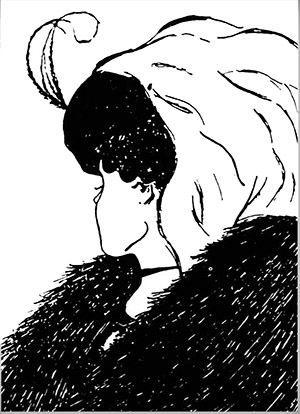
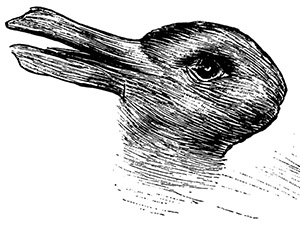
    For the left image, do you see a duck or a rabbit? For the image on the right, do you see a young woman or an old lady? These famous optical illusions help demonstrate how our sense of the world is mediated through ‘reality-tunnels’.

    The Harvard sociologist, Talcott Parsons, uses the word gloss to describe how our minds come to perceive reality. According to Parsons, we are taught how to “put the world” together by others who subscribe to a consensus reality based on shared beliefs, norms and associations.9 A gloss constitutes a total system of language and/or perception. For example, the word ‘house’ is a gloss since we lump together a series of isolated phenomena – floor, ceiling, window, lights, rugs, etc. – and turn it into a totality of meaning. 

    The author and anthropologist Carlos Castaneda commented on this notion, stating, “we have to be taught to put the world together in this way. A child reconnoitres the world with few preconceptions until he is taught to see things in a way that corresponds to the descriptions everybody agrees on. The world is an agreement. The system of glossing seems to be somewhat like walking… we learn we are subject to the syntax of language and the mode of perception it contains.”10 

    The French philosopher Jacques Derrida stated that our understanding of objects (and the words which denote them) are only understood in relation to how they are contextually related to other objects (and denotive words).11 

    We can break free from prescribed reality-tunnels by using objects and language in unusual or disjointed ways, thereby creating new discursive meanings, associations and connotations. This was the aim and outcome of certain art movements such as Dadaism and Surrealism, as well as Brion Gysin and William Burroughs’ cut-up method.12

    The famous ethnobotanist and psychonaut, Terence McKenna, argued that ideology and culture are tools “which give other people control over one’s experience and identity since they lead individuals to shape their identity according to pre-conceived forms. If a person identifies with commercial brands or with popular ideas of what is beautiful, true or important, they give away their power to other people.”13 McKenna once said that you should not see “culture and ideology as your friends,” implying that you should understand reality on your own terms rather than buying into “pre-packaged ideological and cultural ideals” such as communism, capitalism, democracy or some form of totalitarianism.14 Belief in itself, argued McKenna, was “limiting to the individual, because every time you believe in something you are automatically precluded from believing its opposite. By believing something, you are virtually shutting yourself from all contradictory information, thus once again performing the sin of imposing a rigid simplified structure upon an infinitely complex reality.”15

    Much like McKenna, Wilson recommends that a “fully functioning human ought to be aware of their reality tunnel and be able to keep it flexible enough to accommodate and, to some degree, empathise with different ‘game rules’, different cultures.”16 According to Wilson, constructivist thinking, which considers how social and cultural processes determine our perception of the world, constitutes an exercise in metacognition, enabling us to become aware of how reality tunnels are never truly objective, thereby decreasing the “chance that we will confuse our map of the world with the actual world.”17 

    How Your Reality Tunnel Is Formed

    The constraints of human biology partially limit our models of reality. As Wilson states, our DNA “evolved from standard primate DNA and still has a 98% similarity to chimpanzee (and 85% similarity to the DNA of the South American Spider Monkey). We have the same gross anatomy as other primates, the same nervous system and the same sense organs. While our highly developed pre-frontal cortex enables us to perform ‘higher’, more complex mental tasks than other primates, our perceptions remain largely within the primate norm.”18 

    The neural apparatus produced by our genetic coding helps create what ethologists call the umwelt, or “world-field.” Birds, reptiles and insects occupy a separate umwelt or reality-tunnel to primates (ourselves, included). For example, bees are able to perceive floral patterns in ultraviolet light, which we cannot (unless certain technologies are utilised). Canine, feline and primate reality-tunnels remain similar enough that friendship and communication can occur between these different species, however, a snake (for example) occupies such a different reality tunnel that their behaviour appears entirely alien. 

    As Wilson argues, the belief that human umwelt reveals “reality” or “deep-reality” is as “naïve as the notion that a yardstick shows more reality than a voltmeter or that ‘my religion is better than your religion’. Neurogenetic chauvinism has no more scientific justification than national or sexual chauvinisms.”19 He goes so far as to suggest that “no animal, including the domesticated primate, can smugly assume the world created by its senses and brain equal in all respects the ‘real world’ or the ‘only real world’.”20 

    Reality-tunnels are also influenced by “imprint vulnerability,” periods in our lives when early childhood/adolescent experiences “bond neurons into reflex networks which remain for life.”21 The psychological researchers, Lorenz and Tinbergen, won a Nobel Prize in 1973 for their research into imprinting, which demonstrated that “the statistically normal snow-goose imprints its mother, as distinct from any other goose, shortly after birth. This imprint creates a ‘bond’ and the gosling attaches itself to the mother in every possible way.”22 These imprints can be imposed onto literally anything. Lorenz observed a case in which a gosling, in the absence of its mother, imprinted a ping-pong ball. It followed the ping-pong ball around and, on reaching adulthood, “attempted to mount the ball sexually.”23 

    Wilson estimates that the age at which we are imprinted with language determines lifelong programs of “cleverness” (verbal intelligence) and “dumbness” (verbal unintelligence), since linguistic models enable us to articulate mental processing, evaluate complex ideas and communicate with those around us.24 Furthermore, how and when our first sexual experiences are imprinted can “determine lifelong programs of heterosexuality, brash promiscuity or monogamy etc.”25 In more obscure imprints, such as celibacy, foot-fetishism and sadomasochism, the “bounded brain circuitry seems quite as mechanical as the imprint which bounded the gosling to the ping-pong ball.”26 

    These examples suggest that experiences during childhood, when the brain exhibits optimal ‘neuroplasticity’ (a term used to refer to malleability of neural networks in the brain), can shape our reality tunnels far into adulthood. As Sigmund Freud proposed, many “rational” thoughts and behaviours are typically the result of “repressed” memories, impulses and desires, which dwell in the murky depths of the unconscious mind.27 

    Furthermore, reality-tunnels are shaped by social conditioning, the “sociological process of training in a society to respond in a manner generally approved by the society in general and peer groups within society.”28 Manifestations of social conditioning are multifarious but include nationalism, education, employment, entertainment, popular culture, spirituality and family life. Unlike imprinting, which usually requires only one powerful experience to set permanently into the neural networks of the brain, conditioning requires “many repetitions of the same experience and does not set permanently.”29 

    The processes of social conditioning vary greatly, depending on the cultural environment to which one is exposed. For example, an individual born in a Muslim country (such as Saudi Arabia) will likely believe in the teachings of the Quran and adhere to certain religious norms, customs and traditions. However, individuals born in a Western capitalist/consumerist country, or an Eastern country with Hindu or Buddhist traditions, will adhere to different cultural and behavioural codes. 

    Reality-tunnels are also formed through the process of learning. Much like conditioning, learning requires repetition, but it also requires motivation. Therefore, it plays “less of a role in human perception and belief than genetics and imprinting and even less than conditioning does.”30 Learning marks a major difference between how mammals, reptiles, insects and birds perceive the world. For example, snakes share the same reality tunnel since they merely act on biologically determined reflexes, with only minor imprinted differences. Mammals show “more conditioned and learned differences in their reality tunnels.”31 

    Humans demonstrate a higher aptitude for learning due to our highly developed cortex and frontal lobes as well as our prolonged infancy. This variability functions as “the greatest evolutionary strength of the human race” since it enables us to pass down knowledge from one generation to the next. But it also means that we can become brainwashed and label other people who do not share our beliefs as “mad,” “anti-social,” or “blasphemous.” In fact, it could be said that the majority of all wars are the result of two (or more) opposing reality tunnels fighting for supremacy. This is particularly evident in the case of religious conflict, where people kill each other in the name of “God.” 

    Tunnel Vision: The Politicisation of Reality

    The rise of “identity politics” in the 21st century perfectly demonstrates how reality-tunnels prevent us from considering alternative perspectives and viewpoints. During the last decade, the political domain has become increasingly polarised as the left and right engage in a battle for cultural supremacy. Such polarisation was apparent in the Brexit referendum of 2016, in which 51.9% of the British public voted to leave the European Union while 48.1% voted to remain.32 The marginal success of the ‘leave’ campaign highlighted the strong division between both sides of the political spectrum. The former stressed the importance of the Union in promoting social and economic stability, while the latter emphasised the importance of national identity, sovereignty and independence. 

    The rhetoric employed by both the ‘leave’ and ‘remain’ campaign was so binary in its articulation that neither side engaged in meaningful dialogue; instead, the referendum became a series of baseless slogans, mottos and catchphrases – an advertising campaign designed to appeal to target demographics. The referendum was more about two separate reality-tunnels competing for ideological supremacy than a balanced analysis of benefits and risks. 

    The US presidential election of 2016 was a similar drama of competing reality-tunnels, shaped by masterful spin doctors and hidden persuaders who exploited modern advertising techniques to capture specific demographics based on class, age, sex, religion, geographical location and other criteria. 

    Donald Trump was well-known for his campaign slogan ‘Make America Great Again’ and other catchphrases that employed a lexicon of patriotism, populism and protectionism to appeal to those on the right. On the other hand, Hillary Clinton used the slogan ‘Stronger Together’ to evoke feelings of unity, compassion, and solidarity. The election became a battle between two contrasting reality-tunnels, grounded in meaningless rhetoric and hyperbole. 

    Another example of politicisation is the Covid-19 crisis, with the public divided into two camps – those who supported measures such as lockdowns versus the other side that rejected many of these same measures. Political polarisation demolished a sane balanced approach to the crisis, exacerbated and intensified by the ongoing political divide across the media landscape. 

    ‘Echo Chambers’ & Identity Politics 

    Social media has fuelled identity politics by enabling groups and movements to generate an online presence and have real-world impacts. According to independent scholar and author Ilaria Bifarini, this results in the emergence of ‘echo chambers’ in which internet users “find information that validates their pre-existing opinions and activates confirmation bias.”33 This mechanism, says Bifarini, “strengthens one’s beliefs and radicalises them, without adding anything to information and knowledge. The result is the ideological extremism that we are observing today and in which we are taking part, where political debates have been replaced by supporters and verbal violence.”34 

    Another way this happens, for example, is how Google’s online video sharing and social media platform YouTube utilises algorithmic data to show users similar content to their prior engagements – content they are likely to engage with in the future, thus creating a feedback loop in which they are exposed to media reinforcing their political preferences.35 As media scholars Brooke E. Auxier and Jessica Vitak state, “many social media platforms structure their content-feeds based on what an algorithm determines to be the ‘top’ or most ‘relevant’ stories. While these tools may help users control their information and news environments – making consumption more manageable and mitigating information overload – it is possible that these tailoring tools will expose users to redundant information and singular viewpoints.”36

    Both sides of the political spectrum fail to engage in meaningful discussion when they are entrapped in a single reality-tunnel, the stability of which is threatened by competing narratives. Instead, political dialogue becomes characterised by inflammatory insults, name-calling and defamation. 

    Loaded language – such as ‘virtue signallers’, ‘snowflakes’, ‘racist’, ‘transphobic’, ‘Islamophobic’, ‘hetero-normative’, ‘privileged’ – enables identity groups to protect the integrity of their reality-tunnel by excluding those who hold a different opinion. In the same way that religious cult leaders isolate their members from the outside world, so too do identity groups orientate themselves around a closed belief system, which is immune to criticism, contention or challenge. 

    In order to facilitate a more meaningful discussion, it is important that both sides learn to break free from the constraints of their reality-tunnel. 

    Rising Above the Fray

    In his book Prometheus Rising, Robert Anton Wilson provides various techniques for challenging dominant reality tunnels. Writing in the early 1980s, Wilson suggested that “if you are a liberal, subscribe to the [conservative magazine] National Review… Each month try to enter their reality-tunnel for a few hours while reading their articles. If you are a conservative, subscribe to New York Review of Books for a year and try to get into their headspace for a few hours a month. If you are a rationalist, subscribe to Fate Magazine for a year. If you are an occultist, join the Committee for the Scientific Investigation of Claims of the Paranormal and read their journal, The Sceptical Inquirer, for a year.”37 

    To put a modern ‘spin’ on this exercise, if you follow conservative thinkers online such as Jordan Peterson or Ben Shapiro, expose yourself to leftist thinkers such as Slavoj Zizek or Noam Chomsky, and do the opposite if you are on the left. Subscribe to internet channels that do not align with your reality-tunnel. By performing this exercise, you will find that you can think about political issues in a more balanced, neutral and multidimensional way, free from the constraints of ideological dogma. 

    You can use the same technique with religion. In one exercise, Wilson says, “become a pious Roman Catholic. Explain in three pages why the Church is still infallible and holy despite Popes like Alexander VI (the Borgia Pope), Pious XII (ally of Hitler), etc.”38 Then explain why the Church is an immoral and outdated institution; also write three pages detailing why you believe this to be the case. If you have the time, you can perform the same exercise with other religions such as Hinduism, Buddhism, and even Satanism. Explain why these religions hold the key to the ‘true’ nature of ‘reality’ and then refute yourself by providing a counterargument.

    You can use the same technique to become more conspiratorial in your thinking. In one exercise, Wilson says, “start collecting evidence that your phone is bugged. Everyone gets a letter occasionally that is slightly damaged. Assume that somebody is opening your mail and clumsily revealing it. Look around for evidence that your co-workers or neighbours think you’re a bit queer and are planning to have you committed to a mental hospital.”39 Observe how these assumptions influence your perception of other people and their behaviour – it won’t be long before you find evidence to support your paranoid thinking! 

    Once you have sufficiently experimented with this reality-tunnel, “try living a whole week with the program, ‘Everybody likes me and tries to help me achieve all of my goals’.”40 Then try living a whole month with the program, “I have chosen to be aware of this particular reality.”41 Then try living a day with the program, “I am God playing at being a human being. I created every reality I notice.”42 Then try living forever with the metaprogram, “Everything works out more perfectly than I plan it.”43 By adopting these different reality-tunnels, you will notice how malleable your perceptual faculties really are – the world can become a place of conspiracy and collusion or a place of benevolence and positivity, depending on how you view it. 

    Get the issue this article appears in

    Wilson provides another interesting exercise to expand the boundaries of consciousness, in which you “list at least 15 similarities between New York (or any large city) and an insect colony, such as a bee-hive or termite hill. Contemplate the information in the DNA loop, which created both of these enclaves of high coherence and organisation, in primate and insect societies.”44 Then, “Read the Upanishads and every time you see the word ‘Atman’ or ‘World Soul’, translate it as DNA blueprint. See if it makes sense to you that way.”45 According to Wilson, “Contemplating these issues usually triggers Jungian synchronicities. See how long after reading this chapter you encounter an amazing coincidence – e.g., seeing DNA on a license plate, having a copy of the Upanishads given to you unexpectedly…”46

    Experimenting with different reality tunnels is a necessary practice if one wishes to challenge dominant narratives, perspectives and viewpoints and expand the boundaries of human consciousness. As we find ourselves in a post-modern ‘information age’, where an increasing number of political factions compete for informational authority, we are exposed to the hidden forces of propaganda more than ever before. 

    Every time we log into Facebook, Twitter, Instagram and YouTube, we allow ourselves to be manipulated by a complex system of algorithms that generates content based on our likes, dislikes, and even our differences. In order to escape the trappings of ideological dogma, we must become conscious of our biological, social and environmental conditioning and adopt a more multidimensional way of thinking. 

    Understanding about ‘reality-tunnels’ becomes instrumental in achieving true inner liberation since it enables us to think about the mind as a form of technological software that can be continually updated and reorganised. We achieve a state of metacognition, an awareness of one’s thought processes and an understanding of the patterns behind them. It is what the pioneering mind explorer John Lilly called our capacity for “metaprogramming,” the creation, revision, and reorganisation of mental programs.47

    Although we are constrained by the limitations of biological programming (to a certain extent), the creativity of human consciousness is infinite, a maze of endless possibilities and potentialities waiting to be explored. As the Buddha said, “All that we are is the result of all that we have thought. It is founded on thought. It is based on thought.”48 

    [alert type=”general” dismiss=”no”]This article was published in New Dawn 187.[/alert]

    [alert type=”success” dismiss=”no”]If you appreciate this article, please consider subscribing to help maintain this website.[/alert]

    Footnotes

    1. Hartogsohn, I. (2015). The Psychedelic Society Revisited: On Reducing Valves, Reality Tunnels and the Question of Psychedelic Culture, Psychedelic Press, 3 
    2. http://ultrafeel.tv/reality-tunnel-how-beliefs-and-expectations-create-what-you-experience-in-life
    3. Op cit., Hartogsohn, I. (2015), 4
    4. https://en.wikipedia.org/wiki/Confirmation_bias 
    5. Anton Wilson, R. (1983). Prometheus Rising, Tempe, Arizona: New Falcon
    6. https://en.wikipedia.org/wiki/Immanuel_Kant
    7. https://en.wikipedia.org/wiki/Reality_tunnel
    8. Ibid 
    9. Parsons, T. (1951). The Social System, Glencoe, Illinois: The Free Press, 1951
    10. Sam Keen, Castaneda interview, Psychology Today, December 1972
    11. Derrida, J. (1978). ‘Genesis’ and ‘Structure’ and Phenomenology, in Writing and Difference, Routledge. 
    12. https://en.wikipedia.org/wiki/Dada
    13. Op cit., Hartogsohn, I. (2015), 1
    14. Ibid, 2
    15. Anton Wilson, R. (1990). Quantum Psychology: How Brain Software Programs You & Your World, New Falcon Publications
    16. https://en.wikipedia.org/wiki/Reality_tunnel 
    17. Quantum Psychology, 74
    18. Ibid, 74
    19. Ibid, 75
    20-24. Ibid, 76
    25-26. Ibid, 76-77
    27. Wollheim, R. (1971). Freud, Fontana Press
    28. https://en.wikipedia.org/wiki/Social_conditioning 
    29. Quantum Psychology, 77
    30. Ibid
    32. Ibid
    33. Bifarini, I. Cognitive bias and echo chambers: The social media trap, www.academia.edu/40650380/Cognitive_bias_and_echo_chambers_The_social_media_trap
    34. Ibid
    35. Nguyen, C. Echo Chamber and Epistemic Bubbles, www.academia.edu/36634677/Echo_Chambers_and_Epistemic_Bubbles 
    36. Auxier, B. and Vitak (2019). Factors Motivating Customization and Echo Chamber Creation Within Digital News Environments. Social Media and Society, April-June 2019
    37. Prometheus Rising, 83
    38. Ibid, 159
    39. Ibid, 241
    40-43. Ibid, 242
    44-46. Ibid, 190
    47. Lilly, John C. Programming & Metaprogramming in the Human Biocomputer, New York: The Julian Press, Inc., 1967
    48. The Dhammapada

    © New Dawn Magazine and the respective author.
    For our reproduction notice, click here.
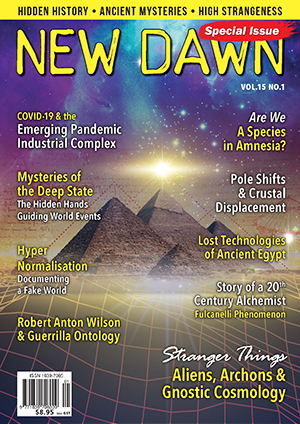
  • Robert Anton Wilson & Guerrilla Ontology

    Robert Anton Wilson & Guerrilla Ontology

    From New Dawn Special Issue Vol 15 No 1 (Jan 2021)

    Although we are in the midst of an ‘information revolution’, many of us rarely question the world around us. As the political domain becomes increasingly polarised, there is a greater need for people to expose themselves to alternative viewpoints and opinions. 

    In theory, the internet should function as an open platform in which mainstream narratives are continually challenged, questioning the institutional authority of governments, multinational corporations and the mainstream press. 

    Thankfully, we can question the ‘status-quo’ thanks to numerous websites, online forums and podcasts dedicated to alternative points of view and research, including parapsychology, geopolitics and ‘conspiracy culture’. At the same time, the rise of social media has resulted in more subtle yet dangerous forms of propaganda and mind control where people are often unknowingly exposed only to those who hold similar views to their own, stuck in a ‘social validation feedback loop’.

    How can we stay open-minded, questioning and pragmatic in today’s world? Guerrilla ontology may provide the answer.

    What is Guerrilla Ontology?

    Guerrilla ontology is a term coined by Robert Anton Wilson in his 1980 book The Illuminati Papers. Wilson defines it as an approach adopted in his novels that mixes “the elements of each book so that the reader must decide on each page, ‘How much of this is real and how much is a put on?’”1 In other words, it functions as an exercise in cognitive dissonance, where “readers are left to form their own interpretation as to which, if any, of the numerous and contradictory viewpoints presented by the characters are valid or plausible.”2 This is similar to the postmodernist claim that textual discourse can be interpreted in a number of different ways (potentially infinite) since there is no singular interpretation. Guerrilla ontology is much more than a literary technique, however. As Wilson stated in an interview: 

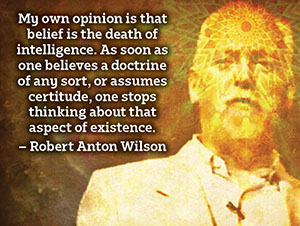
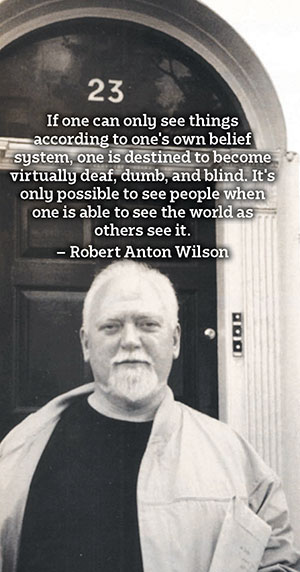
    The Western World has been brainwashed by Aristotle for the last 2,500 years. The unconscious, not quite articulate, belief of most Occidentals [Westerners] is that there is one map which adequately represents reality. By sheer good luck, every Occidental thinks he or she has the map that fits. Guerrilla ontology, to me, involves shaking up that certainty. I use what in modern physics is called the “multi-model” approach, which is the idea that there is more than one model to cover a given set of facts… It’s important to abolish the unconscious dogmatism that makes people think their way of looking at reality is the only sane way of viewing the world. My goal is to try to get people into a state of generalised agnosticism, not agnosticism about God alone, but agnosticism about everything… That’s what guerrilla ontology is – breaking down this one-model view and giving people a multi-model perspective.3

    In other words, the primary aim of guerrilla ontology is to remain in a permanent state of agnosticism and interpret reality through a multitude of cultural, political, economic, philosophical, scientific and spiritual perspectives. Instead of subscribing to a single belief system, guerrilla ontology promotes a radical form of intellectual pragmatism in which contrasting ideologies are synthesised, integrated and assimilated to provide a more complex and dynamic understanding of the world. 

    Wilson assumes there is no ‘objective’ reality; even basic statements such as “there are 24 hours in a day” or “the world is round” are subjectively determined. This multi-modal approach results in an expansion of human consciousness in which all explanatory models are considered both ‘true’ and ‘false’ simultaneously. 

    To fully appreciate the implications of guerrilla ontology, it is crucial to know the meaning of the terms. Ontology is the branch of metaphysics concerned with the nature of existence or being, while guerrilla in this context refers to military tactics used by fringe groups to obtain political power – acts of sabotage, ambushes, raids and hit-and-runs. Guerrilla ontology could be considered a form of philosophical warfare in which the ontologist attempts to undermine authority by subverting the symbols, signs and semiotic systems through which power is exercised and maintained. Using specialised tactics such as culture jamming, reality-hacking, subvertising and meme-magic, the ontologist becomes an active participant in the cultural arena and generates new locations of meaning. Fomenting contradictory ideas induces a sense of confusion and disorientation, causing a malfunction in the psychological programming required for ideological control to function effectively. In this sense, guerrilla ontology is a subversive exercise, a rebellion against all ‘reality tunnels’ that govern perception and narrative. 

    For Wilson, internet technologies can play a fundamental role in challenging our ideological assumptions, creating a decentralised matrix of information where no singular worldview is predominant. Various public and private actors compete for cultural authority, undermining the very concept of ‘truth’ as we know it. As communication networks become increasingly globalised, there is greater exposure to different ideas, theories, concepts and perspectives. People find themselves in a position where they can no longer distinguish between ‘fact’ and ‘fiction’. While there are dangers that this could lead to new forms of manipulation and control, it will also result in a new era of intellectual creativity, dynamism and fluidity. As Wilson states, this ‘information revolution’ is merely a continuum of an ongoing historical trend towards cultural relativism:

    When people started trading and having commerce with one another, they had to learn things the way other people saw them. As a result, some sense of cultural relativism appeared in the ancient Greeks, who were great traders. I think that’s what’s responsible for the rise in Greek Philosophy. Unfortunately, this has always remained a minority point of view because of the entrenched power of dogmatic thought. With the rise of modern electronics, however, things have begun to change faster. We’re now living in the global village which Buckminster Fuller and Marshall McLuhan have long been predicting. I’ve actually met people in their 20s who have travelled to as many as 30 different countries in their lives. With that amount of travel and the emergence of modern electronic media, more and more people are developing a sense of cultural relativism [Wilson made these statements in 1980].4

    In this sense, guerrilla ontology enables us to navigate the new ‘post-truth’ age, where user-generated content undermines the informational monopoly of mass-media gatekeepers and popularises alternative narratives, which would have previously remained on the fringes of society. 

    As previously noted, the purpose of guerrilla ontology is to induce a state of cognitive dissonance in which seemingly contradictory worldviews are assimilated in order to expand the boundaries of human consciousness. For Wilson, internet technologies are part of this expansion of consciousness as more and more people are exposed to different models of reality. 

    Cognitive Dissonance & Quantum Mechanics

    While the multi-model approach described by Wilson seems at odds with the notion of ‘scientific truth’ – that we can establish certain facts about the world through empirical observation – even scientists are required to adopt a multi-model approach when describing phenomena at a quantum level. 

    When examining the behaviour of sub-atomic particles, the principles of Newtonian physics are no longer applicable. Instead, scientists must explain such phenomenon in terms of ‘probabilities’, the different outcomes that occur within a quantum system until the act of measurement results in the occurrence of a single outcome. For example, quantum mechanics demonstrates that light functions as both a particle and a wave, despite the fact that the former has a gravitational mass while the latter does not.5 In this sense, we are limited by the linguistic models that we have at our disposal when observing scientific phenomena. 

    Niels Bohr, the Danish physicist who proposed the Copenhagen Interpretation of quantum mechanics, believed that mathematical equations do not describe the universe with objective precision. Rather, they describe the “mental processes that we have to put ourselves through to describe the universe.”6 For example, when we describe the universe as a three-dimensional space-time continuum, we are actually describing how our minds organise sensory experience; another life-form may experience reality as fourth or even fifth dimensional, and therefore the equations they use to describe reality will be radically different from our own. For Wilson, guerrilla ontology (or cognitive dissonance) is based on the idea that by embracing seemingly contradictory models of the world, we become aware of our own relativistic position within the universe. 

    Religions have known for centuries that cognitive dissonance expands the parameters of the mind. As Wilson states, “most of the occult literature of the world – aside from the 95% of it that is sheer rubbish – consists of tricks, gimmicks and games to trigger meta-programming consciousness.”7 

    The Upanishads, an ancient text central to Hinduism, is full of various paradoxes, intended to spiritually enlighten the reader. For example, it describes Brahman (the ultimate reality) as “non-differentiated, infinite, having neither cause, nor example, immeasurably extensive and without beginning… There is no dissolution, nor creation, neither one bound, nor the novice, neither the seeker after freedom, nor the liberated one.”8 These contradictions reveal what modern science is only beginning to discover – that reality is merely an expression of dynamic conscious thought. 

    Changing the Brain

    In his book Prometheus Rising, Wilson provides numerous techniques to achieve a state of cognitive dissonance. For example, he asks his readers to buy a copy of Christian Science Sentinel and read all the faith healings that month, then buy a copy of The Peyote Cult by anthropologist Weston LeBarre which attributes all this to auto-suggestion, and then read Brain/Mind Bulletin and observe that similar healings are attributed to endorphins in the brain. After that, re-read all the miracles in the New Testament, using each of these filters: Jesus had the correct teaching; Jesus was employing auto-suggestion; the sufferers’ brains released endorphins when Jesus gave them positive auto-suggestion. By examining the phenomenon of faith-healing through a multitude of perspectives, one realises that no single explanation is valid, causing a paradigmatic shift in understanding. 

    According to Wilson, when a paradigm shift occurs – when we go from seeing things one way to seeing them another – “the whole world is remade.”9 All we can possibly ‘know’ is what our mind registers – reality is made up of nothing but thoughts. The brain, in the process of performing 100,000,000 calculations per minute, edits, organises and labels all raw “existential” experience and then classifies according to our belief systems. These systems will vary from culture to culture. What is ‘real’ to a native Inuit will not be the same as what is ‘real’ to a London taxi-driver. They occupy different ‘reality-tunnels’ since their social, economic, political and environmental perceptions of the world are radically different. Wilson describes this phenomenon as “neurological relativism” – each individual has a neurological system different from other members of the same society, enabling them to perceive reality in a unique way. 

    Through the practice of guerrilla ontology, one is aware that the mind and its contents are ‘functionally identical’ – the distinction between ‘me’ (mental awareness) and ‘not me’ (external reality) is merely a linguistic one. We become what Wilson calls “metaprogrammers,” individuals with the ability to continually recalibrate our “reality-tunnels.” 

    The metaprogramming circuit – known as the “soul” in Gnosticism, the “no-mind” in China, the “White Light of the Void” in Tibetan Buddhism, Shiva-darshana in Hinduism, the “True Intellectual Centre” in Gurdjieff – simply represents the brain becoming aware of itself.10

    Wilson describes it as “the artist seeing himself in his painting, seeing himself seeing himself in his painting… It is a conscious mirror that knows it can always reflect something else by changing the angle of its reflection.”11

    Modern psychology demonstrates that neural networks in the brain are able to change through reorganisation, a phenomenon described as neuroplasticity. These changes “range from individual neurons making new connections, to systematic adjustments like cortical remapping.”12 Neuroscientists used to believe that neuroplasticity only occurred during childhood, but modern research has now proven the brain can be altered during adulthood as well. Learning a new language is particularly valuable in this regard; various studies suggest that multilingualism not only restructures the brain but also boosts its capacity for plasticity. As Wilson argues, guerrilla ontology is similar to learning a language since it provides us with new ways of interpreting sensory experience. In the same way that foreign words and phrases allow us to see the world differently, so too do new belief systems expand the boundaries of human consciousness. Through meta-programming (exposing oneself to contradictory models of reality), we are able to rewire the very circuitry of our brains, resulting in more fluid and dynamic modalities of thought. 

    Conclusion

    Guerrilla ontology is a powerful tool for breaking free from the shackles of ideology. As our world becomes increasingly complex, due to the forces of globalisation and technological acceleration, it is important that we possess the ability to transform our social, political, economic, philosophical, scientific and religious beliefs. 

    Those who remain in bondage to a single ‘reality-tunnel’ will inevitably get swept up in the tsunami of information and manufactured narratives. Many people will undoubtedly experience ‘existential crises’ as they encounter numerous theories, models, concepts and frameworks that challenge the stability of their foundational worldview. 

    To navigate what French philosopher Guy Debord called “The Society of the Spectacle,” in which authentic social life has been replaced with its representation – “All that once was directly lived has become mere representation”13 – we must learn to embrace a multi-model approach. While it is important that we remain sceptical of how internet technologies are used to manipulate our thinking, the ‘information age’ allows us to become more open-minded than ever before. As Aleister Crowley once famously stated, “Man is ignorant of the nature of his own being and powers. Even his idea of his limitations is based on experience… There is no reason to assign theoretical limits to what he may be, or what he may do.”14

    [alert type=”general” dismiss=”no”]This article was published in New Dawn Special Issue Vol 15 No 1.[/alert]

    [alert type=”success” dismiss=”no”]If you appreciate this article, please consider subscribing to help maintain this website.[/alert]

    Footnotes

    1. https://guerrillaontologies.com/about/
    2. https://en.wikipedia.org/wiki/The_Illuminatus!_Trilogy#Cognitive_dissonance 
    3. J. Elliot, (1980) ‘Robert Anton Wilson: Searching for Cosmic Intelligence’, available at http://rawilsonfans.org/searching-for-cosmic-intelligence-interview-1980/ 
    4. Ibid.
    5. https://en.wikipedia.org/wiki/Light
    6. R. Wilson, (1983) Prometheus Rising, New Falcon Publications
    7. Ibid.
    8. The Yoga Upanishads (available at) https://archive.org/stream/TheYogaUpanishads/TheYogaUpanisadsSanskritEngish1938#page/n63/mode/2up
    9. R. Wilson, Prometheus Rising
    10. Ibid. 
    11. Ibid. 
    12. https://en.wikipedia.org/wiki/Neuroplasticity
    13. https://en.wikipedia.org/wiki/The_Society_of_the_Spectacle
    14. A. Crowley, (1929) Magick in Theory and Practice, Dover Publications

    © New Dawn Magazine and the respective author.
    For our reproduction notice, click here.
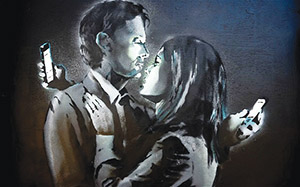
  • Magical Words: General Semantics & the Power of Language

    Magical Words: General Semantics & the Power of Language

    From New Dawn 181 (Jul-Aug 2020)

    Words hold incredible power. When used poetically, they can evoke the most primal of passions within us. When used destructively, they can wage war and create conflict. When used imaginatively, they can create fantastic worlds of fantasy. When used persuasively, they can seduce us into the empty promises of commercial advertising. When used benevolently, they can facilitate social, economic and political change. Words can be used to control us, motivate us and inspire us, and yet many of us are unaware of their hidden esoteric power. 

    It could be argued that words have a life of their own. They have a reality independent of our own existence. As the writer William Burroughs observed, certain words and phrases function in a similar way to a virus (see page 40); they spread from person to person until they become embedded in our collective consciousness. One only has to look at the countless memes that become ‘viral’ on the internet to acknowledge their inherently infectious quality. 

    The biologist and writer Richard Dawkins argues that words operate in a similar way to DNA. Concepts and ideas battle against each other for survival and those which are successful become populated across societies. He writes: “Just as genes propagate themselves in the gene pool by leaping from body to body via sperms or eggs, so memes propagate themselves in the meme pool by leaping from brain to brain via a process which, in the broad sense can be called imitation.”1

    Politicians are particularly aware of the power that language holds over us. During the US presidential campaign in 2008, Barack Obama employed a lexicon of ‘hope’ to instil a feeling of optimism in marginalised communities, and envision a more compassionate America. When Donald Trump was elected to the White House in 2016, the term ‘alternative facts’ became popular among the conservative right of politics to discredit what different news outlets were reporting on various scandals surrounding the new administration. The use of rhetoric proved highly important during the UK’s ‘Brexit’ referendum in 2016, which saw both sides of the political spectrum using highly emotive language to divide voters on key issues. As the linguist Noam Chomsky observes, words are the ultimate currency of political power and are manipulated to create a sense of tribal kindship within certain electoral factions.2 

    Commercial businesses are also aware of the hypnotic effects of language. Each year, corporations spend billions of dollars investing in advertising campaigns to promote products and target consumer demographics. Much of the time, they use loaded language – words with positive or negative connotations to describe a product or that of a competitor. These words appeal to consumers’ emotions, rather than their logical faculties, thereby fetishizing the product being sold. For years, the Coca-Cola Company used the phrase, “the pause that refreshes,” to convey the image (and implant the memory) of the refreshment brought on by consuming a bottle of fizzy coke. These advertising phrases have a memetic quality and become embedded in our collective unconscious, acquiring a mythological status as they get passed on from person to person. 

    Occultists, mystics and shamans have always been familiar with the power of words. One only has to look to religions such as Hinduism and Buddhism and the use of mantras to recognise how language invokes intense feelings of spiritual connection. In Christian cosmology, one of its key precepts reads: “In the beginning was the Word, and the Word was with God and the Word was God.”3In all forms of magic and occultism, secret words and combinations of words were of paramount importance. The fact that the word ‘spell’ is used to denote how certain words are organised is testament to the magical power of language. 

    But how powerful is language? We know that language can affect how we feel but can it also shape our perception? To what extent are our experiences of the world influenced by the modes of communication we use each day? 

    Korzybski & General Semantics 

    Alfred Korzybski (1879–1950)

    In 1933, the Polish-American scholar Alfred Korzybski published his seminal work, Science and Sanity: An Introduction to Non-Aristotelian Systems and General Semantics.4 The book established a new school of thought, General Semantics, which studies the relationship between language and reality. 

    Although the book was criticised at the time of publication, Korzybski’s ideas were subsequently developed by the American academic S.I. Hayakawa in Language in Thought and Action.5 Since then, General Semantics has become a systematic philosophy of linguistics, influencing a variety of academic disciplines. As the American linguist Benjamin Lee Whorf noted, General Semantics is the examination of how language “isolates the world of phenomena into categories and organise[s] the categories in our minds by means of our linguistic system; our speech communities slowly codify the patterns of language in such a way that its terms become absolute and obligatory and therefore we cannot communication without subscribing to the organisation and classifications that the language decrees.”6 

    The first premise of General Semantics is that language never constitutes reality but merely describes it. As Korzybski stated, “every language having a structure, by the very nature of language, reflects in its own structure that of the world as assumed by those who evolve language.” Because language is diagrammatic, the words we use are never equal to the event, person, object or experience that we are describing. For instance, an individual who has acted outside the law may be described as ‘criminal’, however, another person may describe them as ‘responsible’ because they are a good father to their children; neither description is true but neither description is false either. In this sense, language cannot be considered a representation of the world since it depends on the exclusionary categorisation of phenomena to effectively function as a communicative tool.7 

    The second premise of General Semantics if that language never describes reality in its entirety. Korzybski famously said “the map is not the territory.” For example, when I describe a person as ‘happy’, I am excluding all the times that they have experienced anger, depression or jealousy. When I describe a person as ‘respectable’, I am disregarding all the times they have jumped a red light or pushed into a queue. In other words, our linguistic models may be considered inaccurate since they describe events, experiences, objects and people from a single position of space-time, rather than all potentialities simultaneously.8 

    The third premise of General Semantics is that in order for us to use language more meaningfully, we must constantly re-evaluate our assumptions about reality. As Korzybski stated, “no map can be accurate unless it contains itself within the map.” That is to say, when we attempt to describe reality using a particular linguistic model we must be aware that our descriptions are limited by the information that we have at that particular time. For example, prior to Einstein’s theory of relativity, it was common for scientists to describe space and time as separate aspects of the physical universe; we now describe them as being part of a space-time continuum. In this sense, all linguistic models are grounded in the limited knowledge we have of the world around us; they must be constantly updated and revised to account for recent developments in our understanding.9

    As Korzybski observed, language can influence our thoughts, feelings and behaviour. I may call a person an ‘idiot’ because they have acted foolishly or made an error of judgement, but labelling them in such a categorical manner may result in me acting differently towards them than if I had said, “at this particular time, in this particular place, this person is acting foolishly.” By recognising the assumptions that underlie our linguistic models, we can become more pragmatic in our descriptions of the world; we can assume greater control over language and use it to our advantage. The American author, poet and futurist Robert Anton Wilson said: “Those who control symbols control us. You might as well say those who control symbols have the whole world hypnotised. You better become a controller of symbols yourself or you’re going to remain in a trance, a self-hypnotic ideational trance that somebody else laid on you.”10 

    Korzybski is not alone in thinking that language and thought are inextricably linked. Cognitive scientist Lera Boroditsky claims that, “Linguistic processes are pervasive in most fundamental domains of thought, unconsciously shaping us from nuts and bolts of cognition and perception to our loftiest abstract notions and major life decisions.”11 David Ludden, professor of psychology at Georgia Gwinnett College, also believes that “each language carves up the world somewhat differently… each language provides its speakers with a particular worldview that won’t be quite the same as the one that speakers of other languages have. In other words, we see the world according to the framework our language imposes on us.”12

    When you think about it, the notion that language and cognition are fundamentally connected is not a particularly radical one; our thoughts, feelings and behaviours are constantly influenced by our choice of words. Anyone who has been around a person with an exceptionally optimistic attitude knows that positivity is infectious, it rubs off on you. In the same way, negative words and phrases become part of a psychological feedback-loop that reinforce our feelings of depression and negativity. Advertising is such a powerful tool of the capitalist system because language can be strategically used to place us in a hypnotically induced state of emotion, whereby we associate certain feelings with specific words, logos and expressions. 

    Language & Sensory Perception

    Many academics criticise Korzybski’s assertion that language shapes experience, arguing that our linguistic models embody the neurological structure of the brain. However, scientific research into the relationship between language and sensory perception demonstrate that the scope of our vocabulary can actually modify our experiences of reality. In 2008, psychologists from the University of London tested how speakers of English and Himba – a language spoken in northern Namibia – categorised colours presented to them on a computer screen. The Himba language classifies colours in a different way to English. For example, Himba does not contain separate words for green and blue (both use the word buru), whereas English does. Moreover, Himba uses different words to distinguish between various shades of green (dambu and zuzu to light and dark green), while English classifies both dark green and light green as members of the general category ‘green’.13

    The researchers found that this linguistic difference also translated into a perceptual difference: when shown a circle with 11 green squares and one blue square, Himba speakers struggled to indicate which one was different from the others. However, when they were presented with 12 green squares, one of which was slightly lighter than the others, the pattern reversed: Himba speakers readily identified the different shade, however English speakers failed to do so. In other words, speakers of both languages were better at distinguishing between colours that had a linguistic distinction in their language. English speakers, whose language classifies ‘green’ and ‘blue’ separately, found it easier to distinguish between the two. Himba speakers, on the other hand, whose language encodes differences between shades of green, had no difficulty in differentiating between various green hues. 

    Similarly, a study conducted by Jonathan Winawer and his research colleagues at the Massachusetts Institute of Technology found that native speakers of Russia discriminated between light and dark shades of blue differently to their English-speaking counterparts. Unlike English, the Russian language makes a linguistic distinction between light blue, pronounced ‘goluboy’, and dark blue, pronounced ‘siniy’. The researchers tested English and Russian speakers in a timed colour discrimination task, using blue stimuli that spanned the siniy/goluboy border. The data revealed that Russian speakers were much quicker at discriminating between the two colours because of this linguistic differentiation. The research demonstrates that when people have access to wider vocabulary to describe colours, their sensory perception of colour actually becomes more acute.14 

    It turns out that grammatical structures can also influence perception. Many languages are gendered, meaning that speakers are required to modify pronouns, adjectives and verb-endings depending on whether a noun is ‘feminine’ or ‘masculine’. In the Russian language, for example, the word ‘chair’ is considered masculine and therefore any sentence containing the word must adhere to a ‘masculine’ grammar structure. Assigning a gender to a particular word does not just change the structure of a language but also our perception of certain objects. In a study conducted by Lera Boroditsky, Assistant Professor of Cognitive Science at University of California San Diego, researchers found that when asked to describe an object, speakers were more likely to use adjectives associated with its assigned gender. For example, in the German language, ‘bridge’ carries a feminine pronoun, and therefore Germans were more likely to refer to a bridge as ‘beautiful’ or ‘elegant’. Spanish speakers, on the other hand, were more likely to refer to a bridge as ‘strong’ or ‘sturdy’ because the word is masculine in the Spanish language.15

    The Implications of General Semantics 

    The fact that language can shape our reality so viscerally has significant implications. It demonstrates that words have the power to contextualise our perceptual experiences and influence how we see the world. If we are to engage in open and honest discussions about social, political and economic issues, we need to understand how language can be manipulated, controlled and even abused. 

    In the age of social media, where our thoughts and opinions are condensed to 140 characters, we must question the biases, assumptions and preconceptions that underlie our current linguistic models. Much of our disagreements stem from the fact that we are limited by our language; we are prisoners to a particular linguistic system that does not account for the nuances of our reality. 

    Take the abortion debate. Many people are divided on this particular issue because they have different perceptions of what is meant by the word ‘life’. Some believe that a small cluster of cells constitutes ‘life’, while others believe that ‘life’ must possess a consciousness; a human awareness. In this sense, the boundaries of political engagement are essentially calibrated by the linguistic models to which we have access. 

    If language has the potential to alter our perception of colour, it surely has the potential to alter our perception of people, communities and societies. Once we understand the power that words have over us, we can begin to assume greater control over the symbol-systems that govern our lives; we can recognise when language is being used to control, deceive and misinform us. It is only then that we can use language more honestly and meaningfully. 

    [alert type=”general” dismiss=”no”]This article was published in New Dawn 181.[/alert]

    [alert type=”success” dismiss=”no”]If you appreciate this article, please consider subscribing to help maintain this website.[/alert]

    Footnotes

    1. The Selfish Gene by Richard Dawkins, Oxford Paperbacks, 1989
    2. Language and Politics by Noam Chomsky, AK Press, 2004
    3. John 1:1, The Holy Bible, New International Version, 2011
    4. Science and Sanity: An Introduction to Non-Aristotelian Systems and General Semantics by Alfred Korzybski, Institute of General Semantics, 1995
    5. Language in Thought and Action by S. I. Hayakawa, George Allen & Unwin Ltd., 1959
    6. Language, Thought and Reality by Benjamin Lee Whorf, MIT Press, 1964
    7. Science and Sanity, Korzybski
    8. Language in Thought and Action, Hayakawa
    9. Science and Sanity, Korzybski
    10. Lecture by Robert Anton Wilson, www.generalsemantics.org/wp-content/uploads/2011/04/gsb-65-wilson.pdf
    11. How does our Language Shape the Way We Think? by Lera Boroditsky, https://www.edge.org/conversation/lera_boroditsky-how-does-our-language-shape-the-way-we-think
    12. How Language Shapes Our World by David Ludden Ph.D, https://www.psychologytoday.com/gb/blog/talking-apes/201509/how-language-shapes-our-world
    13. Knowing Colour Terms Enhances Recognition: Further Evidence from English and Himba by Julie Goldstein, Jules Davidoff and Debi Roberson, Journal of Experimental Child Psychology 102 (2009) 219-238
    14. The Russian Blues Reveal Effects of Language on Colour Discrimination by Jonathan Winawer, et al, Proceedings of the National Academy of Sciences of the United States of America, 2007; 104(19): 7780-7785 
    15. Language in Mind: Advances in the Study of Language and Thought, edited by Dedre Gentner and Susan Goldin-Meadow, MIT Press, 2003

    © New Dawn Magazine and the respective author.
    For our reproduction notice, click here.