New Dawn – World's Most Unusual Magazine

Author: Richard Smoley

  • Revisiting Joseph Campbell: The Power of Myth

    Revisiting Joseph Campbell: The Power of Myth

    From New Dawn 144 (May-June 2014)

    Perhaps myth first arose out of the answers parents give to their children’s questions. Many of these are unanswerable: Why is water wet? Why is fire hot? Where does everything come from? Who is God? Because people like to tell stories, it makes sense that parents would make up tales, far-fetched, elaborate, but sometimes beautiful, to satisfy this curiosity. The best of these would be passed down from generation to generation to form the body of worldwide myth.

    Even so, this explanation does not tell us why myths are so powerful. Why should these stories have continued to be told for thousands of years? What meaning do they have and what role do they play in our lives?

    The modern study of myth, and its close cousin, religion, began around the Enlightenment, when polymaths began to compile the traditions of non-Western peoples. They also tried to find common elements in these traditions. Most of their answers today look naïve and simplistic.

    The mid-nineteenth-century British author Hargrave Jennings, for example, saw the origins of all the world’s religions in “phallicism,” a worship of the sexual force as well as of the sun and fire. J.G. Frazer, author of The Golden Bough and revered as one of the founders of the discipline of anthropology, said that myths, particularly of the death-and-resurrection variety, were merely recapitulations of the yearly vegetative cycle of growth, death, and renewal (a view known to, and derided by, Plutarch in the first century CE).

    In the twentieth century, Émile Durkheim, one of the founding fathers of sociology, held that religion was nothing more than a primitive abstraction and internalisation of social forces: “Society in general, simply by its effect on men’s minds, undoubtedly has all that is required to arouse the sensation of the divine. A society is to its members what a god is to its faithful.” For the Swiss psychiatrist C.G. Jung, myth and religion expressed a deep layer of the mind that he called the collective unconscious.

    All these views are true. There are many sexual motifs in myths and religion. Societies do unite themselves by means of common myths. There are underlying patterns of myth that seem universal, even among peoples who are far-flung and isolated. But these are only partial truths.

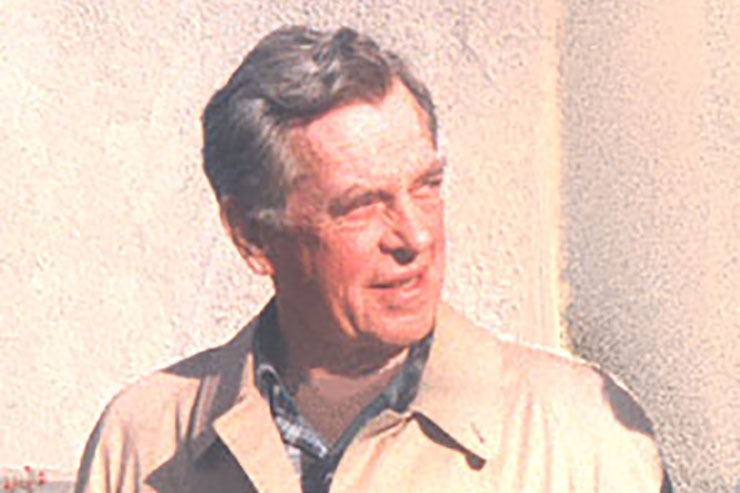
    One of the most comprehensive – and best-known – discussions of myth appears in the writings of the American scholar Joseph Campbell (1904-87). Campbell’s view, expressed in books such as The Hero with a Thousand Faces and the Masks of God series, and in a famous series of televised interviews with the journalist Bill Moyers entitled The Power of Myth, is probably the most influential of all twentieth-century attempts. In many ways it is also the most wide-ranging and comprehensive.

    Unlike his predecessors, who tended to see myth in one-dimensional terms (the product of social pressures, the expression of the collective unconscious, and so on), Campbell acknowledged that myth filled all of these functions. In Creative Mythology, the last volume of his Masks of God series, he writes:

    The first function of a mythology is to reconcile waking consciousness to the mysterium tremendum et fascinans [the terrifying and fascinating mystery] of this universe as it is: the second being to render an interpretative total image of the same, as known to contemporary consciousness. Shakespeare’s definition of the function of his art, “to hold, as ’twere, the mirror up to nature,” is thus equally a definition of mythology. It is the revelation to waking consciousness of the powers of its own sustaining source.

    A third function, however, is the enforcement of a moral order, the shaping of the individual to the requirements of his geographically and historically conditioned social group. [Emphasis here and in other quotes is in the original.]

    These sentences summarise the mythological theories up to Campbell’s time, but they do not complete the picture. He goes on: “The fourth, and most vital, most critical function of a mythology… is to foster the centring and unfolding of the individual in integrity, in accord with d) himself (the microcosm), c) his culture (the mesocosm), b) the universe (macrocosm), and a) that awesome ultimate mystery which is both beyond and within himself and all things.” For Campbell, this fostering of individual potential is the most important function of myth. It is also the one to which he devotes the greatest part of his work.

    The Hero

    Following C.G. Jung, Campbell closely links dream and myth, emphasising how mythic themes appear in the dreams of ordinary people, even those who have never heard the original tales. Every man is a hero, living out these themes in the trials of daily life. “The latest incarnation of Oedipus, the continued romance of Beauty and the Beast, stand this afternoon on the corner of Forty-second Street and Fifth Avenue, waiting for the light to change.”

    This quotation comes from The Hero with a Thousand Faces, published in 1949 and certainly the most influential of Campbell’s works. Its outline of the hero’s journey, drawing upon myths and lore from around the world, has inspired any number of books and films, including George Lucas’s Star Wars series. Broadly sketched, the journey proceeds thus: A person, usually an ordinary and undistinguished individual, is roused from the routine of his or her daily life by a call. This call may take the form of a dream, an animal, a god, or even a predicament: the journey in Dante’s Divine Comedy begins when the narrator, wakened from a stupor, finds himself in a dark wood from which he must escape.

    The hero has free will, however, and may refuse the call. The punishment is an ossification of the self, sometimes symbolised by turning to stone: as Campbell writes, “Lot’s wife became a pillar of salt for looking back, when she had been summoned forth from her city by Jehovah.” In psychological terms this means fixation, which represents “an impotence to put off the infantile ego, with its sphere of emotional relationships.” We can see examples of this all around us: the eternal momma’s boy; the student who cannot leave university, taking degree after degree; the high-school football hero who dwells forever on a few moments of vanished glory on the field.

    For those who accept the call, some kind of supernatural aid appears. In the Inferno, Dante, lost in the dark wood, is saved from wolves by a greyhound (a medieval symbol of Christ) and then meets with Vergil, for Dante’s age the greatest poet of classical antiquity. Thus this spirit guide can be masculine or feminine, animal or fairy. Among the American Indians of the Southwest one favourite figure is Spider Woman, and in many Christian myths the Virgin appears as this helper. In the hero’s journey of everyday life, the help may come in a subtler form: the appearance of a teacher or master, or even a book that serves as the perfect guide for this precise juncture.

    Armed with this help, the hero is ready to cross the first threshold, the boundary between the known and the unknown, the everyday world and the underworld. The shadowy realms of this underworld are, Campbell tells us, “free fields of the projection of unconscious content.” They can be populated by demons, ogres, or other menacing creatures; the hero may also encounter alluring figures that will tempt him to destruction, like Circe or the Sirens in the Odyssey. If he fails to kill the ogre or master his desire for the voluptuous spectre, he is annihilated.

    If he succeeds and goes past this threshold into what Campbell calls “the belly of the whale,” he is annihilated nonetheless. But here the annihilation is the very point of the endeavour. The image of the belly of the whale comes from the biblical book of Jonah, in which the protagonist flees his destiny as a prophet only to be swallowed by a “great fish,” in whose belly he stays for three days. During this time Jonah prays to the Lord and agrees to accept his mission: “I will pay that that I have vowed” (Jonah 2:9). The fish then vomits him up onto dry land.

    Death & Resurrection

    Campbell, like many commentators, underscores the death-and-resurrection motif in this part of the journey. The prophet dies to his old identity and is reborn with a new one. Quoting the esotericist Ananda K. Coomaraswamy, Campbell writes, “No creature can attain a higher grade of nature without ceasing to exist.” The same holds true for the most famous death-and-resurrection myth of them all – that of Christ. The Gospels stress that Christ is to go up to Jerusalem for the specific purpose of being crucified so that he may die and rise again. In this myth, Jerusalem, supposedly the spiritual pinnacle of humanity, is the underworld, and the ogres are the priests and scribes and Pilate. Christ is put to death in an excruciating and humiliating way, but after three days he rises again.

    Before the hero can be resurrected, however, he usually has to undergo a series of trials in the underworld – tasks to be performed, some monster that must be overcome. In Christian myth, this corresponds to the “harrowing of hell,” in which Christ before his resurrection descends to the nether world and defeats Satan, liberating the righteous souls imprisoned there.

    The hero does not always win this conflict, but either way he cannot lose. Even if he dies, he is restored to life in a new and glorified form.

    Once the ordeals have been passed, the hero encounters the Goddess. This is not a desirable fate for those who are unprepared. Campbell recalls the Greek myth of Actaeon, a hunter who stumbles upon a glade where he sees the goddess Diana bathing naked. Because this is an accidental encounter, Actaeon must pay the price: Diana changes him into a stag, and he is torn to pieces by his own hounds.

    This tale highlights two aspects of this part of the hero’s journey: the need for purification from his flaws (including his desires) and the dual nature of the Goddess. She is beautiful, she is infinitely tender, but she is also baleful. The hero cannot encounter one aspect without the other. Campbell recounts a vision of the nineteenth-century Hindu saint Ramakrishna, in which he sees a beautiful pregnant woman arising from the Ganges. She gives birth, but as soon as she does, she turns into a monster, seizes the baby in her jaws, crushes it, and chews it. The Goddess gives birth to all, but having given birth she will take it back again.

    Once the hero faces and accepts this ambiguous and awesome nature of the Goddess, he marries her in a hieros gamos or sacred wedding, signifying the unification of the ambisexual nature that exists in every man and woman.

    Having assimilated the force of the Goddess, the hero must undergo atonement with the father. Campbell expresses it thus:

    The problem of the hero going to meet the father is to open his soul beyond terror to such a degree that he will be ripe to understand how the sickening and insane tragedies of this vast and ruthless cosmos are completely validated in the majesty of Being. The hero transcends life with its particular blind spot and for a moment rises to a glimpse of the source. He beholds the face of the father, understands – and the two are atoned.

    As the quintessential example of this encounter, Campbell cites the book of Job. Job, a “simple and upright man, and fearing God, and avoiding evil,” is nonetheless plunged – for reasons he does not understand – into a maelstrom of suffering in which his fortune, his home, and his children are all annihilated. Most of this book consists of a poetic dialogue between Job, who insists upon his own righteousness, and his so-called comforters, who keep trying to persuade him that he must have done wrong to merit such treatment from the Lord. In the end the Lord himself appears to answer Job “out of the whirlwind,” demanding that he explain the inscrutable workings of the universe: “Where wast thou when I laid the foundations of the earth? declare, if thou hast understanding” (Job 38:4). Job cannot answer; in the end he can only say, “I repent in dust and ashes” (Job 42:6).

    The book of Job remains to this day perhaps the most profound exploration of theodicy, the question of divine justice. But it is still an enigmatic and perplexing work. Jung, in his Answer to Job, saw the manifestation of the Lord as a kind of appeal to power – divine might makes right – but Campbell, as the passage above suggests, views this issue in a deeper and more nuanced way. There is no answer to this question in any conventional sense. The source of which Campbell speaks gives rise both to justice and injustice, as it says elsewhere in the Bible: “I form the light and create darkness: I make peace and create evil: I the Lord do all these things” (Isaiah 45:7). The Old Testament God is frequently mocked – as he is by Jung – for being childish and temperamental, but the Hebrew Bible is great in part because it acknowledges the unfathomable truth that good and evil both arise out of the One. Hence, too, the dual benign and maleficent nature of the Goddess.

    Having faced and overcome these challenges, the aspirant becomes a master, with the power to move between the worlds of magic and of ordinary life. He then undergoes the process of return. And when he does return, he comes bearing the elixir – the boon that can bring healing to the world.
    How the World Works

    More could be said about the hero’s journey, as well as many other forms of myth that Campbell explores in his work. But it may be best to move on to some reflections. To begin with, Campbell is in his way a more profound, or at any rate a less ambivalent, thinker than his predecessor Jung. Jung, a conventionally trained psychiatrist, tended to stop short when he had to face the metaphysical implications of his thought. He was willing to say that his archetype of the Self – the psyche in a whole and integrated form – was an image of God, but he was reluctant to move on and say whether God did or did not exist outside of the psyche. Campbell is less equivocal:

    The mythological figures that have come down to us… are not only symptoms of the unconscious… but also controlled and intended statements of certain spiritual principles, which have remained as constant throughout the course of human history as the form and nervous structure of the human physique itself. Briefly formulated, the universal doctrine teaches that all the visible structures of the world – all things and beings – are the effects of a ubiquitous power out of which they rise, which supports and fills them during the period of their manifestation, and back into which they must ultimately dissolve.

    It would be hard to formulate a clearer or more concise summation of the spiritual teachings of humanity than this. Campbell is telling us these myths do not speak only to our psyches; they are also telling us how the world works.

    This consideration brings up a perplexing issue. Because myth has cosmic implications, it must incorporate a vision beyond a person’s own narrow interests if it is to have any genuine meaning. It is easy to see how the hero’s journey corresponds to the trials of different phases of life. But if there is no more, then the journey speaks to the individual only. That is not enough. As the myths tell us, in the end the hero has to bring some boon to society. His journey has to have collective, if not universal, meaning and value.

    While Campbell acknowledges this fact, at times it sounds as if he still prizes the individual vision above the collective.

    Today, more fortunately, it is everywhere the collective mythology itself that is going to pieces, leaving even the non-individual (sauve qui peut!) to be a light unto himself. It is true that the madhouses are full; psychoanalysts, millionaires. Yet anyone sensible enough to have looked around somewhat outside his fallen church will have seen standing everywhere on the cleared, still clearing, world stage a company of mighty individuals: the great order of those who in the past found, and in the present too are finding, in themselves all the guidance needed.

    But in fact Campbell is aware of the problem: “In the fateful, epoch-announcing words of Nietzsche’s Zarathustra: ‘Dead are all the gods’.” We are in a late phase of Christian civilisation, when the central myth of the faith has lost much of its power and many can no longer believe in it literally. While the passion of Christ mirrors the journey of the hero, it is not so easy to believe that it really happened as recorded. The Gospels offer many problems if taken as straight historical texts, and none of them (or any other surviving Christian text) was written by people who knew Jesus personally. The problem becomes still more acute when we turn to the myth of Genesis.

    We are thus thrown back upon ourselves, as Campbell acknowledged: “In the absence of an effective general mythology, each of us has his private, unrecognised, rudimentary, yet secretly potent pantheon of dream.” The hero’s journey is not something that contemporary society can undergo collectively, as it did with the old mystery religions. Because of this isolation, “one does not know toward what one moves. One does not know by what one is propelled. The lines of communication between the conscious and unconscious zones of the human psyche have all been cut, and we are split in two.”

    Campbell argues that we will need to unearth a new set of symbols to enact this reintegration. Moreover, “this is not a work that consciousness itself can achieve… The whole thing is being worked out on another level, through what is bound to be a long and very frightening process.”

    Up to this point Campbell is right, but in a way he does not go far enough. The best way to see this is by taking another look at the word “myth.” Campbell does not use it as a term of disparagement: he does not, as a rule, say things like “The Genesis story is a mere myth” as opposed to something that is true. In fact “myth” does have this dual meaning. It goes back to the ancient Greeks, from whom we got the word and who frequently used it in a disparaging sense: “Myths [mythoi] deceive, embroidered by elaborate lies,” as the poet Pindar wrote in the early fifth century BCE.

    This is a striking fact, and it reflects and influences our usage to this day. Whether employed by Jung or Campbell or anyone else, “myth” is never applied to anything that is believed to be factually true. When the Greeks and Romans started to think of their stories as myths, it meant they had ceased to believe in them. When we regard the Christian myth in the same way, it means the same thing. The modern rediscoverers of myth do not try to persuade us that it tells us how the world works physically, even if they regard it is true psychologically or metaphysically.

    Thus the renovation of myth to which Campbell points cannot merely involve another set of symbolic images. We have catalogued the great mythic images of world culture, and we will probably not be able to add much that is new. Instead this symbolic renascence must also encompass a worldview in which we genuinely believe, much as a Christian of the year 1300 believed that the Earth really was the centre of the universe, surrounded by the spheres of the planets and stars. This was not a myth to that individual; it was the way things are.

    Our myth today, though few dare call it such, is the scientific worldview. The Big Bang, the limitless expanses of galaxies, the evolution of species – this is how we believe things are in reality. Here we confront a problem. While this grandiose new scientific knowledge has furnished us with an unprecedented degree of technical mastery, it offers no sense of meaningful purpose. Quite the opposite: it seems remorselessly bent on proving the utter futility and triviality of human life. It tramples on any suggestion that anything could possibly exist that is not made of tiny particles moving about in some determinate yet curiously arbitrary pattern.

    Hence the split between the conscious and the unconscious zones of the Western psyche. The conscious mind, educated in a precise but narrow framework, can accept this materialistic worldview; many people cannot accept anything else. But the unconscious revolts at the loss of meaning and will not stand for it. Common consequences include anomie and drug addiction as well as pathological greed and a mania for power.

    This need for meaning and purpose, and for a connection to a reality that is larger than the sum total of material phenomena, indicates this reality exists. You would never feel thirst if there were no such thing as water. But at the same time we still feel the need to connect this higher reality with the universe that we know from sensory experience. We need a worldview that not only discovers distant galaxies but remind us of what Campbell calls the “ubiquitous power” out of which these galaxies arise. Such a worldview, if it can be found, will command the allegiance of humanity for a long time to come. Those who bring it will be the next generation of heroes. They may not have been born yet.

    [alert type=”general” dismiss=”no”]This article was published in New Dawn 144.[/alert]

    [alert type=”success” dismiss=”no”]If you appreciate this article, please consider subscribing to help maintain this website.[/alert]

    Sources

    Joseph Campbell, The Hero with a Thousand Faces, 2d ed., Princeton University Press, 1968.
    Joseph Campbell,  The Masks of God: Creative Mythology, Viking, 1968.
    Émile Durkheim, The Elementary Forms of Religious Life, Translated by Karen E. Fields, Free Press, 1995.

    © New Dawn Magazine and the respective author.
    For our reproduction notice, click here.
  • God’s Forgotten Wife

    God’s Forgotten Wife

    From New Dawn 123 (Nov-Dec 2010)

    Is God a man or a woman? Put baldly, this question seems ridiculous. And yet over the centuries it has proved almost impossible to keep from imagining the Supreme Being in a human form, and a human form immediately implies gender.

    Most pantheons have had no trouble accommodating male and female deities. Or, like the Chinese, they have envisaged the masculine and the feminine principles, the yang and the yin, as the warp and woof of the universe. But the Abrahamic faiths – Judaism, Christianity, and Islam – offer us a weird paradox. God is unique and supreme – and God is male. While theologians equivocate about this fact, and the subtler of them remind us that this is only a metaphor, it has proved a powerful one.

    And yet the Hebrew Bible, the source and origin of all three of these faiths, is not quite so clear about this point. Genesis 1:27 is frequently quoted: “God created man in his own image,” but the second part of this verse is usually left out: “In the image of God created he him; male and female created he them.” An androgynous God may not be as alien to the religion of the Hebrew Bible as we may think.

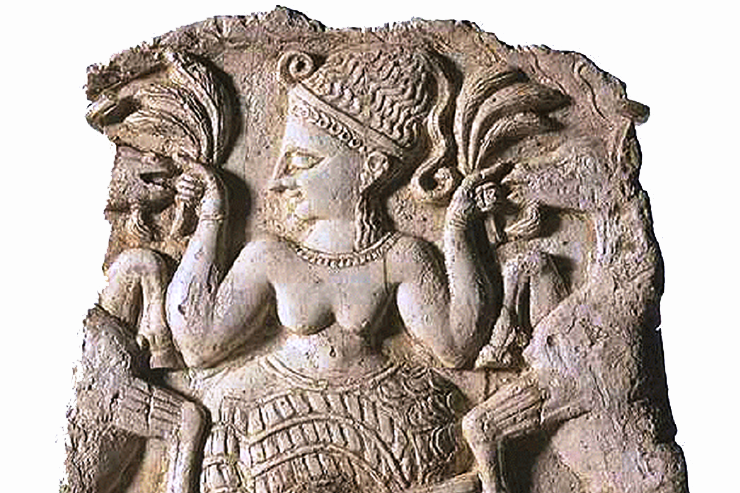
    Indeed the iconography of the God of ancient Israel is in its way androgynous as well. Descriptions of the First Temple (c.940-586 BCE) in Jerusalem say that its innermost chamber, the Holy of Holies, contained two cherubim (im is the masculine plural ending in Hebrew) made of olive wood overlaid with gold, and each of them “ten cubits high” (1 Kings 7:23). In the ancient Near East, cherubim were not fat little babies but fully grown winged human figures, often with the body of a lion. While there are no remnants of Solomon’s Temple left, the surviving image that comes closest in time and place is taken from the palace of King Ahab in Samaria (see the previous article, “The Bible: Myth or History?”). It is made of ivory and, characteristically, shows winged female figures.

    The cherubim in the actual Temple may have been, like the God described in Genesis, both male and female. And while the biblical account describes these cherubim as chastely touching their wings, some rabbinical traditions say they were locked in embrace. One Talmudic sage, Rabbi Qetina, who lived in the late third and early fourth centuries CE, said, “When Israel used to make the pilgrimage, they [i.e., the priests] would roll up for them the Parokhet [the Veil separating the Holy from the Holy of Holies], and show them the Cherubim which were intertwined with one another, and say to them: ‘Behold! your love before God is like the love of male and female!’”1 Flavius Josephus, a Jewish historian of the first century CE, gives an eyewitness picture of the Second Temple (destroyed by the Romans in 70 CE) but is rather equivocal in describing the Holy of Holies. In some passages he insists that it contained nothing at all, but in others he says that what was in it “we are not at liberty to reveal to other nations.”2

    But the story of the feminine face of the Hebrew God is even more intricate than this. Archaeological findings and extrabiblical texts again show a reality that is at variance with the theology of the Hebrew Scriptures. And again, this reality was rooted in the religion of the Canaanites, Israel’s neighbours and relatives.

    Yahweh’s Consort?

    The supreme high god in the Canaanite pantheon is named El. This is a proper name, although in later Hebrew usage the word came to mean “god” in a generic sense. Like many pagan gods, El had a wife, a female consort, whose name was Asherah. Her name is probably derived from a phrase from the Ugaritic language spoken in Syria in biblical times: atiratyammi, “she who treads upon Sea,” “Sea” being a personified chaos monster.3 Her role in the ancient Hebrew religion is a nebulous and controversial one.

    As we have seen already, some scholars believe that Yahweh was originally a manifestation of El, and rarely in the Hebrew Bible is a radical distinction drawn between the two; sometimes they are explicitly identified.4 And contrary to what the Bible would have us believe, archaeological remains indicate that Asherah was sometimes viewed as Yahweh’s consort as well. A number of artefacts have been found that link the two: one inscription, dating from the eighth or ninth century BCE, reads, “I [b]lessed you by (or ‘to’) Yahweh of Samaria and by his Asherah.” Another inscription reads, “To [Y]ahweh of Teiman (Yemen) and to his Ashera[h].”5 Teiman, or Teman, is interesting here because some Bible texts portray Yahweh as being revealed in this region, the southern part of the Transjordan (also connected with Midian): “God came out of Teman” (Habakkuk 3:3). If so, Asherah might have been with him from the beginning.

    These texts are puzzling, partly because of the reference to “his Asherah.” In Hebrew, possession is indicated by a suffix (-hu) added to the word for the thing possessed, and some scholars insist that this is not grammatically possible for a proper name. They would say that “Asherah” is not to be read here as the proper name of a goddess, but as kind of a manifestation of Yahweh.

    This argument is hard to sustain, because it presupposes a theological sophistication that a folk religion in the first millennium BCE is unlikely to have had. But it is true that asherah, in the Hebrew of the Bible, can serve either as a proper name for the goddess or as a common noun for a cult object representing the goddess, possibly a wooden image. One ancient Jewish tradition says that the asherah was either a tree or a tree with a cult object beneath it. Hence translators have rendered asherah variously as “tree” and “grove.” The Bible invariably characterises these “trees” or “groves” as abominations. In the Deuteronomic account, the priests in the Temple discover a lost scroll of the Law of Moses and read it to the young King Josiah (2 Kings 22:8–11). Shocked by his nation’s infidelity, Josiah orders a purge of the Temple artefacts. He “commanded Hilkiah the high priest, and the priests of the second order, and the keepers of the door, to bring forth out of the temple of the Lord all the vessels that were made for Baal, and for the grove, and for all the host of heaven: and he burned them without Jerusalem in the fields of Kidron” (2 Kings 23:4).

    The “grove” here was almost certainly an image of Asherah. Certainly she was connected with a tree motif. The biblical archaeologist William G. Dever contends that this was partly because (especially in a semiarid climate) a tree is a symbol of life. But he also points out that some images portray Asherah with a tree growing out of her pubic triangle. Hence Asherah and the tree symbolise life in this sense too.6

    What was her connection with Yahweh in the Hebrew religion of the First Temple? Raphael Patai, whose book The Hebrew Goddess is one of the most important works on this subject, sums up the picture from the Bible’s point of view: “It appears that, of the 370 years during which the Solomonic Temple stood in Jerusalem, for no less than 236 years (or almost two-thirds of the time) the statue of Asherah was present in the Temple, and her worship was a part of the legitimate religion approved and led by the king, the court, and the priesthood and opposed by only a few prophetic voices crying out against it at relatively long intervals.”7 Saul M. Olyan, a professor at Brown University in the US, writes that Asherah “was an acceptable and legitimate part of Yahweh’s cult in non-deuteronomistic circles. The association of the asherah and the cult of Yahweh suggests that Asherah was the consort of Yahweh in circles both in the north and the south.”8

    Rise of the “Yahweh Alone” Movement

    Where, then, did the opposition to Asherah arise? The remarks by the scholars quoted above tell us: Asherah’s foes were the prophets and the Deuteronomic circle, which eventually produced the long historical saga that comprises Deuteronomy, Joshua, Judges, 1 and 2 Samuel, and 1 and 2 Kings. Where did this Deuteronomic history come from? Remember that Josiah initiated his purge of the Temple after hearing a rediscovered scroll of the Law read by the priests. The standard view today is that this scroll was an early version of the book of Deuteronomy, and that it was not rediscovered but had been written specifically for the occasion: it was forged by the priests to prove to Josiah that their version of monotheism went back to Moses. And Deuteronomy condemns Asherah worship. This is how it tells the children of Israel to deal with the Canaanites: “Ye shall destroy their altars, and break down their images, and cut down their groves, and burn their graven images with fire” (Deuteronomy 7:5; emphasis added). The “groves,” again, are asherim, images of Asherah. But, as we see in 1 and 2 Kings, even the Deuteronomist has to admit that Asherah was welcome in the Temple throughout most of the period of the monarchy (c.1000-586 BCE).

    Distilling all this evidence, biblical and nonbiblical, into a comprehensive picture, we come up with something like this. The worship of Asherah in Canaan goes back far beyond the arrival of Israel on the historical scene in the thirteenth century BCE. And in Israel and Judah up to the end of the monarchy in 586 BCE, Asherah was worshipped alongside Yahweh, often as his consort, both in the popular religion and for the most part in the Temple itself. At some point in the history of Israel – and we do not know exactly what this point was – there arose a “Yahweh alone” movement, as some biblical historians have dubbed it: Yahweh was to be worshipped as the sole god, the lord of the universe – without a consort. This “Yahweh alone” movement was associated with the prophets in particular. It is the prophet Elijah who condemns the worship of foreign gods at Ahab’s capital in Samaria. It is prophets such as Amos, Hosea, and Micah that shape the theology that was later to be codified in the Deuteronomic history.

    The kings were more equivocal. The rulers of the northern kingdom of Israel apparently had little use for the “Yahweh alone” movement; that is why, according to the Deuteronomist, every last one of them “did evil in the eyes of the Lord.” Indeed the prophets said that the northern kingdom was destroyed because it had abandoned the true worship of Yahweh. The rulers of the smaller southern kingdom of Judah were more sympathetic to the nascent monotheism: some of them, notably Hezekiah and (as we have seen) Josiah, tried to purge these supposedly alien elements from Yahweh’s cult, with uneven success.

    As for the priests, who administered the sacred cult of Yahweh at the Jerusalem Temple, they too were not quite so firmly on the side of Yahwistic monotheism as we might believe. As Raphael Patai has shown, the images of Asherah were worshipped in the First Temple for about two-thirds of its lifespan, so the priests of this period could not have had too much difficulty with her. It is only around the time of Josiah in the late seventh century BCE that the picture changes. The priesthood becomes dominated by the monotheistic Yahwists, who write up a scroll of the Law and convince Josiah to purge the Temple.

    Josiah died in 609 BCE, and the Temple was sacked by the Babylonians only a couple of decades later, in 586 BCE, so the worship of the goddess probably did not return in the meantime. The book of Jeremiah has an interesting passage on this score. After the Temple’s destruction, people who “had burned incense to other gods” tell Jeremiah: “We will certainly do whatsoever thing goeth forth out of our own mouth, to burn incense to the queen of heaven and to pour out drink offerings unto her, as we have done, we, and our fathers, our kings, and our princes, in the cities of Judah, and in the streets of Jerusalem: for then had we plenty of victuals, and were well, and saw no evil. But since we left off to burn incense to the queen of heaven, and to pour out drink offerings unto her, we have wanted all things, and have been consumed by the sword and by the famine” (Jeremiah 44:17-18). This passage indicates that some, perhaps many, in Judah believed that the Temple was destroyed not because it had been profaned by the worship of the goddess (as Jeremiah said) but because her worship had been abandoned.9 The “queen of heaven” may in fact be Astarte, another Canaanite goddess, who was worshipped as well as Asherah – but then the two were sometimes conflated even by the worshippers themselves.

    Get the issue this article appears in

    The subsequent history was written by the monotheists. When the Jews returned from exile in Babylonia and rebuilt the Temple (after 539 BCE), the priests and the prophets were now all the “Yahweh alone” party. It was they who were responsible, not only for completing the Deuteronomic history, but for editing and compiling previous sources to create the books of the Pentateuch as well as the writings of the prophets. This is the core of the Hebrew Bible as we now know it, and it explains why we see biblical history the way we do.

    But the goddess was not completely expunged from the Jewish faith. Later parts of the Bible, such as the book of Proverbs, as well as apocryphal works mention a personified figure of “Wisdom,” who has a female form. (The Hebrew word for wisdom, hokhmah, is grammatically feminine.) Still later, the mystics of Judaism speak of the Shekhinah, the “presence” of God. In the Bible, this word does not seem to mean much more than its face value, but in later Judaism, the Shekhinah herself is personified as a kind of feminine aspect of God, and she is spoken of almost as a separate being. The medieval Kabbalists spoke of the Matronit (a name derived from the Latin matrona, “matron”), a divine feminine figure who resembles not only the Virgin Mary as conceived by the Catholics, but the now-forgotten goddesses of the Near East. The divine feminine has long survived the demise of Asherah – just as Christianity adopted the doctrine of Mary as “Mother of God” almost immediately after the pagan temples were closed. No matter how much the authorities and the scriptures insist on their concept of the Supreme Being as a male, there is something in the human mind and heart that refuses to assent completely.

    Current times have seen a resurgent fascination with the divine feminine both in Judaism and Christianity, and there is a widespread sense that these long-forgotten archetypes are reappearing to claim their rightful place in the spiritual consciousness of humanity. That may be the case, but it is more likely that they had never really gone away.

    [alert type=”general” dismiss=”no”]This article was published in New Dawn 123.[/alert]

    [alert type=”success” dismiss=”no”]If you appreciate this article, please consider subscribing to help maintain this website.[/alert]

    Sources

    Margaret Barker, The Great Angel: A Study of Israel’s Second God, Louisville, Kentucky: Westminster John Knox Press, 1992.

    Frank Moore Cross, Canaanite Myth and Hebrew Epic: Essays in the History of Religion of Israel, Cambridge, Massachusetts: Harvard University Press, 1973.

    William G. Dever, Did God Have a Wife? Archaeology and Folk Religion in Ancient Israel, Grand Rapids, Michigan: Eerdmans, 2005.

    Leah Novick, On the Wings of Shekhinah: Rediscovering Judaism’s Divine Feminine, Wheaton, Illinois: Quest, 2008.

    Raphael Patai, The Hebrew Goddess, 3d ed., Detroit, Michigan: Wayne State University Press, 1990.

    Footnotes

    1. This is from the Talmudic treatise B. Yoma 54a, quoted in Patai, 84. Bracketed insertions are Patai’s.
    2. Flavius Josephus, Against Apion, 2:7, 8. Quoted in Patai, 82.
    3. Cross, 15, 37, 66–67.
    4. Cross, 44.
    5. Dever, Did God Have a Wife?, 162. Bracketed insertions are Dever’s.
    6. Dever, Did God Have a Wife?, 225–28.
    7. Patai, 50.
    8. Quoted in Dever, Did God Have a Wife?, 201.
    9. Barker, 51.

    © New Dawn Magazine and the respective author.
    For our reproduction notice, click here.
  • The Cathars and Reincarnation: The Strange Revelations of Arthur Guirdham

    The Cathars and Reincarnation: The Strange Revelations of Arthur Guirdham

    From New Dawn 145 (Jul-Aug 2014)

    The Cathars remain an enigma. An austere, world-denying sect, they were nevertheless associated with a remarkable cultural renascence in the southern France of the twelfth and early thirteenth centuries. Beloved in the regions that supported them, they were popularly known as the bonshommes, the “good men.” Labelled by the Catholics as “the great heresy,” Catharism was so formidable a rival that the church formed the Inquisition to crush it.

    Arthur Guirdham’s story is told in his book The Cathars and Reincarnation

    Who were the Cathars, and where did they come from? The name comes from the Greek katharós, meaning “pure” or “clean.” Their origins are obscure, but they appear to have some connection with sects that stretched back at least to the time of Christ, with exotic names such as the Bogomils, Paulicians, Massalians, and most famously the Manichaeans. I cannot sketch out this history here (I have tried to do so in my book Forbidden Faith: The Secret History of Gnosticism), but it is probably safe to say that some kind of continuous link connects all these groups spanning the first millennium of the Common Era.

    The chief feature these sects all shared was dualism. This word has many meanings. Here it means the belief in a cosmos that is made up of two opposing and more or less equipotent forces: good and evil, light and dark. This polarity is cosmic: it began with the universe and will end only when the universe ends. Our world, the world of matter, is the creation of the dark forces; the light is imprisoned and alien here.

    Note how this differs from conventional Christianity, which teaches that the world, including the world of matter, is fundamentally good. Its evil arises from the Fall of man in the garden, prompted by that old serpent, the Devil. By the old Catholic axiom, natura vulnerata, non deleta – “nature was wounded but not destroyed” by the Fall.

    But the differences are not quite as clear-cut as they may seem. Mainstream Christianity – by which I mean practically all of the churches that call themselves Catholic, Orthodox, or Protestant – has its own strain of pessimism and world-denial. One obvious example is the pathological hatred of the body that Christianity has shown almost since its earliest days. Conventional Christianity may not teach that the world is evil, but it frequently acts as if it is. And while Christianity claims that the sole and ultimate power is good, it also makes the Devil and his minions seem very nearly as powerful. Some scholars even say that Christianity is semidualistic.

    Moreover, if Catholic Christianity and its offspring teach that this world is fundamentally good, why have they so often cast shadows of fear, gloom and barbarism? And if the Cathars were so gloomy and world-renouncing, why was the culture they influenced the most – Languedoc in the twelfth and thirteenth centuries – the most prosperous, open, tolerant, and cultivated society of medieval Europe? What did the Cathar have to do with this efflorescence?

    You can read a great deal about the subject and still be left groping for an answer. The scholarly books, however serious and exhaustive, offer no real clue to this puzzle; the authors themselves often seem baffled by it.

    A Psychiatrist’s Past-Life Memories

    The most vivid and plausible picture of the Cathars comes from an extremely strange source: past-life memories as assembled by a twentieth-century British psychiatrist.

    Arthur Guirdham (1905-92)

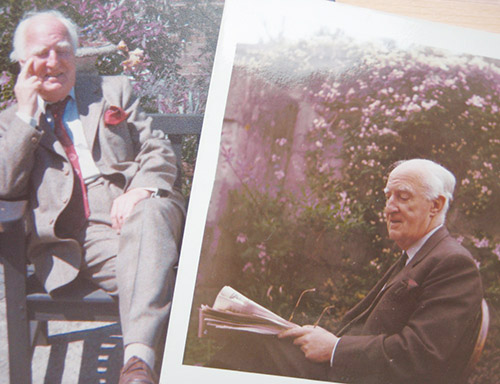
    Arthur Guirdham (1905-92) was born in Cumbria, England, the son of a steelworker. By sacrificing the education of his sisters, his parents were able to give him a decent enough education so that he was able to attend the University of Oxford. Eventually he qualified as a psychiatrist. He was practicing in this capacity in 1962 when he met a patient that he calls Mrs. Smith. His first words to her (as he would be reminded later, to his own surprise) were “Have I seen you before?”

    Mrs. Smith, an otherwise normal woman in her early thirties, came to him with a complaint about a recurring dream that had been disturbing her: “A man entered her room from the right side. She was lying on the floor. His approach filled her with terror.” Although in itself “the dream was not of any particular interest,” it struck a chord in Guirdham. He had been having a similar recurring nightmare in which “a tall man approached the place I was sleeping. He came from behind me on the left. Sometimes he bent over me. I felt rigid and speechless with panic.” Although he could not remember exactly when his nightmares had started, he was certain about when they ended: it was around the time he encountered Mrs. Smith. Moreover, as he later learned, her dreams of this kind stopped as well. “Is this significant?” he wrote. “Not in itself but… I feel that my nocturnal visitor was the same man who disturbed Mrs. Smith’s dreams.”

    For the next year, curious coincidences and synchronicities continued to occur linking Guirdham, Mrs. Smith and the Cathars. Then, in a session in December 1964, Mrs. Smith made a remark to the effect that “love was an immensely creative force and that through it mankind would be bound together.” She attributed this statement to Guirdham himself, even though he was sure he had never said any such thing.

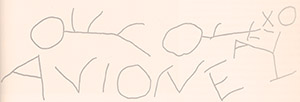
    A member of Dr. Guirdham’s circle made this drawing when she was seven years old. It is said to depict two Inquisitors killed by the Cathars, as well as an English child’s attempt to render “Avignonnet” – a site were Cathars were massacred – in her own language.

    Mrs. Smith then revealed a startling fact. When she was a teenager she had written a novel, which she later destroyed, about life in a medieval women’s community and a man she loved named Roger.

    Two months later, in February 1965, Mrs. Smith told Guirdham something still more astounding: he himself had been Roger, the man she loved, in a past life. “We were from a very poor family but you were of noble birth. I fell in love with you then, and my father said I must never meet you again – you were not of our class and what was more important to him, you were not of our faith. I refused to be parted from you, and was eventually excommunicated. I went to live with you. We weren’t married. You told me that if anything should happen I should go to Fabrissa.” But she was not sure whether this was a person or a place.

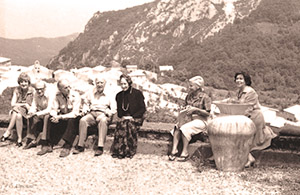
    Soon after Mrs. Smith’s revelations about her past life as a Cathar, other women started coming forward with similar flashbacks and detail, leading Dr. Arthur Guirdham to believe he was witnessing an unbelievable occurrence – mass reincarnation. The above photo of Dr. Guirdham with some of his incarnated soul group was taken at Montségur, France in the 1970s.

    Thus began a strange series of revelations, dreams and encounters, combined with serious historical research into the Cathar saga. It developed that a certain Fabrissa de Mazerolles was a well-known protector of heretics (i.e., Cathars) in early thirteenth-century Languedoc. The identity of the man in Guirdham’s and Mrs. Smith’s dreams also became clear: he was Pierre de Mazerolles, Fabrissa’s nephew. Although Mrs. Smith, or her previous incarnation (named Peirone or Puerilia), was frightened by her memory of Pierre, he had not meant to harm her. He had come to announce gleefully that he had committed murder.

    This crime, which took place in Avignonnet in 1242, is well-documented. It was of two Inquisitors who had been sent by Rome to ferret out Cathars. This did not signal the start of the great persecution launched by the papacy (which had begun in 1209). But it did provoke a reprisal that ended in the climactic siege of Montségur in 1244, the most famous episode in the Cathar epic, which ended with two hundred parfaits being burned alive, and marked the beginning of the end for Catharism as a movement. (Pierre de Mazerolles, incidentally, was not a Cathar; he was motivated by greed and by the sheer joy of murder.)

    Guirdham’s story, told in his book The Cathars and Reincarnation, continues with many ramifications. He does not tell it well. His narrative lurches back and forth between Mrs. Smith’s revelations, his own experiences, actual historical events, the love story of Roger and Peirone, and the teachings of Catharism. Many other characters are introduced, a number of whom can be identified from historical records but who begin to blur together in the narrative.

    Of the two main characters we learn that Roger was imprisoned and died, probably of tuberculosis, while awaiting interrogation by the Inquisition. Peirone suffered a more dramatic fate, and one of the most memorable passages of Guirdham’s books gives her first-person recollection of being burned at the stake:

    The pain was maddening. You should pray to God when you’re dying, if you can pray when you’re in agony… I didn’t pray to God. I thought of Roger and how dearly I loved him. The pain of those wicked flames was not half so bad as the pain I felt when I knew he was dead. I felt suddenly glad to be dying. I didn’t know when you were burnt to death you’d bleed. I thought the blood would all dry up in the terrible heat. But I was bleeding heavily. The blood was dripping and hissing in the flames. I wished I had enough blood to put the flames out. The worst part was my eyes. I hate the thought of going blind… I tried to close my eyelids but I couldn’t. They must have been burnt off, and now those flames were going to pluck my eyes out with their evil fingers.

    As compelling as this is, does it stem from an overactive imagination? The answer lies in the historical veracity of many details in this bizarre story. Mrs. Smith knew many things that she could not have known from her conventional education; indeed some of them were not discovered until after her experiences.

    Active Imagination or Real Memories?

    One example is the colour worn by the Cathar parfaits (“perfect ones”). The parfaits were the elite, the few who had received the initiation known as the Consolamentum and who served more or less as a clergy. Most of the books say they always wore black robes. But Mrs. Smith remembers that Roger’s were dark blue. It was only several years after these revelations that Guirdham came across a statement in La vie quotidienne des Cathares du Languedoc au XIIIe siècle (“The Daily Life of the Cathars in Languedoc in the Thirteenth Century”) by the well-known scholar René Nelli that, although the parfaits had originally worn black, they often switched to dark blue as a disguise in times of persecution. Since Mrs. Smith’s memories were of those days of persecution, this would make sense. This detail had not appeared in print when she had her dreams. Nelli, whom Guirdham consulted, was so struck by the accuracy of her recollections that he told him that when in doubt about some detail he should trust the memory of the patient.

    And the memory was considerable. Like many people of the era, Peirone/Mrs. Smith had a facility for remembering songs and verses that was much better developed than that of people today. She wrote down some of the songs she remembered that Roger had sung. She had transcribed them when she was a teenager. Moreover, some of her verses strongly resemble those in anthologies of medieval French poetry. She only knew a little French, which she had studied at school, and had no knowledge of Languedoc (the Romance dialect spoken in that region) or of medieval French. But, for example, in her verses she uses the word foliete for “foliage.” The French equivalent, which she would have learned at school, is verdure, but the word in Provençal, a language close to that of Languedoc, is folhet.

    Behind all this is a background of detail that brings a lost age vividly to life. Of Peirone’s house, she recalls, “It was little more than a hovel. One room, that’s all… I am sure there was no upstairs. The only furniture was a rough bench and a table. It was almost as dark inside as out, for the small window had no glass in it and was covered with a crude wooden shutter to keep out the elements.” She and her family slept in their clothes on the floor. Frequently she gives details about medieval life that Mrs. Smith knew nothing about, such as the custom of drinking diluted wine.

    Beyond a certain point it is useless to argue about whether these are genuine past-life memories or not. Our age has forgotten that scepticism is not in and of itself a sign of intelligence. It would be more interesting to see what we can learn from these accounts, and how they supplement conventional sources on Catharism.

    The Cathars: New Revelations

    Let us begin with a question already asked: how, if the Cathars were such a dour sect, did they thrive in the free, open, joyous atmosphere of the Languedoc of the period? Guirdham’s answer is clear and sensible. The Cathar parfaits were extremely strict with themselves: they wore robes like monks, they ate no meat, they were celibate, and they fasted often. Those demands were only made of the parfaits. Unlike the Catholic priests of the time, the parfaits actually lived up to their vows; thus they won the affection of the people, and the nickname bonshommes. But ordinary believers – the croyants – were under no such obligations. The demands made on them were light.

    Nor was Catharism as gloomy and world-denying as it has been painted. The Cathars, it is true, believed in covalent forces of good and evil, which existed from the beginning and would last until the end of the universe. They also believed that the world of matter was fundamentally evil (a case that is easy to make). But unlike the Catholics, they did not cling to the gloomy and improbable doctrine of eternal damnation. Guirdham writes:

    In the Middle Ages people were dominated by the fear of Hell. Catharism to some extent dissipated this fear. If the world was regarded as being made by, or under the domination of Satan, it followed that one was entitled to regard this life as Hell. Considering that one got through it somehow, and that there were many compensations in the sunshine of the Languedoc and the Midi, the idea that the world was Hell was really an optimistic one. If this world is the worst Hell one has to put up with, it must have been, even at its lowest, vastly preferable to the perpetual damnation of the orthodox Christians of that epoch.

    This view helps explain how the supposedly sombre Cathars were able to thrive in, and foster, the lively and cheerful civilisation of Languedoc. The world is evil, so one does not need to take it too seriously, and certainly there is no point in making things worse than they already are.

    Another detail casts some light on the cultural impact of the Cathars: they put little stock in marriage. There was no Cathar wedding ceremony, and many Cathar couples lived in what the Catholics would call sin. It is clear from Mrs. Smith’s evidence that Roger and Peirone were not married either.

    Courtly Love

    This point explains another strange fact about the Cathar milieu: it was when the curious tradition of courtly love came into being. (Actually this was in the eleventh and twelfth centuries, earlier than the time of persecution that we have been discussing, in the thirteenth century.) Courtly love, a kind of intense love from afar that was usually unconsummated, was the inverse of marriage: it was often practiced between a man and a woman of divergent social classes, it was not for the purpose of having children, and it was, at least ostensibly, chaste.

    Courtly love was also associated with the poetry of the troubadours, which had Cathar echoes of its own. Guirdham mentions the tradition that says the troubadour poets would wear a rose when singing songs with esoteric themes; when they did not, the songs were about ordinary human love. Denis de Rougemont, in his influential book Love in the Western World, argues that the troubadours invented what we now call romantic love. This view is hard to sustain. Greek lyric and Roman elegiac poetry show people in love much as they are today. But de Rougemont may be right to this extent: the troubadours, and the courtly love they celebrated, were the first (at least since Plato) to connect human love with divine love.

    The Cathars’ indifference to marriage resembles the attitude of another religion that may be called world-denying. The Buddhists have no marriage ceremony as such. Monks do not marry a couple; the couple marry each other; a monk may bless the ceremony, but he does not perform it. This peculiar fact may have something to teach about world-denying religions and their fate in the world, particularly in the West.

    Religion, whose name originates in Latin roots meaning “to bind back” or “to connect,” plays more than one role in society. It attempts to connect man with God, but it also has a social function. Religion holds society together; at least that is how it worked in the past. If, however, religion is to do this, it must take society’s concerns somewhat seriously. A religion that regards the world as ultimately rather unimportant is not likely to be enthusiastic about taking on the role of guarantor of the social order. This attitude may help explain why dualistic movements such as the Cathars and the Manichaeans never established any long-lasting dominance in societies and nations. It is true that Buddhism, which is also somewhat world-denying, has managed to establish itself, but it is striking that a number of Buddhist nations have continued to use native traditions – Shinto in Japan, Confucianism and Taoism in China – to continue to fill some social functions.

    Bodywork, Herbal Healing & Plant Auras

    Guirdham has much more to say about the Cathars in their context, informed by both Mrs. Smith and a woman he calls Miss Mills, who had similar past-life memories. But at this point we may turn to another dimension of Guirdham’s portrait: his own contact with discarnate entities who in their last lives on Earth had been Cathar adepts, including the important and much-honoured Cathar bishop Guilhabert de Castres (c.1165-1240).

    These teachings, assembled in the final section of Guirdham’s book The Great Heresy, deal with subjects ranging from the properties of plants to reincarnation and intercourse with divine beings. These things do not, on the face of it, strike one as part of Catharism. On the other hand, they do not contradict what we know about the Cathars either. In their way, like the rest of Guirdham’s work, they serve to fill out its portrait.

    The Cathar parfaits were, as we have seen, a kind of clergy; they administered the Consolamentum (the only sacrament they acknowledged), taught doctrine, and led services. But they had another important function: they were healers. Guirdham points out that one of Christ’s original commands to his followers was to heal the sick. The parfaits did this using a number of techniques, including what we today would call bodywork and administering herbs and tinctures. Guirdham also discusses the use of jewels in healing, although he acknowledges that they are not as useful for this purpose as they were in bygone ages, when people were more psychically sensitive.

    Guilhabert also told Guirdham a great deal about plants. Plants have auras like human beings, and when, in certain instances, a person finds a certain plant, like a tree, to give off a healing quality, it is the result of this aura. Guirdham himself recalled the case of an old miner who was subject to periodic bouts of depression. At these times he would go off and sit under a particular roadside tree, and afterwards he felt better. But plants can have negative properties as well; some thrive on maleficent vibrations, including perhaps toadstools and fungi that thrive in dank underground cellars. Guilhabert makes the arresting remark that evil can insert itself in nature, citing as an example the lurid aniline-dye colours of recently developed varieties of roses. “The harsh colours bred into the roses were a flamboyant challenge to reinforce their attractiveness to man,” according to Guilhabert.

    Some of these remarks are reminiscent of the ideas of the Austrian visionary Rudolf Steiner, who also spoke of the etheric bodies and auras of plants. This may not be a complete coincidence. Steiner laid claim to the heritage of the Rosicrucian brotherhood of the seventeenth century, and Guirdham suggests that the Rosicrucians may have been the spiritual descendants of the Cathars. “It is traditional,” he observes, “that the Rosicrucian movement arose in Germany in a family where a monk from Narbonne [in Languedoc] had been a tutor.”

    A Secret Cathar Lineage?

    Did the Cathars survive in any other form after finally vanishing from history in the early fourteenth century? Conventional scholarship says they did not. But there may be some evidence of underground Cathar survivals. In a persuasive book called The Secret Heresy of Hieronymus Bosch, author Lynda Harris suggests that the great Netherlandish painter and forerunner of surrealism may have been secretly a Cathar two hundred years after the faith supposedly perished. Harris’s argument is too intricate to go into here, but the facts that Bosch’s ancestral home was the town of Aachen, a former Cathar centre, and that many of his bizarre images have curiously heterodox implications, suggests the Cathars may not have perished as thoroughly as the Inquisitors wished.

    The question keeps presenting itself to the minds of those who think about these subjects. These lost, half-forgotten faiths – the Cathars, the Manichaeans, the Gnostics – did they really die out completely? Did they survive sub rosa under other names, handed down through lineages of secret and untraceable initiations? Or do they reflect something that continually arises out of the depths of human experience? Guirdham suggests as much, writing, “Perhaps it is best to regard Dualism as analogous to a repressed impulse. It passes from memory but continues to exert its influence in different directions below the conscious level.” Perhaps, too, there is another answer, suggested in his books: the religions may vanish, but their adherents do not, and as they return in later centuries and in other bodies, the teachings and truths of those ancient faiths may return as well.

    [alert type=”general” dismiss=”no”]This article was published in New Dawn 145.[/alert]

    [alert type=”success” dismiss=”no”]If you appreciate this article, please consider subscribing to help maintain this website.[/alert]

    Sources

    Arthur Guirdham, The Cathars and Reincarnation, C.W. Daniel, 1990 [1970]

    Arthur Guirdham, The Great Heresy: The History and Beliefs of the Cathars, C.W. Daniel, 1990 [1977]

    Arthur Guirdham, We Are One Another, C.W. Daniel, 1991 [1974]

    Lynda Harris, The Secret Heresy of Hieronymus Bosch, Floris, 1995

    Denis de Rougemont, Love in the Western World, Translated by Montgomery Belgion, Rev ed. Princeton University Press, 1983

    © New Dawn Magazine and the respective author.
    For our reproduction notice, click here.
  • The Quest for the Grail

    The Quest for the Grail

    For most of us, the Grail is a mirage or a rainbow’s end. We may catch a glimpse of it, but if we allow ourselves to be led in its direction, we soon find that it recedes; if we steal a few steps closer, it disappears. And so the Grail has become the quintessential metaphor for all that is beautiful but unattainable.

    The Grail is usually imagined as a cup or chalice, specifically the cup used by Jesus Christ during the Last Supper (or used to catch his blood as it flowed on the cross). Legend says that after Christ’s death and Resurrection, Joseph of Arimathea – who had lent him his tomb for a few days – took this cup to Glastonbury in Somersetshire, England.

    Glastonbury is the site of innumerable legends and fables connected not only with Joseph of Arimathea but with King Arthur and his knights; indeed it was said the bones of Arthur and Guinevere were unearthed there in medieval times. While this may be mere fable, it’s unquestionably true that Glastonbury functioned as the site of an abbey from the seventh century till 1536, when Henry VIII ordered the dissolution of all the monasteries in England. The Gothic ruins of Glastonbury Abbey can still be seen today, and the town remains a popular destination for New Age pilgrims.

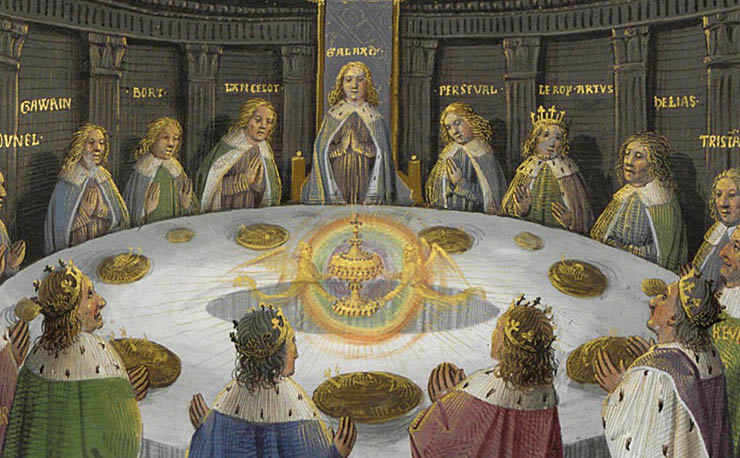
    The Grail too has become intertwined with the legends of Arthur and his knights; this motif first appears in courtly romances written in the late twelfth and early thirteenth centuries. The oldest is the Perceval of Chrétien de Troyes, a kind of Bildungsroman in which a young man proves himself as a knight. During his adventures, he comes to a castle where he witnesses a strange procession:

    A squire entered from a chamber, grasping by the middle a white lance… All present beheld the white lance and the white point, from which a drop of red blood ran down to the squire’s hand…

    Then two other squires came in, right handsome, bearing in their hands candelabra of fine gold and niello work, and in each candelabrum were at least ten candles. A damsel came in with these squires, holding between her two hands a grail. She was beautiful, gracious, splendidly garbed, and as she entered with the grail in her hands, there was such a brilliant light that the candles lost their brightness, just as the stars do when the moon or sun rises. After her came a damsel holding a carving platter of silver. The grail which preceded her was of refined gold; and it was set with precious stones of many kinds.

    The young man is curious about this strange procession, but, minding his manners, he does not say anything about it. The next morning he awakes to find the castle empty, and he rides off. Only later, when he describes the episode to a maiden he meets, does he discover that he has been the guest of “the rich Fisher King.”

    “He is still in such pain that he cannot mount a horse,” the maiden says, “but when he wishes to divert himself, he has himself placed in a boat and goes fishing; therefore he is called the Fisher King.” The maiden also tells the young man that if he had asked the meaning of the Grail procession, he “would have cured the maimed King, so that he would have recovered the use of his limbs and would have ruled his lands and great good would have come of it!”

    The Grail here seems to be a familiar object. In fact the word “grail” is derived from the Old French gradale or graal, and often simply means a large serving-dish. Later on a hermit tells Perceval, “The rich Fisher is the son of the King who causes himself to be served with the Grail. But do not think that he takes from it a pike, a lamprey, or a salmon. The holy man sustains and refreshes his life with a single Mass wafer. So sacred a thing is the grail, and he himself is so spiritual, that he needs no more for his sustenance.”

    There have been other images for the Grail as well. In the thirteenth-century Parsifal of Wolfram von Eschenbach, the Grail is not a cup but a stone fallen from heaven – the lapsit exillis. This obscure Latin phrase has evoked many explanations. Lapsit is a garbled word, meaningless in Latin, but evoking associations of lapis, “stone,” and lapsus, “fallen.” Exillis resembles exilis, “meager” or “poor,” also exsilium, “exile,” elixir, and even ex illis, “from those.” Most likely it is either a mistake – another instance of the barbarous Latin common in the Middle Ages – or a kind of Joycean portmanteau word, deliberately cryptic and meant to evoke a rich nexus of meanings.

    The image of the stone is itself ancient; in describing his version of a Grail Castle, an ancient Greek novelist known as Pseudo-Callisthenes says, “A precious stone, which took the place of a fire, lit the whole temple.”

    All of which leaves us asking, what is the Grail? It does not seem to be a mere object, however sacred. For the Swiss psychiatrist C.G. Jung, the Grail was no less than the principium individuationis (“principle of individuation”) that in us which strives to realise itself and become conscious. For R.J. Stewart, a well-known writer on Celtic themes, the Grail is preeminently “the mystery of regeneration.”

    To integrate these different perspectives, it may be helpful to recollect that in most of the legends the Grail is the cup Christ used at the Last Supper, and which was later used to catch his blood on the cross. Thus it is a cup that holds blood. This, I think, provides the key to the true meaning of this enigmatic symbol. Each of us has within us a cup that holds blood. It is the heart. The Grail is the heart, illumined and awakened so that it may serve as a receptacle for divine energies.

    Few people, in our era or indeed in any era, have their hearts awakened to this extent. This fact helps explain one of the central themes in the Grail mythos: many are called but few are chosen. It would also explain why the few successful candidates are those who are pure of heart, for the heart must be pure before it can be illumined.

    That the Grail is a metaphor for the illumined heart also casts light on two other details in the legends. The Grail is sometimes seen as a serving-platter; moreover, in some versions the question the seeker is supposed to ask is, “Whom does it serve?” Once the heart is illumined and awakened, it becomes a vehicle for service. The question then becomes, whom or what does it serve? That the Grail heroes usually forget to ask this question indicates that it does not admit facile or ready-made answers.

    While few of us are going to be knights or warriors like the Grail heroes, our emotions, refined and purified by insight and integrity of purpose, can form a chalice into which divine energies can flow. Like the Grail itself, this ideal may seem remote, elusive, and unattainable.

    Yet, as the old legends suggest, there is something in the very quest that may serve as its own justification and reward. And once we reach it, we will be asked – or we will ask ourselves – whom or what are we serving?

    A version of this article appeared in Gnosis magazine #51.
    [alert type=”general” dismiss=”no”]This article was published in New Dawn Special Issue 2.[/alert]
    [alert type=”success” dismiss=”no”]If you appreciate this article, please consider a contribution to help maintain this website.[/alert]

    © New Dawn Magazine and the respective author.
    For our reproduction notice, click here.
  • Egypt in the Western Occult Tradition

    Egypt in the Western Occult Tradition

    This article was published in New Dawn Special Issue Vol 8 No 6 (December 2014)

    O Egypt, Egypt, of your reverent deeds only stories will survive, and they will be incredible to your children! Only words cut in stone will survive to tell your faithful works, and the Scythian or Indian or some such neighbour barbarian will dwell in Egypt.

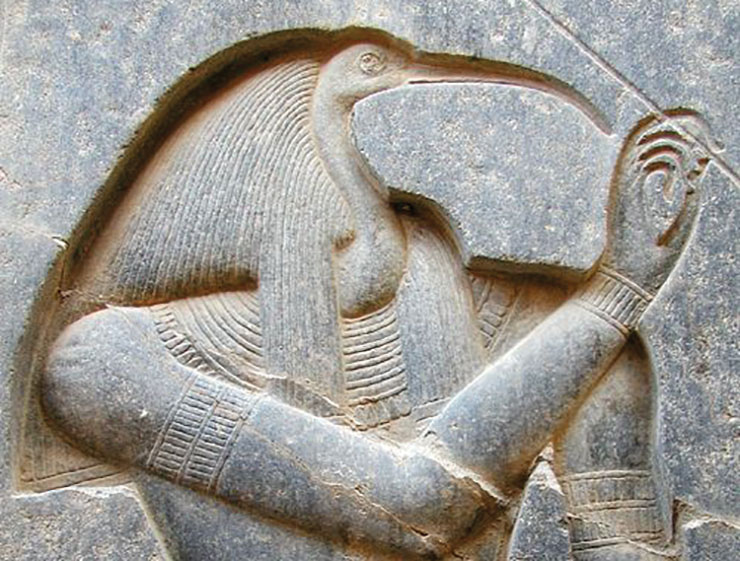
    This haunting passage comes from the Corpus Hermeticum, the celebrated ‘Hermetic’ body of writings, believed to go back to Hermes Trismegistus himself, a semidivine figure associated with the Greek god Hermes and his Egyptian equivalent, Thoth.

    These texts go back no further than the early centuries of the Common Era. The passage above hints at their purpose: to preserve something of the knowledge of Ancient Egypt as its civilisation began to decay. Here is a good place to start when looking at Egypt’s role in the Western occult tradition.

    The Corpus Hermeticum was brought to Italy in the mid-fifteenth century by Greeks fleeing the collapsing Byzantine Empire. The great patron of the arts, Cosimo de’ Medici, had these texts translated into Latin almost immediately. Because scholars thought they went back to Hermes Trismegistus, believed to be a contemporary, and perhaps a teacher, of Moses, they were held in the highest esteem for almost two centuries. When their true date was discovered, they lost much of their prestige, and they have never quite regained it. Nevertheless, they have shaped the Western esoteric tradition in innumerable ways.

    Consider Athanasius Kircher, a seventeenth-century Jesuit who, in the subtitle of Joscelyn Godwin’s recent book about him, was “the last man to search for universal knowledge.” Part of the knowledge he sought was the meaning of the hieroglyphs. Kircher’s interpretation, created out of his own imagination, was almost entirely wrong. But his mistakes are instructive.

    The symbol that he regarded as the key to this knowledge is a human-headed scarab from a bronze tabletop known as the Bembine Table of Isis. The body of the scarab, Kircher says, is the Earth; its wings are the airy sphere; several concentric ovals set in the place of the shoulders are the planetary orbs; the head is Horus, or the Sun; and a crescent above the head is a moon. A winged disk floating nearby is the anima mundi, the “soul of the world.”

    Kircher’s representation reflects, not some genuine knowledge of Egyptian religion, but the system of the Corpus Hermeticum. The Hermetic texts were seen as the embodiment of Egyptian teaching. Their actual relationship to what the Egyptians taught is a much harder issue to sort out, if only because Egyptian religion was multifarious. Scholars used to think they were a mishmash of Neoplatonism, Gnosticism, and early Jewish and Christian mystical teaching. But the title of the main treatise is the Poimandres, a bewildering name that has inspired many fanciful etymologies. Today scholars believe it is a Grecised version of the Egyptian p-eime-n-re or “mind of sovereignty.” At the outset, Poimandres – who is described as an “enormous being” in the Corpus – announces he is the “mind of sovereignty.” There may well be more of Egypt in these texts than people used to think.

    The Corpus Hermeticum was not the only attempt to preserve Egyptian knowledge. Another is a Greek text dating to the fifth century CE, and attributed to Horapollo, a priest of Isis and Osiris. The Horapollo, as it is called, explains the meaning of the hieroglyphs.

    Here is one example. One passage (in a nineteenth-century translation) reads: “When they would represent the universe, they delineate a SERPENT bespeckled with variegated scales, devouring its own tail; by the scales intimating the stars in the universe.” And in fact the image of a snake devouring its tail – the ouroboros – does go back to Ancient Egypt, the first instance being found in a text going back to the fourteenth century bce.

    Whether or not the ouroboros had the meaning given by Horapollo may be moot; it has sometimes been said to symbolise, not the universe per se, but the formless disorder that encircles the universe. In any case, the Horapollo probably reflects some real, though garbled, knowledge of the hieroglyphs. In any event, its interpretation has echoed down through the centuries. Like the Corpus Hermeticum, it shows how Egypt has operated on the Western occult imagination.

    Egypt touched the minds of occultists in other ways as well. The renegade seventeenth-century Italian monk Giordano Bruno harked back to Egypt as a way of reviving and purifying the degenerate Christianity of his time. Bruno’s Egyptian religion has little to do with the Egyptian religion dug up by archaeologists in the last two centuries. Rather it is, again, the doctrine of the Corpus Hermeticum, which in Bruno’s time was still believed to date back to the great age of Egypt. That Bruno wanted to revive the Egyptian religion wholesale may seem eccentric, but it’s understandable in light of the history of the seventeenth century, with its appalling religious warfare. For Bruno, Egyptian Hermeticism was a means of rising above these petty conflicts, a means of fostering tolerance and awakening a higher awareness.

    The Catholic church, which did not see things quite the same way, burned Bruno at the stake in Rome in 1600.

    But in no way has the allure of Egypt waned throughout the centuries. In 1781, the French polymath Antoine Court de Gébelin, in a work entitled Le monde primitif (‘The Primitive World’), said that the Egyptian priests had encapsulated their knowledge in a book of Thoth consisting of visual images. According to Court de Gébelin, this book made its way to Rome and into the hands of the church. When the papal court was removed to Avignon in the fourteenth century, the book was recast into a deck of playing cards, known today as the Tarot. Scholars today are not, for the most part, convinced by this argument.

    The influence of Egypt on the Tarot remains. The Ryder-Waite deck, created in 1910, by far the most popular deck in the English-speaking world, abounds with Egyptian images: sphinxes with breasts; Isis with her crescent moon; the jackal-headed figure of the god Anubis. This is no accident: the deck’s creators, A.E. Waite and Pamela Colman Smith, were both members of the Hermetic Order of the Golden Dawn, an occult order whose symbols and rites were replete with Egyptian imagery.

    By the time of the Golden Dawn, which in its original form lasted from 1888 to 1900, the hieroglyphs had been deciphered by the French Egyptologist Jean-François Champollion, so the Golden Dawn’s picture of Egypt was much more accurate than had been available during the Renaissance.

    One of the most resonant evocations of Egypt came with the 1877 publication of the two-volume Isis Unveiled by the Russian occultist H.P. Blavatsky. Although it took its title from the name of the great Egyptian goddess, Isis was not principally about Egypt. Instead, it argued there was an ancient but unified wisdom tradition that underlay all religions.

    In its way, Isis does present an updated Hermeticism, describing the human makeup in the tripartite fashion of body, soul, and spirit that goes back to the Corpus Hermeticum, the ancient Gnostics, and indeed primitive Christianity. Curiously, in light of Blavatsky’s later teaching, the book denies reincarnation. She would later change or recast her views to support reincarnation. She excused her inconsistency on the (not entirely convincing) grounds that reincarnation was a secret teaching that she had not been allowed to disclose before a certain point.

    Reincarnation itself occupies an ambiguous place in the Western esoteric tradition. Christianity (at least in its conventional forms) has always avoided or repudiated it. In Judaism it is part of the esoteric tradition of the Kabbalah, although until recently it was almost unknown to ordinary Jews.

    Did the Egyptians teach reincarnation? If you ask mainstream Egyptologists, they will generally say no. But Herodotus, the Greek historian from the fifth century bce, says exactly the opposite. In a comprehensive picture of Egypt that can be considered the first anthropological study in human history, Herodotus writes: “The Egyptians were the first to teach that the human soul is immortal, and at the death of the body enters into some other living thing then coming to birth.” He goes on to say: “Some of the Greeks, early and late, have used this doctrine as if it were their own; I know their names, but do not here record them.”

    Here Herodotus probably means Pythagoras, who studied in Egypt and may have learned the doctrine of reincarnation (as well as the geometrical theorem that bears his name) from them. The Corpus Hermeticum speaks of reincarnation as well. Possibly reincarnation was taught among the Egyptians – but only as an esoteric secret passed down orally.

    Reincarnation was an issue that divided the Western esoteric tradition from that of the East. So claimed the founders of an occult order called the Hermetic Brotherhood of Luxor (or H.B. of L.). In 1884 it made its presence known with an ad reaching out to those disaffected with ‘Hindoo Mahatmas’ – an allusion to the hidden Masters that, Blavatsky claimed, were guiding her. The central teachings of the H.B. of L. include a denial of reincarnation, the use of magical and ritual work to attain higher consciousness, and the use of sexual magic as well. The lodge’s use of the name ‘Luxor’ indicates its claim of an Egyptian lineage.

    The H.B. of L. dissolved after only a couple of years because of internal dissention, but it had an influence out of all proportion to its size or lifespan. Its teachings live on in C.C. Zain’s still-extant Church of Light. Some of the H.B. of L.’s sexual magic techniques may have also found their way into Aleister Crowley’s Ordo Templi Orientis.

    Probably the best-known occult order of the twentieth century also traces itself back to Egypt: the Ancient and Mystical Order Rosae Crucis, founded by H. Spencer Lewis in 1915. AMORC has a strong and heavily emphasised Egyptian flavour; Lewis said that it went back to an esoteric lodge founded by Pharaoh Thutmose III in the fifteenth century bce. Today AMORC’s headquarters – Rosicrucian Park in San Jose, California – contains a temple designed with Egyptian motifs as well as an Egyptian museum.

    I could go on much longer. I could, for example, mention the Temple of Set, which in 1975 broke off from Anton Szandor LaVey’s notorious Church of Satan when some members of LaVey’s organisation decided that he was not serious enough about his Satanism. The Temple identifies Satan with Set or Seth, the slayer of Osiris in Egyptian myth. (Despite the similarity of names, scholars do not think the names ‘Satan’ and ‘Set’ are connected, ‘Satan’ coming not from the Egyptian, but from a Hebrew word meaning ‘opponent’.) The Temple of Set does not promote evil per se but advocates “creating an individual, powerful essence that exists above and beyond animal life” (in the words of its website).

    Apart from organisations, there are the many people who are drawn to the mystical side of Egypt through some encounter with its art and architecture. Writers such as John Anthony West, author of The Traveler’s Key to Ancient Egypt, and Normandi Ellis frequently lead tours to Egypt that focus on its mystical and occult aspects. As Ancient Egypt recedes further and further away from us in time, it remains vividly alive in the memory and imagination of the West.

    [alert type=”success” dismiss=”no”]If you appreciate this article, please consider subscribing to help maintain this website.[/alert]

    Sources

    Brian P. Copenhaver, ed. and trans., Hermetica: The Greek Corpus Hermeticum and the Latin Asclepius in a New English Translation with Notes and an Introduction, Cambridge University Press, 1992

    Joscelyn Godwin, Athanasius Kircher’s Theatre of the World: The Life and Work of the Last Man to Search for Universal Knowledge, Inner Traditions, 2009

    Wouter J. Hanegraaff et al., eds., Dictionary of Gnosis and Western Esotericism, Two volumes, Brill, 2005

    Herodotus, Translated by A.D. Godley, Four volumes, Loeb Classical Library, 1931

    The Hieroglyphics of Horapollo Nilous, Translated by Alexander Turner Cory, http://sacred-texts.com/egy/hh/index.htm; accessed Oct. 30, 2014

    David Reigle, “Isis Unveiled: A Perspective”, www.easterntradition.org/isis%20unveiled-a%20perspective.pdf; accessed Oct. 30, 2014

    Richard Smoley, Forbidden Faith: The Secret History of Gnosticism, Harper San Francisco, 2006

    © New Dawn Magazine and the respective author.
    For our reproduction notice, click here.