New Dawn – World's Most Unusual Magazine

Author: Richard Smoley

  • Alchemy – The Art of Transformation: An Interview with Cherry Gilchrist

    Alchemy – The Art of Transformation: An Interview with Cherry Gilchrist

    Cherry Gilchrist’s book on the history and interpretation of alchemy has remained a classic since its first publication in 1984. Alchemy, the Great Work: A History and Evaluation of the Western Hermetic Tradition was published in a new edition by Weiser Books, with an introduction by Mark Booth, in June 2015.

    Her book on alchemy as a system of self-development, drawing on the Twelve Gates of George Ripley and alchemical imagery, is Everyday Alchemy, published by Rider in 2002.

    She has appeared on radio and TV on various occasions to discuss alchemy, most notably on ‘Stephen Hawking’s World’, in an episode filmed in Owlpen Manor in Gloucestershire, UK, home and haunt of an eighteenth-century alchemist.

    Cherry also draws on her knowledge of the Tree of Life, astrology, and divination in her writings on alchemy. She has studied these subjects since her student days at Cambridge, from which she graduated with a degree in English literature and anthropology. Following the line of oral traditions and wisdom, she has also written about Russian folk traditions, ancestry, personal life stories, and myths and legends from different cultures. Cherry is at present writing a book on the traditional Tarot trumps for Quest Books. For details of her work, see http://www.cherrygilchrist.co.uk.

    Other interests include singing early music, and travel. Places visited such as Easter Island, Siberia, and the Silk Road have given her inspiration for her books, and insight into ancient cultures.

    Cherry’s own philosophy is that the Hermetic work can be passed down through a genuine line of teaching, and that it needs to find different forms in new generations. She was a founder member of Saros, the Foundation for the Perpetuation of Knowledge, an organisation headquartered in the UK which took on those aims.

    Cherry lives in Exeter, UK, with her husband, artist Robert Lee-Wade.

    Richard Smoley (RS): Maybe we could start by a brief definition of what you think alchemy is.

    Cherry Gilchrist (CG): Alchemy is about transformation. In its most basic definition, it’s the transformation of base material or metal into gold. However, that is too simplistic, according to the ways in which the tradition of alchemy has been practised and understood over hundreds, even thousands, of years. In a way, alchemy is about the process of creation itself: how does one thing become another? How do things change state? How can we change our state of being? And can we, as so-called conscious human beings, learn how to make those changes? So another way to put it is that alchemy is a way of using the life force to effect transformation, whether that’s on the physical, external level, or in a spiritual way. I hesitate to say that the alchemical process can work either on the material or on the spiritual level, because in one sense, in alchemy, they are completely integrated!

    RS: Most people would say that alchemy is just an old and outmoded form of chemistry. Why should we interest ourselves in it today?

    CG: I think this old chestnut comes up because of the way historians have dealt with alchemy in the last hundred years or so. That has formed the belief we’re fed. I use the word ‘belief’ because I really do think our perception of what is true and false, what is reliably scientific and what is non-scientific and therefore superstitious – in some people’s eyes – is moulded by the way history has been interpreted. Anyone who reads my book will, I hope, have that view changed. The evidence from the history of alchemy alone, when explored more fully, shows just how seriously it was taken, and how it can’t be just cast on the scrapheap as a well-meaning but deluded forerunner to enlightened science. Isaac Newton himself was an alchemist, and funnily enough, scholars have recently begun to pay a lot more attention to that fact.

    I myself make no claims that alchemy is effective when judged by the standards of modern chemistry. I am not a scientist, and clearly we’re not going to go backwards in time and revert to what now seem very primitive methods for working with chemical elements. I think the point is more that alchemy has had many applications over its history, and that the way it led into chemistry as we know it was just one feature of the whole spectrum of alchemy. Maybe it still has more to teach us about how to work with physical materials, though – and with the whole area of interaction of mind and materials opening up in science, it could offer views and approaches which breathe new life into scientific development. But whatever the case, alchemy still has much to impart in terms of psychology, spiritual development, and our relationship with the natural world. In one form or another, it’s still a path to knowledge.

    RS: Could you say a little bit about the origins of alchemy?

    CG: Well, again here we are somewhat constrained by the degree of research and scholarship available to us. This suggests, to put it briefly, that the metal workers of ancient Egypt may have kicked off the interest in the transformation of one material or metal into another. And that this came to early fruition in the Hellenistic, Alexandrian period, which began about three hundred years before the Christian era. But I suspect that if a few scholars really dig into the roots of alchemy, they will find a much wider realm of alchemical endeavour, particularly if they broaden the definition of alchemy. In the Far East, alchemy also had ancient origins, but the focus there was more on how the human body worked. Just as shamanism has extended its definition in recent years – it was once considered to be exclusively Siberian, and now is traced almost worldwide – so alchemy may have a broader historical lineage than we at present suspect. Perhaps this is beginning to happen. It has been suggested for instance that the discovery of charcoal burning is linked to a historical peasant tradition of alchemy as practiced by the Basques, one of the most ancient peoples of Europe.

    RS: Some writers describe alchemy as a physical process – actual working with minerals and plants and so on. Others see it as a psychological process. How do you see these different roles? Are they both valid?

    CG: I used to hold firmly to the view that true alchemy must be applied across the levels, having both a physical and a mental component. Its magic, if I can call it that, is that it is neither purely material or purely spiritual. However, I’ve come to see this in a different light, and I think now that alchemy has an incredible spectrum of application, and can be applied at different levels of creation. The most extreme examples of selective application are perhaps the old-fangled ‘puffers’ who spent all their time trying to work out how to concoct gold and get rich. And also the purely spiritual alchemists among whom we can count Jacob Boehme. I consider now that both of these are valid in their way; they are both participating in an alchemical process. However, if the get-rich-quick alchemists ignored the bigger scale of the creative process and limited their goals to financial reward, they were likely to end up dirty, disappointed, and broke! Alchemical laboratories weren’t pretty, fragrant places to work in.

    The other way round, I suppose, can have more significant results – I mean alchemy as a metaphor for spiritual development does work. But perhaps it will peter out as a way forward, or be very particular to one person, because it is treated then as a set of symbols which could be replaced by another set at will. If you sever the connection between material process and our sense of creation as a whole, or between spiritual and material understanding, then that approach to alchemy can’t flourish for long. There’s much to ponder on here, and I doubt that my own views will ever reach a complete and final conclusion!

    RS: Your book title links alchemy with the Hermetic tradition. How does that work? Does Hermes come into this too?

    CG: Hermes is very important in alchemy, as a kind of patron saint – except that he isn’t very saintly! He’s more of a shape-shifter or trickster figure. Hermes and Mercury meld to a certain extent, so that we have the guiding spirit of Hermes who might or might not lead you to enlightenment through your alchemical practice, and we also have mercury the metal, with its indwelling mercurial spirit, as it were. Hermes is more than a figurehead – his name is associated with a body of literature which has influenced both alchemists and the Western esoteric tradition. Hence the broad term ‘Hermetic tradition’. Nicholas Goodrick-Clarke, in his excellent study The Western Esoteric Traditions, points out that the cult of Hermes was founded on the Egyptian traditions associated with Thoth, and that Hermes evolved into a kind of ‘syncretic god’ who had a profound influence on the whole development of esoteric work up until the Renaissance period. I would say it goes further than that, actually. Walter Scott and G.R.S. Mead, for instance, were keen to plumb the wisdom of the so-called Hermetic texts, and to translate them for others to read in the nineteenth and early twentieth centuries. They have left us a legacy that we value today.

    So we can see Hermes/Mercury as a kind of guide in individual practice of alchemy. But also as a mischievous creature, apt to lead us astray. Michael Sendivogius, in his alchemical treatise The New Chemical Light, which was published around 1608, addresses his readers as “the Sons of Hermes” and includes a wonderful dialogue between the alchemist and Mercury. Here Mercury is the trickster spirit who plagues the alchemist with his cunning ways – the alchemist decides to invoke Mercury himself to shed light on what’s going wrong with his experiments. Mercury appears to him, but laughing his head off! Then they engage in a clever battle of words, at the end of which the alchemist is none the wiser, and demands that Mercury tells him how to make the Philosopher’s Stone, which is another term for Alchemical Gold or the Elixir. Mercury neatly wraps up the repartee with, “Mr Philosopher, if you know, you can make it, and if you don’t, you can’t.” That one gets me laughing too! Suddenly, it’s like the tales of Hodja Nasreddin, or a lesson from Gurdjieff. I prepared a version of this dialogue, and we performed it – perhaps for the first time in nearly 400 years? – at an alchemical conference in Prague. Not many people think of alchemy as being a source of humour, but it’s there, if you dig for it. And we can probably attribute it to the Hermetic influence.

    Anyway, the role of Hermes and his sidekick Mercury make for a fascinating study, one that I want to continue with. But as far as I’m concerned, it’s more than something on the page. On three occasions, Mercury a.k.a. Hermes has actually turned up in my life. Laugh if you will! The first was when I was still a student, in 1970. My boyfriend and I were in Amsterdam, and it was just at the start of my interest in the Kabbalistic Tree of Life and astrology. We met a man in a bar – as you do – and I think I’ll find it easier just to quote from an account that I wrote about this meeting a few years later, if you’ve got the space to include it:

    The streets were dark, and the bar where we went was dimly lit. I recall nothing of his face, or how we began to talk to him. But there cannot have been much small talk before we were all into the realms of psychic and esoteric knowledge. Then I mentioned the Kabbalistic Tree of life, which we had just learned to draw out and name. He showed interest, and asked us what it was. One of us sketched out the diagram and we described the significance of the different sefirot to him. He nodded, and replied, ‘I just wanted to see how much you knew about it’.

    We all exited the bar together, and made our way up to Central Station. It is only from this point that I have a vague recollection of a friend who accompanied him. On the way, we learned more about him, or rather his identity became even less certain as he professed dual if not triple nationality, spoke alternately in French and English, admitted to being known by more than one name, was not keen to be noticed by the police, and mentioned that he had several countries of residence. At the station he fetched a large rucksack, full of books from a left luggage locker. He couldn’t travel round without books, he said, but these were weighing heavy on him and he wanted to give us a number to lighten his load. We took an armful from him, and said our goodbyes.

    Only later did I remember that Mercury, planetary lord of the sephira Hod, and the neophyte’s entry point on the Kabbalistic Tree, is represented as an elusive, shadowy figure, speaker of many tongues. He is coexistent with Hermes, himself a symbol of the ‘Hermetic work’. He is a traveller of no fixed abode, a trickster, and a bringer of books and knowledge. It’s said that he is also fond of a joke now and then.

    RS: That’s a fascinating story. It strikes me as an example of the way the mythical and the occult actually do manifest in daily life – as opposed to the ridiculous clichéd forms you see in horror movies. To go on: why did the old alchemical texts rely so heavily on symbols and emblems rather than verbal descriptions?

    CG: I think it’s clear that you couldn’t really explain alchemy in normal, so-called rational terms. Alchemy doesn’t work as a collection of recipes, as many practitioners have found to their cost. It was considered important too that each alchemist should work it out in their own way. Alchemy has to speak to the spirit; it isn’t just an assemblage and processing of materials. So the symbols can do that. They really stirred the spirit of the historical alchemists, and still resonate for many of us today. Some are very complex, and also very beautiful. Dragons, kings and queens, water and fire, serpents, lovers, lions – a rich panoply of imagery. Colours were very important too, as I discuss in my book. They had their own validity and presence in the alchemical process, and the stages of transformation were marked by colour changes in the vessel. Also the imagery poses problems and questions, which the alchemist must wrestle with. Why was the king sick in bed? What were the dragons fighting about? What do the steps on the mountain represent? This would generate insight and stimulate the imagination.

    It’s also recorded that the secrets of alchemy came to certain practitioners through dreams and visions too – and dreams, as we know, deal in paradoxical, powerful images. The place of dreams in alchemy is a whole topic in itself, which again I discuss in the book. There’s evidence that alchemists deliberately cultivated visionary states, and practiced what today we might call ‘visualisation’.

    RS: Carl Jung found much of value in alchemy. Do you find the hooking up of alchemy with psychology and archetypes of interest? Or is it just one particular slant that doesn’t reflect the real body of alchemical work?

    CG: Jung found himself mesmerised by alchemical imagery, and used it to illuminate his psychological theories and indeed to help him towards new insights into the human psyche. I think he has done us a huge favour by reinvestigating the writings and symbols of alchemy, in one sense. It means you can have a conversation with a psychologist about alchemy, and that it’s crept back into our vocabulary again, at least to an extent. There’s much in Jung’s writings on alchemy that those with a modern education, and little time for prescientific theory, can relate to.

    On the other hand, I also believe Jung done us a disfavour by cutting off the main body of practical alchemy, where laboratories, equipment, and materials were involved. He actually said that the alchemical operations of old were ‘senseless’ and never led to the desired goal. As I said earlier, if you slice off just one layer of alchemy, you may produce something with a kind of one-off value, but you also divorce yourself from the evolving path of alchemy. I do think it’s time that we moved on from Jung’s interpretations.

    RS: How does alchemy work as a spiritual path?

    CG: This is something that has to be done within a context. If you are a Christian believer, it’s perfectly possible to use the symbols of alchemy to represent stages of mystical attainment, and understanding of Christ’s teachings. Boehme did it, and so did the poet Henry Vaughan. I think that if you meditate on the symbols, and you embed the imagery in your consciousness, it will work there, to release your own limitations and expand your awareness in an intuitive, even cosmic way. That’s the power of symbols, and alchemical ones aren’t random – they form a kind of graded teaching system.

    However, we can also use the symbolism in the context of everyday life, if we’re prepared to be attentive, observant, and aim to increase our conscious awareness. This has much in common with Kabbalistic or Gurdjieffian practice. I have written about it in Everyday Alchemy. You can actually start with very simple things – it needn’t be too high-flown or complicated. There’s a talk that I give which begins with the statement, “I’m an alchemist. I cook supper every night.” There’s a moment’s puzzled pause, then laughter, as the audience gets it! I explain that cooking is a process of transformation very much akin to alchemy, and that in our own kitchens we have the materials and the method to start to understand transformation. And that’s just the start. My own path, I would say, is a Hermetic one, and about accessing greater knowledge. Alchemy is a way to do that, and part of the job is reinventing the approach to have relevance to us today.

    RS: Can you say more about alchemy and the creative process? Is it a model which could be used in any sense nowadays for creative work?

    CG: Writers and artists have used alchemy as inspiration for their work for a very long time. Studies of Shakespeare, for instance, as I relate in the book, reveal that he was almost certainly using alchemical templates to plot some of his plays. This is not wild conjecture, but has scholarly backup. Therefore, I think those working creatively can dig into the symbolism, read about traditional forms of alchemy, and find inspiration for their work. I have talked to several artists about this, including one or two highly successful ones, who find that the framework of alchemy is a wonderful source for their creative work. One of the key points that strikes me again and again – with my writing too – is that alchemy is ‘hermetic’. It’s sealed, it’s private up to a certain point. The creative process must ‘cook’ in the vessel, and you must shield it from prying eyes. Too often nowadays we’re expected to talk about artistic or literary work in progress. No, says alchemy! Wait until the time is right, or you risk prematurely wrecking your material. It could all just evaporate. So you have to have courage and patience, and be your own guide for a lot of the time as well. All lessons which I think we could profit from today.

    RS: Alchemy seems to imply there is some kind of consciousness latent even in inanimate matter. Would you agree with that view? If so, what do you think its implications are?

    CG: I do agree, and have struggled for many years to try and understand and perceive that. I think alchemy was way ahead of its time in this respect. Once you start to break out of the dead end of the worldview of the material/mind split, you realise just what a grip it has on you. By that I mean me – and probably many of us. Whether or not the alchemical view of consciousness is really ‘true’ in a scientific sense, I think it’s incredibly important to see just how our values and outlook are shaped by religious, cultural, and scientific thinking. We tend to assume them as the norm, whether we like them or not. And we desperately need new models to go forward. And as far as I can tell, there is progress on the scientific or biological front too in accepting a broader definition of consciousness. According to the biologist Rupert Sheldrake, we do have “species mind,” for instance. I think it will also improve our care of the environment if we even concede the possibility that consciousness of some kind is within everything. And restrict the waste, for instance, of food and resources. I’m not one for saying that all yoghurt in the world cries when you eat a pot of yoghurt! Seriously, I have heard that said! But I can’t bear the waste of life forms, both of plants and animals and probably mineral too, which taints human culture now.

    And, after all, what is consciousness? I don’t mean that as a clever-clever question. But it strikes me there is much further to go in unravelling its mysteries. For instance, how come we are apparently ‘unconscious’ at night, and yet we can create the most amazing dreams? We may generate insights, and even when not dreaming, our identity remains during sleep. How do we often know exactly what time it is when we wake up, if some form of consciousness has not been operating? If we take a broader view of consciousness, rebrand it if you like, we can go much further in our discoveries.
    [alert type=”general” dismiss=”no”]This article was published in New Dawn Special Issue Vol 9 No 2.[/alert]
    [alert type=”success” dismiss=”no”]If you appreciate this article, please consider a contribution to help maintain this website.[/alert]
    „ Alchemy, the Great Work: A History and Evaluation of the Western Hermetic Tradition (Weiser Books) by Cherry Gilchrist is on sale at all good bookstores. For updates and more about her work, visit http://www.cherrygilchrist.co.uk.

    © New Dawn Magazine and the respective author.
    For our reproduction notice, click here.
  • The Lord of the World: What’s Really Behind the Legend of the Mysterious Kingdom of Agarttha?

    The Lord of the World: What’s Really Behind the Legend of the Mysterious Kingdom of Agarttha?

    From New Dawn 151 (Jul-Aug 2015)

    A current theory holds that the secret rulers of humanity are an alien, reptilian race. The best-known version of this view comes from British author David Icke. (See Donald Tyson’s “Reptilians ’R Us” in New Dawn Special Issue Vol. 9 No. 2).

    It is all too easy to believe that the current leaders of humanity are operating from the reptilian part of the brain, which is devoid of any capacity for love, compassion, or justice. But an alien race? What makes reptiles aliens? They have been on this planet for over 300 million years.

    We then face the disturbing possibility that there is nothing less alien than this reptilian impulse. In fact, it is most likely the product of the earth and of earthly evolution. We may then turn around and ask whether it’s actually the higher, more selfless types of motivation that are implants from an alien world.

    The visionary author Philip K. Dick believed something like this. For him the “Immortal One” or the “plasmate,” as he called it, is an impulse that comes from outside our world but can bond with the human entity to create a homoplasmate, in which the mortal human is annexed permanently to the immortal. The Divine Invasion, the title of one of Dick’s novels, alludes to this possibility.

    This consideration leads us to look at a powerful idea that comes out of the world of esotericism: that, just as there are visible hierarchies bent on perpetuating their own power, there are other, unseen hierarchies that are moving (or attempting to move) the human race toward higher and purer states.

    One of the most intriguing versions of this teaching is the idea of the Lord of the World, the head of an unseen but benevolent hierarchy that governs humanity. Governs, that is, in a certain sense only, because any hierarchy that was completely in control of present-day humanity could not possibly be benevolent. So the idea of the Lord of the World encompasses another facet: this sacred hierarchy is, for reasons that are not terribly clear, blocked off and hidden from the majority of the human race. As of course would be his domain – if it exists in earthly terms at all.

    This idea seems to have long existed in Asia, but it only came to the attention of the educated West in the nineteenth century, first from a French jurist named Louis Jacolliot, who had been a magistrate in southern India and had collected local lore when he was there. In his 1873 book Les fils du Dieu (“The Sons of God”), he mentions a legend of “Asgartha, city of the sun, the capital of the Brahmatma, seat of brahminical power, ancestor of Thebes, Babylon, and Nineveh, the Rome of antediluvian times,” destroyed by a revolt of the Kshatriyas (the warrior caste) around 5000 BCE.

    The Subterranean Agarttha

    It was the French occultist Alexandre Saint-Yves d’Alveydre who brought the idea of this mysterious kingdom to the attention of mystics and esotericists. In his book Mission de l’Inde (“Mission of India”), he spoke of the city of Agarttha (whose name in Sanskrit, according to Saint-Yves, meant “inaccessible to violence”) and which continues to exist in some unspecified location of Central Asia, both “on the surface and in the bowels of the earth.”

    For Saint-Yves, Agarttha was a real and palpable city, hidden but in theory discoverable. Indeed, part of the motive of writing his book, he implied, was that “certain powers, in their competition with each other across the whole of Asia” were bound to discover it and try to invade it. He was alluding to Great Britain and Russia, which were then engaged in the “Great Game” for control of Central Asia. By divulging its existence, Saint-Yves believed, he was warning the colonial powers to leave Agarttha alone – for their own good.

    Saint-Yves’ book was published in 1886, but abortively. For obscure reasons, he had almost the entire edition pulled and burned. Only a stray copy or two survived, which made the full publication of the book possible in 1910, a year after his death.

    Mission de l’Inde – published in English under the title The Kingdom of Agarttha – is a short but grandiose work, propounding the idea of “the Sovereign Pontiff” of Agarttha – the Brahmatma. After it was published, it attracted much attention in French occultist circles.

    In 1924, another book appeared: a memoir called Beasts, Men, and Gods by Ferdinand Ossendowski. Ossendowski had been a White officer in the Russian Civil War. After the Whites lost, he had to make his escape across Siberia and Mongolia. Much of the book is a description of these adventures, but the last chapters are dedicated to some of the legends that Ossendowski said he had heard along the way. One was of a subterranean land called “Agarthi.” According to Ossendowski, one lama told him:

    More than sixty thousand years ago a Holyman [sic] disappeared with a whole tribe of people under the ground and never appeared again on the surface of the earth. Many people, however, have since visited this kingdom, Sakkia Mouni [the historical Buddha], Undur Gheghen, Paspa, Khan Baber and others. No one knows where this place is. One says Afghanistan, others India. All the people there are protected against Evil and crimes do not exist within its bournes. Science has there developed calmly and nothing is threatened with destruction. The subterranean people have reached the highest knowledge. Now it is a large kingdom, millions of men with the King of the World as their ruler. He knows all the forces of the world and reads all the souls of humankind and the great book of their destiny. Invisibly he rules eight hundred million men on the surface of the earth and they will accomplish his every order.

    Ossendowski also reported a prophecy allegedly made by the King of the World in the winter of 1890. He forecast fifty years of bloodshed.

    Then I shall send a people, now unknown, which shall tear out the weeds of madness and vice with a strong hand and will lead those who still remain faithful to the spirit of man in the fight against Evil. They will found a new life on the earth purified by the death of nations. In the fiftieth year only three great kingdoms will appear, which will exist happily seventy-one years. Afterwards there will be eighteen years of war and destruction. Then the peoples of Agharti will come up from their subterranean caverns to the surface of the earth.

    It is tempting, though of course completely speculative, to connect the “fifty years of bloodshed” with the two World Wars, followed by a period of comparative peace under three great nations (the United States, Russia, and China?) that would last seventy-one years. If you start this seventy-one years at the end of World War II in 1945, that brings us to 2016. By this reckoning, the people of Agharti will emerge in 2034. Ever since 2012 came and went, we have had no new dates for the imminent End of Time, so those in need of such a thing may want to consider this as a possibility.

    Ossendowski’s book became a best-seller and drew further attention to the idea of Agarttha and the Lord of the World. There has been much debate about whether Ossendowski borrowed his legends from Saint-Yves. Those who say he did point to the similarities even in superficial detail between the two. Those who deny the connection included Ossendowski himself, who said he had never heard of Saint-Yves or his theories before his own book was published.

    René Guénon

    One figure who came out in support of Ossendowski was the famous French esotericist René Guénon. In a short book published in 1927 and entitled Le roi du monde (“The King of the World”; the English title is The Lord of the World), Guénon wrote, “Even if a certain amount of plagiarism were to be admitted, the fact remains that Ossendowski puts forward various original ideas which definitely are not to be found in Mission de l’Inde and which he would certainly not have been able to invent in their entirety,” if only because Ossendowski was “so ignorant of anything which touched upon the esoteric, that he was manifestly incapable of seizing their true import.”

    Guénon’s book is surprising. Ordinarily he had nothing but contempt for the material that came out of French occultist circles like Saint-Yves’. Hence his support for this idea of a hidden kingdom of initiates may seem strange. But in fact it fits in well with Guénon’s worldview.

    One of the mainsprings of Guénon’s thought is the idea that the society of the modern West is not a triumph of evolution (an idea he despised) but rather a reflection of an extremely degenerate age that he equated with the Hindu Kali Yuga, or Age of Darkness. One corollary of this idea is the belief that humanity did have a connection with a sacred centre and hierarchy – in prehistoric times – but this connection has been obscured and to all practical purposes lost.

    Thus it was natural for Guénon to hold to an idea of a hidden sacred kingdom. “This ‘Holy Land,’ which is defended by guardians who keep it hidden from profane view while ensuring a certain exterior communication, is to all intents and purposes inaccessible and invisible to all except those possessing the necessary qualifications for entry,” he wrote.

    Does this holy land exist physically, or does it exist in a symbolic sense only? Guénon replied: “The simple answer is that both geographical and historical facts possess a symbolic validity that in no way detracts from their being facts, but that actually, beyond this reality, gives them a higher significance.”

    The Lord of the World is a short book but a somewhat disjointed one, including chapters on subjects as diverse as the Grail, the mysterious biblical figure of Melchizedek, and the angel Metatron of Kabbalistic legend. Its views can be sketched as follows:

    There is a secret Lord of the World, known as the Brahmatma, possibly to be identified with both Metatron and Melchizedek. Under this potentate, also known as the Brahmatma, are two figures, the Mahatma and the Mahanga, who represent the priestly and royal functions respectively. The abode from which the Brahmatma reigns was called Paradesa before the coming of the Kali Yuga around 3000 BCE (the name was, Guénon says, the source of our word “paradise”) and is now called Agarttha. This “Supreme Centre” is represented in various geographical locales by sacred cities including Jerusalem and Rome, but none of these are the “centre” itself.

    “Agarttha,” Guénon writes, “did not always exist underground and will not always remain so.” Hence the prophecy that the people of Agarttha will, at some point in the (possibly near) future, return to the surface. For Guénon, this symbolises the end of the Kali Yuga, the dark phase of the cycle in which we now live. For the time being, though, Agarttha is hidden and occluded.

    Some who are familiar with Eastern traditions will see a similarity between Agarttha and the kingdom of Shambhala, known from the Tibetan Buddhist tradition. Shambhala, too, is hidden, inaccessible; it is described sometimes as an actual place, sometimes almost as a state of mind. One difference, however, is that Shambhala is seen as a city (possibly) on earth rather than a subterranean one. (See accompanying article on page 66 for an account of Shambhala.)

    This fact led an Italian writer named Marco Baistrocchi to publish several articles in a journal called Politica Romana from 1995 to 1997. Baistrocchi claimed that the truth about Agarttha was quite different: that Saint-Yves and Jacolliot had borrowed the idea from a novel by the British author Sir Edward Bulwer-Lytton. Entitled The Coming Race and published in 1871, it spoke of a subterranean race that had mastered an occult life force known as Vril.

    According to Baistrocchi, Guénon picked up on this idea of a subterranean race for rather convoluted reasons. Mainly he wanted to discourage Western seekers from making contact with authentic sources of Asian spirituality. He wanted instead to channel them toward Western forms – first a kind of initiatic Catholicism reconstituted on medieval lines, and, after that clearly was not going to happen, toward Islam. (Guénon converted to Islam around 1912 and moved to Cairo in 1930; he lived there for the rest of his life.) Guénon thus followed Saint-Yves in trying to prevent “Europeans from restoring contact with the true and authentic Asiatic world, and above all with the doctrine of the Kalachakra from which the myth of Shambhala derives,” writes Baistrocchi. “With the help of his disciples who continued to promote his works, Saint-Yves succeeded in turning aside the curiosity and interest in the Indo-Tibetan world that [H.P.] Blavatsky and the Theosophical Society, for all their limitations, had fostered.”

    The argument, with its plots and counterplots like those in Umberto Eco’s clumsy novel Foucault’s Pendulum, can be hard to follow. Certainly Guénon’s attitude toward the world religions is complex. He regards Christianity as degenerate, believing that its links to the esoteric traditional centre were broken in late medieval times. In the West, only very small and obscure initiatic lineages preserve some semblance of this tradition in Christianity. The religion he prizes above all is Hinduism. Most of his metaphysical theory is derived from Hindu thought in one way or another. Guénon writes fairly little about Islam.

    On the other hand, it is true that Guénon’s influence turned many of his followers into Muslims – with disastrous results, according to Baistrocchi: “By draining the spiritual energies from Europe, the crisis [of the modern world] has been indirectly accelerated and regeneration has been hindered. At the same time, Islam has been reinforced, in which there grows from day to day an ever more rigid, anti-spiritual, and counter-traditional fundamentalism.”

    This claim may be extreme, but it does seem Guénon’s influence has been stronger in the Muslim world and may have fed fundamentalist trends in Islam. Mark Sedgwick’s book Against the Modern World discusses this question in some detail. From a nonacademic point of view, a strange book by Jean-Marc Allemand, René Guénon et les sept tours du diable (“René Guénon and the Seven Towers of the Devil”), explores the “counterinitiatic,” i.e., diabolical elements of our time and locates their centres in such places as Syria, Sudan, and Iraq. (This book has not been translated into English and is out of print in French. For a map of these centres, visit a French blog called “Les chroniques de Rorschach.”)

    C.W. Leadbeater, Alice Bailey & the Christ

    To return to the main thread of our story, travellers who made contact with Tibet in the early twentieth century (when it was still a rarity) were struck by the resemblances between Agarttha, which they knew from the occultist literature, and the decidedly nonsubterranean kingdom of Shambhala, about which they heard in their travels. But they found no stories about a subterranean kingdom. The French explorer Alexandra David-Neel said she asked the Thirteenth Dalai Lama (the predecessor of the one now in office) about this legend. He replied, “Do you take us for moles?” Another high Tibetan authority, the Panchen Lama, told her, “You know that beyond making machines and things like that, Westerners aren’t very intelligent, but I never thought they could have been stupid enough to imagine such things.”

    Agarttha may in a distorted fashion reflect the very real Tibetan legend of Shambhala. If Guénon’s aim had been to steer Westerners away from it – which I very much doubt – he failed miserably, largely because the real legend of Shambhala, central to Tibetan Buddhism, has become so well-known in the West.

    As a result of this direct infusion of Tibetan knowledge, the legend of Agarttha has faded into the background. But the theme of the Lord of the World persists. Along different lines it was propounded by the British Theosophist C.W. Leadbeater. Leadbeater wrote in 1925:

    Our world is governed by a spiritual King – one of the Lords of the Flame who came long ago from Venus. He is called by the Hindus Sanat Kumara, the last word being a title, meaning Prince or Ruler. Other names given to him are the One Initiator, the One without a Second, the Eternal Youth of sixteen summers; and often we speak of him as the Lord of the World. He is the Supreme Ruler; in his hand and within his actual aura lies the whole of this planet….

    In his mind he holds the whole plan of evolution at some high level of which we know nothing; he is the Force which drives the whole world-machine, the embodiment of the Divine Will on this planet…. His consciousness is of so extended a nature that it comprehends at once all the life on our globe.

    The Lord of the World, Leadbeater added, is the head of the Brotherhood, the collection of individuals who have awakened at least to some degree and are working to promote the collective evolution of humanity. The Hierarchy of adepts described by Leadbeater is extremely complex. But, for example, Sanat Kumara, the Lord of the World, is the head of a trinity of rulers of the human race, along with “the Lord Buddha” and “the Maha Chohan.”

    The idea of the Lord of the World was developed further by the British esotericist Alice Bailey, who started as a Theosophist but broke with the Theosophical Society in 1920 because the society’s leaders disapproved of materials she allegedly channelled from the Tibetan master Djwhal Khul (pronounced “jwal kool”).

    Bailey foretells the reappearance of the Christ. Originally Theosophy, the source of all these teachings, did not place much emphasis on the concept of Christ, preferring to see the “Christos” as “the spiritual Ego” or higher Self in each individual. However, both Leadbeater, an Anglican priest, and Bailey, an active proselytizer for evangelical Christianity in her youth, tended to see Christian themes in a more positive way – and put them at the centre of their myth.

    For Bailey the Christ is a high member of the Hierarchy. He is an “avatar,” a divine messenger who is due to return to earth, but not in the way conceived by mainstream Christianity. “No one knows in what nation He will come; He may appear as an Englishman, a Russian, a Negro, a Latin, a Turk, a Hindu, or any other nationality,” Bailey wrote. But it was the preparation for this reappearance of the Christ that was the main work of the Hierarchy in her day.

    To this end “preparation is being made for the emergence of the Hierarchy in the world of men,” Bailey added. “The Hierarchy is orienting itself to a much closer rapport with humanity,” and the members of the Hierarchy “are already – one by one entering into outer activity on the physical plane.”

    This “externalisation of the Hierarchy,” as Bailey called it, the reappearance of the Christ, and the new world religion that will emerge from these events, are all to foster the “Plan.” This Plan, she wrote, “will make available to every man all past achievements and knowledges, it will reveal to man the true significance of his mind and brain, and make him the master of that equipment, and will make him therefore omnipresent and eventually open the door to omniscience. This next development of the Plan will produce in man an understanding – intelligent and co-operative – of the divine purpose.”

    Bailey’s ideas in turn were taken up by the Scottish visionary Benjamin Creme, who, accepting Leadbeater’s identification of the Christ with Maitreya, the coming Buddha of Buddhism, announced in 1975 that Maitreya had already taken incarnation. In the years since, Creme has continued to assert that Maitreya, the “World Teacher is here – and needed.” Creme has even claimed that Maitreya appeared on American television, though when and in what identity is not specified.

    The Dark Forces

    If we are governed from the inner planes by a supernaturally wise and benign spiritual hierarchy, why does the world so often seem to be ruled by evil? One might conclude that anyone who was Lord of the World as we know it would be someone to stay away from.

    In response, Bailey said there are also “dark forces… which are working against the living principle of love (as embodied in the Hierarchy).”

    Like many occult writers, Bailey paints an ambiguous picture of these dark forces. At times they seem to be an essential part of the cosmic order. “The dark forces work with the form side of expression,” she writes, but then adds, “and with the founding of a centre of control which will be theirs entirely.” One has the impression that in some way these dark forces are necessary (in that the “form side of expression” is necessary), but in some other way they represent a kind of corruption and imbalance.

    In any event, if there is a Lord of the World with an attendant Hierarchy, there must also be a corresponding hierarchy of evil, employing, in Bailey’s words, “chaos, disruption, lack of established security, and consequent fear.” This would go toward explaining why, despite the efforts of high beings on the inner planes, the world seems so often to go awry.

    Is it plausible to believe in such things as the Hierarchy or a benevolent Lord of the World living in the etheric realm?

    Certainly it seems unrealistic to search for anything that would prove the existence of such beings and societies in any way that would be satisfying, say, to a journalist. But the fact that these legends persist, and have cropped up so many times in so many different forms, leads one to believe that we as humans recognise that other, larger forces govern our lives. Nor is it satisfying to assume these are simply the forces of nature or of the political and economic powers that be. There is an intuition, however dim, that there are powers behind the scenes of physical reality shaping this reality. Whether you find this possibility inspiring or troubling may, in the end, simply be a matter of your character, taste, and aspiration.

    [alert type=”general” dismiss=”no”]This article was published in New Dawn 151.[/alert]

    [alert type=”success” dismiss=”no”]If you appreciate this article, please consider subscribing to help maintain this website.[/alert]

    Sources

    Jean-Marc Allemand, René Guénon et les sept tours du diable, Maisnie Tredaniel, 1990

    Alice A. Bailey, Ponder on This, Lucis, 1971

    Alice A. Bailey, The Reappearance of the Christ, Lucis, 1948

    Marco Baistrocchi, ‘Agarttha: A Guénonian Manipulation?’, Translated by Joscelyn Godwin, Theosophical History: Occasional Papers, vol. 12 (2010)

    “Les chroniques de Rorschach” Web site: http://leschroniquesderorschach.blogspot.com/2014/10/rene-guenon-et-les-sept-tours-du-diable.html; accessed 20 May 2015

    Philip K. Dick, “Exegesis: Excerpts,” Tekgnostics Web site: www.tekgnostics.com/PDK.HTM; accessed 6 May 2015

    Joscelyn Godwin, Arktos: The Polar Myth in Science, Symbolism, and Nazi Survival, Adventures Unlimited, 1996

    Wouter J. Hanegraaff, ed., Dictionary of Gnosis and Western Esotericism, 2 vols, Brill, 2005

    Philip J. Harris, ed., Theosophical Encyclopedia, Theosophical Publishing House, 2006

    Louis Jacolliot, Les fils de Dieu, Albert Lacroix, 1875

    “Kalachakra Initiations by the Dalai Lama.” The Fourteenth Dalai Lama’s Web site: www.dalailama.com/teachings/kalachakra-initiations; accessed 15 May 2015

    C.W. Leadbeater, The Masters and the Path, 4th ed., Theosophical Publishing House, 1983

    Ferdinand Ossendowski, Beasts, Men, and Gods, Translated by Lewis Stanton Palen, www.gutenberg.org/files/2067/2067-h/2067-h.htm; accessed 15 May 2015

    Alexandre Saint-Yves d’Alveydre, The Kingdom of Agarttha: A Journey into the Hollow Earth, Translated by Jon E. Graham, Inner Traditions, 2008

    Mark Sedgwick, Against the Modern World: Traditionalism and the Secret Intellectual History of the Twentieth Century, Oxford University Press, 2009

    © New Dawn Magazine and the respective author.
    For our reproduction notice, click here.
  • The Masters of Gary Renard

    The Masters of Gary Renard

    Around Christmas of 1992, a man named Gary Renard, living in the remote backwoods of Maine in the northeastern corner of the US, came out of a meditation to find two stylish, good-looking people, a man and a woman apparently in their thirties, sitting on his couch. He had never seen them before and had no idea of where they had come from.

    “There was nothing threatening about them,” Renard would later recall; “in fact, they looked extraordinary peaceful, which I found reassuring. Looking back on the event I would wonder why I had not been more fearful, given that these very solid-looking people had apparently manifested out of nowhere. Still, this first appearance by my soon-to-be friends was so surreal that fear somehow didn’t seem appropriate.”

    The man and woman called themselves Arten and Pursah. They said they were ascended masters who had come to teach Renard some lessons about life, the universe, and Jesus Christ.

    So began a strange series of episodes that would continue off and on for the next nine years and would culminate in Renard’s first book, The Disappearance of the Universe, published in 2003. The story would grow stranger. Arten and Pursah soon identified themselves as later incarnations of the two disciples of Jesus that we know as Thaddeus and Thomas respectively. They began to tell Renard about the true nature of the teaching of Jesus, whom they call ‘J.’

    The portrait of ‘J’ and his times as drawn by Arten and Pursah will be more or less familiar to readers who have some familiarity with the historical Jesus as unveiled by scholarship over the past 200 years. The Gospels were not written by Jesus’ disciples or indeed by anyone who knew him personally (the one exception, Arten and Pursah say, is Mark, who met the master as a small child). The Gospels, composed some forty to eighty years after Jesus’ time, contained some authentic sayings and deeds of his as well as many admixtures and alterations to suit the developing Christian theology. “Don’t you find it a little strange that not one complete original copy of J’s own words in his own language survived the rise of Christianity?” Pursah asks.1 “Do you really think that was an accident?”

    Pursah is of course right. There are traditions of early collections of Jesus’ sayings compiled in his native Aramaic, including Q (a lost source hypothetically used by Matthew and Luke), but none of these works have survived. The Gospels in the New Testament were all written in Greek. “Incredibly,” adds Pursah, “even the later Gospels were changed over the next few centuries. The ending of Mark was completely changed” – a fact that a reader can verify by looking in practically any contemporary version of the New Testament. The authentic text breaks off extremely abruptly at Mark 16:8. There are several alternate endings, none of which is believed to be authentic. The fact that Mark is regarded as the oldest and historically most reliable Gospel – and that this lost ending must have dealt with what Jesus did and said after his resurrection – makes this realisation all the more disturbing.

    What, then, of the famous Gospel that is attributed to Thomas himself – the cryptic collection of sayings that first surfaced in complete form in 1945 as part of the Nag Hammadi scriptures? “You haven’t really read it, have you?” Pursah chides Renard. “Except for that time you browsed it in a bookstore – when you spent half your time looking at that beautiful woman down the aisle.” (This kind of banter characterises the dialogue between Renard and the masters, the result, they tell him, of his own sardonic sense of humour. “When you don’t need it, then we’ll no longer need it in order to get through to you,” Pursah says at one point.) According to Pursah, the Gospel of Thomas as we have it today is authentic, although it was left unfinished by Thomas himself, who was martyred in India, and it was supplemented later on. “What I will affectionately refer to from now on as Thomas is a Jewish-Christian Sayings Gospel that predated Gnosticism,” Pursah adds.

    The reference to Gnosticism is significant because Thomas is generally regarded as a Gnostic Gospel, a text representing a movement of early Christians who believed that gnosis, or enlightenment, is the key to salvation. Thomas is not a Gnostic work, says Pursah. “Gnosticism was a combination of many earlier philosophies mixed in with some of the things J said or that people thought he said. Yes, you could certainly say that J had what might be described as Gnostic tendencies, but they were not all new. Some of them go back to archaic forms of Jewish mysticism.”

    God “Did Not Create the World”

    One of the chief points of similarity between J’s teaching as presented by Renard’s masters and that of the Gnostics is “that the world is very much like a dream and God did not create it…. God did not create duality and He did not create the world,” Pursah says. “If He did He would be the author of ‘a tale told by an idiot’, to borrow Shakespeare’s description of life.”

    This is an uncomfortable idea even for the comparatively enlightened. A few days before writing this article, I was at a conference chatting with a woman who is extremely (and deservedly) well-known and admired in New Age circles. I remarked that I didn’t find this world particularly engaging and didn’t want to come back to it after this lifetime. “Come on!” she said. “What about the beauty and complexity of the universe?”

    I said nothing, but Arten might have replied as he did to Renard: “As for the so-called beauty and complexity of the universe, it’s as though you painted a picture with a defective canvas and inferior paint, and then as soon as you were finished the painting started to crack and the images in it began to decay and fall apart. The human body appears to be an amazing accomplishment – until something goes wrong.”

    The notion of a defective, unreal cosmos – what Pursah calls “psycho planet” – created by someone or something other than the true, good God, should be familiar to anyone who has explored Gnostic thought. But the ideas of Arten and Pursah also bear more than a faint resemblance to those in A Course in Miracles, and in fact the pair urge their pupil to obtain a copy of this work and study it seriously.

    A Course in Miracles

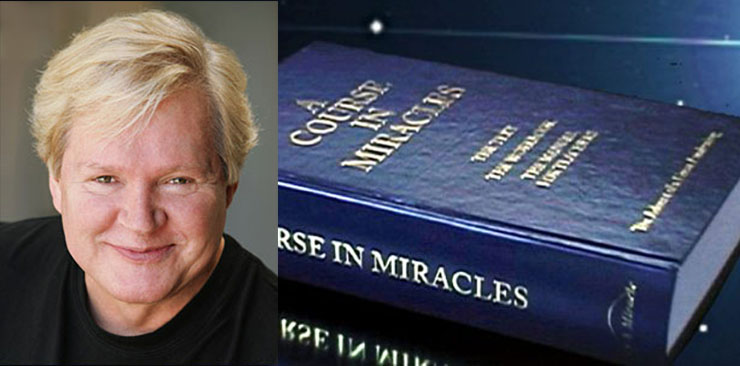
    A Course in Miracles, while familiar to many students of esotericism, remains a mysterious and elusive document. Its story is by now comparatively well-known. It was begun in 1965 when a New York psychologist named Helen Schucman heard an inner voice telling her it would dictate “a course in miracles” and that she should take notes. She complied (with some reluctance), and over the next several years took down material that would amount to some 1,200 printed pages, including a Text, a Workbook containing 365 daily lessons, and a Manual for Teachers.

    With the help of her colleague, Bill Thetford, and an editor named Kenneth Wapnick, Schucman prepared the Course for publication. It first appeared in 1975, and since then has sold more than a million and a half copies. Despite this grassroots success, the Course has been given short shrift by conventional theologians. But then the circumstances of its transmission make it unlikely that the Course would be accepted in conventional circles, since the voice that dictated the material to Helen Schucman claimed to be that of Jesus Christ, correcting 2,000 years of misrepresentation of his teaching. Arten and Pursah say that the Course is genuinely the work of Jesus, and most of The Disappearance of the Universe consists of their attempt to explain the central concepts and practices of the Course.

    To begin with, the Course asserts, the world is not real because it was not created by God: “There is no world! This is the central thought the course attempts to teach.” The world we see, the physical world of suffering and loss and change, is the result of a primordial separation from God – or rather, a belief that separation from God is possible. The Course says, “Into eternity, where all is one, there crept a tiny, mad idea, at which the Son of God remembered not to laugh. In his forgetting did the thought become a serious idea, and possible of both accomplishment and real effects.”

    Pursah expresses the same idea in this way: “For just an instant, for just one, inconsequential fraction of a nanosecond, a very small aspect of Christ appears to have an idea that is not shared by God. It’s kind of a ‘What if’ idea…. the question, if it could be put into words was, ‘What would it be like if I were to go off and play on my own?’ Like a naïve child playing with matches who burns down the house, you would have been much happier not to find out the answer to that question,” because it would mean that our primordial innocence would be “seemingly replaced by a state of fear and the erroneous, vicious defenses that this condition appears to require.”

    Here the Course diverges from classical Gnosticism. For the Gnostics, this world was fashioned by an inferior, arrogant pseudo-god whom they called the Demiurge (from the Greek word for ‘craftsman’ or ‘creator’). For the Course, the world began with a ‘tiny, mad idea’, which is the ego – the stance the fallen Son of God (which is each of us) takes in his deluded belief that he can exist apart from the Father. The apparently “real effects” include the physical world and the body itself, the “hero of the dream.”

    According to the Course, the world is not fashioned by a Demiurge or a second-rate creator God (sometimes identified with the God of the Old Testament) who exists ‘out there’ in the metaphysical stratosphere. It arises out of the ego, out of what is apparently the most intimate, personal aspect of the self. Some of the Gnostic texts characterise the Demiurge in a similar way. The Apocryphon of John says of him: “And he is impious in his madness which is in him. For he said, ‘I am God and there is no other God beside me’, for he is ignorant of his strength, the place from which he had come.”

    There is a curious and elusive crux here. Many investigators of Gnostic thought, including the psychologist C.G. Jung, have taken its mythology at face value: they have thought that the Gnostics believed their own myths. But it is possible that the Gnostics were not so naïve, that they were expressing truths about the human condition, but were doing so in mythological language. This would mean that the Gnostic texts are not to be taken at face value. They express certain spiritual and psychological insights that are not explicitly spelled out but which the Gnostic masters understood and explained to their pupils much as Arten and Pursah do with Gary Renard. This is a highly speculative conclusion, but we see a similar approach with contemporary Tibetan masters, who often teach by expounding highly compressed and cryptic texts to their hearers.

    In this case, the Demiurge is not merely an improbable conception of God but a sharp and accurate portrait of the principle of egotism in ourselves. The ego, like the Demiurge, says “I am God, and there is no other.” Paradoxically, this very assertion shows that it is “ignorant” of its strength, “the place from which it had come” – the divine reality.2 This interpretation would bring the import of the Gnostic texts far closer to the Course.

    If God did not create the meaningless world we see, if there is no ultimate reality to the ego or to its chief creation, the body, then the only appropriate response is to look past these illusions. It’s no coincidence that the Course speaks of laughing at the “tiny, mad idea” of separation.

    The Course also teaches that the only sane response to any form of madness in the world is to forgive it. The Course thus takes one of the chief precepts of the Gospels – forgiveness – and elevates it to a status that it does not have and cannot have in mainstream Christianity. If, as the latter teaches, the world does have a genuine ontological reality, then the evil in it is also real. Forgiveness then becomes a kind of favour bestowed upon the unworthy – an attitude that the Course calls “forgiveness-to-destroy.” By contrast, the Course teaches the undoing of the illusory phenomenal world by literally overlooking it, by seeing past its appearances to what the Course calls the “real world” underneath. This “real world” does not exist in some millennial future; it is present now, in the “holy instant.”

    This is the central idea that Arten and Pursah try to teach their pupil. Forgiveness undoes the ego by undercutting its foundation – the belief in this reality of separation and isolation. Renard’s masters stress that only what God has created is real. Since God did not create this world, it is not real. Nor, for that matter, is the body; it is utterly insignificant. The crucifixion and resurrection of Christ himself were originally intended to illustrate this very point. Consequently, everything from minor gaffes to the most apparently heinous atrocities are to be greeted with one response: forgiveness.

    Entwined with forgiveness is the need for a total and complete release from fear. Fear, according to the Course, is a delusion creation by the ego. Having imagined that it is separate from God (which is impossible in reality), it incurs an enormous sense of fear for having rejected God, and we identify with this fear. As Pursah expresses it:

    ‘Don’t you know what you’ve done?’ – the ego asks in our metaphysical story – ‘You’ve separated yourself from God! You’ve sinned against Him big time. You’re in for it now. You’ve taken paradise – everything He gave you – and thrown it right in His face and said, “Who the hell needs you?” You’ve attacked Him! You’re dead!’

    But since none of this happened in actuality, God is not angry at us and there is no reason to fear. Fortunately, the instant that the “tiny, mad idea” of separation occurred, God produced an answer: the Holy Spirit. The Holy Spirit is, in the Course’s theology, the aspect of God that is aware both of the divine reality and of the world of suffering and separation in which we think we live. To heal our minds, individually and collectively, we must turn them over to the Holy Spirit and let him guide them completely. One of the chief ways to do this is to apply forgiveness in any and all situations, not as a gesture of condescension or noblesse oblige, but as a result of a profound recognition that none of this ever really happened. Forgiveness is justified because there is no sin and no guilt and no reason to fear. We are like a child who is suffering a nightmare of horror although it remains safely in bed under the care of a loving parent. The fact that we can begin to hear the voice of the Holy Spirit – the call to forgiveness – is a sign we are awakening.

    This, at any rate, is a brief sketch of the Course as presented in The Disappearance of the Universe. It raises any number of questions, the most obvious being the nature of this strange revelation. Are we to take it at face value? Are we to believe that these beings, entities who were once disciples of Christ, materialised on someone’s couch somewhere in the Maine woods? The story becomes still harder to credit when we learn that Renard himself is both Thomas and Pursah: he was Thomas in a previous life (which he does not remember) and Pursah is his own last incarnation who will come in the future. Because time is part of the delusory fabric woven by the ego, it has no reality and can be elided or transcended.

    The most evident fact about these claims is that they are impossible for us to verify. There is no way of either proving or disproving that Gary Renard experienced such visitations from alternate realities. The skeptic may deny this possibility, but he could only do so on the basis of common-sense reality, and we know (even if we did not have the Course to remind us) that common-sense reality is a great deal less substantial and consistent than we like to pretend. Renard taped the sessions with Arten and Pursah, but he destroyed the tapes after writing the book. Even if he hadn’t, all we would have would be recordings of Renard conversing with a man and a woman, which would prove nothing to doubters.

    What, then, about the factual accuracy of what the masters say? Their conversations with Renard extend far beyond the Course. They claim, for example, that Mary Magdalene was the wife of Jesus. Arten points out: “By Jewish law at that time a person’s dead body could only be anointed by their family members, and if you look in your New Testament you’ll find that even though J’s body was no longer there, Mary Mag’dalene [sic] was allowed to go to the tomb in order to anoint it. What should that tell you?” We also learn that Edward de Vere, the Earl of Oxford, was the real author of Shakespeare’s works and that the world came close to nuclear holocaust on September 25, 1983, when Russian computers mistook the glints of light reflected off some clouds for attacking American missiles. A counterattack was launched and failed to occur only because an otherwise unknown officer named Colonel Petrov decided it was a mistake and called it off.

    Curiously, the only one of these particular claims that it’s possible to verify is the last. Lieutenant Colonel Stanislav Petrov was monitoring incoming satellite data on September 26, 1983 (not September 25, as Renard’s book has it) when he received signals indicating that the Americans were launching a nuclear attack. “I had a funny feeling in my gut,” Petrov later recalled. Correctly betting that the signal was a computer error, he made a historic decision not to inform his superiors. As The Daily Mail wrote, “Had Petrov cracked and triggered a response, Soviet missiles would have rained down on US cities. In turn, that would have brought a devastating response from the Pentagon.” Instead of treating Petrov as a hero, his superiors interrogated him relentlessly and retired him on a pension that later became almost worthless.3

    Other claims are far more tenuous. The Earl of Oxford has been put forward as the true author of Shakespeare’s works, but most scholars are not convinced. As for Mary Magdalene, various sources have claimed that she was Jesus’ wife, but again the evidence (despite The Da Vinci Code) is highly questionable. But if such assertions cannot be proved, they cannot exactly be refuted either.

    One thing, however, can be stated more or less conclusively. The ideas in The Disappearance of the Universe, whether they were generated by Gary Renard or by his masters or by someone else, reveal a profound and highly accurate knowledge of A Course in Miracles. Indeed this book was apparently intended as a correction for the many misinterpretations of the Course that have often been put forward even by its admirers.

    As a matter of fact, the Course has not been well served by its popularisers, who have tended to present it as a bland update of the American gospel of positive thinking rather than as a rigorous, difficult, but highly powerful means of spiritual development. This point, made mildly in The Disappearance of the Universe, is stressed much more sharply in its 2006 sequel, Your Immortal Reality, where Arten tells Renard, “Including yourself, you could count on two fingers the number of people who are out there on the road accurately teaching this message.” (The other is Kenneth Wapnick.) This rather harsh assessment has provoked a certain amount of hostility to Renard among a number of prominent American teachers of the Course – who are not always as pacific as one might imagine – but there is some truth in the claim.

    We then face the question of whether the Course itself is authentic. Whether or not Jesus dictated it to Helen Schucman is impossible to determine. How could we evaluate the origins of an inner voice inside the head of a woman who has been dead for over twenty-five years? (Schucman died in 1981.) Nor can we make much headway by comparing the Course to conventional Christianity or for that matter the Gospels. Even the most conscientious scholars have admitted that there is an immense chasm separating Christ from Christianity and that the Gospels themselves are highly questionable as historical sources.

    Despite these ambiguities, the Course remains a remarkably powerful and sophisticated (though not exactly flawless) tool for awakening the consciousness. As D. Patrick Miller, the publisher of the first edition of The Disappearance of the Universe, remarks, “The authenticity of the Course has been verified for me because it works, creating positive and dramatic change in my life and the lives of many others whom I’ve met and interviewed – but not because it purports to have a divine source.”

    In cases like these, I have found it helpful to remember an esoteric maxim: Neither accept nor reject. If we can free our minds even from the dichotomy of truth and falsehood, we may be able to open them to dimensions that surpass the yesses and nos of the world we know. This may be partly what Arten and Pursah mean when they tell us the reality of the universe is nondual.
    [alert type=”general” dismiss=”no”]This article was published in New Dawn 107.[/alert]
    [alert type=”success” dismiss=”no”]If you appreciate this article, please consider a contribution to help maintain this website.[/alert]

    Further Reading & Study

    The website for Gary Renard: http://www.garyrenard.com

    The Course in Miracles

    Forbidden Faith: The Secret History of Gnosticism by Richard Smoley

    Inner Christianity: A Guide to the Esoteric Tradition by Richard Smoley

    Secrets Of The Immortal: Advanced Teachings from A Course in Miracles by Gary Renard

    Footnotes

    1. Emphasis here and in other quotations is from the original.
    2. For further discussion of affinities between the Course and Gnosticism, see my book Forbidden Faith: The Secret History of Gnosticism.
    3. See David Hoffman, “I Had a Funny Feeling in My Gut,” The Washington Post, Feb. 10, 1999, www.washingtonpost.com/wp-srv/inatl/longterm/coldwar/shatter021099b.htm; Dec. 4, 2007. I am indebted to D. Patrick Miller for drawing my attention to this fact.


    Bibliography

    A Course in Miracles. Three volumes. Tiburon, Calif.: Foundation for Inner Peace, 1975.

    Gary R. Renard, The Disappearance of the Universe. Berkeley, Calif.: Fearless Books, 2003.

    Gary R. Renard, Your Immortal Reality: How to Break the Cycle of Birth and Death. Carlsbad, Calif.: Hay House, 2006.

    © New Dawn Magazine and the respective author.
    For our reproduction notice, click here.
  • What Are Humans Made Of?

    What Are Humans Made Of?

    The figure seems to hover around 95 percent. That’s the proportion of the universe that consists of dark matter and dark energy – entities that are only dimly and indirectly perceived by scientific apparatus.

    This fact has gotten wide attention lately, but one implication has gone unnoticed: if this is the case for the physical universe, it must also be the case for our own bodies. Therefore 95 percent of your body is made up of matter and energy about which nearly nothing is known.

    This makes the ancient dictum “Know thyself” somewhat harder to satisfy than one might have thought.

    What, then, is the body made of? It is a question that conventional thought cannot answer and for the most part cannot contemplate. This leads us to consider views of the body in the world’s esoteric traditions. As in most areas, they don’t agree on all points, but the similarities are more striking than the differences.

    The first thing we have to acknowledge is that the body, taken as a purely physical entity, has no structure or coherence whatsoever. This is a strange claim to make, but we can see the truth of it simply by contemplating the difference between a living body and a corpse. The living body has coherence; it is capable of motion and activity, and can sustain itself for several decades. The corpse lacks all such features. It will rot to pieces in a very short time.

    There must, then, be an organising structure that holds the physical body together during earthly life. One common name for this, which comes out of early twentieth-century Theosophy, is the etheric body, sometimes known as the etheric double. (I will be mostly using Theosophical terms in this article not because they are necessarily any better, but because they are the most commonly used ones in New Age contexts.)

    Thus, for our discussion, we have to redefine the word body. From an esoteric point of view, a body can be described as a vehicle for structuring experience at a particular level of existence.

    So what is this etheric body? Here is a firsthand observation. The American writer Rosanne Daryl Thomas describes the death of her cat:

    He was leaving us. I held him. He pushed his head under my arm, purring as I stroked him and spoke softly, wanting to fill him with love. And then suddenly his face grew sharper and thinner. His life had gone. I faced his death with grief and unexpected wonder. What I saw was this: that the life force, the spirit, is a thing unto itself, and when it leaves, when it left old Ruffy, his form lost his fullness. Something had clearly gone. What was left once held his old beloved self, but the self which had been present one moment had departed as if on a breeze. I understood what a soul was. It was this self. And I understood that, if energy never dies, that bit of self that was not in him was now elsewhere: where, I could not say, but I had seen it, and seen it go.

    This passage suggests that this organising principle, this “bit of self,” inheres not only in humans but in animals as well.

    Very likely this etheric body is no more immortal than the physical body. One common tradition holds that the etheric body survives for three days or so after physical death. This seems reasonable: it would explain why most encounters with dead loved ones occur a few days after the loved one’s death. The number drops off greatly after that point.

    The etheric body is made up of energy, though of an extremely subtle kind. This energy is known variously as prana, chi or qi, or simply the life force. (Note that Rosanne Thomas uses the phrase life force in the passage above.) The etheric body has its own structure, although this differs radically from the physical object that is studied in anatomy classes. Nevertheless, many traditions describe the patterns of this body, as we see with the meridians of traditional Chinese medicine and the chakras of Hinduism.

    The etheric body is not the whole story. There is also what is called the astral body, a term that can be traced back to the Neoplatonic philosopher Proclus, who lived in the fifth century CE. Man, he said, was composed of an okhēma, literally “vehicle,” made of starry or “astral” material. According to esoteric theory, it is affected and shaped by the configurations of the stars and especially the planets. This idea may explain an ancient Orphic verse, which instructs the recently deceased person to say, “I am the child of earthy and starry heaven.” This astral body is thought to be made up of a subtle, starry stuff sometimes called the astral light. Subjectively, the astral body corresponds to the congeries of thoughts, emotions, and images that surround an individual.

    Why call this a body? Because it is, as said above, a vehicle for structuring experience – in this case, at what we may call the psychological level. This vehicle does not resemble the physical entity – at least not in any detail – but it possesses its own consistency and organisation. Through their clairvoyant investigations, the Theosophists Annie Besant and C.W. Leadbeater described the astral bodies of various individuals and the colours and shapes associated with certain emotions and desires.

    Proclus believed this astral vehicle was immortal, but this is not a universal view. Some say the astral body survives the death of the physical body for around forty days. This would explain why, for example, the Eastern Orthodox tradition says prayers particularly intensely for an individual for the first forty days after his death, and why the period stipulated for reading for the deceased in The Tibetan Book of the Dead is forty-nine days.

    Beyond the astral level, there seems to be less agreement among the traditions, no doubt because these are increasingly remote from earthly experience. The Theosophists posit a mental body, as Kurt Leland observes in his interview, which in this case would consist of the structure of ideas and thoughts that surround the individual. But it is also possible to view the astral (emotional) and mental bodies as essentially the same entity.

    One curious feature of Theosophy is its concept of permanent atoms. As we’ve seen, all of these subtle bodies disintegrate after death. Given this and given the fact that Theosophy teaches reincarnation, we could ask, what reincarnates? The Theosophical answer is that literally one atom (obviously not an atom of the sort known to science) remains of each of the bodies: etheric, astral, and mental. These atoms are linked to the reincarnating Self and are the vehicles of karma: they are where your karma is stored.

    I don’t know of any other traditions that speak of permanent atoms per se, but the idea resembles the concept of the luz in the Kabbalah. Luz, in Hebrew, means “almond.” The French esotericist René Guénon writes that luz is “the name given to a specific, indestructible body, symbolically represented by an extremely hard bone, to which the body, after death, remains attached until its resurrection. As the kernel contains the germ and the bone contains the marrow, so luz contains those elements necessary for a restoration of an individual being.” (Guénon did not believe in reincarnation, so he spoke instead of resurrection.)

    Beyond the astral body are levels that are immortal, or relatively so. The Theosophists speak of a causal body that persists between incarnations, as well as progressively higher levels that are extremely different to picture through the lens of earthly experience.

    All this said, what knowledge can we have of these subtle bodies? Those who can see them clairvoyantly are rare, and, more often than not, have had this ability since birth.

    To experience your own etheric body, the key is proprioception: the subjective, conscious attention to the sensations of the body. This practice is found as a type of meditation both in the Work of G.I. Gurdjieff and Buddhist vipassana meditation. Kum Nye, a Tibetan movement practice taught by the lama Tarthang Tulku, works with it as well. With sufficient practice, you will eventually come to experience sensations as a kind of flow of currents of energy within the body. I would suspect these currents have some relation to the meridians of Chinese medicine and other anatomies of subtle energy.

    To have a sense of the astral body, you may find it helpful to sit or lie quietly and imagine yourself surrounded by light. Allow yourself to choose the colour of light that is most satisfying to you. You may have some preconceptions of certain colours as “higher” or “more spiritual” than others, but set these ideas aside as much as possible and focus on exactly which colour or colours feel the most appropriate, and then focus on visualising these. Pay attention to whatever feelings these colours arouse in you. If they produce some discomfort or irritation, it may be best to find another colour.

    As for sensing the subtle bodies in others, as I’ve said, clairvoyant vision of auras can and does occur (I have sometimes seen them myself), but the majority of people are more aware of these presences kinaesthetically rather than visually. That is, you go into a room and suddenly feel a chilly dread, or, on the other hand, it gives you a feeling of well-being inside. The same holds true when we encounter certain people.

    These kinaesthetic perceptions are, I believe, much more useful avenues of exploration of the subtle realms than attempts at clairvoyance per se. So if you want to cultivate your awareness of these levels, the best way is to focus on what you are feeling rather than on what you might see.

    Causal, mental, astral, etheric bodies – how absurdly mystical they sound! At least to some ears. And yet when we look at these new concepts of dark matter and dark energy, we can legitimately ask if these have something to do with the subtle bodies that have been spoken of for so long and so universally. Could it be that our subtle senses – known under such names as telepathy and clairvoyance – are perceiving these unknown substances? And could it be that science has scoffed at such things because its instruments have been too primitive to detect them?
    [alert type=”general” dismiss=”no”]This article was published in New Dawn Special Issue Vol 10 No 3.[/alert]
    [alert type=”success” dismiss=”no”]If you appreciate this article, please consider a contribution to help maintain this website.[/alert]

    Sources

    René Guénon, The Lord of the World, Translated by Carolyn Shaffer et al., Coombe Springs Press, 1983

    Philip S. Harris, ed., Theosophical Encyclopedia, Theosophical Publishing House, 2006

    Daryl Thomas Rosanne, Beeing: Life, Motherhood, and 180,000 Honeybees, Globe Pequot Press, 2002

    Tulku Tarthang, Kum Nye Relaxation, Two volumes, Dharma Publishing, 1978

    © New Dawn Magazine and the respective author.
    For our reproduction notice, click here.

  • From Witchcraft & Satanic Rites to Demon Possession

    From Witchcraft & Satanic Rites to Demon Possession

    The supernatural: the images that come to mind when that word is uttered often are ones that arouse anxiety or dread. Why?

    To begin with, you can only be afraid of something that you believe is real. A child has a nightmare and wakes up; the parent consoles by saying “it was all just a dream” or “it was all imaginary.” What is imaginary cannot hurt you, and there is no reason to fear it. Only what is real can hurt you.

    But, then, what exactly is real? This is a long and difficult question to answer, but as a partial answer we can say that in order for something to be accounted as real or true, it must accord with our preconceptions of what is possible and what is not. As it turns out, these preconceptions vary wildly from place to place and from age to age.

    For example, over the centuries the views of Western civilisation has swung back and forth about witchcraft. It is a widespread but incorrect belief that the persecution of witchcraft started with Christianity. The Jewish Mosaic Law was quite specific in its condemnation: “Thou shalt not suffer a witch to live” (Exod. 22:18). The pagan world was no more tolerant: the Code of Hammurabi, dating to the early second millennium BCE, discusses a procedure regarding charges of witchcraft, and the Twelve Tables, the founding legal documents of the Roman republic, dating to the fifth century BCE, assumed its existence; later edicts in the time of the empire entailed prosecution for witches.

    By contrast, in Christianity during its first 1,400 years, charges of witchcraft were comparatively scarce, and belief in witchcraft was condemned at least as often as witchcraft itself.

    The witch scare of the early modern era – which has persisted, off and on, to the present – began in earnest in 1484, with the propagation of a bull by Pope Innocent VIII authorising two inquisitors, Jacobus Sprenger and Heinrich Kramer, to deal with witches in certain parts of northern Germany. Sprenger and Kramer followed up by publishing a lurid but highly influential work called the Malleus maleficarum (“The Hammer of Witchcraft”) in 1486, spelling out methods for detecting and punishing witches.

    Although the Catholic Inquisition spearheaded the witch craze, over the decades the inquisitors themselves became increasingly sceptical of witchcraft charges. The largest numbers of condemnations of supposed witches took place in countries like Germany, which were battlegrounds of contending denominations, rather than in Spain and Italy, where the Inquisition was strongest.

    Why should the law, Jewish, pagan, or Catholic, occupy itself with witchcraft at all? Today the preoccupation with such a thing seems exceedingly odd. But it is not at all odd if we consider that the worldview of those eras assumed not only the existence, but also the efficacy, of witchcraft.

    It would be hard to deny that witchcraft, benign or malevolent, is practiced. People cast spells; this is not in doubt. On this point we would agree with the ordinary European of the year 1500. However, we might disagree about whether the spells work. In the Europe of the early modern era, it was generally assumed, by the learned as well as the ignorant, that witches could do good or harm with their spells. A society that believes that something can do harm is likely to try to forbid that thing: hence witchcraft laws.

    The belief in witchcraft did not persist. The history of the early modern era is a history of disillusionment, first in the Catholic hierarchy – whose corruption, assailed for centuries, finally led it to lose its monopoly on the faith of Europeans – and then in its worldview. The witch hunt craze, which peaked in the late sixteenth and early seventeenth centuries, was a major part of this disillusionment. Witchcraft charges became so numerous, so problematic, and in the end so ridiculous that by 1700 European society had ceased to believe them.

    Consequently, witchcraft laws and persecutions faded into oblivion during the eighteenth century. In Britain, for example, the Witchcraft Act was passed in 1735. Replacing earlier laws that entailed penalties for witchcraft, it went in the opposite direction, making it illegal to claim to be a witch. Since witchcraft was impossible, claiming to be one, or alleging that someone else was, was held to be fraudulent in and of itself.

    The 1735 act, which sat on the books for over two centuries, was overturned for extremely peculiar reasons. In 1944 a medium named Helen Duncan claimed to have contacted the spirit of a sailor who had drowned on the HMS Barham. She was jailed for this announcement, allegedly on the ground of being a false medium (under the Witchcraft Act) but in fact because she had been a genuine one: she made her statement before the sinking of the Barham had been made public. Duncan’s case led to the repeal of the Witchcraft Act in 1951, leading to another curious reversal.

    Once the act was repealed, many people came forward claiming to be witches. They also claimed to be part of an ancient tradition – the Old Religion – that had flourished in the British Isles long before the coming of Christianity. The most famous of these individuals was Gerald Gardner, a retired customs official who said he belonged to a coven that met in the New Forest in southern England. Gardner’s works, including High Magic’s Aid, Witchcraft Today, and The Meaning of Witchcraft, launched the contemporary movement known as Wicca. While membership figures for this movement are hard to come by (many Wiccans practice alone, and many others conceal their practices for fear of scorn), one estimate holds there were some 362,000 in the US in 2008. In the UK census of 2011, over 56,000 identified themselves as Pagans, nearly 12,000 as Wiccans, and another 1,300 said their religion was “Witchcraft.”

    Satanism, Exorcism and the Movies

    In the twenty-first century, attitudes toward witchcraft have come full circle. In the medieval era, its existence was denied; in the early modern era, it was believed to exist but was persecuted; in the eighteenth century, its existence was again denied, and today, free from fear of legal penalties (at least in the US and the UK), many individuals are stepping forward and identifying themselves as witches. But since the law in these countries and other lands does not acknowledge the reality of witchcraft, witches can cast spells white and black with impunity.

    Satanism, that great bugbear of fundamentalist Christians, has also come forward in recent centuries. Although rumours of Satanic rites go back at least to medieval times (a Satanic cult is said to have thrived at Louis XIV’s Versailles in the seventeenth century), Satanism first came to widespread attention with the novel Là-bas (“Down There”) by the French author J.-K. Huysmans. Published in 1891, the book included a vivid description of a Black Mass that Huysmans had supposedly witnessed. The current fascination with the Satanic dates from the 1960s. Anton LaVey launched the notorious Church of Satan in San Francisco in 1966. One year later, Ira Levin published Rosemary’s Baby, which became the best-selling horror novel of the decade and inspired Roman Polanski’s even more popular film of the same name, which appeared in 1968.

    Levin no doubt wanted his book to succeed, but later on he was dismayed by its long-term effects, since it led to a genre of horror films lending perhaps undue credibility to the existence of the Evil One. “I feel guilty that Rosemary’s Baby led to The Exorcist, The Omen,” he said in 2002. “A whole generation has been exposed, has more belief in Satan. I don’t believe in Satan. And I feel that the strong fundamentalism we have would not be as strong if there hadn’t been so many of these books… Of course, I didn’t send back any of the royalty checks.”

    As Levin noted, Rosemary’s Baby set the stage for The Exorcist, a 1971 novel by William Peter Blatty that was made into a movie two years later; it is probably the most disturbing film in the Satanic genre. It was released in Germany in 1974. Two years later, a twenty-three-year-old woman, Anneliese Michel, died of dehydration and malnourishment after having sixty-seven exorcisms performed on her over the course of ten months. Her knee ligaments had ruptured from the six hundred genuflections she had performed during each of the ceremonies. Her death led to manslaughter convictions for the four priests who had exorcised her (evidently without success). The story, heavily altered, inspired another Satanic horror movie, The Exorcism of Emily Rose, which appeared in 2005.

    Strangely, recordings of Anneliese’s voice made during her periods of possession strikingly resembled those of Linda Blair, who played the possessed young girl in The Exorcist. (A recording has been uploaded onto YouTube for your listening pleasure.) Was Anneliese’s possession – if that is what it was – a sign that Satan is abroad in the world, or was it a copycat performance of something she had seen in a film? Without question, Anneliese was disturbed – she had had seizures even before The Exorcist was released – but it would seem that art in this case inspired life rather than imitating it.

    Today exorcism is becoming increasingly fashionable. In 1997 the Catholic archbishop of Calcutta ordered an exorcism to be performed on the dying Mother Teresa on the premise that her illness may have been due to demonic attack. The Catholic Church has increased the number of exorcists it is training in Spain and Italy. According to a January 2014 article in the British newspaper The Telegraph, the church claims that “the rise in demonic cases is a result of more people dabbling in practices such as black magic, paganism, Satanic rites and Ouija boards, often exploring the dark arts with the help of information readily found on the internet.”

    Like the inquisitors of the sixteenth century, the Catholic authorities today are comparatively sceptical about demonic possession and attack, insisting these phenomena are extremely rare. In fact, Michael Cuneo, a sociologist at Fordham University in New York and author of American Exorcism, points out that the vast majority of exorcisms, at least in the US, are being carried out by fundamentalist Protestants, sometimes with disastrous results. In 1995, Pentecostal ministers in San Francisco pummelled a woman to death in order to drive out her demons. In 1998, a seventeen-year-old girl in Sayville, New York, was suffocated to death by her mother in an effort to destroy a demon inside her.

    Powerful (Uncontrolled) Thoughts

    Perhaps it is all due to dark rites. Perhaps the priests of the twenty-first century are hearing sinister, scratchy voices out of girls’ mouths because misguided youth are fiddling with Ouija boards. Or perhaps the epidemic of demonic attacks are due to one of the oldest afflictions mankind has suffered – mass belief.

    The power of the mind is now taken as a given not only in alternative spirituality but in mass culture as well. Practically all of the literature on mind power, positive thinking, and similar beliefs focuses on the individual’s use of mind power to, say, materialise the perfect lover or a cheque for a million dollars. As most people who have tried it have discovered, this only works so well – if only because controlling the mind, as has long been recognised, is the hardest thing of all to do.

    If thoughts have power, what kind of power do collective thoughts have? We have already seen that belief in things like witchcraft has come and gone several times over the past few centuries. If there is any truth at all to the idea of mind power, it would follow that collective belief would create a kind of mind-space that all the members of a given culture inhabit, whether they like it or not, or know it or not. As the spiritual teacher J. Krishnamurti once observed in a conversation: “Suppose one is brought up as a Catholic, hmm? You have all the paraphernalia of rituals; accepting authority; accepting Jesus as the only saviour, son of God; and the Virgin Mary; and ascending to heaven, physically. These are all dogmas, asserted by the church and accepted through two millennia, two thousand years, as an actuality… In India, there is the same old thing in a different form, which is not only a belief but, to the believer, it is an actuality.”

    It is an actuality to the culture as well. That is why, for example, we can read a court transcript from five hundred years ago and see a man confessing to changing himself into a toad – as well as a jury that takes him at his word.

    In the Western world the situation is ambiguous. While religious allegiance continues to decline, we cannot necessarily say the same about belief in the occult in general. People continue to see dead relatives, experience miraculous rescues at the hands of angels, and – on the negative side – experience what feel very much like demonic attacks. The explosion of occult horror movies has fed the collective imagination with vivid pictures of evil – particularly over the last forty years. This in turn has fed into the claims of fundamentalist religion, which finds it extremely useful to use these sources of terror to attract new victims. Against this background, it is easy to understand why cases of alleged demonic possession are on the rise.

    The Real and Imagined

    To what extent are these phenomena real, and to what extent are they figments of the imagination? The boundary between the two categories is not easy to draw. A whole fabric of preconception underlies our collective experience of what is real. We have only the most limited degree of control over these preconceptions, in part because we are so oblivious to them. Nor do we have any clear idea, at a deep level, of how and why these collective beliefs change. Of course we are convinced that we today have the truth and that everyone who lived centuries before was ignorant and credulous. But is this belief itself a sign of our own collective delusion?

    In any case, we not only continue to have the supernatural with us, but we have the fear of the supernatural with us too. The best approach may be a middle path between denial and credulity. The esoteric traditions have long recognised the reality of occult phenomena, but have also stressed that they not be given too much importance. One Buddhist tale tells of a young monk who goes to his master and says, “I had a vision of the Buddha during my meditation!” The master replied, “Just keep meditating and it will go away.”

    In the mid-twentieth century the English author Christopher Isherwood found a spiritual home in the Hindu tradition known as Vedanta. At one point he approached his teacher and said that he was experiencing certain supernatural visions. The swami responded that as Isherwood progressed on the spiritual path, he could expect more of these visions. He also told him that he “must take no particular notice of them, and not regard them as a matter of self-congratulation. They have no special significance. The psychic world is all around us, full of sub-creatures, earth bound spirits, etc. To be able to see them is just a knack, a minor talent. Dogs see spooks all the time, it is dangerous to let them interest you too much. At best, they are a distraction from the real objectives of the spiritual life. At worst, they may gain power over you and do you harm.”

    In any event, whether dealing with the supernatural or with anything, the last thing you need is fear.

    [alert type=”general” dismiss=”no”]This article was published in New Dawn Special Issue Vol 8 No 2.[/alert]

    [alert type=”success” dismiss=”no”]If you appreciate this article, please consider subscribing to help maintain this website.[/alert]

    Sources

    “Ira Levin.” Wikipedia: http://en.wikipedia.org/wiki/Ira_Levin; accessed Feb. 24, 2014.

    Christopher Isherwood, My Guru and His Disciple, Vintage Classics, 2013.

    Oliver Libaw, “Exorcism Thriving in U.S., Say Experts”, ABC News, Sept. 11, 2013, http://abcnews.go.com/US/story?id=92541; accessed Feb. 24, 2014.

    David Edmund Moody, The Unconditioned Mind: J. Krishnamurti and the Oak Grove School, Quest, 2011.

    Jacobus Sprenger and Heinrich Kramer, Malleus Maleficarum: The Hammer of Witchcraft, Translated by Montague Summers. Folio Society, 1968.

    Nick Squires, “Rise of the Exorcists in the Catholic Church,” The Telegraph, Jan. 4., 2014, www.telegraph.co.uk/news/worldnews/europe/vaticancityandholysee/10550800/Rise-of-the-exorcists-in-Catholic-Church.html; accessed Feb. 24, 2014.

    “Really Scary! The Real Exorcism of Emily Rose”; www.youtube.com/watch?v=PZfg57LZ34g; accessed Feb. 24, 2014.

    © New Dawn Magazine and the respective author.
    For our reproduction notice, click here.