New Dawn – World's Most Unusual Magazine

Author: Richard Smoley

  • Awakening Your Psychic Powers: An Interview with Kurt Leland

    Awakening Your Psychic Powers: An Interview with Kurt Leland

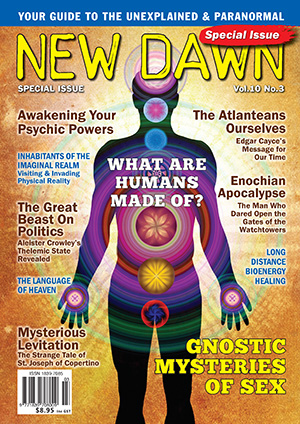
    This article was published in New Dawn Special Issue Vol 10 No 3 (October 2016)

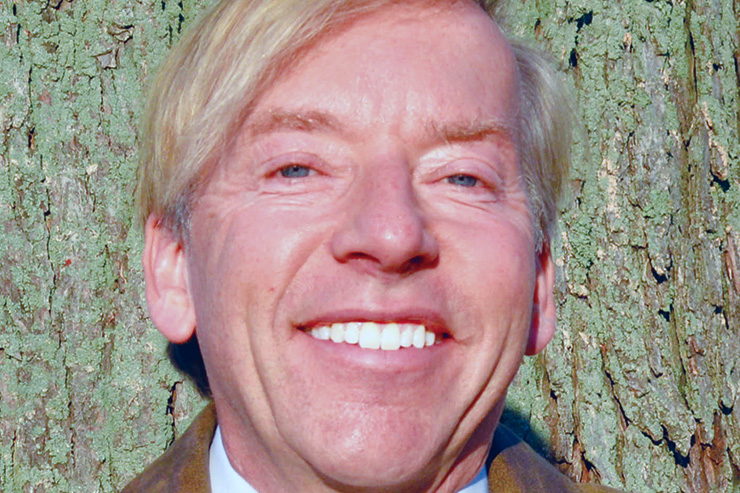
    Kurt Leland is one of today’s most intrepid explorers of the inner planes. A musician and author as well as a visionary, he has written books including Otherwhere: A Field Guide to Nonphysical Reality for the Out-of-Body Traveler and The Multidimensional Human. His latest work is Invisible Worlds: Annie Besant on Psychic and Spiritual Development (Quest Books, 2013). It is an anthology of writings by the Theosophist Annie Besant (1847–1933). Kurt’s website is www.KurtLeland.com.

    I met Kurt during his visit to the Theosophical Society’s American headquarters in Wheaton, Illinois, in the fall of 2011. I was immediately impressed with the depth of his knowledge of, and experience in, the astral and mental realms, which are for most people little more than vaguely understood concepts. He is one of the most lucid and intelligent writers on the inner planes working today. The following conversation was conducted by e-mail in April 2016.

    RICHARD SMOLEY (RS): A lot of people these days are interested in developing their psychic powers. What advice would you give them?

    KURT LELAND (KL): The mind tends to conceptualise a term such as psychic powers, thinking of them as something other than normal, from an unknown realm or level of being – something to be afraid of or acquired by force of will or perpetual practice. Typically such powers come under headings such as telepathy, precognition, clairvoyance (seeing auras), second sight (perceiving ghosts), remote viewing, astral travel, even magical influence over people and events. Some people want to prove to themselves and others that such things are possible and they can do them, not once only (spontaneously or by accident) but regularly (at will or on demand).

    However, I think of psychic powers as the natural concomitant of living within and evolving our subtle bodies:

    An etheric body, having to do with life force and health and offering us the ability to perceive such things as nature spirits, fairies, the recently dead, even angels, as well as to sense events hours or days before they occur;

    An astral body, having to do with desire and emotion, and allowing us to experience our dreams and visit the dead in the afterlife;

    A mental body, having to do with our thoughts and beliefs and allowing us to perceive and travel within a world of ideas and sometimes to contact and learn from them; worldviews of famous dead people;

    A causal or soul body, allowing us to know our past lives, meld minds with others, and perceive and alter the forces in play that create the events of our present life;

    And other bodies whose abilities are less easy to describe.

    My advice to people who want to develop so-called psychic powers is not to target specific name-brand abilities, but rather to develop the subtle bodies and see what shows up. The will- and proof-based approach often leads to frustration and feelings of failure. The approach of developing the special senses of subtle bodies can unfold naturally and organically and enrich our lives with a multitude of adventures in consciousness we may never have heard of before.

    For example, one of my first psychic experiences was sensing the fear of a tree in a wooded area in my neighbourhood after I’d climbed it. At seventeen, I didn’t know trees could feel fear, and I didn’t know this was a psychic experience – until I went back to climb the tree a few days later and it was no longer there, having been bulldozed down to clear the land for a new house. That was an etheric-body experience, not one that could be easily sought after or named or conceptualised. It just showed up, indicating a possible avenue to explore, and gradually developed into a more or less constant, wonderfully enriching awareness of the beingness and inner life of trees.

    RS: How did you develop your own abilities?

    KL: My grandfather on my mother’s side introduced me to the writings of the famous American psychic Edgar Cayce when I was ten or eleven years old. My grandfather knew how to read palms and had some predictive ability, but renounced palm reading when he accurately predicted the age of onset of a serious illness in one of my aunts. Though he taught me the mechanics of palm reading, I can’t say I had any notable psychic experiences when I was a child – yet, after reading about Cayce, I desperately wished for such experiences.

    It wasn’t until I met a woman in college who was a natural psychic from birth that I began regularly having experiences of my own. She had recurring dreams that came true, including dreams about meeting me before we both arrived on campus in the fall of 1976. She knew when people close to her had died, scolding her mother for withholding the information so as not to bother her at school. We developed a telepathic rapport that climaxed with my inventing a place in my imagination that she could see and describe back to me. Whenever I added anything to it, she could tell me what it was. Somehow in the process of hanging out with her, my own abilities began to develop. She had nothing to teach me, she knew nothing about how her abilities worked. Yet somehow my being near her opened up new possibilities for me. Now I understand she was awake and aware within, and could use the senses of a subtle body I had little or no access to – perhaps the etheric body – and that her being awake in that body somehow stimulated mine.

    Otherwise, I’ve never had a formal teacher. I learned much from books, especially the Seth material channelled by the American medium Jane Roberts. When I began to experiment with the Ouija board and automatic writing in the fall of 1980, there was no evidence that I had any talent for such things. Yet I was persistent. It was as if I never stopped knocking on the door, and finally someone let me in. I met my inner teacher by means of these experiments about six months later.

    It certainly seems that my college friend represented nature and I represented nurture. But using the Theosophical framework of subtle bodies, there may be another explanation that encompasses both the notion of being born psychic and that of developing psychic abilities. If we’ve developed any of our subtle bodies in a past life to the point of being able to use their inner senses for clairvoyant (seeing) or projective (travelling) abilities, then we can carry those capacities with us into a subsequent life. The real issue is how soon we recall and realise them – a process I call self-remembering. By this light, my friend self-remembered her use of the etheric body very early and therefore seemed to be a born psychic, whereas I self-remembered my use of this body much later and seemed to develop psychic abilities.

    To extrapolate from this, any spontaneous psychic experience may indicate the possibility of self-remembering the use of a particular body, as in my case with the fearful tree. The challenge is not so much developing psychic powers as finding a way to recall the proper use of one or more of our subtle bodies. Even so, there may be a leading edge of our growth – a body we haven’t mastered yet, which challenges us to develop new inner-sense abilities and the powers of awareness and action within that body.

    RS: Why would you say people today feel so distant from the unseen, subtle levels?

    KL: They’re locked in their mental bodies, a result of family and social conditioning along the lines of scientific materialism, rationality, scepticism, and agnosticism. An overdeveloped mental body is like an overdeveloped physical body – it’s muscle-bound; the focus on increasing size and strength (mathematical, linguistic, and reasoning abilities) has reduced its flexibility or receptivity. The result is alienation from the physical and emotional bodies on one side and from the soul or causal body on the other. The mental body becomes like a fearful teenager hiding in his or her bedroom, with thoughts speeded up through overstimulation by social media, electronic devices, and computer games, and dominated by what one spiritual teacher calls “the tyranny of likes and dislikes.” This results in anxiety, indecisiveness, and black-and-white thinking. To the mental body isolated in this way, the physical body seems bent on betraying us, there’s no soul to guide us, and the whole purpose of life seems to be managing our anxiety.

    The physical body needs quality sense experience – exercise, healthy food, beautiful surroundings, bare feet on the grass or beach, a tempered yet satisfying sex life. The emotional body needs authentic heart-to-heart connection with others. The mental body needs the experience of a community of others who share our beliefs and values. The causal body needs a sense of usefulness and purpose, usually along the line of service to humanity. When the subtle bodies are nurtured in these ways, the boundaries between them soften and we start using them for more than we normally do (acting, feeling, thinking, and serving). That’s when our spiritual powers begin to unfold. We start seeing with the eyes of each body, its inner senses, providing new ways of looking at the world we normally experience and glimpses of the invisible worlds beyond. Eventually we learn to travel in those worlds.

    [alert type=”info” dismiss=”no”]If you appreciate this article, please consider a subscription to New Dawn magazine.[/alert]

    RS: One major issue with psychic powers is self-delusion. You see something uncanny, either visually or with the mind. It seems real. But sometimes it isn’t. How does a person develop discrimination with such things?

    KL: There are many tests and challenges in developing accurate perception from the perspective of each subtle body. I’ve experienced them as a graded course set up by inner teachers and guides, unfolding in projections from the dream state over decades. One example would be learning to identify the same guide under different appearances. Another would be learning the difference in inner-sense impressions associated with a dream character, a deceased individual, a guide, a nonhuman entity, and so on.

    In Invisible Worlds, my anthology of Annie Besant’s Theosophical writings on psychic and spiritual development, she says that the more excited you are about what you’ve perceived, the less likely it is to be real – for example, seeming to receive a mission from some high being. A real experience of receiving such a mission would come with a sobering sense of responsibility and self-examination about what might be required and how to achieve it, not an orgy of self-congratulation over one’s putative spiritual status. 

    RS: Another area of interest is astral travel – the ability to go out of the body in a trance state. Could you start by telling us a bit about this?

    KL: I’m interested in your use of the phrase trance state. Some people may project in that way. My adventures along these lines generally begin from a dream.

    In its simplest form, astral projection is an out-of-body experience in which the etheric body separates from the physical body in a twilight state between waking and sleeping, often accompanied by so-called sleep paralysis (indicating that one’s consciousness is no longer primarily focused in the physical body and so can’t control its movements), a loud vibration during separation, and the ability to view the physical body from a vantage point several inches or feet away. Such experiences are often spontaneous rather than intentionally produced, as a trance state would be.

    Some people report that they can free up a higher body, such as the astral, mental, or causal body, through meditative states, and go travelling on the physical plane or some higher plane. I suppose an intentionally produced trance state, as by self-hypnosis, would be just as effective. But it seems to me that the actual mechanism of so-called astral travel is that we shift the focus of our consciousness from one layer of our energy field (aura) to another. Each layer is actually one of our subtle bodies. When such a shift is successful, we can perceive the plane associated with that body and perhaps travel on that plane. Thus the word astral in the term astral travel is used in a general way to describe any experience in a nonphysical body.

    For most people, the hope or aim is to travel in the astral body on the physical plane to distant places or people. A related ability is remote viewing, which places you on location without the sense of travel. I suppose the only difference between projection and travel is that the first term emphasises the act of leaving the location of the physical body and the other only the experience away from the physical body. Not everyone recalls the actual exit from or return to the physical body. In the case of shifting the focus of consciousness to a different layer of the energy field, there may be no sense of exit or travel from one plane or location to another. You’re just there, wherever it is. 

    RS: Is it a good idea to learn to do astral travel?

    KL: I believe astral travel to be an inevitable outcome of the process of developing our subtle bodies. First, we have what Besant calls a sheath. It allows us to act at the physical, feel in the emotional, think in the mental, and serve in the causal levels of being. Then we develop a body, which begins to perceive on the physical, astral, or mental planes. We all have a well-developed physical body in that sense. Our dreams indicate that we have an astral body capable of perceiving on the astral plane. Mental and causal body dreams are less common. Finally, we develop a vehicle of consciousness, capable not only of perceiving, but also of moving through every level of the physical, astral, mental, or some higher plane. Lucid dreamers and people who can project on the astral plane, knowing the difference between dream characters and locations and the actual scenes, dwellers, and phenomena of the astral plane, are developing the astral body as a vehicle of consciousness.

    My first projections took place when I was fourteen. They terrified me and I avoided them for several years. Subsequently, I learned to develop my etheric, astral, and mental bodies under the guidance of teachers encountered in such projections. Forty-five years later, I think it safe to say that I have fully functional vehicles of consciousness on the physical, astral, and mental planes.

    RS: Whom would you advise not to undergo psychic development?

    KL: Anyone who is anxious, depressed, or prone to exaggerated states of enthusiasm or elation or to obsessive or addictive behaviour. These indicate strains in the relationship between the bodies and the occupying consciousness that we call ourselves. Such strains need to be overcome (along the lines recommended in connection with what our bodies need) before psychic development can be pursued safely.

    The problem with anxieties and fears is that they attract what we’re afraid of, resulting in interactions with undesirable scenes, dwellers, and phenomena of the astral plane. Undesirable interactions may also occur with depression. The problem with enthusiasm or elation is that it makes everything we experience seem more glamorous than it really is, resulting in self-deception or deception by prankish or malevolent astral entities. Obsessive or addictive behaviour can result in our coming under the control of negative entities, as in possession.

    In the end, each of these situations is nothing more than a challenge to be overcome in the development of the bodies. We need to learn how to maintain a balanced, clear-headed perspective as we investigate the possibilities of these bodies. The real shame is when we do so prematurely and frighten ourselves off from further exploration because some passing mood has distorted our perception or attracted unpleasant experiences or made us seem foolish to ourselves or others.

    RS: Is there a connection between the astral level and the post-mortem state?

    KL: I like to think of the astral plane as comprising a number of realms or zones. One such realm is the astral Dream Zone, where our dreams ordinarily take place. Another is the astral Afterdeath Zone, where the initial stages of our journey through the afterlife take place. I’ve explored both realms for many years in projections from the dream state. They’re similar in that their primary function is dealing with emotions and desires. Dreams frequently allow us to satisfy our unfulfilled desires and experience our unexpressed emotions, such as fear, lust or anger. We purge such things through our dreams so we don’t have to act them out on the physical plane. In the astral stage of the afterlife, we perform similar purges of a lifelong accumulation of unfulfilled desires and unexpressed emotions, thus rising from darker to lighter experiences of this realm, as in the Catholic notion of purgatory.

    On the mental plane, there is also a Dream Zone and an Afterdeath Zone. These realms involve exploring our lives in terms of learning and growth – what we have or haven’t learned among the lessons our soul may have intended for us. They’re full of exciting opportunities for exposure to the world’s great minds and cultural achievements. For example, I once visited an area in which it was possible to experience any opera from the vantage point of each of its characters. In the mental Afterdeath Zone, we review our life on earth and fulfil the plans for learning and growth that we were blocked from implementing there, because of lack of courage or extenuating circumstances. This can be a joyful, even heavenly experience.

    RS: Can you contact dead people through psychic means?

    KL: I believe this is possible and I’ve experienced it, though not in the way most people expect. I don’t ordinarily perceive people who have passed on in the auras of others or as ghostly presences hanging about with a desire to give messages. Nor do I go into a trance state so that others can communicate through me with people who have died. When I channel, the being who works through me is almost exclusively the inner teacher I call Charles. I suppose he could be described as a dead person, since as far as I know he’s not currently embodied on the physical plane.

    But I think you mean dead relatives and friends. My interactions with the latter take place in astral projections, usually from the dream state. I visit them in situ, wherever they may be in their progression through the afterlife, from the death of the current body to their preparation for reincarnation. Usually these are people I have a close association with.

    For example, I tracked the afterlife progress of one of my uncles through several stages over a course of eight years – his orientation to the afterlife, the beginning and completion of his long and detailed life review, and his being informed of certain lessons to be learned in his next life just prior to rebirth. Though I observed my uncle without communicating with him, others among the dead have shared with me their thoughts and feelings about their earth life and post-mortem existence. One was a counselling client who died of a reaction between prescription and recreational drugs and was passing through a rehabilitation program on the Other Side because his death had been classified as an unpremeditated suicide.

    I’ve rarely gone looking for people whom I’ve never met at someone else’s request – though Charles has sometimes commented on the progress of a client’s deceased loved one through the afterlife. This is not my favourite kind of work, since some elements of the afterlife can seem distressing to people who think only in terms of happiness in heaven

    RS: Why is so much of society today dead set against believing in the existence of the psychic realms? 

    KL: Religious teachings in many cultures indicate that such things are at best distractions on the spiritual path and at worst the product of malevolent beings such as the Christian devil. Scientific materialism has persuaded us that psychic realms, spiritual paths, malevolent beings, and the devil are nothing but superstitions. Yet I believe such things are what the Buddha called views. The point isn’t to dismiss one view in favour of another, but to try each on for size, to meditate on it, and investigate and explore where it takes us, what it does for us.

    The scientific view that the physical body is a machine that gradually wears out and needs to be ‘fixed’ by an ever-expanding medicine chest of only partially effective remedies isn’t terribly hopeful or inspiring, though it provides the opportunity to explore the function and dysfunction of body parts in relation to each other, time, and illness. The metaphysical view that the body is a conscious entity that needs care, that it could be our friend, that we might have ways of learning from and dialoguing with it, is unprovable in scientific terms, but can yield favourable results when explored as a provisional belief or object of meditation, to be lived as if it were true to see where it takes us. Notions of an etheric, astral, mental, or causal body could be treated in the same way.

    RS: One of your books is called The Multidimensional Human. In what ways are we multidimensional?

    KL: I believe reality consists in as many descriptions of it (views) as we have tolerance for. Each view opens up new possibilities for exploration – new dimensions – and none absolutely excludes another. I’ve gotten the best results in my personal exploration of psychic and spiritual development by adopting the Theosophical view of multiple bodies, each fitted to a particular plane of existence by a specialised set of inner senses that carry us from sheath to body to vehicle of consciousness. The planes themselves are ranged along a continuum of human potential from lowest physical to highest spiritual, and each body and its corresponding level of being is an adventuresome dimension to be explored as we develop our multidimensional humanity – our ability to respond appropriately to each other and to other realms and beings for the mutual benefit of all.

    Kurt Leland’s Spiritual Orienteering website is www.KurtLeland.com, which lists his books and services.

    [alert type=”success” dismiss=”no”]If you appreciate this article, please consider subscribing to help maintain this website.[/alert]

    © New Dawn Magazine and the respective author.
    For our reproduction notice, click here.
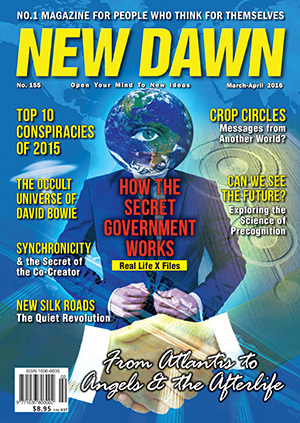
  • From Atlantis to Angels & the Afterlife: The Adventurous Life of Writer Ptolemy Tompkins

    From Atlantis to Angels & the Afterlife: The Adventurous Life of Writer Ptolemy Tompkins

    From New Dawn 155 (Mar-Apr 2016)

    The spiritual, the occult, the paranormal – these things have never sat well with the mainstream press. If they pay attention to such things, it is usually only briefly and with an eye to ridicule. Not surprisingly, the majority of writers on these topics are arrogant ignoramuses.

    This situation may be changing. A small cohort of writers has been developing who are willing to look intelligently, objectively, and engagingly at levels of reality that consensus opinion would rather ignore or condemn.

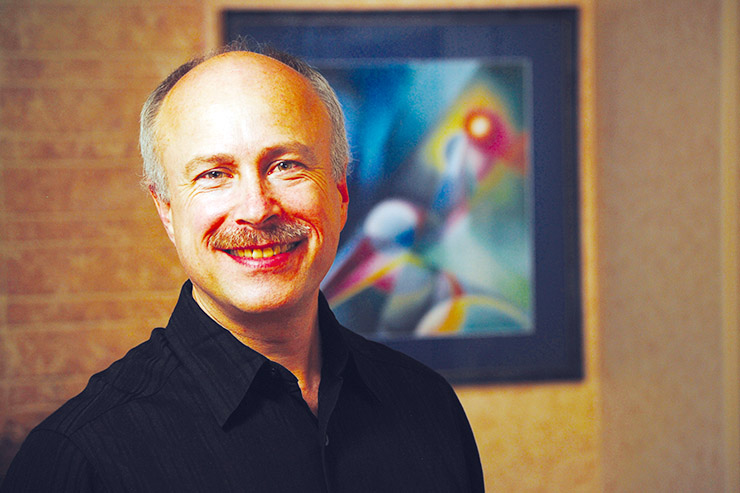
    One of these writers is Ptolemy Tompkins. The son of Peter Tompkins, best-known for his 1970s bestseller The Secret Life of Plants, Ptolemy (named after an ancient Gnostic philosopher, not the proponent of the geocentric theory) grew up in a world of the marvellous in the ’60s and ’70s, the heyday of the New Age. His stepbrother, Nicholas Vreeland, is a prominent Tibetan Buddhist abbot and was the subject of the 2014 film Monk with a Camera, which also features interviews with Ptolemy.

    As a writer, Ptolemy has staked out his own ground in these areas. His first book, Paradise Fever: Growing Up in the Shadow of the New Age, was a chronicle of his life and times as a child of the human potential movement. His other works include The Beaten Path: Field Notes on Getting Wise in a Wisdom-Crazy World; This Tree Grows out of Hell: Mesoamerica and the Search for the Magical Body; The Modern Book of the Dead: A Revolutionary Perspective on Death, the Soul, and What Really Happens in the Life to Come; and The Divine Life of Animals: One Man’s Quest to Discover Whether the Souls of Animals Live On.

    Ptolemy has also collaborated with Eben Alexander, M.D., on his bestselling books Proof of Heaven: A Neurosurgeon’s Journey into the Afterlife and The Map of Heaven: How Science, Religion, and Ordinary People Are Proving the Afterlife. For a number of years Ptolemy worked as a staff editor for the inspirational American magazines Guideposts and Angels on Earth. His latest book Proof of Angels: The Definitive Book on the Role of Angels and the Surprising Role They Play in Our Lives was published in February 2016. No matter what subject he covers, his prose is always fresh, lively, and candid.

    Ptolemy and I have been friends for several years, linked both by common interests and a number of mutual acquaintances. I conducted this e-mail interview with him in October 2015.

    RICHARD SMOLEY(RS): You had quite an upbringing. Your father, Peter Tompkins, was the author of The Secret Life of Plants and a well-known explorer of the metaphysical. What was it like to grow up in that environment?

    PTOLEMY TOMPKINS (PT): He was the coauthor, actually. His coauthor, Chris Bird, and his wife, Lois, were over at the Barn, the converted cow barn I grew up in, all the time. Chris was a great guy – bearish and jolly, and given to histrionics almost as much as my dad was. For the author photo for The Secret Life of Plants, it was decided that the two would look good posed among plants, so they had a shoot at the botanical gardens in DC. The two of them were arguing five minutes into the shoot.

    RS: What were some of the most interesting (and/or famous) personalities that you met when you were young?

    PT: I missed the night Liv Ullman came by for dinner. My dad was very taken with her. Ali McGraw was around a little bit, for reasons I don’t remember. In ’78 my father and my stepmother, Betty Vreeland, brought me along for a trip to Morocco during my spring break. I was in tenth grade at the time, and while in Tangier we went over to an old writer friend of Betty’s, a guy named Paul Bowles, who I’d never heard of. Bowles, astonishingly, had hash, and everyone had some social hits of it after dinner, as was the standard back then. I hardly ever opened my mouth at that age, or smiled either. But the hash was so strong, I’d never had anything like it. I retired to a corner of the living room and sort of dropped through a floor into a world of stoned-ness I’d not had any idea existed. My tendency at the time was to regard all the famous and fancy people my dad met with withering teenage disdain, but there was something about Bowles that I liked. He seemed oddly unphony. I rediscovered him in my early twenties as a reader. I think he’s one of the great prose stylists. As an adult, thinking back on that visit one day, I asked my dad what he’d thought of Bowles. “A bit potty,” my dad said. A typical response.

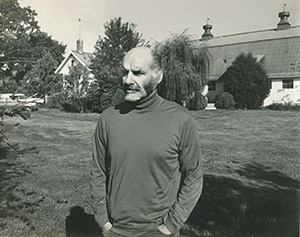
    Peter Tompkins, author of best selling titles in the fields of metaphysics and ancient mysteries, and co-author of The Secret Life of Plants. This photo, taken in 1971, is of Peter at the ‘Barn’, where Ptolemy grew up. Image courtesy of Ptolemy Tompkins

    RS: Your father had an amazing life in his own right. Wasn’t he an American spy behind the lines in Rome during World War II?

    PT: Yes, my dad was behind the lines. He wrote a book on it, A Spy in Rome. He posed as a Roman Fascist, and once had the SS officer in charge of finding him (they knew there was a spy somewhere about) over for dinner. He made him an omelette, an obvious luxury at the time, and the officer detailed the tortures they had in store for the American spy once they found him. Of course the rest of life pales a bit after something like that.

    RS: Your father at one point was vigorously engaged in the search for Atlantis. Could you talk a little about what it was like to take part in it? 

    PT: “Taking part” is probably an exaggeration. I was around. My dad was convinced that the Edgar Cayce readings about the rising of Atlantis were correct. He spent thousands and thousands of dollars photographing the limestone formations off Bimini – the so-called “Bimini Road.” My father loved the idea of Atlantis returning because he wanted the world to become a kind of new Eden. He was a true father of the New Age in this sense – he had the core New Age belief that the world once was, and would be again, a better place. But not better in some mundane sense, but in the sense of being elevated back into a spiritualised condition that it had fallen away from. That’s what the Bimini stuff was all about. Generally speaking, one had to be naked during the filming. There were often times when I was the only one aboard the various boats he hired with a bathing suit on. It drove my dad nuts.

    RS: With all of your exposure to the New Age counterculture, what things would you say are the most valuable that you learned?

    PT: My father taught me the fathomlessly valuable lesson that the mundane world we see around us isn’t all there is, and that if we’re impatient with the limitations of existence as it presents itself now, we are so with good reason. Deep within, we know there’s more. My dad was a pain in the neck to a lot of people. He was far from a perfect person, and he was, I’d say, genuinely a touch mad. But he had a certain nobility of character. He was, in his misguided and often destructive way, truly a great man. Many people think that about their fathers, of course. I think one of the reasons I’ve always been comfortable criticising and making fun of him is because I’m so convinced he had that core of greatness.

    RS: You’ve worked intensively with Eben Alexander in writing his two books, Proof of Heaven and Map of Heaven. Eben is best known for a long and powerful near-death experience he had when he was in a coma in 2008. Could you say a little bit about how you see his experience and how you regard him personally?

    PT: One belief about the world I hold very strongly is that, as the New Age adage has it, everything is significant. The problem, or rather the challenge, it seems to me, lies in celebrating that fact even when the significance one encounters is problematic. It’s great when you find a parking space just when you need one, but that doesn’t mean the world is some giant pinball machine rigged in your favour. Sometimes the odd synchronicities and resonances of life are much more challenging. In the case of Eben, my biggest struggle was just how similar my relationship to him was to my relationship to my dad. I was eleven when The Secret Life of Plants transformed my life overnight, and I got to see the effects of that kind of instant celebrity very close up. Yet at the same time I myself was completely invisible.

    The same thing happened with Proof of Heaven. I worked like a demon to get that book in shape for publication. It took me about four months, and by the time it was done, it was, experientially speaking, my book, not Eben’s. A great portion of the writing in it is by me, not Eben. At the same time, the book describes Eben’s life and his experience. I did not make anything up, and I had full faith in Eben’s honesty. When the book came out and went right to the top of the bestseller lists, and Eben was praised for his fine writing style, etc., I found myself in a situation that really did feel somewhat choreographed. Another person was being praised through the roof beams for a book that I had in large part written. I had, I realised, a couple of options, the only sensible one of which was to be completely unfazed by it. Who wants to be the kind of person who raises their hand at the back of class and says, “Hey, that was my idea, not his!” It began to seem quite clear to me, as the success of the book continued, that I should view the whole thing as a kind of lesson in humility. T.S. Eliot, in the Quartets, says that humility is endless. If T.S. Eliot says that, who am I to argue? So I just made a point of trying to celebrate the success of the book, the good that it was doing, and not get caught up in picayune gripes about not getting the attention myself.

    Eben Alexander and Ptolemy at the Marion Institute in 2014. A great portion of the writing in Alexander‘s Proof of Heaven is by Ptolemy. Image courtesy of Ptolemy Tompkins

    It worked pretty well until that article came out in Esquire magazine which purported to rip the veil away and expose Eben as the calculating phony he really was. The article was full of errors, and made a very brief mention of me, three or four lines, most of them incorrect. I thought: Jesus, here this guy wants to discredit Eben, and he won’t even do me the service of using me as a tool to do so? Somehow I found this really irritating. Eben – again, like my dad – is a great guy, but he’s also frustrating.

    In the end, I came away feeling that his experience was true. There was something about the way he described it in our phone interviews that just made something in me click. It resonated. More than anything else, it reminded me of the visionary journeys made by a number of Persian mystics. One of my favourite books is Spiritual Body and Celestial Earth, an anthology of these experiences compiled and edited by the great French scholar of Islam, Henry Corbin. There were details in Eben’s narrative that brought that book to mind in a truly extraordinary way. Every detail of his journey, from his beginning in the subterranean murk to his meeting with the sister/angel figure to his journey beyond that meeting into the “dazzling darkness” where he encounters God… All of this was just so wildly resonant, and I somehow just knew he couldn’t have been making it up.

    RS: Could you talk about your own beliefs on the afterlife, for example as you discuss them in The Modern Book of the Dead?

    PT: For most of my adult and semiadult life, I have been obsessed with the idea of personal survival. That the you that is really you, and the me that is really me, does not fade away or fall apart with the death of the body, but continues on. Most importantly, I have been taken up with the idea that survival is above all else personal and individual. Nicholas Berdyaev, the Russian writer and philosopher, wrote a three-word sentence that sums all this up: “Personality is indestructible.”

    I was around in the ’70s when my stepbrother Nicholas Vreeland, the Buddhist abbot, first became interested in Buddhism. I looked up to Nicky a great deal, and as he wandered into Buddhist practice, I wandered into one Buddhist book after another. At first I was hugely taken with what I read. But gradually, something began to bother me. I realised the Buddhist focus on the unreality of self at all levels was something I could not accept. The key feature of life, for me, was that it was personal. People are personal, but so are animals and, for that matter trees and plants, just like my father said. Corbin said that in the world above this one, the primary question we ask about what we see there is not “what” but “who,” because up there, everything is a “who.” This is the root of why children love cartoons and fairy tales where everything is personalised, animated – that is, given an anima. The Buddhist suggestion that the self is actually not individual and eternal but aggregate and passing… well, by the time I was in my early twenties I found myself in open rebellion against this idea. I didn’t dislike Buddhism, and I continued to read Buddhist books. At the highest level, I do believe all faiths converge. But I believe that the level where this happens is, quite simply, so high that talking about it from our present vantage point is essentially impossible. I’ll tell you this: if there’s one belief I know I will absolutely never abandon, it is the value of personality – of the individual being. The fact that we, each of us, are both eternal and personal strikes me as the most interesting fact there is.

    RS: Another book of yours is The Divine Life of Animals. Many people are convinced that animals (especially their pets) do have a kind of afterlife. What did you discover in looking into this topic, and what do you think the truth is?

    PT: The Divine Life of Animals arose out of an article I wrote for a magazine called Guideposts where I worked for many years. The article was called “Will My Pet Go to Heaven?”, and it is not exactly a masterpiece of metaphysical speculation. What I discovered working at Guideposts is that there are a lot of wonderful people out there in America, and the world at large, who love their pets deeply and suffer intensely when they lose them. Imagine a woman living in, say, Iowa. Her husband served in World War II, and they live a long, happy, and traditional American middle-class life. Then, as so often happens, the husband dies first, and the wife, alone and heartbroken, begins to rely more and more on the company of her pet – a dog, let’s say. Then the dog dies. Suffering deeply, this woman turns to her clergyperson for reassurance that, just as her husband did not simply blip into nonexistence but exists still, in a world beyond this one, so too does her pet. Alas, her clergyperson, following a long (but far from unanimous) tradition among Christians, tells her that no, there are no dogs in heaven. This has the predictable result of devastating the woman. After all, she relies on her clergyperson for answers to the big questions, and what he or she says, she believes.

    I determined to marshal some evidence that the Christian faith (the faith of the vast majority of Guideposts readers) is far from unanimous on this point. The article received a mind-boggling number of letters in response. Some of these were from cranky by-the-book types assuring me I was wrong, but the vast majority were from people who had suffered the loss of a pet and were vastly grateful to hear, from a source they trusted, that there was more to the picture – that the essence of their pets had indeed survived. There’s a very popular poem called “The Rainbow Bridge” that describes how when a person dies, they will cross the Rainbow Bridge and be greeted by all the animals they have ever loved. This poem is saccharine to the point where it actually does hurt my teeth to read it. And yet, hidden beneath all the maple syrup, there is a core truth: there is a bridge between this world and the worlds above this one, and when we depart from this world, we do not vanish into an impersonal mush, but into a world that is specific and personal just as this world is, only more so. So that’s what I ended up enlarging into The Divine Life of Animals.

    Unfortunately – or perhaps just unavoidably – once I secured a contract for the book, I made it the kind of book I like. That is to say, a more complex one than most of those nice ladies who read Guideposts wanted. This has always been my problem as a writer. I’m too fancy for the people who like simple books, and too simple for the people who like fancy ones. So it goes!

    RS: Your latest book is called Proof of Angels, and you’ve spent a lot of time thinking and writing about people’s encounters with angels. What do you think about angels?

    PT: I think angels are real, and I wish I knew more about them. During my decade at Guideposts, I wrote regularly for Guideposts’ sister magazine, Angels on Earth. Once again, it has a readership largely composed of what you might call conventional, old-fashioned Christians. The original meaning of “angel” is, of course, “messenger,” and what chiefly interests me about angels is the way in which the appearance of one can instantly transform a person’s view of reality. You can’t really use the word “angel” anymore and have it convey any kind of genuine charge. It’s been too much doused in the maple syrup of market-driven spiritual writing (a problem that I know I myself contributed to). But originally, angels were beings characterised by their numinousness, their power, and what you might call their awfulness, taking the root of that word in its original sense, as something inducing awe.

    A crucial key to believing in angels today is to believe in demons too. This is much easier to do, or at least much easier for me to do, because while I bog down when I try to read Augustine or Aquinas on angels, I am riveted when a contemporary writer like Louis Proud or Joe Fisher describe their interactions with demonic beings. The whole succubus/incubus business, with people engaging in what, to hear them talk, is entirely satisfactory sexual congress with nonphysical beings, I find fascinating. There is much literature on this subject, and so much is just so believable. So belief in demons is a great sort of gateway drug to belief in angels.

    One of the single most momentous events in my adult life came when a friend demonstrated to me beyond all doubt that Ouija boards work. With patience and the right circumstances, the planchette really does move, and decidedly individual personalities, or subpersonalities, come through. Who or what are these entities? I don’t know. Is it a good idea to get involved with such entities? I would say no. But is there something real going on here? Absolutely. I’ve had it proved to me, and no one could de-convince me of what I experienced. So I’m very grateful to the demonic world. It had a hand in breaking down my culturally engrained positivist/materialist tendencies that were hardwired into me as a member of modern culture. I see a little more of the real world – the world that is partially material but in much larger part spiritual – as a result of that brief flirtation with the murkier levels of the spiritual world.

    RS: In this whole field, how do you personally separate fact from imagination?

    PT: I think one of the absolutely central keys to accepting the reality of the spiritual world is understanding that all perception is a collaborative event. We are co-builders of everything we see and experience. Ordinary, mundane reality is a creation that takes a fantastically complex amount of work on the part of our brains and unconscious minds to put together. The notion that anything we encounter in our world is just “there” and that we are seeing it objectively, with no help from our imaginative faculty, is, as Coleridge tried so hard to tell us, absurd. The world is a labyrinth, and separating the real from the unreal is a task that greets us anew each day when we wake up (and, if we listen to the traditions, one which will continue to challenge us after we die, only more intensely).

    What to hang on to in this carnival of mirrors? I think the Hungarian Anthroposophist Georg Kühlewind was on to something very important when he said that if we experienced the reality of ourselves – the inner “I” that is our true identity – with the concreteness that we experience an object that we can touch and feel in the material world, most of our problems would vanish. In line with that, I think I’d say that the first thing to do to stay oriented in the maze of existence – both incarnate and disincarnate – is to come to an unshakable belief in the reality of ourselves. Before we can believe anything “out there” can be real, we have to believe – to know – that we ourselves are real. The whole initiatory tradition, from Greece on back to Egypt and who knows where, seems to have that as its primary argument. I’d say that’s what my dad believed, so in that and many another respect, I’m very much his son.

    Ptolemy’s books – including his latest Proof of Angels – are available from all good bookstores and online retailers. His website is www.ptolemytompkins.com.

    Photos of Peter Tompkins/Ptolemy Tompkins courtesy of Ptolemy Tompkins.

    [alert type=”general” dismiss=”no”]This article was published in New Dawn 155.[/alert]

    [alert type=”success” dismiss=”no”]If you appreciate this article, please consider subscribing to help maintain this website.[/alert]

    © New Dawn Magazine and the respective author.
    For our reproduction notice, click here.
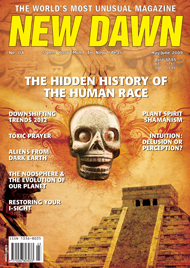
  • Toxic Prayer: Be Careful What You Ask For…

    Toxic Prayer: Be Careful What You Ask For…

    From New Dawn 114 (May-June 2009)

    You might be under the impression that authors choose the titles of their own books. That isn’t true – at least not always. If the publishers don’t like the title, they will change it.

    Such was the fate of a book published in 1997 by the noted mind-body researcher Larry Dossey, M.D., author of Healing Words and Prayer Is Good Medicine. Dossey had written on a provocative subject: if thoughts and prayers have the power to heal, do they also have the power to harm? He called his book Toxic Prayer, but the publishers, Harper San Francisco (now Harper One), were extremely uncomfortable with this title. They feared a backlash from fundamentalist Christians, who, they imagined, would take up arms against the idea that any kind of prayer could ever be harmful. After an anxious discussion that went all the way to the top of the company’s hierarchy, another, safer, though more flavourless title was chosen: Be Careful What You Pray For…You Might Just Get It.

    Whether the decision was a wise one or not (controversy sells books, after all), the whole story raises an awkward issue: is prayer a morally ambiguous force? Can it be used to curse as well as bless? If so, how?

    Of course it depends upon what you mean by prayer. In the conventional monotheistic view, prayer is addressed to the one true God (or sometimes his subordinates, such as Mary or the saints or the angels). Since God is all-good, he will either grant this request if it is beneficial or ignore it if it isn’t.

    This belief, although engagingly simple and clear, begins to erode if we also accept the idea that thoughts have power in and of themselves. By this view, a thought, whether positive or negative or neutral, has effects that can be felt in the psychic dimension and sometimes physically as well. This perspective, which takes us out of the sphere of religion per se and into that of magic, provides a far more equivocal picture of prayer.

    Magic and Invocation

    Magic, wrote the notorious twentieth-century occultist Aleister Crowley, is “the Science and Art of causing Change to occur in conformity with Will.” This definition, while correct up to a point, is too general to be entirely adequate. If I move a coffee cup around my table with my hand, I am effecting change in conformity with will, but no one would claim that that is magic as such. Magic has to do with effecting change by occult means – that is, by means invisible to ordinary sight and inadmissible by ordinary consciousness. If I were to move the same coffee cup around the table without touching it, this would start to look like magic, since the cause of the movement, whatever it is, cannot be seen.

    There are many forms of magic, ranging from sleight-of-hand (that is, using the standard tricks of stage magicians) to suggestion to more genuinely paranormal means. The boundaries between these categories – like the boundary between prayer and magic – are fluid and permeable, but generally we can say that occult magic is believed to work through two principal methods.

    The first has to do with spirits. Most occultists believe that there are unseen creatures inhabiting dimensions of reality that intersect with our own: these beings are variously known as spirits, elementals, angels, demons, devas – the lore has countless names for them. According to the magical world view, it’s possible to engage with these creatures. The magicians of the Renaissance, for example, evoked certain spirits using occult rites. If these spirits were approached the right way (through seals, signs, rituals, invocations, and so on), it was believed that they could be beseeched or, more often, forced to obey the magician’s will. The moral status of these spirits was ambiguous – they were often thought to be demons – but that could prove an advantage when there was dirty work to be done.

    Here is one invocation, of a spirit called Mirael. Taken from a fifteenth-century manuscript of necromancy found in Munich, it is designed to make someone lose his mind: “May Mirael enter into your brain and dissolve and destroy all wisdom, sense, discretion, and thought. I conjure you, Mirael, by all the princes and elders, and by all that you wish to do, that for as long as it pleases me you will flow through the person I look upon and daze him, and that he lose everything that he does not recognise. Otherwise I shall cast you into the depths of the sea so that you shall not escape for eternity.”

    As unsavoury as these practices may sound, they are universal or practically so. Here is another example, this one from the other end of the world. Max Freedom Long, the redoubtable investigator of the Hawaiian form of shamanism known as huna, discusses the death prayer as practiced by the shamans or kahunas: “To become able to use the ‘death prayer’ a kahuna had to inherit from another kahuna one or more ghostly subconscious spirits. (Or he might, if sufficiently psychic, locate subconscious spirit or ghosts, and use hypnotic suggestion to enslave or capture them.)”

    Once a kahuna had some of these spirits under his will, he would offer them food and drink so as to imbue them with mana or vital force and then give them very specific instructions about what to do with this energy. They might, for example, be told to find a given person and enter his body or attach themselves to it. Once they had done this, they would suck up the victim’s vital force. When the victim died, the spirits would return to their master, further strengthened by having absorbed the dead person’s mana.

    Spirits thus require an infusion of energy or life force. There are a number of ways of supplying it. In ancient times the method of choice was blood sacrifice; as the victim’s blood spilled, the vital force would, as it were, evaporate so that the spirits could consume it.

    Homer’s Odysseus describes a sacrifice he has made: “When I had prayed sufficiently to the dead, I cut the throats of the two sheep and let the blood run into the trench, whereon the ghosts came trooping up from Erebus – brides, young bachelors, old men worn out with toil, maids who had been crossed in love, and brave men who had been killed in battle, with their armour still smirched with blood; they came from every quarter and flitted round the trench with a strange kind of screaming sound that made me turn pale with fear.”

    How The Death Prayer Works

    While blood sacrifice is much less common today than it was in antiquity, it is still used, for example, in Santería, Voudun, and other religions of African origin that are practiced in the Caribbean Islands and South America.

    To show how the death prayer works, Long tells of a young Irishman who went to Honolulu and worked as a taxi driver. He became involved with a Hawaiian girl, who then ended her engagement with a Hawaiian boy. The girl’s grandmother, not trusting the young Irishman’s intentions, tried to break up the affair, but without success.

    One day, writes Long, the Irishman’s feet “went to sleep.” The pricking numbness that afflicted his feet gradually crept up his body, making him unable to move. The young man did not believe in magic or death prayers or any such nonsense, so he called in conventional American doctors. They were unable to help him. The numbness had spread to his waist by the time an old doctor who had practiced in the islands for many years was summoned. He recognised the symptoms of the death prayer, and making inquiries of the patient, soon learned about the girl and her grandmother. The doctor paid a visit on the grandmother, who said, “Well, I know nothing about the matter and I am no kahuna – as you know. But I think that if the man would promise to take the next ship for America and never return or even write back, he might recover.”

    The doctor tried to explain the situation to the still-unbelieving Irishman. Although he resisted at first, finally the patient was persuaded to take the grandmother’s advice. The same day he was able to walk again, and that evening he caught a Japanese ship headed for the West Coast of the US.

    How do the kahunas themselves see this whole process? Kahana, a Hawaiian ana’ana priest (priest of the dark forces), explained in an interview: “You are releasing the spirit from this encasement so it can go and get cleansed and purified and come back. It’s time to take it out.”

    One detail in Long’s story raises an issue that has long been disputed: does the victim have to believe in these powers in order to be susceptible to them? Dossey cites one researcher who contends that in such cases, “the victim, family members, and all acquaintances must accept the ability and power of the hexer to induce death. This belief must be commonly held with no exceptions.”

    Long’s story contradicts this claim. The victim did not believe in such things and continued to scoff at them even as he was dying; moreover, nobody even told him that the death prayer had been aimed at him. Attempting to write off such effects purely as a matter of suggestion would then be inaccurate (although it is easier for scientists to accept, since they feel obliged to dismiss actual occult causes from the outset). Indeed Michael Harner, the noted scholar of shamanism, observed that the Jivaro shamans of South America prefer the victim to be unaware of the psychic attack, because then he would take no measures to counter it. “Distant hexing is a security measure,” he told Dossey in conversation.

    [alert type=”info” dismiss=”no”]If you appreciate this article, please consider a subscription to New Dawn magazine.[/alert]

    Creating Thought Forms

    Working with spirits is one time-honoured way to cause harm; another way is closely related to it. This second approach involves sending not spirits but thought forms – mental images infused with vital energy that can thus make their effects felt in the physical world. The difference between the two methods is in the tools: a spirit is usually regarded as a living, more or less conscious entity, whereas a thought form is the creation of a human mind and has no independent existence.

    Admittedly, the line between these two types of magic can be a thin and wavering one. In his Meditations on the Tarot, a contemporary classic of Christian esotericism, Valentin Tomberg writes that this method of creating a thought form is precisely how you create a demon.

    As with all generation, that of demons is the result of the cooperation of the male principle and the female principle, i.e., the will and the imagination, in the case of generation through the psychic life of an individual. A desire that is perverse or contrary to nature, followed by the corresponding imagination, together constitute the act of generation of a demon.

    A term used in the occult literature for such entities is egregor or egregore, a term supposedly derived from the Greek gregoreuein (“to watch, to stay awake”). One famous instance of the creation of an egregor is related by Alexandra David-Neel, a Frenchwoman of the early twentieth century who penetrated the then-forbidden country of Tibet to learn its occult practices. By dint of intense meditation, she was able to generate the form of a monk that took on a quasi-autonomous existence and even made its presence felt to other people. When the entity started to make a nuisance of itself, David-Neel had to devote another several months of intense meditation to destroying it.

    Harming by means of thought forms does not necessarily require the generation of quasi-autonomous psychic entities. Dossey mentions the case of a patient of his, a woman afflicted with chronic fatigue syndrome. The woman was domineering and manipulative while her husband was extremely unassertive. He had always resented his wife; after she fell ill, he started to hate her.

    One night, after a bitter argument, the husband stormed out of the house; when he returned, he found his wife dead. The man was overcome with guilt, convinced that his hatred had killed his wife. He refused to enter psychotherapy and instead joined an extremely conservative fundamentalist church, where he was able to assuage his conscience by believing that her death was the will of a wrathful God.

    Psychologists sometimes employ the term magical thinking. This involves the belief that an inner wish or emotion somehow caused an effect that later happened in reality. A four-year-old child, for example, may hate his brother and wishes he were dead. The brother then dies; the child then believes that somehow he was the cause of the death. It is a version of the old logical fallacy Post hoc, ergo propter hoc: “After this, therefore because of this.”

    Clearly not every case of misfortune can be traced to someone else’s negative thoughts, even if that person really did have those thoughts. Nor is it absolutely clear what the determining factor might be, but it very likely includes the intensity of the desire. A passing irritation that leads a person to say, “I wish he were dead!” probably does not have much effect in most cases. But when the thought is fed and nurtured with intense emotional energy, even unintentionally, it can begin to gain power. The man who thought he had killed his wife had probably directed a huge amount of hatred at her.

    I once had a curious experience in this regard myself. A number of years ago I lived next to neighbours who were causing me a great deal of disturbance with their noise. I had spoken to them about it, but it did no good except to change the source of the noise: their rock band practicing in the garage was supplanted by dogs who got on their roof and barked obnoxiously at everything. I felt the negative energy accumulating in myself, and although I intended no harm to them – I merely wanted them to stop disturbing me – a strange thing happened one day. I put a letter in their mailbox asking them yet again to deal with these issues; it was the only time I ever did that. Then I drove to work as usual and was gone for the rest of the day, only getting back late in the evening. The next morning I noticed something strange: a tall tree that had been directly next to their mailbox was gone. Neighbours later told me that a truck had hit the tree that day, and it had to be taken down.

    There is, of course, no way that I could prove that my thoughts had this entirely unintended effect, but I had never put anything in their mailbox before and never did again. The coincidence was disturbing, and I had the uncanny feeling of being at psychic war with these neighbours; moreover I began to feel an intense psychic charge around my house. A few months later, not wanting the situation to escalate any further, I solved the problem by moving away.

    Thus thought forms, in order to have power, need not have energy directed consciously at them; they can receive this force even when it arises spontaneously and unintentionally. But like spirits, these thought forms do require some energy or vital force in order to operate.

    The Dangers Posed by Toxic Prayer

    Having briefly surveyed some powerful though unsavoury occult practices, what practical lessons can we draw? In the first place, wishing for harm to someone else is remarkably common; one poll indicated that 5 percent of American surveyed had done it (and we have to assume that this is a low figure, since it only accounts for those who were willing to admit as much). In the second place, it is remarkably dangerous. Indeed magical practices of any kind are dangerous, even when one’s intention is reasonably pure; almost invariably something goes awry, producing results that are not exactly what you might have wanted. Occult magic is rather like trying to sculpt something out of nitroglycerin – a sloppy but also highly explosive material.

    The problem is compounded when one is working with an intent to harm. It is extremely difficult, perhaps impossible, to create a thought form or invoke a spirit and remain totally disconnected from it. Thus if you are creating something negative, you can be sure that it will return to you in some form or another, just as in huna the spirits return to the kahuna after they have consumed a victim’s energy. And they are not always easy to control when they are aroused, even by their supposed master.

    To illustrate this point, Max Freedom Long tells another story, which happened to his mentor and informant about huna, an American scientist named William Tufts Brigham. During a trip to the Mauna Loa volcano to collect native plants, Brigham found that one of his servants, a twenty-year-old boy, started to fall ill. Although there was ostensibly nothing wrong with him, he began to waste away and, like the Irishman, lost feeling in his legs. The boy believed that he was being prayed to death, and Brigham’s servants, who regarded him as a great kahuna, begged him to send the spirits back to the one who had launched them.

    “This is perhaps the easiest thing an amateur magician could be called upon to do,” said Brigham. “The spell had been initiated and the trained spirits sent out. All I had to do was to put up the usual big arguments to talk the brainless things over to my side…. I stood over the boy and began to advance arguments to the spirits. I was smoother than a politician. I praised them and told them what fine fellows they were…. Little by little I worked around to tell them how sad it was that they had been made slaves by a kahuna instead of being allowed to go on to the beautiful heaven that awaited.”

    Finally, mustering a supreme concentration of power and will, Brigham let out a tremendous roar. Soon the suffering boy felt better, and in an hour he was up and eating. Later Brigham learned that the kahuna who had sent the curse had neglected to cover himself with the usual occult protection, and by the next morning he was dead.

    Much the same is true with thought forms of the more impersonal variety. To begin with, the thought form, in order to have any effect upon the recipient, must find some resonance in him or her.

    The Theosophists Annie Besant and C.W. Leadbeater write: “In cases in which good or evil thoughts are projected at individuals, those thoughts, if they are to fulfil directly their mission, must find, in the aura of the object to whom they are sent, materials capable of responding sympathetically to their vibrations.” Otherwise the thought form will bounce off. “That is why it is said that a pure heart and mind are the best protectors against inimical assaults…. If an evil thought, projected with malefic intent, strikes such a body, it can only rebound from it, and it is flung back with all its own energy; it then flies backward along the magnetic line of least resistance, that which it has just traversed, and strikes its projector; he… suffers the destructive effects he had intended to cause to another.”

    The Best Protection

    These observations go far toward answering the final and perhaps most pressing question connected with toxic prayer: how do you protect yourself against it? A positive mindset is a good start, so purging thoughts of hatred, judgment and violence from your mind is a necessity. It’s also helpful to clear away negative thoughts that are aimed at yourself: recognise that thoughts of your own weakness, inferiority, vulnerability and sickness are poisons and rid yourself of them. If this kind of thinking has been a lifetime habit, it may prove difficult to break, but even the smallest efforts can bring results and will also create a momentum that gradually builds.

    For those with some ability at visualisation, some of the standard forms of occult protection can be useful. The most common is probably envisaging yourself as surrounded by a sphere or ovoid form of white light. But the exact technique you use is probably less important than the clarity and power you bring to the thought, so you will probably do best by experimenting which methods work for you. Conventional prayers can also be employed, such as the Lord’s Prayer, which after all includes the petition “Deliver us from evil.” Again, the specific form of the prayer is not as important as whether it arouses a powerful and positive emotional response in yourself.

    Perhaps the chief thing to remember is not to fear. Fear is a negative emotion and weakens you far more than it strengthens you, and it is probably no coincidence that the cultures in which psychic attack is most common are those pervaded by fears of black magic. For this reason, a healthy, grounded, common-sense mindset may be the best protection of all.

    [alert type=”general” dismiss=”no”]This article was published in New Dawn 114.[/alert]

    [alert type=”success” dismiss=”no”]If you appreciate this article, please consider subscribing to help maintain this website.[/alert]

    Sources

    Anonymous [Valentin Tomberg], Meditations on the Tarot: A Journey into Christian Hermeticism, Translated by Robert A. Powell, Warwick, N.Y.: Amity House, 1985

    Annie Besant and C.W. Leadbeater, Thought Forms, Adyar, Madras, India: Theosophical Publishing House, 1978 [1901]

    Aleister Crowley, Magick in Theory and Practice, New York: Castle, n.d.

    Alexandra David-Neel, Magic and Mystery in Tibet, New York: Dover, 1971

    Larry Dossey, Be Careful What You Pray For…You Might Just Get It, San Francisco: Harper San Francisco, 1997

    S.E. Hertel, “Kahuna Ana’Ana: The One Who Walks in Darkness”, Gnosis 14 (winter 1990), 30-33

    Homer, The Odyssey, Translated by Samuel Butler, http://classics.mit.edu/Homer/odyssey.html; March 10, 2009.

    Richard Kieckhefer, Forbidden Rites: A Necromancer’s Manual of the Fifteenth Century, University Park, Pa.: Penn State Press, 1997

    Max Freedom Long, The Secret Science Behind Miracles, Santa Monica, Calif.: DeVorss, 1948

    Richard Smoley, “Man as God and Creator”, Gnosis 28 (summer 1993), 56-60

    © New Dawn Magazine and the respective author.
    For our reproduction notice, click here.

  • Gnostic Mysteries of Sex: An Interview with Tobias Churton

    Gnostic Mysteries of Sex: An Interview with Tobias Churton

    From New Dawn Special Issue Vol 10 No 3 (June 2016)

    Tobias Churton is one of today’s most visible and prolific writers on the Western esoteric tradition. He first came to the attention of the public in the UK in 1987, with the release of a four-part television series called “Gnostics.”

    Since then he has written nineteen books, including Gnostic Philosophy, The Invisible History of the Rosicrucians, and biographies of William Blake, the seventeenth-century British esotericist Elias Ashmole, and Aleister Crowley. He holds a master’s degree in theology from the University of Oxford and is an honorary fellow of the University of Exeter in the UK. His website is tobiaschurton.com.

    Churton was featured in a New Dawn interview that I conducted in 2005 (see New Dawn 91). In November 2015, I conducted another e-mail interview with him, this time focusing on his recent book Gnostic Mysteries of Sex: Sophia the Wild One and Erotic Christianity.

    RICHARD SMOLEY (RS): Your latest book is called Gnostic Mysteries of Sex. Could you start by briefly sketching out who the Gnostics were?

    TOBIAS CHURTON (TC): Not all Gnostics called themselves by the name, but it is a name attached by orthodox Church leaders from the second to the fifth centuries CE to leaders and groups of spiritual deviants from orthodoxy who regarded their experience or “knowledge” (Greek: gnosis) as a superior aspect of salvation to that of other Christians. Since Gnostics prided themselves on originality, personal revelations, and esoteric insights, their views on any number of doctrines vary considerably, but they share some speculative doctrines in common.

    The first and most fundamental is that the universe perceptible to the senses derives from a deformation of spiritual being into something unintended by the source of being. This unknowable “Father,” knowledge of whom Jesus brings to the gnostic, is called the “Depth” – as in an unfathomable ocean or abyss. The material universe results from a primal catastrophe: a fall from ideal into relative being. In this deformation drama, sparks of divine seed have become alienated in an unfamiliar realm and experience pain and longing. Insofar as the universe is imperfect, it is the work of a Demiurge or “fashioner,” working with relative, not absolute being. This being knows no higher than himself, like the classic egotist. Sometimes identified with the Elohim (“God” or “gods”) of Genesis, the creator of the world is regarded as the enemy of Man as a spiritually conceived being, opposed implacably to Man’s enlightenment. “Lord of this world,” the maker senses there’s something special about Man. Man has something within him. The master of matter is jealous of this spiritual substance and, while incapable of understanding it, wants it, and failing that, determines to keep fallen Man ignorant of it, lest Man escape from the world’s finite grip and become free.

    The hylic or material being (the earthly Adam), belonging to the sensual universe, dies with it, for the material universe is constrained by time, unlike spirit, which is eternal.

    The only means of escape is realisation of divine origin and destiny – gnosis. This means to be spiritually awake, able thereby to see beyond the universe and the Demiurge. To effect realisation, Christ descended to earth, appearing as mortal flesh, to summon the awakened spirits and raise the weak by awakening the dormant psyches of the soulful, but lost, children of divine Wisdom (Sophia). Gnostic writers present Jesus as an esoteric philosopher holding the keys to the door to eternity, for which the world rulers conspire to destroy him and those who follow him.

    The Gnostics presented sometimes highly intelligent twists on every aspect of established Gospel teaching. From alleged secret sources, they created an esoteric religion of wide-ranging meaning and applicability to Man, seen as being in existential distress. Gnosis has nothing to say to those comfortable with and in the world as it is.

    Moral teachings among Gnostics vary widely, for in their view state of mind is of vital significance and superior in essence to actual conduct. There were somewhat contradictory streams of interpretations in Gnostic thought and practice, and their enemies were not scrupulous in delineating greater or lesser factors, since all Gnostics were deemed a mortal threat to orthodox faith. Gnostics were, generally speaking, indifferent to religious authorities, and their radical individualism became intolerable to the growing monarchic episcopacy of the Catholic or Orthodox church.

    Brilliant enemies of gnosis, such as Tertullian in the late second to mid-third centuries CE, simply dismissed Gnostics for trying to turn the “saving faith” into philosophy, that is, something conformable to Socratic reasoning. This is not altogether fair, since the Gentile Church had from its beginnings been required to express its doctrines to people who used philosophy to justify religious practices. One thinks of St Paul in the Areopagus (Acts 17:16–34). After all, the Jewish faith never explained why the universe was created in terms philosophically explicable to the existential condition of human life. God willed it and thought it good, whether men could see it, or like it, or not. It is also important to recognise that a dominant stream of gnosis served essentially as a magical religion that sought God in the lowest effects as well as the highest causes. That is to say, the divine spirit or pneuma was not only scattered in Man for some Gnostic schools, but hidden in the recesses of Nature: such insights vitalised alchemy. The divine seed has been sown everywhere, as gnostic alchemists, or “Hermetists,” maintained.

    Contemporary Western esotericism and its historical antecedents are impossible to conceive of without the Gnostic phenomenon of late antiquity. Insofar as esotericism still thrives, so does gnosis, though mediated, as ever, in diverse forms, including philosophy of religion.

    RS: One of the most fascinating figures in your book is Simon Magus. Could you say a little about him and his views on sex?

    TC: He is fascinating, isn’t he? This Samaritan magician gets a nasty walk-on part in Acts, and contradictory accounts of him appear in patristic and sundry apocryphal works. He was obviously a major threat to the apostolic efforts of the primitive Church. Just why is not altogether clear, especially from Acts, where he tries to buy the power of the Holy Spirit. This is telling, in its way, of the style of the magician. He recognised the Holy Spirit experience as a psychic phenomenon that could be induced if you knew the trick: nothing new to a magician for whom what we today call hypnosis was a stock in trade.

    Acts does not mention the crucial detail that Simon was accompanied by a whore, Helen (= the “torch”), whom he saved from a Tyrian brothel to be his consort. Groups of Gnostics worshipped them both, at least by the second century, and it became established in that century that he was the first Gnostic heretic and that all the Gnostic streams derived from him. As for his teachings, or rather alleged teachings (we have no first-century evidence for his specific doctrines), we have fascinating accounts in the second-century writings of the orthodox Christian Hippolytus.

    I may be the first to have realised that while Hippolytus’s accounts of Simon’s doctrines try to trash them as absurd Greek philosophy, Hippolytus’s accounts nevertheless transmit – probably without Hippolytus even realising it – a fairly complete system of sexual magic, expressed in symbols. What Hippolytus misunderstood as philosophy was, I think, the basis for working magical practice.

    Simonian doctrine takes the view that sex has magical potential: it could be “redeemed” as a means to make supermen and superwomen. Looking at Simon anew was one of the most exciting things I discovered when writing the new book, and it became a real mind-opener: shocking perhaps, but definitely revelatory. It is no surprise that Simon had a work attributed to him called The Great Revelation. More intriguingly, he seems to have had some important link to John the Baptist.

    [alert type=”info” dismiss=”no”]If you appreciate this article, please consider a subscription to New Dawn magazine.[/alert]

    RS: A main theme in your book is the connection between sex and enlightenment. How did the Gnostics see this relation?

    TC: This is too big a question to be adequately dealt with in a magazine interview; the answer represents the substance of the book. Very briefly, the Gnostic understanding of sex is informed by the Platonist view that in the eternal world, there is a unity of substance. The eternal world, or world of the aeons, provides the eternal “ideas” that are used to fashion a copy or reflection of it and to make it manifest under the finite conditions of time and space. Those eternal characteristics are deformed and dissolved in the process or drama of pure radiant spirit descending into “darkness.” In order to create, we must move from one, unity, to two: reflection and manifestation. All reflection involves a measure of distortion.

    Therefore, to manifest the divine mind, as Divine Wisdom (in the form of Lady Sophia) precociously endeavours to do imperfectly in Gnostic systems (creating the Demiurge in the process), is to make distortion inevitable. The idea of harmonious syzygies of divine powers becomes unbalanced through the act of creation. When this principle is linked to the existence of men and women, we note that the perfect Man, like God, is, in Gnostic thought, androgynous, containing masculine and female characteristics in perfect harmony.

    In the sphere of manifestation, this harmony is lost, and man and woman appear separate and at odds. But gnosis can initiate the return to harmony. Gnostics made much of the Genesis story that Adam’s rib became the basis for woman, especially since it was extracted when Adam was asleep. Sleep, to a Gnostic, means the cosmic and spiritual unconsciousness or amnesia characteristic of material consciousness. Man and woman become each other’s tempters in the world of nature. This antipathy is reflected in the first human progeny, Cain and Abel, who are immediately opposed – opposition leading to the primal murder.

    Following the logic of androgyny as being the original human form in the spiritual sense, it followed that perfected sexual union could become a sacramental and spiritual pre-enactment of the ultimate destined unity of the Gnostic spirit, restored to the Pleroma or “Fullness” of the Godhead. The mutual infusion of male and female enacts and prefigures the apocatastasis, the restoration, or what Gnostics called “the healing of the passions of matter”: the return to the One.

    Obviously such sexual communion was a dedicated spiritual act. Interpretations of this essential dynamic of Gnostic sex varied very widely, but one can see echoes in the later theories associated with Hindu and Buddhist Tantric traditions. Enlightenment comes from manifestation and glorification of the divine seed. This seed is identified in many Gnostic traditions as the pneuma or spirit. In some groups, this identification was taken perfectly literally, but it is a feature I found to be of relevance to all Gnostic traditions, whether libertine or ascetic (the twin poles of Gnostic sexual morality).

    I think much that I have found will shock and perhaps awe those used to the contemporary “soft” exposition of Gnostic thought and practice. Not least is my discovery of the identity and origin of the Gnostic feminine archangel called Barbelo; it should change minds considerably, given time.

    RS: The Gnostics seem to have encompassed a wide range of attitudes toward sensuality, ranging from complete asceticism to a kind of hedonism. What inspired these differing stances?

    TC: The body is the locus both of union and disharmony. It is mortal and it contains, even imprisons, the immortal pneuma or spirit, which needs awakening. Since the body is mortal, what flesh does with itself may have no ultimate significance. Its role is strictly that of a vehicle of spirit.

    The body is linked to the lower worlds, so the Gnostic can afford to despise it, or, alternatively, use it for the spirit’s purposes. Gnostics, especially the followers of Carpocrates and those within the Sethian tradition, tended to believe that the spirit was so superior to flesh that flesh could not damage it. According to Irenaeus, these Gnostics said that the spirit is like gold: it can be mixed with dung but come up shining. On the other hand, the orthodox teaching was that acts of the body tarnish the spirit, injure it, and so such acts are culpable; moral choices indicate spiritual cleanliness or the lack of it.

    Gnostics of radical persuasion gave these kinds of teachings their own twists. Being radical in the face of the world for them meant turning the follies of matter and its creator on their heads: flouting decencies indicated that one had seen through the façade of conformity to the Demiurge’s spiritually destructive way, the false “God of the law.” The Law governed flesh, not spirit, for the governor of spirit is the heavenly Father, and the heavenly Father is not, in Gnostic thinking, the author of the Law. They took – or twisted – this idea from the liberty Paul offered to the redeemed Gentile: free of the Law through grace and, insofar as practicing spiritual love with conscience, a “law unto himself” (Romans 2: 10-15). So, in short, some Gnostics used sex as a weapon against the Demiurge and his order, and regarded such behaviour as heroic.

    There also appears to have been a movement that gained force in the third century and flourished in the fourth and fifth centuries called encratism (from the Greek enkrateia, meaning self-restraint). Encratite streams of gnosis advocated strict asceticism, bodily continence, and the maintenance of the seed in purity, as ordinarily understood. Sethian Gnostics, on the other hand, believed that sexual substances were changed in status when they were treated as sacraments, as bread and wine could be changed into body and blood of Christ by elevated intention. The book deals with all these complexities and sorts them out, I think; many are put in context for the first time. The subject remains highly charged, as it is so fundamental, and the basic issues are deeply relevant to us today, as we attempt to find a universal morality with spiritual authority behind it.

    RS: Catholic Christianity became increasingly puritanical over the centuries. It finally reached the point where it viewed all sex as bad to one degree or another. What inspired this trend?

    TC: We find encratism in the monastic movement with the third-century Egyptian Pachomius and his many followers, who persist to this day. Encratism’s essential fear of sex became critical in the final formation period of Catholic doctrine and is very much still with us, though finding itself greatly opposed by powerful commercialisation of the libido, and radically changed social mores. Originally seen as a heresy (by Clement of Alexandria, for example), encratism eventually triumphed over much of the Catholic and Orthodox churches, creating a two-tier morality: one for clergy, monks, and nuns, and one for the rest who were to aspire to the renunciation characteristic of the classes of the saved.

    Sex was the battleground. Curiously, Isaac Newton and others believed that encratism originated among Gnostic groups, on the basis of the ascetic wing of that “movement.” I rather think that encratism was a doctrine that insinuated itself through all the churches, including the Gnostic assemblies, eventually splitting and arguably dissipating the Gnostic ferment.

    There appears to have been a mood that hit the Roman Empire in the second century, a waning of the lamp, so to speak, when many considered having been born into this world a liability. In such a mood, it was not difficult to take on the widespread Christian doctrine that sin entered the world through the sin of Adam, transmitted every time a child was born. It was not difficult to conclude that by abstaining from procreation and sex, one was effectively contributing to the saving of souls, since it was deemed that lust conditioned most, if not all, births. Some countered that birth gave the opportunity for Christ and his Church to show God’s saving love. But this was, and is, something of a sop to comfort ordinary nonclerical Church members, while providing continued employment for the “sexless” pastors of the procreating sheep.

    RS: One part of your book I found particularly interesting was the discussion of the resurrection of the physical body as seen by different early Christian sects. To all appearances the apostle Paul specifically denied the idea of the physical resurrection, but a couple of centuries later it was a heresy not to believe in such a thing. Could you talk a bit about this process?

    TC: Paul inspired many Gnostics with his words that flesh and blood cannot inherit eternal life (1 Corinthians 15:50). It gave them fuel for the thought that only the destiny of the divine pneuma, spirit, mattered. The body had no part in salvation. However, the major heresiologists (Irenaeus, Tertullian, Hippolytus, Clement of Alexandria) considered it one of the Gnostics’ chief heresies that they regarded the body as being of no significance in salvation. So although the orthodox circles might have respected the writings of Paul, there was clearly a stronger tradition that the resurrection of the body, prefigured by Christ, was axiomatic, and supported in Old Testament prophecies such as that of the vivification of the valley of dry bones in Ezekiel. It was much more important to them than I think Christians today can possibly comprehend.

    As I say in the book, no one who accepts cremation really believes in the resurrection of the body, even though the Christian liturgy still explicitly refers to the resurrection of the body and the life everlasting. Now we know that cremation has only become acceptable recently in the Church’s history. Many modern Christians seem to share the priorities of the Gnostics nowadays where the body is concerned. That is, they don’t expect their flesh to be resurrected.

    Gnostics regarded the orthodox picture of Jesus’s body on the cross as “false vision.” The true body of Christ was spiritual. Rather – referring to the blindness of those without gnosis – it was “their man” who “they” nailed to the cross; it was in fact “their man,” their idea and their awareness of what they thought man was, that was seen being crucified. The enemies of Christ put themselves to death. The “lord of this world” defeated himself, as St Paul taught, for the “lord of this world” did not know the ancient secret of the Demiurge’s ultimate destruction by the secret processes of divine redemption. As Gnostics saw it, the real man, the spiritual, “living Jesus” was in reality above all that, high above the place of the skull (“Golgotha”) or “earth,” and was laughing at “their” folly, not so much laughing at the men who could not see spiritual reality, the crucifiers and blind onlookers, but the Demiurge himself, he who had thought in his jealousy he could frustrate the essential work of Christ by getting the powers-that-be to nail up Jesus of Nazareth to “their cross.” As the Gnostic Gospel of Philip has it: Jesus came “crucifying the world.” You see, there is a great subtlety to Gnostic doctrine here, and missing it makes it very easy for unsubtle orthodox evangelical minds simply to say that Gnostics were wicked because they denied that the Saviour suffered on the cross, and that therefore there is no salvation in gnosis. It’s not that simple.

    It is fascinating that today a key Gnostic doctrine has become accepted by most Christians in some way or other, even if they resort to Paul’s other doctrine of a “spiritual body” raised incorruptible. All this says a great deal. There may be more to the relation of “spirit” and “flesh” than we understand properly; certainly such debates used to enliven conferences of 1890s spiritualists in a manner we should definitely find strange today, but perhaps the wheel has turned and we must look again at what is meant by “body.”

    RS: There are many discussions of the sexual techniques of the Gnostics, but most of them are rather vague. What were they doing sexually, and what did they think it would accomplish?

    TC: One notable thing about my new book is that I have been able to locate actual techniques used by different Gnostic sodalities, and comparisons are made in technical detail between kundalini yoga, various Tantric practices, and the practices of Gnostic groups, especially Sethian, Simonian, and Valentinian groups. Understanding may have been vague before, Richard, but not so now. The Gnostics appear to have transmitted explicit practices of what, since Theodor Reuss’s time in the early twentieth century, esotericists have called “sexual magic” or “magick.” The Gnostic claims of some modern esoteric groups now have a greater basis in fact, I think.

    RS: Some Gnostic sects were accused of having a sacrament in which sexual fluids such as semen and menstrual blood were consumed. And in fact many magical traditions attribute considerable power to these substances. Do you think there is any truth to this idea?

    TC: Not for me to say. That is the belief of some persons. I describe what some Gnostics believed and practised and leave judgement to the reader’s interest and experience. I would simply offer these questions: Is the occult power of any substance in the substance itself, or in the way it is conceived? Or could it be that power lies in the relation between substance and mind? When pagans saw, or heard of, the Catholic eucharist, they could only conclude that eating the Saviour’s flesh and blood constituted gross cannibalism. The Gnostics of course had their own take on this, and it is revealed in the book.

    RS: You discuss William Blake and a tradition of sexual magic that he may have been heir to. Could you talk a little about Blake and how he fits into this theme?

    TC: I was very interested in the relation between Blake’s riddle in his epic poem Jerusalem (not the hymn called by that name):

    I give you the end of a golden string

    Only wind it into a ball

    It will lead you in at heaven’s gate

    Built in Jerusalem’s wall

    And Andrew Marvell’s poem “To his Coy Mistress,” written in the 1650s, a century and half earlier. In both there are clues to a powerful sexual magic, or mysticism if you prefer, consistent with Blake’s belief that the New Age would be characterised by the refinement of sensual knowledge, by which he was undoubtedly informed by the idea of an explosively sexual gnosis, which nonetheless had to be approached in a guarded form lest it be debased by debased minds.

    This is the perennial problem with esoteric sexual doctrines. They have been kept secret to try to prevent their perversion. Of course the enemy always thinks such matters are perverted, but that may only indicate the debasement of their own minds. Spiritual things are spiritually discerned.

    RS: To get more personal: what do think the connection is between sex and spirituality? Can sex really be used to move toward enlightenment?

    TC: At least in the fields enjoyed by readers of New Dawn, who doesn’t share this interest? We are sexual beings. We are, in essence, spiritual beings, if not actually, then at least in potentia. Sex is the means of creation. From one, two, from two: all. Spirituality raises the created to its highest potential, in theory.

    However, since you ask about my personal outlook, I rather accept that morality is not as relative as some antinomian Gnostics averred, and to understand the Ten Commandments seems to me to be a first vital step on the road to understanding divine love. We may approach spiritual things best with purity of mind, though I don’t think that means quite the same thing as puritanism of mind. In a sexual context, the Golden Rule might incur some moral debasement: do unto others as you would have them do unto you. Some folk want things done to themselves I think other folk might best avoid, or be protected from!

    Put in stark terms as you have – “sex used to move toward enlightenment” – well, I don’t really understand what that means. If I want “enlightenment,” I may go to the source of illumination. “Sexual magic,” as I understand it, is a discipline that is not for the foolhardy, or for anyone in search of a quick rush. In some ways, it may seem a very long way indeed up the hill, and clearly for most people it is far too long, difficult, and treacherous a process. There are abundant risks. But if the alternative to accepting that possibility is the idea that sex is a really bad thing and we’d be holier and safer without it, or that it’s solely for procreation, well, I think that’s pretty mechanical, uninteresting, and joyless.

    When we were young, was not sex an intimation of heavenly things? And did we not spoil it all as time went on and innocent romance turned to selfish lust? True marriage gives us a way back to the first intimation, so long as we understand what is really meant and implied by the word union. The Valentinian Gnostics really invented romantic, spiritual love, though as I show in the book, it was surprisingly different to what we might think when we hear those words today.

    Man is all potential, and precious little realisation. Gnostics give us a clue to what might be, perhaps even to what ought to be. Can we learn anything from their convictions, as well as their alleged errors? I think we can.

    Further reading: Gnostic Mysteries of Sex by Tobias Churton.

    [alert type=”general” dismiss=”no”]This article was published in New Dawn Special Issue Vol 10 No 3.[/alert]

    [alert type=”success” dismiss=”no”]If you appreciate this article, please consider subscribing to help maintain this website.[/alert]

    © New Dawn Magazine and the respective author.
    For our reproduction notice, click here.
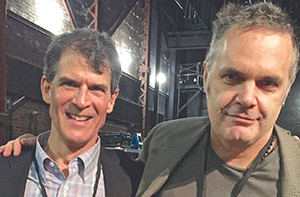
  • American Gurus & the Search for Enlightenment: An Interview with Arthur Versluis

    American Gurus & the Search for Enlightenment: An Interview with Arthur Versluis

    From New Dawn 154 (Jan-Feb 2016)

    Until recently the academic world paid almost no attention to the Western mystical and esoteric traditions. If any scholars strayed into these areas, they did so gingerly and apologetically, often feeling the need to sneer at these currents as a way of safeguarding their reputations.

    This situation began to change in the 1980s. A small group of academic scholars in mainstream universities began to pay serious attention to esotericism as a formative part of the Western spiritual and intellectual culture.

    Arthur Versluis (left) is one of the central figures in this development. Chairman of the department of religious studies at Michigan State University in the US, he has helped form a community of academics that share these interests. He is the founding president of the Association for Esoteric Studies, the leading academic research group in the US in this field, and founder of the online journal Esoterica.

    Versluis’s books include The Secret History of Western Sexual Mysticism: Sacred Practices and Spiritual Marriage (2008), Magic and Mysticism: An Introduction to Western Esotericism (2007); The New Inquisitions: Heretic-Hunting and the Intellectual Origins of Modern Totalitarianism (2006); Restoring Paradise: Esoteric Transmission through Literature and Art (2004); The Esoteric Origins of the American Renaissance (2001); Wisdom’s Book: The Sophia Anthology (2000); Wisdom’s Children: A Christian Esoteric Tradition (1999); and American Transcendentalism and Asian Religions (1993).

    His 2014 book, American Gurus: From Transcendentalism to New Age Religion, traces the rise of spiritual teachers outside the folds of religious traditions. Many of them claim to teach various forms of instant or immediate enlightenment.

    In October 2015, I conducted an e-mail interview with Versluis to discuss American Gurus.

    RICHARD SMOLEY (RS): One of the main themes of American Gurus is a phenomenon called immediatism. Could you talk a little bit about that?

    ARTHUR VERSLUIS (AV): Immediatism refers to a religious assertion of spontaneous, direct, unmediated spiritual insight into reality (typically with little or no prior training), which some claim is enlightenment. It refers to a claim of a “pathless path” to religious enlightenment, because the immediatist says “away with all ritual and practices!” and claims that direct spiritual awakening or enlightenment is possible at once, without meditation or years of guided praxis. In American Gurus, I show that an immediatist approach to enlightenment is deeply embedded in the contemporary religious scene, and is fundamentally a modern New Age phenomenon with some historical antecedents.

    RS: How has this quality of immediatism played itself out in the America of the last 150 years?

    AV: As I said, immediatism as discussed in the book is really a phenomenon of the last several decades. Of course, some antecedents are visible in Anglo-European American literature in much earlier authors. I argue that if contemporary American immediatism has a single ancestor to whom it owes the most, that figure is Ralph Waldo Emerson. In the book, I show that Emerson is much more deeply influenced by Platonism than is usually acknowledged today, and further, I discuss his work in terms of Emerson’s own gnostic experience. Literary critic Harold Bloom was right when he said that in American literature, the titanic figure is Emerson, and one can measure American literature as being before and after Emerson. Of course, Bloom wants to cordon off the term Gnostic to refer to the world-rejecting perspective attributed to it by Hans Jonas and those who follow his existentialist, early-twentieth-century interpretation of “Gnosticism” in late antiquity. However, in my usage, gnosis and gnostic have only their generic implications of one who claims direct spiritual insight, a “gnostic” being someone who experiences gnosis, or illumination. Emerson is the archetypal American figure in this regard.

    But strictly, speaking, Emerson is best described as a Platonist, whereas immediatism discussed in the latter half of the book is a contemporary or relatively recent New Age phenomenon based to a considerable extent, though by no means exclusively, in Neo-Advaitic Hinduism, or what is known as the “satsang movement.”

    RS: You contrast immediatism with Platonism. What are some of the main differences between the two?

    AV: Platonism, like Buddhism and Hinduism, includes contemplative practices and rituals. As I show in my new book Perennial Philosophy [see excerpt, ‘Leaving the Cave’, on page 60], Platonism centres on the contemplative ascent and illumination, and although it does not exclude the possibility of immediate illumination without praxis, it also certainly is not based in that. Immediatism, on the other hand, typically represents a claim that one does not need practices or ritual, but simply needs to be in the presence of a guru, or, sometimes, that one needs to do nothing at all. Immediatism is quite attractive in a New Age consumerist marketplace because it doesn’t ask anything in particular of us, but tells us that we’re “always already” “enlightened.”

    RS: Which of these do you feel more in sympathy with?

    AV: My admiration for and understanding of Platonism continues to grow. Plotinus is an extraordinary figure, whose work Enneads should be read by everyone in the West who feels called to an inner life. But Platonism is not like Buddhism, which has so many available teachers and gurus, as well as a wide range of practices and traditions.

    RS: One figure that you discuss at length is Robert Anton Wilson. Both in Wilson and the Discordian movement there’s obviously a great deal of spoofing going on. Where do you think the joking stops and the serious message begins? Could you comment on Wilson’s work a little and say why it’s significant?

    AV: Robert Anton Wilson is an entertaining figure, and of course Discordianism and variants of or like it are often quite funny. I think one of the more interesting connections mentioned in the book are the links between Wilson and various magical practitioners, authors, and groups, including Christopher Hyatt, Lon Milo DuQuette, and others who might be grouped roughly in the category of “left-hand” magic. In fact, one of the other authors in a volume Wilson contributed to says directly “We are Black Magicians.” I think Wilson’s work needs to be understood in the context of overcoming monotheistic and other forms of what he would call “programming” as well as in the context of going beyond dualities, but as an individualist and a spiritual anarchist. He specialises in semantic disorientation toward those ends.

    RS: Could you comment about William S. Burroughs and his relation to this tradition?

    AV: Burroughs is quite different from many of the other figures discussed in the book. He rejects traditional religions, and offers instead what he calls a “Magical Universe” full of gods and demons in conflict. His magical world is harsh, demonic, characterised by paranoia, and could be described as a kind of cosmic confidence game. He is a somewhat sinister and fascinating figure. I’d suggest readers take a listen to the Bill Laswell album that includes Burroughs reading passages from his novel The Western Lands to get a sense of his unmistakable voice. Critical accounts of his work have not fully taken into account his occultism, for the most part. But his work represents more of a reference point in the book, not a main subject.

    RS: Could you talk a little bit about the Traditionalist Frithjof Schuon and the kind of Sufism that he came to embrace?

    AV: The book really doesn’t focus on Schuon or Traditionalism, but rather mentions them in passing as a reference point. Broadly speaking, I think Traditionalists would dismiss many of the more recent figures discussed in the book as spiritually harmful and deluded. I think it’s pretty clear that Schuon and his circle emphasise spiritual practices and thus aren’t immediatist in the way that, say, Andrew Cohen might be.

    RS: Another figure you discuss is Peter Lamborn Wilson, who has embraced what he regards as a radical, heretical Islam. What would you say are some of the most significant things about Wilson and his work?

    AV: I know Peter – we published my conversation with him in JSR: Journal for the Study of Radicalism a few years back. I talk to him from time to time. He is one of the liveliest intellects I know, a voracious reader, and full of interesting and surprising ideas. I think the radical, antinomian aspects of some offshoots of Sufism both influenced and appeal to him. He is fundamentally what I call a spiritual anarchist, and a real American character.

    RS: At the end of your book you discuss a number of self-styled enlightened masters ranging from Andrew Cohen to Franklin Jones (Adi Da) to Ken Wilber. You mention that teachings of love and compassion seem more or less absent from their discourse. Could you say a little bit about why?

    AV: In the last chapter, I quote Georg Feuerstein’s critique of some of the guru figures you mention. He argues, as do a number of others, that it’s possible to believe one has reached the end of a spiritual path when one actually has only gone partially down it, for instance. It might well be that some people who claim enlightenment have realised something, but have not gone through all the stages as described, for instance, in Buddhist descriptions of the stages leading to enlightenment. Lama Surya Das refers to such claims, cleverly, as “premature immaculation.” One can’t discount the possibility of less charitable interpretations as well, of course.

    Get the issue this article appears in

    RS: One of the most striking conclusions in your book is that the whole immediatist strain in American spirituality could be viewed as part of the absorption of Asian religions, notably Hinduism and Buddhism, in American culture. Many of the self-styled enlightened masters seem to have an affinity for the Hindu Advaita tradition in particular. Could you suggest why this might be?

    AV: One of two epigraphs for the book as a whole is a remark by pollster George Gallup, Jr., who observed, “Americans want the fruit of religion, but not its obligations.” I think there’s a lot of truth to that, and it does help explain why what’s called “Neo-Advaita” Vedanta is popular; it tends to require only that one show up for satsang, or an audience with a Neo-Advaitic guru. But there’s a larger frame, which is the emergence of the New Age movement more generally. The basic idea of a “New Age” is that it just happens to you; it is fundamentally more passive and consumerist than based in traditional practices. It lends itself to spiritual consumerism.

    RS: How do you believe these impulses – notably the influence of Asian religions – will develop in our civilisation in the time to come?

    AV: This is really an interesting question to explore. Asian religions in America, in particular Buddhism and Hinduism, but also Taoism and others, are becoming acclimated, but also are beginning to be Americanised and, more broadly, Westernised. Thus there are a number of practitioners and teachers who see themselves as maintaining the essence of the religious tradition, but at the same time adapting it to the modern American or Western context. Of course, one argument is that some of them, for instance, many Neo-Advaitin teachers, have so essentialised the tradition as to have created something else, which critics argue is diminished into a variant of New Age consumerism. And that is the argument that may often be wielded. But one also has to recognise that as Asian religions become rooted in the West, especially the gnostic initiatory lineages, it is inevitable they also adapt and are adapted to new and very different cultural contexts. An example of this would be the German teacher of Zen Buddhism and mysticism, Willigis Jäger. Another would be B. Alan Wallace, who has a Ph.D. in religious studies and is also a teacher of Tibetan Buddhism. And there are many others, in different traditions. This phenomenon will continue to develop, I’m sure – it is arguably the most important religious development in the West since the emergence of Protestantism.

    American Gurus: From Transcendentalism to New Age Religion (Oxford University Press, 2014) is available from all good bookstores and online sellers. Professor Arthur Versluis has a website at www.arthurversluis.com.

    [alert type=”general” dismiss=”no”]This article was published in New Dawn 154.[/alert]

    [alert type=”success” dismiss=”no”]If you appreciate this article, please consider subscribing to help maintain this website.[/alert]

    © New Dawn Magazine and the respective author.
    For our reproduction notice, click here.