Many New Dawn readers will know of British writer Christopher Knight from his first book The Hiram Key, which he co-authored with Robert Lomas and published in 1996.
Quickly becoming a best seller, The Hiram Key was acclaimed a classic in the field of alternative history, going on to influence a generation of researchers among them The Da Vinci Code’s Dan Brown.
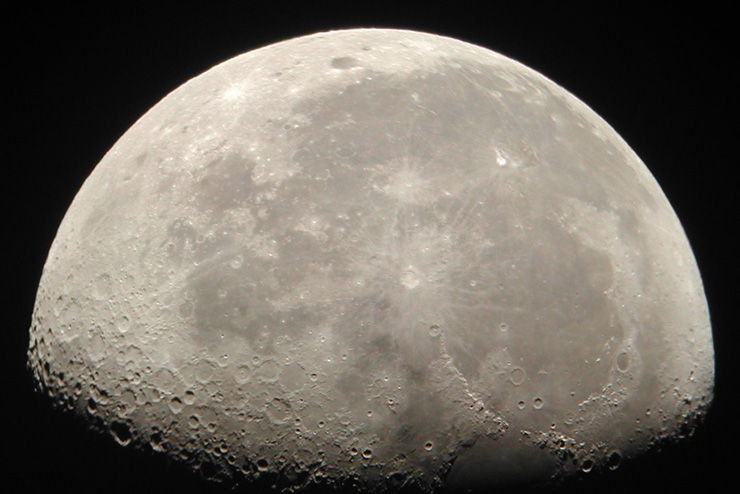
In the last ten years Knight has written six books, four with Robert Lomas and two, including his latest Who Built the Moon?, with Alan Butler. In Who Built the Moon?, Knight and Butler raise some fascinating and challenging questions, foremost: Could it be that the Moon is artificial? Could it even be hollow? And does the Moon really exist through some happy accident, or is a blueprint apparent – and if so, who was the architect?New Dawn recently spoke with Christopher Knight about his controversial new book and his astonishing conclusions. – New Dawn
NEW DAWN: All of mankind’s visits to the Moon have not answered some of the most basic questions about its origin and importance. Your new book Who Built the Moon? (co-authored with Alan Butler) brings to light some extraordinary facts about the Moon, and comes to a mind-blowing conclusion about its origin. Could you briefly outline some of these little known and ignored facts?
CHRISTOPHER KNIGHT: The Moon sits very close to the Earth yet it is widely regarded as the strangest object in the known universe. It is a bit like knowing that every person in the world is completely normal except the person you live next door to, who has three heads and lives on a diet of broken razor blades.
The book lists the strangeness of the Moon, which includes the fact that it does not have a solid core like every other planetary object. It is either hollow or has a very low-density interior. Bizarrely, its concentration of mass are located at a series of points just under its surface – which caused havoc with early lunar spacecraft. The material the Moon is made from came from the outer surface of the Earth and left a shallow hole that filled with water and we now call the Pacific. This rock left the Earth to produce the Moon very quickly after our planet had formed around 4,6 billion years ago.
The Moon is not only extremely odd in its construction; it also behaves in a way that is nothing less than miraculous. It is exactly four hundred times smaller than the Sun but four hundred times closer to the Earth so that both the Sun and the Moon appear to be precisely the same size in the sky – which gives us the phenomenon we call a total eclipse. Whilst we take this for granted it has been called the biggest coincidence in the universe.
Furthermore, the Moon mirrors the movement of the Sun in the sky by rising and setting at the same point on the horizon as the Sun does at opposite solstices. For example, this means the Moon rises at midwinter at the same place the Sun does at midsummer. There is no logical reason why the Moon mimics the Sun in this way and it is only meaningful to a human standing on the Earth.
ND: What led you to write Who Built the Moon? And does this latest book relate to your earlier research when writing Civilization One and Uriel’s Machine?
CK: All of the six books I have had published over the last ten years are part of a continued single piece of research. I came to write Who Built the Moon?with Alan Butler after we had finished Civilization One, because our research led us to study the Moon very closely.
We had found that the superbly advanced measuring system in use over 5,000 years ago was based on the mass, dimensions and movements of the Earth.
However, for thoroughness we checked every planet and moon in the solar system to see if there was any pattern. Amazingly, it worked perfectly for every aspect of the Moon but did not apply at all to any other known body – except the Sun.
It was as though we had found a blueprint where the Moon had been ‘manufactured’ using very specific units taken from Earth’s relationship with the Sun. The more we looked, everything fitted – and fitted perfectly in every conceivable way.
ND: Most astoundingly, you found that an ancient system of geometry and measurement used in the Stone Age works perfectly on the Moon. What exactly is this system and how could the ancients have attained this knowledge?
CK: It is not possible to describe the greatness of this ancient system of geometry and measurement without repeating the content of Civilization One.
The work of Alexander Thom, a brilliant professor of engineering from Oxford University, was our starting point. He identified the existence of what he called the Megalithic Yard. This was a precise unit of measurement that was the basis of late Stone Age structures across Western Europe – such as Stonehenge. Most archaeologists have written his work off as a mistake but when one looks coldly at their objections they are baseless.
Alan and I were able to show how they made these highly precise linear units based on the rotation of the Earth and how they were also the basis of all time, capacity and weight units in use today. Once again these are exact – not approximations or close fits.
Where the ancients got such knowledge is quite baffling. All we can be certain of is that they were way ahead of us today! It’s easy to check out by anyone with a calculator.
ND: Your conclusion is there are more than enough anomalies about the Moon to suggest it is not a naturally occurring body and was quite possibly engineered to sustain life on Earth. How did you reach this conclusion?
CK: Not only is the Moon an apparently impossible object, it has some unique benefits for us humans. It has been nothing less than an incubator for life. If the Moon was not exactly the size, mass and distance that it has been at each stage of the Earth’s evolution – there would be no intelligent life here. Scientists are agreed that we owe everything to the Moon.
It acts as a stabiliser that holds our planet at just the right angle to produce the seasons and keep water liquid across most of the planet. Without our Moon the Earth would be as dead and solid as Venus.
ND: If the Moon is an artificial construct, what are your theories on who or what built it, and why?
CK: In Who Built the Moon? we explain that we could not come to any other conclusion than the Moon is artificial. Because it is certain that it is 4.6 billion years old that raises some interesting points. Another factor was the obvious message that has been built into the Moon to tell us it’s artificial. The language of the message is base ten arithmetic so it looks as though it is directed to a ten digit species that is living on Earth right now – which seems to mean humans.
The question of why the Moon had to be built is easy to answer: To produce all life, especially humans. As to who did it – well that’s a lot tougher! We give the three possibilities we can think of, namely: God, aliens or humans. The only one of these that is 100% scientifically possible is the last one. Time travel is universally accepted as being physically possible and a number of scientists are close to sending matter back in time. We can envisage that machines could be built in the future that could be sent back to remove matter from the young Earth to construct the Moon – probably using mini black hole technology.
[alert type=”general” dismiss=”no”]This article was published in New Dawn 96.[/alert]
[alert type=”success” dismiss=”no”]If you appreciate this article, please consider subscribing to help maintain this website.[/alert]
With the publication of Holy Blood, Holy Grail in the mid-nineties and the Gnostic Gospels found in Nag Hammadi, a new perspective on the role of Mary Magdalene in the revelation and dissemination of the esoteric teachings of Christ has emerged onto the public stage. With the release of The Da Vinci Code, she has been placed firmly in the public consciousness, her story awakening both excitement and controversy.
It is my contention that Mary Magdalene was the carrier of a tradition of respect and reverence for the Divine Feminine, a secret initiatory tradition that leads back through Jesus, Gnosticism, the esoteric teachings of Judaism, and the Egyptian mysteries of Isis to the ultimate ground or source of all religions. By seeking out the alternative roads to understanding, by looking at the Gnostic texts, legends, symbols, and iconography, one discovers the distinct possibility Mary Magdalene was not only first witness to and herald of the Resurrection, but the chief disciple and recipient of Christ’s’ gnosis, as well as teacher and transmitter of these extraordinary Mysteries to the people of France.
On the shores of the Mediterranean Sea outside Marseilles at Les Saintes Marie de la Mere there is a small chapel dedicated to Mary Magdalene and consecrated by Archbishop Roncalli (who later became Pope John XXIII). Given a place of prominence within this chapel are paintings of her arrival from Palestine in a small rudderless boat.According to legend, soon after the crucifixion and Resurrection, Mary Magdalene and her family were expelled from the Holy Land, set adrift on the Mediterranean Sea and made their way to this region, particularly the area around Southern France and Northern Spain. At this time in history, aside from the already established Celts, many Greeks, Arabs, Jews and others lived and travelled in this area. There was even a Jewish city known as Glanum Levi whose ruins can be found today in Provence.
In the midst of this cosmopolitan confluence of cultures, along with the exchange of goods there must have been an exchange of philosophical and religious ideas. It is very possible that during this period many spiritual and symbolic links were discovered between these diverse peoples and their traditional belief systems that stretched back to the temples of Egypt. Before her arrival in Les Saintes Marie Sur Les Mere, France was riddled with Isis cults. The name Paris etymologically can be linked to the pre-Celtic ParIsis, the grove of Isis. Clearly this region was fertile ground for Mary Magdalene’s mission.Following her arrival in France, she was said to have travelled the land, preaching the authentic Gnostic gospel of Jesus, which had been directly transmitted to her during his time on Earth and in mystic visions after his return to the more subtle dimensions of light. French religious literature from the Middle Ages is filled with legends and stories of the life of Mary Magdalene from this period until her death. Tales abound of her miraculous healings, her performance of the ritual of baptism, her aid in fertility and childbearing and even her ability to raise the dead. There are even reports of a secret tradition of the healing arts that exists today in France and traces its roots back to Mary Magdalene.1
After this prophetic mission was accomplished, Mary is reported to have withdrawn to a cave in Ste. Baum, where she spent the remainder of her days in pray and seclusion. She is believed to have been buried at Ste. Maximin where her remains were watched over by Cassianite monks from the fifth century until the Saracen invasion. Then in 1058, in a papal bull, Pope Stephen acknowledged the existence of her relics in the church of Vezeley, which became one of the major places of pilgrimage during the Middle Ages.
But before we look at the evidence for her distinctive role as Apostle of the Apostles and prophetic mission, let us take a look at the hidden history of Gnosticism, the powerful doctrine of Divine grace, healing and illumination that she was said to have transmitted.
The Gnostic Teachings
It was during the Hellenistic period that the mystic knowledge of Egypt, the great symbols, myths, astronomical, scientific and metaphysical teachings passed into the heart of the Mystery Schools of Greece and Rome, which included the region of Gaul where Mary Magdalene is reported to have lived and preached. These secret initiatory teachings of the Egyptians were also retained and transmitted through the inner circles of Judaism to Jesus himself.
At the heart of this lineage of transmission was an extraordinary metaphysical teaching known as Gnosticism. This teaching is believed to be the spiritual basis of his essential message to humanity, a message revealed to Mary Magdalene, his disciples and followers through the vehicles of metaphor, allegory and parable. Unlike the patriarchal, dogmatic, materially based teachings prevalent during this period, Gnosticism placed primary value on the feminine qualities of receptivity, intuitive perception, visionary experience and the art of healing. It was a teaching of love, selflessness, harmony and communion.
The mystic experience of, and communion with, the essential grace and majesty of Divinity, lay at the heart of this Gnostic transmission. The clear and immediate experience of this awakening was known as gnosis or wisdom. Often translated from its Greek root as ‘knowledge’, Gnosticism goes much deeper than mere intellectual understanding. Like a brilliant flash of light arising from the darkness, this understanding arises in the individual as a bright lucid awareness – an intuitive realisation of the pure essence, nature and energy of Divinity as it flows within oneself, the luminous realms and all of creation.
From the Gnostic viewpoint, the answers to all of life’s mysteries can only be found when one “opens oneself to this divine current and allows oneself to be penetrated by it to the point where one is fully transformed and illuminated by it.”2 From the viewpoint of many early Gnostic communities, this divine current was perceived as the feminine, healing and nurturing energy of God’s Holy Spirit.
The fundamental doctrine of the Gnostics relates the dualistic nature of the world in which we reside, the eternal struggle between good and evil. They believed that Jehovah, the wrathful god of the Old Testament was a false god and expression of what they called the demiurge. For how could a fully enlightened divinity contain within him the base emotions of anger, jealousy and vengeance? For them, the real God was a loving deity equally and directly accessible to all. This God taught that love, compassion and the true sacrifice and transformation of the self, or ego, was the highest spiritual path.
The Gnostics believed that the plan of this demiurge, or Satan, was to trap spirit in matter, and the Earth itself was a prison in which souls were exiled from their divine home. For them, the real world was the non-material world of spirit and all of their rituals and practices were designed to purify them and provide them with the means to find their way out of the impure world of matter, darkness and suffering and return to their true home in the Light.
Clearly, these sacred esoteric teachings were revolutionary. Unlike the fixed, restrictive, hierarchical systems prevalent during this period, these teachings were open to all, female, male, rich, poor Jew or Pagan. This all-inclusive transmission of teachings formerly reserved for the elite was at odds with the practices of Orthodox Judaism and the emerging Church of Rome. For once the seeker had been touched by this Gnostic current, she or he came to recognise their own divine nature and perceive their place in the world from a whole new perspective. No longer did they need the intercession of a priest or rabbi to connect them with their spiritual inheritance.
Evidence of Mary Magdalene’s primary role as disciple, visionary, mediatrix and herald of these revolutionary teachings can be found in a number of Gnostic texts. These include The Pistis Sophia, The Gospel of Philip, The Gospel of Mary and more.
Apostle of the Apostles
The Pistis Sophia is a Coptic Gnostic revelatory work composed and/or compiled in Egypt around the middle of the second century CE. It claims to disclose the “secret teachings of the Savior,” reserved for his inner circle of initiates during the eleven years following his Resurrection. Filled with powerful, poetic imagery, this text reveals the intimate connections between this emerging form of Christianity, Paganism and beliefs and rituals founds in the Egyptian Book of the Dead.3 It also clearly recognises and demonstrates Mary Magdalene’s essential role as foremost disciple, seer and prophetess.
It appears the teachings found in the Pistis Sophia were created specifically for the apostles who would go forth and spread his gospel. It takes the form of a dialogue between Jesus and these apostles and consists primarily of questions and answers. It is fascinating to note that in this text, out of the forty-six questions asked of him, thirty-nine of them come from Mary Magdalene. Due to her sincerity, astute level of inquiry and ability to comprehend the essence of his words, time and time again she is praised and recognised by him for her clarity and insight.
For example, after Jesus presents the first part of these mystical teachings concerning the aeons, orders and regions of the “Great Invisible,” he acknowledges Mary Magdalene’s superior capacity for contemplation, insight and revelation.
It came to pass then, when Mary had heard the Savior say these words, that she gazed fixedly into the air for the space of an hour. She said: “My Lord, give commandment to me to speak in openness.” And Jesus, the compassionate, answered and said unto Mary:
“Mary, thou blessed one, whom I will perfect in all mysteries, of those of the height, discourse in openness, thou, whose heart is raised to the Kingdom of Heaven more than all thy brethren.”
Throughout the text, after listening to her interpretation of his teachings, he acknowledges her perceptive abilities,
Well, said, Mary, for thou art blessed before all women on earth, because thou shalt be the fullness of all fullness and the perfection of all perfections.
This is only the first of a number of texts that speak of Mary Magdalene’s gifts and unique relationship with Jesus. According to a group of Gnostic Gospels discovered in 1945 in a cave in Upper Egypt near the village of Nag Hammadi, she was said to be an inspired prophetess who continuously experienced the living presence of her Lord within her.
In The Gospel of Mary, from this collection, Mary Magdalene, the visionary, reveals to the other disciples teachings that were transmitted to her through visionary experience. In this gospel, she clearly takes the lead, not only soothing and reassuring the male apostles who fear capture and death, but relating to them teachings of the Savior that she alone has been privileged to receive. As in the Pistis Sophia, the Savior blesses her for her visionary capacity. When Peter questions her vision, Levi responds with, “If the Teacher held her worthy, who are you to reject her? Surely the Teacher knew her very well, for he loved her more than us.”4
In The Gospel of Philip, from the same collection, the disciples appear to be jealous of the intimate relationship between the Savior and Mary Magdalene.
The Companion of the savior is Mary Magdalene. But Christ loved her more than all the disciples and used to kiss her often on the mouth. The rest of the disciples were offended by it and expressed disapproval. They said to him, “Why do you love her more than all of us?” The Savior answered and said to them, “Why do I not love you like her? When a blind man and one who sees are both together in darkness, they are no different from one another. When the light comes then he who sees will see the light, and he who is blind will remain in darkness.”
Because I have no reason to doubt Philip’s account or the words found in these early texts, I feel that the Christianity brought to France by Mary Magdalene has a different feel about it because it was closer to the authentic teachings of Jesus. If Mary Magdalene truly was the Apostle of the Apostles, then Jesus transmitted more to her or perhaps she understood this transmission better than the rest of the apostles. Through this lens we can begin to perceive and acknowledge the different understanding and practice of Christianity that emerged in Southern France, one that lasted over 1,200 years and in a sense pervades the place to this day.
Magdalene’s Legacy
When one looks at the history of the region one finds evidence that with her arrival, a surge of spiritual awareness, code of ethics and respect for feminine values began, which wove itself into the very fabric of the psychic landscape of Europe. The Order of the Knights Templar was created in this region. The alchemists began their flurry of Cathedral building to preserve the secret metaphysical teachings passed down to them from ancient Egypt. The Crusades and the entire Back to Jerusalem movement began in this area. The mystical Kabbalistic texts the Bahir and Zohar emerged from this region, bringing to the Jewish people knowledge of the Shekhina, or ‘indwelling presence’ and ‘feminine potency of God’. The cults of the Virgin Mary, Mary Magdalene and Black Madonna, symbolically representing the three aspects of Isis in her role as Universal Goddess, arose here and spread throughout Europe.
It was here the troubadours and poets such as Wolfram von Eschenbach, Robert de Bouron and others sang their songs of devotion to the feminine principle and wrote their fables of the Holy Grail. And it was here in the beautiful mountains and valleys of Provence and Languedoc that the Cathars, as carriers of the Gnostic transmission of Jesus and Mary Magdalene, rebelled against what they considered to be the excesses of the priestly hierarchy, renounced all worldly possessions and fully committed themselves to the path of spirit. Among the Cathars, women as well as men were priests who transmitted divine grace and healing power through the laying on of hands in their sacred initiatory rites that link back to Mary Magdalene, Isis and the healing traditions held by the temple priestess.
As time marched on, the Church of Rome, threatened by the inroads these powerful Gnostic teachings were making among the local populace, labelled them heretical and moved to suppress them. To cement the rule of the Church of Rome, Pope Innocent III called for a Crusade against this Gnostic Cathar heresy. This crusade, which had as its focus the torture, murder and eradication of these loving and compassionate people was the starting point of a wave of fear, suffering and suppression of the feminine in both her divine and worldly aspects that would spread throughout Europe and become known as the Holy Inquisition.
Closer to our time, there are the visions of Saint Bernadette and the healing waters of Lourdes, as well as the mystery of Father Sauniere, Rennes Le Chateau and his strange chapel dedicated to Mary Magdalene. Then there is the saga of Otto Rahn searching through the hills and valleys of this region for the Nazis trying to find the Holy Grail for the upper echelon of the SS. There are the legends of the secret alchemists who live in a magical castle somewhere in the Pyrenees recently popularised in the Harry Potter series. Finally, emerging from this region, is the mystery of the Alchemical Cross of Hendaye, the prophetic visions of Nostradamus and the Basque legend that John of the Apocalypse still lives in a cave in the Pyrenees and will leave that cave only at the end of time.5
These events and stories reveal that Mary Magdalene and the Gnostic current may very possibly be the driving force behind the rich history of this region. Whether it is fact or legend that Mary Magdalene actually came to this area is less important than the power and impact her life and teachings had upon the people of France. It is obvious to anyone who opens their eyes to see, that early in the history of this grace-filled tradition, Mary Magdalene, Apostle of the Apostles entered and has remained at the heart of Christianity.
[alert type=”general” dismiss=”no”]This article was published in New Dawn Special Issue 2.[/alert]
[alert type=”success” dismiss=”no”]If you appreciate this article, please consider a contribution to help maintain this website.[/alert]
Footnotes:
1. From a conversation with minister and playwright Lila Sophia Tresemer, co-author of the play and DVD, Re-Discovering Mary Magdalene (written with her husband, David Tresemer), for which I created the choreography. In their travels through France, she discovered a tradition of using the healing oils of Mary Magdalene that was said to have been passed down to healers now living in the south of France.
2. Sharron Rose, The Path of the Priestess; A Guidebook for Awakening the Divine Feminine (Inner Traditions, 2002) p.104
3. From the forward by Leslie Shepard to G.R.S. Mead’s, Pistis Sophia (University Books, 1974), p. xvii
4. From the recent translation by Jean-Yves Leloup, The Gospel of Mary Magdalene (Inner Traditions, 2002).
5. For greater insight into these events see Weidner and Bridges, The Mysteries of the Great Cross of Hendaye: Alchemy and the End of Time (Destiny Books, 2003) and the Sacred Mysteries DVD, Secrets of Alchemy: The Great Cross and the End of Time.
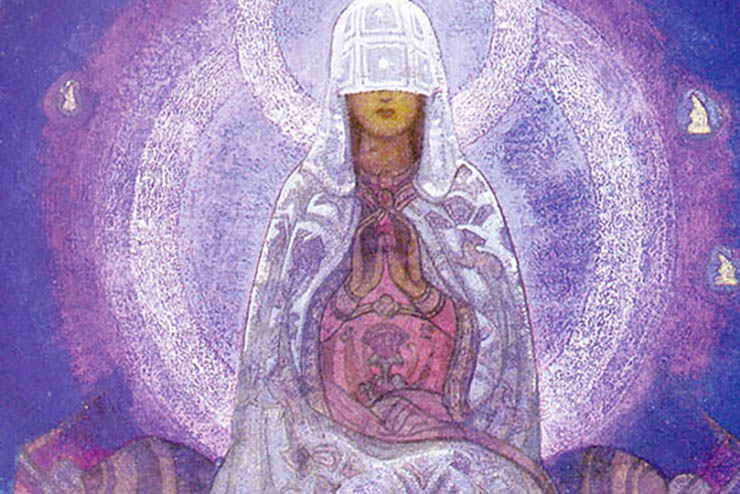
Top image caption: The “Mother of the World” by mystic and artist Nicholas Roerich (1874-1947). Nicholas and his wife Helena taught that the World Mother has manifested many times over the millennia. (Image courtesy of the Nicholas Roerich Museum, New York, www.roerich.org).
If you asked them what life was like in prehistoric times, most people would conjure up an image like the famous opening scenes of 2001: Space Odyssey – groups of hairy savages grunting and jumping around, foaming at the mouth with aggression as they bash each over the heads with sticks. We take it for granted that life was much harder then, a battle to survive, with everyone competing to find food, struggling against the elements, men fighting over women, and everyone dying young from disease or malnutrition.
A whole branch of “science” has grown up around this view of the human race’s early history. This is a relatively new discipline of evolutionary psychology, which tries to explain all of the negative sides of human nature as “adaptations” which early people developed because they had some survival value. Evolutionary psychologists explain traits like selfishness and aggression in these terms. Life was such a struggle that only the most selfish and aggressive people survived and passed on their genes. The people with gentle and peaceful genes would have died out, simply because they would have lost out in the survival battle.
Evolutionary psychologists see racism and war as “natural” too. It’s inevitable that different human groups should be hostile to one another, because once upon a time we were all living on the edge of starvation and fighting over limited resources. Any tendency to show sympathy for other groups would have reduced our own group’s survival chances.
But fortunately we don’t have to believe any of this crude nonsense. There is now a massive amount of archaeological and anthropological evidence which suggests this view of the human race’s past is completely false. Life for prehistoric human beings was far less bleak than we might imagine.
Take the view that life was a “struggle to survive.” The evidence suggests that the lives of prehistoric human beings were a lot easier than those of the agricultural peoples who came after them. Until around 8000 BCE, all human beings lived as hunter-gatherers. They survived by hunting wild animals (the man’s job) and foraging for wild plants, nuts, fruit and vegetables (the woman’s job). When anthropologists began to look at how contemporary hunter-gatherers use their time, they were surprised to find that they only spent 12 to 20 hours per week searching for food – between a third and a half of the average modern working week! Because of this, the anthropologist Marshall Sahlins called hunter-gatherers “the original affluent society.” As he noted in his famous paper of that name, for hunter-gatherers, “The food quest is so successful that half the time the people do not seem to know what to do with themselves.”1
Strange though it may sound – the diet of hunter-gatherers was better than many modern peoples’. Apart from the small amount of meat they ate (10-20% of their diet), their diet was practically identical to that of a modern day vegan – no dairy products and a wide variety of fruits, vegetables, roots and nuts, all eaten raw (which nutrition experts tell us is the healthiest way to eat.) This partly explains why skeletons of ancient hunter-gatherers are surprisingly large and robust, and show few signs of degenerative diseases and tooth decay. As the anthropologist Richard Rudgley writes, “We know from what they ate and the condition of their skeletons that the hunting people were, on the whole, in pretty good shape.”2
The hunter-gatherers of Greece and Turkey had an average height of five feet ten inches for men and five feet six for women. But after the advent of agriculture, these had declined to five feet three and five feet one. An archaeological site in the lower Illinois Valley in central USA shows that when people started cultivating maize and switched to a settled lifestyle, there was an increase in infant mortality, stunted growth in adults, and a massive increase in diseases related to malnutrition.
Hunter-gatherers were much less vulnerable to disease than later peoples. In fact, until the advances of modern medicine and hygiene of the 19th and 20th centuries, they may well have suffered less from disease than any other human beings in history. Many of the diseases which we’re now susceptible to only actually arrived when we domesticated animals and started living close to them. Animals transmitted a whole host of diseases to us which we’d never been exposed to before. Pigs and ducks passed the flu on, horses gave us colds, cows gave us the pox and dogs gave us the measles. And later, when dairy products became a part of our diet, we increased our exposure to disease even more through drinking milk, which transmits at least 30 different diseases. In view of this, it’s not surprising that with the coming of agriculture, people’s life spans became shorter.
The transition from a nomadic hunter-gatherer way of life to a settled agricultural one began in the Middle East at around 8000 BCE, spreading into Europe and Asia over the following millennia (and developing independently in some places). Many of the world’s cultures have myths that refer to an earlier time when life was much easier, and human beings were less materialistic and lived in harmony with nature and each other. In ancient Greece and Rome this was known as the Golden Age; in China it was the Age of Perfect Virtue, in India it was the Krita Yuga (Perfect Age); while the Judeo-Christian tradition has the story of the garden of Eden. These myths tell us that, either as a result of a long degeneration or a sudden and dramatic “Fall,” something “went wrong.” Life became much more difficult and full of suffering, and human nature became more corrupt. In Taoist terms, whereas the earliest human beings followed the Way of Heaven and were a part of the natural harmony of the Universe, later human beings became separated from the Tao, and became selfish and calculating.
Many of these myths make clear references to the hunter-gatherer way of life – for example, the Greek historian Hesiod states that during the Golden Age “the fruitful earth bore [human beings] abundant fruit without stint,” while the early Indian text the Vaya Purana states that early human beings “frequented the mountains and seas, and did not dwell in houses” (i.e. they lived a non-sedentary way of life). The garden of Eden story suggests this too. Originally Adam and Eve ate the fruit from the tree of knowledge, until they were forced to leave the garden and forced to “work hard and sweat to make the soil produce anything.” It appears that, at least in part, these myths are a kind of “folk memory” of the pre-agricultural way of life. The agricultural peoples who worked harder and longer, had shorter life spans and suffered from a lot more health problems must have looked at the old hunter-gatherer way of life as a kind of paradise.
Warfare and Social Oppression
There are other significant reasons why these peoples would have seen earlier times as a Golden Age. There is a great deal of evidence suggesting that prehistoric human beings were much less war-like than later peoples. Archaeological studies throughout the world have found hardly any evidence of warfare during the whole of the hunter-gatherer phase of history. There are, in fact, just two indisputable cases of group violence during all of these tens of thousands of years.
A cluster of sites around the Nile Valley show some signs of violence from around 12,000 BCE. The site of Jebel Sahaba, for instance, has a grave containing the bodies of over 50 people who apparently died a violent death. And in south-east Australia, there are some signs of inter-tribal fighting – as well as of other kinds of social violence such as the cranial deformation of children – at several different sites dating from 11,000 and 7000 BCE. Lawrence Keeley’s book War Before Civilisation suggests several other examples of prehistoric violence and warfare, but all of these are dubious, and have been dismissed by other scholars. For example, Keeley sees cut marks on human bones as evidence of cannibalism, when these are more likely to be the result of prehistoric funeral rituals of cleaning bones of their flesh. He also interprets highly abstract and stylised drawings in caves in Australia as depicting battles, when they are open to wide variety of other interpretations. In this way, as the anthropologist R. Brian Ferguson remarks, Keeley’s “rhetoric exceeds his evidence in implying war is old as humanity.”3
The lack of evidence for warfare is striking. There are no signs of violent death, no signs of damage or disruption by warfare, and although many other artefacts have been found, including massive numbers of tools and pots, there is a complete absence of weapons. As Ferguson points out, “it is difficult to understand how war could have been common earlier in each area and remain so invisible.” Archaeologists have discovered over 300 cave prehistoric “art galleries,” not one of which contains depictions of warfare, weapons or warriors. In the words of the anthropologist Richard Gabriel, “For the first ninety-five thousand years after the Homo sapiens Stone age began [until 4000 BCE], there is no evidence that man engaged in war on any level, let alone on a level requiring organised group violence. There is little evidence of any killing at all.”4
There seems to have been equality between the sexes in prehistoric times too. The fact that women provided so much of the tribe’s food strongly suggests they had equal status, since it’s difficult to see how they could have low status while performing such an important economic role. The healthy, open attitude ancient hunter-gatherers had to the human body and to sex – shown by the massive numbers of sexually explicit images and objects archaeologists have discovered – suggests this too, since the oppression of women appears to be closely linked to a sense of alienation from the human body, and a negative attitude to instincts and bodily processes.
Contemporary indigenous peoples are sexually egalitarian too. Before European conquest and colonisation, many of them traced descent and ownership of property through the mother’s rather than the father’s side of the family. And as the anthropologist Tim Ingold notes, in “immediate return” hunter-gatherer societies (that is, societies which live by immediately using any food or other resources they collect, rather than storing them for later use), men have no authority over women. Women usually choose their own marriage partners, decide what work they want to do and work whenever they choose to, and if a marriage breaks down they have custody rights over their children.5
In prehistoric societies there were no status differences between individuals either. There were no different classes or castes, with people who had more power and possessions than others. For archaeologists, the most obvious signs of social inequality are differences in graves, in terms of size, position and the goods which are placed inside them. Later agricultural societies have larger, more central graves for more “important” people, which also have a lot more possessions inside them. Men generally have more “important” graves than women. But the graves of the ancient hunter-gatherers are strikingly uniform, with little or no size differences and little or no grave wealth.
Almost all contemporary hunter-gatherers show a striking absence of any of the characteristics that we associate with social inequality. The anthropologist James Woodburn speaks of the “profound egalitarianism” of immediate-return foraging peoples and emphasises that no other way of human life “permits so great an emphasis on equality.”6 Foraging peoples are also strikingly democratic. Most societies do operate with a leader of some kind, but their power is usually very limited, and they can easily be deposed if the rest of the group aren’t happy with their leadership. People don’t seek to be leaders – in fact if anybody does show signs of a desire for power and wealth they are usually barred from consideration as leaders. And even when a person becomes a leader, they don’t have the right to make decisions on their own. Decisions are made in co-operation with other respected members of the group.
All of this strongly argues against the idea that prehistoric human beings were brutes whose only concern was survival, and whose lives were full of cruelty and conflict, as men competed against each other for status and food and sex. Warfare, social oppression and male domination – and an existence that was “nasty, brutish and short” – belong to a later phase of human history. Evidence from artwork, cemeteries and battle sites suggests there was an “eruption” of these social pathologies during the fourth millennium BCE, starting in the Middle East and central Asia. The root cause of this change seems to have been environmental. Around this time massive areas of land which had been fertile for thousands of years started to turn into desert. This happened all over the Middle East and central Asia, creating the massive belt of arid or desert land which runs across from the Steppes of southern Russia to the Arabian and Iranian deserts. The groups who lived in the area – including the original Indo-Europeans and Semites – were forced to flee and look for new fertile lands, causing massive waves of migrations.
This environmental disaster seems to have changed the psyche of these peoples. Whereas before they had been peaceful and egalitarian, now they became aggressive, hierarchical and patriarchal. Over the following centuries they spread over Europe, the Middle East and Asia, killing and conquering the peaceful “Old World” peoples they came across, including the civilisation of Old Europe (which was reconstructed by the archaeologist Marija Gimbutas). By 500 BCE, these peoples had more or less completely conquered the whole of Eurasia, leaving only a few indigenous peoples such as the Laplanders of Scandinavia, the tribal peoples of Siberia, and the indigenous peoples of the forests and hills of India. In mainland Europe the only surviving non-Indo-European indigenous peoples were the Basque people of northern Spain (who amazingly still survive today) and the Etruscans of Italy, who were soon to be wiped out by the Romans.
In my book The Fall, I try to explain how these people were (and are) different from the peaceful peoples who came before them. My theory is that the environmental catastrophe (the drying up of their fertile lands) caused an “Ego Explosion.” These peoples developed a stronger and sharper sense of identity, or of individuality, which made them feel more separate to nature and to other people, and more liable to be aggressive and to lust after power and status. We – modern day Eurasians – are the descendents of these peoples, and we have inherited their strong sense of ego. This is still the main difference between us and indigenous “unfallen” peoples such as the Native Americans, Australian Aborigines and the peoples of Oceania, and the reason why they have a much more respectful attitude to nature than us, and a more spiritual vision of the Universe. Our strong sense of ego “walls us off” from other people and nature, makes us unable to sense the alive-ness of the world around us, and may ultimately be responsible for our extinction as a species.
However, there are some signs that, as a culture, we are slowly transcending the “fallen” psyche, and going beyond our ego-separateness. Over the last 300 years or so, there has been a new spirit of empathy growing, which has led to less cruel treatment of children and animals, less severe punishments for criminals, the women’s movement, the abolition of slavery, the socialist movement, a new respect for nature, a more open and healthy attitude to sex and the human body and so on. And there has been a new sense of the sacred and of the possibility of self-transcendence, which has led to a massive upsurge of interest in esoteric/spiritual philosophies and practices like paganism, shamanism, Buddhism, meditation and so on.
There are signs that we are reconnecting with nature, regaining our sense of the aliveness of the world and of the hidden mysteries of the cosmos. The characteristics of the prehistoric golden age may be slowly re-emerging. The only question is whether there is enough time left for these characteristics to emerge fully, before the old “fallen” psyche leads us to self-destruction.
The idea that human history is a gradual but continual progression – starting from a state of savagery, with generations slowly making technological and social advances and passing these down, and leading to the pinnacle of western European civilisation – is a leftover from the Victorian era, part of the same colonial mentality which saw “primitive” indigenous peoples as subhumans who could be justifiably conquered and killed. Rather than a progression, the last 6000 years of war, oppression, misery and hardship are the result of a painful degeneration from an earlier, healthier state. We may finally be moving forward now – but only in the sense of turning a full circle, and rekindling glimmers of ancient harmony.
[alert type=”general” dismiss=”no”]This article was published in New Dawn 95.[/alert]
[alert type=”success” dismiss=”no”]If you appreciate this article, please consider subscribing to help maintain this website.[/alert]
Footnotes:
1. Sahlins, M. (1972). Stone Age Economics. New York: Aldine de Gruyter,. p.36.
2. Rudgley, R. (2000). Secrets of the Stone Age. London: Random House, p. 36.
3. Ferguson, R.B. (2000). ‘The Causes and Origins of Primitive Warfare.’ Anthropological Quarterly, 73.3, 159-164, p.159.
4. Gabriel, R. (1990). The Culture of War: Invention and Early Development. New York: Greenwood Press, p. 21.
5. Ingold, T., Riches, D. & Woodburn, J. (Eds.). (1988). Hunters and Gatherers, Volume 2: Property, Power and Ideology. Oxford: Berg.
6. Woodburn, J. (1982). ‘Egalitarian Societies.’ Man, 17, 431-51, p.432.
Political activists of the so-called “religious Right” in the United States never tire of preaching that their country was founded as “a Christian democracy.” But they are wrong on both counts.
When Benjamin Franklin was leaving the first Continental Congress, he was asked by one of many anxious patriots waiting outside the courthouse, “What have you given us?” Franklin replied, “A republic, if you can keep it.”
The difference might seem trivial or even non-existent to narrow-minded persons for whom democracy and dictatorship are the only conceivable forms of government. Yet, the very word, “democracy,” does not occur once in the Bill of Rights, the US Constitution, or any state constitution. It was mentioned often by America’s Founding Fathers, but invariably as a synonym for “mob rule,” and, along with obsolescent monarchy, an evil to be avoided.
Thomas Paine, the American Revolution’s most eloquent voice, summed up his colleagues’ view of democracy when he described it in his world-famous “Rights of Man” as “a species of demagoguery, wherein clever charlatans, making promises as enticing as they are impossible to fulfil, win for themselves unwarranted power and wealth, persuading gullible people to discard their liberties for a secret tyranny masquerading as public freedom.”
Particularly in the writings of Thomas Jefferson, the historic models held up for emulation did not include Greek democracy, but the Venetian and Roman republics. The difference between these examples most important to men like Paine and Jefferson was the concept of citizenship. Anyone born in a democratic state automatically becomes a citizen with all the privileges that entails, including the right to vote. In a republic, one is not born a citizen, but may only become one when he or she reaches adulthood; can demonstrate at least a fundamental grasp of the workings of their government, and is either going to school or gainfully employed.
In modern America, all that remains of these basic requirements is a restriction against voting until one’s eighteenth year. Foreigners must, in fact, pass tests proving their basic comprehension of the Constitution before becoming US citizens, which makes them more knowledgeable, discerning voters than native-born Americans, who are supposed to receive the same kind of rigorous Constitutional education, but rarely, if ever, do. In demanding at least some qualifications for citizenship, America’s Founding Fathers believed that responsible leaders could only by chosen by a competent electorate. Today, however, such notions are shunned as “elitist” in most countries described as “democratic.”
Yet more shocking to bible-beating conservatives, if they were to learn the awful truth, is that the United States was not founded by Christians, at least of the kind they would approve. Instead, that country’s constitutional republic was conceived, fought for and built almost entirely by deists. While the majority of Americans, then as now, were at least nominally Christian, most of their leaders were not. George Washington, John Hancock, Patrick Henry, Paul Revere and virtually all of their intellectual compatriots were deists. The term is not generally familiar today, but signifies a person who believes in a universal, compassionate Intelligence that made and orders Creation, manifests its will through natural law, but requires no religious dogma to be understood, only the faculty of reason with which every human is endowed.
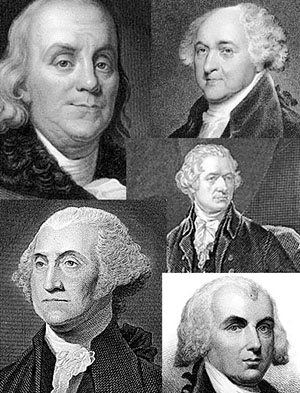
America’s most famous deists were among the Founding Fathers of the country. Notable deists were the men in this montage, from top right proceeding clockwise, John Adams, Thomas Paine, James Madison, George Washington, and Benjamin Franklin.
Referring to the church of his day, Paine wrote, “The Christian theory is little else than the idolatry of the ancient mythologists, accommodated to the purposes of power and revenue… My own mind is my own church.” Like his fellow deists, who made a clear distinction between church and state, he was convinced that freedom meant being able to speak one’s mind on all subjects, religious as well as political. He did not “condemn those who believe otherwise. They have the same right to their belief as I have to mine.”
Nor were the deists anti-Christian. They concluded that Christianity had at its theological core the same mystical truth found in every genuine spiritual conception; namely, the perennial philosophy of compassion for all sentient beings as the means by which the human soul develops. This recognition, however, deeply offended mainstream Christians, who insisted their brand of faith alone was correct, all others being heretical at best or demonic at worst.
As an example of the extremes these defenders of the One True Religion went to demonstrate their piety, hob-nails initialled “T.P.” were sold by the thousands to Londoners who could walk all day on the name of Thomas Paine. His treatment in the land he had done so much to free was more harsh. When he walked through the streets of his hometown in Bordentown, New Jersey, doors and window shutters were pointedly banged shut as he passed by, while cries of “Devil!” followed him everywhere.
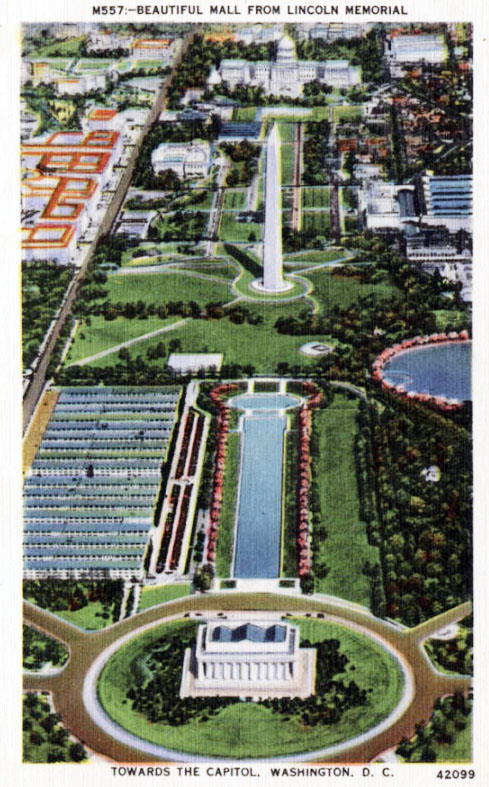
Modern American Christian crusaders would be even more alarmed to learn that not only was their country founded by deists, but its capitol deliberately designed as a metaphor for Freemasonry. In his profoundly researched book, The Secret Architecture of our Nation’s Capital (London: Century Books, Ltd., 1999), author David Ovason offers abundant evidence to show that Washington, D.C. was built by Freemasons who incorporated their arcane, even heretical ideas in the White House, the Washington Monument, the Library of Congress, the Post Office, the Capitol Dome, the Federal Trade Commission Building, the Federal Reserve Building, even Pennsylvania Avenue itself.
But what is, or was, Freemasonry? Like any idea or organisation that persists over time, Freemasonry deviated from its initial purpose until, in the end, it bore only slight, outward resemblance to its origins. By way of comparison with a group alleged without much real foundation to have been Freemasonry’s precursor, the Knights Templar was founded in the early 12th century, ostensibly for guarding pilgrim routes to Jerusalem with a few soldiers sworn to poverty and abstinence, but grew to become a virtually autonomous army richly equipped and armed, finally blossoming into an economic entity so potent it called down on itself the murderous envy of a French king.
So too, Freemasonry began in 1717 as a fraternity dedicated to humanitarian, deistic principles for Englishmen unhappy with the royal powers-that-be, and so were forced to operate with discretion. By the time early Americans were ready to part ways with the Mother Country, Freemasonry had spread to their shores and was embraced by many revolutionaries as an expression of opposition to everything British, including the Church of England. The secret order continued to grow in membership and prestige, until it was infiltrated and perverted from its high-minded ideals by Spartacus Weishaupt, a demented power-freak who wanted a respectable vehicle for subversion and insurrection. Separated by a vast ocean from the facts, even Thomas Jefferson was fooled by Weishaupt’s duplicity.
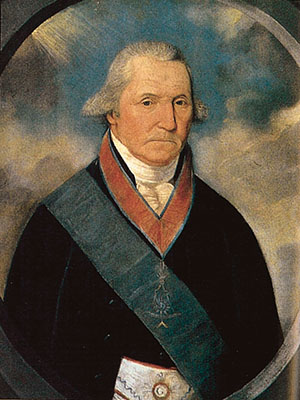
Dressed in full Masonic regalia of a past master, US President George Washington sat for this portrait by William J. Williams, a fellow Mason, in 1794.
Henceforward, the “Free and Accepted Masons” were lumped together with Communists as the secretive enemies of Western Civilisation, and outlawed in most European countries. Even in the United States, though they were never banned, the Freemasons were under suspicion by the Federal Bureau of Investigation for many years, and condemned by several congressmen. Thus criminalised or under suspicion, their popularity went into a long decline, until today their once numerous, now largely abandoned lodge buildings, some still bearing masonic emblems, testify to an aging, dwindling following. It is wrong, therefore, to parallel the Freemason George Washington, for example, with the likes of Adam Weishaupt, anymore than it is to equate George Washington with George Bush.
“The very struggle for independence seems to have been directed by the Masonic brotherhood,” Ovason writes, “and, some historians insist, had even been started by them.” Indeed, the War for Independence began in a warehouse owned by a Mason, and a majority of the revolutionaries who undertook the Boston Tea Party of 1773 were Masons. The most famous American Mason was George Washington himself, although some biographers not altogether happy with Freemasonry have tried to minimalise his association with it. In fact, however, he was the first Master of the Alexandria, Virginia lodge (Number 22) from April, 1788 until December the following year.
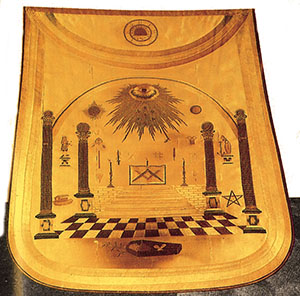
On a visit to America in 1784, Marquis de Lafayette presented this Masonic apron to his old friend, former commander in chief, and fellow craftsman, George Washington.
It was this lodge number that was carried before him on a masonic standard, as Washington, leading ranks of fellow Masons all wearing their emblematic aprons, walked in procession to the founding of the American capital, in 1793. The event was commemorated in a pair of bronze panels designed in 1868. They portray him laying the cornerstone surrounded by masonic symbols, including the square and trowel. Washington was still Master Mason when inaugurated as the first President of the United States on 30 April 1789. After his death ten years later, he was laid to rest at his Mount Vernon estate in a masonic funeral, during which all save one of the pallbearers were members of his own lodge.
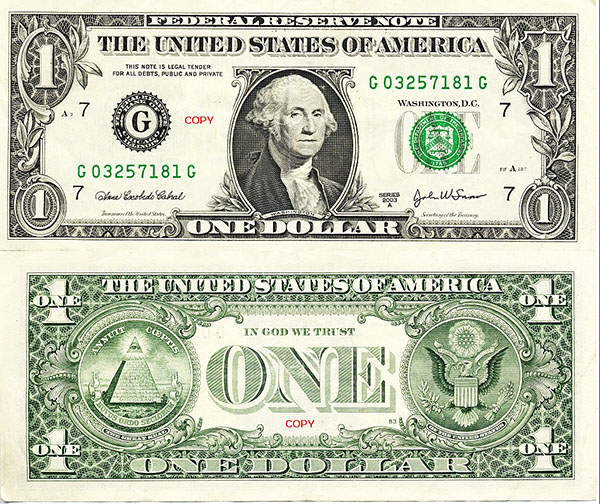
Ovason observes in a companion volume (The Secret Symbols of the Dollar Bill, CA: HarperCollins, 2004) that Washington’s masonic significance was not only expressed in the city to which he gave his name: “The portrait of George Washington, at the centre of the dollar bill, is highly symbolic.” The President’s image is centrally framed by the last letter in the Greek alphabet, an Omega, for “completion”, or the Ultimate, and implying that the foremost Founding Father represented the apogee of human values. His appearance on the one-dollar bill is by no means the only non-Christian symbol found here.
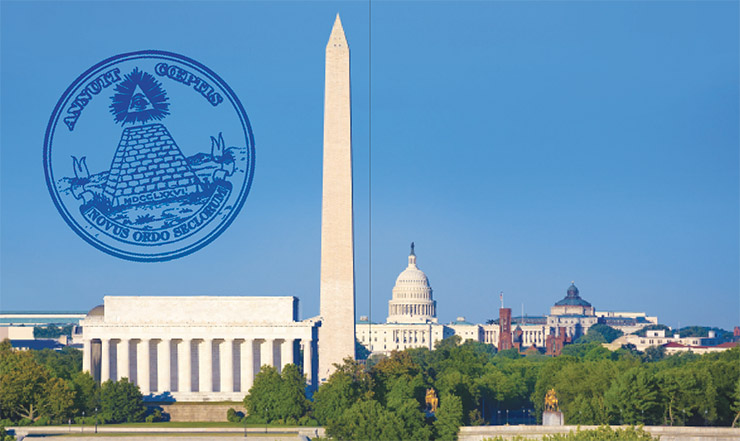
Especially cogent is the illustration of a truncated pyramid surmounted by a radiant delta enclosing a single eye beneath the words Annuit Coeptis. A motto on a scroll near the base reads, Novus Ordo Seclorum. Both were derived from the great Roman writer, Virgil. In his classic epic, the Aeneid, he directs a prayer for assistance to Jupiter, king of the gods: Audacibus annue coeptis, or “Favor our daring undertaking!” Novus Ordo Seclorum, “a New Order for the ages,” was taken from one of his famous Ecologues – Magnus ab integro seclorum nascitur ordo, or, “The great series of ages is born anew.”
Esoteric symbolism is replete on the rear side of the United States one dollar bill. (Top) Front side of the dollar bill.
“The idea of a truncated pyramid was Masonic,” Ovason writes. It is certainly “pagan,” and generally understood to mean stability and virtue in the 18th century. According to President William McKinley, the twenty fifth president of the United States and himself a Mason, it also meant strength and duration. But these obvious characterisations only represent the figure’s exoteric aspect. Far less well recognised, the pyramid depicted on the one-dollar bill, unlike any in the Nile Valley, has seventy two stones. This amount is hardly circumstantial, because it has been revered by mystics as one of the most sacred of all numerals.
Since Pythagorean times, in the 7th century BCE, and millennia earlier still in ancient Egypt, 72 has represented the ways of writing and pronouncing the name of the Almighty, not the Christian or even Old Testament Yahweh, but God as represented by the Sun, as it moves through space and time. Ovason explains, “Due to the phenomenon called precession, the Sun appears to fall back against the stars. This rate of precession is one degree every seventy two years.” In other words, the dollar bill’s seventy two stones signify the deist conception of the Supreme Being as rooted in the pre-Christian, non-Biblical Ancient World.
The single-eyed triangle radiating energy above the truncated pyramid is another Egyptian image, the Utchat, or Udjat, the all-seeing eye of Ra, a sun-god and the divine king of heaven. Esoterically, the Utchat was identified with Maat, the moral law pervading all Creation. Its appearance hovering above the apex of the dollar bill pyramid not only reinforces the solar symbolism of that sacred structure, but embodies the principle of Maat America’s Founding Fathers sought to inculcate in the constitutional republic they designed.
But the esoteric, deistic, even “pagan” Freemasonry of America’s Founding Fathers is most apparent in the arcane influence that Ovason traces throughout the design and construction of the US capital. These early Americans did not weave this occult symbolism through their country’s foremost city for clubbish reasons, but because their iconological signs were the emblems of a new civilisation they wanted to create in the New World.
For New Dawn’s 92nd issue, Jason Jeffrey described in “Washington, D.C.: A Masonic Plot?” how the White House is located at the apex of a five-pointed star – the ancient geometric seal of King Solomon, with which he conjured supernatural powers – formed by the intersections of Massachusetts, Rhode Island, Vermont and Connecticut Avenues with K Street NW. But the significance of this urban pentagram is overshadowed by what Ovason has identified as the city’s chief orientation to Virgo.
He writes that central Washington, D.C. has twenty public zodiacs, with Virgo prominent in each one. The founding of Federal City, as it was previously known, laying the cornerstones of the President’s House, in the wing of the Capitol and the foundation stone of the Washington Monument, all were timed to coincide with the appearance of this astrological figure. Ovason shows that the White House, Capitol building and Washington Monument form a strangely imperfect “Federal Triangle” that only makes sense when we realise it identically resembles a configuration made by the stars – Arcurtus, Spica and Regulus – that bracket Virgo.
On evenings from August 10th to the 15th, as the Sun sets over Pennsylvania Avenue, the Constellation Virgo appears in the sky above the White House and the Federal Triangle. At that same moment, the setting Sun appears precisely above the apex of a stone pyramid in the Old Post Office tower, which is just wide enough to occlude the solar disc. According to the 19th century Freemason, Ross Parsons, “The Assumption of the Virgin Mary is fixed on the 15th of August, because at that time the Sun is so entirely in the constellation of Virgo that the stars of which it is composed are rendered invisible in the bright effulgency of his rays.”
Formal ground-breaking ceremonies for the National Archives Building were conducted under Virgo. Two years later, three planets were in Virgo for the official laying of the structure’s cornerstone. The Federal Reserve Building is replete with a five-petaled design motif, the symbol of Virgo. The great clock at the Library of Congress is depicted with a comet in Virgo. Because of its centralised location, Ovason believes that “the Library of Congress was sited in this position and its symbolic program established precisely in order to demonstrate the profound arcane knowledge of the Masonic fraternity which designed Washington, D.C. … the city was surveyed, planned, designed and built largely by Masons.” Indeed, no less than twenty one memorial stones with lapidary inscriptions from various masonic lodges line the inside shaft of Washington Monument.
But why would they incorporate so many references to Virgo in their capital? As Ovason points out, the construction of Washington, D.C. “marked one of those rare events in history when a city was planned and built for a specific purpose.” He fails to mention, however, that nearly two hundred years before, the first permanent European settlement in North America foreshadowed Virgo’s ceremonial centre on the Potomac River.
In 1606, Sir Francis Bacon established Jamestown in Virginia, ostensibly named after Elizabeth, the Virgin Queen. But the emblem he chose, and which survives today as the state seal, is the image of Pallas Athene, Parthenos, the virgin goddess of Greek myth, the divine patroness of civilisation.
Bacon, as Greg Taylor observed in the same issue of New Dawn, prefigured the Freemasons with his vision of a practical utopia based on individual liberty and social responsibility – essentially the same ideals that formed the basis of the US Constitution. When America’s Founding Fathers came to compose that document, they perpetuated the identical sacred virginal symbolism initiated at Jamestown.
Repeated symbolism in the architecture, astrological timing and the very lay-out of Washington, D.C. to Virgo-Virgin Athene represent homage to the Eternal Feminine, Goethe’s “ewige Weiblicher,” which, in his “Faust,” leads us onward – “zieht uns hinan.” The Freemasons who envisioned and constructed the capital of the United States did so to put their new country in accord with that pure (“virginal”) energy they believed to actually exist as the demiurge of Creation. They worshipped that energy, personified in the goddess, a concept that was anathema to the patriarchal Christians of their time (and ours?).
As Ovason concludes, “A city which is laid out in such a way that it is in harmony with the heavens is a city in perpetual prayer.” Given so great a distance the present occupants of Washington, D.C. have strayed from the original intentions of its designers, the US capital needs all the prayers it can get!
[alert type=”general” dismiss=”no”]This article was published in New Dawn 94.[/alert]
[alert type=”success” dismiss=”no”]If you appreciate this article, please consider subscribing to help maintain this website.[/alert]
The age of iron has no other seal than that of Death. Its hieroglyph is the skeleton, bearing the attributes of Saturn: the empty hourglass, symbol of time run out… – Fulcanelli
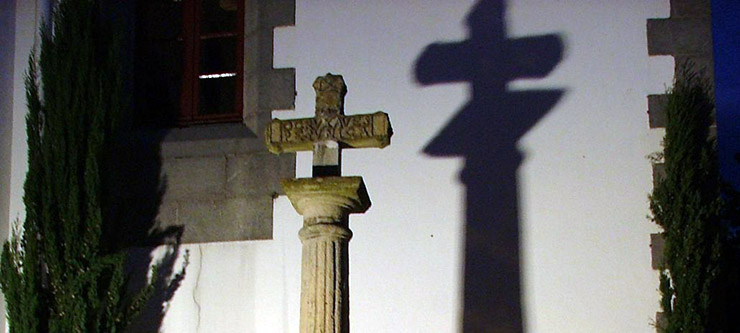
The inspiration for this article comes from my almost nineteen years of research into the Great Cross of Hendaye and the French alchemist Fulcanelli. The unknown, anonymous, alchemist Fulcanelli in his masterpieceThe Mysteries of the Cathedrals first brought the cross at Hendaye, France to the world’s attention.
While the details of this research can be found in other articles written by myself and in the two books I co-authored,1 it can be stated that the Great Cross at Hendaye appears to be describing not only the end of the great four ages of the Hindu Yuga system but also the four ages of alchemical chronological time keeping. According to the cross at Hendaye, the Iron Age, or the Kali Yuga, will be coming to an end with the galactic alignment on the winter solstice of December 21st, 2012.
According to the mythology of the Yuga system, there are four ages of life and time on our planet. It is important to remember there are many cycles within cycles in the Hindu Yuga system so the years mentioned next may have to do with a larger cycle than the one addressed in this article. Perhaps the huge number of years referred to below is the cycle of the solar system as it circles another star, or perhaps it is a portion of the great cycle of one revolution around the galactic centre.
The first age is the Satya Yuga or the Golden Age, according to Fulcanelli. The Hindu texts tell us that this age lasts 1,728,000 years. This is an age of extreme splendour when the beings on our planet appear to live much longer than they do now. In this age there are no wars, famines, strife or evil.
The second age is called the Treta Yuga, or the Silver Age. As in the second law of thermodynamics, or entropy, things begin to slip in this age and the beings on Earth begin to deteriorate. This slippage, at least during this second age, is the beginning of corruption, and evil is introduced into the planetary sphere. This age lasts 1,296,000 years according to the Vedic texts of India.
The third age of this cycle is called the Dvapara Age, or the Bronze Age. This is the beginning of the ‘fall’ of humanity. In this age corruption comes on more fully, evil begins to spread, and things start to fall into disharmony. This age lasts 864,000 years.
The last age is called the Kali Yuga, or the Iron Age. This age is the age we are in right now. Evil and corruption become the driving force as greed, wars, famine and disease spread across the planet like a tidal wave of death and destruction. This age lasts, according to the Hindu texts for 432,000 years.2
What is important to understand while discussing these huge numbers found in the Hindu texts is they are describing the four ages within a context of understanding that each successive age is shorter than the previous age. The Satya Yuga, or the Golden Age, is one quarter longer than the Treta Yuga, or the Silver Age. The Treta Yuga is one quarter longer than the Dvapara Yuga, or the Bronze Age. Understanding these differences in the lengths of the ages becomes important to the following discussion.
According to Fulcanelli and the cross at Hendaye, the alchemical Four Ages comprise the four quadrants of a 25,920 year-long cycle called the precession of the equinoxes. Essentially, the precession of the equinoxes can be explained by the fact that our Earth has a wobble. Like a top spinning on the floor, as it begins to lose momentum this wobble of the Earth takes nearly 26,000 years to unfold. The strange engraving of the four ‘A’s’ (see Figure 5) on the cross of Hendaye is a “hieroglyph of the universe”, according to Fulcanelli. It is “comprised of the conventional signs of heaven and earth, the spiritual and the temporal, the macrocosm and the microcosm, in which major emblems of the redemption (cross) and the world (circle) are found in association.”
The Precession of the Equinoxes
What Fulcanelli appears to be saying here is that the precession of the equinoxes is to be divided into four distinct ages of 6,480 years each (4 divided into 25,920) or, to round off the figures to approximately 6,500 years each. This is also interesting because the zodiacal cycle, which lasts 25,920 years, has four fixed signs. These are the signs of Aquarius, Taurus, Leo and Scorpio. These four signs are separated by 6,500 years each. Also in the Book of Ezekiel and in the Book of Revelation we are told of the angel with four faces. This angel has the face of a Lion (Leo), a Bull (Taurus), a Man (the angel) and an Eagle (in older times Scorpio was represented by an eagle instead of a scorpion). Apparently, according to Fulcanelli, both of these books in the Bible are warnings and messages about the four quadrants of the precession of the equinoxes and appear to be telling us that there is some kind of great change whenever we arrive at one of these four signs.
Of course it is well known that we are currently entering the Age of Aquarius. The Cross at Hendaye and Fulcanelli are telling us there are tremendous changes to be found here on Earth when we enter into one of the four fixed signs. Apparently these changes can be cataclysmic.
Obviously this 6,500 year long dating of the four alchemical ages disagrees with the Hindu Yuga system, which insists that each Yuga is of varying time lengths. It is in trying to iron out the dissimilarities in these two time periods that the hyperdimensional aspects of time can be best revealed.
It is well known in modern physics that four dimensional space, of which time is an aspect, is in the shape of a hypersphere (see Figure 3). This hypersphere appears similar to the shape of a donut, or a bagel. The energy, or the flow of the energy stream, within this hypersphere works like this: As shown in the illustration, the flow comes out of the bottom of the sphere, winds its way up around the outside edge, crosses the outside equator of the torus sphere and moves towards the hole in the top of this torus. The energy flow then begins to fall through the top of the hole and begins to spin in a vortex. This energy flow continues until it comes out of the bottom side of the torus where the energy flow begins its outward expansion again. This flow is continuous and, in a sense, infinite.
The Four Dimensional Hypersphere torus is also represented by the hypercube. A hypercube is a cube within a cube according to physicists. Essentially this cube, also called ‘The Cube of Space’ or the ‘Tetragrammatron’ by the alchemists, is a straight edged version of the donut shaped hypersphere (see Figure 2).
Scientists love to be able to construct objects using straight lines, so they have created the hypercube to help them better understand the hyperdimensional universe that surrounds us. Alchemists, however, like to use the curved lines of nature, so the donut shaped torus or hypersphere, is a better, more natural visual description of hyperdimensional space and will be the one I use in this article.
The alchemists believe there is a hyperdimensional ‘body’ around every living thing on Earth. This hyperdimensional ‘body’ or sphere known to mystics as the luminous energy body, also surrounds every planet and star as well. Each object in the three dimensional world is an affectation of four-dimensional space. Humans, animals, plants, planets and stars are the solid inside of the fourth dimensional energy flow. As you will see, time also travels in this fashion.3
In order to begin to comprehend the topographical nature of time, it is very important to understand the guts of this hyperdimensional sphere. By the ‘guts’ I am referring to the vortexes that make up the energy flow running through the centre of the hypersphere. As the energy flow begins to fall into the vortex that runs through the centre of the sphere, it takes on the shape of a tetrahedron.
A tetrahedron, as shown in Figure 4, is the building block of three-dimensional space and is the founding member of the Platonic Solids. The tetrahedron is the simplest object that can be created in three dimensions. The only object with just four sides, the tetrahedron is also shaped like a vortex.
Let us digress for a moment and discuss vortexes. Back in the Midwest of the United States, where I come from, there is a place called Tornado Alley. This is the flat Great Plains that stretches from Texas to the Dakotas. Each year this area is visited by numerous tornados, which wreak havoc on the farms and towns of this area. These tornados usually start in May and last until early August. Having witnessed several tornados in my early years I became fascinated by them and was once even a ‘storm chaser’. In my young and foolish days I used to chase after tornados with my Bolex 16mm camera in order to capture them on film. I became very familiar with these lethal vortexes.
But understanding tornados also helps us understand vortexes and the density of forces in the hypersphere. Tornados (and also hurricanes) are made up of air like that which surrounds us all the time. But as the air begins spinning it takes on a strange solidity. While the swirling air at the top of a tornado is somewhat dangerous, it is the spinning air near the surface of the ground that is really dangerous. Near the tip of a tornado, where it is in contact with the ground, the air takes on the quality of solid iron. The tips of tornados can rip buildings apart, throw cars and trucks thousands of feet, and punch chaffs of wheat into the very centre of trees like a bullet. As the air spins more violently, the tip of the tornado vortex becomes as strong as 50 locomotives engines and possesses the density of the hardest of metals. Yet it is just comprised of air molecules. But these molecules are spinning so quickly they create a mass that is extremely powerful. It is the spin of the air that causes it to densify and take on the solidity of metals.
Getting back to the central core of our hyperdimensional torus, we can understand the vortexes inside this sphere and how time unfolds by using the tornado analogy. As the energy flow begins to dip down into the top of the tetrahedral shaped vortex, it begins to spin. As the energy flow descends, its spin becomes more rapid and compressed. Like a tornado, as it reaches further down, the tip of the vortex ‘hardens’. It could be said that his hardening of vorticular forces is what makes up the solidity of our three dimensional space. Each human, plant, animal and indeed every planet and star alike are the hardened tips of hyperdimensional vortexes, which are flowing all around us constantly.
Like air, these hyperdimensional forces are pretty much invisible to us. It is only when these forces coagulate into a spinning vortex that they can be seen and felt. It is through the rapid spinning of four-dimensional space that the solidity of the third dimension is actually created. The mystics from all great traditions know this and they realised these inner dynamics of the fourth dimension as it interacts with the third dimension. The fourth dimension is the surrounding sphere and the third dimension are the tetrahedral vortexes that make up the central core of the sphere. To the ancients, four-dimensional space was called ‘spirit’ and three-dimensional space was called ‘matter’.
So what does this have to do with time and the topography of time? Remember the dilemma we face in trying to make the four ages of the precession match up with the Ages or Yugas from the Hindu system? By attempting to make the two into one we can not only understand the topology of time, but also we can map time like the ancients and we can know where we are in the river of time.
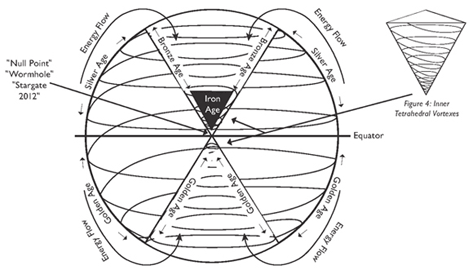
As shown in illustration Figure 3, imagine that we are coming through the very centre of where the two tetrahedral tornado vortexes intersect at the very centre of the inner hyperdimensional sphere. Moving down the bottom vortex towards the outside surface of the sphere, each spin in the vortex takes longer and is wider and slower than the previous spin in the vortex. In other words, the energy flow expands after it passes the ‘null’ point in the very centre of the hyperdimensional sphere, or torus, where the tips of the two tetrahedral vortexes touch.
This energy flow continues its expansion as it climbs over the lip of the bottom edge of the sphere where the vortex meets the outside edge of the sphere. The energy flow continues to expand until it reaches the outside equator area of the sphere. Once it gets past the equator, the energy flow begins to condense, the flow begins to move faster and the spin density increases. This flow continues until the energy flow reaches the upper lip of the outside of the hyperdimensional sphere where it begins to ‘fall’ into the top of the tornado tetrahedral vortex.
Now as the flow of energy falls down the vortex towards the null point at the very centre of the sphere it begins to harden as it spins faster and faster. This goes on and on until the vortex is so hard it is like iron. This is how the fourth dimensional forces create three-dimensional reality. As the vortex spins faster and faster eventually it compresses down to the point where it has nowhere to go but outwards again. This occurs at the null point in the centre of the sphere and the energy flow now begins to once again expand.
The Golden Age is the time period that starts at the null point in the centre of the sphere and continues through the bottom vortex. As the energy flow expands outwards time appears to slow down. The entire period of the Satya Yuga, or the Golden Age, continues as the energy flow goes down the bottom vortex and rounds across the top of the sphere. It continues expanding until it arrives at the equator.
The equator of the outside of the hyperdimensional sphere is the borderline between the Satya Yuga and Treta Yuga, or the Golden Age and the Silver Age. Now the energy flow begins to contract as it flows upwards towards the north pole of the hypersphere.
The Silver Age, or the Treta Yuga, continues until the energy flow rounds the top lip of the hyperdimensional sphere and begins to fall into the upper tetrahedral vortex. This then is the borderline between the Treta Yuga and the Dvapara Yuga, or the border between the Silver Age and the Bronze Age.
About two thirds down in the upper vortex, where the energy flow is spinning so fast that it becomes as solid as iron, is the beginning of the last Age, the Kali Yuga, or the Iron Age. This spinning continues to gain density, compression and speed as it races towards the central null point in the very centre of the sphere. As it approaches this null point the forces become unbelievably fast, violent and dense. It is only when these forces achieve maximum density and they can no longer compress any further that they begin to suddenly flip and begin the expansion of the flow. This happens in an instant. This is the shift from the Iron Age, or the Kali Yuga to the Golden Age, or the Satya Yuga. The borderline between the Iron Age and the Golden Age is the most distinct border in this topographical illustration of hyperdimensional time. It is the most jarring and is instantaneous.
Take notice of the hourglass shape of the two tetrahedral vortexes inside the hyperdimensional sphere. Is this why Fulcanelli tells us about the hourglass in the quote at the beginning of this article? In Hindu mythology the God Shiva dances the world into and out of existence playing his dhamaru which is a two sided drum shaped like an hourglass.
Notice that, like the number of years in the Hindu Yuga system, the distance travelled through our ages in the hypersphere is similar; the Golden Age, which is the distance between the null point in the centre and the outside equator is twice the distance as that travelled through the Silver Age which is the distance from the equator to the top of the lip of the upper vortex. Equally, the distance travelled from the top of the vortex to two thirds down, which is the Bronze Age, is half the length of the Silver Age. Finally, the tip of the vortex is half the length of the Bronze Age.
This part, called the Iron Age, is the Age in which we live. This is also why, in the Iron Age, each second feels shorter than the second before. This is why each day, each month and year appear to be going faster than they did previously. In the topology of time this effect can be easily understood and explained.
Also remember, even though the distance travelled is much further in the Golden Age than it is in the Iron Age, the number of years it takes is the same. It takes 6,480 years to go through the Golden Age just as it takes 6,480 years to go through the Iron Age, but it feels much different. In the Golden Age each second, each day, each month and year appear to be longer than the previous day, month and year. Time is expanding in the Golden Age and with that expansion the anxiety and tension of the Iron Age disappears. It is a paradise, especially to those who may have survived the passing through the wormhole, or the null point at the centre of the hyperdimensional sphere.
Therefore, the years listed within the Yuga system are actually symbolic times that explain the lengths of time as it is felt not as it is lived. So the Golden Age or the Satya Yuga feels like it is much longer than the Kali Yuga, or the Iron Age.
The shamans in Peru tell us that we are approaching the Pacha Cuti, which means literally ‘the world turned upside down’. They say that it will arrive in the year 2012. This is also the year when the great Mayan calendar reaches its end point. The cross of Hendaye is quite explicit in saying we are reaching the very end of the Iron Age. I would suggest that the null point, or the wormhole at the very centre of the hypersphere, is very likely the 2012 date. Our hypersphere appears to be regulated by the periodic alignment of the galactic centre with the Sun. This also matches the four fixed signs of the zodiac and explains why the Christian tradition is preparing for the endtimes.
Oddly enough, it also appears that Stanley Kubrick is trying to tell us about the end of our Age in his masterpiece film 2001: A Space Odyssey. The Starchild at the end of the film has passed through the Star Gate of the black monolith and is returning to Earth to create a new world or a new Age.4
It is through our understanding of the Four Ages, the fixed signs of the zodiac, and the Yuga system that we can finally appreciate the message our ancestors have handed down to us. We are about to pass through the Star Gate, the wormhole, and the null point of hyperdimensional space.
The Cross of Hendaye reveals the most important knowledge of all, which is the end of time and the beginning of the Golden Age. Awareness of this knowledge helps us all to more fully comprehend the nature of the times in which we reside and the destiny of the human race.
At the very core of all the great spiritual traditions to be found across the planet from the ancient Egyptian to the Incan and Mayan, Indo-Tibetan, Alchemical Europe and even the Hebrew Kabbalah lies the knowledge of the secret of the alchemy of time. Unencumbered by the excessive demands, stresses and speed of the modern age, our ancestors spent lifetimes in contemplation of the essential mysteries of our world.
One of the great mysteries they discovered was that time is not stagnant or linear but flows in great transformative cycles. In fact, it is only recently modern historians have begun arguing that time travels in a straight line. Within the limited period of historical examination these modern historians are viewing a snap shot of history and believe this snapshot represents the entire picture. But does it?
The alchemists of Egypt and Medieval Europe knew that time moved in great elongated cycles, and that each part of the cycle had a ‘quality’. This quality shaped and reformed the world. Just as sunrise has a different quality from midnight, so too does each aspect of the great cycle possess a quality that distinguishes it from other parts of the cycle. When the cycle of time changes, so too do events change here on Earth.
These sacred scientists and alchemists of our past used various devices and practices to mark the changes in the quality of time. Astrology, divination and prophecy are some of the more obvious processes that our ancestors used to understand the mysterious process of time.
At the heart of the secrets traditions of the Egyptian and Greek mystery schools they knew that a process, which they called the precession of the equinoxes, measured the Great Cycle or the Great Year. What they understood was that the stars in the night sky are not fixed. Through their long observation and meditation upon the heavens they came to realise that the stars and the constellations were slowly changing their place in the sky above us. Creating the zodiac to assist them in these huge measurements of time they used the twelve signs to act as a giant time clock. Through this they began to understand the Great Cycle. They realised that it took 2,160 years to move through each sign of the zodiac and that it took 25,920 years for the equinoxes to move through all 12 signs. The creation of the Great Year of nearly 26,000 years gave them a clock that allowed them to measure time.
They then came to understand that each of the signs, or places on the clock appeared to bring forth changes in the quality of life here on Earth. So they came to realise that every 2,160 years the quality of time changed. They also began to understand that the four quadrants of this great chronological clock appeared to bring forth even sharper changes in the quality of time. The four signs associated with these four quadrants are the signs of Aquarius, Taurus, Leo and Scorpio. There does seem to be some historical linkage between this idea that passing through the edges of these four signs brings great changes here on Earth. About 6,500 years ago we passed through the sign of Taurus. Coincidentally, the human race began domesticating cattle, building walled cities, developing agriculture, fighting wars and beginning the city-states that would evolve into governments and monarchies. Thirteen thousand years ago, as we passed through the Age of Leo, great changes occurred including a dramatic climate shift as the ice ages began to end. The extinction of many animals including the Woolly Mammoth, the Saber Tooth Tiger, the Giant Tree Sloth, and many other species happened at about this time. Interestingly, according to anthropologists, the emergence of Cro-Magnon Man appears to have occurred about 26,000 years ago, the last time we passed through Aquarius.
The Great Cross at Hendaye is a 350-year-old alchemical monument to the end of time. It sits in a churchyard in Hendaye, France. The Great Cross at Hendaye appears to be a symbolical construct that explains this science of the cycles of time. The Cross at Hendaye describes the extraordinary changes that are about to occur in our present era. It speaks of the end of our current Age of Iron and the creation of a coming Golden Age.
The great cosmic time clock in the sky is changing. We are now entering the quadrant of Aquarius. From what the alchemical Cross at Hendaye is saying, this change is sure to have a dramatic effect on our species and on our planet.
What these changes are, or will be, is anybody’s guess. But they are sure to be spectacular and remarkable. The end of time, the end of this age and the great transformation of humanity is at hand. This change in the quality of time will govern and dictate the changes here on our fragile planet. The changes in the quality of time cannot be forestalled. The fundamentalist revival taking place all over the world reveals more about the quality of time from which we are emerging than it does reveal anything about the quality of time for that which is coming.
The Peruvian shamans living high up in the Andes Mountains have come down to tell us that a new species of human being is about to appear. They call this being ‘Homo Luminous’. They tell us that forerunners of Homo Luminous are already among us right now. Like Cro-Magnon Man of 26,000 years ago, the last time we passed through the cusp of Aquarius, so too now a new human is emerging.
This new human will possess entirely new qualities that we do not have. The great Avatars, Jesus Christ, Krishna and many others may have been early arrivals for this newly emerging species. Aquarius is the only one of the four quadrant signs that is symbolically represented by a human, and this human carries a container of water. This symbology is interesting as DNA can only be activated in water. So even the symbolic nature of the sign of Aquarius seems to suggest a change in the genetic structure of the human race.
Our spiritual existence is really a unique combination of free will and predestination. While we possess the ability to act freely within the moment, there is little we can do about the larger cycles of time and the qualities that emerge at the cusp of each of the four great signs. So as the hand on the great cosmic time clock passes into Aquarius one can expect massive changes to occur. While the ancient art of alchemy is concerned with many aspects of our existence including the extraction of light from plants and minerals, the transformation of the dark lead of our physical being into the pure gold of enlightenment and much more, alchemy also is a symbolic ontology concerned with the observation in the changes of the ‘quality’ of time through the 25,920 years-long duration of the Great Year.
The world is changing. The past will disappear and history will become legend and finally myth. Our destination is unknown. The only thing we know for sure is that it will change.
[alert type=”general” dismiss=”no”]This article was published in New Dawn 92.[/alert]
[alert type=”success” dismiss=”no”]If you appreciate this article, please consider subscribing to help maintain this website.[/alert]
Footnotes:
1. See www.jayweidner.com; The books A Monument to the End of Time: Alchemy, Fulcanelli and the Great Cross and Mysteries of the Great Cross of Hendaye: Alchemy at the End of Time are authored by Jay Weidner and Vincent Bridges. 2. For more information, see ‘Tolkien at the End of Time: Alchemical Secrets of the Lord of the Rings’ by Jay Weidner and Sharron Rose in New Dawn No. 82 (January-February 2004), and ‘Reflections on the Cycle of the Great Yuga’ by Sharron Rose at www.sharronrose.com. 3. For more information on the luminous energy body, see my films Healing the Luminous Bodywith Dr. Alberto Villoldo, ArtMind with Alex Grey and Yoga of Light with Sharron Rose. 4. See ‘Alchemical Kubrick: 2001: The Great Work on Film’at www.jayweidner.com.