New Dawn – World's Most Unusual Magazine

Category: Articles

  • Synchronicity: The Key of Destiny

    Synchronicity: The Key of Destiny

    From New Dawn 88 (Jan-Feb 2005)

    Synchronicity is the most mysterious thing in the world. Synchronicity is the term parapsychologists use for “meaningful coincidence.” It happens to everyone, more often than we realise. But synchronicities are not “mere” coincidences, random accidents without significance.

    Going through a half-forgotten collection of old photographs, you’re surprised to find the snap-shot of a friend you lost contact with years ago. Just then the telephone rings and the voice on the other end of the line belongs to the same person in the photo.

    You’re desperate to find a parking place because you’ve got to be on time for a crucial appointment. There’s not an open spot as far as the eye can see. Suddenly, a car pulls out in front of you, leaving you a space right in front of the address where you’re expected.

    You’ve just finished reading a book about rare birds, when the first humming-bird you’ve ever seen in your back yard is drinking nectar from a nearby flower.

    These are typical incidents of synchronicity. And while most people brush them aside as insignificant happenstance, some of the greatest minds in history have grappled with this universal enigma. “Synchronicity” was coined by last century’s leading psychologist, Carl Gustav Jung. Fascinated as he was by it, even Albert Einstein could not understand how it worked.

    A synchronous event of my own in 1991 prompted me to interview, over the next six years, eventually 100 persons about their feelings on this elusive enigma. The meaningful coincides they shared with me proved more illuminating than anything I ever read on the subject.

    Collecting them into a loose order, I was somewhat astounded to see that these synchronous events experienced by my friends and acquaintances arranged themselves into repeating categories. Although many of the persons interviewed differed widely in age, spiritual beliefs or education, the meaningful coincidences they recounted all belonged to specific groups of common experience.

    Widening my research, I found that persons belonging to other cultures, sometimes long dead – often many hundreds of years ago – fell into the same seventeen categories which emerged from the men and women who told me of their own fortuitous occurrences. Their often dramatic, occasionally funny, always numinous testimony formed the basis for a book I wrote, Synchronicity & You, Understanding the Role of Meaningful Coincidence in your Life. Synchronicity is fundamentally a form of guidance that enters into the personal lives of every human being. Even if we knowingly discard it, at least part of its influence enters our subconscious.

    Some guiding synchronicities form a category best described as “Warnings.” A representative incidence of admonitory synchronicity not included in my book was recounted by the California poet, Miriam Hohf:

    “Many years ago, when I was a small child living in the Pennsylvania countryside, I took long walks by myself across the fields and into the forest, listening to the birds and talking to the rabbits and squirrels. I never felt afraid and deeply loved all the trees and animals. But on one otherwise beautiful, sunny day, my surroundings felt different somehow.

    “Everything was absolutely calm and motionless. Just when I approached the edge of the forest, however, a gust of wind suddenly arose, loudly rustling the leaves. I stopped and listened to them, because I felt they were speaking to me. They seemed to be saying, ‘Go away! Do not come into the woods today! There is danger here! Danger! Not safe to play here today! Go away!’ For the first time, a chill of fear ran through me and I fled, almost in tears. I did not visit the forest again, too afraid to return.

    “About a week after my experience, mother told me about a terrible story just published in the local paper. It seems that on the same day the leaves spoke to me the body of another little girl was found by the police. She had been brutally raped before being murdered. Did the spirits of the forest warn me in the rustle of their leaves?”

    Another prominent category of synchronicity falls under the heading of Numbers, which thread together mystical human experience, often with surprising results. The number 57, for example, is an intimate characteristic of the American Revolution, as investigator Arthur Finnessey abundantly demonstrates in his well-researched book, History Computed.

    Among the outstanding examples he cites is the last time the Liberty Bell rang, in tribute to George Washington, before it cracked on February 22, 1846 – 57 years after his 57th birthday. Together with his titles and signature, the closing paragraph of the US Constitution, following its original seven articles, makes up 57 words. It was ratified by 57 yes-votes from New Hampshire, and all Constitutional law begins with the Constitution’s 57th word – that word being, “All.” On February 6, 1777, 57 weeks to the day after the pivotal Battle of Princeton, another turning-point took place when the French joined the American cause. They fought off 19 British warships, making it possible for Washington to defeat Cornwallis on October 19, 1781, in a war which began on the 19th of April, 1775 – 57 is the sum of these three significant 19s.

    Washington’s only two victories over British Commander Cornwallis were 57 days apart. So too, 57 days separated the other decisive battles of the war, at Cowpens and the Guilford Courthouse. The final anniversary of Lexington and Concord celebrated during the Revolutionary War was precisely 57 months, 57 weeks and 57 days after they were fought. In South Carolina’s most famous assault at “Fort Ninety Six”, 57 Americans were killed. Interestingly, “96” is the sum total of the number of men who signed the Declaration of Independence (57) and the Constitution (39). The American Revolution’s 57th month concluded on 19 January, 1780; the Redcoats took Charleston exactly twice times 57 (114) days later. Twelve times 57 (684) days before, the decisive Battle of Monmouth was fought.

    In numerical symbolism, 57 is the combination of two numerals, 5 and 7. Five is associated with male energy (i.e., war), while seven signifies the completion of cycles. Together they form a symbolic concept perfectly reflecting the completion of major military cycles running like inter-linking themes throughout the history of the Revolutionary War. Isodore Kozminsky refers to any number from 55 to 64 as “the Sword,” associated with military victory (Numbers, Their Meaning & Magic, NY: Samuel Weiser, 1977, page 51).

    These ancient interpretations of 57 make its frequent recurrence throughout the War of Independence very appropriate. Yet, we stand in awe of its historical significance: Was it somehow an out-growth or expression of America’s violent struggle for freedom, or did it from the beginning (from before the beginning) determine historical events?

    The outstanding feature of 57, around which acausal incidents revolved, was a major rift in the fabric of history – the American Revolution. All other, similarly powerful historical events likewise produce extraordinary high levels of meaningful coincidence. In fact, the more dramatic, even traumatic, the event, the greater the intensity and sheer number that appear.

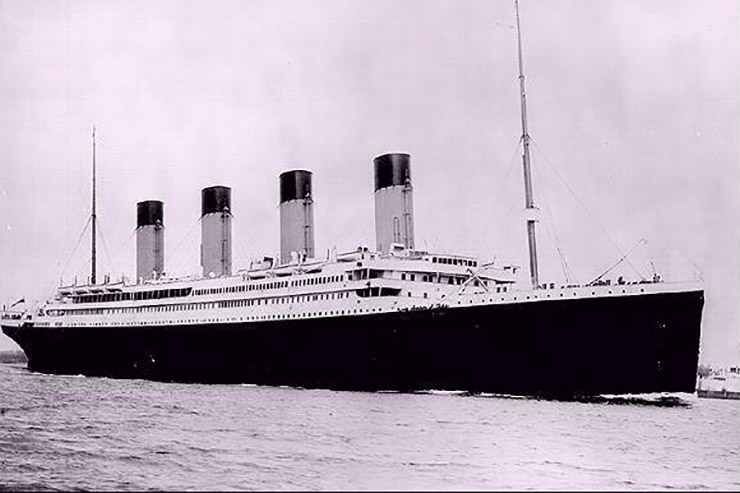
    An outstanding example was the Titanic disaster. Hardly any other single occurrence in the 20th century generated such a large collection of impressive examples. So many, in fact, they embraced all 17 categories of synchronicity. The meaningful significance of particular numerals played its part in the Titanic disaster, too – in that classic bad-luck symbol, Number 13.

    That this traditionally unfortunate number was factually associated with the most infamous of unlucky ocean liners should come as no surprise. Two, separate examples serve to illustrate. A British journalist, W.T. Stead, demonstrated his contempt for superstition by deliberately concluding a story on the 13th of April, 1912. Further tempting fate, his narration described the discovery of an ancient Egyptian sarcophagus and the curse of violent death alleged to overtake anyone who verbally translated its inscription. The next day, R.M.S. Titanic met the disaster in which Stead perished.

    A fellow passenger who lightheartedly challenged the deadly number was from Youngstown, Ohio. George Wick had been traveling with his family through Europe for several months and booked homeward voyage on Titanic. While in transit to Cherbourg, where the doomed ship would make final docking before attempting her transatlantic crossing, he stopped at Paris. There he purchased a Grand Prix sweepstakes ticket, choosing Number 13 on purpose, just to prove to everyone that he was not superstitious. “Watch and see what it does for me!,” he exclaimed. Several days later, Wick went down with the vessel.

    The “Warnings” cited in Miriam Hohf’s childhood experience proliferated around the Titanic before she sailed. A White Star insignia crumbled to pieces in the hands of Mrs. Arthur Lewis while she was pinning it to her husband’s cap. He was just about to board R.M.S. Titanic, where he was a steward. At the time, she regarded the incident as a bad “omen,” although he dismissed her expressed anxiety as foolishness, until the ship foundered a few days later. Fortunately, Mr. Lewis survived.

    In another Titanic-related warning, Colonel John Weir, a mining engineer with a worldwide reputation, almost canceled his first class ticket because of distressful feelings about the voyage. Staying at London’s prestigious Waldorf Astoria, he awoke on the morning of April 10th to find that the water pitcher atop his dresser had unaccountably shattered, soaking his clothes. He seriously expressed his premonitory feelings to the hotel manager, who allayed the Colonel’s “superstitions” enough for him to reluctantly board the great ocean liner. While at sea, Weir told his secretary about the burst water pitcher, could not shake his sense of foreboding, and said he must get off Titanic at the next opportunity, when it docked in Queenstown, Ireland. Again dissuaded, he remained aboard, only to go down with the ship he intuited was doomed.

    As some measure of the magnitude of synchronous phenomena associated with the disaster, no less than 899 persons who initially booked passage for Titanic’s maiden voyage eventually refused to board her because of warnings they experienced in the forms of various omens, premonitions, dreams and precognitive events. An additional 4,066 would-be passengers either missed the boat or canceled their reservations, usually under apparently normal circumstances, but sometimes through unusual coincidences that prevented them from sailing.

    Blanche Marshall suffered a hysterical outbreak on April 10th, 1912, as she and her family watched the Titanic steam past the Isle of Wight from the roof of their home overlooking the River Solent. In a virtual panic, she said the liner would sink before it reached New York and railed against her husband, daughters and servants for being blind to her vision of masses of people drowning in the freezing waters of the North Atlantic.

    While neither Mrs. Marshall nor anyone she knew sailed aboard the Titanic, she was prevented from boarding another doomed liner just three years later by similar precognition. In 1915, her husband had booked tickets for their return trip to England from America aboard the Lusitania. She thought nothing of it until she saw the May 1st date of the tickets. Convinced the ship would be torpedoed and sunk on that passage, Blanche convinced him to change their booking. Interestingly, she felt safe traveling on Lusitania at any other time. It was only the prospect of the May 1st crossing that alarmed her. True to her sense of foreboding, the vessel was torpedoed and sunk with heavy loss of life on the same voyage she refused to take.

    A sub-category of “Premonitions” is synchronous literature. Published in 1892, From the Old World to the New described the sinking of an ocean liner after colliding with an iceberg in the North Atlantic. The “fictional” name of its captain, E.J. Smith, likewise belonged to the man who commanded R.M.S. Titanic, twenty years later. Interestingly, the author of From the Old World to the New, W.T. Stead, lost his own life on board the same ship.

    While Titanic was being readied for her maiden voyage, the May issue of Popular Magazine was coming off the presses with the story of Admiral, an 800 foot-long ocean liner crossing the North Atlantic through calm seas at 22 1/2 knots. She strikes an iceberg and sinks, leaving the survivors among her thousand passengers to be rescued by a steamer. Similarities to the real-life tragedy convinced readers the story was based on Titanic’s particulars. But author Mayn Clew Garnett was said to have received the details for his novelette in a dream he had while sailing on the Titanic’s sister ship, Olympic. While he may have been influenced by physical parallels noticed during his passage aboard the virtually look-a-like vessel, Garnett’s selection of 43 north latitude for Admiral’s collision with the iceberg was virtually the same position at which Titanic met her identical fate.

    Literature is not alone among the arts which figure into synchronous events. More in black humour than conscious precognition, a crewman and his wife made recordings for each other, the husband singing “Only To See Her Face Again” to her “True Til Death,” on April 7, 1912, prior to his service about the world’s greatest ocean liner. Three days later, he sailed on the Titanic, never to return.

    Animal interaction in human experience forms its own, distinct category of synchronicity, and was not missing in the fate of R.M.S. Titanic. The age-old sailor’s belief that rats leave ships long before any apparent danger of sinking was exemplified aboard R.M.S. Titanic, when two crewmen in a forward boiler room saw panic-stricken rodents scampering aft, away from the starboard bow. Next day, an iceberg struck that very spot. Both men escaped the disaster with their lives, because the rats’ sudden appearance had made them uneasy enough to station themselves, as often as possible, in the immediate vicinity of the lifeboats.

    Another incident of animal synchronicity associated with Titanic concerns Bess, a thorough-bred horse belonging to Isadore Straus, the co-founder of Macy’s Department Store. The same night he and his wife were killed in the sinking, six-year-old Bess suddenly died of causes the veterinarian was unable to determine.

    Tactile sensations comprise a sub-heading of “Death” in synchronicity. The unaccountable perfume of flowers associated with someone close and recently deceased is not uncommon. Another example belongs to May de Witt Hopkins, who experienced the fragrance of roses in her London home one day after R.M.S. Titanic sank. Although word of the disaster had spread by that time, names of those on board were not yet published. But with the flowery scent filling her room from no apparent source, Hopkins suddenly felt that someone she knew was trying to make her aware of his or her death. She later learned that a friend, who was, unbeknownst to her, a passenger on the ship, had indeed perished when it went down. Interestingly, her own mother, during the late 19th century, had been similarly alerted to the death of a loved one by a mysterious, flowery odour.

    “Inanimate Objects,” like the White Star insignia that fatefully disintegrated in the hands of Mrs. Lewis, comprise a wide-ranging group of synchronous experiences. The Managing Director of the White Star Line, Joseph Bruce Ismay, survived the Titanic, but thereafter resigned his post, because he was publicly, although unfairly, blamed for the tragedy. He spent the next 25 years of his life in virtual seclusion, dying on October 17, 1937. That same Sunday afternoon, a framed, oval mirror that hung in Ismay’s office during his tenure at the White Star Line suddenly crashed from its hook, scattering broken pieces across the floor.

    Two weeks after Titanic was lost, a large wooden crate left unclaimed at Pier 61, in New York harbour, was opened by port authorities. They were surprised to see that it contained a meticulously detailed model of the sunken vessel. It had originally been sent to the US for promotional purposes on behalf of the White Star Line and was supposed to be returned to the London offices on the doomed ship’s return voyage. But the 30 foot-long representation was accurate in more particulars than anyone could explain. Although it presented a full compliment of 20 davits, there were only a dozen miniature lifeboats. Moreover, the bow was partially ruined and a long crack appeared from the keel toward the upper deck, mimicking the actual damage sustained by Titanic.

    As might be expected, “Dreams” are an important category of synchronicity. While traveling in Europe during the spring of 1912, a New York lawyer, Isaac C. Frauenthal, dreamt of being aboard a large ship which collided with some floating object and began to sink. His was a long, vivid nightmare, in which he clearly recalled the sights and sounds of calamity. Several nights later, the identical psycho-drama repeated itself, and he told his brother and sister-in-law that it must be a warning against their up-coming voyage on R.M.S. Titanic.

    But they laughed at his dream and convinced him to go through with their return trip to America aboard the doomed White Star liner. All three survived the sinking foretold in Isaac’s recurring nightmare.

    Perhaps the most inexplicable aspects of synchronicity are those more infrequent instances of “Parallel Lives.” When Lucien P. Smith narrowly escaped death during the terrible fire on Viking Princess, in 1966, it was his second, major disaster at sea. A survivor of the Titanic, he was in his mother’s womb when that ship sank, just as Mrs. Astor, also aboard, was pregnant with her son, John Jacob. Both children were born eight months after the sinking, in which their fathers perished. Their mothers died in the same year, 1940.

    Individual lives and major conflicts are events sometimes so powerful they echo beyond their own time and appear to replay themselves in the future. Such an extraordinary case of parallel history began to unfold when William C. Reeves went aboard the tramp steamer, Titanian, as an ordinary seaman, departing Scotland for New York on April 13, 1935. Ten days later, at 2300 hours, he was ordered into the foc’s’le head to stand watch.

    Although the sea was calm, the darkness was moonless and impenetrable. Reeves began to feel increasingly uneasy, not only because of the very poor visibility conditions he now faced as ship’s look-out. He thought, too, of the premonitory novel he had been reading in his cabin, Morgan Robertson’s Futility. Reeves was unable to keep his mind from drifting back to a dramatic moment in the book when Titan’s look-out missed seeing an iceberg in time to avoid disaster. Also, he could not help but notice the ironic similarity of his ship’s name, Titanian, and Robertson’s Titan with Titanic.

    As his sense of irony deepened into anxiety, he realised that the time was now 23:35, just five minutes before the hour Titanic struck the iceberg. Reeves knew that penalties were severe for raising a false alarm, the darkness ahead showed no sign of danger, and for some moments he hesitated to act. But at last his feelings of imminent collision overwhelmed him and he ordered the bridge to stop engines, “Iceberg ahead!”

    No sooner had the ship’s speed dropped off, than she smashed into several large fragments of ice, which twisted her bow and disabled her propeller. Slowing to full stop, Titanian’s crew were astonished to behold an enormous iceberg looming directly ahead out of the darkness. The floating mountain appeared at 23:40, the same hour of Titanic’s collision.

    Doubtless, had the Titanian not stopped in time, she would have followed her predecessor to the bottom. An SOS sent to Cape Race, Newfoundland, brought rescue to the stranded crew.

    The multiple synchronicities of this parallel event – the similar ships’ names, Reeves’ powerful premonition, his reading of Robertson’s book, precisely the same hour for meeting with a deadly iceberg – far out-strip all considerations on behalf of mere chance. Instead, they clearly define the operative principle of meaningful coincidence as a legitimate phenomenon.

    [alert type=”general” dismiss=”no”]This article was published in New Dawn 88.[/alert]

    [alert type=”success” dismiss=”no”]If you appreciate this article, please consider subscribing to help maintain this website.[/alert]

    © New Dawn Magazine and the respective author.

    For our reproduction notice, click here.
  • The Hermetic Universe

    The Hermetic Universe

    Ever since my formative years, when I first began to think in concepts, I have always been confounded by the mystery of human existence. By and large we all tend to take this consciousness of ours for granted, but for me it has always been a source of wonder. Equally perplexing is that ultimate question in life: death – that future happening looming over the horizon of all of our lives like some conceptual black hole. What, one wonders, is the purpose in the unending cycle of the genesis and inevitable destruction of all of us? Why are millions of sentient beings all over our planet created, only to starve or be slaughtered wholesale, many without ever having been given the opportunity to fulfil themselves?

    On the wider scale of evolution, we see evidence in palaeontological and fossil records, of the emergence and subsequent violent extinction of whole races of people and species of animal. These entities come and go with alarming regularity. But to what avail?

    In the greater universe also, existence is no less capricious, with the continuous formation and devastating destruction of planets, stars – even entire galaxies. And who knows what countless other life-forms out there are being indiscriminately annihilated in this way? Just normal, everyday occurrences – but these inviolable and often disturbingly violent events have persistently gnawed at my reason. Why, I ask myself, would the theologians all-wise and all-knowing Benefactor – if he exists – create such a myriad of wonderful forms and then turn round and simply destroy them? These endless cycles of life and death, creation and destruction – what kind of devilment is this?

    The ongoing debate over the possible existence and modus operendi of a conscious, all-knowing creator proceeds unabated, with contributors from all disciplines lining up to have their say. However, owing to a specific sequence of events which led me on a solitary quest which was to last nearly fifteen years, I believe I have found a way of understanding what might really be going on in and around us. And ultimately, if I am right, the future looks not all bad. What is more, in this particular scheme of things, God is tangible, very much alive, and undeniably omnipresent.

    Strange as this may seem, this whole scenario can all be explained with numbers.

    Introducing the Hermetic Code

    The theory in question centres on a familiar numerical symbol: 22/7. This is pi of course, a unique mathematical convention whose discovery is generally attributed to the Greeks, but which in fact expresses a symmetry that was recognised as far back as the time of the Egyptians of the Old Kingdom.

    It is now generally accepted by all but the most hardened sceptic that the classical pi ratio – 22/7, or 3.142857 etc. – is incorporated in the dimensions and proportions of the Great Pyramid. That the Egyptians knew of this value is further substantiated by a key piece of non-pyramidal evidence. This appears in the form of a royal decree, one of the most important administrative documents of the Old Kingdom, which appoints the high priest and Grand Vizier Shemaj Director of Upper Egypt. This document officially places all twenty-two nomes (districts) under his authority, enumerating them from first to last. Some time later the pharaoh appoints to the post of deputy the overseer vizier j, who seems to be the son of the same Shemaj. But then comes the most interesting part of this ancient decree, which states that the son’s jurisdiction, as deputy, extends to only seven nomes. The symbolism is obvious: father over son, twenty-two over seven: pi.

    Most people are aware that pi is the ratio of the circumference of a circle to its diameter. However this ratio exists separate from circles as well. It resonates in and around us and is the answer to innumerable maths puzzles. It is intrinsic to the solutions of probability and statistical questions; and it is part of how we interpret phenomena as varied as the structure of atoms to the motion of stars. Is it not remarkable, therefore, given its uniqueness and sophistication, that the ancient Egyptians incorporated this symmetry, not only in the proportions and dimensions of what is undoubtedly one of the most impressive pieces of architecture of the ancient world, but also as a basic model for the conduct and interactions of their high priests?

    Now, apart from geometry and the solving of probability and statistical questions, there is another, much more important aspect of the pi convention. This is its musical conformity. 22/7 is in fact an expression of three consecutive octaves of resonance. An octave, as everyone knows, comprises seven fundamental notes: Do-re-mi-fa-sol-la-ti. The eighth note, Do, a repeat of the first but with double the pitch frequency, is the first note of the second octave. Accordingly the eighth note of the second octave – again, Do – is the first note of the third. Taken together these three octaves contain twenty-two notes.

    What we have here, in fact, is a symbolic embodiment of the two most fundamental laws of nature, namely, the ubiquitous law of three forces (active-passive-neutral), and the lesser-known but equally all-embracing law of octaves. The law of three forces, as we shall see, is the absolute mainstay of all creative processes, whose influence manifests practically everywhere. The second law, the law of octaves, tells us that all phenomena generated by these three primordial forces are essentially musically structured. To sensibly visualise this concept, we need to look at the formula pi when expressed musically, like so:

    Do-re-mi-fa-sol-la-ti-Do-re-mi-fa-sol-la-ti-Do-re-mi-fa-sol-la-ti-Do.

    This configuration expresses in exact scientific terms everything you need to know to understand the General Theory of just about Everything. All one need do to appreciate this is to remember the key musical numbers incorporated within it. These are: 3, 4, 7, 8, 22, and 64. Three, the number of the Trinity, is the number of octaves encoded in pi. Four is the number of base-notes (Dos) in three consecutive octaves. Seven is the number of intervals between the notes of the major scale. Eight is the number of individual notes in the major scale. Twenty-two is the number of notes in three consecutive scales or octaves. And, according to the law of three forces, the three octaves incorporated in pi are each sub-divisible into three octaves apiece, giving an inner formula of nine octaves, or sixty-four notes. So eight is the constant, and sixty-four, is the square of it.

    So much for the maths. You don’t need to be an Einstein to venture further, although it is worth noting the most famous scientific equation of all time – e=mc2 – was formulated to verify this great scientist’s Special Theory of Relativity, which states that e, the latent nuclear energy contained in any given element, is equal to m, the mass of the thing, multiplied by c2, the square of the constant speed of light. As we shall see, the square of the constant occurs time and again throughout the whole of nature.

    I have called this musical pattern of symmetry the Hermetic Code, after the Greek god of wisdom and patron of alchemy Hermes Trismegistus, known as the god Thoth, in Old Kingdom Egypt. As noted previously, it was in ancient Egypt where the pi symmetry first came to light, both in its most famous piece of architecture the Great Pyramid – and also in extant administrative documents of the Old Kingdom.

    The law of three expressed in the Hermetic Code can be recognised by anyone. Nothing in this universe can be created without the combined action of the three forces described by it: active, passive and neutral. The three main constituents of atoms – protons, electrons and neutrons – the triplet-codon templates of the genetic code, the three pin plug, two opposing teams and a neutral referee, the three primary colours of the spectrum of light, the tripart social and political arenas, two chemical compounds and an intermediary catalyst – all of these trinities exist and interact as a direct result of the three fundamental forces described by the first law of nature. Whenever and wherever something is created, these three forces will inevitably be there.

    The second law – the law of octaves – also operates throughout the entire universe. For example, the atomic scale of matter described by the periodic table of elements in chemistry conforms to this law precisely. Based on the atomic weight of a given substance, the table begins at its apex with hydrogen, the lightest of all elements, which has just one electron tracing a specific orbit, or period, around the nucleus. The heavier the element, the more electrons it hosts, and the more periods are needed to accommodate them. The table culminates with substances like curium, one of the densest of radioactive elements. The curium atom consists of ninety-six electrons, which between them trace a total of seven periods around the nucleus precisely the number of periods, or intervals, between the fundamental notes of the major musical scale. The eighth, transcendental note of this atomic scale is the whole phenomenon, all atoms combined.

    There is also a current method of classification in nuclear physics called the theory of quantum chromodynamics, which indicates that, beneath the atomic scale, in the world of subatomic quanta, there are also distinct musical symmetries. The American physicist Murray Gell-Man noted that the categories of particle-molecules known as baryons, mesons and pions always combine together in families of eight, which he called octets – hence his name for the system: the eightfold way. Further, each of the eight particles in an octet is a triplet made up of three smaller particles, which Gell-Man called quarks. Three quarks to each particle, eight particles to each octet – an altogether familiar pattern. And then we have the hermetic structure of light, with its three primary colours, the seven fundamental colours of the spectrum and the final eighth note, the product of all seven colours when spun together – the white ray.

    Whilst still on the subject of theoretical physics, significantly the number sixty-four, the square of the musical constant, has surfaced in superstring theory, which describes all particles in the universe as infinitesimally small strings made of a kind of vibrational energy. You really cannot get more conceptually obscure than superstring theory, with its eleven different dimensions (three spacial, one temporal, and seven others of increasingly acute curvature), and a system of higher mathematics guaranteed to give the layman a form of intellectual vertigo. But no matter, all we need to know here is that this incredibly complicated system holds that there are eight degrees of manifestation or modes of movement inherent within the string itself. Moreover, in order to account for the four-dimensional structure of classical space-time geometry, the superstring theory is further developed through calculating the formulation of the string in four dimensions, the mathematics of which apparently produces precisely sixty-four specific degrees of movement associated with it. The detailed mechanics of this theory involves a language all of its own, inaccessible to the general reader, myself included. The point is – and any lay observer can see this – even the most complex and advanced mathematical formulae of present-day scientific thought, taken as symbols, reflect virtually every aspect, every nuance, of the original Hermetic Code.

    As well as the microcosmic music of the underworld, there is also a cosmic aspect of the Hermetic Code. This is dramatically reflected, not only in the musical symmetry of light itself, but also in the movements of major planets in relation to the Sun, many of which, as I explain in my book High Priests, Quantum Genes, beat out endlessly repeating intervals developing in time, which exactly conform to the relative values of the fundamental notes of the major scale. Ergo, the music of the spheres is not simply legend, but fact.

    Perhaps most crucial of all aspects of the Hermetic Code is that it actually resonates throughout the entire organic world. Probably most of you will have heard of the genetic code, a chemical arrangement used by the DNA in the cells of your body to manufacture amino acids, the building blocks of all organic life. In the genetic code there are four kinds of fundamental chemical bases: adenine, thymine, guanine and cytosine. In this respect it is significant there are exactly four base-notes, four Dos, in the triple-octave of resonance described by pi. It takes three of these bases to make what is known as a triplet-codon, an amino acid template, of which there are precisely sixty-four variations. Each of these codons correspond to one or another of twenty-two more complex components, namely, the twenty amino acids and two further coded instructions for starting and stopping the process of protein synthesis.

    All this, therefore, is crystallised music, composed by nature from units and sub-units of the constant number eight and its natural multiple, the square of the constant, sixty four. This same universal harmony is also reflected in the ever present number seven of course, which again, as we see from the periodic table, is prevalent throughout the whole of nature. This is simply because it, too, is an expression of the law of octaves, which describes eight fundamental notes, but with seven intervals between.

    So the General Theory of just about Everything is described in its entirety by the Hermetic Code, an exact blueprint, not only of the underlying structure of the physical universe, but also of the genetic code, of the DNA molecule, of life itself. This unique evolutionary concept has been in existence at least since the time of Old Kingdom Egypt. And, remarkably, the symmetry it describes is currently resonating through the entire spectrum of modern scientific enquiry. How strange is that? Well, not quite so strange, for the seeds of science were sown long ago, as we shall see when we go back in time. Consider this:

    In the symbolism of every major religion and belief system in history, the key numbers of the Hermetic Code are paramount. Without exception, these immensely powerful religious doctrines are all exact copies of the original blueprint. To briefly illustrate this, we need only to focus on the two key numbers of the octave: eight (the notes) and seven (the intervals between).

    In ancient Egypt, where the Hermetic Code first came to light, the people revered a pantheon of eight principal gods. There were three main theologies in the Old Kingdom: Hermopolitan, Memphite and Heliopolitan, and in all of them the octave format formed the basic blueprint.

    In China, in the third millennium BCE, the legendary sage Fu Hsi introduced a belief-system which was subsequently condensed into a book we today know as the I-Ching, whose chapters were numbered using a combination of eight three line symbols called trigrams. Confucius, who later added commentaries to this enigmatic book, subsequently introduced a system of instruction known as the Eight Steps of Learning.

    The body of writings known as the Vedas of Indian tradition described the nature of reality as being supported by a system of proofs, of which there were considered to be eight fundamental types. Reminiscent of this also are the systems of the Buddha, with his Eightfold Path, and the Persian Zoroaster, with his pantheon of eight Bounteous Immortals. Pythagoras, as we know, reinvented his own take on this oldest of sciences by working out the precise mathematics of the octave. In the Book of Genesis of Mosaic tradition, we read that God worked for six days, rested on the seventh, presumably starting over again on the eighth. Later still, Jesus Christ acted out possibly the greatest musical performance of all time through the Passion, which began on Palm Sunday and ended, seven days later, on the Sunday of the Resurrection. Finally we have Mohammad, last of the great revelationists, whose famous night journey began at the sacred site of the furthest mosque (The Dome of the Rock Temple in Jerusalem – the first note), and continued up through the seven heavens.

    The number seven, or the septenary principle, is equally ubiquitous in the annals of human tradition.

    It first appears in the customs of the Neanderthal race as far back as 75,000 BCE. In a cave at Drachenloch in the Swiss Alps, a known bear-hunter site, there was discovered an altar in which were enshrined seven bear skulls, each with their muzzles pointing toward the entrance.

    The Hindus regarded the constellation of the Great Bear (our Plough), as the heavenly home of the Septarishi, an embodiment of the seven Rishis (properties) applicable to the whole of nature. Their land had seven peninsulas, seven islands, seven rivers, seven seas and seven mountains.

    Another key number of the Hermetic Code, as noted earlier, is the number sixty-four, the square of the constant. This, too, is a vital component of many major religious and esoteric traditions. We have already noted this number is intrinsic to the pi convention, whose encoded triple-octave is further subdivisible into nine inner octaves – sixty-four notes. The Greeks recognised an Egyptian number system known as the Magic Square of Mercury, defined by the number 2080, which is the sum of all the numbers from one to sixty-four. Mercury, of course, is a Romanised version of Hermes/Thoth, the Egyptian messenger of the gods.

    In the time of the Buddha it was customary for the nobility to consult a council of sixty-four Brahmins on matters of supreme importance. The ancient game of chess, whose true origins are the subject of endless debate and whose strategic possibilities are seemingly endless, is played on a board comprising sixty-four squares. The Tarot pack, with its fifty-six minor arcana cards also includes a major arcana of twenty-two cards. This major arcana, a triple-octave on one scale, must also, according to the law of three forces, be a single octave on another scale. If we add this greater single octave onto the minor arcana figure, we end up with a total of sixty-four notes. And again, in the Koran, there is a crucial chapter on the sacred light of Allah – chapter sixty-four.

    So, what does all this mean? It means many things, whose separate conceptual strands all lead us back to the same hermetic blueprint. It means that the Hermetic Code, the design plan for everything existing – particles, cosmic concentrations, living cells – is applicable literally everywhere, not only in the wider universe, but also, as we see from esoteric traditions going back over centuries and millennia, in the ephemeral realms of the collective human psyche. It tells us that, if everything is music, then everything is hermetic, genetic, alive. There is an ancient dictum attributed to the Egyptian god Thoth which sums up this idea perfectly: As above, so below. The message is clear: man below and the universe above, as stated so emphatically in Genesis, are made in the same image. Everyone, quite literally, is a miniature universe. And expansion is the natural course of things.

    And so, if hermetic is genetic, this means the whole universe itself is alive, it is a living organism of infinite size. So if you are looking for a god, we have here a candidate that outshines all of the ill-defined, abstract deities alluded to by clueless clerics – an all-powerful, omnipresent deity that actually does exist.

    If we assume, therefore, that the universe is itself an organism, a living entity, and that we are all copies of it, then this would imply that the more advanced products of an organic brain – ideas, theories, concepts – are also in their own way alive, they are metaphysical genes, as organic as the brain from which they originate. The ancients of the remote past, in my view, seem somehow to have understood this, which is why they devised a musical mode of existence in the form of prescribed disciplines and rituals which enabled them to psychologically conform to the laws and forces controlling evolution. This is precisely why religion was first invented – to instil into the collective consciousness of humanity the necessity of harmonising one’s inner faculties according to the principles of the Hermetic Code.

    The aim was quite straightforward, it was an attempt to complete the natural course of one’s evolutionary and psychological development by living-out a harmonious existence and ultimately transcending on to a higher plane, a greater musical scale above. This greater scale, a wholly scientific concept describing a higher dimension of existence accessible to the trained mind, is the heaven expressed in all religions.
    [alert type=”general” dismiss=”no”]This article was published in New Dawn 87.[/alert]

    [alert type=”success” dismiss=”no”]If you appreciate this article, please consider a contribution to help maintain this website.[/alert]

    © New Dawn Magazine and the respective author.

    For our reproduction notice, click here.
  • Brothers of the Shadows: A Perspective on Conspiracies

    Brothers of the Shadows: A Perspective on Conspiracies

    From New Dawn 86 (Sept-Oct 2004)

    In his book Perpetual War for Perpetual Peace Gore Vidal suggests that the American public has been conditioned to respond to the word ‘conspiracy’ with a smirk and a chuckle. Conspiracy, in other words, is for the nuts and the loners, and is not to be taken seriously. In this way, he argues, through the media’s association of the concept of conspiracy with fringe or extreme elements, the real conspirators go unnoticed.

    It is a vital point, and Vidal courageously chases and exposes genuine conspiracies by politicians, the FBI, lobbyists for the tobacco companies, and so on. But the flip-side of the conspiracy coin is the proliferation of fanciful and fantastic theories that now crisscross the globe in seconds with the help of electronic media.

    The spread of the internet has democratised conspiracy theory. Millions of people now have the means to publish their own unique analysis of what is going on. A necessary consequence of this massive growth in personal digital publishing is that it is getting to be much more difficult to find the pearls among the rubbish. Someone even observed that, in the age of the internet, if you want to keep something secret you make it public…

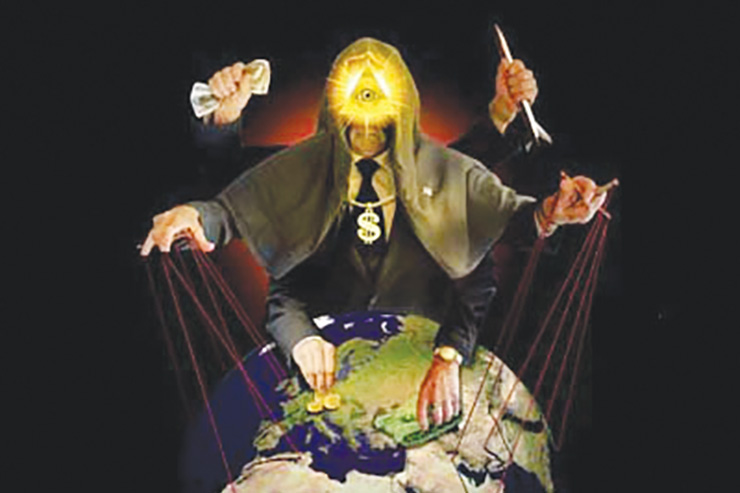
    Amidst the more fantastic theories of UFOs and intergalactic lizards, certain core themes do persistently reoccur in the mass of ‘conspiracy theory’ material now available. Principal among them is the idea that a shadowy elite is seeking to enslave humanity under the auspices of a single, centralised world government. The name of the mysterious ‘Illuminati’ is most often associated with such a group, although what is meant by it is frequently ill defined. The Illuminati are, supposedly, a cabal of top bankers, politicians and businessmen seeking to create the aforesaid all-powerful government.

    What is the truth of all this? I do not propose to give a full answer here, but would like to introduce a perspective on the theme – one that has generally not been given serious consideration – taken from the research of Rudolf Steiner. In the second part of the article I will try and relate Steiner’s ideas to other more familiar conspiracy research.

    So why Steiner? Because, if for no other reason, his pronouncements and indications on practical areas of life have borne such remarkable fruit, testimony to which are thousands of Waldorf schools offering a new kind of education, farms successfully practicing bio-dynamics, clinics dispensing anthroposophic medicines, and so on.

    As a profound clairvoyant, Steiner claimed to investigate other dimensions of reality for insight into the human condition. His legacy is hundreds of volumes of published talks and written works on a cornucopia of themes. However, as mentioned above, his work – in contrast to that of many other spiritual teachers and gurus – has shown itself to have practical applications in all areas of life. This in itself does not provide ultimate evidence for the truth of his work, but it does correspond to the biblical dictum: “[B]y their fruits ye shall know them.”

    In 1916 and 1917, in the midst of the catastrophic First World War, Steiner gave a series of 25 lectures to a group of his followers who gathered together at their centre in Dornach in neutral Switzerland. These lectures, since translated and published in English,1 offer a unique reading of contemporary events.

    Behind the outer façade of world affairs, suggested Steiner, the machinations of occult groups or ‘brotherhoods’ were at work. Certain of these brotherhoods had wanted the Great War to take place, and had manipulated events to bring it about. In doing this, they sought to protect the dominant economic position of the English-speaking world, and in turn to crush the ‘mediating’ role of Central European powers such as Germany, the Austro-Hungarian empire, and so on.

    These occult brotherhoods – small groups of men who met together in ‘lodges’ and practiced ceremonial magic as a means of achieving certain goals – originated from the English-speaking (Anglo-Saxon) world and were allied, in particular, with Anglo-American interests. Their aim was to extend Anglo-American influence across the globe, and to ensure the predomination of Anglo-American culture. Furthermore, they sought to extend its superiority into the distant future; essentially to ensure that the present state of affairs continues evermore.

    According to Steiner’s research, human evolution goes through ‘great periods’ of development. During each of these periods, a particular people is given the task of leading humanity in a spiritual sense. Over the millennia, it has been the destiny of different peoples to bring specific qualities, in a benevolent way, to the whole of humanity. Particular periods of history are thus led by particular nations. This does not imply a form of political control or empire – and is certainly not a theory of national or racial superiority – but is referring to a spiritual form of authority.

    Steiner suggested that the Western world, and in particular the English-speaking peoples, have been given the task of getting to grips with the material world – of becoming comfortable on Earth and developing in harmony with it. In this specific sense, the West was to introduce a certain kind of (beneficial) materialism into human development. But this materialism was only meant to be developed up to a certain point. It was necessary in order for humans to become fully part of the earthly world, and to help introduce an individualised consciousness (the ‘I’). But beyond that it had the potential to be destructive. Materialism as a philosophy, which shuts out the possibility of soul and spirit, is retrogressive, asserted Steiner, and works as an evil in human evolution.

    The Anglo-American brotherhoods that seek dominion over mankind know this, and hence today are deliberately sponsoring various kind of materialism in the hope of halting and trapping humanity at the present stage of its development. They don’t want humans to progress beyond the present stage of immersion in the material world. In other words, they don’t want us to reconnect in a free way with our spiritual ‘I’, because they know that their grip over humanity would then be lost. Human progress is dependent on spiritual knowledge, and thus the occult brotherhoods work against it.

    Steiner explained further the brotherhoods were aware that the Slavic peoples were to be given the task of leadership on behalf of humanity during the next ‘great period’ of history. For this reason, the Anglo-American brotherhoods not only sought to dominate the present great period of human development, but – knowing that the Slavs had an important mission in the future – sought to gain control over the Slavic peoples (Russia in particular) in the present, in order to interfere with or even put a halt to their coming task. In this way, the Anglo-American brotherhoods could extend their control over human development into the distant future.

    Steiner later claimed that the Bolshevik Revolution in Russia, which led to the creation of the USSR and the 72-year cultural, intellectual, economic and political repression of the populations of its various peoples, was masterminded and sponsored by these same brotherhoods as a means of controlling the region and its peoples.2

    What is the evidence for Steiner’s analysis? Apart from anything else, it is interesting to note the present state of world affairs, and how – since Steiner spoke about this topic in 1916-17 – Anglo-American culture has come to dominate the globe in tandem with American economic and political influence (with the enthusiastic support of British politicians). The assertion of unilateral military action by the United States and Britain in the 2003 invasion of Iraq – in the face of almost total global opposition – was a good example of this formidable power at work. However, admittedly these observations do not provide ‘proof’ in a strict sense.

    Another source of evidence is the remarkable research of Prof. Carroll Quigley (1910-77) who wrote two substantial volumes, The Anglo-American Establishment (1949) and Tragedy and Hope (1966),3 on the secret network which emerged from the enterprise of Cecil Rhodes. Quigley characterised the power of this group through its influence in politics, culture and social life as “terrifying”.

    It is important to note that Quigley was no crazed and paranoid conspiracy nut, but a respected Georgetown professor, and even the teacher of Bill Clinton. (How such networks might be related to the brotherhoods Steiner is talking about will be considered later.) Other authors have followed Quigley’s lead and complemented his studies with contemporary observations. A few have even related Steiner’s ideas to Quigley’s research.4 In this context, however, I would like to mention only two external ‘symptoms’, which, at the very least, offer circumstantial evidence for Steiner’s diagnosis.

    In 1893, an Englishman called C.G. Harrison delivered six lectures to the Berean Society, a mysterious group of ‘Christian esotericists’. A record of these lectures is to be found in Harrison’s remarkable book The Transcendental Universe. Little is known about the Berean Society or Harrison, although he wrote two further books in his lifetime. What is clear is that Harrison, who speaks in defense of the “high” Church, had access to a phenomenal store of esoteric thought, and was furthermore privy to a certain amount of inside knowledge. In his second lecture, he spoke not only of “the next great European war”, but also of the “national character” of the Slavic peoples and its ability to “enable them to carry out experiments in Socialism, political and economical, which would present innumerable difficulties in Western Europe”.5 Remember that these lectures were given in 1893, 21 years before the First World War and 24 years before the Bolshevik Revolution!

    While Harrison claimed to be a “theoretical occultist” as opposed to a “practical” one – i.e. he did not practice magic or ritual, with the implication that he was not a member of a “lodge” himself – from his work it is evident he represents an esoteric strain of thought which clearly defends the English establishment. How could he know about the forthcoming War as well as the “experiments in Socialism”, which would take a grip on Russia and its surrounding states for most of the twentieth century? If he was not, as he claimed, a “practical occultist” himself, it is reasonable to assume he had contact with people who were, and who had access to the malign plans of such secret groups referred to above.

    The second significant piece of evidence which offers some backing for Steiner’s claims of occult interference in world politics is to be found in a special edition of the satirical weekly The Truth, published at Christmas 1890. Under the heading ‘The Kaiser’s Dream’, the magazine featured a cartoon map of Europe together with a humorous commentary. Many observations can be made of the map, but the most pertinent point to note in relation to the above is that all the countries of Europe are shown as republics with the exception of Russia and its neighbouring states, over which are written the words “Russian Desert”. In addition, Germany is identified with the words “German Republics”! This map signifies not only a foreknowledge – similar to Harrison – of the fate of Russia to become a cultural as well as an economic ‘desert’, but also of the future splitting of Germany into ‘republics’. The magazine’s editor, Henry Labouchère, was a Freemason. Was his remarkable foresight pure luck, or once again did he have some inside knowledge of future plans to shape the world?

    It is of course possible that the above examples are merely coincidences and happy flukes, but surely it is unlikely. Do these examples offer evidence for the existence of occult brotherhoods with pernicious plans for political manipulation? We may never know for sure, but it is evident that Steiner’s perspective offers much serious food for thought, and opens up important new vistas for understanding current world events.

    Steiner and Modern Conspiracy Research

    Having sketched out Steiner’s picture of secret brotherhoods, I would like now to try and show how his perspective might relate to the more general conspiracy research referred to earlier. To many readers of this magazine the Bilderberg Group, the Council on Foreign Relations and the Trilateral Commission will be more than familiar. In addition, the Yale University secret society Skull and Bones is often identified by investigators in the conspiracy field. The latter has been thrown into the limelight recently due to the remarkable admission by both Republican and Democratic candidates of the 2004 American presidential election that they are members of the exclusive club.

    As Skull and Bones is a tiny society that invites only 15 undergraduates per year to join its ranks – and at any one time has only 800 or so living members – the fact that the two candidates for the post of the most powerful position in the world are members of it (from a population totaling some 293 million people) is quite incredible!

    It has long been known that George W. Bush is an initiate of Skull and Bones (as was his father George Bush Snr. and grandfather Prescott Sheldon Bush).6 According to the key researcher of Skull and Bones, Antony C. Sutton, the society was first founded in 1833. Members, who meet secretly in its ‘tomb’ on the grounds of Yale, are sworn to secrecy about the group’s rites and activities. In terms of its operations and philosophy, Sutton refers to the ‘dialectical’ process, based on the philosopher Hegel, as being at the heart of Skull and Bones thinking. In particular, he tries to prove that the group has been instrumental in funding and encouraging the development of both far-left and far-right political groupings – principally the Communists and Nazis – in the twentieth century. From the point of view of Skull and Bones’ broad vision of human development, left and right are viewed as two parts of the Hegelian dialectical process; one political wing represents ‘thesis’ while the other represents ‘antithesis’. These two aspects clash and fight each other, but eventually merge to form a ‘synthesis’. It is this synthesis, according to Sutton, that Skull and Bones is aiming to create. By controlling and manipulating the conflict, it controls the outcome (or synthesis).

    It is interesting to note that Sutton first published his interpretation of Skull and Bones in the mid-1980s. At that time, he quoted the group as working for a ‘New World Order’ (NWO). This NWO was to be the product of the synthesis of political left and right. Shortly after the collapse of the Eastern-bloc communist countries, and the subsequent triumph of Western capitalism – a triumph that Francis Fukuyama referred to in his famous book as ‘the end of history’ – George Bush Snr. began to use the specific phrase ‘New World Order’ in public speeches.

    This fascinating fact offers some circumstantial evidence for Sutton’s reading. Presuming that Sutton is correct, humanity is living right now within the period of ‘synthesis’ – the birth of a NWO led by the West, and principally the United States. (And perhaps it will come as no surprise to adherents of Sutton’s analysis that a new ‘dialectic’ has suddenly appeared to take the place of the old, i.e. Communism versus Capitalism is replaced with the West versus Islamic Fundamentalism.)

    Antony Sutton’s series of booklets on Skull and Bones begins with hisIntroduction to the Order,7  in which he points out that – despite them being commonly associated with conspiracy – organisations such as the Council on Foreign Relations and Trilateral Commission are ultimately not secret, and have large public memberships. Likewise, it could be added that despite the fact the Bilderberg conferences are not open to the press or public, the names of the people who attend these yearly private meetings are not concealed. (The minutes of the 1999 meeting in Sintra, Portugal were even leaked and published wholesale on the internet.) Lists of members of the above groups can be found in Robert Gaylon Ross’s Who’s Who of the Elite, Members of the Bilderbergs, Council on Foreign Relations, Trilateral Commission and Skull and Bones Society.)

    Sutton suggests that organisations such as the above form a larger ‘outer circle’ of members, while societies such as Skull and Bones form part of an ‘inner circle’ of truly secret groupings, of which there is a still further ‘inner core’ – the ‘decision-making core’ – which remains completely out of public view, i.e. truly hidden (or, literally, ‘occult’). This is a reasonable hypothesis. From what is known of the Bilderberg conferences, for example, it could be inferred that their essential motivation is to further the Western Capitalist Project through high-level networking and the grooming of young talent. To put it in another way, they are working for the economic, political and cultural domination of a globalised world by the West – in particular by the English-speaking peoples led by the United States and Britain. (Although the Bilderberg conferences include guests from around the world, the emphasis is on North America and Europe, and its leadership is Anglo-Saxon.)

    From what is known of the Bilderbergers – and much has reached the public domain – there appears to be no more conspiracy than that. Groups such as Skull and Bones (and Sutton deduces that there are others such as Scroll and Key) are not completely secret in that their existence and membership are well documented. According to Sutton these are the ‘core’, with similar objectives to the more public groups but with more focused and consciously-held goals.

    In contradistinction to the Bilderbergers etc., true secret societies usually have elaborate initiation ceremonies and use ritual as a critical part of their mutual enterprise. The brotherhoods Steiner speaks of, as has already been mentioned, are also built on Masonic principles of secrecy and ritual, but are hidden from public view.

    In relation to the groups referred to above, it is quite possible that such genuinely occult brotherhoods form part of the inner, ‘decision-making’ core, which Sutton refers to. Having said that, as Sutton points out, most members of the larger groups would have no inkling of any subterfuge or conspiracy, and neither would many members of Skull and Bones. This work would be left to the directors, or ‘initiates’, with esoteric knowledge and understanding. According to Steiner, the specific brotherhoods he is referring to not only have the conscious goal of maintaining Anglo-American domination, but complement this aim with real esoteric insight – i.e. an understanding of the evolutionary cycles referred to above.

    The above sketch gives a useful framework for comprehending how public groups such as Bilderberg, more secret groups like Skull and Bones, and the occult societies that Steiner refers to might interact and co-exist. In this sense, the true occult societies would be the central inspiration for the larger intersecting groups of organisations with politically active individuals. To my mind, such a complex picture is more convincing than the nebulous idea of a single all-powerful ‘Illuminati’ that is supposedly responsible for creating a massive conspiracy that controls every aspect of modern life.

    [alert type=”general” dismiss=”no”]This article was published in New Dawn 86.[/alert]

    [alert type=”success” dismiss=”no”]If you appreciate this article, please consider subscribing to help maintain this website.[/alert]

    Footnotes

    1. Karma of Untruthfulness Volumes I & II, Rudolf Steiner Press, London, 1988 and 1992.
    2. See further in Sergei O. Prokofieff, The Spiritual Origins of Eastern Europe and the Future Mysteries of the Holy Grail, Temple Lodge Publishing, London, 1993.
    3. The Anglo-American Establishment was only published in 1981, Books in Focus, New York.Tragedy and Hope was published in 1966 by Macmillan, New York.
    4. See Terry Boardman, Mapping the Millennium, Behind the Plans of the New World Order, Temple Lodge Publishing, London, 1998, and Amnon Reuveni, In the Name of the ‘New World Order’, Manifestations of Decadent Powers in World Politics, Temple Lodge Publishing, London, 1996.
    5. The Transcendental Universe, Lindisfarne Press, New York, 1993, pages 98-99.
    6. Daily Telegraph, London, 12 July 2004.
    7. The Secret Cult of the Order (1983), An Introduction to the Order (1984), How the Order Creates War and Revolution (1985), How the Order Controls Education (1985), Veritas Publishing Co., Aukland. A more recent and high profile study is Alexandra Robbins Secrets of the Tomb.

    © New Dawn Magazine and the respective author.
    For our reproduction notice, click here.
  • Gnosticism: Ancient and Modern

    Gnosticism: Ancient and Modern

    From New Dawn 85

    Every dog has its day, so they say, and it looks like Gnosticism, an ancient approach to spiritual experience, may be having its day, once again. Of course, despite the best efforts of the early Catholic Church, Gnosticism never really disappeared, but its reappearance over the centuries has been fleeting and sporadic. Why, as we march into a new millennium, is this hidden stream of quasi-Christian mysticism triggering a fresh interest among both spiritual seekers and readers of popular novels?

    Dan Brown’s mega-bestseller, The Da Vinci Code, surely shares part of the credit. This publishing phenomenon, which sold over 6 million copies, took a simmering interest in the Knights Templar, the Divine Feminine, alleged secret societies such as the Priory of Sion, the Holy Grail, and the question of the historical Jesus, and stirred these ingredients together with a generous dollop of Gnosticism.

    The result was a blockbuster thriller that unexpectedly caught the popular imagination. Despite the fact that at least two other previous thrillers, The Da Vinci Legacy by Lewis Perdue (1983), and Kingdom Come (2000) by Jim Hougan, had overlapped much of the same territory, lightning struck Brown’s novel and sparked innumerable dinner-table discussions of heretofore-arcane topics such as Mary Magdalene’s real relationship to Jesus.

    But the success of The Da Vinci Code is just the culminating phase of a gradual public awareness of Gnostic matters that extends back at least a century to the great Occult Revival of the late 19th century. At that time, Gnosticism slowly re-emerged from the shadows, nudged by the French occultist Eliphas Lévi, and propelled along by Madame Blavatsky’s Theosophical Society, French neo-gnostics such as Papus and Jean Bricaud, and researchers such as G.R.S. Mead (whose pioneering discussion of the Gnostics, Fragments of a Faith Forgotten, was for many decades one of the few sourcebooks on the subject for general readers).

    However, it was the discovery of a cache of ancient Gnostic scriptures at Nag Hammadi in the Egyptian desert in 1945 that really set off the modern phase of the Gnostic revival. Although their translation into English was not complete until the late 1970s, early access to some of the writings inspired the great psychologist Carl Jung to draw parallels between the ancient Gnostics and modern depth psychology. The publication in 1977 of the Nag Hammadi Librarytranslations, followed in 1978 by religious scholar Elaine Pagels’ best-selling exposition, The Gnostic Gospels, guaranteed that Gnosticism would not go away anytime soon. But before we take a further look at the burgeoning phenomenon of modern Gnosticism, a review of the ancient Gnostic teachings is in order.

    Gnosis and the Church

    Though scholars argue there were Gnostic teachings that predated the early Christian era, what is most commonly thought of as Gnosticism consisted of numerous Christian sects that thrived in the immediate centuries after the ministry of Jesus. These sects, often gathered around charismatic mystics, certainly thought of themselves as Christian, and it was only their emphasis ongnosis, or divine knowledge, that later earned them the sweeping label of Gnostic.

    As Christianity spread outside the confines of a specifically Jewish faith, it was perhaps inevitable that some gentile Christians would reinterpret their conception of God to distinguish Him from the tribal “G-d of Israel” Whose Covenant with His people seemed anchored to their particular identity as Jews. Christian aspirations to a universal faith, applicable to anyone with ears to hear, led many Gnostics to posit that God the Father, of whom Jesus spoke, must be a different God altogether: a hitherto Unknown God Who existed far above the earthly realm and was free of ethnic contracts or favouritism. Christ functioned as the messenger from this remote and impartial God, and some Gnostic scriptures downgraded the Jealous God of the Old Testament to the role of Demiurge, a lesser creator-god who brought a flawed Creation into existence and mistakenly ruled it with a heavy hand as if he were the True God.1

    Thus, in the Gnostic view, salvation from this diminished material realm of suffering and injustice depended less on one’s mere beliefs or on the following of religious laws that the Demiurge put in place, than on the individual’s inner experience of gnosis – a divine knowledge of the cosmic order and one’s true identity. The Gnostic scriptures alluded to Christ’s secret teachings, which would aid the Gnostic to embrace gnosis, and armed with this knowledge, to escape the illusory realm of the Demiurge at the time of death.

    There are any number of reasons why Gnosticism was bound to come into conflict with that portion of the Church which was consolidating into an institutional monolith. Gnosis, by its very nature, was an individual experience that eluded systematisation. While the Gnostics had priests and even bishops, their leadership derived from their mystical bonafides, not from a bureaucratic position of authority. Furthermore, the canonical Gospels portrayed Jesus as the fulfillment of Old Testament prophecy and the Messiah promised to the Hebrews. The Gnostics’ break with what they considered the Demiurge was at cross purposes with this historical reading and undermined the working mythos of the institutional Church.

    In another example of scriptural reversal, some Gnostic versions of the Creation story of Adam and Eve portrayed the Serpent as Liberator, offering the apple as a means to knowledge unfairly denied to humankind by the despotic Demiurge. There was obviously no way to accept this counter-version and the traditional version at the same time.

    Divine Feminine

    The most common Gnostic revision of the Creation story spoke of Sophia (Wisdom), an extension of the True God, venturing forth from the Pleroma (the fullness of the ineffable divine realm), producing an aborted spiritual being, Ialdobaoth (the Demiurge), who in turn created the flawed material world. Sophia, seeing sparks of the divine entrapped in matter, descended to try and free them and was herself entrapped. It took the efforts of the Christ (pre-existing in the Pleroma) to extricate her and return her, past the Archons presiding over intermediate planes, to her rightful place beside Him: a tale symbolic of the plight of the soul enmeshed in illusion.

    Finally, the indications in Gnostic scriptures, such as the Gospel of Philip and the Gospel of Mary, that Mary Magdalene was closer to Jesus than the other disciples and received secret teachings denied to them, undercut both St. Paul’s misogynist version of Christianity and the Catholic Church’s claim to legitimacy based on St. Peter’s supposed selection as the “rock” on which the Church would be built. The prominent role given to the Divine Feminine via the Gnostic veneration of the Magdalene and Sophia was partly recuperated by the Roman Church through the significance it later afforded the Virgin Mary, but this status was subsumed within the overall supremacy of a Church run by celibate males.

    Whatever Gnosticism’s virtues as an effective path to gnosis and to unconditioned consciousness, it was simply too idiosyncratic and contrarian to make the grade as a stabilising component of Roman power. Its subversive counter-myths stood little chance of being integrated into a social order based on top-down power relations emanating from Rome and Constantinople. The prevailing Church absorbed those elements of the Gnostic worldview that best served its own ends and scuttled the rest, consigning the Gnostics to the oblivion of heresy and their scriptures to the bonfires of proscribed texts.

    Of course attempts to obliterate ideas or spiritual currents that remain attractive to some are never wholly successful. Pockets of Gnostic alienation persisted among the Eastern European Bogomils, and eventually influenced the Cathars of Languedoc (southern France). The scourge of the Inquisition originated as a response to the growing influence of the Cathars, whose 12th century challenge to the Catholic Church could no longer be tolerated. The Albigensian Crusade in the 13th century effectively wiped out the Cathars.2  Subsequent Gnostic impulses and teachings survived as heavily-cloaked myths and symbol systems within marginal esoteric currents of the West.

    It was only once the religious and social hegemony of the Church was diminished by the succeeding blows of the Protestant Reformation, the Renaissance, and the scientific rationalism of the Enlightenment, that there was sufficient elbow room for Gnosticism to re-emerge into the light of day.

    Yet, the question remains why Gnosticism should prove of special interest to increasing numbers today. Are there particular characteristics of today’s society that resonate with the Gnostic worldview? One answer is provided if we consider the popularity of “The Matrix” movies and the influential ideas of science fiction author Philip K. Dick.

    The Illusion of Daily Life

    Central to both the Matrix and to Dick is the creeping perception that things are not as they seem: our perception of reality, both individual and collective, is an artificial construct masking the unnerving truth. In ripping away the façade of normality, we come face to face with our true dilemma – we live in a maze of illusions and self-delusions from which we must extricate ourselves. This is, of course, a fundamentally Gnostic worldview.

    The ancient Gnostics were aware that material existence is, at its root, a beguiling and temporary illusion. (Hindus called this “Maya.”) Modern physics has confirmed this at the sub-molecular level, where one can see that apparently solid objects are, in fact, composed of moving bits of energy that are neither wholly particle nor wave. The closer one looks, the less there is to see. The vast emptiness of outer space is mirrored by the vast emptiness within matter itself.

    Esoteric traditions around the world teach that consciousness can exist independent of the body, and that the ability to deliver our consciousness from its addiction to sensory input and compulsive thought patterns can lead to an experience of divine consciousness (gnosis). The message of the Christ of the Gnostics was not that he considered himself the unique and only Son of God, but that each person has the potential to expand their consciousness across the vast emptiness to the level of godhood or Self-realisation.

    If the illusoriness of daily life was self-evident in the relatively simple world of two millennia ago, it is becoming even more so, for those with the eyes to see, in the present world of cybernetic virtual realities, Hollywood dream-worlds, instant messaging, corporate branding campaigns, and information warfare. The ancient Gnostics were resigned to the fact that the majority of humans were fatally caught in the illusion, and for this they were called elitists.  Similarly, modern Gnostics perceive that most people around them are inextricably locked into a delusory existence in which their potential consciousness is siphoned off in exchange for corporate profit and material survival. This, too, is a minority perception, but it is steadily growing.

    The Gnostic rush many of us felt upon first seeing the Wachowski Brothers’ “The Matrix” was the heady sensation that somehow a deprogramming meme had made it through the corporate maze of AOL-Time-Warner, and that the dream factory itself had been tricked into promulgating a flash of gnosis. Millions responded and suddenly there was much more money on the table. All too predictably, the second and third Matrix films smothered the first film’s spark of insight under tons of ever more dazzling special effects, violence, and pretentious symbolism. The still small voice of the wake-up call embedded in film one was drowned out by the din of its own success. The series’ degeneration was an uncanny recapitulation of the suppression of ancient Gnosticism by the early Church. In the end, the Matrix – like the Church before it – emerged triumphant.

    Of course, it is a bit of a leap from perceiving daily life as delusory to embracing an ancient cosmology that specifies a false god, a True God, a malevolent pantheon of Archons, and a hieros gamos (divine marriage) of Christ and Sophia. Unless one is in the market for a ready-made dramatic cast of spiritual entities to believe in, the Gnostic myths best serve as metaphors for one’s dilemma – and, in fact, that may have been the role they played for the early Gnostics, as well.

    There are two ways to view the Gnostic myths as potent metaphors: one inner and one outer. The inner way is to see the Gnostic cosmology as a visionary description of the hurdles one must leap in meditation. In trying to ascend to a contemplative state of pure consciousness, one must move beyond the incessant activity of the mind (the Demiurge), and past one’s fears and compulsions (the Archons), before one can arrive at a consciousness beyond time and space (the Pleroma). The successful achievement of this gnosis while still “in the body” prepares one for the similar passage that one’s consciousness must take after death.

    An outer reading of the Gnostic cosmology, on the other hand, might consider the Demiurge to be anyone’s flawed and limited image of God, which must be seen through and surpassed on the way to true spiritual insight. The Archons would be the many social laws, institutions, and corporate entities that hamstring one’s existence. On this level, a kind of external gnosis would be one’s realisation of the ultimate inability of these earthly captors to imprison our higher self. In this reading, Christ’s crucifixion and resurrection serve as metaphors for our own daily immolation and extrication. In this instance, a Gnostic motto might be: “Don’t let the bastards get you down!”

    Wandering Bishops

    Reading The Da Vinci Code or The Gnostic Gospels or watching “The Matrix” are all very well, but such books and movies do not by themselves constitute a Gnostic revival. Revivals or movements require actual social vehicles to engage and embody people’s interests. One place this is happening – albeit on a small scale – is in the low-profile milieu of small independent Gnostic churches. An examination of this phenomenon leads us to the quirky turf of “wandering bishops” – a curious subculture of purported Catholic, Orthodox, and Gnostic bishops who usually (and painstakingly) trace their lines of apostolic succession back to (wait for it) St. Peter or one of the other apostles. This requires some explaining.

    The mainstream Roman Catholic Church hangs its legitimacy on unbroken lines of consecration from bishop to bishop, extending all the way back to St. Peter. Only bishops (or higher clergy) can ordain priests or consecrate other bishops – a form of organisational quality-control, as well as a narrow conduit for the divine grace that is said to be conveyed in the sacrament of ordination. Since an ordination or a consecration makes the recipient “a priest forever unto the order of Melchizadek,” a priest or bishop who later turns heretic, or otherwise runs afoul of the Church’s hierarchy, retains legitimate Orders – even if forbidden to celebrate Mass or excommunicated from the Church.

    Employing a liberal interpretation of this curious rule, schismatic churches such as the Jansenist Dutch Church, which broke with Rome in 1723, could claim legitimate apostolic succession despite their status outside the Roman Church’s umbrella.  Taking this logic one step further, some bishops consecrated by bishops of the Dutch Church (later the Old Catholic Church, following an alignment with other “national” churches in 1889) claimed the right to start their own churches and pass on the line of “valid” consecration. For instance, Bishop James Ingall Wedgewood was consecrated a bishop in the Old Catholic Church in 1916 and within two years had founded the Liberal Catholic Church, which became a kind of esoteric house church for the Theosophical Society.3

    One of the most influential of these independent bishops was Joseph René Vilatte, an Old Catholic missionary in Wisconsin, who sought and received consecration as bishop from the Syrian Jacobite Church in 1892 in Ceylon and subsequently consecrated several other bishops in North America and France who consecrated numerous other bishops in turn.

    Needless to say, notions of doctrinal fidelity or consistency – which were understandably a key concern of Rome – were lost in the shuffle, with the result that independent bishops, who were often “more Catholic than the Pope,” sometimes shared the same apostolic lines as esoterically inclined bishops with Gnostic leanings. Over time, this led to a new generation of Gnostic bishops who could now claim apostolic succession. Exactly why apostolic succession would matter to latter-day Gnostics is something of a mystery, particularly since whatever legitimacy the original Gnostics claimed derived from gnosis itself, not from institutional standing. One suspects that even heretics desire approval, and in the absence of Gnostic lines of succession, most latter-day Gnostic bishops are quite happy to gain succession from St. Peter, illicit though it may be – especially if it tweaks the nose of the Vatican.4

    One Gnostic “Patriarch” in France, Jules Doinel (Tau Valentin II), sidestepped the issue altogether by receiving “a double spiritual consecration; the first by Jesus in person, the second during a spiritualist séance by two Bogomile bishops.”5  Doinel, who founded the Universal Gnostic Church, went on to consecrate the noted French occultists Papus and Sédir, thus empowering further Gnostic lines, some of which have continued to the present. Another Gnostic group of French origin, the elusive Holy Order of Miriam of Magdala, has cited traditions of a female apostolic line extending back to Mary Magdalene, but has attached no importance to providing verification of such traditions. The spurious Priory of Sion, celebrated in The Da Vinci Code and hyped in Holy Blood, Holy Grail – and likely of no earlier origin than 1956 – avoided ecclesiastical trappings altogether, preferring to concoct a lineage based on the supposed bloodline of Jesus and Mary Magdalene which the Priory claimed to guard.6

    Perhaps representative of the Gnostic branch of bishops in the English-speaking world was one Richard Duc de Palatine, an Australian originally named Ronald Powell, who was initially ordained in the Liberal Catholic Church and, in 1953, consecrated a bishop by Mar Georgius I (Hugh George de Willmott Newman), Patriarch of Glastonbury, one of the most fecund independent bishops. Palatine then founded his own Pre-Nicene Gnostic Catholic Church. Palatine, whose penchant for organising esoteric orders was second to none, also founded the Order of the Pleroma, the Brotherhood of the Pleroma, the Disciplina Arcani, and the Hermetic Brotherhood of Light. These appear to have led a largely mail-order existence.7  Palatine’s episcopal concerns were intermingled with esoteric, magical, and even Freemasonic preoccupations, but in spite of this – or perhaps due to it – some serious modern Gnostics became associated with him. The most notable is Bishop Stephan Hoeller, arguably the foremost proponent of a contemporary Gnosticism.

    Hoeller was consecrated by Palatine in 1967 and for a number of years worked within the fold of his Church and other groups. His Los Angeles-based Ecclesia Gnostica (Church of Gnosis) grew out of his work with the Pre-Nicene Church, and Hoeller has been an indefatigable author and synthesizer, drawing upon ancient Gnostic sources, Jungian psychology, and esoteric Christian concepts, in an effort to construct a modern Gnostic presence.

    Secret Teachings of Jesus

    As a diligent search of the Web will show, there are an ever increasing number of fledgling Gnostic churches, most of them situated in, or derived from, the “wandering bishop” milieu. Many of them consist of little more than a bishop and a local congregation, if that. This is not, in and of itself, a bad thing. After all, the ancient Gnostic sects amounted to the same thing: scattered groups with little uniformity between them. But it also presents the would-be seeker of gnosis with a certain dilemma: Can gnosis be taught? And if it can, who is qualified to teach it?

    The ancient Gnostics claimed to be guardians of the secret teachings of Jesus, teachings that were lost when Gnosticism was defeated. Formal issues of apostolic succession aside, no modern Gnostics can claim to perpetuate those teachings in unaltered form, because the chains of transmission have been lost. Even the scriptures that have been recovered – as fascinating as they may be – retain an opaque quality, because the original interpretive keys are absent.

    Thus, any modern Gnostic group or teacher must be carefully evaluated, based on subtle qualities that evidence real spiritual depth and understanding. Impressive lists of titles, degrees, and credentials mean little if there is no indication of a voice that speaks from the experience of gnosis. While it may be too much to expect that any given Gnostic teacher is going to be the embodiment of divine illumination, one still has the right to expect that those who talk the talk can walk the walk.

    Divine knowledge may be gained in a variety of ways – after all, it was not the exclusive possession of the Gnostics, any more than the True God is the possession of any single religion. If teachers of real attainment choose to use the metaphors of ancient Gnosticism to encourage self-discovery, then the Gnostic revival may fulfill its promise. But if the rekindled interest in Gnosticism is going to amount to anything besides a few books and movies and an unsatisfied hunger for enlightenment, we need to see a growing indication of the true discovery of inner godhood, not a fruitless scramble to decipher a few fragments of someone else’s gnosis.

    [alert type=”general” dismiss=”no”]This article was published in New Dawn 85.[/alert]

    [alert type=”success” dismiss=”no”]If you appreciate this article, please consider subscribing to help maintain this website.[/alert]

    Footnotes:

    1. Some scholars have suggested that this reframing of G-d was first done by Jewish intellectuals who were themselves dissatisfied with the Torah’s portrayal of the deity. Thus early Christian Gnosticism may have been influenced by, or may have been an extension of, a Jewish Gnosticism intent on reinterpreting the Jewish religious traditions. See: Birger A. Pearson, “The Problem of ‘Jewish Gnostic’ Literature,” in Nag Hammadi, Gnosticism, and Early Christianity, edited by Charles W. Hedrick and Robert Hodgson, Jr. (Peabody, Mass: Hendrickson Publishers, 1986), pp. 15-35.
    2. Yuri Stoyanov, The Hidden Tradition in Europe (London: Penguin/Arkana, 1994).
    3. The premiere exposition of this milieu is Peter F. Anson’s Bishops at Large (London: Faber & Faber, 1964), which is both droll and exhaustively detailed. It is, sadly, long out of print. A more recent (and apologetic) discussion of the phenomenon can be found in Lewis Keizer’s The Wandering Bishops: Apostles of a New Spirituality (2000), available in PDF format at:www.hometemple.org/WanBishWeb%20Complete.pdf.
    4. The Vatican, for its part, seems to have nothing encouraging to say about independent bishops. One of the more common claims of Vatican recognition for the sacraments and orders of the Liberal Catholic Church, for instance – a supposed positive ruling by the Roman Congregation of Rites – has been exposed as a hoax. (See: “Rome and Liberal Catholic Orders,” by Rev. L. K. Langley at: www.lcc.cc/tlc/lxvi1/rome.htm) The Vatican’s stance appears to be that so-called valid orders are worthless without the Church’s recognition.
    5. Anson, p. 307.
    6. See: Robert Richardson, “The Priory of Sion Hoax,” GNOSIS Magazine #51, pp. 49-55, (www.gnosismagazine.com). Reprinted in New Dawn No. 61 (July-August 2000).
    7. Anson, pp. 492-495, and J. Gordon Melton, The Encyclopedia of American Religions, Second Edition (Detroit, Mich: Gale Research, 1987), pp. 612, 618.

    © New Dawn Magazine and the respective author.

    For our reproduction notice, click here.
  • The Masons and the Moors

    The Masons and the Moors

    This article was published in New Dawn 86 (Sept-Oct 2004)

    The origins of Freemasonry – as would be expected of such a “venerable secret society” – are shrouded in myth, legend and almost impenetrable obscurity. Since at least the late 18th century Masonic writers have sought to establish a link between the Knights Templar and the Freemasons. Freemasonic lore and symbols have been traced to ancient Egypt and Phoenicia. Yet, despite all the books and articles exploring Freemasonry published over the last hundred years, there is one area that has not received attention. It concerns Freemasonry’s debt to Islamic mysticism and a shadowy tradition connecting the Masons with the Moors of North Africa.

    Moorish Science

    The involvement of Freemasons in the establishment of the United States of America is well documented. In fact Masons featured so prominently in drafting the American Declaration of Independence that many people believed it a thoroughly ‘Masonic project’. Not only George Washington but also the US founding fathers Benjamin Franklin and Thomas Jefferson were high-degree Masons. Masonry had a profound influence on the formation of American society, but there was also another secret power which has gone completely unnoticed.

    The Kingdom of Morocco under the leadership of Sidi Mohammed Ben Abdullah, known as King Mohammed III, was the first country in the world to recognise the United States of America as an independent nation in 1777. This historic act by the North African Muslim kingdom highlights the relationship then existing between America’s Masonic leaders and the Moors. Before exploring this strange connection further we need to understand the part played by the Moors in the transmission of knowledge to Europe.

    Moor is the classical name in Europe of the Muslim people of North Africa. In Spain, where Muslims ruled for over five hundred years, Arabs are still called Moros. The term “Moor” came to be synonymous with “Muslim” in many contexts, for example the Muslim communities in the Philippines are known to this day as Moros. The Supreme Wisdom of the Moors, much of it derived from ancient Egypt, has come to be known as “Moorish Science”.

    The Moors provided the vital link between ancient and modern civilisation. The light of knowledge which illuminated the Moorish lands of Spain and Sicily was instrumental in dispelling the gloom of ignorance that enveloped mediaeval Europe.

    “It was under the influence of Arabian and Moorish revival of culture,” writes Robert Briffault in The Making of Humanity, “and not in the 15th century, that the real renaissance took place. Spain and not Italy, was the cradle of the rebirth of Europe. After sinking lower and lower in barbarism, it had reached the darkest depths of ignorance and degradation when the cities of the Saracenic world Baghdad, Cairo, Cordova, Toledo, were growing centres of civilisation and intellectual activity. It was there that the new life arose which was to grow into a new phase of human evolution. From the time when the influence of their culture made itself felt, began the stirring of a new life.”

    The Orientalist Stanley Lane-Poole acknowledged the great impact Moorish civilisation had on Europe when he wrote:

    For nearly eight centuries under her Muslim rulers Spain set to all Europe a shining example of a civilized and enlightened state. Art, literature and science prospered as they then prospered nowhere else in Europe. Students flocked from France and Germany and England to drink from the fountains of learning which flowed only in the cities of the Moors. The surgeons and doctors of Andalusia were in the vanguard of science; women were encouraged to devote themselves to serious study, and a lady doctor was not unknown among the people of Cordova.1

    The 19th century French writer on the esoteric sciences, Gerard Encausse, known as “Papus”, noted how “the Gnostic sects, the Arabs, Alchemists, Templars” form a chain transmitting ancient wisdom to the West. This explains why within the Ritual of Freemasonry there is the admission “we came from the East and proceeded to the West.” A Masonic author Bernard H. Springett says:

    The plain fact that much of what we now look upon almost entirely as Freemasonry has been practised as part and parcel of the religions of the Middle East for many thousands of years, lies open for anyone who cares to stop and read, instead of running by. But it is frequently and scornfully rejected by the average Masonic student…2

    So we find that just as Europe borrowed considerably from the learning of the Moors, European Freemasonry took its “secret wisdom” from the Muslim East.

    With the end of Moorish rule in Spain, the Europeans began to colonise Africa, Asia and the Americas. In time European Christians conquered Muslim territories and the great debt Western civilisation owed to the Moors was quickly forgotten. By the 18th century European Christians saw themselves as the predestined rulers of the world with a divine mission to “civilise” the heathen. Western historians conveniently ignored the immense contribution of the brilliant and energetic Moorish civilisation in delivering Europe from mediaeval barbarism. We can only conclude this is a result of the pride and presumption of Westerners, which prevent them from recognising the truth or importance of their debts to the East.

    Seekers of Truth

    The founders of the American republic, as high-degree Freemasons, were aware of the importance of Moorish wisdom and culture to the birth of Western civilisation. This may explain why Morocco was the first nation in history to recognise the United States, and what’s really behind the story of George Washington being presented with a Moorish flag. Some researchers believe this flag consisted of a red background with a green five-pointed star in the centre of it. The star or pentagram, which the Moors called the Seal of Sulaiyman and coloured green to honour Islam, also figures prominently in Masonic art and architecture. The layout of the city of Washington D.C. – designed by Freemasons – incorporates the pentagram.

    When Freemasons travelling in the Moorish lands encountered Sufis, the mystics of Islam, they soon recognised a common bond. “Sufi-ism,” said Sir Richard Burton, was “the Eastern parent of Freemasonry.” John Porter Brown, an American diplomat in Turkey in the mid 1800s, was a Freemason who wrote sympathetically of the Sufi path. In The Darvishes, he admits finding it “rather strange that the Dervishes of the Bektashi Order consider themselves quite the same as the Freemasons, and are disposed to fraternize with them.” Brown commented how in Turkey Freemasonry had come to be generally regarded as “atheism of the most condemnable character.” A position not unlike the one held by Papus, the celebrated French occultist and Gnostic bishop, who tried to counter the Masonic lodges which, he believed, were in the service of British imperialism and the international financial syndicates. Papus also viewed Freemasonry as a diabolical perversion of the ancient secret tradition and atheistic at heart.

    When Madame Blavatsky (1831-1891) set out in search of hidden wisdom it was to the Moorish land of Egypt that she journeyed. Blavatsky claimed to be a disciple of the Masters Morya and Koot Hoomi. The researcher K. Paul Johnson convincingly shows her tales of the “Masters” to be modelled on real people, many genuine occult adepts. Prominent among them Jamal ad-Din al-Afghani, a Sufi scholar, tireless political intriguer, and the leader of radical movements throughout the Muslim world, whose travels enigmatically paralleled those of Madame Blavatsky for more than thirty years. Best remembered for co-founding the Theosophical Society and helping to popularise Buddhism and Hinduism in the West, Blavatsky also proudly wrote of “living with the whirling dervishes, with the Druze of Mount Lebanon, with the Bedouin Arabs and the marabouts of Damascus.”

    Madame Blavatsky’s “Masters” are very close to the Sufi tradition of Khwajagan (Persian: “Masters”). Ernest Scott states “the Khwajagan teachers are entirely corporeal and literal, having been physically located in the Hindu Kush area since the 10th century. The Hindu Kush range is in Afghanistan: geographically, it forms the Western extreme of the Himalayas.”3 Scott quotes from a paper by a Turkish writer who describes how members of the Khwajagan:

    …intervene from time to time in human affairs. They do this, not as leaders or teachers of mankind, but unobtrusively by introducing certain ideas and techniques. This intervention works in such a way as to rectify deviations from the predestined course of human history. This inner circle, it is claimed, concentrates its activities in those areas and at those times when the situation is critical for mankind.”4

    Certainly Madame Blavatsky’s teacher Jamal ad-Din al-Afghani, who was raised in Afghanistan, fits the description of a Master Adept. His life is described as a mysterious odyssey that led through lands as far apart as India and America. Received by heads of state in Cairo and Istanbul, he moved in both underground radical circles and the highest centres of power in European and Oriental capitals.

    The idea of living ‘spiritual guides’ or masters is central to Sufism. In the words of Sir John Glubb Pasha: “Sufism cannot be defined in words, nor can it be comprehended by the human intellect. It can only be imperceptibly ‘caught’ or imbibed by association with a Sufi master.” The Sufi master is revered by his disciples for being in contact with a level of higher consciousness, his mission on Earth directed by higher powers. Studying the lives of some of the greatest Sufi masters we often find them to be wandering holy men (& women) whose actions are usually misunderstood by orthodox believers. The shrines of Sufi masters are centres of trance dancing, exorcism, and miraculous healings.

    The Sufi tradition is integral to Moorish Science.

    Sufi masters are also renowned for communicating with their followers through dreams. There are numerous stories of Sufi saints appearing in a disciple’s dreams and using telepathy to direct followers to undertake a special mission.

    Mission to America

    A few years after Madame Blavatsky founded the Theosophical Society in New York in 1875, the Master Adept Jamal ad-Din al-Afghani turned up in America around 1882. Two Americans of African descent, who are rumoured to have studied under al-Afghani, were the parents of the man who would one day establish Moorish Science in the United States.

    Noble Drew Ali (born Timothy Drew) early in the 20th century took a job as a merchant seaman and found himself in Egypt. According to one legend, Noble Drew Ali made a pilgrimage to North Africa where he studied with Moorish scholars and received a mandate from the king of Morocco to instruct Americans of African descent in Islam. His association with the ruler of Morocco is significant when we recall the historic relationship between this Moorish country and the early United States.

    At the Pyramid of Cheops his followers believe he received initiation and took the Muslim name Sharif [Noble] Abdul Ali; in America he would be known as Noble Drew Ali. On his return to the United States in 1913 he had a dream in which he was ordered to found a movement “to uplift fallen humanity by returning the nationality, divine creed and culture to persons of Moorish descent in the Western Hemisphere.” He organised the Moorish Science Temple along lines similar to Masonic lodges, with local temple branches and “Adept Chambers” teaching the esoteric wisdom derived from the secret circle of Eastern Sages, the Master Adepts of Moorish Science.

    Noble Drew Ali is said to have made a historic visit to Washington, D.C. in order to reclaim the Moorish flag and obtain official recognition to call his people to their true faith, “Al Islam”. The US president, believing that African Americans would not embrace Islam, gave Noble Drew Ali full authority to teach Moorish Science in America.

    By the end of the 1920s, membership in the Moorish Science Temple had grown substantially. With increasing numbers of African Americans rallying behind Noble Drew Ali the Moorish movement soon came under the scrutiny of the FBI. In 1929 several Moors, including Noble Drew Ali, where detained for questioning by the Chicago police. Released from custody, Noble Drew Ali fell ill and never recovered. Many Moors suspected his death the result of a severe police beating.

    Following the inexplicable ‘death’ of Noble Drew Ali, the Moorish Science Temple continued and gave rise to unique Islamic groups among the African American community. Much of the known history of Moorish Science in North America is extremely complex and obscure.

    By the 1950s some white American poets and jazz musicians came into contact with Moorish Science. The North African cities of Tangiers and Marrakech held a magic attraction for the leaders of America’s counterculture, with writers like William S. Burroughs spending years living in the Moorish lands. The Moorish Orthodox Church of America was formed by white Americans who held Moorish Science passports and had ties with certain “Wandering Bishops” of the Old Catholic and Eastern Orthodox churches.

    Joseph Matheny, the American author and media theorist, first encountered Moorish Science when he was researching time travel and quantum consciousness. In his book Ong’s Hat The Beginning, the Moorish Orthodox Church is called “one of the most secretive and mysterious religious organisations ever known to man” and:

    a revolutionary and heretical sect of Islam that carries on an ancient tradition which sought to counterbalance the forces of orthodox Islam. Despite the controversial and dubious nature of the MOC, part of their tradition has been to serve as the torch bearers of freedom against the tyrannical and repressive aspects of the Earth’s patriarchal power structure as our planetary consciousness shifts to the Age of Aquarius and sets its site on unlimited freedom and the expression of life in all of its true wonder and beauty.

    Years before the “War on Terror” and Bush’s invasion of Afghanistan and Iraq, this writer attended a lecture organised by people associated with the Moorish Orthodox Church. The speaker, a Moorish Sheik returned from a long sojourn in the East, claimed Freemasonry is built on a twisting of the truth of Moorish Science. It is the secret power behind the West based on the Supreme Wisdom derived from esoteric Islam. The European colonisers usurped the knowledge of the Moors and created a nefarious system of control that blinds man to his true identity. Freemasonry was identified as a chief player in the world “Babylonian” system, the mastermind of the institutions of indoctrination that prevent the full knowledge of the True God to be known. Moorish Science is the effective counter to the Freemasonic imposters and a force for Truth, Love, Peace, Freedom and Justice. The Sheik also revealed how Afghanistan and Iraq figure in sacred geography and numerology, and mentioned a secret war between the Anglo-American and Asiatic powers.

    Is there a struggle between occult brotherhoods to influence human destiny? Are the dramatic events taking place in the world, from the continuing strife in Palestine, Iraq and Afghanistan, to the rivalry between the forces of Atlanticism (Britain and the USA) and Eurasia (Russia and China), just surface manifestations of a deeper conflict? Certainly the strange saga of Moorish Science and the Moorish Orthodox Church adds weight to the observation made by one of the 20th century’s most controversial mystics:

    …There is a history behind our so-called history that you cannot even conceive of. History has a deeper base. The periphery that we know as history is not the reality. Behind our so-called history continues another history, a deeper one about which we know nothing.5

    [alert type=”general” dismiss=”no”]This article was published in New Dawn 86.[/alert]

    [alert type=”success” dismiss=”no”]If you appreciate this article, please consider subscribing to help maintain this website.[/alert]

    Footnotes:

    1. Stanley Lane-Poole, Studies in a Mosque

    2. Bernard H. Springett, Secret Sects of Syria and the Lebanon

    3. Ernest Scott, People of the Secret

    4. Ibid.

    5. Bhagwan Shree Rajneesh, I AM THE GATE: The Meaning of Initiation and Discipleship

    © New Dawn Magazine and the respective author.
    For our reproduction notice, click here.