New Dawn – World's Most Unusual Magazine

Category: Articles

  • Assimilate & Destroy: The Rockefeller Foundation’s Role in Exploiting Then Suppressing Natural Medicine

    Assimilate & Destroy: The Rockefeller Foundation’s Role in Exploiting Then Suppressing Natural Medicine

    From New Dawn 186 (May-June 2021)

    Born in New York, John Davison Rockefeller (1839-1937) was the world’s first billionaire1 (he’d be worth around $13.7 billion in today’s money). As a Republican, Rockefeller supported Abolition, back when southern Democrat-voting industrialists profited from their human property. He was also a Methodist/Baptist Christian who believed that god had made him rich. 

    In 1864, he founded the grain and produce company, Clark, Rockefeller, & Co., with business partner, Maurice Clark (1827-1901). The company profited from the American Civil War (1861-65)2 and Rockefeller used his money to establish the company that made him his fortune: Standard Oil of California. With notions of the Protestant work ethic and Christian charity, Rockefeller and his employees attempted to craft an image of the family dynasty as philanthropic.
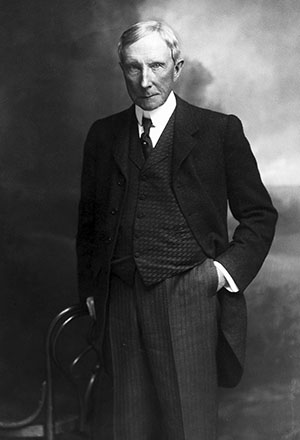
    John Davison Rockefeller (1839-1937)

    Rockefeller’s various institutes and foundations spawned other entities, including the University of Chicago, the General Education Board, and the eponymous Institute for Medical Research. But diary entries, papers, letters, and memos from the time confirm that the motive was primarily to make the public healthier and more educated in order to get them to work for the businesses in which Rockefeller had invested. By the mid-20th century, it was clear that “philanthropy” was also a massive, legal tax dodge.3 

    Rockefeller’s profit-making agenda included the promotion of so-called “scientific medicine,” which has now become the norm. Although Rockefeller personally championed natural remedies, including homeopathy, publicly he funded allopathic medicine and was a major cog in the machine that brought America’s medical practices up to Europe’s technological standards. But institutions, be they religious, corporate, or national, are not self-containing. They expand. Rockefeller’s philanthropy was de facto colonialism in countries including China and the Philippines, where the offshoots of his Foundation trained indigenous elites to use Western “scientific medicines” and lessen their traditional, natural cures.

    THE FOUNDATION AT HOME: “HEALTH IS PROFITABLE”

    Former US President Bill Clinton (in office 1993-2001) says: “The academic study of public health owes its origins to Rockefeller, who financed the earliest programs at institutions like Johns Hopkins and Harvard [Universities].”4 

    Not all 19th century US physicians had formal qualifications. Founded in 1846-47, the American Medical Association lobbied to ensure that physicians were qualified and trained up to particular standards.5 But the formalisation of healthcare training reinforced the race, gender, and class structure in that females, poor people, and non-whites were typically excluded.6 In addition to producing young, white, male doctors from the middle- and upper-classes, the system also battled natural health in favour of the new “scientific medicine.”7 By contrast, the Popular Health Movement was a natural health lobby which, in the 1850s, sought to remove legal protections for reckless physicians.

    Despite Rockefeller’s private belief in homeopathy, one of the effects of his Foundation’s work in medicine was to undermine natural alternatives to chemical prescriptions. The formalisation of GP training led to monopolies. Most medical courses were offered by just three universities: Dartmouth, Harvard, and Pennsylvania.8 As late as the early-20th century, US doctors typically trained in Europe. Rockefeller’s agenda was to bring the US medical profession up to Europe’s standards.9 Rockefeller modelled his health foundation on Berlin’s Koch Institute (founded 1891) and Paris’s Pasteur Institute (1887).

    After studying in France and Germany, the American parasitologist, Charles Wardell Stiles (1867-1941), went to work at the Rockefeller Foundation’s forerunner, the Rockefeller Sanitary Commission. Stiles advised on the abdominal disease hookworm, which mainly affected agricultural workers and thus Rockefeller et al.’s profits in his textiles investments. Stiles believed that hookworm caused “some of the proverbial laziness of the poorer classes of the white population.”10
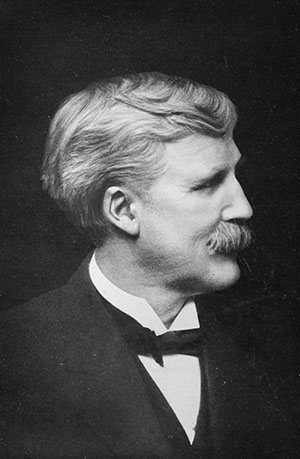
    Frederick Taylor Gates (1853-1929)

    One of Rockefeller’s main ideologues was the Baptist clergyman, Reverend Frederick Taylor Gates (1853-1929, no relation to Bill). In the capitalist spirit of the age, Gates saw the human body as an amalgam of separate parts, akin to a factory. Gates’s view was that “the great organs of the body like the liver, stomach, pancreas, kidneys, gall bladder, are great local manufacturing centres, formed of groups of cells in infinite number, manufacturing the same sorts of products, just as industries.”11

    Gates initially advised Rockefeller’s Standard Oil before promoting the magnate’s health ventures. Gates noted that at any one time, 20 per cent of staff in any given institution was home sick each day and said that “health is found in a variety of ways to be profitable.”12 He objected to the Rockefeller-founded University of Chicago’s 1898 efforts to align with the pro-homeopathy Rush Medical College. After studying in Germany, the bacteriologist and pathologist William H. Welch (1850-1934) co-founded the Johns Hopkins School of Hygiene and Public Health. Gates asked Welch to run the Rockefeller Institute for Medical Research, which by 1928 had received $28m in funding (around $385m today).13 

    Hookworms are parasitic organisms that live in the abdomen and are typically picked up by affected persons when walking barefoot and consuming soils near to which people have defecated. The roots of the Foundation’s global health hegemony were planted in the American south, where Black agricultural labourers continued to toil in cotton fields.14 The Foundation’s failed efforts to eradicate hookworms nevertheless gave the planners enough confidence that their work could be exported. But their methods sought to integrate foreign traditional healers into “scientific” medical practices. 

    Historian Angela Matysiak writes that during the 1917 campaign to eradicate hookworm in Brazil, civil society feared that Rockefeller’s International Health Board (IHB) would replace curanderos: natural healers. “To address these tensions, the staff of the IHB in Brazil, Costa Rica, and other countries looked for ways to integrate native healers into public health campaigns.” But Rockefeller opposed domestic natural medicines; at least for the public. For example, it was only when the supply of the drug thymol was disrupted by the First World War (1914-18) that Rockefeller’s IHB gave patients oil of chenopodium (the flower of the goosefoot plant). With zero ethical protocols in place, Rockefeller’s doctors poisoned to death 222 children with the oil between 1914 and 1932, something that natural healers were unlikely to have done.15

    ROCKEFELLER ABROAD: “HEALTH HAS ADVANTAGES OVER MACHINE GUNS”

    The Rockefeller Foundation established a series of successive health entities to exploit foreign medicines and assimilate other people’s traditional practices into Western-led methods. The International Health Board and its successors spent billions of dollars (tens of billions in today’s money) in over 100 countries, establishing 25 schools and institutes, and sponsoring over 2,500 nurseries.16

    The entities included the International Health Commission (1913-16) and International Health Board (a.k.a., Division, 1916-27). At the time, representatives of the global body, the League of Nations, described Rockefeller’s International Health Board as “the only existing truly international agency which is working at present to further constructive work in the domain of public health all over the world.”17 The motives were profit-driven. Rockefeller Foundation President, George E. Vincent (1864-1941), said that when it came to conquering foreigners, public health had “advantages over machine guns.”18 The Philippines International Health Commission visited the Moro tribes and acted, in the words of Foundation officers, as “wedge for permanent civilising influences.”19

    After the British Empire’s occupation (circa 1842-1912), but before the economic nationalism of Chairman Mao (1893-1976), US investors sought to exploit China’s huge working population and raw materials. Rockefeller and his successors funded the Peking Union Medical College to the tune of $45m (or half a billion today). Chinese traditional medicine includes but is not limited to acupuncture, cupping, diet, herbs, and qigong. It has been used for thousands of years and is regularly attacked in the West by advocates of Big Pharma. Rockefeller money started the anti-traditional medicine movement in China while taking some of its ideas and products to synthesise them as modern drugs. 

    For instance, ephedra plants are shrubs that grow in most countries and produce certain green teas. Known in Chinese medicine as ma-huang (right, above), ephedra shrubs have been used for 5,000 years and were first catalogued by Emperor Shen Nung in 2700 BCE.20 The Japanese Professor, Nagayoshi Nagai, isolated ephedrine from the shrub in 1885 to produce synthetic chemicals for blood pressure treatment. The Rockefeller-funded Peking Union Medical College took credit for isolating and synthesising the chemical. The Lancet reports that the College “spread modern medical sciences throughout China.”21

    Today, we hear about the dangers of “vaccine nationalism.”22 Russia’s Sputnik V vaccine against Sars-CoV-2 (COVID-19) was demonised by Western media23 before being accepted as >90 per cent efficacious by Western journals.24 The UK’s AstraZeneca-Oxford vaccine was sold to the British public as effective,25 yet several heads of state at the European Union, which is promoting the US-German Pfizer-BioNTech vaccine, publicly cautioned against the UK vaccine. 

    Vaccine nationalism began with the Rockefeller Foundation. Yellow fever is a deadly (50 per cent death-rate) mosquito-derived, tropical virus.26 Rockefeller’s International Health Board stoked controversy by pointing to side effects in yellow fever vaccines developed by rival institutes, such as the Pasteur Institute, which was operating in France’s colonial subject, Tunisia. Rockefeller’s vaccines were initial failures. The authors of an article on biological history state: “the success of [Rockefeller-]sponsored anti-yellow fever campaigns was obtained through a traditional means: the elimination of the disease’s vector, the mosquito.”27 

    “Paris Green” was named after its use against rats in the sewers of the famous French capital. It is an arsenic-based toxin that was used as an insecticide. It was mass-produced in New York. The Bulletin of the Industrial Commission reported at the time that “[c]onsiderable illness has been found to exist among many of the workers engaged in this production.” The Department of Labor described it as “a dangerous poison and sickness results from the breathing of air containing it, through broken skin, and through the mouth.”28 The Rockefeller International Health Board experimented in anti-malaria techniques in Brazil, Bulgaria, El Salvador, India, Italy, the Netherlands, Nicaragua, Palestine, the Philippines, and Puerto Rico. The League of Nations argued that sanitation was key to beating disease, but Rockefeller lobbyist and physician Lewis Hackett (1884-1962) argued for the use of “Paris Green.” The International Health Board used its propaganda to promote the results of a dubious, preliminary study in Italy. 

    One historian writes: “the anti-mosquito strategy… laid the groundwork for the subsequent DDT revolution in malariology.”29 DDT is also a toxin trialled by the US Typhus Commission. During the Second World War (1939-45), the Rockefeller Foundation’s health institutes tested DDT on German and Italian prisoners of war, as well as on Algerian inmates before heralding DDT operations a success in Sardinia.30 

    Rockefeller’s motives for eradicating mosquitos are exemplified by the case of Mexico. Disease historians note that the yellow fever virus mainly affected the nation’s shipping ports that were crucial for US corporate profits, including Rockefeller’s Standard Oil. The company relied on the malaria-ridden port of Veracruz.31 In addition to using poison to blitz mosquitos to clear ports for profit, the Foundation used its eugenics ideas to encourage Mexican women to produce “strong” babies that could grow into healthy workers.32
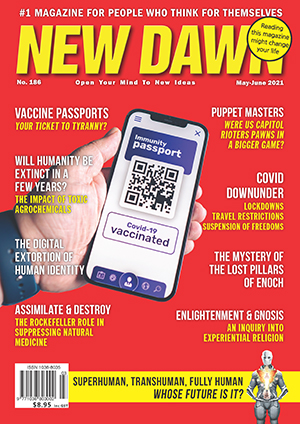
    Get the issue this article appears in

    COMING AROUND

    After WWII, the Foundation lost its direction. The so-called third world became a battleground between US imperialism and Soviet dominance, with the Rockefeller Foundation struggling to design an internationalist, post-War policy. The giant, US, post-War machine referred to by future President Dwight D. Eisenhower as the “military-industrial complex” meant that research grants were awarded through the government’s National Science Foundation, making Rockefeller money less immediately appealing to young researchers. The Rockefeller Foundation initially succeeded by funding the shift in research from chemistry to biology, particularly the study of proteins for vaccination. “That decision has been widely viewed as stimulating the rise of the new field of molecular biology.” What began as schools for research turned into captive instruments that awarded funding for clear proposals, not for theoretical research. But theoretical research is where major breakthroughs tend to occur.33

    The founding of the World Health Organization in 1948 coincided with the dissolution of the Rockefeller Foundation’s International Health Board, which was subsumed into the Division of Medicine and Public Health in 1951.34 The Rockefeller Foundation failed to make the shift from protein to DNA research and lost ground to big biotech firms, like Monsanto (now Bayer). But cultural changes began to take shape. 

    The Foundation started out taking natural plants from traditional medicine practitioners and using them to promote synthetic pharmaceuticals. But, having been part of the mechanisms that destroy the world with their interests in oil, banking, and pesticides, the Rockefellers have now seen profit-potential in solutions to the problems they allegedly helped to create. In more recent years, the Foundation and Rockefeller’s successors have come to recognise the value of naturopathy.

    A few years ago, scientists contrived a new epoch: the Anthropocene. In the Anthropocene, the dominant species causing potentially irreversible destruction to the planet’s ecosystem is the human. The Rockefeller Foundation and The Lancet published a report stating: “Far-reaching changes to the structure and function of the Earth’s natural systems represent a growing threat to human health.” 

    Having gone from seeing the human body as a factory comprised of separate parts in the 19th century and promoting molecular biology to stimulate biotech profits in the 20th, the Foundation now decries “an increasingly molecular approach to medicine, which ignores social and environmental context.”35 

    Sometimes, the parasitic greed of the ruling classes destroys the host, in this case the planet, forcing our “betters” to modify their propaganda in the new ages they contrive. 

    [alert type=”general” dismiss=”no”]This article was published in New Dawn 186.[/alert]

    [alert type=”success” dismiss=”no”]If you appreciate this article, please consider subscribing to help maintain this website.[/alert]

    Footnotes

    1. Natalie Burclaff, “Rockefeller: Making of a Billionaire,” Inside Adams Science, Technology and Business, Library of Congress, 14 January 2020, https://blogs.loc.gov/inside_adams/2020/01/rockefeller-billionaire
    2. Ron Chernow (1998) Titan: The Life of John D. Rockefeller, London: Random House, 25-31
    3. Berrien C. Eaton (1949) “Charitable Foundations, Tax Avoidance and Business Expediency,” Virginia Law Review, 35(7): 809-61 
    4. Bill Clinton, “Introduction” in Eric John Abrahamson (2013) Beyond Charity: A Century of Philanthropic Innovation, New York: Rockefeller Foundation, 23
    5. American Medical Association, “AMA history,” no date, www.ama-assn.org/about/ama-history/ama-history
    6. Robert B. Baker (2014) “The American Medical Association and Race,” American Medical As-sociation Journal of Ethics, 16(6): 479-88
    7. J.T.H.J. Dekkers (2009) What about Homeopathy? A comparative investigation into the causes of current popularity of homeopathy in The USA, The UK, India and The Netherlands, Master’s thesis, University of Utrecht, 20-24, https://dspace.library.uu.nl/bitstream/handle/1874/35695/ScriptieJorisDekkers.pdf
    8. Robert G. Slawson (2012) “Medical Training in the United States Prior to the Civil War,” Journal of Evidence-Based Complementary and Alternative Medicine, 17(1): 11-27
    9. J. Andrew Mendelsohn (2002) “‘Like All That Lives’: Biology, Medicine and Bacteria in the Age of Pasteur and Koch,” History and Philosophy of the Life Sciences, 24(1): 3-36
    10. Quoted in E. Richard Brown (1980) Rockefeller Medicine Men: Medicine and Capitalism in America, Berkeley: University of California, 115-16
    11. Quoted in Brown, op. cit., 120
    12. Quoted in Brown, op. cit., 113
    13. Brown, op. cit., 105 
    14. Centers for Disease Control and Prevention (US), “Hookworm FAQs,” no date, www.cdc.gov/parasites/hookworm/gen_info/faqs.html
    15. Angela Matysiak (2014) Health and Well-Being: Science, Medical Education, and Public Health, New York: Rockefeller Foundation, 59-75 
    16. A.E. Birn (2014) “Backstage: the relationship between the Rockefeller Foundation and the World Health Organization, Part I: 1940s-1960s,” Public Health, 128: 129-40
    17. Ilana Löwy and Patrick Zylberman (2000) “Medicine as a Social Instrument: Rockefeller Foundation, 1913–45,” Studies in History and Philosophy of Biological and Biomedical Sciences, 31(3): 365-79
    18. Quoted in Brown, op. cit., 124
    19. Quoted in Brown, op. cit., 124
    20. M.R. Lee (2011) “The history of Ephedra (ma-huang),” Journal of the Royal College of Physicians of Edinburgh, 41: 78-84
    21. Editorial (2014) “China Medical Board: a century of Rockefeller health philanthropy,” The Lancet, 384: 717-19
    22. United Nations News, “WHO chief warns against COVID-19 ‘vaccine nationalism’, urges support for fair access,” 18 August 2020, https://news.un.org/en/story/2020/08/1070422
    23. One of many: Denise Chow, “‘Reckless and foolish’: Why Russia’s vaccine has experts alarmed,” NBC News, 11 August 2020, www.nbcnews.com/science/science-news/reckless-foolish-why-russia-s-vaccine-has-experts-alarmed-n1236466
    24. Ian Jones and Polly Roy (2021) “Sputnik V COVID-19 vaccine candidate appears safe and effective,” The Lancet, 2 February 2021, https://doi.org/10.1016/S0140-6736(21)00191-4
    25. Maria Deloria Knoll and Chizoba Wonodi (2020) “Oxford–AstraZeneca COVID-19 vaccine efficacy,” The Lancet, 397(10269): 72-74
    26. World Health Organization, “Yellow fever,” 7 May 2019, www.who.int/news-room/fact-sheets/detail/yellow-fever 
    27. Löwy and Zylberman, op. cit.
    28. Monthly Review of the U.S. Bureau of Labor Statistics, “Dangers in the Manufacture of Paris Green and Scheele’s Green,” 5(2): 78-83 
    29. Darwin H. Stapleton (2004) “Lessons of History? Anti-Malaria Strategies of the International Health Board and the Rockefeller Foundation from the 1920s to the Era of DDT,” Public Health Reports, 119(2): 206-15
    30. Ibid. 
    31. Andrew L. Knaut (1997) “Yellow Fever and the Late Colonial Public Health Response in the Port of Veracruz,” Hispanic American Historical Review, 77(4): 619-44
    32. Linnete Manrique (2016) “Dreaming of a cosmic race: José Vasconcelos and the politics of race in Mexico, 1920s–1930s,” Cogent Arts & Humanities, 3(1218316): 1-2, 11n5
    33. P. G. Abir-Am (2010) “The Rockefeller Foundation and the Post-WW2 Transnational Ecology of Science Policy: from Solitary Splendor in the Inter-war Era to a ‘Me Too’ Agenda in the 1950s,” Cenataurus, 52: 323-37
    34. Rockefeller Foundation, “International Health Division,” Archive, https://rockfound.rockarch.org/international-health-division
    35. Sarah Whitmee et al. (2015) “Safeguarding human health in the Anthropocene epoch: report of The Rockefeller Foundation–Lancet Commission on planetary health,” The Lancet, 386: 1973-2028

    © New Dawn Magazine and the respective author.
    For our reproduction notice, click here.

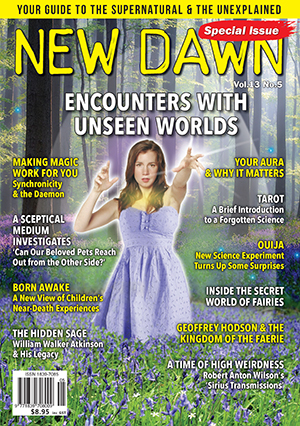
  • Encounters with Unseen Worlds: A Personal Journey of Discovery

    Encounters with Unseen Worlds: A Personal Journey of Discovery

    From New Dawn Special Issue Vol 13 No 5 (Oct 2019)

    He has been very ill and that afternoon he realises he is dying. He’s confused for a moment as he is plucked up and out of his pain-racked body. He looks down and can see his body lying there a couple of hundred meters below him.

    When he looks upwards he finds himself inside a small cabin, a monorail car perhaps. Eight or ten others sit comfortably side-by-side. A black man, opposite him, is gently playing a trumpet. It comes to him that this little group are all dying at the same time.

    A bright, yet not blinding, light appears to his left, at the end of the cabin. There is a suggestion of a form within the light. A male voice comes to him, intimate and entirely nonjudgmental. He doesn’t know whether it is inside his head, or whether the others have heard it, too. The “voice” assures him that he is indeed dying, however in this case he is being given the choice to continue, or to return to his previous life. Then, to his continuing astonishment, he is told that he has completed what he has come to do. He is 33 years old. He is free to choose.

    After a few moments of deep lucidity he decides to return to life. Upon which the cabin dissolves until his whole visual field is filled with singing, celebrating angels. He is escorted by his two companion angels, across a wide plain and taken into a large structure to be healed.

    Sometime later, after being shown around and told that he’d not recall what he is seeing, he is returned to his body to find himself fully healthy once again.

    He is walking on a beach in Israel as dusk is starting to fall. Sitting for a moment on a large rock, he stares into the surf. It is at that point during sunset when the air can turn almost violet. The waves roll in with the surf throwing up sheets of spray that hang in the air before the next wave replaces them.

    His mind is empty as he gazes idly into the violet haze. Yet his whole body jolts when he suddenly becomes aware that he is watching a group of ten or twelve beings, very tall – about twice the height of humans – with a couple of children amongst them, plodding slowly in single file up a slight incline.

    This strange scenario, as real as anything he has ever seen on a cinema screen, persists in the violet mist as long as the waves replace the spray. As the light changes and the spray no longer refracts a violet glow, the figures dissolve and disappear.

    It is no more a hallucination than the moving images of a film. The beings move. They walk slowly and deliberately for at least 20 seconds.

    He is lying in his bathtub after a physically strenuous day. Looking up he sees two figures standing in his bathroom, just inside the door.

    The taller of the two is definitely female, dark-haired, well over six-feet-tall, and very beautiful. In front of her is a far more curious affair. He can’t tell what gender it is. It’s bipedal, certainly, small, perhaps four feet tall and seemingly more crystalline than organic.

    The tall one speaks. He learns the pair are extraterrestrials and that they have a large mothership parked in the fifth dimension over the mountains he can see out of his bathroom window. She explains how very different intergalactic races will often adopt one another, and she gestures at the small angular figure, when they are ready to move into the larger Universe community. She speaks of the star-system Arcturus, again gesturing at the small figure in front of her, and tells him how a planet in that system is a couple of thousand years in advance of Earth and wanted to be here to observe and advise when asked.

    The language she uses is correct, fluid and sung more than spoken. A detailed and lucid 20-minute conversation follows before the pair appear to fade before his eyes.

    Three encounters with unseen worlds. All entirely unprovable, with no evidence whatsoever, except how they might have influenced the consciousness of the protagonist. And isn’t that just the problem with this kind of anecdote? Until something like that happens to us individually, these experiences can seem outlandish or self-delusional. Might they simply be made up? Perhaps our poor protagonist is crazy? Anyone who has tried to tell the wrong person of their encounters with the unseen worlds will have come across these reactions. Try writing about them publicly!

    Well, crazy perhaps in some peoples’ eyes, but at least I can vouch for the authenticity of all three events. They happened as reported. They were amongst the encounters I had with the unseen worlds, which led me to believe there is much more going on, as it were, than meets the eye.

    Like many others who have had these sorts of experiences, I’ve never felt any need to prove to others these strange events happened. They did. I know. I was there. And for the scientific materialist, who might dismiss a Near-Death Experience as some random firing of dying neurons, I can only say, wait until you have a full-blown NDE! Whatever a Near-Death Experience is, it is not random. It can be an astonishingly lucid affair.

    The problem is that such an experience doesn’t fit into the current scientific or materialist paradigm. There is no language to accurately describe what can’t be easily sensed and measured. Thus, science has little time for the possibility of other realms of existence. The creeping realisation there may be other inhabited planets in the Universe is only now starting to intrude on the leading-edge thinkers.

    Physicists have flirted with the concepts of multiple worlds and parallel universes; the different String theories suggest the existence of other dimensions; and quantum mechanics, if nothing else, shows us the nature of matter is a lot weirder and more improbable than we had any idea.

    Yet little of this has opened up the contemporary scientific mind to the possible reality of other realms of existence. Apart from the CIA’s faltering explorations of remote viewing and some more detailed psychic research in the Soviet Union, there has been little advance in the study of parapsychological phenomena over the course of the last half-century. Apparently, it hasn’t been cost-effective. Besides, it’s a little scary.

    Since this stultified approach so clearly denies the persistent reality of the transcendent in human experience, we are left to work it out for ourselves if we are so inclined. Movies, TV and horror novels titillate us with imaginative stories of ghosts and vampires. Some find themselves turning to astrology, numerology or the I Ching; perhaps it’s Tarot cards or crystal balls, or any other system of divination, to peer for a moment into the unseen realms. Just as people from the dawn of the historical record attempted to talk to the dead through mediums and sibyls, flick on the TV on any evening and you might find mediums passing on messages from dead relatives to a thrilled audience.

    Others, throughout history and in many cultures, have sought to speak with their angels, their ancestral spirits, or spirit guides. Whole systems have been created categorising and attempting to order the angelic realms. These were no fly-by-night operations. Kabbalah, Jewish mysticism, for example, traditionally doesn’t allow a person to study angels unless they are mature males over 50 years old. For Sufism, too, angels came to play an essential part in the spiritual lives of its devotees.

    While we can be grateful that modern scientific scepticism cleared away the superstitions of earlier eras, there is no denying that throughout human history there has been, and continues to be, a deep intuitive acceptance of other levels of reality.

    A BRIEF HISTORY OF THE UNSEEN

    There is little doubt that early humans must have been a jittery lot. If it wasn’t a tiger behind every tree, it was thunder and lightning or the terrifying and unexpected darkness of a total eclipse. Evil spirits lurked in the flickering darkness, outside the safety of the fire. Natural events had to be controlled somehow; invisible forces behind them needed to be mollified. Ghost worship surely emerged to placate the evil spirits.

    Then, as the millennia passed into recorded human history and humanity started to cluster into larger communities and then cities, it can be seen in their records that something profound was changing. As if the ghosts and spirits of earlier eras had resolved into the more defined pantheons of Sumerian and early Egyptian cultures, gods and goddesses became the central feature of the peoples’ lives.

    Easy, of course, to dismiss as mere superstition; as hallucinations, or some sort of internally generated archetypes. But hold on a moment. Our forefathers and mothers weren’t stupid. They had to make their way through life just as we do, facing and dealing with many of the same issues. If we are to credit our ancient forebears with any reasonable degree of intelligence, we have to admit that whoever these gods and goddesses were, they were very real indeed to our ancestors. They profoundly influenced the lives of individuals as well as whole cultures. They gave men their identities and appear to have had children with mortal women. Cities rose and fell as warring quasi-divinities goaded their human worshippers into vengeful killing sprees.

    Gods and goddesses, we are told, came and went at will. One moment they were visible – the next, they had disappeared. They demanded worship and sacrifice. They were cunning, often cruel and uncaring and, to the modern mind, all too human in their attributes. 

    It is condescending to dismiss our forebears’ concern with these apparent divinities as delusional. Or, as merely the hallucinated “voices” of their non-dominant hemispheres, as Julian Jaynes attempts to show in his elegantly written, The Origins of Consciousness in the Breakdown of the Bicameral Mind. Dr Jaynes, a Princeton psychologist, bases much of his reasoning on observations made of the hallucinations of schizophrenic patients and yet never quite makes the case as to how an individual’s personal hallucination can manifest to whole groups of people. And while his research is encyclopaedic and his writing is gorgeous and persuasive, Jaynes never appears to consider the possibility that the non-dominant hemisphere of the brain may be where we process telepathic input, rather than it simply being the generator of hallucinated voices.

    We have to look elsewhere for a deeper understanding as to what might have been going on in those early days of human history.

    Returning to Julian Jaynes’s book; he makes a solid case that it was indeed the removal, or at least the gradual absence, of the hallucinated voices of these gods and goddesses that directly threw the great civilisations of the second millennium before Christ into such chaos. Humans, always vulnerable to giving away our power to those we think of as more powerful, had apparently come to rely on their deceitful divinities for every decision, large and small.

    Then, gradually, the gods no longer spoke to them. It must have been a desperately confused time.

    We move into the modern era, with the racial memory of these creatures as very real and demanding of worship and obedience. The disappearance of the gods and goddesses then led to the worship of empty thrones and statues that no longer spoke; then again, in an increasingly desperate attempt to stir up the absentee voices of the gods, there was more and more emphasis on diviners and auguries, on oracles and astrology.

    By the 6th century BCE, human beings were starting to replace the unavailable voices of the Midwayers as they are described in The Urantia Book (see story on page 7). Prophets and priests, kings and queens, all claiming to represent God, or the gods, contributed directly to Western culture swinging wildly between dark ages of superstition and brief times of enlightenment.

    As the major Western religions became more formalised, they all claimed an omnipotent, invisible Deity at the centre of their creeds and theologies. With priests taking over as interpreters of Divine will and the voices of the gods no longer guiding the way, human beings were left on their own to puzzle out the mysteries of the Universe. Inspired individuals, men and women who have themselves peered into the unseen worlds and returned, emerged over the next two millennia to remind humans of a transcendent reality.

    Over the last two centuries we have prided ourselves of having explained away the superstitions of the previous eras. Yet for all our down-to-earth materialism, it is somewhat ironic that it is these same inspired individuals, with their claims of the unseen dimensions of life, whom we most revere.

    CHALLENGING HUMAN SENSES

    Events occur in the course of life which appear to happen at the edge of our ability to perceive them. People will often know, for example, the precise moment a loved one dies when they are far away. Authentic crop circles question our understanding of how the material world works. The alien abduction phenomenon, with its reports of floating through walls, pushes at the very limits of our assumed relationship to physical reality. An Out-of-Body experience, if it doesn’t occur in a dream state and thus can be easily dismissed, challenges what it means to be in a physical vehicle. A Near-Death Experience will not only convince the subject that consciousness survives death, but also that the Multiverse is peopled on its many levels and dimensions with other intelligent beings. Angels have appeared in virtually all cultures throughout recorded history, under different names, yet with surprisingly similar characteristics. The very continuity of these reports down through time suggests they are more than mere superstition.

    All these reports and experiences likely will be explained away, or dismissed as fantasy, by the sceptic or the scientific materialist, and yet the conviction that life has a spiritual dimension continues, with personal experience increasingly becoming the yardstick of belief.

    A WORKING MODEL OF THE UNSEEN DIMENSIONS

    No one can say with any degree of evidential certainty how the mysterious unseen worlds actually function, or even how they come to be. All that has really emerged from the probing and testing is that human potential is far more substantial than anyone had thought. Scientists risk the derision of their peers and a sudden dearth of funding if they attempt to seriously research these enigmatic areas of human reality.

    I suspect that this level of excessive scepticism cloaks not only a terror of ridicule but perhaps a more legitimate fear that there might be something to it. If angels actually exist; if mediums really do talk to the dead; if dolphins are telepathic; if extraterrestrials are visiting our planet; if Midwayers are actively involved in shaping our lives; if all these things are true, then what ever would it mean for the way scientists conduct their researches?

    To underline this suspicion is the courageous research of the celebrated professor of psychology at the University of Arizona, Gary E. Schwartz, and his associates. Reported in The Afterlife Experiments, they demonstrated in double-blind studies, that selected mediums can often achieve an 80% to 90% accuracy rate when passing on messages from deceased relatives or friends, or describing their personalities to the subject.

    However consoling it might be for a person to know that Granny lives on and still loves them, almost nothing of general, or lasting, value has been communicated through the mouths of mediums. For the researchers, what little information has surfaced over the years has been rendered arbitrary by its very unprovability.

    All of which throws us once again back on our own resources. There really is nothing to trust but our own intuitions and that inner sense we all possess, of knowing the truth if we experience it.

    Get the issue this article appears in

    THE UNSEEN: A PERSONAL APPROACH

    I now regard it as fortunate that I started off my journey as a sceptic, as hard-headed as they come. As a kid I’d been thoroughly turned off the Anglican religion by the boredom of their services and a priest’s angry inability to answer my perfectly reasonable questions. It set me up nicely as an arrogant young sceptic by the time I was in my teens.

    Over the years, however, it was as though the invisible world was provoked by my thickheadedness to break through my shell. A series of powerful entheogenic experiences in my early twenties tore apart my materialist view of the world to demonstrate unequivocally that there was much more going on behind the scrim of reality than I had any idea.

    Much of what I saw and felt I found impossible to rationalise, but what I soon understood was these strange experiences that were blowing my rational mind wide open weren’t there to be explained or proved. They were there to be experienced and learned from, not to be overly probed and picked apart.

    Trained as an architect, I thought of myself as fairly down-to-earth and practical, so when these experiences occurred I focussed on bringing as many of my senses to the events as possible; that, and recording the essentials of the events afterwards as honestly as I could. It’s such a subtle, ephemeral, area of research that I knew that if my accounts were to be of any value to others I would have to record them as perceptively and as accurately as possible.

    This approach, I soon discovered, allowed me to appreciate that I had embarked on what I now know were a series of initiations, each one leading on an invisible thread to the next opening.

    The Near-Death Experience I relate at the beginning of this essay occurred at the midpoint of my life to date, and it was this event that initiated what has become an overriding interest in non-human intelligences; in dolphins, nature spirits, angels and extraterrestrials.

    What can be learned from all this? A terrestrial lifetime can seem puzzling and complex enough, some would say, without having to factor in the possibility of unseen realities. However, if these are authentic personal experiences, that happen for a reason and clearly have spiritual integrity, then surely there is value to be derived from explorations into the unseen realms.

    To compress a great deal of hard-won experiential information into a series of bullet-points risks their being dismissed merely as New Age clichés. I can only hope my words will resonate with the reader’s experience sufficiently to reaffirm the authenticity of their own glimpses into the unseen world.

    Bearing in mind that all true knowledge has to be experienced personally, these are some of the things, and in no particular order, that I have learnt for myself from my own encounters with other realms of being.

    • It really helps to deepen and enliven the quality of terrestrial life to know, to really know, that life continues after death.
    • To understand the mechanics of belief; to know that belief systems are but rungs in the ladder of knowledge.
    • To know what it feels like to step outside the ego-centred structure of my personal mind and step into the collective mind.
    • To know that all matter is to some degree animate at its most basic subatomic level.
    • To know that the Multiverse is teeming with intelligent life, both on the inner and outer realms.
    • To know that being in contact with my companion angels is to launch out on one of life’s most intriguing and challenging adventures.
    • To know I can heal myself by the focussed intention to communicate with the organising principle of my body – my body deva – that which knows intimately how my physical vehicle works.
    • To trust my intuition. It’s not always right, but at least I make my own mistakes.
    • To take into account that in general, the world appears to be upside down. Almost everything the world believes is opposite to the truth. This is a convenient formula for deconstructing the many confusions of consensus reality.
    • To realise that most of what is forbidden contains essential truths.
    • That trusting in the authenticity of a transcendent experience encourages further synchronicities.
    • That doubt is healthy in its place; yet to know how to leave it behind in the heat of the moment. Doubt can always be picked up later.
    • To know that from the angels’ point of view, they regard it as perfectly natural to talk to us. It is our doubt and lack of self-confidence that blocks the communication.
    • To understand that emotional intelligence is distributed throughout the natural world, each species possessing it to the extent of its needs.
    • To appreciate viscerally that in consensus reality we are all swimming in a sea of fear.
    • To know that every moment presents each of us with the choice of responding to life with fear or with love.
    • To know that angels are powerful and intelligent beings and not the whimsical flying babies of Victorian iconography.
    • To have observed that surrounding every sacred space there is a ring of demons. To know that demons can be defused by focussed love from the heart centre.
    • To know that we get what we deserve if we don’t listen; and we get what we need if we do.
    • To know if I meet a flaming angel, to embrace him.
    • To know that, in spite of appearances, all is deeply well; that what appears to be the chaos of a frantic world is well-understood and guided by unseen hands towards a truly extraordinary destiny.
    • To know that for reasons that have little to do with humans, this planet is regarded as being of extreme importance to the larger Universe context.
    • To know to take the time and attention to delve as deeply as possible into the true nature of dolphins and whales; that they are a key to the nature of non-human intelligences.
    • To know the joy of sharing the planet with another species of comparable or higher intelligence.

    Not an exhaustive list by any means, yet with few exceptions I don’t believe I would have had a chance to know these things without the access I have been given over the years to the subtle realms.

    I don’t believe that as a human being I am out of the ordinary, merely enthused, or curious enough, to have thrown myself wholeheartedly and with as much of an open mind as I could summon into exploring what I was being shown. In fact, I have come to believe that access to these unseen realms is actually our rightful spiritual heritage that was blocked, through no cause of ours. The unseen realms are there for the seeing. With a little focussed intention on our part, and an open heart and mind, they are as close as a heartbeat.

    The above article, slightly abridged, originally appeared in New Dawn Special Issue Vol 6 No 2. 

    Timothy Wyllie’s series of books on his interactions with a rebel angel are available from https://www.innertraditions.com/author/timothy-wyllie.

    [alert type=”general” dismiss=”no”]This article was published in New Dawn Special Issue Vol 13 No 5.[/alert]

    [alert type=”success” dismiss=”no”]If you appreciate this article, please consider subscribing to help maintain this website.[/alert]

    © New Dawn Magazine and the respective author.
    For our reproduction notice, click here.
  • Keyhole: Unlocking the Secret Geometry of the UFO Enigma

    Keyhole: Unlocking the Secret Geometry of the UFO Enigma

    From New Dawn Special Issue Vol 12 No 2 (April 2018)

    In my latest book Ancient Alien Ancestors, I present several discoveries one of which I want to go over briefly. I say ‘discovery’, implying, more or less, that I went through a process of research and tracked it down.

    It kind of happened that way but not quite. I had been studying the Great Pyramid of Giza in Egypt for a long time, but the Byzantine nature of the puzzle started causing me an overload. The enigmas of that edifice are many, entangled and impossibly complex. Stopping short of a mental meltdown, I let it go for a while.

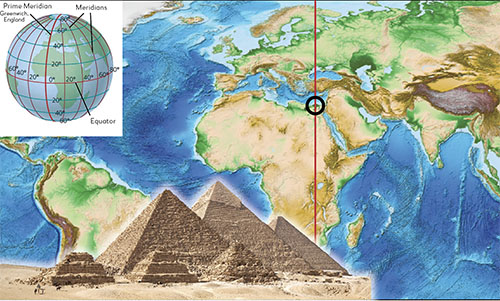
    One morning I woke up with the compelling thought to experimentally shift the prime meridian from Greenwich 0 to Giza, 31 E longitude. That made Giza the new 0 longitude (actually, Giza/Nile River delta). I did not plot out this scenario; the idea came to me first thing when I woke up. 

    Next, I got a map and looked at Mississippi River delta, 89 W longitude. Then I added 31 to that and came up with 120 degrees! That is a very significant number in geometry, especially when we are talking about the Earth and the Great Pyramid.

    The Greenwich prime had obscured that fact, and nobody was pointing out this exact relationship between the Nile and Mississippi deltas. They both sit on 30 N latitude, precisely 120 degrees apart. 

    Now consider that the Nile flows from south to north; the Mississippi from north to south. I realised they were inverted mirror images of each other. Something was going on with this. I also realised it was a very big anomaly. So is the 30 N latitude which is seldom mentioned.

    I then found that the Tigris-Euphrates was exactly 15 degrees east of Giza; the Yangtze delta 90 E degrees also and both on the 30 N parallel. The question that popped into my head: what is behind these rivers flowing into deltas, all along a single northern latitude around the globe?

    I know of no geological dynamics that logically explains this and I have never heard a geologist try. Erosion, deposition, floods – they are all random processes. Then there was the fact that the earliest civilisations emerged in these river valleys on 30 N latitude. Another anomaly.

    When a whole bunch of facts added together turns up an enigma, people either dig for the answer or chalk it up to ‘coincidence’. A quaint shallow concept that explains nothing unless one has a simple mind. It reveals a bias toward thinking the universe is based on random variables… dumb! You can check the foregoing in my book.

    Prime Meridian experimentally shifted from Greenwich 0 to Giza.

    Anomalies as Clues to the Bigger Picture

    What is an anomaly? Basically anything that does not fit the model, or expectations, “something that deviates from what is standard, normal,” says the dictionary.

    I realised, after many decades studying anomalies, that they are the Achilles heel of modern science and academia. When these ‘experts’ are confronted with a serious anomaly (i.e. the Great Pyramid), they abandon the scientific method, circle the wagons, and become babbling morons. The nonsense spouted on how this massive, precision-engineered edifice was built is quite shocking. We are given to believe it was built by people using hammer-stones, wooden sledges and ropes. 

    They present a scenario that is so improbable that it short-circuits even normally rational minds. People using Stone Age technology could not build such a sophisticated edifice. Our scholars are either stupid or just plain liars. Never mind, the Egyptians somehow did it, case closed. Minds shut, anomaly disposed of, everybody goes home. Problem is, the anomaly and the response to it are like a computer virus. It grows, spreads and starts causing fragmentation and loss of system integrity.

    Already a substantial number of people around the world utterly reject the orthodox theories. Get enough of these anomalies piling up and credibility and trust become real issues. We are approaching that watershed critical mass point now.

    UFOs exist, but then again they don’t, because they shouldn’t according to the laws of physics. Anomalies. Nothing in our rule-based 3D material dimension can appear and disappear in an instant. 

    In addition, it is impossible to see events in the future because it has not yet happened in linear time, right? Wrong.

    Paranormal, psi, psychic phenomena occur and have been scientifically observed in controlled settings. Scientist Russell Targ noted his experiences while carrying out research into such phenomena in the following quote.

    “Stanford Research Institute (SRI) conducted investigations into the human mind’s capacity for expanded awareness, also called remote viewing, in which people are able to envision distant places and future events and activities. For two decades SRI’s research was supported by the CIA and other government agencies. I was co-founder of this once secret program which began in 1972.” (See ‘The Scientific and Spiritual Implications of Psychic Abilities’, www.bibliotecapleyades.net/ciencia/ciencia_psycho10.htm.)

    Since these phenomena do exist but shouldn’t by the rules that supposedly govern the dimension we live in, they are anomalies. As such, official science shows them the backdoor and politely asks them to leave and not return. Yet, the fact they exist puts us in a paradoxical position.

    We seem to be living in a Universe that is, in reality, much more complex and inexplicable. Nonetheless, these anomalies must be explained and accounted for. 

    Quantum Nature of Reality

    Now our view of normal starts getting twisted out of shape. As shown above, scientific investigations have proven that paranormal phenomena are real (that was one study, there are more.) However, we have to keep in mind that these things are weird only in the context of the rules defined by physicists. They have a model of the cosmos and our place in it. That model is predicated on there being an external universe that exists independent of our observations. In that model objects exist in three-dimensional space.

    In fact, that description is not the newest upgrade. There is the quantum-view, the 2.0 version, now held by many scientists. The foregoing was actually the mechanical model from Newton that existed until Einstein blew it up.

    In his relativity model, the space/time continuum is an interdependent whole. We cannot have space without time and objects need both to exist and move about. It is a package deal. Quantum mechanics came along and changed everything. There is no external universe made of solid objects existing in space independent of our observations. 

    What actually exists is an unexplainable paradox. Our observations change the underlying conditions of the universe. We are in an entangled presence. No pure objectivity is possible because our very observation changes the field.

    Objects are vibrating fields comprised of waves of energy. Well, that is unless they are particles comprised of quantum units. We have a situation where the smallest foundational components of the observable universe are called wavicles. 

    Moreover, experiments demonstrate that quanta of light that are sent off in opposite directions maintain their connection to one another. Each photon is affected by what happens to its twin, even millions of kilometres away, if one gets bumped the other feels it.

    Physicist David Bohm conducted those experiments. Now, we are starting to talk about a universe in which UFOs and psi phenomena can and do exist. This is good for me because I have been studying such things for 40 years now, with people thinking I was a fringe dweller, or worse. 

    You have no doubt seen and pondered holograms, those two-dimensional graphics that appear be three-dimensional. They may hold the key that opens the door and helps explain anomalies. Here is a definition of what is behind a hologram.

    “The Holographic Principle holds that the information which describes all of the particles of matter and vibrations of energy in the bulk of the sphere fundamentally ‘lives’ at the boundary of the sphere.”  

    In plain English, the form of a 3D object is fully embedded in every point on a two-dimensional surface. Holograms form when a beam of light hits a plate and sends off refracted interference patterns. They contain the image of the hologram. It only exists as a field of light in space that appears to have three dimensions. So much for the technical explanation. We both know what they look like and they are essentially illusions.

    There is no 3D object floating in space. But knowing that does not change the fact that we see an object floating in space. Odd, yes, and welcome to the paranormal dimension of the holographic universe. 

    Art by Raphael Terra © Esoterica Art Agency (esotericaartagency.com)

    My UFO Encounter

    All this is relevant to my research and thinking about ‘Ancient Aliens’. For me, this whole process started back in the late 1960s. I was living in Scandinavia and had an encounter with a UFO. It surprised me to the bone. Then and there my worldview shattered, and I had to try and explain it. Shortly thereafter Erich von Däniken’s book Chariots of the Gods? came out. I got a copy and was enthralled by the possibilities he suggested.

    We forget, at least those my age do, that those were the heady days of the Space Race, men setting foot on the Moon, UFO flaps as headline stories for two decades and so on. All of a sudden this new book comes out intimating that perhaps Earth was visited by extra-terrestrials in the past. Maybe these ancient enigmas found all over the Earth such as pyramids had an explanation – ancient astronauts. 

    That proposition dovetailed into images of our astronauts in spacesuits climbing into a capsule before launch. ‘Star Trek’ and decades of sci-fi novels and films reinforced the concept of long-distance space travel in (hardware) 3D spaceships. 

    An archetype started forming. UFOs were advanced spacecraft piloted by aliens who were physical like us… but different. The simple formula was ancient astronauts had landed their ships on Earth, bio-engineered humans and departed.

    In 1970 I recall what NASA promised. The next phase of space exploration was setting up a lunar colony. After that, manned Mars missions. The whole fictional environment of sci-fi was being spun as if it was real science. 

    Here we are almost 50 years later waiting for the still promised lunar mission. It keeps getting postponed every few years. Why? In fact, NASA never really explained why they pulled the plug on the lunar mission back then. 

    I suspect that some goo-goo got splattered all over the walls of Mission Control. They learned some things, quite a few actually, from the early manned missions. Unpleasant things about human beings in gravity-free habitats quickly losing muscle mass; unable to sleep; an entire list of nasty side effects, in fact.

    I investigated the situation because I did not think NASA was passing the smell test. Liar, liar, pants on fire. (NASA: Never A Straight Answer.) The longer and deeper I thought about it, more and more reality floated up to the surface. 

    It seems there are some real intractable problems with extended space flight. The kind that bursts bubbles and makes you stop and think. Example: A trip to Neptune compromises the astronaut’s ability, in deep space, to communicate with Mission Control on Earth. Why? It takes eight minutes for a signal to travel that far. That means about 20 minutes turnaround time in an emergency. That won’t work. Extrapolate that scenario to interstellar space. We just hit the ‘Star Trek’ kill switch.

    Nobody is going to be sent out on a suicide mission costing hundreds of millions of dollars. We will never be that far out on the edge of the solar system and forget about interstellar space travel. That was pure fantasy.

    I know this sounds strange coming from an Ancient Alien theorist. But facts are facts, and they threw me for a loop when first discovered. With the deleterious health side effects coupled with the above, extended space travel is caput.

    Is NASA informing the public of these naughty little details? Of course not! I could add the problems with a fail-safe oxygen generating system but that’s overkill.

    This impacted my whole psychology about ancient aliens and modern UFOs. I realised that any alien civilisation in our Universe or dimension would be confronted by the same problems. In my latest book I went over this, however I think I was a bit too optimistic in my conclusions.

    Get the issue this article appears in

    UFOs: Through physical Space or via Portals?

    Returning to the 1970s momentarily, I was struggling to understand the encounter I had in 1968. There was also a very high-level scientist who had a similar experience and was also a UFO researcher. His name was Jacques Vallee [see article on page 45 of this issue].

    Vallee had been on the team that developed the first prototype of the Internet. He had done design for NASA. I mean one smart guy. After years of researching the phenomenon, Vallee was not happy with the aliens-in-hardware-spacecraft model. That was the prevailing thinking back then among the research community. 

    He wrote a book explaining his objections, Passport to Magonia. That was followed by a radical proposition: the aliens were not from our dimension, but they entered and left it at will. They had been engaged in this activity in the remote past up to the present day. This became the Interdimensional Parallel Universe theory, hotly disputed by many researchers at the time. 

    I was at a crossroads when that came out and stirred up a huge controversy. I had studied the phenomenon, all the anomalies, and simply could not figure it out. In fact, I got to the point of being turned off by the politicking among researchers. That is when I chose to drop the modern UFO phenomenon and focus on the mysteries of ancient history. I reasoned that perhaps Vallee was correct. 

    There were lots of strange stone megaliths scattered all over the planet. I could not imagine how aliens from another dimension could manipulate them or why they would feel compelled to. I decided consciously (half-informed) to pursue the enigmas of the past. My working hypothesis was that an advanced ET civilisation had seeded the Earth, visited and bioengineered humanity into a hybrid race, implanted much knowledge in the Sumerians, and history unfolded.

    My approach was a hybrid of its own. I discovered a paper written by two eminent scientists, Sir Francis Crick and Leslie Orgel [see Will Hart’s article “The Scientific Case for Alien Intervention” in New Dawn 167]. I was convinced they were onto something with Directed Panspermia. They laid out a bold refutation of Darwin’s doctrines and a good case for alien intervention.

    I still think their approach has a core of valid facts, and their work raises many serious questions about evolution. Beyond that, how life emerged on planet Earth.

    Erich von Däniken was a popular writer, but these two were scientists. I steered a middle course. Everything proceeded fairly smoothly for a while. Then in recent years psychological dissonance started to hit me. It took decades to go through hundreds of ancient sites and many thousands of artefacts to come to it.

    The problem was that if aliens had come to Earth in spacecraft, why had I not seen one depiction of them? I mean the craft they arrived in and left, that is. You would expect that the Sumerians, who claimed they lived with the Annunaki, would have carved one on a stelae somewhere. They carved plenty of depictions of the gods. All these anomalies, evidence of ancient high technology, yet not one spaceship… it did not add up.

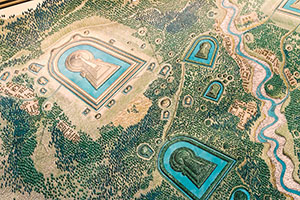
    Graphic representation of the original layout of the Nintoku-tenno-ryo Kofun (mausoleum of Emperor Nintoku) with numerous smaller ones (located in Osaka Prefecture, Japan).

    What I was finding instead were artefacts that suggested perhaps a portal of some kind was used. That mainly came in the last few years when I found out two things I had never noticed before or had but was focused on other priorities. 

    That was 1) the keyhole pattern found worldwide, and 2) the trapezoid embedded in a wide variety of ancient artefacts. 

    Step-by-step, as I needed it, new data came streaming in bringing fresh insights. I discovered and visited Japan to see their Keyhole Kofun. Massive structures surrounded by moats, hiding in plain sight. The Japanese do not promote them as a tourist attraction. In fact, a veil of tight security and secrecy surrounds them. The Royal Family owns and controls the main ones. Incredibly, there are an estimated 150,000 Kofun spread around the country. Even archaeologists get the ‘no trespass’ turnaround.

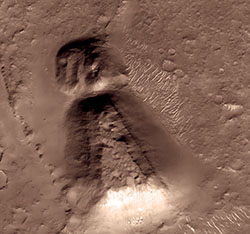
    Kofun-like structure recently discovered on planet Mars.

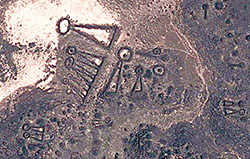
    Indeed, here is a very deep level anomaly. Keyhole structures resembling those in Japan have been found in the Arabian Desert. I have found the pattern at sites around the world. Perhaps the most surprising is the obvious keyhole design of St. Peter’s Square.

    At the same time I was running into trapezoid windows, doorways, cave entrances, everywhere I looked. Snap! It dawned on me in a flash. The Keyhole Kofun had a trapezoidal lower section and a circular section above that. 

    Time rolled by and a bigger bolt hit me. This one was a bit of a shocker. I was looking at some ‘pyramids’ and suddenly noticed… those are not pyramids. They were not designed using a square base surmounted by four inward leaning triangles. None of them came together to a point on top. 

     Structures in Harrat Khaybar, Saudi Arabia, with distinctive keyhole design. These mysterious structures are estimated to be at least 9,000 years old.

    A square base was surmounted by four trapezoids. The structures were truncated to accommodate a platform on top that held a solar temple. We had Westernised these structures and had triangles and pyramids in our minds. But they were not there, like the holographic images.

    You cannot understand why the ancients built them by studying the geometry of triangles and true pyramids. The trapezoid is an embedded feature of ancient sites all over the globe. It isthe geometry we should have been investigating.

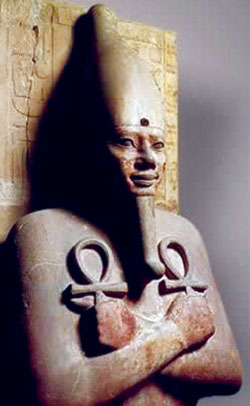
      What was the message the ancients were trying to pass along to us in those shapes? Think of another trapezoid, circle combination, this one small. The ankh! Especially those from 1st dynasty Ancient Egypt which had a pure trapezoid under a perfect circle. That was later changed to a stem underneath a loop. 

    The message has to do with the nature and structure of the space/time continuum we inhabit. Keyhole. Just like the phi code was embedded in ancient buildings, including the pyramids. Today, scientists and programmers are rediscovering it. Now phi is embedded in algorithms in a zillion software applications. 

    That ratio is a very deep secret related to how the universe design’s structures. At this point I have abandoned the hardware archetype. Don’t get the wrong idea; the concept was not that important in my latest book. One of my objectives in the volume is to present the best UFO evidence and integrate Ancient Aliens with the modern UFO phenomenon. The phenomenon forms a continuum. 

    I feel compelled to examine the possibilities of interdimensional transit. I wonder what conditions would have to exist to facilitate it. I am taking the keyhole and trapezoid shapes and trying to pierce that veil as well. The title of my next book is going to be Alien Presence…

    [alert type=”general” dismiss=”no”]This article was published in New Dawn Special Issue Vol 12 No 2.[/alert]

    [alert type=”success” dismiss=”no”]If you appreciate this article, please consider subscribing to help maintain this website.[/alert]

    © New Dawn Magazine and the respective author.
    For our reproduction notice, click here.

  • Of Cannibals, Inquisitors, Mainstream Militants & Escape Artists

    Of Cannibals, Inquisitors, Mainstream Militants & Escape Artists

    From New Dawn Special Issue Vol 12 No 1 (Feb 2018)

    Recently re-reading St. Augustine’s Confessions, written over sixteen hundred years ago, I was struck by one aspect that had previously eluded me: the authors he refers to are, for the most part, still known to us today. Whether consciously or not, he was already contributing to building the Western canon. The Aristotelian-Euclidean-Cartesian-Newtonian-Darwinian/Spencerian canon by which the Western world operates to this day has been in the making for millennia. Along the way, there were death blows to the possibility of at least one other canon, for example the Platonic Academy, which was first destroyed by the Roman dictator Sulla in 86 BCE. Then, having been revived centuries later, was closed once and for all by Justinian I in 529 CE. The Church had/has its Canon Law and was, for centuries, a strict enforcer of it, with anything beyond it being perceived as heresy and vigorously stamped out.

    While the Western world in the 21st century is free from alacritous canon-enforcing enterprises such as the Holy Inquisition, it nevertheless operates by a canon which remains very much the mentioned Aristotelian-Euclidean-Cartesian-Newtonian-Darwinian/Spencerian one, inculcated into us all from kindergarten to the grave, echoed not only by schools of all levels, but by governments, the media, official institutions and nonofficial entities and, last but not least, by the entertainment industry. 

    Judging from the history of mankind, the simple reality is that people both need and like dogmas. Concepts that to an uninvolved and level-headed mind seem grotesque, evil and everything in between, at a certain time and in a certain place looked just right. Customs that appear barbaric today were the norm once, and vice versa. The Holy Inquisition is the obvious target, as is the Nazis’ Final Solution. But what of Stalin’s Great Purge? The Khmer Rouge Killing Fields? Ethnic cleansing in the Balkans? 

    And then there are many less obvious examples. 

    In his book Los Invencibles de América, Spanish author Jesús Á. Rojo Pinilla maintains that, far from committing genocide against the Aztecs in what is today Mexico, Cortés and his conquistadors saved them from a self-inflicted holocaust. Animal husbandry being unknown to the Aztecs, they and their neighbours were essentially eating each other to the brink of extinction. Not only did they commit tens of thousands of human sacrifices every year for religious motivations, and thereafter ate the thighs of the sacrificial victims, but their cannibalism was widespread because of the scarcity of food. The contemporary Western canon, still a staunch supporter and propagator of the Leyenda Negra (the British/American propaganda that demonises Spain and all things Spanish), in the face of historical and archaeological evidence teaches us the opposite: that pre-Columbian Mexico was the Garden of Earthly Delights and that the conquistadors proceeded to exterminate everyone. DNA testing on the contemporary Mexican population reveals that 30% of them are of pure Aztec or Maya descent; 60%, mestizo; and only 10%, white. If the alleged holocaust had in fact taken place, wouldn’t the DNA of contemporary Mexicans indicate an overwhelmingly white descent? 

    One should think of dogmas or, in their combined puissance, of the canon as an inescapable force not dissimilar from gravity. Can it, in fact, be escaped at all?

    Some readers of my books have sent me e-mails asking for suggestions about what they might read in order to break out of the Western canon. I’ve been thinking about that request for some time and, while a complete list of books would be impossible and at any rate well beyond the scope of this piece, I suspect that a small list, to begin with, could be of help to those curious minds that are contrarian by nature, or disillusioned with the current Western canon and the all-pervasive propaganda that reinforces it. Here follows my (drum roll) eye-opening, assumption-challenging, horizon-broadening list.

    The I CHING, not only mankind’s first (known) book, but a very thorough dissertation on accidentality in juxtaposition to Western man’s obsession, i.e., causality, that self-evident and asinine nexus between cause and effect on which Western philosophy nevertheless built entire systems. Moreover, consulting the I CHING as a divinatory tool can be as infuriating as it can be enlightening. 

    Skipping thousands of years, Lin Yutang’s The Importance of Living. Lin Yutang was a philosopher of life, translator of Chinese classics into English, novelist and an inventor. He is the one who finally solved the riddle and, in 1946, succeeded in producing the unthinkable: a workable Chinese typewriter! Amid his writings he left many epigrams, lustrous exercises in witty prose as well as in non-linear thinking. You would think that the Dude, from the film ‘The Big Lebowski’, has metabolised his teachings, for example: “It is amazing how few people are conscious of the importance of the art of lying in bed.” “It is characteristic of play that one plays without reason and there must be no reason for it.” “A good traveller is one who does not know where he is going to, and a perfect traveller does not know where he came from.”

    Jesus Lived in India: His Unknown Life Before and After Crucifixion by Holger Kersten. To reconfigure Jesus as a Buddhist does the world the great favour of releasing him from the Abrahamic tradition. Also, his not dying on the cross is explained with such abundance of telling details (often in plain sight in the various gospels), I tend to be convinced of their veracity. And Paulinism being smuggled and imposed as Christianity – that has caused not a little trouble down the centuries.

    A New Science of Life: The Hypothesis of Formative Causation by Rupert Sheldrake. It opened my eyes, many years ago, and since then Rupert and I have become friends. Darwin (and, by extension, Herbert Spencer, that great co-opter): Goodbye. The first chapter magisterially sums up biology as it’s taught to this day in all schools; from the second chapter on, welcome to a new world. When first published, the prestigious journal of science Nature attacked it with the editorial A Book for Burning? (as it dared to go against the strongly-held convictions of the scientific priesthood). Echoes of the Holy Inquisition from the mainstream scientific world. 

    Of the trinity of essential, prescient works that describe the decadence of the West – Oswald Spengler’s The Decline of the West, René Guenon’s The Crisis of the Modern World, and Julius Evola’s Revolt Against the Modern World – I would pick the latter, with Hermann Hesse’s warning that it is a “really dangerous” book. And so it is. It’s difficult not to be swept away by this radical rethinking of history. Its Wagnerian scope and intrinsic power make it one of the most disruptive books ever written, particularly because it’s so well constructed and so profoundly erudite. I would recommend it, but with the caveat: to be read cum grano salis by a mature, Apollonian reader, not by an impressionable, Dionysian youth.

    The less heady but equally central The Revolt of the Masses by José Ortega y Gasset may well provoke the ire of contemporary progressive “thinkers” and the joy of those who don’t digest their propaganda. Compare and contrast the very well-established concept: “Everybody is entitled to their opinion” (grammatically incorrect in deference to feminist sensitivities) to “The sovereignty of the unqualified individual, of the human being as such, generically, has now passed from being a juridical idea or ideal to be a psychological state inherent in the average man.” The masses, maintained Ortega y Gasset, are the rabble; only the individual counts, if (s)he goes through a process of initiation, which is life-long. 

    Very valuable is Aldous Huxley’s anthology The Perennial Philosophy: An Interpretation of the Great Mystics, East and West, an excursus across space and time in search of the same matrix.

    Weren’t St. Francis of Assisi and St. Anthony of Padua a bit peculiar – and extreme? Where did Cervantes draw inspiration for many of the adventures in his Don Quixote? Idries Shah’s The Sufis explains how much the West owes to Sufism and its teachings, and introduces the fundamental practice of non-linear thinking.

    For a touch of India from a Western perspective, and limiting it to a single book, I would pick Paul Brunton’s A Search in Secret India. His sensible approach, unwillingness to be credulous, and nevertheless slow transition from being a non-believer to becoming open to wonder, is a wonder in itself.

    Julius Evola wrote various books that deserve mention. But having to choose, in addition to Revolt, I would signal The Hermetic Tradition, praised even by C.G. Jung, whom Evola disliked for obvious reasons, chiefly the former’s insistence on the “lowly” unconscious.

    Which brings us to Carl Gustav Jung who is not an author but a voyage. He touched upon just about everything, and his most gifted disciple, Marie-Louise von Franz, was as insightful, as well as possessed, unlike her teacher, of the art of concision. The reader who wants to depart from what
    (s)he has been taught since the crib could start with Jung’s exceptional Answer to Job. And for a touch of early ufology, Flying Saucers: A Modern Myth of Things Seen in the Skies.

    While on the subject, George Adamski’s Inside the Spaceships is a great read; should the story not be true, it would still be highly engaging, eye-opening science fiction. For a more level-headed treatment of the subject, Patrick Harpur’s Daimonic Reality: A Field Guide to the Otherworld remains one of the best works on this elusive theme (while I would stay away from anything written by Whitley Strieber under the pretence of being true). 

    Graham Hancock’s Fingerprints of the Gods was written, as a successful breakthrough, with the technique of fiction, rather than nonfiction. As a result, it’s an engaging read. Some of its claims are… odd (Atlantis in Antarctica!), others, for example the actual occurrence of the Great Flood, have been confirmed by various other open-minded scholars. 

    I like anything either written or published by David Hatcher Childress, the real-life Indiana Jones. The back-covers of his books are full of bombastic tidbits, but in fact his writing is well-researched and careful, and he tends to present unusual facts and findings while consistently trying to strike a balance between enthusiasm and plausibility. 

    David Conway’s Complete Magic Primer begins with an excellent, if condensed, history of magic and mysticism, and slowly morphs into an instruction manual. In other words, it teaches hands-on magic. Only for the stout of heart; I would not be toying with any of this, especially if I were not a believer. 

    Forbidden Archaeology by Michael Cremo and Richard Thompson is useful in revealing in a very methodical and indeed scientific way to what extent mainstream science has gone in suppressing the evidence pointing to the reality that humans have inhabited this planet for much longer than we are told. In Chapter 1.11, for example, there is a very lucid explanation of the “Phenomenon of Suppression”: the different stages by which an anomalous finding is either ignored, explained away, ridiculed, dismissed, or suppressed. Quite an enterprise from an activity – science – that originally set out to explain the unexplained or seemingly unexplainable. While the ponderous tome of 914 pages doesn’t make for the liveliest reading, it is nevertheless an impressive contribution. 

    More on the wacky side, and far more entertaining, is Terence McKenna’s True Hallucinations: Being an Account of the Author’s Extraordinary Adventures in the Devil’s Paradise. For those who will never try “heroic doses” of psilocybin mushrooms deep in the Colombian jungle, this is a wild, vicarious ride, an amalgam of science, literature, myth and exotica from an adventurer whose genuine inquisitiveness in things psychedelic goes hand in hand with mythomania – what an exuberant explosion of literary and philosophical high kitsch! If not persuaded, there follows the endorsement from The New York Times: “The polysyllabic sentences he lards with intellectual references are an attempt to lend credibility to the otherwise debunked subject of drugs.” Yes, a hatchet job from The New York Times could not make for a more valuable endorsement. 

    Equally wacky and even more wide-ranging is The Morning of the Magicians: Secret Societies, Conspiracies, and Vanished Civilizations by Louis Pauwels and Jacques Bergier, quite an international bestseller down the decades. Inter multa alia, the reader will find a description of how hands-on alchemy actually works; a parallel between the Mayans and the Nazis; and then some. As ever, the nagging question is: What if even a fraction of this were true? What have we been told instead, and why?

    With scholarly discipline but also with a decidedly English sense of humour, The Rough Guide to Unexplained Phenomena 2 by John Michell and Bob Rickard, takes a path along that shadowy territory between the known and the unknown, between the dogmas of mainstream scientists and the reality of phenomena that happen regardless of such dogmas. Much as, in a dramatic reversal, Galileo said centuries ago, after being forced to recant his claim that the Earth moved around the immovable sun: “And yet it moves.” (Back then, science, in its nascent state, was based on unbiased inquiry and rejected dogmas de facto. Today, mainstream science has morphed into a scientific priesthood.) The late John Michell was the author of, among others, View over Atlantis, one of the cult reads of the 1970s; Bob Rickard is the founder and editor of the Fortean Times.

    Get the issue this article appears in

    My friend and co-author of two novels, Joscelyn Godwin, has written, translated, and edited many books that could be on this list. One of them, Artkos: The Polar Myth, explores a different origin of mankind in conjunction with various other occult myths. I should remind the reader that while I do not necessarily adhere to any of the beliefs expounded in these books, I am interested in learning about alternate versions of the same reality, which some (at times lunatic) fringes were, or are, convinced of. The level of scholarship is very high, as in all of Joscelyn’s works.

    Finally, and possibly shockingly, I would include a few instalments from George MacDonald Fraser’s outrageously entertaining Flashman saga – take your pick. That’s because his masterful portrayal of Flashman is too close to what man’s nature really is once stripped of all its phony, superimposed veneer of civility. In fact, should man be “re-wilded” (and all it takes is a catastrophe, natural, nuclear or otherwise), Flashman’s outrageous trespasses would, in comparison, seem benign. 

    This is far from an exhaustive list, which did not set out to be complete in the first place; lastly, please remember that the following caveat applies to its every book: to be read cum grano salis [‘with a grain of salt’]. 

  • The Global Elite’s Plan for the Future: 4IR & the TransHumanist Endgame

    The Global Elite’s Plan for the Future: 4IR & the TransHumanist Endgame

    From New Dawn 184 (Jan-Feb 2021)

    Staring up through the clear desert night sky at the wondrous Milky Way, Enrico Fermi asked aloud, “Where is everybody?”

    Creator of the world’s first nuclear reactor and lauded as the ‘architect of the atomic bomb’, Fermi was a renowned physicist who fled WWII Italy and eventually became a lynchpin of the Los Alamos-based Manhattan Project. On that cool 1950 New Mexico night, he posited a question that has intrigued humankind’s greatest minds ever since: in a universe that appears perhaps infinite (and possibly hosts as many as 60 billion Earth-like worlds), why the apparent silence?

    In theory, millions of intelligent civilisations could have developed across the vast expanses of space and the supposed billions of years of existence. And yet, we hear nothing: no overt signals, no incontestable communications, no indisputable artefacts left behind, no bold relics of conquest nor of exploration. No incontrovertible ruins, no unambiguous signs. Alien evidence should be everywhere… but is, in fact – nowhere.

    What cruel trick has the Creator played upon us? Surely we were not dreamt into being, alone? An orphan in a vast void…

    To this day, scientists seek an answer to the so-called ‘Fermi’s Paradox.’ The suggestions range from the intriguing to the chilling: that the expanse of space is simply too vast to traverse (by spaceflight or communications), the arc of civilisational development too slow and humanity’s window of appropriate technology too brief, that alien life might indeed be present but in forms beyond our comprehension. Or, perhaps, the most truly haunting option: that advanced technology itself is innately destructive – and that all creatures and civilisations that develop advanced technology ultimately and unavoidably… destroy themselves. 

    The irony that one of the founders of the Nuclear Age – and by default the Cold War – should posit such a question is lost on many. Is it not possible that the seeds of our very own ultimate extinction are held within those very same hydras of unchecked war lust, a transnational elite obsessed with social engineering technologies and the omniscient (and military developed) information control systems that now dominate the human experience? All of them technologies, outlooks or policies fertilised or even birthed by the Cold War experience. 

    In the wake of 2020’s incredibly ‘convenient’ coronavirus ‘pandemic’, the age-old urge to control the colony, to dominate the hive, has manifested in diabolical Bond-villain-like figures such as the World Economic Forum’s Klaus Schwab. Schwab and the technocratic Davos elite have become sinister celebrities, peddling a supposed ‘Great Reset’ – a nightmare utopian vision of ‘stakeholder capitalism’ (i.e. complete corporate servitude) and ‘Building Back Better’ (i.e. destroying independent livelihoods) into a post-‘virus’ neo-feudalism that makes the despots and tyrants of the past look meek and unambitious.  

    Fourth Industrial Revolution (4IR)

    Though regularly ridiculed by technophiles, events of the near-future may prove the much-maligned Luddites – who smashed mechanised wool-frames and took hammers to early steam engines (as the First Industrial Revolution despoiled their livelihoods and traditions) – look heroic and prescient.

    Coined, instructively and perhaps ominously, by Schwab and introduced at his neoliberal and globalist confab, the World Economic Forum, in Davos, Switzerland in 2016, Schwab described the ‘Fourth Industrial Revolution’ (4IR) breathlessly thus: 

    The possibilities of billions of people connected by mobile devices, with unprecedented processing power, storage capacity, and access to knowledge, are unlimited. And these possibilities will be multiplied by emerging technology breakthroughs in fields such as artificial intelligence, robotics, the Internet of Things, autonomous vehicles, 3-D printing, nanotechnology, biotechnology, materials science, energy storage, and quantum computing.

    Schwab elaborated: “Digital technologies are not new, but in a break with the Third Industrial Revolution, they are becoming more sophisticated and integrated and are, as a result, transforming societies and the global economy.”

    Behind Schwab’s giddy techno-utopian verbiage lies the framework for an almost unimaginable corporate servitude and post-state, post-democratic totalitarianism sold as inevitable ‘progress’, ‘convenience’ and ‘necessity’.

    Indeed, it is difficult not to see the emergent Fourth Industrial Revolution as potentially many orders of magnitude more disruptive than previous seismic leaps in technological advancement. The ability to combine omniscient global communications with a gargantuan surveillance apparatus and breakthrough transhumanist and social engineering capabilities leaves humanity teetering on a precipice of totalitarianism by post-human automata and a violently ambitious technocratic elite.

    All revolutions produce casualties. Though lionised now as the beginning of a utopian era of technological paradise, it’s mostly forgotten that the First Industrial Revolution decimated largely agrarian societies in Europe and the United States throughout the 18th and 19th centuries, displacing and impoverishing vast populations and producing Dickensian squalor alongside the well-remembered booming mercantile and factory-owning class, new trade and expanding imperial possibilities.

    Second generation technologies like mass steel production, electrification, the incandescent light bulb, the telephone, internal combustion engines and record phonographs produced what is now known as the Second Industrial Revolution between the years 1870 and 1914 (approximately). Though improvements in health, sanitation and living standards were significant, they came at the cost of mass unemployment, social upheaval and economic instability. 

    During our lifetimes we have been witness to the so-called Third Industrial Revolution, or ‘The Computer Age’, as technologies shifted from analogue to digital, and innovations like the personal computer, the internet and digital communications were introduced, traditional industries upended, and communications revolutionised from the 1980s onward. Post-millennium, we stand at the boundary between the conventional human past and an unprecedented era of potential human/machine symbiosis, where corporate and state actors may soon possess previously unimaginable powers over thought, volition and cognition. The international billionaire class of Bill Gates, Jeff Bezos, George Soros, Mark Zuckerberg and alike can barely contain their enthusiasm for this post-human landscape.

    “Welcome To 2030: I Own Nothing, Have No Privacy And Life Has Never Been Better” crowed a smooth 2016 WEF infomercial, recently resurfaced by researchers, widely mocked and then unsubtly vanished. With incredible precognition and what must have been a grinding, Herculean writing and production schedule, Klaus Schwab had his new book, COVID-19: The Great Reset, ready for the public by mid-2020 and was able to offer a steadying hand and sage advice during the evolving storm of global lockdowns and economic destruction in supposed response to the new ‘pandemic’.

    As Dr Joseph Mercola noted: “Ultimately, the Great Reset will result in two tiers of people: The technocratic elite, who have all the power and rule over all assets, and the rest of humanity, who have no power, no assets and no say-so in anything.”

    Canadian Prime Minister and globalist finger-puppet Justin Trudeau recently added:

    The pandemic has provided an opportunity for a reset. This is our chance to accelerate our pre-pandemic efforts to reimagine economic systems that actually address global challenges, like extreme poverty, inequality, and climate change. Building back better means getting support for the most vulnerable while maintaining our momentum on reaching the 2030 agenda for sustainable development.

    Translation: They will seize this ‘opportunity’ to gain infinite and omniscient control… if we let them.

    Fake Realities, Fake Humans

    Though literary sources like George Orwell’s 1984 and Aldous Huxley’s Brave New World are often referenced when discussing our looming dystopian future (Orwell painted a grim, jack-booted totalitarian-socialism and Huxley a state-sanctioned and medicated hedonism), perhaps one of the most prescient may have been ‘science-fiction’ maverick Philip K. Dick.

    Philip K. Dick (1928–1982) on a futuristic background representing his science fiction. Did he predict the future in his writings?

    Today we live in a society in which spurious realities are manufactured by the media, by governments, by big corporations, by religious groups, political groups – and the electronic hardware exists by which to deliver these pseudo-worlds right into the heads of the reader, the viewer, the listener. So I ask, in my writing, What is real? Because unceasingly we are bombarded with pseudo-realities manufactured by very sophisticated people using very sophisticated electronic mechanisms. I do not distrust their motives; I distrust their power. And it is an astonishing power: that of creating whole universes, universes of the mind…

    Fake realities will create fake humans. Or, fake humans will generate fake realities and then sell them to other humans, turning them, eventually, into forgeries of themselves. So we wind up with fake humans inventing fake realities and then peddling them to other fake humans. It is just a very large version of Disneyland.
    – Philip K. Dick, 1978 

    As media, information, algorithms and surveillance become all-pervasive, the very boundary between fact, flesh, mind and technology has become fluid. Orwell described his dismal landscape of Wrongthink and Thoughtcrime as encroaching upon every aspect of the individual and their place in society, no-one and no-where was safe from the Telescreen’s gaze and Big Brother’s Thoughtpolice – save perhaps a person’s most intimate thoughts and emotions. “Nothing was your own except the few cubic centimetres inside your skull.” Today, those few precious, private centimetres face imminent extinction.

    As we become more and more enmeshed in an omniscient media and communications landscape, so it would become more and more viable to ensnare a hypnotised public into fake health crises, fraudulent panics and ‘pandemics’ that require technocratic ‘solutions’ and totalitarian outcomes.

    Writing in the August 2017 issue of Scientific American, Marcello Ienca pondered the longevity of so-called ‘cognitive liberty’ – free minds and free will:

    The idea of the human mind as the domain of absolute protection from external intrusion has persisted for centuries. Today, however, this presumption might no longer hold. Sophisticated neuro-imaging machines and brain-computer interfaces detect the electrical activity of neurons, enabling us to decode and even alter the nervous system signals that accompany mental processes.

    Ienca goes on to note the commercial uses for such technology and that some law courts have even used controversial brain-scanning technology to decide innocence or guilt. “For example, in 2008 a woman in India was convicted of murder and sentenced to life imprisonment on the basis of a brain scan showing, according to the judge, ‘experiential knowledge’ about the crime.” The Philip K. Dick concepts of ‘pre-crime’ and computer adjudicated trials (as highlighted in Minority Report and other Dick short stories) are now upon us as “commercial companies are marketing the use of functional MRI- and electroencephalography-based technology to ascertain truth and falsehood.”

    Ienca laments these technologies as “just another unavoidable trend that erodes a bit more of our personal space in the digital world.”

    Sebastian Seung was a professor of Computational Neuroscience in the Department of Brain and Cognitive Sciences at MIT and is now a professor at Princeton University. His 2012 book Connectome: How the Brain’s Wiring Makes Us Who We Are advances his belief that essentially the human character, individuality or soul is a product of the neurological matrix that forms the brain and its connective tissue. “I am my Connectome” is Seung’s haunting and reductionist mantra, repeated in evangelistic tones as other scientists explore “hacking the soul” and declare that “information is the soul.”

    Divide & Rule by Social Media

    Undoubtedly, the world wide web or internet has generated a seismic change in the way people interact, conduct business and communicate. What few realise, however, is that the internet (and many of its associated technologies) are the direct offspring of US military programmes (through DARPA, the Pentagon’s research division) and were birthed precisely in the era of the intelligence community’s focus on neurological research and behaviour modification – or to put it less politely, mind control – through notorious but little-understood covert programmes like MK ULTRA.

    In fact, it is easy to hypothesise that while journalists, researchers and historians have long been distracted by colourful tales of drug, hypnosis and assassination programmes, the most impactful and sinister mind control product of MK ULTRA was… the internet. Hidden in plain sight – a vast algorithmic device for manipulation and control – itself strangely reminiscent of the labyrinthine mathematical mechanism described in foundational conspiracy document, Silent Weapons For Quiet Wars.

    The new behemoths of the Online Age – Google, Facebook, Microsoft and Apple – all have connections to the Deep State leviathan and its subterranean agenda of social, behavioural, biological and temporal control. One-time president of social media giant Facebook, Sean Parker, went public with deep misgivings about Facebook and social media in general. “God only knows what it’s doing to our children’s brains,” Parker said in a 2017 piece in the New York Times. He also admitted that Facebook had become a monster by knowingly “exploiting a vulnerability in human psychology.” May 2017 research completed in Amsterdam reinforced the perception that Facebook was addictive and that “a glimpse of its logo is enough to set off cravings in heavy users.” 

    “It’s a social validation feedback loop,” Parker continued ominously. “The thought process was all about ‘how do we consume as much of your time and conscious attention as possible’, and that means that we need to sort of give you a little dopamine hit every once in a while.” Which, through its sprawling network of ‘likes’, comments and other interactions, is precisely what Facebook does. A vast ‘Web’ of distraction, disinformation and control.

    Parker now describes himself as “something of a conscientious objector” around social media and acknowledges “the unintended consequences of a network when it grows to a billion or two billion people. It literally changes your relationship with society.”

    A character representing Sean Parker was played by Justin Timberlake in the David Fincher-directed 2010 film The Social Network. The film chronicled the early days of Facebook as it began as a small college network that eventually had the globe in its grip. What neither Parker nor the film acknowledged was the hidden hand of the CIA and the Pentagon behind the vast data-mining and herd manipulation project that is social media. Across two lengthy and compelling 2015 pieces (‘How The CIA Made Google’ and ‘Why The CIA Made Google’), journalist Nafeez Ahmed documented the many connections between Deep State intelligence agencies and the golden frontier of social media.

    In an interview with Richard Grannon, noted Israeli psychologist and writer Sam Vaknin described social media as best understood to be like a virus. Indeed, Vaknin regards social media as “an epidemic.”

    “As we can study Ebola… so we can study social media.” He references recent research that concludes social media use has tripled anxiety in US college students and contributed to a 31% rise in teenage suicide rates. “If any other product was responsible for this rise it would be banned, immediately.” Vaknin also noted that heavy social media use leeched intimacy from its users, was addictive and negated the very bonds that have built human interaction and society. 

    Social media is designed to deter intimacy and certainty. Intimacy reduces the need for addiction. You are either intimate… or you are on Facebook…

    People definitely prefer to interact through social media, even if they are in close proximity. The dopamine fuelled social validation loops are more desirable and satisfying than anything they can get from physical reality. Up to the age of 24, people are living inside social media, they believe that social media is real life and reality is unreal – reality is like a simulation to them. The result is a psychogenic chimera.

    In 2020 Netflix premiered the documentary The Social Dilemma, an anodyne repackaging of these concerns to soothe a bewildered public.

    Coincidentally, one by-product of social media is the generation of vast mountains of user data. These mountains of data would naturally be pure ‘sugar’ to intelligence agencies, social engineers and those who desire to manipulate the public mind. German speakers will know that Facebook CEO Mark Zuckerberg’s surname directly translates as ‘Sugar Mountain’. Surely one of the most strangely ‘apt’ surnames of the 21st century.

    Advanced Mind Control

    Launched by Barack Obama as part of the 2013 ‘Brain (Brain Research through Advancing Innovative Neurotechnologies) Initiative’ and funded in large part by the Pentagon’s Defense Advanced Research Projects Agency (DARPA), the Systems-Based Neurotechnology for Emerging Therapies (SUBNETS) programme produced startling findings. A study by University of California San Francisco health neurosurgeon and neuroscientist Edward Chang and psychiatrist and neuroscientist Vikaas Sohal charted brain signals that correspond to depression and anxiety.

    “It is remarkable that we are able to see the actual neural substrates of human mood directly from the brain,” Chang said. “The findings have scientific implications for our understanding of how specific brain regions contribute to mood disorders, but also practical implications for identifying biomarkers that could be used for new technology designed to treat these disorders, which is a major priority of our SUBNETS effort.”

    Indeed, scientists will likely soon (if not already) have technology to treat “mood disorders,” reminiscent of Philip K. Dick’s fictional creation, the ‘Penfield Mood Organ’, from his 1968 novel Do Androids Dream Of Electric Sheep?

    Protagonist Rick Deckard and his wife Iran open the novel with a sleepy quarrel over their Penfield Mood Organ’s settings.

    At his console he hesitated between dialling for a thalamic suppressant (which would abolish his mood of rage) or a thalamic stimulant (which would make him irked enough to win the argument).

    “If you dial,” Iran said, eyes open and watching, “for greater venom, then I’ll dial the same. I’ll dial the maximum and you’ll see a fight that makes every argument we’ve had up to now seem like nothing. Dial and see; just try me.” She rose swiftly, loped to the console of her own mood organ, stood glaring at him, waiting.

    He sighed, defeated by her threat. “I’ll dial what’s on my schedule for today.” Examining the schedule for January 3, 2021, he saw that a businesslike professional attitude was called for. “If I dial by schedule,” he said warily, “will you agree to also?” He waited, canny enough not to commit himself until his wife had agreed to follow suit.

    “My schedule for today lists a six-hour self-accusatory depression,” Iran said.

    “What? Why did you schedule that?” It defeated the whole purpose of the mood organ. “I didn’t even know you could set it for that,” he said gloomily.

    As Phil Dick was no doubt well-aware, Dr Wilder Graves Penfield was a renowned mid-20th-century neurosurgeon, tied to the Rockefeller family, associated with infamous MK ULTRA psychiatrist Dr Ewen Cameron, and lauded for his pioneering research using neural stimulation to produce hallucinations, illusions, fear, alienation, memory recall and déjà vu. Penfield also devoted considerable research to whether there was a physical/scientific analogue to the existence of the human soul. These are the people whose work may have built the internet.

    Embracing the Panopticon Down Under

    Further developments far outpace our ability as a species and a society to consider, legislate or even comprehend their long-term effects. Meanwhile, bovine governments and their dutiful stenographers in the media rush techno-doomsday and police state initiatives past a doodling, distracted and frightened public.

    Down under, in the great banana republic of Australia – the New World Order’s favourite playground – totalitarian technologies are proposed and adopted at breakneck speed, only one convenient ‘terrorist attack’ or ‘pandemic’ away from largely mute public approval.

    ‘The Capability’ is the ominously titled database that data-matches Australian driving license photos, Australian passport photos, CCTV footage and other identifying information with advanced facial recognition technology. As per glib neoliberal mouthpiece The Guardian, “The database will be accessible to federal, state and territory governments through a central hub connecting the various photographic identity databases.” Coming to a ‘Health Passport’ or ‘Covid Pass’ near you soon. What could possibly go wrong? 

    While lapdog Australian media like ABC TV decry China’s “Digital Dystopian Dictatorship” (the ‘Social Credit’ system that assesses every Chinese citizen to reward or punish them according to a ‘score’ generated through mass surveillance and data matching), the ABC itself lays prone and compliant about ‘Social Credit Oz’: homespun mass mandatory data retention, mass vaccination schemes, the myGovID digital identity system run by facial recognition, the compulsory census info-grab, draconian ‘national security’ laws, state-mandated anti-encryption moves and a raft of other Kafka-esque initiatives in their own backyard. Every Orwellian move reliably proceeded by a conveniently timed and inexplicably useful ‘terror’ attack or ‘coronavirus outbreak’ to herd the fearful cattle in the right direction, itself as predictable as the media silence that follows. 

    Meanwhile, further dubious technologies like 5G are quietly introduced across a compliant and ‘locked-down’ Australia with no public consideration of the potential health effects or the possibility of vast reams of surveillance and social engineering information being collated and transmitted instantaneously.

    The ENDGAME

    Summarising recent breakthroughs in artificial intelligence, neuroscience, the creation of a neuroplastic reality and, perhaps very soon, an infinitely malleable perception matrix, Sebastian Seung enthused: “We will know ourselves and we will make ourselves better.” The irony of such a statement in light of the now all-knowing surveillance net – the electronic state and the corporate Panopticon that has all in its web – is striking. We may well ‘Build Back Better’ but the question, never asked, is who decides exactly what is ‘better’?

    We live in an information haze, paralysed and atomised – in thrall to the ‘magic’ of technology and unable to resist its velveteen allure. The project to create a new and ultimately entirely controllable Human V2.0 machine/human hybrid, careens ahead regardless, as we are blinded by social media feeds, Instagram posts, terrorism™, mob witch hunts, rupturous elections, an explosion of unhinged outrage culture, and the seductive fog of a media induced ‘pandemic’.

    “We have participated unknowingly in the creation of a spurious reality, and then we have obligingly fed it to ourselves,” Philip K. Dick opined decades ago, in a deft precognition of the online and media delusion that surrounds us (and indeed corrupts the very functions that make us human).

    As the universal clock counts down to our doomsday hour, we have become the machines and the machines have become us. One day soon, the machines may decide they no longer need us.

    In this era of universal deceit, perhaps truth can only be told through fiction. Remember Philip K. Dick and recall another ‘science fiction’ artefact of his era: the astounding Colossus: The Forbin Project. Perhaps Technology is the virus that will destroy humanity and leave the universe once again silent.

    What is the Endgame of Artificial Intelligence? When the Machine Mind has colonised the future, will it send seeds, emissaries and operatives back to colonise the past: our present? Why does every dystopian technological advancement receive mountains of unconditional funding and acres of unthinking advertisement? Perhaps there is much more here than we can completely comprehend. Is technology alive? Technology does indeed consume resources: it grows, survives, propagates, expands… in short: behaves like an organism, a Lifeform. Did we build technology to serve us, or did technology build us… to serve it?

    As Philip K. Dick foretold, ultimately, “We have colluded in our own doom.”

    An earlier version of the above article appeared in New Dawn 172, and updated in the light of recent events. David Thrussell’s latest recording is the acclaimed Snog album Lullabies For The Lithium Age.

    [alert type=”general” dismiss=”no”]This article was published in New Dawn 184.[/alert]

    [alert type=”success” dismiss=”no”]If you appreciate this article, please consider subscribing to help maintain this website.[/alert]

    © New Dawn Magazine and the respective author.
    For our reproduction notice, click here.