New Dawn – World's Most Unusual Magazine

Category: Articles

  • The Golden Age of Social Engineering

    The Golden Age of Social Engineering

    From New Dawn 163 (Jul-Aug 2017)

    The totalitarian urge is not, historically speaking, a new thing. The eons are etched with the rise and fall of empires, despots and demagogues: numberless battles waged and endless conflicts have been fought for the bodies, hearts and minds of the many.

    In the past century alone, obvious examples of the instinct to control mass populations surfaced repeatedly. While it is generally accepted these totalitarian tides ultimately foundered, the extraordinary advances in electronic and computer technologies witnessed in recent decades may have delivered us to the final and fatal shores of potential permanent technocratic enslavement. A penultimate moment in the great swinging pendulum of fragile human freedom. The ‘Golden Age’ of the cyber-yoke.

    In previous eras, imperial conquests, resource grabs and the intranational and international slave markets captured bodies and shackled armies of unfortunates into indentured servitude. Over time this trade withered (it could be argued more so due to inherent logistical and economic unsustainability than the more common and more palatable narrative of ‘moral awakening’). It could also be speculated that the instinct to dominate ‘lessers’ never really vanished but remains strategically dormant from time to time. 

    We now stand, however, at a precipice where it is no longer necessary nor even desirable to capture bodies for political or economic power: today’s battlefield is for the mind, the technological management of perceptions, the vast yet subtle canvas of technologically-enabled social engineering. For, if the slave cannot see himself as a slave, then he can never truly resist his bondage either.

    This new mechanism for permanent mass mental-enslavement has two gargantuan pincers – one overground and one underground. The overground rubric consists of the omniscient media and conditioning biosphere – traditionally formed by a coalition of industrially minted Hollywood-style mass ‘entertainment’ products, the organs of compulsory state ‘education’ and the self-regulating and self-reinforcing ‘news’ media. In recent years ‘digital disruption’ has given rise to the painful yet inevitable displacement of the all-powerful legacy media by the emerging online titans of ‘social media’.

    While ostensibly an organic process, it’s instructional to note that the ‘Internet explosion’ has innumerable connections to our intelligence agencies and so-called ‘Deep State’ nexus. Are we witnessing a unique era of hyper-controlled information and opinion?

    How the CIA Made Google
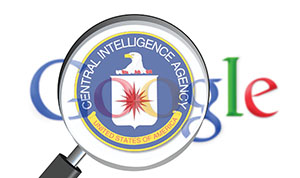
    In a thorough, detailed, substantive, striking and universally ignored January 2015 Medium magazine piece, journalist and academic Nafeez Ahmed chronicled at length the substantial seed-funding channelled from the CIA/NSA/DARPA locus to Google founders Sergey Brin and Larry Page while they developed their nascent (and soon omniscient) online Goliath at Stanford University.

    According to Ahmed, “the United States intelligence community funded, nurtured and incubated Google as part of a drive to dominate the world through control of information. Seed-funded by the NSA and CIA, Google was merely the first among a plethora of private sector start-ups co-opted by US intelligence to retain ‘information superiority’.” He further claims this clandestine process, “allowed some of the most powerful special interests in corporate America to systematically circumvent democratic accountability and the rule of law to influence government policies, as well as public opinion in the US and around the world. The results have been catastrophic: NSA mass surveillance, a permanent state of global war, and a new initiative to transform the US military into Skynet.”

    Perception management was the focus of this project from the outset, as arms of the Pentagon/Deep State octopus mushroomed outward. Marketed as supposedly fresh-faced dot-com innovators, “Google styles itself as a friendly, funky, user-friendly tech firm that rose to prominence through a combination of skill, luck, and genuine innovation. This is true. But it is a mere fragment of the story. In reality, Google is a smokescreen behind which lurks the US military-industrial complex.”

    Through a labyrinth of shadowy funding cut-outs like the MITRE Corporation and MDDS, and directed by the equally obscure ‘Highlands Forum’ (a ‘liaison/bridge’ between the Pentagon/CIA/NSA and ‘private’ industry and the major defence contractors), Brin and Page spent years being shepherded by the invisible hand of the secret state. It’s not difficult to hypothesise what the secret state wanted in return – ‘Total Information Awareness’.

    According to a career CIA scientific researcher and academic attached to the project, “the last time we met in September 1998, Mr. Brin demonstrated to us his search engine which became Google soon after.” That very same month, Brin and Page officially incorporated the Google company.

    In-Q-Tel – Funding New Technologies of Surveillance

    Founded in 1999, In-Q-Tel is the CIA venture capital investment arm. Linked numerous times to Google (through rotating board members and executive officers, and even more directly in co-investments and stock connections), the In-Q-Tel website lists, “Information and Communication Technologies,” “Physical and Biological Technologies,” “On-site determination of individual human traits for Intelligence Community purposes,” “Tracking and/or authentication of both individuals and objects,” “Nano-bio Convergence” and “Physiological Intelligence” as areas of activity. A deep domain of mass surveillance and mass conditioning.

    According to Lee Fang in The Intercept, April 2016, In-Q-Tel has also invested in “a range of skin care products… a patented technology that removes a thin outer layer of the skin, revealing unique biomarkers that can be used for a variety of diagnostic tests, including DNA collection.” Dr. Kevin O’Connell, a ‘senior solutions architect’ with In-Q-Tel, remarked that, “The DNA contained in microorganisms in a person’s gut or on a person’s skin may contain sequences that indicate a particular geographical origin.” Even skin will be analysed and weaponised.

    In-Q-Tel was also a presence at the birth of the now ubiquitous data-mining colossus Facebook, through a number of board member and funding connections (notably Accel Partners and DARPA) that ran into many millions of dollars. It is estimated that today Facebook has at least 1.2 billion daily users – vast swathes of their personal information available to be collated, analysed, actioned and owned in perpetuity. As the Facebook terms of use noted at one point, “by posting Member Content to any part of the Website, you automatically grant, and you represent and warrant that you have the right to grant, to Facebook an irrevocable, perpetual, non-exclusive, transferable, fully paid, worldwide license to use, copy, perform, display, reformat, translate, excerpt and distribute such information and content and to prepare derivative works of, or incorporate into other works, such information and content, and to grant and authorise sub-licenses of the foregoing.”

    With economical irony Facebook’s ‘privacy policy’ also declared: “Facebook may also collect information about you from other sources, such as newspapers, blogs, instant messaging services, and other users of the Facebook service through the operation of the service… in order to provide you with more useful information and a more personalised experience.”

    This is, in effect, a blanket permission to retain, collate, combine, analyse, monetise and weaponise any and all information gleaned through the site and other sources. An open ticket for permanent surveillance.
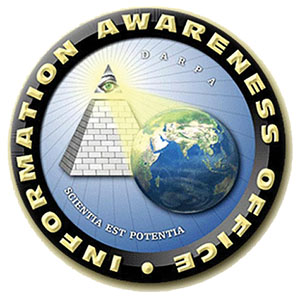
    ‘Total Information Awareness’

    Indeed, an abortive attempt to launch a doppelgänger omniscient surveillance dragnet first surfaced through the Pentagon’s ‘Information Awareness Office’ in 2002.

    ‘Total Information Awareness’ was a US programme (commissioned by the IAO) from early 2003 until it was defunded in late 2003 after a public backlash over its admittedly ominous title and logos. Scientific American remarked that the “creepy” Total Information Awareness programme “never really ended,” the New York Times noting that it was “quietly thriving” at the NSA. TIA may have overreached with its draconian branding and sinister sub-Illuminati presentation. An alternate branding, something a little more ‘friendly and funky’, perhaps with an exuberant, geeky figurehead, would probably fly a little better with the public.

    The Facebook website was officially launched on 4 February 2004.

    Supposed chieftain of the now world-beating Facebook mega-corporation, Mark Zuckerberg, has never really impressed as anything more than the Deep State’s start-up poster-boy.

    Zuckerberg in his 2017 ‘Mission Statement’ was clearly prodded to include as many saccharine buzz-words (“civically-engaged,” “inclusive,” “supportive” etc) as possible, while attempting to lamely obscure the manifesto’s barely-subterranean push for censorship, political partisanship and global governance. A high-tech low-calorie caterwaul for the New World Order.

    Indeed, it would be laughable were Facebook not the leading global disseminator of ‘news’ and aggregator of pilfered mass personal information. The clouds grow thicker and more sinister again when one considers Facebook’s experiments in ‘emotional contagion’, ‘voter engagement’, ‘shadow-banning’ and regular disappearing of ‘disagreeable opinions’.

    An unsubtle crop of ever-more familiar names rotate through positions at the Pentagon, NSA, DARPA, CIA, Google and Facebook (and the institutions and corporations that have invested, developed or greased-wheels between them). Peter Thiel, Anita Jones, Regina Dugan, Gilman Louie, Rob Painter, James Breyer and countless others spin in ever-decreasing circles around the nexus of ‘national security’, high technology and ‘Information Superiority’. As Ahmed pointed out, “many of Google’s most senior executives are affiliated with the Pentagon Highlands Forum, which throughout the period of Google’s growth over the last decade, has surfaced repeatedly as a connecting and convening force. The US intelligence community’s incubation of Google from inception occurred through a combination of direct sponsorship and informal networks of financial influence, themselves closely aligned with Pentagon interests.”
    Google bought the ‘Keyhole’ satellite imaging technologies that power Google Earth from In-Q-Tel (the CIA venture capital arm): just one among countless instances of advanced technologies that bounce easily between military and ‘private’ spheres.

    Google was also directly and regularly in business with the Pentagon: quietly selling “enhanced versions of Google Earth” (as targeting systems for drone strikes and alike) and “search engines that can be used internally by agencies.” 

    A series of 2014 emails surfaced between then NSA Chief General Keith Alexander and Sergey Brin, wherein Gen. Alexander described Google bluntly as a “key member of [the US military’s] Defense Industrial Base.”

    Notable also is the number of Goldman Sachs executives and senior partners on that rotating list, marking the financial and banking behemoth, “responsible for creating the billion dollar fortunes of the tech sensations of the 21st century, from Google to Facebook, (as also) intimately linked to the US military intelligence community.”

    Going Underground in the Battle for the Mind

    The Deep State/Military-Industrial-Entertainment-Complex aims for ‘Full Spectrum Dominance’ not simply on the traditional battlefield but now more so in the battle for the mind – a conflict raging across social media, legacy media, new media and essentially all electronic communications. The 2014 Pentagon report ‘A New Information Paradigm? From Genes to “Big Data” and Instagram to Persistent Surveillance… Implications for National Security’ was typical of the vast and incalculably ambitious event horizon where all roads appear to lead to globally co-ordinated social control.
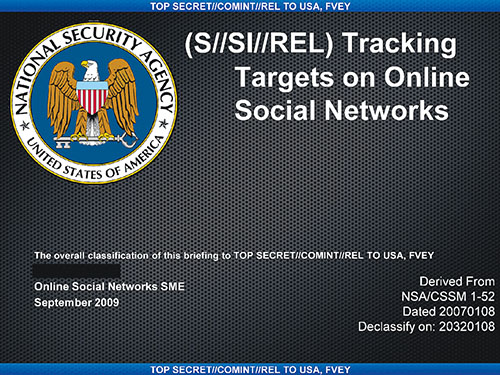
    Screenshot from NSA’s online spy toolkit, part of “XKEYSCORE,” a software program that collects “nearly everything a user does on the Internet,” according to former NSA contractor Edward Snowden who leaked the classified programs in 2013.

    And it’s here that the Leviathan goes underground. Thanks to alleged whistleblowers like Edward Snowden, William Binney and Wikileaks’ ‘Vault7’ revelations, we now have an inkling as to the mind-boggling reputed surveillance capabilities of largely secret (and wholly unaccountable) agencies like the NSA and Great Britain’s GCHQ. Through a plethora of programmes such as PRISM and XKEYSCORE, it would appear that every electronic communication, every photo, every video, every tweet and phone call, is now collected and available for analysis or use (we also know that Google often directly builds and supplies surveillance technology in partnership with the NSA). The standard media apologist or sweaty politician’s justification for this gargantuan dragnet is ‘terrorism’, an excuse so lame that it does not deserve a serious response. Internal Pentagon communications make the actual target perfectly clear – “the domestic population.”

    It’s entertaining to witness unpredictable data-mining upstart Cambridge Analytica crib basic social engineering and election ‘management’ ploys from the NSA/Google playbook – as the organs of controlled media ‘opposition’ like The Guardian look on and meltdown in agonised apoplexy.

    We now have the distinction of being the most surveilled populace in all of history. Every tyrant from ages past spins with electro-static envy.

    Further Pentagon communications also advocate weaponising “armed non-state groups” and the creation of “pseudo-terrorist groups” for the express purpose of manipulating the opinions and emotional “core” of domestic populations – a glib and bland clarion call for permanent war, propaganda and social conditioning of the highest order.

    According to Ahmed’s research, “The Pentagon must also increase its capacity for ‘behavioural modelling and simulation’ to ‘better understand and anticipate the actions of a population’ based on ‘foundation data on populations, human networks, geography, and other economic and social characteristics’.”

    Ongoing projects evaluated how “the psychological reaction to narrated events is ‘influenced by how the narrator frames the events, appealing to different values, knowledge, and experiences of the listener’. Narrative framing that ‘targets the sacred values of the listener, including core personal, nationalistic, and/or religious values, is particularly effective at influencing the listener’s interpretation of narrated events’, because such ‘sacred values’ are closely tied with ‘the psychology of identity, emotion, moral decision making, and social cognition’. By applying sacred framing to even mundane issues, such issues ‘can gain properties of sacred values and result in a strong aversion to using conventional reasoning to interpret them’.”

    One line of research has been dedicated to “extracting narratives from millions of American, Iranian and Chinese weblogs, and subjecting them to automated discourse analysis to compare them quantitatively across the three languages. The investigators then follow up using behavioural experiments with readers/listeners from different cultures to gauge their reaction to different narratives ‘where each story makes an appeal to a sacred value to explain or justify a morally-questionable behaviour of the author’.”

    Surely, only the naive would ask why the Pentagon funds research investigating how to exploit people’s ‘sacred values’ to extinguish their capacity for logical reasoning, and enhance their emotional openness to ‘morally-questionable behaviour’?

    A plot, it appears quite clearly, for ultimate and systemic control. The new ‘mental plantation’ of emotional triggers, bewildered dupes, permanent animalised fear and electronic herd instincts. All in service, it would seem, to the digital overlords and the ‘rape-and-pillage’ economics of globalism.

    Ideas Ripped from Literary Sources?

    It’s possible to see the modern informational and political landscape as inexorably and perversely shaped and even predicted by a triumvirate of influential historic literary sources – H. G. Wells, Aldous Huxley and George Orwell.
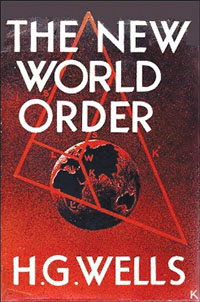
    Though largely known today as ‘merely’ a science-fiction writer (War of the Worlds, The Time Machine etc.), Wells was also a prodigious non-fiction writer, theorist, committed socialist and passionate forward-thinker. An entire sub-set of his writings has almost completely vanished from the popular consciousness: extraordinarily insightful, prophetic and relevant books like The New World Order (1940) and The Open Conspiracy (1928), oddly out-of-print for many decades.
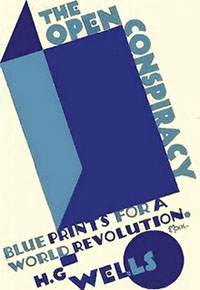
    In those latter two volumes, Wells clearly advocated for the titular ‘New World Order’, arguing that only a one-world government supported by a vigorous, free and open press (in his view) would be strong enough to resist the inevitable and malignant power of transnational corporations and the financial elite. The Open Conspiracy acknowledged that the general population would have great animus toward such a project, without a concerted campaign of mass propaganda and a subterranean scheme to disable nationhood and democracy through secret trade agreements and labyrinthine international treaties. However well-meaning Wells’ original concepts, they have been inverted to secure a global architecture of control into the hands of the very financial elites and transnational corporations that he sought to blunt.

    The most noteworthy political leader to reanimate Wells’ ‘New World Order’ concept and phrase in modern times was US President George Herbert Walker Bush. It’s tempting to see him as some kind of Golem/Homunculus re-combination of ‘Herbert George Wells’ and American imperialist and slaver hero William Walker.

    Note also that this project has advanced in part through the perky mass entertainment distractions of Huxley’s ‘feelies’ and the conditioning of his pan-pharmaceutical, soporific ‘soma’. From Orwell’s nightmare dystopia Nineteen Eight-Four we seem to have inherited the perpetual war state, fuelled by a revisionist propaganda atmosphere, waves of perpetually synchronised ersatz ‘terrorist’ attacks, omniscient surveillance and the obligatory Emmanuel Goldstein/Osama Bin Laden/ISIL crew (direct from central casting). Though these authors wrote cautionary tales, those tales have now been weaponised.

    No matter what their actual provenance, many foundational documents of ‘conspiracy’ folklore are today eerily prescient about decades-long social engineering projects.

    Originally available as a series of three cassette recordings (taped in 1988 and sometimes titled ‘The New Order of Barbarians’), the recollections of Dr. Lawrence Dunegan prove to be haunting and compelling. He described a lecture he ostensibly attended on 20 March 1969 (given by one Dr. Richard Day), wherein a nefarious plan for the complete disablement and infantilisation of civic, democratic society was tabled. Dr. Day invoked a mass campaign of propaganda, brainwashing and social engineering of such scale as to be difficult to comprehend. The vast majority of his outlandish predictions now seem to have come to pass.

    Likewise, an anonymously xeroxed samizdat document ‘Silent Weapons For Quiet Wars’ (most likely authored by the intriguing figure of Hartford Van Dyke) mapped human society in a series of pseudo-scientific diagrams and descriptions, specifying suggested positions for economic and cultural ‘shocks’ to render the body politic paralysed and obedient.

    Despite this apparently omniscient ‘Manhattan Project’ of sinister synthetic bondage, resistance might yet arise in unpredictable places.
    The Rise of the ‘Precariat’

    A recently identified substrata or caste of people, the so-called ‘Precariat’ (a neologism: being the presumed combination of ‘precarious’ and ‘proletariat’), draw their numbers from the collapsing middle-class and tend to be ‘over-educated’ and unable (in today’s ‘flexible’ labour market) to find secure employment suitable to their upscale skill-set. They also tend to be smart, disenchanted, disenfranchised, angry, supposedly ‘irrational’ and liable to be unconvinced by mainstream political orthodoxies. In other words – they don’t think (or vote) the way they are supposed to – and some ‘blame’ them for the shock of Brexit and the election of orange-plated iconoclast Donald Trump. Not ‘racists’, nor ‘homophobes’, nor ‘misogynists’: as globalism savages those excluded from the professional-elite-enabling and media/academic classes, the Precariat can only grow in numbers and seething underground rage. 

    Sir John Glubb was a professional soldier, diplomat, scholar and writer. His little-known 1978 volume The Fate of Empires lucidly charted the rise and fall of numerous empires past. It’s difficult not to see reflections of our own Golden epoch in its pages: as the Anglo-American empire stumbles through the inevitable downward imperial arc (the ‘Age of Affluence’ followed by the final ‘Age of Decadence’) and violently thrashes to stay afloat – grasping at God-like schemes of complete control (or planet-wide annihilation). 

    Both Orwell and Lenin voiced the opinion that humanity’s best hope rested in the hands of an awakened proletariat. Perhaps, if they were alive today, they might shift their allegiances to the Precariat – that educated yet entirely uncomfortable class destined to listless part-time work in unfulfilling service fields (like ‘Uber’) and environmentally inoculated against the prevalent parasitic thought paradigm (and its attendant globally networked, socially engineered zeitgeist).

    The scholars and scientists in service of empire have likely studied Glubb, Wells, Huxley, Orwell and alike: synthesising a delightful, gilded menu of utterly fantastical control mechanisms. History, however, tells us that all empires overreach and collapse inwardly from decadence and hubris. But we stand on a knife-edge. Can these ‘science-fiction’ technologies override the inherent cycles of civilisation? Will these inhuman and autocratic sciences prevail and condemn us to an ahistoric future of permanent soul-slavery? Or will those ‘cast-offs’ – the human detritus discarded by the machines of external and internal conquest – vanguard an unlikely resistance?

    It’s up to you.

    It is better to perish than to live as slaves.
    – Sir Winston Churchill

    [alert type=”general” dismiss=”no”]This article was published in New Dawn 163.[/alert]

    [alert type=”success” dismiss=”no”]If you appreciate this article, please consider subscribing to help maintain this website.[/alert]

    References

    Sir John Glubb, The Fate of Empires, William Blackwood & Sons, Edinburgh, 1978
    H.G. Wells, The New World Order, Secker & Warburg, London, 1940
    H.G. Wells, The Open Conspiracy, Victor Gollancz Ltd., London, 1928
    Aldous Huxley, Brave New World, Chatto & Windus, London, 1932
    George Orwell, Nineteen Eighty-Four, Secker & Warburg, London, 1949
    “How the CIA made Google: Inside the secret network behind mass surveillance, endless war, and Skynet—part 1” by Nafeez Ahmed, https://me
    dium.com/insurge-intelligence/how-the-cia-made-google-e836451a959e
    “How the CIA made Google: Inside the secret network behind mass surveillance, endless war, and Skynet—part 2” by Nafeez Ahmed, https://medium.com/insurge-intelligence/why-google-made-the-nsa-2a80584c9c1
    ‘CIA’s Venture Capital Arm Is Funding Skin Care Products That Collect DNA’ by Lee Fang, https://theintercept.com/2016/04/08/cia-skincare-startup/
    https://wikileaks.org/ciav7p1/index.html

    © New Dawn Magazine and the respective author.
    For our reproduction notice, click here.
  • Archetypes To Live By: The Power of Universal Symbols

    Archetypes To Live By: The Power of Universal Symbols

    From New Dawn 164 (Sept-Oct 2017)

    A human life is a story, with a beginning, middle and an end. Like stories, our lives are filled with moments and experiences that shape us into who we ultimately become. Many of those moments and defining experiences become embedded within the subconscious mind, and even deeper into the ‘collective unconscious’ where they continue to drive our behaviours, actions and thoughts long after their shelf-life has worn out. They take on a symbolic form, and, in turn, a universal aspect that is understood, and experienced, by others all over the world regardless of time, place, colour, gender or creed.

    These universal symbols are called ‘archetypes’, a word which has its roots in the ancient Greek archein for ‘original, old’, and typos for ‘pattern, type or model’. Archetypes are models or blueprints of original patterns, concepts, ideas, objects, themes and motifs that are later copied, modelled after, emulated and derived from. They serve as a foundation for understanding who we are not only as individuals, but as the collective of humanity as well.

    Two of the biggest figures in the development and evolution of the study of archetypes were Swiss psychoanalyst Carl Gustav Jung, and comparative mythologist Joseph Campbell. Both have been instrumental in our understanding of archetypes, and their research served as the springboard for more recent examinations by noted authors and experts in the field of personal transformation.

    Levels of the Mind

    Before we delve into the world of archetypes, we need to understand the levels of the human mind and how they operate. The most obvious to us is the conscious mind, which basically is the present and aware mind we live with on a daily basis. It is awake, rational, analytical and observant, but also preoccupied, overwhelmed and distracted. It is both clear mind and monkey mind, and the level of mind we use to interact with others and our physical environment.

    Just below the level of the conscious mind lies the mighty world of the subconscious, where the vast majority of our behaviours, thoughts, actions and personalities emerge from. Like the base of an iceberg, the tip being the conscious mind, the subconscious is the ‘driver’ of the vehicle and is a place of shadows and darkness, buried experiences and embedded patterns, old beliefs and fears and all sorts of programming that has built up over the years, often at the hands of external influences like parents, peers, teachers, religious and political figures and cultural beliefs.

    Where the conscious mind makes plans, the subconscious mind often derails those plans because of old patterns we don’t even know are there. So, it makes sense that most of who we believe ourselves to be is not even who we really are. Rather, it is the product of the vast expanses of the subconscious. And it is very hard to find the programming within, let alone change it!

    Deeper still is a realm of mind that connects us to everyone else, and to all of humanity. It is below the personal subconscious, and filled with images and symbols as its means of expression. Dreams, visions, patterns, and yes, archetypes, live here in the collective unconscious, which may be described as the universal grid we are all locked into, yet often completely unaware of.

    Carl Jung believed that it was here, at this deepest layer of reality, of mind, that most of what made us ‘us’ existed. The collective unconscious is not a place where language and words are spoken, but where images and symbols reign. These symbols are universal to humanity, and links us to those who have lived in the past, and to those who live thousands of miles away, in cultures and societies far different than our own. On this level, we all ‘get’ each other.

    Archetypes

    Born in 1875, Carl Gustav Jung was a Swiss-German with a fascination for the fields of psychiatry and psychotherapy. He began his illustrious career as a student of Sigmund Freud until differences of ideologies, basically those of Freud involving infantile sexuality and the Oedipus Complex, drove Jung to strike out on his own. Jung believed that the world’s myths, origin stories and even religious stories contained universalities that were shared by all, even amongst cultures that had no interaction with one another. How could this be? Jung noted the symbols common to all were archetypes, stored away in the collective unconscious, but always popping up into our human experiences and interactions in very visible and identifiable ways.

    From this “common psychic substrate,” as Jung called it, which is present in each and every one of us, comes the very source materials from which we become ‘human’ in a way we can all identify with. He wrote extensively about this in his seminal books, notably The Archetypes and the Collective Unconscious, which suggested archetypal symbols are not learned but inborn. These patterns were inherited by each generation by both genetic and non-genetic means. They became a part of the DNA of humanity, so to speak.

    The Jungian archetypes became the structures by which psychology, psychotherapy and even recovery therapy and counselling looked at the deepest root causes of personal patterns, dream motifs and long-held problems the conscious mind could not overcome or change. These symbols also infiltrate every aspect of creativity, entertainment and today’s pop culture in the characters and themes we most flock to in novels, movies and television shows.

    The main Jungian archetypes are:

    PERSONA: The mask we wear to others, and often ourselves. This is our public role and the way we wish to be perceived out in the world. It is NOT the true person we are.

    SELF: The authentic self, which can only be achieved once we have unified the SHADOW side and the ANIMA/ANIMUS. The whole SELF. This is what we should have as the ultimate goal – the real person we want to, and were meant to, be.

    SHADOW: The ‘dark’ aspects of SELF we often deny exist or tuck away into the depths of the subconscious. This is our primal, sexual, animal side. It is both creative and destructive, and often contains all that we have repressed.

    ANIMA/ANIMUS: The mirror images of gender within. The ANIMA is the female aspect, and the ANIMUS is the male aspect. Females have a repressed ANIMUS they must acknowledge. Males have a repressed ANIMA. 

    GREAT MOTHER: The nurturer and creative force, which begins as the archetypal MAIDEN, then becomes the caretaker and MOTHER of the world, and then becomes the wise old CRONE.

    HERO: The aspect that takes on challenges, exhibits bravery and courage, and partakes of the journey of life, obstacles and all, with all the growth, trials and transformations that it entails.

    CHILD: The innocent one who sees life as pure. The child within.

    WISE OLD MAN/WOMAN: The wise part of Self that knows all, sees all. Also known as SAGE, PRIEST, PRIESTESS, MENTOR, and even KING or QUEEN. Both kind and understanding, and cantankerous and snarky, just like our favourite grandparents.

    Other archetypes include everything from MARTYR, VICTIM, WARRIOR, SURVIVOR, PRINCE, PRINCESS, GODDESS, GOD, JESTER, FOOL, ARTIST, ANTI-HERO, BEAST, HEALER, GENIUS, STORYTELLER, LEADER, FOLLOWER and even DEMON. While Jung was focused upon the main archetypes associated with his field of study, we can easily see how modern humans exhibit a number of archetypes he did not include, and how those evolve along with humanity as a whole.

    For example, today we might call a ‘GEEK’ an archetype that is associated with the rise of technology all over the world. A boy in Japan and an old woman in Norway will both understand the symbol of someone immersed in gadgets and computer gear. Today, we might recognise a DIVA on a global scale, but thousands of years ago, she might have been called a GODDESS. We evolve, and therefore the inherent archetypes that describe our experiences do too.

    Archetypes can even be applied to life events that are universal, such as birthdays, marriage, first menses, menopause, death, funeral rites, baptisms, and coming of age rituals. Jung referred to them as “situational archetypes.” These events happen in most of the world’s cultures, with only the specifics that are changed. Interestingly, life itself is an archetype…

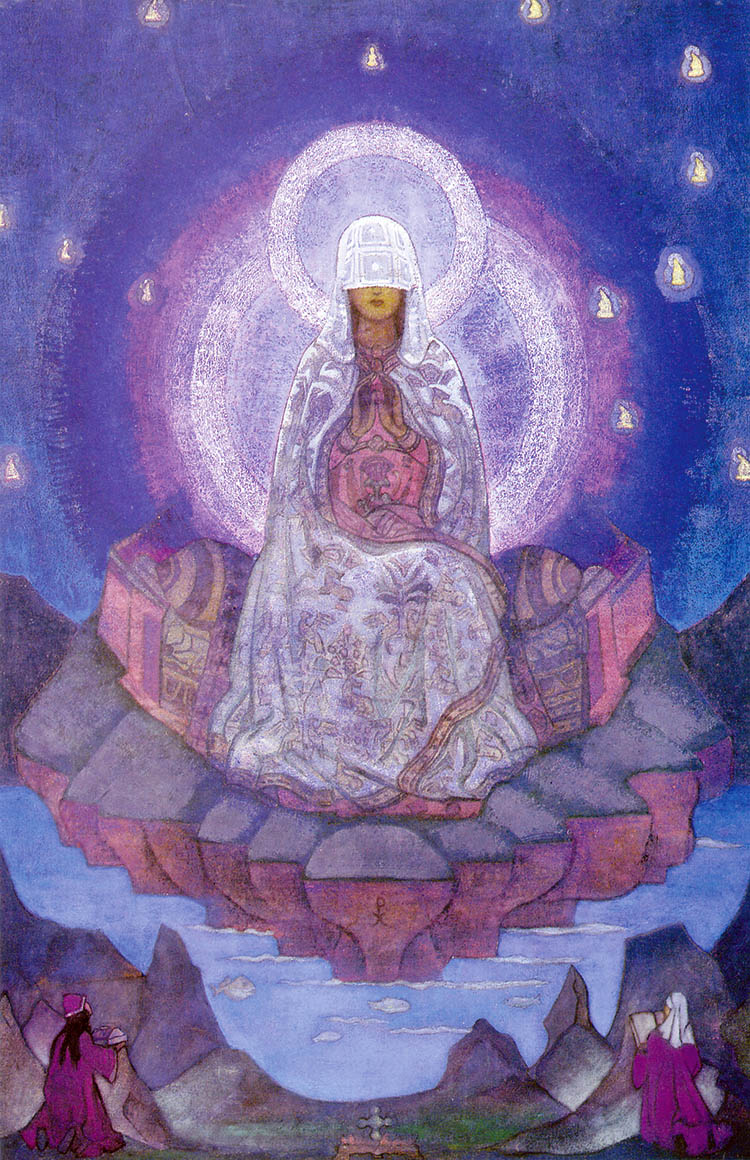
    Nicholas Roerich, ‘The Mother of the World’, painted in 1924.

    The Hero’s Journey

    Joseph Campbell’s “Hero’s Journey” is an archetypal motif for the human experience, itself filled with archetypes, and one of the most identifiable explanations of the universality of the most popular stories, whether they are old or new. Campbell was a noted mythologist, writer and lecturer who literally put comparative religion and mythology into the hands of the layperson by making such complex subjects both simple and understandable in his many books, including The Power of Myth, and lecture series for PBS. His “Hero’s Journey” motif was the basis for the most popular movie franchise in history, Star Wars, as George Lucas, the creator of the science fiction adventure series, was a huge fan of Campbell and met with him while structuring his storylines.

    One only needs to watch how the story of a young lad named Luke Skywalker unfolds to see this archetype at work and be able to identify with aspects of it. Luke begins as an innocent and ordinary young man, working for his aunt and uncle, when he is called to adventure upon their tragic deaths. He is afraid at first, but takes on that call and soon meets with allies in the form of two droids, who help him along in his journey. He also has wise older mentors to teach him the ways of the Jedi. He crosses the threshold from his normal life into one of galactic adventure, where he runs into the enemy in the form of a dark-cloaked individual who he must do battle with, but first he enters the dark cave of truth where he comes face to face with his innermost fears. He comes out to face the supreme ordeal, hitting bottom. The abyss calls out to him. But Luke seizes the sword and gets a reward for it, which drives him on to the journey home as a newly resurrected hero. Then, BOOM, before he makes it home, the biggest battle of all confronts him and he overcomes it, with his newfound courage, strength and wisdom. Then, finally, he heads back home with a treasure in hand, truly transformed,and is celebrated as a hero.

    The most endearing, and enduring, forms of entertainment contain this journey in some form. The genre might change from science fiction to western, but the bold elements are there in all their archetypal glory, and we respond accordingly.

    But understanding archetypes intellectually doesn’t help much when we are struggling to fully express ourselves and actualise the authenticity we feel within.

    Working With Archetypes

    So we understand what archetypes are. Big deal. Unless we can find a way to apply this knowledge to bettering our lives, it really doesn’t matter much. If a concept isn’t useful, we tend to toss it aside. However, when it comes to archetypes, we truly do have the ability to literally rewrite the stories of our lives if we know how.

    First we have to dig up the archetypes that operate us and put them under the microscope. Are they serving us? Are they sabotaging us? Did we even choose these archetypes in the first place, or were they chosen for us by other people with other agendas?

    It all begins with an honest appraisal of who we are, what our ‘story’ is, and how we see ourselves in the eyes of others. For some people, writing out the beats/defining moments of their own personal history can reveal telling patterns that may not be obvious on the surface. Meditating on our lives can do the same by shedding light where all was concealed in shadow. Then, sitting down and reviewing our story becomes more honest and truthful, much in the same way someone in recovery undertakes a ‘fearless moral inventory’ as part of the 12-step work. 

    This takes time and effort, but will show us exactly where patterns that still govern our actions and behaviours originated, and who planted them there. Only then can we ask if those patterns are chosen by us, and if they are helping us achieve authenticity and fulfilment of the SELF… or keeping us under the power and control of the PERSONA – the mask we wear for the world.

    One powerful way to see exactly what archetypes are active in our lives is to notice what we complain about the most.

    “I am so tired of doing everything for everybody. Who helps me?” 

    “Why do I have to always repeat myself? I feel like no one even listens to me or sees me?”

    “I am sick of being a doormat for others to take advantage of.”

    Any of those sound familiar? If so, think of yourself as a VICTIM or MARTYR.

    How about:

    “I always have to be strong.”

    “I am tired of saving everyone.”

    “I have to lead every situation because no one else steps up to the plate.”

    You, my friend, have a WARRIOR imbalance.

    And that is key, because some of the archetypes within are positive, some are negative, and some are just in need of a little balance. We all want to be warriors, but as shown above, when that archetype is too strong and active, we may need to temper it with a little VICTIM in order to not feel taken for granted, burnt out or overwhelmed saving the world. Even WARRIORS need to be taken care of now and then.

    We have all heard it said that it takes approximately 21 days to change a habit. When it comes to changing a negative archetype and replacing it with a more empowering one, we have to repeat ourselves and act as if. Say, for example, we want to replace the inner FOOL with a SAGE. We must pretend at first that we are wise and act from that belief until it becomes habitual and embedded within the subconscious, and then the collective unconscious. We may still behave as the FOOL now and then, but course correction is a part of archetypal work and it won’t happen overnight. Knowing that, we can move forward to creating a new ‘vision’ of who we are that is more aligned with our authentic SELF, and not the PERSONA we have been wearing just to survive.

    Guided visualisation can assist us in meeting with the aspects of ourselves we need to change or eliminate, and also to further empower the archetypes we like and that work for our greater good. 

    Watch Your Language

    Those who follow the teachings of the laws of attraction can attest to the power of words to define us. When we want to change our lives, and the symbols that we operate by, we must watch what we say as well as what we do. The words we choose to describe ourselves are telling.

    “I am a survivor.”

    “I am a loser.”

    “I am an addict.”

    “I am _________” Fill in the blank.

    What we say about ourselves is what we believe and what we manifest. Yet is it accurate, or again, imposed upon us from our childhoods by those who decided to label and categorise us as they saw fit? 

    In the recovery movement, standing up and saying “I am an alcoholic” or “I am an addict” is a powerful part of admitting the truth and getting out of denial. But are these labels ultimately keeping us stuck and associated with the very aspects we wish to change? Can we rephrase these to be more powerful and assist in our recovery? “I am a sober person.” “I am thriving without drugs.”

    Even those who are cancer survivors are recognising the amazing power that choosing words can have on their ability to stay positive and possibly assist in healing. “I am a cancer survivor” is being replaced with “I am a thriver,” and the difference in the energy is palpable.

    Act Local, Think Global

    The great thing about working with archetypes is that we not only become more actualised and authentic individuals, but we contribute to the collective. We can change the archetypes that are at play on a global scale from negative to positive if we do the hard individual work first. Imagine a world that is more PEACEMAKER and less WARMONGER. Can we envision and work towards a planet of NURTURERS and CREATORS, neutralising the overwhelming power of the DESTROYERS and USERS? This world can certainly use more ARTISTS and LOVERS and VISIONARIES. But first we must become those things on a personal level.

    Archetypes are working all the time in each of us, whether we stop to notice at all. By taking a look at where we are now, and whether or not we are living as we desire, we can get a good gauge on how much deep work is needed to take off the masks of the PERSONA and step into a more actualised SELF. Symbols and images are somewhat useless unless we can find a way to use them for growth and transformation. 

    If indeed a human life is a story, then each human has the ability to revise, rework and rewrite that story to better reflect the truth of who he or she is. That is the power of archetypes. They shape the subconscious and form the substrate of the collective unconscious. Without change on those levels, we cannot change on the conscious level.

    We must dive deep to the base of the iceberg and the dark murky ground upon which the base stands to really understand why we act, think and behave the way we do… and how we can once and for all tell the world the stories of our lives the way they were meant to be written.

    For more on this subject, obtain a copy of Marie D. Jones’ book The Power of Archetypes: How to Use Universal Symbols to Understand Your Behavior and Reprogram Your Subconscious (New Page Books, 2017).

    [alert type=”general” dismiss=”no”]This article was published in New Dawn 164.[/alert]

    [alert type=”success” dismiss=”no”]If you appreciate this article, please consider subscribing to help maintain this website.[/alert]

    © New Dawn Magazine and the respective author.
    For our reproduction notice, click here.
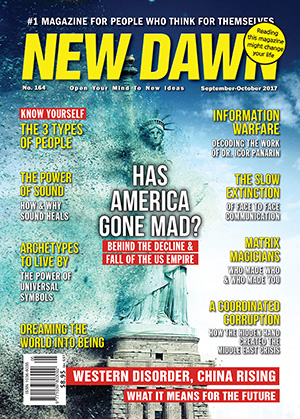
  • Western Disorder, China Rising….

    Western Disorder, China Rising….

    From New Dawn 164 (Sept-Oct 2017)

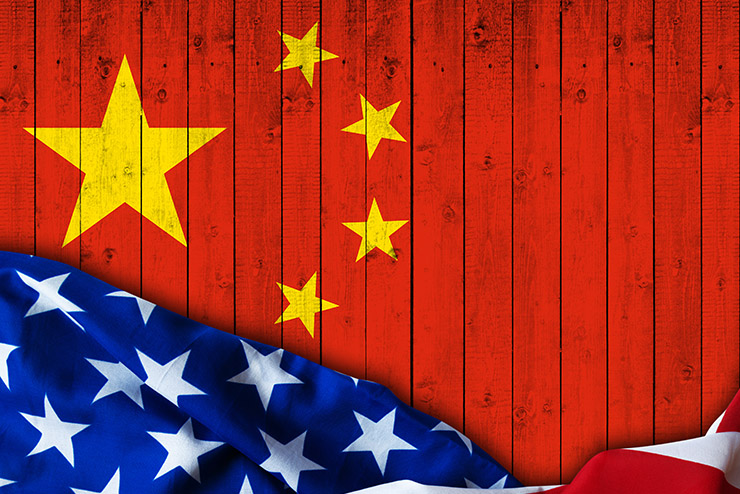
    Are we approaching the end of the English speaking world order? asks former Australian diplomat Reg Little  (1936-2019). This article, published in 2017, explains the reasons for the current state of affairs and the decline of the so-called “West.”

    Western decline is explored on a daily basis by anyone surfing a variety of websites addressing subjects like international finance, global geopolitics, advances in the China Russia partnership, troubles in any of America’s small wars, or technology advances in areas like quantum computing and hyper-sonic missiles. 

    Even a Pentagon study, “At Our Own Peril: DoD Risk Assessment in a Post-Primacy World,” which appeared in June 2017, explored aspects of the situation. This highlighted the problem as it was part of an effort to further raise the ineffective military spending that has already been a major contributor to US decline. In fact, the study provided evidence of a sense of desperation. Normally, Western political leaders and their mainstream media do their best to render any interest in such matters as evidence of folly and misguided loyalties.

    One sentence, randomly encountered in a daily commentary on precious metals, captures much of the widespread sentiment amongst informed observers: Watching America’s “leadership” destroy itself; aided and abetted by a vicious, yet self-immolating mainstream media that has, for all intents and purposes, been re-branded the “fake news,” it’s difficult to have hope for the future.

    As America has declined, China has become the world’s largest economy in real terms, the largest trading partner for most nations, the repository of the world’s largest financial reserves, the unrivalled leader in maintaining substantial rapid economic growth, and the pace-setter in critical technology innovation. It is also the leading global strategist, through its use of the Belt and Road initiative (BRI) to restructure the global trading community. This has the potential to marginalise recalcitrant English speaking, maritime nations accustomed to global authority.

    Russia, despite inherent differences with its neighbour, has been thrust into a close partnership with China by clumsy and counter-productive Western policies. This has strengthened China’s economic and political position through facilitating access to energy, nurturing an unrivalled defence and technology partnership, and providing an unchallengeable foundation for the BRI, reaching across Eurasia, into Africa, and even commanding attention across vast oceans.

    In the past, native speakers of the English language have been privileged in a variety of ways to be at the forefront of unprecedented intellectual, political, economic and technological initiatives for more than three hundred years. These built first a global empire and then aspired to construct a new world order, only today to confront an End of Empire moment. 

    The challenge posed by the BRI and highlighted by a Beijing meeting, hosted by China’s President Xi Jinping in May 2017, is very poorly appreciated. Its vision of new-tech infrastructure spanning and uniting Eurasia, Africa and beyond represents a fundamental conceptual transformation of the international trading and cultural order. China is at the strategic centre, in terms of infrastructure capacity, financial organisation and technological vision.

    The BRI will create many newly empowered multi-lingual and multi-cultural trading communities where the authority of the English language and its associated ways and values will be a fading memory. High-speed rail networks, massive ports and a variety of free trade zones will marginalise the English speaking, maritime people who have shaped the past three centuries, unless they integrate fully. 

    End of Empire periods are characterised by a major dilemma. Loyalty demands a commitment to the values and actions that have defined the past and the construction of empire. Strategic response and action, in contrast, demands a fundamental re-evaluation of those past values and actions and a readiness to anticipate and manage often unattractive imperatives. As relationships evolve and shift, this is a troubled and confused process. Previously privileged groups find themselves struggling internally to defend accustomed, but fading, powers and privileges.

    While the above historical phenomena seems universal, it is best and most copiously recorded in one part of the world. China has extensive written histories, and more recently diverse television series, exploring and evaluating human behaviour in the course of successive rises and falls of dynasties. These offer many insights into the confusing and chaotic trials being experienced in the English speaking world today. The complacent certainties of Manchu aristocrats at the end of the 19th century can seem to foreshadow similar qualities in Wall Street bankers in the early 21st century. In both instances, the comforts and certainties of the recent past inhibit the development of any coherent strategies to manage the challenges of the present and future.

    Competing English & Chinese Strategic Wit 

    Unfortunately, in today’s English speaking world there is neither a similar body of historical experience nor any form of comparable historical record. This allows the Chinese leadership class to oversee Western decline with both passive inaction and superior understanding. 

    A Western leadership class educated in Chinese classics and history might have remarked that its problems began over seven decades ago. At that time, a conquered and occupied Japan resorted in a highly disciplined manner to utilising a strategy that could be traced back at least as far as the Zhou Dynasty three millennia ago. The Twelve Civil Offensives of the Six Secret Teachings attributed to Jiang Taigong, the major strategist in the founding of the Dynasty, outline a means of conquest through service. A more powerful adversary is made first dependent, then vulnerable, through immaculate service.

    Despite a type of Western counter attack against the Asian Economic Miracle with the 1997 Asian Financial Crisis, China and other Asian peoples have been able to continue emulating Japan’s post-1945 example. Even so, no relevant Western leader has remarked on, let alone responded strategically to, this type of disciplined dexterity that turns weakness into strength, when confronted with a more powerful adversary.

    This example is but one of many that illustrate the contemporary failings of the English speaking peoples. A mythology has been created around their leadership role in creating a culture of progress. This works to render the past irrelevant and eliminate the need to study the historical experience and wisdom of other peoples. The British historian John Hobson in The Eastern Origins of Western Civilization identified a British practice of “intellectual apartheid,” which mocked and looked down on people who did not share the progressive values of the European Enlightenment.

    The folly of this Western culture of progress also elevates a type of financial power and corporate calculation to a form of supreme authority. This is displayed in a major form of criticism levelled against the BRI. This argues that it is difficult to see how many of the projects can produce an acceptable return on capital but neglects to note:

    • China’s need to find new markets to replace uncertain, and often declining, Western markets
    • China’s need to address economic instability amongst people on its Western borders
    • China’s rewards from economic dynamism in its Western regions
    • China’s already advanced strategy of becoming the global infrastructure standard setter
    • China’s use of BRI as a productive outlet for its reserves of fragile US dollars 
    • China’s use of BRI to defuse attempts to pressure it geopolitically
    • China’s use of BRI to consolidate its important relationship with Russia and other neighbours
    • China’s use of BRI to bond with surrounding and distant regions
    • China’s use of BRI to assume a central and leading position in global geopolitics 
    • China’s use of BRI to reduce the power and influence of an often hostile English speaking world 
    • The neglect, deliberately or otherwise, of these issues by most English language commentators reflects a variety of deep-seated Western vulnerabilities, including:
    • Chinese strategic thought and action frequently escape Western recognition
    • Chinese strategic action is almost impossible to comprehend using Western corporate values and priorities
    • Chinese strategic action exploits a deep mastery of Western thought 
    • Chinese strategic action can be based on Western ignorance of Chinese thought
    • Chinese remember and Westerners forget a century of Chinese humiliation
    • Chinese easily master the financial and corporate stereotypes that dictate Western thought
    • Chinese classical and historical wisdom has an infinite variety 
    • Chinese language limits severely Western understanding
    • Chinese strategists can count on the untranslatable character of much of their wisdom

    Interestingly, a book has just appeared with the title Cracking the China Conundrum: Why Conventional Economic Wisdom Is Wrong.

    A Problem for Imperial Legacies 

    Peoples such as those in what might be termed legacies of empire, like Australia, confront unique challenges during end of empire times. The centres of empire do not want to surrender accustomed privileges, even in distant parts of the world. The outposts of empire are also accustomed to various privileges, even if they are in decline, and can be loath to take the initiative in preparing for a future that promises less favours. Even worse, many habits of thought and behaviour are the product of empire and people have little idea of other possibilities even as these assume a powerful role in distant places. In this situation past habits and practices can continue to rule even when they no longer serve their intended purFor example, people in a country like Australia can continue to believe in the superiority of American and English education, commerce and technology even as evidence mounts that global best practice standards are being set in Japan or China. These sentimental and customary attachments become most difficult to abandon when such an adjustment demands the mastery of a difficult language, an alien way of thinking and challenging forms of community coherence. A review of the Australian Cabinet reveals not one person with any education, experience or interest of significance in a major Asian language, culture or economy.

    Not surprisingly, such a leadership community looks constantly to declining centres of empire far from Australia for guidance on how to respond to unfamiliar challenges. Alternatively, it takes guidance from those educated to the standards and habits of thought of those declining centres of empire. These authoritative figures produce guidelines for policy makers with erudite think pieces with headlines in English like “Saving the Global Economic System.” A more appropriate theme would be “The Challenges of Prospering in an Unfamiliar Global Economic System.” 

    In reality, the English language has become a thought prison for most. They cannot begin to think from the perspective of an emerging Chinese global economic system. Of course, this is no simple matter. 

    Once out of the education system, few career focused individuals can afford to venture into such a challenging and alien environment. Those who might decide that this cannot be avoided are unlikely to progress far. It will simply be too hard to build a community of like educated and like-minded allies to exercise any influence on the mainstream, to advance a professional career or become more than an irritating critic on the sidelines.

    In fact, three decades, from early childhood rote learning of the classics to professional relevance, would be needed to educate a generation of China literate professionals. As a consequence, most of the English speaking world will become ever more dependent on ethnic Chinese native speakers to assume leadership roles in a bewildering environment, best understood from Beijing. This is easily foreseeable and predictable today. This assertion, however, will be bitterly, if ineptly, contested in the English speaking world.

    Inevitable economic difficulties and budget funding shortages are already pervasive. These will become increasingly acute, as English language leaders continue to neglect the development of a greater capacity to comprehend the character of Chinese thought culture. 

    This is transforming the world first constructed by the Honorable English East India Company, under the guidance of its discreet, strategic and knowledgeable financiers. Unfortunately, few English speaking political leaders comprehend in any depth either the financial strategists who have shaped the fading global order or the Chinese strategists who are creating a dynamic new global order. 

    Today the West’s financial strategists not only support a succession of self-defeating wars but continue to neglect the importance of effective industrial policy and infrastructure maintenance. American infrastructure is in an advanced stage of neglect and disintegration. The Australian Treasurer has just announced plans to spend $10 billion over the next decade on an inland rail upgrade. But this may symbolise Australia’s increasing backwardness in rail efficiency. On completion, it could lag Chinese standards by more than several decades. At a time of imperial decline, the cost of being a legacy of empire takes many forms.

    The British Imperial Legacy

    Australia, being placed geopolitically and geocommercially in close proximity to, if not as part of, the dynamic Asian region, offers perhaps the most acute study of the dilemmas posed by the legacy of the British empire. Its present government in Canberra displays no evidence of any serious understanding of BRI or other Chinese and Asian dynamics. 

    It is difficult to avoid the impression that its Ministers are more guided by influences from a fading imperial past than by any understanding of Australia’s geopolitical and geocommercial realities. The nation’s leaders seem restricted to developing policy shaped by ‘information’ from the Murdoch and Fairfax media, which rarely strays from the orthodoxies of mainstream New York media and its financial masters. 

    In a sense, Australia’s present leadership seems too indolent to explore information from alternative sources or from insights and evaluations shaped by other traditions of thought culture. In many respects, and despite Australia’s geocommercial Asian dependence, Australia’s leaders seem to be little more than modelled on global English language stereotypes. As such they are captives of the disorder that is the contemporary legacy of an English speaking empire or world order.

    After some of their predecessors tried but failed to give substance to rhetoric about an Australian Asian future, the present generation of leaders seem resigned to leaving the future to others who will come later. They seem content to limit themselves to managing domestic disappointments as the economy is unnecessarily marginalised in a global order offering fewer and fewer privileges to English speaking peoples. Democratic processes perform poorly in this environment as Ministers mostly come to power with little relevant education or experience and leave power before the consequences of their failings become evident. English language limitations and conventions ensure a minimum of informed criticism of this process, as the maintenance of the mythology of democracy takes priority. 

    In Australia’s case there is a faint but unnerving echo of the innocence of the Aboriginal people before the arrival of European settlers. Mono-cultural Australian leaders today have little more real understanding of their neighbouring Asian civilisations than earlier settlers had of European civilisation several centuries ago. Yet the imperial certainties that created today’s Australia are now under challenge.

    [alert type=”general” dismiss=”no”]This article was published in New Dawn 164.[/alert]

    [alert type=”success” dismiss=”no”]If you appreciate this article, please consider subscribing to help maintain this website.[/alert]

    © New Dawn Magazine and the respective author.
    For our reproduction notice, click here.
  • The Philosopher Tsar: Vladimir Putin’s Favourite Thinkers

    The Philosopher Tsar: Vladimir Putin’s Favourite Thinkers

    From New Dawn Special Issue Vol 15 No 3 (June 2021)

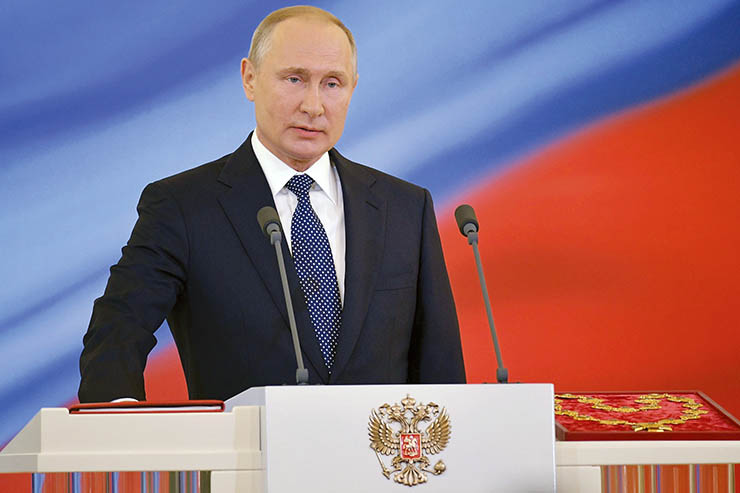
    In 2014, at the annual meeting of United Russia, the Russian Federation’s dominant political party, amidst the standard rhetoric of party politics, Russian President Vladimir Putin gave his regional governors a list of books he said they should read. 

    Putin likes to come across as a reader – Dostoyevsky is a favourite writer of his – and he isn’t averse to name dropping some classics in the middle of an interview. But the list he gave to his governors at that meeting didn’t include Crime and Punishment, War and Peace, or Dead Souls, to mention just a few of the contributions to world literature that Mother Russia has made, by way of Dostoyevsky, Tolstoy, and Gogol. 

    The names that drew attention from political commentators in the West wouldn’t be easy to find on Kindle or in an airport bookstall on your way to Vladivostok, Irkutsk, or wherever your regional office might be. They were names of philosophers, individuals who, traditionally, are not known for producing page-turners. 

    Putin wanted his governors to become familiar with them because the Russia he saw on the horizon would be informed with the spirit of their thought. 

    A lot has happened since that meeting in both Russia and the world. Among other things, the United States had some new presidents. Putin, of course, has remained in power, seemingly as fixed in place as the tsars of old. 

    No doubt Joe Biden has advisers guiding him on how best to establish a new relationship with Russia. But if he finds himself with time to kill en route to wherever his proposed summit with the Russian leader might be, he might up his game a bit by skimming through the weighty volumes that Putin assigned to his governors.

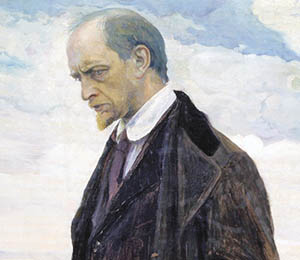
    The three thinkers that Putin suggested the governors should read were Vladimir Solovyov (1853–1900), a friend of Dostoyevsky and, according to the late American Russian scholar James Scanlan, the greatest and most influential of Russian philosophers; Nikolai Berdyaev (1874–1948), an aristocratic, fiercely independent thinker who combined a passionate religious temperament with an existential commitment to freedom; and Ivan Ilyin (1883–1954), a much more political thinker than Solovyov and Berdyaev. 

    All three were part of a remarkable period in Russia’s cultural history known as the Silver Age, a time of deep spiritual and mystical experiment and excitement aborted by the rise of the Bolsheviks. 

    In recent years, Putin has looked back to this time in an attempt to revive the character of “Holy Russia” as a way of resolving the identity crisis Russia has struggled with since the collapse of the Soviet Union. For some critics in the West, the philosophers Putin namechecked were simply examples of a kind of “mystical exceptionalism,” a reheating of nineteenth-century ideas about Russia’s “messianic role in world history.”1

    Whatever Putin’s real aims in namedropping these thinkers may be – and of course he is a cagey politician before anything else and has his own purposes in mind – they deserve to be read. If nothing else, if Biden did read them, he might get an angle on Tsar Vladimir that might otherwise escape him.

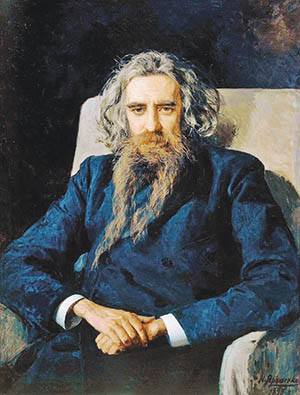
    Vladimir Solovyov

    Portrait of Vladimir Solovyov by Nikolai Yaroshenko, 1892.

    Solovyov’s The Justification of the Good, for example, which is on Putin’s list, is a long, detailed, eminently logical and rigorously rational argument for the supreme value of the “good in-itself,” the Good in a Platonic sense, that is. 

    Since the eighteenth century, the West has seen the “good” in a purely utilitarian sense, a “practical” good, one that can be seen and measured in material things: a new car, a new computer, a holiday in the tropics. Or it sees the good in terms of the consequences of some action. Hence the notions of “the greatest good for the greatest number” and “the ends justify the means,” formulas that historically have had disastrous results. 

    This idea of a measurable good is at the root of Western consumerism, as well as that of the various socialist alternatives to it; both see the good in terms of higher living standards, more and better things. 

    While it is undeniably good that all should be fed, clothed, and housed decently – a belief Solovyov, who gave away what money he had, put into practice – a society that defines the good in this way forgets the truth of the Gospel: that man does not live by bread alone. 

    Solovyov saw that the dominance of rationalism in the West had eclipsed the perception of the spiritual dimension of life, an argument he made in his first major work, The Crisis of Western Philosophy. The series of lectures he gave on the “God-Man,” the path of theosis, our evolution into a higher, more spiritual consciousness, were attended by Tolstoy and Dostoyevsky and influenced both. Russia, he believed, could be the birthplace of such a consciousness, and his ideas informed the Silver Age. He died in 1900.

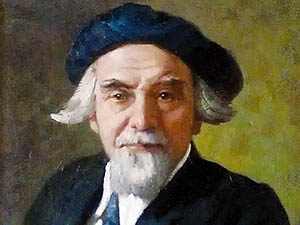
    Nikolai Berdyaev 

    Nikolai Berdyaev 

    Nikolai Berdyaev was one of the many Russian thinkers, poets, critics and other members of the intelligentsia who in 1922 were aboard the “philosophy steamers” that carried them out of their homeland and into exile in the West, courtesy of Comrade Lenin. 

    A devout if eccentric Christian, Berdyaev started out as a Marxist but after reading Solovyov rejected Marx’s materialism. He became a radical religious existentialist, obsessed we can say with the idea of freedom. His early work, The Philosophy of Inequality, another on Putin’s reading list, was a response to the enforced egalitarianism of the Revolution. 

    He argued that the intelligentsia’s passion for the “people” and the “proletariat” had become little more than idolatry. Truth in itself, like Solovyov’s good in itself, had fallen away, and only those truths that were helpful to the Revolution were embraced. (Is there a parallel with our own times, perhaps?) But without real truth, existential truth, human beings fall prey to the forces of materialism and become little more than the property of the state or the market. 

    Berdyaev continued his philosophical struggle for freedom from Berlin and then Paris, writing book after book, with titles like The Destiny of Man, Slavery and Freedom, and Spirit and Reality, his remarkable autobiography, until his death in 1948.

    Ivan Ilyin 

    Portrait of Ivan Ilyin by Mikhail Nesterov, 1921. 

    Ivan Ilyin started out as a political idealist, believing that if people could grasp what he called “legal consciousness,” a kind of intuition of the need of rule of law, government would not be necessary, as we could govern ourselves. This naivety received a buffeting with the 1905 Revolution, and Ilyin’s views changed radically. 

    From a kind of spiritual anarchist, he became the advocate of the need for a small group of dedicated men who had achieved “legal consciousness” to guide the vast majority who hadn’t. This was rather the same view as Lenin, except that his small band of dedicated revolutionaries would usher in the new, classless, godless society. 

    Ilyin’s view was much more that of Dostoyevsky’s Grand Inquisitor in The Brothers Karamazov, who argues that men do not want freedom but bread and that the church, which rules the state, must shoulder the burden of their freedom for them. Like Berdyaev, Ilyin was shipped out of Russia on the “philosophy steamers,” and until his death in 1954, he was a voice of opposition to the Soviets. 

    Our Tasks is a collection of Ilyin’s writings that Putin put on his list. One essay, “What the Dismemberment of Russia Means for the World,” written in the 1950s, spells out in eerily prescient detail what will happen to Russia with the collapse of communism and the introduction of Western democracy and the free market. In the chaos that would follow what he called “the Balkanization of Russia” – and which actually did happen – Ilyin predicted that a strong man would arise, who would re-establish order and control and reunite the nation… No wonder that of the three, Ilyin’s name turns up the most in Putin’s speeches.

    Of course, here I can only suggest why readers might want to take a look at Putin’s philosophers. They all warrant attention; Solovyov and Berdyaev for their own sake; Ilyin, I would say, to get an idea of what’s on the Russian President’s mind. 

    For more on this subject, read Gary Lachman’s book The Return of Holy Russia, which covers Vladimir Putin, the Silver Age, Solovyov, Berdyaev, Ilyin and the other remarkable figures making up Russia’s tumultuous spiritual history.

    Footnote

    1. www.nytimes.com/2014/03/04/opinion/brooks-putin-cant-stop.html

    [alert type=”general” dismiss=”no”]This article was published in New Dawn Special Issue Vol 15 No 3.[/alert]

    [alert type=”success” dismiss=”no”]If you appreciate this article, please consider subscribing to help maintain this website.[/alert]

    © New Dawn Magazine and the respective author.
    For our reproduction notice, click here.
  • What is the Tarot?

    What is the Tarot?

    From New Dawn Special Issue Vol 13 No 5 (Oct 2019)

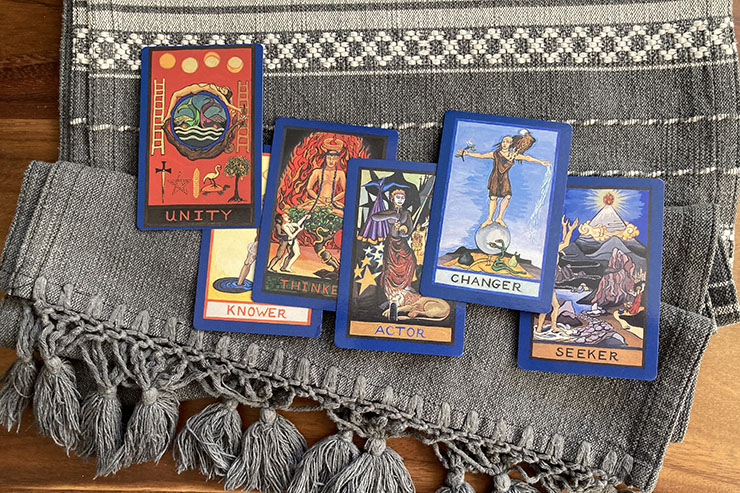
    The Tarot is a path. In Egypt it was called the Books of Life or Books of Thoth and also the Royal Way of Life. The word Tarot was derived from the Egyptian words Tar, meaning path or way, and ro, ros or rob, meaning royal – hence: The Royal Way of Life. And the Books of Life, used in connection with initiation ceremonies, were quite literally the Books of a path of initiation, and its 22 symbols or pictograms were like the words of a sentence adding up to a single meaning. Or they could have been compared to steps upon the way or beads upon a string. They were to be understood singly but also as a whole, a totality, and in relationship to each other.

    It is said that the candidate for initiation in the Egyptian mysteries had to pass between paired rows of Tarot symbols inscribed in hieroglyphs on huge tablets of stone and signify his understanding of them before he could be accepted. The symbol T also stands for an initiate; and in early times initiates were know as T’s.

    It is possible that the original Books of Thoth contained a secret describing a very specific and literal pathway or method by which the initiate might attain realisation.

    The Egyptian Books of T were not cards at all but mighty Books embodying cosmic principles. The authorship of the Books of Life was ascribed to Thoth-Tehuti, the scribe of the gods and one of the oldest of the gods who, by tradition, came from Atlan – or Atlantis, the Land of Atlan. Thoth may have been an historical personage. It is believed that he established a colony in Egypt before Atlantis went down. If so, this would place his date at around 10,000 BCE, at about the time of the final submergence of Atlantis, according to Plato’s account.

    In his Tehuti aspect, he invented the alphabet, and it is he, along with Osiris, who weighs the heart in the Egyptian Book of the Dead. He is ibis-headed; his symbol is a feather; and he is associated with Truth.

    No one has seen the originals of the Books of Thoth. The present day Tarot of the Bohemians, or gypsy pack, used as a fortune-telling deck, is a descendant of the originals but has undergone many alterations in form and symbols as it has been rendered by countless artists. Madame Blavatsky said that the originals of the Tarot were stored in Mesopotamia in cylinder seals of copper and would one day be found. However, their historical origin can never be established, and it is possible that we will never know whether they were written by the legendary Thoth-Tehuti or whether they sprang from an earlier source. But their historical origin is, in the present consideration, beside the point. 

    During the Middle Ages, the Tarot was carried to Europe, some say by the Knights Templar, others by the gypsies. The gypsies, according to one account, were the descendants of Egyptian priests who rescued the Books of Thoth, also called the Tora, from the burning library at Alexandria; and the gypsies may easily have been Egyptians as the very word gypsy suggests. In the 14th and 15th centuries, the Tarot appeared in the guise of a playing card deck, also as a fortune-telling deck with the addition of the 56 cards of the minor arcane, or the four suits – wands, swords, cups and pentacles – which are the foundation of all modern playing card decks.

    The medieval Tarot deck of 78 cards has survived until the present as a fortune-telling pack, and appears in numerous popular versions. While this preserved the original 22 Tarot symbols, or major Arcanum, which otherwise would have been lost, it obscured their real meaning. Their sacred purpose was forgotten and few realised that they described a path or that they contained a teaching, a way of life.

    Although the Kabbalists found and stressed an esoteric meaning in the cards, relating them to the ten Sephiroth on the Kabbalist Tree of Life and the Hebrew letters, this was overshadowed by their use as a fortune-telling deck, and the cards came to be thought of chiefly as a means of predicting the future, with mundane and literal meanings ascribed to each card.

    Tarot & Your Destiny

    The Tarot symbols are archetypal symbols of man’s unconscious and represent the enfoldment of his unconscious. They are, therefore, his built-in destiny for any given time period. They are directly linked with cosmic principles and for this reason are predictive on a grand scale. For that which is within is expressed without. Even as the seed contains the tree, that which the unconscious contains is outed and fulfilled externally. Destiny is internal. What is inherent in the times, in the unconscious of man, becomes the time itself. This is another way of saying that man is his own Fate, and that he writes his Destiny, or the Tarot.

    The above is abridged from T: The New Tarot, The Tarot for the Aquarian Age by John Starr Cooke and Rosalind Sharpe (Western Star Press, 1968).

    The full story about the Book of T or the New Tarot for the Aquarian Age, can be read in New Dawn 145, “ONE: The New Tarot & the Secret Doctrine that Launched the Counterculture” by Mark Walker, and also see the websites www.royalmaze.com and www.tarot.one.

    [alert type=”general” dismiss=”no”]This article was published in New Dawn Special Issue Vol 13 No 5.[/alert]

    [alert type=”success” dismiss=”no”]If you appreciate this article, please consider subscribing to help maintain this website.[/alert]

    © New Dawn Magazine and the respective author.
    For our reproduction notice, click here.