New Dawn – World's Most Unusual Magazine

Category: Articles

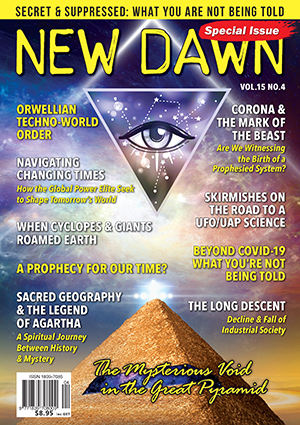
  • The Post-Pandemic Orwellian Techno-World Order

    The Post-Pandemic Orwellian Techno-World Order

    From New Dawn Special Issue Vol 15 No 4 (Aug 2021)

    In Nineteen Eighty-Four, George Orwell described three competing tyrannies: Oceania, Eastasia, and Eurasia. As the great powers fight endless wars (or so their publics are told), the domestic population of Oceania is suppressed by Big Brother’s omniscient surveillance, the Ministry of Truth’s dictation of reality, and the compliance of the public, who report any dissent to the ruling Ingsoc party. It has long been a cliché to say that we live in Orwellian times.

    The first Cold War lasted roughly from 1945 to 1991, with the collapse of the Soviet Union. The second began in 2000 with the election of Russia’s President Vladimir Putin and continues to the present. Examples of events that support a Cold War 2.0 hypothesis include proxy wars on Russia’s borders (Ukraine) and against its allies (Syria), as well as accusations that Russia is interfering in Euro-American politics (election hacking). The mounting war against China can either be seen as part of the overall nexus of Cold War 2.0, perhaps Cold War 2.1, or as a Cold War 3 with an entirely different set of dynamics. For instance, blaming China for the Covid virus is far more serious than accusing Russia of meddling in foreign elections. 

    Covid has been used as an excuse by both the US administrative state and the Chinese CCP to push ahead with their respective agendas. The Euro-American plan is called The Great Reset, a World Economic Forum (WEF) initiated project that envisages a major restructuring of the so-called capitalist order to pre-empt revolution by the disenfranchised. China’s long-term plan is the Belt and Road: a series of investment and infrastructure projects across neighbouring states designed to build literal bridges to lucrative trade with Europe via Central Asia. As the WEF wants to “Build Back Better,” emphasising health data and green technologies, China wants to update the Belt and Road with next-generation climate infrastructure. Generally, these developments are known as the Fourth Industrial Revolution. 

    Echoing the British colonialists of bygone centuries, US President Jimmy Carter’s National Security Advisor, the late Zbigniew Brzezinski – whose daughter Mika co-hosts a show on MSNBC (an example of the permanent administrative state) – wrote a book about geopolitics entitled The Grand Chessboard. Just as 9/11 put “the pieces… in flux,” as Britain’s then-Prime Minister Tony Blair said, Covid-19 has shaken the chessboard. The pieces are being reset by the major US financial institutions and tech oligarchs. As they seek to crack China’s lucrative, highly populated, data-driven economy, China in the eyes of many – like war-hawk Steven Bannon – seeks to subvert American institutions by stealing intellectual property and funding its cultural programmes under the pretext of outreach projects.

    This article examines some of the contours of the new world order and its impact on ordinary working people. 

    LOSING CHINA, BUILDING A PERMANENT WAR ECONOMY

    After World War II, the US built a perpetual war machine to conquer the world (“full spectrum dominance” the military later called it) and stimulate research and development science and technology that could create a new economy. 

    In his farewell address, US President Dwight D. Eisenhower famously described this arrangement as the “military-industrial complex,” under which nuclear energy emerged from US-led atomic weapons development at Los Alamos. Climate science owes its origins to the Pentagon’s ILLIAC IV supercomputer. Modern PCs and Macs take their blueprints from systems developed by the Department of Defense, as does the internet – originally developed under Raytheon contracts with the Advanced Research Projects Agency. The satellites that allow for instantaneous global communications were originally built for the armed forces’ missile guidance systems and surveillance. The cargo ships that transport goods and materials from the third to first worlds are based on designs culled from naval destroyers, just as the jet aeroplanes that transport hundreds of millions of people around the world take their designs from WWII-era bomber planes. The GPS systems that guide such logistics also come from military R&D, as do the touchscreens on iPhones and iPads: touchscreens being originally designed for Air Force pilots. And on and on it goes.

    Crucially, these technologies became the very instruments of oppression in “democratic” America and the West generally, as the US National Security Agency used computers, the internet, and satellite signals intelligence to spy on its own citizens, and indeed the world, via the Five Eyes network. Declassified State Department and CIA reports reveal that the main US interest in China was preventing a Sino-Soviet alliance that would create the kind of unified, anti-US “communist” super-region envisaged in Orwell’s Nineteen Eighty-Four. 

    During World War II, Formosa (now Taiwan) was under the occupation of fascist Japan. Between 1945 and 1949, when the Chinese Communist Party fought a civil war to overthrow the ruling Kuomintang, US administrations gave $2bn ($14bn in today’s money) of taxpayer money to the latter. The geostrategic importance of Taiwan was considered to be of utmost importance to the US military because of Taiwan’s potential to host US military bases. After their defeat, the Kuomintang based themselves in Taiwan where they ruled until the 1990s. The US agreed at the Cairo Conference (1943) that Taiwan belonged to China but backtracked in an effort to use Taiwanese sovereignty as a strategic weapon against the CCP. American commentators refer to the CCP victory over the Kuomintang as the “loss of China.” But US fears that China would become a Soviet puppet were unfounded.

    There is little to suggest that the US directly involved itself in Chinese affairs until the Nixon administration visited in 1972. Major progress from the US corporate perspective was made after the death of Mao (1976), who was replaced by Deng Xiaoping. The CIA already had an eye on Deng as a counterweight to the Soviets. In 1979, Deng began a series of “reforms.” Mao’s rural collectivism came to an end when the US-led International Monetary Fund issued loans that were serviced, in part, by the expansion of private landlords. Major infrastructure projects triggered mass migration from the rural to new urban areas. The process of privatising China’s healthcare system was initiated, creating what US drug companies called a “China market,” which included flooding the country with the antibiotics that have now caused a global bacteriological resistance crisis.

    In 2001, China joined the World Trade Organization (WTO). Many US exports assembled in Mexico and other countries by inexpensive, exploitable labour went to China instead. Pointing to the numbers, some argue that America’s economic decline is a myth. The share of China’s state-owned enterprises in the processing and assembly sectors declined from 40% in 1995 to 6% in 2015, meanwhile 60 per cent of China’s assembly economy is controlled by foreign corporations, like Apple: the world’s first trillion-dollar company. Because US companies own the intellectual property rights to the products they have assembled on the cheap in China, it is the US companies, not the Chinese assembly plants, that make most of the profits.

    China aims to redress the imbalance via a domestic production and design initiative called China 2025 that will grow over the next century. The US Council on Foreign Relations has already reacted by asking whether it will negatively impact global trade, which translates as hurt US corporate profits. Empires, be they national or corporate or mixtures of the two, hate competition. 

    CHINA RESISTS

    But China never fully yielded to US corporate demands. In addition to joining the WTO, it forged international pacts, trade deals, and alliances. In 1991, China joined the Asia-Pacific Economic Cooperation group (APEC). China is not a member of the Association of Southeast Asian Nations (ASEAN) but has associate status through various treaties. One of which is the ASEAN-China Free Trade Area signed in 2002. Members include Brunei, Cambodia, Indonesia, Laos, Malaysia, Myanmar, Philippines, Singapore, Thailand and Vietnam. 

    In 2001, China, Kazakhstan, Kyrgyzstan, Russia, and Tajikistan formed the Shanghai Cooperation Organization (SCO). In 2017, both India and its enemy Pakistan joined SCO. The project is designed to integrate countries in the region, cooperate on military affairs, and expand infrastructure projects. In 2006, the APEC states entered into negotiating the Free Trade Area of the Asia-Pacific (FTAAP). At the ASEAN Summit in Cambodia 2012, several countries entered into negotiations with China for a Regional Comprehensive Economic Partnership (RCEP). The agreement created one of the biggest economies in the world ($49.5 trillion) and included 3.4bn people. 

    In 2013, President Xi Jinping announced China’s new Silk Road Economic Belt (“Belt and Road Initiative”) in a speech delivered in Kazakhstan. The professed aim is to foster economic trade and cultural cooperation across Eurasia and Southeast Asia. This is a rival to America’s Silk Road Strategy Act 1999, which sought to absorb some of the ex-Soviet states into the “free market”: Armenia, Azerbaijan, Georgia, Kazakhstan, Kyrgyzstan, Tajikistan, Turkmenistan, and Uzbekistan. In 2011, having occupied Afghanistan (a key route along the “Silk Road”) for a decade, US President Barack Obama announced a New Silk Road of America to capture “South Asia’s… population of more than 1.6 billion,” including its “vast energy resources – including oil, gas, and hydropower.”

    After 9/11, US government initiatives expanded the R&D-based economy of computers, internet, GPS, etc. to hi-tech and big data. The CIA seed-funded what became Google. Google Maps started life as the CIA’s EarthViewer. The kind of massive data gathering, analysis, sharing, and cybersecurity engaged in by the NSA and other Western intelligence agencies is similar to how tech firms gather blanket data on consumers and sell them to advertisers and brokers. After the millennium, the CCP began constraining some US corporate influence in China, particularly reversing its healthcare privatisation and copying US e-commerce. Where the US has Google, China has Baidu. Where China has Alibaba, America has Amazon.

    Like the US, China also started using public money to create a new biotech economy, which will soon be linked to big data. Under its “full spectrum dominance” doctrine, the US is continuing its “dual-use” policy, in which touchscreens that work for the Air Force, for instance, are adapted to commercial iPhones. The phones that allow for personal and business communications also have backdoor technologies that allow the NSA to snoop on private citizens. China recently developed a similar doctrine called “fusion.”

    BUILD BACK BETTER VS. BELT AND ROAD

    World War II created the military-industrial complex that gave us computers etc. September 11 ballooned the military-intelligence establishment that gave us Total Information Awareness (TIA) and big data. Covid-19 has accelerated the trend towards the merging of the military-industrial complex (infrastructure), the military-intelligence establishment (TIA and big data), and the military-corporate-biotech complex that collects, analyses, modifies, and sells genetic and medical information for profit and social control. 

    “We stand on the brink of a technological revolution that will fundamentally alter the way we live, work, and relate to one another,” said Klaus Schwab, founder of the World Economic Forum (WEF), in 2016. WEF is the annual meeting of the Global Power Elite: academics, asset managers, big tech, energy magnates, inventors, investors, the pharmaceutical industry, and politicians. Schwab was talking about the Fourth Industrial Revolution or Industry 4.0. The First Industrial Revolution was mechanic, the Second electric, the Third automated, the Fourth “is characterised by a fusion of technologies that is blurring the lines between the physical, digital, and biological spheres.” 
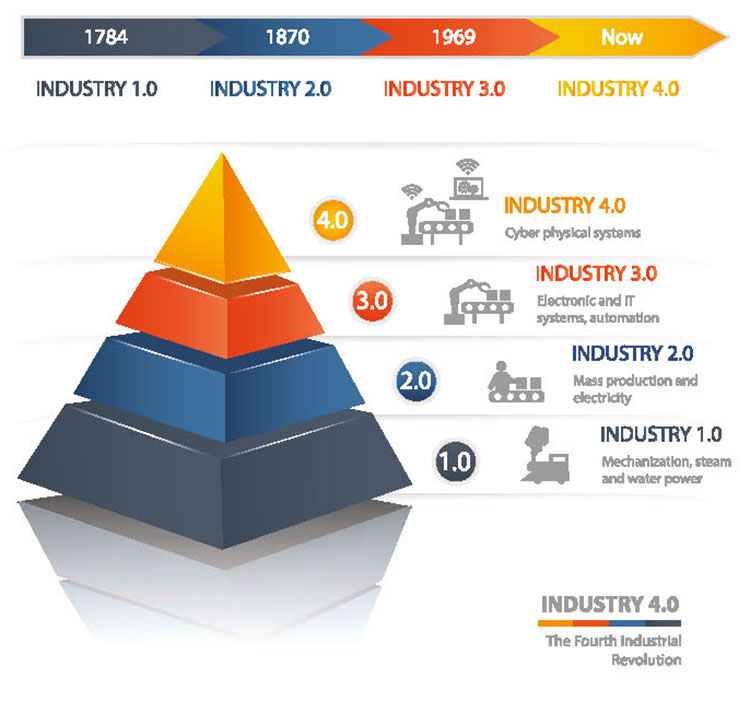
    The technologies that constitute Industry 4.0 include “artificial intelligence, robotics, the Internet of Things, autonomous vehicles, 3-D printing, nanotechnology, biotechnology, materials science, energy storage, and quantum computing.” But monopolies and the military-intelligence-complex control these technologies. “Engineers, designers, and architects are combining computational design, additive manufacturing, materials engineering, and synthetic biology to pioneer a symbiosis between microorganisms, our bodies, the products we consume, and even the buildings we inhabit.” The pandemic gave promoters of Industry 4.0 the perfect opportunity to accelerate their agenda: funding for big pharma, the integration of nanotech with therapeutics, tracking apps synched to geo-locational data as vaccine passports, and more.

    Schwab co-authored a book subtitled The Great Reset with the economist Thierry Malleret. They state: “In the post-pandemic era, COVID-19 might be remembered as the turning point that ushered in a ‘new type of cold war’.” The novelty, according to the authors, is that China is not attempting to force its ideology on the world, unlike, they claim, the Soviet Union. “The absolute prerequisite for a proper reset is greater collaboration and cooperation within and between countries.”

    The goal of the WEF is not to get rid of the “capitalist” system that they acknowledge had created unprecedented inequality. Rather Build Back Better (B3) will be a way of “future-proofing capitalism,” from demographic changes, revolutions opposing inequality, and push-backs against corporate globalisation. “Despite the tragedy, we must leverage the COVID-19 pandemic, and make sure that it becomes the catalyst for a profoundly positive transformation of the global economy, taking us closer to a world in which everyone can live well, within planetary boundaries.”

    Around the same time as the B3 announcement, governments in the West launched what we are supposed to believe are identical initiatives for their supposedly sovereign states. US President Biden announced that – with the kind of fiscal stimulus and state economic planning that he and his Democratic Wall Street puppeteers could have introduced forty years ago – he will “rebuild an economy where every American enjoys a fair return for their work and an equal chance to get ahead.” But B3 will exacerbate the very class divisions that WEF claims to want to reduce. B3 focuses on the middle, not lower, working, or destitute classes. B3 includes the American Families Plan, “an ambitious, once-in-a-generation investment to rebuild the middle class and invest in America’s future.”

    It turns out that B3 was part of the Build Back Better World Partnership (B3W), described by the White House. “Through B3W, the G7 and other like-minded partners will coordinate in mobilising private-sector capital in four areas of focus – climate, health and health security, digital technology, and gender equity and equality – with catalytic investments from our respective development finance institutions.” Voice of America (VOA), which used to be – and maybe still is – funded by the CIA, reports that B3W was “presented by Biden as an explicit challenge to China.” VOA notes that B3W’s focus on “climate, health and health security, digital technology, and gender equity and equality… are not really in direct competition with much of what China has been doing through the Belt and Road program.”

    Like Western countries, the CCP has also used Covid to accelerate elements of its Belt and Road Initiative (BRI). Over 60 per cent of BRI has been affected by the pandemic. Chinese lenders could face losses in third countries. BRI is shifting instead to the Digital, Green, and Health Silk Roads (as the CCP calls them) of data, environment, and vaccines. The CCP also introduced a dual circulation concept, in which any foreign investment should yield returns for Chinese consumers.
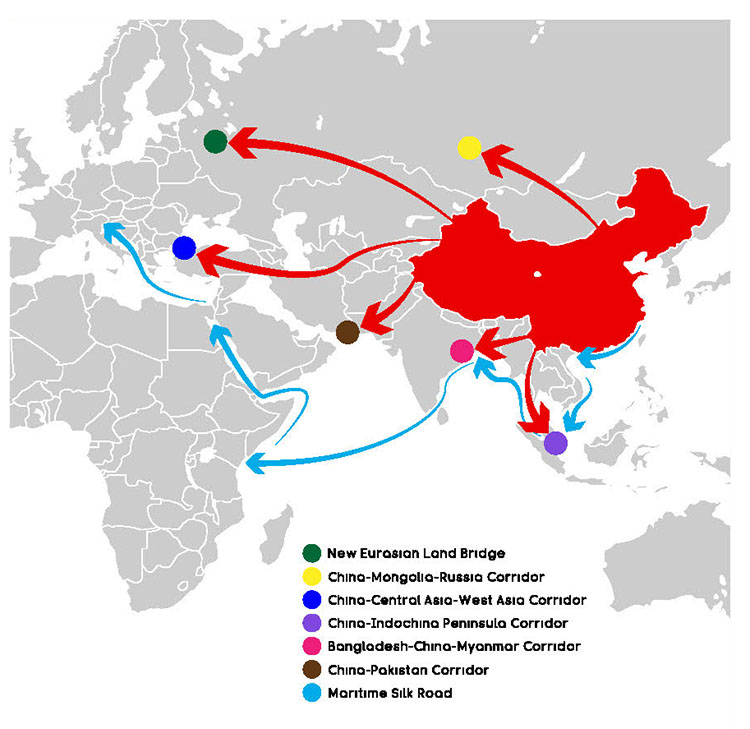
    US corporations are pre-empting the “dual circulation” model by tapping into China’s demographically-stalling mega-population of 1.4 billion people. Chinese workers tend to have higher relative personal savings than Westerners, particularly with their wealth tied into property. China’s asset management market is worth an estimated $18.9 trillion (Rmb121.6 trillion). The wealth is locked up in the older generations who are beginning to outnumber the young. Asset firms and private equity companies, such as BlackRock and the financial arms of Goldman Sachs and JPMorgan, are accessing personal wealth as investments and portfolio boosters.

    Goldman has partnered with the state-owned Industrial and Commercial Bank of China. The deal could allow the Wall Street firm to draw on the savings of hundreds of millions of the bank’s Chinese customers. BlackRock has partnered with the China Construction Bank, and JPMorgan Asset Management will invest $415m in the China Merchants Bank. To quote the Financial Times: “some investors say the biggest risk is not getting into China quickly enough.”

    THE END OF PERSONAL SOVEREIGNTY
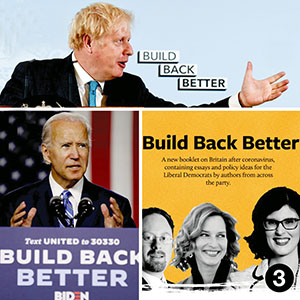
    Build Back Better following the Great Reset triggered by Covid will lock big data and finance monopolies into the very infrastructure of town and city plans, health and elder-care providers, the Internet of Things, and increasingly intimate surveillance: the Big Brother of Orwell’s novel. Growing numbers of workers will programme apps from their “homes”: tiny, barely-affordable studio apartments for the renting young, and small mortgaged houses for the middle-aged, middle-class. The real wealth is owned by the likes of BlackRock through investments in land, social infrastructure, and even private health and genomic data. 

    We’ve heard of the “new normal,” but the WEF introduces the “next normal,” in which the “everything from home” concept confines humans to cell-like dwellings where necessities and luxuries are delivered to the door by robots and humans in the precarious proletariat class (“precariat”). “Work from anywhere” connects the human to endless labour, destroying the boundary between work and leisure. The so-called “integrated response” to health will see private data shared among academics and big data firms. The concept of free healthcare vanishes in a fog of privatisation. To prevent flights to the rural areas where the elites live in mansions and keep property prices high by owning huge tracts, hyperconnectivity will keep “talent” attracted to megacities like New York and Tokyo.

    With the headline, “The Drones Were Ready for This Moment,” the New York Times (NYT) sings the praises of autonomous and semi-autonomous vehicles during the pandemic. Smaller versions of the drones that blow children to pieces in the Middle East can enforce pandemic laws, but they can also deliver products to the new “everything from home” class. Companies like San Francisco’s Zipline used the crisis as an opportunity to deliver medicines by drone to self-isolating patients. Echoing earlier observations, the NYT piece notes: “Just as World War II hurried the development of emerging technologies like computers, rocketry, jet aircraft and atomic energy, the pandemic may speed the development, and adoption of, drone technology.”

    Much of the above was pioneered in China, so when Wuhan was locked down in early-2020, e-commerce and home-delivery companies already had their logistics coordinated.

    At the start of the pandemic, the monopolies Amazon, Google, and Facebook coordinated their data-sharing responses with the World Health Organization. Civil servants, frontline workers, and private employees alike have been obliged by various agencies, governments, and corporations to download health apps onto their phones in order to upload and receive data on their Covid and vaccination statuses, as well as provide their geolocation info to employers, leisure and hospitality services, and federal authorities. This has created a huge private-sector telemedicine/tracking market.

    Another dystopian trend hastened by Covid is data brokerage. Since the mid-2010s, the industry has “expanded aggressively in what amounted to a virtual regulatory vacuum,” to quote the Financial Times. By 2020, the industry was worth $200bn. The brokers tracking as much of your life as possible to sell your data to advertisers and insurers include Acxiom, Corelogic, Experian, Equifax, and Nielsen. Guarded by blockchain, wearable health trackers – like watches – coupled with real-time Covid-status monitoring apps synchronised to central healthcare databases could feed intimate information about smart city dwellers. 

    As the US and China employ the so-called soft power of investment and hi-tech to absorb states in their respective spheres of orbit, the internal control over their populations increases. One of the most sinister, recent developments is the creation of a market for your very DNA. Biotech giants have been patenting the genes of life for five decades. In more recent years, ancestry tracing companies have acclimatised us to yielding our most intimate and wide-reaching genetic materials: the very keys to our existence. As we have seen with gain-of-function and vaccine research, such technologies can be essentially weaponised to create super-viruses. The other application for this new era of research is selling genomic data to big pharma, big data, and credit brokers. 

    Companies like 23&Me analyse customer’s genetic information to screen their clients for diseases. Big pharma is keen to access such information. One report notes of GlaxoSmithKline: “GSK invested $300 million in 23&Me for an exclusive license to their informational database.” It concludes: “The race is now on to gather large biological and clinical datasets with China and the UK sequencing significant cohorts in their population.” The US, too, of course.
    WE ARE ALL WINSTON SMITH
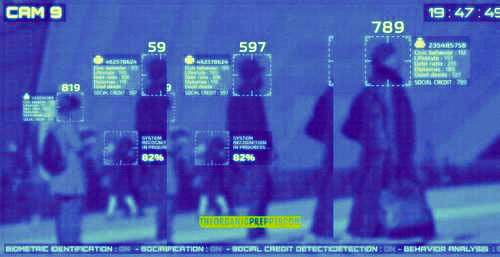
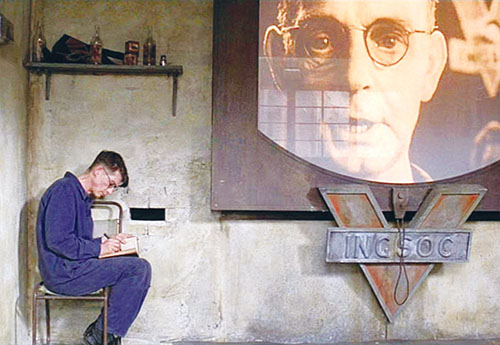
    A scene from the film version of Orwell’s novel Nineteen Eighty-Four. Winston Smith (played by actor John Hurt) works while under the watchful eye of Ingsoc’s ‘Big Brother’ telescreen. Human existence under the Fourth Industrial Revolution may be one of constant remote monitoring and trustworthiness scores.

    In Nineteen Eighty-Four, the antihero Winston Smith thinks that he has evaded Big Brother and broken his employer the Ministry of Truth’s conditioning. But the all-encompassing environment in which he is conditioned proves too overpowering. With internal rebellions in the form of freedom of thought pulverised by the party, Ingsoc remains unopposed in its endless quest to demonise Eurasia and Eastasia led by regimes that, if they exist, also demonise Oceania to justify the internal repression of their own peoples. 

    Orwell’s book is an apt metaphor for the present geopolitical struggle and related expansion of the Fourth Industrial Revolution on both sides. Industry 4.0 requires all populations to be held prisoner under a long-planned agenda called “full-spectrum dominance.” The question is: are some strong enough to resist, or will we all meet the same fate as Mr Smith?

    [alert type=”general” dismiss=”no”]This article was published in New Dawn Special Issue Vol 15 No 4.[/alert]

    [alert type=”success” dismiss=”no”]If you appreciate this article, please consider subscribing to help maintain this website.[/alert]

    Footnotes

    1. George Orwell, Nineteen Eighty-Four, 1949, Secker & Warburg
    2. Joseph Smith (1997, 2nd) The Cold War: 1945-1991, Wiley
    3. The UN Secretary-General, António Guterres, does not date Cold War 2.0 but stated: “The cold war is back – with a vengeance, but with a difference. The mechanisms and the safeguards to manage the risks of escalation that existed in the past no longer seem to be present.” UN, 13 April 2018, SG/SM/18986-SC/13294 
    4. Kees van der Pijl (2018) Flight MH17, Ukraine and the New Cold War: Prism of Disaster, Manchester University Press
    5. Dmitri Trenin, “The New Cold War Is Boiling Over in Syria,” Foreign Policy, 14 April 2018
    6. Kathleen Hall Jamieson (2018) Cyberwar: How Russian Hackers and Trolls Helped Elect a President: What We Don’t, Can’t, and Do Know, Oxford University Press
    7. Few have said Cold War 3, but plenty have said Cold War 2.0, which means simultaneous Cold Wars with Russia. For the latter, see, for instance: Ken Dilanian, “As the U.S. and China spar on the world stage, Cold War 2.0 may already have begun,” NBC News, 15 July 2020
    8. Quoted in Andrew Tyrie, “The road to anarchy,” Guardian, 6 November 2001
    9. www.ourdocuments.gov/doc.php?flash=false&doc=90&page=transcript
    10. Sharon Weinberger, “How Soviet Bomb Tests Paved the Way For U.S. Climate Science,” Smithsonian Magazine, 7 May 2018
    12. Hercules E. Haralambides (2019) “Gigantism in container shipping, ports and global logistics: a time-lapse into the future,” Maritime Economics and Logistics, 21(1): 1-60
    13. Stephen Dowling, “The Boeing 747: The plane that shrank the world,” BBC Future, 28 September 2018
    14. Mariana Mazzucato, “A strong industrial strategy has many benefits,” Financial Times, 1 December 2016
    15. Anthony R. Wells (2020) Between Five Eyes: 50 Years of Intelligence Sharing, Casemate Publishing
    16. Binghui Liao, David Der-wei Wang and Dewei Wang (2006) Taiwan Under Japanese Colonial Rule, 1895-1945: History, Culture, Memory, Columbia University Press
    17. Cited and quoted in Russell D. Buhite (1978) “‘Major Interests’: American Policy toward China, Taiwan, and Korea, 1945-1950,” Pacific Historical Review, 47(3): 425-51
    18. www.cia.gov/readingroom/docs/polo-34.pdf
    19. Chao Hsiang-ke and Lin Hsiao-ting (2011) “Beyond the carrot and stick: the political economy of US military aid to China, 1945–1951,” Journal of Modern Chinese History, 5(2): 199-216
    20. www.cia.gov/readingroom/docs/DOC_0001494693.pdf
    21. See my President Trump, Inc.: How Big Business and Neoliberalism Empower Populism and the Far-Right, Clairview Books, 139
    22. See my Capitalism and Coronavirus: How Institutionalized Greed Turned a Crisis Into a Catastrophe (2020), Ursa Major
    23. See my Privatized Planet: “Free Trade” as a Weapon Against Democracy, Healthcare and the Environment, 2019, New Internationalist. 
    24. Ibid. 
    25. Ibid.
    26. Ibid. 
    27. Nafeez Ahmed, “How the CIA made Google,” Insurge Intelligence, 22 January 2015, https://medium.com/insurge-intelligence/how-the-cia-made-google-e836451a959e
    28. Leanna Garfield, “The CIA’s EarthViewer was basically the original Google Earth,” Business Insider, 30 December 2015
    29. www.weforum.org/agenda/2016/01/the-fourth-industrial-revolution-what-it-means-and-how-to-respond
    30. Ibid. 
    31. Klaus Schwab and Thierry Malleret (2020) COVID-19: The Great Reset, Forum Publishing 
    32. www.weforum.org/agenda/2020/07/to-build-back-better-we-must-reinvent-capitalism-heres-how
    33. www.whitehouse.gov/build-back-better
    34. www.whitehouse.gov/briefing-room/statements-releases/2021/06/12/fact-sheet-president-biden-and-g7-leaders-launch-build-back-better-world-b3w-partnership
    35. Rob Garver, “Can Biden’s Build Back Better World Partnership Really Challenge China?,” VOA, 18 June 2021
    36. Alice Han and Eyck Freymann, “Coronavirus Hasn’t Killed Belt and Road,” Foreign Policy, 6 January 2021
    37. Thomas Hale, Harriet Agnew, Michael Mackenzie and Demetri Sevastopulo, “Wall Street’s new love affair with China,” Financial Times, 28 May 2021
    38. Ibid. 
    39. www.weforum.org/agenda/2021/04/future-of-smart-cities-covid-19-digital
    40. www.nytimes.com/2020/05/23/style/drones-coronavirus.html
    41. Capitalism and Coronavirus, op. cit. 
    42. HIMSS Media, “Roundup: Tech’s role in tracking, testing, treating COVID-19,” Mobile Health News, 1 May 2020
    43. Alex Kulitski, “How COVID-19 reshaped the telemedicine market,” Forbes, 8 June 2021
    44. Aliya Ram and Madhumita Murgia, “Data brokers: regulators try to rein in the ‘privacy deathstars’,” FT, 8 January 2019
    45. Zack Whittacker, “Data brokers track everywhere you go, but their days may be numbered,” TechCrunch, 8 July 2020
    46. www.bernardmarr.com/default.asp?contentID=1177
    47. Paul Hawken (2013, revised ed.) The Ecology of Commerce, Harper Business
    48. https://reform.uk/sites/default/files/2018-12/Blockchain%20in%20the%20NHS%20-%20VF_1.pdf

    © New Dawn Magazine and the respective author.
    For our reproduction notice, click here.
  • Vladimir Putin: Notes of a Former Emigrant

    Vladimir Putin: Notes of a Former Emigrant

    From New Dawn 187 (Jul-Aug 2021)

    Most people in Western countries receive a distorted and one-sided view of Russia’s long-serving president Vladimir Putin. Mainstream media reflects a clear anti-Russia bias which means we never hear the other side of the story – like in the days of the Soviet Union and Cold War. The following report by returned emigrant Yuriy Smirnov details how after near collapse Russia has been revived under Vladimir Putin. [Please note this article was published in 2021 prior to the start of Russia’s Feb. 2022 ‘Special Military Operation’ in Ukraine.]

    Unlike most citizens of Russia, my “acquaintance” with Vladimir Vladimirovich Putin took place in 2008, when I returned after a seven-year absence from the country. I survived in the 90s, and well-remember the period of wild capitalism, widespread banditry, and the ever-drunk president [Boris Yeltsin] dancing to the tune of the United States.

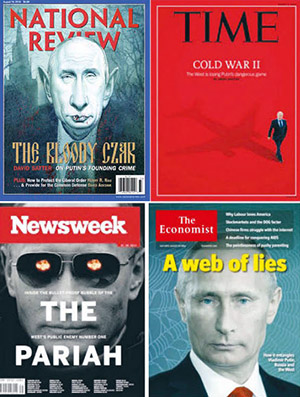
    Vladimir Putin regularly makes the cover of mainstream media news magazines as part of the ongoing campaign to demonise him and Russia.

    While in exile, I missed the beginning of Putin’s presidency. Life as a new immigrant to New Zealand dictated its own, more urgent goals and objectives. I simply did not care about what was happening in Russia. After a long absence, in 2008 I ended up in Moscow, observing Russia with an unbiased, fresh eye, and eagerly absorbing everything around me, looking for signs of positive change.

    The first thing that caught my eye was a lot of social advertising against smoking. A poster in the Moscow subway made a strong impression on me: a very beautiful girl smiling at you, wearing a dress… from cigarette butts! – it felt so disgusting, you could almost smell the unpleasant odour of old cigarette butts in an ashtray.

    A little later, I was pleasantly surprised by another fact that spoke of positive changes in the country: both Putin and Dmitry Medvedev [president from 2008 to 2012], during their presidencies, made their traditional New Year’s speech WITHOUT a glass of champagne in hand! The head of state always sets an example to his people, and that was messaging on a subconscious level: alcohol is not at all an obligatory attribute of any holiday in Russia. In the 90s, the behaviour of Boris Yeltsin in public was a clear message and approval of widespread drunkenness and alcoholism. Most people followed that example – alcohol kept flowing and the people were slowly drinking themselves to death.

    Putin’s subsequent actions confirmed that his sober behaviour in public was not accidental but one of the successive steps to improve the health of the nation. As a result, in Russia today there is a complete ban on advertising of alcohol and tobacco in any form, strict requirements for liquor stores, age restrictions (for tobacco, no sales to anyone below 18 years of age; for alcohol, no sales to people under 21 years of age), a ban on smoking in public places, a ban on the sale of alcohol from 23:00 to 11:00, and tougher penalties for violations.

    In subsequent years, it was very interesting for me to observe and track the positive changes initiated by Putin, or occurring with his approval and support, things that contributed to the strengthening of our country and improvement of the quality of life of the people. According to my observations, many of these facts have gone unnoticed by the general public, and that’s why I decided to list them below as opposed to the established philistine habit of blaming Putin for all the troubles occurring in Russia.

    So, what good has Putin done for Russia in 20 years, apart from the steps mentioned above to improve the nation’s health?

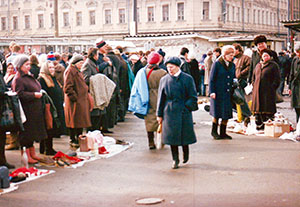
    Flea market in Rostov-on-Don, Russia, 1992. In order to survive, citizens sold off personal possessions in desperate times after the country had been brought to its knees by Western-imposed radical economic reforms (so-called shock therapy).

    1. Saving Russia from total collapse

    Putin assumed the presidency at a time when the economically dependent and externally controlled country was on the verge of collapse. Due to Putin’s thoughtful and consistent reforms, Russia survived as an independent, sovereign state.

    2. Ending the war in Chechnya 

    The hotbed of terrorism in the south of Russia was eliminated – the significance of this fact can hardly be overestimated.

    3. The Russian economy, destroyed in the 90s, was completely restored 

    Thanks to certain successive steps taken by Putin:

    3.1: State investments in agriculture, and domestic farm and entrepreneurship support, led to the fact that today the country feeds itself, and we are no longer dependent on imports. Moreover, the ban on the cultivation of GMO products, and Russia’s vast areas and favourable environmental situation, have made the country one of the main suppliers of high-quality food products in the world.

    3.2: Creation of funds that stabilise the country’s economy. Anticipating difficult times, Putin created a “safety cushion” in the form of the Stabilization Fund and the National Welfare Fund. This helped the country survive economic trials (for example, a threefold drop in oil prices). Today, social obligations to citizens are fulfilled mainly from the resources of these funds.

    3.3: Gold and foreign exchange reserves were created. Gold accounts for 22% of the total value of the reserve, which was 2,295 tons of gold in 2021. For comparison, in 1993 there were only 267 tons, and in 2008, 450 tons. For several years, Russia has been the largest buyer of gold in the world.

    3.4: Repayment of government debts. As most people know, an independent state policy is possible only if a country does not have significant debt obligations to other countries and financial institutions. Thus, the very fact that Russia can strongly defend its position in the international arena was made possible through Putin’s strategic genius when he promptly and significantly reduced Russia’s external debt. Today, the external public debt of Russia is one of the lowest in Europe; for many years it has been kept at $50-56 billion and is less than 5% of the country’s GDP. 

    After assuming the presidency of Russia in December 1999, it was anticipated that Vladimir Putin would continue to allow Russia to be vampirised, but he took what the globalists have ever since been calling a “wrong direction,” the title of a Council on Foreign Relations position paper “Russia’s wrong direction.” Putin’s record  reveals that he is more adept at ‘5-D chess’ than his Western counterparts, as he steers Mother Russia through the current tumultuous period in global affairs.

    4. De-dollarisation

    With Putin’s direct assistance/support, organisations such as BRICS (a union of Russia, Brazil, South Africa, China, and India) and Eurasian Economic Union (comprising Kazakhstan, Belarus, Russia, Kyrgyzstan, and Armenia) were created as an alternative to the IMF and Western economic institutions. They agreed to achieve monetary and financial sovereignty, as well as gradually eliminate dependence on the US dollar in regional trade in favour of national currencies. 

    5. Re-equipment of the Russian defence complex with new high-tech weapons

    In his Presidential Address to the Federal Assembly in 2020, Putin announced that Russia had created new types of weapons which are unmatched in the world. It was one more step in the strengthening of defence capability, and therefore Russian independence from outside pressure.

    6. Family support and solving the demographic issue 

    In the early nineties, the mortality rate in Russia exceeded the birth rate. With the construction of new children’s institutions, the introduction of additional child benefits and maternity capital, and a general increase in the standard of living, the demographic crisis was overcome. In 2012, population growth exceeded mortality, which speaks for itself.

    Putin’s careful attitude to children and family is a special topic. From year to year, in many of his public statements, Putin speaks about the importance of strengthening families and traditional family values. He also believes that the family plays a key role in nurturing a child’s personality. And here I want to emphasise that Putin is referring precisely to the traditional family, where there is a man, a woman, and a child (children). Personally, he has nothing against gays, but when it comes to the future of Russia, he believes that it is the traditional family that is vital for the survival of the nation and essential for the development of the country. “Strengthening the family will ensure the development of Russia as a successful country,” said Putin in his message to the Federal Assembly on 15 January 2020.

    7. Return of Crimea to Russia

    The reunification was made possible through a referendum where 96% of the inhabitants of the peninsula voted to join Russia. And it was to Putin’s credit that he promptly responded to this referendum and made a politically wise decision to annex Crimea. At the same time, the question of annexing the Donetsk and Luhansk regions was not even considered (despite repeated requests from the leadership of the republics), which undoubtedly was another wise decision by Putin – thus he managed to avoid direct military confrontation between Russia and Ukraine.

    Front cover of Vladimir Megré first book of the Ringing Cedar series, Anastasia. Like many thousands across the world, the author of this article, Yuriy Smirnov, was inspired by the book series.

    8. State support for gifted schoolchildren, students, young scientists

    On the initiative of Putin, the presidential program “Gifted Children,” the national initiative “Our New School,” the Federal Target Program “Children of Russia,” and the national priority project “Education,” have all been operating in Russia. Work is also in progress under the Decree of the President of the Russian Federation, “On measures of state support for talented youth.”

    In addition, under the national project “Science,” a system of support measures – financial, social, and professional – has been established for young scientists who carry out advanced research. Grants from the President of the Russian Federation are allocated in the form of two-year subsidies to finance the costs of fundamental and applied scientific research.

    9. Widespread and consistent de-bureaucratisation in the country

    This is another special topic worthy of attention. According to Putin, all senseless procedures and absurd norms in the social sphere that humiliate and exhaust people must be removed. In recent years, social services and government procedures have become convenient and understandable for citizens and entrepreneurs.

    10. Free hectare to every Russian citizen

    In 2016, with the support of Putin, the Far East Hectare Program was launched that grants the right to every citizen of Russia to receive a land plot of up to one hectare in the Far East for free (10 regions of the Far East occupy 36% of the territory of Russia). In the middle of 2020, the program “Land is Simple” was announced, which will allow registering land plots in ownership remotely, without unnecessary bureaucratic procedures. You can read more about it here https://ecominded.net/land-giveaway-russia.

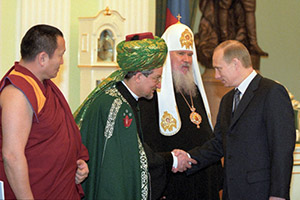
    Vladimir Putin meets with Russian religious leaders. A Russian Orthodox Christian, he has long supported Russia’s spiritual traditions.

    11. Amendments to the Constitution of Russia 2020

    The 1993 Constitution of the Russian Federation was adopted in conditions of acute internal political crisis with the country on the verge of total collapse. Tanks fired at the parliament, and in Moscow there were clashes. The situation has now changed dramatically, and amendments to the Constitution are considered a natural result of 20 years of Putin’s activity. At the all-Russian referendum, 77.92% of Russian citizens voted for the amendments of the Constitution.

    The complete list of amendments includes 206 changes in various areas from social guarantees to the judiciary and local governments. Not all of them are equal. Some, in my opinion, are more important, some less. But most of all, I like the fact that the following standards are now set out at the state level:

    The priority of the Constitution of the Russian Federation over international law.

    Children are the most important priority of Russian state policy.

    Protection of the institution of marriage as a union of a man and a woman (that is, a traditional family!)

    High officials, deputies and judges are prohibited from having foreign citizenship, residence permit in another country and foreign bank accounts.

    Russia ensures the protection of historical truth and does not allow the falsification of history and the belittling of the value of the heroic deed of the people in defence of the Motherland.

    Russia is taking measures to maintain and strengthen international peace and security to ensure the peaceful coexistence of states and peoples.

    Russia protects the rights and interests of compatriots living abroad.

    Get the issue this article appears in

    12. Russian national idea as hope of the world

    “Each man will live for his fellow man! The principle has been born. It will take years for it to be crystallised, but out of Russia comes again the hope of the world” – this was the prophecy of the American clairvoyant Edgar Cayce in 1944. I do not know if Vladimir Putin is familiar with Cayce’s prophecies, but for me it is an undoubted fact that he perfectly understands the importance for Russia to have a certain unifying idea, without which the further development of the state is impossible, not to mention that it can bring hope for the rest of the world.

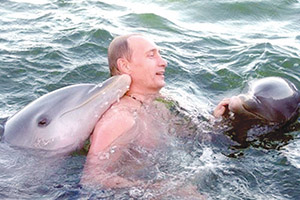
    Putin is often seen in nature and is known as an animal lover. The above footage of Putin playing with dolphins was filmed in December 2000 at Cuban health resort Varadero (one year after he assumed the presidency).

    In the 19th century, the national idea of ​​Russia was formulated by Count S.S. Uvarov (in 1833) in the form of three components: “Orthodox Christianity, Autocracy and Communality.” During the Soviet period, communism became the national idea. After the collapse of the Soviet Union, the communist idea was rejected and the so-called “de-ideologisation of society” declared. But, as they say, “a holy place is never empty,” and hostile forces – both external and internal – began to actively impose ideologies alien to Russia – the ideology of the Western way of life, individualism, consumerism, profiteering, violence, various sects, etc. Fortunately, the mentality of the people, which forms the basis of any national idea, has been formed for centuries and changes extremely slowly, thanks to which it still successfully resists the forced introduction of the values ​​and morality of the Western world.

    Every people have their own special system of thinking, the way of life that determines their view of the world, development of their community; and every person behaves in accordance with his/her national mentality and historical development. What are the main features of the Russian mentality?

    First, it is an unusually great kindness. Naturally, there are kind people in every nation. There are peoples who may have a lot of flaws, but it is kindness that comes first. These are the Russians.

    Secondly, it is a very humanistic view of things. The common future of mankind takes first place in the human value system, next comes the fate of the people, the fate of the family takes third place, and personal fate comes last.

    Third, a highly developed sense of selflessness. A Russian is unequalled when it is necessary to “lift an unliftable” or to “bear an unbearable,” when it is necessary to “dissolve” yourself in the lives of other people or to dedicate your entire life to something you serve.

    These three qualities – kindness, a humanistic worldview and selflessness – are united in the concept of spirituality as the distinguishing feature of the Russian mentality.

    Then comes the next group of distinctive qualities of the Russian mentality. First, it is communality. It could also be called conciliarity; in the Soviet period it was called collectivism.

    Secondly, it is traditionality, which manifests in reliance on, and preservation of, folk culture, folk traditions, folk language, folk pedagogy, folk rituals, folk crafts, etc.

    Thirdly, it is openness, i.e. the curiosity of a Russian, the ability of Russian culture to be open to external influences, to absorb the values ​​of different peoples, to spiritually enrich and transform them, while keeping its own originality and unity.

    These three features can be combined into a second general concept – the national character of the Russian mentality.

    Finally, there is a third group of qualities. Firstly, it is patriotism or love for the Motherland, love for your homestead and the country, the willingness to faithfully serve its prosperity, love the home, and a readiness to defend it.

    Secondly, it is a recognition of the need for strong sovereign power. Obviously, Russia needs this to resist under current conditions the external and internal forces trying in every possible way to weaken Russia, to oust it from the ranks of the leading world powers, or even destroy it altogether.

    Patriotism and the recognition of the need for strong state power can be united by the third general concept – great power statehood.

    These three general concepts – Spirituality, National Character and Great Power Statehood – constitute the core of the national idea of ​​Russia. For me, it is obvious that all these qualities of the Russian mentality are inherent in Vladimir Putin and are clearly expressed in his actions aimed at building strong sovereign power and supporting traditional, cultural Russian values ​​and patriotism.

    In conclusion, I would like to emphasise once again that Putin inherited an almost collapsed nation with a lot of problems. Now Russia is again a strong global power with a developed economy. Therefore, even if you don’t like something happening in the country, don’t be so quick to blame Putin. Re-read this impressive list of positive facts again, and then put yourself in the Russian president’s shoes and imagine how much work was required to solve the problems and implement all of these changes, despite pressure from external forces and the resistance of the engorged Russian parliament and financial oligarchs.

    For more on Vladimir Putin, see Gary Lachman’s article ‘The Philosopher Tsar’ in New Dawn Special Issue Vol 15 No 3.

    [alert type=”general” dismiss=”no”]This article was published in New Dawn 187.[/alert]

    [alert type=”success” dismiss=”no”]If you appreciate this article, please consider subscribing to help maintain this website.[/alert]

    © New Dawn Magazine and the respective author.
    For our reproduction notice, click here.
  • Destiny Calling: Experiments with Dreaming, Time & Synchronicity

    Destiny Calling: Experiments with Dreaming, Time & Synchronicity

    From New Dawn 181 (Jul-Aug 2020)

    This article about synchronicities and precognitive dreams was originally published in Quest magazine in 1997. At the time I wrote it, I didn’t have access to the dream journals I mention in it, and so had to rely on memory. Since then I have retrieved the journals from Los Angeles – where they were slumbering in storage – and at present am working on a book about dreams, time, and the strange relationship between. This article can serve as a taster for the full-length treatment to come.

    Since around 1980, I have kept, more on than off, a dream journal. Some years are less accounted for than others, but on the whole I have a fairly well-stocked entry book for what was going on in my sleeping mind over the last seventeen years.

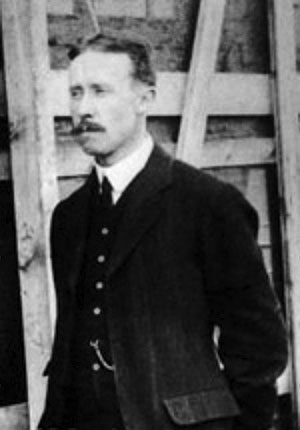
    J. W. Dunne (1875–1949) 

    I began the journal after reading an amazing book, An Experiment with Time, by J. W. Dunne. In it, Dunne, an aeronautics engineer,tells how he discovered that he could dream the future. One night heawoke from a dream in which he had been arguing with someoneabout the time. He said it was 4:30 a.m. In the dream Dunneassumed, with the strange logic of dreams, that his pocket watchmust have stopped; he reached for it to check, and found that it had. He then woke up.

    A curious sort, Dunne decided to see what time it “really” was. He found his pocket watch and looked: it had stopped at precisely 4:30. Dunne assumed he must have noticed this earlier, forgotten it, also forgotten to wind the watch, and dreamed about it. He wound the watch and went back to bed. When he woke later, he assumed he’d have to fix the time, since he had no idea what time it was when he wound the watch the night before. When he checked the watch against a clock, he was surprised to discover it was correct. The watch had stopped at 4:30 a.m.

    More odd things happened. Lying in bed one morning, Dunne found himself wondering what time it was. He tried an experiment. He closed his eyes and “fell into one of those semi-dozes in which one is aware of one’s situation” – what we’d call a “hypnogogic state” – and concentrated on knowing what time it was. He saw an image of his watch, poised in front of him. It said two and a half minutes past eight (Dunne is meticulous with details). He opened his eyes and reached out for his watch. His vision was correct: the time was two and a half minutes past eight.

    Not long after, Dunne had a dream in which he was in Egypt, near Khartoum. He saw three men approaching from the south, dressed in ragged army uniforms, very much like those of the soldiers he had recently been fighting in the Boer War in South Africa. In the dream he wondered why they should travel on foot from the bottom of the continent to the top, and asked them. They replied that was precisely what they did. The next morning he saw a news headline: “The Cape to Cairo: Expedition at Khartoum,” over a story describing the expedition he had dreamed about.

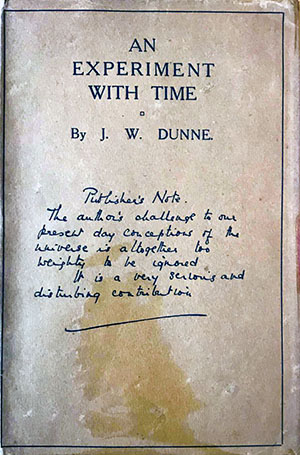
    First edition of An Experiment with Time.

    But perhaps the most thrilling dream was of the eruption of Mont Pelee on the island of Martinique in 1902. Dunne dreamed he was on an island, and that cracks and fissures had opened under his feet. Steam escaped from these openings, and in the dream Dunne realised that the island was about to explode. He knew he had to escape, and tried to help the 4,000 people he knew would be killed. The next morning the newspaper carried a story about the disaster. Dunne was off on the number of people lost; it was 40,000, not 4,000. But this discrepancy proved a key to his experience. When reading of the disaster, Dunne had hastily read that 4,000 people had been killed. It was only later that he went back and saw that he had misread the newspaper. Dunne realised that he wasn’t dreaming about the actual events – the volcano or the expedition – but about his reading about them in the morning paper. He had dreamed the future, but it was his own, specific future – in which he misread the number in the newspaper.

    This led Dunne to believe that what he was experiencing was, odd as it sounds, “normal.” He hadn’t developed some strange power to see the future; our ideas about time, he believed, were wrong. We usually think of time moving in a definite order: past, present, future. Dunne’s dreams were giving him his usual experience but in a different order. After studying many dreams, Dunne concluded that they were made up of a mixture of past and future events. We usually don’t notice this because, for one thing, we easily forget our dreams, and for another, we usually pay very little attention to our experience.

    Dunne went on to write a series of interesting books in which he developed his philosophy of “serialism,” a somewhat complicated metaphysic of different “times,” each encompassing the other. While making for fascinating reading, Dunne’s theory leaves us with an infinite regression of “selves,” each one, as it were, looking over the previous self’s shoulder. Dunne argued that the only way we can notice that one time is different from another is for there to be a consciousness outside of the two times and able to compare them. So, Time 1 is everyday time of past, present, and future. Time 2, which includes Time 1, is the time of dreams, where the future mixes with the past and present. Time 3 looks at Time 2 and compares it to Time 1, and so on until we arrive at the ultimate timekeeper, God, who is aware of all times simultaneously. The vision is inspiring but, to me at least, unsatisfying. If you think of the infinite reflections we get when we hold one mirror up to another, you’ll see what I mean.

    After reading Dunne’s books, I decided to keep a dream journal. I had been interested in dreams already through reading C. G. Jung and had occasionally written down unusual ones. And I had been interested in the strange character of time through reading the Russian philosopher P. D. Ouspensky. In Tertium Organum, New Model of the Universe, and his novel, The Strange Life of Ivan Osokin, Ouspensky, like Dunne, started from the recognition that our usual ideas about time are inadequate. Ouspensky explored the idea of eternal recurrence – the notion that our lives repeat over and over again. Ouspensky believed this was responsible for déjà vu, and speculated on a six-dimensional time. Time is strange, Ouspensky knew, and like Dunne he felt that our usual account of it was sadly inaccurate. Other writers followed, including T. C. Lethbridge and J. B. Priestley.

    Lethbridge is best known for his work with pendulums, but in his last years he wrote about “Dunne type dreams.” Priestley called himself a “time haunted man,” and was influenced by both Dunne and Ouspensky. His reflections on time and dreams can be found in his books Man and Time and Over the Long High Wall. He also wrote plays based on Ouspensky’s theories – Time and the Conways and I Have Been Here Before.

    Future Dreams

    Having said this, I should mention that I don’t have a theory to account for “future dreams.” Dunne’s serialism doesn’t satisfy me. Ouspensky’s speculations on the fourth, fifth, and sixth dimensions offer more to go on, but I think they are a beginning, not an “answer.” To tell me I dream the future because time is six-dimensional is fine, as long as you also tell me how that answers it. Unfortunately, when I discuss this with friends, I usually get an answer similar to this, which suggests to me more a disinclination to take on the difficult business of thinking than a sure grasp of the metaphysics of temporal displacement.

    What I first discovered in following Dunne’s example is that he was right: bits of the future did turn up in my dreams, but nothing as thrilling as a volcano (although they did turn up later). What came through were trivial items. I dreamed of playing a red guitar. I didn’t own one, nor did I know anyone who did. But later that day, through a chance meeting, I wound up at someone’s apartment, and this acquaintance handed me a red guitar, asking me to “check this out.” I started strumming and only then remembered I had written about this in my journal that morning. I dreamed of sitting cozily with an attractive woman I knew slightly; I chalked that one up to Freudian wish fulfilment until, again through a chance connection, I found myself in a more intimate setting than I would have expected with the woman in question. Similar dreams followed, enough to convince me that something more than mere coincidence was at work here.

    One of my earliest “future dreams” proved to be a “vision” of an event that took place months later. I had dreamed of riding on the back of a motor scooter with someone I didn’t know through an unfamiliar neighbourhood. The landscape was hilly, with palm trees and other vegetation not native to Manhattan, where I was living at the time. In a particularly memorable part of the dream, we were passing large trucks with the words “cosmic consciousness” painted on the side. An odd enough dream to begin with, but then, months later, I found myself on the back of a Vespa, riding with a newly made friend through the Silverlake district of Los Angeles, to where I had just moved from Manhattan. We passed the hills I had seen in the dream, also the palm trees. But in place of the trucks, something else was there. As we passed a street with the same name as my friend – I remember pointing it out to him – I remembered the dream. Suddenly I was hit with a strong dose of déjà vu, and a feeling that walls of some sort had just fallen, and that my awareness of things expanded in all directions: a close enough description of a snippet of “cosmic consciousness” to get me thinking about what exactly was going on. Around the same time as this “waking” event I had a very powerful lucid dream – these are dreams in which we know we are dreaming – featuring the same friend that generated the same odd feeling of expanded awareness.

    Two things came from that dream: the realisation that some future events appear “distorted” – or “symbolically,” depending on how you look at it – in dreams, and that the recognition that “you have dreamed this” is accompanied by a peculiar sensation and emotion. The dream was, as it were, fulfilling its own prophecy: I had dreamed about cosmic consciousness, and remembering the dream when in the same situation in waking state produced a sensation of expanded awareness. Ouspensky said certain kinds of knowledge aren’t available unless we’re in the right emotional state. I had begun my experiment in a spirit of scientific objectivity but soon saw that I couldn’t treat dreams as we do other objects of study. They aren’t dead specimens, as many “scientific” dream researchers seem to regard them. To understand them fully, a certain emotional warmth, much as we direct toward people, is necessary.

    In the years that followed I collected more “future dreams.” Certain patterns emerged, as well as more characteristics that Dunne didn’t mention. My reading of Jung had made me aware of the psychological value of dreams, their meaning as indicators of what Jung called the “individuation process,” an approach to dreams apparently unfamiliar to Dunne. This meant that I began to think not only of the puzzles of time and consciousness that “future dreams” present, but also what these glimpses meant for me. Two books deal with related phenomena from this perspective: Ray Grasse’s The Waking Dream [1996] and Victor Mansfield’s Synchronicity, Science, and Soul-Making [1995].

    Some of the patterns dealt with time itself. The dreams came in cycles. There would be several in a week, then none for a few months, then another flurry. Some of the most spectacular related to films. During a period of intense Jungian study, I dreamed about a film of the old 1930s pulp character the Shadow – not unusual for a reader of Jung. I knew of no such film and, though I had been a great fan of the pulp revival in my youth, I hadn’t thought of this character in years. In the dream, the Shadow appeared as a two-dimensional figure on a wall, then popped out and became three-dimensional. I had this dream in 1990. In 1994, I went to see the film The Shadow, starring Alec Baldwin, and saw exactly what I had seen in my dream. Sometime before, a friend who was working on Francis Coppola’s version of Dracula had invited me to a screening. A few nights before, I had a frightful nightmare in which I rescued a woman friend from some gruesome face in a strange, Hieronymous Bosch-like village. Wolves hung upside clown on crosses, fires burned, throwing up blood-red shadows and thick, black smoke, and foul-looking characters waded through arms, legs, and other body parts, carrying axes and pikes. It was a charnel house, something out of one of Emanuel Swedenborg’s hells. Truly evil. I went to the screening and saw what I had dreamed: the film begins with a scene of Vlad the Impaler’s handiwork – crucified wolves, fires, blood and gore. In both instances the “feeling” was there, what I started to call the “timeslip.”

    Synchronicity Cloud

    Along with emotionally charged dreams, there were many about trivial, everyday matters. I would be standing at a street corner and notice a car pass by and realise I had dreamed this the night before. I dreamed of a fountain, with terracotta steps rising on either side. In the dream, this was somewhere in Italy. That day, by chance, I got a lift from a friend into Hollywood and decided to get out a few blocks from my destination and walk the rest of the way. When I got out of the car, there were the fountain and steps; it was not Italy, but Sunset Boulevard. And the feeling. Not exactly déjà vu, but an odd mixture of this and another sensation described by Ouspensky, from his studies with Gurdjieff, called “self-remembering.” Jungian friends “explained” my dreams as “synchronicities.” I had no doubt they were, but didn’t see how calling them this rather than “coincidence” told me anything about how they happened.

    I noticed that certain psychological conditions seemed, if not to cause the dreams, at least to accompany them more than others. States of tension or, conversely, of great interest and happiness seemed to be preferable to an even keel. Tension produced an uncomfortable feeling that the membrane separating dream from reality – shaky distinctions at best – had been perforated. Situations in which I would hear, metaphorically, the Twilight Zone theme would produce a feeling that I was “dreaming” while awake, and it took some effort to keep up appearances and not turn tail. It seemed then that the dream feeling was seeping into my waking life and that my consciousness consisted of a muddle of the two. Conversely, when happy, alert, and expectant, I would find synchronicities popping up almost a dime a dozen.

    Once, on a weekend trip to San Francisco, it was as if I had stepped into a “synchronicity cloud.” Not only had I dreamed several small events of the day, but I found myself bumping into coincidences left and right. For example, I had been reading Edgar Allan Poe’s stories and had just read about a particular character with an unusual name. I looked up at the building I was standing in front of: the same name was emblazoned across the storefront. Several similar things happened. Likewise, at the start of a move to Europe, I was waiting for my flight at JFK airport, reading The Glass Bees by the German writer Ernst Junger, himself a connoisseur of dreams and psychic phenomena. The hero was describing how, during his military training, his cavalry sergeant had taught him the value of learning how to fall by deliberately arranging a slip from the saddle. The moment I read this, I looked up to see a large man fall flat on his back.

    I mention synchronicities because, although some of my “future dreams” were clearly related to my psychological development, many weren’t. Jung defines synchronicities as “meaningful coincidences,” having to do with our “individuation,” our growth and maturity. I mentioned volcanoes earlier. Several years ago, I woke from a dream in which my ex-wife and I were with her uncle in Japan. He was helping us escape from a flood of lava and urging us to hurry. I had never met her uncle nor been to Japan; I also hadn’t heard about the volcano that had erupted there that week until after the dream. Synchronicity? But what had volcanoes in Japan to do with my psychological growth? Again, a few years ago, I dreamed of tremendous explosions and devastated landscapes; only later that day I realised it was August 6, the anniversary of Hiroshima, something I hadn’t remembered until then. Some “future dreams” were perhaps telepathic; my ex-wife may have been in rapport with her uncle in Japan, and I may have picked up her intuition, but she didn’t mention it to me, nor was she aware of the volcano. In any case, this seems to me a case of synchronicity with no particular meaning for me. Yet some other dreams clearly did have meaning. One night I dreamed of a man’s face directly in front of mine; it was nasty, and he was shouting. That night I went to an outdoor concert at the Hollywood Bowl. There was a misunderstanding about my seat, and I lost my temper with an usher; naturally enough, he replied in kind. Only later did I realise his was the face in the dream. Had I been more aware, I could have avoided a foolish argument.

    The Invisible Writing

    But my most striking dreams are ones in which I feel some “intelligence” is communicating with me, giving guidance and advice. With these, I’m convinced something not “myself” is at work. I dreamed of dancing in a circle of Tibetan monks. We were passing a ball of yarn back and forth; when the ball came to me it began to unravel. We held onto the edges and danced; the yarn opened up and a beautiful mandala appeared. I woke feeling that something extraordinary had happened. That day, in the bookstore I managed, a colleague told me he had found a picture of me in my past life. I laughed as he pulled out a copy of Alexandra-David Neel’s Secrets of Tibetan Yoga and showed me the back cover. There was a photo of a pudgy, cherubic monk with round glasses, the kind I wore. I hadn’t mentioned the dream. The friend said this meant I should take up Tibetan Buddhism. I thought it meant I was on the “right path” already.

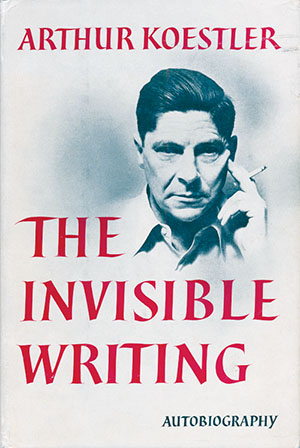
    One last dream. At the same bookstore I made a habit of putting books aside, thinking I might buy them. One was The Invisible Writing, Arthur Koestler’s autobiography. Koestler wrote of how he had abandoned the “scientific” materialist outlook of his youth while waiting to be shot as a prisoner during the Spanish Civil War. To pass the time in his cell, Koestler worked out the mathematical proof that there is no highest prime number. He became so absorbed in this that he had a kind of mystical experience; only a small nagging at the back of his mind distracted him. “Oh, yes,” he remembered, “I may be shot tomorrow. Is that all?” Koestler then realised he had been wrong to think the reality of the world could be found in the Marxist rationalist thought he had been trained in, the visible proofs of history, economics, and sociology. Reality lay in what he called “the invisible writing,” the intuition, poetic and mystical. The experience changed his life. He left Marxism and devoted himself to exploring human creativity and the meeting points of science and mysticism.

    At the time I found Koestler’s book, I was facing a crisis: I had to decide whether to carry on with a PhD program or take a chance on writing, as I had always wanted to do. The doctorate would mean security, a job, prestige, but it would also mean letting go of my unorthodox interests, such as future dreams, and becoming a “serious” scholar. I decided not to buy the book. That night I dreamed that I returned to the store and bought The Invisible Writing. Wish fulfilment? But “bought” in slang means to accept, to believe. The dream was telling me to buy more than the book; it told me to “buy” the idea of “the invisible writing,” a point that came home literally when I borrowed a biography of Jung that night and opened it at random to a chapter describing his ideas about dreams as messages from a hidden self. The chapter’s title? “The Invisible Writing.” I didn’t finish graduate school.

    The above article originally appeared in Quest: Journal of the Theosophical Society in America, Vol 85, Issue 12.

    Gary Lachman’s new book is Dreaming Ahead of Time: Experiences with Precognitive Dreams, Synchronicity and Coincidence, available from all good bookstores and online retailers.

    [alert type=”general” dismiss=”no”]This article was published in New Dawn 181.[/alert]

    [alert type=”success” dismiss=”no”]If you appreciate this article, please consider subscribing to help maintain this website.[/alert]

    © New Dawn Magazine and the respective author.
    For our reproduction notice, click here.
  • Robert Anton Wilson & Guerrilla Ontology

    Robert Anton Wilson & Guerrilla Ontology

    From New Dawn Special Issue Vol 15 No 1 (Jan 2021)

    Although we are in the midst of an ‘information revolution’, many of us rarely question the world around us. As the political domain becomes increasingly polarised, there is a greater need for people to expose themselves to alternative viewpoints and opinions. 

    In theory, the internet should function as an open platform in which mainstream narratives are continually challenged, questioning the institutional authority of governments, multinational corporations and the mainstream press. 

    Thankfully, we can question the ‘status-quo’ thanks to numerous websites, online forums and podcasts dedicated to alternative points of view and research, including parapsychology, geopolitics and ‘conspiracy culture’. At the same time, the rise of social media has resulted in more subtle yet dangerous forms of propaganda and mind control where people are often unknowingly exposed only to those who hold similar views to their own, stuck in a ‘social validation feedback loop’.

    How can we stay open-minded, questioning and pragmatic in today’s world? Guerrilla ontology may provide the answer.

    What is Guerrilla Ontology?

    Guerrilla ontology is a term coined by Robert Anton Wilson in his 1980 book The Illuminati Papers. Wilson defines it as an approach adopted in his novels that mixes “the elements of each book so that the reader must decide on each page, ‘How much of this is real and how much is a put on?’”1 In other words, it functions as an exercise in cognitive dissonance, where “readers are left to form their own interpretation as to which, if any, of the numerous and contradictory viewpoints presented by the characters are valid or plausible.”2 This is similar to the postmodernist claim that textual discourse can be interpreted in a number of different ways (potentially infinite) since there is no singular interpretation. Guerrilla ontology is much more than a literary technique, however. As Wilson stated in an interview: 

    The Western World has been brainwashed by Aristotle for the last 2,500 years. The unconscious, not quite articulate, belief of most Occidentals [Westerners] is that there is one map which adequately represents reality. By sheer good luck, every Occidental thinks he or she has the map that fits. Guerrilla ontology, to me, involves shaking up that certainty. I use what in modern physics is called the “multi-model” approach, which is the idea that there is more than one model to cover a given set of facts… It’s important to abolish the unconscious dogmatism that makes people think their way of looking at reality is the only sane way of viewing the world. My goal is to try to get people into a state of generalised agnosticism, not agnosticism about God alone, but agnosticism about everything… That’s what guerrilla ontology is – breaking down this one-model view and giving people a multi-model perspective.3

    In other words, the primary aim of guerrilla ontology is to remain in a permanent state of agnosticism and interpret reality through a multitude of cultural, political, economic, philosophical, scientific and spiritual perspectives. Instead of subscribing to a single belief system, guerrilla ontology promotes a radical form of intellectual pragmatism in which contrasting ideologies are synthesised, integrated and assimilated to provide a more complex and dynamic understanding of the world. 

    Wilson assumes there is no ‘objective’ reality; even basic statements such as “there are 24 hours in a day” or “the world is round” are subjectively determined. This multi-modal approach results in an expansion of human consciousness in which all explanatory models are considered both ‘true’ and ‘false’ simultaneously. 

    To fully appreciate the implications of guerrilla ontology, it is crucial to know the meaning of the terms. Ontology is the branch of metaphysics concerned with the nature of existence or being, while guerrilla in this context refers to military tactics used by fringe groups to obtain political power – acts of sabotage, ambushes, raids and hit-and-runs. Guerrilla ontology could be considered a form of philosophical warfare in which the ontologist attempts to undermine authority by subverting the symbols, signs and semiotic systems through which power is exercised and maintained. Using specialised tactics such as culture jamming, reality-hacking, subvertising and meme-magic, the ontologist becomes an active participant in the cultural arena and generates new locations of meaning. Fomenting contradictory ideas induces a sense of confusion and disorientation, causing a malfunction in the psychological programming required for ideological control to function effectively. In this sense, guerrilla ontology is a subversive exercise, a rebellion against all ‘reality tunnels’ that govern perception and narrative. 

    For Wilson, internet technologies can play a fundamental role in challenging our ideological assumptions, creating a decentralised matrix of information where no singular worldview is predominant. Various public and private actors compete for cultural authority, undermining the very concept of ‘truth’ as we know it. As communication networks become increasingly globalised, there is greater exposure to different ideas, theories, concepts and perspectives. People find themselves in a position where they can no longer distinguish between ‘fact’ and ‘fiction’. While there are dangers that this could lead to new forms of manipulation and control, it will also result in a new era of intellectual creativity, dynamism and fluidity. As Wilson states, this ‘information revolution’ is merely a continuum of an ongoing historical trend towards cultural relativism:

    When people started trading and having commerce with one another, they had to learn things the way other people saw them. As a result, some sense of cultural relativism appeared in the ancient Greeks, who were great traders. I think that’s what’s responsible for the rise in Greek Philosophy. Unfortunately, this has always remained a minority point of view because of the entrenched power of dogmatic thought. With the rise of modern electronics, however, things have begun to change faster. We’re now living in the global village which Buckminster Fuller and Marshall McLuhan have long been predicting. I’ve actually met people in their 20s who have travelled to as many as 30 different countries in their lives. With that amount of travel and the emergence of modern electronic media, more and more people are developing a sense of cultural relativism [Wilson made these statements in 1980].4

    In this sense, guerrilla ontology enables us to navigate the new ‘post-truth’ age, where user-generated content undermines the informational monopoly of mass-media gatekeepers and popularises alternative narratives, which would have previously remained on the fringes of society. 

    As previously noted, the purpose of guerrilla ontology is to induce a state of cognitive dissonance in which seemingly contradictory worldviews are assimilated in order to expand the boundaries of human consciousness. For Wilson, internet technologies are part of this expansion of consciousness as more and more people are exposed to different models of reality. 

    Cognitive Dissonance & Quantum Mechanics

    While the multi-model approach described by Wilson seems at odds with the notion of ‘scientific truth’ – that we can establish certain facts about the world through empirical observation – even scientists are required to adopt a multi-model approach when describing phenomena at a quantum level. 

    When examining the behaviour of sub-atomic particles, the principles of Newtonian physics are no longer applicable. Instead, scientists must explain such phenomenon in terms of ‘probabilities’, the different outcomes that occur within a quantum system until the act of measurement results in the occurrence of a single outcome. For example, quantum mechanics demonstrates that light functions as both a particle and a wave, despite the fact that the former has a gravitational mass while the latter does not.5 In this sense, we are limited by the linguistic models that we have at our disposal when observing scientific phenomena. 

    Niels Bohr, the Danish physicist who proposed the Copenhagen Interpretation of quantum mechanics, believed that mathematical equations do not describe the universe with objective precision. Rather, they describe the “mental processes that we have to put ourselves through to describe the universe.”6 For example, when we describe the universe as a three-dimensional space-time continuum, we are actually describing how our minds organise sensory experience; another life-form may experience reality as fourth or even fifth dimensional, and therefore the equations they use to describe reality will be radically different from our own. For Wilson, guerrilla ontology (or cognitive dissonance) is based on the idea that by embracing seemingly contradictory models of the world, we become aware of our own relativistic position within the universe. 

    Religions have known for centuries that cognitive dissonance expands the parameters of the mind. As Wilson states, “most of the occult literature of the world – aside from the 95% of it that is sheer rubbish – consists of tricks, gimmicks and games to trigger meta-programming consciousness.”7 

    The Upanishads, an ancient text central to Hinduism, is full of various paradoxes, intended to spiritually enlighten the reader. For example, it describes Brahman (the ultimate reality) as “non-differentiated, infinite, having neither cause, nor example, immeasurably extensive and without beginning… There is no dissolution, nor creation, neither one bound, nor the novice, neither the seeker after freedom, nor the liberated one.”8 These contradictions reveal what modern science is only beginning to discover – that reality is merely an expression of dynamic conscious thought. 

    Changing the Brain

    In his book Prometheus Rising, Wilson provides numerous techniques to achieve a state of cognitive dissonance. For example, he asks his readers to buy a copy of Christian Science Sentinel and read all the faith healings that month, then buy a copy of The Peyote Cult by anthropologist Weston LeBarre which attributes all this to auto-suggestion, and then read Brain/Mind Bulletin and observe that similar healings are attributed to endorphins in the brain. After that, re-read all the miracles in the New Testament, using each of these filters: Jesus had the correct teaching; Jesus was employing auto-suggestion; the sufferers’ brains released endorphins when Jesus gave them positive auto-suggestion. By examining the phenomenon of faith-healing through a multitude of perspectives, one realises that no single explanation is valid, causing a paradigmatic shift in understanding. 

    According to Wilson, when a paradigm shift occurs – when we go from seeing things one way to seeing them another – “the whole world is remade.”9 All we can possibly ‘know’ is what our mind registers – reality is made up of nothing but thoughts. The brain, in the process of performing 100,000,000 calculations per minute, edits, organises and labels all raw “existential” experience and then classifies according to our belief systems. These systems will vary from culture to culture. What is ‘real’ to a native Inuit will not be the same as what is ‘real’ to a London taxi-driver. They occupy different ‘reality-tunnels’ since their social, economic, political and environmental perceptions of the world are radically different. Wilson describes this phenomenon as “neurological relativism” – each individual has a neurological system different from other members of the same society, enabling them to perceive reality in a unique way. 

    Through the practice of guerrilla ontology, one is aware that the mind and its contents are ‘functionally identical’ – the distinction between ‘me’ (mental awareness) and ‘not me’ (external reality) is merely a linguistic one. We become what Wilson calls “metaprogrammers,” individuals with the ability to continually recalibrate our “reality-tunnels.” 

    The metaprogramming circuit – known as the “soul” in Gnosticism, the “no-mind” in China, the “White Light of the Void” in Tibetan Buddhism, Shiva-darshana in Hinduism, the “True Intellectual Centre” in Gurdjieff – simply represents the brain becoming aware of itself.10

    Wilson describes it as “the artist seeing himself in his painting, seeing himself seeing himself in his painting… It is a conscious mirror that knows it can always reflect something else by changing the angle of its reflection.”11

    Modern psychology demonstrates that neural networks in the brain are able to change through reorganisation, a phenomenon described as neuroplasticity. These changes “range from individual neurons making new connections, to systematic adjustments like cortical remapping.”12 Neuroscientists used to believe that neuroplasticity only occurred during childhood, but modern research has now proven the brain can be altered during adulthood as well. Learning a new language is particularly valuable in this regard; various studies suggest that multilingualism not only restructures the brain but also boosts its capacity for plasticity. As Wilson argues, guerrilla ontology is similar to learning a language since it provides us with new ways of interpreting sensory experience. In the same way that foreign words and phrases allow us to see the world differently, so too do new belief systems expand the boundaries of human consciousness. Through meta-programming (exposing oneself to contradictory models of reality), we are able to rewire the very circuitry of our brains, resulting in more fluid and dynamic modalities of thought. 

    Conclusion

    Guerrilla ontology is a powerful tool for breaking free from the shackles of ideology. As our world becomes increasingly complex, due to the forces of globalisation and technological acceleration, it is important that we possess the ability to transform our social, political, economic, philosophical, scientific and religious beliefs. 

    Those who remain in bondage to a single ‘reality-tunnel’ will inevitably get swept up in the tsunami of information and manufactured narratives. Many people will undoubtedly experience ‘existential crises’ as they encounter numerous theories, models, concepts and frameworks that challenge the stability of their foundational worldview. 

    To navigate what French philosopher Guy Debord called “The Society of the Spectacle,” in which authentic social life has been replaced with its representation – “All that once was directly lived has become mere representation”13 – we must learn to embrace a multi-model approach. While it is important that we remain sceptical of how internet technologies are used to manipulate our thinking, the ‘information age’ allows us to become more open-minded than ever before. As Aleister Crowley once famously stated, “Man is ignorant of the nature of his own being and powers. Even his idea of his limitations is based on experience… There is no reason to assign theoretical limits to what he may be, or what he may do.”14

    [alert type=”general” dismiss=”no”]This article was published in New Dawn Special Issue Vol 15 No 1.[/alert]

    [alert type=”success” dismiss=”no”]If you appreciate this article, please consider subscribing to help maintain this website.[/alert]

    Footnotes

    1. https://guerrillaontologies.com/about/
    2. https://en.wikipedia.org/wiki/The_Illuminatus!_Trilogy#Cognitive_dissonance 
    3. J. Elliot, (1980) ‘Robert Anton Wilson: Searching for Cosmic Intelligence’, available at http://rawilsonfans.org/searching-for-cosmic-intelligence-interview-1980/ 
    4. Ibid.
    5. https://en.wikipedia.org/wiki/Light
    6. R. Wilson, (1983) Prometheus Rising, New Falcon Publications
    7. Ibid.
    8. The Yoga Upanishads (available at) https://archive.org/stream/TheYogaUpanishads/TheYogaUpanisadsSanskritEngish1938#page/n63/mode/2up
    9. R. Wilson, Prometheus Rising
    10. Ibid. 
    11. Ibid. 
    12. https://en.wikipedia.org/wiki/Neuroplasticity
    13. https://en.wikipedia.org/wiki/The_Society_of_the_Spectacle
    14. A. Crowley, (1929) Magick in Theory and Practice, Dover Publications

    © New Dawn Magazine and the respective author.
    For our reproduction notice, click here.
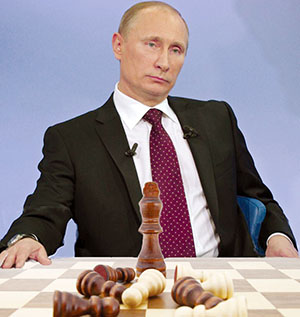
  • Secrets of Natural Antibiotics & Antivirals

    Secrets of Natural Antibiotics & Antivirals

    From New Dawn 184 (Jan-Feb 2021)

    For much of human history, the true cause of infectious diseases remained a mystery. In the absence of treatment, many patients succumbed to their illnesses. It was not until the nineteenth century that evidence for the existence of germs was revealed. The discovery of penicillin in 1929, and then that of many other pharmaceutical antibiotics, finally permitted the specific treatment of infectious diseases. The mortality and suffering connected to these illnesses dropped so spectacularly that the plants we had used empirically until then in the fight against germs were abandoned.

    However, over the last few decades, an increasing number of studies have brought these plants back into the spotlight. Extensive research has made it possible to gain a deeper understanding of their antibiotic properties. Not only have they been shown to have greater therapeutic effectiveness than was once believed, but also a much greater spectrum of action. Indeed, many are effective against viruses, which is not the case for pharmaceutical antibiotics. In addition, their side effects – if they even have any – tend to be benign, and the plants do not prompt germs to develop resistance against them.

    Today, we also benefit from better preparation methods for plant-based remedies, making it possible to obtain products that are more powerful and reliable than those of centuries past.

    Natural Antibiotics

    Natural antibiotics are chemical substances produced by plants ranging from the most common weeds (Thyme, Savory, Oregano etc.) of our local surroundings to more exotic species (Eucalyptus, Ravintsara, Tea Tree etc.). Several hundred plants possess antibiotic properties, so our reserve of these remedies is quite extensive. People have been benefiting from their healing properties for thousands of years.

    Natural antibiotics have a twofold action: a direct effect against the germ and an indirect effect through the terrain. A plant’s direct action comes from the toxicity and caustic nature of the antibiotic substances it possesses. The indirect action of natural antibiotics (which conventional antibiotics do not possess) is equally dangerous for germs. Although they are not attacked directly, germs still suffer serious damage because, by altering the characteristics of the terrain, natural antibiotics make it unfit for their survival. 

    Anti-viral properties

    While both kinds of antibiotics share points in common – a more or less powerful effect depending on the germ, a narrow or broad spectrum of action, and the ability to attack protozoans, bacteria, and fungi – the comparison ends there. Natural antibiotics possess, in fact, other characteristics that distinguish them fundamentally from conventional antibiotics.

    The majority of natural antibiotics are antivirals, which is never the case with conventional antibiotics. Moreover, their antiviral properties are often quite powerful. They offer effective and non-toxic treatment against numerous illnesses (flu, shingles, etc.) that are untreatable by conventional antibiotics. This is all the more valuable because, outside of natural antivirals, the number of existing antivirals is quite limited.

    An advantage of natural antibiotics is they do not encourage germs to develop resistance to them. What are the reasons for this? 

    Conventional antibiotics consist of a single molecule. This makes it easy for a germ to manufacture an enzyme capable of neutralising them. Natural antibiotics, on the other hand, are composed of many different molecules. The essential oil of mountain savory, for example, owes its action to one ketone, four kinds of phenols, and seven kinds of monoterpenes, to mention only a few of its components. A germ that tries to develop a resistance to this natural antibiotic would have to produce either an enzyme capable of neutralising all these molecules at once (which is impossible) or a dozen different enzymes (which is also impossible).

    Another advantage is that the side effects common with conventional antibiotic therapy – diarrhea, bloating, digestive disorders – do not manifest with natural antibiotics because they do not throw the intestinal flora out of balance. To the contrary, they support a healthy microbial balance by killing the virulent germs. If they do happen to trigger such symptoms, it would only be due to the laxative effect of certain plants.

    Essential Oils

    Natural antibiotics are mostly used in the form of essential oils. These are the volatile aromatic oils that give plants their characteristic odours and contain their medicinal constituents. They are extracted from plants by distillation or expression. These oils are contained in the tiny droplets of aromatic substances that are released by crushing mint or thyme leaves, for example.

    According to biologists, essential oils contain more compounds than all the chemists in the world could synthesise by working for one thousand years. Among these compounds are terpenes, phenols, aldehydes, and alcohols with antibiotic properties. They are among the most powerful of natural antibiotics.

    Essential oils can be taken orally, as an ointment on the skin, or by suffumigation – that is, using fumes (from steams, vapours, smoke, etc.). Their distribution power in the tissues is enormous. Several minutes after they have been spread on the skin, they will have entered the bloodstream. Twenty minutes to two hours later, they are in the lungs, being exhaled with every breath.

    Because essential oils are extremely concentrated – it requires pounds of plants to obtain several drops of essential oil – it is important to scrupulously respect the indicated dosages and the instructions on using them.

    One of these instructions is that a cure with essential oils should not last more than about seven days. If an additional cure is necessary, one should switch to natural antibiotics in the form of mother tinctures, which are alcohol and water-based preparations. These can be used for long-duration treatments.

    Three examples of natural antibiotics will now follow, two in the form of essential oil and the other in the form of a mother-tincture.

    The Essential Oil of Niaouli (Melaleuca quinquenervia)

    Niaouli essential oil is extracted from the leaves of the paperbark tree, which is widespread in New Caledonia and Madagascar. The antibiotic properties of this tree have been long known to the natives of these regions, who used them to disinfect water. 

    Niaouli oil is distilled from the fresh leaves and twigs of the paperbark tree.

    Niaouli essential oil is a very powerful natural antibiotic against numerous bacteria (including Staphylococcus aureus and the streptococci responsible for scarlet fever and acute articular rheumatism) and against most viruses and fungi. It is therefore an excellent antibacterial, antiviral, and antifungal. To a lesser extent, it is also active against parasites like the plasmodium that is responsible for malaria.

    This essential oil’s spheres of activity are the respiratory tract, the digestive tract, and the genital and urinary domains. Diluted in a little sweet almond oil, it is effective against skin infections.

    Dosage:

    Oral: Take 2 to 4 drops, three to five times a day, diluted in 1 teaspoon of honey or dispersant 

    Topical: Dilute 5 to 10 drops in 1 teaspoon of sweet almond oil for use as an ointment.

    A Natural Anti-Viral: Ravintsara (Cinnamomum camphora)

    Cinnamomum camphora,commonly known as the camphor tree, is native to China, Japan, and Taiwan, and has been introduced to many other countries. The oil extracted from the Cinnamomum camphora that grows in Madagascar is known as ravintsara. This is the medicine of the Malagasy, who have long known of the medicinal properties of the tree’s leaves and have benefited from using them to treat a vast number of health problems.

    Ravintsara essential oil is rich in 1,8-cineole and alpha-terpineol. It is an extremely powerful antiviral with a broad spectrum of action. This spectrum is, in fact, so broad that ravintsara essential oil is recommended for all viral afflictions: herpes, hepatitis, viral enteritis, chickenpox, and more. It is especially effective against the flu virus (whether used to prevent it or heal it), shingles, and infectious mononucleosis. In addition to its antiviral activities, ravintsara essential oil is also an effective antibacterial and has both antifungal and antiparasitic effects. Its spheres of operation are primarily the respiratory tract, the digestive tract, and the skin.

    Ravintsara essential oil has no caustic effects and so can be used neat (undiluted) on the skin.

    Dosage:

    Oral: Take 3 to 5 drops, three times a day, in 1 teaspoon of honey or dispersant.

    Topical: For massages or ointments, use 3 to 5 undiluted drops; for baths, add 10 to 15 drops to the bathwater.

    Note: Don’t confuse ravintsara with ravensara (Ravensara aromatica)

    The Mother Tincture of Purple Coneflower (Echinacea purpurea)

    Echinacea owes its effectiveness to its combination of antibiotic and immune-stimulating properties. Its enzymes destroy the enzymes that bacteria release to weaken the cellular membranes of their host cells. The bacteria must therefore remain outside the cells to carry out their harmful activities, and there they are destroyed by the macrophages whose production and activity are strongly increased by the immune-stimulating properties of echinacea.

    The activity of macrophages – which consists of swallowing and then destroying invaders – is a nonspecific defence system. It works against bacteria as well as viruses, fungi, and parasites. Echinacea therefore has an extremely broad spectrum of action, which makes it useful against all infections, wherever they may be located. Because of its completely innocuous nature, it is recommended for use by everyone, including children and the elderly.

    Mother tincture of echinacea offers a simple and effective means of using this medicinal plant. Small doses ingested several times a day (five or six times, for example) have been shown to be more effective than a higher dose taken one time. In long-term treatments (to address chronic infection or flu prevention, for example), echinacea’s immune-stimulating actions are more effective if it is taken in courses with a pause between them. For example, you might take echinacea for two weeks, then pause for one week, then repeat.

    Dosage:

    Oral: Take 20 to 30 drops of the MT, in a little water, three to five times a day. For acute disorders, take 20 drops every two hours during the first two days, and then start taking the normal dosage.

    Topical: Try gargling with echinacea MT to treat an infection of the throat, teeth, or mouth (canker sores); dilute 30 to 50 drops in a glass of lukewarm water and gargle. The same dosage can be applied to cotton padding for a compress to treat infections in wounds, bites, boils, abscesses, and so forth.

    To learn more, obtain a copy of Christopher Vasey’s book Natural Antibiotics and Antivirals: 18 Infection-Fighting Herbs and Essential Oils.

    [alert type=”general” dismiss=”no”]This article was published in New Dawn 184.[/alert]

    [alert type=”success” dismiss=”no”]If you appreciate this article, please consider subscribing to help maintain this website.[/alert]

    © New Dawn Magazine and the respective author.
    For our reproduction notice, click here.