New Dawn – World's Most Unusual Magazine

Category: Articles

  • Getting Beyond the Robot: Some Reflections on Paradoxical Freedom

    Getting Beyond the Robot: Some Reflections on Paradoxical Freedom

    From New Dawn 182 (Sept-Oct 2020)

    Some weeks ago I had an odd experience. Like many other people, I have spent the past few months under a voluntary “house arrest,” following the rules the government has set out in order to combat COVID-19, the coronavirus that has stopped the world in its tracks. 

    I am not the most gregarious of people and so being asked to practice social distancing, to self-isolate and stay at home, was not, as it was for many others, that much of a hardship. I missed being able to see friends or to sit at a café or loiter in bookshops, but to be honest I spend most of my time reading or writing at home anyway, and my neighbourhood in North London has many quiet, leafy backstreets, so my daily ration of exercise, taking a walk or riding my bicycle, was pleasant. I also have a small garden where I can stretch my legs and putter around outdoors. Lockdown, then, was more of an inconvenience for me than a burden. 

    I hasten to add that I am aware of how lucky I am. The last thing I would want to appear is callous, insensitive to how difficult things have been for many people less fortunate. In fact, the odd experience mentioned above is directly related to this, the inveterate human habit of “taking things for granted.”

    What happened is this. One morning, when the usually dull London spring had brightened and the day promised to be fine, I stepped out of my backdoor and into my little patch of garden, a cup of coffee in hand. The air was unusually fresh – a collateral benefit of lockdown, which left hardly any traffic on the streets – and as I took a deep breath, I stretched and looked up. Whether it was the cleaner air or simply the fine weather, what I saw surprised me. I can think of no better word. 

    What did I see? The sun. The sun had surprised me.

    When I say that the sun surprised me, I don’t mean that it poked its head from behind a cloud and said “Peekaboo!,” although, to be sure, that would have been even more surprising and perhaps cause for concern. No, the sun didn’t do anything unusual. It was just there, as it usually is, bright, yellow-white, and too dazzling to do more than glance at. Nevertheless, I found myself asking “What is that?” As soon as I did, I realised what I had asked. 

    What is that? It’s the sun, of course, something you’ve seen all your life and which has been around for close to five billion years and which is expected to be around for another five billion. It is a middling size star set in a galaxy among billions of other stars, in a universe of billions of galaxies. It is a great ball of fire, ninety-three million miles away, in which hydrogen is being transformed into helium, and it could swallow more than a million earths. And so on. I “knew” all this, but this knowledge somehow didn’t answer my question, nor did it explain why I should suddenly see something as ubiquitous as the sun as strange. I was genuinely surprised by it, and if any of my neighbours were in earshot that morning, they may have wondered what it was that I was giggling about.

    This sense of being surprised by something I took for granted and rarely devoted much thought to, was related to an odd exhilaration I felt at the beginning of the corona crisis. Although I was not as badly affected as many others, I still had to change my routine. After a few trips to my usual market resulted in a tour of empty shelves, I decided to go to smaller ones that hadn’t yet been pillaged by hysterical hoarders. Even there I had to make do with what they had. The smaller shops were further away, so I used the daily food run as an extra bit of exercise, pulling on my backpack and heading out on my bike. I took all the advised precautions, wore gloves – at that point touch seemed the main means of transmission – wiped down my supplies with antibacterial agents, and washed my hands after that. I was in “crisis mode,” but the odd thing was that I found myself feeling more that I was on holiday. 

    Again, I know these past months have been anything but a holiday for many people, and my sympathy goes out to them, and to all the frontline workers who had to deal with a very dangerous and very deadly situation – and are still dealing with it. What was odd was that, as I mentioned, I was not actually doing anything very different from my ordinary routine. Yes, I had made a few changes but nothing too upsetting. But there was something odder still. Recognising that something unusual was happening to me, I decided to try to analyse exactly what that was, to apply a bit of phenomenology to my consciousness. The result was that I realised that the essence of the strange exhilaration I felt was paradoxically a sense of freedom.1

    Freedom? During lockdown when my movements were severely proscribed and what I was allowed of them were saddled with various precautionary measures? How could I feel free, in a very real sense – certainly more than I usually do – when, to all intents and purposes, my freedom was limited, more than it usually was? And if this wasn’t paradoxical enough, my reflections led to an even odder insight. It was that the “freedom” I was feeling was not one that I had recently been granted – as some people, celebrating the easing of lockdown in some places may be feeling now. No. It was a feeling for the freedom I already possessed but had become used to. It was a freedom the “crisis” had reminded me of, just as I had been reminded of the strange reality of the sun, although I thought I knew all about that. I had taken the freedom I already possess for granted, just as I had taken the sun for granted. The sun had surprised me and so had my freedom.

    When it came to me that this was the source of the odd happiness – I can’t think of a better word – I was experiencing, I had to laugh. Why? Because I realised that I was experiencing exactly the kind of shift in consciousness that Colin Wilson describes in many of his books, a shift from what he calls “the robot” to “real me,” or, in your case, to “real you.” This odd transition is at the heart of Wilson’s work, and it was apparently something I already knew, as I had written a book about Wilson’s life and work entitled Beyond the Robot. I may have known it, but I had taken it for granted, just as I had taken the sun for granted. Now I saw that I had had an experience of this phenomena, and I knew, with the kind of knowledge that comes from experience, that Wilson was right.

    What is the robot? It is a labour-saving device that we have developed over thousands of years of human evolution. Its main function is to perform laborious, repetitive tasks with a minimum of energy, thus freeing up consciousness for more complex operations. Think of some skill that you now possess but which cost an immense amount of effort when you were first learning it. It can be anything, from tying your shoes or learning how to type, to riding a bicycle or playing a musical instrument. At first, it is discouragingly difficult; we have to expend much energy and focus our attention on each little step, making sure we put our finger on the right letter on the keyboard or turn the handlebar in the right way. We fail, make mistakes, fall down, grumble. 

    But if we keep at it, one day something miraculous happens. We discover that we can ride our bicycle, type a letter – or email, these days – or play a tune. We have learned how to do these things, which means we no longer have to think about where to put our fingers on the keyboard but can think instead about what we want to say in our email. What has happened is that our robot has taken over the grunt work, freeing “us” up to consider other things. He is a kind of automatic pilot that keeps us flying while we can enjoy the view and think about what we’ll do when we reach our destination.

    This is why the philosopher Whitehead said that “Civilisation advances by extending the important operations which we can perform without thinking about them.”

    If it wasn’t for the robot we would never learn anything and would have to start from scratch each time we wanted to type, ride a bicycle, or use any other learned skill. Animals have robots, but theirs are not as versatile or capable as ours. You can teach a young dog new tricks, but even their capacity to acquire new skills is severely limited. A dog may fetch your morning paper – although these days I suspect that is a lost art – but it can’t learn French or how to sew (and of course this is also true of many people…)

    So the robot is a handy, indispensable tool and we simply couldn’t do without it. But there’s one hitch. He does his job too well. The robot is like a valet who is eager to do everything for us. He is happy to take things out of our hands and never complains about the tasks he has to perform. Such an eager helper can overstep his brief. He begins to do things that we would rather do ourselves. He is such a good automatic pilot that we forget that we really should get back at the controls. And this is not his fault. To extend my metaphor, he hasn’t hijacked the plane from us; we have allowed him to infer that we would like him to take control. And, accommodating fellow that he is, he is happy to oblige.
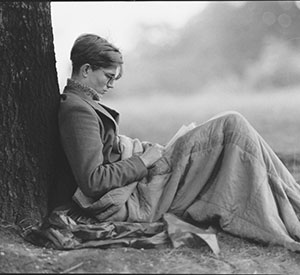
    A young Colin Wilson on Hampstead Heath, London, 1956. His seminal work The Outsider was published the same year.

    The problem is when we allow the robot to do everything for us, life begins to lose its savour. As Wilson writes, the robot has “one enormous disadvantage.” What is that? 

    “If I discover a new symphony that moves me deeply,” Wilson writes, “or a poem or a painting, this bloody robot promptly insists on getting into the act. And when I listen to the symphony for the third time, he begins to anticipate every note. He listens to it automatically, and I lose all the pleasure. He is most annoying when I am tired, because then he tends to take over most of my functions without even asking me. I have even caught him making love to my wife.”2 

    (Wilson does not mention it, but one wonders if his wife ever caught her own robot in the act as well.)

    Eventually, by allowing the robot to do everything for us, life begins to feel slightly unreal, or at least not as real as it used to feel. It is not a sudden change; it happens gradually, imperceptibly. But at some point, the moments of delight that we used to feel at a sunset, a starry night, or simply relaxing with music and a glass of wine, begin to dwindle. “The shades of the prison-house begin to close,” as Wordsworth tells us, and the “intimations of immortality” we received in our youth no longer arrive. We have “grown-up.” That is why we have a nostalgia for our childhood, although, as Wilson points out, we develop our robot precisely in order to help us deal with the emotional and psychological turbulence of youth. In “The Rock,” T.S. Eliot asks, “Where is the life we have lost in living?” Wilson answers: “In the hands of the robot.”

    Sometimes the feeling of being cut off from life is so acute that it can lead to suicide or, conversely, to sudden outbursts of violence, just in order to “feel alive” again. This is the thesis behind Wilson’s “existential” study of murder and sex crime, in books such as his Encyclopaedia of Murder and Order of Assassins. Some individuals, who have allowed their lives to become almost completely automatic, periodically erupt into a murderous rage, the violence throwing off the robot temporarily. More often, we resort to expedients like alcohol or drugs, which achieve their effect by putting the robot to sleep for a while. That is why after a glass of wine or two, things that struck us as uninteresting take on a strange glow of meaning. It’s no coincidence that poetry and wine have long been linked. The problem here is that by putting the robot to sleep, our own efficiency is hampered; that is why we are advised not to drive while drunk. Wine may inspire poetry, but the actual writing is best done while sober.

    Wilson discovered there was another way to get the robot out of the driver’s seat. Crisis has the effect of putting the robot in his place – or rather, of putting “us” in ours. This is why so many of the “outsiders” Wilson wrote about – people with a high appetite for purpose and meaning, “life more abundant,” which the modern world can’t provide – followed Nietzsche’s advice and “lived dangerously.” 

    As an example, Wilson offers the existentialist Jean-Paul Sartre who said he never felt as free as when he was a member of the resistance during the German occupation of Paris and was in danger of being arrested by the Gestapo. Another more extreme example is the novelist Graham Greene. As a teenager, Greene suffered from acute boredom, and when he discovered his brother’s revolver, he decided to play Russian Roulette. He put a bullet in a chamber, spun the cylinder, took the gun out to the common, and put the barrel to his head. Then he pulled the trigger. When Greene heard the hammer click on an empty chamber, he experienced an “extraordinary sense of jubilation… as if a light had been turned on… and I felt that life contained an infinite number of possibilities.”3 

    Greene had been so bored that the thought of blowing his brains out seemed appealing. Nothing had changed except something in him. The “infinite possibilities” were always there; Greene had simply been blind to them. He didn’t see them because his robot was on the watch, and he isn’t programmed to see possibilities but to perform functions with a minimal expenditure of effort. 

    As Wilson points out, as he pulled the trigger the thought that he could die caused Greene to concentrate his mind in a sudden psychic spasm, into a kind of mental fist. When he heard the hammer hit an empty chamber, he relaxed. The sudden contraction of his attention, in effect, told his robot that “this is important,” and so it handed over control to Greene. That is why when he relaxed, “he” was seeing life’s infinite possibilities. “He” was living again, briefly, not the robot.

    Something similar, Wilson tells us, happened to Dostoyevsky when he faced execution and received a sudden reprieve: an immediate, overwhelming insight that “all is good.”

    Greene’s experience is summed up in a quotation from the English man of letters Doctor Johnson that Wilson is fond of quoting: “when a man knows he is to be hanged in a fortnight, it concentrates the mind wonderfully.” Greene’s mind was thus concentrated. So were Sartre’s and Dostoyevsky’s. This is why the philosopher Heidegger and the esoteric teacher Gurdjieff both suggested that the one sure way for humans to overcome their “forgetfulness of being” was to maintain an awareness of their inevitable death. The thought of the reality of our death causes us to make a sudden inner effort and we momentarily push the robot aside.
    I was not going to be hanged in a fortnight, nor was I in danger from the Gestapo. But the change in my routine prompted by the “crisis mode” I had adopted had, I believe, a similar effect. I somehow felt more alive. This, I believe, is the same phenomenon that led many Londoners who survived the Blitz to remember it as the most exciting times of their lives. Many of them said that they never felt more alive or more free. They could be blown up at any moment, and this added a certain savour to everything. What had happened, in Wilson’s terminology, is that I had lowered my “indifference threshold.”4 

    This is the term Wilson uses to highlight the fact that when we have allowed the robot to take over our lives, things that we would otherwise find pleasant and agreeable elicit no response from us. We are indifferent to them. “We” do not enjoy the music we listen to or the book we are reading or even the love we are making, because “we” are not really involved. We all know how difficult it is to cheer someone up when they are deeply depressed or bored. Wilson discovered, though, that where something pleasant fails, an inconvenience can succeed. It can shake us out of our indifference and break through the “I can’t be bothered barrier” many of us spend much time behind. Somehow, the inconvenience prompts us to respond, and when it is overcome we find ourselves in a better mood than we were in before the inconvenience. Paradoxically, it has “cheered us up.”
    When I was surprised by the sun, it was because “I” was seeing it that morning, not the robot. And because “I” was more real, so was the sun. Gurdjieff captured this in the title of his last, unfinished book, Life is Real Only Then, When “I Am.” Gurdjieff knew about the robot; his way of speaking about it was to say that we are all mechanical, machines, not real human beings. Or that we are all asleep, believing we are awake. This is the most dangerous part of “living on the robot”: we accept this half-life as the real thing and don’t realise that we are actually unconsciously “de-valuing” life by involuntarily ignoring a great deal of it. Not in some physical sense – I hadn’t ignored the sun all these years and now suddenly got a glimpse of it. The robot edits out everything that he considers inessential, so the world he presents to “us” is stripped down to practical concerns; all the “extras” are omitted. Just the facts, no meaning. This is why when he is given a holiday, everything seems more “interesting,” rather like the effect of colour being added to a black and white sketch, or a sumptuous soundtrack to a silent film.

    We simply don’t understand that most of the time we are “living” in name only, and accept our moments of non-robotic consciousness as “gifts” or “treats,” short breathing spaces we deserve before getting back into harness. These moments, what the psychologist Abraham Maslow called “peak experiences,” are really moments when our consciousness is working as it should, and not at the “energy-saving” levels the robot usually has it set at. We all have much more energy and power than we know, but because we have come to accept the minimum levels that the robot limits us out of habit, we never draw on these supplies. Gurdjieff again knew this; that’s why he developed a whole system of what we can call “artificial inconvenience” or “induced crisis,” to push his students past those limits.

    Yet, like genuine crisis, the artificial kind can become habitual too. Greene eventually stopped playing Russian Roulette because the kick of not blowing his brains out lost its thrill; it’s a wonder he survived to write his gloomy novels. Gurdjieff had to develop more and more difficult exercises and create more inconvenience in order to keep his students on their toes. In his last days in Paris, Gurdjieff’s students “lived dangerously” by piling into his car and driving at breakneck speed to parts unknown until the petrol ran out; Gurdjieff was an appalling driver, and they would have to find petrol in order to get back. As some reports suggest, at times the crisis Gurdjieff induced proved too great and a student collapsed. And as Wilson points out, we have created civilisation in order to minimise crisis, so there is something absurd about having to put a gun to your head in order to feel alive. 

    This led to Wilson’s insight that we can apply two other methods to free ourselves of the robot, neither of which involve actual physical danger. One is to put more effort and attention into everything we do. Wilson often quotes this line from Hermann Hesse’s allegorical novel The Journey to the East: “A long time devoted to small details exalts us and increases our strength.” Devoting time to small details strikes us as a bore, and as soon as we feel this, the robot is there to take over. But if we put, say, twice as much attention into some “boring” task – such as cleaning our flat – we can find that we actually enjoy doing it.5 Why? Because “we” are doing it, not the robot. The enjoyment is not from the task itself but from our being “alive” while doing it.We can see this as a version of the exercises Gurdjieff gave to his students; the sense of “being alive” is what he called “self-remembering,” which, in fact, is what we are doing when we “feel alive.”

    Another method is to use the imagination to create a crisis “in the mind.” This is the same as Heidegger suggesting we maintain an awareness of the reality of our death. You can try this right now. Take a look at your life and focus on everything that is important to you. Now, imagine how you would feel if those things were threatened. Say your house has burned down or you have been diagnosed with a fatal, incurable disease. Imagine, as Doctor Johnson suggests, that you will be hanged in a fortnight. If you are able to imagine this vividly enough, you should get a taste of what it would feel like if it was real. 

    But we can go a step further. If you can imagine the loss of what is important to you, you can also use your imagination to evoke a sense of the reality of those things you would lose, for this is what the crisis does: it puts the robot in the back seat so that “you” are in touch with reality. So, rather than focus on the negative impact of loss, you can focus on the positive impact of remembering that you now possess what you would regret losing. The essence of both exercises is to evoke a sense of reality, and the shock of a positive reality can be just as effective as that of a negative one, as well as being a lot less gloomy.

    This, I believe, is what happened when I was surprised by the sun, and when I felt an odd exhilaration at the start of the corona crisis. I had taken my freedom for granted. Now, when that freedom was constrained, this inconvenience reminded me of it; hence the paradox that I felt more free. The crisis mode I had adopted made “me” more “present” and I remembered how much I possessed and had to feel grateful for. It was a collateral benefit of a difficult time. With any luck I will not need another crisis to be reminded again.

    [alert type=”general” dismiss=”no”]This article was published in New Dawn 182.[/alert]

    [alert type=”success” dismiss=”no”]If you appreciate this article, please consider subscribing to help maintain this website.[/alert]

    Footnotes

    1. “A single obsessional idea runs through all of my work: the paradoxical nature of freedom.” Colin Wilson The Occult (London: Watkins Publishing, 2015) p. xxiii.
    2. Colin Wilson “Existential Psychology: A Novelist’s Approach” in The Bicameral Critic (Salem, NH: Salem House, 1985) p. 39.
    3. Quoted in Colin Wilson Frankenstein’s Castle (Sevenoaks, UK: Ashgrove Press, 1980) p. 122.
    4. Space does not allow me to tell it here, but the story of how Wilson arrived at this insight is worth telling. I do in Beyond the Robot: The Life and Work of Colin Wilson (New York: Tarcher/Penguin, 2016) pp. 33-34.
    5. We can also employ what we can call the “Tom Sawyer effect,“ and pretend that we are enjoying it and then find that we actually do. This refers to the scene in Mark Twain’s novel when Tom pretends he is enjoying painting the fence and by doing so, tricks his friends into paying him to let them have a go. They do enjoy it, so the trick is really on Tom. He has convinced them that painting is fun and their enjoyment ironically proves him right.

    © New Dawn Magazine and the respective author.
    For our reproduction notice, click here.
  • Enlightenment & Gnosis: An Inquiry into Experiential Religion

    Enlightenment & Gnosis: An Inquiry into Experiential Religion

    From New Dawn 186 (May-June 2021)

    The study of mystical religious experience was introduced into psychological studies in the late nineteenth century. Curiously, this somewhat novel interest was initially stimulated by researchers of medical psychology who observed that phenomena resembling those experienced by mystics frequently resembled the experiences of mental patients. 

    One outstanding example that attained seminal status was the work of Theodore Flournoy, From India to the Planet Mars: A Study of a Case of Somnambulism with Glossolalia, published in the year 1900 (the year when Sigmund Freud published his work Interpretation of Dreams). Flournoy’s work influenced Pierre Janet, C.G. Jung, and Freud himself.

    In 1913, C.G. Jung developed a technique for inducing visions that he named “active imagination.” In such experiences, hypnagogic states were combined with visualisation techniques with the objective of inducing waking imaginations of an autonomous character. (Autonomous in this context means that the vision is not consciously directed but acts on its own. This feature distinguishes Jung’s procedure sharply from the “guided imaginations” and reveries popular in New Age circles.) 

    Summing up the major conclusions drawn from the studies of mystical and related states by depth psychologists, mystical experiences are states of consciousness that bring about a radical elevation of awareness and at times a deep and abiding union of the individual mind with a realm of transcendence which extends beyond all features of terrestrial embodiment. These states of radical awareness and mystical union have become the definition of certain Western and Eastern exalted states of consciousness, the former known as Gnosis and the latter as Enlightenment. Upon these states are based the traditions known as Gnosticism and Buddhism.

    The Twin Traditions

    The present writer contends that there are two paramount traditions of mystical spirituality in the world. They are so closely related to each other that it may be justified to give them the metaphorical label of twins. They are named Gnosticism and Buddhism. To familiarise oneself with the “twins” and their relationship, one needs to attempt a comparison of their origins as far as these might be discerned historically.

    As the child is father to the man, so Vedic Hinduism is the forerunner of Buddhism. It is known that Buddhism evolved out of Hinduism by way of its founder, Gautama the Buddha. It is said that one’s ancestry is always important, and this may be true of religious traditions as well. The Hindu religious matrix, out of which Buddhism arose, had a significant influence on this tradition. 

    For an unknown length of time prior to Buddha, Hinduism possessed a classical school of Yoga, in Sanskrit called Jnana, meaning “the way to union through knowledge.” The structure and composition of Hindu religious life are not unlike those of ancient Gnosticism. It has been said that Hinduism is not so much a religion as it is a family of religions. The diversity of ancient Gnostic traditions is undoubtedly similar. Individual Guru figures are certainly present in both traditions, as are diverse sacramental ritual practices designed as aiding the transformation of consciousness. 

    On the side of doctrine, there are significant similarities also. Perhaps the most important of these is the belief in the presence of the Divine in the human spirit. The Atman is identical with Brahman, so the Advaita school of Vedanta declares – universal divinity is present in miniature within each person. In Gnosticism, the Pneuma (individual human spirit) is seen as a spark sprung from the divine flame. As noted, self-knowledge in-depth thus is knowledge of God. 

    Another teaching that makes Buddhism’s background and Gnosticism similar is the teaching that declares the existence of many divinities in realms between the ultimate and the material dimensions, yet all connected with a supreme spiritual fullness. These few examples might indicate that the doctrinal foundations underlying Buddhism are akin to Gnosticism itself. 

    Although akin to Judaism and even more closely to Christianity, Gnosticism was undoubtedly inspired by the mystical experiences of the initiates of the various Mysteries of Greece, Egypt, Rome, and perhaps Persia. These Mysteries afforded many persons very impressive individual mystical experiences. Their tradition survived in diverse forms among the Gnostics, Hermeticists, and Neo-Platonists. Thus, along with others, the Gnostics became the heirs of the Mysteries of antiquity.

    The Wisdom of the Knowing Ones 

    When it comes to Buddhism itself, the signs that join it to Gnosticism are numerous and powerful. The supreme objective of Buddhism is identical with the ultimate aim of Gnosticism. This is none other than Liberation, meaning freedom from embodied existence and thereby from all suffering. This liberation is brought about not by belief or by the following of moral precepts, but rather by a radical altering of consciousness, an experience of inexpressible liberating power called by Buddhists Bodhi, often translated as Enlightenment, and known to Gnostics as Gnosis, the latter translated by G.R.S. Mead as “the knowledge of the things that are.” The supreme quality to be cultivated in the quest for Enlightenment/Gnosis by the Buddhist is called Compassion, while the Gnostic Christian cognate quality is known as Love.

    Some students in the West have chosen to believe that the Mahayana doctrine of Bodhisattva-hood makes it incumbent on Buddhists to keep reincarnating until there is no one to be helped any longer. Some years ago, H.H. the Dalai Lama, within the hearing of the present writer, replied to such a question: “You just get Enlightenment, then you will know”! 

    The pioneer present-day Gnostic scholar, Elaine Pagels, pointed out in her Gnostic Gospels that it is legitimate to translate the term Gnosis as used by the ancient Gnostics as insight, for it involves an intuitive process of knowing oneself. Pagels also goes on to emphasise that this knowing oneself at the deepest level is simultaneously to know the Divine and that this is the true secret of Gnosis. 

    Edward Conze (1904–1979), photo  c.1930.

    Many highly informative statements were made by the late renowned Buddhist scholar Edward Conze, who openly called Buddhism “the Gnosticism of Asia.” The following paragraphs are in part based on a lecture by Prof. Conze that I attended some decades ago in the Pacific Northwest of the United States. The lecture concerned the convergence of Gnosticism and Buddhism. Here are some of the outstanding points:

    1. Salvation (Liberation) is achieved through Gnosis, or Enlightenment. Gnosis offers insight into the enslaving structure of the archonic creation; Buddhism practices insight into the dependent origination of manifest existence. These insights bring liberation.
    2. Ignorance is the true root of evil. In Gnosticism it is called agnosis, and in Buddhism avidya. The absence of liberating insight creates wickedness and evil actions.
    3. The knowledge, cherished by both Gnostic and Buddhist, is arrived at not by ordinary means of information and reasoning but as the result of internal revelation.
    4. Spiritual attainment differs with what might be called psycho-spiritual types. There are levels of insight that range from foolish materialism (hyletic consciousness) to illumined Gnosis (pneumatic states).
    5. Regarding rules of behaviour and commandments, a certain mystically informed relativism is inherent in both systems. While at the lower levels of spiritual ascent, rules of behaviour are often regarded as being of great importance; in exalted spiritual states, their significance diminishes. (Accusations of antinomianism have been levelled against both Gnostics and Buddhists by their critics.)
    6. When opting for preference between myth and fact, both Gnosticism and Buddhism show an inclination toward myth. Modern mythologists, including Mircea Eliade and Joseph Campbell, concluded that insights gained by the Enlightenment of the Buddhist and by the Gnosis of the Gnostic are best understood in terms of myth.
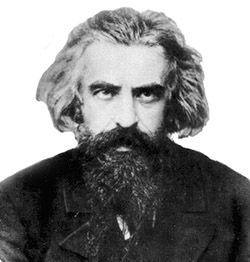
    7. One of the most potent mythologems appearing in both Gnosticism and Buddhism is the feminine deific principle of wisdom – Sophia and Prajna, respectively. Conze was fond of quoting the Hevajra Tantra: “Prajna is called Mother because she gives birth to the world.” In fact, there are other important feminine figures among the deities of Mahayana Buddhism that may be considered cognate to Sophia, such as Tara and Kwan Yin. It may be noted that in Western Christianity (Roman Catholicism and Protestantism), the figure of Sophia has been driven underground, but this did not occur in the Orthodox Churches of the East. The obscured Sophia was brought into a renewed prominence by the Russian Sophiologist theologians, beginning in the late 19th century and continuing to the present, starting with the magnificent scholar and poet Vladimir Soloviev (1853–1900). A very large number of artists, literati, philosophers and theologians became advocates and devotees of “the feminine wisdom of God.” It may be stated that the Russian Sophiologists came as close as anyone to rediscovering a feminine deity similar to such figures in Buddhism.
    Vladimir Soloviev (1853–1900)

    After noting several similarities in the teachings and spiritual ambiance of Buddhism and Gnosticism, a penultimate evaluation of their relationship may be important. The origins, both historical and other, of the two traditions are cognate. Both had their beginnings with a founder who experienced exalted spiritual states and whose example helped generate a tradition oriented toward such experience. Even as the Buddhist tradition moved outside of Hinduism, so the Gnostic tradition, in Christian garb, separated from Judaism. The similarity of the story of the two ends here, for the majority within Christendom cast out the Gnostic minority, condemning it to a mostly underground existence. Buddhism, on the other hand, for the most part, morphed into folk-religiosity, although esoteric communities continued. Both traditions maintained their orientation toward transcendental experience, which allowed for great, even ultimate transformations. Thus, we may conclude that even in the midst of their frequent misapprehensions, the early leaders of depth psychology have discovered something of momentous significance in regard to mystical consciousness. 

    Not only were the mystics of East and West not to be seen as victims of psychosis, but rather as persons who gained access to an insight so profound that it supersedes all worldly knowledge and information. Gnostic and Buddhist sages always had their successors in history.

    It may be appropriate to close this article with a passage, part meditation, part sermon, heard many years ago from the lips of a teacher, and remembered by the present writer: 

    Richard, Duc de Palatine (1916–1977)

    “You are not of this world. You are not this body that you inhabit. You are not these emotions, these thoughts, this ego you identify with. You are not even your life and death. When you are able to distance yourself from these things, then the true you, the Gnostic you, comes into the focus of your cognition. Purer than the ether, more radiant than the sun, purer than the driven snow, filled with life and taken out of the context of death, this is the self you are. To help you know this, Jesus and Buddha and all the other great messengers of light have come into this world, making the sacrifice to come from the fullness into the emptiness to bring you this. You must know this, and you must do this, because without it you are not really alive, you are not really conscious, but with it, you are all things, you have all things, and the All has become you. This is the message of Gnosis!” 

    (This meditation was conducted for his students by the late Richard, Duc de Palatine during his visits to the USA.)

    [alert type=”general” dismiss=”no”]This article was published in New Dawn 186.[/alert]

    [alert type=”success” dismiss=”no”]If you appreciate this article, please consider subscribing to help maintain this website.[/alert]

    © New Dawn Magazine and the respective author.
    For our reproduction notice, click here.
  • Getting Serious with Spiritual Practices in an Age of Crisis

    Getting Serious with Spiritual Practices in an Age of Crisis

    From New Dawn 181 (Jul-Aug 2020)

    Over the years, I have used a variety of contemplative practices in combination to achieve specific spiritual outcomes. These practices eventually became ritualised into cyclical patterns in which the stage was set for some surprising results. 

    For almost two decades, I became fascinated with the idea that we are living in a computer simulation but I couldn’t wrap my head around that concept because it didn’t fit with the near-death-experience studies of how the soul transitions into the afterlife. To gain a better understanding of what I was dealing with, I put together a set of contemplative practices to give me insight into this phenomenon. I used mindfulness meditation, the mantra sound āh as well as visualising and dialoguing with inner images of spiritual masters from both Western and Buddhist traditions to create a ritual. To help anchor and entrain this experience in my mind, I used Theta music sounds. Entrainment enabled my mind to reproduce the Theta frequencies within the ritual practice.

    Intermittently, I had been working with these specific ritual practices throughout the years eager to find some resolution, but none emerged. About a year ago, I set aside a few months devoted to this practice hoping for insight; still nothing. I then changed the routine – one day mindfulness meditation and the next the ritual practice – but still nothing, so I thought. Then a few weeks later while practising only mindfulness meditation, I found myself in an unusual reality, not knowing if it was related to my computer simulation quest.

    What emerged was a stunning inner vision. I found myself looking at a small open gate made of shiny sparkling gold. I saw beyond the gate a pathway meandering through a landscape of beautiful colours made up of various shades of blues, reds and yellow flowers, beautiful grasses and trees made up of various shades of green. I was looking out of my eyes at this beautiful scene and decided that since the gate was open I would walk through. Once across the threshold, I found myself in a world hard to describe! Those beautiful colours of blues, reds, yellows, and greens were now vibrant shimmering brilliant colours. I have never seen anything so beautiful. 

    It suddenly dawned on me, if I walked further into this beautiful landscape, I would not return to ordinary reality. I gently backed out and crossed the threshold. Once on this side of the gate, the colours muted and the brilliance was gone. Then, suddenly, my timer went off and I moved out of mindfulness meditation and back into ordinary reality. The experience deeply puzzled me, and I wondered why it happened in mindfulness meditation rather than ritual state, and what it meant in regard to what I was pursuing.  

    Two weeks later, I decided to use insight meditation and go back to the gate. In the meditation, it was hard focusing my awareness back to the gate, but once there I found a new problem – the gate was closed. Not only was the gate closed but it had a dull gold finish and the brilliant colours of the flowers, grass and trees on the other side were also dull. “Why is it now different,” I asked myself. Since that experience, I have made three more inner journeys back to the gate and in all three, the gate remains closed. This raised questions such as, “Why am I now locked out”? and “Why was I trapped on this side of the gate”? 

    Throughout the oncoming months, I puzzled over this inner vision trying to understand its meaning. It all came together with my second vision which was prophetic. It began on 13 August 2019 when I read an article in the British newspaper The Telegraph on DNA bioweapons. These weapons could potentially target specific individuals and groups. I had read similar reports before, but this time something different happened. While reading the article online, I lost it! Something radically shifted inside me. In my inner vision, I saw thousands of people dying from these bioweapons. I panicked, feeling trapped in a new world I didn’t want to be part of. I tried to run but to where? I thought of Canada, the mountains, some island, where I could be safe. My spouse and a friend tried to calm me, but to no avail, I was trapped. For three weeks, I had constant visions flooding my mind of mass deaths and every part of my mind was filled with profound darkness and gloom, watching people dying from these biological agents. I have never had an experience like this before. 

    Trying to gain some composure, I reached out to one of the editors at New Dawn magazine, asking if they had published any articles on bioweapons. The tenor of the email I sent New Dawn was one of panic because I was still seeing the death visions in my mind. I discovered they had published an article on the topic. Once I got the email response, I closed my computer for over a week trying to deal with these constant dark visions of mass death. During that week, my contact at New Dawn sent three very consoling emails.

    After three weeks, the visions slowly lessened, giving me the chance to attempt to process what happened. For the first time, I connected the vision of the golden gate with the mass death vision. In the golden gate vision, I felt trapped on this side of the gate because the gate remained closed. In the mass death vision, I felt trapped in a dark world I could not escape. At the time, I could not understand what all this meant. Then, in April 2020, after meditating, it all came together – these were visions of what was to come, the COVID-19 pandemic. I saw it all on 13 August 2019! 

    Currently, we do not know if COVID-19 was scientifically created in a lab as a bioweapon. If that’s not the case, then it was probably made in the environmental lab of the earth from pollution, or could have come from outer space hitching a ride on a spacecraft returning to earth from the international space station, or transmitted from animals that have these novel viruses. It appears these visions were triggered by contemplative practices which enabling me to see a dark gloomy future, the one we all globally experienced.      

    Components of Contemplative Practices and Lifestyle

    When I first began putting together a contemplative lifestyle, I used the Trappist (Cistercian), Tibetan Buddhist and Hindu monastic (ashrams) daily practices as a loose model. This model included working in the everyday world, contemplation, meditations, mindfulness, silence, solitude, spiritual retreats, study to enhance spiritual growth, simplicity, and service to others. I added these activities one at a time until I had a complete regimen. Some activities I used daily, some weekly, some monthly, some quarterly, and some yearly such as retreats. 

    As we enter this new age of mass deaths from biological agents, these contemplative practices are essential to our emotional, mental, and spiritual health, and provide insights into our lives. 

    If you are a monk living in a community, your daily regimen is set. However, most of us, including myself, live in the secular world and need to create our own personal contemplative routine. I felt that the most important activities for a spiritual lifestyle was to begin with contemplation and meditation practices because I was already using some of them. Contemplation, which includes contemplative prayer and various forms of meditations, are used to alter one’s consciousness to bring oneself into the present moment, as well as focusing and visualising on specific spiritual icons and images. By being in the present moment, a person can explore their inner landscapes; in my case, opening a portal to prophetic visions. 

    Mindfulness eventually emerges from various forms of contemplation and meditation. I learned early on that contemplating sacred images and using various forms of meditation put me in contact with the present moment. I attuned to minute details in the present moment, allowing me to focus exclusively on the task at hand, bringing me into the here and now.  

    Contemplation, meditation and being mindful is wrapped in a cocoon of silence. Silence allows one to disconnect from the outer world of distractions. It facilitates an inner exploration by gaining insights into one’s inner world – we learn to know ourselves. As with insight meditation, silence allows us to observe thoughts coming into our awareness without the disruption of external sounds. 

    With silence comes solitude and with solitude comes spiritual retreat. Silence enhances contemplation, meditation and mindfulness, setting the stage for solitude. Solitude can be practised without going on a spiritual retreat. The best option is to create a personal retreat by isolating yourself for a weekend in your home. In a pandemic lockdown, isolating oneself should be easy if you are alone, but with a family this could be difficult. Solitude enables you to listen and experience the inner presence, that deep connection with your soul, what I experienced with the visions. 

    A contemplative lifestyle also includes a study regimen to enhance spiritual growth. I studied the world’s contemplative traditions and religions, and the individuals within those traditions who created new spiritual practices. This information helped me compare where I was in my spiritual growth and where I was on my spiritual journey. I also used spiritual readings called Lectio Divina. Lectio Divina is a Benedictine contemplative practice incorporating spiritual reading, meditation and prayer which promotes spiritual communion and connection. 

    All these practices gave me perspective on what is important in life. I became aware that I own nothing. I’m only using things in this reality for a short period of time. I knew that shedding a lot of useless physical baggage and clutter, and living a life of simplicity, was the answer to many of my woes and distractions. Besides, in our present situation, human lives are more important than the useless baggage we throw away.

    It goes without saying, that if one cultivates a contemplative lifestyle, one finds themselves in service to others, which happened with people helping those during the COVID-19 pandemic. I have been in service to others throughout my life beginning as a child, helping family and neighbours as well as others in my community who were in need. When I was a psychotherapist, I set aside a certain amount of time to see clients in need at no cost or at a very reduced fee. As a priest, I help others specifically in spiritual development and tutor students on the college level at no cost. Being in service to others not only feeds our spirituality but our humanness as well. 

    The Tree of Contemplative Practices 

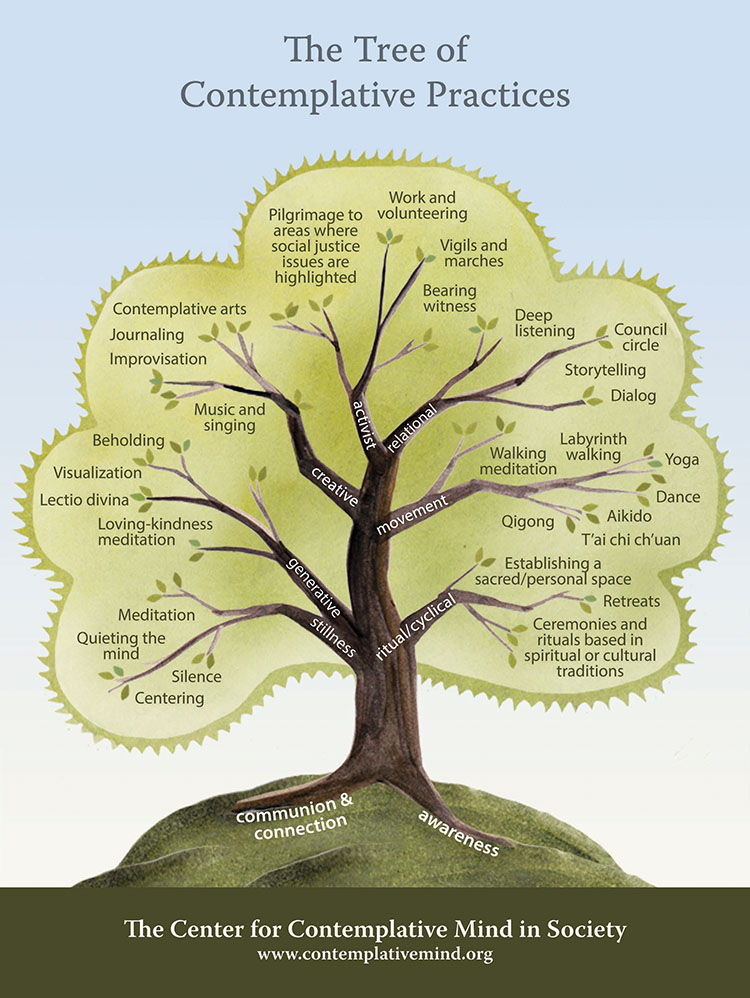
    In this time of global crisis, where does one begin? The Tree of Contemplative Practices (issued by US-based Center for Contemplative Mind in Society), offers a sampling of some of the practices used the world over. In reference to the above illustration, there are two roots feeding the tree – communion/connection and awareness – which symbolise the various contemplative practices from the world’s wisdom traditions as well as those created in the secular world. 

    Throughout my life, I have engaged in at least one of the practices in each category, beginning in childhood with storytelling. I can attest that each practice focuses the practitioner’s attention on the here and now as we must be aware of what we are doing in the present moment for the practices to work. 

    The branches on the Tree signify seven categories of contemplative practices: 

    Stillness Practices are used to quiet the mind and body to create calmness and focus, and they include contemplation, meditation, quieting the mind, silence, and centring. 

    Generative Practices produces thoughts and feelings of devotion and compassion and includeLectio Divina, visualisation, beholding, and loving-kindness meditations. 

    Creative Practices are activities that begin with inner fermentation and move into outer manifestation in the exploration, development, expression and interactions with our creative potential as well as our humanness resulting in a deep sense of fulfilment, and include contemplative arts, improvisation, journaling, music and singing. 

    Activist Practices are in service to others and include pilgrimages to areas where social justice issues are highlighted, work and volunteering, vigils, marches, and bearing witness. 

    Relational Practicesfocus on the interaction with others and include council circles as in Native American and other indigenous cultures, dialogue with deep listening and storytelling. 

    Movement Practices are actively focused practices that brings one into the moment through physical actions, and they include labyrinth walking as in many monasteries, walking meditation, yoga, dance, Qigong, Aikido, and Tai Chi Chu’an. 

    Ritual/Cyclical Practices focus on specific intentional routines that brings one’s attention and awareness into the here and now by altering consciousness through various rituals connecting us to the deepest parts of our spirituality. They include symbolic ceremonies and rituals based on replaying mythical stories from spiritual and cultural traditions, establishing a sacred/personal space and spiritual retreats.

    This is only a sampling of contemplative practices as there are many more, for example, eating meditation, contemplative walks, gardening, and chanting. All these practices are intended to cultivate awareness, wisdom and being in the present moment. These practices can help relieve the anger, tension, and desperation that one may feel when coping with crises such as the COVID-19 pandemic. 

    © The Center for Contemplative Mind in Society. Concept & design by Maia Duerr; illustration by Carrie Bergman. Permission to use given by The Center for Contemplative Mind in Society.

    Developing a Contemplative Lifestyle in the Age of COVID-19

    One of the key objectives when developing a contemplative lifestyle is commitment. Commitment to making major modifications in one’s spiritual journey by changing the habitual patterns that keep us locked in a destructive mindset. These habitual patterns often divorce us from our humanness, and we became mediocre and lifeless. By helping others, we move away from the mundane and reconnect with ourselves and those we love. Once we set ourselves apart for a short period of time to unplug from the distractions of everyday life, we commune on a vastly different level. The practices that we incorporate into our contemplative routines are those we commit to observing daily, and this commitment allows us to help others. Commitment is extremely important!

    If one does not currently use contemplative practices, select at least one from the Tree of Contemplative Practices and learn to use it by yourself through readings or with the help of a teacher. I suggest starting with a stillness practice such as contemplation or meditation because these practices centre a person and bring them into the moment – and being in the moment is that state of mindfulness which allows us to think more clearly. 

    You may then go on to add another practice such as silence. With silence, one becomes aware of the small gradation in thoughts and a deep awareness of one’s spiritual core – the soul. 

    In all contemplative traditions, simplicity is the key to happiness. Without simplicity, we are caught in the cluttered web of meaningless materialistic consumption that never makes us happy. True happiness comes from simplicity because it unclutters our mind so we can think of more important things such as our connections with each other. Being in service to others allows our humility and compassion to grow and can give meaning and purpose to our lives. 

    All the years I engaged in contemplative practices, beginning in high school with the study of Thomas Merton and later joining the Rosicrucian Order, all those practices helped open a prophetic portal in myself. The one thing I now know that I did not know before is I have visionary insight. I had two prophetic visions which I did not understand at the time. With hindsight, I know our world was caught in the grip of a new biological threat coupled with the other threats we currently face. My extra burden is that I had these prophetic visions and did not understand them at the time – in a sense I knew what was coming – a situation I now have to grapple with. 

    In this age of crises and sudden threats such as COVID-19, contemplative practices are truly an effective panacea to help us cope with anger, frustration, and fear of an uncertain future. Mindfulness meditation, in particular, can calm us and create a solid foundation for connecting with each other. I cannot guarantee you will have a prophetic visionary experience as I did, but as I look to the future, one question haunts me, “Is this the shape of things to come?” 

    [alert type=”general” dismiss=”no”]This article was published in New Dawn 181.[/alert]

    [alert type=”success” dismiss=”no”]If you appreciate this article, please consider subscribing to help maintain this website.[/alert]

    © New Dawn Magazine and the respective author.
    For our reproduction notice, click here.
  • The Astonishing Achievements of our Ancient Ancestors

    The Astonishing Achievements of our Ancient Ancestors

    From New Dawn Special Issue Vol 14 No 3 (June 2020)

    Like other New Dawn readers, I had heard something about Roman road-builders, Mayan mathematicians and Babylonian astronomers. But I was subsequently surprised to discover that these and other peoples achieved levels of applied science in the deep past equal to and occasionally surpassing similar material accomplishments taken for granted today. Some important innovations first conceived during antiquity were lost when the civilisation associated with their creation collapsed and were completely forgotten, only to be independently re-invented thousands of years later by modern developers utterly unaware of their ancient precursors. 

    Yet more remarkably, a time very long ago, when mainstream historians and conventional archaeologists assure us that superstition and ignorance alone ruled the world, human genius attained certain levels of technology still beyond our grasp. So many, in fact, that hundreds of collected specimens fill the pages of my new book until their superfluity overflowed its printed limitations. How grateful I am, then, to New Dawn for this opportunity to share with you some of the truly extraordinary instances of Ancient High Tech that missed being included in the volume so entitled! 

    Five hundred and more years ago, Inca medical practitioners treated serious heart ailments with extracts of foxglove, a procedure only now acknowledged for its efficacy by 21st century health care professionals. 

    Among the most startling examples belonged to Inca medical practitioners, whose advanced healing agents were revered as part of a larger, cultural legacy inherited from Kon-Tiki-Viracocha, “Sea Foam,” pre-Columbian South America’s founding father and flood-survivor from an island kingdom of unique power, overwhelmed in prehistory by a catastrophic deluge. After establishing himself in the Andes Mountains, Inca tradition explained that he schooled their ancestors in the use of plant extracts from Digitalis lanata, a flower known today as “foxglove,” for the successful treatment of serious heart conditions. After the Conquistadors overthrew Inca Civilisation, its culture was entirely demonised, along with all traditional medical knowledge, which fell into oblivion for the next four centuries. 

    Not until 1930 were botanists able to extract digoxin from the leaves of the foxglove plant and discovered (re-discovered) its effective properties for treating atrial flutter and heart failure. Its resulting compound is rated today on the World Health Organization’s List of Essential Medicines as among the safest and most effective measures necessary for any health system. But teasing digoxin from Digitalis lanata demands careful precision and observant skill because the slightest error in determining the correct amount can mean the difference between strengthening the heart or inducing cardiac arrest. This life-and-death discrepancy signifies that Inca physicians not only recognised its critically narrow parameters, but themselves possessed sufficient expertise to properly act upon such a distinction. 

    They also applied the secrets of Matricaria chamomilla to effectively deal with gastrointestinal problems, particularly irritable bowel syndrome and intestinal cramps, when taken as a mild laxative for its anti-inflammatoryand bactericidal effects. Only within the last thirty years has research with animals demonstrated the antispasmodic, anxiolytic (anxiety-reducing), anti-inflammatory, antimutagenic (mutation reducing), and cholesterol-lowering effects of “wild chamomile,” which is additionally included in many of today’s sleep aid products. While all this is relatively new to us, the ancient Andeans were familiar with Matricaria chamomilla and its soothing benefits long before the last Inca emperor was killed in 1533. His culture likewise treated hyperlipidemia, an acquired or genetic disorder that results in high levels of lipids; these are fats, cholesterol, or triglycerides circulating in the blood. 

    The condition was addressed in pre-Conquest South America with extracts of plantago paralias, some forms of which additionally predispose to acute pancreatitis, and may be useful for glycaemic control in patients with type 2 diabetes. The anti-cancer effects of plantago paralias are only now being gradually appreciated. It is clear that Inca pharmaceutical and pharmacological knowledge not only far outdistanced the contemporaneous quackery of European physicians in the 16th century, but still has much to offer modern medical developments. On the other side of the Ancient World, Nile Valley practitioners similarly undertook quantum advances in the healing arts only now coming to light. 

    Imagined reconstruction of scene from ancient Egyptian civilisation. The ruins on display today in modern day Egypt – although still impressive – are a pale representation of how it really would have looked.

    Just ten years ago, archaeologists analysing the skeletal remains of Roman Era inhabitants of Upper Egypt and adjacent Nubia during the early 1st century CE found the presence of tetracycline, an antibiotic in use today for treating bacterial infections. The Egyptians ingested tetracycline with a special beer concoction not unlike sour porridge. Further investigation revealed that retrieved Roman Era samples were identical in substance to the same beverage dating to the advent of Pharaonic Civilisation, more than three thousand years before. 

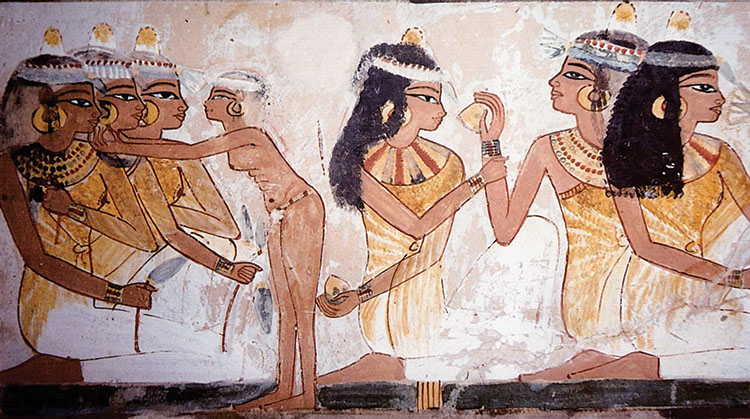
    Egyptian girls at a 19th Dynasty party (around 1290 BCE) give each other different-flavoured breath mints.

    Related evidence in the form of surviving medical papyri revealed how dynastic physicians and brewers deliberately contaminated their beer with streptomyces, tetracycline-producing soil bacteria that thrives in the arid conditions of the Egyptian desert. Their grain thus laced with tetracycline, the Egyptians observed how it cured them of various bacterial ailments, five thousand years before the discovery of penicillin by Alexander Fleming, in 1928. Their high level of medical science helps explain why many residents of the Nile Valley experienced healthy longevity, such as the famous Pharaoh Ramses II, who lived to celebrate his ninety-seventh birthday. 

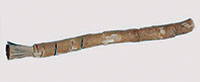
    A toothbrush from the time of Cleopatra, last ruler of Egypt’s Ptolemaic Kingdom, circa 40 BCE.

    Advances in Egyptian dentistry were constantly stimulated by the country’s persistent problem of sand blown by desert winds into food consumption, a dilemma that occasioned the world’s oldest known recipe for toothpaste. The 4th century CE papyrus is a Greek-language copy of a traditional Egyptian invention already in common use at the outset of the 1st Dynasty, thirty-four hundred years earlier. The original formula calls for one drachma (one-hundredth of an ounce) of rock salt, another drachma of mint, and one more drachma of dried iris, plus twenty grains of pepper. 

    Dentists only recently re-discovered the beneficial properties of the iris flower, which has been found effective against gum disease and is now in commercial use again after the passage of sixteen centuries – yet another example of an ancient innovation reaching out from the deep past to influence modern technology. According to the sixteen hundred-year-old papyrus, all its specified ingredients should be crushed and mixed together into a “powder for white and perfect teeth.” It was discovered by Dr Hermann Harrauer, in charge of the papyrus collection at Vienna’s National Library, in 2002, atop a rubbish dump outside the modern Egyptian town of Al-Mahamid Qibly, the dynastic Imiotru, known to the Greeks as Crocodilopolis because it housed the most prominent Early-Middle Kingdom sanctuary (2050 BCE–1652 BCE) of the crocodile-god Sobek. 

    His name is a participial form of the verb sbq, “to unite,” or “create wholeness,” i.e., “health,” and therefore appropriate to the discovery of a toothpaste recipe, especially given Sobek’s abundant and powerful teeth. “It was written,” observed Dr Harrauer, “by someone who obviously had some medical knowledge as he used abbreviations for medical terms.” The ancient Nile Valley cleaning agent was faithfully replicated by an Austrian dentist, Dr Heinz Neuman. “Nobody in the dental profession,” he declared, “had any idea that such an advanced toothpaste formula of this antiquity existed.” A colleague volunteered to personally test the recreation. “I found that it was not unpleasant,” said Dr Neuman. “It was painful on my gums and made them bleed, as well, but that’s not a bad thing, and afterwards my mouth felt fresh and clean. I believe that this recipe would have been a big improvement on some of the soap toothpastes used much later.” 

    Anglo-American soap industrialist William Colgate began marketing the first commercial toothpaste in 1873, but it was hygienically inferior to its pharaonic forerunner, which had been lost since the Ancient Old World collapsed. Egyptian dental care even extended to the invention of breath mints made, as recounted in a 16th Dynasty papyrus, from combining cinnamon, frankincense and myrrh, boiled together into a honey base, then shaped as small pellets for easy consumption. Myrrh, a natural gum extracted from tree resin, is analgesic – a pain killer. The Ancients’ greatest contribution to general health, however, was their institution of general hygiene. 

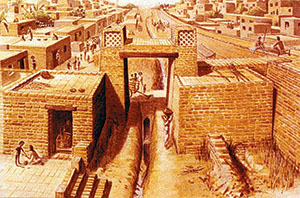
    The city of Mohenjo Daro in late 4th Millennium BCE India was a model urban centre of ingenious water management for communal sanitation and public hygiene.

    While the Roman baths are famous, they were preceded three thousand years by the lesser-known public water facilities of 4th Millennium BCE Mesopotamia and India. In describing the Indus Valley’s earliest urban centres, US researcher David Hatcher Childress writes that “the plumbing sewage system throughout the large cities is so sophisticated that it is superior to that found in many Pakistani (and other) towns today. Sewers were covered and most homes had toilets with running water. Furthermore, the water and sewage systems were kept well separated.” Near Baghdad, homes and sacred structures in the Sumerian city of Eshnunna (modern Tell Asmar in Iraq) featured elaborate arrangements for personal sanitation. 

    “One excavated temple,” according to Childress, “had six toilets and five bathrooms.” He goes on to quote the July 1935 issue of Scientific American magazine, explaining that the temple’s plumbing equipment “connected to drains which discharged into a main sewer, one meter high and fifty meters long. In tracing one drain, the investigators came upon a line of earth ware pipes. One end of each section was about eight inches in diameter, while the other end was reduced to seven inches, so that the pipes could be coupled into each other, just as is done with drainpipes in the 20th century.” 

    Very old as Sumerian plumping may have been, its age pales compared to a series of anomalous lead pipes inadvertently discovered inside three caves at Báigōngshān, the “White Mountain,” earlier this century by palaeontologists visiting China from the United States. With an eighteen-foot-high ceiling, the largest cave features two reddish-brown pipes sixteen inches in diameter. Outside and above its entrance, dozens of hollow pipes, some likewise sixteen inches in diameter, with others down to four inches in width, protrude horizontally from the rock face. About two hundred sixty feet from the cave’s mouth, similarly hollow formations appear on the beach of and within Lake Tuosu, protruding vertically from the water or lie just below its surface, although they differ in ranging from 0.8 to 1.8 inches diameter, and have an east-west orientation. After the American palaeontologists shared their discovery with local authorities in the city of Delingha, the Báigōngshān and Lake Tuosu sites were written up in a six-part series of articles published by Henan Dahe Bao, the “Henan Great River News,” in June 2002. 

    These reports attracted the attention of state geologists and geophysicists, who visited and studied White Mountain, returning to the Beijing Institute of Geology with sample fragments which were subjected to standard examination procedures. These dated the objects to circa 150,000 Years Before Present. Additional testing with different chronological methods consistently repeated the same time parameter, until even stubborn disbelievers, such as Brian Dunning of Skeptoid.com, in the US, were forced to concede the pipes’ Middle Palaeolithic provenance, tens of thousands of years before homo sapiens arrived in Asia. 

    Interviewed by a prominent, state-run newspaper, The People’s Daily, in 2007, Zheng Jiandong, a geology research fellow from the China Earthquake Administration, half-heartedly proposed a natural explanation. He wondered if iron-rich magma may have arisen from deep within the Earth, elevating iron into fissures, where it may have solidified into tubes. He admitted his speculation was apparently negated by not only the pipes own, decidedly artificial appearance, but by their physical connection to nearby Tuosu, more convincingly suggesting a manmade function as part of some water supply system. Moreover, their non-random, uniformly east-west alignment on the lakeshore contradicts a magmatic hypothesis. Additional samples were further analysed at a local smelter, where eight per cent of their material composition could not be identified. “There is indeed something mysterious about these pipes,” Jiandong said. 

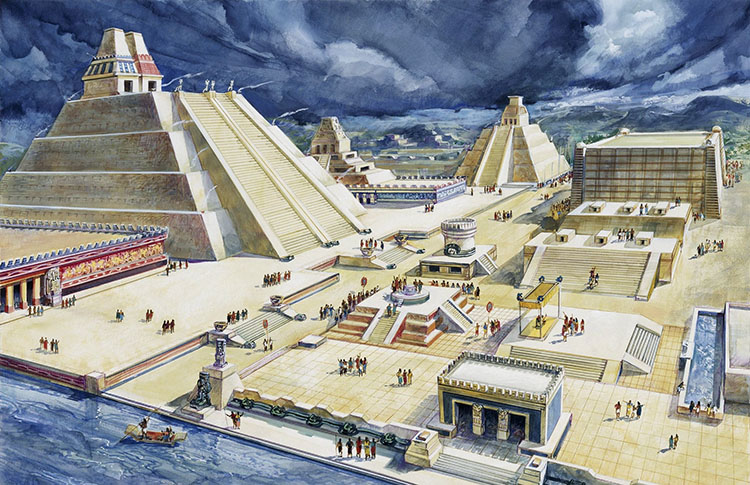
    Artistic recreation of Mexica-Tenochtitlan, the capital of the expanding Aztec Empire in the 15th century until it was captured by the Spanish in 1521. The following comment from Bernal Díaz del Castillo in his The Conquest of New Spain leaves no doubt as to the impressive achievements made by the Aztecs: “When we saw so many cities and villages built in the water and other great towns on dry land we were amazed and said that it was like the enchantments… on account of the great towers and cues and buildings rising from the water, and all built of masonry. And some of our soldiers even asked whether the things that we saw were not a dream?… I do not know how to describe it, seeing things as we did that had never been heard of or seen before, not even dreamed about.”

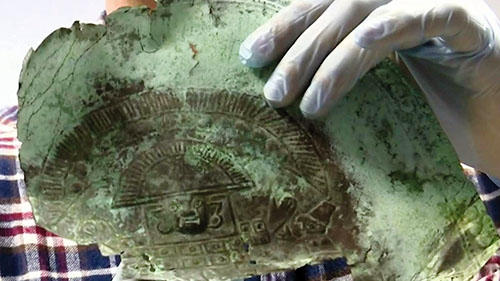
    There is also something mysterious about an object found in January 2019 by former Massachusetts Institute of Technology professor Dr Michael Torres while sweeping his metal-detector over Melbourne Beach, on the east coast of Florida, in the United States. Brushing the concealing sand aside brought to light what appears to be an Inca “funeral mask” embossed with an anthropomorphic figure surrounded by geometric designs. Dr Torres convincingly speculates that it was part of South American riches taken by 18th century Spaniards who packed their looted treasure aboard a galleon that sank in a storm. Since then, pieces driven by wave action continue to wash up onshore. 

    The mask’s humanoid image is similar to other native representations of Kon-Tiki-Viracocha, the flood-hero described in our above discussion of Andean herbal medicine. What most sets the object apart from other such artefacts, however, is its construction from iridium, supposedly first discovered by London chemist Smithson Tennant in 1803. It took ten more years for another British scientist, John George Children, to melt a very small sample of iridium with the aid of the most galvanic battery available at the time. The first melting of iridium in appreciable quantity was finally accomplished by 1860 when blast furnaces had become powerful enough for the job. 

    Evidence of lost high technology – this 10th century BCE Andean mask is made of iridium, the earth’s second-hardest mineral, which was historically unknown until 1803 and only melted for the first time nearly sixty years later.

    Yet, the same achievement was successfully undertaken nearly three thousand years before at the hands of a nameless pre-Inca people, whose surviving copper slag heap at Wankarani, in the Bolivian highlands, is a likely site for the mask’s creation between 900 BCE and 700 BCE when artisans there were known to have been the premiere metal smiths of pre-Columbian South America. 

    The Melbourne Beach find comprises a copper base upon which extraordinarily high temperatures have fused an iridium surface covered with melted silver and gold. As the most corrosion-resistant material known, iridium is the second-densest metal after osmium, with which it is sometimes combined in an alloy for pen tips and compass bearings. Iridium is one of the rarest elements in Earth’s crust, with annual production and consumption of only three tons. Most of it comes from outer space, delivered to our planet’s surface in meteor, asteroids and comet collisions over the course of millions of years. 

    How the Wankarani could have found, let alone identify scarce iridium – much less sufficiently melt this very high density, nearly immalleable and exceptionally hard mineral for artistic workmanship – is made all the more impossible by archaeologists’ insistence that furnaces operated by pre-Spanish Bolivians never approached the extraordinarily high temperatures required to melt iridium. Indeed, that was only achieved, as history tells us, as recently as the 19th century. Yet, there is the Andean mask, material proof to the contrary, and physical evidence of a technological level unequalled for some twenty-seven hundred years. 

    It is haunted by even more intriguing and difficult questions to answer: What was the artefact’s purpose? Why was so challenging a metal chosen for its medium of creation? Iridium’s stellar melting point makes it among the most heat-resistant minerals known. Was the Melbourne Beach object really a “funeral mask” as some observers believe? Or was it a face plate of some kind to protect someone, very long ago, from an encounter with a dangerous heat source? Its further study may tell.

    Learn more by reading Frank Joseph’s book Ancient High Tech: The Astonishing Scientific Achievements of Early Civilizations (Bear & Company), which explores the advanced technology, science, and medicine achieved by ancient civilisations hundreds and thousands of years ago.

    [alert type=”general” dismiss=”no”]This article was published in New Dawn Special Issue Vol 14 No 3.[/alert]

    [alert type=”success” dismiss=”no”]If you appreciate this article, please consider subscribing to help maintain this website.[/alert]

    © New Dawn Magazine and the respective author.
    For our reproduction notice, click here.
  • Obesity Machine: How the Processed Food Industry Profits From Eating Disorders

    Obesity Machine: How the Processed Food Industry Profits From Eating Disorders

    From New Dawn Special Issue Vol 15 No 2 (Apr 2021)

    Scientists, politicians, media, and health professionals note that Western countries face obesity and fatness epidemics. Large numbers of poor, malnourished children are obese because the cheap, processed, low-nutrient food bought by their parents – bread, cereals, snacks, etc. – contains high concentrations of sugars. 

    In addition to the systemic factors explored below, there are darker, more secretive reasons for our addiction to what the late philosopher-comedian George Carlin called “slow death by fast food.” But it is not just fast food. To save money on raw materials, sell innovation to other companies, and hook consumers onto their products, food giants have developed intricate supply lines for big firms like McDonald’s and PepsiCo. Using sophisticated design techniques based on the biology of pleasure and addiction, they have contributed to ill-health. 

    Obesity Epidemic

    Obesity can cause serious health problems that lower life-quality, shorten it, and frequently lead to hospitalisation. Cushing’s disease (excess cortisol), polycystic ovary syndrome, and other ailments can cause obesity, as can depression. Usually, however, pathologies are caused by obesity. Typically, obesity results from the individual’s overeating, choice of foods, and lack of exercise. In most cases, obesity and weight gain do not appear to be solvable by the individual. Data suggest that most people who diet and exercise cannot lose weight and sustain their weight loss. Rather, weight-loss is typically achieved by a holistic change-of-life approach, not by dieting and exercising alone. This is partly because the system makes people revert to their old, sedentary lifestyles and partly because they are addicted to bad food. Only a comparatively small number of people can sustain weight loss without changing their approach to life and food. Obesity can cause, contribute to, or worsen cancer, coronary heart disease, gallbladder disease, high blood pressure, low-density lipoprotein cholesterol, sleep apnoea, and type-2 diabetes.

    Systemic reasons for the obesity crisis include the unconscious, evolutionary flaw that makes people eat more than they need to in case they cannot eat again for a while. In nature, food can be scarce. In our artificial societies, it is abundant. Our brains developed to overeat in case of scarcity. Anthropologists note that once humans developed settled agriculture 10,000 years ago, obesity became a problem for the first time. 

    A related issue is that the human body is built for hunting and gathering. We are “born to run,” as anthropologists put it, yet modernity enforces sedentary living: the bus or car to work, sitting at a desk for most of the day, watching TV in exhaustion in the evening. Our intestines are now excessively long because our ancestors used to eat raw foods that took longer to digest. High-nutrient, fat-burning raw food diets are a niche, not the norm. The system has separated us from our environment: biodiversity is replaced by fields for monoculture, the nutrients in soils are depleted along with the pesticides and transport time, and the shelf-life of food lessens its nutritional quality. Work exhausts people and processed ready-meals are cheap. Corporate branding brainwashes us into reaching for high-sugar treats.

    The epidemic of fatness and obesity has many consequences. Typically, overweight people are less happy and live shorter, unhealthy lives compared to thinner people. Morbidities including diabetes, heart disease, strokes, high blood pressure, and excess cholesterol often combine to make individuals more susceptible to death and injury from bacteria and viruses, including SARS-CoV-2.

    The World Health Organization defines overweight and obese as excess fat accumulation relative to body mass index (BMI): “a person’s weight in kilograms divided by the square of [their] height in meters (kg/m2).” Overweight is BMI greater than or equal to 25 and obese 30. Globally, obesity relative to population increase has tripled since the 1970s. Nearly 2 billion adults are overweight and 650 million are obese. Relative to population size, the fattest populations on Earth tend to live on small islands: American Samoa, the Cook Islands, Kiribati, the Marshall Islands, Nauru, Palau, Samoa, Tokelau, and Tonga. 

    In Australia, nearly 70 per cent of adults are overweight: around half of whom are obese. Obesity is more common in older people. Poverty is a factor. Poor people are up to 40 per cent more likely to be obese than their wealthier counterparts. In the UK, nearly 70 per cent of men and 60 per cent of women are overweight. Of those, a quarter of men and a third of women are obese. Each year, around 800,000 British people are hospitalised with weight-related ailments: over 10,000 of which are directly related to obesity. Prevalence of obesity tends to be higher in the Midlands and in the Northeast of England around Durham, Hull, Lincolnshire, and Yorkshire. These areas correlate to deprivation and poverty. On average, over 50 per cent of Europeans are overweight or obese, with numbers varying from country to country: e.g., 36 per cent in Italy and 54 per cent in the Netherlands. 

    In the US, over 70 per cent of adults are overweight, of whom 42 per cent are obese. Twenty per cent of American children are obese. Areas in the US with the highest numbers of overweight and obese people include Memphis (TN), Shreveport (LA), Carmel (IN), Jackson (MS), and San Antonio (TX). These areas also correlate with high levels of poverty. 

    The most overweight countries in Asia are Malaysia (15 per cent obese), Brunei (14 per cent), Thailand (10 per cent), Indonesia (7 per cent), and the Philippines (6.5 per cent). Being in the top-five economies by GDP, Japan is a good country to compare with other so-called developed countries with big economies and high levels of poverty, such as European giants and the USA. Epidemiologists point to Japan’s traditional dietary habits as a reason for its comparatively low rate of obesity: 4 per cent compared to America’s 42 per cent. The Japanese consumption of fish, vegetables, and soybean products instead of dairy, fat, and meat is one explanation. 

    What’s On Your Plate?

    When it comes to contributing to fatness and obesity, the usual suspects include food and beverage corporations whose products are loaded with bad fats, salt, and sugar: Burger King, Kellogg’s, KFC, McDonald’s, PepsiCo, and other big brands. 

    PepsiCo is worth $204bn and sells numerous brands. Crisps and potato chip brands include Cheetos, Doritos, Lay’s (Walkers in the UK), and Ruffles. Beverages include Aquafina bottled water, Mirinda fizzy orange, Mountain Dew, Pepsi, and Tropicana fruit drinks. Twenty-two such brands generate $1 billion a year for the company. Billions of people across 200 countries consume these for lunch at work, dinner at home, at parties, and when walking or shopping. PepsiCo spends over $2bn per annum on advertising. The cereal producer, Kellogg’s, owns the cracker brand Austin, the Nutrigrain bar, the crisps Pringles, and a number of sweet and savoury breakfast cereals including All-Bran, Coco Pops, Cornflakes, Crunchy Nut, Froot Loops, and Frosted Flakes. These and other products make Kellogg’s a $22bn company. 

    The Swiss firm Nestlé is worth $313bn. In addition to instant coffee, its products include baby food (Cerelac, Gerber, and NaturNes), bottle water (Perrier and S.Pellegrino), cereals (Cheerios, Fitness and Lion), confectionary (Aero, KitKat and Quality Street), instant meals (Buitoni pasta, Lean Cuisine diet and Stouffer’s frozen), and ice cream (Dreyer’s, Extrême and Häagen-Dazs). The company’s bottled water industry is worth $7bn a year. In 2005, Nestlé’s then-CEO, Peter Brabeck-Letmathe, said that many people think that, “as a human being you should have a right to water. That’s an extreme solution.” He added: “The other view says that water is a foodstuff like any other, and like any other foodstuff it should have a market value.” He concluded: “I believe it’s better to give a foodstuff a value.”

    Globally, the baby formula industry is worth $11bn, including Nestlé’s products. Beginning in the 1970s, Nestlé targeted uneducated women in Africa and Latin America with marketing that led them to believe that artificially produced “scientific” baby milk formulae was more nourishing for their infants than breast milk. They also marketed their products as an example of social mobility, appealing to mothers’ yearning to escape absolute poverty. Nestlé hired women to play “nurses” who would call unexpectedly on mothers to sell them their formula. The fake nurses also told the mothers lies about how their natural milk would dry and that they’d be unable to feed their children. Dr Stephen Joseph of the pro-corporate US Agency for International Development said that baby formula killed a million children a year by depriving them of nutrition. It also led to stunted growth and brain damage among survivors. 

    These and other corporations use all manner of modified products in their foods. Sugar is a soluble carbohydrate that comes in several basic forms: galactose (found in a variety of products, including dairy), glucose (plant sugar), fructose (fruit sugar), and sucrose (cane sugar, a.k.a., granulated, regular, table). Added sugar is present in over 70 per cent of processed foods, including savoury products like bran cereals, bread, juice, and yoghurts. In the US, the Food and Drug Administration requires companies to list sugar in their ingredients. But companies use a loophole to disguise sugar as corn syrup, dextrose, fructose, maltose, rice syrup, and sucrose. Government corn subsidies in the 1970s gave food producers an abundance of cheap corn which they synthesised into an unhealthy, cost-saving replacement for natural sugars.

    Starch is the carbohydrate used by plants for energy storage. Corn syrup (also known as glucose syrup) is starch converted to sugar. The process was invented by the chemist Gottlieb Kirchhoff in 1812. Today, most corn syrup is procured from No. 2 yellow dent corn, first grown in the US in 1846. Corn syrup is used as a thickener and as a cheaper alternative to cane sugar. High fructose corn syrup is commonly added to crackers, fizzy drinks, ready-meals, salad dressing, and sweetened juices. Caused by non-alcoholic fatty-liver disease, hepatocellular carcinoma is the most common type of liver cancer. Fructose has toxic effects on the liver, including increasing the production of fatty acid, insulin resistance, and oxidative stress. Fizzy drinks can raise bodily glucose, fructose, and insulin levels within 15 minutes of consumption. The body tries to convert fructose metabolism to glucose. In addition, the high concentrations of corn syrup in fizzy drinks contribute to type-2 diabetes.

    Monosodium glutamate (MSG, a.k.a., sodium glutamate) is a natural salt in a variety of foods. Today, it is used as a synthetic flavour enhancer. In 1908, the chemist Kikunae Ikeda isolated brown crystals of glutamic acid, leading the way for the artificial production of MSG. MSG is present in crisps, dressings, fast foods, processed soups, and seasonings. Clinical studies compared hundreds of middle-aged to elderly people who have the same caloric intake and take the same amount of exercise. They found that those who have a high concentration of MSG in their diets tend to be susceptible to weight gain and obesity compared to those who eat little MSG. 

    So-called “trans fats” are emulsifiers: food additives that prolong shelf-life. They are produced naturally in dairy products, but they also occur when food manufacturers add hydrogen to vegetable oil (hydrogenated oil), which converts liquid into solid fats. Trans fats raise the level of low-density lipoprotein (LDL) cholesterol in the blood. Elevated levels of LDL do not easily dissolve and can increase the risk of Alzheimer’s, artery disease, heart attack, infertility, stroke, and type-2 diabetes. Collectively, trans fats constitute partially-hydrogenated oils, which the US Food and Drug Administration labelled unsafe in 2015. But trans fats are still found in processed bread, cakes, fast foods, margarine, pastries, snacks, and vegetable oils.

    The Giants

    It is easy to point the finger at McDonald’s, PepsiCo and the like, but from which companies do they acquire their modified additives? Kellogg’s, Nestlé, etc. typically purchase their flavour- and shelf-life-enhancing additives from other firms about which few people have heard. Enter the supply kingpins. 

    By 2020, the top ten global food companies and their values (in US dollars) included Cargill ($113.5bn), Archer Daniels Midland (ADM, $64.65bn), Sysco ($60bn), JBS ($51.7bn), and George Weston ($50bn). Scientists at these companies have spent decades perfecting the micro components of their foods to enhance flavour and addictiveness. The packaged products are then sold to food sellers, like KFC, whose scientists find innovative ways to synthesise them into their products. 

    Writing against these practices, Dr Steven Witherly developed a Food-Pleasure equation which posits that humans are addicted to junk food in part because Sensation (including taste like salt (MSG), smell, texture, and variety) are augmented by Caloric Stimulation (with proteins like gluteomorphins (gluten found in breads and cereals, etc.) and carbohydrates such as sugar, starch, and fat (including trans fats)). The stomach and small intestines contain receptors including mechanoreceptors and chemoreceptors, the latter are stimulated by amino acids, carbohydrates, and lipids. Using Doritos as an example, Witherly applies the equation and notes that the potato chip’s shape, dusty coating, combination of sugar and salt, plus high-fat saturation stimulate the consumer’s pleasure whilst increasing the amount of gut hormones that reduce anxiety. The same formula applies to KFC and other brands. 

    Cargill supplies many of the big food companies including KFC, McDonald’s, and PepsiCo. It sells 40 types of salt to food producers: flaked, ground, pulverised, smashed, and more. For instance, when popcorn producers buy from Cargill, they expect the shape of the salt to cling to every part of the textured popcorn kernel. Cheese and meat manufacturers buy Cargill salt because they want the ingredient to be as textureless as possible. In some products, a “flavour burst” is produced by processing the salt into micro-pyramid shapes. 

    In addition to allegedly making consumers addicted, Cargill has developed a shocking environmental and human rights record. In 2019, former US Congressman Henry A. Waxman’s Mighty Earth NGO infamously described Cargill as “the worst company in the world.” The company was founded in 1865 by the US businessman William Wallace Cargill whose descendants remain the controlling shareholders in the business. The original company was a grain-storage house in the frontier towns of Iowa. By the 1920s, operations had expanded to Italy and Canada. In 1938, it was banned from the Chicago Board of Trade for influencing grain prices. Today, Cargill employs 155,000 people in 70 countries and owns more than 60 subsidiaries. In addition to meats, oils, and salts, products include animal feed, bio-industrial, food ingredients, and proteins.

    Founded in 1902, ADM provides products and services including animal feed, drinks, fuel, and industrial chemicals. It owns hundreds of subsidiaries worldwide include agro-investment firms, holding companies, trading partnerships, processing plants, and chemical manufactures. It brags: “We transform natural products into a complete portfolio of ingredients and flavours for foods and beverages, supplements, nutrition for pets and livestock and more.” ADM has at least “27 customer innovation centres in 21 different countries and a team of 400 food scientists.” ADM’s acidulants are used for flavour, colour, and moisture control. They include drums of citric acid (“non-GMO options available”), Citrisol® 501 to prevent off-colouration, sodium citrate dihydrate powders for emulsification, and potassium citrate for preservation. ADM supplies companies including Kellogg’s and PepsiCo.

    Fake Food

    “Sustainability” is the new buzzword among corporate conglomerates that have spent years ruining the Earth. Over the last few decades, food giants have merged to create mega-corporations, with many processed food suppliers like Tyson investing in smaller, organic firms. In the name of sustainability, they have a revolving door system, where the former CEO of one company joins the board of another. Advisory sessions are another feature. In September 2020, for instance, Ray Young, ADM’s Chief Financial Officer, shared a roundtable with, among others, Amy Senter, Vice President of Global Sustainability at Kellogg’s. The agenda included modifying food production in the name of greening up. 

    Recently, the multimillion-dollar asset manager, John Hancock Life Insurance, which owns tracts in Australia and Canada, sold land in the Columbia River Basin in the upper west of the USA to an anonymous investor, who journalists found out was the centibillionaire Bill Gates. The Basin contains unusually rich and tillable soil. The deal made Gates the biggest landowner in the US. Given his open support for genetically-modified organisms, it is possible that Gates will use the land to grow GMO crops. In addition, public money was used by NASA to develop fungus proteins. Using the technology, the company Nature’s Fynd developed a meat-free burger with proteins grown in the public Yellowstone National Park. The company raised $80 million from former US Vice President Al Gore’s Generation Investment Management and from Bill Gates’s Breakthrough Energy Ventures. 

    The solution to the crisis of fake food, GMOs, and addictive substances is to eat as little processed food as possible. Grocery stores have, over the last few decades, expanded their range of dairy-, gluten-, and GMO-free products to include organic foods. Support independent local health food shops and visit farmer’s markets. Social media is full of free, on-demand amateur and professional chefs who teach us how to cook healthy foods from scratch. Where possible, food can be grown in gardens and even in pots on windowsills and balconies, or if you haven’t a garden on an allotment, check for growers’ associations and local community gardens. Self-reliance and group-cultivation is great exercise, fresh air, and key to defeating fattening, poisonous, processed foods. 

    [alert type=”general” dismiss=”no”]This article was published in New Dawn Special Issue Vol 15 No 2.[/alert]

    [alert type=”success” dismiss=”no”]If you appreciate this article, please consider subscribing to help maintain this website.[/alert]

    Footnotes

    1. Centers for Disease Control and Prevention (US), www.cdc.gov/obesity/adult/causes.html
    2. Ariana Chao (2014) Nursing Forum, 49(3): 189-99
    3. David Miles (2006) The Tribes of Britain, Weidenfeld and Nicolson
    4. Christopher McDougall (2009) Born to Run: A Hidden Tribe, Superathletes, and the Greatest Race the World Has Never Seen, Profile Books
    5. Open Access Government 14 August 2019, www.openaccessgovernment.org/office-workers-sitting-down/71612
    6. Karen Hardy et al. (2017) The Science of Nature, 104(2): https://link.springer.com/article/10.1007/s00114-016-1420-x
    7. Donald R. Davis, Melvin D. Epp and Hugh D. Riordan (2004) Journal of the American College of Nutrition, 23(6): 669-82
    8. World Health Organization, 1 April 2020, www.who.int/news-room/fact-sheets/detail/obesity-and-overweight
    9. Alice Murphy, The Who (Australia), 10 Jan 2019, www.who.com.au/the-worlds-top-ten-fattest-countries
    10. Australia Institute of Health and Welfare, 23 July 2020, www.aihw.gov.au/reports/australias-health/overweight-and-obesity
    11. Cate Burns, Victoria Health Promotion Foundation, April 2004, www.vichealth.vic.gov.au/~/media/ResourceCentre/PublicationsandResources/healthy%20eating/Literature%20Review%20Poverty_Obesity_Food%20Insecurity.ashx
    12. National Health Service, Statistics on Obesity, Physical Activity and Diet, 5 May 2020, https://digital.nhs.uk/data-and-information/publications/statistical/statistics-on-obesity-physical-activity-and-diet/england-2020
    13. Graham Moon (2007) Social Science and Medicine, 65: 20-31 
    14. Save the Children quoted in Datablog, The Guardian, 23 February 2011, www.theguardian.com/news/datablog/2011/feb/23/child-poverty-britain-map
    15. Eurostat, 2014, https://ec.europa.eu/eurostat/statistics-explained/index.php/Overweight_and_obesity_-_BMI_statistics
    16. Centers for Disease Control and Prevention, National Center for Health Statistics, www.cdc.gov/nchs/fastats/obesity-overweight.htm
    17. Rochie Bernardo, WalletHub, https://web.archive.org/web/20160323054225/https://wallethub.com/edu/fattest-cities-in-america/10532
    18. PovertyUSA, www.povertyusa.org/data
    19. Molly Moore, Statista, 9 Nov 2020, www.statista.com/statistics/1179519/asean-obesity-prevalence-by-country
    20. GlobalData Healthcare, 28 Jan 2020, www.pharmaceutical-technology.com/comment/low-obesity-japan
    21. Trading Economics, https://tradingeconomics.com/pep:us:market-capitalization
    22. Sirsha Bhogaraju, Market Realist, 26 July 2020, https://marketrealist.com/2019/11/pepsico-a-must-know-overview-of-the-consumer-giant
    23. A. Guttmann, Statista, 12 August 2020, www.statista.com/statistics/286547/pepsico-advertising-spending-worldwide
    24. Kellogg Company, www.kelloggcompany.com/en_US/brandportfolio.html
    25. Sky News, 28 Sept 2017, https://uk.news.yahoo.com/kelloggs-boss-john-bryant-step-195800506.html
    26. Companies Market Cap, https://companiesmarketcap.com/nestle/marketcap
    27. Nestlé, www.nestle.com/aboutus/overview/ourbrands
    28. Quoted in Erwin Wagenhofer (2005) We Feed the World, Bullfrog Films
    29. Jill Krasny, Business Insider, 25 June 2012, www.businessinsider.com/personal-finance/nestles-infant-formula-scandal-2012-6#the-baby-killer-blew-the-lid-off-the-formula-industry-in-1974-1
    30. Darra Goldstein (2015) The Oxford Companion to Sugar and Sweets, Oxford University Press, 688 
    31. University of California San Francisco, http://sugarscience.ucsf.edu/hidden-in-plain-sight
    32. Hopkins Medicine, www.hopkinsmedicine.org/health/wellness-and-prevention/finding-the-hidden-sugar-in-the-foods-you-eat
    33. Tom Philpott, Mother Jones, 26 July 2020, www.motherjones.com/food/2019/07/the-secret-history-of-why-soda-companies-switched-from-sugar-to-high-fructose-corn-syrup
    34. Katherine Marengo, Medical News Today, 29 May 2019, www.medicalnewstoday.com/articles/325315
    35. Brittany Dewdney et al. (2020) Biomolecules, 10(4): 496
    36. Mary E. Patterson et al. (2018) Journal of Nutrition and Intermediary Metabolism, 14: 1-7
    37. Atsushi Yokota and Masato Ikeda (2011) Amino Acid Fermentation, Springer, p. v. 
    38. WebMD, www.webmd.com/diet/foods-high-in-msg
    39. ScienceDaily, 14 August 2008, www.sciencedaily.com/releases/2008/08/080813164638.htm
    40. Food and Drug Administration (US), www.fda.gov/food/food-additives-petitions/trans-fat
    41. WebMD, www.webmd.com/heart-disease/ldl-cholesterol-the-bad-cholesterol
    42. FDA, www.fda.gov/food/food-additives-petitions/final-determination-regarding-partially-hydrogenated-oils-removing-trans-fat
    43. Diabetes.co.uk, 15 Jan 2019, www.diabetes.co.uk/food/trans-fats.html
    44. Food Processing Technology, 6 Nov 2020, www.foodprocessing-technology.com/features/top-ten-food-companies-in-2020
    45. Steven A. Witherly (2007) Why Humans Like Junk Food: The Inside Story on Why You Like Your Favorite Foods, the Cuisine Secrets of Top Chefs, and How to Improve Your Own Cooking Without a Recipe!, iUniverse
    46. FoodIngredientsFirst.com, 17 May 2012, www.foodingredientsfirst.com/news/kfc-introduces-homegrown-canola-oil.html
    47. Cargill, 21 March 2016, www.cargill.com/story/cargill-and-mcdonalds-france-partner-with-french-poultry-farmers
    48. Cargill, 1 January 2015, www.cargill.com/history-story/en/THIRD-BAY-PEPSI.jsp
    49. Michael Moss (2013) Salt, Sugar, Fat: How the Food Giants Hooked Us, W.H. Allen, 286-87
    50. Mighty Earth (2019) The worst company in the world, www.mightyearth.org/wp-content/uploads/Mighty-Earth-Report-Cargill-The-Worst-Company-in-the-World-July-2019.pdf
    51. Banktrack, www.banktrack.org/company/cargill
    52. Neil Weinberg with Brandon Copple, Forbes, 25 Nov 2002, https://web.archive.org/web/20021115202802/https://www.forbes.com/forbes/2002/1125/158.html
    53. Cargill, www.cargill.com/about/company-overview
    54. Securities and Exchange Commission, 31 Dec 2018, www.sec.gov/Archives/edgar/data/7084/000000708419000012/adm-ex21_20181231x10k.htm
    55. ADM, www.adm.com/our-company
    56. ADM, www.adm.com/news/stories/adms-wright-named-a-woman-worth-watching-in-stem
    57. ADM, www.adm.com/products-services/food/acidulants
    58. ADM, www.adm.com
    59. Ibid. 
    60. Anna Wiber, Baking Business, 13 March 2018, www.bakingbusiness.com/articles/45738-how-general-mills-kellogg-keep-ingredient-supply-chains-transparent
    61. ADM, 6 May 2013, www.adm.com/news/news-releases/adm-cocoa-receives-supplier-of-the-year-award-from-pepsico-mexico
    62. Andy Coyne, 15 Dec 2017, www.just-food.com/analysis/2017-the-year-in-food-industry-ma_id138359.aspx
    63. ADM, 16 Sept 2020, www.adm.com/news/news-releases/adm-and-cdp-launch-climate-week-with-panel-on-esg-and-business-performance
    64. Eric OKeefe, “Bill Gates: America’s Top Farmland Owner,” Land Report, 11 Jan 2021, https://landreport.com/2021/01/bill-gates-americas-top-farmland-owner
    65. Katherine Davis, Business Journals, 16 Feb 2021, www.bizjournals.com/chicago/inno/stories/news/2021/02/16/bill-gates-backed-food-startup-reveals-products.html
    66. Jonathan Shieber, Techcrunch, 15 Feb 2020, https://techcrunch.com/2021/02/15/after-raising-150-million-in-equity-and-debt-natures-fynd-opens-its-fungus-food-for-pre-orders

    © New Dawn Magazine and the respective author.
    For our reproduction notice, click here.