New Dawn – World's Most Unusual Magazine

Category: Articles

  • Dreams, Spirits & the Occult: The Secret World of Carl G Jung

    Dreams, Spirits & the Occult: The Secret World of Carl G Jung

    From New Dawn 174 (May-June 2019)

    On 11 February 1944, the 68-year-old Carl Gustav Jung – then the world’s most renowned living psychologist – slipped on some ice and broke his fibula. Ten days later, in hospital, he suffered a myocardial infarction caused by embolisms from his immobilised leg. Treated with oxygen and camphor, he lost consciousness and had what seems to have been a near-death and out-of-the-body experience – or, depending on your perspective, delirium. 

    He found himself floating 1,000 miles above the Earth. Seas and continents shimmered in blue light and Jung could make out the Arabian desert and snow-tipped Himalayas. He felt he was about to leave orbit, but then, turning to the south, a huge black monolith came into view. It was a kind of temple, and at the entrance Jung saw a Hindu sitting in a lotus position. Within, innumerable candles flickered, and he felt that the “whole phantasmagoria of earthly existence” was being stripped away. It wasn’t pleasant, and what remained was an “essential Jung,” the core of his experiences. 

    He knew that inside the temple the mystery of his existence, of his purpose in life, would be answered. He was about to cross the threshold when he saw, rising up from Europe far below, the image of his doctor in the archetypal form of the King of Kos, the island site of the temple of Asclepius, Greek god of medicine. He told Jung that his departure was premature; many were demanding his return and he, the King, was there to ferry him back. When Jung heard this, he was immensely disappointed, and almost immediately the vision ended. 

    He experienced the reluctance to live that many who have been ‘brought back’ encounter, but what troubled him most was seeing his doctor in his archetypal form. He knew this meant that the physician had sacrificed his own life to save Jung’s. On 4 April 1944 – a date numerologists can delight in – Jung sat up in bed for the first time since his heart attack. On the same day, his doctor came down with septicæmia and took to his bed. He never left it, and died a few days later. 

    Jung was convinced that he hadn’t simply hallucinated, but that he had been granted a vision of reality. He had passed outside time, and the experience had had a palpable effect on him. For one thing, the depression and pessimism that overcame him during WWII vanished. But there was something more. For most of his long career, he had impressed upon his colleagues, friends, and reading public that he was, above all else, a scientist. He was not, he repeated almost like a mantra, a mystic, occultist, or visionary, terms of abuse his critics, who rejected his claims to science, had used against him. Now, having returned from the brink of death, he seemed content to let the scientist in him take a back seat for the remaining 17 years of his life. 

    Although Jung had always believed in the reality of the ‘other’ world, he had taken care not to speak too openly about this belief. Now, after his visions, he seemed less reticent. He’d had, it seems, a kind of conversion experience, and the interests the world-famous psychologist had hitherto kept to himself now became common knowledge. Flying saucers, astrology, parapsychology, alchemy, even predictions of a coming “new Age of Aquarius”: pronouncements on all of these dubious subjects – dubious at least from the viewpoint of modern science – flowed from his pen. If he had spent his career fending off charges of mysticism and occultism – initially triggered by his break with Freud in 1912 – by the late 1940s he seems to have decided to stop fighting. The “sage of Küsnacht” and “Hexenmeister of Zürich,” as Jung was known in the last decade of his life, had arrived.

    All in the Family 

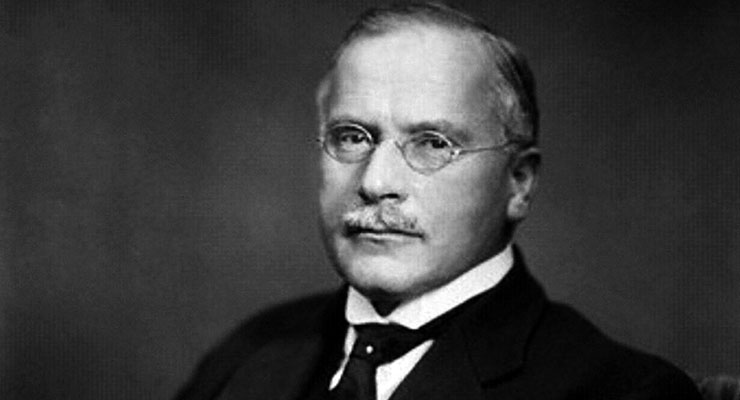
    A young Carl Jung    

    Yet Jung’s involvement with the occult was with him from the start – literally, it was in his DNA. His maternal grandfather, Rev. Samuel Preiswerk, who learned Hebrew because he believed it was spoken in heaven, accepted the reality of spirits, and kept a chair in his study for the ghost of his deceased first wife, who often came to visit him. Jung’s mother Emilie was employed by Samuel to shoo away the dead who distracted him while he was working on his sermons. 

    She herself developed mediumistic powers in her late teens. At the age of 20, she fell into a coma for 36 hours; when her forehead was touched with a red-hot poker she awoke, speaking in tongues and prophesying. Emilie continued to enter trance states throughout her life, in which she would communicate with the dead. She also seems to have been a ‘split personality’. Jung occasionally heard her speaking to herself in a voice he soon recognised was not her own, making profound remarks expressed with an uncharacteristic authority. This ‘other’ voice had inklings of a world far stranger than the one the young Carl knew. 

    His parents Emilie Preiswerk & Paul Jung 

    This ‘split’ that Jung had seen in his mother would later appear in himself. At around the age of 12, he literally became two people. There was his ordinary boyhood self, and someone else. The ‘Other’, as Carl called him, was a figure from the 18th century, a masterful character who wore a white wig and buckled shoes, drove an impressive carriage, and held the young boy in contempt. It’s difficult to escape the impression that in some ways Jung felt he had been this character in a past life. Seeing an ancient green carriage, Jung felt that it came from his time. 

    His later notion of the collective unconscious, that psychic reservoir of symbols and images that he believed we inherit at birth, is in a sense a form of reincarnation, and Jung himself believed in some form of an afterlife. Soon after the death of his father, in 1896 when Jung was 21, he had two dreams in which his father appeared so vividly that he considered the possibility of life after death. In another, later dream, Jung’s father asked him for marital advice, as he wanted to prepare for his wife’s arrival. Jung took this as a premonition, and his mother died soon after. And years later, when his sister Gertrude died – a decade before his own near-death experience – Jung wrote that, “What happens after death is so unspeakably glorious that our imagination and feelings do not suffice to form even an approximate conception of it.”1

    Tables & Knives

    Jung’s mother was involved in at least two well-known paranormal experiences that are recounted in practically every book about him. Sitting in his room studying, Carl suddenly heard a loud bang coming from the dining room. He rushed in and found his mother startled. The round walnut table had cracked from the edge past the centre. The split didn’t follow any joint but had passed through solid wood. Drying wood couldn’t account for it; the table was 70 years old and it was a humid day. Jung thought: “There certainly are curious accidents.” As if she was reading his mind Emilie replied in her ‘other’ voice: “Yes, yes, that means something.” 

    Two weeks later came a second incident. Returning home in the evening, Jung found an excited household. An hour earlier there had been another loud crack, this time coming from a large sideboard. No one had any idea what had produced it. Jung inspected the sideboard. Inside, where they kept the bread, he found a loaf and the bread knife. The knife had shattered into several pieces, all neatly arranged in the breadbasket. The knife had been used earlier for tea, but no one had touched it nor opened the cupboard since. When he took the knife to a cutler, he was told that there was no fault in the steel and that someone must have broken it on purpose. He kept the shattered knife for the rest of his life, and years later sent a photograph of it to psychical researcher JB Rhine. 

    Spirits Afoot

    By this time Jung, like many others, was interested in spiritualism, and was reading through the literature – books by Zöllner, Crooks, Carl du Prel, Swedenborg, and Justinus Kerner’s classic The Seeress of Prevorst. At the Zofingia debating society at the University of Basel, he gave lectures on “The Value of Speculative Research” and “On the Limits of Exact Science,” in which he questioned the dominant materialist paradigm that reigned then, as today. Jung led fellow students in various occult experiments, yet when he spoke to them about his ideas, or lectured about the need to take them seriously, he met with resistance. Apparently, he had greater luck with his dachshund, whom he felt understood him better and could feel supernatural presences himself.2 

    Cousin Helene Preiswerk

    Another who seemed to feel supernatural presences was his cousin, from his mother’s side of the family, Helene Preiswerk. In a letter to JB Rhine about the shattered bread knife, Jung refers to Helly – as she was known – as a “young woman with marked mediumistic faculties” whom he had met around the time of the incident, and in his “so-called’ autobiography Memories, Dreams, Reflections he remarks that he became involved in a series of séances with his relatives after the incidents of the bread knife and table. Yet the séances had been going on for some time before the two events, and at their centre was Helly, whom Jung already knew well and who, by all accounts, was in love with him. This is an early sign of his somewhat ambiguous relationship with the occult. 

    Helly would enter a trance and fall to the floor, breathing deeply, and speaking in old Samuel Preiswerk’s voice – although she had never heard him. She told the others that they should pray for her elder sister Bertha, who, she said, had just given birth to a black child. Bertha, who was living in Brazil, had already had one child with her mixed-race husband, and gave birth to another on the same day as the séance.3 Further séances proved equally startling. At one point, Samuel Preiswerk and Carl Jung Sr – Jung’s paternal grandfather – who had disliked each other while alive, reached a new accord. A warning came for another sister who was also expecting a child that she would lose it; in August the baby was born premature and dead.4 

    Helly produced further voices, but the most interesting was a spirit named Ivenes, who called herself the real Helene Preiswerk. This character was much more mature, confident, and intelligent than Helly, who Jung described as absent-minded, and not particularly bright, talented, or educated. It was as if buried beneath the unremarkable teenager was a fuller, more commanding personality, like Jung’s ‘Other’. This was an insight into the psyche that would inform his later theory of “individuation,” the process of “becoming who you are.” Helly did blossom later, becoming a successful dressmaker in France, although she died young, at only 30. 

    In Jung’s dissertation on the séances, On the Psychology and Pathology of So-called Occult Phenomena, he describes Helly unflatteringly as “exhibiting slightly rachitic skull formation,” and “somewhat pale facial colour,” and fails to mention that she is his cousin. He also omits his own participation in the séances, and dates them from 1899 to 1900, whereas they had started years before. Gerhard Wehr politely suggests that, “[T]he doctoral candidate was obviously at pains to conceal his own role, and especially his close kinship relationship, thus forestalling from the start any further critical inquiry that might have thrown the scientific validity of the entire work into question.”5 

    In other words, Jung the scientist thought it a good career move to obscure Jung the occultist’s personal involvement in the business. 

    The Poltergeist in Freud’s Bookcase

    In 1900, the 25-year-old Jung joined the prestigious Burghölzli Mental Clinic in Zürich. Here, he did solid work in word-association tests, developed his theory of ‘complexes’, and initiated a successful ‘patient-friendly’ approach to working with psychotics and schizophrenics. It was during his tenure that he also became involved with Freud. From 1906, when they started corresponding, to 1912, when the friendship ruptured, Jung was a staunch supporter of Freud’s work and promoted it unstintingly. 

    Carl Jung standing in front of Burghölzli clinic, Zurich circa 1909

    There were, however, some rocky patches. One centred on the famous poltergeist in Freud’s bookcase. Visiting Freud in Vienna in 1909, Jung asked him about his attitude toward parapsychology. Freud was sceptical and dismissed the subject as nonsense. Jung disagreed, and sitting across from the master, he began to feel his diaphragm glow, as if it was becoming red-hot. Suddenly a loud bang came from a bookcase. Both jumped up, and Jung said to Freud: “There, that is an example of a so-called catalytic exteriorisation phenomenon!”, Jung’s long-winded circumlocution for a poltergeist, or “noisy spirit.” When Freud said “Bosh!”, Jung predicted that another bang would immediately happen. It did. Jung said that, from that moment on, Freud grew mistrustful of him. From Freud’s letter to Jung about the incident, one gets the feeling that he felt Jung himself was responsible for it. 

    This isn’t surprising; Jung did manifest numerous paranormal abilities. While in bed in a hotel room after giving a lecture, he experienced the suicide of a patient who had a strong “transference” on him. The patient had relapsed into depression and shot himself in the head. Jung awoke in his hotel, feeling an odd pain in his forehead. He later discovered that his patient had shot himself precisely where Jung felt the pain, at the same time Jung woke up. More to the point, a visitor to his home once remarked about Jung’s “exteriorised libido,” how “when there was an important idea that was not yet quite conscious, the furniture and woodwork all over the house creaked and snapped.” 

    The Red Book

    The personal Red Book of Jung resting on his office desk (credit Lance S. Owens).

    It was Jung’s break with Freud that led to his own ‘descent into the unconscious,’ a disturbing trip down the psyche’s rabbit hole from which he gathered the insights about the collective unconscious that would inform his own school of ‘analytical psychology’. He had entered a ‘creative illness’, unsure if he was going mad. In October 1913, not long after the split, Jung had, depending on your perspective, a vision or hallucination. While on a train, he suddenly saw a flood covering Europe, between the North Sea and the Alps. When it reached Switzerland, the mountains rose to protect his homeland, but in the waves he saw floating debris and bodies. Then the water turned to blood. The vision lasted an hour and seems to have been a dream that had invaded his waking consciousness. Having spent more than a decade treating mental patients who suffered from precisely such symptoms, Jung had reason to be concerned. He was ironically rather relieved the next summer when WWI broke out and he deduced that his vision had been a premonition of it. 

    Yet the psychic tension continued. Eventually there came a point where Jung felt he could no longer fight off the sense of madness. He decided to let go. When he did, he landed in an eerie, subterranean world where he met strange intelligences that ‘lived’ in his mind. The experience was so upsetting that for a time Jung slept with a loaded pistol by his bed, ready to blow his brains out if the stress became too great. 
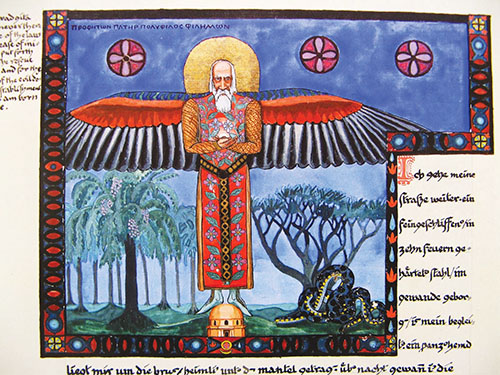
    A page from Carl Jung’s Red Book (Liber Novus) depicting “Philemon,” Jung’s image of the Wise Old Man archetype.  

    In his Red Book he kept an account, in words and images, of the objective, independent entities he encountered during his “creative illness” – entities that had nothing to do with him personally, but who shared his interior world. There were Elijah and Salome, two figures from the Bible who were accompanied by a snake. There was also a figure whom Jung called Philemon, who became a kind of ‘inner guru’ and who he painted as a bald, white-bearded old man with bull’s horns and the wings of a kingfisher. One morning, after painting the figure, Jung was out taking a walk when he came upon a dead kingfisher. The birds were rare in Zürich and he had never before come upon a dead one. This was one of the many synchronicities – “meaningful coincidences” – that happened at this time. 

    There were others. In 1916, still in the grip of his crisis, Jung again felt that something within wanted to get out. An eerie restlessness filled his home. He felt the presence of the dead – and so did his children. One daughter saw a strange white figure; another had her blankets snatched from her at night. His son drew a picture of a fisherman he had seen in a dream: a flaming chimney rose from the fisherman’s head, and a devil flew through the air, cursing the fisherman for stealing his fish. Jung had yet to mention Philemon to anyone. Then, one afternoon, the doorbell rang loudly, but no one was there. He asked: “What in the world is this?” The voices of the dead answered: “We have come back from Jerusalem where we found not what we sought,” words that form the beginning of Jung’s strange Seven Sermons to the Dead, a work of “spiritual dictation,” or “channelling,” he attributed to “Basilides in Alexandria, the City where the East toucheth the West.” 
    Ghosts in the House 

    By 1919, WWI was over and Jung’s crisis had passed, although he continued to practise what he called “active imagination,” a kind of waking dreaming, the results of which he recorded in the Red Book. But spirits of a more traditional kind were not lacking. He was invited to London to lecture on “The Psychological Foundations of the Belief in Spirits” to the Society for Psychical Research. He told the Society that ghosts and materialisations were “unconscious projections.” “I have repeatedly observed,” he said, “the telepathic effects of unconscious complexes, and also a number of parapsychic phenomena, but in all this I see no proof whatever of the existence of real spirits, and until such proof is forthcoming I must regard this whole territory as an appendix of psychology.” 

    Scientific enough, no doubt, but a year later, again in England, he encountered a somewhat more real ghost. He spent some weekends in a cottage in Aylesbury rented by Maurice Nicoll (later a student of Gurdjieff and Ouspensky) and while there was serenaded by eerie sounds, while an unpleasant smell filled the bedroom. Locals said the place was haunted and, on one particularly bad night, Jung discovered an old woman’s head on the pillow next to his; half of her face was missing. He leapt out of bed and waited until morning in an armchair. The house was later torn down. One would think that, having already encountered the dead on their return from Jerusalem, Jung wouldn’t be so shaken by a traditional English ghost, but the experience rattled him; his account of it only appeared 30 years later, in 1949, in an obscure anthology of ghost stories. 

    When his lecture for the SPR was reprinted in the Collected Works in 1947, Jung added a footnote explaining that he no longer felt as certain as he did in 1919 that apparitions were explicable through psychology, and that he doubted “whether an exclusively psychological approach can do justice to the phenomenon.” In a later postscript, he again admitted that his earlier explanation was insufficient, but that he couldn’t agree on the reality of spirits because he had no experience of them – conveniently forgetting the haunting in Aylesbury. But in a letter of 1946 to Fritz Kunkel, a psychotherapist, Jung admitted: “Metapsychic phenomena could be explained better by the hypothesis of spirits than by the qualities and peculiarities of the unconscious.” 

    A similar uncertainty surrounds his experience with the I Ching, the ancient Chinese oracle, with which he began to experiment in the early 1920s and which, like horoscopes, became part of his therapeutic practice. Although he mentioned the I Ching here and there in his writing, it wasn’t until 1949, again nearly 30 years later, in his introduction to the classic Wilhelm/Baynes translation, that he admitted outright to using it himself. And although he tried to explain the I Ching’s efficacy through what would become his paranormal deus ex machina, synchronicity, Jung admits that the source of the oracle’s insights are the “spiritual agencies” that form the “living soul of the book,” a remark at odds with his quasi-scientific explanation. Ironically, his major work on “meaningful coincidence,” Synchronicity: An Acausal Connecting Principle (1952), written with the physicist Wolfgang Pauli, provides only one unambiguous example of the phenomenon, and readers who, like me, accept the reality of synchronicity, come away slightly baffled by Jung’s attempt to account for it via archetypes, quantum physics, statistical analysis, mathematics, JB Rhine’s experiments with ESP, astrology, telepathy, precognition, and other paranormal abilities, all of which read like a recrudescence of Jung’s “I am a scientist” reflex. 

    Age of Aquarius

    In the 1920s, he plunged into a study of the Gnostics – whom he had encountered as early as 1912 – and alchemy. It was Jung, more than anyone else, who salvaged the ancient Hermetic pursuit from intellectual oblivion. Another Hermetic practice he followed was astrology, which he began to study seriously around the time of his break with Freud. Jung informed his inner circle that casting horoscopes was part of his therapeutic practice, but it was during the dark days of WWII that he recognised a wider application. In 1940, in a letter to HG Baynes, Jung speaks of a vision he had in 1918 in which he saw “fire falling like rain from heaven and consuming the cities of Germany.” He felt that 1940 was the crucial year, and he remarks that it’s “when we approach the meridian of the first star in Aquarius.” It was, he said, “the premonitory earthquake of the New Age.” 

    He was familiar with the precession of the equinoxes, the apparent backward movement of the Sun through the signs of the zodiac. By acting as a backdrop to sunrise at the vernal equinox, each sign gives its name to an ‘age’ – called a ‘Platonic month’ – which lasts roughly 2,150 years. In his strange book Aion (1951), he argues that the ‘individuation’ of Western civilisation as a whole follows the path of the ‘Platonic months’ and presents a kind of “precession of the archetypes.” Fish symbolism surrounds Jesus because He was the central symbol of the Age of Pisces, the astrological sign of the fish. Previous ages – of Taurus and Aries – produced bull and ram symbolism. The coming age is that of Aquarius, the Water Bearer. In conversation with Margaret Ostrowski-Sachs, a friend of Hermann Hesse, Jung admitted that he had kept this “secret knowledge” to himself for years, and only finally made it public in Aion. He wasn’t sure he was “allowed” to, but during his illness he received “confirmation” that he should. 

    Although the arcane scholar Gerald Massey and the French esotericist Paul Le Cour had earlier spoken of a coming Age of Aquarius, Jung was certainly the most prestigious mainstream figure to do so, and it is through him that the idea became a mainstay of the counterculture of the 1960s and ’70s. This was mostly through his comments about it in his book Flying Saucers: A Modern Myth of Things Seen in the Sky (1958), in which he argued that UFOs were basically mandalas from outer space. During his crisis, he had come upon the image of the mandala, the Sanskrit ‘magic circle’, as a symbol of psychic wholeness, and he suggested that ‘flying saucers’ were mass archetypal projections, formed by the psychic tension produced by the Cold War that was heating up between Russia and America. The Western world, he argued, was having a nervous breakdown, and UFOs were a way of relieving the stress. 

    Jung wrote prophetically: “My conscience as a psychiatrist bids me fulfil my duty and prepare those few who will hear me for coming events which are in accord with the end of an era… As we know from ancient Egyptian history, they are symptoms of psychic changes that always appear at the end of one Platonic month and at the beginning of another. They are, it seems, changes in the constellation of the psychic dominants, of the archetypes or ‘Gods’ as they used to be called, which bring about… long-lasting transformations of the collective psyche. This transformation started… in the transition of the Age of Taurus to that of Aries, and then from Aries to Pisces, whose beginning coincides with the rise of Christianity. We are now nearing that great change… when the spring-point enters Aquarius…” Ten years later, The Fifth Dimension (whose very name, appropriated from the title song of The Byrds’ third LP, suggests the cosmic character of the Mystic Sixties) had a hit song from the hippie musical Hair echoing Jung’s ideas, and millions of people all over the world believed they were witnessing “the dawning of the Age of Aquarius.” 

    Jung the Mystic
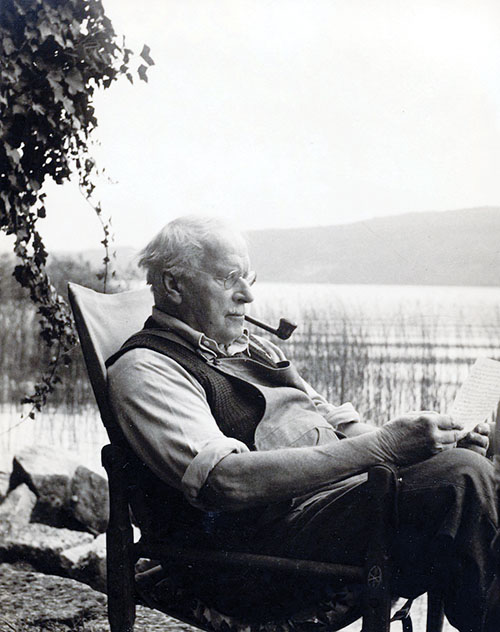
    Jung reading (1956)

    Jung died in 1961, just on the cusp of the ‘occult revival’ of the 1960s, a renaissance of magical thinking that he did much to bring about. He was also directly responsible for the “journey to the East” that many took then, and continue to take today. Along with the I Ching, Jung gave his imprimatur to such hitherto arcane items as The Tibetan Book of the Dead, Taoism and Zen, and without his intervention it’s debatable if these Eastern imports would have enjoyed their modern popularity. That he was in many ways a founding father of the Love Generation is seen by his inclusion on the cover of the Beatles’ Sgt Pepper’s Lonely Hearts Club Band album, although Jung himself would have thought “flower power” sadly naïve. 

    Although for all his efforts he has never been accepted by mainstream intellectuals, his effect on popular culture has been immense, and our contemporary grass roots, inner-directed spirituality, unfortunately associated with the New Age, has his name written all over it. Jung himself may have been equivocal about his relationship with mysticism, magic, and the occult, but the millions of people today who pay attention to their dreams, notice strange coincidences and consult the I Ching have the Sage of Küsnacht to thank for it. 

    The above article first appeared in Fortean Times 265 and is reprinted with the kind permission of the author.

    [alert type=”general” dismiss=”no”]This article was published in New Dawn 174.[/alert]

    [alert type=”success” dismiss=”no”]If you appreciate this article, please consider subscribing to help maintain this website.[/alert]

    FOOTNOTES 
    1. Quoted in Vincent Brome, Jung: Man and Myth, Scientific Book Club, 1979, 277 
    2. Brome, op. cit., 68 
    3. Deidre Bair, Jung: A Biography, Little Brown, 2004, 48 
    4. Ibid., 49 
    5. Gerhard Wehr, Jung: A Biography, Shambhala, Boston, 1987, 72 

    © New Dawn Magazine and the respective author.
    For our reproduction notice, click here.

  • Magic for Grown-ups: The Work of the UR Group

    Magic for Grown-ups: The Work of the UR Group

    From New Dawn 172 (Jan-Feb 2019)

    In the consensus view, magic belongs (if at all) in Disney films and Harry Potter books, and adults who actually believe in it are stuck in infantile or medieval superstition. It does not help that the most famous magus of modern times, Aleister Crowley, was a sex maniac and a drug fiend.1 Nor does the later development of Chaos Magick inspire much hope, with its dark, postmodern metaphysic. To most sane people, whether or not they have a spiritual outlook, magic is best left alone.

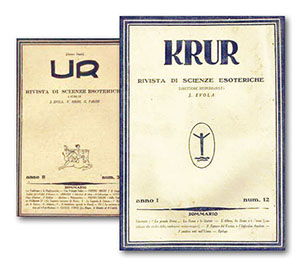
    This would also have been the attitude of the “Gruppo di UR,” a group of Italians led in the late 1920s by Julius Evola and Arturo Reghini.2 Their magic was not for the casual, the credulous, or those excited by the cool or the weird. It was for those dedicated to “magic as science of the I,”3 a concept that I will try to explain below. Although the group’s activities were private, involving only a handful of participants, they shared them with the world in a monthly journal, called first UR and then KRUR. The print-run, estimated at a thousand copies, suggests a surprising level of interest in Fascist-era Italy. In its three-year existence, UR/KRUR published 142 articles under 23 different pseudonyms, making it one of the twentieth century’s richest compilations of esoteric material and instruction.

    English language readers had access to the UR Group’s work in 2001, with a translation of the first of the three volumes.4 I helped with its preparation and promised that if no one else could be found to translate the other two, I would do so after I retired. Eventually I had to keep my promise. The second volume will appear in February 2019, and the third, hopefully, before another eighteen years have gone by.

    Baron Julius Cesare Evola (19 May 1898 – 11 June 1974)

    In his Introduction, Julius Evola states that the goal of this magic is knowledge of “metaphysical reality.” 

    Metaphysical reality exists and works in transcendent mode, in utter independence from the world of men. Nonetheless, he who is established in that mode and casts his glance downward can draw from it reference-points for a system of values and principles, which may confer earthly and temporal life with an order and a meaning that would otherwise be wholly lacking. (p.1)5

    Those familiar with Evola will recognise in these few lines the core of his doctrine. It is a hard and chilly one for those preferring the comforts of religion and a warm embrace of humanity. This magic has nothing to do with them, or with the order and meaning that help them to get by in earthly life. It is anti-humanistic, antisocial, and utterly at odds with the modern world. But although Evola was at the centre of the UR enterprise, he was not so harsh in his choice of collaborators. Being “established in metaphysical reality” is a tall order, and none of them claimed more than temporary glimpses of it. What they did claim, though, is that it has existed, and left its traces in Tradition.

    “Tradition,” as the word was used by Evola, René Guénon, and Ananda Coomaraswamy, meant the body of wisdom acquired or revealed in the distant past and handed down in the form of myths, symbols, rites, and to an extent religions.6 There was a time, they say, when humanity lived in concord with it, open to spiritual realities and in harmony with nature. But that was a Golden Age, and we are in the Age of Iron, the Kali Yuga.7 The magic of the UR Group is a lifeline for a few in this dark age who sense what has been lost and are determined to regain it.

    The UR Group’s journals contained five different kinds of documents:

    • Expositions of methods, disciplines, and techniques; 
    • Reports of initiatic experiences, historical and contemporary;
    • Translations of traditional texts. The first volume included a Mithraic Ritual and excerpts from Neoplatonic, alchemical, and Buddhist writings; the second, songs of Milarepa and a complete translation of the Turba philosophorum, with commentaries.
    • Traditional doctrines placed in context, to challenge modern views and attitudes;
    • The study of various forms of Tradition over history, to show their continual validity in the human world.

    The three volumes are not necessarily sequential because new contributors appear and the articles address different levels of commitment. One need not tread the magical path to appreciate the UR Group’s global approach to esotericism, which owed much to the Theosophical Society’s example of opening to the wisdom of the East. Esotericism apart, there is a refreshing contrast between their attitudes and the forced consensus of today. 

    Magic Guided by Science

    When Evola edited the group’s papers for publication in book form, the title “Introduction to Magic as Science of the I” implied that this was not a belief system but a science. Nothing was to be taken on trust unless proved by personal experience – and even then, subjected to the test of Tradition. The latter acted as a control for evaluating modern movements such as spiritualism, psychical research, occultism, Theosophy, psychoanalysis, and Jung’s depth psychology. All of these failed the test of traditional authenticity and were dismissed as deviances only to be expected of a dark age. But unlike the Traditionalism of René Guénon and his followers, that of the UR Group paid no respect to exoteric religions. To the aspirant for their sort of magic, religions were simply irrelevant. To Reghini, especially, they were worse than that, for he was a staunch defender of pagan traditions against monotheism and the Christian hegemony. 

    A partial exception was made for Rudolf Steiner’s Anthroposophy. Several members of the UR Group were active in Steiner’s movement, and their contributions reflect this. But Evola, as editor, drew a firm line between Steiner’s techniques for obtaining “knowledge of higher worlds” and his Christocentric and reincarnational doctrines.

    The scientific method is essentially amoral: that is why it is widely mistrusted today. The science of the UR Group followed the same principle, but with a crucial difference:

    As an example, from the moral point of view one may say: “You mustn’t lie, because lying is bad, and telling the truth is good.” From the initiatic point of view one is simply aware that lying causes a sort of lesion and contradiction in the unity of the being, which is a condition contrary to that of an initiatic qualification. (p. 243)

    The most dedicated members of the group formed “chains” for group work, numbering perhaps no more than five participants. They worked with guided imagery to build up psychic energy, and might “eventually be able to contact other chains, created on the same principles by other groups and in other places.” One wonders whether this has actually happened. Hans Thomas Hakl’s Foreword mentions that UR-type groups continue up to the present day, mostly in Italy and all in deliberate obscurity. Here are some of the principles: 

    In some kinds of chain the individuals are simply thrown together, and the polarity of masculine 0 and feminine Y necessary for operations is not reflected harmoniously in every member. Instead, they separate into the opposition of the fluid, passive mass formed by the majority = Y, and the active role of a leader = 0. But in the type of chain proposed here, every member must distinctly and firmly possess self-awareness, control, and mastery: thus both aspects of the Hermetic complementarity. Each must participate in the chain as an individual, as a distinct force. The chain formed by such individuals will become compact and positive in every way when, through repeated meetings, the various distinct elements become attuned and form a unity. (p. 42)

    Beyond the Grave & the Great Liberation

    These practices served an intention that went beyond one’s earthly life. In a commentary on the Tibetan Book of the Dead, Evola (writing as “Ea”) remarks:

    One notes the special emphasis on qualities that need to be obtained in one’s lifetime, through suitable disciplines and control of one’s own mind; they are not only of use in this existence and for progress along the Way, but also beyond the grave, in the battle for one’s own destiny. (p. 137)

    Experiences “beyond the grave” are beyond the reach of the empirical science that the UR Group preferred. Consequently, they had to rely on Tradition and be very selective in their choice of authorities. That of Tibetan esotericism stood high in Evola’s estimation, and he sets out the options as found there. The first is said to be offered to everyone upon death, but very few are able to seize the opportunity:

    Then suddenly the supreme test occurs, the experience of the pure state of Being, dazzling, annihilating, with terrifying radiance and the “sound of a thousand thunders.” If the soul has the ability to identify with it, as though hurling itself out of itself, incinerating everything in itself that is “other” or “ignorance,” in an instant it will have attained the Great Liberation. (p. 134)

    If the soul fails in this – as almost all do – the Supreme Reality may take the form of a divine figure worshipped in life, to which the fortunate soul can abandon itself. But if that too fails, the being is fated for another incarnation. This is demonstrably the case with all of us, unless we are Bodhisattvas, so it is important to know the options that remain:

    Under such circumstances, which represent a fall and the loss of the higher possibilities offered after death, there are still actions to be taken, as it were in extremis, to avoid the worst outcome. It is possible to collect oneself and […] to “steer” it to some degree. Even in these crises, within these ultimate possibilities, the decisive factor is to restrain the mind, and not to give in to the irresistible emotions of attraction or repulsion that make play with the soul. (p. 136)

    These quotations show how the UR Group treated a traditional text, restating it in plain language without foreign words or alien images. Once those are eliminated, it is obviously the same doctrine as Plato taught at the end of his Republic, where souls choose their next lives, wisely or foolishly as the case may be. This example also served the purpose listed as no. 4 above, challenging modern notions of chance and genetic determinism.

    Initiation & Sex Magic

    The reports of initiatic experiences make fascinating reading. Reghini (writing as “Pietro Negri”) evokes their environment and atmosphere:

    Years ago we were doing the ritual in an inner room of an isolated old tower by the sea, with enormously thick walls. The conditions were ideal: the only biped around was the falcon that now and again took flight with its strident cry. The only opening was a tiny window in the thick wall; but between its weather-worn frame and the wall there was a little gap, through which a hornet once entered, probably attracted by the smell of incense. We noticed it at the beginning of the ritual because of the noise it made with its claws, walking on the paving. (pp. 309-10)

    Nothing could be done, except to hope that it wouldn’t sting anyone. A more analytic essay reports on what happens when one tries to maintain awareness during sleep. The writer glimpses his other self “slipping catlike out of my body, while I straightway plunged into the leaden unconsciousness of sleep.” (p. 185) Another describes how one’s faculties of thinking, willing, and feeling, usually blended, begin to separate during initiatic work:

    It is difficult to describe the nature of these experiences to those who have not been through them. There are apparitions of thoughts that present themselves rather as absolute entities, icy and sharp as crystals, absolutely detached from any kind of life. There are unconditioned determinations of the will, which asserts itself simply for the sake of its own assertion, passing above any imagination, motive or sentiment. There are also emotional states, both exalted and debased, which occur without cause and penetrate to the depths of the soul, with a sort of immensity that overwhelms any mental content.

    We must realise that the very thing that originates these phenomena simultaneously offers a basis for defending oneself against them. Through detachment one progressively realises an I that is not what thinks, wills or feels, because it possesses a simplicity that rests solely on itself. The chief principle is not to hold on to these reactions. Becoming scared and trying to repel them only opens a door to them. (p. 315)

    This volume also contains advanced instructions for sexual magic, much too complicated and demanding to arouse any prurient interest. Briefly, physical sex may not occur at all, or not before years of practice. The approach is exclusively from the male point of view, for reasons that Evola explains in alchemical terms: 

    Hermetically, one can say in general that woman can attain the “White Work,” while the “Red Work” is an eminently virile affair. These two degrees of the Hermetic Work correspond, moreover, to the Lesser and the Greater Mysteries. (p. 397)

    Pain, Illness & Drugs

    An essay on “The Metaphysics of Pain and Illness” states defiantly that “all that modern medical science can say is often based on the reversal of cause and effect, given that the plane on which the true causes are found is inaccessible to either physical eye or microscope.” (p. 190) These causes often lie in “certain forces to which consciousness has been unwilling or unable to open itself,” because of its fixed habits and self-identity: 

    This fixity works such that whenever there is a contact with a transcendent force, it causes something comparable to a lesion – an interior lesion. In that moment consciousness, taken by surprise, is thrown into a state of agitation and fear for its own individuality, feeling its foundations shaking. (p. 189)

    The chance offered is then lost, but the consequence may not be a total waste. Indeed, 

    …certain forms of illness can bring forth moments of illumination. Likewise, we know of schools and also traditions in savage peoples, in which suffering has been considered as a means of attaining ecstasy, as in the cases of shamans, flagellants, etc. We might make many other suggestions: for example, explaining why sometimes prayer in states of intense pain can cause extraordinary effects, facilitating a state of transcendence and thus the conversion of the forces we have mentioned. (p. 192)

    No serious book on magic can neglect drugs, called here by the alchemical term of “corrosive waters” and grouped together with poisons and alcohol. The ancients had knowledge of the most effective substances for initiatic use, which were always kept in deepest secrecy. They are not even for grown-ups, though in exceptional cases they may serve to give the ultimate push to a soul which is perfectly in control of itself. 

    And if in extreme cases consciousness may thus pass from the individual to the non-individual state, thereby becoming free, one of the consequences may be the manifestation, albeit sporadic, of various incidental magical powers, even influencing natural phenomena. (p. 151, note 3)

    Notice in this aside that the UR Group’s science had no problem with the paranormal, though it considered psychical research for its own sake a waste of time. Evola, writing here as “Agla,” had no illusions about the lure and consequences of drugs, which he describes with forcible eloquence:

    When the imagination is seized and transported on the wings of the “dragon,” there breaks forth the fantastic world of visionaries, the orgy of forms and colours of false clairvoyants, the dreams filled with subtle and seductive sensations of opium and hashish users.

    When it is the faculty of sensation that is seized – alone, or together with the former – the force gives rise to a world of strange pleasures, indefinable, intoxicating, which gradually become a necessity for the soul. It creates vice. All those in ordinary life who abandon themselves to drug use are precisely on this plane, almost without exception. (pp. 151-52)

    These quotations touch on the states of being to which occultists give various names, such as the subtle, etheric, and astral planes, or the imaginal world. Western occultism is full of efforts to classify the various levels, aethyrs, mansions, sub-planes, etc. The UR Group did not doubt their existence or the powers that might be derived from them, but their ambitions reached further than that. 

    Realising the Absolute Individual

    The “science of the I” rests on the assumption, fortified by Tradition, that the human being is potentially divine. Ercole Quadrelli (writing as “Abraxa”) puts it plainly:

    The Supreme Mystery of the Initiations – that is what you now hear: in man is the liberation and the immortality of the gods. The god realises the man – the man liberates the god. (p. 114)

    This turns the usual esoteric analysis inside-out. Instead of seeing us as compound beings culminating in a divine spark or atma, it sees us as gods, whose business it is to manifest through that compound. The “I” in question is what Evola had been calling the “Absolute Individual,” and the “science” is the method of realising it. 

    After ninety years, nothing about the UR Group seems old-fashioned, except their complete innocence of today’s pseudo-morality. Each member had a significant social, academic, political, or creative career outside the group, but there is very little pretentiousness or posing about them. Those who are interested in them as individuals can find out more in Renato del Ponte’s Preface to the first volume, which first broke their anonymity, and in Thomas Hakl’s Foreword to the second. Given their strong personalities, it is remarkable that they could come together, even for a few years, and produce something of such lasting value.

     All quotations are from Introduction to Magic, Volume II: The Path of Initiatic Wisdom by Julius Evola and The UR Group, translated by Joscelyn Godwin, foreword by Hans Thomas Hakl © 2018 Inner Traditions Press. Printed with permission from the publisher Inner Traditions International. www.InnerTraditions.com.

    [alert type=”general” dismiss=”no”]This article was published in New Dawn 172.[/alert]

    [alert type=”success” dismiss=”no”]If you appreciate this article, please consider subscribing to help maintain this website.[/alert]

    FOOTNOTES
    1. Of course Crowley was much more than that. I refer to his public persona.
    2. See my article “Who Was Julius Evola, Really?”, New Dawn 162 (May-June 2017), 60-68.
    3. The Italian phrase “magia quale scienza dell’Io” could be translated as “magic as science of the Self,” but that now carries a Jungian flavour alien to the group’s intentions.
    4. UR 1927, published as Julius Evola and the UR Group, Introduction to Magic: Rituals and Practical Techniques for the Magus, translated by Guido Stucco, edited by Michael Moynihan, preface by Renato del Ponte (Rochester, Vt.: Inner Traditions, 2001). 
    5. All quotations are from Introduction to Magic, Volume II: The Path of Initiatic Wisdom by Julius Evola and The UR Group, translated by Joscelyn Godwin, foreword by Hans Thomas Hakl © 2018 Inner Traditions Press. Printed with permission from the publisher Inner Traditions International. www.InnerTraditions.com
    6. See my article “Understanding the Traditionalists,” New Dawn 147 (Nov-Dec. 2014), 63-69.
    7. See my article “When Does the Kali Yuga End?”, New Dawn 138 (May-June 2013), 63-68.

    © New Dawn Magazine and the respective author.
    For our reproduction notice, click here.
  • Secrecy & Surveillance: The Australian National Security State

    Secrecy & Surveillance: The Australian National Security State

    From New Dawn 177 (Nov-Dec 2019)

    Australian society, as has been its wont for some time, relishes secrecy and surveillance. Forget the laid-back, relaxed demeanour that remains the great fiction of a confected identity; like all such forced assumptions, the slight trace should not be mistaken as the main tendency. The political culture of Australia remains shaped by penal paranoia and indifference to transparency. The citizen is not to be trusted; governments know best. The subject is to be policed and regulated into apathetic submission, convinced that such measures are for the broader good. 

    As Brian Toohey notes in his latest, sprawling book titled Secret, power has accrued to Australian officials and ministers incrementally through “a succession of new laws and policies” driven by the profane trinity of secrecy, ignorance and fear. These have served to “deprive Australians of basic liberties and increase the risk of being dragged into a devastating war that could escalate into a full-blown nuclear catastrophe.”1

    The statute books of the federal parliament are larded with provisions of secrecy that make doing credible journalism in the country, not to mention any of its cognates, nigh impossible. Journalists and scribblers are left to their own devices, inventive as these might be, assisted by the odd prized leak from a source who will, in time, be punished. This is particularly so regarding the public service and public servants, who do not fall within newly enacted laws covering the private sector; they remain the traditional targets of state regulation and punishment. 

    The leakers, in turn, are offered shallow protections. The public servant must, essentially, keep any whistleblowing confined to the narrowest of circles while following obscured hoops of process within regulated channels. Investigations must be permitted to take place, though these may not lead to any resolution. Patience must be exercised as the most taxing of virtues. This invariably endangers and compromises the whistleblower, rendering information confined that might have greater value in the public domain.

    The Australian National Security State has been particularly aggressive in this regard, emboldened by additions to its form since the 11 September 2001 attacks on the United States by the Al Qaeda terrorist group. As the head of the Home Affairs department, Mike Pezzullo, explained with sinister import to a gathering of the Trans-Tasman Circle in October 2017, “The state has to embed itself invisibly into global networks and supply chains, and the virtual realm, in a seamless and largely invisible fashion, intervening on the basis of intelligence and risk settings, increasingly over a super scale and very high volumes.” 

    Fitting words for the chief bureaucrat of Australia’s dangerously enlarged department that includes, as Toohey notes, ASIO, the Australian Federal Police, the Australian Criminal Intelligence Commission, and the Australian Transaction Reports and Analysis Centre.2 And while such a department flourishes in conspiratorial paranoia in assessing and responding to perceived threats, those monitoring potential abuses within the system, such as the Inspector-General of Intelligence and Security, have found themselves marginalised and relegated to minor importance. “This is not abracadabra,” lamented its current officeholder, Margaret Stone. “It’s not an incantation. It has to be real.”3 

    The national security state has taken several notable scalps over the years. Individuals such as former customs officer Allan Kessing, who authored two reports on lax airport security, faced a suspended sentence, convicted in 2007 under section 70(2) of the Crimes Act 1914 (Cth). The reason? Disclosing confidential material obtained in the course of his employment even if, in his words, it involved exposing “theft, smuggling and systematic criminality” at Sydney Airport.4 All efforts to either seek a public clearance of his name, or legal remedy, have failed. In a startling note of disingenuousness, Kessing became something of a poster boy for the Labor Party in the 2007 federal election, a figure of inspiration behind a change to the secret state that never took place. As he recalled to Alan Jones, then-leader Kevin Rudd “actually mentioned me by name and promised me there would be reform to whistleblower laws and a pardon would be considered. And neither of which happened.”5 

    In an even graver and more recent case, David McBride is facing prosecution for theft and three counts of breaching the Defence Act for being a person who, as a member of the defence force, allegedly communicated a plan, document or information to journalists Dan Oakes, Andrew Clarke and Chris Masters. The old official secrets provision of the Crimes Act 1914 has also come into play, meaning that any jail sentence is bound to be a lengthy one.

    The central part of McBride’s contribution to the latest flexing of muscle by the national security apparatus centres on the alleged war crimes by Australian special forces in Afghanistan. This came from material obtained by McBride in 2014 at the high-security joint operations headquarters in Bungendore. It led to the publication of “The Afghan Files,” an invaluable source of information on Australia’s flawed military effort in Afghanistan available via the ABC. 

    McBride fits the blueprint of the complicated, troubled whistleblower, a believer in institutions, yet disturbed by their atrophy and what he insists is an obsession by decision-makers with “opinion polls.”6 It was McBride who proved the figure of inspiration behind raids by the Australian Federal Police in June upon Australian journalists, raids which have revealed the extent the unwieldy security apparatus has grown.

    Raiding journalists

    On the morning of 4 June this year, News Corp political editor Annika Smethurst was readying to leave for work, only to witness Australian Federal Police bearing down on her home with a warrant. The warrant was broad, essentially limitless. A statement from the AFP subsequently confirmed that it had “executed a search warrant at a residence in the ACT suburb of Kingston today (4 June 2019)” on a matter relating “to an investigation into the alleged unauthorised disclosure of national security information that was referred to the AFP.”7 The AFP “will allege the unauthorised disclosure of these specific documents undermines Australia’s security.” The gravity of the allegations was affirmed in an update that soon followed: “This warrant relates to the alleged publishing of information classified as an official secret, which is an extremely serious matter with the potential to undermine Australia’s national security.”

    Within hours, radio 2GB Drive presenter and Sky News contributor Ben Fordham revealed that he was also the subject of an investigation after discussing the attempt of six asylum seeker boats to reach Australia. The story piqued the interest of a peeved Department of Home Affairs official, who proceeded to scold Fordham’s producer for discussing “highly confidential” material in a berating phone call. “In other words,” explained the broadcaster bluntly, “we weren’t supposed to know about it.”8 

    Over the course of the next morning, with no settling of dust in order, a second raid by the AFP was executed against the Sydney offices of the national broadcaster, the ABC. Those named in the warrant – investigative journalists Dan Oakes and Sam Clark, along with ABC director of news Gaven Morris – were linked to The Afghan Files.9 Australia’s national security state has gotten very busy indeed.

    Since Smethurst’s story titled “Let Us Spy on Aussies” broke last year, the security wallahs have been attempting to root out relevant sources, mobilising the AFP in the process. The account detailed information on discussions between the Home Affairs and Defence departments on the possibility of granting the Australian Signals Directorate powers to monitor the emails, bank records and text messages of Australian citizens. Letters between Secretary of Home Affairs Mike Pezzullo and Defence Secretary Greg Moriarty featured. The case with the ABC was even more dubious: as the source was already known to be McBride, the effort to raid the national broadcaster was a crude statement of state power. 

    Inadequate protections

    The modus operandi of any national security state is that any effort to open it up to scrutiny must be resisted. Concessions to openness are bound to be minimal and ineffectual. As a 2016 review by Philip Moss of the Public Disclosure Act 2013 noted, the Commonwealth statute supposedly meant to protect whistleblowers in the public sector has left its fair share of disappointments. “The experience of whistleblowers under the PID Act is not a happy one… The experience of agencies is that the PID Act is hard to apply.” In its application, surmises Stephen Easton writing in The Mandarin, “it is very difficult for a whistleblower to understand the precise sequence of actions they should take to qualify, and there is very little advice or support available to help them meet the criteria.”10

    Initial disclosures, for instance, must be made to supervisors, the authorised officer in the agency, the Commonwealth Ombudsman or the Inspector-General of Intelligence and Security. Avenues for external public interest disclosures are narrow and infuriatingly vague. Submissions made to Moss to assist his review were also sceptical about the illusory balance struck in the name of the public interest. “We believe the spirit and intent of the PID is appropriate,” went the submission from the Australian Tax Office, “however the legislation in its current form does not always strike the right balance to ensure serious matters in the public interest are addressed and other matters which are less serious are dealt with under alternate legislation.”11 Various other defects were also noted: how, for instance, to compel supervisors to give public interest disclosures (section 60A) made to them to an authorised officer, and what might be seen to be a serious disclosure as opposed to one not deemed such (section 29).

    Jurisprudence referring to the PID has also found it wanting. Federal Court judge John Griffiths called it “technical, obtuse and impracticable” in finding that the Act did not apply to a Parliament House security guard.

    Media organisations would like to see parliament shed its conservative skin in this regard, passing legislation that would enhance Freedom of Information provisions, arm press outlets with the means to contest warrants aimed at journalists, furnish whistleblowers with credible protections, and tilt the balance away from the national security grand inquisitor that seems to prevail in Canberra.

    This is a tall order indeed given the surveillance infrastructure that is already in place. The Telecommunications (Interception and Access) Amendment Act 2015, passed with bipartisan support, imposes a noxious data retention regime that risks compromising the respect of a journalist’s confidences. The grant of a Journalist Information Warrant permits some 21 government agencies access to the telecommunications data of journalists or those who employ them which are required to be retained for up to two years. This can be undertaken without their knowledge, is unimpeachable in a court of law and has a duration for up to six months. Such measures are political, not legal determinations, granted at the discretion of the Minister, rather than a judicial officer. The test is simple and expedient: warrants will be granted if the public interest in exposing the source outweighs that of keeping confidentiality. To leave such measures of calculation to a political agent is a dangerous gamble indeed.

    Those working to a Canberra drum beat might well point out that recent reforms have taken place in terms of protecting journalists. The Smethurst-ABC raids took place in the aftermath of amendments that were meant to ease the sting in what had been archaic official secrets provisions of the Crimes Act 1914 (Cth). These, including those provisions used to punish Kessing, were repealed on 29 June 2018, leaving the way for new regulations dealing with national security information. A public interest defence, found in the National Security Legislation Amendment (Espionage and Foreign) Interference Act 2018, protects those “engaged in the business of reporting news, presenting current affairs or expressing editorial or other content in news media.” A closer inspection of the provisions shows this to be inadequate for two crippling reasons: the sources remain unprotected, and journalism remains arbitrarily open-ended. (Will, for instance, the modern blogger or citizen journalist fall within such a defence?) 

    The Act makes the point of covering what is deemed “inherently harmful information”: security classified information; information obtained by, or made by or on behalf of, a domestic intelligence agency or a foreign intelligence agency in connection with the agency’s functions; or information on “the operations, capabilities or technologies of, or methods or sources used by, a domestic or foreign law enforcement agency.” A close reading of the legislation shows that leaking sources, and more broadly those informants who supply classified material, cannot avail themselves of any defence. The Law Council’s efforts to convince the federal government to extend the public interest defence to suppliers of the information was rejected, leaving the way open for such cases as Smethurst’s: spare the journalist but attack the source. According to Law Council president Arthur Moses, the protection is shabby, a mere “mirage because it does not cover a journalist’s source.”12 Conduct deemed a contravention of provisions regarding intelligence sources (the publication of names or identity of staff, for instance), does not satisfy the test, nor conduct deemed to assist, directly or indirectly, “a foreign intelligence agency or a foreign military organisation.” 

    Unchanging environments

    Understanding Canberra and the public service is to understand a form of studied stasis, an effort to stymy change. Ideas tend to go there to find cold storage if not expire altogether. The way to keep them in cold storage and throw away the key is to set up an inquiry, with all the baubles and tinsels of cheap accountability. This is the preferred approach of the Morrison government, knowing that such an inquiry will be guaranteed to kill off any reform drive. (Four months should do it: the inquiry is due to report on 17 October.) In his letter to the opposition leader Anthony Albanese, Prime Minister Scott Morrison informed his counterpart that, “The Government is committed to ensuring our democracy strikes the right balance between a free press and keeping Australians safe – two fundamental tenets of our democracy.”13 

    Knowing the hostility this government and its predecessors have had to the exposure of abuses of state and corporate power, limitations have already been inked. The mechanism being used to ensure only modest changes is to use the Parliamentary Joint Committee on Intelligence and Security (PJCIS), a body of approved politicians who can be trusted to do the right thing by the dictates of secrecy and security. Morrison claims the PJCIS is “well placed to conduct this inquiry given its responsibility for, and experience in, handling issues concerning national security information and legislation.” He would: independent MPs are excluded; contrarians are barred. Whatever qualifications the sitting members will have, their most valued pre-requisite is the capacity for premature adjudication of the problem, adjusted to satisfy the security apologists. 

    The PJCIS has been one of the most important entities behind approving the shabby Australian national security state, a clumsy creation that does nothing to improve security let alone preserve freedoms. Its members are terrified by the predations of technology and the wilder elements of the Internet. They see any effort to restrain such reach as necessary to protect Australians. Andrew Wilkie, the independent MP more qualified than most to sit on the committee given his background as an officer of the Office of National Assessments, makes the point starkly. “The Labor and Liberal-dominated PJCIS is part of the problem because it’s signed off on every unnecessary security reform in recent history.”14 

    Wilkie reminds us of the dubious resume of the PJCIS, which features reserve, acceptance of the surveillance rationale, and clay-footedness towards civil liberties. “Who could forget the controversial data retention bill of 2015 and just last year the encryption bill? In both cases the PJCIS recommended some tweaks around the edges, but… recommended the bills be passed, despite the serious concerns about both.”15 While the European Union makes strides against such inefficient and dangerous policies as data retention, Australian governments embrace them with a relish for anachronism, ears bent to the warnings of Duncan Lewis of the Australian Security Intelligence Organisation about the next foreign threat of interference. “It’s constant,” he is reported to have told The Weekend Australian (27 July 2019). “Every day there is a discovery. Some of them are more alarming than others.”16

    To permit the PJCIS the means and latitude to decide that balance on press freedom and security would be the equivalent of granting full powers of determination to a taxidermist over your favourite pet. Denis Muller of the Centre of Advancing Journalism at Melbourne University saw this move as appointing foxes the guards of henhouses or giving poachers the means to oversee game-keeping.17 

    The inquiry hopes to assess, in part, “Whether and in what circumstances there could be contested hearings in relation to warrants authorising investigative action in relation to journalists and media organisations; (and) the appropriateness of thresholds of law enforcement for law enforcement and intelligence agencies to access electronic data on devices used by… media organisations.” A full agenda for reform is guaranteed to be avoided.

    Labor, in turn, is trying to shore up its poor parliamentary performance of late in attempting to set up a second, separate inquiry free of the clutches of the PJCIS. That inquiry makes explicit reference to the “public’s right to know and press freedom.” Senator Kristina Keneally, shadow minister for home affairs, notes a prevailing “culture of secrecy and perverting the public’s right to know that has been making its way through this government for too long.”18 In unwittingly casting such stones in the glasshouse, she ignores the record of previous Labor governments with similar leanings towards the national security state. The bipartisan consensus remains unchallenged.

    The parliamentary committee has its Canberra compliment of defenders. This is hardly surprising: the national security state will always have its sponsors, ensuring that the narrative is not so much controlled as scotched. Jacinta Carroll, as director of national security policy at the National Security College at ANU, writing in The Strategist (8 July), sees the PJCIS as “the appropriate body to undertake this review, as it’s made up of elected representatives of the people in Australia, and it’s also an established and expert body in the matter at hand.”19 Carroll’s they-know-best tone is schoolmarmish, characteristic of the befuddlement shown by security hacks. She accepts, in tokenistic fashion, that, “A functioning and vibrant democracy is characterised by engaged civil society and informed debate.” As Australian democracy is not vibrant, lacking oxygen for a civil society struggling to fend off the overly keen regulators and over-committed spooks, her observation has little bearing on reality. 

    Given all that, she still insists, as the inquiry takes place, that all “maintain the focus on being informed about the complexities, nuances and competing interests at play, and not be lured into an oversimplified debate.” Read: let bought parliamentarians seduced by national security briefs and their promoters dictate the balance. The parents of the Australian Security State know best.

    [alert type=”general” dismiss=”no”]This article was published in New Dawn 177.[/alert]

    [alert type=”success” dismiss=”no”]If you appreciate this article, please consider subscribing to help maintain this website.[/alert]

    Footnotes

    1. Brian Toohey, Secret: The Making of Australia’s Security State, Melbourne University Press, 2019, xiii
    2. Toohey, Secret, 241
    3. Quoted in Toohey, Secret, 244
    4. Crikey, 14 Sep 2009
    5. 2GB, 6 Jun 2019
    6. www.smh.com.au/politics/federal/what-i-ve-done-makes-sense-to-me-the-complicated-colourful-life-of-david-mcbride-20190621-p5204h.html
    7. www.afp.gov.au/news-media/media-releases/afp-statement-search-warrant-kingston-act
    8. www.news.com.au/finance/business/media/radio-star-ben-fordham-targeted-after-australian-federal-police-raid-political-editor-annika-smethursts-home-over-spy-story/news-story/ee864fd6be6c84dfa108647565c7ee25
    9. www.abc.net.au/news/2017-07-11/killings-of-unarmed-afghans-by-australian-special-forces/8466642
    10. www.themandarin.com.au/110350-attorney-general-open-to-reforming-obtuse-federal-whistleblower-protection-law/
    11. www.pmc.gov.au/sites/default/files/public-submissions/pid/submission-ato.pdf
    12. www.theaustralian.com.au/commentary/actions-expose-risk-to-journalism-democracy/news-story/7f20ccaae6301d55b899b4f382b8c6ac
    13. https://theconversation.com/morrison-and-albanese-to-discuss-inquiry-into-press-freedom-119767
    14. www.theaustralian.com.au/nation/politics/alp-push-for-press-freedom-committee/news-story/314162de8da318ba97c829f80a098cbd
    15. Ibid.
    16. www.theaustralian.com.au/nation/defence/espionage-threats-unprecedented-says-spy-boss-duncan-lewis/news-story/e90c51bb103ffd1d536ae7b691671891
    17. https://theconversation.com/parliamentary-press-freedom-inquiry-letting-the-fox-guard-the-henhouse-119820
    18. www.theaustralian.com.au/nation/politics/alp-push-for-press-freedom-committee/news-story/314162de8da318ba97c829f80a098cbd
    19. www.aspistrategist.org.au/parliaments-joint-intelligence-committee-the-right-body-to-review-press-freedom/

    © New Dawn Magazine and the respective author.
    For our reproduction notice, click here.
  • False Flags & Geopolitical Objectives: From the Reichstag Fire to Douma

    False Flags & Geopolitical Objectives: From the Reichstag Fire to Douma

    From New Dawn Special Issue Vol 12 No 3 (June 2018)

    The easiest way to gain control of a population is to carry out acts of terror. [The public] will clamour for such laws if their personal security is threatened.
    – Joseph Stalin

    Stalin’s statement has been taken as a guiding principle by several governments in the past century. The objective is not just to “gain control” of their citizens, although that is certainly a by-product. An examination of history shows that the false flag attack is also designed to serve a wider geopolitical purpose.

    Wikipedia defines a false flag as a “covert operation designed to deceive; the deception creates the appearance of a particular party, group or nation being responsible for some activity, disguising the actual source of responsibility.”

    This article examines some of the more notable false flags, but the focus needs to be on the underlying geopolitical objective. In other words, what was the false flag designed to achieve, beyond Stalin’s adage of being a means to control one’s population.

    It is also necessary to broaden the scope of the definition to include a frequent corollary of a fictitious argument designed to serve the same geopolitical purposes. A third aspect is the blatant coup designed to effect ‘regime change’. Those three aspects are not necessarily discrete but often shade into one another with, for example, lies about an alleged attack serving as a pretext to influence a change in an opposing government’s policy short of a coup.

    Ukraine in 2014 was a blend of several different forms of the regime change paradigm whose actual target was a third country – in that case, Russia. The false flag shooting down of MH17 followed the February 2014 American organised coup. The complete misrepresentation of the circumstances around Crimea re-joining the Russian Federation has been part of an unparalleled demonisation of Russia in the Western media. Anyone who raises any questions about allegations against Russia, of which there are many, is attacked in a manner not seen since the worst days of the late US Senator Joe McCarthy.

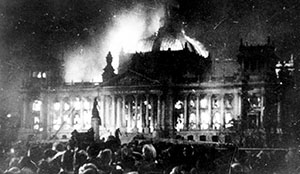
    On 27 February 1933, the German parliament (Reichstag) building burned down.

    One of the best-known false flag attacks of modern history was the Reichstag fire of 1933. At the Nuremberg war crimes trials in the late 1940s, Hermann Goering admitted German government responsibility for the fire. The fire was used to blame the communists, thus demonising a potential counterforce to Nazi rule. It also enabled the Nazis to pass a series of laws allowing them to arrest designated groups who were then tried and executed after ‘trials’, or held in concentration camps, or used as slave labour.

    Martin Niemoller wrote about the consequences in his famous poem in which he refers to “they” who came for the communists, then the trade unionists, then the Jews and finally for him, by which time there was no one left to speak for him. It is a salutary reminder of the perils of remaining silent.

    Operation Gladio was a post-World War II program that incorporated many different elements of the broader false flag. It was initially established in the immediate postwar years as a plan to have ‘stay behind’ resistance fighters in the event of a Soviet invasion of western, northern and southern Europe.

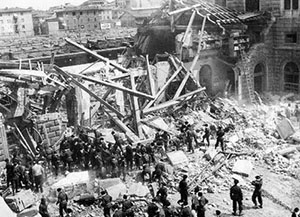
    In August of 1980, Gladio operatives bombed a train station in Bologna, Italy, killing 85 people.

    The idea was that if a country was occupied, trained resistance fighters could carry out acts of sabotage against the occupying forces, much as for example French partisans continued to fight German occupying forces during the period 1940-1945.

    Whatever the initial plans of Operation Gladio, they rapidly morphed into a program to carry out sabotage and murder that could be blamed on leftist or communist groups. The general public was thereby to be frightened into voting for conservative right-wing parties who could be relied upon to follow the US’s geopolitical wishes.

    The fear, largely imagined, of a Soviet takeover of the countries not allocated to it by the Yalta agreement was part of the driving ideology. Hatred of the Soviet Union and its successor States was always uppermost in Western political leader’s minds. 

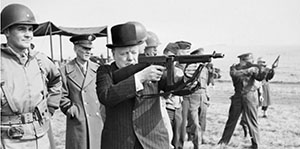
    Operation Unthinkable was an actual plan devised by Winston Churchill in 1945. It called for an attack upon the Soviet Union immediately after the war had ended. The plan envisaged using recently defeated German troops as part of the spearhead.

    Winston Churchill ordered the planning of Operation Unthinkable in 1945.

    Churchill’s hatred of the ‘Bolsheviks’ had a long history. He was instrumental in sending British forces into Russia to fight in the civil war on the anti-communist side, for the so-called ‘White Russians’. An Australian warship was used in the Black Sea in 1918 to gather intelligence on behalf of the same operation.

    Operation Gladio (which was the Italian version) carried out a series of terrorist attacks. One of the better-known incidents was the bombing of the Bologna railway station which killed scores of people. The bombings, blamed on the Red Brigades, were a powerful propaganda tool against Italy’s Communist Party. The actual perpetrators were right-wing fascist groups such as Ordine Nuovo, organised, financed and armed by the CIA.

    The CIA had barely been formed when it organised the rigging of the 1948 Italian elections. In a genuinely free election, the communists would undoubtedly have emerged the largest and strongest party. Since 1948 the CIA has accumulated a long and dishonourable history of interfering in foreign elections. It is a point always worth recalling in the current hysteria being generated over alleged Russian interference in the 2016 US presidential election.

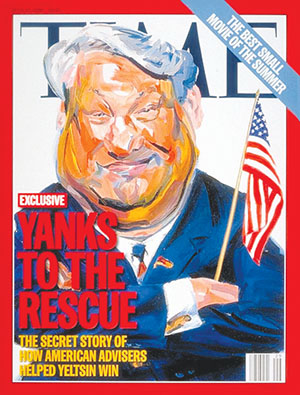
    Ironically, one of the more blatant examples of US interference in foreign elections was the engineering of Boris Yeltsin’s ‘victory’ in the Russian presidential elections of 1995. Time magazine even ran a cover story boasting about the manipulated result.

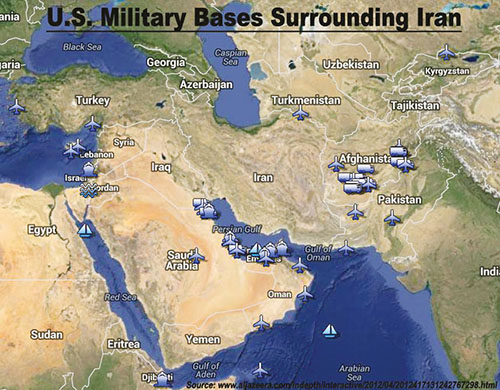
    Next Major False Flag – Target Iran

    The United States CIA and Britain’s MI6 also organised the 1953 coup that overthrew the democratically elected government of Mohammad Mosaddegh in Iran. Iran’s crime? It nationalised the Anglo Persian oil company (now BP). That a country should control its own resources was intolerable to these two imperial powers. In 2013 the CIA admitted it was behind the coup. In documents released that year, it was also clear that the British opposed the release of any documents disclosing its role in the Iranian coup. The British still refuse to acknowledge they were the instigators of the coup, and that they needed American help in order to carry it off.

    That coup is significant on a number of levels. The then British Prime Minister Anthony Eden saw Mosaddegh as a serious threat to Britain’s strategic and economic interests. Iran’s national interests were not considered.

    The coup saw the installation of the Shah’s regime, whose brutal secret police, the Savak, trained by the Americans, became a byword for cruelty and oppression.

    The third lesson was that the Shah’s brutalities lead to the 1979 Islamic revolution, putting Iran on America’s “axis of evil” list. Hybrid warfare by the Americans including assassinations, cyber attacks, sanctions and support for the terrorist group MEK have followed ever since.

    Iran’s government is still designated for violent overthrow as set out in the Brooking Institution’s “Which Path to Persia” (2009). That publication is nothing less than a blueprint for violent regime change. Again, something to remember when one hears protestations from Western leaders about their commitment to such concepts as the rule of law and respect for national sovereignty.

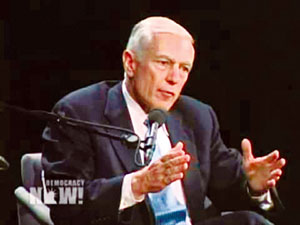
    Iran was one of the seven countries designated for regime change as disclosed by US General Wesley Clark in a revealing interview he gave on the American TV programme ‘Democracy Now’ in 2007. Clark was talking about a document he had seen in the Pentagon shortly after the events of September 2001. The seven countries referred to were Iran, Iraq, Lebanon, Libya, Somalia, Sudan and Syria.

    In a 2007 interview US General Wesley Clark revealed knowledge of a Pentagon document that called for regime change in seven countries after 9/11.

    The United States and its allies have directly attacked five of those seven since Clark’s revelations. Lebanon was previously attacked and occupied by Israel, the United States’ staunchest ally in the Middle East.

    Iraq, Syria and Libya have all been devastated by the United States and its allies in regime change operations. They have a number of features in common, not least that they are rich in natural resources, particularly oil and gas. They were and continue to be the objects of sustained vilification through propaganda, false flag attacks and outright lies used to justify invasion and occupation.

    In Iraq’s case, for example, the first Gulf War in 1990 featured in its build up the US Senate testimony of a 15-year-old girl identified only as Nayirah. She testified that Iraqi soldiers who had occupied Kuwait (following a green light from the US ambassador to Iraq, April Gillespie) took babies from their incubators in Kuwait’s hospital and threw them onto the “cold hard floor” to die.

    It was a complete lie, told by the daughter of Kuwait’s ambassador to the United States, and coached by the public relations firm Hill and Knowlton. None of this was, of course, told to the American public.

    In May 1996, 60 Minutes interviewed Madeleine Albright. Correspondent Leslie Stahl said to Albright, “We have heard that a half-million children have died. I mean, that’s more children than died in Hiroshima. And — and, you know, is the price worth it?” Albright replied, “I think this is a very hard choice, but the price — we think the price is worth it.”

    The decade of sanctions on Iraq following its defeat in that war caused the death of more than half a million civilians, mainly women and children. This was a price that the then US Ambassador to the UN, Madeleine Albright, considered “worth it.”

    First Gulf War, Vietnam & 9/11

    The 1990 first Gulf War was bracketed by two other major wars based on false flags and lies. The American war in Vietnam got its major reboot (it had been going on in one form or another for the preceding ten-plus years) from the so-called Gulf of Tonkin incidents.

    These incidents involved two US warships operating in the Gulf of Tonkin, the USS Maddox and the USS Turner Joy. On 2 August 1964, North Vietnamese gunboats attacked the Maddox. The US said the attack was “unprovoked.” It was anything but. The Maddox was gathering intelligence on the North Vietnamese and giving that intelligence to the South Vietnamese, which in turn used it in attacking the North.

    Two days later, the US said the Maddox was attacked again, and also the Turner Joy. In fact, there was no attack at all. The false allegation was used by US President Lyndon Johnson to obtain the Gulf of Tonkin resolution, giving him the power to wage warfare on the North.

    The resulting war, which ended in 1975 with the undignified scramble for evacuation by helicopter from Saigon’s rooftops, killed more than three million Vietnamese, devastated the countryside, and left a toxic legacy from chemical warfare that reverberates to this day.

    No legal consequences have flowed from this or any other attack upon nation states undertaken by the US and its allies, including the ever-willing Australians.

    The other ‘bracket’ to the first Gulf War was the October 2001 attack on Afghanistan. It was ostensibly justified by the ‘9/11’ attacks in New York City and Washington. The whole 9/11 saga ranks as one of the major false flag operations of the past 100 years. To accept the US government’s version of that event requires a total suspension of disbelief. It also requires one to reject as false basic scientific principles, common sense, and a now overwhelming body of evidence demonstrating the falsity of the official conspiracy theory.

    The events of 9/11 have a much broader significance. Exactly as with the Reichstag fire 68 years earlier, 9/11 was used to implement a legislative program and policy changes that dismantled basic constitutional protections, to wage war on dissent, and to justify a series of foreign wars and occupations under the false rubric of a “war on terror.” A series of wars of terror would be a more accurate nomenclature.

    The events of 9/11 were blamed on ‘former’ CIA asset Osama bin Laden and the Taliban government of Afghanistan who the United States alleged were sheltering him and refusing to turn him over. As noted, none of the official story relating to 9/11 could possibly be true, and that extends to the invasion of Afghanistan. We now know that the decision to invade Afghanistan was made in July 2001, two months before 9/11, and immediately after the Taliban government had refused an American offer to build and control a gas pipeline from the Caspian Sea. 

    The decision to invade was only partly due to the pipeline issue. Afghanistan has a very lucrative opium crop, and the proceeds from the sale of its refined product – heroin – finances much of the US’s clandestine operations. Afghanistan is now part of a string of nearly 400 military bases designed to ‘contain’ China. 

    Although the Taliban government was quickly overthrown, the United States and its allies (including Australia) have shown no intention of leaving. Nearly 17 years after the invasion, there is precious little progress for the Afghan people that can be demonstrated. The Taliban now control more Afghan territory than at any time since the 2001 invasion. The Australian government periodically makes statements about staying to complete its ‘mission’ of training Afghan security forces. It is silent on the question of what it hopes to achieve in the future that it has been unable to realise in the past 17 years.

    Since Operation Cyclone in the 1970s, the US geopolitical objectives in Central Asia have been control of its oil and gas resources, fomenting unrest in the Muslim republics of the then Soviet Union and China’s Xinjiang province (also with a significant Muslim population), and undermining the capacity of China and Russia to challenge the full spectrum dominance ambitions of the US government and its Deep State operatives.

    Yinon Plan for the Middle East

    Another key to understanding the geopolitical dynamics of the Middle East is the Yinon Plan, named after Oded Yinon, an advisor to former Israeli prime minister Ariel Sharon. In an article published in the Hebrew journal Kivunim (Directions) in February 1982, Yinon sets out what he termed “a strategy for Israel in the 1990s.”

    The plan envisaged the dismemberment of Egypt with Israel annexing the Sinai Peninsula. The Palestinians were to be squeezed out of the West Bank. Jordan was to be liquidated as a State, Lebanon was to be cantonised along ethno-nationalist lines, and Iraq split into its Shi’ite, Sunni and Kurdish components.

    Syria was similarly to be split into smaller states. Israeli foreign policy has essentially followed this plan, although there have been setbacks including the expulsion from Lebanon and Iraq retaining its territorial unity. Syria is an ongoing project, although thanks to Russian, Hezbollah and Iranian intervention, that plan has also, at least for the time being, been thwarted. The ethnic cleansing of Palestinians, blatant murders of Palestinians including children, and the theft of their land has, however, continued unabated. 

    Israel continues to illegally occupy the Golan Heights, seized from Syria in the 1967 war. It does so in defiance of international law and multiple UN General Assembly resolutions (Security Council resolutions are invariably vetoed by the United States). On all these issues they have the tacit support of the Australian government, either through silence or voting in Israel’s favour on UN resolutions.

    Iran represents far too big a challenge for Israel on its own, and accordingly the US has been recruited to fight Iran on Israel’s behalf. That is also likely to fail, not only because the US has failed for the past 39 years to achieve its geopolitical goals in Iran, but that Iran’s increasing integration into the wider Russia-China geopolitical realignment through organisations such as the SCO, BRI, NSTC and EAEU means Iran’s security is increasingly underwritten by both China and Russia.

    The progressive destruction of the US dollar’s role as the principal medium of exchange in world trade will greatly accelerate the diminution of the US’s capability to wage endless war. The changing financial structure of the world, including but not limited to the demise of the petrodollar, is quite probably the single most important change to the dynamics of the geopolitical world likely to occur in the very near future.

    In countries like Australia, the political leadership of both major parties seems singularly unable to grasp the significance of these changes. Major political and economic risks will flow from maintaining the ‘joined at the hip’ US alliance. China, which currently takes a third of Australia’s total exports, has already issued several increasingly blunt warnings about the economic consequences to Australia of being shown “a friendly face but a cold shoulder.” The import of this warning is seemingly lost on Australia’s political class.

    False Flags that Flopped – Salisbury & Douma

    It is in this context of the rapidly changing geopolitical balance that one has to interpret the two latest false flag initiatives by the Anglo-American duopoly – the Skripal poisoning in Salisbury, England, and the Douma ‘chemical attack’ in Syria.

    Although some thousands of kilometres apart, they are linked both in their characteristics and what they signal about modern geopolitical realities. Almost everything said by the British government about the Skripal attack is false. The same is true about the alleged ‘chemical attack’ in Douma.

    The significance of these two events is not just their manifest absurdity. Anyone with a modicum of intelligence, common sense and the ability to conduct basic research, rapidly ascertained the contradictions, implausibility and sheer scientific nonsense of the official story.

    An important and encouraging factor is that the histrionic response to both events was limited almost exclusively to a small number of mostly Western nations. Africa, Latin America and most of Asia conspicuously failed to support the UK/US version of events about either Salisbury or Douma.

    Those Western countries who supported the UK’s version of the Skripal poisoning and the illegal missile attack on Syria following the Douma allegations, including Australia, simply ignored the conventions that underlie their much-vaunted belief in the “rules-based international order” and the “rule of law.”

    These conventions include a presumption of innocence until the contrary is established. The contrary can only be established by admissible evidence proven to a very high standard. The accused, whether an individual or a nation, is entitled to know the evidence against them. A true rule of law system does not argue by assertion, and following Alice in Wonderland’s ‘Mad Queen’, demand the sentence before the verdict. 

    These and other fundamental conventions were simply ignored. The British simply pronounced Russian guilt, told blatant lies, tried to pre-empt any valid scientific inquiry, defied several international conventions to which they were a party, imposed sanctions before evidence had even being gathered, and launched in the case of Douma a missile attack that was a blatant violation of international law.

    More evidence emerges, both in Salisbury and Douma, discrediting the original wild claims by the British, the Americans and others including Australia. But rather than withdraw their wild allegations and apologise, government ministers simply ignore that evidence and repeat their fabrications ad nauseum.

    In this they are unquestionably supported by a mainstream media for whom notions of fair and accurate reporting are but a distant memory. Important revelations are unreported, and the original lies repeated in the confident expectation they will be contradicted neither by other parts of the mainstream media or by politicians.

    The lessons we draw from the experiences of the past eighty years are that in increasingly important respects our democracy is a sham. The abdication of the media, the pro-war consensus of the politicians, and the complete absence of accountability in any meaningful sense for the endless breaches of international law, strongly indicate there are effectively no longer any limits that the citizens can impose on their political leaders.

    George Orwell’s 1984, rather than being seen as a warning of a dystopian future, is instead treated by our political leaders as a training manual. We have every right to be fearful.

    [alert type=”general” dismiss=”no”]This article was published in New Dawn Special Issue Vol 12 No 3.[/alert]

    [alert type=”success” dismiss=”no”]If you appreciate this article, please consider subscribing to help maintain this website.[/alert]

    © New Dawn Magazine and the respective author.
    For our reproduction notice, click here.
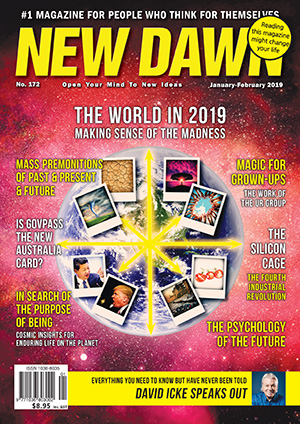
  • The Five Eyes: The International Syndicate That Spies on the Entire World

    The Five Eyes: The International Syndicate That Spies on the Entire World

    From New Dawn 177 (Nov-Dec 2019)

    Power is a peculiar thing. In different ways, we’ve become accustomed to co-existing with it and will even forgo some liberties as part of a Faustian trade-off for various modern conveniences. When that power is virtually invisible, it is beyond scrutiny; and when it’s transnational, it takes on a whole new dimension. We are now fast approaching a point in history where opaque structures of power pose a direct threat to our hard-fought-for constitutional and democratic institutions. 

    Former US National Security Agency (NSA) and Central Intelligence Agency (CIA) analyst turned whistleblower Edward Snowden offered the general public their first real glimpse of this new reality, back in 2013, when he leaked the largest single classified document dump in history. He revealed what could only be described as a vast international conspiracy, in which multiple Western intelligence agencies work hand-in-hand collecting and analysing the personal data of their citizens, completely side-skirting any domestic laws guarding our right to privacy and due process. This ‘conspiracy’ plays a pivotal role in backing-up various allied deep states around the world. 

    The operational core of this digital syndicate is known as the Five Eyes alliance. Code named FVEY, it represents an international signals intelligence (SIGINT) and communications intelligence (COMINT) gathering agreement between the United States, United Kingdom (UK), Canada, Australia and New Zealand. The Five Eyes alliance agencies include, but are not limited to, the US’s NSA and CIA, the UK’s Government Communications Headquarters (GCHQ), Canada’s Communications Security Establishment Canada (CSEC), the Australian Signals Directorate (ASD), and New Zealand’s Government Communications Security Bureau (GCSB). 

    This cooperative intelligence-sharing arrangement traces its historical roots to the UKUSA Agreement of 1946, as generally agreed in the 1941 Atlantic Treaty signed between the Allied powers during World War Two. 

    After its official status was announced in 1955, the Five Eyes was expanded to the Nine Eyes, which includes the original five members along with four additional partnering governments who are granted “third party status.” These include spying agencies from Denmark, France, the Netherlands, and Norway. 

    The Nine Eyes would later expand to a Fourteen Eyes agreement which includes the Nine Eyes plus Germany, Belgium, Italy, Spain, and Sweden. Not surprisingly, the Fourteen Eyes more or less corresponds with the core European members in the NATO military alliance. The Fourteen Eyes may also be extended up to 17 Eyes when considering other regular third party contributors like Japan, Singapore, and Israel. 

    In the late 1960s, the Five Eyes launched the ECHELON program, powered by a global array of US-run satellites and SIGINT bases located in North America, Europe, Asia, and Australia. Initially, the Five Eyes arrangement was ideally suited for the Cold War where the primary task was gathering intelligence from the former Soviet bloc countries and their allies. Later, as the internet expanded, the sheer volume of digital content and communications meant that the Five Eyes had to readjust its core competency – from an organisation mainly preoccupied with spying on governments, institutions, and persons of interest, to an organisation whose primary task was to spy on absolutely everyone. With this new raison d’être in mind, the Five Eyes cooperative framework became ideal for allowing spy agencies to bypass domestic laws that might prohibit them from conducting surveillance or hacking their country’s own citizens. Overcoming legal or technical barriers became fairly straightforward, especially in the wake of the attacks of 9/11. The USA Patriot Act meant that intelligence and law enforcement agencies could invoke national security and require telecoms companies and internet service providers (ISPs) to allow fibre optic splitters to be installed at key nodes in the telecommunications infrastructure, allowing spooks to divert massive data flows to be captured and run through the various Five Eyes data analysis centres. 

    The participating intelligence agencies of each country in the 5 Eyes
    alliance.

    The digital revolution gave the Five Eyes syndicate the ability to amalgamate and combine what was previously separate disciplines of intelligence – like SIGINT, COMINT, geospatial and human intelligence – now all rolled into one comprehensive data collection system. Once they reached this stage, getting it to perform was simply a case of tweaking the software. When Snowden’s story broke in 2013, one of the key components of the NSA’s mass surveillance operation was a software interface called XKEYSCORE. The Intercept describes the tool as follows: 

    The sheer quantity of communications that XKEYSCORE processes, filters and queries is stunning. Around the world, when a person gets online to do anything – write an email, post to a social network, browse the web or play a video game – there’s a decent chance that the internet traffic her device sends and receives is getting collected and processed by one of XKEYSCORE’s hundreds of servers scattered across the globe.

    Whereas previous iterations of the NSA’s global information dragnet hauled in large quantities of data and required a combination of computer and human intelligence to sift through it all, XKEYSCORE “extracts and tags metadata and content from the raw data so that analysts can easily search it,” allowing for a much more refined and efficient data capture operation. In essence, what used to be done by the entire ECHELON system and scores of human analysts could now be achieved with a few strokes of the keyboard.

    Spectre is Real

    Michael McKinley of the Australian National University, in an article describing the full scope of the NSA’s digital arsenal, mentions “[t]he known codewords for them over recent times: Blarney, Echelon, Dancingoasis, PRISM, Tempora, XKEYSCORE [sic], Muscular, Pinwale, EgotisticalGiraffe, Stormbrew, Fairview, Oakstar, Mainway, Rampart-T, and Nucleon. Between them, they aim to attack computers using certain types of legal privacy software, and overall to harvest, store, and analyse whatever internet traffic can be hoovered up.”

    Imagine if the NSA connected all of these data trawling nodes with an artificial intelligence backbone that analysed and parsed out teraflops of information in real-time. It would make the agency omnipotent. This very same dystopian scene was brought to life on the big screen in the 2015 James Bond film Spectre starring Daniel Craig. In the film, a latter-day Blofeld, played by actor Christoph Waltz, devised a new unofficial international ruling committee, S.P.E.C.T.R.E. (Special Executive for Counter-intelligence, Terrorism, Revenge and Extortion), comprised of the world’s top organised crime figures. Through his network’s infiltration of the very top levels of Western intelligence, Blofeld receives unrestricted, real-time access to all surveillance data collected by the “Nine Eyes” countries. This backdoor key gives Blofeld the power to steer global political events, move markets, and when necessary, blackmail any individual or institution into compliance. 

    Aside from its striking parallel to the West’s current global surveillance dragnet, Spectre raises important questions obscured by the film’s ostentatious plot. Even without Blofeld, the current Nine Eyes intergovernmental network retains all of the capabilities that any nefarious villain would ever want, to wield power or ward off any potential challengers. If operations are conducted outside public view, then the potential for abuse is virtually boundless. 

    Five Eyes: A Fraternal Order

    The fraternal nature of SPECTRE was alluded to by the antagonist’s cinematic forefather, Ernst Stavro Blofeld, depicted in the 1963 Bond film Thunderball. “SPECTRE is a dedicated fraternity whose strength lies in the absolute integrity of its members,” said Bond’s nemesis.

    Blofeld wasn’t wrong. In essence, the Five Eyes intelligence network is precisely that – a type of Anglo-fraternal organisation that wields a noticeable advantage over its rivals. Such unfettered cooperation between advanced nations like the US, UK, Canada, Australia and New Zealand, means that the technical continuity of this geopolitical alliance remains more or less unmatched. Leveraging the resources of five countries spread around the globe affords the coalition a substantive advantage over just about any other global competitor. No other bloc can match its scope and scale, geographically and technologically. 

    It is also fundamentally neo-colonial in nature. The fact that this network comprises current and former British colonial possessions speaks to the Anglo-centric or Atlanticist worldview on which its mission is based. That Atlanticist agenda is best described as something akin to a Bilderberg Committee agenda – a set of political and industrial objectives and goals informally agreed upon by some of Western society’s most powerful luminaries and technocrats who meet at the beginning of summer at the annual Bilderberg Meeting. 

    Interestingly, this fraternal brotherhood only seems to extend to certain allies. While German spy agencies like the Bundesnachrichtendienst (BND) cooperate with their US counterparts as a “third party” government through the Fourteen Eyes agreement, Washington spooks still feel the need to constantly spy on Berlin. The 2013 Snowden leaks revealed that Germany is a major target of US espionage run out of the NSA’s own European Cryptologic Center (ECC), known affectionately as the “Dagger Complex,” located in Griesheim, in the German state of Hesse. 

    According to “secret” NSA documents viewed by the German publication DER SPIEGEL, the American bunker accounts for the agency’s “largest analysis and productivity in Europe.” The documents also note that the NSA uses its infamous XKEYSCORE software to trawl up its main areas of interest from inside the German government, namely foreign policy, economic stability, new technologies, advanced weaponry, arms exports, and international trade. 

    To add insult to injury, WikiLeaks revealed in 2015 that the phone of German Chancellor Angela Merkel had been wiretapped for years by US spies.

    When interviewed on the matter, former NSA and CIA head Michael Hayden was quite flippant, openly admitting, “We steal secrets. We’re number one in it…. But, he adds, this is not malicious or industrial espionage…. We steal stuff to make you safe, not to make you rich.”

    Hayden lamented the German disclosure but admitted the US government had grossly underestimated German values on issues pertaining to privacy, stating: 

    Perhaps we underestimated the depth of feelings that the German people – and again, not just the chancellor, but the German people, felt about this question of privacy, given their historical circumstances compared to our historical circumstances. At the Munich Security Conference it was clear to me that Germans regard privacy the way we Americans might regard freedom of speech or religion. 

    In similar fashion, both the European Union and the United Nations are also said to be under US surveillance. Like with Germany, NSA espionage objectives on the EU include foreign policy goals, the economy, international trade, and “energy security.” The targeting of the UN adds a whole other international dimension to these operations. A 2013 report filed by The Guardian newspaper paints a rather disturbing picture: “[L]ong before [former United Nations Secretary-General] Ban’s limousine had even passed through the White House gates for the meeting, the US government knew what the secretary general was going to talk about, courtesy of the world’s biggest eavesdropping organisation, the National Security Agency.” 

    Australia: Casualty in a Cold War

    On the surface, having the NSA conduct surveillance operations on key allies like Germany may not make much sense. Why would America risk compromising an important relationship with a pivotal partner and fellow NATO member? To help answer that question, we need to go back 50 years and look at what happened in Australia circa 1970. 

    Cover of the new film release of Allies (available at 
    www.roninfilms.com.au/feature/9916/allies.html).  

    In the groundbreaking documentary film Allies (1983), a number of top former US and Australian politicians and intelligence officials went on camera to recount one of the most tumultuous periods in the country’s history during the Cold War, marked by the establishment of the Australian Security Intelligence Organisation (ASIO). 

    The film disclosed a series of shocking admissions rarely heard before in public, but which lifted the veil on the hidden hierarchy latent within the Five Eyes order. Revelations included an admission by Victor Marchetti, former executive assistant to the deputy director of the CIA (1955-1969), who stated: “Intelligence organisations in many countries have a loyalty that is not necessarily to the duly constituted government, they have a loyalty to what they consider the establishment.” Some officials testified that their loyalty was not to their elected leaders but the CIA. 

    Such testimony provides some of the most unequivocal evidence to date about the existence of an unelected shadow government or Deep State, directed by America’s Central Intelligence Agency. For the Americans, managing this autonomous power structure first meant securing its geostrategic interests in host countries as well as its strategic facilities like the NSA’s Pine Gap listening base located in central Australia. Securing these assets became a national security issue – Washington could not risk any newly elected government interfering with US intelligence operations.

    In the film, Dr John Burton, Secretary of the Australian government Department of External Affairs (1947-1950), described the Five Eyes thinking as follows: 

    …the need for an intelligence organisation was to ensure that governments elected (for example) on a social welfare platform would not argue that they had a mandate to recognise China, to change the agreement with the United States, or other things which the Labor Party had intended before the Petrov Commission. They’ve always argued that the intelligence operation, or the intelligence services, operating as an informal group – are the protection of democracy against itself.

    While the notorious Petrov Affair (1954) helped sideline Australia’s Labor party for many years afterwards, the real trigger for a US-backed coup came in 1972 when Gough Whitlam led Labor to victory for the first time in 23 years. The Whitlam government called into question Australia’s supporting roles in various military conflicts taking place in Southeast Asia, including Vietnam and Indonesia, and challenged the top-secret nature of US bases operating in Australia. Details of a CIA plot to depose Whitlam were revealed by NSA contractor Christopher Boyce, who was convicted of espionage and sentenced to federal prison in the US. Boyce’s story was later made into a cinematic classic, The Falcon and the Snowman.

    Whitlam would soon be removed from office in 1975 after being “dismissed” by the country’s Governor-General, with much of the evidence pointing to a US/British regime-change operation. This marked a noticeable shift to the right in Australian politics and an unflinching “special relationship” with subsequent US Administrations. 

    This story demonstrates the lengths that the US-led Five Eyes syndicate is willing to go to secure its assets in foreign countries. In the case of Australia, this meant US intervention to derail any government that might threaten US foreign policy and its global intelligence operations. From this vignette, one could draw a parallel to Washington’s ill-treatment of Germany – another ally that also hosts numerous US military bases and intelligence-gathering facilities, and which functions as an anchor for US operations in Europe in much the same way Australia does for the Asia-Pacific region. 

    The China Syndrome

    In the 21st century, mere national monopolies are no longer sufficient for Silicon Valley moguls and their shepherds in the intelligence community. Firms like Google, Apple, Facebook and Twitter command near-global monopolies in their respective markets. This means that as long as those Western firms permeate and dominate the planetary information space, Five Eyes operatives only require a backdoor into a handful of these firms to surveil and control almost every aspect of public (and even private) life. 

    Controlling technology markets has become a matter of paramount concern for the Five Eyes. That includes keeping out any foreign product which could cause a wrinkle in their control matrix. As expected, this situation feeds neatly into a ready-made geopolitical drama, especially if the Trojan Horse in question arrives in the form of a Chinese firm. 

    As Britain expedites the roll-out of its controversial high-frequency 5G network, new security concerns have surfaced at the heart of the Five Eyes as politicians and spooks debate the possibility a foreign actor could compromise the alliance from within. 

    Western technocrats have rushed to finalise preparations to create a grid of “smart cities” and smart infrastructure including fleets of self-driving cars on “smart highways,” as well as a host of public services – all linked as part of the “internet of things.” To make this project work, the UK has to partner with the only company who can deliver enough advanced equipment on time and on budget – Chinese telecommunications giant Huawei. 

    In theory, Five Eyes fears may be warranted. With 5G set to provide the new framework for real-time spying and data monitoring, Western spy chiefs and politicians are afraid of becoming too reliant on potential geopolitical and commercial rival China. Practically speaking, Huawei’s hardware is fairly standardised and compatible with other components used to configure the UK’s new 5G network, and to date, there is no proof of any latent Chinese spyware in any of the components in question. UK spy chiefs are already lining up in defence of the realm, with former MI6 head Richard Dearlove chiming in: “…we must conclude the engagement of Huawei presents a potential security risk to the UK. The key question that follows is can that risk be sufficiently mitigated to render it negligible?”

    A number of tertiary arguments against Huawei are being employed by Western officials including charges that China steals Western intellectual property, or that Chinese firms are inherently ‘anti-competitive’ because of state subsidies given to many enterprises. Reading between the lines, more of a worry for the Five Eyes (or a privatised Spectre syndicate) is the fact that a whole range of other Huawei products could employ a different proprietary Chinese encryption protocol that would give not only Chinese officials and intelligence workers a privacy edge, but the public mass-consumer too – keeping the NSA from intercepting a user’s communications, or at least making it much more difficult. Thus, keeping Chinese products out of Western surveillance zones could be a major priority for Five Eyes technocrats. 

    Earlier this year, US President Donald Trump escalated the technology war with China by signing an executive order that prohibits US companies from installing any “foreign-made” telecoms equipment which the US deems a national security threat, meaning that Huawei requires a special license issued at the discretion of Washington. Huawei Chairman Liang Hua responded at an industry press conference during the China-Germany-USA Media Forum, saying that the US placing Huawei on its entity list has had “no substantial impact” on Huawei’s business and that all of the company’s flagship products are shipping as normal.

    In the short-term, the Trump Administration is more likely to deploy economic warfare by drastically increasing tariffs on Chinese products. In this war, the winning edge might be with the state-managed economy where Chinese planners typically plot the course ahead looking at 20 to 30-year windows, as opposed to US firms that prioritise mere quarterly gains and shareholder dividends. 

    Liang Hua remarked that in only two or three years, Huawei will have developed a complete technological and commercial “ecosystem” for its range of products, making it more difficult for the Five Eyes syndicate to maintain their digital hegemony by trying to shut Huawei out of international markets. Naturally, this poses a direct threat to the West’s global digital media and communications mafia, and its overlapping fraternal network of government agencies, corporations and ‘white-collar’ organised criminal syndicates. 

    The War on Encryption 

    Aside from concerns about statecraft, most independent-minded citizens might be alarmed by the unbridled Orwellian power of such a global operation. On this point, there is little advice one can offer other than to stay off social media or go ‘off-grid’ (offline) as much as possible to avoid leaving a detailed digital footprint that can be used to build a profile on you. 

    For those who depend on the internet for their day-to-day existence, going off-grid is not really a practical option, but there are tools available that can help make surveillance difficult for 5, 9, and 14 Eyes member governments. Besides using a reliable encrypted chat or messaging service, if you are not already using a Virtual Private Network (VPN), then now may be a good time to start. VPN encrypts all of your internet traffic and scrambles your IP address, making it difficult for anyone monitoring you online to pinpoint your identity, device, and physical location. One key requirement is trying to use a service based outside the Fourteen Eyes countries. This means you may not be immediately exposed should your service provider’s host country ask for back door access to your internet records. If you are using a service within the Fourteen, then be sure to choose a company that has a ‘no logs’ policy. In other words, should a US or UK agency like the NSA or GCHQ make a formal request from a service provider to hand over all your internet search data, then there will be nothing they can hand over. Likewise, you can use a number of encrypted instant messaging services like Telegram, or encrypted email services like Proton Mail, and also consider using an internet browser that doesn’t keep data on your surfing like Brave, or a search engine like Duck Duck Go which doesn’t save data on all of your search activity.

    Perhaps the biggest obstacle to Five Eyes hegemony are digital services that use end-to-end encryption. This means only the sender and receiver can view the content, concealing communications from the prying eyes of Western spy agencies. Needless to say, insatiable state authoritarians are not happy about this and have laid down a harrowing ultimatum to tech companies, demanding write-in backdoor access protocols supposedly for “law enforcement.” If firms do not comply, government officials threaten they should be ready for brute force intrusions by agents of the state. Knowing they do not have the public on their side, governments have resorted to intimidation and scare tactics in order to swing public opinion in their favour. 

    While served as Home Secretary in 2015, former UK Prime Minister Theresa May authored a rather opprobrious piece of legislation entitled the Investigatory Powers Act (IPA), which outlines where the British police state is heading in terms of privacy and encryption. The bill requires that any “communications service provider” (ISPs, social media platforms, VOIP, email providers and messaging service) must comply with a secret warrant signed by the Home Secretary which names any persons or organisations the government wishes to spy on. 

    One watchdog organisation who has followed the IPA is the Electronic Frontier Foundation (EFF). According to researchers, the draconian decree, also known as the ‘Snooper’s Charter’, requires tech companies to insert special malware onto their systems so the spooks can use their platforms to “interfere with any other system.” The secret warrant explicitly allows those companies to violate any other laws in complying with the warrant. Essentially, the warrant enables said tech firms to violate the law in the process of complying with the government’s secret snooper’s warrant. This would also include the Home Secretary ordering firms like Facebook, Samsung or Apple to quietly remove their ‘secure communication’ features from products without notifying the public about it. 

    In terms of its legality (or lack thereof), the devil is in the absence of detail. Danny O’Brien from EFF noted how the UK government has been very careful not to pin itself down with any specifics, explaining, “Sure enough, the word ‘encryption’ does not appear in the Investigatory Powers Act (IPA). That’s because it is written so broadly it doesn’t need to.”

    EFF describes the severity of the IPA in terms of riding roughshod over basic civil rights and protections:

    “The Investigatory Powers Bill, one of the first laws to explicitly permit such techniques for law enforcement and intelligence work, contains very little in the way of oversight, and grants the British government an almost blank check for deploying malware against individual users as well as the heart of the internet’s infrastructure. It also demands that private companies and individuals assist in the deployment of this spyware, no matter where they operate in the world, and requires that this assistance be kept permanently secret from customers, partners, and the general public.

    IPA provisions might also include the government forcing a chain of coffee shops to use the company’s free WiFi service to deploy British spy agency malware against its customers. 

    The state’s intrusion goes even further with the IPA laying the parameters for the UK government to demand tech companies supply them with new product designs… in advance of commercial release. This is a shocking act of overreach by the British state – one that exceeds even the most invasive state intervention in a country like China. 

    One has to ask: given the chance, would the UK government eventually pursue a complete ban on encryption? 

    While there is considerable push-back from tech companies and public advocacy groups, there’s surprisingly little rebellion from most mainline politicians, partly because they are not being pressured from their constituents on this issue. What anti-privacy initiatives like the IPA clearly demonstrate is that Britain is the one clearly setting the dark tone and aggressive pace for the Five Eyes cohort. The agenda clearly seeks a renewed license to put tech firms in a corner by deploying emotive language and invoking evermore dramatic conspiracy claims. In her article written for the Telegraph, current UK Home Secretary Priti Patel even went so far as to equate Facebook’s noncompliance with aiding and abetting “child abusers, drug traffickers and terrorists plotting attacks.” 

    Of course, Patel’s comments shouldn’t surprise anyone who has followed the issue of privacy over the years, particularly in the post-9/11 era where politicians and national security state operatives routinely gaslight the public to justify every intrusion or roll-back of privacy rights by citing the most extreme and infrequent instances of ‘terrorism’. For the 21st century technocracy and police state, that’s been the gift that just keeps giving, but by the same token the public have become increasingly wary of such dramatic government claims due to the fact that very rarely, if ever, has government wiretapping or backdoor spying actually thwarted a terrorist attack in what is popularly referred to in national security rhetoric and Hollywood propaganda lore as ‘the ticking bomb’ scenario. 

    According to a report by security experts Sophos, at a recent Five Eyes security summit officials left no doubt as to their intentions, stating: “Tech companies should include mechanisms in the design of their encrypted products and services whereby governments, acting with appropriate legal authority, can obtain access to data in a readable and usable format.”

    Five Eyes member Australia took the matter even further, threatening to “break in” if tech companies do not facilitate the access requirements of the state. This new policy initiative was expressed unabashedly in a memo issued by the Australian Dept of Home Affairs on behalf of the Five Eyes alliance:

    The Governments of the Five Eyes encourage information and communications technology service providers to voluntarily establish lawful access solutions to their products and services that they create or operate in our countries…. Should governments continue to encounter impediments to lawful access to information necessary to aid the protection of the citizens of our countries, we may pursue technological, enforcement, legislative or other measures to achieve lawful access solutions.

    A closer look at the memo reveals that Australia’s authoritarian designs are not restricted to stopping terrorists and paedophiles but appear to target any entities they feel are “sowing discord” (including any popular dissenting opinion and analysis), that supposedly threatens our vaunted “democratic institutions.” This may also include any foreign media (as depicted in the heavily promoted ‘Russian disinformation’ narrative), independent media, and free-thinking individuals on social media. The language could not be more arbitrary: 

    We are determined to ensure that the technologies that have been developed to enhance prosperity and freedom are not exploited by those who seek to promote terrorism and violent extremism; prey upon and exploit our children; or spread disinformation and discord to undermine our democratic institutions.

    This, alongside Britain’s notorious ‘Snooper’s Charter’, demonstrates how Five Eyes partners are working in concert by gradually laying down an alliance-wide legal framework that will legitimise what would normally be unwarranted activity by state agencies. This is done by suspending any constitutional provisions or rights – all in the name of protecting national security, or even the national interest as the state defines it. 

    Many leading VPNs and messaging services can protect your data with 256-bit encryption, now used in most modern encryption algorithms and protocols. For the moment, this technology offers fairly robust protection from the prying eyes of the intelligence services, but advances in computing power may eventually put many of these protections at grave risk. New advances in quantum computing threaten to usher in a new event horizon whereby the next generation of computers could conceivably crack today’s industry-standard 256-bit encryption key in a relatively short period of time – in mere minutes, or even seconds. Researchers at the Massachusetts Institute of Technology (MIT) have shown how a quantum processor can crack a seemingly impenetrable 2,048-bit RSA encryption in only eight hours. Exactly how far off we are to this quantum revolution is anyone’s guess but when it arrives it could tip the scales of privacy away from the consumer and in favour of those organisations who control this new technology, namely Silicon Valley monopolists and the intergovernmental Five Eyes complex. On the flip side, advances in quantum decryption may also coincide with new methods of encryption that could slow down quantum crackers enough to make decryption impractical. 

    It’s incredible to think that these technological battles waged in binary virtual space may end up defining our relationship with the state in the physical world. 

    Things are moving extremely fast right now. Such a dystopic state of affairs must be resisted on every level. Our future depends on it. 

    [alert type=”general” dismiss=”no”]This article was published in New Dawn 177.[/alert]

    [alert type=”success” dismiss=”no”]If you appreciate this article, please consider subscribing to help maintain this website.[/alert]

    Footnotes

    1. UKUSA Agreement Release (1940-1956),www.nsa.gov/news-features/declassified-documents/ukusa/
    2. A Look at the Inner Workings of NSA’s XKEYSCORE, www.theintercept.com/2015/07/02/look-under-hood-xkeyscore/
    3. The unsettling reality if Five Eyes is the guardian against Huawei (Part 2), www.johnmenadue.com/michael-mckinley-the-unsettling-reality-if-five-eyes-is-the-guardian-against-huawei-part-2-a-survey-audit-concerning-prudence-integrity-law-and-ethics/
    4. US Intelligence Watches Germany Closely, www.spiegel.de/
    international/world/germany-is-a-both-a-partner-to-and-a-target-of-nsa-
    surveillance-a-916029.html
    5. NSA tapped German Chancellery for decades, WikiLeaks claims, www.
    theguardian.com/us-news/2015/jul/08/nsa-tapped-german-chancellery-
    decades-wikileaks-claims-merkel 
    6. Shame on US, www.spiegel.de/international/world/spiegel-interview-with-former-nsa-director-michael-hayden-a-960389-2.html
    7. Portrait of the NSA: no detail too small in quest for total surveillance,
    www.theguardian.com/world/2013/nov/02/nsa-portrait-total-surveillance
    8. Huwaei, 5G and the Five Eyes, www.henryjacksonsociety.org/shop-hjs/defending-our-data-huawei-5g-and-the-5-eyes/
    9. US blacklists Huawei, places it on entity list, www.economictimes.
    indiatimes.com/news/international/business/us-blacklists-huawei-places-it-on-entity-list/articleshow/69353632.cms
    10. Twitter, https://twitter.com/HuXijin_GT/status/1176465008974123008
    11. Five Eyes Unlimited: What A Global Anti-Encryption Regime Could Look Like, www.eff.org/deeplinks/2017/06/five-eyes-unlimited
    12. UK Investigatory Powers Bill, www.eff.org/issues/uk-investigatory-powers-bill
    13. Facebook’s encryption could stop our police doing their job properly –
    and I won’t allow that to happen, www.telegraph.co.uk/politics/2019/07/30/facebooks-encryption-could-stop-police-job-properly-wont-allow/
    14. What’s the Evidence Mass Surveillance Works? Not Much, www.pro
    publica.org/article/whats-the-evidence-mass-surveillance-works-not-much 
    15. Five Eyes nations demand access to encrypted messaging,www.naked
    security.sophos.com/2019/08/01/five-eyes-nations-demand-access-to-
    encrypted-messaging/
    16. Five Country Ministerial 2018, www.homeaffairs.gov.au/about-us/our-port
    folios/national-security/security-coordination/five-country-ministerial-2018
    17. MIT Technology Review, www.technologyreview.com/s/613596/how-a-quantum-computer-could-break-2048-bit-rsa-encryption-in-8-hours/
    18. Why Quantum Computers Might Not Break Cryptography, www.quanta
    magazine.org/why-quantum-computers-might-not-break-cryptography-20170515

    © New Dawn Magazine and the respective author.
    For our reproduction notice, click here.