New Dawn – World's Most Unusual Magazine

Category: Articles

  • Alice A. Bailey: Mother of the New Age or the New World Order?

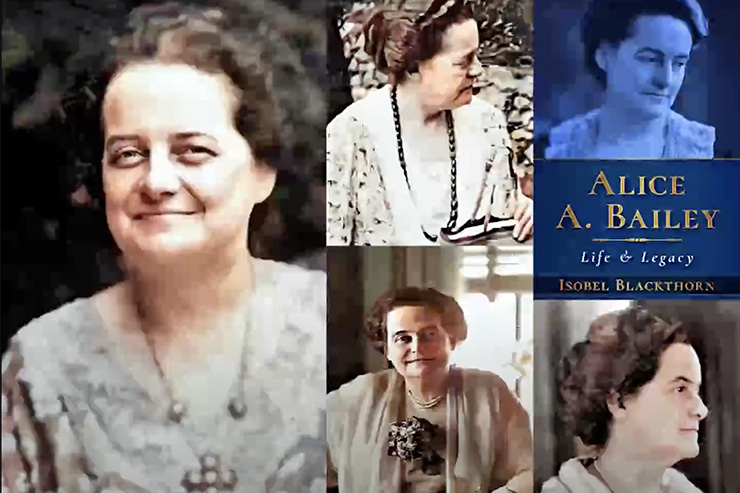
    Alice A. Bailey: Mother of the New Age or the New World Order?

    From New Dawn Special Issue Vol 13 No 2 (June 2019)

    One of the most controversial figures to emerge from the Theosophical Society (TS) in the early twentieth century grew up a devout Christian far removed from occult circles. For many decades her faith was unshakeable, yet the seeds of her conversion lay in her introspective nature and sensitivity to mysticism. 

    In the scholarly milieu, she is considered to be the mother of the New Age movement, harnessing the term circulating among occultists and the spiritually minded in her milieu, and composing a series of foundational texts which provide much of the theoretical basis of New Age thinking. 

    The obscure Theosophist has left a hidden legacy that continues to this day to influence world affairs behind the scenes through various key roles, bodies and organisations operating within the United Nations. The degree of influence is difficult to gauge, but conspiracy theorists would argue it is significant.

    Alice Ann Bailey (1880–1949) was born into the aristocratic La Trobe-Bateman family. Among her ancestors are Victoria’s first governor, Charles La Trobe, and the renowned book illuminator, Edward La Trobe. Other notables include neoclassical architect Benjamin Henry Boneval La Trobe and Alice’s grandfather, civil engineer John Frederick La Trobe Bateman. 

    Unlike her younger sister, Alice deviated from the path her family expected her to tread. She did not marry, and she had no interest in pursuing a university education. Instead, adhering to her unwavering belief in the need for the salvation of souls, she worked as a missionary in soldier’s homes for the British army in Ireland and India, expounding the Gospels, entertaining the men playing checkers, serving cocoa and eggs, and sitting beside the ill and dying. 

    Her time in India came to an abrupt end when she suffered a physical and psychological breakdown. Her faith, which she had held dear for so long, began to waver. It was then she fell in love with a soldier in the Hussar regiment, Walter Evans. It was an unfortunate match. The couple moved to Cincinnati where Walter attended Lane Theological Seminary. 

    Three daughters and numerous bruises later, Alice managed to free herself from Walter’s violence. She then spent several years packing sardines in one of Monterey’s canneries, made famous by John Steinbeck in Cannery Row.

    It was during this period that Alice converted to Theosophy after attending a lecture at the home of some acquaintances. She devoured the teachings and received guidance from founder Madame Helena Blavatsky’s personal students. Before long, Alice was giving her own classes in Theosophy.

    Consumed by this new body of knowledge, she moved to the Theosophical headquarters at Krotona, Hollywood, where she worked in the café. As soon as she could, she joined the elite Esoteric Section of the society. 
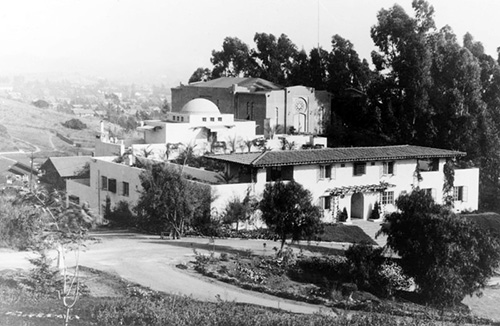
    Krotona Institute of Theosophy, Hollywood, USA, early 1900s. Credit: Los Angeles Public Library

    In January 1919, Alice Evans met her second husband, Foster Bailey, a lawyer and Freemason from Massachusetts born into a distinguished family of politicians and lawyers, hailing on the maternal line from founding father of Fitchburg, Amos Kimball. The couple soon took on key administrative roles in the TS, Foster as secretary and Alice as editor of the sectional magazine. 

    Around October of that year, Alice began writing as amanuensis for The Tibetan or Djwhal Khul, one of the Theosophical Masters of Wisdom. The Tibetan had also been Blavatsky’s master, from which her seminal text The Secret Doctrine arose. Reluctant at first, Alice took on the role of writing for The Tibetan, a role that would culminate in twenty-four volumes of esoteric teachings and commentary, a number written in her own right and many published posthumously. The collection became known as the Blue Books due to their indigo covers. 

    A year later, an organisational row resulted in both Alice and Foster being ousted from their roles in the TS. They moved to New York where Foster was offered work as secretary of a Theosophical association. The couple quickly married and settled in Ridgefield Park, NJ. While Foster continued to campaign to change key organisational practices of the TS, Alice continued writing as she visioned their future. 

    She established a Secret Doctrine class held in a room on Madison Avenue, which became an outstanding success. Interest grew and grew from all over the United States and beyond, and correspondence mounted. In 1922, the Baileys established the Lucis Trust and published the first three volumes of her opus. In 1923, they founded the Arcane School – an esoteric training school delivered by correspondence to disciples around the world. 

    Alice Bailey would dedicate the rest of her life to laying the foundations of a new age of spiritual enlightenment, in the hope of countering the continued rise of materialism, hatred and greed.

    The Blue Books

    Alice Bailey’s body of work is in part a reformulation of the Theosophical current of Western Esotericism, composed in language accessible to the contemporary mind. Central to Theosophy are: a belief in the existence of the soul, reincarnation and the interconnectedness of all existence; an epochal view of evolution that includes consciousness; the transmission of an Ageless Wisdom from master to disciple; and a commitment to humanitarianism. 
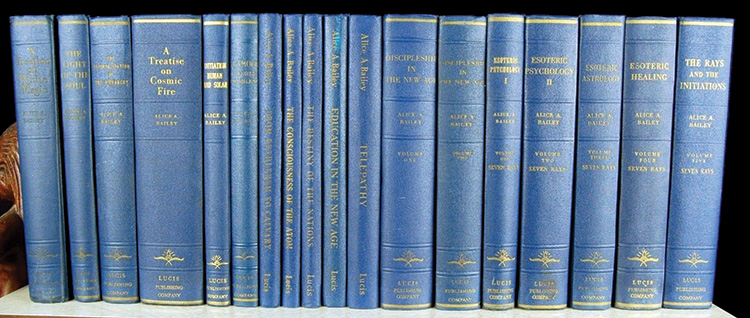
    There is nothing fluffy between the pages of the Blue Books. The atmosphere the teachings evokes is business-like, with an emphasis on responsibility, leadership and executive management. The volumes are instructional texts for aspirants and disciples of the spiritual path. Some are harder to read than others. The volumes include A Treatise on Cosmic Fire, an intricate cosmology drawing on Neoplatonist metaphysics and Eastern philosophy. Other works provide instructions for disciples on how to live, think and behave. A Treatise on the Seven Rays provides a detailed formulation of human psychology and advice on meditation and healing. 

    Cemented in Alice Bailey’s particular version of Theosophy are Christian ideas of goodwill and good works, and she sought to make these basic principles the cornerstones of her teachings. She made it her mission to elevate occultism from the lower reaches of charlatans and counter the left-hand path some occultists follow. For Alice Bailey, esoteric thought and practice needed to be oriented towards selfless, altruistic goals and always for the good of the whole. 

    Controversies

    Despite these noble aims, during her lifetime Alice Bailey aroused the wrath of purist Theosophists, Christians and Jews who all took issue with her body of work.

    Purist Theosophists accused Alice Bailey of false claim-making over her assertion that the source of most of her writings was none other than Blavatsky’s master Djwhal Khul. That she was merely a conduit in telepathic rapport receiving the next outpouring of the Ageless Wisdom provided her with a handy disclaimer should any issues of copyright or plagiarism arise. Some even alleged Alice Bailey made use of secret Theosophical teachings only available to members of the society’s Esoteric Section, a matter that cannot be proven as the teachings have not been made available in the public domain. 

    She upset members of the Jewish community through her criticisms of their exclusive practices and an attachment to the notion of a Chosen People, which separated Jews from the rest of humanity in her eyes. Controversy also surrounds interpretations of the Theosophical root races, which appear to position Jews as less advanced. She trod sensitive ground even then, although to her credit some of her closest allies and co-workers were Jewish, including renowned psychiatrist Roberto Assagioli, who was highly influential in the foundation of humanistic and transpersonal psychology. Today, the Lucis Trust has issued an explanation of Alice Bailey’s position on the Jewish faith which can be found on their website. 

    The Lucis publishing company started life as the Lucifer Publishing Company; an unfortunate choice and Alice Bailey quickly changed the name when she realised the upset it was causing among fundamentalist Christians. Her original choice stuck in the minds of later Christians, including author Constance Cumbey, who uses the original name to take Alice Bailey to task over her alliance with pure evil. Conspiracy thinkers cite the same. 

    Throughout her writing life, Alice Bailey strove to gain credibility in academic circles. She wanted her texts to be taken seriously and set apart from the gamut of occult literature being published at the time. She solicited forewords and prefaces from sympathetic scholars including popular psychologist Harry Allen Overstreet and eminent professor of philosophy Oliver L Reiser. Not having received a tertiary education, she was at pains to include references to leading scholars in the fields of psychology, philosophy and religion, including the eminent psychiatrist Carl Jung. She met with some success but failed to achieve acceptance among the intellectual milieu. 

    She rose above all of these threats to her reputation and credibility, yet a close reading of her unfinished autobiography reveals a defensive tone in relation to her husband, her daughters, her views on Jews, her own Christian fundamentalism and the Theosophical Society. It is transparent that she was painfully aware of her critics and sought to counter their claims.

    Influencing the New Age Movement

    Alice Bailey can be called the mother of the New Age movement if for no other reason than she set out to give birth through her texts, organisations and followers to a new and spiritually informed world order. Many who know of and respect Alice Bailey can be found in the New Age movement, yet few may realise just how influential her work has been in the movement’s foundation.

    The New Age began as a utopian counter culture which rejected mainstream beliefs and values and searched for alternatives. The roots of the New Age are deep and can be traced back at least to the 1800s when interest in spirituality as an alternative to mainstream religion and dull intellectualism burgeoned, culminating, in esoteric circles, in the founding of the Theosophical Society in 1885. Alice Bailey, along with Rudolf Steiner and Krishnamurti, brought Theosophical teachings to their own audiences, helping to perpetuate continuing interest in the Ageless Wisdom. 

    Hopes for a new utopian age were prevalent in Europe, Britain and America in the 1920s and 30s, at a time when the occult and spirituality to some degree fused. While dedicated seekers were committing to particular currents, dabblers and ‘armchair enthusiasts’ tried out or considered various strands, everything from the ideas of Mary Swainson, through Gurdjieff, Ouspensky, Meher Baba, Sufism, Rosicrucianism, Wicca and Jung, along with the aforementioned Theosophists. 

    Alice Bailey was a prominent figure in the scene. She lectured far and wide. The Beacon was acknowledged to be a high-quality occult periodical.Book reviews and her letters appeared in the prestigious Occult Review. 

    What others may have lacked and Bailey had in abundance was a highly focused missionary zeal. Everything she did in every hour of every day for thirty years was devoted to her cause. Her single-mindedness fuelled a similar dedication in her students, especially among her Arcane School graduates, those who have carried forward her vision. She continues to draw towards her, out of the general pool of seekers, those who are as serious, focused and committed as she. 

    Her entire body of work can be described a New Age thought-form. She sought to found a paradigm, not a movement of spiritual seekers. All the personal-growth training contained in the New Age movement is, in Alice Bailey’s worldview, meant to be preparation for world service, not self-aggrandisement. For her, healing of various emotional and mental wounds is a side issue, something that may occur solely to divest the personality of its own obstacles. 

    A Treatise on White Magic: or The Way of the Disciple is a work prized as a training manual for spiritual discipleship, containing fifteen ‘rules’ of the path, in essence a guide on how to avoid the dark path of black magic and render the student equipped for world service. Disciples are “instruments of service,” charged with developing their intuition and their sense of values, and turning their inner ear to those voices on the inner planes in order to inaugurate the New Age. 

    Should her disciples fail in their responsibilities, then the Masters will withdraw, change their plans, and find some other way to proceed. Alice Bailey’s entire canon pivots on this one single charge. An opportunity exists for a new orientation, for humanity to pass through the portal of initiation into the kingdom of the soul. This is the New Age, should we want it.

    Alice Bailey’s New Age is the dawning of global consciousness and the manifestation of the World Disciple, one with an expanded awareness of affairs affecting humanity and the planet. The hallmark of such global consciousness is world service, relinquishing selfish desires of the personality and acting in goodwill to foster right relations for the good of the whole. 

    Through her texts and organisations, she not only helped conceptualise the New Age, she energised the concept with her evangelical drive, infusing the very notion with the atmosphere of ‘born again’ religious fervour. Her mission was to convert, to foster the birth of the soul, to guide her readers towards spiritual enlightenment. 

    She was not unsuccessful. Her followers went on to interpret and step down her teachings to render them intelligible to seekers among the general population. Authors such as Vera Stanley Alder, Nancy Magor and Michael J. Eastcott, and Roberto Assagioli, provided interpretive bridges for later seekers, practitioners and writers. New Age luminaries inspired by Alice Bailey include David Spangler, William Bloom, Benjamin Creme and Jean Houston.

    Alice Bailey has influenced Western understanding of the chakras, colour therapy, light work, astrology and transpersonal psychology, as well as providing core inspiration for the well-known alternative community of Findhorn in Scotland’s northeast. 
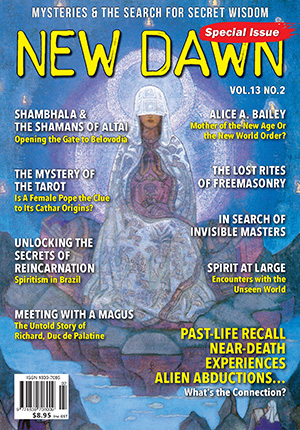
    Alice Bailey & the United Nations

    The New Age Alice Bailey sought to inspire took a new turn during World War II. In response to the evils of dictatorship, Bailey, like many others of her time, yearned for better governance. She was distressed by the war, deeply affected by the suffering she saw and appalled by the aggressor nations. She argued the need for a new world order, one founded on ideas of equality, goodwill and leadership. She advocated equality of opportunity for all, individual freedom and autonomy, the eradication of poverty, the sovereign rights of all nations, a universal education, shared resources distributed fairly, and disarmament. 

    She had no outward anchor for her reflections until 1st January 1942, when government representatives of twenty-six nations pledged to fight against the Axis powers and signed the Declaration of the United Nations, a declaration that led to the founding of the United Nations on 24th October 1945 in San Francisco, when its charter was ratified. Until then, all her efforts were poured into training disciples who were to go off in their various directions in the capacity of world service. The United Nations gave Bailey a focus and from then on she directed her disciples towards the organisation. 

    Her support of the United Nations is unsurprising, the organisation representing a dovetailing of her spiritual ethos with the pressing concerns of the era to address the situation that had led to another world war, not least a widespread desire to create some form of international law designed to protect individuals and groups from abuses meted out by nation states, challenging the idea that a nation has an inviolable right to treat its citizens or anyone within its borders however it wishes. Through Alice Bailey’s eyes, there was at last hope of a better world, one founded on unity, goodwill and right relations. 

    Alice Bailey’s call for a New World Order and support of the United Nations have resulted in an uproar among conspiracy theorists. Conspiracists are not wrong when they point to the infiltration of the UN by Alice Bailey’s co-workers. Membership of the UN’s Spiritual Caucus is filled with her people. Her organisation, World Goodwill, is a UN NGO. In 1952, Eleanor Roosevelt read Alice Bailey’s prayer, The Great Invocation, on a radio broadcast from the UN building in New York. 

    One key UN figure closely associated with Alice Bailey is Robert Muller, who served in the UN for forty years and was assistant to three Secretary Generals. Muller devised the World Core Curriculum for which he was awarded the UNESCO Peace Education Prize in 1989, a curriculum loosely based on Alice Bailey’s Education in the New Age. He contributed to Alice Bailey’s magazine, The Beacon, and addressed Arcane School conferences. 

    A coterie of influential figures operating out of plain sight would arouse suspicion in most of us. When those individuals believe in and are practising a form of occultism, suspicions inflame. And when the focus of activity is the United Nations – a locus for the New World Order – the result is a perfect storm of fear, speculation and evidence gathering. Whether Alice Bailey deserves it or not, she has become a pet hate among conspiracists.

    The Passing of a Remarkable Occultist
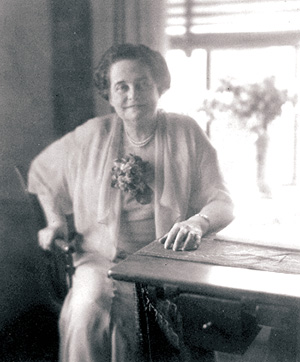
    Alice Bailey can be called the mother of the New Age movement if for no other reason than she set out to give birth through her texts, organisations and followers to a new and spiritually informed world order.

    Alice Bailey passed away in December 1949 with her husband Foster at her bedside. She had been ill for many years. Among her health conditions, she suffered from pernicious anaemia. Symptoms are wide-ranging and incapacitating. Even with treatment, the condition can be debilitating and painful. Alice received regular blood transfusions. Despite this, she worked tirelessly to the very end, holding executive meetings from her hospital bed. 

    After her death, Foster and their closest co-workers set about continuing the work. The Lucis Trust continues to publish the Blue Books in twenty languages and maintains and promotes the organisations she founded. Her co-workers to this day occupy key roles within the United Nations, and her texts continue to influence alternative spirituality and Western esoteric understanding and practice. 

    Alice Bailey’s version of esoteric truth is meant to foster goodwill and right relations. It is up to the individual to decide if it does.

    Isobel Blackthorn has written a biography of Alice Bailey. To learn more, visit this web page: https://isobelblackthorn.com/alice-a-bailey-life-and-legacy/

    [alert type=”general” dismiss=”no”]This article was published in New Dawn Special Issue Vol 13 No 2.[/alert]

    [alert type=”success” dismiss=”no”]If you appreciate this article, please consider subscribing to help maintain this website.[/alert]

    Bibliography

    Alice Bailey was prolific. Here is a selection of her works mentioned above. All her teachings are available for purchase at the Lucis Trust (www.lucistrust.org) or via online retailers.
    A Treatise on Cosmic Fire, 1925
    A Treatise on White Magic or The Way of the Disciple, 1934
    A Treatise on the Seven Rays: Esoteric Psychology Vol I, 1936
    A Treatise on the Seven Rays: Esoteric Psychology Vol II, 1942
    Education in the New Age, 1954
    The Externalization of the Hierarchy, 1957

    © New Dawn Magazine and the respective author.
    For our reproduction notice, click here.
  • Evolution Upside-Down: History is Cyclical, Not Linear

    Evolution Upside-Down: History is Cyclical, Not Linear

    From New Dawn Special Issue Vol 12 No 3 (June 2018)

    Charles Darwin possessed some characteristics which greatly endear him to me. He was an ‘amateur’, not a professional, making it clear that an all-consuming thirst for knowledge is a mania, not a profession, with its clerical and bureaucratic overtones. And there is something immensely dashing about his voyage on the Beagle. True, he was looking for confirming instances of his pre-established theory; also true, he did seem to neglect whatever evidence he chanced upon that went against it. But the confirmation bias syndrome seems to be embedded in human nature. Objectivity is impossible. 

    Anyway, when he published his seminal works Origin of Species (1859) and The Descent of Man (1871), he happened to have the right ideas at the right time. It was the age of Positivism, that proud and most legitimate descendant of the Enlightenment. And it was the dawn of the most materialistic and deterministic age in recorded history. Darwin’s theory of biological evolution through natural selection was enthusiastically co-opted by Herbert Spencer and the intelligentsia, and applied to society as a whole. The evolutionary dogma is now taught in every school in the Western world, and found in every textbook, and not just of science, but also of history, civics, etc. The whole ethos of Western societies is imbued with, and hinges on, the materialistic myth of evolution and progress.

    The broad concept of ‘evolution’, therefore, has been an invaluable ally to modern societies. Implicitly, but often also explicitly, these maintain that, by finding themselves at the apex of the process of societal evolution, the cosmology they incarnate could not be but the best one. It is a Machiavellianly powerful argument. Why, we were apes; then, humans who could barely, say, light a fire; eventually, we mastered nature (and how!); and now, as exponents of modern democracies in the free, secular and enlightened world, we spread the good news to our fellow humans in less privileged countries, or rather ‘developing’ countries and, surely, by the laws of evolution. (Among many, many ‘anomalies’, Göbekli Tepe, the archaeological site in Anatolia, debunks such a simplistic explanation, but that does not seem to matter to the establishment.) Indeed, such ideas spread like the plague. 

    As a consequence, a Single Thought is imposed upon the world, along with a Single Behaviour. The same way of reasoning, the same ‘values’, the same way of speaking, dressing, even eating. A completely arbitrary subjective point of view has been disguised as objective and is being imposed on a global scale through cultural lobbies and the mass media. Glory to the intrinsic supremacy of the evolutionary dogma, and its ramifications: liberalism and the free market, the latter being, in effect, the result of merciless natural selection.

    Leibnitz, and far more recently Popper, postulated that we live in “the best of possible worlds.” It is the principle of sufficient reason. While Leibnitz argued that God could not have created but the best of possible worlds, one that is constantly undergoing changes for the better, Popper affirmed that contemporary Western societies, and their socioeconomic system, represent the very best system that could possibly be conceived as opposed to previous social and cultural organisations.

    Now, dear reader, if you agree with Leibnitz and Popper, read no further. You are a well-adapted human specimen, the result of a pervasive cultural indoctrination, or outright brainwash. A true son/daughter of your times. If you don’t agree, read on – at your own risk.

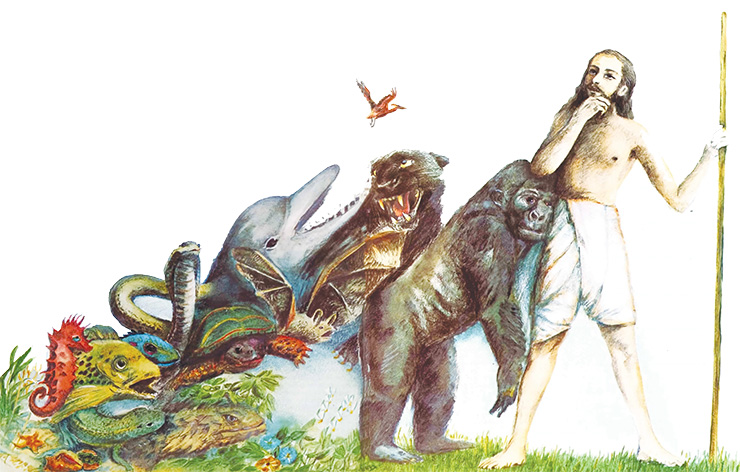
    When I was a teenager, an Italian progressive rock group released an album entitled Darwin. One of its songs encouraged the listener to “think a little differently.” It continued by explaining that nothing had been created by God, but rather all creation had created itself, and then had constantly improved thanks to the laws of evolution. Even spaghetti rock was co-opting its own warped version of Darwinism! Well, I now ask you to “think a little differently.” For you see – I do not believe that man is derived from the ape by evolution, but that the ape is derived by man by involution.

    Joseph de Maistre explained that savage peoples are not primitive peoples in the sense of original peoples, but rather the degenerated and/or degenerating remains of ancient peoples that have disappeared. I rebel against the evolutionary dogma and assert that animal species clearly show the degeneration of primordial man’s potential. In a nutshell, the ‘forbidden philosopher’ Julius Evola wrote: “These unfulfilled or deviant potentials manifest themselves as byproducts of the true evolutionary process that man has led since the beginning. For this reason, ontogenesis, the biological history of the individual, does not repeat in any way the process of phylogenesis, the presumed evolutionary history of the species, but passes again through some eliminated possibilities. It stops to roughly outline them and then moves beyond, subordinating these possibilities to the superior and specifically human principle, which is defined and fulfilled little by little in the development of the individual.”

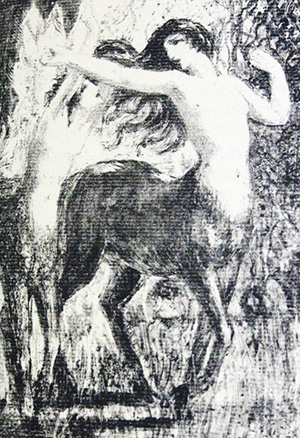
    Contrarian enough? It makes wonderful, if non-linear, sense. But the scientist would need proof. (Institutional science, incidentally, does tend to play a fixed game, as it sets up its own rules, and implicitly dismisses anything that does not quite conform with them.) Imagine, for example, a centaur, a four-legged horse body topped by a two-armed human torso with head. This lovely creature, if unearthed somewhere, would bring evolutionary theory to its knees, because there are simply no ancestors from which centaurs might have descended. On the other hand, the esoteric world may well consider us, two-legged humans, the degenerated and maimed mongrels of a centaur. 

    Artist’s rendition of a Centaur that appears in French poet Maurice de Guérin’s literary work Centaur.

    Poets seek truth, not scientists. The French poet Maurice de Guérin in his Centaur has the creature meet Pan, coming down from the mountains to the valley, there to drink from a river. It is night time. The river shimmers, a silver streak under the moon. This is the archaic Pan, a being immediately belonging to the Earth, not at all a god, though later he will be promoted to that rank. And it is Pan that De Guérin’s Centaur sees that night on the opposite side of the river, or… the first man. The Centaur is overwhelmed by disgust. And by sadness. In him, the Centaur sees a maimed individual. That being on the other side of the river announces, furthermore, his own demise, and the end of the Golden Age. Not by chance does the river seem, in the night, a silver streak. The Silver Age has begun.

    The world must have been in mourning when man detached himself from this part of his own being. The Golden Age gives way to the Silver Age. The lot will fall to Herodotus, in the fifth century BCE, to transition from the Silver Age to the Bronze Age. He stands at the cusp of the two epochs, and ushers in history. The Renaissance, and later the Enlightenment, will usher in the Iron Age, in which we live at present. 

    The scientist cannot but reject this. He must. Of course, if palaeontologists or archaeologists did unearth the remnants of a Centaur, it would not only be a fatal blow to evolutionary theory, but to science as a whole. Also, finding true anachronisms would be useful. Such as human beings fossilised inside the stomach of, say, an allosaur; or a trilobite in Cenezoic (‘recent’, up to 65 million years old) strata. But again, science, and Western societies, by and large, tend to dismiss or indeed conceal evidence that may damage the status quo. This censorship is a survival tactic, not in any way shocking or original. But apparently traces of nicotine were recently found inside an ancient Egyptian sarcophagus. Tobacco being a plant of the New World, such a discovery should have changed if nothing else our perception of history. Indeed, it would mean so much more. Not surprisingly, very little has been said or made of this. Why, Atlantean studies, i.e., the entertaining of the possibility that there was an advanced civilisation in prehistoric times, are deeply subversive. They make nonsense of Darwin, Marx, and Freud, and greatly annoy the professorial ‘experts’. They question the Big Bang cosmology. They inspire no belief in progress or social engineering. And ultimately open the door to the “black tide of mud,” as Freud called the occult (really the esoteric) in his famous feud with Jung. 

    A few years ago, I spent quite a number of afternoons and evenings interviewing the shaman, or rather ‘bundle-carrier’, of the Miccosukee tribe, in the Everglades of South Florida. After a few sessions I realised that the man was able to read my next question as I formulated it in my mind and would answer to it without my asking it orally. As would be expected, I was utterly unable to read his mind, or anybody’s. Eventually, a very odd take on history surfaced from his words.

    When the Spaniards kicked out the last Moor, thus achieving their epochal Reconquista after eight centuries of Muslim occupation, that very year, 1492, Columbus officially and ostensibly discovered America (in error?). It is hardly a coincidence. Certainly, metahistory is not taught in any school, so people are at best perplexed by it. That there should be powers involved in epochal changes which go well beyond the pettiness of human greed and social upheavals would seem a self-evident truth, yet contrariwise denied out and out as utterly unthinkable by the heralds of the evolutionary historical dogma. And what did the white men do when they came to America, asked the bundle-carrier? 

    They found the Golden Age, I realise now, in retrospect. It was not the New World; it was the Old World, older than history, older than myth.

    Yes, America was still in a state of grace. Macroscopic cereal only grew here: corn, Zea mays, bearing grains on very large ears which did not require any milling. It was the food of giants, of the Titans. Cacao, Theobroma cacao, the Fruit of Gods, which ‘theo-broma’ means in Greek. The origin of this tropical understory tree were the Amazon Headwaters from where it moved to Central America. Cocoa cultivation began by Mayan tribes in Central America, around 1500 BCE. Mayans and Aztecs attributed divine origin to the cocoa tree, brought to them by god Quetzacoatl. The sacred beverage called ‘chocolatl’ was consumed from golden cups. And the list goes on. Tobacco, i.e., Nicotiana tabacum. An herbaceous plant, tobacco was first used by the peoples of the pre-Columbian Americas. Native Americans cultivated the plant and smoked it in pipes for medicinal and ceremonial purposes. The rustica variety was used by shamans to enter trance states and induce hallucinations. Tomato, Lycopersicon esculentum, was another gift of the Golden Age. A fruit which grew readily not from a tree, and could be cultivated anywhere, provided there be enough warmth. Its edible, fleshy, usually red fruit has become a staple for cuisines the world over. What would Italian cooking be without it? No pizza? No pasta? And what of the following other godly gifts: vanilla; potatoes (which, ironically, made the Industrial Revolution possible); immense herds of bison grazing and roaming freely in the Northern Plains? What of the turkey, which has become such a symbolic animal in the US, and is raised and eaten all over the world? No fowl of this size grew in Europe and, again, with good reason, as Europe had left the Golden Age, then the Silver Age, and indeed was leaving even the Bronze Age.

    I have a print by Eanger Irving Couse which I bought in Taos, New Mexico. Painted about a hundred years ago, it depicts a sylvan scene. A native American, wearing only a loin-cloth, and crouching on his knees, is hiding behind a clump of trees, keenly observing, unseen, some turkeys in a clearing, a few paces from him. With his right hand he is clutching what at first sight appears to be a spear. On closer inspection, one realises he is merely holding on to a branchless sapling, which can be mistaken for a spear, but is in fact a slender young tree rooted in the ground. This image, incidentally very well executed, speaks volumes. The native American, slim but evidently not hungry, does not intend to kill the turkeys, but does enjoy observing them.

    Photo of the author’s Eanger Irving Couse print.

    Such people, primitive, original people, deserved the Golden Age in which they still lived. They had no need for eschatology. Indeed, drawings have been found in caves depicting primitive hunters hunting also in their after-life. There really was no after-life, no demarcation between life here and life elsewhere. The Golden Age was the Garden of Earthly Delights, and gold itself, paradoxically, was not needed.

    White man brought along not only a host of exotic diseases, but banking, the greatest disease of them all.

    Indeed, the Catholic Church had been banning for centuries the charging of interest, as it perceived it as usury, with banking, and lending, becoming an accepted practice only during the early Renaissance. 

    “What,” asked my friend, the Miccosukee bundle-carrier, “what did the white men need banking for in America?” As a matter of fact, they owned everything: land, trees, rivers, fish, fowl, game. Everything they saw. Yet, they introduced that supreme artifice – banking. 

    We know what has happened since to the millions of bison that used to roam the prairies, at the hand of the white man, hunting for sport with lever action rifles. We know what has happened to the native Americans. Yet, we continue to disguise our societies as the logic result of evolution and progress.

    Frederic Edwin Church, the painter from the Hudson River School, made it a point to record the last vestiges of the Golden Age in this continent. He spared no effort in reaching the remotest places so as to portray their Golden Grandeur. Far more than Turner or Caspar David Friedrich, respectively from England and Germany; precisely because he roamed the Americas, he had the last chance to sing her Golden glory.

    But the evolutionary dogma has branched out and infected also the world of art. It is hard to believe, as art should have been the only field immune to such poison. Yet, we have been told that art, too, evolves. Who could like Giotto now, he who did not know perspective? Clearly, Pier della Francesca and Paolo Uccello, who introduce it, were far superior. But they pale in comparison to the grandeur of Michelangelo and, later, Tiziano. However, Caravaggio, with his shadows and chiaroscuro, is far more evolved. Not to mention Goya. Away at last from those stale religious subjects, into the far better common-life themes. But impressionism fuzzed this up too – a change for the better, of course – and all the other -isms led to the best artistic expression of them all: abstract art, a.k.a. ‘anything-goes-ism’. Indeed, as a further development along the evolutionary scale leading to perfection, ugliness became beautiful, and the beautiful, ugly. Major cities across the Western world number many a museum dedicated to this pinnacle of artistic evolution: ugly art. All along, Theodor W. Adorno and other Marxist philosophers were busy singing the praises of ugliness. 

    How can we defend ourselves from the aberrations caused by the globalised co-option and imposition of an all-encompassing evolutionary dogma? I think I have given you some hints. History is cyclical and not, as we are eloquently and assiduously told, linear. We are caught up in the very low ebb, at present. The Iron Age, or the Kali Yuga, as described in traditional Hindu texts. But the tide may come in the future. In the meantime, we are already doing what is best: differentiating ourselves from mainstream thinking.

    P.S.: My wife and I have quite a collection of abstract painting of which we are very fond; inconsistency is a good sign.

    Guido Mina di Sospiro’s Forbidden Fruits: An Occult Novel, co-authored by Joscelyn Godwin, is available from all good bookstores.

    [alert type=”general” dismiss=”no”]This article was published in New Dawn Special Issue Vol 12 No 3.[/alert]

    [alert type=”success” dismiss=”no”]If you appreciate this article, please consider subscribing to help maintain this website.[/alert]

    © New Dawn Magazine and the respective author.
    For our reproduction notice, click here.
  • Synchronicity & the Daemon: Making Magic Work For You

    Synchronicity & the Daemon: Making Magic Work For You

    From New Dawn Special Issue Vol 13 No 5 (Oct 2019)

    Are ‘meaningful coincidences’ and a sense of déjà vu signs of a ‘higher self’ – another secret you? If so, could this be the key to magic and even art? 

    These two questions have over a millennia’s long pedigree. From Plato, Socrates, Carl Jung to modern Hollywood movies. But for you and me, they may hold the key to understanding life’s most miraculous moments. 

    Bridges Between Time

    In Plato’s Symposium, the ancient Greek prophetess Diotima of Mantinea says to Socrates that love is a “great daemon.” She elaborates, saying that “everything daemonic is between divine and mortal.” In other words, a Daemon appears to be a ‘bridge’ between two realities, between two levels of time – ‘mortal time’ and ‘divine time’, or eternity. 

    “Socrates with disciple Diotima,” painted by Franz Caucig, 1810. The ancient Greek prophetess Diotima of Mantinea said to Socrates that love is a “great daemon,” and that “everything daemonic is between divine and mortal.”

    Over time, the word Daemon has come to be understood – or misunderstood – as meaning an evil spirit or devil. Now that is not to say that evil spirits and forces don’t exist (I like to be open on the issue). But in pre-Christian ancient Greece, the word Daemon meant something more benign. It meant a ‘tutelary deity’, a type of Guardian Angel. Diotima was an early challenger of this notion, however, insisting that it was something much more profound. 

    As we’ll see, the Greek prophetess was ahead of her time. 

    Peake’s Daemon – Our Secretive Silent Self

    More recently, the author Anthony Peake explored the mystery of the Daemon in his book The Daemon: A Guide to your Extraordinary Secret Self (2008). Peake argues that the Daemon is an aspect of our psyche whose domain is within our non-dominant hemisphere of the brain (i.e. the right). It exists, he claims, in a state outside of linear time. The Daemon is also silent; it has no access to the speech centres of the brain, which are in the left hemisphere, or the ‘dominant hemisphere’. 

    Author & original thinker Anthony Peake

    Peake argues convincingly that the Daemon is a silent observer who has a wholly different perspective on our lives. It may even know our individual destiny, and those of others.

    In Daimonic Reality: A Field Guide to the Otherworld (1994), the philosopher Patrick Harpur makes some further distinctions that help us understand some of its qualities. He roughly divides the human mind into two types of ego. Our everyday sense of identity which lives in mortal time – and which we refer to as ‘I’ or ‘me’ – is what he calls the rational ego. 

    Our rational ego confers upon us a sense of continuity in time. Our other self is, too, an ego – with its own identity – but with crucial differences. He says that the Daemon is “not of consciousness, but of the unconsciousness.” The Daemon is also “not a waking, but a dream ego; not a rational, but an irrational ego” – an ego he calls the Daimonic Ego (Peake’s Daemon).1

    Now, this brings us to the other topic of this article: synchronicity. 

    The Swiss psychologist Carl Jung coined the word synchronicity. It refers to those odd moments in life when the inner world of the mind is reflected in the outer world as an event. We call these coincidences. What makes Jung’s synchronicity different from a coincidence is that they are meaningful to the observer. Thus, synchronicity simply means ‘meaningful coincidence’ – a confluence of inner and outer events that seem to converge into a singular moment. 

    Synchronicities appear as if matter and mind ‘came together’ for a brief moment. But, as I will argue in this article, they may be interventions from our Daemonic minds. 

    Books That Find You – Two Synchronicity Cases

    As an example of typical synchronicity, I will use my own case. In fact, it inspired me to pursue the themes explored in this article. 

    A few years ago I was walking into Stourbridge Town in the West Midlands to do some shopping. For a reason I have forgotten, I was talking to my friend about the Austrian esoteric philosopher Rudolf Steiner. I had to admit I didn’t know much about him despite having read a few books which referenced his work. 

    Before long I asked aloud: “What are the fruits of his philosophy, Anthroposophy?” (I am paraphrasing, but I remember using the words’ fruits of Anthroposophy’.) Nonetheless, we continued walking, and as we approached a charity shop, we decided to investigate. The shop was small and generally over packed with clothes and other bric-a-brac. There was a small book section in the corner. 

    I glanced over it, and immediately a book grabbed my attention. The Fruits of Anthroposophy by Rudolf Steiner! Immediately I bought it, taking it as a sign – from a dimension unknown – that I ought to read more about Anthroposophy. 

    Before we unpack the implications of the synchronicity and the Daemon, let’s turn to another synchronicity. This time by one of the world’s most prolific British writers on occultism and existentialism, the late Colin Wilson. 

    Colin Wilson (1931–2013) (Photo credit: Simon Brighton)

    Again, it concerns a book.

    He was writing an article about the subject of synchronicity for An Encyclopedia of Unsolved Mysteries (1987). Shortly afterwards he experienced a profound synchronicity. He said that it seemed so “preposterous” that it defied the ordinary definition of a coincidence. 

    For his article, he described a synchronicity that happened to the French ufologist Jacques Vallee. Vallee had been researching a Los Angeles-based religious cult. Its name, the Order of Melchizedec, termed after an obscure biblical prophet. 

    Vallee had been attempting to find more information about the cult but with little success. At some point during his search he took a taxi to Los Angeles airport. To his astonishment, the taxi driver who gave him his receipt signed it ‘M. Melchizedec’. And whom, it turned out, was the only Melchizedec in the enormous Los Angeles telephone directory. 

    Wilson must have thought this an impressive synchronicity, enough to include in his encyclopaedia. But the universe – or his Daemon – seemed to think one better. 

    He says that after he finished writing his passage on Vallee’s remarkable story, he broke off to take his dogs for a walk. He continues:

    “As I was leaving my workroom, I noticed on the camp-bed a book that had obviously fallen off the shelf, and which I did not recognise. It was called You Are Sentenced to Life, by a Dr W. D. Chesney, and I had obviously bought it many years before in California and sent it for binding. But I had never actually read it. When I came back from my walk, I glanced through the book – and discovered, at the very end, a page headed ORDER OF MELCHIZEDEC.”2

    Now the question that haunts us in these moments of meaningful coincidences is: “Well, what does it all mean?”

    In each instance above, there is a sense that it is confirming a thought, as it were, rather as if some force is reminding us that we’re on the right path. Wilson’s account seems to say, ‘Yes, synchronicities do happen, and if you think Vallee’s is impressive, how about this…’ And then this mysterious ‘force’ ensures that the right book is brought to Wilson’s attention. After such an experience, it is almost impossible to shake off the conviction that the universe is a far stranger place than we take for granted. 

    Hallmarks of Another ‘You’

    So, where does the Daemon fit into all this?

    The Daemon, as we have seen, is the unconscious and non-rational ego lying silent in our non-dominant hemisphere of the brain. And if anything is non-rational, then it is the synchronicity that Jung described as an “acausal connecting principle” (indeed an irrational description which simply means a cause that is not a cause!). 

    In The Many Faces of Coincidences (2017), Laurence Browne says, “[there is an] uncanniness that often accompanies these experiences, as if an ancient memory of the mysteriousness and inter-connectedness of life is suddenly and unexpectedly evoked.”3 Based on the above cases, this seems to be true enough. 

    Could it be that this other-self, the Daemon, is somehow involved in these unusual experiences? And, as it exists without access to our speech centres, is the synchronicity a mode of its expression? An expression, after all, that appears to lie outside time and space in the ordinary sense. And which – much like what Diotima said to Socrates – appears to exist between two levels of time, mortal and divine.

    Veronica Goodchild, author of Songlines of the Soul (2012), believes that synchronicities are “moments of epiphany” designed to slow us down. They act to bring us into the present moment, providing us with a glimpse of “another world in the ordinary one.”4 

    The Daemon, I would argue, seems a likely candidate for this other self – or force – that comes into our lives in moments of synchronicity or déjà vu. We can see that our minds split into two complementary parts – into a rational ego and Daemonic ego. We can also see that in these moments we experience reality through two perspectives. This also answers the sense of uncanniness that soon accompanies synchronicity. Seeing the world in a state of ‘double-exposure’, as it were, reality itself appears to curiously overlap with another world.

    Worlds Together, Towards an Occult Psychology

    Indeed, a simultaneity of two worlds coming together is its most reported impression. Moments in which the inner world of the mind seems to link up with the outer world. It appears nothing less than magical. Jeffrey Kripal, the Chair of Philosophy and Religious Thought at Rice University, says that synchronicity “[is] essentially a shiny new word for what we would have earlier called magic.”

    The difference between magic and synchronicity experiences is more in degree than kind. Magic infers the will of a magician to affect change in himself or the environment. It is an active means to create synchronicity, of manipulating time and space under one’s desires. But synchronicity appears in unexpected moments, accounting for the initial surprise – the shock of seeing reality conform to one’s thoughts.

    Yet is this true? In both examples above, synchronicity often appears when we’re intensely thinking about something. It may bother or even obsess us, whether consciously or otherwise. Many such cases of synchronicity can be found in books like Trish and Rob MacGregor’s The Synchronicity Highway (2013) or Raymond E. Fowler’s Synchrofile (2004). 

    Wilson’s experience is a case in point. He was writing and intensely thinking about synchronicities for his encyclopaedia entry. The event seems related; the book that fell off his shelf was relevant to what he was thinking and writing about at the time. And in my own experience, too, it was related to my desire to know more about Rudolf Steiner’s philosophy. The Daemon appeared to confer this opportunity. 

    Once we begin to think about the synchronicity experience in more depth, we see that it is what only a few centuries ago we would have called magic. Again, to return to Wilson’s example, we can see that there might be an element of mind-over-matter – or psychokinesis – involved. He managed to somehow unconsciously will the book to fall from the shelf. He also seemed to know on a deeper level – perhaps in the Daemonic mind – that this book contained the chapter he required and that he would return to find it.

    The late physicist F. David Peat suggested it is the degree and sensitivity of mind that makes one open to the synchronicity experience. He said that a mind in “constant process of creative change… will respond to the overall patterns of nature so that the individual can enter into these patterns in new ways.”5

    There are moments in life when we are far more open than usual to ‘creative change’. We could call these moments of intersection important events that shape our lives, pushing it in one direction or the other. Taking a risk is often a good example and one in which we often consciously look for ‘signs’ that a risk is worth taking. We look for omens or portents which may foretell the future – good or bad – of our choices. Authors Trish and Rob MacGregor describe the beauty of taking such risks lies in its galvanising of our unconscious elements. These rise to the surface of our rational ego – our everyday consciousness – allowing us to evolve, to challenge ourselves. 

    There are, alas, darker moments in our lives when we ask for guidance, and we appear to receive it – or, sadly, we don’t. Let’s say we do receive something apparently miraculous. Say, a synchronicity or omen that appears uncannily unlikely: Is it merely pathological? A desperate attempt to force reality to mean something but, in reality, is simply our mind playing tricks on us? 

    In the Domain of the Muse – Magic, Art and Creativity 

    At this point, these questions become very interesting. As we have seen, our silent partner, the Daemon, lies apparently dormant within our psyche and seems to intercede in moments of heightened importance. It as if we call forth our unconscious self in moments of risk, radical change, or “Dark Nights of the Soul.” 

    Anthony Peake also makes the argument that the Daemon is our self that has already lived our lives before, in a sort of Eternal Recurrence. Our sense of déjà vu is, he argues, a recognition to our everyday self of a return, a re-run of our lives that feels eerily familiar. We feel, for a fleeting moment, the presence of the Daemon in our minds. 

    The corollary of this, of course, would be that to practice magic is to take risks and seek out ways of creating moments of transitions in our lives. In developing moments of intersection that forces our unconscious Daemon into manifesting. It would be reassuring to think we could work closely with a ‘Self’ that has, after all, lived our lives before. We could improve our own lives and those of others. Although relying too much on risks and shocks, of course, harbours many implicit dangers. We would, of course, unconsciously create needless and uncontrollable chaos in our own lives. Indeed, it reminds of that old proverb: “Be careful what you wish for.” Our conscious, ‘rational’ selves often make the wrong choices after all; not knowing what is best for us. 

    A subtler and gentler approach may be more suitable. In situations of risk and crisis, the Daemon may appear to scream out, imbuing our lives with signs and synchronicity. But there are also its more generative and beautiful dimensions. These imbue and saturate our art and appear in moments of heightened creativity. 

    Both rely heavily on moments of vision and intuition, of flashes and influxes of inspiration. In short, we’re now in the domain of the Muse, that Daemonic ‘in between’. Shakespeare said that the Muse gives “forms of things unknown [a] local habitation and a name.” 

    The imagination, so crucial to magic, here transmutes the invisible world of the Daemon into the here-and-now. We see it in forms of art, poetry, sculpture, dance and music. This, in itself, is a method of generating synchronicity. Dance is a synchronised performance – usually to music – expressing on one level that which is in implicit in the mind of the dancer. It becomes explicit – actual – in the form of the dance. In essence, the whole dance lies complete in the mind of the individual (unless it is, of course, improvised). The dance then unfolds again, in time, as a performance. 

    Again, magic is related to the arts (black magic is referred to as the ‘black arts’; white magic is often called the Hermetic Art). One need only turn to books on alchemy to see that it is often referred to as ‘The Great Work’. Usually equated with forming gold out of base elements, in esotericism and psychological theory it symbolises the transformation of the individual’s psyche. We may here replace ‘base elements’ as that of unconscious processes. Those aspects of ourselves that are unknown, even primal. Their elevation – through transmutation – become higher forms such as art, music and dance; the ‘gold’ of the alchemists. 

    Synchronicities, then, become life’s most artful expressions. They show themselves in a marriage between two realities – that of the rational ego and the Daemonic ego. These are the converging of the rational and irrational; conscious and unconscious. And as we have seen, this can be understood as magic in its microcosmic form. That in which the implicit becomes explicit; the subjective – or thought, feeling, sensation – becomes the objective. The manifest event that happens in ‘real time’ and is directly experienced. 

    The magician, of course, would see synchronicity as confirmation of his deep intent played out in the world. An artist also attempts to bring out what exists within the imagination. And once the canvas, sculpture or musical arrangement is actualised to satisfaction, it ‘feels right’. It provides a pleasing quality of completeness both in the artist and hopefully to other people, even culture at large.

    The Daemon appears to exist within this realm of art and possibility; in short, the imagination. But it is not the imagination of mere fantasy and fancy. It is instead the possible and latent realities, even evolutionary potentialities. The full actualisation of the Daemon into ordinary consciousness would effectively make one a superman or a madman. This would depend on the level of integration of one’s personality and self-discipline. A poorly integrated person would fly apart if his unconscious processes suddenly made themselves too explicit. 

    As already mentioned, the Daemon appears to have access to our lives already lived. It has, at some point, ‘been us’ and gone through all our trials and tribulations. In psychological terms, it would be called our super-ego or our Transpersonal Self. Patrick Harpur adds that the “unconscious, soul, imagination – whatever model we use – are in themselves non-spatial, just as they are timeless.”6

    Dreams, art, intuitions, synchronicities and omens – all are part of the magician’s and artist’s toolkit. All are the product of a timeless zone. Indeed, we often call a piece of awesome music ‘timeless’ for its sense of forever being new, interesting and inspiring. It’s almost as if the artist tapped into some wellspring of creative force recognised by some deeper part of ourselves. It moves us, brings us to emotional heights, and places us in another state of consciousness.

    Heightened states of emotion, says occult historian Mitch Horowitz, “[are] the ideal state for using affirmations and visualisations to impress the subconscious and spur subtle abilities of thought.”7 But instead of imagining ourselves in some occult ritual to artificially evoke these heightened emotional states, we may turn to an everyday example. Our next artistic symbol pulls together all the threads of this article into a modern myth. It is an eminently practical and timeless classic of popular entertainment.

    Eternal Returns, Hollywood Style

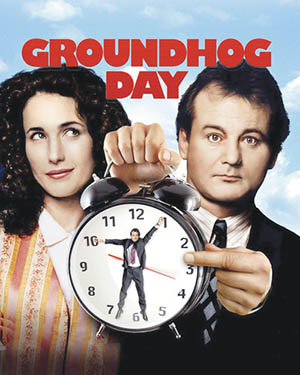
    The movie Groundhog Day (1993) stars Bill Murray as Phil Connors, a cynical TV weatherman who is sent to cover the annual event of the movie’s namesake in Punxsutawney, Pennsylvania. But, once the first event is over, he wakes up to the same radio alarm playing Cher’s ‘I Got You Babe’. For the second day in a row and at precisely the same time. It quickly dawns on him, however, that this is not a mistake of the radio station, but of an odd time-loop in reality itself. 

    Each day is repeated, identical to the last, with only our hero being aware and able to act differently. As each day draws to a close, and he loses consciousness or retires to bed – once again the day repeats, and it’s once again identical to the last.

    At first, Phil Connors believes he is losing his mind, and those around him are quick to concur. But, after a few returns to his repeated fate, he begins to experiment. After all, he knows there are no direct consequences, for even if he killed someone, the next day they would be alive again. The victim would have no memory of the previous day – which, for them, is once again ‘today’, ‘now’. For Connors, of course, he retains a memory of every previous day. Thus, he can build up a mastery of all the circumstance and events that unfold each time. In this respect, Connors is the Daemon, the self that has already experienced your life before. 

    What’s interesting about the movie is that, at first, Connors indulges in base fantasies; brutalities, cruelty, infidelities. This eventually leads to a pervasive sense of emptiness; even despair and suicide. Once he reaches this spiritual threshold, he becomes more positively active. He decides to learn how to speak Japanese, French, and many other languages. He perfects various sports, learns how to dance, and further betters himself with the infinite time he appears to have at his disposal. After all these feats, he becomes, for all intents and purposes, a type of Superman. He knows the destinies, personalities and idiosyncrasies of everybody in the small town. 

    He brings joy and exuberance to everybody he meets. Connors has finally decided that he should use his timeless powers to uplift and creatively interact with his own life and those of others. In psychological terms, he’s become what the psychologist Abraham Maslow called a “self-actualiser.” 

    In an article on synchronicity, philosopher John Michell warns of invoking synchronicity frivolously. Michell says that these techniques are often taught in “cults and business schools.” He warns against them, calling them black magic. He concludes by saying that we are better off accepting life’s rewards and punishments as they are due. Connors finally is challenged to do just this. Michell also advises us to adapt “ourselves, our actions and thoughts, to a preponderance” of life’s rewards. We do this by orienting our actions and thoughts towards evolution and creative self-development. 

    If there is a lesson in all this, it seems to be hidden in the wonderful layers upon layers of movies like Groundhog Day. For the key to magic, like life, seems to be that we break out of our cycles of selfishness and psychological – even physical – entrapment. Instead, like Connors, we actualise our most intuitive and creative layers. Through these actions, we bridge two worlds in an effective and dynamic manner. We bring about a complexity and integration within our psyches. We become, in short, better people. 

    What happens to Phil Connors once he becomes the best version of himself? Time continues as normal and a new dawn beckons. This appears to be what our Daemon – through synchronistic hints – wants to create. It promises ascending spirals of evolution and not circles of stagnation. 

    Synchronicities along with our companion Daemon seem, at times, to lead us, providing us with curious hints. Nonetheless, they provide the keys to magic. The lock that it promises to open is no less than our own destinies – so let’s make our lives a work of art. 

    [alert type=”general” dismiss=”no”]This article was published in New Dawn Special Issue Vol 13 No 5.[/alert]

    [alert type=”success” dismiss=”no”]If you appreciate this article, please consider subscribing to help maintain this website.[/alert]

    FOOTNOTES
    1. P. Harpur, Daimonic Reality, Pine Winds Press 2003, 251
    2. C. Wilson, Supernatural, Watkins Publishing 2011, 446
    3. L. Browne, The Many Faces of Coincidence, Imprint Academic 2007, 2
    4. Quoted in: R & T. MacGregor, The Synchronicity Highway, Crossroads Press 2013, 41
    5. F.D. Peat, Synchronicity, Bantam Books 1987 
    6.  Ibid. 2003. 
    7. M. Horowitz, The Miracle Club, Inner Traditions 2018, 33

    © New Dawn Magazine and the respective author.
    For our reproduction notice, click here.

  • Alien Abductions & the Paranormal

    Alien Abductions & the Paranormal

    From New Dawn Special Issue Vol 13 No 1 (Feb 2019)

    Among the most influential and widely known alien abductions is the story of what happened to Betty and Barney Hill, an American couple from Portsmouth, New Hampshire, who were reportedly abducted by extraterrestrials while driving back from a vacation in Montreal. 

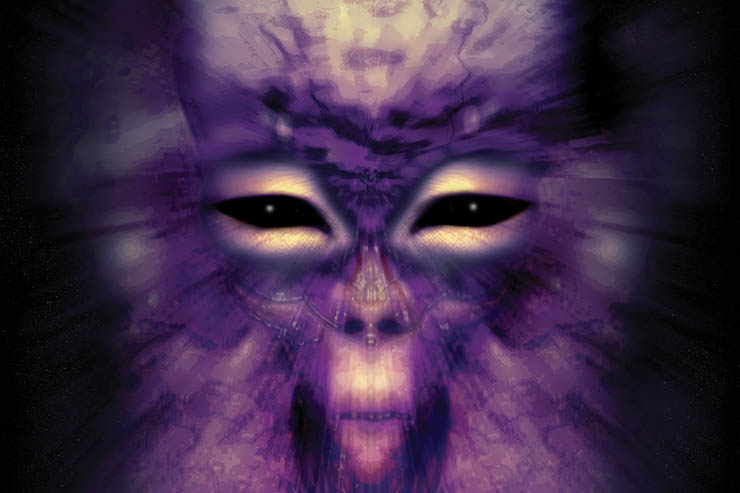
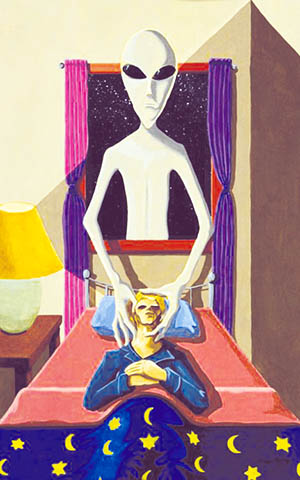
    The couple described being taken into an alien spacecraft where strange surgical operations were performed on them. The couple could not initially remember the incident, only waking up to discover that they had travelled 35 miles without any memory of the last two hours. It was only through hypnotic regression that they recalled encountering extraterrestrial beings, characterised by disproportionately large foreheads and black opaque eyes. Although the couple returned to their normal lives, after undergoing extensive hypnotherapy they continued to discuss the incident with friends, family and UFO researchers.1 

    Since Betty and Barney Hill’s encounter in 1961, alien abductions have become a widespread phenomenon. A study conducted by the sociologist Dr Ron Westrum suggests that nearly four million Americans have been abducted by aliens at some point during their lifetime.2 There are many explanations for these ‘alien’ encounters: some believe they are the result of sleep paralysis, or they are part of an undisclosed military project. Nevertheless, the phenomenon remains an intriguing mystery that has yet to be fully understood. 

    Paranormal Connections

    Many people are unaware there is a close relationship between alien abductions and the paranormal. Dr Richard Boylan, a clinical psychologist at California State University, has studied alien abductions for several decades. In his book, Close Extraterrestrial Encounters: Positive Experience with Mysterious Visitors (1994), Boylan lists twenty characteristics associated with alien abduction, several of which include the reception of telepathic messages and the development of psychic abilities.3 

    Kenneth Ring, professor of psychology at the University of Connecticut, has also found that many abductees report an increased sensitivity to electromagnetic fields, enhanced information-processing capacity, and the development of psychic abilities.4 It is also common for abductees to experience a greater connection with friends, family and the environment. The renowned alien contactee and author Whitley Strieber claims that many abductees experience paranormal phenomena as part of a wider spiritual transformation. He writes:

    “What basically happens is that the witness’s whole sense of reality explodes. People become psychic, they begin to believe that they can see into the future… they acquire wisdom and new compassion… they become deeply concerned with the welfare of the environment.”5

    The connection between alien abductions and the paranormal has been extensively studied by Denise Stoner and Kathleen Marden. In 2012, the independent researchers conducted a study in which 75 alien abductees were given a multiple-choice questionnaire and asked their personal background, religious/spiritual beliefs and other relevant information. They also completed a survey which contained 16 fill-in questions relating to their abduction experience. According to the data, 51% experienced paranormal activity for the first-time following contact, 89% reported receiving telepathic messages from their extraterrestrial visitors, and 72% claimed they were more sensitive to their surrounding environment.6 

    Poltergeist Activity 

    One paranormal phenomenon commonly associated with alien abductions is poltergeist activity. In a study conducted by Simon Brian Harvey-Wilson, 11 abductees were randomly selected from an abduction support group in Australia and interviewed about their alien encounter. 

    Wilson found that many subjects had experienced unusual activity in their homes following contact. A subject, named Angela, described “most electrical appliances not working, having a lot of static. And the television… often just goes to static.” Another subject, named Karen, explained how her stereo system would turn on“in the middle of the night and then it would actually flip through to my favourite song on the CD… and it would just play the song. And then it would stop and turn off.” One subject even recalled how objects would fly off the shelves without any sign of disturbance and the electrical system in her house would suddenly blow:

    “I had occasions when things would move off the shelf, and they wouldn’t smash on the floor… they would be able to move from one place very carefully to another… Other times, I would have enormous electrical activity in the house, so much so that it would blow. It would actually trigger the alarm system or trigger things to come on.”7

    These experiences correspond with the research conducted by Stoner and Marden, which found that 88% of abductees experienced poltergeist activity in their homes following contact. 68% of them reported malfunctions in electronic equipment such as computers, radios and televisions.8 Some of them also reported light bulbs turning on and off, street lights blinking when they walked underneath them, and the hands on their watches spinning.

    The connection between alien abductions and poltergeist activity became so apparent during Marden and Stoner’s research that they decided to measure the electromagnetic fields of their subjects.9 They used a TriField Natural EMF Meter to measure the surrounding environment and the bodies of abductees within four days of an abduction, as well as the bodies of a control group. The data suggested that the electromagnetic field of the abductees was significantly higher than the ambient environment and control group following an alien encounter. Although the sample size was too small to make definitive conclusions, the findings correspond with research undertaken by Professor Ring at the University of Connecticut who found that many abductees report a heightened sensitivity to electromagnetic fields.10

    Even more interesting is that many UFO researchers believe there is a fundamental connection between extraterrestrials and electromagnetism. UFO researcher Chris Line believes that extraterrestrial beings are vibrational in nature and therefore possess the ability to conceal themselves within the infrared part of the electromagnetic spectrum.11 

    The author Ann Druffel also believes that since reality is ultimately electromagnetic, “very close-up sightings, and particularly those which involve paralysis, abduction and other unpleasant experiences, might be from an interdimensional source, co-existing with our earth.”12 If these extraterrestrial beings exist as a purely energetic form of consciousness, it may be possible for them to interfere with the electromagnetic fields produced by physical objects as well as the human mind and body. Poltergeist activity could be representative of the same extraterrestrial intelligence encountered during alien abductions, but merely manifested in a different form. This would make sense considering that many abductees claim extraterrestrials have the ability to shapeshift and assume a variety of physical and non-physical forms. 

    Healing Abilities

    Poltergeist activity is not the only paranormal phenomenon associated with alien abductions. During his research, Simon Brian Harvey-Wilson found that many of his subjects developed healing abilities either prior or subsequent to contact.13 One subject, named Patricia, explained how her encounter with extraterrestrials resulted in her becoming a holistic healer. She claims to now have the ability to “pick up information about where trauma has occurred or where energy blocks are in the body that may have manifested… what information, what emotion is held in that… or what trauma is held in the body in those areas.”Another subject, named Angela, claimed that she developed healing abilities after she was abducted by aliens as a teenager, and could now “pick up on people’s feeling’s feelings and emotions and thoughts” and see “where they had problems, like diseases in their bodies.” 

    These accounts correspond with the research undertaken by the renowned psychiatrist and writer John E. Mack (1929–2004) who interviewed hundreds of abductees as part of a government-sponsored research project into the extraterrestrial phenomena. He found that a significant percentage of abductees developed healing abilities after contact as well as a greater connection with people, animals and nature.14 This corresponds with research undertaken by Stoner and Marden who found that 50% of abductees were able to heal others for a short period of time following an alien abduction, and 2% possessed healing abilities from a young age. Marden states that many subjects reported having their vibrational frequency raised during an abduction, which was apparently connected to the development of healing abilities.15

    John E. Mack (1929–2004) 

    The question as to why abductees develop psychic abilities remains a mystery. However, one explanation is that these extraterrestrials are benevolent and want to enhance humanity’s psychospiritual development. The idea of otherworldly beings assisting humanity is integral to the culture of shamanic societies in which the shaman communicates with spirit-helpers to acquire knowledge or wisdom that can benefit the community. The religious historian Mircea Eliade talks about how “the shaman frequently sees and consults with his guardian spirit… has it help him, and uses it to help others to recover from illness and injury.”16 Comparing shamanism and the strangeness of alien encounters, shamans and abductees could be essentially communicating with the same benevolent ‘alien’ intelligence that, in certain cases, aims to physically, emotionally and spiritually heal humans.

    Possible theories and explanations

    Much research has been undertaken into the psychological makeup of abductees to assess whether certain personality traits increase the probability of individuals experiencing paranormal occurrences.17 While these studies are valuable from a scientific perspective, they do not say anything meaningful about the experience itself. If paranormal occurrences are real but can only be experienced by a certain personality-type, it would make sense that abductees share a common psychological profile. This does not make their experiences invalid or delusional in any way, however.

    From a philosophical perspective, all sensory experience is mediated through the psychology of the mind. If you placed a highly attentive individual in the middle of a city, they would notice certain faces, objects and buildings that other people might not; this does not mean that what they are witnessing is purely imaginary. Rather, their psychological predisposition enables them to experience a wider range of sensory input than the ‘ordinary’ person. In this sense, it could be argued that abductees are more likely to experience paranormal phenomena because they are more perceptive, insightful and open to such experiences. 

    Empirical science may never be able to explain the relationship between alien abductions and the paranormal if these experiences are representative of a reality that exists outside the ordinary boundaries of sensory perception. As many UFO researchers have noted, the idea that abductees are communicating with entities from other worlds cannot be entirely dismissed. 

    The UFO researcher Nick Pope suggests that the “idea of abductions being explained in terms of our reality interacting with other realities must be considered. If abductions are taking place, then it is possible that those responsible might come from another dimension or parallel universe.”18 Writer C.D.B. Bryan also believes that “there might exist simultaneous other realities; further, that it is during, or within some sort of overlapping of these realities that alien abductions occur.”19In this sense, the relationship between alien abductions and the paranormal might be explained through the existence of other dimensional realities, which abductees are able to access through altered states of consciousness. 

    This explanation makes sense from the perspective that the brain operates like a television set and can ‘tune into’ different frequencies of reality. The writer and journalist Graham Hancock is a well-known proponent of this theory and says that “the relationship of consciousness to the brain may be less like the relationship to the generator to the electricity it produces and more like the relationship of the TV signal to the TV set.”20In this sense, the brain does not create consciousness but acts as a bioelectrical conduit for its reception; the world that we regularly perceive is one of many dimensions that theoretically exist but remain inaccessible during ordinary states of awareness. Abductees, however, possess the ability to ‘tune’ into other frequencies of reality and communicate with entities of an interdimensional nature. 

    While scientific materialism claims that consciousness is generated by the brain, this argument presents a profound philosophical problem: how do electrical circuits in the brain, which are non-conscious, produce consciousness? This question becomes much less problematic if we assume that the brain ‘receives’ consciousness and other realities can be accessed when the biochemical composition of the brain is altered. From this perspective, alien abductions and certain paranormal experiences are pointing to other dimensional realities that materialise during altered states of awareness. 

    Although this theory of consciousness contradicts the materialistic view that alien abductions result from biochemical activity in the brain, these perspectives are not incompatible. There is no reason to assume that because alien abductions occur within the brain that they have no dimensional reality. From a philosophical perspective, all sensory experience has a neurological explanation. Our entire perception – colour, shape, taste, smell, touch – is the product of biochemical processes that occur within the mind. If we assume that the brain acts as a receptor for different frequencies of reality, then it is possible that abductees are accessing alternate worlds and communicating with entities of an interdimensional nature. 

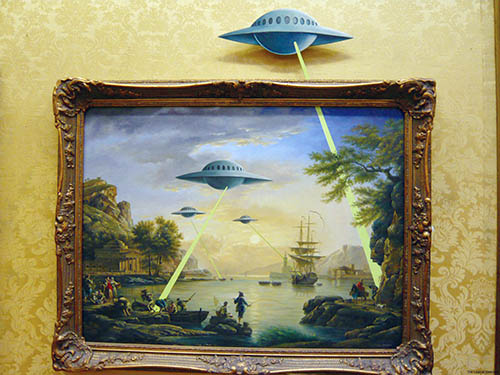
    ‘UFO invasion’ by Banksy

    Parallel Universes and Quantum Physics

    The idea there are multiple dimensions is increasingly supported by modern science, particularly in the field of quantum physics. In 1957, Princeton graduate Hugh Everett III proposed the ‘many worlds’ interpretation of quantum mechanics as a means by which to resolve the ‘wave-function collapse’ problem. The wave function is a mathematical expression of all potential states of a subatomic system, such as every possible location of a quantum particle. One cannot attribute a greater degree of reality to one state over any other; they all exist as mathematical potentialities until they are measured by a conscious observer, at which point the wave function ‘collapses’ and a single state becomes observable. This poses a problem in regard to what defines ‘measurement’ and why the act of observation affects reality at a subatomic level. In order to resolve this problem, Everett theorised that when a measurement is made one outcome occurs in the universe that we are currently occupying and another occurs in an alternate universe. In this sense, there are many different universes, not that different from our own, in which all possible outcomes occur.21 

    The ‘multiple-worlds’ theory has since been developed by other scientists. In 2014, physicists Michael Hal, Dirk-Andre Deckert and Howard M. Wiseman published an academic paper entitled ‘Quantum Phenomena Modelled by Interactions between Many Classical Worlds’, in which they propose there are an infinite number of universes that overlap one another and occupy the same region of space-time simultaneously.22 Furthermore, multidimensionality is a key component of string theory, which proposes that subatomic particles are comprised of multidimensional ‘strings’ or ‘string-loops’.

    As modern science finds more evidence for the existence of multiple universes, the interdimensional explanation for alien abductions and their connection to the paranormal starts to make a lot more sense. As the American ethnobotanist, mystic, and psychonaut Terence McKenna (1946–2000) observed, “if you take the broad world of the so-called mysteries – parapsychological, shamanic, extraterrestrial, and so forth – and hypothesize another spatial dimension, then all these mysteries become trivial… This sort of thing becomes quite the ordinary run of things if were hypothesize dimensions hidden from ordinary experience.”23 

    Conclusion

    As one can see, there is a close relationship between alien abductions and the paranormal. The research undertaken by Simon Brian Harvey-Wilson, Denise Stoner, Kathleen Marden and John E. Mack suggests that many abductees experience poltergeist activity and develop healing abilities. They also experience a greater connection with friends, family and the environment as part of a wider spiritual transformation. While scientific materialists might claim that abductees are more prone to paranormal experiences because of their neurology, this argument is redundant when one considers that all sensory experience originates in the brain. Just because a phenomenon has a neurological explanation does not make it invalid or implausible. 

    An intriguing explanation for alien abductions and the paranormal is that they reflect alternate dimensions existing outside the ordinary boundaries of sensory perception. From this perspective, the brain operates much like a television set and can ‘tune’ into different frequencies of reality. While this theory may seem absurd, modern science is finding increasing evidence for the existence of multiple dimensions. The ‘many worlds’ interpretation of quantum mechanics, as well as the theoretical framework of string theory, suggests there are multiple universes overlapping each other within the same region of space-time. 

    If abductees are able to somehow access these parallel worlds and communicate with beings of an interdimensional nature – or indeed ‘extraterrestrials’ are breaking through into our world – then paranormal phenomena could be the result of interacting with these alternate dimensions.  

    [alert type=”general” dismiss=”no”]This article was published in New Dawn Special Issue Vol 13 No 1.[/alert]

    [alert type=”success” dismiss=”no”]If you appreciate this article, please consider subscribing to help maintain this website.[/alert]

    FOOTNOTES
    1. https://en.wikipedia.org/wiki/Barney_and_Betty_Hill
    2. https://en.wikipedia.org/wiki/Alien_abduction_claimants
    3. Richard Boylan, Close Extraterrestrial Encounters: Positive Experiences with Mysterious Visitors, Wild Flower Press, 1997
    4. K. Ring, The Omega Project: Near-Death Experiences, UFO Encounters and Mind at Large, William Morrow & Co, 1992 
    5. W. Strieber, Confirmation: The Hard Evidence of Aliens Among Us, Simon & Schuster, 1998
    6. www.kathleen-marden.com/et-contact-what-experiencers-know.php 
    7. https://ro.ecu.edu.au/cgi/viewcontent.cgi?article=2390&context=theses
    8. www.kathleen-marden.com/et-contact-what-experiencers-know.php
    9. Ibid. 
    10. Ibid.
    11. C. Line, ‘The Jinn – From a scientific viewpoint’, Flying Saucer Review 34 (4) 13-18, (1989)
    12. A. Druffel, ‘Input into the infra-red/ultra-violet theory’, Flying Saucer Review, 37 (4), 5-10, (1992)
    13. https://ro.ecu.edu.au/cgi/viewcontent.cgi?article=2390&context=theses
    14. J.E. Mack, Abduction: Human Encounters with Aliens, Simon & Schuster, 1995
    15. www.kathleen-marden.com/et-contact-what-experiencers-know.php
    16. M. Eliade, Shamanism: Archaic Techniques of Ecstasy, Penguin Arkana, 1951/1989
    17. P. Hough & P. Rogers, ‘Individuals Who Report Being Abducted by Aliens: Investigating the Differences in Fantasy Proneness, Emotional Intelligence and the Big Five Personality Factors’, 2007, https://journals.sagepub.com/doi/abs/10.2190/IC.27.2.e 
    18. N. Pope, The Uninvited: An Expose of the Alien Abduction Phenomenon, Simon Schuster, 1997
    19. C.D.B. Bryan, Close Encounters of the Fourth Kind, Orion Books, 1996
    20. https://grahamhancock.com/the-consciousness-revolution-hancock/
    21. www.scientificamerican.com/article/hugh-everett-biography/ 
    22. https://arxiv.org/abs/1402.6144
    23. www.scribd.com/document/211958906/Z-Aliens-Archetypes-Terence-McKenna

    © New Dawn Magazine and the respective author.
    For our reproduction notice, click here.
  • The 7 Chakras: Portals to Cosmic Awakening

    The 7 Chakras: Portals to Cosmic Awakening

    From New Dawn Special Issue Vol 12 No 4 (Aug 2018)

    The chakras are our energetic blueprint. The knowledge of the chakras is a critical component to genuinely understand the nonphysical energy body. To understand who we truly are, we need to investigate this component of our being that is normally invisible to the naked eye – know thyself.

    The word chakra itself means wheel in Sanskrit. This is due to the fact that the chakras are circular in shape. The chakras, however, do not spin. The nadis and the spokes or petals as they are sometimes called are fixed. It is the energy or prana that spins or moves through the chakras. An excellent comparison is the acupuncture points from Chinese medicine. These specific points are fixed yet it is the chi or the life-force that moves through the meridians.

    The chakras are much more than just energy centres. The 7 chakras are complex in nature. They are responsible for maintaining physical, emotional, mental and spiritual well-being. In fact, the condition of the aura and the chakras will have a direct correspondence to a person’s health as well as their emotional and psychological state. Although there are seven major chakras, numerous secondary chakras have specific and different functions.

    They represent the complete spectrum of human consciousness. These states can fluctuate depending on the various situations we experience and how we integrate our awareness into our experience. They are our interface to the universe and our potential for evolution and inner transformation.

    Muladhara Chakra – root support in Sanskrit

    This chakra is related with the Earth element and consists of 4 spokes. Muladhara is essentially the battery of the being and is responsible for vitality. Many people who suffer from low energy levels are often disconnected from their inherent source of vitality, the Earth. People who work in big cities, in tall buildings, with air-conditioning are fundamentally deprived of prana, the basic life-force. By connecting with the Earth, even the simple act of walking on the beach (barefoot) will energise this chakra.

    As this chakra is the root, it will directly influence the ‘glow’ of the other chakras and the aura in general. It is the foundation and the base level of our energetic being. It is also the home of kundalini shakti, the primordial energy that although dormant in most people, once awakened rises through the energetic column known as sushumna nadi creating transformation and spiritual awakening as it fuses with the crown. This awakening is the union of energy and consciousness, which is the fusion of the feminine and masculine to produce states of samadhi or cosmic consciousness.

    Psychologically, the energy of fear and greed is located here. This creates a fight or flight mentality. Muladhara is also responsible for the overall integration on the physical plane.

    This chakra is the location of some of the most basic instincts such as survival, shelter, eating and sleeping. In comparison to the upper chakras, muladhara is a more primitive form of consciousness but highly significant for maintaining life. Physically this chakra controls the bones and the teeth, the dense aspects of our being and is also related with the sense of smell.

    Svadhisthana chakra – one’s own dwelling place in Sanskrit

    This chakra is related with the water element and consists of 6 spokes. Svadhisthana is a highly significant chakra as approximately 80% of humanity is dominant in this form of consciousness. Similarly, approximately 75% of this planet is water. This chakra is related to the collective consciousness and incorporates many of our social norms, ‘the done thing’.

    As svadhisthana is related with the water element it will take the shape of any receptacle that it is poured into. If you pour water into a glass, it takes the shape of the glass. If you pour water into a pot, it takes the shape of the pot etc. This is notable as it reflects the lack of distinct individual values and beliefs that define svadhisthana. This chakra is therefore the crowd, the masses or the perceived norm. Opinions and beliefs are malleable to ‘fit in with the crowd’. If everyone is talking about the football, the person who thinks at the level of svadhisthana will want to fit in and then display an interest in football. This consciousness also reflects the need to ‘keep up with the neighbours’, be respectable and conform.

    This way of being has given rise to the derogatory term ‘sheeple’ by those in the awakening community. The global elite exploit this form of consciousness as people who perceive reality through this lens just ‘go with the flow’ and are in fact afraid to be different or adopt an attitude that goes against mainstream beliefs. This is the core of the manipulation and control because this consciousness is simply not able to evaluate control systems and methods of manipulation. Judgment is unproductive as when this consciousness is dominant it is simply not possible to decipher the orchestrated methods of global control and deception.

    The Roman phrase ‘give them bread and circuses’ summarises the distraction and entertainment-celebrity-gossip consciousness of today, which is precisely designed to keep humanity locked in the lower of frequencies of existence. Moreover, the sense of taste is the sense governed by svadhisthana, which is typified by fashionable ‘foodie’ culture and further reinforces the point. This reflects the pleasure seeking nature of svadhisthana.

    Breaking free of these control systems requires a rising of consciousness to begin to understand the powerful indoctrination that humanity currently endures and having the ‘eyes to see’.

    Svadhisthana is also related with the moon, sexuality and reproduction hence the relationship to the genitals and the tongue. A sexy, charismatic or charming person is a definitive characteristic of svadhisthana chakra. Even forms of dance that involve sensual movements of the pelvic area is a reflection of the consciousness at this level.

    When most people consider their personal issues and emotional problems, they are predominantly on this chakra. The water element is quite heavy and thus depression, feeling dejected, self-pity and sadness are all related to impurities or imbalances in this chakra.

    Manipura chakra – city of jewels in Sanskrit

    This is a reference to the dazzling aspect of manipura as it is related to the fire element and consists of 10 spokes.

    Manipura is the antithesis of svadhisthana as it is related to the Sun and the qualities associated with leadership, authority, power and self-confidence. Svadhisthana is the crowd. Manipura are the leaders of the crowd. This consciousness assumes the role of leadership, the emotional and psychological connection to success and ‘making it’ as well as positions of influence and power.

    In essence, all personal development teachings to be more motivated, productive, dynamic, confident and to believe in oneself are related to this chakra. This is an expression of the fire element which embodies these qualities.

    However, the lower emotions of manipura include anger, frustration, rage, arrogance and egocentric behaviour. This is an expression of the disharmony of the fire in an impure state. The precision and control of martial arts is also related to this chakra, which is a reflection of the legs being connected to this sphere of force. The sense of sight is also related to manipura chakra.

    Importantly, the lower three chakras are not ‘bad’ as there is only an issue if there are impurities, blockages or the chakras are imbalanced. Otherwise there will be an ongoing harmonious experience. Yet all negative states of consciousness and emotions can be attributed to these 3 lower energy centres.

    Anahata – unstruck in Sanskrit

    This refers to the quality of the soul that is indestructible or eternal. Anahata chakra has 12 spokes and is related to the air element. The numbers of spokes the chakras have is significant as there is a relationship between the number of spokes of the chakra and the consciousness that is embodied. For example, in regard to anahata, the 12 astrological signs, the 12 months of the year, the 12 hours of the day, the 12 disciples of Jesus, the 12 different names of the Sun god Surya (and there are many others), all have a relationship to the heart.

    The consciousness of the heart is also considered a key aspect of the ongoing planetary Paradigm Shift. Many mystics claim that this is the cosmic plan for humanity and the future earth will be characterised by love and compassion.

    Yet the prevalent issue of heart disease in today’s society although can be related to dietary and lifestyle choices is still a disharmony at the level of the physical heart.

    Significantly, the etheric body and the chakras control the physical body. If there is a disturbance, weakness or blockage in the subtle bodies, this will eventually be reflected in the physical body. Generally, the deepest and most complete way of healing an emotional issue is to work directly on the non-physical aspect of our being. Although this is not true in every situation as once a health issue has manifested in the physical body, the health of the physical body also needs to be addressed. The cause of the issue itself can be due to an emotional imbalance, which will originate in the astral body at the emotional level and then filter through to the physical body. This is definitively the body-mind connection.

    The consciousness of the heart is always beautiful. These qualities of tenderness, softness, humility, self-abnegation, compassion, forgiveness, empathy, affectivity, self-acceptance, pure unconditional love and deep inner peace are all wonderful aspects of anahata chakra.

    There is also a form of deep refinement, a certain gracefulness and a deep harmony that reflects an individual with this resonance. The connection to the air element also gives an energetical lightness to someone who is dominant at this level. The arms and hands are related to the heart and this correlates with the sense of touch and the practice of various forms of healing through the hands which all correspond to anahata chakra.

    Anahata chakra is also significant as there are 3 chakras above and 3 chakras below. This is the middle way or middle path of the heart that unites the lower and higher aspects of our being.

    The chakras also comprise the polarity of the universe – the plus and the minus, the solar and the lunar, the yin and the yang. Thus in the case of the heart, the capacity to feel love, to understand and to receive love is yin. The ability to emit love, to produce it and to manifest love is yang. This means the chakras needs to be balanced and centred between the 2 poles of the universe for deep and profound harmony.

    Visuddha – especially pure in Sanskrit

    This chakra is related with the ether, which is the fifth element and has 16 spokes. The number of spokes or petals is significant as this is an indicator of the complexity of consciousness. As the chakras move higher in the body they also become more complex in their scope of consciousness.

    Visuddha chakra is related to time and space. This is the true nature of reality that transcends the experience of time from the limited perspective of past, present and future. At this level, time is experienced as a single duration – the eternal now. Visuddha encapsulates the vastness of space, the cosmos and the expansion of the universe. This elevated sphere of consciousness also includes aesthetics, sacred geometry – and a deeper form of inspiration that can unlock the mysteries of the universe and discover the true laws of reality. Some classical music also has the frequency of Visuddha, which has a pristine and sublime resonance.

    This level of consciousness is rare on this planet at this time, yet traces are still apparent such as the exceptional aesthetic qualities and precision of the Great Pyramid at Giza.

    As this chakra rules over the thyroid and parathyroid glands and as thyroid health issues are common today for women over 40, it is important be aware of the significance of this energy centre for maintaining good health in this area of the body.

    The purity of visuddha chakra filters through to an individual’s actions and the type of environments they frequent and the lifestyle they adopt. Clairaudience is another aspect of visuddha as hearing is the sense connected to this energy centre. Other paranormal powers also include the ability to access the akashic records. The throat chakra also governs the power of speech from a very elevated perspective.

    Ajna – command in Sanskrit

    This chakra is related to the mind and has 96 spokes although is it often depicted with just 2 large petals. This is related to the fact that it is the final level of polarity (yin and yang) before connecting to unity consciousness.

    Ajna chakra is a truly elevated sphere of consciousness that few can truly embody in today’s society. The power of ajna is to offer a superior form of intellect that is consistent with that of a genius. Examples include those people that can flick through a telephone book and remember the numbers of each person, a chess player that can play numerous games of chess simultaneously and win, as well as those that can learn and retain knowledge quickly, all resonate with the power of the third eye.

    Ajna chakra also contains the power of clairvoyance, telepathy and a form of ‘knowing’. Some of the great prophets of history such as Nostradamus had their gift from the opening of ajna chakra. The third eye has this capacity for one to be a seer or a visionary – the ability to see with the mind’s eye.

    The assumption that as ajna is connected to the mind that all mental health issues are related to this chakra is incorrect. Each chakra has an aspect that is connected both to the emotional body as well as the mental body. So it is best to harmonise the chakra that is relevant to the specific emotional or mental issue. Although, because of its superior nature, ajna does control the chakras beneath it.

    Sahasrara – thousand-petaled in Sanskrit

    Although sahasrara is not technically structured in the same way as the 6 other major chakras, it is still classified as one of the 7 chakras. This is because sahasrara is not a wheel but it covers the top of the head and is shaped like a steeple pointing upwards, similar to the ‘crown’ of Buddha.

    Sahasrara is the pinnacle of human evolution. Its activation produces states of samadhi or cosmic consciousness in the yogic tradition. This opening creates what is known as enlightenment, moksha, mukti, sartori, self-realisation and is the gateway to transcendence to experience the true nature of reality.

    The consciousness of sahasrara is characterised by lucidity, detachment, sacredness and a higher state of consciousness. Sahasrara is the sum total of all the chakras. The enduring symbol of the beam of light fusing with the prism and then dispersing into all of the colours of the rainbow succinctly represents the quality of this chakra. This is because sahasrara has no polarity, it is oneness and is unity consciousness. Sahasrara embodies the ultimate oneness of creation and eliminates the role of the ego that creates the illusion of separation.

    The subject of the chakras is a vast one. Human beings are a direct carbon copy of the Universe. The quantum physics understanding that the part is in the whole and the whole is in the part reflects this wisdom. Ultimately, to fully embody and know the 7 chakras is to know the universe and experience the complete spectrum of consciousness that is the potential of humanity.

    [alert type=”general” dismiss=”no”]This article was published in New Dawn Special Issue Vol 12 No 4.[/alert]

    [alert type=”success” dismiss=”no”]If you appreciate this article, please consider subscribing to help maintain this website.[/alert]

    © New Dawn Magazine and the respective author.
    For our reproduction notice, click here.