New Dawn – World's Most Unusual Magazine

Category: Articles

  • Mysterious Beasts & Natural Wonders: Toward a New Understanding of Bigfoot, Flying  Saucers, Fairies & other Inconvenient Realities

    Mysterious Beasts & Natural Wonders: Toward a New Understanding of Bigfoot, Flying Saucers, Fairies & other Inconvenient Realities

    From New Dawn 179 (Mar-Apr 2020)

    Several years ago a critic wrote about me, “Horowitz is an okay historian, but the guy believes in leprechauns for chrissakes.”That is true – I plead guilty. In this paper, I will try to explain why my critic is right. 

    Although I am not a crypto-zoologist, I am a great admirer of the paranormal investigator Charles Fort (1874–1932). People wouldn’t necessarily call me a Fortean, though. I don’t study anomalies. But my critic was referencing a series of events that I once related, which happened to me about 20 years ago in the nation of Belize in Central America. 

    For those of you who don’t know Belize, it’s a very beautiful, English-speaking country that borders Guatemala and Mexico on the Caribbean. Belize is filled with lush forestry, rainforests, snaking rivers and hills – including vast hills in the highlands, which are the subject of folklore and mysteries. 

    I was staying in the hill country at an eco-jungle lodge founded by a very enterprising couple and their kids from Maryland. They carved the whole place themselves out of the jungle interior. The area attracted a fair amount of ecotourism. Staying at a lodge next door was the actress and model Brooke Shields (who was very nice). 

    Now, a cabdriver was taking us to this jungle lodge from the airport in Belize City. It was a long drive of about two-and-a-half hours. The final leg ascended a very rocky, unpaved road up a mountain. It was difficult to navigate in a standard car because the rocks and roots and undulating landscape caused the car to hit bottom from time to time, and the terrain can damage the chassis.

    As we drove up the hill, the driver started saying, “I really don’t like going up into these hills. As soon as I drop you off, I am going to turn around and speed off and get out of here.” It seemed odd to speed away on such treacherous landscape. “What’s the rush?” I asked. 

    “Well,” he said, “there are little men who live in these hills. They’re called aluxes. They’ve lived here for centuries. If you see one of them while you’re walking around in the forest you’ll get so frightened that you won’t be able to speak. Your voice will get caught in your throat. I really don’t like coming up here.”

    Sure enough, he dropped us off, turned around, and sped away. I thought, “Well, that’s kind of strange.”

    We checked into the lodge and the next day went canoeing down a river that ran below the ridge on which it was perched. I started telling one of my travelling companions that I was really kind of pissed off at this cab driver because I thought he was just playing “scare the tourist.” I thought he was trying to have a little fun at our expense.

    As I was talking about this, drifting along this deadly quiet river, a big boulder came crashing down in front of us, having been rolled down a hill or falling down a hill from somewhere along the ravine we were canoeing through.
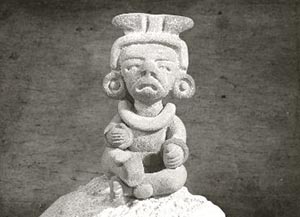
    Figurine of an Alux – Belize’s legendary “little folk.”

    I got nervous and I thought, “All right, I need to watch what I say.” Because there’s a folk tradition that if you talk about these creatures they come around. This is why some people in Ireland today won’t make reference to “little folk” or leprechauns – they use euphemisms like “the other crowd.” This opens an interesting point: you find traditions of these little creatures all throughout the world. This folklore exists in Central America, in Ireland, in Polynesia, in West Africa. Virtually every continent has these legends, going back centuries, which include the detail that if you start talking about these little beings, sometimes called wood sprites or fairies or brownies, you invite them into your life, and they can cause mischief.

    Many traditional-minded people in Ireland today believe so strongly in the existence of “the other crowd” that in 1999 a major highway under construction in County Clare got rerouted to avoid running past what was known as a fairy bush – the domain, so it is said, of these little beings. The fear was that if you run a highway through a fairy bush you will incur their wrath, and they will cause accidents. A folklorist and historian named Eddie Lenihan, with whom I’ve worked and greatly respect, helped prompt the change. 

    Who Goes There?

    Perhaps I’m sympathetic to these events because I do not want to live in a world where no mysteries remain. I do not want to live in a world where you hear a twig snapping in the woods and don’t wonder, “Who goes there?” I don’t want to live in a digital, fluorescent-lit environment in which we feel that we know everything that’s out there.

    Call it sentiment, but I think that most of us feel intuitively, and sometimes through personal experience or study, that the belief nothing at all is lurking in the dark corners doesn’t cover all the bases of life. 

    There exists so much testimony and so many stories of people having unusual experiences with things that are not supposed to be there, whether they’re little men or Bigfoot or something that’s lurking in the water. We’re all attached to these stories to some degree. Obviously, the concept of Bigfoot or some kind of mysterious simian runs not only through a great deal of our folklore but wields a great hold on people’s attention today. 

    The question is, why? We face so many crises and problems in the world: war, climate change, famine, and all of the wonderful things coming out of the White House. Why would we be interested today in the persistence of mysterious winged beasts or Bigfoot or yeti or fairies? For what reason?

    I think part of the reason is not only that some of these things may be empirically real – when considering the paranormal I do not remove empiricism from the table prima facie, a point to which I’ll return – but I think our fascination with mysterious beasts and natural wonders speaks to how we feel, and have reason to feel, that there exists an unseen dimension of life. Something beyond our workaday, five-sensory existence.

    What I am describing goes beyond a wish to believe in the mythical. Rather, it touches upon our understanding of a world that doesn’t fully disclose itself, but that we experience intuitively, insightfully, and even cognitively in terms of phenomena that may be causatively related to our minds, as well as to unseen dimensions, the reality of which we’re unable to fully decipher but which we catch glimpses of from time to time. 

    The UFO Thesis

    This is true also of so-called UFO or extraterrestrial sightings. I think that we are actually living through a moment, in the here and now, where we are experiencing a cultural breakthrough in understanding about the existence of unknown forces and expressions of life.

    This can be seen in particular with regard to the UFO thesis. In September 2019, the Guggenheim Museum in New York City hosted a remarkable, and I would say unprecedented, panel on UFOs and extraterrestrials. This was notable in itself because the Guggenheim is not considered a fount of occult passions. This is the first time I can recall any major cultural institution in the city hosting a panel like this and earnestly exploring this question.

    The panel was the work of a very innovative curator, Troy Therrien, who oversees the Guggenheim’s architectural collection. It featured writer and scholar Gordon White, a wonderful occult intellect, and philosopher and historian Diana Pasulka. It was a fascinating program before a packed house. Afterwards, the curator asked me: “At what point do you think it is going to become intellectually embarrassing within our culture not to take seriously the question of UFOs?” I told him that I do not refer casually to paradigm shifts. I often deflect questions from mainstream journalists about supposed occult revivals because I think such framings are usually a way of trying to find a news hook. I don’t speak casually about those kinds of cultural shifts. With that in mind, I replied, “I actually think, in all honesty, that we have just now, at this very time, entered the point culturally where it is no longer sustainable or even intellectually serious to wave off the notion of UFOs.”

    This shift arose in part from an event in 2017. The Pentagon and the Navy released cockpit footage and recordings of pilots witnessing UFOs, including vehicles moving at unbelievable speeds, behaving in ways that airborne vehicles are not supposed to behave, and the pilots asking: “What is that?” This material was so plain, clear, and persuasive that it moved even holdouts in the gatekeeping culture to acknowledge its significance. 
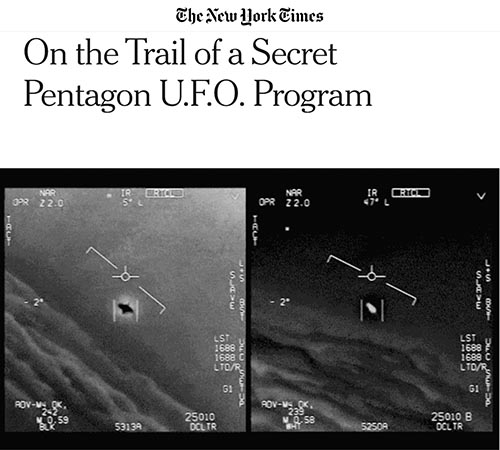
    The footage appeared in a prominent and widely read piece in The New York Times, co-written by the excellent researcher Leslie Kean. I consider it one of the most significant news stories because it finally moved the dial on the debate. The question of what UFOs are remains unsettled, of course; but that the testimony and records of such phenomena raise profoundly valid questions is now denied by no serious person.

    I date the before-and-after of this shift to a pair of columns that appeared in the same newspaper by the opinion writer Ross Douthat. This writer considers himself a no-nonsense, old-school conservative, of which we have few remaining in the US. In December 2017, Douthat wrote a column headlined “Flying Saucers and Other Fairy Tales.” As you can gather, the column denigrated interest in UFOs as a persistent and silly trope. Oddly enough, as a device for dismissing the delusions of UFO acolytes, Douthat used the work of my friend Jacques Vallée. Jacques is known not only for co-designing the prototype of the Internet, but he is also one of the most trenchantly intelligent UFO researchers of our time, as well as a brilliant social observer and writer. His diaries Forbidden Science revive a style of serial-memoir writing that hasn’t been seen since the early-to-mid twentieth century. 
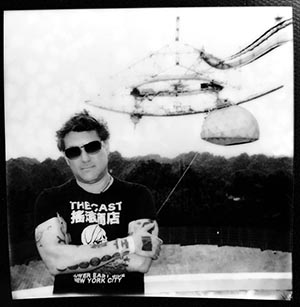
    The author Mitch Horowitz at Arecibo Observatory radio telescope in Puerto Rico, USA, which maps the cosmos using radio waves and also seeks ET contact. The Observatory is famous for the “Arecibo message,” a 1974 interstellar radio message carrying basic information about humanity and Earth sent to globular star cluster M13. Photo credit Jacqueline Castel

    The columnist cited Jacques as saying that there was mechanical unlikelihood of vehicles from outer space being able to reach our terrestrial confines. But what Douthat omitted in Jacques’ work, and what is most distinguishing in his theorising about UFOs, is that he long ago posited there are so many apparent mechanical impossibilities involving UFOs that, following the principle of Occam’s Razor, it’s plainer and broader to theorise that some of these sightings may be extra-dimensional. I’ll say more about that and define what is meant by extra-dimensional. Oddly, the columnist entirely omitted that key facet of Jacques’s outlook.

    Flash forward to August 2019, a month before the Guggenheim panel. The same columnist reversed course and wrote a piece, while not related specifically to UFOs, in which he noted the persuasive (if unsettled) nature of some of the UFO data that had recently been released, without noting that less than two years earlier he dismissed the validity of considering such data. I tweeted my thanks that he had seen fit to change his position. To my surprise, the New York Times opinion section retweeted me – another institution not known for its occult passions. I began to realise, typified by this little turn of events, that we have reached a turning point where it was intellectually unserious to dismiss the UFO question. I would challenge any materialist scientist or philosopher to push back against that statement. 

    Random Numbers & Patterns

    Until 2007, there was a parapsychology lab at Princeton University. It was known by the acronym PEAR for Princeton Engineering Anomalies Research Lab. This was a serious parapsychology lab in existence for about 30 years. When PEAR was operating it conducted a number of experiments with machines known as random number generators. We use random number generators every day – they produce an infinitely variable pattern of numbers and we commonly use these things to set passwords. 

    Parapsychologists sometimes use random number generators to test for ESP or telekinesis. They might place a subject in proximity to a random number generator to see if he or she proves capable of disrupting the randomness, of creating a signal in the noise, so to speak. Perhaps I jump to a conclusion by using the term create – but, rather, there is congruity between the individual’s efforts to interrupt randomness and the appearance of a pattern that shouldn’t be there.

    One of the things the Princeton lab did, going back many years, was to place random number generators at various locations around the world. It was found – and there have been journal articles about this and I’m simplifying it somewhat – that during the events of 9/11, immediately preceding the events, during them, and immediately following, the random number generators started displaying patterns.

    There was an interruption in these completely randomised and chaotic displays of numbers. Suddenly numbers would repeat. There was a traceable pattern at certain moments. Researchers were left with an enormous question, which begs further research and further understanding: Why, at a moment of what could be loosely described as a global trauma, did this network of random number generators demonstrate a pattern, an interruption in the noise?

    This raises the tantalising prospect of mental causation. Of whether we, through the agency of thought, are able to impact and produce outcomes. This isn’t a paper on mental causation, but there are many different scientific fields, including neuroplasticity, quantum mechanics, placebo studies, and psychical research, that have demonstrated causation relating to thought. One way of empirically discussing the manifestation of energies is to note that during that period of global trauma we saw some apparently unified impact of thought, which was exercising probable telekinetic influence on this network of random number generators.
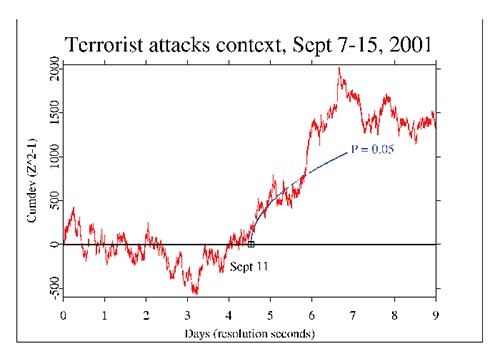
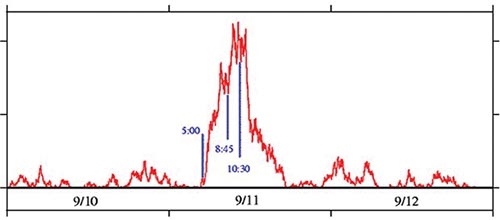
    The Princeton Engineering Anomalies Research Lab, a research program at Princeton University that studied parapsychology (and was closed in 2007), established the Global Consciousness Project in 1998 to detect possible interactions of “global consciousness” with physical systems. Employing electronic random number generators in locations around the globe (see map), the project detected anomalous fluctuations in the nine-day period around the September 11, 2001 terrorist attack as per the graphics. When great events synchronised the feelings of millions of people, their network of RNGs became “subtly structured.” (see http://noosphere.princeton.edu)

    Check Your Foundation

    I think we may be approaching a new way of understanding Bigfoot sightings, UFOs, persistent reports of anomalous beasts and things that go bump in the night and twigs snapping, so to speak. 

    People in many reaches of US society are obsessed with the existence of Bigfoot. It is the subject of these mostly awful cable TV pseudo-documentaries; it fuels an enormous stream of books, articles, debates, and controversies. Scientists complain that no one has been able to produce viable DNA evidence of Bigfoot. One might argue that point, but that’s the broadly held critique. 

    If one concedes the point, however, it could open to a more radical and supple thesis. Several scientists, including Richard Feynman, have observed that you can’t get out of a problem by employing the same thinking that got you into it. I’ve found that is a universal principle. I have found it a good principle in writing, for example. If you write a sentence or paragraph and you’re wrestling with it and clarity keeps eluding you, there’s probably something wrong with the foundation. It’s best to toss out the line or paragraph and start fresh. If something proves chronically difficult – this is true in relationships, too – there’s probably a flaw in the foundation itself. 

    The same may hold true for the question of mysterious beasts and natural wonders. Maybe the reason we don’t find more physical or DNA evidence is that, while these persistently reported phenomena are real and are actually occurring, they do not necessarily conform to our five-sensory material lives.

    This returns us to the observation that Jacques Vallée made about UFOs probably being some kind of inter-dimensional manifestation, which enter our awareness intermittently and then vanish. There may exist an infinitude, or superposition, of events occurring all the time and everywhere, which we are capable of measuring or experiencing only intermittently (such as in the cases of documentary imagery), fractionally, or at periods of extreme sensitivity, in the same way that ESP or telekinesis may manifest at highly receptive moments. This ties into the question of psychical energies being unleashed during instances of trauma or crisis or intensity.

    Super Events

    Consider it this way: Within the particle lab, more than eighty years of quantum experiments demonstrate that subatomic particles occupy a state of superposition or a wave state. As such, they appear everywhere at once. They exist in a state of infinite possibility. We know this because subatomic particles display interference patterns, which demonstrate that they are non-localized. They exist in a state of potential until an observer takes a measurement. When an observer decides to take a measurement the particle collapses from a wave state to localized state. Without that measurement, the particle will not occupy a definite, locatable place.

    This is not controversial. No quantum physicist would challenge eighty years of this data. What is controversial are the implications of the data, and the willingness of our culture to follow those implications. In the 1930s, physicist Erwin Schrödinger devised a thought experiment known as Schrödinger’s Cat. He intended to force his colleagues to acknowledge the impossible possibilities that occurred in the particle lab. Schrodinger challenged them to acknowledge the evident absurdity of what was being documented – of this surreal reality in which everything exists everywhere at once, in a state of infinitude.

    One variant of Schrödinger’s Cat experiment could be put this way: You take a house cat and place around its neck a collar with what Schrödinger called a “diabolical device.” Upon contact with a single atom this device releases a fatal poison. You take the collared cat and place it in one of a pair of boxes. You then direct a single atom at the two boxes. After you check the boxes to see the outcome. What would you find?
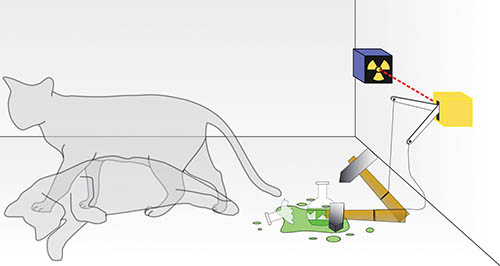
    Schrödinger’s cat thought experiment: a cat, a flask of poison, and a radioactive source are placed in a sealed box. If an internal monitor (e.g. Geiger counter) detects radioactivity (i.e. a single atom decaying), the flask is shattered, releasing the poison, which kills the cat. The Copenhagen interpretation of quantum mechanics implies that after a while, the cat is simultaneously alive and dead. Yet, when one looks in the box, one sees the cat either alive or dead, not both alive and dead. This poses the question of when exactly quantum superposition ends and reality collapses into one possibility or the other.

    All commonly observed reality dictates if the atom went into the empty box, the cat would be alive. If the atom went into the box that held the cat and tripped the poison device, the cat would be dead. Simple, right? But Schrödinger said, no, that’s not reality at all. You would have to allow for the existence of a dead/alive cat. Because at one time, when that atom was in a wave state, it appeared in both boxes at once. It became localized in a single box only when you went to check. 

    Hence, reality demands that you would have a dead/alive cat. It’s impossible, it makes no sense, and yet it’s absolutely required if we’re to accept the data from quantum physics. 

    In the 1950s, physicist Hugh Everett extrapolated further from the Schrödinger’s Cat experiment. Everett contended that the timing of your decision to look or not look in the boxes would create a past, present and future for that cat. If you were to wait eight hours, say, until you checked the boxes, you would not only have a dead/alive cat, but the alive cat, having been stuck in the box for eight hours, would be hungry. You actually created a past narrative and present for that animal. Your decision to look, not look, to wait, to not check it all, creates an arc of life for this animal. 

    That could be the actual nature of reality: all outcomes exist in infinite potential and become localized or actualised only when they reach our perspective. This may be a matter of measurement, focus, or awareness, accident or choice.

    Leaving aside the question of freewill (another issue entirely), what I’ve described raises the possibility that these persistent, extraordinary events – sightings of everything from serpents in the water, to mysterious winged beasts, to otherworldly beings, to gnomes, to Bigfoot – may be the result of perspective and of these things intermittently localizing in our reality.

    A related possibility comes from what is called string theory. String theorists try to explain the strange behaviour of subatomic objects, as well as why such objects affect one another at distances, and why, as Isaac Newton observed, even macro objects at vast removes mirror each other’s motions. String theory holds that all particles and all matter are not separate entities but rather are part of vast, undulating networks of strings. When an object at one point in space affects another object, we’re not seeing two distinct entities but a unified string of objects. What’s more, different dimensions and universes exist along these strings, so we may not always see the thing causing an effect. In string theory, all material and events are one whole. We catch only hints of this through exquisitely fine measurement. 

    When speaking of measurement, we naturally think of laboratory instruments. But what are our senses if not instruments of measurement through which we navigate reality? On the psychological scale, it may be that at moments of profound sensitivity, or at moments in which we are emotionally primed in a certain way – maybe through trauma, through euphoria, through a sense of crisis – we catch glimpses of things that are real but do not usually register with the senses or mechanics through which we experience daily life. Anomalous entities exist, but they exist at other points on a vibrating, cosmic string, or what we might call another dimension. That’s one theory. Another, not necessarily at odds with string theory, is that these anomalies occupy a state of superposition which you select into your locality – not manifest but select, which is my preferred term – through perspective.

    Hence, these strange events or entities may be real, but they are perceived only occasionally, and we give them names like Bigfoot or fairies or UFOs. These potentialities exist all around us, but we don’t possess the instrumentation to measure such things. Our way of viewing the world is coarse and limited – even illusory. For example, we organise our lives by linear time. Linear time feels very real. It’s overwhelmingly persuasive. But linearity itself is an illusion. It is a necessary illusion which we use to organise life, but it’s not real.

    We know that time slows down at or near light speed. The aging process slows when a being is moving near light speed. We likewise know that time slows or bends in environments of extreme gravity, like black holes. These things are no longer theoretical, they’ve been measured, they’re real, they’re actual. Yet they make no sense to us. As we go through daily life and our commutes and so on, it makes no impact on us that time can actually slow.

    Even knowing this, being able to understand this, being able to talk about this, doesn’t necessarily impact our everyday experience of linearity. Because linearity is probably a very necessary illusion for five sensory beings. But it’s a device, not ultimate reality. Ultimate reality is stranger than we’re given to believe. 

    Why Don’t We See Reality?

    Why don’t we pick up more on this material? Why does life seem so orderly to us? There’s just one of me here, there’s just one of you there, there’s one chair that you’re sitting on. There’s not an infinitude of chairs. It feels so practical, so actual. It’s difficult to imagine that any of this quantum or string phenomena can be real in more than an abstract way or on the subatomic scale. Philosopher William James, in his Gifford lectures in 1902, made an observation that speaks to this. When a mystic sees something, James said, it’s as if he or she is viewing it through a microscope. The mystic sees more and more of what’s really going on because of his or her extreme sensitivity.

    If I look at a drop of water, all I see is a common drop. It’s translucent, it feels like what I call wet. But if I look at that same drop through a microscope, all kinds of things are revealed. There are single-cell organisms, there are bacteria, there are molecules moving around. The molecules are made up of atoms and other particles that are similarly moving around. All kinds of things are occurring that I don’t normally see. 

    James made the contention that the mystic is always viewing things as if through a microscope. When you pan the camera back, so to speak, you experience less and less of what’s really happening. Without crediting James, quantum physicists today call this the phenomenon of “information leakage.” They respond to the apparent disparity between the particle world and our macro world by saying what James said, which is that when you’re measuring things with extremely fine and well-tuned instruments, you’re seeing more and more of what’s really going on. But when your capacity for measurement coarsens, you lose data and see less and less of what’s occurring.

    Just as linear time is a device, just as particles exist in a wave state or state of superposition, it is possible that we live amidst an infinitude of extraordinary events, which we perceive in only fragments or at fleeting moments, maybe moments of great awareness, maybe moments in which our ordinary thought patterns, for whatever reason, get interrupted, maybe moments that are available to some of you because you have a gift for what we call ESP or sensitivity or intuition. It could be that at such times, the individual is capable of seeing what’s really happening, and yet such individuals get smeared with terms like psychosis, fraud, imagination, fantasy, or confirmation bias. Materialists over-rely on the term confirmation bias to ignore testimony. Consistent testimony from varying sources forms a record and should be considered. Materialists fail to realise that confirmation bias, or prejudicial thought, is their own problem, too. 

    If my contention is correct, which is to say you get what you’re looking for, we’re all in the same boat. So let’s sit down together in an interdisciplinary way and have a conversation and try to determine the topography. We must try to understand more of what’s going on. We won’t get there if we dismiss or underfund or ban the so-called borderline sciences. Think of the possibilities that open to us if scholarly research into psi or extra-cognition really becomes available. If places like the Princeton Engineering Anomalies Research lab didn’t have to close because it was time for the founders to retire and nobody else had the energy to maintain the kind of fundraising or fight the battles that they fought to keep that lab alive.

    We have money for everything in this society. There’s no shortage of resources. And yet we always seem to cry poverty when it comes to dispensing resources in a more democratic way or allotting really modest sums to keep alive research into the nature of reality itself. The reason I appreciate today’s best paranormal investigators, and why I appreciate historical figures like Charles Fort, is because they poke holes in the straight story. They drive us to ask questions that might otherwise never get considered.

    A Damnable Bore

    Fort himself was a fascinating character. He was born in Albany, New York, in 1874 and lived and worked for much of his life in The Bronx. Like the occult scholar Manly P. Hall, Fort did a great deal of his research in the New York Public Library (where I now sit in a research room writing these words). Newspapers used to call Fort “the mad genius of the Bronx.” He produced his first of four books in the year 1919. It was called The Book of the Damned. By “damned” Fort meant the facts that didn’t fit in: outsider facts, theories, and ideas; facts that were considered unfit for consumption, so they were pushed to the margins.

    Fort would gather news reports of things happening around the world that weren’t supposed to be happening, like mysterious airships in an age before we had the term flying saucers; frogs falling from the sky; mysterious beasts; spontaneous combustion; telekinesis – all sorts of things that didn’t fit the straight story. 

    Some people thought Fort was a genius, that he was modernity’s greatest critic of science, because he understood that science in the early 20th century had formed its own orthodoxy, its own canon, to the point of excluding things that didn’t fit in. 

    The novelist Theodore Dreiser was a great admirer of Fort. He said, “To me no one in the world has suggested the underlying depths and mysteries and possibilities as has Fort. To me he is simply stupendous.” Whereas H.G. Wells called Fort “one of the most damnable bores who ever cut scraps from out-of-the-way newspapers.” So, there was a binary attitude about Charles Fort. But I’ve always loved the man, and I think his work has retained a legion of fans and readers precisely because he was capable of poking holes in the straight story. 

    Beastly Traits

    There’s another dimension to the presence of mysterious or allegorical beasts. Some of the beasts that appear in parable and mythology, like the sphinx or griffin or centaur, summon us to traits that are actual or potential parts of our personas, of our abilities as human beings, which we are divorced from, which get pushed off to the margins of our understanding, which we can speak of only in terms of metaphor because they’re not accepted, they’re not understood, they’re not integrated into the human story. As Charles Fort would say, they’re “damned.” 

    Obadiah Harris, the past president of Manly P. Hall’s Philosophical Research Society (PRS) in Los Angeles, shared a wonderful story with me a few years before his death in 2019. We held a very moving memorial service for Obadiah at PRS, which you can find online. Obadiah said that when Manly Hall used to ready himself in his office each Sunday morning prior to delivering his weekly talk, he would pause before his altar and rub a wonderful little Egyptian statuette of a cat. It was a black onyx model of Bastet, one of the Egyptian cat gods. He would rub this little cat for wisdom because a cat has the ability to see in the dark. Many people felt Manly displayed a preternatural ability of speaking extremely fluidly and at great length without notes. I’m not suggesting a connection but I did like the story. And this little cat really existed – I held it in my hands – but it has unfortunately disappeared from Manly’s office. We’d like to re-select this little cat into existence. 
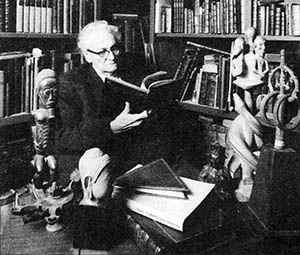
    Manly P. Hall (1901–1990), founder of the Philosophical Research Society, reading in his study.

    We often ascribe powers to animals that exist within ourselves, but that we don’t feel capable of summoning. We mythologise them. In that vein, I want to share the story of two episodes I experienced recently in Egypt in connection with mythical or allegorical animals.

    In February 2019, I was travelling in Egypt with my friend Ronni Thomas. Ronni is a brilliant film director and we are making a documentary about the 1908 occult book The Kybalion. I once regarded The Kybalion as a kind of early-twentieth century novelty of occult literature. Several years ago, however, I came to realise that I was wrong. I was underestimating the nature and the greatness of that short book. It’s a beautiful and very relevant distillation of the spiritual psychology found in the Hermetic writings that appeared during the final stages of Egyptian antiquity.

    For the film, we decided to go back to the source, as much as we were capable. Ronni made the courageous decision that we should do some filming in Egypt. Off we went to Egypt in the month of February. I can disclose this now that I’m safely back home, but we had no license to actually film because it’s enormously expensive. We had a decent budget, but it was out of reach. So we had to surreptitiously film in Egypt, which is no small risk because if you’re caught without the proper licenses, you will be arrested and thrown in jail, which is probably not a great experience. We were very aware of this, but felt that even though we lacked the proper licensure, and we simply couldn’t afford it within the confines of our budget, we just had to do this.

    We were able to get some extraordinary footage. There are sneak peaks of the documentary on YouTube and Vimeo. We expect the final film to be released in 2020. You’ll be surprised at how much footage we were able to gather illegally, but very lovingly, in Mother Egypt. We were also granted some remarkable access and opportunities. I had two opportunities that I want to share, both involving exposure to allegorical beasts.
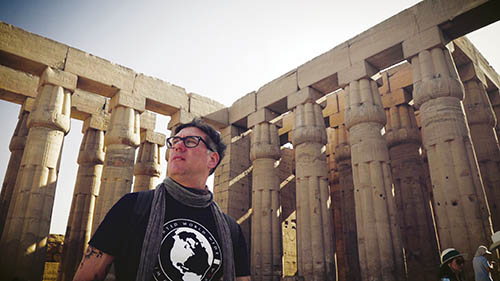
    Mitch Horowitz at the Temple of Karnak, Egypt, February 2019.

    Subterranean chambers exist in the Valley of Kings that are off the path of most people who visit Egypt. These chambers are accessible if you’re basically willing to pay the right people. My wish is that it wouldn’t be commerce alone that allowed people to gain entry to these places, but sometimes you have to deal with the world as it is. We were willing, as much as we were able, to pay off the right people to enter some places that are normally off limits. 

    After paying, we were able to enter a chamber very, very deep in the Valley of Kings. Within this chamber is a large bas-relief of a bull. A bull in Ancient Egyptian symbolism represents strength, virility, and personal power. It’s an enormously potent image within the pantheon of Egyptian deities and allegories. The guide who took me into this chamber gestured to me that it was permissible to touch and lay hands on this enormous bas-relief. The carvings in the chamber were incredibly well preserved. One of the astounding things that we don’t always realise when we look at Egyptian monuments is that they were originally colourised. They were not only three dimensional, they were not only covered in beautiful precious stones and finishing material, but they were majestically and very vividly colourised. Over time, the most widely seen or weathered monuments have lost this colour.

    This was within a very dry, temperate, cool underground chamber, and these images and bas-reliefs had been preserved going back thousands of years. I was a little uncomfortable when the guide invited me to lay hands on the bull because I have tremendous respect for antiquities, and I would never want to do anything to detract from the power and the beauty of these monuments. I’m very aware that if tourists and travellers are traipsing through the place all day and laying hands on the object, it gets damaged or degraded. And yet I felt that I was being given an invitation.

    The philosopher Jacob Needleman once said to me, “What do you do when someone offers you a gift?” Brilliant student that I was, I just stared at him blankly. He said, “You accept it!” So I made the decision to accept this gift. I can only report in all candour what happened. As I laid hands on this bull, I experienced, call it what you will, a tremendous rush of lightning and electricity shooting through my body, and I felt this sense of inner light within me. The only phrasing I can use to describe it is just feeling this flash of lightning pass through me. It was an extraordinary and tactile experience.

    Of course, one could say, “Look, you’re a suggestible guy, you’re an excitable person.” I don’t know, nor would the person saying that know, just what occurred. But I can only report that it was, for me, a palpable experience. Here I stood before this magnificent allegorical beast carved in a bas-relief going back more than 3,000 years, still fully colourised and vivid, and the symbol of virility and strength and power, and I was invited to lay my hands on it. I felt lightning absolutely pass through me. It was one of the most remarkable experiences of my life.

    We had another experience when we were at the Temple of Karnak in Luxor. Our guide was aware that Ronni and I had occult interests. There’s a colloquialism in Egypt for people like us – they call us “meditators.” Terms like occult and New Age don’t translate very well. Once they say, “Oh, you’re meditators,” then they know what you want to see. Our guide for this leg of the trip was an extraordinary woman who was multilingual even though she had never travelled outside the country. She learned English, French, and Korean on her own through BBC language courses. She brought us to a small temple to the cat goddess Sekhmet, which is tucked away on a side path in this vast complex. This small temple is closed and padlocked. A soldier toting an automatic rifle and a robed guide guard it. The only way to gain entry is by paying a bribe. Again, you sometimes have to deal with the world as you find it. And, of course, people are entitled to earn a living. 

    The soldier and guide looked at us like, “Who are these two mangy characters?” We very nicely said hello and greeted them with as much money as possible, and then everybody was all smiles. We were invited to enter this chamber to Sekhmet, a goddess with the head of a cat and the body of a woman. I can’t begin to tell you how completely dark it was inside this chamber. The chamber is thousands of years old and there wasn’t so much as a streak of light, with no cracks or fissures in the wall. 

    We were guided to kneel at the feet of Sekhmet and invited to kiss her feet and lay our hands upon her body and recite a prayer. We performed this short ceremony in pitch blackness. This, too, was an experience of absolute transcendence. There seemed to be a complete dissolution between us as separate beings and the goddess before whom we kneeled. I think we both experienced a sense of dissolving, almost like a lightness of body that felt something like what an out-of-body experience might be like. We felt a complete disassociation crouched in the darkness before this goddess. We felt, you could say, almost a sense of transcendent oneness with that before us, and everything briefly entered a state of non-physicality. It was remarkable.
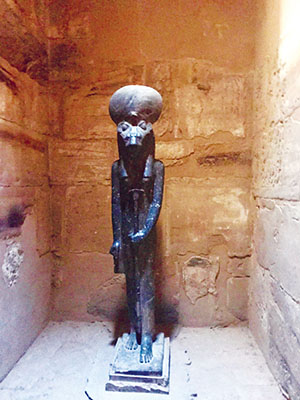
    Statue of Sekhmet in small chapel of the Temple of Ptah in the precinct of Amun-Re at Karnak Temple. The statue, which is about two meters high, receives light only from a small hole in the ceiling.

    I’m not someone who goes around collecting experiences, but this left us two travellers, two seekers going places off the permissible path, with perhaps some feeling for what our primeval ancestors might have felt in the presence of these extraordinary beings. The episode reaffirmed my belief, which I’ve explored elsewhere, that we have neglected some of the wisdom of our primeval ancestors who identified with and personified certain energies in deific form, and who gave these energies names, whether Set or Sekhmet or Bastet or Minerva or Zeus or Jupiter or Athena.

    They identified these energies, maybe as projections of their own intellect or maybe non-localized intellect, and deified them. They also petitioned them. When people come to me in need, when they’re feeling at a dead end in life or things aren’t going the way they wish, my suggestion, as an ethical and spiritual experiment, is to identify a god or goddess from the ancient pantheon, whether from Egypt, Persia, the Hellenic world or elsewhere, one with whom you resonate, one that is meaningful to you, one whose characteristics or traits seem to capture something that you need in life, and having done so I see no reason why you cannot enter a prayerful state and make a petition to this deity and see what occurs. You may find exactly the help that you need. My contention is that the old gods may be lonely. They hunger for human attention and veneration. 

    People from all over the world used to travel great distances to honour and petition these gods. That is no longer so. It could be that these personified energies or intelligences hunger for human contact; and if you make the personal decision to attempt a relationship with one of these deities and to make a petition, you could be surprised. 

    I speak to you from deepest personal experience. I would never offer something as a suggestion that I haven’t tried and experimented with myself. I’ve had some of the deepest, most meaningful spiritual experiences of my life by following the path that I just described. You certainly don’t need to tell anybody what you’re doing; you don’t need to tell your shrink or your boyfriend or your spouse. It’s yours. It’s your private experiment. It’s something I’ve found bountifully fruitful and significant. We displace onto certain ideals of allegorical beasts and deities and beings, traits that perhaps exist within us and that we are capable of selecting or having a relationship with.
    Reclaiming the Damned

    I have written elsewhere of how the snake or the serpent represented wisdom in cultures all over the world. This was true in Egyptian culture, this was true in Hebraic culture, this was true in Mayan culture, this was true in Celtic culture. Every culture around the world, spanning enormous stretches of time, distance, language, and custom, identified the snake as a symbol of illumination, possibility, provocation, and awareness. 

    I think that we, in the Western world, have made a tremendous misreading of Genesis 3, where we have associated the snake who conversed with Eve as a figure of evil or maleficence. Rather it was the snake who gave Eve permission to eat from the so-called Tree of Knowledge of Good and Evil, which the creator had placed in the midst of the garden, so the parable goes, even though the garden dwellers, who were supposedly beloved and cared for, were prohibited from eating from it and gaining awareness, and were told they would die if they did so. The snake told Eve, “You’ve been deceived. You will surely not die if you eat the fruit from this tree.” She took the challenge and did not die from eating the fruit, which she shared with Adam. Their eyes were opened, and they gained the capacity for measurement and creativity; they gained the capacity to argue with the creator, and they were expunged from the garden of paradise. Their offspring, Cain and Abel, so the story goes, got caught up in this tragic act of fratricide. But it’s very possible that the price of creativity, the price of awareness, the price of perspective, is friction. 

    Haven’t we seen this play out across our culture? In Europe, for centuries, they committed witch burnings, which are still occurring in parts of the world today. People who are clearly capable of functioning in the world are called lunatics or flying-saucer nuts when they have extraordinary experiences. Plato famously theorised that if we were all captured in a cave, chained and capable of witnessing reality only as shadows cast on a wall and someone was somehow able to leave the cave and came back and tell the other captives about the splendour that existed in the outside world, what would they do? They would kill the individual. 

    Isn’t that the story of the snake in the garden, essentially playing out over and over again? Every time a capable, mature, intelligent person speaks of an extraordinary experience, he or she is told, “Don’t talk about seeing a UFO. You’re going to lose your rank and your reputation within the Air Force. Don’t try to experiment with ESP, everybody’s going to think you’re a nut and you’re going to lose your departmental funding. Don’t question the standard dating of the Great Sphinx or of the pyramids because if you start questioning the standard timeline people in your department are going to get hostile toward you, and you’ll be branded a nut.”

    What do we do? We disassociate from these abilities and experiences and code them into parable, story, myth, and archetype, because it’s a way of distancing ourselves from abilities and possibilities that exist within the human experience, but that are easier for us to understand and talk about, that are less risky for us, if we classify them as mythology, as anomalies, as wonders, as little green men, as strange encounters. People who testify to these things in an actual way are treated, in effect, like Adam and Eve, expelled from the garden of paradise, or seen differently, expelled from the garden of conformity. Yet this state of affairs is getting shaken up at this very moment.

    As I mentioned earlier, I do not speak casually about paradigm shifts. Every generation seems to think it exists on some kind of a precipice. Some generations did indeed exist on a precipice. The World War I generation existed on a precipice. I don’t think one should speak about this casually. But I do believe we are facing possibilities and questions in our generation, at this very moment, that may upend our idea of what it means to be human as much as the theories of Darwin upended people’s views and understanding of human nature in the Victorian age.

    I think we’re poised on this precipice, where we look out at the world, we look out at testimony of wondrous beasts, strange beings, and anomalous events, and we’re coming to realise that we’re not necessarily looking at things that are fantasies or chimeras. We are actually looking into a mirror. And what we’re looking at is gazing back at us. These are the traits of our own personas that we’re becoming reacquainted with. Our personas are inter-dimensional, unmoored by linearity, and symbiotic with a larger cosmic reality than we have previously understood. 

    Mitch is lecturer-in-residence at the Philosophical Research Society in Los Angeles, where he originally delivered the lecture on which this article is based. 

    [alert type=”general” dismiss=”no”]This article was published in New Dawn 179.[/alert]

    [alert type=”success” dismiss=”no”]If you appreciate this article, please consider subscribing to help maintain this website.[/alert]

    © New Dawn Magazine and the respective author.
    For our reproduction notice, click here.
  • Rudolf Steiner: Dweller on the Threshold

    Rudolf Steiner: Dweller on the Threshold

    From New Dawn 171 (Nov-Dec 2018)

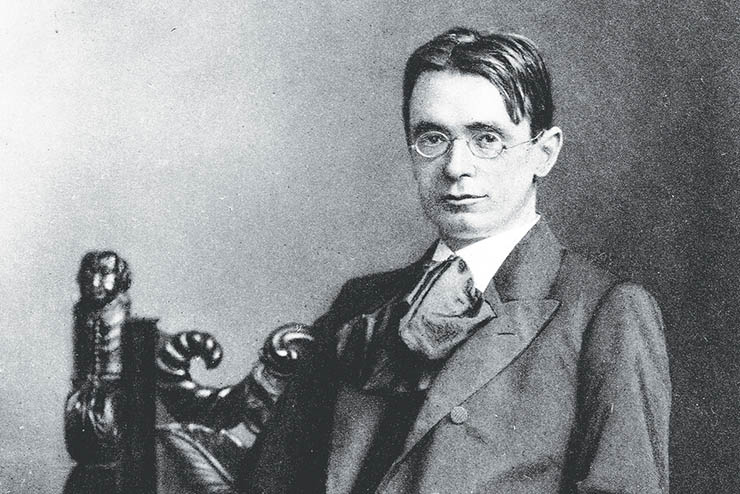
    The most enigmatic figure to emerge from the “occult revival” of the early twentieth century was also the most successful, the Austrian “spiritual scientist” Rudolf Steiner (1861-1925). Although many of his contemporaries were outwardly more eccentric – think of Madame Blavatsky, Gurdjieff or Aleister Crowley – it’s precisely Steiner’s sobriety that is so striking, making him seem somewhat out of place in the often flamboyant world of the esoteric.

    We generally associate ideas of the occult, higher consciousness and spiritual worlds with exotic, extraordinary characters with something of the trickster about them; Blavatsky, Gurdjieff and Crowley would certainly fall into this category. Steiner was precisely the opposite. Standing at the lectern with his pince-nez in hand, he projected an image of irreproachable rectitude. Steiner was earnestness incarnate, his one gesture of bohemian extravagance the flowing bow ties he was fond of wearing, a remnant of his early student days. Where Blavatsky, Gurdjieff and Crowley each took pains to present a formidable self-image, there was something simple and peasant-like about Steiner. Combined with this wholesomeness was an encyclopedic erudition. If we were to use an archetype to describe Steiner, it would have to be that of “the Professor” – or more precisely, “the Doctor,” as he was known by those around him. Commenting on her magnum opus, The Secret Doctrine, Madame Blavatsky once remarked that she “wrote, wrote, wrote” like the Wandering Jew “walks, walks, walks.” Steiner too wrote a great deal, but his main mode of disseminating his ideas was lecturing, and in the years between 1900 and 1925, he lectured, lectured, lectured, delivering more than 6,000 talks across Europe.

    In a dry and often pedantic style, Steiner informed his audience of the results of his spiritual research, his “supersensible” readings of the occult history of the world made available to him through what is called “the Akashic Record.” In matter-of-facts terms, he introduced them to his teaching, Anthroposophy, telling them along the way about ancient Atlantis, life after death, astral and etheric bodies, the true meaning of Christianity and much, much more. Yet this humble, self-effacing character became one of the most influential, and simultaneously vilified, forces in the spiritual and cultural life of early twentieth century Europe, and his ideas are still relevant today. 

    Steiner’s efforts to lead “the Spiritual in the human being to the Spiritual in the Universe” have produced remarkably concrete results. Since his death, more than 1,000 schools around the world work with Steiner’s pedagogical principles, not to mention the many special-needs schools, working along lines developed by Steiner a century ago. There are also the hundreds of “bio-dynamic” farms, employing Steiner’s agricultural insights, developed decades in advance of our interest in ecology and organic foods. The practical application of Steiner’s ideas had also informed very successful avenues in holistic healing, the arts, architecture, economics, religion and other areas. 

    Given these achievements in the “real world,” which certainly exceed those of other esoteric teachers, why isn’t Steiner better known? You would reasonably expect the average educated person to have some idea of who, say, Jung is, or Krishnamurti, or the Dalai Lama; possibly even Blavatsky, Gurdjieff or Crowley. But Steiner? He remains something of a mystery, a name associated with a handful of different disciplines and endeavours, but not solidly linked to any one thing. He remains, as one of his most eloquent apologists, the Inkling Owen Barfield, called him “the best kept secret of the twentieth century.” It’s certainly time that he was better known.

    Early Life

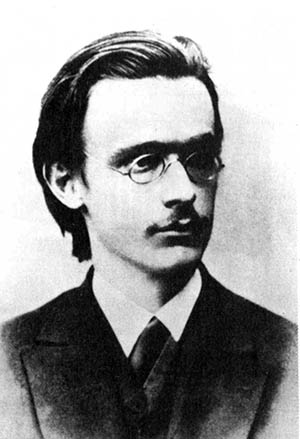
    Rudolf Steiner as 21-year-old student (1882)

    Rudolf Steiner was born on 27 February 1861, in the small rural town of Kraljevec in what was then Hungary but is today part of Croatia. His father was a telegraph operator for the Southern Austrian Railway, and Steiner spent his first years amidst magnificent scenery: mountain ranges and green plains were his playgrounds. Steiner felt that it was significant that he grew up in a part of Europe where East meets West, as it was also significant that childhood had an equal measure of natural beauty and modern technology – at the time, both the railways and the telegraph were relatively new innovations. 

    In Knowledge of the Higher Worlds and its Attainment (1905), Steiner relates that a crucial experience on the path of higher consciousness is an encounter with the Guardian of the Threshold, a spiritual being embodying one’s unredeemed karma. Well before his career as an esoteric teacher, Steiner was himself a dweller on several thresholds, having one foot in the mysteries of nature, the other in the methodology of science. It was this combination of mystic visionary and disciplined thinker that gave Steiner’s later career its peculiar character.

    The house where Rudolf Steiner was born, in present-day Croatia.

    When Steiner was eight, his father was transferred to Neudörfl, near the border with Lower Austria. An argument with the local teacher led his father to educate the boy himself, and this meant that he spent a great deal of time on his own at the railway station where his father worked. Young Steiner was deeply introverted; as he admits in his Autobiography (1925), he had great difficulty relating to the outer world. He also had an inquisitive mind and was obsessed with many questions the adults he knew seemed unable to answer. This subjectivity might have taken a morbid turn were it not for his discovery of mathematics. When Steiner came upon a book of geometry, it was a revelation. “That one can work out forms which are seen purely inwardly, independent of the outer senses, gave me a feeling of deep contentment. I found consolation for the loneliness caused by the many unanswered questions. To be able to grasp something purely spiritual brought me an inner joy. I know that through geometry I first experienced happiness.”1

    Steiner’s joy upon discovering geometry may strike us as odd, yet the experience was essential in getting him through an early crisis. What impressed Steiner so greatly about geometry was that it seemed to offer proof that within the mind there existed a kind of “soul space,” an inner equivalent of the external space of the natural world. The soul space was “the setting for spiritual beings and events.” Thoughts for the young Steiner were not “mere pictures we form of things”; they were rather the “revelations of a spiritual world seen on the stage of the soul.” Geometry, Steiner believed, although produced by the human mind, had an objective reality independent of it, and for him this meant that the soul space in which it was revealed was also real.2

    Rather precocious stuff, perhaps, but Steiner’s early years included an event that made him question the outer world’s monopoly on reality. 

    A Paranormal Encounter

    One day at the railway station, he had a paranormal experience, an early manifestation of his psychic abilities. Sitting in the waiting room, he saw a strange woman enter; although he didn’t know her, he felt she resembled other members of his family. Standing in the middle of the room, the woman spoke to the boy. “Try to help me as much as you can – now as well as in later life,” she said. Then she walked into the stove and disappeared. Steiner decided not to tell his parents, afraid that they would scold him for lying. But he noticed that his father was sad, and he later discovered that a female relative who lived in the neighbouring town had committed suicide at the same time that he had had his vision. 

    This early experience marks for Steiner the beginning of a life-long involvement with the dead. Much of his later esoteric teaching involves accounts of the soul’s experiences in the afterlife and of the machinery of karma and reincarnation, the balancing of the spiritual books that casts the departed back into the stream of life in order to complete their tasks. While other boys of his age were fantasising about the Austrian equivalent of cowboys and Indians, Steiner was preoccupied with the reality of the spirit worlds and the soul’s encounter with the beings that inhabit them.

    Later, as a young man, Steiner would on two occasions have unusual opportunities to verify some of his ideas about the meaning of death. Twice he would come into intimate contact with families in which the father was a recluse who would die soon after Steiner made their acquaintance. Yet on both occasions, although never actually meeting the man, Steiner formed a profound intuitive relation with the deceased, so deep and insightful in fact that he was asked by both families to give the funeral orations. Later still, during his years as an esoteric teacher, Steiner informed his followers that one means of helping the dead in their spiritual journeys was to read to them from his writings.

    When Steiner was eighteen, his father was transferred once again, this time to Inzersdorf. His new location had the advantage of being close to Vienna, and it was decided that Steiner would study at the Technical School there. Although he had leanings toward literature and philosophy, he chose instead to work towards becoming a science teacher. 

    One day on the train to Vienna, he met a man who would have a profound influence on his life. Felix Koguzki was a herb-gatherer who travelled to Vienna regularly to sell his wares. It’s not known how they fell into conversation, but the teenaged Steiner soon discovered that this simple, uneducated man had strange experiences like his own, and a deep, personal knowledge of the other worlds. He was the first person with whom he could speak about his spiritual visions, and their talks boosted Steiner’s confidence; more than likely, they also convinced him that he wasn’t crazy. 

    Rudolf Steiner

    Meeting a Master

    Around the same time, Steiner had an encounter with another individual whose name has not come down to us. Steiner refers to him only as “the Master.” The French writer Edouard Schuré, author of the bestselling The Great Initiates (1889), and later a friend and follower of Steiner, remarked that the Master was “one of those potent personalities who are on Earth to fulfil a mission under the mask of some homely occupation.” Steiner had by this time read widely in philosophy, specifically the German Idealists, and had worked his way through Hegel, Schelling and several others, absorbing Kant’s Critique of Pure Reason during his history class, which bored him. Steiner was obsessed, then and later, with refuting scientific materialism, and this became the impulse that drove his philosophical studies. 

    Although he doesn’t mention this episode in his Autobiography, in a lecture given in Berlin in 1913, Steiner spoke of the experience. Speaking in the third person, he told his audience: “from that time onward a soul-life began to develop in the boy which made him entirely conscious of worlds from which not only external trees or mountain speak to the human soul, but also the Beings who live behind them…”3 

    What little we know of the Master is that he pointed out some passages in the work of Johann Gottlieb Fichte, one of Kant’s most important followers, which helped Steiner in his quest. Fichte’s work focused on the centrality of the human ego, the “I,” the locus of consciousness and the self that scientific materialism argued was mere illusion. Steiner’s spiritual experiences convinced him that this was palpably false and the “I,” rather than being an illusion, was a concrete, irreducible reality. For the next twenty years, until Steiner’s re-invention as a spiritual leader, his work would focus on developing a methodical epistemology proving this fact.

    Introduction to Goethe

    The single most important influence on his ideas, however, was the work of Johann Wolfgang von Goethe. Goethe is best known for his drama Faust (1808-1832), which takes a cautionary tale about a pact with the Devil and transforms it into an archetype of Western consciousness. Although he’s never enjoyed the same reputation among English speakers, Goethe is one of the Olympians of Western literature, sharing the top shelf with Plato, Dante and Shakespeare (Jung too thought Goethe a key figure, even to the extent of sometimes believing he was an illegitimate descendent of the great man.) Often regarded as the last true Renaissance man, Goethe was not just a giant of literature but also a statesman, traveller, and most important for Steiner, a scientist, making important contributions to botany, anatomy, mineralogy, and optics. Through his literature tutor Karl Schröer, who opened his mind to Goethe’s importance, Steiner was offered what must have seemed the chance of a lifetime. At twenty-two, he was head-hunted as the editor of Goethe’s scientific writings for a major edition of the polymath’s work.

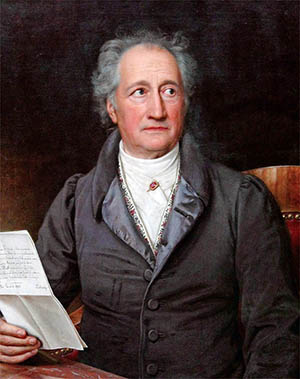
    Johann Wolfgang von Goethe (1749–1832)

    For an unknown rural scholar to be offered such a position might seem unusual, but the general consensus on Goethe’s scientific musings at this point was that they were useless as science and dreary as literature; in truth, no one else wanted the job of editing them. Aside from his early success in proving that the human upper jaw contained the intermaxillary bone found in other mammals – Goethe was, in a different way, an evolutionist long before Darwin – most scientists found Goethe’s attempts to disprove Newton’s theory of colour, or to demonstrate the existence of what he called the Urpflanze, the archetypal plant from which others emerged, muddleheaded if not insane. 

    Yet for Steiner, Goethe’s science was the prototype for what would become his own phenomenology of the spirit worlds. Instead of the conventional scientist’s cold, dispassionate eye regarding the world as mere matter, passive to his intrusions, Goethe called instead for “objective imagination,” an active participation in the reality under scrutiny. The subjectivity of the scientist – his state of consciousness – was vastly more important than the increasingly hair-splitting exactitude provided by his instruments. This “objective imagination” became for Steiner the basis for his own “supersensible cognition.”

    Encountering Nietzsche

    Steiner’s work on Goethe opened many doors. One led to Weimar, Goethe’s city, where he was asked to work on the Goethe Archive, another prestigious task. Although Steiner found few congenial colleagues, the work had other compensations. He was introduced to the city’s literary and cultural life and made many acquaintances. One in particular led to a momentous meeting. Elizabeth Forster Nietzsche, sister of the ill-fated philosopher, approached Steiner to work with her in establishing a Nietzsche Archive. This led to Elizabeth introducing Steiner to her brother, who had been insane from syphilis for several years. Elizabeth had taken to dressing the defenceless Friedrich in a toga, and positioning him by the window, where his blank stare and unkempt appearance provided the impression of a great prophet. Steiner, aware of Nietzsche’s madness, was nevertheless impressed – not with the figure before him, but with its spiritual aura. He saw Nietzsche’s soul “hovering over his head, infinitely beautiful in its spiritual sight…” It was a soul that “brought from former lives on Earth golden riches of great spirituality…”4

    If mention of Nietzsche’s “soul” brimming with “golden riches of great spirituality” suggests to readers familiar with the author of Beyond Good and Evil and The Antichrist that Steiner was as ignorant of Nietzsche’s philosophy as his sister Elizabeth notoriously was, they should have a look at Steiner’s book Friedrich Nietzsche: Fighter for Freedom (1895), a remarkable perceptive study which at times even reads like Nietzsche. Throughout his career, Steiner had an uncanny knack for entering into and defending the ideas of thinkers with whom he had profound disagreements – like the staunch materialist Ernst Haeckel – a critical sympathy that often led to much misunderstanding.

    When his work at Weimar was ending, rather than embark on academic career (Steiner had received his doctorate in philosophy during his stay and could easily have found a comfortable niche somewhere), he decided instead to move to Berlin, home of Germany’s nascent avant-garde. He had by this time published what many believe to be his most important book, The Philosophy of Freedom (1894), an exhilarating, if often difficult work of epistemology which Steiner believed established beyond doubt the reality of the human “I.” Others, like the influential philosopher Eduard von Hartmann, author of the once immensely popular The Philosophy of the Unconscious, were less convinced and suggested he had muddled the question. Steiner, however, was undaunted and believed he had a mission to disseminate his ideas. He also needed to find work. Although his followers tend to see Steiner’s life as the undeviating unfolding of a pre-ordained destiny – and Steiner himself, we must admit, contributes to this belief – like the rest of us, he was looking for his place in the world and the means to get on in it. He was also filled – rightly so – with the conviction of his own genius. The literary and cultural world of Berlin might offer opportunities not available elsewhere.

    Steiner, however, made the thoroughly impractical decision of buying a moribund periodical, The Magazine for Literature. His previous brief catastrophic experience in Vienna as an editor of a political magazine seemingly forgotten, Steiner proceeded to run the already failing Magazine for Literature into the ground, alienating its readers with his persistent exhortations regarding the spiritual life. In the age of Strindberg, Wilde, Ibsen, Wedekind, and Shaw, Steiner’s idealism seemed a stale leftover from a forgotten time.

    Yet, although he bemoaned the burden destiny had placed on him, Steiner seems to have enjoyed hobnobbing with bohemians: his acquaintances include poets, playwrights, novelists and political activists. In fact, his reputation among the demi-monde caused academics to cancel their subscriptions, and Steiner earned the unique distinction of being the one esoteric teacher – as far as I know – to have a periodical banned in Czarist Russia, because its editor was known to socialise with anarchists. 

    It was also in Berlin that Steiner married his first wife, although one gets the impression that the relationship with Anna Eunicke was little more than platonic. Anna had been Steiner’s landlady in Weimar, and when he moved to Berlin she followed him. There he moved in with her again, and, almost as an afterthought, married her in 1899 in a civil ceremony. (It was in the Eunicke household in Weimar that Steiner had had one of his experiences with the death of a reclusive father.) Anna, not particularly well-educated or cultured, was apparently very happy to have Herr Doctor Steiner under her roof; Steiner, for his part, thus avoided the “misery of living alone,” as well as that of the cheap lodgings and bad food he had endured up till then. Anna was ten years older than Rudolf, and their relationship raises the question of Steiner’s sexuality, of which there is no mention in the entire 406 pages of his Autobiography. I do have it on the authority of one Steiner scholar, Christopher Bamford, that the Doctor was indeed celibate.

    Berlin & Theosophy

    But it was in Berlin that Steiner’s real career began. For a time he seemed willing to speak to any group who would listen to him. He lectured on history and other subjects at the Workingman’s College, surreptitiously slipping large doses of Idealism to budding Marxist materialists. He also lectured to the Giordano Bruno Society and The Coming Day, a quasi-Nietzschean cultural group. He managed, however, to alienate all of this (as well as Anna Eunicke, whom he soon left) when he accepted a request to lecture to the Berlin Theosophical Society. For years, Steiner had tried to express his insights into the spiritual worlds under the cover of philosopher. Now, at the turn of the century and the age of forty, he decided to forgo the camouflage and speak directly of his experiences.

    Steiner quickly rose to prominence among the Theosophists and was soon made head of the society’s branch. One member of his audience was particularly struck. Marie von Sivers, who became Steiner’s second wife in 1914, was a Baltic Russian actress. She asked if it weren’t time for a new spiritual movement to arise in Europe. More to the point, didn’t Steiner think he should lead it? Steiner did, but he insisted that any such movement would be firmly based on Western esoteric sources. Steiner had recently passed through a spiritual crisis which convinced him that the “Christ event” was the single most important incident in human history. He had no time for “Eastern wisdom” or mystic Mahatmas. He more or less adopted the cosmic evolutionary framework of Madame Blavatsky’s Secret Doctrine and informed it with large helpings of German Idealist philosophy and Christian mysticism, developing a peculiarly idiosyncratic neo-Rosicrucian system of esoteric thought, aided by his own readings of the Akashic Record. In light of this it’s difficult to ignore the occult historian James Webb’s remark that Steiner joined the Theosophical Society in order to take it over.

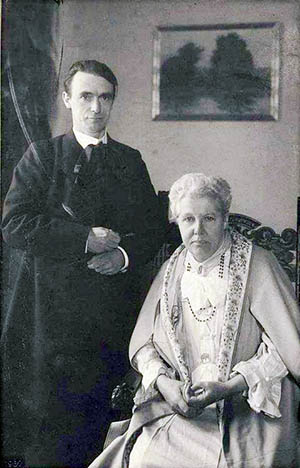
    Rudolf Steiner & Annie Besant (1907)

    His relationship to the society was rocky, and in 1913 he and its head, the ex-Fabian Annie Besant, came to rhetorical blows over C.W. Leadbeater’s advocacy of the Indian boy Krishnamurti as the second coming of Christ. Steiner was disgusted at the idea, and even more so at Leadbeater’s known paedophilic predilections. He demanded Besant’s resignation; she retaliated by ex-communicating him. Steiner left with much of his flock – by this time several thousand – and started his own group, the Anthroposophical Society. As opposed to Theosophy, which spoke of the wisdom of the gods, anthroposophy was concerned with the wisdom of the human being.

    Building a New Movement & the Goetheanum

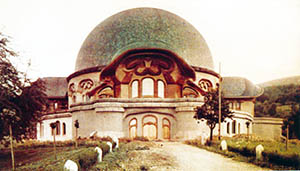
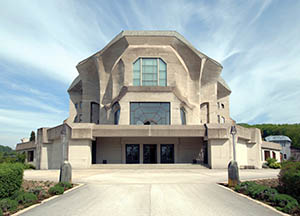
    Practically the first thing Steiner did was to build a temple for his new movement. Land was secured in Dornach, Switzerland, and during WWI Steiner gathered a community of followers from several different countries to construct the Goetheanum, a weirdly beautiful fusion of art nouveau and Expressionist architecture that Steiner himself designed. His lecturing was curtailed by the fighting, but his greatest popularity came with the war’s end. Steiner’s plan to reconstruct Europe, The Threefold Commonwealth (1922), sold some 80,000 copies in its first edition, and audiences for his public appearances were now in the thousands; on one occasion the crowds outside a Berlin auditorium were so great they stopped traffic. 

    The original Goetheanum, which burned to the ground on New Year’s Eve 1922.

    This period, however, also saw the start of the anti-Steiner campaign that would plague him henceforth. Practically everybody hated him: Catholics, Protestants, Marxists, proto-Nazis, not to mention other esotericists. There were at least two attempts on his life, and the number of occult attacks fomented by the “black brotherhoods” is unknown. One clear victory from this time was the establishment of the first Steiner school in Stuttgart in 1919. Based on pedagogical principles developed over decades of tutoring – in Vienna he had cured a retarded hydrocephalic boy to the extent that child grew up to earn a medical degree – Steiner’s educational ideas earned him deserved renown, and an international reputation among experts that continues today.

    Steiner endured vilification in the press and disruption at his lectures with equanimity, but one victim of the attacks was, many believe, the Goetheanum, which burned to the ground on New Year’s Eve 1922. Arson by right-wing proto-Nazis is the common assumption, although an electrical fault remains a possibility. In any case, a decade’s effort, not to mention an architectural wonder, was lost overnight: the building was made of the same wood as that used in making violins and burned fiercely. Steiner took the tragedy as a sign that some changes in the society were necessary. His original occult teachings, based on the idea of an evolution of consciousness and the ability to achieve “supersensible thinking,” were, he felt, obscured by the success of subsequent initiatives. 

    Front view of the Goetheanum in the Swiss town of Dornach, the seat of the General Anthroposophical Society.

    Steiner education, the Christian Community (a religious group using Steiner’s ideas), the Threefold Movement for social change, eurythmy – a form of what he called “visible speech” – and newer developments like bio-dynamic farming and anthroposophical medicine were taking centre stage. Steiner had attracted many younger followers after the war, eager to rebuild society, and these clashed with his older, more esoterically inclined devotees. Bickering within the Anthroposophical Society, whose numbers had swollen in the post-war years, threatened to undo much that had been achieved. On the first anniversary of the Goetheanum’s destruction, Steiner announced plans for a second temple; it stands today in Dornach, defiantly made of concrete. He also told his followers that he was reconstructing the society as well. Although he had not previously even been a member of the society, remaining only its spiritual guide and adviser, he now declared himself president of the newly formed General Anthroposophical Society which, although most successful in Germany, today has branches around the world.

    Ahriman & Coming World Inferno 

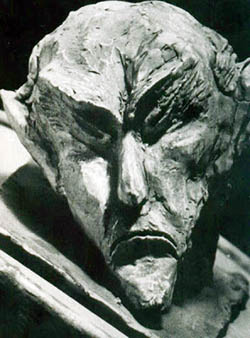
    Steiner’s last years were spent in sowing as many seeds as possible for future work; they were also darkened by his belief in a coming world conflagration, when the archangel Michael, overseer of the current stage of human consciousness, would face off against the power of Ahriman, a spiritual being who seeks to prevent humanity’s development. Steiner spoke ominously of the incarnation of Ahriman, an Antichrist-like figure, whose display of miraculous powers would precede a catastrophic “war of all against all.” Steiner believed this unavoidable destiny would take some time to unfold – Ahriman is scheduled to arrive in the 3000s – yet many of his followers suspect that in recent years the process has been speeded up. Steiner himself had grave doubts about the growing pace of technological development, warning his followers that materialist science gains its great power through unwittingly releasing Ahrimanic entities. In his last communications, Steiner called on his followers to develop their consciousness in order to rise above nature to the same extent that technology sank below it. He also gave series of lectures about karma and its work in human history.

    The head of Ahriman, carved in wood by Rudolf Steiner.

    Steiner died on 30 March 1925. He had been ill for at least a year with an undisclosed stomach ailment, although there is some speculation he had been poisoned. He continued lecturing until it was physically impossible for him to do so, and his followers were astounded when, on the evening of his last scheduled lecture, they found a note saying that it had to be cancelled because of the Doctor’s health. Nothing like this had ever happened before. The Doctor, they believed, was invulnerable. 

    The exact nature of Steiner’s illness remains unknown, but it is clear that his inability to refuse help to those who came to him was a key factor. Along with his public and private lectures, and his practical work as a teacher, architect, and agriculturalist, Steiner made himself available to any who needed his counsel. For many years, he had practically no free time, and wherever he went his hotel room saw a constant stream of visitors including, on one occasion, Franz Kafka. Some asked about their astral bodies; others their diet or their marriages; Kafka asked about his writing. Steiner advised them all, giving little bits of himself to thousands. He was, as the Russian novelist Andrei Biely, a follower, once remarked, “a giant of the power of kindness.”5 It’s not hard to see how such solicitude would eventually wear anyone down.

    In the end, it’s difficult to give an exact assessment of a man whose work combines cogent criticisms of Kant with accounts of life in Atlantis. But this “mild, gentle, good, kindly man,” whose achievement in “humanitarian terms is remarkable and enduring,” as the psychiatrist Anthony Storr wrote of Steiner in his study of gurus, Feet of Clay, remains, for devotees and non-initiate alike, something of an enigma.

     This article first appeared in Fortean Times 205, January 2006.

    [alert type=”general” dismiss=”no”]This article was published in New Dawn 171.[/alert]

    [alert type=”success” dismiss=”no”]If you appreciate this article, please consider subscribing to help maintain this website.[/alert]

    FOOTNOTES
    1. Rudolf Steiner, Autobiography, Rudolf Steiner Publications, 1977, 28
    2. Ibid, 28-29.
    3. Quoted in Colin Wilson, Rudolf Steiner: The Man and his Vision, Aquarian Press, 1985. 38
    4. Steiner, Autobiography, 223
    5. Andrei Biely, Reminiscences of Rudolf Steiner, Adonis Press, 1987, 8

    © New Dawn Magazine and the respective author.
    For our reproduction notice, click here.
  • You Can Heal Your Life: Identifying the Beliefs & Emotions Causing You Pain and/or Illness

    You Can Heal Your Life: Identifying the Beliefs & Emotions Causing You Pain and/or Illness

    From New Dawn Special Issue Vol 13 No 4 (Aug 2019)

    Our emotions and beliefs form our world. They are the basis for everything we manifest into our lives. Our beliefs are formed over time by our family, upbringing, culture, governments, media, schools, friends and general society. We are often unaware of what deep seated beliefs we hold. 

    Emotions are an in-the-now expression of our inner beliefs, e.g. the same event can cause one person to feel anger, another sadness, or for a different person no emotional reaction. We often think of emotions as an innate reaction, something we have no control over. However, we can consciously choose to change our emotions and how we react to certain situations through positive thought, which in turn changes our beliefs. Our subconscious (where our beliefs reside) has no judgment or understanding of ‘good’ or ‘bad’; it simply draws to us experiences that support our beliefs. Henry Ford once said, “If you believe you can, or believe you can’t, you are right.”

    General negative emotions and beliefs cause general ill health. Anger can cause chemical reactions in the body to produce an acidic environment that welcomes viruses to take up residence. An acidic diet can also bring on anger; some people are attracted to acidic producing foods in the first place by holding an underlying belief such as, “I’m not worthy of health or happiness.” Germs aren’t the bad guys; it is the environment in which the germs thrive that cause the problems,1 which are directly connected to our emotions.

    Specific medical issues can be connected to specific beliefs, e.g. rheumatism comes from feeling victimised, resentment, lack of love and chronic bitterness.2 An illness or pain is your body’s final warning that something is wrong and needs to be treated on the physical level. However, if the emotional cause behind the illness or pain is not addressed, the physical symptoms will return over time.

    Positive emotions, such as joy and gratitude, bring healing energy to the body. Having a good laugh or thinking of something that makes your heart go ‘ahh’ is the best medicine for your body and spirit. Positive thoughts, gratitude and affirmations are very powerful when repeated over time for improving health and wellbeing. 

    The Hawaiian practice of healing and forgiveness, Ho’oponopono,3 suggests we repeat the phrase, “I’m sorry, forgive me, thank you, I love you,” wherever negative emotions arise. “I’m sorry” is an acknowledgement that you created pain or caused errors. “Forgive me” for not knowing this was inside you. “Thank you” for allowing yourself to release and cleanse the memory. “I love you” is directed to your inner being. This is a very empowering exercise. 

    The body directs us to negative beliefs and emotions by how and where it exhibits pain and illness.

    Louise Hay (1926–2017) was an American motivational author and the founder of Hay House. She authored several New Thought self-help books, including the 1984 best seller, You Can Heal Your Life.

    One of the best systems I have found to identify and rectify health problems is the work of Louise Hay (1926–2017). For over forty years she shared her knowledge of positive thinking. Louise’s work is based on using positive affirmations to change your inner beliefs. She suggested that by repeating these affirmations over and over, seeds are planted in your subconscious for new beliefs to blossom. Love Your Body came out in the mid 1980s with affirmations for each specific body part. You repeat one affirmation each day, taking note of any negative emotions that arise. Then go back to these problem areas and work specifically with them for a few months. The subconscious needs at least a month of constant repetition to plant those seeds of change. When doubts and fears arise, Louise suggests we acknowledge they are old limiting beliefs that no longer have power over us, and say “Out! I no longer need you.”

    Some examples from Love Your Body:

    I Love My Neck – I willingly turn to acknowledge other viewpoints and other ways of doing things. I am willing to change. I choose thoughts that keep me flexible in my ideas and in my creative expression. I express myself freely and joyously. I am safe. I love and appreciate my beautiful neck!

    I Love My Toes – My toes are inspectors of the future, going before me to clear the way. They are straight, flexible and strong. They reach out, feeling and finding the perfect pathway in life. I choose the thoughts that protect my pathway. As I move forward, all details take care of themselves. I love and appreciate my beautiful toes!

    You can also use the book for information on acute conditions, e.g. if you have a sore neck, ask yourself if there is some viewpoint you are ignoring or if you are being inflexible. Sometimes just acknowledging the emotional cause can help clear the physical symptom.

    Louise’s book Heal Your Body was first published in 1976 listing ailments, possible causes and affirmations. This is my most used resource from my hundreds of books, with my 1988 edition falling to pieces! The insights into the emotional causes of illness are still as relevant today as when they were first written. Here are some examples:

    Abdominal cramps = Fear. Stopping the process. = I trust the process of life. I am safe.

    Acne = Not accepting the self. Dislike of the self. = I am a Divine expression of life. I love and accept myself where I am right now.

    Gum Problems = Inability to back up decisions. Wishy-washy about life. = I am a decisive person. I follow through and support myself with love.

    Heart Attack = Squeezing all the joy out of the heart in favour of money or position etc. = I bring joy back to the centre of my heart. I express love to all.

    Indigestion = Gut-level fear, dread, anxiety. = I digest and assimilate all new experiences peacefully and joyously.

    Migraines = Dislike of being driven. Resisting the flow of life. Sexual fears. = I relax into the flow of life and let life provide all that I need easily and comfortably. Life is for me.

    Overweight = Fear, need of protection. Running away from feelings. Insecurity, self rejection. Seeking fulfilment. = I am at peace with my own feelings. I am safe where I am. I create my own security. I love and approve of myself.

    Skin problems = Anxiety, fear. Old, buried gunk. I am being threatened. = I lovingly protect myself with thoughts of joy and peace. The past is forgiven and forgotten. I am free in this moment.

    Here is one of Louise’s daily general affirmations: “Everything I need to know is revealed to me. Everything I need comes to me. All is well in my life.” Imagine how wonderful life could be if this affirmation was the basis for you creating your day. My personal affirmation is, “I am happy, healthy, wealthy and wise,” and on most days I achieve at least one of these goals!

    In her book The Secret Language of Your Body, Inna Segal, a Melbourne based healer and teacher, also lists body parts, medical conditions and possible emotional causes similar to Louise Hay’s work. However, instead of using affirmations, Inna advises to ask your ‘Divine Healing Intelligence’ for help, in combination with visualisations. This phrase is an acknowledgement that you have created the negative health condition and you have the power and means to heal it. 

    For example, gums represent being unsure of yourself or decisions you have made, procrastinating, not following through on projects, being too demanding or selfish or a refusal to change. Remedy: Close your eyes. Focus on your gums. Visualise a red ray of light moving through your gums, clearing and dissolving all infections, stagnation and blockages. You might even feel your gums begin to tingle. Say: “Divine Healing Intelligence, I ask you to release all procrastination, indecision, self sabotage, selfishness and stagnation from my gums, as well as all points of view, positive and negative charge, and all patterns that contribute to this condition.” Repeat the word “CLEAR” until you feel a shift occur. Visualise a white ray of light moving through your gums, cleansing and regenerating them. Say: “Divine Healing Intelligence, please install my ability to make empowering decisions, follow through with projects, be persistent and open myself to positive change and transformation. Thank you.” Say: “Divine Healing Intelligence, please heal and regenerate my gums and teeth to their maximum strength, vitality and health.”4

    Both Louise and Inna connect gums with decision-making. Become your own health detective (as well as healer) by matching body parts with the way the condition exhibits itself, i.e. itching, inflammation, infection, pain, tumours etc. You can change beliefs, emotions, stresses and reactions through awareness of the part you play in the process of manifesting. 

    For example: itching = unsatisfied, remorse, irritated and annoyed; Inflammation = anger, frustration, fear, seething and self sabotage; legs = carrying us forward in life, facing our future; left side of the body = feminine aspect. 

    So, if you have an itchy left leg ask yourself, “Am I annoyed with the direction my future is taking? Has a female irritated me? Am I feeling unsatisfied with the feminine side of myself with regards to this future project?” If the right leg is inflamed, ask yourself, “Do I have a fear of the future? Am I angry at a male for blocking my progress?” 

    If the itching or inflammation is acute, then it may clear up quickly once you have acknowledged the emotional cause or situation that caused it. If it is a chronic condition, then this detective exercise can point you in the right direction for identifying your beliefs, to enable you to write your own positive thoughts to change the limiting belief.

    Here is a brief list of conditions, body parts and emotions I have compiled mainly from Louise Hay:

    Itching = unsatisfied, remorse, irritated, annoyed

    Inflammation = anger, frustration, fear, seething, self sabotage

    Pain = guilt, seeking punishment, longing for love

    Infection = anger, frustration, annoyance, bitterness, lack of joy

    Fat = over sensitivity, resistance to forgive, fear, needing protection, covering anger

    Tumour = building remorse, holding onto old hurts and shocks

    Ulcers = fear, not being good enough

    Eyes = to see the past, present and future clearly

    Mouth = new ideas, nourishment

    Neck = flexibility of ideas

    Throat = expression, creativity

    Breast = nurturing, female principle

    Lungs = ability to take in life and joy

    Heart = love, security

    Arms = ability to hold experiences of life

    Spine and joints = flexibility, support

    Stomach = digest new ideas

    Liver = anger, primal emotions

    Kidney = shame, disappointment, failure

    Intestines = assimilation, absorption, elimination

    Bladder = anxiety, fear of letting go, 

    Bowel = holding on to old ideas

    Knees = support, ego, pride

    Feet = our understanding of life

    A lifetime of your subconscious supporting negative beliefs results in “becoming set in your ways.” Many symptoms of ‘old age’ reflect this, e.g. being inflexible can cause aching joints, stooped posture and arthritis, while fear of the future can result in poor eyesight, loss of hearing, leg pain and Alzheimer’s.

    Have lots of fun being a health detective, and keep your physical body healthy through your emotions. Remember, fairy dust can only make Peter Pan fly when combined with happy thoughts, and Harry Potter can only defeat the dementors that feed on fear with his happiest memory!

    [alert type=”general” dismiss=”no”]This article was published in New Dawn Special Issue Vol 13 No 4.[/alert]

    [alert type=”success” dismiss=”no”]If you appreciate this article, please consider subscribing to help maintain this website.[/alert]

    FOOTNOTES
    1. The Truth About Cancer by Ty Bollinger (see review in New Dawn 160)
    2. Heal Your Body by Louise Hay
    3. The Book of Ho’oponopono by Luc Bodin M.D., Nathalie Bodin Lamboy & Jean Graciet (see review in New Dawn 158)
    4. The Secret Language of Your Body by Inna Segal

    © New Dawn Magazine and the respective author.
    For our reproduction notice, click here.

  • COVID-19: Trigger for a New Social Order

    COVID-19: Trigger for a New Social Order

    From New Dawn 180 (May-June 2020)

    I can remember them saying that ‘everything changed after 9/11’. It did, but certainly not for the better. I think we can all agree on that.  I remember how everyone surrendered their rights and key aspects of democracy, all in the name of ‘keeping us safe’.

    Back then, world-changing decisions were made in reaction to an exaggerated threat, with sweeping ‘emergency measures’ and laws enacted. Usually, nothing good follows from a government that is making decisions and formulating permanent policy, suspending constitutions and rights – imposing all of this on a population operating from a position of fear. That much we did learn. Some of us did anyway. 

    In January, like a leviathan sprung forth from the titans Oceanus and Ceto in ancient Greece, the global coronavirus pandemic was born. Like 9/11, it was a disruptive event, but this time on a scale unimaginable. Whether or not one believes this was naturally-occurring or a biologically-engineered pathogen (there is every reason to believe it could be), it is beyond argument that this ‘crisis’ is and will be used to advance a multi-pronged globalist agenda, likely to feature more wars between the great powers. 

    Modern man is now entering realms of dystopia only imagined before by the likes of Aldous Huxley and George Orwell, with more than a hint of Philip K. Dick. What makes all of this difficult for so many is that the sudden transition has been almost instantaneous, leaving people in a near callow state of bewilderment, wondering what just happened to their old life. 

    No matter which way this situation goes, it’s almost certain life will never be the same. 

    COVID CRISIS

    By now we should be familiar with the story: a novel coronavirus, scientifically known as SARS-CoV-2, or COVID-19, has made its way across the planet, infecting millions of people and registering over 100,000 deaths (as of the time of writing) across 180 countries. The victims of this outbreak are overwhelming elderly persons over the age of 70 and those in palliative care, most of who have severe and chronic underlying medical conditions. 

    Make no mistake about it – this is a disruptive event on a scale the modern world has never seen before. The shock and awe began from the moment the story broke from the Chinese city of Wuhan in Hubei Province. Global audiences were inundated with images of Chinese authorities putting hundreds of people into biological suits, hosing down the outside of buildings, before quarantining themselves in their apartments. Then began a state-sanctioned medieval-style program that western media and politicians enthusiastically dubbed a “lockdown,” a term aptly borrowed from the prison industrial complex. 

    Wuhan was an unforgettable spectacle which really impacted the western psyche, such that when the coronavirus made it to European and North American shores, the public was already conditioned to expect a Chinese-style response from their own governments. Not surprisingly, this is exactly what they got and, in fact, it was what they demanded. 

    On 12 March, British Prime Minister Boris Johnson called an emergency press conference where he took to the podium, flanked by his two leading science advisors, Sir Patrick Vallace and Chris Whitty, who proceeded to explain the government plan of action which was centred around the commonly known epidemiological concept of “herd immunity.” Their strategy was a familiar one because it has been the orthodoxy in modern epidemiology – allow a virus to go through approximately 60-80% of the population in order to achieve herd immunity, naturally extinguishing the virus in a single season. But Johnson made the fatal error of grossly overestimating the death rate at 1% of the total infected, an estimate that would have left the country with some 52 million infected and 500,000 fatalities. Of course, in hindsight, these numbers were pure fiction, but at the time everyone was so enveloped in fear that they believed the ‘experts’. Nonetheless, the herd immunity approach was more or less identical to the ‘no lockdown’ approach taken by European countries Sweden and Iceland, as well as Belarus, Mexico, and Japan. This would entail standard random sample testing nationally and for those exhibiting COVID-19 symptoms. The elderly and vulnerable people would be told to self-isolate for a period of time while studies were conducted. 

    ‘Plan A’ didn’t last long. On 24 March, Johnson appeared on national TV, this time without his science team, to announce a nationwide lockdown – an effective shutdown of society and most of the country’s economy. The UK was now following fellow NATO member states France, Italy, Spain and others, which had already imposed draconian national lockdowns, including strict new ‘social distancing’ guidelines preventing people from being together. 

    It appeared that Johnson’s sudden 180º degree turn was prompted in part by an alarmist report generated by one of the government ‘expert’ teams at Imperial College London, led by controversial computer modeler Neil Ferguson who was previously responsible for the 2001 ‘Foot and Mouth’ crisis, a debacle which ended in the unnecessary culling of some six million livestock in Britain. This time, Ferguson and his team worked their modelling magic to come up with an estimated half a million coronavirus deaths if the government did not implement “very intense social distancing and other interventions now in place.” While the figure was completely fictional, the media seized on it, as did government officials, which fuelled fear and panic across Britain’s government-media complex. Frightened and unsure, the public accepted the authoritarian measures, but the government never gave an end date to the quarantine; it was left open-ended at the discretion of the government’s scientific coterie.

    Once that bubble of fear had been sufficiently inflated, a medieval-style lockdown was a fait accompli in numerous countries including Australia and New Zealand. The impact of a full national quarantine is yet unknown, but it’s already becoming clear that it will be nothing short of cataclysmic for those countries who agreed to the voluntary self-destruction of their economies and the indefinite suspension of democracy. 

    It’s worth noting this isn’t the first time the United Nations, the World Health Organization (WHO), and Imperial College tried conjuring a global panic over a flu virus. Back in 2005, the “range of deaths,” the UN warned of bird flu virus H5N1, “could be anything between five and 150 million.” Officials even drafted in Imperial’s most reliable doomsayer, Neil Ferguson, to help come up with another completely fictional death toll of 200 million people. His high school level math equation was breathtaking in its over-simplicity: 

    “Around 40 million people died in the 1918 Spanish flu outbreak,” said Prof. Ferguson. “There are six times more people on the planet now so you could scale it up to around 200 million people probably.”

    That doomsday prediction led to the culling of tens of millions of birds in Southeast Asia, but the pandemic never really materialised. In the end, human fatalities numbered in the hundreds worldwide. It was a non event. 

    Similar unremarkable numbers followed the global hype over the H1N1 swine flu in 2009. Thanks to the work of investigative journalist Sharyl Attkisson, the Center for Disease Control (CDC) in the US was caught over-inflating the number of cases – a fraudulent move that had grave implications for government policy and stoking unfounded public fear. 

    With COVID-19, the globalist medical industrial complex, led by WHO, hoped to repeat the previous public relations campaigns by hyping the novel coronavirus as the next Spanish Flu. This time they were given an extraordinary opportunity thanks to China which put on an incredible media performance and ‘show of strength’ in the month of January by ‘locking down’ Wuhan – inspiring western and other leaders to try the same big government approach. However, the results would turn out economically disastrous for western ‘lockdown’ countries. 

    Economic Collapse

    All of this is certain to trigger a protracted global recession marked by at least 12 months of negative growth, with economic and social displacement the likes of which the world has never seen before. The decision by countries like the UK, France, Italy, Canada, Australia, New Zealand and the US to voluntarily implode their economies and place most of their populations under house arrest will have a lasting impact not only on national economies but also the global economy for years to come. In terms of scale, the damage caused to markets and industry has already surpassed the 2008 financial crisis by orders of magnitude, and there’s no end in sight. 

    To ‘fight the coronavirus’ governments have imploded their real economies and replaced them with nationalised pools of finance earmarked for each section of the economy. This emergency transformation is the same as a wartime mobilisation of an economy, with a heavy focus on the medical and pharmaceutical industrial complex, the military, and selected corporate partners hand-picked by the state. This hard fusion of state and corporate interests is classic corporatism or fascism. In this brutal and constrained environment, these are some of the only institutions strong enough to remain viable. 

    The net effect of immediately putting millions of workers onto government welfare rolls and pushing hundreds of thousands of small-to-medium-sized businesses (SMEs) into bankruptcy will be the largest consolidation and transfer of wealth in modern history. Those with enough capital to ride out the crisis will be able to buy-up companies, and even whole industries, for literally pennies on the dollar. Monopolies like Amazon, Google and telecoms giants will consolidate and solidify their market shares as competitors gradually die off and are swallowed-up in receivership. Formerly independent contractors will now be reliant on government assistance, as will any business qualifying for government ‘relief’ grants and loans. Large corporations will now have governments covering the cost of their payrolls for the duration of the crisis. 

    There is no semblance of any discernible sound economic model to describe what is now happening with government printing up record amounts of money to cover the enormous cost of the shutdown. For a wealthy country like the US, the Federal Reserve Bank will simply go into overdrive, creating trillions of dollars to be released through various ‘stimulus plans’ and bailouts. The New York Fed is now pumping trillions of new dollars into banks, with the Fed also issuing ‘bridge’ loans directly to businesses. This never happened before in history. The US is also buying up unprecedented amounts of corporate stock in order to keep Wall Street afloat. With these levels of quantitative easing, there are risks of hyperinflation and other systemic problems. This may be coupled with higher food prices due to supply shortages, and stagnant wages due to a glut in the labour market after the government’s domestic scorched earth economic policies. The end result of all these bailouts (if they ever end) will be exactly as with any war in history: a rapid wholesale transfer of power, control and ownership into centralised government and the central banking cartel.

    For individuals and families, this means your savings are wiped-out, your property collapses in value, and your future prospects are dim, at least in the short to midterm, and you will have no choice but to load up on personal and family debt to survive. 

    Before this crisis, we saw the largest wealth gap in modern history since the Gilded Age (1870–1900), with the richest 1% now owning more than half of the world’s wealth. After the first phase of this crisis, that gap may double or even triple. With SMEs wiped out, the only jobs available will be with the government or with a handful of mega-corporations. 

    As is often the case after any war, developed and developing countries are likely to become dependent on credit lines from either the International Monetary Fund (IMF) or from the United States itself which will have plenty of dollars and US Treasury bonds for sale or loan at near zero percent interest rates. Plenty of funny money to go around, mostly for the elites.

    The shutting down of the world’s airlines – along with biosecurity and financial stagnation hitting certain sections of global trade – will severely injure the dominant system of globalisation. This will no doubt encourage already existing regional trading blocs, like ASEAN in Southeast Asia, and the African Union, leveraging their interests to create more regionalised and resilient trading networks. As physical trade and relations are codified regionally, globalisation will increase in the online digital sphere and with international e-commerce, online learning and social networking. 

    Now, with massive economic recession, marked by record levels of mass unemployment and debt, the balkanisation of formerly open globalisation routes, combined with a new global veil over scarcity of resources, all under a broad cloak of biological insecurity – the soil is fertile for more dismantling of democracy and a rise in fascist regimes, particularly in the West. The trend was already moving in this direction before the crisis, but now it will only accelerate. 

    Historically speaking, the scene is now set for another world war in which the winner sets the agenda for a ‘new world order’ going into the 21st century. 

    Full Spectrum Dominance:
    World War Footing

    Just as in 1914 and the onset of World War I, the year 2020 will be a major pivot point for the early 21st century and should be seen as a tangible prelude to a new world war. There are a number of reasons why this is likely. 

    It is true that you can implement more change in two years of war than you can in twenty years of peace. In the case of the corona crisis, that two years was reduced to two months. Presently, events are being framed by western powers as the “global fight against an invisible enemy,” but the corona crisis has created a number of new paradigms some of which are classic precursors for war. The first and most obvious is the fact that virtually overnight, the western countries, especially NATO member states the United States, United Kingdom and France, have effectively mobilised all aspects of their country’s economy and restructured society to reflect both a wartime economy and a state of martial law. The western bloc countries are now prepared to bunker down for a long war if need be. 

    The threat of a biological agent presents some serious problems for a globally-embedded military as America’s. Already the US had to cancel major NATO drills in Europe, and pull some of its naval fleet into dock because of the coronavirus and fears of infecting large numbers of military personnel. Other countries may have similar issues. In this sense, the disease has severely slowed fighting across the world – one of the more unexpected, albeit welcome, tertiary benefits of the crisis. 

    The western powers first obvious choice for instigating either a hot or cold war is China, along with its allies. When US President Donald Trump refers to COVID-19 as “the Chinese virus,” he is signalling to his base and to the war hawks in the Republican Party that the White House is preparing a confrontation. Anti-Chinese rhetoric and media propaganda has increased substantially in the US since the onset of the corona crisis, with many Americans, particularly the right-wing, now blaming the Chinese for releasing this pestilence into the world. 

    After a few more months of economic destruction, social malaise and an increasing death toll in the US, the new ranks of unemployed will be demanding a scapegoat for their terrible suffering, at which time a war with China could become more viable for Washington. This could take the form of an on-off, hot-cold war which lasts for 30 or 40 years, and pulls in other major powers using proxy battlegrounds in third party countries. 

    For the US empire, one primary objective in confronting China would be to disrupt and possibly derail Beijing’s historic infrastructure and economic development known as the Belt and Road Initiative, designed to link Europe with Asia along various routes over land and sea. If successful, the global centre of gravity would shift away from the US and back towards Eurasia. In the event of a global depression post-corona, the US is geopolitically well-placed to weather the storm as it commands the control of both the Atlantic and Pacific oceans. China’s Belt and Road would effectively upend Washington’s plans for Fortress America lording it over all global markets during this new tumultuous epoch. 

    In some ways, the crisis has disrupted the emergence of a new multipolar world, but the imperative for multipolarism may also be propelled by the economic balkanisation and the fact that the US will continue withdrawing its military assets from stalwart outposts like the Middle East. Any US withdrawal from the world stage will be filled by other emerging powers like Russia, India, Turkey and possibly Japan. Many of these emerging powers require resources and materials, so the scramble to establish trading routes in Africa will be a post-corona feature. 

    The corona crisis also provides a convenient cover for the aggressive roll-out of 5G networks around the world. These look to be the backbone of a new global surveillance state able to track and record everything in real-time. Along with millions of masts in towns and cities, the network will also feature an array of new satellites with the potential to flood our atmosphere and communities with even more untested high-frequency radiation. 

    One World Health &
    Medical Martial Law

    The current ‘state of war’ extends internationally with blanket travel restrictions already in place. There looks to be a rapid drive to institute a streamlined global system of mandatory digital tracking and tracing, implemented under the auspices of ‘global health’ and spearheaded by the World Health Organization (WHO). They are joined by participating governments and the transnational corporations that will roll out these new ‘health surveillance’ systems. 

    The real question that remains unanswered is what will happen once all the ‘lockdown’ measures are relaxed, and international air travel opens up again? There are already noises coming from governments and organisations about requiring citizens to pass some form of ‘immunity test’ for COVID-19 to be granted freedom of movement within society by carrying an ‘immunity passport’ or digital certificate stored on a microchip or smartphone. This dovetails with the rapid drive for a cashless society as a result of the corona scare. Due to corona contagion fears, paper money and coins are being stigmatised as ‘dirty’ with many retail outlets refusing to accept cash. Once this system is adopted domestically, it follows that these same restrictions will be extended to international travellers. Needless to say, this has grave implications for personal liberty and privacy. At present, this juggernaut seems difficult to stop. 

    If allowed, this new bio regime will become the de facto governance for the world’s population. Microsoft founder Bill Gates (net worth $97.8 billion) has called for a national vaccine tracking system in the US, funded in part by an estimated $100 million he and his wife Melinda’s Gates Foundation have donated to fight the coronavirus to discover ‘a fix’ as quickly as possible. Gates is already heavily invested in vaccine research, development and production and, with his wife, they are a primary driver in the proliferation of vaccines globally. Gates says he will front the investment for seven new vaccine factories around the globe, and as he told Daily Show host Trevor Noah during an interview on 2 April, “until we get the world vaccinated.” 

    Clearly, he has a vision for vaccinating every person on the planet, presumably for the coronavirus, or until the next big ‘outbreak’. “The only thing that really lets us go back completely to normal and feel good about sitting in stadiums with lots of other people is to create a vaccine and not just take care of our country but take that vaccine out to the global population,” said Gates.

    From oligarchs like Gates, the transnational pharmaceutical corporations, and the government officials in their pocket, the warning is clear: you will not be permitted to resume ‘normal life’ until you accept the latest vaccine. And do not expect the list of newly required vaccinations to end with the novel coronavirus. Once this first precedent is set, countries dependent on international travel and trade will be forced to adopt the regulatory framework of this new ‘one world health’ security complex. The trail is then blazed for a constant stream of vaccine requirements to ‘fight’ various and sundry outbreaks and ‘biothreats’, be they real, exaggerated or completely fabricated. This could be another disruptive force going forward.

    Combine this with naked authoritarian statements made by other self-appointed corona tsars like Dr Michael Ryan, Executive Director of WHO, who recently remarked that members of families may need to be removed from their homes by force. “Most of the transmission actually happening in many countries now, is happening in the household at family level…. In some sense, transmission has been taken off the streets and pushed back into family units. Now, we need to go and look at families to find those people who may be sick and remove them, and isolate them in a safe and dignified manner,” said Ryan. 

    The obvious danger here is that this new state-corporate regime will discriminate against and marginalise citizens based on their immunity records, requiring them to take a new vaccine to receive rights and privileges. This would be a complete abrogation of personal liberty and human rights, effectively turning the clock back hundreds of years – all based on what many leading doctors and epidemiologists agree is no more of a significant public health threat, in terms of infections and fatalities, than seasonal influenza. 

    A COVID Green New Deal?

    One of the clear main political beneficiaries of a COVID-19 global shutdown has been the climate change lobby. 

    By forcibly shutting down millions of businesses and pulling tens of millions of cars off the road and grounding world commercial airlines, the crisis has delivered young Greta Thunberg the evidence she and her supporters need to demonstrate the virtues of a net zero carbon world in a real-life simulation. 

    This will also accelerate the adoption of a so-called ‘Green New Deal’ internationally, which may have less to do with saving the environment or ‘changing the climate’, and more to do with the creation of new global financial bubble based on the commodification and financialisation of Earth’s ecosphere. This is essentially a new ‘green-backed’ and fully tradeable monetary credit, bond and derivatives market. 

    Greta didn’t appear out of nowhere in 2018. She and her handlers have been tasked with a mission, and now in just three weeks they are very close to realising large pieces of their agenda, which also dovetails with UN Agenda 2030 sustainability goals. 

    Who’s Winning:
    Globalism or Nationalism?

    Nationalism vs Globalism

    Another unexpected byproduct of this crisis has been a number of European Union member states kicking Brussels to the curb, either for not reacting fast enough to help, or simply for not releasing enough funds for struggling public institutions and businesses. As a result, countries like Italy and Poland are exerting their nationalist power over Brussels’ relatively weak and ineffectual response to requested assistance from members states. 

    At the same time, this new global control grid lends itself towards the implementation of a world government structure to be used to fund an international regime that regulates and adjudicates problems, as well as manage future ‘outbreaks’. In late March, former British PM and Chancellor, Gordon Brown, called for world leaders to create a provisional global government body in order to tackle the coronavirus pandemic and manage the global economic collapse. 

    ABOVE:   The Guardian, 26 March 2020

    Whatever geopolitical and social engineering agendas were already in motion before the crisis, you can be sure that the coronavirus has accelerated many of them. 

    In terms of power-grabs, this is the embodiment of “never let a good crisis go to waste.”

    Oh, and don’t forget –it’s really all about saving lives. 

    [alert type=”general” dismiss=”no”]This article was published in New Dawn 180.[/alert]

    [alert type=”success” dismiss=”no”]If you appreciate this article, please consider subscribing to help maintain this website.[/alert]

    FOOTNOTES
    1. Professor who predicted 500,000 Britons could die from coronavirus and prompted Boris Johnson to order lockdown accused of having ‘patchy record of modelling pandemics’, www.dailymail.co.uk/news/article-8164121/Professor-predicted-500-000-Britons-die-coronavirus-accused-having-patchy-record.html
    2. Return of the oppressed, https://aeon.co/essays/history-tells-us-where-the-wealth-gap-leads
    3. Is an ‘immunity certificate’ the way to get out of coronavirus lockdown?, https://edition.cnn.com/2020/04/03/health/immunity-passport-coronavirus-lockdown-intl/index.html
    4. The first steps after lockdown ends: How will Spain return to normal life?, https://english.elpais.com/society/2020-04-05/the-first-steps-after-lockdown-ends-how-will-spain-return-to-normal-life.html
    5. Bill Gates Calls For National Tracking System For Coronavirus During Reddit AMA, www.forbes.com/sites/mattperez/2020/03/18/bill-gates-calls-for-national-tracking-system-for-coronavirus-during-reddit-ama/
    6. Bill Gates on Fighting Coronavirus – The Daily Social Distancing Show (YouTube), www.youtube.com/watch?v=iyFT8qXcOrM
    7. The coronavirus is washing over the U.S. These factors will determine how bad it gets in each community, www.statnews.com/2020/04/01/coronavirus-how-bad-it-gets-different-communities/
    8. Gordon Brown calls for global government to tackle coronavirus, www.theguardian.com/politics/2020/mar/26/gordon-brown-calls-for-global-government-to-tackle-coronavirus

    © New Dawn Magazine and the respective author.
    For our reproduction notice, click here.
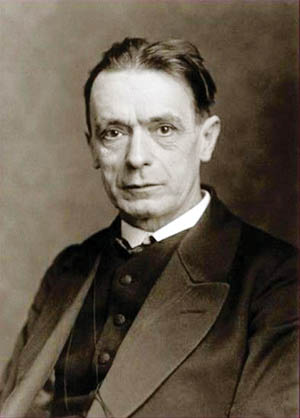
  • Psychic Self Defence

    Psychic Self Defence

    From New Dawn Special Issue Vol 11 No 4 (Aug 2017)

    They’re out there, moving stealthily in the darkness. The black magicians, the occult terrorists, Satanists, Mansonoids, Mindwarpers, Cattle Mutilators. “Nights black agents” as the Bard called them. They’re calling down curses on their enemies, sticking pins in Voodoo Dolls, summoning the mighty devil Choronzon to fall upon the earth and afflict it with madness, chanting to invoke the 777 servitors of Beelzebub. Well, yes. But let’s not lose our heads about it. The first and foremost thing to learn about evil is that it generally exists only in your own alarmed imagination.
    – Robert Anton Wilson, ‘Don’t be afraid of Black Magick’, Gnostica, Feb-Mar 1977

    The above quote is a great place to start when talking about psychic self defence. Too many people today are just plain paranoid and this is not, I repeat, not the state of mind to start contemplating psychic self defence. It is all too easy to stand in the position of being so self righteous that we attribute psychic attacks to all those who disagree with us. This in itself can be a form of psychic attack, known as a ‘Belief Attack’, and occurs when we project so much paranoia and fear that it returns to haunt us. The more we fight it, the stronger it gets.

    It is important to be objective before you start attributing certain experiences to psychic attack. The first stage of critical examination should involve examining your own mental and emotional state, and of those around you. If, after some thought, you still feel something is wrong then, and only then, should you consider that you might be under psychic attack. 

    With these clarifications in mind, it is true that psychic attacks are more prevalent than we think. Traditional systems of magic believed all diseases were a form of psychic attack. While we may not accept this today, certainly diseases of sudden and unexpected manifestation, uncontrollable headaches, nightmares, loss of ‘luck’ and other maladies, may have a psychic origin. These things in themselves do not mean you are under attack, however, in combination, and in the right situation, they are perhaps indicative.

    The Law of Association

    The simplest explanation for how psychic attacks work is found in what is known as the Law of Association. The most erudite definition of this is found in Real Magic by Isaac Bonewits, where he states that “if any two or more patterns have elements in common, these patterns interact through these elements, and control of one pattern facilitates control over the other(s), depending, among other facts, on the number of common elements involved.” 

    In simple terms, if two or more people are in contact (or have been in contact) an ‘astral link’ exists between them. This link may be used by either party to influence the other. It is also possible to create an astral link through the use of objects that have, in the past, been in contact with the other party – common examples would include hair, nails and clothing. The Law of Association gives us a basic idea of how a psychic attack may be accomplished, but things are never as simple as they seem. There are four distinct forms of psychic attack.

    Psychic Static

    This form of attack could probably be best understood as unconscious thought projection. It usually originates from someone you have known for quite a while, and is more intense when this person is under stress. Many cases of poltergeist activity can be attributed to psychic static, and traced to a teenager with emotional problems. In cases of psychic static, the originator usually has no knowledge of what is happening, the force being projected unconsciously along the primary astral threads or links the unknowing perpetrator possesses. This form of attack commonly causes headaches and minor mental disturbances, while in extreme cases poltergeist activity and sympathetic emotional reactions (including pain) have been noted.

    Psychic Draining

    This sort of psychic attack happens when you open up to far too many people. The result of such unreserved openness is a feeling of exhaustion and loss of energy. This form of psychic attack occurs regularly, far more than we care to admit. There are more emotional and psychic ‘vampires’ than we realise. These are professional victims, those who demand our constant emotional attention and assistance. Certainly, there are also deliberate psychic vampires (gurus and cult leaders are good examples) but these are few and far between. Far more prevalent is the professional victim who whines for assistance, affection and help, draining you of every ounce of energy.

    Psychic Attack

    Full frontal psychic attack is very unusual, but does occur. It is usually committed by someone you know or have at least had some contact with. Psychic attack by someone unknown to you is unusual, but possible (as long as they have something which connects you to them). Full frontal psychic attack can range from the simple nuisance attack to curses that can bring about disease and death.

    Psychic Atmospheres

    Psychic atmospheres come in two forms. The first is the classic haunted house or location. When you enter these locations or environments you are linked to them. Usually this attack is impersonal, that is to say, you have no personal connection to the situation, but this is not always the case. While this category borders on haunting and is not always considered a psychic attack, if you are living in a haunted house and find it is becoming a nuisance then this may be the explanation.

    The second is what can be best described as systematic attack. To fully appreciate this we need to consider it in some detail.

    Living in a World Possessed!

    I have deliberately chosen an exaggerated paragraph heading as it is important to consider how alien the Gnostic really is to the fallen world. Once you are on The Path of Transfiguration your very substance is in a state of transformation, a state which is opposed to everything the Demiurge, the World of the Archons and by extension, the physical world system (including governments, churches etc.), stand for. When Jesus said you should expect persecution, he was not joking! When you start to be reborn, your energy is like a beacon, a flashing light warning the fallen system, the Archons, Memes, demons and fallen angels to take a special interest. I am not suggesting you should always be looking over your shoulder – paranoia does not help in spiritual transformation – however you must be aware that you are now a stranger in a war torn land and the earth is no longer your home. There are many skills you need to develop to deal with this; some as outlined below are psychic and occult in nature, others are more psychological. Both have their place.

    Since the physical world is a fallen kingdom, the Demiurge has dominion over it. In the New Testament when St. Paul says, “Satan is the God of this world,” he is speaking literally. It is therefore of no use to expect justice, equality and perfection in our daily lives. While we must fight against injustice and hatred there is a limit; the baseline must be – does it interfere with my spiritual life? It is of no value spending your whole life fighting ‘City Hall’, and losing your soul. Within the fallen world there are many ‘little tyrants’, meaningless individuals who believe that by climbing to the top of their little dunghill they have made it. They will fight to the death to get to the top, and then fight to the death to stay there. It is self defeating for the Gnostic to constantly do battle with these ‘Gods in their own mind’ type people. You could spend every day of your life fighting them and still there would be more. 

    It is important for the Gnostic to be brutally realistic with themselves. Too often we fight against some injustice not because it is really that unjust but because our ego hurts. The bottom line is that we do not wish to lose face. In many cases the actual loss incurred by simply ignoring a petty tyrant is far less than the time and effort lost in the battle that would result if you challenged them. 

    There is a difficulty here; we must control the ego, we must be prepared to backdown, to lose face in the eyes of the world. This is a most difficult thing. There is a time for battle and a time for retreat. There is a time to ‘go quietly on the earth’, and another to ‘rage against the night’. The Gnostic must be able to decide what strategy to use in which situation. There is no value spending your life fighting against the world – judgement has already been passed, the earth is dead. Your task is to transform, to be Transfigured – not to try and save everybody else. 

    As part of this strategy the Gnostic needs to learn to keep his own counsel, to keep separate from the world. Avoid meaningless acquaintances, cultivate only those who share (or at the very least) have a strong sympathy for your belief system. The less ‘psychic links’ you have, the less you are open for them to be abused. Be cunning – use your mind as well as your psychic skills.

    Techniques of Psychic Self Defence – Cutting the Cord

    There are many simple techniques for dealing with unwanted connections or links, both ritual and psychic. A very simple technique uses a chair (or a partner) and some string or cord. You enter a meditative state and visualise the person with whom you have an astral link sitting in the chair in front of you; a cord or piece of string can be run from yourself to the chair (or partner). Spend some time contemplating the nature of the link you have with this person, consider the emotions involved, go over times when you meet them, try and make the link as real as possible. If you are working with a ritual partner get them to ‘role play’ the other person – make the experiences as real as possible. If you wish to combine technology with the experience, use photographs, videos or tape recordings of the person. After a period of time you should begin to sense the link; as you sense the link becoming stronger, focus the link on the cord. (The cord should be tied firmly to the chair or held firm by your partner). Sense all your connection entering the cord.

    After you feel your whole relationship in this cord, use a ritual dagger (or a pair of scissors if you prefer) to cut the cord. As the cord is cut, state firmly that the connection to this person is severed. Visualise the psychic connection, that glistening white line of light, being severed between you and them forever.

    A variation of this technique is to visualise the cord and see it as representing all unwanted connections, name it ‘acquaintances and business partners’, ‘distant family members’ and disconnect accordingly.

    The Dome

    This is a simple visualisation technique that can be used to create a protective psychic environment. Imagine a Dome, a bit like an inverted test-tube. It should surround what you need to protect – yourself, your home, whatever. Try and experience what the Dome you have visualised is like, notice its colour, textures, smell – everything you can. Interact with the Dome; using your imagination tell it what you want it to be. It should be weightless and unobtrusive. It should repel forces that are not sympathetic to your environment, but otherwise not have any other task. If it is surrounding you, notice it moving when you move. Make sure you (and the Dome) are clear about what has to be accomplished. If you feel you are under regular psychic attack, then visualise the outside of the Dome as a reflective, shiny surface, bouncing back any destructive forces. Remember to check the Dome often and recharge it!

    The Bell

    Visualise a bell between your hands. See it clearly and make yourself aware of all the senses connected to it. Move the image to your Solar Plexus and sense it extending a field of energy to all parts of your Astral body. Programme it to ring if you are psychically attacked, and react with a shield of light. If a psychic attack occurs, you should hear the sound of the bell and a shield of light will surround you. Another variation to use is to visualise a laser that shoots down energies that are unsympathetic to your development. The adaptations are endless.

    [alert type=”general” dismiss=”no”]This article was published in New Dawn Special Issue Vol 11 No 4.[/alert]

    [alert type=”success” dismiss=”no”]If you appreciate this article, please consider subscribing to help maintain this website.[/alert]

    © New Dawn Magazine and the respective author.
    For our reproduction notice, click here.