New Dawn – World's Most Unusual Magazine

Category: Articles

  • The End of the Kali Yuga in 2025: Unravelling the Mysteries of the Yuga Cycle

    The End of the Kali Yuga in 2025: Unravelling the Mysteries of the Yuga Cycle

    From New Dawn Special Issue Vol 11 No 3 (June 2017)

    A number of ancient cultures believed in a Cycle of World Ages in which we gradually descend from a state of spiritual perfection and material abundance to one of ignorance and scarcity. In ancient India, this was called the Yuga Cycle. The Yuga Cycle doctrine tells us that we are now living in the Kali Yuga; the age of darkness, when moral virtue and mental capabilities reach their lowest point in the cycle. 

    The Mahabharata describes the Kali Yuga as the period when the “World Soul” is Black in hue; only one quarter of virtue remains, which slowly dwindles to zero at the end of the Kali Yuga. Men turn to wickedness; disease, lethargy, anger, natural calamities, anguish and fear of scarcity dominate. Penance, sacrifices and religious observances fall into disuse. All creatures degenerate. Change passes over all things, without exception.

    The Kali Yuga (Iron Age) was preceded by three other Yugas: Satya or Krita Yuga (Golden Age), Treta Yuga (Silver Age) and the Dwapara Yuga (Bronze Age). In the Mahabharata, Hanuman gives the following description of the Yuga Cycle to the Pandava prince Bhima:

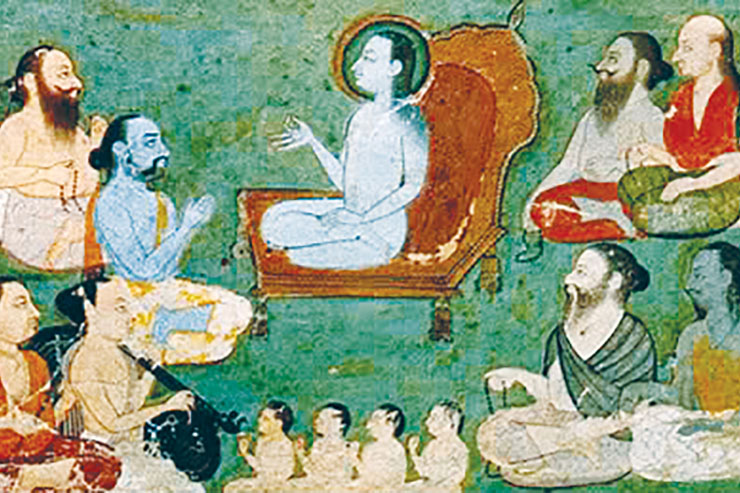
    The Krita Yuga was so named because there was but one religion, and all men were saintly: therefore they were not required to perform religious ceremonies… Men neither bought nor sold; there were no poor and no rich; there was no need to labour, because all that men required was obtained by the power of will… The Krita Yuga was without disease; there was no lessening with the years; there was no hatred, or vanity, or evil thought whatsoever; no sorrow, no fear. All mankind could attain to supreme blessedness. The universal soul was White… the identification of self with the universal soul was the whole religion of the Perfect Age. In the Treta Yuga sacrifices began, and the World Soul became Red; virtue lessened a quarter. Mankind sought truth and performed religious ceremonies; they obtained what they desired by giving and by doing. In the Dwapara Yuga the aspect of the World Soul was Yellow: religion lessened one-half. The Veda was divided into four parts, and although some had knowledge of the four Vedas, others knew but three or one. Mind lessened, Truth declined, and there came desire and diseases and calamities; because of these men had to undergo penances. It was a decadent Age by reason of the prevalence of sin.1

    Now we are living in the dark times of the Kali Yuga, when goodness and virtue has all but disappeared from the world. When did the Kali Yuga begin, and when does it end? 

    In spite of the elaborate theological framework of the Yuga Cycle, the start and end dates of the Kali Yuga remain shrouded in mystery. The popularly accepted date for the beginning of the Kali Yuga is 3102 BCE, thirty-five years after the conclusion of the battle of the Mahabharata. This date is believed to be based on a statement made by the noted astronomer Aryabhatta in the Sanskrit text Aryabhatiya, where he writes that:

    When sixty times sixty years (i.e. 3,600 years) and three quarter Yugas had elapsed, twenty-three years had then passed since my birth.2

    This means that Aryabhatta had composed the text when he was 23 years old and 3,600 years of the current Yuga had elapsed. The problem here is that we do not know when Aryabhatta was born, or when he composed the Aryabhatiya. He does not even mention the Kali Yuga by name, and simply states that 3,600 years of the Yuga had elapsed. Scholars generally assume that the Kali Yuga had started in 3102 BCE, and then use this statement to justify that the Aryabhatiya was composed in 499 CE. However, we cannot use the reverse logic, i.e. we cannot say that the Kali Yuga must have started in 3102 BCE since the Aryabhatiya was composed in 499 CE, for we do not know when Aryabhatta lived or completed his work.

    Another important source is the Aihole inscription of Pulakesin II of Badami, which was incised on the expiry of 3,735 years after the Bharata war and 556 years of the Saka kings.3 If we take the beginning of the Saka Era as 78 CE, then the Bharata War took place in 3102 BCE, then the Kali Yuga, which started 35 years after the Bharata War, began on 3067 BCE. But we must remember there is an Old Saka Era as well, whose beginning date is disputed, and for which various dates have been proposed by scholars ranging from 83 BCE – 383 BCE.4 If the Aihole inscription refers to the Old Saka Era, then the Kali Era starts a few hundred years before 3102 BCE.

    The truth is that there is no text or inscription which gives us an unambiguous date for the beginning of the Kali Yuga. Although the popularly accepted date is 3102 BCE, there is no astronomical basis for it. There is a claim that the computation was based on the conjunction of the five ‘geocentric planets’ (i.e. the planets visible to the naked eye) – Mercury, Venus, Mars, Jupiter and Saturn – at 0° Aries at the beginning of the Kali Yuga as mentioned in the Surya Siddhanta. But the Surya Siddhanta explicitly states that this conjunction of planets at 0° Aries takes place at the end of the Golden Age.5 Besides, modern simulations indicate that on 17/18 February 3102 BCE, the five geocentric planets occupied an arc of roughly 42° in the sky, which cannot be considered as a conjunction by any means. Therefore, neither is there any astronomical basis for the start date, nor do we have any evidence that Aryabhatta or any other astronomer had calculated the date. Before the 6th century CE, the date does not occur in any Sanskrit text or inscription. It could have been invented by later day astronomers or adopted from some other calendar. The vagueness surrounding the origin of this very important chronological marker makes its validity highly suspect.

    The task of figuring out the start date of the Kali Yuga from the ancient Sanskrit texts, however, is fraught with difficulties, since a number of inaccuracies have crept into the Yuga Cycle information contained within them. In many Sanskrit texts the 12,000-year duration of the Yuga Cycle was artificially inflated to an abnormally high value of 4,320,000 years by introducing a multiplication factor of 360, which was represented as the number of ‘human years’ which constitutes a ‘divine year’. In the book, The Arctic Home in the Vedas (1903), B.G. Tilak wrote that: 

    The writers of the Puranas, many of which appear to have been written during the first few centuries of the Christian, era, were naturally unwilling to believe that the Kali Yuga had passed away… An attempt was, therefore, made to extend the duration of the Kali Yuga by converting 1,000 (or 1,200) ordinary human years thereof into as many divine years, a single divine year, or a year of the gods, being equal to 360 human years… this solution of the difficulty was universally adopted, and a Kali of 1,200 ordinary years was at once changed, by this ingenious artifice, into a magnificent cycle of as many divine, or 360 × 1200 = 432,000 ordinary years.6

    Yuga Cycle of 24,000 Years

    However, certain important Sanskrit texts such as the Mahabharata7 and the Laws of Manu,8 which scholars believe were composed earlier than the Puranas, still retain the original value of the Yuga Cycle as 12,000 years. The Mahabharata explicitly mentions that the Yuga Cycle duration is based on the days and nights of human beings. The Zoroastrians also believed in a Cycle of the Ages of 12,000 years’ duration. The Great Year or Perfect Year of the Greeks was variously represented as being of 12,954 years (Cicero) or 10,800 years (Heraclitus) duration. Surely, the Yuga Cycle cannot be of different durations for different cultures.

    In the book The Holy Science (1894)Sri Yukteswar clarified that a complete Yuga Cycle takes 24,000 years, and is comprised of an ascending cycle of 12,000 years when virtue gradually increases and a descending cycle of another 12,000 years, in which virtue gradually decreases. Hence, after we complete a 12,000-year descending cycle from Satya Yuga -> Kali Yuga, the sequence reverses itself, and an ascending cycle of 12,000 years begins which goes from Kali Yuga -> Satya Yuga. Yukteswar states that, “Each of these periods of 12,000 years brings a complete change, both externally in the material world, and internally in the intellectual or electric world, and is called one of the Daiva Yugas or Electric Couple.”9 

    The 24,000-year duration of the complete Yuga Cycle closely approximates the Precessional Year of 25,765 years, which is the time taken by the sun to ‘precess’, i.e. move backwards, through the 12 Zodiac constellations. Interestingly, the Surya Siddhanta specifies a value of 54 arc seconds per year for precession, as against the current value of 50.29 arc seconds per year. This translates into a Precessional Year of exactly 24,000 years! This means that the current observed value of precession may simply be a temporary deviation from the mean.

    The concept of an ascending and descending cycle of Yugas is still prevalent among the Buddhists and Jains. The Jains believe that a complete Time Cycle (Kalachakra) has a progressive and a regressive half. During the progressive half of the cycle (Utsarpini), there is a gradual increase in knowledge, happiness, health, ethics, and spirituality, while during the regressive half of the cycle (Avasarpini) there is a gradual reduction in these qualities. These two half cycles follow each other in an unbroken succession for eternity, just like the cycles of day and night or the waxing and waning of the moon. 

    The ancient Greeks also appear to have believed in an ascending and descending Cycle of Ages. The Greek poet Hesiod (c. 750 BCE – 650 BCE) had given an account of the World Ages in Works and Days, in which he inserted a fifth age called the ‘Age of Heroes’, between the Bronze Age and the Iron Age. In Hesiod’s Cosmos, Jenny Strauss Clay writes:

    Drawing on the myth in Plato’s Statesman, Vernant also claimed that the temporal framework of Hesiodic myth, that is, the succession of races, is not linear but cyclical; at the end of the age of iron, which he divides into two, the cycle of races starts again with a new golden age or, more likely, a new age of heroes, as the sequence reverses itself…Vernant himself offers a solution when he remarks that “there is not in reality one age of iron but two types of human existence.”10

    This is very interesting. Jean-Pierre Vernant, who is a highly-acclaimed specialist in ancient Greek culture, believes that the Cycle of the Ages reverses itself as per Hesiod’s account. Not only that, he states the Iron Age has two parts, which corresponds to Yukteswar’s interpretation in which the descending Kali Yuga is followed by the ascending Kali Yuga. We can surmise, in this context, that the ‘Age of Heroes’, which immediately followed the Bronze Age in Hesiod’s account, must be the name ascribed by Hesiod to the descending Kali Yuga.

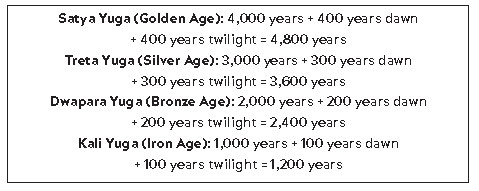
    The evidence from different sources supports the notion of a complete Yuga Cycle of 24,000 years, comprised of an ascending and descending cycle of 12,000 years each. This brings us to the question of the relative durations of the different Yugas in the Yuga Cycle, and the transitional periods, which occur at the beginning and end of each Yuga, and are known as Sandhya (dawn) and Sandhyansa (twilight) respectively. The values in the following table are provided in the Sanskrit texts for the duration of the Yugas and their respective dawns and twilights:
    Yugas of Equal Duration?

    Since so many inaccuracies crept into the Yuga Cycle doctrine, as pointed out by Yukteswar and Tilak, we also need to question the accuracy of the relative durations of the Yugas mentioned in the Sanskrit texts. Although the Yuga Cycle is mentioned in the mythic accounts of around thirty ancient cultures, as described by Giorgio de Santillana, professor of the history of science at MIT, in the book Hamlet’s Mill (1969), we find very little information regarding the relative durations of the different ages within this cycle. 

    In the few accounts where the durations of the Yugas are specified, we find that each age in the Yuga Cycle is of the same duration. For instance, the Zoroastrians believe that the world lasts for 12,000 years, which is divided into four equal ages of 3,000 years each. A Mexican source known as the Codex Rios (also referred to as Codex 3738 and Codex Vaticanus A) states that each age lasts for 4,008, 4,010, 4,801 and 5,042 years respectively for a total of 17,861 years. We can see that in this case also the duration of each age is nearly the same. 

    Therefore, the durations of the four Yugas mentioned in the Sanskrit texts (i.e. 4,800, 3,600, 2,400, and 1,200 years) deviate from the norm. The duration of each Yuga, in this sequence, decreases by 1,200 years from the previous one. This is an arithmetic progression which is rarely, if ever, found in natural cycles. Could it be that the Yuga durations were deliberately altered at some point in the past in order to give the impression that the duration of each Yuga decreases in tandem with the decrease in virtue from one Yuga to the next?

    Here is the most startling fact: Two of the most famous astronomers of ancient India, Aryabhatta and Paulisa, believed that the Yuga Cycle is comprised of Yugas of equal duration! In the 11th century, the medieval scholar Al-Beruni had compiled a comprehensive commentary on Indian philosophy, sciences and culture titled Alberuni’s India, in which he mentions that the Yuga Cycle doctrine was based on the derivations of the Indian astronomer Brahmagupta, who in turn derived his knowledge from the Sanskrit Smriti texts. He makes an interesting statement in this regard:

    Further, Brahmagupta says that “Aryabhatta considers the four yugas as the four equal parts of the caturyuga (Yuga Cycle). Thus he differs from the doctrine of the book Smriti, just mentioned, and he who differs from us is an opponent.”11

    The fact that Aryabhatta believed the four Yugas to be of equal duration is extremely pertinent! Al-Beruni reasserts this in no uncertain terms: “Therefore, according to Aryabhatta, the Kali Yuga has 3,000 divya years…. each two yugas has 6,000 divya years… each three years has 9,000 divya years.” Why would Aryabhatta subscribe to such a belief? Did he have access to sources of information that are lost to us now?

    Paulisa, another celebrated astronomer of ancient India, also subscribed to the idea of Yugas of equal duration. Alberuni says that, while presenting the calculations for the duration of a kalpa, “he (Pulisa) has not changed the caturyugas into exact yugas, but simply changed them into fourth parts, and multiplied these fourth parts by the number of years of a single fourth part.”12

    Thus, two of the most respected astronomers of ancient India, Aryabhatta and Paulisa, believed in a Yuga Cycle that comprised of 4 Yugas of equal duration of 3,000 divine-years each. However, their opinion was overshadowed by the contradictory view held by Brahmagupta. He railed against Aryabhatta and the other astronomers who held differing opinions, and even abused them. Al-Beruni says about Brahmagupta: 

    He is rude enough to compare Aryabhatta to a worm which, eating the wood, by chance describes certain characters in it without understanding them and without intending to draw them. “He, however, who knows these things thoroughly, stands opposed to Aryabhatta, Srishena, and Vishnucandra like the lion against gazelles. They are not capable of letting him see their faces.” In such offensive terms he attacks Aryabhatta and maltreats him.13 

    We can now understand why Brahmagupta’s opinion finally prevailed over that of the other astronomers of his time, and it certainly did not have anything to do with the inherent soundness of his logic, or the authenticity of his sources.

    It is time for us to stop standing in opposition to Aryabhatta, Paulisa, Srishena, Vishnucandra and others like the “lion against gazelles,” and instead take cognizance of the very real possibility that the Yugas in the Yuga Cycle are of equal duration, and the 4:3:2:1 sequence of the Yugas may have been a mathematical manipulation that crept into the Yuga Cycle doctrine sometime prior to 500 CE. It is possible this manipulation was introduced because people were inclined to believe that the duration of a Yuga should decrease in tandem with the decrease in virtue and human longevity from one Yuga to the next. A neat formula was devised in which the total duration of the Yugas added up to 12,000 years. However, there was one problem. If the Kali Yuga is of 1,200 years duration, then it should have been completed many times over, since its proposed beginning in 3102 BCE. In order to circumvent this potentially embarrassing situation, another complexity was introduced. Each ‘year’ of the Yuga Cycle became a ‘divine year’ comprised of 360 human years. The Yuga Cycle became inflated to 4,320,000 years (12,000×360) and the Kali Yuga became equal to 432,000 years (1,200×360). Humanity became consigned to an interminable duration of darkness. 

    Original Yuga Cycle Encoded into Saptarshi Calendar 

    The original Yuga Cycle doctrine appears to have been very simple: A Yuga Cycle duration of 12,000 years, with each Yuga lasting for 3,000 years. This cycle is encoded in the Saptarshi Calendar which has been used in India for thousands of years. It was used extensively during the Maurya period in the 4th century BCE, and is still in use in some parts of India. The term Saptarshi refers to the ‘Seven Rishis’ or the ‘Seven Sages’ representing the seven stars of the Great Bear constellation (Ursa Major). They are regarded as the enlightened rishis who appear at the beginning of every Yuga to spread the laws of civilisation. The Saptarshi Calendar used in India had a cycle of 2,700 years; it is said that the Great Bear constellation stays for 100 years in each of the 27 Nakshatras (lunar asterisms) which adds up to a cycle of 2,700 years.14 The 2,700-year cycle was also referred to as a Saptarshi Era or a Saptarshi Yuga. 
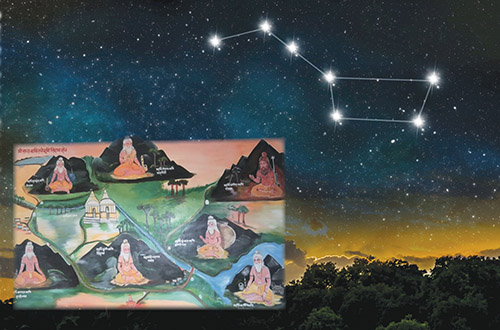
    The Great Bear constellation (Ursa Major) is clearly visible in the northern sky throughout the year. The seven prominent stars represent the Seven Sages (Saptarshi), each one depicted in the painting.

    If the 2,700 year cycle of the Saptarshi Calendar represents the actual duration of a Yuga, then the remaining 300 years out of the total Yuga duration of 3,000 years automatically represents the ‘transitional period’, before the qualities of the subsequent Yuga are fully manifested. The total duration of the Yuga Cycle, excluding the transitional periods, is equal to (2,700×4), i.e. 10,800 years, the same as the duration of the ‘Great Year of Heraclitus’ in Hellenic tradition! This clearly indicates the underlying basis of the Cycle of the World Ages in both India and Greece was the 2,700 year Saptarshi Cycle.

    It is agreed by historians that the Saptarshi Calendar, in use during the Maurya period in the 4th century BCE, started in 6676 BCE. In the book Traditions of the Seven Rsis, Dr. J.E. Mitchiner confirms this: 

    We may conclude that the older and original version of the Era of the Seven Rsis commenced with the Seven Rsis in Krttika in 6676 BCE… This version was in use in northern India from at least the 4th century BCE, as witnessed by the statements of Greek and Roman writers; it was also the version used by Vrddha Garga, at around the start of the Christian era.15 

    In fact, the recorded chronology of Indian kings goes back further than 6676 BCE as documented by the Greek and Roman historians Pliny and Arrian. Pliny states that, “From Father Liber [Roman Bacchus or Greek Dionysus] to Alexander the Great (d. 323 BCE), Indians reckon 154 kings, and they reckon (the time as) 6,451 years and 3 months.”16 Arrian puts 153 kings and 6,462 years between Dionysus and Sandrokottos (Chandragupta Maurya), to whose court a Greek embassy was sent in 314 BCE.17 Both indications add up to a date of roughly c.6776 BCE, which is a 100 years prior to the beginning of the Saptarshi Calendar in 6676 BCE. 

    It is obvious from the accounts of Pliny and Arrian that they must have identified a specific king in the Indian kings list who corresponded to the Greek Dionysus or Roman Bacchus, and whose reign had ended at around c.6776 BCE. Who could that have been? According to the renowned scholar and Orientalist Sir William Jones, Dionysus or Bacchus was none other than the Indian monarch Rama. In his essay “On the Gods of Greece, Italy and India” (1784), Sir William Jones 

    deems Rama to be the same as the Grecian Dionysos, who is said to have conquered India with an army of satyrs, commanded by Pan; and Rama was also a mighty conqueror, and had an army of large monkeys or satyrs, commanded by Maruty (Hanuman), son of Pavan. Rama is also found, in other points, to resemble the Indian Bacchus.18 

    Sir William Jones also points out that, 

    Meros is said by the Greeks to have been a mountain of India, on which their Dionysus was born, and that Meru is also a mountain near the city of Naishada, or Nysa, called by the Grecian geographers Dionysopolis, and universally celebrated in the Sanskrit poems.19

    The identification of Dionysus with Rama provides us with fresh perspectives. According to the Indian tradition, Rama lived towards the end of the Treta Yuga (Silver Age), and the Dwapara Yuga (Bronze Age) had started soon after his demise. This implies that the 6676 BCE date for the beginning of the Saptarshi Calendar, which is 100 years after Dionysus, i.e. Rama, indicates the beginning of the Dwapara Yuga in the descending cycle.

    A later Saptarshi Calendar, still in use in India, began from 3076 BCE. But, as Dr. Subhash Kak points out, “the new count that goes back to 3076 BCE was started later to make it as close to the start of the Kali era as possible.”20 In the book Traditions of the Seven Rsis, Dr. Mitchiner says that the Saptarshi Calendar for the Kali Yuga (the Kashmir Laukika Abda) started when the Saptarshis were in Rohini. Since the Saptarshis were in Rohini in 3676 BCE, it implies the Kali Yuga cycle must have commenced in 3676 BCE. 

    Tracking Down the True End Date of Current Kali Yuga

    Now this is where it gets interesting. A Saptarshi Era began in 6676 BCE, and another cycle started exactly 3,000 years later in 3676 BCE. But the Saptarshi Cycle is of 2,700 years’ duration. Why did the Saptarshi Era for the Kali Yuga start 3,000 years after the previous cycle? This means a 300-year ‘transitional period’ must have been added to the end of the previous cycle! It clearly proves the hypothesis that the 2,700 year Saptarshi Cycle, along with a 300-year transitional period, was the original calendrical basis of the Yuga Cycle. 

    If we use the 6676 BCE date as the beginning of the Dwapara Yuga in the descending cycle, and the 2,700 year Saptarshi Cycle along with a 300-year transitional period as the basis for the Yuga Cycle, then the entire timeline of the Yuga Cycle is unravelled.

    This Yuga Cycle timeline takes the beginning of the Golden Age to 12676 BCE, more than 14,500 years before present, when the Great Bear was in the Shravana nakshatra (the Great Bear will advance by 3 nakshatras in every Yuga because of the 300-year transitional period). This agrees very well with the Indian tradition, since the Mahabharata mentions that in the ancient tradition the Shravana nakshatra was given the first place in the nakshatra cycle. 
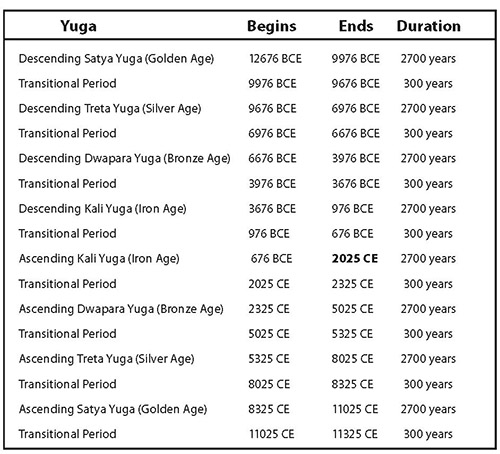
    Yuga Cycle timeline based on the Saptarshi Calendar. According to
    this interpretation, the Kali Yuga ends in 2025, to be followed by a 300
    year transitional period leading up to the Ascending Dwapara Yuga.

    The timeline also indicates that the ascending Kali Yuga, which is the current epoch in which we are living, will end in 2025 CE. The full manifestation of the next Yuga – the ascending Dwapara – will take place in 2325 CE, after a transitional period of 300 years. The ascending Dwapara Yuga will then be followed by two more Yugas: the ascending Treta Yuga and the ascending Satya Yuga, which completes the 12,000 year ascending cycle. 

    The Sanskrit text Brahma-vaivarta Purana describes a dialogue between Lord Krishna and the Goddess Ganges. Here, Krishna says that after 5,000 years of Kali Yuga there will be a dawn of a new Golden Age that lasts for 10,000 years (Text 50, 59). This can be immediately understood in the context of the Yuga Cycle timeline described here. We are now ending the Kali Yuga, nearly 5,700 years since its beginning in 3676 BCE. And the end of the Kali Yuga will be followed by three more Yugas spanning 9,000 years, before the ascending cycle ends. 

    Archaeological & historical evidence

    According to the Yuga Cycle doctrine, the transitional periods between the Yugas are associated with a collapse of civilisations and environmental catastrophes (pralaya), which wipe out virtually every trace of any human civilisation. The new civilisation that emerges in the new Yuga is guided by a few survivors of the cataclysm, who carry with them the technical and spiritual knowledge of the previous epoch. Many ancient sources tell us of the enigmatic group of ‘Seven Sages’ (‘Saptarshi’) who are said to appear at the beginning of every Yuga and promulgate the arts of civilisation. We find them in myths across the world – in Sumeria, India, Polynesia, South America and North America. They possessed infinite wisdom and power, could travel over land and water, and took on various forms at will. The Saptarshi Calendar of ancient India appears to have been based on their periodic appearance at the beginning of every Yuga.

    As we shall see, the Yuga Cycle timeline proposed here correlates very strongly with the major cataclysmic events that periodically impact our planet, and with a number of important dates recorded in various ancient calendars and scriptures. 

    The planet was subjected to sudden and destructive, deep-water, oceanic comet impacts during the 300-year transitional period at the end of the last Golden Age, circa 9600 BCE.

    The first transitional period in the 12,000-year descending Yuga Cycle is the 300-year period at the end of the Golden Age from 9976 BCE – 9676 BCE. This is the time when the last Ice Age came to a sudden end; the climate became very warm quite abruptly, and there was a catastrophic global flooding. Many ancient legends refer to this time period. In the Timaeus, Plato tells us of the mythical island of Atlantis which was swallowed up by the sea in a “single day and night of misfortune” in c.9600 BCE. The Zoroastrians believe the world was created by Ahura Mazda at around 9600 BCE, (i.e. 9,000 years before the birth of their prophet Zoroaster in c.600 BCE).

    This event has also been recorded in the flood myths of many ancient cultures, which almost uniformly talk of enormous walls of water that submerged the entire land to the highest mountain tops, along with heavy rain, fireballs from the sky, intense cold and long periods of darkness. Archaeologist Bruce Masse of the Los Alamos National Laboratory in New Mexico examined a sample of 175 flood myths from different cultures around the world and concluded that the environmental aspects described in these events, which is also consistent with the archaeological and geophysical data, could have only been precipitated by a destructive, deep-water, oceanic comet impact.21 

    In recent years, a team of international scientists found compelling evidence that the Earth was bombarded by multiple fragments of a giant comet nearly 12,800 years ago, triggering the start of a rapid and intense cooling period called Younger Dryas, which lasted for nearly 1,200 years till c.9700 BCE. The force of the comet impact, combined with the vicious cold snap that followed, brought about the extinction of a large number of North American megafauna including woolly mammoths and giant ground sloths, and ended a prehistoric civilisation called the Clovis culture – the first human inhabitants of the New World.22
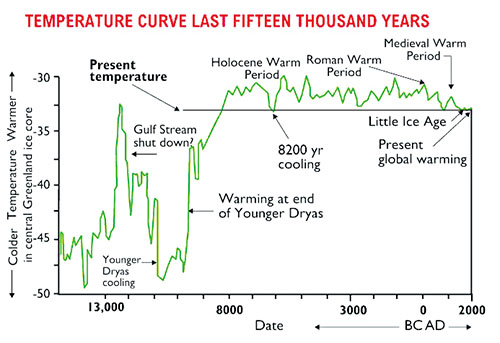
    This temperature graph shows the sudden cooling at the beginning of the Younger Dryas and an equally sudden warming at the end of the Younger Dryas.

    The Younger Dryas ended as abruptly as it started, for reasons not fully understood. Geologists from the Niels Bohr Institute (NBI) in Copenhagen studied the Greenland ice core data and concluded that the Ice Age ended exactly in 9703 BCE. Researcher Jorgen Peder Steffensen said that, “in the transition from the ice age to our current warm, interglacial period the climate shift is so sudden that it is as if a button was pressed.”23 The 9703 BCE date for the sudden climate shift falls within the 300-year transitional period at the end of the Golden Age from 9976 BCE – 9676 BCE, and as such it provides the first important validation of the Yuga Cycle timeline identified here.

    Black Sea Catastrophe & Global Floods

    The 300-year transitional period between the Treta Yuga (Silver Age) and the Dwapara Yuga (Bronze Age) from 6976 BCE – 6676 BCE also coincides with a significant environmental event – the Black Sea Catastrophe – recently dated to 6700 BCE. The Black Sea once used to be a freshwater lake. That is, until the Mediterranean Sea, swollen with melted glacial waters, breached a natural dam, and cut through the narrow Bosphorous Strait, catastrophically flooding the Black Sea. This raised the water levels of the Black Sea by several hundred feet, flooded more than 60,000 square miles of land, and significantly expanded the Black Sea shoreline (by around 30%).24 This event fundamentally changed the course of civilisation in Southeastern Europe and western Anatolia. Geologists Bill Ryan and Walter Pitman of Lamont-Doherty Earth Observatory in New York, who first proposed the Black Sea Catastrophe hypothesis, have gone to the extent of comparing it to Noah’s Flood. 
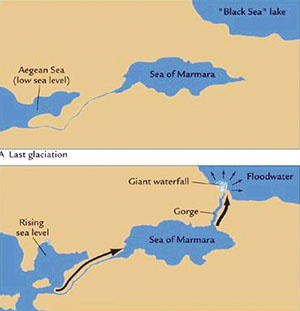
    The Black Sea catastrophe, before and after. The water from the Aegean Sea cut through a narrow Gorge (Bosphorous Strait) and plunged into the Black Sea creating a gigantic waterfall. 

    Similar major flooding events took place in many parts of the world, as massive glacial lakes, swelled by the waters of the melting ice, breached their ice barriers, and rushed into the surrounding areas. Sometime between 6900 BCE – 6200 BCE the Laurentide ice-sheet disintegrated in the Hudson Bay and an enormous quantity of glacial waters from the inland Lake Agassiz/Ojibway discharged into the Labrador Sea. This was possibly the “single largest flood of the Quaternary Period,” which may have single-handedly raised the global sea level by half a meter.25 The period between 7000 BCE – 6000 BCE was also characterised by the occurrences of gigantic earthquakes in Europe. In northern Sweden, some of these earthquakes caused ‘waves on the ground’, 10 metres high, referred to as ‘rock tsunamis’. It is possible that the global chain of cataclysmic events during this transitional period may have been triggered by a single underlying cause, which we are yet to find out.

    The transitional period between the Dwapara Yuga and Kali Yuga, from 3976 BCE – 3676 BCE, was again marked by a series of environmental cataclysms, whose exact nature remains a mystery. It is referred to in geology as the 5.9 kiloyear event, and is considered one of the most intense aridification events during the Holocene period. It occurred around 3900 BCE, ending the Neolithic Sub-pluvial and initiated the most recent desiccation of the Sahara Desert. At the same time, between 4000 BCE – 3500 BCE, the coastal plains of Sumer experienced severe flooding, which “was the local effect of a worldwide episode of rapid, relatively short-term flooding known as the Flandrian Transgression – which had a significant impact not only along the shores of the Gulf but in many other parts of Asia as well.”26 This catastrophic flooding event led to the end of the Ubaid period in Mesopotamia, and triggered a worldwide migration to river valleys. Soon afterwards, we find the emergence of the first river valley settlements in Egypt, Mesopotamia and the Indus Valley in c. 3500 BCE.

    This transitional period between the Yugas is also recorded in ancient calendars. For a very long time there was a prevalent belief in the Western world that the world was created in 4004 BCE. This date comes to us from the genealogies of the Old Testament. The date is just 28 years prior to the end of the Dwapara and the beginning of the transitional period. The year of world creation in the Jewish religious calendar is 3761 BCE, which is in the middle of the transitional period.

    Greek Dark Ages & Great Upheavals

    As per the ancient traditions, the descending Kali Yuga, which was referred to by Hesiod as the ‘Age of Heroes’, came to an end with the battle fought on the plains of Troy. The Yuga Cycle timeline indicates that the 300-year intervening period between the descending and ascending Kali Yuga extended from 976 BCE – 676 BCE; and very interestingly, this overlaps with the 300-year period from 1100 BCE to 800 BCE which is referred to by historians as the Greek Dark Ages! 

    Historians regard the Greek Dark Ages as a period of transition from the Late Bronze Age to the Early Iron Age. Robert Drews writes that: 

    Within a period of forty to fifty years at the end of the thirteenth and the beginning of the twelfth century (c.1200 – 1100 BCE) almost every significant city in the eastern Mediterranean world was destroyed, many of them never to be occupied again.27
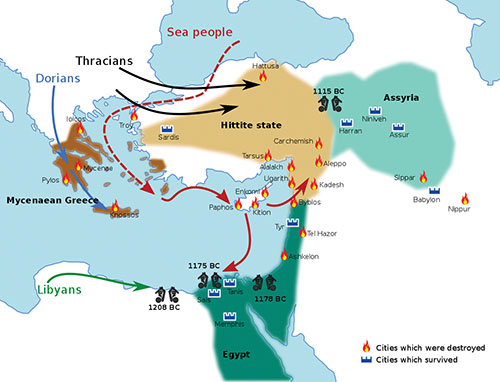
    Map of the Late Bronze Age collapse in the Eastern Mediterranean along with movements of people. 

    This sudden and violent disruption plunged the entire Near East, North Africa, Caucasus, Aegean, and Balkan regions into a Dark Age that lasted for three hundred years, and was characterised by great upheavals, famine, depopulation, and mass movements of people. Almost every city between Pylos and Gaza was violently destroyed, and many abandoned. The palace economies of Mycenae and Anatolia collapsed, and people lived in isolated, small settlements. 

    In Egypt, the period from 1070 BCE – 664 BCE is known as the ‘Third Intermediate Period’ during which time Egypt was overrun by foreign rulers. There was political and social disintegration and chaos, accompanied by a series of crippling droughts. In India, the Indus Valley civilisation finally ended around 1000 BCE, and after a gap of nearly 400 years we see the emergence of the 16 Great Kingdoms (Mahajanapadas) in the Gangetic Plains at around 600 BCE. Catastrophe also struck the Olmec civilisation of Mesoamerica at this time. A wholesale destruction of many San Lorenzo monuments occurred in c.950 BCE and the site was abandoned in c.900 BCE. Scholars believe drastic environmental changes may have been responsible for this shift in Olmec centres, with certain important rivers changing course.

    When the ascending Kali Yuga began in 676 BCE, much of the knowledge, traditions, and skills from the descending Kali Yuga were forgotten. Possibly in response to this grave social crisis, a number of philosophers and prophets appeared at this time, trying to re-discover the lost wisdom, and spread it amongst the ignorant masses. Among them were Buddha (623 BCE), Thales (624 BCE), Pythagoras (570 BCE), Confucius (551 BCE), Zoroaster (600 BCE), and Mahavir Jain (599 BCE). But much sacred knowledge was irretrievably lost. For instance, the original Vedas were comprised of 1,180 sakhas (i.e. branches), of which only 7 or 8 sakhas (less than 1%) are remembered now. Various errors, omissions, and interpolations also crept into the ancient texts as they were being revised and written down. The mistakes in the Yuga Cycle doctrine were some of them. 

    The Yuga Cycle timelines proposed here accurately mirrors the worldwide environmental catastrophes that accompany transitional periods between Yugas. Every 2,700 years our planet is impacted by a series of cataclysmic events for a period of a few hundred years, which brings about a total or near total collapse of civilisations across the world. In every case, however, civilisation restarts immediately after the period of destruction. The four key transitional periods, since the end of the Golden Age, are summarised in the above table.

    It is evident that the Yuga Cycle used to be tracked using the Saptarshi Calendar. It was of 12,000 years duration, comprised of four Yugas of equal duration of 2,700 years each, separated by transitional periods of 300 years. The complete Yuga Cycle of 24,000 years was comprised of an ascending and descending Yuga cycle, which followed each other for eternity like the cycles of day and night. For the past 2,700 years we have been passing through the ascending Kali Yuga, and this Yuga is coming to an end in 2025. 
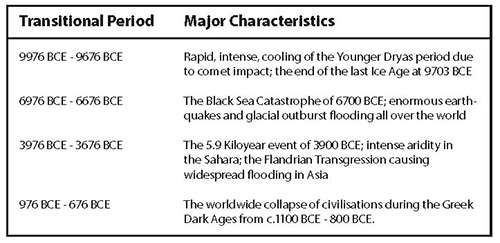
    The Transitional Periods between Yugas

    In accordance with convention, the 300-year transitional period following 2025 can be broken into two periods of 150 years each. The first 150-year period – the ‘Twilight of Kali’ – is when the Kali Yuga structures may collapse due to a combination of wars, environmental catastrophes, and cosmic changes, while the second 150-year period – the ‘Dawn of Dwapara’ – is the time when the spiritually evolved systems and philosophies of the Dwapara Yuga may begin to emerge. It is likely, though, that the twin processes of collapse and emergence will progress simultaneously throughout the entire 300-year transitional period, albeit at different intensities. 

    The current upswing in tectonic activities and extreme weather phenomena on one hand, and the initial signs of the awakening of a higher consciousness amongst humanity on the other, may be indicative of the fact that the effects of the transitional period are already underway. We need to be aware of these greater cycles of time that govern human civilisation, and the changes that are looming in the horizon.

    [alert type=”general” dismiss=”no”]This article was published in New Dawn Special Issue Vol 11 No 3.[/alert]

    [alert type=”success” dismiss=”no”]If you appreciate this article, please consider subscribing to help maintain this website.[/alert]

    Footnotes

    1. Krishna-Dwaipayana Vyasa, The Mahabharata, trans. Kisari Mohan Ganguli (1883-1896) book 3, chapter CXLVIII, from Internet Sacred Texts Archive, www.sacred-texts.com 
    2. Aryabhatiya, Kalakriyapada, verse 10
    3. D.C. Sircar, Indian Epigraphy, Motilal Banarsidass Publ., 1965, 318
    4. Richard Salomon, Indian Epigraphy: A Guide to the Study of Inscriptions in Sanskrit, Prakrit, and the other Indo-Aryan Languages, Oxford University Press, 1998, 181
    5. Surya-Siddhanta: A Text-Book of Hindu Astronomy, tr. Ebenezer Burgess, Phanindralal Gangooly, Motilal Banarsidass Publ., 1989, Chapter 1, 41
    6. Lokamanya Bâl Gangâdhar Tilak, The Arctic Home in the Vedas, Messrs. TILAK BROS, 1903
    7. The Mahabharata, tr.Kisari Mohan Ganguli, Book 12: Santi Parva, Section CCXXXI
    8. Laws of Manu, tr. G. Buhler, Chapter 1 verses 69, 70, 71
    9. Sri Yukteswar, The Holy Science, 1894, xi
    10. Jenny Strauss Clay, Hesiod’s Cosmos, Cambridge University Press, 2003, 83
    11. Alberuni’s India (AD 1030), trans. Dr. Edward C. Sachau, London, 1910, Chapter XLII 373-374
    12. Ibid, 375
    13. Ibid, 376
    14. Subhash Kak, “On the Chronological Framework for Indian Culture”, Indian Council of Philosophical Research (2000), 1-24
    15. J.E. Mitchiner, Traditions of the Seven Rishis, Motilal B, 1982, 163
    16. Pliny, Naturalis Historia, 6.59-60
    17. Arrian, Indica 9.9
    18. Encyclopaedia Londinensis Vol 21 (1826) 677
    19. Sir William Jones, “On the Gods of Greece, Italy and India”, Asiatic Researches vol. 1 (1788), 221-75
    20. Subhash Kak, “On the Chronological Framework for Indian Culture”, Indian Council of Philosophical Research (2000), 1-24
    21. Luigi Piccardi and Bruce Masse, Myth and Geology, Geological Society of London Special Publication, 2007, 273 
    22. “Nanodiamond-Rich Layer across Three Continents Consistent with Major Cosmic Impact at 12,800 Cal BP”, The Journal of Geology, 2014, volume 122, 475–506
    23. “Danish Arctic research dates Ice Age”, 11 Dec. 2008, http://politiken.dk/newsinenglish/article611464.ece
    24. “Geologists Link Black Sea Deluge To Farming’s Rise”, New York Times, 17 Dec. 1996
    25. Graham Hancock, Underworld: The Mysterious Origins of Civilization, Three Rivers Press, 2002, 82-83
    26. Ibid, 31
    27. Robert Drews, The End of the Bronze Age: Changes in Warfare and the Catastrophe ca. 1200 B.C., Princeton University Press, 1993, 4

    © New Dawn Magazine and the respective author.
    For our reproduction notice, click here.

  • The Fantastic Reality of Pauwels and Bergier

    The Fantastic Reality of Pauwels and Bergier

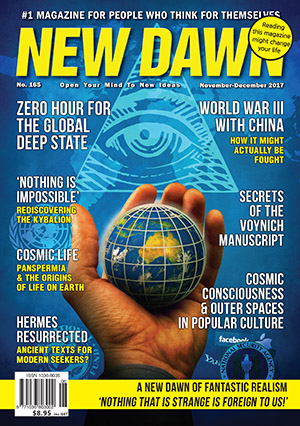
    From New Dawn 165 (Nov-Dec 2017)

    In 1960 a book appeared in France that triggered a kind of revolution. Not a political one, although one of the book’s authors had political ideas that slanted distinctly toward the right. It was more a revolution of the mind, of the imagination we might say, or even of reality itself. In the Paris of Jean-Paul Sartre and Albert Camus, of existentialism, black polo necks, engagement and dreary “authenticity,” the book had the effect of a flying saucer landing at the Café Deux Magots, or of a cosmic wormhole opening in Saint-Germain-des-Prés. In the black and white world of “nausea” and the “absurd,” Marxism and social commitment, it seemed to explode with technicolour visions of a strange new world. Or perhaps a strange old one, a forgotten past that at the start of that most modern of decades, seemed poised to return to lead a new generation into a fantastic future.

    The book was Le Matin des magiciens, or as it was soon called in its American edition, The Morning of the Magicians (The Dawn of Magic in the UK). Its authors were an unlikely pair. Louis Pauwels was a journalist who had edited a hostile, misleading book about the enigmatic esoteric teacher G. I. Gurdjieff. Pauwels had spent his last years in Paris and edited the newspaper Combat after the end of World War II; a previous editor had been Camus himself. The Russian born Jacques Bergier was a physicist and chemical engineer with an interest in alchemy and a colourful past as a spy and resistance fighter. The two met while working on a series of articles on contemporary science for a popular Parisian journal. Accounts have it that they were introduced by André Breton, the Black Pope of Surrealism, who had a distinct interest in magic himself, as his exploration of the Tarot, Arcane 17, shows. If true, then the revolution sparked by his introduction proved more influential and widespread than the one Breton had hoped Surrealism itself would bring about.

    Jacques Bergier (1912–1978) was a nuclear physicist and chemical engineer who was active in the French Resistance in World War II and helped destroy the German atomic plant at Peenemünde.
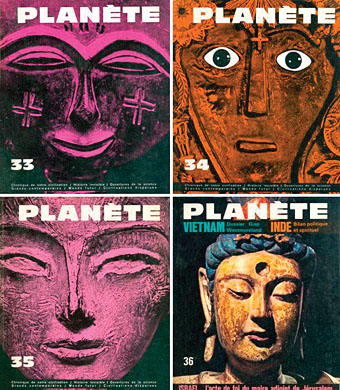
     Louis Pauwels (1920–1997) was a French journalist who founded the magazine Planète, an outgrowth of Le Matin des magiciens. 

    Pauwels and Bergier soon discovered they had much in common. They shared a central insight, dissatisfaction with what they saw as the unnecessary limits of modern science, a constraint many find still in place today. Pauwels had already spent several years investigating various schools of ‘alternative thought’. Along with spending time in Gurdjieff’s groups in the late 1940s, he had also explored the teachings of Swami Vivekananda and the Traditionalism of René Guénon. Bergier too came from a somewhat mystical background; he often spoke of a great-uncle in Russia who had been known as a ‘miraculous rabbi’. Bergier had trained with the physicist André Helbronner, whose area of inquiry was the transmutation of elements, the essence of alchemy. Helbronner was murdered by the Nazis at Buchenwald and Bergier himself spent time in Mauthausen. After his release, he became a spy for the Allies. On one mission he discovered that the Germans had a secret supply of uranium, evidence, it seemed, the Nazis were close to making their own atomic bomb.

    Bergier also claimed that in 1937 he met the elusive Fulcanelli, one of the most mysterious figures in the history of alchemy. Fulcanelli was believed to have discovered the secret of the philosopher’s stone and in his work Le Mystère des Cathédrales he revealed the hidden meanings of the alchemical “green language,” the esoteric symbols carved in stone in the great Gothic masterpieces of Chartres and Notre Dame de Paris. (Another said to have known Fulcanelli was the maverick Egyptologist René Schwaller de Lubicz, who claimed Fulcanelli stole the manuscript of Le Mystère des Cathédrales from him.) In the 1950s, Bergier’s name was linked to the American weird fiction writer H. P. Lovecraft, who had acquired a critical cachet in France denied him in his homeland. His fascination with Lovecraft’s work was long-lived. A letter Bergier wrote praising Lovecraft’s work was published in Weird Tales in 1936; another letter was published a year and a half later, lamenting Lovecraft’s death in 1937.

    Select english language editions of The Morning of the Magicians

    Pauwels and Bergier decided to write a book, exploring their ideas. For five years they gathered material, haunting libraries and periodical rooms, rummaging through newspapers, magazines, and scientific journals, seeking out curious and little-known bookshops. They studied ancient texts, investigated abandoned practices, and pored over reports of strange phenomena that were overlooked or actively ignored by the mainstream, creating their own kind of ‘X-Files’. They aimed to show how practices like alchemy, long dismissed by the modern mind, had many parallels with modern physics, and that in some strange way the modern age fast coming upon us might have more to do with ancient insights found in magic and the occult than we would suspect. In a way, they wanted to do for the post-war world what Madame Blavatsky had done a century earlier with her unwieldy masterpiece Isis Unveiled (1877): bring science up to date with the latest secrets from the remote past. This was in line with their belief that, “As a preliminary to understanding the present one must be capable of projecting one’s intelligence far into the past and far into the future.”1

    Their publisher, Éditions Gallimard, assumed the book would have modest success. They were unprepared for the reception it received. France had a long history of interest in the occult – Gurdjieff himself had died only a decade earlier – but in 1960, angst was still the rage, and the bleak milieu of Waiting for Godot, with its grim comic nihilism, was still au courant. That a book on magic and alternate realities would set the Seine on fire was hardly to be expected. Yet, within weeks of publication, Le Matin des magiciens had both banks of the river talking about things that left existentialists scratching their heads. While Allen Ginsberg howled in the Beat Hotel and American tourists slipped editions of the scandalous Olympia Press into their suitcases, amazed readers of Pauwels and Bergier were talking about alchemy, spacemen, lost civilisations, magic, occultism, quantum physics, secret societies, altered states of consciousness, the weird discoveries of Charles Fort, forgotten groups like the Hermetic Order of the Golden Dawn, and its once notorious members, like the dark magician Aleister Crowley and much, much more.

    Kick-Starting the “Occult Revival of the 1960s”

    The book was a hit. It seemed to appear at just the right time and took everyone by storm. In the process, it kick-started what became known as the “occult revival of the 1960s,” ushering in an occult boom that lasted into the 1970s and remains with us today as the New Age. Les Matin des magiciens went on to sell millions of copies in France, and by 1963 there were UK and US editions, which did just as well. The long post-war drabness and futility had lifted and a bright, exciting, and marvellous future, filled with mystery and miracle, seemed to beckon. The book’s basic message, that there are more things in heaven and earth than are dreamed of by rive gauche philosophers, caught on. Paris-Presse called it, “One of the most exciting books of our time.” Le Monde devoted two long articles to its success, and that of Planète, the magazine that Pauwels and Bergier quickly started in magiciens wake. No longer were we stuck in our ‘historical moment’, as existentialists had said. The readers of Planète found that for 5.50 francs – not cheap at the time – they could investigate the ancient past, stretch their minds into the far-flung future, dive deep into their own inner worlds, or journey out into the stars. 

    Many Frenchmen did. At its height, Planète had a bi-monthly circulation of more than 100,000, an impressive showing for a journal of its kind. Although it did not translate into the English-speaking world as had Les Matin des magiciens, Planète was a success in Italy, Belgium, Switzerland, and conferences devoted to its themes were held in places as far-flung as Canada and Argentina. Buenos Aires was home to the writer Jorge Luis Borges, who shared Pauwels and Bergier’s taste for what they called “fantastic realism”; his work appeared in several issues and he participated in the conference held there. 

    Along with Borges, Planète’s pages were home to other writers well-known to European readers, such as the ufologist Aimé Michel, the science fiction writer George Langelann – whose story ‘The Fly’ was the basis for several films – and the cryptozoologist Bernard Heuvelmans, among many others. Articles ranged from “A New Science of Dreams” and “Korzybski and General Semantics,” to “The True Woman of the Thousand and One Nights” and “A Mutant of the Eighteenth Century,” with reprints of works by C. S. Lewis, the Austrian occult novelist Gustav Meyrink, Salvador Dali, and others. 

    With its wide range of subjects and eclectic editorial brief – “Nothing that’s strange is foreign to us” was its motto – Planète catered to the burgeoning taste for the new, the marvellous, the unusual and magical that characterised the decade of the “mystic Sixties,” with articles on science, literature, archaeology, film, history, occultism, and much else. Workshops and clubs based on Planète’s themes were opened in Egypt, India, and Mexico. Its reach was global, we could even say planetary, and its impact was, like that of the book that spawned it, eventually felt around the world.

    Reality is Much More Fantastic Than We Imagine

    The 1950s had seen some other odd best-sellers. Immanuel Velikovsky’s Worlds in Collision, for example, published in 1950,hadrevived the catastrophe theory of cosmology by arguing that a comet sprung from Jupiter just missed Earth but destroyed Atlantis and caused several biblical miracles as it passed by. It sold millions of copies. In 1956 the Englishman Cyril Henry Hoskins started a long and successful career with his book The Third Eye: The Autobiography of a Tibetan Lama, written under the pseudonym T. Lobsang Rampa. That Hoskins, a plumber, had never journeyed far from his home in Devon, England, seemed no obstacle to this account of his past life in the Himalayas, and his millions of readers agreed. 

    But The Morning of the Magicians – the edition I knew – was different than these and other popular books about flying saucers, like George Adamski’s Flying Saucers Have Landed (1953) or suburban witchcraft, like Gerald Gardner’s Witchcraft Today (1954). It tried to link together, however loosely, a variety of unusual phenomena and ideas, in most cases with little more than their sheer strangeness. It argued a point of view, the idea that reality is already much more fantastic than we imagine, and that if we peek beneath its surface, we will discover the strange connections linking everything together. This may be the roots of a ‘conspiracy consciousness’, but it is also the beginning of a sense of a deeper meaning, hidden somewhere within the everyday world, that we can discover if we look for it. 

    Where Lovecraft, a familiar figure to Planète readers, warns us not to connect the dots, for fear of discovering a maddening reality – “the most merciful thing in the world,” he tells us, “is the inability of the human mind to correlate all its contents.” Pauwels and Bergier positively insist that we do so. For them, reality is not devastating, but fantastic, and their pursuit of it is not an escape from life – as it is for many romantics – but a deeper participation in it. The fantastic was reached by making contact with reality directly, by throwing off old habits of mind and prejudices of thought and opening consciousness to new possibilities. It was reached through what Pauwels and Bergier, borrowing from Gurdjieff, called “the awakened state,” a new way of understanding reality, beyond the usual limits of “yes” or “no” that keep us hypnotised.2 

    It was this aspect of the book that attracted the praise of important figures like the philosopher Edgar Morin and the writer Umberto Eco. For the historian of religion Mircea Eliade, what was “new and exhilarating” about The Morning of the Magicians, “was the optimistic and holistic outlook… in which human life again became meaningful and promised an endless perfectibility.” We were called to “conquer the physical universe and to unravel the other, enigmatic universes revealed by occultists and gnostics.”3 Not all shared Eliade’s appreciation. Some, like the scholar of esotericism Antoine Faivre, who knew Pauwels and Bergier, saw the book as little more than a “masterpiece of confusionism” and “an adroit commercial undertaking.”4 That it was a commercial success is undoubted, yet an honest appraisal must admit to some “confusionism” as well. 

    An attentive reader soon encounters it. The book is full of inaccuracies, its breathless prose often trips over itself with sensational claims, its research is questionable, and references are at a premium. It is, as Colin Wilson wrote, a “curious hodgepodge of a book,” “too wild and undisciplined,” and lacking a connecting thread linking together its ideas about a hollow earth, ancient astronauts, lost civilisations and dozens of other strange items.5 In this, it suffers the same defect as the books of Charles Fort, a central influence on Pauwels and Bergier, and which also hampers their later collaborations Eternal Man (1972) and Impossible Possibilities (1974), neither of which have the same magic as their first effort. Blavatsky’s Isis Unveiled, mentioned earlier, has the same problem: it presents an enormous amount of material which, while undoubtedly startling and exciting, soon begins to numb through sheer excess. 

    Probably the most serious inaccuracies in the book involve the alleged occult interests of Hitler and the Nazis, dubious claims about dark forces at work behind the Fuehrer that have gone on to spawn a whole genre of suspect literature, and which seeped into music, film and other areas of culture. Serious investigations into the “occult roots of National Socialism” done by Nicholas Goodrick-Clarke, Hans Thomas Hakl and others throw doubt on most of the claims made about “occult Nazism” in The Morning of the Magicians. 

    There are other mistakes – those about the Hermetic Order of the Golden Dawn deserve special mention – but the general shakiness of many of Pauwels and Bergier’s claims has led the book to be categorised by later readers as a “grab-bag of inspiring misinformation.” In this it is much like the work of an earlier Frenchman with a taste for the occult, Éliphas Lévi, whose gripping and highly readable books on Kabbalah and magic, while inspiring many young occultists – myself included – are nevertheless peppered with mistakes and outright howlers. 

    Yet in one sense the sensationalism and inaccuracies of The Morning of the Magicians hardly matter; in the occult genre, sadly, they are often the norm. Whatever the book’s flaws, its place in the counter-history of western consciousness is secure. As I say in Turn Off Your Mind, my history of the influence of occult ideas on the 1960s, one of the remarkable things about The Morning of the Magicians is that it seemed to presage many of the themes that would come to dominate that decade.6 For one thing, it heralded the ancient astronaut craze that hit the screen with Stanley Kubrick’s psychedelic ‘2001: A Space Odyssey’ (1968) and made Erich von Däniken, author of Chariots of the Gods (1969),a rich man. But perhaps even more significant was its anticipation of the youth rebellion that would characterise the times. 

    One of the central themes of The Morning of the Magicians is that of the mutant, young individuals with strange abilities, who are evolving into a higher type of human, and who stand out from the average. Pauwels and Bergier give many examples of this phenomenon, but they were not alone. Around the same time ‘The Village of the Damned’ (1960), the film version of John Wyndham’s novel The Midwich Cuckoos, was released. It tells the story of a strange meteor shower that leaves the young women of a small English village pregnant, although many are virgins. The children turn out to be part of a collective mind, possessing enormous intellects and strange mental powers. And in 1963 Marvel Comics started what was to become one of its most successful series, The X-Men. This featured teenagers who, like the mutants of ‘The Village of the Damned’, possess weird powers and band together for support in a world that won’t accept them. 

    Not long after this, other, real-life teenagers felt something similar. In Haight-Ashbury in 1967 the San Francisco Oracle, the psychedelic spreadsheet for the Aquarian Age, published a “Manifesto for Mutants.” It proclaimed:

    Mutants! Know now that you exist!
    They have hid you in cities
    And clothed you in fools clothes
    Know now that you are free.

    By then the occult revival, spawned by The Morning of the Magicians, was in full swing. The fantastic realism that its authors sought to awaken in their readers seemed, at least for a time, to have taken to the streets. If the ‘reality revolution’ of that mystic decade eventually petered out – Planète itself stopped publishing in 1972, Bergier died in 1978 and Pauwels in 1997 – the light of that magical morning nevertheless still shines today.

    [alert type=”general” dismiss=”no”]This article was published in New Dawn 164.[/alert]

    [alert type=”success” dismiss=”no”]If you appreciate this article, please consider subscribing to help maintain this website.[/alert]

    Footnotes

    1. Louis Pauwels and Jacques Bergier, The Morning of the Magicians, Dorset Press, 1988, vii
    2. Ibid., 96
    3. Mircea Eliade, Occultism, Witchcraft, and Cultural Fashion, University of Chicago Press, 1976, 10
    4. Antoine Faivre, Access to Western Esotericism, SUNY Press, 1996, 104
    5. Colin Wilson, The Supernatural, Carrol & Graf, 1991, 1-2
    6. Gary Lachman, Turn Off Your Mind: The Mystic Sixties and the Dark Side of the Age of Aquarius, Disinformation Books, 2003, 19; expanded UK edition The Dedalus Book of the 1960s; Turn Off Your Mind, Dedalus Books, 2009

    © New Dawn Magazine and the respective author.
    For our reproduction notice, click here.
  • Unveiling Nature’s Secrets: Interview with Stephen Harrod Buhner

    Unveiling Nature’s Secrets: Interview with Stephen Harrod Buhner

    From New Dawn 176 (Sept-Oct 2019)

    JACK FOX-WILLIAMS (JFW): Could you explain how you became interested in plant intelligence? Was there a particular event or piece of information that sparked your interest?

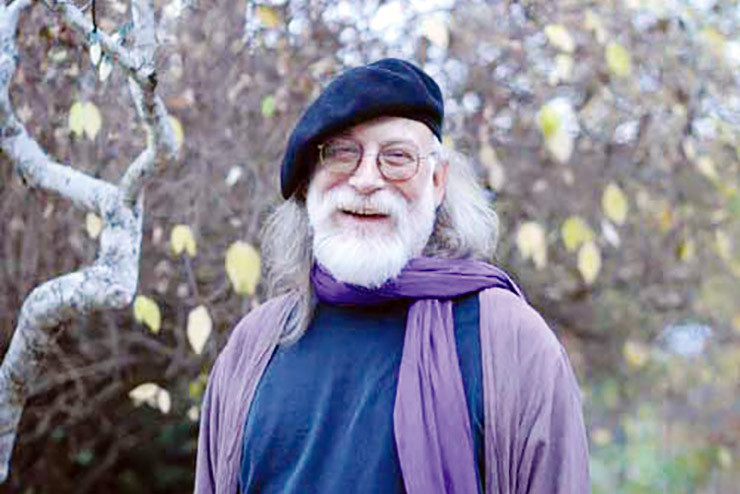
    STEPHEN HARROD BUHNER (SHB): I was born in 1952. There were only around 2.5 billion people on the planet then (compared to nearly 8 billion now).There was still a lot of wild land, places people didn’t go and I spent a lot of time in them. During those times I felt a real sense of communication from wild landscapes, a kind of touching that I think most people naturally feel (though they rarely talk about it except in the most general sense). In my 20s I moved to the high country of Colorado and began spending more and more time in wild forest ecosystems. And I began to have unusual experiences the more I allowed myself to drop down into those landscapes, become less mental but more experiential, my senses more alive. Every so often I would drop into a kind of dream state where a plant that had caught my attention would communicate incredibly detailed information about its medicinal uses. The experience was much like sitting and having tea with a friend and having a convivial chat. Well, of course, this kind of thing is strongly dismissed by our culture, presumed to be some kind of anthropomorphic projection, an irrational fantasy. Nevertheless, the experiences kept happening and the information I was getting, when I consulted medicinal herbals, turned out to be accurate.

    I am by nature extremely curious and not all that wedded to reductive ways of thinking, so I began to research the experiences I was having. (This was all pre-Internet of course.) In the basement of the University of Colorado library I found a great many ethnobotanical texts that contained interviews with tribal peoples of North America, among them many who used and knew plant medicines. All of them described similar experiences. When asked where they got their knowledge of plant medicines, all of them said from the plants, in a dream or vision. 

    Over the years, as I have explored this kind of information transmission, I found that it is root to most knowledge, even among scientists. It turns out that kind of dream state is very common among mathematicians (who often experience numbers as alive) and scientists such as Barbara McClintock who won the Nobel prize for her work with corn. She quite clearly talked as if the corn were communicating with her. 

    In my own experience, I found plants to be highly convivial, intelligent life forms, kindred to us and quite capable of communication with all of the life forms around them. This has been, of course, borne out by much research. Plant neurobiologists now understand that the root system of plants is a highly developed brain, much like our own, and uses the same neurochemicals as we do. It does conflict with older reductive (and extractive) ways of thinking and there is a lot of name calling going on. Still, it is clear that our approach to the natural world, that it is insentient and there for our use in any way we see fit, is not a sustainable way to live. We see the results of that all around us; the future is not looking too good. 

    JFW: What kinds of scientific experiments have been carried out which indicate that plants demonstrate some form of intelligence?

    SHB: I am not all that much a fan of reductive, extractive science which is only one small subset of what used to be called natural science. Cutting up a friend to see what makes him tick never really appeals to me. Despite this, I read a great deal of scientific research, perhaps some 30-35,000 journal studies in the past decade. Jagadis Chandra Bose did a lot of work in the early 20th century on plants that is still highly relevant, though it fell out of favour as more reductive thinking took hold. The people studying allelopathy have found that plants are highly communicative, that they utilise chemical signalling to talk to all the other plants in the ecosystem they are in about what is going on. They send chemical “words” telling about a particular insect predator that might be eating them, make and then release compounds that will deter the insect or even call the exact predator of that insect to that location. They send all this information to all the other plants in the region. If other plants are sick, plants will make and release the compounds needed to heal them. Plant neurobiologists have found that the brain system of plants is extensive, that they have memory, plan for the future, teach new generations, are complex tool makers and users (their chemical abilities far exceed our own), and have neural networks that, in some instances, far exceed our own. 

    The thing to keep in mind is that our brains are not the point, it is the neural network that our brains hold that is the essence. The brain is merely the organ that holds the neural network. Take it out of the brain and it is identical in appearance and function to the root system of plants. And while our neural net is limited by the size of our skulls, the neural network of plants, held in soil, is not limited at all. Some aspen root systems are over 100,000 years old and cover hundreds of acres. 

    JFW: What are the implications of plant intelligence in terms of thinking about the natural world and our connection to it? 

    SHB: We are in the midst of changing paradigms. The older, reductive, mechanistic paradigm that looked at the earth as a ball of non-sentient resources we could do with as we please has reached its limits. It is destroying the ability of most life forms to endure, for the ecosystems of the planet, and which allow us to live as well, to endure. Younger and less mentally restrictive scientists in every field are finding that the world around us is far different than the pictures that reductionists have created (and taught all of us to believe). All life is intelligent, none of it is mechanical, and you cannot use the ecosystems of the planet as resources for unlimited extraction. 

    Understanding that plants are highly intelligent (that every life form in fact is highly intelligent and communicative) forces a foundational shift in our human orientation. If we don’t care we will not be careful, and we as a species are not careful and in fact don’t really care about the other life forms on this planet. But if we kill them we kill ourselves. 

    The findings of newer researchers don’t bode well for the older system but that older system will fight very strongly to keep itself in place. It is just the way things work. 

    JFW: What is the significance of plant intelligence in shamanistic societies? Could it be argued that modern science is revealing what shamanistic cultures have known all along?

    SHB: All people, and I mean all, know that the earth and everything in it is alive. Four-year-old children naturally know this. They have to be forcefully taught that the world is dead. Ancient and indigenous cultures never killed that sensibility but rather developed it. I don’t actually like the term shamanistic since it refers to a specific cultural practice located in Siberia, but I do know what you mean. Indigenous cultures that understood the world is alive did regularly engage in dreaming and visionary experiences in which knowledge of the world and life around them was directly communicated to them; they were interwoven into the life web of the planet, not separate from it. It was not only indigenous cultures but all ancient cultures as well that knew this, no matter how developed they became. 

    The thing that we call science has taken the long way around. And yes, they are now getting back to where we started long ago, aware that all of nature is alive, intelligent and aware. That we are merely one part of a very large living scenario… and not all that important a part when it comes right down to it. We are merely one life form sitting in the council of life, a specific instance of a general condition. Still, the mechanical mindset that has been built the past two centuries will take a long time to dismantle; I fear that only as the world’s ecosystems begin to crumble will the species as a whole be willing to change. 

    JFW: Are there wider philosophical implications associated with plant intelligence? Does it change the way we should think about consciousness in any radical way?

    SHB: Of course there are philosophical implications. Monotheism and science have embraced the idea that humans are special, different in nature and essence than all other life on earth. But we are not. In many respects the most difficult thing that any person faces is their own unimportance. How much more difficult then will it be for an entire species to face that and be willing to change?

    This interview accompanies an article by Jack Fox-Williams on Plant Intelligence which can be read here.

    [alert type=”general” dismiss=”no”]This article was published in New Dawn 176.[/alert]

    [alert type=”success” dismiss=”no”]If you appreciate this article, please consider subscribing to help maintain this website.[/alert]

    © New Dawn Magazine and the respective author.
    For our reproduction notice, click here.

  • Remarkable Recoveries

    Remarkable Recoveries

    From New Dawn Special Issue Vol 12 No 4 (Aug 2018)

    Some people with serious, medically incurable illnesses recover unexpectedly. People with cancers, multiple sclerosis, scleroderma, Crohn’s Disease, fibromyalgia, and many other diseases have returned to health – with no conventional medical explanation for how they managed to do so.

    Modern medicine has occasionally reported the occurrence of these “spontaneous remissions” but has not delved into them to explain how people recover without medical interventions.

    Remarkable recoveries have held great interest for me for nearly three decades. My initial focus was on remarkable improvements produced by spiritual healing, as in Therapeutic Touch, Healing Touch, Reiki, Qigong, Traditional healing interventions (e.g. Native American ceremonial healings) and Prayer Healing. These often have been labelled ‘miraculous’ healings in the popular press.

    Healers with strong gifts of healing may find them occurring too regularly in their practices to label them as such. In Healing Research, Volume 1, I review extensive scientific research (Popular Edition and Professional Supplement) and anecdotal reports (Popular Edition) confirming that these remarkable recoveries occur with spiritual healing.

    Conventional medicine views such unusual recoveries from illness as ‘spontaneous remissions,’ brought about by unknown processes of recuperation of the human organism. I have also thoroughly researched the vast potentials of human capacity for self-healing in Healing Research, Volume 2 (Popular and Professional editions). To some extent, all healings, by any modality, must involve activation of self-healing potentials and abilities.

    I was excited in 1993 to find an annotated bibliography of 3,000 reports of spontaneous remissions, gathered from 3,500 references in over 800 journals in 20 different languages by Brendan O’Regan and Caryl Hirshberg, titled ‘Remarkable Recoveries’. I found this collection utterly fascinating. There were tantalising medical notes on remarkable spontaneous recoveries from cancers, skeletal deformities, hormonal abnormalities, and hundreds of other types of physical problems.

    However, these reports never included any in-depth considerations of psychological or spiritual issues that might have contributed to the unusual remissions from diseases – that in many cases were expected to be fatal; and conversely, reports from psychological literature rarely included medical details or documentations of the associated physical problems.

    The situation has actually worsened in the years since the publication of this annotated bibliography. When I trained in medicine in the 1960s at the University of California, Los Angeles, we had a department of Psychosomatic Medicine. When people had physical symptoms combined with psychological symptoms, or when physical symptoms could not be explained by physical or laboratory examinations, a consultation from this department would often uncover stresses and psychological mechanisms that could explain the unusual symptoms. Psychotherapy could then often relieve the problems.

    Here is a typical example of the problems addressed by the doctors in Psychosomatic Medicine, in this case as a psychiatric consultation to the Neurology Department.

    ‘Tom,’ a 40 year-old married factory worker, was admitted for evaluation of weakness in his right hand and arm that were making it impossible for him to perform at his usual level of competence on the assembly line. Neurological examination was normal, with the exception of weakness in the muscles of his right hand, arm and shoulder. No peripheral nerve or muscle damage, no spinal or brain lesion could be identified. Psychosomatic consultation revealed that the weakness in this very meek and mild-mannered man had started following an uncharacteristic, major argument with his wife. In short, this was found to be a psychological weakness produced by Tom’s unconscious mind to help him control the angry impulses he had been feeling, with a wish to strike his wife. The symptom also served to punish himself for having had this impulse. Brief psychotherapy resolved the symptoms.

    There are no longer any departments of Psychosomatic Medicine in the United States, although the subject is to varying extents included in medical school curricula under headings such as Behavioral Medicine or Bio-Psycho-Social Medicine. This is a measure of how much further Western medicine has distanced itself from awareness of the mind-body connection. A Google search turns up only references to European and Japanese listings for Psychosomatic Medicine.

    Exploring Remarkable Recoveries

    The on-line International Journal of Healing and Caring (IJHC) is undertaking to publish reports on recent, medically documented reports of Remarkable Recoveries. We believe that the life stories of people who have experienced these dramatic improvements in their illnesses can teach us ways to facilitate recoveries in other people with similar problems.

    There are many avenues through which such transformations may occur. Wholistic healing addresses body, emotions, mind, relationships (with each other and the environment) and spirit. Each and every one of these levels of our being can contribute to health and illness. Research in wholistic healing confirms that addressing these multiple levels can relieve many illnesses (Healing Research, Volume 2). Remarkable recoveries can add much to our understanding about the relationships of each of these factors to our physical health as well as to every level of our being.

    Many factors have contributed to this over-focus on the physical body. The advances in high-tech diagnostic procedures, and the enormous investments in pharmaceutical and surgical interventions have led to increasingly mechanistic approaches to assessing and treating illnesses. We have been sold on the ‘quick fix’ that chemical interventions can offer for physical symptoms. Our successes in these areas have led to several generations of distancing ourselves from the other aspects of our being. This is particularly true in the light of increasingly detailed medical focus on various parts of the physical body – to the increasing neglect of the person who inhabits that body.

    Few doctors have more than a cursory training in psychological issues contributing to health and illness. Many psychiatrists today are trained in programs where psychotherapy is an elective, and many of the trainees see little relevance of this subject to their prescription of psychoactive medications.

    Subspecialisation is another factor in the distancing of awareness of factors beyond the body that contribute to illnesses. Over several centuries, Western society has assigned care of the body to physicians; of the spirit to clergy; and in the past century, of the emotions, mind, and relationships to various subspecialising therapists in the mental health fields. Each speciality tends to work in varying degrees of isolation from the others. Within this system, care seekers have become used to thinking of physical problems as being only physical in their roots and causes.

    These splits often can be bridged fairly readily – between body on the one side and emotions, mind, relationships and spirit on the other. My work with people who have physical pains of all sorts has taught me that the average person can reconnect with psychological and spiritual issues contributing to their symptoms. This is true even when the pains have been present for decades and even when the pains have clear physical causes.

    People who have remarkable recoveries often credit the spiritual dimensions of their awareness and beingness for providing strength, inspiration and transformative energies. In all my years of searching, I found only one publication that documents the medical evidence for remarkable recoveries through spiritual healing (of Kathryn Kuhlman). This is by a physician, Richard Casdorph, who documented the evidence of amazing physical changes produced by spiritual healing, including in his reports the medical examinations, laboratory tests and x-rays (The Miracles, 1976).

    There are many psychological processes that have led us to distance ourselves from awareness of some of the factors and issues beyond the physical body that may contribute to physical illness. In distancing ourselves from those aspects of ourselves that are not physical, we have reached a place where mind, emotions, relationships and spirit are increasingly unfamiliar to many of us – especially as they relate to physical symptoms and illnesses. Anything that is unfamiliar is easy to reject, especially if it were to require us to re-evaluate our basic beliefs about ourselves.

    For many people it is far easier to distance themselves from that which is unknown, and therefore beyond their understanding, than it is to explore a change of their beliefs and explanations for the world – within and outside themselves. I believe it is this distancing of oneself from the unknown that has led us to reject and ignore the challenges that remarkable recoveries pose to our understanding of mechanisms of health and illness.

    Examples of Remarkable Recoveries

    1. Ellen Marie Schweickart shares her truly awesome odyssey of pioneering ways to successfully deal with her advanced case of scleroderma, which is considered a medically untreatable disease. Ellen’s symptoms began in 2001. She was advised by the eligibility doctor who assessed her for disability in 2003, “I am so very sorry to have to tell you this but you are suffering from a horrible, painful, debilitating autoimmune disease for which we have no known cure and at the rate of your progression you will not survive more than two years. I suggest you go be with your loved ones and do whatever you have always wanted to do, perhaps travel to Antarctica.”

    With dogged persistence, Ellen sought all the information she could gather on possible contributors to her symptoms of skin thickening to the point of limiting mobility, pain, weakness, difficulty swallowing and more. Working her way through removing allergens, dietary changes, and other approaches, she was able to slow the progression of her disease. It was when she started using Emotional Freedom Techniques (EFT) that the progression of her symptoms was halted and then reversed. Ellen is now close to completely free of her scleroderma.

    Lest you think that this is an isolated case of a person blessed with extraordinary physiological and/or psychological capabilities, Ellen shares a brief report from Katie, another woman with scleroderma, which was so advanced that she was on renal dialysis. Katie’s disease has similarly been reversed using EFT plus other approaches.

    A word of caution, however, to readers who may have the same or similar problems. Some of the treatments Ellen used included medications without the supervision of a doctor.

    2. Patsy Anthony-Green suffered from Crohn’s Disease, which produces inflammation for unknown reasons in the lower end of the small bowel, extending sometimes into the large bowel. Her Crohn’s was so severe she had to have the affected portions of her bowels surgically removed. Despite careful adherence to dietary restrictions, her intermittent symptoms continued to plague her periodically. By using EFT, Patsy has been able to halt her Crohn’s disease.

    Patsy Anthony-Green also suffered from pains in her knee over several decades, following a ski injury. An MRI showed severe deterioration of the cartilage in that knee. Patsy also cured herself of pains in her knee using EFT.

    3. Gary Craig, founder of EFT, reports on success in treating Sally, a 51 year-old woman, six years after she had suffered a Traumatic Brain Injury (TBI) in an auto accident. Sally had severe unsteadiness in walking and suffered from inability to tolerate intense or complex stimuli, such as many people talking in a room, or even walking along a carpet with a ‘busy’ pattern. In a single session of EFT, Sally was cured of her unsteadiness, and in further sessions her sensitivity to complex stimuli was markedly reduced. The EFT treatment was tracked by Donna Bach, ND and Gary Groesbeck, BCIAC with a Mind Mirror III electroencephalograph, which demonstrated interesting changes as Sally’s condition improved. Participating in organising this report, I weigh in with the observations that while it is unclear whether diagnostically it was brain trauma that was reversed or whether it was a post traumatic stress disorder (PTSD) causing these symptoms that was alleviated, the fact is that Sally’s condition was dramatically improved.

    When we come back to fuller awareness of the interconnections between all levels of our being, then remarkable recoveries can happen. Some would call these ‘miracles.’ I believe that our sense of something being miraculous is just a commentary on our unfamiliarity with the mechanisms that underlie the event.

    [alert type=”general” dismiss=”no”]This article was published in New Dawn Special Issue Vol 12 No 4.[/alert]

    [alert type=”success” dismiss=”no”]If you appreciate this article, please consider subscribing to help maintain this website.[/alert]

    © New Dawn Magazine and the respective author.
    For our reproduction notice, click here.

  • Original Genius: David Unaipon (1872–1967) born David Ngunaitponi

    Original Genius: David Unaipon (1872–1967) born David Ngunaitponi

    From New Dawn 160 (Jan-Feb 2017)

    In modern times, the term ‘genius’ has been thrown about far too often for it to be meaningful. From celebrities to politicians, the standard of the genius has dropped so low that we can no longer take the word seriously.

    However, if indeed there was true genius to speak of, the name David Unaipon would certainly fit the bill in a number of ways. His name might not immediately be recognised by every Australian – which is a sad indictment of our cultural heritage – but his face is a face we encounter on a daily basis when shopping or paying one of the many bills that account for expenditure in this once-lucky country. His unassuming smile greets us on one side of the Australian $50 note. History tells us that he was a prolific writer, deep philosopher and scholar, accomplished linguist, cross-denominational preacher and inventor of the highest degree – an Australian genius if ever there was one!

    David Unaipon (1872–1967) born David Ngunaitponi

    What made David Unaipon all the more special was the fact that he was an activist, bringing to light the plight of Australian Aboriginals of his day at a time when the Aborigines were relegated to the classification of Flora and Fauna by the Australian Government, considered a dying race. He was articulate, knowledgeable, well-read, able to apply complex scientific concepts to diagrams of his inventions, and envisioned a brighter future for all people despite the prejudices he faced. His selfless pursuits were for the betterment of all Australians but, unfortunately, he became victim to the scourge of white government plagiarism, publishing royalty scams and the baggage of well-meaning do-gooders…

    And, yet, he managed to shine as a high achiever and truly great man despite all obstacles.

    During his early schooling at Point McLeay Mission in South Australia’s Coorong region, a 7-year old David impressed one senior who stated that, “I only wish the majority of white boys were as bright, intelligent, well-instructed and well-mannered, as the little fellow I am now taking charge of.” (G. Jenkin, Conquest of the Ngarrindjeri, Rigby 1979, 185). This “little fellow” gravitated towards the sciences but also had a passion for philosophy and music. His father, James Ngunaitponi, was an evangelist and his insights into Christianity obviously had a moral and ethical bearing on his son, a future Holy Man. 

    David Unaipon’s sketch of an “Improved mechanical motion device” which was the basis of modern mechanical sheep shears.

    Unaipon invented a number of items and designed many more. His provisional patent 15,624 for an “Improved mechanical motion device” was the basis of modern mechanical sheep shears – a tool that propped up Australia’s multi-million dollar wool industry for decades and an achievement for which he never received any formal creative credit or financial reward. (An image from the design of these shears is included in the artwork of the $50 note). Pre-dating World War One, Unaipon utilised the aerodynamic characteristics inherent in an ancient Aboriginal weapon – the boomerang – thus creating drawings of what would later be recognised as the helicopter. He also explored the effects and applications for the polarisation of light and broke new ground in other fields of scientific research. His importance as an inventor inspired those in the know to celebrate his genius with terms such as “Australia’s Leonardo da Vinci.” What other description could come close?

    He spent much of his adult life researching solutions to the problems of creating a perpetual-motion device – something that eluded him and continues to elude the greatest scientific minds of our time. It could be argued he would have made further steps towards his goal if only he had the proper financial support. However, if he was successfully able to transmute his ideas into a feasible working model, the employment of his device would inevitably have been adopted for military purposes, directly conflicting with his high morals and religious beliefs. One can only wonder what other incredible achievements David Unaipon might have conceived if he was afforded the opportunities of the white ruling class.

    As a side note, the use of David’s image on the Australian $50 note is surrounded in controversy: institutional copyright infringement has resulted in the legal challenge of the Reserve Bank of Australia’s utilisation of his image without his family’s permission. 

    [alert type=”general” dismiss=”no”]This article was published in New Dawn 160.[/alert]

    [alert type=”success” dismiss=”no”]If you appreciate this article, please consider subscribing to help maintain this website.[/alert]

    © New Dawn Magazine and the respective author.
    For our reproduction notice, click here.