New Dawn – World's Most Unusual Magazine

Category: Articles

  • The Magus Was A Spy: Aleister Crowley and the Curious Connections Between Intelligence and the Occult

    The Magus Was A Spy: Aleister Crowley and the Curious Connections Between Intelligence and the Occult

    From New Dawn 105 (Nov-Dec 2007)

    In Magick Without Tears, Aleister Crowley observed a fundamental similarity between the “Secret Chiefs,” the invisible and inaccessible Masters to whom he professed obedience, and “Captain A. and Admiral B. of the Naval Intelligence Service.” Both, he noted, “keep in the dark for precisely the same reasons; and these qualities disappear instantaneously the moment They want to get hold of you.”1

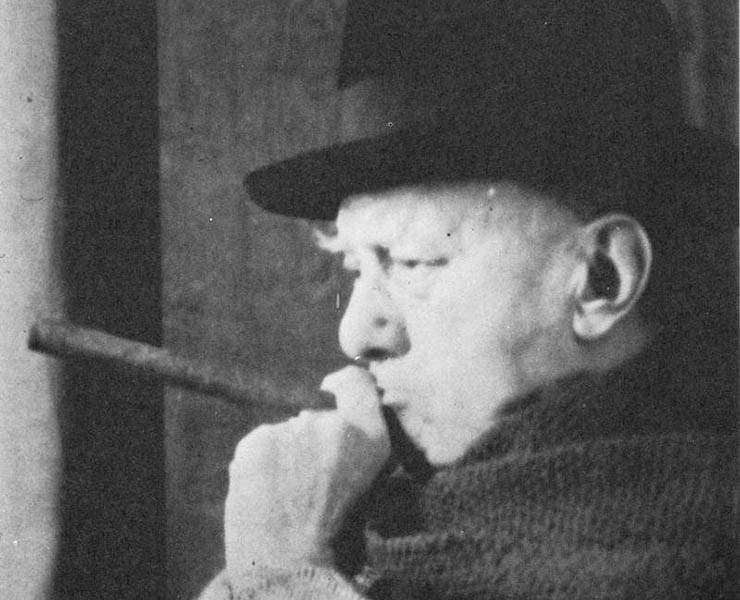
    Crowley, arguably the most famous – or infamous – occultist of the last century, spoke from personal experience. Throughout his career, Mr. Crowley, aka “The Great Beast 666” and “the Wickedest Man in the World,” maintained some kind of connection with one or another aspect of British intelligence, most notably the Admiralty’s Naval Intelligence branch. His case is by no means exceptional. Many of his associates in the occult realm, among them Everard Feilding, Theodore Reuss, Hanns Heinz Ewers, and Maxwell Knight, also had links to one spy agency or another.

    The inter-connection of occultism and espionage goes back at least to the Elizabethan intrigues of Dr. John Dee, and certainly is much older than that. For Crowley, Dr. Dee was a role-model in more ways than one. Occult orders and spy agencies do share much in common. Both are focused on the acquisition and safeguarding of specialised knowledge and embrace secrecy as a cardinal virtue. They are selective in recruitment and members are bound by oaths of silence and loyalty. They operate, so much as possible, outside public view or even public awareness. The pursuit of occult knowledge provides an excellent training ground for espionage and kindred intrigue, and vice versa. As Crowley’s literary creation Sir Anthony Bowling put it, “investigation of spiritualism makes a capital training ground for secret service work, one soon gets up to all the tricks.”2

    What follows is a selective and inevitably brief survey of various persons who were involved in intelligence work and occult pursuits. The common denominator and main object of attention will be Crowley himself.

    Crowley makes scattered allusions to intelligence work in his autobiographical writings but never offers any details. Generally, friend and foe have dismissed such claims as flights of fancy. However, far from inventing or exaggerating his clandestine exploits, he deliberately downplayed them or avoided mentioning them at all. A case in point is Crowley’s reference in his Confessions to his involvement in a 1899 conspiracy to foment a rebellion in Spain with the aim of restoring Don Carlos II to the country’s throne.3 Crowley teasingly offered to someday reveal the full and true story of the incident, but he never did.

    There was much more involved in this affair than Crowley let on. The key figure in the British-based plot was Lord Betram Ashburnham. He was the leader of a small but determined cabal of British “Legitimists” whose aim was the replacement of Queen Victoria and her line with a restored Stuart dynasty. Ashburnham also reigned as grand master of a neo-Templar outfit dubbed the Order of St. Thomas of Acon. Another leading light among the Legitimists was S. L. MacGregor Mathers, who just happened to be the dominating figure of the Hermetic Order of the Golden Dawn (HOGD) and Crowley’s mentor and promoter in that esoteric organisation. The HOGD included a number of persons, among them William Butler Yeats, who were sympathetic to Irish nationalism and Celtic revivalism, ideas actively encouraged by the Legitimists.

    Such sentiments inevitably aroused the curiosity of the guardians of the realm. The Spanish plot fizzled when someone, odds are Crowley, betrayed it from within. The Golden Dawn soon splintered as the result of internal rivalries in no small part exacerbated by Crowley’s disruptive antics. This episode represents one of his first forays into clandestine work and reveals the primary roles he played later on: infiltrator, informer and provocateur.

    Crowley had good reason to stay mum about such things. First, there was the Official Secrets Act, a legal Sword of Damocles that threatened to come down on the head of anyone who revealed too much. Beyond that, Crowley’s services to the State bought him tolerance and even protection from the temporal powers-that-be. For all his outrageous behaviour, and despite public outcries that he be hanged or worse, the self-proclaimed Beast never ran into any serious legal difficulty in his homeland. Even his apparent treason during WWI was conveniently ignored.

    I first stumbled upon Crowley’s intelligence angle while researching British espionage activities in WWI New York. More out of curiosity than anything else, I retrieved a small file from the records of the US Army’s Military Intelligence Division (MID). What immediately jumped out was a September 1918 report from the MID officer at West Point, New York. In this, he noted that as a result of his investigation of a strange Englishman who had been camping out on nearby Esopus Island, he discovered that the subject, one Aleister Crowley, “was an employee of the British Government on official business of which the British Consul, New York City has full cognizance.”4 Moreover, “the British Government was fully aware of the fact that Crowley was connected with… German propaganda and had received money for writing anti-British articles.” Clearly, the Beast’s later claims were not just flights of fancy.

    The then British Consul in New York was Charles Clive Bayley, a career diplomat who had encountered Crowley in Russia a few years prior. The Beast’s 1913 visit to Moscow also seems to have included an intelligence dimension. However, the men at the New York Consulate most intimately involved with his clandestine activities were Captain (later Admiral) Guy R. Gaunt and Major Norman G. Thwaites. The first was the Australian-born naval attaché who ran British intelligence operations in New York early in the war. To all outward appearances, he was not the type to look kindly on Crowley or anything smacking of the occult. He cooperated with Crowley with evident reluctance and no doubt on the orders of higher-ups.

    Thwaites worked for MI1c, then the operative cover for the Secret Intelligence Service (SIS) later best known as MI6. As second-in-command to the station chief, Sir William Wiseman, Thwaites effectively ran the operation from 1917. Regarding things occultish, Thwaites was more open-minded. In his memoirs, Thwaites devotes an entire chapter to “Spiritism” and tells how in New York he used trance mediums and a Ouija board to expose a German plot.5 While he makes no overt mention of Crowley, it does not seem far-fetched to suppose that the Beast might have offered some sage advice.

    A better example of the intelligence-occult connection among Crowley’s associates is the man who recruited him for secret work in 1914, his long-time friend, the Right Honourable F. H. Everard Feilding. Feilding was for years the secretary of London’s Society for Psychical Research (SPR) and had much experience in the investigation of mediums and paranormal phenomena. Of course, some in the SPR might argue that their pursuits were scientific, not “occult.” Still, Feilding’s interests definitely veered in the latter direction. In addition to being a longtime chum of Crowley, he was a member of the Beast’s very exclusive and very occult A.’.A.’. order.6

    Soon after the outbreak of the war, Feilding nabbed a commission in the Royal Naval Volunteer Reserve (RNVR), a common accommodation for intelligence work, and started out serving Admiral Reginald “Blinker” Hall and the Naval Intelligence Division (NID). By 1915, Feilding was in Athens attached to the East Mediterranean Special Intelligence Bureau, another branch of MI6, and spent the rest of the war in intelligence-related posts in Egypt and Syria. Sir Compton Mackenzie, who served with Feilding in Greece, later wrote of him that “his approach to the whole question of intelligence was that of one investigating a house alleged to be haunted.”7

    Despite the great distance separating them, Crowley and Feilding kept in touch during the war. Indeed, Feilding received at least some of the Beast’s reports, intervened when Crowley ran into difficulty and overall acted as a kind of remote case officer.

    Back in the summer of 1914, Crowley had hoped to land a commission like Feilding’s, but the latter, or his boss Admiral Hall, had something different in mind: an “unofficial” undercover mission in America. Crowley’s secret service in wartime America is a surprisingly complex story, so for now it must suffice that his single greatest accomplishment was the infiltration of a German propaganda ring headed by the German-American writer George Sylvester Viereck. From this vantage, Crowley spun a web of influence among German diplomats and spies and garnered the secrets of propaganda, sabotage and Berlin’s support to Irish and Indian nationalists. According to George Langelaan, a future British intelligence officer who later befriended Crowley in Paris, the Beast believed that he had played an indirect part in the sinking of the Lusitania by helping to convince gullible Germans that such brazen and bloodcurdling tactics would frighten the Yankees into curtailing trade with the Allies.8 It was no coincidence that back in London Admiral Hall hoped to push the Germans in the same direction.

    The presumed source of Crowley’s influence with German schemers in the USA was his skill as a propagandist and his improbable profession of Irish nationalism (he not being in the least bit Irish). However, his reputation and connections as an occultist must have played some part as well. For instance, Viereck took at least an amateur interest in occultism and his penchant for orgiastic sex hints at an affinity for the sex-magic rites of the Ordo Templi Orientis (OTO), the esoteric body of which Crowley claimed to be the anointed head in America.

    A “magickal” connection is even stronger in another German Crowley cultivated in New York, Hanns Heinz Ewers, who had at least some acquaintance with the OTO. Ewers was a serious student of the occult and a writer whose works reflected a fascination with the supernatural and sexual perversion.9 He also was a veteran agent of the German secret service and after coming to the US in 1914, Ewers undertook a series of secret missions to Spain and Mexico.

    In the latter place, Ewers encountered another German mystic involved in clandestine affairs, Heinrich Arnold Krumm, better known as Dr. Arnoldo Krumm-Heller. Thanks in part to his masonic and Rosicrucian pedigrees, Krumm-Heller had finessed a position of influence near pro-German Mexican President Venustiano Carranza. In 1916, Krumm-Heller quietly passed through the New York area on his way back to Germany as a special emissary of Carranza. Unfortunately for him, someone tipped-off the British authorities, who pulled Krumm-Heller off the boat and sent him back to the States. Once again, that someone most likely was Crowley who could have pried the secret from a too trusting Ewers. In any case, someone kept Maj. Thwaites very well informed about Ewers’ contacts and activities.

    It may be significant that Ewers, Viereck and others in the German secret apparatus were members of a quasi-masonic fraternal order called Schlaraffia. Ewers, in fact, was one of the organisation’s top officers. Outwardly, the society was dedicated to fellowship and good times, which did not rule out some members taking a deeper interest in occult matters. American and British intelligence pegged Schlaraffia as a “Secret German Propaganda Society” tasked with doing Berlin’s work “in a silent, secret way.”10

    Crowley’s credibility among Germans like Ewers may have been enhanced by his association with a venerable member of both the German occult and intelligence milieus, Theodor Reuss. Reuss’ work for Berlin’s secret services dated back to the 1880s when he infiltrated the Socialist League in London. His chosen trade of journalist, as in so many other cases, provided a handy cover for intelligence-gathering of one sort or another. Reuss made London his home base for several years before 1914, where he probably acted as a talent-scout or recruiter for German intelligence.

    Reuss also had a passion for joining or forming occult secret societies. His most notable association was with the above-mentioned Ordo Templi Orientis. Reuss became head of the Order around 1905, and in 1910 he recruited Aleister Crowley into its ranks. Two years later, he proclaimed the Beast head of the London branch. One can only wonder as to whether Crowley’s enlistment in the OTO included an overt or covert effort to draw him into Germany’s service. Might Crowley’s association with Reuss have been encouraged by someone in Britain’s secret service? Perhaps the OTO link was one reason that Feilding and Hall picked him for the New York job.

    Crowley maintained contact with Reuss during the war. The latter, after a brief stint with German counter-intelligence (hunting English spies on the Dutch border), surfaced in neutral Switzerland where he schemed to entice expatriate radicals and other avant-garde types into the German net. His main such effort was the “Anational Lodge and Mystic Temple” which hosted a Congress at Monte Verita (a counter-culture haven in southern Switzerland) in the summer of 1917. Reuss featured Crowley’s Gnostic Mass in the ceremonies, but in New York Crowley quietly denounced Reuss’ efforts to the British and the Americans. For example, the Beast assured New York State Deputy Attorney General Alfred Becker that Reuss was an “out and out German” and a dangerous propagandist “whom he always thought might have some considerable official position in Germany.”11 He even hinted that Reuss had made a secret wartime visit to New York.

    One more German of occult stripe with whose name Crowley’s ended-up linked in intelligence reports was Rudolf Steiner. He is best known as the founder and guiding light of Anthroposophy, the spiritual movement he founded after splitting with Annie Besant’s brand of Theosophy. Steiner’s wartime connection to the Beast is alleged in reports attached to Crowley’s MID file. Crowley and two other men, George Winslow Plummer, head of the Societas Rosicruciana in America, and a British mystic, the Rev. Holden Sampson, reportedly belonged to an “occult German order, the head of which is Dr. Rudolf Steiner in Berlin.”12 More ominously, they were supposed to be able to communicate with Steiner “without using any cable or telegraph system in public use.”

    The precise “occult order” referred to was a mystery at the time and still is. Steiner was never head of the OTO, and the description does not fit Anthroposophy. The best that MID could determine was that it was some sort of Rosicrucian group. Of course, maybe it never existed at all, and Steiner’s followers could insist that their leader would never have sunk so low as to become involved in anything smacking of espionage.

    However, Steiner devotees might be more bothered by a 1923 report titled “Rudolf Steiner and the Anthroposophical Society” also found in the American MID files. The document appears to be of British origin and is an addendum or response to previous MI6 communiqués about Steiner. There is no indication of the author’s identity, although he or she was well-versed in Steiner’s business and other affairs. It is not out of the question that Crowley was involved in its concoction one way or another. The gist of the report states:

    “[Steiner’s] early training as a Jesuit, when he was probably initiated into occult secrets, of which this body makes a special study… and his friendship with Lenin in Switzerland in 1909; were all preparing him for a career of subtle, underground political intrigue, cleverly disguised under the cloak of religious illumination, which was to make him in future years such a dangerous power to Church and State.”13

    Naturally, such accusations are not proof, but the document is evidence that Steiner and his ventures were matters of curiosity and suspicion to both American and British intelligence.

    The above barely scratches the surface of Crowley’s 1914-19 escapades, but we need to look elsewhere to find further evidence of his and others’ involvement in espionage.

    In the wake of WWI, the Beast established a small spiritual community/mystical school, dubbed the Abbey of Thelema, in an abandoned farmhouse near Cefalu on the northern coast of Sicily. In 1922, Italian authorities expelled him from the country, allegedly because of the unorthodox sexual practices at the Abbey. Oddly, they made no effort to shut down the place or give the boot to anyone save him. In 1926, an apparently deranged British woman named Violet Gibson tried to assassinate Italy’s new dictator, Benito Mussolini. The Fascist police discovered a link between the would-be assassin, Theosophist circles, and the above-mentioned Annie Besant.14 This spurred Italian authorities to take another look at papers seized from Crowley’s residence at Cefalu. Among them, a subsequent report noted, were documents from the “special espionage service” of the British Government and reports to same concerning conditions in Italy.15 The Beast seems to have been up to his old tricks.

    Other materials linked Crowley to the British Consul in nearby Palermo. His name was Reginald Gambier MacBean and, as might be expected, he was a member of more than one occult organisation. First and foremost, he was a passionate follower of Besant and Theosophy. He held the allegiance as far back as 1917 which had once prompted an investigation by MI5. Shortly after Crowley set-up shop at Cefalu, MacBean assumed the title of Grand Master of a restored Memphis-Mizraim Masonic Lodge in Italy. According to Crowley, this esoteric branch of Freemasonry was aligned with the OTO. The question remains as to whether Theosophists, MacBean or Crowley had anything to do with the attempt on Mussolini, but there were more than enough tangled threads to make any sensible Fascist policeman suspicious.

    Next, in 1928, Crowley’s name surfaced in correspondence between the India and Foreign Offices regarding the Russian artist, Theosophist and suspected Soviet asset, Nikolai Roerich. Arthur Vivian Burbury, who recently had spent three years as an MI6 man inside Britain’s Moscow Embassy advised that:

    “As to possible sources about Roerich – his connection with Russia,  Thibet… Theosophists… and various ‘secret’ organisations… leads me to think that information as to him might be obtained from an (undesirable) Englishman who has curiously intimate knowledge of all such things. His real name is Aleister Crowley.”16

    Just how or when Burbury came to be acquainted with the Beast is another mystery, as are Crowley’s sources of information regarding Roerich. Nevertheless, it does demonstrate that however “undesirable” Crowley may have been in some circles, he still counted as a useful informant in others.

    This much is certain: whatever his personal involvement, Roerich’s Central Asian expeditions during 1925-28 were backed and infiltrated by Soviet intelligence. The Kremlin’s chief agent-on-the-spot was Yakov Blumkin, an adventurous trouble-shooter who was himself alleged to be a student of the occult. Behind Blumkin stood the sinister chekist Gleb Bokii and his “parapsychologist” ally Alexander Barchenko, both men steeped in occult lore and practice.17

    Around 1936-37, Crowley entered into a curious relationship with Maxwell Knight, head of the MI5 branch that handled “subversives” and their contacts with foreign agents. The basis of this relationship usually is presumed to be Knight’s keen interest in the occult, especially “black magic.” However, it seems probable that Knight also tapped the Beast’s vast reservoir of knowledge for more practical purposes. For example, in what arguably was Knight’s greatest counter-intelligence coup, the infiltration and breakup of a pro-Nazi ring during the early part of WWII, he employed at least one agent specifically chosen to exploit “interest in spiritualism, clairvoyance, astrology and anything to do with the occult.”18

    In truth, Knight’s interest in Crowley began years earlier. His onetime agent Joan Miller recalled a rumour around MI5 that Knight’s former wife had perished “in some sort of occult misadventure in which the notorious Aleister Crowley was involved.”19 The tale is apocryphal; the unfortunate Mrs. Knight died from an accidental (?) drug overdose. But that does not rule out she or her husband having had previous knowledge of the Beast. In the early ‘20s, Maxwell was the “director of intelligence” for the British Fascisti, and in that capacity he worked very closely with a certain George Makgill. Makgill was obsessed with uncovering nefarious cults and conspiracies, one of which he was convinced was headed by the horrid Mr. Crowley.
    Get the issue this article appears in

    Last but no means least, there is the vague if persistent tale that Crowley was involved in the affair of Rudolf Hess, the high-ranking Nazi who flew to Scotland in early 1941 on an ill-fated peace mission. The basic story comes from Ian Fleming, creator of James Bond, who at the time was an officer in British Naval Intelligence and right-hand-man to NID’s chief, Admiral John Godfrey. Fleming later confessed that one of his unfulfilled wartime schemes was to have Hess, a man strongly influenced by occult beliefs, interviewed by Aleister Crowley.20 According to Fleming, the Beast was more than willing, but the one who stepped forward to kill the idea was none other than Maxwell Knight.

    Interestingly, immediately after the war’s outbreak, Crowley had received a note from Fleming’s boss, Admiral Godfrey, extending his greetings and summoning Crowley to an interview at the NID offices.21 Godfrey directed the Beast to a Commander C. J. M. Lang. A veteran intelligence officer, Lang was then connected to the NID section dealing with the interrogation of POWs. Yet another story, though no more, claims that Crowley ultimately did encounter Hess at a hush-hush MI5 interrogation facility known as Camp 020 or Latchmere House.22 If so, did Max Knight quash Fleming’s plan because he had his own plans for Hess and Mr. Crowley?

    In conclusion, the preceding by no means exhausts the connections between Crowley, intelligence and the wider occult realm. The names of George Gurdjieff, Jack Parsons, Nikola Tesla and even Crowley’s “widow,” Patricia Deirdre Doherty, could be invoked along with many others.

    Hopefully, this brief article offers a glimpse into what was – and no doubt still is – a significant cross-pollination between the two spheres, a connection about which much remains to be learned.

    [alert type=”general” dismiss=”no”]This article was published in New Dawn 105.[/alert]

    [alert type=”success” dismiss=”no”]If you appreciate this article, please consider subscribing to help maintain this website.[/alert]

    Footnotes:

    1. A. Crowley, Magick Without Tears. New York: Ordo Templi Orientis, 1954, pp.61-62, or www.hermetic.com/crowley/mwt/mwt_09.html.
    2. Ibid., Moonchild. London: Mandrake Press, 1929, 308, or www.hermetic.com/crowley/moonchild/mc22.html. “Sir Anthony Bowling” was Crowley’s alias for Everard Feilding.
    3. Ibid., The Confessions of Aleister Crowley: An Autohagiography. London: Mandrake Press, 1930, p.120.
    4. US National Archives, Military Intelligence Division (MID), General Summary, Intelligence Officer, West Point, N.Y., 23 Sept. 1918, p.4.
    5. Thwaites, Velvet and Vinegar, London: Grayson & Grayson, 1932, pp.233-240.
    6. Commonly assumed to stand for Ordo Astrum Argentum or Argenteum Astrum (“Silver Star”) though the true meaning is known only to initiates.
    7. Compton Mackenzie, Greek Memories. London: Chatto & Windus, 1939, pp.29-34.
    8. George Langelaan, “L’agent secret, fauter de paix,” Janus (#2, Sept. 1964), pp.49-51.
    9. On Ewers’ career see Wilfried Kugel, Der Unverantwortliche: Das Leben des Hanns Heinz Ewers. Duesseldorf: Grupello Verlag, 2001.
    10. MID, 10516-474/31, “In Re: Hans [sic] Heinz Ewers,” 24 June 1918.
    11. US National Archives, Department of Justice, Bureau of Investigation, Old German Files, Case # 365,985, Report of Agent O’Donnell, 30 July 1919.
    12. MID, 9140-808, Office of Naval Intelligence, “German Suspects,” 10 July 1917, etc.
    13. MID 9140-808, 21 April 1923.
    14. These events are presented in novelised form in Claudio Mauri’s La Catena Invisibile: Il giallo del fascismo magico. Milan: Mursia, 2005.
    15. Marco Pasi, Aleister Crowley e la tentazione della politica. Milan: FrancoAngeli, 1999, pp.175-176, pp.196-199.
    16. Phil Tomaselli to author, 18 Dec. 2003, extracted from July 1926 correspondence between the India Office and the Foreign Office Library.
    17. On these people and connections see Aleksandr Andreev, Okkul’tist strany sovetov. Moscow: Eksmo, 2004, Oleg Shishkin, Bitva za Gimalei. Moscow: Eksmo, 2003, and Markus Osterrieder, “From Synarchy to Shambhala: The Role of Political Occultism and Social Messianism in the Activities of Nicholas Roerich,” paper presented at the international conference on “The Occult in 20th Century Russia,” Berlin, March 2007.
    18. Bryan Clough, State Secrets: The Kent-Wolkoff Affair. Hove: Hideaway Pub., 2005, p.31.
    19. Joan Miller, One Girl’s War: Personal Experiences in MI5’s Most Secret Section. Dingle, Eire: Brandon Books, 1986, p.45.
    20. John Pearson, The Life of Ian Fleming. London: Companion Books, 1966, pp.117-118.
    21. Martin Booth, A Magick Life: A Biography of Aleister Crowley. London: Hodder & Stoughton, 2000, p.395.
    22. P. R. Koenig, “Crowley Met Rudolf Hess,” www.groups.yahoo.com/thelema93-1/messsage/2733, 31 August 2000.

    © New Dawn Magazine and the respective author.
    For our reproduction notice, click here.
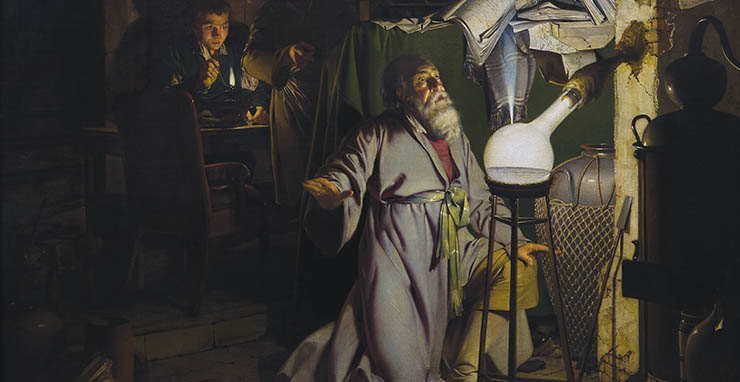
  • Alchemy – The Art of Transformation: An Interview with Cherry Gilchrist

    Alchemy – The Art of Transformation: An Interview with Cherry Gilchrist

    Cherry Gilchrist’s book on the history and interpretation of alchemy has remained a classic since its first publication in 1984. Alchemy, the Great Work: A History and Evaluation of the Western Hermetic Tradition was published in a new edition by Weiser Books, with an introduction by Mark Booth, in June 2015.

    Her book on alchemy as a system of self-development, drawing on the Twelve Gates of George Ripley and alchemical imagery, is Everyday Alchemy, published by Rider in 2002.

    She has appeared on radio and TV on various occasions to discuss alchemy, most notably on ‘Stephen Hawking’s World’, in an episode filmed in Owlpen Manor in Gloucestershire, UK, home and haunt of an eighteenth-century alchemist.

    Cherry also draws on her knowledge of the Tree of Life, astrology, and divination in her writings on alchemy. She has studied these subjects since her student days at Cambridge, from which she graduated with a degree in English literature and anthropology. Following the line of oral traditions and wisdom, she has also written about Russian folk traditions, ancestry, personal life stories, and myths and legends from different cultures. Cherry is at present writing a book on the traditional Tarot trumps for Quest Books. For details of her work, see http://www.cherrygilchrist.co.uk.

    Other interests include singing early music, and travel. Places visited such as Easter Island, Siberia, and the Silk Road have given her inspiration for her books, and insight into ancient cultures.

    Cherry’s own philosophy is that the Hermetic work can be passed down through a genuine line of teaching, and that it needs to find different forms in new generations. She was a founder member of Saros, the Foundation for the Perpetuation of Knowledge, an organisation headquartered in the UK which took on those aims.

    Cherry lives in Exeter, UK, with her husband, artist Robert Lee-Wade.

    Richard Smoley (RS): Maybe we could start by a brief definition of what you think alchemy is.

    Cherry Gilchrist (CG): Alchemy is about transformation. In its most basic definition, it’s the transformation of base material or metal into gold. However, that is too simplistic, according to the ways in which the tradition of alchemy has been practised and understood over hundreds, even thousands, of years. In a way, alchemy is about the process of creation itself: how does one thing become another? How do things change state? How can we change our state of being? And can we, as so-called conscious human beings, learn how to make those changes? So another way to put it is that alchemy is a way of using the life force to effect transformation, whether that’s on the physical, external level, or in a spiritual way. I hesitate to say that the alchemical process can work either on the material or on the spiritual level, because in one sense, in alchemy, they are completely integrated!

    RS: Most people would say that alchemy is just an old and outmoded form of chemistry. Why should we interest ourselves in it today?

    CG: I think this old chestnut comes up because of the way historians have dealt with alchemy in the last hundred years or so. That has formed the belief we’re fed. I use the word ‘belief’ because I really do think our perception of what is true and false, what is reliably scientific and what is non-scientific and therefore superstitious – in some people’s eyes – is moulded by the way history has been interpreted. Anyone who reads my book will, I hope, have that view changed. The evidence from the history of alchemy alone, when explored more fully, shows just how seriously it was taken, and how it can’t be just cast on the scrapheap as a well-meaning but deluded forerunner to enlightened science. Isaac Newton himself was an alchemist, and funnily enough, scholars have recently begun to pay a lot more attention to that fact.

    I myself make no claims that alchemy is effective when judged by the standards of modern chemistry. I am not a scientist, and clearly we’re not going to go backwards in time and revert to what now seem very primitive methods for working with chemical elements. I think the point is more that alchemy has had many applications over its history, and that the way it led into chemistry as we know it was just one feature of the whole spectrum of alchemy. Maybe it still has more to teach us about how to work with physical materials, though – and with the whole area of interaction of mind and materials opening up in science, it could offer views and approaches which breathe new life into scientific development. But whatever the case, alchemy still has much to impart in terms of psychology, spiritual development, and our relationship with the natural world. In one form or another, it’s still a path to knowledge.

    RS: Could you say a little bit about the origins of alchemy?

    CG: Well, again here we are somewhat constrained by the degree of research and scholarship available to us. This suggests, to put it briefly, that the metal workers of ancient Egypt may have kicked off the interest in the transformation of one material or metal into another. And that this came to early fruition in the Hellenistic, Alexandrian period, which began about three hundred years before the Christian era. But I suspect that if a few scholars really dig into the roots of alchemy, they will find a much wider realm of alchemical endeavour, particularly if they broaden the definition of alchemy. In the Far East, alchemy also had ancient origins, but the focus there was more on how the human body worked. Just as shamanism has extended its definition in recent years – it was once considered to be exclusively Siberian, and now is traced almost worldwide – so alchemy may have a broader historical lineage than we at present suspect. Perhaps this is beginning to happen. It has been suggested for instance that the discovery of charcoal burning is linked to a historical peasant tradition of alchemy as practiced by the Basques, one of the most ancient peoples of Europe.

    RS: Some writers describe alchemy as a physical process – actual working with minerals and plants and so on. Others see it as a psychological process. How do you see these different roles? Are they both valid?

    CG: I used to hold firmly to the view that true alchemy must be applied across the levels, having both a physical and a mental component. Its magic, if I can call it that, is that it is neither purely material or purely spiritual. However, I’ve come to see this in a different light, and I think now that alchemy has an incredible spectrum of application, and can be applied at different levels of creation. The most extreme examples of selective application are perhaps the old-fangled ‘puffers’ who spent all their time trying to work out how to concoct gold and get rich. And also the purely spiritual alchemists among whom we can count Jacob Boehme. I consider now that both of these are valid in their way; they are both participating in an alchemical process. However, if the get-rich-quick alchemists ignored the bigger scale of the creative process and limited their goals to financial reward, they were likely to end up dirty, disappointed, and broke! Alchemical laboratories weren’t pretty, fragrant places to work in.

    The other way round, I suppose, can have more significant results – I mean alchemy as a metaphor for spiritual development does work. But perhaps it will peter out as a way forward, or be very particular to one person, because it is treated then as a set of symbols which could be replaced by another set at will. If you sever the connection between material process and our sense of creation as a whole, or between spiritual and material understanding, then that approach to alchemy can’t flourish for long. There’s much to ponder on here, and I doubt that my own views will ever reach a complete and final conclusion!

    RS: Your book title links alchemy with the Hermetic tradition. How does that work? Does Hermes come into this too?

    CG: Hermes is very important in alchemy, as a kind of patron saint – except that he isn’t very saintly! He’s more of a shape-shifter or trickster figure. Hermes and Mercury meld to a certain extent, so that we have the guiding spirit of Hermes who might or might not lead you to enlightenment through your alchemical practice, and we also have mercury the metal, with its indwelling mercurial spirit, as it were. Hermes is more than a figurehead – his name is associated with a body of literature which has influenced both alchemists and the Western esoteric tradition. Hence the broad term ‘Hermetic tradition’. Nicholas Goodrick-Clarke, in his excellent study The Western Esoteric Traditions, points out that the cult of Hermes was founded on the Egyptian traditions associated with Thoth, and that Hermes evolved into a kind of ‘syncretic god’ who had a profound influence on the whole development of esoteric work up until the Renaissance period. I would say it goes further than that, actually. Walter Scott and G.R.S. Mead, for instance, were keen to plumb the wisdom of the so-called Hermetic texts, and to translate them for others to read in the nineteenth and early twentieth centuries. They have left us a legacy that we value today.

    So we can see Hermes/Mercury as a kind of guide in individual practice of alchemy. But also as a mischievous creature, apt to lead us astray. Michael Sendivogius, in his alchemical treatise The New Chemical Light, which was published around 1608, addresses his readers as “the Sons of Hermes” and includes a wonderful dialogue between the alchemist and Mercury. Here Mercury is the trickster spirit who plagues the alchemist with his cunning ways – the alchemist decides to invoke Mercury himself to shed light on what’s going wrong with his experiments. Mercury appears to him, but laughing his head off! Then they engage in a clever battle of words, at the end of which the alchemist is none the wiser, and demands that Mercury tells him how to make the Philosopher’s Stone, which is another term for Alchemical Gold or the Elixir. Mercury neatly wraps up the repartee with, “Mr Philosopher, if you know, you can make it, and if you don’t, you can’t.” That one gets me laughing too! Suddenly, it’s like the tales of Hodja Nasreddin, or a lesson from Gurdjieff. I prepared a version of this dialogue, and we performed it – perhaps for the first time in nearly 400 years? – at an alchemical conference in Prague. Not many people think of alchemy as being a source of humour, but it’s there, if you dig for it. And we can probably attribute it to the Hermetic influence.

    Anyway, the role of Hermes and his sidekick Mercury make for a fascinating study, one that I want to continue with. But as far as I’m concerned, it’s more than something on the page. On three occasions, Mercury a.k.a. Hermes has actually turned up in my life. Laugh if you will! The first was when I was still a student, in 1970. My boyfriend and I were in Amsterdam, and it was just at the start of my interest in the Kabbalistic Tree of Life and astrology. We met a man in a bar – as you do – and I think I’ll find it easier just to quote from an account that I wrote about this meeting a few years later, if you’ve got the space to include it:

    The streets were dark, and the bar where we went was dimly lit. I recall nothing of his face, or how we began to talk to him. But there cannot have been much small talk before we were all into the realms of psychic and esoteric knowledge. Then I mentioned the Kabbalistic Tree of life, which we had just learned to draw out and name. He showed interest, and asked us what it was. One of us sketched out the diagram and we described the significance of the different sefirot to him. He nodded, and replied, ‘I just wanted to see how much you knew about it’.

    We all exited the bar together, and made our way up to Central Station. It is only from this point that I have a vague recollection of a friend who accompanied him. On the way, we learned more about him, or rather his identity became even less certain as he professed dual if not triple nationality, spoke alternately in French and English, admitted to being known by more than one name, was not keen to be noticed by the police, and mentioned that he had several countries of residence. At the station he fetched a large rucksack, full of books from a left luggage locker. He couldn’t travel round without books, he said, but these were weighing heavy on him and he wanted to give us a number to lighten his load. We took an armful from him, and said our goodbyes.

    Only later did I remember that Mercury, planetary lord of the sephira Hod, and the neophyte’s entry point on the Kabbalistic Tree, is represented as an elusive, shadowy figure, speaker of many tongues. He is coexistent with Hermes, himself a symbol of the ‘Hermetic work’. He is a traveller of no fixed abode, a trickster, and a bringer of books and knowledge. It’s said that he is also fond of a joke now and then.

    RS: That’s a fascinating story. It strikes me as an example of the way the mythical and the occult actually do manifest in daily life – as opposed to the ridiculous clichéd forms you see in horror movies. To go on: why did the old alchemical texts rely so heavily on symbols and emblems rather than verbal descriptions?

    CG: I think it’s clear that you couldn’t really explain alchemy in normal, so-called rational terms. Alchemy doesn’t work as a collection of recipes, as many practitioners have found to their cost. It was considered important too that each alchemist should work it out in their own way. Alchemy has to speak to the spirit; it isn’t just an assemblage and processing of materials. So the symbols can do that. They really stirred the spirit of the historical alchemists, and still resonate for many of us today. Some are very complex, and also very beautiful. Dragons, kings and queens, water and fire, serpents, lovers, lions – a rich panoply of imagery. Colours were very important too, as I discuss in my book. They had their own validity and presence in the alchemical process, and the stages of transformation were marked by colour changes in the vessel. Also the imagery poses problems and questions, which the alchemist must wrestle with. Why was the king sick in bed? What were the dragons fighting about? What do the steps on the mountain represent? This would generate insight and stimulate the imagination.

    It’s also recorded that the secrets of alchemy came to certain practitioners through dreams and visions too – and dreams, as we know, deal in paradoxical, powerful images. The place of dreams in alchemy is a whole topic in itself, which again I discuss in the book. There’s evidence that alchemists deliberately cultivated visionary states, and practiced what today we might call ‘visualisation’.

    RS: Carl Jung found much of value in alchemy. Do you find the hooking up of alchemy with psychology and archetypes of interest? Or is it just one particular slant that doesn’t reflect the real body of alchemical work?

    CG: Jung found himself mesmerised by alchemical imagery, and used it to illuminate his psychological theories and indeed to help him towards new insights into the human psyche. I think he has done us a huge favour by reinvestigating the writings and symbols of alchemy, in one sense. It means you can have a conversation with a psychologist about alchemy, and that it’s crept back into our vocabulary again, at least to an extent. There’s much in Jung’s writings on alchemy that those with a modern education, and little time for prescientific theory, can relate to.

    On the other hand, I also believe Jung done us a disfavour by cutting off the main body of practical alchemy, where laboratories, equipment, and materials were involved. He actually said that the alchemical operations of old were ‘senseless’ and never led to the desired goal. As I said earlier, if you slice off just one layer of alchemy, you may produce something with a kind of one-off value, but you also divorce yourself from the evolving path of alchemy. I do think it’s time that we moved on from Jung’s interpretations.

    RS: How does alchemy work as a spiritual path?

    CG: This is something that has to be done within a context. If you are a Christian believer, it’s perfectly possible to use the symbols of alchemy to represent stages of mystical attainment, and understanding of Christ’s teachings. Boehme did it, and so did the poet Henry Vaughan. I think that if you meditate on the symbols, and you embed the imagery in your consciousness, it will work there, to release your own limitations and expand your awareness in an intuitive, even cosmic way. That’s the power of symbols, and alchemical ones aren’t random – they form a kind of graded teaching system.

    However, we can also use the symbolism in the context of everyday life, if we’re prepared to be attentive, observant, and aim to increase our conscious awareness. This has much in common with Kabbalistic or Gurdjieffian practice. I have written about it in Everyday Alchemy. You can actually start with very simple things – it needn’t be too high-flown or complicated. There’s a talk that I give which begins with the statement, “I’m an alchemist. I cook supper every night.” There’s a moment’s puzzled pause, then laughter, as the audience gets it! I explain that cooking is a process of transformation very much akin to alchemy, and that in our own kitchens we have the materials and the method to start to understand transformation. And that’s just the start. My own path, I would say, is a Hermetic one, and about accessing greater knowledge. Alchemy is a way to do that, and part of the job is reinventing the approach to have relevance to us today.

    RS: Can you say more about alchemy and the creative process? Is it a model which could be used in any sense nowadays for creative work?

    CG: Writers and artists have used alchemy as inspiration for their work for a very long time. Studies of Shakespeare, for instance, as I relate in the book, reveal that he was almost certainly using alchemical templates to plot some of his plays. This is not wild conjecture, but has scholarly backup. Therefore, I think those working creatively can dig into the symbolism, read about traditional forms of alchemy, and find inspiration for their work. I have talked to several artists about this, including one or two highly successful ones, who find that the framework of alchemy is a wonderful source for their creative work. One of the key points that strikes me again and again – with my writing too – is that alchemy is ‘hermetic’. It’s sealed, it’s private up to a certain point. The creative process must ‘cook’ in the vessel, and you must shield it from prying eyes. Too often nowadays we’re expected to talk about artistic or literary work in progress. No, says alchemy! Wait until the time is right, or you risk prematurely wrecking your material. It could all just evaporate. So you have to have courage and patience, and be your own guide for a lot of the time as well. All lessons which I think we could profit from today.

    RS: Alchemy seems to imply there is some kind of consciousness latent even in inanimate matter. Would you agree with that view? If so, what do you think its implications are?

    CG: I do agree, and have struggled for many years to try and understand and perceive that. I think alchemy was way ahead of its time in this respect. Once you start to break out of the dead end of the worldview of the material/mind split, you realise just what a grip it has on you. By that I mean me – and probably many of us. Whether or not the alchemical view of consciousness is really ‘true’ in a scientific sense, I think it’s incredibly important to see just how our values and outlook are shaped by religious, cultural, and scientific thinking. We tend to assume them as the norm, whether we like them or not. And we desperately need new models to go forward. And as far as I can tell, there is progress on the scientific or biological front too in accepting a broader definition of consciousness. According to the biologist Rupert Sheldrake, we do have “species mind,” for instance. I think it will also improve our care of the environment if we even concede the possibility that consciousness of some kind is within everything. And restrict the waste, for instance, of food and resources. I’m not one for saying that all yoghurt in the world cries when you eat a pot of yoghurt! Seriously, I have heard that said! But I can’t bear the waste of life forms, both of plants and animals and probably mineral too, which taints human culture now.

    And, after all, what is consciousness? I don’t mean that as a clever-clever question. But it strikes me there is much further to go in unravelling its mysteries. For instance, how come we are apparently ‘unconscious’ at night, and yet we can create the most amazing dreams? We may generate insights, and even when not dreaming, our identity remains during sleep. How do we often know exactly what time it is when we wake up, if some form of consciousness has not been operating? If we take a broader view of consciousness, rebrand it if you like, we can go much further in our discoveries.
    [alert type=”general” dismiss=”no”]This article was published in New Dawn Special Issue Vol 9 No 2.[/alert]
    [alert type=”success” dismiss=”no”]If you appreciate this article, please consider a contribution to help maintain this website.[/alert]
    „ Alchemy, the Great Work: A History and Evaluation of the Western Hermetic Tradition (Weiser Books) by Cherry Gilchrist is on sale at all good bookstores. For updates and more about her work, visit http://www.cherrygilchrist.co.uk.

    © New Dawn Magazine and the respective author.
    For our reproduction notice, click here.

  • Living at the End of an Age

    Living at the End of an Age

    This article was published in New Dawn Special Issue Vol 11 No 3 (June 2017)

    Turning and turning in the widening gyre

    The falcon cannot hear the falconer;

    Things fall apart; the centre
    cannot hold;

    Mere anarchy is loosed upon the world,

    The blood-dimmed tide is loosed,
    and everywhere

    The ceremony of innocence is drowned;

    The best lack all conviction,
    while the worst

    Are full of passionate intensity 

    – W. B. Yeats, The Second Coming

    Apocalyptic literature and prophecies are found throughout history. But as the ‘world’ has not ‘ended’, our modern day smug intelligentsia – imbued with a belief in ‘progress’ and the Darwinian concept of history that sees a ‘march of humanity’ – scoffs at such notions. Dr. A. R. Wallace, a leading Darwinian scientist of the Victorian era, in a book optimistically entitled The Wonderful Century (1898), wrote of this as the best of all times:

    Not only is our century superior to any that have gone before it but… it may be best compared with the whole preceding historical period. It must therefore be held to constitute the beginning of a new era of human progress…1

    The philosopher-historian Oswald Spengler predicted the ‘decline of the West’ in the aftermath of World War I. The word most commonly used to describe him, even by his admirers, was that of a ‘pessimist’. Does one, however, become a ‘pessimist’ to acknowledge the mortality of organisms, and acknowledge they have life cycles that end in death? Such is life; such is history. Spengler explained:

    I see in place of that empty figment of ONE linear history… the drama of a number of mighty cultures, each having its own life; its own death… Each culture has its own new possibilities of self-expression which arise, ripen, decay and never return…. I see world history as a picture of endless formations and transformations, of the marvellous waxing and waning of organic forms… The professional historian on the other hand, sees it as a sort of tapeworm industriously adding to itself one epoch after another.2

    Entitling the first chapter of his treatise on alchemy ‘The Plurality & Duality of Civilisations’, Julius Evola – Spengler’s Italian translator – states:

    Recently in contrast to the notion of progress and the idea that history has been represented by more or less continuous upward evolution of collective humanity, the idea of a plurality of the forms of civilisation and of a relative incommunicability between them has been confirmed. According to this second and new vision of history, history breaks down into epochs and disconnected cycles.… A civilisation springs up, gradually reaches a culminating point, and falls into darkness and, more often than not, disappears. A cycle has ended….3

    Today’s liberal-democratic intelligentsia actually refer to our era as ‘the end of history’, the term used by Francis Fukuyama as the title of an essay and a subsequent book. Our liberal-democratic ideals, epitomised and imposed over the world by the USA, have supposedly reached such perfection there is nothing left other than to establish a liberal dispensation over the universe for all time, and nothing more need be done. Another name for it is ‘American millennialism’.

    Romans, Greeks, Chinese, Moors, Iranians, Assyrians, regarded their empires as eternal. They had their ‘prophets of doom’ who predicted the empire would fall if they forgot their traditions. These doomsayers arose at those very epochs where their civilisations were at the height of wealth and power, typically at the empire-state. Here stands the dilemma, the paradox. When a High Culture (Civilisation) has reached its external limits – as when a human organism reaches middle age – sudden or gradual disintegration is the only course possible. A slow decline may be largely imperceptible. It is what T. S. Eliot referred to when writing of the end of Western civilisation, “not with a bang but with a whimper.”

    Oswald Spengler stated that he could show the West is going through the same cycles as Greece and Rome in their epochs of decay. He revealed through studying analogous eras of the history of civilisations, that there is nothing unique about the West’s cycle. It is therefore nonsense to refer to something as ‘progress’ when it has appeared many times before over thousands of years. This is especially true of liberal and left-wing ideas implemented as ‘progressive’, such as the West’s birth control and high abortion rates. A sage from ancient Greece, Rome, India, Egypt, Israel, would say in regard to Western social doctrines called ‘progressive’: ‘been there, done that, and it does not end well’.

    Universality of Cyclic Outlook

    Traditional societies, that is, those societies that intuited and maintained a connection with divinity and saw their place in a cosmos, regarded cultures as living organisms that passed through cycles of birth, youth, maturity, old age, decay and death.

    The Greeks and Romans referred to four eras named after the four metals: gold, silver, bronze and iron. Between the Bronze and Iron cycles was an intervening Heroic cycle, where the Heroes resist encroaching Chaos. The Hindus have four cyclic divisions called yugas: Satya, Treta, Dvapara and Kali, a demon not to be confused with the goddess Kālī; the Kali Yuga being the Dark Age of decline and chaos. The Persians had four cycles named after gold, silver, steel and an iron compound. The Chaldean view was similar. The Mayans had solar cycles, with a fifth Heroic cycle in which giants are fought. Chinese tradition recounts ten former Ages called ‘kis’ that have passed in succession. The Chinese also have an historical perspective based on ‘dynastic cycles’. The Buddhists have ‘Seven Suns’ or epochal cycles.

    The Hopi of Arizona say there have been three prior ‘world cycles’ or ‘Suns’. According to Hopi lore, this cycle will end if people do not change their ways. The spirit of the world will become frustrated. A Hopi elder commented to author Graham Hancock that, “There are no values at all any more – none at all – and people live any way they want, without morals or laws. These are the signs that the time has come.” The elder stated that the only chance is “that the Hopi do not abandon their traditions,” and that the Hopi impart their Traditionalism to the rest of the world. He explained that all is fated according to divine law.4

    In the Old Testament ‘Daniel’ this rise and fall is represented by a statue of four civilisations symbolised by a head of gold, chest and arms of silver, stomach and thighs of brass, and the legs of iron and feet of iron and clay.5

    According to Islam, there is a succession of ‘prophetic cycles’, each ending with the corruption of that cycle and the nexus with the divinity restored by a new prophet.

    Warnings from the Past

    The whole cosmic order is under Me. By My will it is manifested again and again, and by My will it is annihilated at the end. 
    – Bhagavad Gita6

    A High Culture is maintained by its adherence to Tradition. This typically includes a symbolic axis, such as Mount Olympus or Fuji, or perhaps one that is imaginative such as Yggdrasil of the Norse. The ruler often is a god-king or at least a priest-king whose primary function is to maintain the balance between the terrestrial and divine order, such as the annual rituals performed by the Chinese Emperor at the temple of the Forbidden City. He is responsible for nothing less than the balance between Earth and Cosmos.

    If a culture reaches the civilisation stage, the focus is diverted from the internal to the external, from ethos to wealth, from spirit to matter. The degradation is manifested in every facet of society. Religions lose their inner meaning, and become Reformations for example; kings become at most figureheads in a democracy, the social classes reflect money rather than élan, aristocracy gives way to oligarchy and plutocracy in the name of ‘democracy’. This is all called ‘progress’, but has occurred many times before as the symptoms of decay. The process is analogous to a cancer that destroys the cells of an organism, the cells being the classes and institutions of the social organism. In this situation, to quote W. B. Yeats, “the centre does not hold,” ‘progress’ (chaos) destroys the axis around which a culture is maintained, and everything falls apart like spokes falling from a wheel whose axis has broken.

    During epochs of decay, those who maintained traditional beliefs are warned of impending culture-death. Religious texts also mention the cyclical character of the cosmos. The Norse referred to the final culture-cycle as the Wolf Age-Axe Age. The focus is on moral decay:

    Brothers shall battle and slay one another

    Blood ties of sisters’ sons shall be sundered.

    Harsh is the world. Fornication is rife,

    Luring to faithlessness spouses of others.7

    The Hindu text Visnu Purana describes the Kali Yuga in terms that could just as well have been written by a contemporary critic of modern Western society:

    Wealth (inner) and piety (following one’s dharma) will decrease day by day until the whole world will be entirely depraved. Then property alone will confer rank; material wealth will be the only source of devotion; passion will be the sole bond between the sexes; falsehood will be the only means of success in litigation… Earth will be venerated for its mineral treasures… He who gives away much money will be the master of men, and family descent will no longer be a title of supremacy… Men will fix their desires upon riches, even though dishonestly acquired.8

    The Greek poet Hesiod referred to successive ages, the final being the ‘Iron Age’, in which,

    men never rest from labour and sorrow by day, and from perishing by night; and the gods shall lay sore trouble upon them…. The father will not agree with his children, nor the children with their father, nor guest with his host, nor comrade with comrade; nor will brother be dear to brother as aforetime. Men will dishonour their parents as they grow quickly old, and will carp at them, chiding them with bitter words, hard-hearted they, not knowing the fear of the gods. They will not repay their aged parents the cost their nurture, for might shall be their right: and one man will sack another’s city. There will be no favour for the man who keeps his oath or for the just or for the good; but rather men will praise the evil-doer and his violent dealing. Strength will be right and reverence will cease to be; and the wicked will hurt the worthy man, speaking false words against him, and will swear an oath upon them. Envy, foul-mouthed, delighting in evil, with scowling face, will go along with wretched men one and all. And then Aidos and Nemesis, with their sweet forms wrapped in white robes, will go from the wide-pathed earth and forsake mankind to join the company of the deathless gods: and bitter sorrows will be left for mortal men, and there will be no help against evil.9

    Polybius (born circa. 200 BCE) observed this phenomenon in Hellenic Civilisation like Spengler did of ours, writing:

    In our time all Greece was visited by a dearth of children and generally a decay of population, owing to which the cities were denuded of inhabitants, and a failure of productiveness resulted, though there were no long-continued wars or serious pestilences among us. If, then, any one had advised our sending to ask the gods in regard to this, what we were to do or say in order to become more numerous and better fill our cities, – would he not have seemed a futile person, when the cause was manifest and the cure in our own hands? For this evil grew upon us rapidly, and without attracting attention, by our men becoming perverted to a passion for show and money and the pleasures of an idle life, and accordingly either not marrying at all, or, if they did marry, refusing to rear the children that were born, or at most one or two out of a great number, for the sake of leaving them well off or bringing them up in extravagant luxury.10

    The words were echoed by Roman historians centuries later, as Rome underwent the same cycle of decay. Tacitus remarked that regardless of state efforts to encourage the birth rate, “childlessness prevailed.”11 At the beginning of the second century, Pliny the Younger wrote that his was “an age when even one child is thought a burden preventing the rewards of childlessness.” Plutarch observed that the poor had lost the confidence to sire children.12 By the middle of the second century Hierocles stated that “most people” seemed to regard children as interfering with their lifestyle.13 Marriage was no longer regarded a crucial institution, even considered a burden to a hedonistic existence. As early as 131 BCE the Roman Censor Quintus Caecilius Metellus Macedonicus proposed to the Senate that marriage be made compulsory, as too many males were opting to remain unmarried. A century later Augustus Caesar quoted Quintus in proposing his own marriage laws, but met no more favour in the Senate than had the Censor. Prostitution was so widespread it became a substitute for marriage. Roman cities also abounded with male prostitutes as homosexuality and bisexuality had become common.14

    Rome, in its decay, sounds all very ‘modern’, very ‘Western’.

    In Egypt Nefer-rohu warned Pharaoh of the inversion of the social order that will destroy the cosmic nexus:

    The weak of arm is now the possessor of an arm. Men salute respectfully him whom formerly saluted. I show thee the undermost on top, turned about in proportion to the turning about of my belly. The top man will make wealth. It is the paupers who eat the offering bread, while the servants jubilate. The Heliopolitan Nome, the birthplace of every god, will no longer be on earth.15

    The predicament sounds like today’s ‘progressive’ theories of equality.

    Ibn Khaldun (1332–1406), a well-travelled sage, grappled with the same problems confronting Islamic Civilisation as those Spengler confronted in regard to the West. Like the Greeks, he referred to ‘progressively’ decaying ‘generations’, each further removed from the founding tradition of the culture:

    When a tribe has achieved a certain measure of superiority with the help of its group feeling, it gains control over a corresponding amount of wealth and comes to share prosperity and abundance with those who have been in possession of these things. It shares in them to the degree of its power and usefulness to the ruling dynasty. If the ruling dynasty is so strong that no-one thinks of depriving it of its power or of sharing with it, the tribe in question submits to its rule and is satisfied with whatever share in the dynasty’s wealth and tax revenue it is permitted to enjoy…. Members of the tribe are merely concerned with prosperity, gain and a life of abundance. (They are satisfied) to lead an easy, restful life in the shadow of the ruling dynasty, and to adopt royal habits in building and dress, a matter they stress and in which they take more and more pride, the more luxuries and plenty they acquire, as well as all the other things that go with luxury and plenty.

    As a result the toughness of desert life is lost. Group feeling and courage weaken. Members of the tribe revel in the well-being that God has given them. Their children and offspring grow up too proud to look after themselves or to attend to their own needs. They have disdain also for all the other things that are necessary in connection with group feeling…. Their group feeling and courage decrease in the next generations. Eventually group feeling is altogether destroyed…. It will be swallowed up by other nations.16

    Amidst the corrupt opulence of the eunuch-ridden Chinese court, while the Manchus approached, General Shih K’o-fa addressed his Emperor in Spring 1645:

    Whilst Your Majesty is banqueting on choice viands and quaffing wine from beakers of jade, it behoves you to remember your starving servants in the North. If, in spite of all his efforts, the late Emperor was unable to ward off disaster, how much more should you, inferior to him in ability, tremble as one who stands on the brink of a precipice. If you perform your duties with zeal and vigilance, it may be that your ancestors’ spirits in Heaven will intercede with the Almighty on your behalf, and that your heritage may be regained. But if you remain in idle dalliance in Nanking, lavishing favours on sycophants and forgetful of the welfare of your troops, if you proclaim our secret plans from the housetops and fail to distinguish between loyal devotion and treason, if you show yourself so lacking in dignity that the worthy men about you are constrained to retire from official life, and the brave hesitate to serve you, then assuredly your ancestors will regard you as unworthy of their aid, and destruction, inevitable and final, will come upon you.17

    China fell to the Manchu and another cycle of dynasties proceeded, until the Manchu also succumbed to decay.

    Get the issue this article appears in

    Seeing the Present in the Past

    While each High Culture and Civilisation is self-contained, the corresponding culture-epochs between each have been noted by present day historian-philosophers, most notably Spengler. The Traditionalists Julius Evola and Rene Guénon both stated that nothing can stem the tide of decay during the Kali Yuga/Iron Age/Axe Age. However, those with perception of what is taking place around them might, to use a biblical reference, ‘live in the world, but be not of it’. Evola used the Eastern phrase, ‘ride the tiger’, and Guénon explained:

    If the elect of which we spoke could be formed while there is still time, they could so prepare the change that it would take place in the most favourable conditions possible, and the disturbances that must inevitably accompany it would in this way be reduced to a minimum; but even if they cannot do this, they will still have before them another yet more important task, that of helping to preserve the elements which must survive from the present world to be used in building up the one that is to follow. Once one knows that a re-ascent must come, even though it may prove impossible to prevent the downward movement first ending in some cataclysm, there is clearly no reason for waiting until the descent has reached its nadir before preparing the way for the re-ascent. This means that whatever may happen the work done will not be wasted: it cannot be useless in so far as the benefit that the elect will draw from it for themselves is concerned, but neither will it be wasted in so far as concerns its later effects on mankind as a whole.18

    The writings of sages in Greece, Rome, Egypt, and India seem remarkably familiar, distinctly ‘modern’, as though their observations were warnings for our own time. Rome and Greece, in particular, were so very ‘modern’ in their dismissal of family and childrearing, as ‘burdens’ to hedonistic enjoyment. Today, ‘progressives’ congratulate themselves on how enlightened they are, and celebrate the demographic demise of Western societies, where aging populations are replenished by emigrants with alien manners and thinking, whose assimilation is based not on their adaption to the host cultures, vestiges of which are now few, but in a common pursuit of material gain. The Late West is barely sustained by a money nexus which replaced a spiritual nexus, and the resulting culture is one in which everything becomes a commodity, life is reduced to a banal consumer existence devoid of higher purpose.

    The West, existing in name only, proceeds as an infection upon the world, purveying its culture-pathogens on any remaining societies that are attempting to maintain some degree of tradition. When such societies resist Western pathogens, they are called ‘undemocratic’ and targeted for destruction. History does not ‘end’, however. Our epoch of decay is nothing unique, and has been seen many times before across time and place. As Spengler foresaw, with indications even in his own time, after the West something new arises: an era led by a people who maintain their vigour and hold high a torch of the next Civilisation.

    [alert type=”general” dismiss=”no”]This article was published in New Dawn Special Issue Vol 11 No 3.[/alert]

    [alert type=”success” dismiss=”no”]If you appreciate this article, please consider subscribing to help maintain this website.[/alert]

    Footnotes

    1. Quoted by Asa Briggs (ed.), The Nineteenth Century: The Contradictions of Progress, Bonanza Books, 1985, 29
    2. Oswald Spengler, The Decline of The West, Allen and Unwin, 1972, Vol. 1, 21-22
    3. Julius Evola, The Hermetic Tradition, Inner Traditions, 1995, 13
    4. Graham Hancock, Fingerprints of the Gods, 1995, 533
    5. Daniel 2
    6. Bhagavad-Gita, Ch.9:8
    7. Voluspa, v. 46
    8. Vishnu Purana, Elysium Press, 1896, 310
    9. Hesiod, Works and Days, ca. 700 BCE, translated by Hugh G. Evelyn-White, 1914
    10. Polybius, Histories, 37.9
    11. Tacitus, Annals of Imperial Rome, iii, 25
    12. Plutarch, Moralia, Book iv
    13. Stobaeus, iv, 24, 14
    14. Rodney Stark, The Rise of Christianity: A Sociologist Reconsiders History, Princeton University Press, 117
    15. ‘The Prophesy of Nefer-rohu’, translated by John A. Wilson, The Ancient Near East, Vol. I, Princeton University Press, 1973
    16. Muhammad Ibn Khalud, The Muqaddimah, Franz Rosenthal, ed., Dawood, Princeton, 1969, 107
    17. E. Backhouse and J. O. P. Bland, Annals and Memoirs of the Court of Peking, Houghton Mifflin, 1914
    18. R. Guénon, La crise du monde modern [Crisis of the Modern World], Paris, Bossard, 1927

    © New Dawn Magazine and the respective author.
    For our reproduction notice, click here.
  • The Lord of the World: What’s Really Behind the Legend of the Mysterious Kingdom of Agarttha?

    The Lord of the World: What’s Really Behind the Legend of the Mysterious Kingdom of Agarttha?

    From New Dawn 151 (Jul-Aug 2015)

    A current theory holds that the secret rulers of humanity are an alien, reptilian race. The best-known version of this view comes from British author David Icke. (See Donald Tyson’s “Reptilians ’R Us” in New Dawn Special Issue Vol. 9 No. 2).

    It is all too easy to believe that the current leaders of humanity are operating from the reptilian part of the brain, which is devoid of any capacity for love, compassion, or justice. But an alien race? What makes reptiles aliens? They have been on this planet for over 300 million years.

    We then face the disturbing possibility that there is nothing less alien than this reptilian impulse. In fact, it is most likely the product of the earth and of earthly evolution. We may then turn around and ask whether it’s actually the higher, more selfless types of motivation that are implants from an alien world.

    The visionary author Philip K. Dick believed something like this. For him the “Immortal One” or the “plasmate,” as he called it, is an impulse that comes from outside our world but can bond with the human entity to create a homoplasmate, in which the mortal human is annexed permanently to the immortal. The Divine Invasion, the title of one of Dick’s novels, alludes to this possibility.

    This consideration leads us to look at a powerful idea that comes out of the world of esotericism: that, just as there are visible hierarchies bent on perpetuating their own power, there are other, unseen hierarchies that are moving (or attempting to move) the human race toward higher and purer states.

    One of the most intriguing versions of this teaching is the idea of the Lord of the World, the head of an unseen but benevolent hierarchy that governs humanity. Governs, that is, in a certain sense only, because any hierarchy that was completely in control of present-day humanity could not possibly be benevolent. So the idea of the Lord of the World encompasses another facet: this sacred hierarchy is, for reasons that are not terribly clear, blocked off and hidden from the majority of the human race. As of course would be his domain – if it exists in earthly terms at all.

    This idea seems to have long existed in Asia, but it only came to the attention of the educated West in the nineteenth century, first from a French jurist named Louis Jacolliot, who had been a magistrate in southern India and had collected local lore when he was there. In his 1873 book Les fils du Dieu (“The Sons of God”), he mentions a legend of “Asgartha, city of the sun, the capital of the Brahmatma, seat of brahminical power, ancestor of Thebes, Babylon, and Nineveh, the Rome of antediluvian times,” destroyed by a revolt of the Kshatriyas (the warrior caste) around 5000 BCE.

    The Subterranean Agarttha

    It was the French occultist Alexandre Saint-Yves d’Alveydre who brought the idea of this mysterious kingdom to the attention of mystics and esotericists. In his book Mission de l’Inde (“Mission of India”), he spoke of the city of Agarttha (whose name in Sanskrit, according to Saint-Yves, meant “inaccessible to violence”) and which continues to exist in some unspecified location of Central Asia, both “on the surface and in the bowels of the earth.”

    For Saint-Yves, Agarttha was a real and palpable city, hidden but in theory discoverable. Indeed, part of the motive of writing his book, he implied, was that “certain powers, in their competition with each other across the whole of Asia” were bound to discover it and try to invade it. He was alluding to Great Britain and Russia, which were then engaged in the “Great Game” for control of Central Asia. By divulging its existence, Saint-Yves believed, he was warning the colonial powers to leave Agarttha alone – for their own good.

    Saint-Yves’ book was published in 1886, but abortively. For obscure reasons, he had almost the entire edition pulled and burned. Only a stray copy or two survived, which made the full publication of the book possible in 1910, a year after his death.

    Mission de l’Inde – published in English under the title The Kingdom of Agarttha – is a short but grandiose work, propounding the idea of “the Sovereign Pontiff” of Agarttha – the Brahmatma. After it was published, it attracted much attention in French occultist circles.

    In 1924, another book appeared: a memoir called Beasts, Men, and Gods by Ferdinand Ossendowski. Ossendowski had been a White officer in the Russian Civil War. After the Whites lost, he had to make his escape across Siberia and Mongolia. Much of the book is a description of these adventures, but the last chapters are dedicated to some of the legends that Ossendowski said he had heard along the way. One was of a subterranean land called “Agarthi.” According to Ossendowski, one lama told him:

    More than sixty thousand years ago a Holyman [sic] disappeared with a whole tribe of people under the ground and never appeared again on the surface of the earth. Many people, however, have since visited this kingdom, Sakkia Mouni [the historical Buddha], Undur Gheghen, Paspa, Khan Baber and others. No one knows where this place is. One says Afghanistan, others India. All the people there are protected against Evil and crimes do not exist within its bournes. Science has there developed calmly and nothing is threatened with destruction. The subterranean people have reached the highest knowledge. Now it is a large kingdom, millions of men with the King of the World as their ruler. He knows all the forces of the world and reads all the souls of humankind and the great book of their destiny. Invisibly he rules eight hundred million men on the surface of the earth and they will accomplish his every order.

    Ossendowski also reported a prophecy allegedly made by the King of the World in the winter of 1890. He forecast fifty years of bloodshed.

    Then I shall send a people, now unknown, which shall tear out the weeds of madness and vice with a strong hand and will lead those who still remain faithful to the spirit of man in the fight against Evil. They will found a new life on the earth purified by the death of nations. In the fiftieth year only three great kingdoms will appear, which will exist happily seventy-one years. Afterwards there will be eighteen years of war and destruction. Then the peoples of Agharti will come up from their subterranean caverns to the surface of the earth.

    It is tempting, though of course completely speculative, to connect the “fifty years of bloodshed” with the two World Wars, followed by a period of comparative peace under three great nations (the United States, Russia, and China?) that would last seventy-one years. If you start this seventy-one years at the end of World War II in 1945, that brings us to 2016. By this reckoning, the people of Agharti will emerge in 2034. Ever since 2012 came and went, we have had no new dates for the imminent End of Time, so those in need of such a thing may want to consider this as a possibility.

    Ossendowski’s book became a best-seller and drew further attention to the idea of Agarttha and the Lord of the World. There has been much debate about whether Ossendowski borrowed his legends from Saint-Yves. Those who say he did point to the similarities even in superficial detail between the two. Those who deny the connection included Ossendowski himself, who said he had never heard of Saint-Yves or his theories before his own book was published.

    René Guénon

    One figure who came out in support of Ossendowski was the famous French esotericist René Guénon. In a short book published in 1927 and entitled Le roi du monde (“The King of the World”; the English title is The Lord of the World), Guénon wrote, “Even if a certain amount of plagiarism were to be admitted, the fact remains that Ossendowski puts forward various original ideas which definitely are not to be found in Mission de l’Inde and which he would certainly not have been able to invent in their entirety,” if only because Ossendowski was “so ignorant of anything which touched upon the esoteric, that he was manifestly incapable of seizing their true import.”

    Guénon’s book is surprising. Ordinarily he had nothing but contempt for the material that came out of French occultist circles like Saint-Yves’. Hence his support for this idea of a hidden kingdom of initiates may seem strange. But in fact it fits in well with Guénon’s worldview.

    One of the mainsprings of Guénon’s thought is the idea that the society of the modern West is not a triumph of evolution (an idea he despised) but rather a reflection of an extremely degenerate age that he equated with the Hindu Kali Yuga, or Age of Darkness. One corollary of this idea is the belief that humanity did have a connection with a sacred centre and hierarchy – in prehistoric times – but this connection has been obscured and to all practical purposes lost.

    Thus it was natural for Guénon to hold to an idea of a hidden sacred kingdom. “This ‘Holy Land,’ which is defended by guardians who keep it hidden from profane view while ensuring a certain exterior communication, is to all intents and purposes inaccessible and invisible to all except those possessing the necessary qualifications for entry,” he wrote.

    Does this holy land exist physically, or does it exist in a symbolic sense only? Guénon replied: “The simple answer is that both geographical and historical facts possess a symbolic validity that in no way detracts from their being facts, but that actually, beyond this reality, gives them a higher significance.”

    The Lord of the World is a short book but a somewhat disjointed one, including chapters on subjects as diverse as the Grail, the mysterious biblical figure of Melchizedek, and the angel Metatron of Kabbalistic legend. Its views can be sketched as follows:

    There is a secret Lord of the World, known as the Brahmatma, possibly to be identified with both Metatron and Melchizedek. Under this potentate, also known as the Brahmatma, are two figures, the Mahatma and the Mahanga, who represent the priestly and royal functions respectively. The abode from which the Brahmatma reigns was called Paradesa before the coming of the Kali Yuga around 3000 BCE (the name was, Guénon says, the source of our word “paradise”) and is now called Agarttha. This “Supreme Centre” is represented in various geographical locales by sacred cities including Jerusalem and Rome, but none of these are the “centre” itself.

    “Agarttha,” Guénon writes, “did not always exist underground and will not always remain so.” Hence the prophecy that the people of Agarttha will, at some point in the (possibly near) future, return to the surface. For Guénon, this symbolises the end of the Kali Yuga, the dark phase of the cycle in which we now live. For the time being, though, Agarttha is hidden and occluded.

    Some who are familiar with Eastern traditions will see a similarity between Agarttha and the kingdom of Shambhala, known from the Tibetan Buddhist tradition. Shambhala, too, is hidden, inaccessible; it is described sometimes as an actual place, sometimes almost as a state of mind. One difference, however, is that Shambhala is seen as a city (possibly) on earth rather than a subterranean one. (See accompanying article on page 66 for an account of Shambhala.)

    This fact led an Italian writer named Marco Baistrocchi to publish several articles in a journal called Politica Romana from 1995 to 1997. Baistrocchi claimed that the truth about Agarttha was quite different: that Saint-Yves and Jacolliot had borrowed the idea from a novel by the British author Sir Edward Bulwer-Lytton. Entitled The Coming Race and published in 1871, it spoke of a subterranean race that had mastered an occult life force known as Vril.

    According to Baistrocchi, Guénon picked up on this idea of a subterranean race for rather convoluted reasons. Mainly he wanted to discourage Western seekers from making contact with authentic sources of Asian spirituality. He wanted instead to channel them toward Western forms – first a kind of initiatic Catholicism reconstituted on medieval lines, and, after that clearly was not going to happen, toward Islam. (Guénon converted to Islam around 1912 and moved to Cairo in 1930; he lived there for the rest of his life.) Guénon thus followed Saint-Yves in trying to prevent “Europeans from restoring contact with the true and authentic Asiatic world, and above all with the doctrine of the Kalachakra from which the myth of Shambhala derives,” writes Baistrocchi. “With the help of his disciples who continued to promote his works, Saint-Yves succeeded in turning aside the curiosity and interest in the Indo-Tibetan world that [H.P.] Blavatsky and the Theosophical Society, for all their limitations, had fostered.”

    The argument, with its plots and counterplots like those in Umberto Eco’s clumsy novel Foucault’s Pendulum, can be hard to follow. Certainly Guénon’s attitude toward the world religions is complex. He regards Christianity as degenerate, believing that its links to the esoteric traditional centre were broken in late medieval times. In the West, only very small and obscure initiatic lineages preserve some semblance of this tradition in Christianity. The religion he prizes above all is Hinduism. Most of his metaphysical theory is derived from Hindu thought in one way or another. Guénon writes fairly little about Islam.

    On the other hand, it is true that Guénon’s influence turned many of his followers into Muslims – with disastrous results, according to Baistrocchi: “By draining the spiritual energies from Europe, the crisis [of the modern world] has been indirectly accelerated and regeneration has been hindered. At the same time, Islam has been reinforced, in which there grows from day to day an ever more rigid, anti-spiritual, and counter-traditional fundamentalism.”

    This claim may be extreme, but it does seem Guénon’s influence has been stronger in the Muslim world and may have fed fundamentalist trends in Islam. Mark Sedgwick’s book Against the Modern World discusses this question in some detail. From a nonacademic point of view, a strange book by Jean-Marc Allemand, René Guénon et les sept tours du diable (“René Guénon and the Seven Towers of the Devil”), explores the “counterinitiatic,” i.e., diabolical elements of our time and locates their centres in such places as Syria, Sudan, and Iraq. (This book has not been translated into English and is out of print in French. For a map of these centres, visit a French blog called “Les chroniques de Rorschach.”)

    C.W. Leadbeater, Alice Bailey & the Christ

    To return to the main thread of our story, travellers who made contact with Tibet in the early twentieth century (when it was still a rarity) were struck by the resemblances between Agarttha, which they knew from the occultist literature, and the decidedly nonsubterranean kingdom of Shambhala, about which they heard in their travels. But they found no stories about a subterranean kingdom. The French explorer Alexandra David-Neel said she asked the Thirteenth Dalai Lama (the predecessor of the one now in office) about this legend. He replied, “Do you take us for moles?” Another high Tibetan authority, the Panchen Lama, told her, “You know that beyond making machines and things like that, Westerners aren’t very intelligent, but I never thought they could have been stupid enough to imagine such things.”

    Agarttha may in a distorted fashion reflect the very real Tibetan legend of Shambhala. If Guénon’s aim had been to steer Westerners away from it – which I very much doubt – he failed miserably, largely because the real legend of Shambhala, central to Tibetan Buddhism, has become so well-known in the West.

    As a result of this direct infusion of Tibetan knowledge, the legend of Agarttha has faded into the background. But the theme of the Lord of the World persists. Along different lines it was propounded by the British Theosophist C.W. Leadbeater. Leadbeater wrote in 1925:

    Our world is governed by a spiritual King – one of the Lords of the Flame who came long ago from Venus. He is called by the Hindus Sanat Kumara, the last word being a title, meaning Prince or Ruler. Other names given to him are the One Initiator, the One without a Second, the Eternal Youth of sixteen summers; and often we speak of him as the Lord of the World. He is the Supreme Ruler; in his hand and within his actual aura lies the whole of this planet….

    In his mind he holds the whole plan of evolution at some high level of which we know nothing; he is the Force which drives the whole world-machine, the embodiment of the Divine Will on this planet…. His consciousness is of so extended a nature that it comprehends at once all the life on our globe.

    The Lord of the World, Leadbeater added, is the head of the Brotherhood, the collection of individuals who have awakened at least to some degree and are working to promote the collective evolution of humanity. The Hierarchy of adepts described by Leadbeater is extremely complex. But, for example, Sanat Kumara, the Lord of the World, is the head of a trinity of rulers of the human race, along with “the Lord Buddha” and “the Maha Chohan.”

    The idea of the Lord of the World was developed further by the British esotericist Alice Bailey, who started as a Theosophist but broke with the Theosophical Society in 1920 because the society’s leaders disapproved of materials she allegedly channelled from the Tibetan master Djwhal Khul (pronounced “jwal kool”).

    Bailey foretells the reappearance of the Christ. Originally Theosophy, the source of all these teachings, did not place much emphasis on the concept of Christ, preferring to see the “Christos” as “the spiritual Ego” or higher Self in each individual. However, both Leadbeater, an Anglican priest, and Bailey, an active proselytizer for evangelical Christianity in her youth, tended to see Christian themes in a more positive way – and put them at the centre of their myth.

    For Bailey the Christ is a high member of the Hierarchy. He is an “avatar,” a divine messenger who is due to return to earth, but not in the way conceived by mainstream Christianity. “No one knows in what nation He will come; He may appear as an Englishman, a Russian, a Negro, a Latin, a Turk, a Hindu, or any other nationality,” Bailey wrote. But it was the preparation for this reappearance of the Christ that was the main work of the Hierarchy in her day.

    To this end “preparation is being made for the emergence of the Hierarchy in the world of men,” Bailey added. “The Hierarchy is orienting itself to a much closer rapport with humanity,” and the members of the Hierarchy “are already – one by one entering into outer activity on the physical plane.”

    This “externalisation of the Hierarchy,” as Bailey called it, the reappearance of the Christ, and the new world religion that will emerge from these events, are all to foster the “Plan.” This Plan, she wrote, “will make available to every man all past achievements and knowledges, it will reveal to man the true significance of his mind and brain, and make him the master of that equipment, and will make him therefore omnipresent and eventually open the door to omniscience. This next development of the Plan will produce in man an understanding – intelligent and co-operative – of the divine purpose.”

    Bailey’s ideas in turn were taken up by the Scottish visionary Benjamin Creme, who, accepting Leadbeater’s identification of the Christ with Maitreya, the coming Buddha of Buddhism, announced in 1975 that Maitreya had already taken incarnation. In the years since, Creme has continued to assert that Maitreya, the “World Teacher is here – and needed.” Creme has even claimed that Maitreya appeared on American television, though when and in what identity is not specified.

    The Dark Forces

    If we are governed from the inner planes by a supernaturally wise and benign spiritual hierarchy, why does the world so often seem to be ruled by evil? One might conclude that anyone who was Lord of the World as we know it would be someone to stay away from.

    In response, Bailey said there are also “dark forces… which are working against the living principle of love (as embodied in the Hierarchy).”

    Like many occult writers, Bailey paints an ambiguous picture of these dark forces. At times they seem to be an essential part of the cosmic order. “The dark forces work with the form side of expression,” she writes, but then adds, “and with the founding of a centre of control which will be theirs entirely.” One has the impression that in some way these dark forces are necessary (in that the “form side of expression” is necessary), but in some other way they represent a kind of corruption and imbalance.

    In any event, if there is a Lord of the World with an attendant Hierarchy, there must also be a corresponding hierarchy of evil, employing, in Bailey’s words, “chaos, disruption, lack of established security, and consequent fear.” This would go toward explaining why, despite the efforts of high beings on the inner planes, the world seems so often to go awry.

    Is it plausible to believe in such things as the Hierarchy or a benevolent Lord of the World living in the etheric realm?

    Certainly it seems unrealistic to search for anything that would prove the existence of such beings and societies in any way that would be satisfying, say, to a journalist. But the fact that these legends persist, and have cropped up so many times in so many different forms, leads one to believe that we as humans recognise that other, larger forces govern our lives. Nor is it satisfying to assume these are simply the forces of nature or of the political and economic powers that be. There is an intuition, however dim, that there are powers behind the scenes of physical reality shaping this reality. Whether you find this possibility inspiring or troubling may, in the end, simply be a matter of your character, taste, and aspiration.

    [alert type=”general” dismiss=”no”]This article was published in New Dawn 151.[/alert]

    [alert type=”success” dismiss=”no”]If you appreciate this article, please consider subscribing to help maintain this website.[/alert]

    Sources

    Jean-Marc Allemand, René Guénon et les sept tours du diable, Maisnie Tredaniel, 1990

    Alice A. Bailey, Ponder on This, Lucis, 1971

    Alice A. Bailey, The Reappearance of the Christ, Lucis, 1948

    Marco Baistrocchi, ‘Agarttha: A Guénonian Manipulation?’, Translated by Joscelyn Godwin, Theosophical History: Occasional Papers, vol. 12 (2010)

    “Les chroniques de Rorschach” Web site: http://leschroniquesderorschach.blogspot.com/2014/10/rene-guenon-et-les-sept-tours-du-diable.html; accessed 20 May 2015

    Philip K. Dick, “Exegesis: Excerpts,” Tekgnostics Web site: www.tekgnostics.com/PDK.HTM; accessed 6 May 2015

    Joscelyn Godwin, Arktos: The Polar Myth in Science, Symbolism, and Nazi Survival, Adventures Unlimited, 1996

    Wouter J. Hanegraaff, ed., Dictionary of Gnosis and Western Esotericism, 2 vols, Brill, 2005

    Philip J. Harris, ed., Theosophical Encyclopedia, Theosophical Publishing House, 2006

    Louis Jacolliot, Les fils de Dieu, Albert Lacroix, 1875

    “Kalachakra Initiations by the Dalai Lama.” The Fourteenth Dalai Lama’s Web site: www.dalailama.com/teachings/kalachakra-initiations; accessed 15 May 2015

    C.W. Leadbeater, The Masters and the Path, 4th ed., Theosophical Publishing House, 1983

    Ferdinand Ossendowski, Beasts, Men, and Gods, Translated by Lewis Stanton Palen, www.gutenberg.org/files/2067/2067-h/2067-h.htm; accessed 15 May 2015

    Alexandre Saint-Yves d’Alveydre, The Kingdom of Agarttha: A Journey into the Hollow Earth, Translated by Jon E. Graham, Inner Traditions, 2008

    Mark Sedgwick, Against the Modern World: Traditionalism and the Secret Intellectual History of the Twentieth Century, Oxford University Press, 2009

    © New Dawn Magazine and the respective author.
    For our reproduction notice, click here.
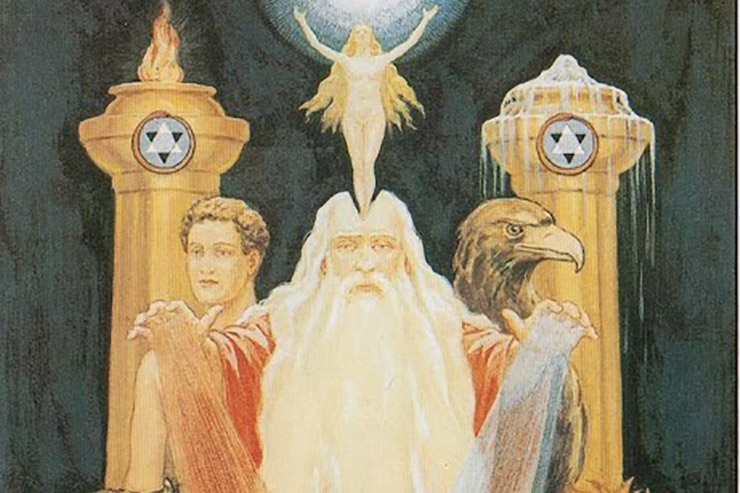
  • The Dawning Aeon of the Child: Personal Thoughts & Reflections

    The Dawning Aeon of the Child: Personal Thoughts & Reflections

    From New Dawn Special Issue Vol 11 No 3 (June 2017)

    In 1904, while visiting Cairo with his wife Rose, the English occultist Aleister Crowley received a text known as The Book of the Law via direct voice transmission. He described its author as “a messenger from the forces ruling this earth at present.” Three one-hour sessions over a three-day period resulted in 220 verses announcing a New Aeon with a New Law for mankind – a changing of the guard of the spiritual hierarchy ruling the planet. The Book of the Law proclaims a new era in ethics, morality, culture, and science.

    Crowley insisted The Book of the Law proved the first postulate of religion, the existence of Higher Consciousness independent of the human brain and body. He would spend the next 43 years of his life explaining and proclaiming its message and significance in all his writings.

    An inspiring, mysterious, and poetic text, devotees of The Book of the Law interpret its message as the sole rule and guide of their lives. Many have found it fulfils that role admirably, never failing to provide insight and direction when called upon.

    We must then ask ourselves: What does the inauguration of a New Aeon mean? I remember a cynical comedian from my childhood. He called himself “the Old Philosopher” and had recorded a funny rant on a 45rpm record, mocking the celebrations of the New Year. His pitch was something like, “New what? New worries, new problems? I’d rather have out with the New and in with the Old because I am familiar with the Old!” I remember laughing with my parents as I first became aware of the irony of the dual-edged nature of progress. Looking at the New Aeon from my perspective today, I am acutely conscious of that irony in a manner that I was not when I took my first steps on this path a half century ago.

    This new Aeon of the Child (Horus) follows that of the Father (Osiris) and the Mother (Isis). While Crowley spoke of these aeons as 2,000-year periods – seemingly corresponding to the astrological divisions of the Precession of the Equinoxes – I think they may best be understood as longer term symbolic constructs rather than calendrical dating systems. The aeons appear to be indicators of larger cultural and historical trends by which human progress and evolution may be understood and identified.

    The Aeon of the Mother (Isis) is characterised as a time of unity with Nature, the ascendant Priestess, intuition over intellect, before the widespread use of writing and even language, the Palaeolithic period. Hunter-gatherers searching throughout the land, moving where directed by the patterns of rainfall, weather and soil fertility, maintaining a synchronous and harmonious relation with the environment that bespoke a oneness and lack of separation. Cave dwelling and the building of rudimentary shelters, individual and communal skirmishes, the fears of the night assuaged by the introduction of fire, the opening of the sciences by the charting of the heavens. Paganism reigned as the spiritual answer to the questions of existence. The many gods who controlled the world were appealed to with intention and sincerity that embodied the fervour, fear, and gratitude of a dependent human being, the Babe sustained at the Breast of the All.

    The Aeon of the Father (Osiris) introduced the formula of self-sacrifice, the religion of the Dying God. From Osiris and Adonis to Christ, the community was ‘saved’ by the courage of the Chosen One, willing to plunge into Death at the command of a Greater Destiny whose impersonality demanded an abrogation of self-interest to the wider needs of his fellows. At the same time, mankind began to exercise dominance over Nature. Building a more dependable food supply with the mass herding of pastoral animals and land and crop cultivation. The taming of rivers with dams, the massive construction of edifices that towered above the landscape and celebrated the power of the mind and our species. Language, writing, philosophy, measurement were all aspects of this purposeful rearrangement of the natural world, the shaping and sculpturing of reality as if man were a co-creator working with the Heavenly Father to root out chaos and leave his personal stamp on existence.

    At the same time, suffering was conceived as the norm. Massive armies raged through continents sweeping aside civilisations with their swords and arrows and the armoured steeds on which they rode. Life was cheap. Individuality and personal rights were unknown. Sin was a constant nagging force whose instinctual power and insistence must be rejected and triumphed over at all costs. Salvation was to be sought in the after-death state and was based on obeying dictated ethical and religious principles, unquestioning adherence to the teachings of those who knew better, those who made the rules. Expect no satisfaction in the here and now. This is the testing ground of humanity, the place of Trial and Tribulation. These challenges would temper the soul with hardship. Their mastery would open the joys of the next world to the acolyte who listened.

    The current Aeon of the Child (Horus) represents a more confident period of self-awareness, as the Babe bursts forth fully-armed to confront the world in which he or she is launched. The legitimate birth of the rightful claimant of existence, one who participates without restriction in the natural order of the universe, cognizant, questing, and entitled. Just watch kids at play. Crowley calls this period that of “the recognition of the individual as the unit of society.”

    On the other hand, there are the terrors of the Child contradicting this unity, the fears and insecurities as it navigates its way through the darkness of uncertainty. The natural and optimistic self-assertion of the soul freed from oppression is opposed by the demanding irrationality of the squalling baby – absolutely shameless in its own self absorption. As a parent himself, Crowley was well aware of this dual nature and had no hesitation about expressing it.

    In his Introduction to the first popular publication of The Book of the Law in 1938, Crowley wrote the following:

    Observe for yourselves the decay of the sense of sin, the growth of innocence and irresponsibility, the strange modifications of the reproductive instinct with a tendency to become bisexual or epicene, the childlike confidence in progress combined with nightmare fear of catastrophe, against which we are yet half unwilling to take precautions.

    Consider the outcrop of dictatorships, only possible when moral growth is in its earliest stages, and the prevalence of infantile cults like Communism, Fascism, Pacifism, Health Crazes, Occultism in nearly all its forms, religions sentimentalised to the point of practical extinction.

    Consider the popularity of the cinema, the wireless, the football pools and guessing competitions, all devices for soothing fractious infants, no seed of purpose in them.

    Consider sport, the babyish enthusiasms and rages which it excites, whole nations disturbed by disputes between boys.

    Consider war, the atrocities which occur daily and leave us unmoved and hardly worried.

    We are children.

    These words could have been written this morning rather than nearly eighty years ago. Perhaps if we substitute “Facebook” for “the wireless” we can feel totally up-to-date.

    Crowley wrote further of the fraudulent political constructs of democracy, fascism, and communism from which we still suffer. He described them as “cavort[ing] crazily all across the globe.” He pegged them for what they are: “abortive births of the Child, the New Aeon of Horus.” A sobering characterisation that the purveyors of Fake News might contemplate as they work to inflame the passions of their historically-illiterate flocks.

    In contrast with the common tendency to over-idealise progress and modernity, one cannot help but compare Genghiz Khan of the Aeon of Osiris with Kim Jong Un, his pathetic alter-ego in the Aeon of Horus.

    As an admirer of Thomas Jefferson, I believe his writings in the Declaration of Independence were the opening doctrinal pronouncement of the politics of the New Aeon:

    We hold these truths to be self-evident, that all men are created equal, that they are endowed by their Creator with certain unalienable Rights, that among these are Life, Liberty and the pursuit of Happiness.

    Jefferson wrote further that government must not be trusted to be the arbiter of human conduct. “In questions of power, then, let no more be heard of confidence in man, but bind him down from mischief by the chains of the Constitution.” Imagine if the chains of the Constitution and its Bill of Rights were wrapped around the necks of the violent thugs raging through the streets of Berkeley, California as I write – transforming a town noted as the birthplace of the modern “Free Speech Movement” into a bastion of the tyranny of the mob and the triumph of censorship and intimidation.

    Get the issue this article appears in

    • • •

    With all that said, Crowley did not waver in his faith in this new stage of the evolution of human consciousness. He acknowledge a balance in all things. He was specifically singled out as the Prophet of the New Aeon and he wrote this glowing tribute in that same Introduction, “Liberty stirs once more in the womb of Time.”

    When I become discouraged by life’s hard experiences – or the caterwauling of our modern Anarchists, Snowflakes and Social Justice Warriors – I can turn for solace and inspiration to the words that express my fondest hopes for the future of humankind in the New Age. Words that celebrate a new day coming – words that help me learn to gaze with wisdom, patience, and tolerance at the birth pangs of the New Aeon.

    Among the Class A writings of Thelema (those that must not be changed inasmuch as the style of a letter because, as Crowley indicated, they originate from the highest level of Truth) is Liber Tzaddi. It is one of my favourites, an optimistic description of the transition to this New Age of Horus. Here is a long extract. If I may be forgiven for presuming to speak for Crowley, I imagine these words may have sustained him as well.

    1. In the name of the Lord of Initiation, Amen.
    2. I fly and I alight as an hawk: of mother-of-emerald are my mighty-sweeping wings.
    3. I swoop down upon the black earth; and it gladdens into green at my coming.
    4. Children of Earth! rejoice! rejoice exceedingly; for your salvation is at hand.
    5. The end of sorrow is come; I will ravish you away into mine unutterable joy.
    6. I will kiss you, and bring you to the bridal: I will spread a feast before you in the house of happiness.
    7. I am not come to rebuke you, or to enslave you.
    8. I bid you not turn from your voluptuous ways, from your idleness, from your follies.
    9. But I bring you joy to your pleasure, peace to your languor, wisdom to your folly.
    10. All that ye do is right, if so be that ye enjoy it.
    11. I am come against sorrow, against weariness, against them that seek to enslave you.
    12. I pour you lustral wine, that giveth you delight both at the sunset and the dawn.
    13. Come with me, and I will give you all that is desirable upon the earth.
    14. Because I give you that of which Earth and its joys are but as shadows.
    15. They flee away, but my joy abideth even unto the end.
    16. I have hidden myself beneath a mask: I am a black and terrible God.
    17. With courage conquering fear shall ye approach me: ye shall lay down your heads upon mine altar, expecting the sweep of the sword.
    18. But the first kiss of love shall be radiant on your lips; and all my darkness and terror shall turn to light and joy.
    19. Only those who fear shall fail. Those who have bent their backs to the yoke of slavery until they can no longer stand upright; them will I despise.
    20. But you who have defied the law; you who have conquered by subtlety or force; you will I take unto me, even I will take you unto me.
    21. I ask you to sacrifice nothing at mine altar; I am the God who giveth all.
    22. Light, Life, Love; Force, Fantasy, Fire; these do I bring you: mine hands are full of these.
    23. There is joy in the setting-out; there is joy in the journey; there is joy in the goal.
    24. Only if ye are sorrowful, or weary, or angry, or discomforted; then ye may know that ye have lost the golden thread, the thread wherewith I guide you to the heart of the groves of Eleusis.
    25. My disciples are proud and beautiful; they are strong and swift; they rule their way like mighty conquerors.
    26. The weak, the timid, the imperfect, the cowardly, the poor, the tearful – these are mine enemies, and I am come to destroy them.
    27. This also is compassion: an end to the sickness of earth. A rooting-out of the weeds: a watering of the flowers.
    28. O my children, ye are more beautiful than the flowers: ye must not fade in your season.
    29. I love you; I would sprinkle you with the divine dew of immortality.
    30. This immortality is no vain hope beyond the grave: I offer you the certain consciousness of bliss.
    31. I offer it at once, on earth; before an hour hath struck upon the bell, ye shall be with Me in the Abodes that are beyond Decay.
    32. Also I give you power earthly and joy earthly; wealth, and health, and length of days. Adoration and love shall cling to your feet, and twine around your heart.
    33. Only your mouths shall drink of a delicious wine – the wine of Iacchus; they shall reach ever to the heavenly kiss of the Beautiful God.

    (Full text of Liber Tzaddi at www.sacred-texts.com/oto/lib90.htm)

    [alert type=”general” dismiss=”no”]This article was published in New Dawn Special Issue Vol 11 No 3.[/alert]

    [alert type=”success” dismiss=”no”]If you appreciate this article, please consider subscribing to help maintain this website.[/alert]

    © New Dawn Magazine and the respective author.
    For our reproduction notice, click here.