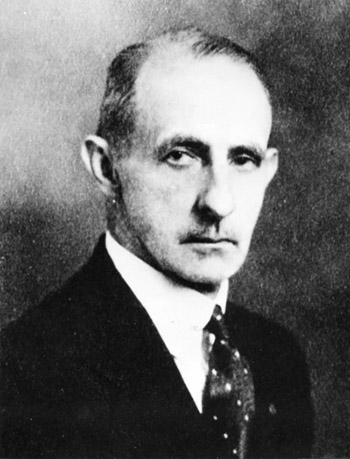
Thought is energy. Active thought is active energy; concentrated thought is a concentrated energy. Thought concentrated on a definite purpose becomes power. – Charles F Haanel (1866–1949), New Thought teacher known for his book The Master Key System
Through the faculty of creative imagination, many great artists, musicians, writers, inventors and poets became great because they cultivated and developed the habit of listening to their inner guidance that speaks from within. They learned to trust guidance and endeavoured to keep in touch with its stream, which could come and go based on who really knows.
The ultimate source of this stream is quite mysterious. Its quality is, of course, the logical outcome of tremendous hard work – study, concentration, practice, accumulation of knowledge and experiences, contemplation, experimentation, etc. The creative faculty of Mind synthesises new expressions that take the form of music, art, superior ideas, inventions – across the multitude of fields of human endeavour. On occasion, the spirit moves and inner guidance delivers brilliant original and useful breakthroughs into the world of humanity.
A large body of work exists on afterlife communications, channelling and even messages from aliens. We also have long-maintained traditions around the world of seeking advice from ancestral spirits. The former category of communications is usually unexpected, unpredictable and delivered to the individual, often out of context. The latter form of seeking advice is a more controlled exercise conducted by experienced shamans using tested rituals.
To the outrage of sceptics and diehard materialists, there are numerous recorded instances of people dialoguing with the spirits of the deceased, especially famous people. Author Frank DeMarco has actively engaged in an ongoing series of conversations with various non-physical beings, including historical individuals and a group he calls “the guys upstairs.” DeMarco’s conversations with Ernest Hemingway led to the publication of his book Afterlife Conversations with Hemingway. DeMarco’s accompanying article tells you how it can be done.
The Ancient Greeks believed that inspiration or “enthusiasm” came from one of the nine muses of Greek mythology, each goddess assigned expertise in a particular domain of the arts.
Great musicians know the power of that sudden stream of inspiration pouring into their mind, the sound of the music sometimes accompanied by lyrics – where does that come from? Child music prodigies include Mozart and Chopin, and there are plenty of other cases of child geniuses. The truth of this phenomenon confounds logic.
The imagination collects the material with which the mind weaves the canvas that will dress your future. – Charles F Haanel
An example from modern-day pop music is Lady Gaga. She has admitted in interviews that the source of some of the catchy tunes on her debut album ‘The Fame’, which shot her to worldwide fame, had mysteriously appeared in her mind. The same thing happened with her second studio album ‘Born this Way’, another major hit. In a 2011 interview, speaking about the song ‘Bloody Mary’ which she says was inspired by her fascination with Mary Magdalene, Gaga said, “I wrote it pretty quickly. I mean I wrote it in fifteen minutes! Actually all the songs on the album were written in fifteen minutes! It’s just the process of putting it all together takes much longer. But the lyrics and the melodies come to me very quickly, and if they don’t I usually move on.” (Source: www.popjustice.com/articles/an-interview-with-lady-gaga)
Imagination is the light by which we can penetrate new worlds of thought and experience. – Charles F Haanel
We now refer to the mysterious title of this article… who said that? The self-made American singer-songwriter and poet Lana Del Rey (birth name Elizabeth Grant) broke into stardom with her debut 2012 album ‘Born to Die’. As of 2020, Del Rey had sold 19.1 million albums, over 13 million singles worldwide, and received numerous accolades. Did she do it all by herself or get some help from “the guys upstairs?”
Del Rey let some of us into a secret, in a rare and little-known admission she made at the premiere of her short film Tropico in 2013, with its underlying surreal spiritual messages. This was the message on the flyer handed out to guests:
“Most of my friends are dead – and many of them I have never met before. In my private life, I live quietly, and with all the choice of living at hand, I prefer to bask in the legend of people I’ve only heard about. To me – they are as real as the people sitting in this theatre. I learned from Charles Haanel, through his experimentations with imagination that through actively honouring the memories of your choice historical figures, and in consulting with them as though they were real, you are eventually able to receive true guidance from them as though they were really here. True, it is a strange way to live – but it is magic, and I’ve found my magical thinking has lead to miraculous results. So, this video is my homage to the legends I’ve learned from as well as a nod to my colourful past. I hope you like it. It was the best I could do with my limited ability to translate my inner visions into pictures. On that note, I’d like to thank everyone who made that possible!” – LANA
On 11 June 2023, an interview with David Grusch, a retired member of the United States National Geospatial Intelligence Agency, was aired by NewsNationin which he revealed that the United States was in possession of “spacecraft from another species.”
Grusch was also part of the Pentagon group tasked with identifying UFOs – now formally labelled UAP (unexplained aerial phenomenon) – and during that time he was approached by staff who described to him the retrieval of “fragments” of UFOs as well as “intact and partially intact” craft. He was told that analysis of these fragments revealed they were of non-human origin. Grusch confirmed that bodies of extraterrestrial beings had also been retrieved, thereby adding one more story to the 70-plus years of military testimony and UFO research that has been debunked, disparaged and diminished by a scurrilous media and a largely incredulous global public.
Unfortunately the great gaping hole in Grusch’s testimony is the fact that his statements are based on hearsay. Grusch did not produce any evidence to back up his allegations, and he has not made any moves to disclose the evidence that he says he has seen. His credibility comes from the fact that he is a former intelligence officer with high clearance. One other point in his favour is that he has commenced legal proceedings against the US Department of Defense (DoD) over the government cover-up of UFO information in what he calls a “sophisticated disinformation campaign targeting the US populist [sic] which is extremely unethical and immoral.” Unsurprisingly the DoD is denying Grusch’s claims.
For reasons yet unknown, Grusch selected Ross Coulthart to host his interview. Coulthart is a prize-winning ex-60 Minutes journalist with 30 years of newspaper and television reporting behind him. Unfortunately, Coulthart’s innocence on the topic is clearly on display, along with a peculiar Cheshire-cat grin of surprise that such things as crashed UFOs and retrieved occupants are real. If Grusch had selected an established UFO researcher to interview him, and if the interview questions had not been vetted by the DoD, the questions – and more importantly the answers – would have been much more revealing.
Despite all the hype, David Grusch is merely the most recent in a long line of Chicken Littles telling us the sky is about to fall. To paraphrase his statements:
UFOs are real;
UFOs have crashed and their wreckage has been analysed and reverse-engineered;
ETs have been retrieved, both dead and alive;
Not all ETs are friendly and some may have murdered human beings;
Some UFOs may be interdimensional constructs;
Black Ops pursuant to UFO retrievals have been established and are ongoing;
Governments of the world have engaged in a disinformation campaign designed to keep the world in blissful ignorance;
Some people have been murdered by the US government to keep the UFO secret.
The Interdimensional Hypothesis
Whether we believe Grusch is legitimate or not – and to be fair, he has engaged a lawyer and taken refuge behind whistleblower protection laws – everything he has said is ostensibly true. During his interview, he takes pains to repeat things that he wants us to pay attention to. Early in the interview, he tells us that he doesn’t want to pin down a specific place of origin for UFOs, saying instead that “…maybe they’re coming from a different physical dimension as described in quantum mechanics. We know there’s extra dimensions…” and “…there most likely are physical, additional spatial dimensions. And you can imagine, 4- and 5-D space where what we experience as linear time ends up being a physical dimension in higher dimensional space… it could be that this is not necessarily extraterrestrial, and [it’s] actually coming from a higher dimensional physical space that might be co-located, you know, right here.”
In December 2020, former CIA Director John Brennan said something similar in a statement that some UFOs might be “some type of phenomenon that is the result of something that we don’t yet understand and that could involve some type of activity that some might say constitutes a different form of life.”
Dr J. Allen Hynek (1910-1986) of Project Blue Book fame.
Did Brennan mean a ‘different form of life’ from somewhere on Earth, or from somewhere a bit more etheric?
J. Allen Hynek was also of this opinion, stating in 1975: “There could be [another] universe with different quantum rules or vibration rates. Our own space-time continuum could be a cross-section through a universe with many more dimensions… we always think of another universe [as] someplace else. Maybe it’s right here.”
A few years earlier, Jacques Vallee had already suggested ET intelligences were an ancient phenomenon, living in an alternate reality that co-existed alongside our own.
The Borderland Sciences Research Association
The idea of UFOs originating from another dimension is hardly new. During the 1950s when George Adamski was greeting our 3-dimensional space brothers in the California desert, a group of researchers not very far away were working towards another hypothesis entirely.
Newton Meade Layne (1882-1961), founder of the Borderland Sciences Research Association.
Newton Meade Layne began his research into esoteric matters in 1931, and later went on to found the Borderland Sciences Research Association (BSRA) in order to more formally research ‘borderland sciences’, an area of study which these days dovetails neatly into modern quantum physics.
Meade’s interests became full-blown psychic research around 1945 when he met Mark Probert, a trance medium who was in contact with approximately 15 deceased persons – among them Lao Tzu and Thomas Jefferson – who provided channelled information on the nature of flying saucers.
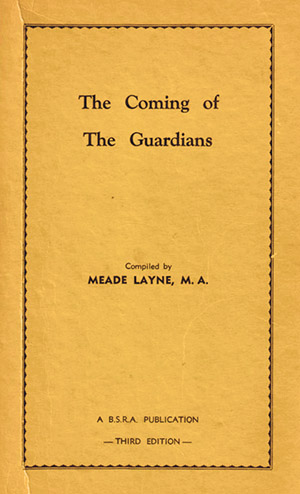
In 1947 it was reported that a pilot had seen a formation of UFOs near Mt Rainier – this was Kenneth Arnold’s seminal sighting of nine crescent-shaped craft, which kicked off the modern wave of UFO interest. This was of no surprise to Layne, as in 1946 Probert had already begun channelling information on the nature of UFOs, which they termed “Aeroforms” or “Emergents.” The information stated that “flying saucers and their inhabitants [come] from another plane of existence, a denser one, and only reached our world by changing their vibrations. They were not crafts from outer space, or delusions, but the interpenetration of planes of existence.”
Layne’s book that mentions “emergents.”
Layne’s etheric UFOs are defined as follows: “The Aeroforms are for the most part emergents. That is, they emerge into our plane of perception from a frame of reference which is different from our own. This process can also be described as a conversion of energy and a change of vibratory rate. When this change is effected, the disc or saucer becomes visible and tangible. …It amounts to a process of materialisation and dematerialisation. …[J]ust as there is a spectrum of sound and colour, there is also a spectrum of tangibility [and] the discs come out of worlds of substance a hundred thousand times more dense than the matter [we] perceive with our senses.”
It was also made clear that while there are indeed physical craft like the ones encountered by Adamski, “the majority of UFOs are etheric in nature, and not of [our] dimension.”
Humans supposedly occupy three dimensions, or what we call 3-D space. However, as Time is counted as its own dimension, then technically we are really 4-D beings – although who is to say there are not intelligences living a 3-D existence minus the 4-D complication of Time? According to String Theory, there could be 10, 12 or even 20 extra dimensions concurrent with our plane of existence, and there could well be intelligences occupying 7-D or 8-D or even 20-D space. The complicating factor is that all these dimensions are nested together – i.e. our own existence includes 1-D, 2-D and 3-D space, which means that a 5-D world encompasses 1, 2, 3, and 4-D space as well, which may make higher dimensions inherently unstable. David Grusch specifically nominated 5-D in his interview – make of that what you will.
Mysterious metals
In his article “Mat and Demat: Etheric Aspects of the UFO,” Layne explores the substance of UFOs more deeply. He says: “When the energy conversion takes place, the aeroform becomes visible and tangible. It appears to be and definitely is what we call solid substance, and so remains until the vibratory rate is again converted. The ‘steel’ of a landed disc is an etheric steel and its copper is etheric copper since the prototypes of all our metals exist in etheric matter; nevertheless, chemical analysis has shown certain radical differences.”
This presages Grusch’s statement about, “…extremely strange, heavy, atomic metal… arrangements that we don’t understand, you know, what the emergent properties are, but there’s just a very strange mix of elements.”
This sounds a lot like somebody trying to describe metal that is not quite like our metal – similar enough to appear familiar, but different enough to appear entirely extraterrestrial. Is this how etheric metal would translate into human terms once it had emerged into our 3-D space? (And it has not gone unnoticed that Grusch used the words “emergent properties,” which may or may not be a nod to Meade Layne’s theory of “emergent”….)
The Scientific Coalition for UAP Studies (SCU) produced a lengthy report on the observations of the infamous ‘Tic-Tac’ UFO – when the US Navy encountered a ‘Tac Tac’-shaped UFO off the coast of California in 2004 – and made a number of points in their paper, including that the characteristics of the ‘Tic Tac’ UFO “bring into question whether the object existed as a physical mass.”
That the ‘Tic-Tac’ possessed some kind of mass is corroborated by its appearance on radar, along with the fact that the pilots engaged visually with the object. However the SCU believe that the object simultaneously did not have mass, as exhibited by the object’s extreme acceleration, the instantaneous direction changes observed, and the apparent lack of atmospheric interaction during acceleration.
If that’s the case, then it corroborates Dave Grusch’s claim that at least some of these objects may be interdimensional, and also supports Meade Layne’s channelled information that UFOs are ‘emergent’ in our realm, capable of altering their vibrational rate so that their etheric craft are able to pass through water and solid earth as easily as a jumbo jet passes through air.
The ‘Tic-Tac’ video is mentioned about 20 minutes into the Grusch interview. He states only that it was “[t]ruly anomalous, absolutely. Technical vehicle, physical, and that’s absolutely something that we didn’t make.” Grusch’s categorisation of the ‘Tic-Tac’ as being a physical vehicle as opposed to a non-physical vehicle is telling when he has been at such pains to alert us to the possibility of interdimensional craft. Clearly, there are two types of UFOs plaguing our planet, the corporeal and the incorporeal, and it’s a distinction that Grusch is careful to make.
But what Grusch – and everybody else – ignores about the ‘Tic-Tac’ event is that another object was tracked beneath the ‘Tic-Tac’ on sonar, moving under the surface of the ocean at the impossible speed of 500 knots (950 km/hr).
The underwater speed record by a man-made craft is held by a Russian submarine (in 1969!) and is a mere 44.7 knots (83 km/h).The US Navy is currently developing a submersible that can travel at 100 knots (185 km/h). Only torpedos are capable of travelling faster under water, at around 200 knots (370 km/h). If this is the case, then what could possibly be travelling at 500 knots beneath the ocean?
Artist’s recreation of the Tic-Tac UFO encounter. If it wasn’t for the ‘Tic-Tac’ video leak there would be no US Senate UAP hearings, no DoD All-domain Anomaly Resolution Office (AARO), no Harvard Galileo Project, and certainly no public platform for the Dave Grusch’s of the world to climb up onto.
Unidentified Submersible Objects (USO)
Unidentified objects flying over and under the oceans are not new and have been reported ever since man set sail on the seas. In 1950 something like a Tic-Tac was reported over the North Atlantic when the crew of a ship witnessed a UFO travelling over the ocean at an altitude of 15-30 metres. It was described by the captain as an “ovular, cylindrical shaped object,” about three metres long. The object was silent as it passed by the ship and was described as having a “churning or a rotary motion.” A crew member added that “it had an elliptical shape and I could clearly see it had three dimensions. It wobbled in the air, made no noise and was a metallic white in colour.”
But the truly interesting stuff is what happens under the water. During the 1947 Kon Tiki expedition, when Thor Heyerdahl and his crew traversed the Pacific from Peru to Polynesia on a raft, two inexplicable submarine anomalies were observed. The first of these was described as follows:
“About two o’clock on a cloudy night, on which the man at the helm had difficulty in distinguishing black water from black sky, he caught sight of a faint illumination down in the water which slowly took the shape of a large animal. …Sometimes it was roundish, sometimes oval or triangular, and suddenly it split into two parts which swam to and fro under the raft independently of one another. Finally there were three of these large shining phantoms wandering around in slow circles under us. They were real monsters, for the visible parts alone were some five fathoms long.”
Heyerdahl attempted to explain this encounter as some kind of enormous phosphorescent sea creature, but a glowing light that is five fathoms (16-17 metres) long, self-illuminated, changes shape from a circle to a triangle and is capable of splitting into two and three parts is in all likelihood not a sea creature. Later on the voyage, Heyerdahl had another mysterious nocturnal encounter, and this time he didn’t even attempt to explain it away:
“[O]n one single occasion we saw the sea boil and bubble while something like a big wheel came up and rotated in the air, while some of our dolphins tried to escape by hurling themselves desperately through space.”
A group of these same ‘wheels’ had been reported sixty years earlier in 1880 in the Persian Gulf, when the crew of a steamer encountered “an enormous luminous wheel whirling around, the spokes of which seemed to brush the ship along. The giant wheels were estimated to be between 460 and 550 metres in diameter. A gleaming light glided along the surface of the sea ahead of the wheels.”
Thirty years after that, in 1909 in the Straits of Malacca, the captain of a steamship reported another “vast brilliantly illuminated revolving wheel, partly submerged beneath the water, with long arms issuing from the centre around which the whole system appeared to rotate.” And one year later, in 1910 in the South China Sea, another steamer captain reported a “horizontal wheel spinning rapidly above the water. The entire crew on watch witnessed the phenomenon. They all felt somewhat uncomfortable as they watched the bright spinning wheel suddenly change direction.”
In 1990 yet another mysterious glowing wheel was reported from Sevastopol when marine scientists in the Black Sea “observed an object that resembled a wheel, as large as a ten-story building, standing vertically underwater. [T]he ‘wheel’ would remain immobile for a while and then move into a horizontal position, rotate, and depart.”
But USOs are not always wheel-shaped. In 1945 a ship returning from Alaska witnessed a large round object approximately 45-75 metres in diameter rising from the sea. It climbed into the sky until it achieved level flight and then turned to circle the ship, moving smoothly and with no sound before disappearing into the distance. In 1962 the Australian warship HMAS Voyager pursued a large submarine object just outside of Jervis Bay. The sonar blip registered an object 100 metres long and accelerating. During the pursuit, Voyager achieved surface speeds of 38-40 knots (70-75 km/h) but was unable to match pace with the underwater object, which finally shot off at a speed that the “sonar operators estimated in the hundreds of knots.”
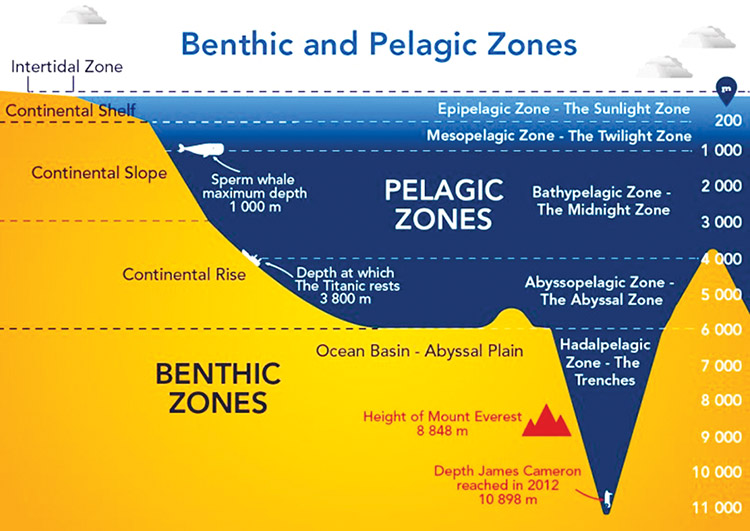
Over 80% of our oceans remain unmapped and unexplored, and with our current technology humans are incapable of exploring much beyond the 3,000 metre zone.
What are the USOs?
Whatever technology USOs use to penetrate watery bodies, it is apparent that the molecular structure of water, ice, and even solid ground, is no impediment to their passage. This example, from the Laptev Sea in 1978, is particularly interesting: “…the captain and most of the crew aboard a Soviet destroyer saw a dome-shaped object at an altitude of thirty meters. It sparkled with bright yellow colour and seemed to be semi-transparent. While the object was in view, [the] ship’s navigation system ceased to function. After a while, the UFO slowly descended to the sea’s surface and glided across at great speed – all without disturbing the surface of the water.”
Whether this indicates that a USO is able to alter the molecular structure of water so that it behaves in ways we have not observed water to behave before, or whether the USO’s own molecular structure is not as solid as it appears, is still open to conjecture. But it remains a fact that over half of reported UFOs are observed coming out of, going into, or moving under oceans, seas and lakes, and yet these USOs barely rate a mention in most reports on the topic of unidentified objects.
It’s almost as though they are being ignored on purpose, possibly to deflect attention away from what could be the true origin of UFOs or, at the very least, the best hiding place for them. So who or what are behind the USOs?
The Extraterrestrial Hypothesis
Extraterrestrial beings may have established bases beneath our oceans for the simple expedient of the ocean depths being inaccessible to humans. It is an incredible fact that the oceans account for seventy per cent of our planet’s surface, and yet over eighty per cent of the content of those oceans is unknown. This means that the vast majority of our planet is not only unexplored but unobserved.
What is known is that the oceans contain the largest geological feature on our planet, a mid-ocean rift system 64,000 kilometres long and 11,000 metres deep, and mountains higher than Mt Everest. The deepest parts of our oceans are completely inaccessible to human eyes, with zero visibility and pressures over a thousand times greater than those on dry land. The bottoms of the seas would be a perfect place for an extraterrestrial civilisation to set up base since man could never discover them there, and it is clear that their craft have no difficulties traversing from the depths to the shallows in an instant. In fact, they exhibit nonchalant ease when moving through mediums from water to air to space and beyond.
Intelligence from the Deep?
Is it possible that the uncharted depths of our oceans harbour an unknown aquatic race endemic to our planet? If you ascribe to Evolution and the belief that all life began in the watery depths, it is not hard to imagine that while we were crawling out of the slime and growing hairy legs, another branch of our original salamander-like state opted to stay in the comfortable embrace of the ocean where they evolved at the same rate as we over the same extended timeframe.
Given the vast array of mystery underwater objects, it would seem that we need to at least consider this as a possibility, since we can no longer deny ‘something’ is down there. This mysterious ‘something’ seems to have been around for as long as we have – if not longer – and it has hidden itself in the very place that we can never hope to go.
The ludicrous reality is that we have more hope of finding intelligent life on Mars than we do of finding it at the bottom of our oceans for the simple expedient of it being relatively easy to get to Mars, and nigh impossible to get to the deepest parts of our seas.
Underwater Bases?
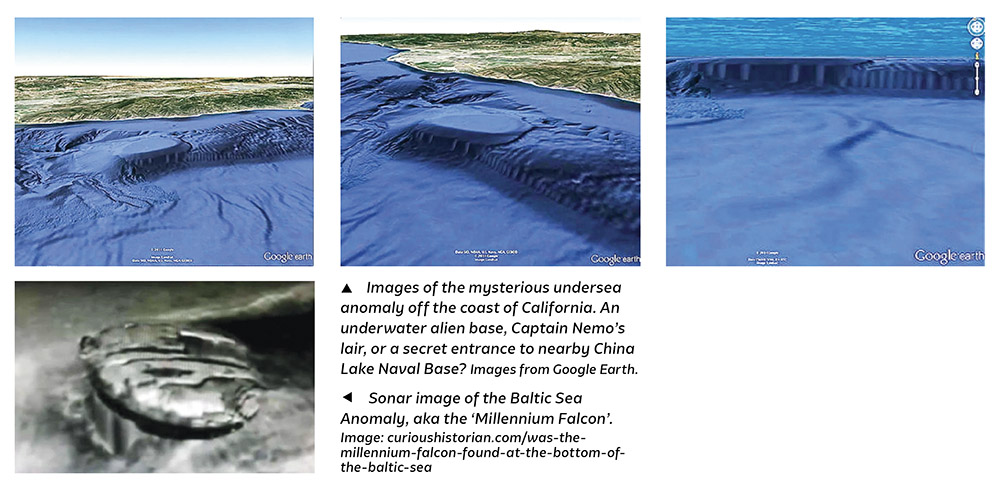
The Tic-Tac encounter took place off the coast of California, in an area renowned for UFO and USO sightings. The area south of Catalina Island is notable for a magnetic anomaly related to three mysterious craters beneath the sea. In addition, in 2014 an unusual ‘geological’ formation off the coast of Malibu was spotted on Google Earth. The structure sits 600 metres beneath the surface of the ocean and is estimated to be 188 metres in height and about 4,500 metres wide. It is oval-shaped with a flat roof and ‘support pillars’, and the ‘entrance’ is about 830 metres wide. It has been suggested that this structure is either a USO base or a military base somehow connected to China Lake Naval Base in the Mojave Desert. It is worth noting that the coast of California is riddled with military bases, with five located in the near-vicinity of this underwater anomaly.
Three years earlier and on the other side of the globe, another underwater anomaly was discovered – the ‘Millennium Falcon’ of the Baltic Sea. Discovered in 2011 by a deep-sea exploration group called ‘Ocean X’, the mysterious object sits just off the coast of Sweden and rests 75 metres down on the ocean floor. In their report, the discoverers described “distinctly artificial features” including what looks like a staircase, and a “circular hole surrounded by a square frame.” Geologists prefer to see this object as a boulder deposited by glaciation, although given its unusual morphology and the fact that the discoverers reported electrical equipment and communication failures when they came within 200 metres of the object, this does not seem likely.
These mysterious anomalies are only very recent discoveries, and they illustrate perfectly the real possibility of artificial structures located beneath our oceans and seas – literally right under our noses.
Nefarious Intent?
Considering that UFO research has been ongoing for decades, and given everything David Grusch said has been said before, the question then becomes: why are people paying attention now?
There have been suggestions that Grusch is a staged whistleblower revealing truths, half-truths, or outright lies in an attempt to make the world believe the USA is in possession of superior technology gleaned from off-world sources – a clever tactic given the world is teetering on the edge of World War Three.
In support of this idea, retired Army Colonel Karl Nell has said that “[Grusch’s] assertion concerning the existence of a terrestrial arms race occurring sub-rosa over the past eighty years focused on reverse engineering technologies of unknown origin is fundamentally correct.”
The fact that this whistleblower story – in comparison to the literally hundreds of whistleblower stories that have come before – is the one to hit the headlines and gain global coverage suggests it has the backing of the same powerful media moguls that greased the Pandemic and slid it down our throats.
Now that we have a perceived UFO ‘threat’, the USA is able to hide behind it in order to increase its surveillance of the world’s skies, from the ground up to and including satellites in near space. NORAD has improved its ability to track highspeed UFOs and made efforts to readjust radar calibrations to better track slower objects at altitude. The surge of high-altitude balloon deaths that we have seen recently may have been in response to this increased surveillance, and UFO occupants should be decidedly alarmed at the US Air Force’s ‘shoot first and ask questions later’ mentality.
There are others who suggest Grusch’s revelations may be the foundation of the next false flag event, priming a world-weary planet for an impending alien invasion – an intergalactic war that will be fought entirely in our heads thanks to the manipulation of the media and the soon-to-be unleashed Project Blue Beam, poised to project holograms of battle-UFOs over a major city near you (see page 19).
Researcher Dr Steven Greer certainly feels that the world is being prepared for a “fake UFO psyop” based on “deliberately constructed false intelligence,” and that we don’t have much longer to wait for it.
The ‘alien invasion’ would be achieved using man-made UFOs that appear so advanced that the world will believe the ‘attack’ is coming from space. Greer believes the UFO false-flag event has been in train for the past seven years and is ramping up for deployment any day now. Grusch’s statements that ETs are murdering humans could well be part of this greater plan, instilling just enough fear for humans to be sufficiently panicked at the sight of a UFO. Greer believes that the increase of UFO information via the media is part of a “slow enculturation” plan designed to prime the globe for an onslaught of these terrifying ‘alien events’.
Even Meade Layne foresaw the use of the UFO phenomenon as a weapon against man, saying in 1950 that “…there is some danger of panic. If these visiting craft are attributed to some foreign and unfriendly government, hostility and fear might develop; and if they are believed to come from some other planet of our solar system, unreasoning and superstitious fear is to be reckoned with, perhaps with a considerable degree of social disintegration.”
In a world where information is used as a weapon of war in increasingly more cunning ways, how can we trust anything we see? Truth vies for supremacy against misinformation and disinformation, and those terms themselves are misinformation and disinformation, like verbal swords designed to cut truth into segments that are easily disposed of.
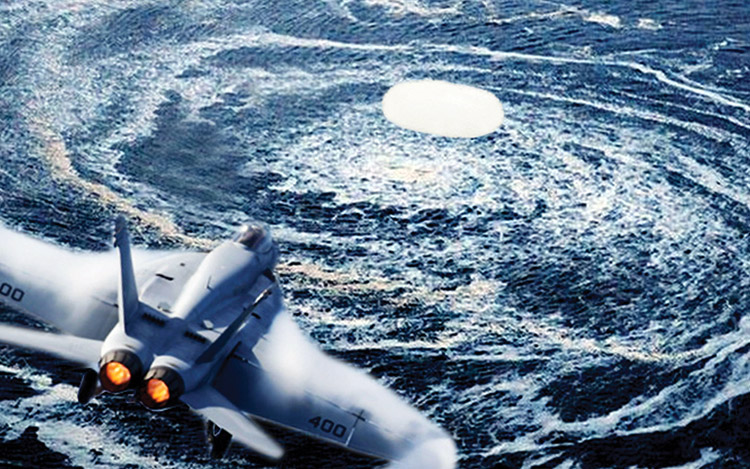
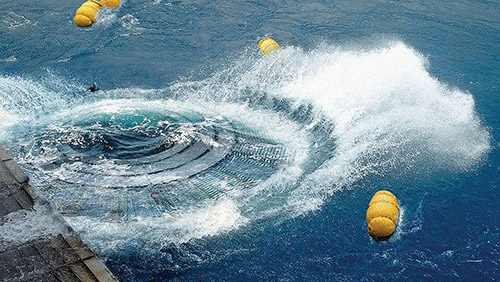
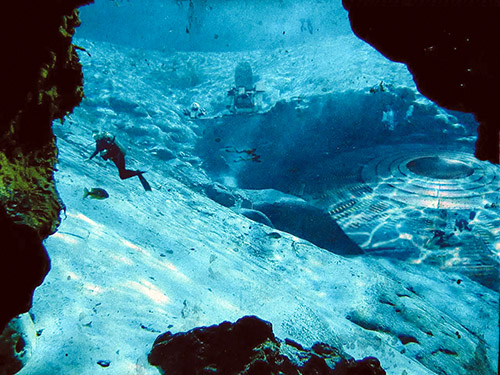
A mostly ignored possibility are UFOs or Unidentified Submersible Objects hiding in the oceans. These images are from the 2008 film, “The Orion Conspiracy.”
Confusion Reigns
Not long after Grusch spectacularly spilled his beans, Dr Sean Kirkpatrick, the director of the Pentagon’s All-domain Anomaly Resolution Office (AARO) made a statement that “AARO has found no credible evidence thus far of extraterrestrial activity, off-world technology, or objects that defy the known laws of physics.” And to counter Grusch’s claims of downed craft, Kirkpatrick stated that “AARO has not discovered any verifiable information to substantiate claims that any programs regarding the possession or reverse-engineering of extraterrestrial materials have existed in the past or exist currently,” thereby refuting Grusch’s claims of downed ET craft, adding to the confusion, and maintaining official secrecy all at the same time.
Before you imagine that AARO has the last word on the UAP phenomenon, it is important to understand that AARO operates under a ‘Title 10’ authority, while the US intelligence community operates under a ‘Title 50’ authority. This means that AARO is unable to force higher authorities to disclose information pertaining to UAP and ultimately “is not a serious investigative body.” In addition, AARO is “facing a funding shortfall that will impede its ability to fulfil its mission,” an alarming state of affairs which saw sixteen senators sign a request to the Deputy Secretary of Defense for increased funding.
We should perhaps be more understanding of Kirkpatrick’s disappointing findings given that AARO is working in an information vacuum and with limited resources. If this situation continues, there is no hope that AARO will ever produce any meaningful findings regarding UAP, which leaves us with the likes of Grusch and his fellow whistleblowers as our sole information source, whatever that information might be worth.
Instead of reminding you to watch the skies, I will instead ask that you watch television. Grusch’s confessions have opened a floodgate of follow-up confessions and whistleblowers are popping up to the left and right of us, but so far none of them have offered any tangible proofs. All they have as support are their words, and the slack-jawed endorsement of a naïve (or complicit) media.
But proof, when it comes, will have to be carefully vetted. In our current AI age of information manipulation, how will we be able to believe anything flashed before our eyes? And is it a coincidence that the ‘proofs’ have waited 70 years to be released, coincidentally at the same time this technology is available and when humanity has never been so unsure of reality in its very long lifetime?
If you thought the game had reached its crescendo, then you aint seen nothin’ yet!
16. Stott, M. Aliens Over Antipodes, Space-Time Press, Sydney 1984, pp. 61-62
17. Heyerdahl, T. The Kon Tiki Expedition, C. Tinling and Co Ltd 1958p. 92
18. Ibid, p. 118
19. Stott, M. Aliens Over Antipodes, Space-Time Press, Sydney 1984, p. 56
20. Ibid, p. 55
21. Ibid, p. 57
22. Stonehill, P. and Mantle, P., Russia’s USO Secrets: Unidentified Submersible Objects in Russian and International Waters, Richard Dolan Press 2016, p.51
23. Sanderson, I. Invisible Residents: The Reality of Underwater UFOs, Adventures Unlimited Press 2005, pp. 35 -36
25. Stonehill, P. and Mantle, P., Russia’s USO Secrets: Unidentified Submersible Objects in Russian and International Waters, Richard Dolan Press 2016, p. 133
In a series of essays written in 2022, Terry M. Boardman revealed the deeper background to the Ukraine conflict, which he argues is actually a proxy war, an episode in a much longer-lasting war that the West, or more specifically, the ‘Anglosphere’, has been waging against Russia for about 200 years for both exoteric and esoteric reasons. The following extract from his new book looks at the all-important spiritual/esoteric dimension of the conflict.
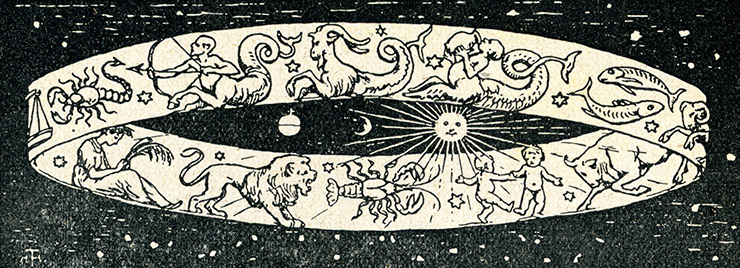
This esoteric aspect has to do with ensuring that the Slavic peoples, and especially the Russians, will not fulfil their potential to become the world’s ‘vanguard culture’ from the mid-fourth millennium onwards, but instead will come under the domination of the English-speaking peoples, whose current ‘vanguard’ status – which has become overwhelmingly driven by materialistic concerns and ambitions – would otherwise come to an end in the mid-fourth millennium (the end of the Age of Pisces).
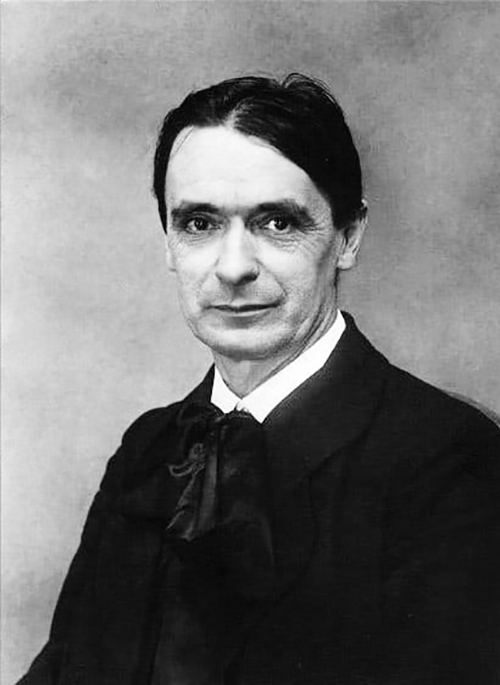
Rudolf Steiner (1861–1925)
What does it mean that the Slavic peoples have the potential to become the world’s ‘vanguard culture’ from the mid-fourth millennium onwards? It means that in what Rudolf Steiner called the Age of the Spirit-Self (the Age of Aquarius), which, according to Steiner, will follow the Age of the Consciousness Soul (the Age of Pisces), the human ‘I’ (the essential self, the spiritual kernel of the human being), in large numbers of individuals, will have learned to see itself and other I’s as spiritual beings.
These spiritualised I’s will then seek to form new communities on the basis not of the old blood ties or traditional religions but out of their own insight. The Age of the Spirit-Self (the Age of Aquarius) will be a new age of community, based on empathy for others, an age of brother-and-sisterhood that we in the West today can hardly even conceive of, just as people in Ancient Greece and Rome would hardly have been able to conceive of our modern Western individualist culture.
But we can see foreshadowings of this future today in the remaining traditional communal behaviours of non-Western cultures, although such behaviour is instinctive and collective, based on blood ties, whereas in the future (Slavic) epoch of the Spirit-Self it will be based on the moral individualism that will have been won as a result of our current (Germanic) Age of the Consciousness Soul.
The seed of this new impulse to new community, new fraternity, Steiner described, is already there in the Slavic peoples, who not only have the impulse to community – which all eastern peoples too have to a greater or lesser degree in comparison with the more individualistic westerners – but the Slavs also have a Christian culture. The native Slavic sense of community has been infused with over 1,000 years of an empathic Christian sensibility, which one can see especially in the unfolding, for example, of village life in Russia, the nature of the mir, a word which translates variously as community, peace, village, world, cosmos. Russian and Slavic literature is permeated with this empathic sensibility.
The English-speaking peoples are a branch of the larger Germanic group of peoples that originated in northern Europe (Scandinavia). From the late fifteenth century onwards, these Germanic peoples gradually replaced the peoples of southern Europe as the arbiters of the destiny of the West. The southern Europeans of the Greco-Roman or Mediterranean region had been those arbiters since the eighth century BC (the Age of Aries) when Greek culture began to flourish and Rome was founded, but from the fifteenth century AD onwards, the military, cultural and economic power of the Italian states, Iberia and France (France straddles both south and north) gave way, chronologically, to that of Switzerland, the Netherlands, Sweden and eventually England.
Rudolf Steiner described in numerous lectures how in the period of just over 2,000 years until the fifteenth century, Europeans – a sizeable minority of them, at any rate – had learned to think for themselves; this was a key achievement in what he called the Age of the Intellectual-Mind Soul. No longer did they feel the gods or God thinking through them or inspiring them; now Europeans felt that they themselves were thinking.
In the following Age of Pisces, from the fifteenth century, the Germanic or northern European epoch, the focus of development is on the individual human will – how human thinking applies the human will and, essentially, how the individual will becomes morally informed and directed by the human ‘I’.
This is a very dangerous phase of development, in some ways rather akin to adolescence in an individual’s development, because its early stage is usually one of considerable confusion, egocentricity and selfishness as well as materialism, a view of life that results from feeling alienated, to a greater or lesser degree, as an individual from the rest of life and the cosmos.
We are only 600 years into this Germanic or northern European epoch, the Age of the Consciousness Soul, as Rudolf Steiner called it, with its American and Australasian offshoots, and though there have been positive signs of growing human maturity over the past 60 years or so, there is still plenty of evidence of a thoroughly egocentric and competitive, materialistic culture in the West, especially in economic life.
Steiner described that the spiritual counterforces – which exist to provide humanity with the resistance it needs to develop inner capacities for love and freedom – desire that these egocentric and competitive, materialistic attitudes and behaviours (which have become extreme in the age of American hegemony since 1945), should continue on into the next epoch of human development, the Age of the Spirit-Self (the Age of Aquarius); indeed, their aim is for human development, in effect, to stop at our present stage. Life on earth would then become so miserable and oppressive that most people would no longer wish to incarnate on this planet, or if incarnated, would soon seek to exit this life. This is the goal of those spiritual counterforces who oppose humanity’s growth and development. If it were achieved, the mission or task of humanity and the Earth would be a failure. Love and freedom would wither in human and social development.
These counterforces, Steiner pointed out, influence the thoughts and actions of those at the helm of the English-speaking countries in the modern age. What is the aim, Steiner asks, of the elite groups, once secretive and only semi-visible, which are operative in the English-speaking world? In January 1917 he said:
They do not work out of any particular British patriotism, but out of the desire to bring the whole world under the yoke of pure materialism. And because… certain elements of the British people as the bearer of the Consciousness Soul are most suitable for this, they want, by means of grey magic [he means the mass media – TB], to use these elements as promoters of this materialism. This is the important point. Those who know what impulses are at work in world events can also steer them. No other national element, no other people, has ever before been so usable as material for transforming the whole world into a materialistic realm. Therefore, those who know, want to set their foot on the neck of this national element and strip it of all spiritual endeavour – which of course lives equally in all human beings. Just because karma has ordained that the Consciousness Soul should work here [in Britain] particularly strongly, the secret brotherhoods have sought out elements in the British national character. Their aim is to send a wave of materialism over the earth and make the physical plane the only valid one. A spiritual world is to be recognised only in terms of what the physical world has to offer.
This last point can be understood in the ways in which, in the West, spiritual practice has been taken over by, or put in the service of, physical aims, e.g. the commercialisation of Christmas and Easter, the turning of Eastern spiritual practices in martial arts and meditation from ways of living into ‘techniques’ of supporting ‘health’ – sport and ‘mindfulness’, and more recently, the creation of alternative worlds in virtual reality, Second Life and the Metaverse, in which individuals can supposedly live out their fantasies.
The following article by Patrick Henningsen – written only months after Russia launched its special military operation in Ukraine on 24 February 2022 – explains the background dynamics of this war. The facts outlined here – that were suppressed in the West but well known to informed observers – are only now emerging in mainstream media as Western backers of Ukraine begin to face reality.
There is no avoiding war; it can only be postponed to the advantage of others. – Niccolo Machiavelli
They say timing is everything. Had this war happened two years earlier, or one year later, the outcome would have been vastly different.
As for the great Atlanticist power bloc, this isn’t a war they’ve been willing to fight, not in the traditional military sense anyway.
As the mortars and bombs continue to fall and efforts to kickstart negotiations are ongoing, a sustainable path to peace seems unlikely to emerge in Ukraine.
While Russia seems intent on seeing through its “Special Military Operation,” the US and its allies will have to decide what they want and exactly how long they plan to fight Russia down to the last Ukrainian.
The western chorus of nations contends that by waging their ‘war of choice’ against its neighbour Ukraine, the Russian Federation and its President Vladimir Putin have fallen foul of the vaunted Rules-Based International Order. By doing so, they have effectively left the international community.
However, on closer examination of the evidence and historical context surrounding this highly contentious geopolitical event, it becomes clear that it was the “international community” which left Russia – leaving it with no choice but to pursue its national security interests on its own accord.
As it stands, Russia, Ukraine, and the North Atlantic Treaty Organisation (NATO) alliance are now at war, with each party firmly in the belief that they are fighting an existential conflict – not over any particular political or territorial dispute but for their future existence, or in the case of NATO, its relevance as a regional hegemonic entity.
No one saw this coming, or did they?
How Did We Get Here?
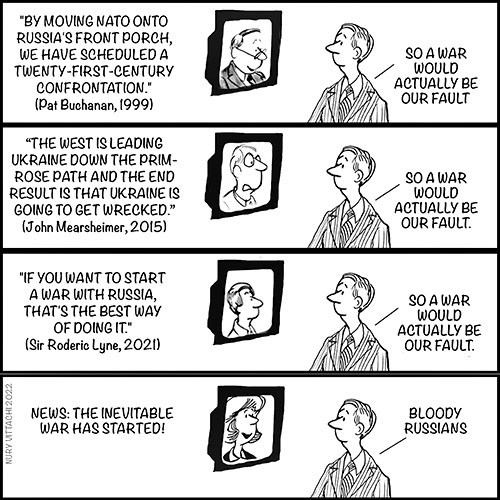
It’s no secret that over past decades numerous foreign policy experts warned that NATO’s continued eastward expansion, coupled with the US and UK’s increasingly strident rhetoric and aggressive policies directed against Russia would end up fomenting war in Ukraine.
Chief among those were luminaries like George Kennan and Henry Kissinger. Kennan, the architect of America’s policy of Soviet containment during the Cold War, was adamant that unchecked NATO expansion would eventually lead to war with Russia. Kissinger agreed, and thought that Ukraine should not be dominated by either NATO or Russia but rather act as a neutral bridge between east and west.
Also raising the alarm was one of America’s leading international relations scholars, Professor John Mearsheimer, who succinctly drove this same point home in public interviews and lectures,1 but even his cogent and considered realist arguments garnered little interest within Washington’s foreign policy clique.
The US, UK, and western Europe were fully engaged on this path following the February 2014 Maidan coup d’etat in Ukraine, especially after Russia’s supposed ‘annexation’ (as the West refer to it, while Russians will regard it as a reunification) of Crimea, an act that triggered some of the harshest economic sanctions seen yet prosecuted by the US and European Union against Russia.
And just like that, The Great Game was truly in play again.
Undoubtedly, one of the material consequences of the 2014 US-backed coup in Kyiv was Ukraine losing the Crimean Peninsula to the Russian Federation in February/March of that year. Two main factors made this transfer a fait accompli. Firstly, with a predominantly Russian population, Crimeans viewed the unconstitutional toppling of democratically elected President Viktor Yanukovych in Kyiv as an illegitimate seizure of the government and feared ethnically-motivated retribution against Russians and Russian-speaking citizens at the hands of western-backed radical Ukrainian nationalists who had seized power.
This policy of disenfranchisement and lustration (where a new regime bars any opponents to its legitimacy from participating in the political process) had already reared its ugly head in other primarily Russian-speaking regions of Ukraine, in the eastern region of Donbass, where protests against Kyiv’s illegal coup regime broke out in Donetsk and Luhansk. They were suddenly treated as insurrectionists for not recognising the new putsch government in Kyiv, which effectively suspended the parliamentary representation of the Donbass parties, and even deployed the military to quell the growing political opposition.
Knowing they may meet a similar fate, Crimea’s local councils held a regional referendum on leaving Ukraine and joining the Russian Federation. The result was overwhelming, with roughly 95% favouring secession. The process was made that much easier by the fact that Crimea is home to one of Russia’s largest military installations housing some 20,000 personnel located on the southern-most tip of Crimea, in the port city of Sevastopol. Since the time of Catherine the Great it has been the historic home of Russia’s Black Sea Fleet, and since the fall of the Soviet Union, Russia had been leasing the base from the Ukrainian state.
It should be noted that none of this would have gone smoothly had the overwhelming majority of Crimea not supported the new mandate. That, and the fact that Crimea had previously belonged to Russia up until 1954 when then Soviet premier Nikita Khrushchev gave the peninsula to the Soviet republic of Ukraine – a purely political move designed to curry favour with Ukraine at the time – explains why this changing of the guard was virtually seamless.
This brings us to the second reason Crimea reunited with Russia. From a national security standpoint, Moscow could not risk the fate of its main naval port to the machinations of an unstable, US-backed radical nationalist junta in Kyiv. From Russia’s point of view, if Ukraine joined the EU, or worse, was folded into the NATO alliance, it would only be a matter of time before Moscow’s cherished warm water port was jeopardised, and with that closing Russia’s access to the Mediterranean Sea.
If Ukraine joined NATO and then tried to take back Crimea by force, Russia would be compelled to retaliate, triggering NATO Article 5, opening the door for all-out war between NATO and Russia. For Russia, that risk was simply unacceptable. From a statecraft point of view, these series of events can be viewed as totally logical, and not the impulsive machinations of an unstable despot in Moscow.
Russia’s canny but ultimately necessary geopolitical move incensed the West to no end. From this point on, Washington and London have ben determined to find new ways to isolate Russia, beginning with the work of discrediting and isolating them internationally, and aiming to somehow retake the Donbass and Crimea, while edging ever closer to achieving regime change in Moscow. That’s the general plan, and war planners in Washington and Brussels are sticking to it.
A War Like No Other
For all practical purposes, World War III has already begun. It is a war being fought on multiple levels, and the conflagration over Ukraine may only be the start.
The “international community” you often hear about.
For its part, the West has declared full-blown economic war against Russia including a total embargo on trade and commerce, and the banning and restriction of Russian communications, media, culture, and even participation in international sports. Who would have imagined that a leading global power could be cancelled, at least in western spheres of influence in the “International Community” as it common refers to itself, the moralising confederation comprised mainly of North America, UK, the European Union, Japan, Australia and New Zealand. The rest of the world, including China, India, Africa, the Middle East, and large portions of South America including Brazil, have taken a much more neutral stance in relation to Russia.
But in order to really understand what is happening, we must consider how we arrived at this point in history, and maybe speculate where events are likely to take us once the dust finally settles on this phase of the conflict.
How We Got Here
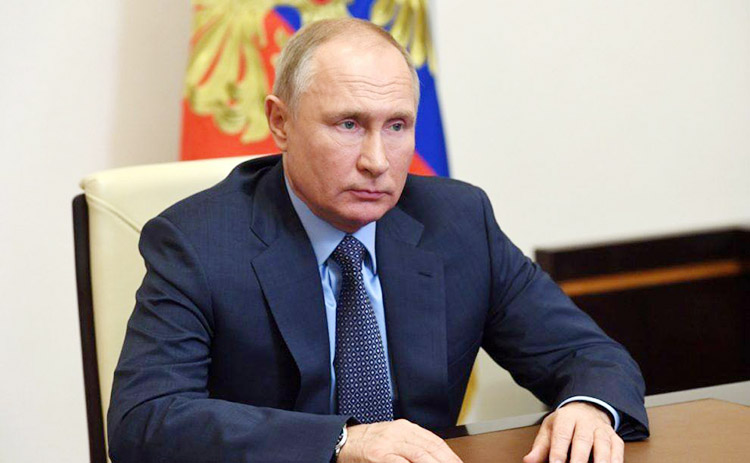
The narrative in popular western mainstream media discourse is that this war came out of nowhere – an impulsive act of hubris by an unstable ‘mad man’ and dictator, Russian President Vladimir Putin, who simply decided one day to invade Ukraine to realise his ambition of reconstituting the former Soviet empire. That’s a favourite fallback position for most American and British politicians and pundits. If only it were true.
In reality, we are seeing the logical conclusion of a series of events and provocations coming from NATO and Ukraine itself. Ever since their open invitation to Ukraine and Georgia at the 2008 NATO Summit in Bucharest, the West has steadily supplied weapons, military ‘advisors’, and other technical and intelligence support to those former Soviet republics. Could Russia afford to wait for US-made medium-range missiles to arrive in those countries?
For those and other reasons, Russia’s military intervention did not surprise foreign policy heavyweights like Kissinger or Mearsheimer. Even Ukrainian president Vodolymyr Zelenskyy’s political advisor, Oleksiy Arestovich, predicted this clash would unfold during a 2019 interview.2
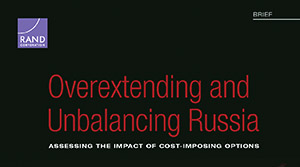
If that’s not convincing enough, read the RAND Corporation’s 2019 strategicreport, “Overextending and Unbalancing Russia,”3 which describes chapter and verse how Washington’s primary goal has been to undermine Russia by repeating what it considers as past successes against the Soviet Union during the Cold War. Only this time, rather than ‘hedge for peace’ by simultaneously engaging in productive bilateral relations or outpacing the enemy in arms and technology, the report opines that NATO should focus on enacting a dizzying range of anti-Russia measures in what it calls hybrid war. This includes leveraging NATO members against Russia, engaging in political and economic warfare, and active measures across all information warfare fronts. Whereas communism vs capitalism was the defining dialectic that shaped strategy and tactics during the old Cold War, new quasi-ideological fault lines should be reframed, like ‘dictatorship vs democracy,’ and the fomenting of divisions on religious and ethno-nationalist lines. Beyond this, we have the military theatres. For war planners at RAND, these are ranked according to perceived risks, benefits, and “likelihood of success.”
The RAND report also suggests capitalising on what the West perceives as Russia’s “deep-seated” anxieties about provocations from the West and advises that this vulnerability must be exploited to get Russia to react. And react it did.
When Russia launched its military intervention in Ukraine on 24 February 2022, it was the culmination of a long series of events that had effectively forced Russia into a national security quandary that would be difficult to avoid without making serious compromises. It could ultimately degrade its current position as a global power in the short term but, more importantly, pose a severe risk to its territorial integrity in the long term.
Operation Z: Putin Springs the Trap?
To present a thorough analysis of this historic impasse taking place over Ukraine, we need to first cast the scene back a few centuries, followed by a detailed depiction of both World Wars, and give a brief analysis of the formation and dissolution of the Soviet Union, including a granular look at the post-Soviet development of its respective satellite states. In New Dawn 191 (Mar-Apr), I covered some of the historical rivalries between the British and Russian empires in my article, ‘The Great Game 2.0: What’s Behind the Ukraine Crisis’.
For this analysis, we’ll move the timeline forward to February 2014, to the infamous Maidan uprising, known locally as the “Revolution of Dignity” in Kyiv. While the mainstream media likes to portray this colour revolution as a grassroots uprising ‘embodying the spirit of western democracy’ with young Ukrainians expressing their EU aspirations, the hard reality was that this was a violent coup d’etat, leading to the ouster of a democratically elected president, Viktor Yanukovych. The evidence now reveals that he was replaced by a succession of hand-picked US political puppets installed to do the bidding of regime change practitioners in Washington.
This was exposed in detail during a leaked phone call between then US Undersecretary of State, Victoria Nuland, and US Ambassador Geoffrey R. Pyatt in Kyiv. The degree to which they were micromanaging their new incoming regime was astonishing. The full sequence of events is well-documented in director Igor Lopatonok’s 2016 film, Ukraine on Fire, featuring Oliver Stone.
It turns out that this hostile takeover of Ukrainian politics was in the works for a very long time. Perhaps the most shocking aspect of the 2014 Maidan coup was how the US and its allies harnessed the power of Ukraine’s radical far-right nationalist cells to enforce a political line on the streets of towns and cities across the country.
Many refer to movements like Right Sector (Pravyy Sektor) and their respective paramilitary and ‘volunteer corps’ militant factions as Neo Nazi. However, they are much more than that. By any reasonable measure, these are not ‘neo’, but rather, bona fide Nazis – adherents to the Nazi ideology, descendants in the political (and in some cases, genealogical) lineage of Hitler’s western Ukrainian brigades, and inspired by controversial figures like Stepan Bandera, who to this day, is still idolised by radical nationalists in Ukraine. Bandera was leader of the Organisation of Ukrainian Nationalists in the 1930s and 1940s, which fought alongside the Waffen SS during Nazi Germany’s scorched earth march towards Stalingrad. It is a matter of historical record that Banderites engaged in pogroms and atrocities against Jews, as part of the broader Holocaust, as well as slaughtering Poles. History also reveals that Washington and the CIA groomed Banderite cells in western Ukraine after WWII through programs like Operation Aerodynamic.4
Following the Maidan coup, Washington installed interim Prime Minister Arseniy Yatsenyuk, followed by billionaire oligarch, President Petro Poroshenko, who marshalled these same radical nationalist forces and began integrating them into the Ukrainian military structure. Extremist militias like the Aidar and Azov Battalions were deputised to help Kyiv prosecute a brutal civil war in eastern Ukraine’s Donbass region – to put down the rebellion against the post-coup government which the rebel opposition in Donetsk and Luhansk regarded as an unconstitutional regime.
After his election, Poroshenko mounted an “anti-terror operation” in the eastern regions – bringing the full force of Ukraine’s military against its own people. A bloody eight-year-long civil war ensued that was systematically whitewashed from Western mainstream media and politics. Burying this inconvenient truth was essential for the United States, British and their NATO partners to condition the western public to see no evil in a newly-minted ‘democratic’ Ukraine.
Meanwhile, Russia was incensed, only it could not intervene militarily in Ukraine to protect ethnic Russians without provoking a major international incident. So instead, it provided diplomatic, economic aid, no doubt some special military support and technical training, likely comprising of some arms, hardware, intelligence and communications support. For its part, Moscow also offered invaluable international media coverage of the conflict through Russian outlets like RT and Sputnik.
In order to de-escalate the situation, Russia, Ukraine, Belarus, France and Germany drafted the Minsk Accords, or “Minsk I & II,” in 2014 and 2015 respectively. This initially helped reduce fighting which had already taken thousands of lives and displaced many hundreds of thousands from the region. It’s important to note here that Minsk Process was codified by UN Security Council Resolution 2202, unanimously endorsing the “Package of measures for the Implementation of the Minsk Agreements.” But unfortunately, in the years that followed, successive US-backed governments in Kyiv systematically undermined the agreement and rather than de-escalate the fighting in Donbass, increased the military build-up, culminating in a massive uptick in troop and equipment deployments to the region under President Zelenskyy.
Ironically (or not), Zelenskyy ran for office in 2019 on the promise of uniting the country and ‘bringing peace’ to Donbass, neither of which happened. Instead, the violence and proliferation of far-right militias in Donbass increased dramatically. It was clear this is what Ukrainians wanted, which was a far cry from what eventually unfolded. To make matters worse, Zelenskyy threw gasoline on the fire by constantly courting NATO membership when he (and his western handlers) knew full well that this was an absolute red line for Russia. Zelenskyy could have defused tensions earlier by disavowing NATO aspirations and declaring Ukraine a neutral state. The coup de grace came in February 2022 after Zelenskyy remarked at the Munich Security Conference that he would like his country to acquire nuclear weapons. At that point few can argue that Russia lacked sufficient reason to make its bold move in order to secure its own vital national security interests.
It is not at all surprising that most western pundits are largely aloof to this progression of events, and that Russia’s concerted moves are as much political as they are military. The great strategist Carl von Clausewitz said it best in his seminal text, One War: “War is simply the continuation of political intercourse with the addition of other means.”
In the spring of 2021, Moscow would increase its frequency of military drills and manoeuvrers, amassing more military forces along its border with Ukraine. In December of that year, Washington and its allies began raising the alarm that Russia was planning to invade Ukraine. Moscow issued an urgent letter to the Washington demanding that its security concerned be addressed immediately to avoid further escalation, but its overtures were largely brushed aside and ignored by the US State Department. For the next three months, western alarm bells dominated media coverage, all the while Russia was denying any intention to move its forces into Ukraine.
Then on 21 February something extraordinary happened. Vladimir Putin sprung the trap.
After eight long years of bloodshed and failed peace negotiations, the Russian president took to the airwaves to announce Moscow’s formal recognition of the independent republics of Donetsk and Luhansk. For a legal perspective, this immediately qualified them for official Russian military protection, including the establishment of humanitarian corridors which were quickly opened. After more than seven years of stalled diplomacy, Moscow finally chose to abandon the already dead Minsk agreement and directly deal with the situation in Donbass – and the threat posed by a US-controlled and NATO-occupied Ukraine to its national homeland security.
On 24 February, Putin took to the airwaves again to deliver an hour-long lecture on the geographical, cultural, political, and geopolitical history of Ukraine and its interconnected relationship to Russia. Western pundits were left puzzled. Why was Putin delivering this masterclass in Soviet history and articulating concepts underpinning Russia’s national security doctrine?
Those questions were soon answered when Moscow announced its military intervention code-named “Z,” effectively invading Ukraine from four different directions, with these goals: to secure the Donbass, followed by “demilitarisation,” and “denazification” of Ukraine.
Within 72 hours, the Russian armed forces had begun their “Special Military Operation” (SMO).
For the West, decrying Russia’s surprise invasion of Ukraine means they’ve suddenly discovered the concept of international law and are pointing to Article 51 of the United Nations Charter, and how the international community must condemn this egregious violation of Ukraine’s territorial integrity. While this may be true with respect to the letter of the law in this instance, such international treaties have never hindered the United States and its allies in the recent past – not in Iraq, Libya, Yemen, Syria, Yugoslavia, nor in Vietnam, to name but a few. The same could be said for Turkey’s incursions and occupations in Cyprus and northern Syria, and especially Israel’s 75 year-long incursion, illegal occupation and systematic ethnic cleansing of the native Palestinian population.
Following Russia’s SMO, the West enacted an unprecedented reflexive, collective response – a program of full-spectrum dominance – which includes overlapping strategies of hybrid warfare, the results of which have invariably altered the current world order.
Hybrid Warfare & Full-Spectrum Dominance
Governments and military structures are engaged in hybrid warfare. If you’re living in the West, they don’t tell you that you are immersed in a theatre of constant conflict is a 360-degree hippodrome of mass media information warfare with active measures and countermeasures. Even seemingly innocent bystanders – the general public – are viewed by governments and military strategists as active participants in the broader war theatre.
This has always been the case throughout history, articulated as propaganda and soft power, with citizens in whatever country on whatever side find themselves in a war for the age-old ‘battle for hearts and minds’. The process of public engagement also requires an incendiary ingredient to drive it, whereby the state conditions the people to both fear and hate the enemy de jour. Without that sense of personal and collective threat, or at the very least, in the Orwellian sense, that “two minutes of hate,” members of the public will not feel civically and emotionally invested in the process.
Additionally, an emerging new compliment to the military theatre is cyber warfare, now touted by western planners as a key domain to build up offensive and defensive capabilities. Klaus Schwab in Davos is gaming out this digital conflagration with the World Economic Forum’s “Cyber Polygon” tabletop simulations.
As much as the mainstream media spinners try to frame it, this Russia vs ‘The West’ conflict is not the proverbial ‘black hat vs white hat’ square-off. On the contrary, it is incredibly complex with many overlapping layers of history, culture, ethnic strife, and political and geopolitical forces which push and pull various actors, both in the theatre of war and on its periphery.
It’s crucial to understand that this is a proxy war pitting a US-UK-led NATO against Russia using Ukraine as the proxy, or cudgel, to poke the Russian bear. This was done numerous times during the Cold War, and it should be of no surprise history again repeats itself here. As it cannot engage in a direct military fashion, NATO is applying the Syrian model – trafficking an unlimited number of lethal arms, supplies and military advisors into Ukraine, with the express goal stated in the RAND document of wearing down and’ overextending’ Russia. Western planners openly boast about creating “another Afghanistan” for Russia.
Economic Warfare
Part of this hybrid warfare was the “mother of all sanctions,” an all-out economic war waged by the West against Russia to destroy their economy, hoping it provokes the Russian population to rise up and overthrow their leader. This is an attempt to cancel what is arguably the world’s top commodities producer – exporting a large share of the world’s gas, oil, wheat, fertiliser, minerals and key components for the highly globalised nuclear power, and space exploration industries.
The move to ban and restrict the Western bloc from purchasing Russian natural gas, oil, food and fertiliser has come even though Europe overly relies on these Russian supplies to heat their homes and provide power, minerals and product to run their industries, and put food on their tables. This highly self-destructive collective economic suicide pact is already backfiring spectacularly in the West, triggering tumults in already shaky natural gas and oil markets, and causing food shortages, supply chain disruptions, and a lack of available and affordable supplies of grains, sunflower oil, fertiliser and other essential staples.
Some western farmers cannot plant in the spring due to either a lack of supplies or the fact that the fertiliser price is too high, making farming unprofitable. A hike in fuel prices has triggered record-levels of inflation across the board in the West, spelling a lower standard of living for the working and middle classes right across the western world.
In another significant development, in late March the US sanctioned Russia’s Central Bank and seized some $300 billion of Russia’s foreign currency assets to bring on financial armageddon in Russia. President Putin turned the tables by announcing that Russia would no longer accept dollars and euros for its gas and oil, and payment would need to be made in Roubles. With the stroke of a pen, Putin made the Russian Rouble a type of reserve currency, and there was an immediate effect on the US dollar’s near-global monopoly as the pre-eminent world reserve currency. To make this move stick, Putin pegged the Rouble to gold, effectively making the Rouble a gold-backed currency. Russia’s currency was further bolstered by the fact it’s backed by a basket of essential commodities like oil, gas, and wheat. Interestingly, this very same move propelled the US economy after the Second World War following the Bretton Woods Agreement.
Time will tell how well this pans out for the Russian economy, but early signs are western economies are suffering most in sanctions blowback – the sort of damage that might eventually lead to political consequences in elections.
The only people in the West who seem pleased with these ruptures are the green lobby and Klaus Schwab’s Great Reset parishioners, both dreaming to leverage this artificial crisis to advance their ‘sustainable’ agendas and press home the argument that fossil fuels are now too expensive and a liability to global stability (because they supposedly pad the pockets of the Russian war machine).
Will it work or will it all end in tears? You might ask the Central Bankers who have certainly used this crisis to accelerate their roll-out of a new Central Bank Digital Currency (CBDC), completely in line with the Great Reset’s digital global fiat and cashless society, with its digital ID wallets, to be tied to your social and carbon credits. Many believe, and rightfully so, that this looks very much like the final implementation stage of the globalist plan to enslave the planet. It’s becoming harder to argue with that conspiracy theory.
Are we seeing a new bipolar or even multipolar world order taking shape – with Russia and China leading Eurasia in one direction while Klaus and the West head towards their technocratic digital ‘utopia’? If this unfolds, we may see a bifurcated world economy and digital media, on polar ends of a bifurcated world order, with different rules, values, and practices in different hemispheres.
As we go to press, Ukraine’s actor-cum-statesman, Volodymyr Zelenskyy, was still being paraded (via Zoom) in front of US Congress, the British, Canadian, and Australian parliaments, and the Council of Europe in Brussels, with western leaders enthusiastically chanting the nationalist mantra Slava Ukraini!” (Glory to Ukraine!)
This issue has become a global cause célèbre in the West, with Ukrainian flags flying over municipal buildings, businesses, and lapel pins, and with school children and churches doing bake sales, airline hostesses passing the hat around on long-haul flights, and other endless online fundraisers – all raising money for the Ukrainian cause as everyone joins in the biggest geopolitical virtue-signalling campaign in modern history.
However, none of this will change the facts on the ground.
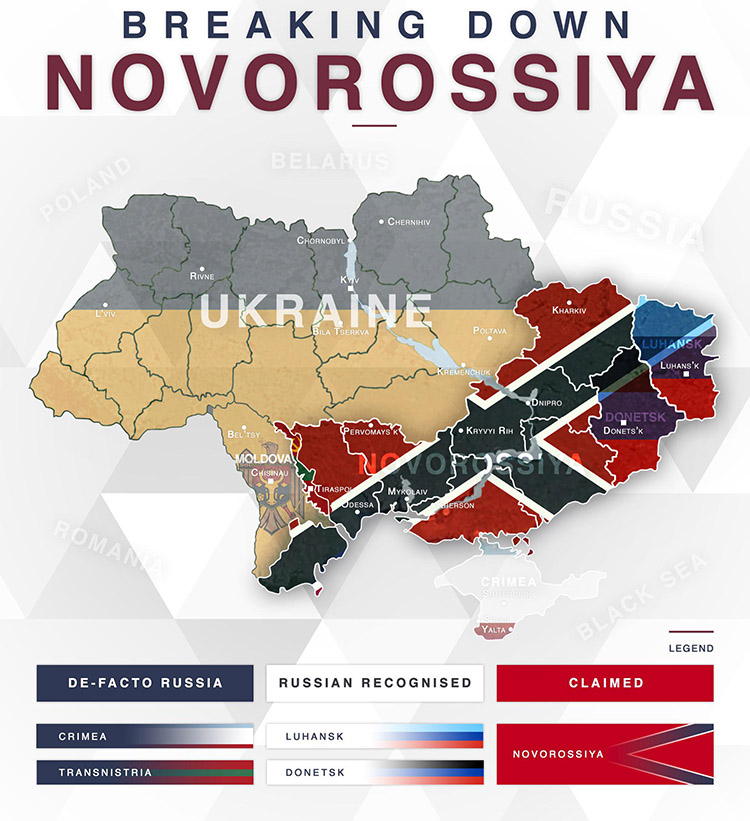
What we know of the ongoing conflict resolution talks between Russia and Ukraine is that there is a stalling for time which is likely being directed behind the scenes by the US State Department. In reference to the previously-cited RAND report and US/UK/NATO strategy, stretched-out negotiations allow for the unrestricted flow of weapons over the Polish border into western Ukraine. But the longer Kyiv drags this on, the more territory Zelenskyy’s Ukraine stands to lose. The territory presently held by Russian forces is beginning to resemble historic “Novorossiya,” which is also the proposed confederation of the Donetsk and Luhansk People’s Republic. This would create a land bridge stretching from Moldova, over to Crimea, across to Mariupol, and up to Kharkov. The remainder of the current Ukrainian state would have lost access to the Black Sea.
Another potential outcome is providing the West and its media establishment with a face-saving ‘out’ – something like how the invasion has gone so poorly for Russia and wore them down so much that in the end they were forced to negotiate a settlement due to the brave Zelenskyy-led resistance. Remember, the western PR machine can spin anything into a win, no matter how bad things have really gone.
One of the most extraordinary parts of this story is the revelation that just days before the Russian invasion, Zelenskyy was offered a peace deal by German chancellor Olaf Scholz while attending the Munich Security Conference – but the Ukrainian president turned it down.6 The peace deal was “that Ukraine should renounce its NATO aspirations and declare neutrality as part of a wider European security deal between the West and Russia” and that “the pact would be signed by Mr. Putin and Mr. Biden, who would jointly guarantee Ukraine’s security.” It’s reported that Zelenskyy rejected the offer, saying, “Putin couldn’t be trusted to uphold such an agreement and that most Ukrainians wanted to join NATO.”
Was Zelenskyy in a position to dial-down tensions and nullify one of Russia’s main reasons for the invasion? But through a combination of incompetence and pressure from anti-Russia US hawks, did he make one of the most careless and fatal mistakes in history?
This rapid sequence of events has exposed the intellectual, ethical, and moral bankruptcy of western neoliberal chauvinism, and its postmodern civilisational narcissism. That phase of unipolar dominance may be coming to an end.
It is a time of great turbulence, but it is also a time of great revelations. In just a few short months, this war is already reshaping the global order, and before long it may not be the same world order the master planners had envisioned.
Don’t look now, but these are those interesting times you always dreamed about.
The great awakening continues…
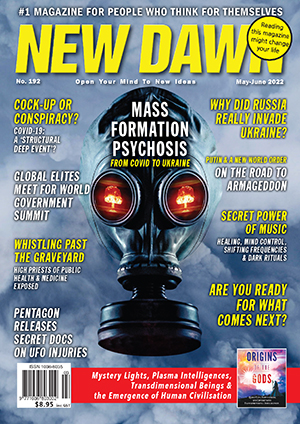
[alert type=”general” dismiss=”no”]This article was published in New Dawn 192.[/alert]
[alert type=”success” dismiss=”no”]If you appreciate this article, please consider subscribing to help maintain this website.[/alert]
Footnotes
1. John Mearsheimer: Is the West Responsible for the Ukraine Crisis?, https://21stcenturywire.com/2022/03/02/john-mearsheimer-is-the-west-responsible-for-the-ukraine-crisis/
2. Former Ukrainian presidential advisor perfectly predicted Russian invasion in 2019, www.intellinews.com/former-ukrainian-presidential-advisor-perfectly-predicted-russian-invasion-in-2019-238183/
3. RAND Corp. Overextending and Unbalancing Russia, www.rand.org/pubs/research_briefs/RB10014.html
5. Pentagon-Ukraine Bio Labs: The Hunter Biden Connection, https://21stcenturywire.com/2022/03/23/pentagons-ukraine-bio-labs-the-hunter-biden-connection/
6. Vladimir Putin’s 20-Year March to War in Ukraine – and How the West Mishandled It, www.wsj.com/articles/vladimir-putins-20-year-march-to-war-in-ukraineand-how-the-west-mishandled-it-11648826461
Myth for us – except in exceptional cases of extreme degradation and the secularisation of tradition and culture – is not the fiction of primitives, superstition, or misunderstanding. Instead, myth is a concise expression of the highest sacred truths and principles, which are “translated” into a specific language for worldly life to the extent that such is practically possible. Myth is sacred truth expressed in popular language. Wherever the preconditions for a myth’s understanding disappear, the mythical content must be discarded for another to take its place.
The contradictory processes of de-mythologisation and re-mythologisation were not unknown to ancient civilisations, in which old myths were sometimes destroyed (de-mythologisation) and replaced with new myths (re-mythologisation). In other words, the processes of de-mythologisation and re-mythologisation are mutually conditioned and dependent processes. They do not call into question the very foundation of traditional mythical associations; rather, they keep them eternally current and alive.
Dangerous Intuitions
In Greece, the process of de-mythologisation reached its complete and radical peak after Xenophanes (565–470). This was not followed by any process of re-mythologisation, it was the consequence of a total de-sacralisation and profanation of culture, whose result was the extinguishing of the mythical and the awakening of historical consciousness, in which man ceases to see himself as mythical and instead begins to understand himself as a historical being. This is a phenomenon that has analogies in two moments in history: the first was the process of de-mythologisation brought by early Christianity.
For the first Christian theologians, myth was the opposite of the Gospel, and Jesus was a historical figure whose historicity the Church Fathers proved and defended to the unbelieving. This was contrasted by the process of re-mythologisation of the Middle Ages which saw a whole series of revitalisations of ancient mythical content, often conflicting and irreconcilable, ranging from the Grail myths to the myth of Frederick II, eschatological myths in the era of the Crusades, and various millenarian myths. Such was, without a doubt, the re-actualisation of mythical content and their “dangerous intuitions” which transcend their causes and serve as evidence of the very presence of mythical forces within the historical world, which no process of de-mythologisation is capable of destroying or extinguishing.
The Consumer Mythology: The Midnight of History
Another example of the radical process of de-mythologisation was that brought by the Enlightenment era to its peak in the “technological universe.” This is the direct expression of the degradation and decline of modern man, who is no longer a mythical or historical being but merely a “consumer” within the “consumerist and technocratic civilisation,” or simply an “appendix” to the technological universe. The heroic impulse of man as a mythical being, or even a historical being, was extinguished. The destructive forces of de-mythologisation constantly purged and expunged mythical components from the domain of consumerist civilisation and human memory in general, exterminating the “dangerous intuitions” harboured within them. Within the technological universe, which is only the final stage of the fall of (modern) man, the human horizon is finally closing because here man has only one power and only one freedom: the power to spend and the freedom to buy and sell. This freedom and this power testify to the death of man (as known by myth and history) because within the universe of technology and the consumer civilisation anything that transcends this “animal of consumption” cannot exist. “The death of art” spoken of by the historical avant-garde was simply a consequence of the death of man, first as a mythical being, then as a historical being.
Of course, the process of de-mythologisation can never be completed for the simple reason that destruction does not touch the mythical forces themselves. They continue to appear and return through history, whether under the guise of the “historical” or as something opposed to history. This is also true for the one-dimensional universe of the technocratic utopia. As a result, in the consumer civilisation, real mythical components are replaced by mythical simulacra, by self-sown sub-cultural ideologies and the “myths” of the consumer mythology whose heroes are comic book figures such as Superman. But the exhaustion of the long and destructive processes of de-mythologisation does not mean a return to mythical time. The German author Ernst Jünger wrote in his At the Wall of Time:
We are standing at the midnight of history, the clock has struck twelve and we look ahead into the darkness, where we see the contours of future things. This view is followed by fear and heavy premonition. Things we see or think that we can see still do not have a name, they are nameless. If we address them, we do not intuit them accurately and they escape the noose of our control. When we say peace, it could be war. Plans of happiness turn into murderous ones, often overnight.
In short: “Rough incursions, which in many places convert historical landscapes into elementary ones, hide subtle changes of a more aggressive kind.”
At the Dawn of History
Ernst Jünger’s At the Wall of Time conveys much about the transition of myth into history, about the moment in which mythical consciousness is replaced by the historical. History, of course, has not existed as long as man has historical consciousness and rejects as non-historical the vast spaces and epochs of “pre-history” – whole peoples, civilisations, and countries – because “some person or some event must have very specific characteristics that would make them historical.” The key to this transition, according to Jünger, is provided in the work of Herodotus through which man today “passes as through a land illuminated by the rays of dawn”:
Before him (Herodotus) there was something else: mythical night. That night, however, was not darkness. It was more of a dream, and it knew of a different connection between people and events than that of historical consciousness and its selective forces. This brings rays of dawn into Herodotus’ work. He stands on top of the mountain that separates day from night: not only are there two epochs, but also two types of epochs, two types of light.
In other words, what we call history is the moment of transition from one mode of existence to something quite different. This is the time of the shift of two cycles which we cannot identify with a change of historical epochs – the matter in question is a profound change in the very existence of man. The sacred in the manner of previous epochs retreats, ancient cults disappear, and in their place come religions which soon afterwards become historical or anti-historical, even when they trigger events and historical plots. The Crusades called by the Western Church deepened divisions and schisms, and eventually gave birth to the Reformation, which began with religious enthusiasm and the desire to return to “biblical beginnings,” only to end with a historical movement which opened the way for the unhampered development of industry and technology unconstrained by the norms of (Christian) tradition and free from human hopes and desires.
Artwork by Alexey Belyaev-Guintovt
The Grimace of Horror
The historical world, the outlines of which we can find in Homer and which were shaped by Thucydides, reached its zenith somewhere at the end of the 19th and beginning of the 20th century with unclear boundaries in time and space. But upon clear consciousness of its laws and regulations, it started to collapse and the vast edifice of history became unstable, signifying penetration by hitherto unknown foreign forces. These forces have a Titanic elementary character, first seen in technological disasters which claimed hundreds of thousands of victims and then in the cataclysmic events of the 20th century, in the world wars and revolutions in which millions were killed and crippled. The release of nuclear energy, radiation, and the environmental destruction that enormous areas were exposed to, the daily toll in blood, whether it was sacrificed to “progress” in peacetime conditions or as a direct consequence of military intervention and conflicts, represented something that emerged out of the framework established by the historical world.
Of course, history did not end there, as was expected by Marx or Fukuyama. Rather, what really became apparent is the acceleration of historical time, which condenses events and shortens the distances between key turning points of history. The point, however, is that those forces which we have called historical do not operate alone, and man’s role in these events is fundamentally changing: he is no longer able to act on an equal footing with the gods, to follow them, oppose them, or even subdue them as is represented in myth. As was still the case in the mature historical era, he is no longer an active participant in history guided by passions or his own will. Instead, he now becomes the plaything of something unknown, involved in events that surpass him, against his will and outside of his ideas.
The expression of cheerful self-confidence is gradually replaced by a grimace of horror. Man, who until yesterday considered himself a sovereign and master, realises his weakness. The means on which he relied to turn against his creator at the decisive moment prove powerless. Technological systems and social arrangements have their reverse side, their automatic features that do not restrain but encourage destruction, putting man in the position of a wizard’s apprentice who frees forces that he is too immature to handle. Corruption, crime, violence, and terror are consequences rather than causes, and political responses, regardless of colour and sign, do not offer solutions but increase disarray. If the hour of panic had not descended, man would have at least gained awareness of his own downfall.
All of this was unthinkable in the mature historical age because man then was still ruled by himself, and thus history as well. History, therefore, could have no sense of direction other than the one given by man himself, his own deeds and thoughts. Each concept of the “meaning of history” was a concept of the emergence of man, whereas in the classical historical age man did not emerge but simply was. The question of the “meaning of history” was a meaningless question, and it is not found in the works of classical writers from Herodotus and beyond. The question of the “meaning of history,” which is always found outside of man, becomes possible only when the focus of history shifts beyond man himself, whether into the sphere of social or technological relations.
Modern man discovers his weakness too late. His collapse is not to be blamed on myth or history but on none other than the weakness and cowardice of modern man. The world of “civilised values,” and the historical world in general which he created, proves to be much weaker than we have been accustomed to believe – weaker structurally, spiritually, and ethically. At the first sign of alarm, it begins to collapse, revealing what is, in fact, modern man’s inner readiness for capitulation.
This is the “midnight of history” that will soon be replaced by something different; this moment is marked by the spread of Titanic forces demanding sacrifices of blood.
History, let us repeat, has not lasted as long as has man on Earth. But consciousness of this only occurs late within history, perhaps only at its end, when the boundaries of time and space change – on the one hand with the discovery of the distant past of man and lost civilisations, then the past of the planet and the cosmos, and on the other with the discovery of space, of the ocean depths, and the interior of the Earth through archaeological and geological layers in a virtually Vernean way. New perspectives cause dizziness. Pre-history and post-history gain in importance only when history becomes a crumbling edifice. Yet, man’s turn from history towards something that he is not yet able to define or see clearly now resembles escape.
In one way or another, the technological universe and the consumer civilisation will come to an end, in the same way that the classical historical epoch ended with technocracy and totalitarian order in its complete form, which arose not out of courage or strength but out of cowardice, weakness, and fear. It is impossible to say how long this will take. It is also irrelevant whether this will happen due to internal attrition, overreach, disaster, or a combination of all these factors together. But in each of these cases, collapse is the consequence of man’s inability to dwell within the historical world and to rule it as a sovereign-supreme being.
However, the return of myth is not possible in the sense of a return to the state of “pre-history.” Mythological forces remain present, just as they have been during the entire historical period, but they cannot establish the previous state for lack of the necessary preconditions. First and foremost, the “substrate,” the fertile ground, is missing, as modern man is too weak in the spiritual, psychological, and even “physiological” senses.
Together with history, culture and its current meaning gradually disappear as well, remaining a mere instrument of social engineering. In the technocratic utopia, mass culture (as opposed to the culture of the historical period) is just one of the ways for the utopian fantasies and desires of the masses to be channelled. The elite culture, meanwhile, which constantly drifts between conformism and negation, between scepticism and denial, between scepticism and irony and back again to conformism, remains essentially a tool of de-mythologisation and the suppression of the dangerous intuitions contained in myth, thus enabling more or less painless integration into the technological universe under the illusion of free will. The appearance and awakening of dangerous intuitions and dormant archetypes on the margins of the technocratic social mechanism creates a situation of conflict and leads to glitches in its functioning.
In the domains beyond the technocratic utopia, culture will need to take a more traditional role than the one it assumes under consumer civilisation. The disintegration of the historical world in its final stage, which we are witnessing today, allows us to see something out of it.
For much of the historical period, culture was the privileged domain of sacred and mythical forces. This is one of the ways in which mythical forces can penetrate the world again – historically, realising themselves in history, unlike in the technological universe where they usually manifest themselves through the uncontrolled elements of folkloric subcultures and are often distorted to the point of being unrecognisable simulacra of the mythical, not veritable expressions. Such testify more to the eternal and unquenched need of man for mythical content than they represent a sign of the real presence of the mythical.
In the post-technocratic era, culture will be very closely tied to re-mythologisation under the sign of re-recognising and re-awakening true mythical content, the revitalisation and innovation of ancient and traditional forms instead of, as before, their exorcism. The meaning and purpose of de-mythologisation, on the other hand, must be limited to its capacity in traditional societies – to the purification of degenerate “folkloric” mythical forms so that in their place may come forms which veritably represent tradition.
The above text is based on passages from Boris Nad’s first volume of selected works in English, The Reawakening of Myth (PRAV Publishing, 2020), available from PravPublishing.com.