New Dawn – World's Most Unusual Magazine

Category: Articles

  • Return of The Mind Parasites: Lovecraft, Wilson, & Phenomenological Science Fiction

    Return of The Mind Parasites: Lovecraft, Wilson, & Phenomenological Science Fiction

    From New Dawn 188 (Sept-Oct 2021)

    In 1959, while staying at the farmhouse of an old friend, the British existentialist Colin Wilson came across a book seemingly designed to attract his attention; the fact that it was the only one in the house practically ensured that it would. Its title was The Outsider and Others and its author was H. P. Lovecraft, the American pulp horror fiction writer from the pages of Weird Tales, who in recent time has been promoted to the rank of a Penguin Modern Classic. Wilson had never heard of Lovecraft but his own first book, the one that had made his name as an “angry young man” a few years back, was called The Outsider, so naturally he was interested. 

    Wilson’s book was an account of modern alienation and the extreme mental states of creative individuals trying to overcome it. Lovecraft’s brand of “eldritch,” “grotesque,” “nameless” horror – these are only a few of his hyperbolic adjectives – seems far away from the angst and la nausée of existentialism, and yet appearances can be deceiving. Wilson took the mouldy volume off the shelf – it was published in 1939, two years after Lovecraft’s death – its yellowing pages almost crumbling at his touch, and settled down to read. Before turning in that night Wilson knew that he had come across an “outsider” indeed. If anyone fit the bill of the isolated, alienated man of genius, loathing the mediocrity of the modern age, Lovecraft did.
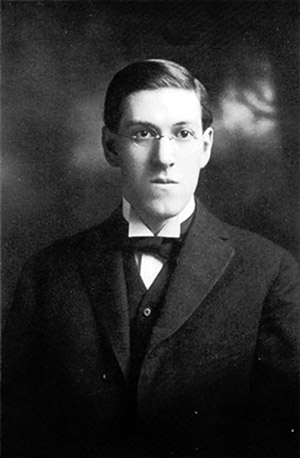
    H. P. Lovecraft, circa 1915.

    Wilson was so taken with Lovecraft that reading him inspired one of the books in his “Outsider Cycle,” in which he attempts to provide the foundation of what he called a “new existentialism,” to replace the dreary rive gauche version of Sartre and Camus, and the gloomy Schwarzwald meditations of Professor Heidegger.1 Wilson believed that all three had taken a wrong turn at Edmund Husserl, the founding father of phenomenology, out of which existentialism emerged. The books in Wilson’s “Outsider Cycle” methodically spell out his objections to what had become a philosophy of meaninglessness and despair, in an attempt to regain existentialism’s original object: the vision of freedom. In outsider figures like Blake, Nietzsche, Gurdjieff, and others, Wilson had discovered experiences of a “Yea-saying,” affirmative consciousness that Sartre and the others had left out of their analyses. Central to his analysis of these moments of “affirmation” was Husserl’s dictum that consciousness is intentional. It is not the passive recipient of sense impressions impinging from without, but an active reaching out to reality, in order to grab it with the talons of the mind. It was this, Wilson believed, that the old existentialists had lost sight of.

    Wilson’s book, The Strength to Dream (1962), a study in what he called “existential criticism,” focused on how different writers used the imagination to present their values, their vision of the world. He started with Lovecraft and were he alive to have read it – which is entirely possible; he would only have been in his early seventies – Lovecraft would no doubt had been gratified that he was taken seriously, and perhaps not a little bemused at the literary company he was keeping. Wilson put him in the context of W. B. Yeats, August Strindberg, and, perhaps surprisingly Oscar Wilde, as agents of what he called “The Assault on Rationality,” writers who reject the everyday world and create an alternative more to their liking. Yet Lovecraft might not have been amused at Wilson’s assessment of him as “that man of dubious genius” who “carried on a lifelong guerrilla warfare against civilisation and materialism,” and who was a “somewhat hysterical and neurotic combatant.”2 

    Aside from his atrocious style, filled with phrases like “black clutching panic” and “stark utter horror” – Lovecraft always had a bad habit of overwriting – what repelled Wilson about Lovecraft was his “soured romanticism.” He was a man so revulsed by the triviality of modern life, it seemed, that he reminded Wilson more of the Düsseldorf mass murderer Peter Kürten, who dreamed of blowing up whole cities, in fantasies of revenge against the inequities of life, than of his tragic predecessor, Edgar Allan Poe.3 Lovecraft never engaged in any of the violent acts that filled Kürten’s horrific career, but his tales of ancient evil and exiled gods – Cthulhu and Co. – returning to their lost domain – planet Earth – were, Wilson believed, the literary and psychological equivalents of Kürten’s brutal assaults on “society.” Both, Wilson argued, were engaged in acts of ressentiment against a world that negated them.

    Wilson’s estimation of Lovecraft, however, increased over time, helped by a visit to Providence, Rhode Island, where Lovecraft spent most of his short life. Wilson was a visiting lecturer at Brown University and took the opportunity to read Lovecraft’s letters and other works held in the library. His interest eventually led to a correspondence with August Derleth, the man more than anyone else responsible for Lovecraft being known at all today. After Lovecraft’s death Derleth became his literary executor and through his Arkham House Press kept Lovecraft in print. Derleth had read Wilson’s criticisms of Lovecraft and thought he had been unfair. Wilson was open enough to Derleth’s comments to revise some of his remarks about Lovecraft for the American edition of the book. Yet Derleth still felt Wilson had short changed Lovecraft. In a letter to Wilson he wrote, “If you’re so critical of Lovecraft, why don’t you write a fantasy novel, and see whether it’s any good…”4

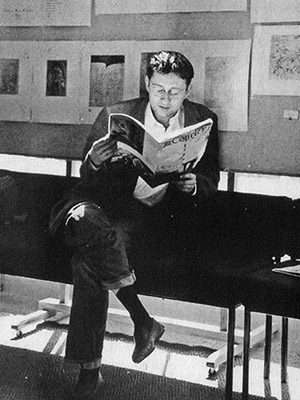
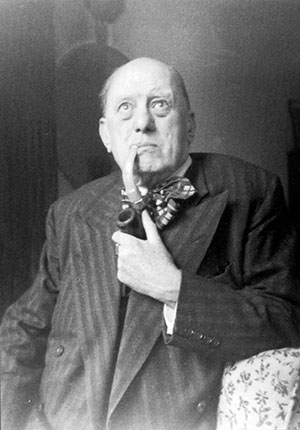
    The English writer, philosopher and novelist, Colin Wilson (1931–2013)

    Wilson Takes Up the Challenge

    Not one to ignore a challenge, Wilson brooded on the idea. His interest was not in terrifying people as Lovecraft’s had been. It was, in fact, more along the lines of the sort of quasi-science fiction Lovecraft was writing towards the end of his life, in stories like The Shadow Out of Time. With its vision of ancient alien races sending their consciousness out into the depths of time and space, this produces more a sense of awe than a shudder – something we find in H.G. Wells and Olaf Stapledon, two other writers with a “cosmic” point of view. Wilson’s own vision was that of a consciousness free from time, able to rise above the “triviality of everydayness” that revulsed Lovecraft (the phrase is Heidegger’s) and become aware of the “reality of other times and places,” and not only of the one in front of your nose. 

    It was while working on his Introduction to the New Existentialism (1966)that Wilson came upon an idea that would give the old Lovecraftian theme a new twist. Lovecraft’s fellow Weird Tales writers all added to Lovecraft’s Cthulhu Mythos, inventing gods, ancient races, lost cities, and, most effectively, fictional texts such as Lovecraft’s Necronomicon, that give the tales a flavour of authenticity. But Wilson’s contribution wouldn’t be another god, like Clark Ashton Smith’s Tsathoggua, although he will draw on this, nor a forbidden text like Robert E. Howard’s Unaussprechlichen Kulten, nor will his protagonists meet their doom in a ruined temple on some unknown South Pacific island. Wilson’s monsters would come from somewhere else. They would come from the mind.5

    Wilson’s first foray into what we can call “phenomenological science fiction,” The Mind Parasites (1967), came on the back of a series of novels in which Wilson used the constraints of genre fiction for philosophical purposes.6 His first novel, Ritual in the Dark (1960), is an existential thriller about a sexual killer, and could best be described as Jack the Ripper meets the Brothers Karamazov in duffle-coated early 1950s London. It works out in fictional form some of the themes of The Outsider. This was a practice Wilson continued with detective novels (Necessary Doubt (1964)), psychological crime thrillers (The Glass Cage (1966)), erotica (The Sex Diary of Gerard Sorme (1961)), and later with espionage, police procedural, soft porn, and, as we will see, science fiction.

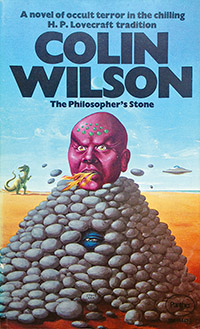
    Wilson’s engagement with Lovecraft led to several works, some serious attempts at using Lovecraft’s themes for philosophical purposes, some, like his contributions to the Lovecraft sendups The Necronomicon (1978) and The R’lyeh Text (1995) more tongue in cheek pastiche than anything else.7 The two novels I look at here, The Mind Parasites and its follow-up The Philosopher’s Stone (1969), are Wilson’s masterpieces in the genre. In them Wilson managed to put into gripping fictional form the essence of his “new existentialism,” and the insight that would inform his decades long investigation into the occult and paranormal, his search for “Faculty X,” the ability of the human mind to free itself of the constraints of time and space and occupy “other times and places.” 

    Wilson wrote another science fiction novel, The Space Vampires (1976), that uses some Lovecraftian ideas – sadly it was made into the dreadful film Lifeforce (1984) – and his later epic Spider World series(1987-2002)is his attempt at a Tolkienesque fantasy. Yet it is in The Mind Parasites and The Philosopher’s Stone that Wilson managed to find, to my mind at least, the perfect balance between the ideas and a narrative to convey them. The books are, borrowing a title from Alfred North Whitehead, “adventures of ideas.” Like the late novels of H.G. Wells, that Wilson, against critical opinion, rated highly, they are compelling because of Wilson’s ability to make the ideas come alive. The reviewer who said of his work that he had a “narrative style that can make the pursuit of any idea seem exciting detective work” knew what he was talking about.

    The Mind Parasites
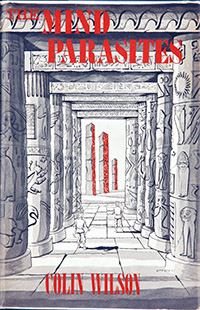
    First edition hard cover of The Mind Parasites.

    The Mind Parasites begins in 1994 – the future for its first readers, the past for us – when the archaeologist Gilbert Austin learns that his friend, the psychologist Karel Weissman, has committed suicide. The death, of course, was enough to shock him. But suicide? “It was impossible.” Weissman “had not an atom of self-destruction in his composition.” What could have driven him to take his own life? It was true that the suicide rate had increased considerably over the years. But Weissman was a follower of the humanistic psychology of Abraham Maslow (who shares billing with Husserl in the new existentialism). It was unthinkable. What made him do it? 

    The answer to that, Austin suspects, could be found in the collection of papers Weissman left behind. Yet before Austin can attend to them, his own work takes him to Turkey where he and his colleagues make an incredible discovery. Strange figurines of an unknown origin lead them to tunnel below the surface only to discover a huge block seventy feet long two miles underground. It is the remains of a cyclopean city, a metropolis built by giants eons ago… 
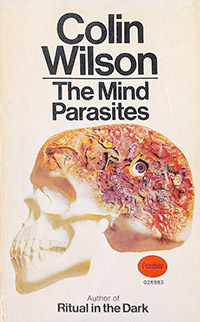
    First edition paperback of The Mind Parasites.

    Yet these allusions to the Great Old Ones and Elder Gods of Lovecraft’s mythos are really a red herring, for the truly evil creatures – who, borrowing from Clark Ashton Smith, Wilson calls the Tsathogguans – are not, like Cthulhu, resting in sunken R’lyeh, waiting to be awakened, but inhabit a much more intimate space: that of the mind. Austin discovers why his friend had killed himself: he had become aware of psychic vampires that have been bleeding human consciousness dry for the past two centuries, and they had got rid of him… Just as they had got rid of the generation of creative geniuses, the Romantics, who Wilson sees as the first sign of a new stage in the evolution of human consciousness.

    Wilson’s The Outsider sought to answer the question why so many creative individuals of the 19th and early 20th centuries either died young, went mad, committed suicide, or in some way came to a bad end. Nietzsche, Baudelaire, Ibsen, Keats, Shelley, Kleist, Novalis, Poe; this list, chosen at random, could go on. These men and others, lesser known, experienced eruptions of the imagination unlike anything that had been seen before. The poets of the previous age said that the “proper study of man is man.” The Romantics disagreed and sought to embrace the entire universe. The ecstasies they experienced convinced them that men were really sleeping gods. Yet when they returned to earth from their ecstatic excursions, they were struck by the banality of the world they were forced to inhabit, and their inability to revive the vision of inner freedom and space, the “bird’s eye view” over space and time. Self-pity, depression, weariness set in. Baudelaire compared the poet to the albatross: when aloft, the bird’s great wings enable him to soar gracefully, yet on land they are encumbrance, tripping him up. This brutal world was not meant for such noble creatures, and so many of them succumbed.

    Wilson’s mind parasites are an allegory of how the mind can collapse on itself, of how easy it is for it to slip into existential despair and a self-produced insanity. In The Outsider Wilson relates several experiences of what Swedenborg called “vastation,” a total emptying out of any sense of meaning, of any reality propping up your existence. One night on the desert, meditating on the reality of history, and on the knowledge of that reality housed within his mind, Gilbert Austin becomes aware that within his own consciousness, there is a universe as strange and unknown as the one he gazes out on at the stars… the essence of the Romantic vision. It was then that something odd happens. Austin catches a glimpse of “some alien creature” in his own mind. He then discovers that his friend Weissman had had the same experience. Weissman’s research into the growing suicide rate uncovered a disturbing fact: the human race was losing its power of self-renewal. “For more than two centuries now,” Weissman reports, “the human mind has been constantly a prey to energy vampires.” 

    Around the turn of the eighteenth century, a kind of change came over the western mind: the powerful optimism of the early Romantics – Beethoven, Goethe, Blake – is followed by a gloomy pessimism, a despair the mind parasites feed on. “The artists who refused to preach a gospel of pessimism and life-devaluation were destroyed.” Some individuals, like the Marquis de Sade, were completely in the vampires’ control. Pessimists, like Schopenhauer, lived to a ripe old age. Nietzsche, the life-affirmer, goes mad. Men may really be gods, but it is in the parasites’ interest that they never find this out. Those who suggest as much are quickly done away with…

    Having become aware of the parasites, Weissman is a threat to them, so they attack him with waves of depression and despair until he can stand it no longer and kills himself. When the parasites discover that Austin is aware of them, they try the same tactic. But in the meantime he has learned of Husserl’s work in phenomenology and of the central insight that consciousness is intentional. In one of the most remarkable battle scenes in all literature, a campaign that takes place entirely within the mind, Austin fends off the waves of suicidal emptiness and cosmic despair until his increased powers of intentionality rout the parasites.8 Now that their cover is blown, it is all out war.

    The rest of the novel relates Austin’s gathering together a team of other intellectuals – psychologists, historians, scientists – who become the human race’s vanguard against the parasites. Through mastering Husserl’s phenomenological techniques, they learn how to direct their intentionality as if it were a laser beam of consciousness. One by-product of this is that they all become psychokinetic, their consciousness able to reach out and “grab” the world in a very literal way. Their psychokinetic powers are enormous. In an attempt to unite the world against the parasites, they use their combined mental energies to disintegrate the “Kadath block” on live television, claiming it was destroyed by the parasites. When they discover that the parasites have a base on the moon, they decide the only way to rid humanity of these deadly pests is to move the moon out of its orbit. Wilson’s use of the moon as the source of mankind’s afflictions is a nod to Gurdjieff, who saw “sleeping humanity” as “food for the moon.” He also makes use of the theories of Hanns Hörbiger, enamoured by Hitler, about the different moons the earth has had in the past. 

    By the end of the novel, not only have Austin and his colleagues got rid of the moon, they have fended off a race war, prompted by the parasites, who glut themselves on the negative energies given off. The discovery of the ancient cyclopean city that started the book is of relatively minor importance compared to the revelatory insights into consciousness the team has achieved. At one point in the story, Austin becomes aware of other intelligences, benevolent ones, out in space, beyond the orbit of Pluto. He and his colleagues ride off, not into the sunset, but in the direction of that distant planet, their spaceship propelled by the powers of their minds… They are eager to join the other “policemen of the universe,” and to learn exactly how powerful a consciousness free of the parasites really is. Their mysterious voyage becomes a myth for future exploration into the vastness of existence, inner and outer.
    Get the issue this article appears in

    The Philosopher’s Stone & Relationality
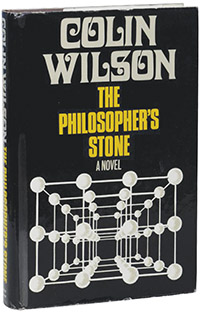
    First edition hard cover of The Philosopher’s Stone.

    In The Mind Parasites Wilson explores the possibilities inherent in Husserl’s intentionality. In The Philosopher’s Stone it is another power of consciousness, relationality, Wilson’s own coinage, that takes centre stage. Readers of Wilson’s little book Poetry and Mysticism (1968), written at the behest of the poet Lawrence Ferlinghetti for his City Lights imprint, will recall that in it Wilson’s speaks of “duo-consciousness” and of what he calls the “web-like” character of consciousness, when thoughts and recollections spread out and link together, forming a kind of “net” of awareness. In The Philosopher’s Stone the relationality of consciousness leads to what Wilson calls “time-vision,” the ability to look into the past as if through a telescope. If in The Mind Parasites the heroes discover their psychokinetic powers, in The Philosopher’s Stone it is psychometry, the ability to know the past of an object simply through touch, that Wilson’s heroes discover they possess. It is through this that the protagonists become aware of the Great Old Ones, brooding in some dimension outside our own, waiting for their chance to return

    First edition paperback of The Philosopher’s Stone.

    But again, they are a red herring. The real subject of the novel is once again consciousness; this time, its potential to slow down and even to stop the aging process. In Back to Methuselah, Bernard Shaw argued that human life is too short to make any good use of it; humans needed to live to at least three hundred in order to mature. Wilson took up Shaw’s challenge as to how this could be done. His answer: the fountain of youth – or at least of immortality – lay in the prefrontal lobes of the brain.9

    In search of a phenomenological elixir vitae, Wilson’s hero, Howard Lester, discovers that the “value experiences” of the psychologist Aaron Marks (Maslow’s “peak experiences”) seem able to slow down our biological clocks. He arrives at this insight after his research leads him to conclude that, statistically, philosophers, composers, scientists, mathematicians – anyone who makes a practice of trying to view life objectively, and not through the gauze of their emotions – live longer than other people. He discovers that the source of the “VE” are the brain’s prefrontal lobes, its most evolutionarily advanced part. Through a series of experiments introducing a minute quantity of “Neumann alloy” into their own prefrontal lobes, Lester and his colleague, like Gilbert Austin and his team, discover unknown powers of consciousness. Their “relationality,” the intuitive glue that spreads across reality like the ripples on the surface of a deep, still pond, increases enormously, until they are able to use their imagination to peer into time. 

    Wilson has a long section in which Lester, sinking into a state of “contemplative objectivity,” finds himself in sixteenth century London, rather as Charlotte Ann Moberly and Eleanor Jourdain, authors of An Adventure (1911), found themselves transported to the Versailles of Marie Antoinette. This is a time travel novel with a twist. Actual, physical time travel, the kind his hero H. G. Wells wrote about in The Time Machine, Wilson argues, is an absurdity. There is no “time” to travel through; “time” is a word we use to refer to process, and to think of “process travel” is nonsense. But the mind is not limited by the logic that constrains physical reality, as J.W. Dunne, author of An Experiment With Time (1927), discovered with his “precognitive dreams.” Just as Dunne was able to see into the future, Wilson’s phenomenological alchemists, in search of their own philosopher’s stone, can turn their vision to the past. The imagination, Wilson said, is “the ability to grasp realities not immediately present.” The past isn’t present, but it is a reality, and through their increased powers of relationality – awareness of the connectedness of everything – Wilson’s heroes can imaginatively grasp it.

    One result of this new faculty is proof that Francis Bacon was really the author of Shakespeare’s plays. Another is that K’ tholo – Lovecraft’s Cthulhu – was one of the founders of human civilisation. Another is that the Great Old Ones are not dead, only sleeping, but their influence can be felt. They have erected barriers to the heroes’ time-vision which prevents them from reaching far enough back into the past to solve the mystery of… but that would be telling. En route the reader learns the truth about Stonehenge, the Maya, the Voynich Manuscript – a Wilsonian standby, that surfaces in more than a few places – poltergeists and much more. 

    Wilson said that the aim of his writing was to get people to think. His novels are more fables or parables, than the kind of character analysis we associate with most modern fiction, which sticks obsessively to “everyday” consciousness and its trivial concerns. They share this character with the late novels of Wells, which use the barest structure of a novel for didactic purposes. Readers who find ideas exciting will find Wilson’s – and Wells’ – didactic fictions breath-taking. (“I apologise for sounding didactic,” Wilson’s hero says at one point. “It is impossible to say anything that is not commonplace without sounding didactic.”) I have read them a number of times yet each time I discover new things and come away exhilarated. If, as Wilson says, “close-upness deprives us of meaning,” his phenomenological fictions are cable cars to the heights, to the “bird’s eye view,” that enables us to enter that inner universe from which we can view the outer one with “contemplative objectivity.” “The will feeds on enormous vistas,” Wilson tells us. “Deprived of them, it collapses.” In The Mind Parasites and The Philosopher’s Stone the reader will find vistas enormous enough to feed his will no end.

    Footnotes

    1. The Outsider (1956), Religion and the Rebel (1957), The Age of Defeat (The Stature of Man in the US) (1959), The Strength to Dream (1962), Origins of the Sexual Impulse (1963), Beyond the Outsider (1965), and Introduction to the New Existentialism (1966).
    2. Colin Wilson, The Strength To Dream (London: Abacus, 1979) p. 1.
    3. Colin Wilson and Pat Pitman, Encyclopedia of Murder (London: Arthur Baker, 1961) pp. 326-335.
    4. Colin Wilson, The Mind Parasites (Rhinebeck, NY: Monkfish Press, 2005) p. xvii.
    5. Wilson admits to being inspired by the science fiction film Forbidden Planet (1956), in which Walter Pidgeon portrays Morbius, a scientist who has increased his mental powers through contact with the technology of an ancient, more highly evolved race. He was unaware that he was at the same time increasing the power of his unconscious mind. Because of this he releases “monsters from the Id.”
    6. Recently the book has been the object of some renewed interest, seeing Wilson’s allegorical creatures as the possible agents of our contemporary malaise. See www.awakeninthedream.com/articles/mind-parasites-of-colin-wilson 
    7. Wilson also contributed two shorter works, “The Return of the Lloigor,” in Tales of the Cthulhu Mythos, ed August Derleth (Sauk City, WI: Arkham House, 1969) and “The Tomb of the Old Ones” in The Antarktos Cycle, ed Robert M. Price (Oakland, CA: Chaosium Publications, 1999).
    8. I can only mention here that in another novel, The Black Room (1971), an espionage tale set around the effort to defeat a sensory deprivation chamber, Wilson works out the same ideas.
    9. This was before Wilson became aware of the significance of “split brain” psychology surrounding the left and right cerebral hemispheres, which he will write about in Frankenstein’s Castle (1981) and Access to Inner Worlds (1983).

    © New Dawn Magazine and the respective author.
    For our reproduction notice, click here.
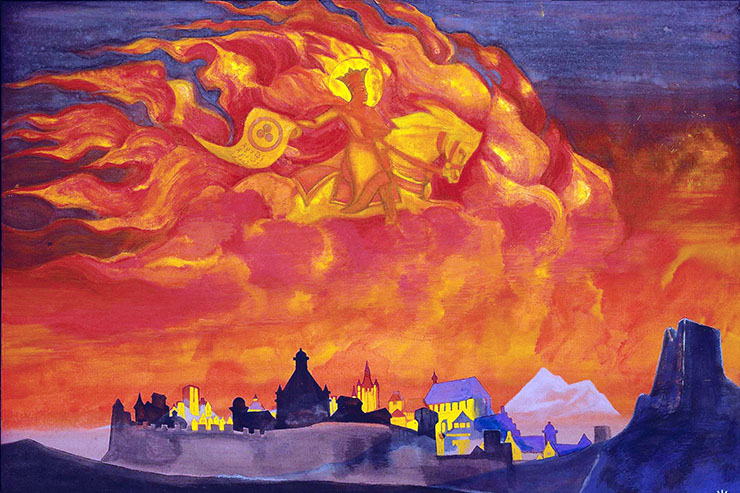
  • The Eurasian Vision in the Great South Land

    The Eurasian Vision in the Great South Land

    From New Dawn Special Issue Vol 15 No 3 (July 2021)

    ‘Eurasia’ was not a name you heard in Australia thirty years ago. Apart from an obscure reference in academic publications focused on the Soviet Union, ‘Eurasia’ (Ezrasia) would occasionally be mentioned by emigres from the former Russian Empire who had made their way to Australia in the post-war period. Many of these Russians had lived for years in Harbin, Manchuria after fleeing the 1917 Bolshevik Revolution and resulting Russian Civil War.

    My earliest recollection of ‘Eurasia’ was in a talk on the Russian artist Nicholas Roerich’s 1924-28 Central Asian expedition given to a meeting of the Melbourne-based Gnostic group the Order of the Pleroma. The speaker, an elderly gentleman who had corresponded with Professor Roerich in the 1940s, captivated his listeners with a vivid account of the Russian explorer’s extraordinary journey through Siberia, Mongolia, across the Gobi desert to Tibet and the scarcely known Trans-Himalayas. Covering vast unexplored regions of Eurasia, Roerich visited ancient monasteries, holding discussions with lamas, hermits and sages. He heard of ancient legends about the holy mountain, the planetary axis, and of the mysterious sacred land of Shambhala. Roerich immediately recognised how the vivid stories of Shambhala matched the Siberian myth of ‘Belovodye’ – the mystical ‘Golden Land’ also known as the ‘White Waters’.

    While in Kashmir, Roerich’s encounter with long-forgotten wisdom inspired him to undertake a series of paintings dedicated to the Great Teachers of humanity – The Banners of the East. Roerich’s experiences led him to conclude that all cultures stem from a single source disseminated during the great migrations of people in distant historical times. This common source, he believed, should be searched for in Eurasia.

    The Russian writer Maxim Gorky called Nicholas Roerich “the greatest intuitivist of modern life.” However, Roerich and his wife Elena always maintained they were directed in their undertakings by ‘Messengers of Wisdom’, the same mysterious personages who guided another Russian mystic, Madame H.P. Blavatsky, in the nineteenth century.

    Prior to setting out in 1924 on their grand Central Asian expedition, the Roerich’s were instructed by their spiritual guide to launch the ‘Great Plan’, a Sacred Union of the East. A truly visionary geopolitical program, the Great Plan called for the union of Mongolia, Tibet, parts of India and China, with Siberia. This vast Eurasian Sacred Union was to have as its capital the equally visionary city of Zvenigorod that Roerich believed would appear in the Altai Mountains. While Roerich’s mystical Eurasian Sacred Union never materialised, his adventures in the service of this ‘utopian’ dream did capture the imagination of the world, drawing attention eastward to the great wonders of Central Asia.

    According to historian John McCannon, “Aside from its breathtaking scope and fantastic nature, the most striking thing about the Great Plan is the way in which it wed political aspiration with esoteric belief… any attempt to understand Roerich’s political actions without taking into account his occult convictions…. is fruitless or inadequate.”

    Nicholas Roerich was held in high regard by Russian emigres in Australia who were devoted to esoteric teachings. The writer Andrew Tomas, who was born in the Russian imperial city of St. Petersburg in 1906, considered Nicholas Roerich to be his Master. Tomas, who lived in China before settling in Australia in 1948 and becoming an Australian citizen, wrote of first meeting Roerich in Shanghai in 1935. The profound impact that Roerich had on Tomas is evident in two of his books published in the 1970s, Shambhala: Oasis of Light and Beyond the Time Barrier. Today, Tomas is remembered as a pioneering Australian UFO researcher, the author of popular paperbacks like We Are Not the First: Riddles of Ancient Science and On the Shores of Endless Worlds.

    Fascinated by Nicholas Roerich’s journeys, I asked a Russian-Australian ‘old time’ esotericist for more information on Eurasia. He kindly gave me a book, A New Party in Russia by P. Malevsky-Malevitch, one of the first books about Eurasianism written in English way back in 1928. Nicholas Roerich was indeed inspired by a thoroughly Eurasian vision. One centred on the reconciliation of apparent opposites, the transcending of ideological differences, from which a new grand synthesis can emerge and a new day dawn for the peoples of earth, neither exclusively Western nor wholly Eastern, but truly Eurasian. 

    When in 1991 it was decided to publish a magazine that explored conspiracies, cover-ups and metaphysics, with a positive eye on the future, the title ‘New Dawn’ was suggested. Then those involved remembered Nicholas Roerich’s enigmatic statement, “The East has said that when the Banner of Shambhala encircles the world, verily the New Dawn will follow.” So, on the 1st May 1991, the first issue of New Dawn magazine appeared.

    [alert type=”general” dismiss=”no”]This article was published in New Dawn Special Issue Vol 15 No 3.[/alert]

    [alert type=”success” dismiss=”no”]If you appreciate this article, please consider subscribing to help maintain this website.[/alert]

    © New Dawn Magazine and the respective author.
    For our reproduction notice, click here.

  • Manifesto of the New Magi

    Manifesto of the New Magi

    From New Dawn Special Issue Vol 15 No 3 (July 2021)

    “The new magi [wizards] establish their art and realise social upheavals. They specialise in geopolitics, mass science, and they subjugate the elements; they tame the Atlanticist Leviathan, and they fatten up the continental Behemoth.”
    – A. Dugin & S. Kuryokhin

    In their 1995 ‘Manifesto of the New Magi’, Aleksandr Dugin and Sergey Kuryokhin set forth provocative statements calculated to realise a complete mystical transformation of society.  

    Reflecting on the influence of the ‘Manifesto of the New Magi’ in his interview with Charlie Nash for New Dawn magazine, Aleksandr Dugin explained that in the mid-1990s “the people around Kuryokhin and myself were artists, painters, musicians and filmmakers. They were a minority… totally countercurrent [to] the mainstream liberal tendency that surrounded us.” Adding “the influence of [the] New Magus was on one hand, very limited. Very small. But on the other hand, it was read by the [social] elite, the leading people. Many of them were perplexed.”

    The idea for such a Manifesto can be found in the Russian avant-garde of the 1920s, among artists and writers like Kandinsky, Malevich, Mayakovsky, Bely and Yesenin. 

    Sergey Kuryokhin, noted Dugin, was always up to date and “didn’t accept the main moral line, didn’t accept post-modernity as the answer. For him, it was a question. And those who still, in Russia or outside, have the same position, for them the ‘Manifesto of the New Magi’ is still a source of inspiration.” 

    “Because new magic, the new magi,” the Russian professor emphasised, “is not only about some group existing in Russia,” but remains attractive “to all those who share the main principles.”

    Manifesto of the New Magi
    By Aleksandr Dugin & Sergey Kuryokhin —

    1. We are facing a crisis of art, a lack of vitality, and the domination of pure mechanicalism. Post-Modernism – the very syndrome of degeneration – is itself deformed. Interest in art today is either tackiness (theatre, cinemas, and rock concerts), or das provozierte Leben (“the provoked life” in Gottfried Benn’s words), that is the occupation of a narrow and closed circle of “vampiric intellectuals” who have completely lost all orientation, but have not lost the need for food, social status, and vanity.

    2. We are facing a crisis of politics, a lack of thought and fresh ideology, and the degeneration of politics since the splash of Perestroika. Politics has totally lost all logic and life. Politics today is either a pathological conjunction (in the centre) or a pathological caricature (in the periphery). Politics is always and everywhere equally uninteresting.

    3. The critical low points in the degeneration of art and politics have now been reached simultaneously, all at once. This is not always how things go, but it is the case now. The lowest points of the two sinusoids have coincided.

    4. In such moments in the cycle of decline, a new impulse must be acquired for development, one which lies generally outside the sphere of the process itself. Sometimes politics spurs art, and vice versa. But now both spheres are in decline. Impulse must be sought elsewhere.

    5. This new realm is MAGIC. Magic is not events, things and objects but causes; magic does not simply describe but actively operates. Magic precedes art and politics. Art and politics became autonomous only upon being detached from their magical source. This source has not disappeared but merely slipped away to the periphery from where it exerts indirect influence. Secret societies, lodges and orders have governed history and inspired artists.

    6. Indirect influence has not been sufficient as politics and art forgot the necessity of constantly appealing to magic. Only the direct, total replacement of art and politics with MAGIC can save the situation.

    7. Today’s politicians and artists have outlived themselves. Nothing can save them. They are incapable of nourishing themselves with magic and liveliness. They ought to be written off and discarded. They are totally uninteresting. A new type should replace them.

    8. This new type is not a politician or artist dealing with magic, but the NEW MAGUS engaged in politics and art.

    9. All forms of art and all political ideologies have their occult parallels in operative magic. Paintings emerged as worldly depictions of the gods and symbolic signs. Political ideologies are secular expressions of metaphysical and religious doctrines, e.g. capitalism is, according to Max Weber, secularised Protestantism, while socialism and fascism are variations of Indo-European, Aryan traditions in which, according to Georges Dumézil, there is no caste of merchants. The source has gradually been lost sight of. With modern politicians and artists, we are dealing with incurable, inveterate idiots. The degree of talent and ideological success now directly depends on degree of acquaintance with occult doctrines.

    10. This fact must be recognised and accepted as an inevitability.

    11. Instead of a separate art, separate politics, and separate magic, a new synthetic discipline should be introduced, that of MAGIC, which directly establishes its own politics and its own art. The new hermeneutics is that historical context and aesthetic peculiarity should be discarded: it all comes down to occult paradigms. Goethe and Breton, Lenin and Churchill, can all be boiled down to magical paradigms (of the Masonic-Occultist and Hermetic-Rosicrucian bent) which they represented. All the rest can be discarded. Along with the new art and new politics will come a new approach to the study of art and a new political science.

    12. The new scholars of art and the new political scientists will not be separate people from the new artists and new politicians. They will be one and the same figures. And these figures will be none other than the NEW MAGI.

    13. Art thus becomes not the imitation of ritual or the imitation of the manufacture of fetishes, amulets, and idols, but the ritual itself, the manufacturing of amulets, fetishes, and idols.

    14. Politics thus becomes not the captured “remake” of collective orgies or the realisation of vague indirectly perceived metaphysical projects, but the direct myth-making and occult architecture of the masses.

    15. All of this is carried out and conceptualised by the NEW MAGI.

    16. Magic is an operative science. It demands real results, real metamorphoses – of objects, phenomena, and the operator. MAGIC is an experimental science that does not allow “obscurantism” and demagogy. The result, not the project, is the aim. Without concrete “eidetic realisation,” there is no magical act. If everything remains essentially as it was before the magical act, then we are dealing with either failure or charlatanism. Idiots and intellectuals shall not pass.

    17. The NEW MAGI affirm their art and carry out social coups. They specialise in geopolitics, large-scale science, and subjugate the elements; they tame the Atlantic Leviathan and feed the continental Behemoth. The minimum social scale of the NEW MAGIC is a country, people, state, or legions of human masses. Ascetics and marching bands of degenerate sects are of no interest to anyone. The NEW MAGIC deals with the phenomenon of the GIGANTIC, the GIGANTIC-NEW (a la Martin Heidegger).

    18. Our aims will become clear only when people begin to participate in our practice, actively or passively, as subjects or objects. Magic solves all gnoseological problems through Praxis (like Marxism).  

    19. From the outside, the crisis of art and politics may seem to be something objective. But do not build illusions, for it was organised by US in order to clear the path for the NEW RACE, the race of magic kings.

    20. We operate with abysses. For us, the invisible has its own geography. Black is not simply the absence of light, but a huge gamut of shades which earthly optometry has not even dreamed of.

    21. Abyssus abyssum invocate.

    22. In voce cataractarum.

    [alert type=”general” dismiss=”no”]This article was published in New Dawn Special Issue Vol 15 No 3.[/alert]

    [alert type=”success” dismiss=”no”]If you appreciate this article, please consider subscribing to help maintain this website.[/alert]

    © New Dawn Magazine and the respective author.
    For our reproduction notice, click here.
  • ‘All I Know is What is on the Internet’: The Emergence of the Post-Truth Age

    ‘All I Know is What is on the Internet’: The Emergence of the Post-Truth Age

    From New Dawn 199 (Jul-Aug 2023)

    It must be said that postmodern philosophy has not received the best PR. As soon as people hear the names Foucault, Deleuze, Derrida and Debord, they predictably roll their eyes, expecting some pretentious spiel about the relative nature of truth, knowledge and morality. 

    However, post-modern discourse provides valuable insight into the ‘high weirdness’ of contemporary culture, where nothing truly seems real and traditional systems of social order have begun to crumble away. 

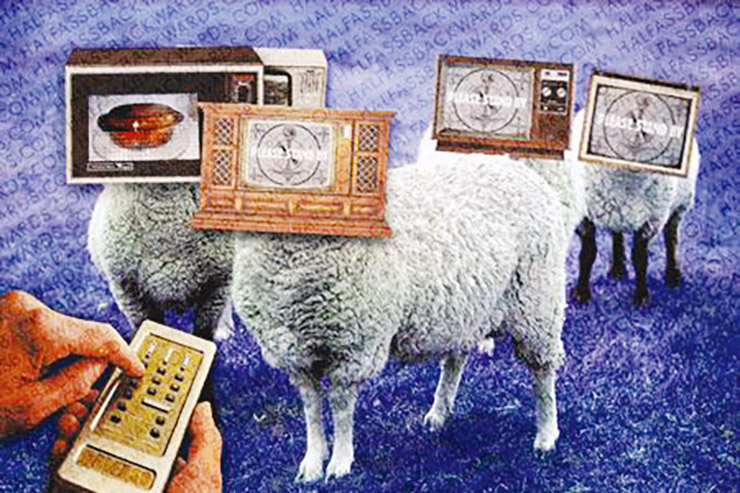
    As the mainstream media ideologically distorts and occludes reality, and big-tech companies rigorously censor alternative information (while ‘hilarious’ videos of cats falling over accumulate millions of views), it appears that there is no reality beyond that which we see through our television screens, mobiles and tablets – a world of artificial simulation and dissimulation. 

    Even the politicians, in whom we blindly place our faith and trust, have no regard for the truth since the very concept of ‘truth’ has become redundant in an age of fake news, viral marketing and social algorithms. In a telling interview, when US presidential candidate Donald Trump was confronted about an error in the statistics he presented about race-based violent crimes, he merely replied, “all I know is what is on the internet.”1

    As Dr Kane X. Faucher observes, “This kind of chamber or echo-effect of selective exposure is highly problematic for a variety of reasons, not least of which being that confirmation bias has an impact on decision-making and the possibly narrow or distorted worldview one may embrace. When it comes to what people choose to believe, this may also be on account of the narrow selective process of hidden algorithms. The tautological nature of the spectacle’s ‘truth’ forecloses the possibility of seeking beyond it to mount a significant or resonant challenge.”2 

    As social media sites subtly manipulate our political opinions, biases and assumptions, recommending certain content based on algorithmic prediction and selection, it becomes increasingly difficult to distinguish fact from fiction, truth from illusion, particularly when information has become the most priceless commodity – a substitution for the real itself. 

    How did we find ourselves in this hallucinatory, post-truth world where representation has replaced reality? Can the very notion of truth ever be resuscitated in a technocratic society where the boundary between the real and the imaginary has dissolved into thin air? 

    By turning to the postmodern thinkers of the 21st century, we can better understand why we now find ourselves in an uncanny world of simulation and simulacra – a world where the map precedes the territory.3 

    Baudrillard, Debord & the Society of the Spectacle

    Since the late nineteenth century, with the rise of mass production and industrialism, the symbolic value of commodities has superseded their functionality as consumers invest in a particular identity or lifestyle. For example, when I purchase a Mercedes car, I am not only investing in a functional object which will transport me from one place to another but a status symbol associated with ideas of luxury, comfort and innovation. 

    As the French sociologist, philosopher and poet Jean Baudrillard observed, modern society is characterised by the emergence of a sign economy, in which commodities become increasingly disconnected from the physical world: 

    …use value is itself produced as a sign (and is not a fundamental truth) to help keep consumption going and the consumer society in business. In the fetishised realm of consumption, objects are misrecognised everywhere as being endowed with forces like “happiness, health, security, etc.” We see this so much that we forget that “what we are dealing with first is signs: a generalised codes of signs, a totally arbitrary code of differences, and it is on this basis, and not on account of their use values or their innate ‘virtues’, that objects exercise their fascination.”4

    In other words, a commodity only acquires value through its differential relation to other signs rather than its intrinsic usefulness. The Mercedes car is no more luxurious than other vehicles on the market, but the company has distinguished itself by creating a brand image of luxury, comfort and innovation – social concepts which have no existence beyond their symbolic differentiation. In this sense, the sign economy functions as an entirely self-referential (or tautological) system (similar to the structure of language, where words are defined by other words, in a prison of the referential) in which consumers exchange capital (which in itself has no intrinsic value) for a particular sign or symbol, which has no instrumental function beyond the symbolic system which produces it. 

    As Baudrillard explained in Simulation and Simulacrum (1981), ever since the emergence of photography, radio, cinema, television and other replicative technologies, reality has been incrementally replaced by the representational to the point that we can no longer distinguish between original and copy

    As modern consumers are force-fed images of violence, sex and celebrity, they become so divorced from the physical world that they enter a virtual reality – that which Baudrillard terms the hyperreal

    Today, the history that is “given back” to us (precisely because it was taken from us) has no more of a relation to a “historical real” than neofiguration in painting does to the classical figuration of the real. Neofiguration is an invocation of resemblance, but at the same time the flagrant proof of the disappearance of objects in their very representation: hyperreal.5 

    The German philosopher Walter Benjamin, in The Work of Art in the Age of Mechanical Reproduction, similarly suggests that mass production not only replicates the physical but replaces it, transforming reality into hyper-mimetic simulacra: 

    What shrinks in an age where the work of art can be reproduced by technological means is its aura. The process is symptomatic; its significance points beyond the realm of art. Reproductive technology… removes the thing reproduced from the realm of tradition. In making many copies of the reproduction, it substitutes for its unique incidence a multiplicity of incidences.6 

    The copy is duplicated so many times that we cannot even speak of an original since reality itself has become the reconstruction of a reconstruction, without beginning or end, existing in a timeless present. 

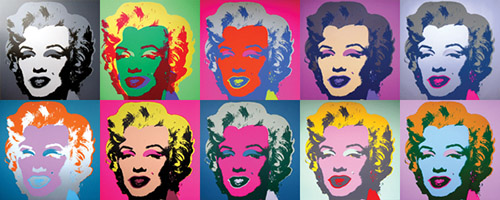
    Take Andy Warhol’s infamous Marilyn Monroe print. The public has a certain perception of the actress based on the iconography of cinema and television, and she was photographed in such a manner as to maintain this two-dimensional stereotype. This photograph is then transformed into an artistic (or aesthetic) image and sold for millions of dollars, never once leaving the realm of symbolic representation. In a sense, there is no Marilyn Monroe, only the replicated images we see of her plastered across posters, keyrings, coffee cups and other fetishistic memorabilia, where she becomes the copy of a copy, the replica of a replica, entirely disembodied from the real. 

    Andy Warhol, Marilyn Monroe (Marilyn) 1967 FS II.22-31

    However, in the age of post-modernity, where information is the most priceless commodity, the sign economy becomes uncannily spectral (and even phantasmagoric) in its non-being – an empty vacuum in which texts, images and videos endlessly circulate as if they were physical objects, even when they have no external phenomenality or dasein

    As the social media machine steadily encroaches upon our daily lives and so-called ‘influencers’ dominate the cultural zeitgeist, we become passive spectators, gawping over the latest Instagram image with 100,000 likes. While technology provides the illusion of active participation and social collaboration, in actuality, it turns us into informational consumers, entirely disconnected from the physical world. 

    As Faucher notes, “Digital representation becomes the active process and product of this milieu, a hyperreal environment that subordinates the now impoverished value of the non-digital to the production of images that are destined for digital re-production of images that are destined for digital re-production. The network spectacle is presented as unassailably good, perfect, and the primary source of the positively represented values decanted from neoliberalism such as efficiency, speed and connectivity. However, it is those very values that not only speak directly to issues of exchange value and commodity fetishism, but also physically impoverishes those who labour to support the spectacle.”7 

    As we docilely gaze at Instagram images of photoshopped models standing next to lavish sports cars with pseudo-philosophical quotes about ‘living your dreams’, we forget that a multinational infrastructure based on the exploitation of the poorest countries has been set up in order to feed our insatiable technological addiction. When we stare into the black mirror of our iPhones, we rarely think about the raw materials, sweatshop manufacture and precarious work required to keep this system in motion. The exploitation remains firmly hidden from view, keeping us ignorant as to its true economic and environmental effects. The Spectacle becomes the only knowable ‘reality’. 

    The French philosopher, film-maker and Situationist, Guy Debord, foresaw the emergence of spectacular society in which the general public passively consumes texts and images with detached fascination rather than actively participating in a vibrant culture. As he observes, in Society of the Spectacle (1967), everything “that was directly lived has moved away into representation.”8 

    Guy Debord: “When Poetry Ruled the Streets”

    In regard to political history, we remain barred from the past since time itself has entered the realm of the representational, and these representations are manufactured, designed and assembled by the Spectacle itself. The mainstream media functions as nothing more than a tautological system of informational input and output, continually referencing its own self-fabricated mythologies, narratives and constructions. 

    Debord stated: “The Spectacle proves its arguments simply by going round in circles: by coming back to the start, by repetition, by constant reaffirmation in the only space left where anything can be publicly affirmed, and believed, precisely because that is the only thing to which everyone is a witness.”9 

    Our understanding of the past has no existence outside the lens of the media, distorting, fabricating and occluding reality as we know it. Take a film like Apocalypse Now. Here, we see the cinematic representation (not to be mistaken for mere replication) of a historical event, manufactured for mass consumption, which in itself is the reconstruction of a reconstruction – a war that was televised, cinematised and narrativized to present a certain version (or model) of history. This is not to suggest that the Vietnam War never happened. On the contrary, it was a bloody and detestable conflict in which thousands upon thousands of innocent people were killed in the name of capitalist economics. But since the public’s perception of the war was always interfaced through the eye of the camera, it had no meaning beyond the screen and therefore could be replicated as replica without the real ever rearing its ugly head. 

    Online Petitions, Virtue Signalling & the Politics of the Spectacle

    In our societies of the Spectacle, political engagement becomes increasingly tokenistic, a way of providing the public with a false sense of autonomy, even as the techno-industrial machine subtly silences voices of dissidence, subversion and resistance. 

    Politics is nothing more than a theatrical drama in which public and private actors take to the stage, ‘looking good’ for the cameras, making reference to abstract ideals such as the ‘national interest,’ ‘international cooperation’ and ‘economic growth’ in order to win the hearts and minds of voters. 

    It is no coincidence that many politicians – including most famously the 40th president of the US, Ronald Reagan – have close ties to Hollywood. As Paul Virilio observes in War and Cinema, politics is now a form of entertainment and vice versa – a circus act designed to keep the masses in a state of docile complacency, with no real way of changing the system.10 

    Social media has ‘spectacularised’ political engagement in new and even more dangerous ways since it digitally empowers online users yet alienates them from the physical world, becoming nothing more than the simulation of a simulation. 

    Anyone can go on Twitter and post a 140-character tweet about Jeffrey Epstein’s ‘suicide’ or the Prince Andrew scandal, but what is the result of such anger and frustration? It merely exists inside an empty vacuum – an artificial reality – where information endlessly circulates, generating more and more content, while the dominant cultural paradigm remains untouched, unharmed and unscarred. 

    Thus, we now see the rise of the ‘virtue-signalling’ culture in which individuals openly criticise corporate exploitation, media misrepresentation and governmental corruption, even as they support the very institutional systems they verbally disparage. The proliferation of virtue signalling – in which people attempt to win praise for showing support for a social cause without actually doing anything meaningful to advance it – is a predictable outcome of the Spectacle.

    Of course, it would be inaccurate to suggest that online discourse has no impact on the real world. When the Black Lives Matter Movement urged disenfranchised minorities to take to the streets and protest against police brutality, the internet was key in organising local demonstrations, rallies and marches. Yet, even then, the movement became a mere spectacle – a televised form of entertainment – reappropriated by the mainstream media in order to maximise its informational output. 

    As Baudrillard astutely observed, that which begins in the world of simulacra inevitably ends in the world of simulacra since there is no external reality to even reference.

    This is why today we see the emergence of a ‘petition culture’ in which a disillusioned public tries to bring about meaningful change by signing online petitions, many of which never even reach the ears of the political establishment. 

    In the United Kingdom, Parliament is obliged to discuss a petition if it receives enough signatures, however these political processes are entirely theatrical – a psychodrama ritual – designed to give the illusion of democratic engagement (while the puppet masters pulling the strings remain occluded in the shadows). Thousands of people could sign a petition requesting a public inquiry into the many documents which have gone missing that implicate prominent British politicians in cases of child abuse and sex trafficking, but it would not make any difference – the game has ended before it even began. 

    Furthermore, many of the political issues which are brought before Parliament, such as the ‘energy crisis’ and the ‘cost of living’, are carefully engineered by the mainstream media in order to create problems to which the state has a solution, establishing a pretext for further governmental intervention and control. 

    Get the issue this article appears in

    Take the ‘living crisis’. Many people are urging national governments to take immediate action and implement a universal basic income, which supports the poorest in our society. However, while there is no denying that the global economy is in big trouble, the economy itself (which never leaves the hermetic realm of sign, symbol and simulation) is never brought under scrutiny – it remains a constant a priori. Moreover, there is no discussion on how a universal income would be implemented, who would control it, or whether it would lead to new forms of economic regulation (such as a social credit scoring system). 

    This is exactly how the simulacra functions – it provides ‘false’ solutions to ‘false’ problems within a ‘false’ system based on a ‘false’ currency, blurring the boundary between the real and the representational to the extent that the latter replaces the former. The modern Spectacle is so overwhelming in its hyper-mimetic power that we cannot even speak of an external reality where meaningful political change can be actualised – the medium has now become the message. 

    The profound sense of alienation, disillusionment and unreality that many of us experience in today’s ‘post-truth’ culture cannot be understood as a historically isolated phenomenon but an eschatological climax – a technological singularity – where the simulation has finally replaced the real. 

    Even a film like The Matrix does not encapsulate the hallucinatory nightmare of modern civilisation, since at least there was the possibility of escaping Plato’s cave, a division between reality and illusion; in today’s digital age, we awake from the simulacra only to find ourselves in another simulation, unable to break free from the prison of the referential. 

    Our culture will only become stranger once virtual reality technologies become increasingly advanced in their power to deceive and replace a world that never existed in the first place. As everything that is solid melts into thin air, all that remains is a dream inside a dream – a holographic universe where reality itself is but a spectral ghost of the past. 

    [alert type=”general” dismiss=”no”]This article was published in New Dawn 199.[/alert]

    [alert type=”success” dismiss=”no”]If you appreciate this article, please consider subscribing to help maintain this website.[/alert]

    Footnotes

    1. K. Faucher, (2018), Social Capital Online, University of Westminster Press, 115
    2. Ibid. 
    3. J. Baudrillard, (1994), Simulacra and Simulation, Michigan University Press
    4. J. Baudrillard, (2019), For a Critique of the Political Economy of the Sign, Verso, 90 
    5. J. Baudrillard, (1994), 45 
    6. Counterfeit Castles: The Age of Mechanical Reproduction in Bram Stoker’s “Dracula” and Jules Verne’s “Le Chateau des Carpathes”, Texas Studies in Literature and Language, Winter 2014, Volume 46, Issue 4, 428-471
    7. K. Faucher, (2018), 110
    8. G. Debord, (1970), The Society of the Spectacle, Black & Red 
    9. Ibid. 
    10. P. Virilio, (1989), War and Cinema: The Logistics of Perception, Verso

    © New Dawn Magazine and the respective author.
    For our reproduction notice, click here.
  • Aleister Crowley & UFOs: Did Occultists Open an Interdimensional Portal?

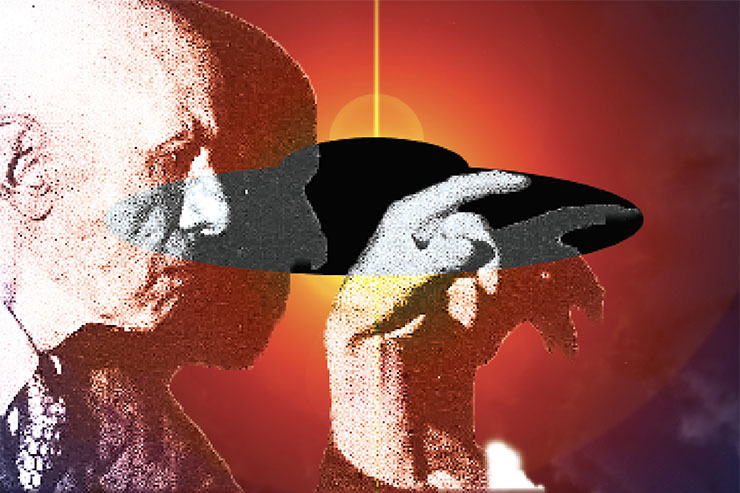
    Aleister Crowley & UFOs: Did Occultists Open an Interdimensional Portal?

    Five years ago, in 2017, the New York Times broke the story on a black-budget Pentagon program tasked with investigating UFOs. Since then, a steady stream of photos and videos have been leaked by whistleblowers and politicians interested in opening the hitherto taboo subject of UFOs to the mainstream.

    As recently as March of 2023, journalists Jeremy Corbell and George Knapp published photos showing “UFOs” over conflict zones including the “Baghdad Phantom” and the “Mosul Orb.” Though the evidence is intriguing, the search may be too linear. The assumption is that flying saucers are machines with physical properties.

    There is another school of thought which claims that UFOs and aliens are interdimensional in nature. This theory is understandably harder to fathom due to our linear mode of thinking and three-dimensional conditioning. Yet, this would help explain some of the more perplexing questions related to the phenomenon, including why they are so hard to spot with the naked eye or by radar.

    Over 100 years ago, in 1918, English writer and occultist Aleister Crowley, whilst holed up in a rented apartment on Central Park West in New York City, conducted a series of magickal experiments.

    According to occult lore, those operations opened an interdimensional portal, a gateway if you will, allowing beings commonly referred to as ‘grey aliens’ entry into our world.

    The Amalantrah Workings

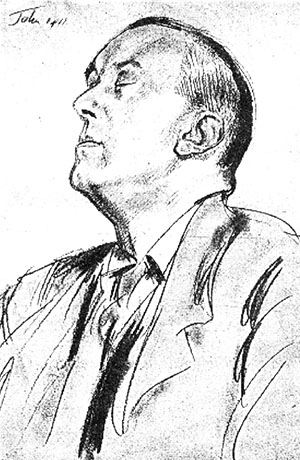
    Aleister Crowley in meditation. Sketch by Augustus John.

    Aleister Crowley arrived in America shortly after the outbreak of World War 1, fleeing England on the ill-fated British ocean liner Lusitania. After several jaunts across the States, Crowley took up residence in New York and, in September 1917, shacked up with one Roddie Minor, a married woman whom Crowley describes as “big, muscular and sensual,” and in possession of a “well-developed clairvoyant faculty.”

    Roddie would serve Crowley as his “scarlet woman,” and together the two embarked upon ceremonial sex magick rituals in an attempt to open a transdimensional doorway for the purpose of communion with discarnate intelligences.

    Conducted from January to March 1918, the Amalantrah Workings bore fruit in a number of ways.

    During the rituals, while under the heady influence of opium and hashish, Roddie would relate to Crowley a series of visions involving a king, a small boy, and a wizard who went by the name of Amalantrah. This wizard imparted to them a cryptic message: to “find the egg.”

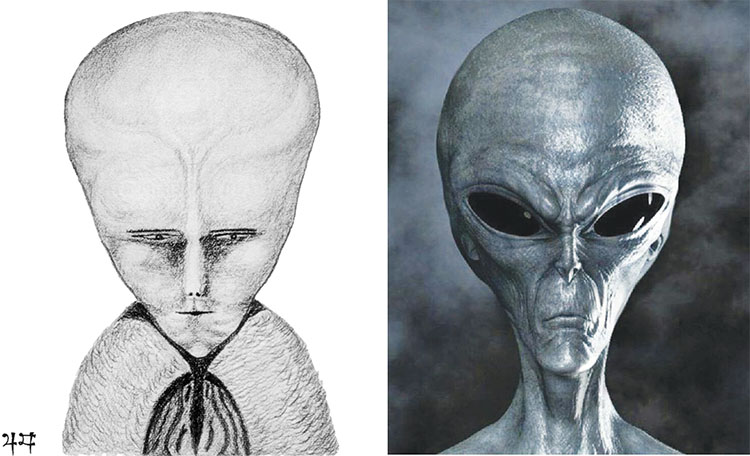
    In addition, Crowley himself claims to have made contact with an entity named Lam, from which he made a remarkable drawing. Crowley insists the artwork is a portrait drawn from real life, though a portrait of what? That is the matter in question and the subject of some dispute.

    Crowley took his invocations seriously, never dismissing them as mere hallucinations, even when derived through hallucinogenic drugs. John Symonds, in The Beast 666: The Life of Aleister Crowley, writes that Crowley, “made no attempt to interpret this material in terms of unconsciousness. To him the characters and incidents of mescal visions were more real than anything reality or the ego could provide. He would not have been surprised to meet… Amalantrah strolling down 5th Avenue. The wizard would have descended onto the plane of illusion, that is all.”

    Crowley’s portrait of Lam undoubtedly bears a striking resemblance to the ubiquitous ‘grey alien’ referenced in pop culture today and, to the best of our knowledge, represents the first depiction of such an entity in modern times.

    The portrait went on public display for the first time at Crowley’s 1919 Dead Souls exhibit, held in Greenwich Village, New York. Later that year, the drawing was published in The Equinox III, No. I, at the front of a Crowley penned commentary on H.P. Blavatsky’s The Voice of the Silence.

    Below the picture, an inscription reads: “LAM is the Tibetan word for the Way or Path, and LAMA is He who Goethe, the specific title of the Gods of Egypt, the Treader of the Path, in Buddhistic phraseology. Its numerical value is 71, the number of this book.”

    In one of those serendipitous quirks of history, Crowley ended up giving the Lam portrait, in 1945, to his heir apparent and eventual British head of O.T.O. (Thelemite religion), Kenneth Grant, who would, in turn, take the football-shaped headed ‘extraterrestrial’ and run with it.

    Aleister Crowley’s portrait of the entity he made contact with in 1918. Many suggest it bears remarkable similarity to the classic grey alien which made its appearance in the final decades of the 20th century. 

    Kenneth Grant & Typhonian O.T.O.

    It didn’t take long for Grant to make some changes to Crowley’s Ordo Templi Orientis (O.T.O.). After he founded the London-based New Isis Lodge in 1954, Grant began to tinker with Crowley’s Thelemite teachings by mixing in some H.P. Lovecraft influences and a heavy dose of extraterrestrial themes.

    Grant issued a manifesto declaring the discovery of an extraterrestrial “Sirius/Set” current emanating from Nuit, a newly discovered trans-Plutonian planet (also named by Crowley in The Book of the Law). Karl Germer, American head of the O.T.O., would have none of it and promptly expelled Grant from the O.T.O.

    Grant evened the score when, upon Germer’s death in 1969, declared himself Outer Head of the O.T.O. This claim was disputed by the then-current American head, one Grady McMurtry, resulting in a schism, with Grant’s order renamed Typhonian Ordo Templi Orientis.

    In the Typhonian O.T.O., emphasis was placed upon “construction of a magical formula” for establishing communion and contact with “the Magical Entity known as Lam.” To this end, Grant penned The Lam Statement, with Crowley’s portrait of Lam being used as a “Yantra,” or the visual focus, wherein “entry may be effected by projecting consciousness through the eyes.” The name Lam, in turn, would be used as the “Mantra.” A magical procedure was then set forth for one to invoke Lam and “enter the egg.”

    The most significant aspect of The Lam Statement, and in turn, Crowley’s Amalantrah Workings, is that contact with an extraterrestrial entity, rather than being a passive event, can be an act of will, initiated by a human. This is called, by ufologists, a Close Encounter of the 5th Kind (CE-5).

    This method shares a lot in common with the practices of CSETI (Center for the Study of Extraterrestrial Intelligence). Led by Dr Steven M. Greer, this group uses a set of protocols, one being “thought,” to make contact with aliens. Curiously, this technique, called Coherent Thought Sequencing, was discovered in 1973, approximately the same time (1972) that The Lam Statement was published. All these techniques represent alleged methods by which portals are opened onto other dimensions.

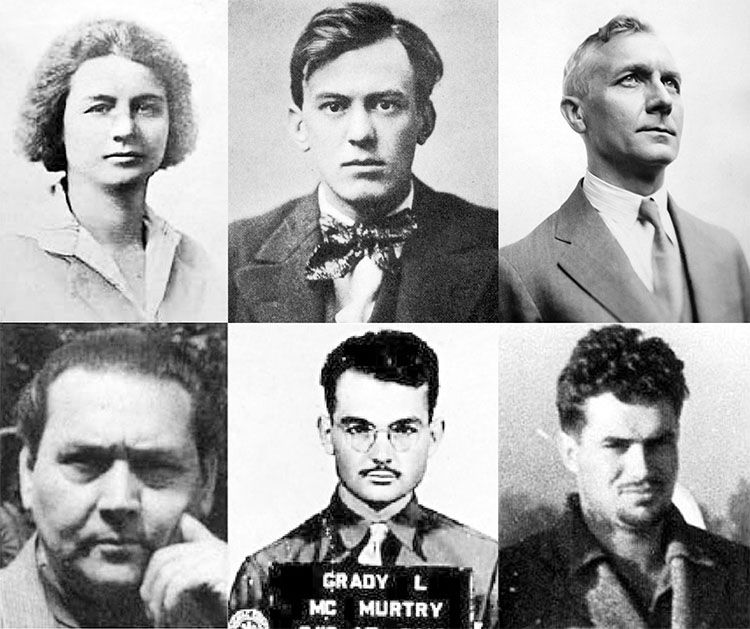
    ABOVE:   (top row) Roddie Minor, a young Aleister Crowley, Karl Germer; (bottom row) Kenneth Grant, Grady McMurtry, Jack Parsons

    Jack Parsons & the Babylon Workings

    In 1946, rocket scientist Jack Parsons performed the Babylon Workings, a continuation of the Amalantrah Workings. This resulted, according to Thelemites, in yet another interdimensional portal opening or maybe even a widening of the gateway first discovered by Crowley.

    In the Babylon Workings, Parsons wasn’t trying to contact Lam but rather the Whore of Babylon herself, which would help him summon a Moon Child. Apparently, someone forgot to close the door behind them.

    According to Kenneth Grant, “The Babylon Workings began just prior to the wave of unexplained Ariel phenomenon now recalled as the Great Flying Saucer Flap. Parsons opened a door and something flew in.”

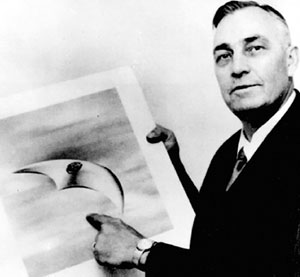
    Kenneth Arnold points out one of the disc-like objects he saw flying over Mt. Rainier, Washington on June 24, 1947. 

    Certainly, 1947 saw, in UFO terms, all hell break loose, starting with the Kenneth Arnold UFO sightings over Mt. Rainier, Washington on June 24, 1947. And then, of course, later that summer, the notorious Roswell, New Mexico, alleged UFO crash and retrieval of alien bodies. Since then, there has been a steady stream of UFO sightings worldwide with no let-up in sight.

    Is there evidence extant, prior to modern times, supporting the claim that aliens existed? There is indeed a plethora of evidence, and it turns out such documents indicate that Crowley is not the first person to open a portal by means of the occult, after all.

    Going back to the Middle Ages, we find in Britain a peculiar gentleman by the name of John Dee, who was an astronomer, mathematician and advisor to Queen Elizabeth 1. With the help of a scryer named Edward Kelley, Dee made contact, through a system of Enochian magic, with ‘Angelic’ beings whom he described as “little men” that moved about in a “fiery cloud.”

    The terms ‘UFO’ and ‘aliens’ didn’t exist back then, of course, but it sure sounds like Dee and Kelley were talking about that very thing. What is even more interesting are descriptions, made in the Apocryphal Book of Enoch, which Dee references, of alien-like beings called ‘Watchers’, and what seem to be acts of alien abduction:

    And I Enoch was blessing the Lord of majesty and the King of the ages, and lo! the Watchers called me – Enoch the scribe – and said to me: “Enoch, thou scribe of righteousness, go, declare to the Watchers of the heaven who have left the high heaven, the holy eternal place, and have defiled themselves with women, and have done as the children of earth do, and have taken unto themselves wives.” (1 Enoch 12.3–8)

    Writer and researcher Erich von Daniken believes that ancient stargates abound, scattered across the face of the earth from Egypt to Peru, serving at one time or another as portals for the ‘gods’ to enter into our world. His hypothesis, referred to as the ‘ancient astronaut theory’, asserts that extraterrestrial intelligences have visited earth through stargates since the dawn of time, even having a hand in creating the human species.

    Betty & Barney Hill And Crowley

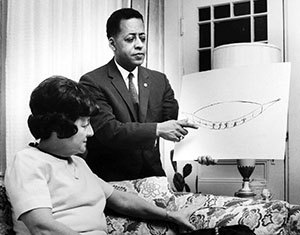
    On the evening of September 19, 1961, Betty and Barney Hill were driving south on Route 3 through the White Mountains of New Hampshire in their 1957 Chevrolet Bel Air when Betty spotted a bright object in the sky, which she initially took to be a falling star, though it was falling upward. Noticing that the object was moving erratically, Betty and Barney pulled the car over to take a closer look, as well as to walk their dog Delsey.

    The Hills continued to drive and at about one mile south of Indian Head, the flying object descended rapidly toward their vehicle, causing the Hills to stop their car in the middle of the road. The object, shaped like a flying cigar and 80–100 feet long, filled the entire field of view in their windshield. Barney jumped out of the car and, using his binoculars, claimed to have seen 8–11 humanoid figures, described as “somehow not human.”

    Betty & Barney Hill with an illustration of the flying object and the aliens that abducted them in 1961. 

    Barney returned to the vehicle and, fearing capture, quickly drove away. Betty and Barney then experienced amnesia, or memory loss, and the next thing they knew was that they were 35 miles farther along on their journey, with two hours missing and unaccounted for.

    Three years later, the Hills underwent regression hypnosis in an attempt to retrieve their lost memory. After subsequent sessions, the Hills were able to recall an experience of abduction by aliens who claimed to be from the Zeta Reticuli system. After a physical examination by the aliens, the Hills had their memories erased and were returned to their car. Thus began the era of the alien abduction scenario.

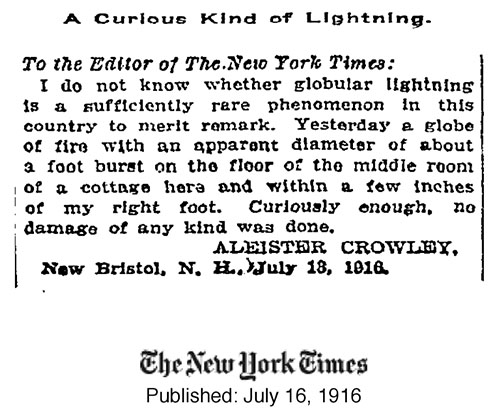
    How does Aleister Crowley fit into this? Well, as you may recall, Crowley was living in New York in 1918, but before he moved there, Crowley lived in, you guessed it – New Hampshire, near a town called New Bristol, located less than an hour away from where the Hills experienced their alien abduction. In New Hampshire, Crowley had his own paranormal visitation, with a type of glowing orb. The experience affected Crowley enough for him to write and submit a letter for publication in The New York Times. The letter reads:

    To the Editor of The New York Times:

    I do not know whether globular lightning is a sufficiently rare phenomenon in this country to merit remark. Yesterday a globe of fire with an apparent diameter of about a foot burst on the floor of the middle room of a cottage here and within a few inches of my right foot. Curiously enough, no damage of any kind was done.

    ALEISTER CROWLEY.
    New Bristol, N.H.,
    July 13, 1916

    During his stay in New Bristol, Crowley conducted some peculiar occult rituals. It was 1916 (the inverse of 1961), and according to Richard Cavendish in A History of Magic, Crowley promoted himself to the rank of Magus. This was done by way of a ceremony involving the baptism of a toad as Jesus of Nazareth, then crucifying the poor creature.

    Writer/researcher Christopher Knowles notes, on his website, that the highway which links Crowley’s home in New Hampshire to the Hill’s abduction spot is Interstate 93. Knowles points out that the number 93 is “the holiest of holies in Thelemite gematria.” The number itself is derived, numerologically, from combining two central words in the philosophy of Thelema – which are Thelema (Will) and Agape (Love), taken from the phrases “Do what thou wilt shall be the whole of the Law” and “Love is the law, love under will.”

    Furthermore, Knowles claims that the aliens which abducted the Hills deposited them in the town in which Crowley was living in 1916. Knowles writes: “35 miles down the road would have ensured that the Hills would have woken up in the very same town in which Crowley was actually living in 1916 (Hebron/Bristol)… Let me repeat that: the Hills woke up from their missing time episode in the very same town that Aleister Crowley had lived just months before his own contact experience (in the Amalantrah Working).”

    Regarding Hebron, we find a reference to it in Numbers 13:22: “And they ascended by the south, and came unto Hebron; where Ahiman, Sheshai, and Talmai, the children of Anak, were. (Now Hebron was built seven years before Zoan in Egypt.)”

    In Numbers 13:33 we learn that the “children of the Anak,” or the Anunnaki, are descended from the Nephilim, sky gods who “from Heaven to Earth came.”

    Quest for the Holy Grail

    What were Crowley’s own thoughts on the alien agenda, and do we even know if the Great Beast gave any credence to the field of ufology? This may be hard to establish for, tellingly, Crowley passed away at the very dawn of the UFO flap, in the year 1947, the same year which ushered in the modern wave of UFO sightings. Terminology like “flying saucer” and “UFO” didn’t even exist during his time. To discern his thinking, we need to look for clues, of which he left a few.

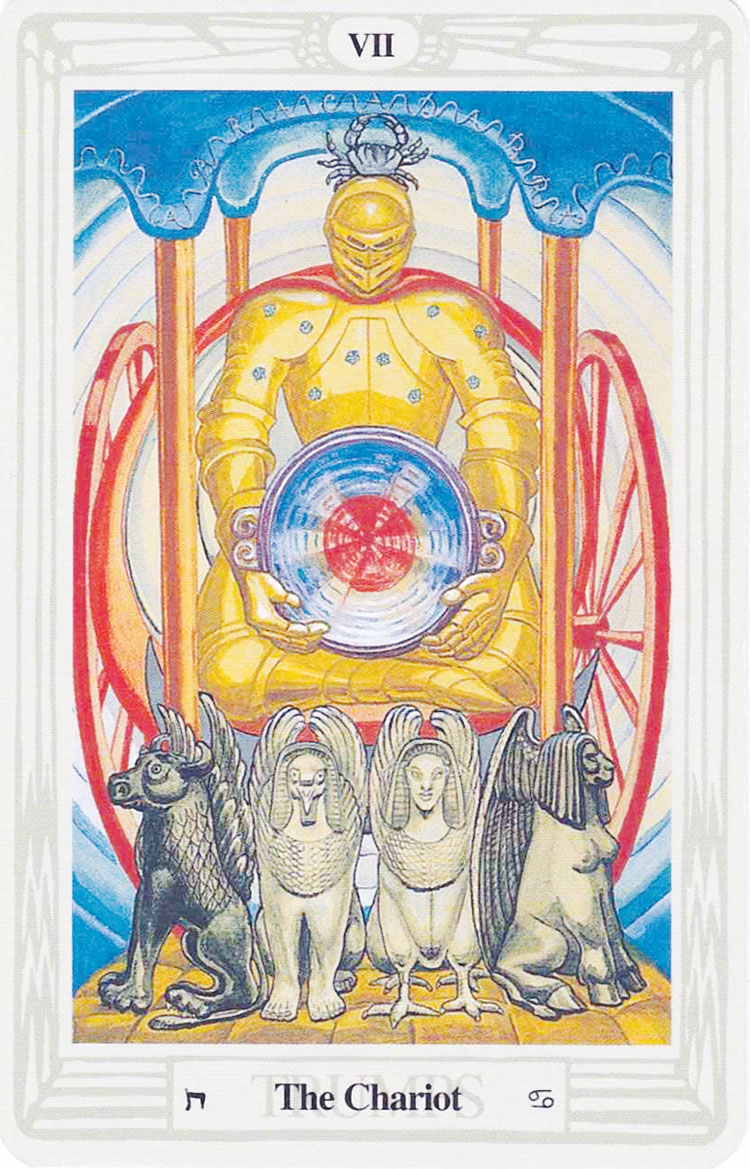
    Let us turn our attention to The Book of Thoth by Aleister Crowley, a divinatory tarot deck painted by Lady Frieda Harris according to guidelines and instructions set by Crowley himself. Take a look at the seventh Trump card – the Chariot – for there is something curious about this card.

    The seventh Trump card – the Chariot – of Aleister Crowley’s The Book of Thoth, a divinatory tarot deck. Note the spinning saucer like object held by the charioteer clothed in armour.

    The card depicts a Charioteer clothed in armour, sitting cross-legged inside a chariot drawn by four Cherubs – the Bull, Lion, Eagle and Man. There is a blue canopy on the Chariot which, according to Crowley, represents Binah, the feminine principle, and scarlet wheels, representing Geburah, the principal of energy. Everything is, in fact, quite standard to the symbolism found in a traditional version of this card, except for one anomaly – the Charioteer is holding in his hands what appears to be a rotating flying saucer.

    What can we discern about this saucer-like image? In The Book of Thoth, Crowley gives a brief interpretation of this symbol, saying:

    The central and most important feature of the card is its centre – the Holy Grail. It is of pure amethyst, of the colour of Jupiter, but its shape suggests the full moon and the Great Sea of Binah.

    In the centre is radiant blood; the spiritual life is inferred; light in the darkness. These rays, moreover, revolve, emphasising the Jupiterian element.
    (The Book of Thoth, p. 86–87)

    Crowley doesn’t speak much on the subject, and yet, what he does say is revealing. He acknowledges that this symbol is the most important feature on the card, but he refers to it as the “Holy Grail.” There is a bit of a discrepancy here, as the Holy Grail is, traditionally, a vessel that serves as a motif in the Arthurian literature and is often depicted as a cup, sometimes as a dish. It has also been (rarely) depicted as a stone, though this would be the first time it’s shown as a spinning flying saucer, if that is what we are seeing.

    Crowley says his version of the card is “much influenced by the Trump portrayed by Eliphas Levi,” and indeed many of the same motifs are present in both cards, sans the saucer. If Crowley’s “Holy Grail” is not literally a cup, then he must be using the term metaphorically, to denote a goal of great significance, as in the Arthurian “Quest,” which set the Knights of the Round Table on a mission, searching for their elusive Grail.

    Aleister Crowley (1875–1947)

    Can this “Quest” be the search for extraterrestrial life? Consider Crowley’s description again, in a different light. The wording could just as easily be used to describe a UFO, like “light in the darkness,” “rays, moreover revolve,” and “Jupiterean element.”

    If Crowley is dropping hints here that he is talking about a UFO, then the seventh Trump is the perfect place to drop it, for the term “chariot” was often used by the ancients to denote the modes of transport used by flying “gods” or aliens, as discussed in greater detail by Erich von Daniken in the book Chariots of the Gods.

    In this light, Fox Mulder of the television series The X-Files could be viewed as a modern iteration of the medieval archetype of a Knight of the Round Table, searching for truth in the holy saucer. As they say, the truth is out there.

    References

    John Symonds (1997). The Beast 666: The Life of Aleister Crowley. Pindar Press. ISBN 978-1-899828-21-0. OCLC 60232203.
    Kenneth Grant (1980). Outside the Circles of Time. Frederick Muller Ltd. ISBN-10: 0584104685
    John Carter (2004). Sex and Rockets: The Occult World of Jack Parsons (new ed.). Feral House. ISBN 978-0-922915-97-2.
    Richard Cavendish (1991). A History of Magic. Penguin Books. ISBN-13: 978-0140192797
    secretsun.blogspot.com/2012/03/wizards-workings-and-walk-ins-on-lam.html
    Aleister Crowley (1974). The Book of Thoth. Samuel Weiser, Inc.; 1st edition. ISBN-13: 978-0877282686.
    Erich von Däniken (1984). Chariot of the Gods. Berkley; Reprint edition. ISBN-13: 978-0425074817

    © New Dawn Magazine and the respective author.
    For our reproduction notice, click here.