New Dawn – World's Most Unusual Magazine

Category: Articles

  • Would They Tell You If Asteroid Apophis Was Going to Slam into Earth?

    Would They Tell You If Asteroid Apophis Was Going to Slam into Earth?

    From New Dawn Special Issue Vol 18 No 2 (April 2024)

    The odds against tomorrow for life on Earth are not good. Genocide in the guise of fake “pandemics”; the collapse of urban population centres; a Third World War… Pick your poison! Singly or a combination of mortal body blows to civilisation are progressively demolishing every aspect of modern culture before our own eyes.

    Yet, all these fatal symptoms of a self-destructive society may be thrown into a cocked hat as pathetically puny compared to what the Cosmos has in mind for us.

    Potential Collision Course with Earth

    Apophis is larger by nearly forty-seven metres than Australia’s Q1, the second tallest skyscraper in the Southern Hemisphere. 

    On 19 June 2004, three American astronomers at the Kitt Peak National Observatory in Tucson, Arizona, discovered a peanut-shaped asteroid on a potential collision course with Earth. Because Roy Tucker, David Tholen, and Fabrizio Bernardi determined that the object had a 2.7 per cent chance of hitting our planet during its next orbital pass, they christened the object Apophis, Greek for the Ancient Egyptian god of destruction, Apep. At 370 metres in length, Apophis is larger than Australia’s tallest building, Queensland Number One, by 47.5 metres, with an estimated total weight of 1.1 million tons of solid rock and nickel-iron.1

    The stony colossus will travel at speeds between 56,327 kilometres per hour and 72,420 kph after entering our atmosphere.2 Too large for burning up through its frictional descent or in an airburst, its impact will result in a four-gigaton detonation.This is the equivalent of two hundred thousand atomic bombs of the type that destroyed Hiroshima near the close of World War Two. Or eight times the explosive force of Russia’s Czar Bomba, history’s largest man-made nuclear blast, on 30 October 1961, in the Novaya Zemlya archipelago of the Arctic Ocean.3
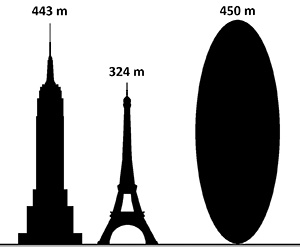
    Size comparison of Apophis (right) with the Eiffel Tower of Paris (centre) and New York City’s Empire State Building (left).

    For example, if Apophis strikes downtown Sydney, 2.4 million residents in the metro area will be instantly vaporised.4 Another million victims would suffer second and third-degree burns within a twenty-six-mile radius of the impact zone, while an additional four hundred thousand persons outside the fireball would die from a resulting 272-decibel shockwave.5 Its 1,609-kph winds would claim more than one hundred thousand more lives as they obliterate virtually every man-made structure standing inside a twenty-one-kilometre radius from the blast centre.6 Sixty-three kilometres outside the impact zone and travelling at a reduced speed of 322 kph, the winds would still be powerful enough to take the lives of an additional thirty-five thousand people.7 The only thing to mark where Sydney once stood would be a black, smouldering impact crater, 5.1-kilometres across.8

    Repercussions would not be confined to southeast New South Wales, burned by a 129-kilometre-wide firestorm. The two thousand cubic kilometres of debris and ash ejected into the atmosphere by the asteroid strike will block sunlight sufficiently long enough to halt food production on Earth for at least the following two years. Worldwide famine inevitably follows extensive damage to whole eco-systems, with the subsequent collapse of human agriculture.9
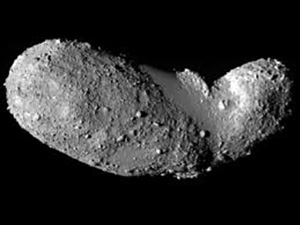
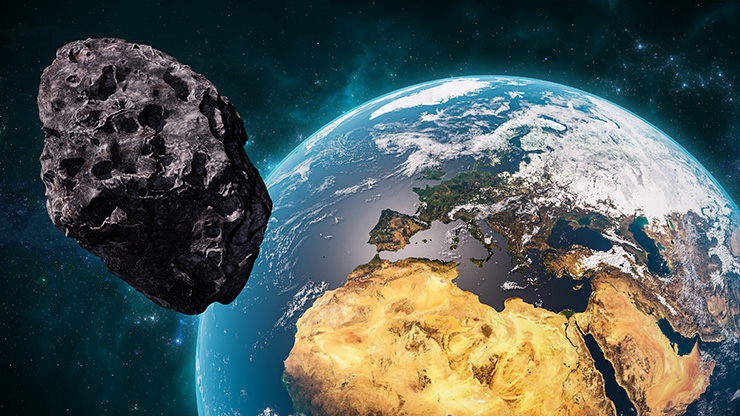
    Asteroid Apophis  

    As such, Apophis could starve our fragile civilisation to death with a global famine, especially given that mankind’s natural living spaces are already stressed by decades of unrelieved industrial abuse. But we are hardly the first species to have similarly died out, as witness Earth’s previous five mass extinction events, the best known and most comparable example being the infamous asteroid that wiped out the dinosaurs 65.5 million years ago. Accordingly, we can make no claim on uniqueness.

    Asteroid Threat is Real

    Astronomers have only recently come to realise that our world is circling through a cosmic shooting gallery thick with near misses, twenty-three hundred of which are identified and classified as “hazardous,” capable of colliding with our planet. Apophis is the most threatening of them all due to the unusually extreme nearness of its orbit. Astronomers assure us, however, that possibilities for its collision with any one of mankind’s five hundred and twelve urban population centres inhabited by one million or more residents is statistically impossible. Scholarly memory is short, however.
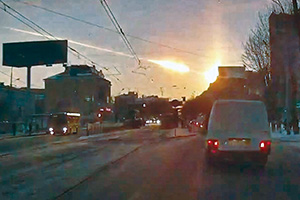
    The meteor that narrowly missed vaporising Chelyabinsk’s 1,160,000 residents eleven years ago was eighteen metres in length. Apophis is more than twenty times as long.

    Just eleven years ago, a ten-thousand-ton meteor detonated 23.3 kilometres over the Russian city of Chelyabinsk. The air-burst’s 500 kilo-tonnes of TNT generated were equivalent to America’s “Ivy King” bomb, the largest pure-fission nuclear weapon ever tested by the United States. About fifteen hundred people in and around Chelyabinsk were injured, with one hundred twelve hospitalised, mainly due to flying shards of glass from windows shattered by the exploded object’s shock wave. Three thousand buildings in six cities across the region were damaged by the detonation and impacts.10 Had the 15 February 2013 bolide – which descended at nineteen kilometres per second – blew apart three seconds later, it would have consumed Chelyabinsk’s 1,160,000 residents in a rapid series of cataclysmic events not unlike the hypothetical annihilation of Sydney by Apophis, described above.

    It would appear our cities are not immune from heaven-sent destruction. To be sure, most materials from outer space naturally fall into seas or lakes, covering as they do, seventy-one per cent of the Earth’s surface. This is little consolation, however, because the consequences of more than a million tons of solid rock falling at seventeen kilometres per second into a large body of water could be more catastrophic than the obliteration of a single metropolitan area. Some observers – the popular American astrophysicist Neil deGrasse Tyson among them – calculate Apophis may strike the Pacific Ocean, five hundred km west of Santa Monica on Friday, 13 April 2029, at 8:46 p.m., local California time, when it is nearest our planet.11
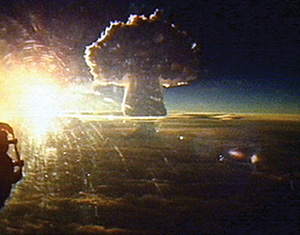
    If Apophis collides with Earth, it will generate eight times the explosive force of Russia’s Czar Bomba, the single most physically potent device ever deployed on Earth, the most powerful nuclear bomb tested, and the largest human-made detonation in history.

    Should a collision occur in that area, the asteroid will cavitate a hole in the sea several kilometres across before exploding. The Sentry Risk Table estimates that Apophis would impact Earth with kinetic energy equivalent to twelve hundred megatons of TNT.12 By way of comparison, the Japanese city of Nagasaki was destroyed in 1945 by a nuclear bomb rated at 1.2 megatons. The tsunami Apophis generates will rear up six hundred metres high to radiate outward in all directions, travelling at more than eight hundred kph. Making landfall in a succession of forty to fifty waves per minute, most forms of human habitation along a thousand kilometres up and down the west coast of the United States would be wiped from the face of the Earth.13 San Diego, Los Angeles, Sacramento and San Francisco will no longer exist. Coastal regions of Canada, Alaska and southwestern Asia, even Australia, but especially the Hawaiian Islands, would experience some serious after-effects. Terrible as the images were of the 2011 tsunami that took at least twenty thousand lives in Japan, they would pale at the prospect of thirty-nine million people killed by Apophis.

    What are the Chances?

    But is there any realistic potential for such an unprecedented occurrence? Astronomers at America’s Jet Propulsion Laboratory “announced that Apophis has no chance of impacting Earth in the next one hundred years.”14 This from the same people who were blind-sided at Chelyabinsk. They nonetheless concede that no other space rock of its size has more closely approached the Earth in recorded history. So close, in fact, Apophis will be easily visible to the naked eye by millions of observers in rural as well as darker suburban areas.

    The outer space visitor will be clearly discernible through ordinary binoculars from most locations, when its brightness peaks at magnitude 3.1, while passing over Europe, Africa and western Asia at only five times the radius of the Earth, ten times closer than the Moon. The asteroid is expected to traverse the surface of our planet at less than twenty-nine thousand kilometres – a hair’s breadth, in astronomical terms – beneath the geosynchronous positions of orbiting communication satellites. To maintain their geo-stationary belt formation, they must maintain a constant altitude of 37,015 kms, which is sufficiently high to escape Earth’s gravity. If the satellites descended eight thousand kms to the level of Apophis during its close encounter, tidal forces would drag them down to destruction, as they can the in-coming asteroid.15

    At the very least, its rotation axis will be altered, distorting the orbital path, thereby setting the scene for another scheduled engagement in 2036, when the great bolide will get another, more likely crack at hitting us. Its orbit could be additionally changed by even a partial resurfacing of the object’s surface, a subtle enough alteration causing it to crash, if not in five years, then, with increasing inevitability, sometime in a future return, perhaps no later than during another predicted return in 2068.
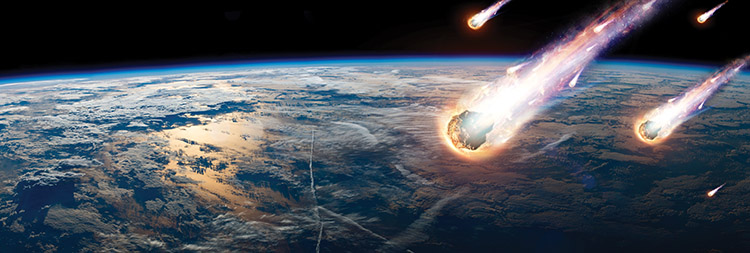
    Bombing Apophis to deflect its trajectory away from Earth, as some observers suggested, is no longer an option, because resultant debris, like that from NASA’s “Double Asteroid Redirection Test,” could re-form into dangerous meteor swarms.

    As Apophis streaks downward through the orbits of our 8,337 communications satellites, running into any one of them could engender at least an incremental deflection, nevertheless influential enough to nudge it on a direct heading toward Earth. Their numerical threat pales before the vast field of space junk encircling our planet. There may be as many as 170 million pieces of debris currently in orbit.16 While the vast majority are too small to track due to the limits of current technology, these fragments are no less dangerous. Combined, their numbers alone make at least several collisions with Apophis virtually inevitable. In fact, if the asteroid strikes anything over the next five years, its orbit will be warped potentially into a collision course, given its already close near-miss predicted for 2029.

    Then there is the Yarkovsky Effect. Two years before his death in 1902, a Polish-Russian civil engineer, Ivan Osipovich Yarkovsky, discovered how the heating of a rotating object in space causes it to experience a force that, while subtle, leads to significant, long-term distortions in its orbit, particularly that of an asteroid. Its irregular interaction with solar radiation – alternating heating and cooling of opposite sides, as the object spins – effects its trajectory. As Nature magazine reports, “The Yarkovsky Effect is the main source of uncertainty in impact probability estimates for this asteroid.”17

    Contributing to the incalculable complexity of its unpredictability is the out-gassing an asteroid undergoes as it nears the sun when rising temperatures elicit trajectory-diverting jets. Endeavouring to factor in all these unstable variables, astrophysicists have found to their dismay that Apophis is shifting its orbital path by one hundred seventy metres per year – a change that will either take it further away from Earth or target our planet. Confirming this indeterminable effect, American scientists at the National Aeronautics and Space Administration (NASA) admit that “radar measurements and ground observation discovered Apophis’ trajectory is gradually deviating from a purely gravitational orbit.”18
    Get the issue this article appears in

    Would They Tell Us?

    While none of the above data proves Apophis must inevitably strike the Earth sometime later this century, nor does it conclusively eliminate that probability, but, on the contrary, suggests a collision is entirely possible. What it does show is that the slender difference between a near miss and an impact is too close to call.

    Doubtless, all this and more are thoroughly recognised by NASA authorities, who may feel they must downplay the bolide as a threat to ally public fears and the consequent potential for social unrest. A sampling of the many comments posted by viewers of various sites that discuss Apophis on Youtube, the internet video-sharing platform, reflects this uneasy uncertainty:

    “If it was going to crash into the Earth, they would not tell us, because that would cause panic. I think we will not know the whole truth until a few days before it arrives.”

    “So, this is something you shouldn’t worry about? It would be insane chaos and civil unrest if human beings knew of their demise with several years’ notice. I guarantee you that if and when one is on a collision course with earth, you won’t be made aware of it until the people in charge alone tell you that it is. They are definitely downplaying this.”

    “If it is going to hit, would they tell us, or keep it secret? Do you think they are going to tell us?”

    “Worked for a printing company in the early ‘90s. One day, we were printing the covers for Time magazine that had a picture of this asteroid and doomsday graphics saying it would hit in 2029. But the name they gave it then was Wormwood.19 The run was cancelled half-way thru the shift, and we never heard about it again.”

    “And if Apophis was going to hit the Earth with great certainty, do you really think people would be told this? The powerful ones would just leave us in false hope while they prepare their bunkers deep underground.”

    “If it was going to hit, they would not tell us. This story will be much different in a few years. Sure, if the variables in place when these measurements were made hold true and nothing changes between now and then, it won’t be life threatening. But that’s a lot of time for things to happen. Its orbit could change from gravity tugs coming from other objects, its mass could change, altering its trajectory. It’s not wise to assume it’ll be the same five years from now, as it is today.”

    “I don’t believe the recalculations. I believe they know people would panic. Why would they do this, if they feel it won’t hit us?”

    “I’m not convinced that the re-calculations predicting a near miss are conclusive. At that close a proximity, standard deviation in calculations alone cannot unequivocally guarantee no impact in 2029 or 2036, or again in 2068. I have the impression of this being denial of the threat of impact. Or perhaps an attempt to placate everyone.” 20

    NASA authorities would be extraordinarily remiss should they fail to attempt some serious means of deflecting Apophis away from a collision, even if they believed in the unlikelihood of such an event.

    A Hubble Space Telescope image of the debris cloud ejected from the surface of Dimorphos two seconds after it was hit by NASA’s DART mission in an attempt to divert the asteroid’s trajectory, but instead broke off and shot into space more than three dozen large boulders, plus many hundreds or thousands of smaller rocks. Courtesy of NASA, ESL, David Jewitt/UCLA

    Only two years ago, they deliberately slammed a half-ton DART planetary defense spacecraft into another asteroid, less than half the size of Apophis, at 20,922 kilometres per hour. Their “Double Asteroid Redirection Test” was meant to test theoretical strategy for deflecting similar objects headed for Earth. The strike produced mixed results: while it succeeded in slowing down the target’s orbit around a twin meteoroid by a few millimetres per second, the trajectory of Dimorphos was not budged. Worse, DART unintentionally smashed off thirty-seven large fragments, which were ejected from the surface in a tight pattern resembling buck-shot.

    A weapons’ analogy occurred to University of California (Los Angeles) astronomer, David Jewitt: “The boulder swarm [arising from Dimorphos] is like a cloud of shrapnel expanding from a hand grenade. Because those big boulders basically share the speed of the targeted asteroid, they’re capable of doing their own damage.” He added that “given the high speed of a typical impact, a five-meter boulder hitting Earth would deliver as much energy as the atomic bomb that was dropped on Hiroshima.”21

    Hopefully, NASA scientists have made effective progress in the development of “planetary defense spacecraft” since the ricocheting Dimorphos affair. If so, they are not talking, at least about 2029’s potentially unlucky Friday the Thirteenth.

    “If they say ‘no, we don’t need to worry’,” offers a Youtube commentator, “that means we do need to worry. NASA began by telling us, ‘Apophis has a 2.7% chance of impacting earth’, to, ‘actually, it will definitely pass within 29,000 kilometres, but now has a zero per cent chance of hitting.’’ I smell a monumental rat.”22

    [alert type=”general” dismiss=”no”]This article was published in New Dawn Special Issue Vol 18 No 2.[/alert]

    [alert type=”success” dismiss=”no”]If you appreciate this article, please consider subscribing to help maintain this website.[/alert]

    SOURCES

    1. science.nasa.gov/solar-system/asteroids/apophis
    2. news.yahoo.com/nasa-explains-alert-public-apocalyptic-111301382.html
    3. Youtube: God of Chaos asteroid more dangerous than NASA admits. Apophis update.
    4. Ibid.
    5. echo.jpl.nasa.gov/asteroids/Apophis/Apophis_2013_planning.html
    6. D. Morrison (6 April 2011). “Asteroid 2004 MN4 will come scarily close to Earth on April 13, 2029, but it will not hit.”
    7. Youtube, Op. cit.
    8. web.archive.org/web/20130317183119/http://apophisasteroid.net
    9. Ibid.
    10. planetary.org/articles/what-was-the-chelyabinsk-meteor-event
    11. bild.de/regional/berlin/weltuntergang-ausgerechnet-4178182.bild.html
    12. cneos.jpl.nasa.gov/sentry/notes.html
    13. iopscience.iop.org/article/10.3847/PSJ/ac66eb
    14. science.nasa.gov/solar-system/asteroids/apophis
    15. mpainesyd.com/idisk/Public/paine_tsunami_asteroid99.pdf
    16. nhm.ac.uk/discover/what-is-space-junk-and-why-is-it-a-problem.html
    17. nature.com/articles/s43247-021-00337-x
    18. Youtube, Op. cit.
    19. The New Testament tells how, at the end of the world, “a great star fell from heaven, blazing like a torch, and it fell on a third of the rivers and on the springs of water. The name of the star is Wormwood. A third of the waters became wormwood, and many died from the water because it was made bitter” (Rev 8:10–11). Some alternative researchers speculate the Book of Revelation name describes the common exterior resemblance of multiple-cratered asteroids to worm-eaten wood, thereby inferring that ancient advanced scientific technology in the form of a powerful telescope was accessed by the late 1st Century CE biblical author’s original sources, long before it was re-invented in Holland, in 1608. For further discussion, see the author’s Ancient High Tech: The Astonishing Scientific Achievements of Early Civilizations (2020).
    20. Youtube: Apophis Asteroid and Earth at Closest Approach
    21. newsroom.ucla.edu/releases/planetary-defense-nasa-dart-mission-asteroid
    22. Youtube: Apophis Asteroid – Apophis is Coming in 2029.

    © New Dawn Magazine and the respective author.
    For our reproduction notice, click here.

  • The Future of Life in a Digital Gulag

    The Future of Life in a Digital Gulag

    From New Dawn Special Issue Vol 14 No 5 (Oct 2020)

    In the so-called “developed world,” governments are working tirelessly to implement a digital dictatorship.1 Convincing evidence shows that numerous countries are gearing up their respective countries for similar systems.2 

    Since the false flag attack of 11 September 2001, the world has experienced an unprecedented escalation in the obliteration of civil and human rights.3 With suspicious synchronicity, governments acted in concert to strip citizens of fundamental rights, such as the right to privacy and many others. In retrospect, the original plan, that commenced with the controlled demolition of the three World Trade Center buildings and the attack on the Pentagon, has become manifest: an elite wants total control of you and everything else. 

    The path toward totalitarianism has its victims, and today we can observe with clarity the consequences of giving power structures the privilege to manoeuvre unhindered. For example, legal systems have become geared toward injustice, science has been corrupted, technological advances that could benefit humanity have been utilised in the military and policing domain, and ‘enemy’ countries are invaded and bombed, often on false pretexts.4 

    Since 2001, a long list of mass casualty events – some of which were exposed as false flag attacks with direct evidence – have been conducted to maintain official narratives and further the elitist agenda of a digital gulag.5,6 

    Most recently, the supposed unprecedented ‘Black Death’-like dangers of COVID-19 resulted in the largest human experiment in history with billions of people reduced to chess pieces in a larger game directed by the mass media and other institutions.7 Unanimously, governments worldwide, regardless of political ideology and system, acted in near-perfect tandem, wiping out whatever was left of our rights and inventing a “new normal,” a grotesque and Orwellian term, part of a long list of modifications made to the dictionary by the mass media and government institutions. 

    We now move to the all-important question: How will it be to live in a digital prison? 

    Surrogate Solitary Confinement

    We have plenty of historical firsthand accounts of how it was to live under dictatorships not involving advanced technology. Living in a technologically controlled dictatorship is likely to be much worse than under past dictatorships. One of the central reasons for the inevitable worsening living conditions is that the technology runs without interruption, constantly collecting and analysing massive amounts of data in a split second. In stark contrast, everything had to be done manually in the more primitive dictatorships of the past. Technology allows for total dominance and subversion (if the ‘power’ stays turned on). 

    Most people – but especially those who regularly use internet-based communication – already assume they are being spied on all the time, in part due to the revelations of whistleblowers and alleged whistleblowers. There are also ‘controlled’ whistleblowers who release information to further the agenda of the elite. For example, Edward Snowden, whose documents revealed nothing new, appeared on front pages across the world. He was interviewed countless times on TV, and bestselling autobiographies were published after he went public with his supposedly secretly and illegally obtained documents from the US National Security Agency (NSA).8,9 

    Previous whistleblowers who revealed the exact same information, like Bill Binney, a former director of the NSA, are labelled “conspiracy theorists” and deliberately ignored by the mass media, a clear indication that at that time, the elite had no interest in exposing their secret surveillance. Later, it was to their advantage to tell the world about the massive spying and intrusion of privacy. Of course, an NSA-equivalent government institution exists in most developed countries, surveilling citizens and sharing data with other countries.10 

    The elite essentially wants you to believe that you have zero privacy, and they will find out if you misbehave. It is well-known that people change their behaviours when they think they are being spied on. In a highly advanced dictatorship, there will be little or no privacy; essentially, you will never know when you are private or when you are being spied on – delivering, in effect, total surveillance. The likely consequences of a digital dictatorship are as follows:

    A. Isolation-like measures imposed on those who cannot stay within the framework of the system. 

    B. Full ‘matrix’-style manufactured news via advanced digital manipulation. 

    C. Anti-establishment content, such as this article very difficult if not impossible to find, and punishment for accessing it. 

    D. In addition to the technology, strangers and friends monitor your behaviour and report you to the authorities if you are not behaving correctly (‘mental health’ issues). You will never know who is a friend or an enemy. The Chinese social credit system rewards people for spying on each other.

    E. Facial recognition software identifies and tracks you almost everywhere you go. 

    F. You are forced to alter your thought patterns if, in any way, your thoughts “offend” the state, which may use “cognitive spyware”11 to control your thoughts. 

    It can be argued that the conditions of living under constant stress in a digital prison produce the same psychiatric outcomes as when people are exposed to solitary confinement, which is classified as torture by the United Nations.12 

    Being unable to express your innermost feelings due to fear of punishment – humans are complex biological and spiritual beings – can result in feelings of social isolation and inhibition. 

    In the early 1990s, Dr Stuart Grassian conducted extensive interviews with people held in isolation at the Pelican Bay State Prison, a supermax prison in California. Dr Grassian discovered that solitary confinement “induces a psychiatric disorder, which he called ‘SHU Syndrome’, characterised by hypersensitivity to external stimuli, hallucinations, panic attacks, cognitive deficits, obsessive thinking, paranoia, and a litany of other physical and psychological problems. Psychological assessments of men in solitary at Pelican Bay indicated high rates of anxiety, nervousness, obsessive ruminations, anger, violent fantasies, nightmares, trouble sleeping, as well as dizziness, perspiring hands, and heart palpitations.”13

    Although it is a subject with considerably many facets, including economic advancement and even spurious diagnoses, the great rise in mental disorders in the West can likely, in part, be ascribed to the increase in stress and demands of modern society. It is highly likely that mental disorders will explode under conditions of digital totalitarian confinement. 

    Regardless of psychiatric diagnoses, the living conditions inside a social crediting system strongly resemble that of regular prisons: Everything has to be done in a certain way, there is no privacy, cameras everywhere, and snitches are on every street corner ready to reveal your infractions to better their own abysmal situation. No creativity is allowed within this rigid control grid, every wrongdoing instantly reduces your privileges, and you are expected to do what you are told to do and not ask questions. A digital prison will be a real-life nightmare with serious consequences for the well-being of the majority. 

    Fusion between Fiction & Real-Life Events

    People generally fall victim to propaganda designed to push through politically expedient laws that reduce individual discernment and disenfranchise the masses. In the future, propaganda will see new levels of sophistication such as undetectable digitally manufactured events. At that time, even dissidents and critically thinking academics, if they still exist, will have trouble discerning real-life events from that manufactured to sustain the system, and keep people asleep and conforming to the “new normal.” As the flow of information is highly restricted, it becomes easier to persuade, manipulate, and convince the masses of blatant lies. The elite will assuredly want to control your reality to the greatest extent possible.

    There will undoubtedly be people who can cope with the draconian rules. It remains, however, a distinct possibility that the majority will become chronically stressed from constant surveillance, lack of privacy, and anti-human processes. 

    Illustration shows the web of telecommunication electromagnetic fields (including 5G) soaking the entire environment of a modern day city. 

    Presenting a full description of how life will be in a digital dictatorship could easily take up several volumes. For example, we could mention transhumanist dreams of fusing AI into human biology and its effect on those going down that path or discuss how “implanted memories”14 and technology will play a key role in creating the future “model citizen.” 

    Overall and essentially, in this world we will experience autonomous systems disrupting and depriving people of what has been called “the power process.”15 For instance, autonomous robotic technology and machines will replace factory workers, self-driving vehicles will replace bus and taxi drivers, food will be chemically manufactured by printers rather than harvested, etc.16 In a digital tyranny, it is essential to reduce and control the masses into simple compliant cogs in the social machine, like the reliable algorithms of AI systems and robotics. 

    Ultimately, humans become depressed, lethargic, and apathetic if they do not have meaningful goals in which attainment requires effort; hence, the power process has been disrupted. We use goals to give our bodies (and minds) the exercise it needs to function optimally. Unlike historical dictatorships, the possible future one will likely offer the physical necessities of life (think ‘universal basic income’). The danger of a digital dictatorship is that may offer convenience, safety and even perceived luxuries (think ‘Brave New World’) in a wide range of areas, but the convenience comes at great cost. 

    ‘Morality Pills’ for Dissidents

    Three years ago, I made a bold prediction in my article “The Notion of Evil Killer Genes Examined”:

    In the foreseeable future, if western governments embrace the highly questionable notion that violence is, in large part, a result of genes rather than environment and culture, it could lead to enforcement of mandatory genetic editing such that future generations would not have allegedly undesirable genes. To persuade public opinion, the spurious argument could be injected via the mainstream media that opponents to genetic editing are responsible for violence and killings carried out by those with bad genes because they allow such genes to exist.17 

    Three years later, the very idea of covertly modifying behaviour – deemed undesirable by the people in power in the name of the public good – appears to be on the agenda. The elite are fully aware that the “last refuge,” when everything else fails or is corrupted, is the human mind. Power is the money of the elite, and they want control of your cognitive faculties. They want perfect citizens, a new generation of bovine conformism, created and shaped by neurologically targeting human decision-making processes.

    Recently, Dr Parker Crutchfield, an Associate Professor of Medical Ethics, Humanities and Law at the Western Michigan University, advocated Nazi-like government intervention by administering “moral enhancement” to noncooperative people for the alleged “public good.”18 The doctor explicitly says that “the problem of coronavirus defectors could be solved by moral enhancement.”19 

    In a 2018 peer-reviewed paper, “Compulsory moral bioenhancement should be covert,” he argued that “a covert compulsory moral bioenhancement program is morally preferable to an overt moral bioenhancement program.”20 He later suggested that it perhaps should be done via “the water supply.”21 His later paper, “The epistemology of moral bioenhancement,” notes that “Moral bioenhancement is the potential practice of manipulating individuals’ moral behaviours by biological means in order to help resolve pressing moral issues such as climate change and terrorism.”22

    If Nazi doctor Josef Mengele had lived to see the aforementioned recommendations and the new technological ability of modern science to manipulate behaviour, it would have brought a cynical smile to his old lips. As is well-known, Dr Mengele conducted horrific human experiments on subjects regarded as undesirable, or unworthy of life, by the establishment. His experiments revolved around the spurious philosophy that the Aryan race was superior to other races due to genetics rather than environment. Although strongly condemned by the scientific community, it is striking how some vocal scientists are publicly encouraging methods that parallel the ruthless, inhuman, and grotesque methods of Dr Mengele whose experiments were carried out within the law but without the consent of the participants. The idea that there is a necessary nexus between morality and legal validity is pseudoscientific nonsense. 

    The well-paid scientific technocratic elite, legislators, and the like, in conjunction with pharmaceutical companies and other powerful institutions, frequently cite the purported lack of morality of dissidents who, for example, refuse to let their children be injected with aluminium-laden vaccines, despite the fact that studies have found a causal link between aluminium and Alzheimer’s disease.23,24 The elite, and scientists like Dr Crutchfield, equate “good moral behaviour” with what they deem appropriate for “the public good.” Collectivism has many victims, not limited to the destruction of axiomatic individual rights. In reality, what is considered good or evil is highly variable within societies and cultures, dependant on historical and spiritual developments, and subject to change over long periods of time. 

    It is increasingly apparent that the world religion of the 21st century is scientism. In his masterpiece, “Our New Technocratic Lords,” philosopher Jerry Day eloquently describes how science has become a powerful vehicle for population control:

    Science is being used as a means of social control. That means control of you. Both science and religion have been used throughout history as mechanisms of social control. The elite classes put forth the idea that they know something the common classes do not know, and therefore the common classes must heed the commands of the elites. The elites claim that they have heard God speak, or they have discovered some new mysterious science, and the common masses must, for their own survival and protection, follow the direction of the wise and learned elites. 

    Science, when applied politically, is just another faith. It is a faith controlled by central authorities who pick and choose the science they wish to use to achieve goals, applying terminology such as climate change. Anything referred to as science is supposed to be taken as true or real and not to be questioned. Of course, true science is the practice of unwavering scepticism and inquiry, constant challenge, and re-evaluation. Science as a political tool is no longer science: it is behavioural control, power over others. When science is used politically, it is not research, inquiry, exploration, or progress as science is supposed to be. In political application, science is simply dogma and tyranny. Real science is always evolving, open to question, and should never be used as a device for social control. The only thing that justifies control of humans is when those humans grant informed consent to be controlled, not as a voting mass, but one by one, individually, with the power of revocation of that grant. Science is incidental to such political enterprise. 

    You might say that real science is the discovery of physical reality. In politics, science is turned into something very different. Science is redefined to mean group truth, imposed reality, inflexible absolutist doctrine, something you must agree with and behave accordingly, or suffer reprisal at the hands of the state. There will never be any such thing as group truth. A group is nothing but a bunch of individuals with individual viewpoints. Individually, we believe whatever we want, whenever we want.25

    Get the issue this article appears in

    Conclusion: Conformity is Insanity

    By observing the overall reaction of people to the ever-harsher demands of the powerful and over-privileged, we can safely conclude that people generally embrace conformity; resisting the establishment requires energy and dangerous commitment. Society, backed by the power of the mass media, largely accepts, without question, the pious platitudes regurgitated by the rich and wealthy. The masses eagerly vote for a new candidate, hoping this time it will get better, but nothing changes. Change by means of voting is an illusory quest: a system can never be changed in the long-term within the legal and moral boundaries set up by ruling elites. Voting maintains the power of the elite; if voting could transform society it would have been made illegal. 

    Considering the rapid changes to living conditions in the last few years, even months, without any signs of resistance, it appears that unless a major collapse of developed countries takes place – financial and social – it is likely we will end up in a digital prison. At that time, it might be too late to resist. Thus, unless a collapse takes place or a powerful quasi-religion emerges to swallow the elite and other parasitic entities, then, inescapably, freedom will be illegal in the future.   

    [alert type=”general” dismiss=”no”]This article was published in New Dawn Special Issue Vol 14 No 5.[/alert]

    [alert type=”success” dismiss=”no”]If you appreciate this article, please consider subscribing to help maintain this website.[/alert]

    Footnotes

    1. “One World Digital Dictatorship” www.crimeandpower.com/2020/01/05/one-world-digital-dictatorship/
    2. Ibid. 
    3. “Key Evidence of Controlled Demolition” www.ae911truth.org/evidence/evidence-overview 
    4. “US-Imposed Post-9/11 Muslim Holocaust & Muslim Genocide,” Dr. Gideon Polya (Korsgaard Publishing 2020) 
    5. Ibid. 
    6. “BOSTON BOMBING CHRONICLES” www.crimeandpower.com/boston-bombing-chronicles/ (Korsgaard Publishing 2020)
    7. “The New 9/11: A Global Virus Pandemic,” New Dawn 180 (May-June 2020)
    8. “What Do We Know About Edward Snowden? Webster G. Tarpley” www.youtube.com/watch?v=7zPkhkEr7Ko 
    9. “How to identify CIA limited hangout?” https://off-guardian.org/2018/01/04/how-to-identify-cia-limited-hangout/
    10. “UKUSA Agreement” https://en.wikipedia.org/wiki/UKUSA_Agreement 
    11. “One World Digital Dictatorship” www.crimeandpower.com/2020/01/05/one-world-digital-dictatorship/
    12. “The United States is the Largest Prison Camp in the World”, www.crimeandpower.com/2019/12/06/the-united-states-is-the-largest-prison-camp-in-the-world/
    13. “What are the psychological effects of solitary confinement?” https://solitarywatch.org/facts/faq/
    1. “’Implanted’ Memories Indistinguishable from Real Ones”, New Dawn 180 (May-June 2020)
    15. “Technological Slavery,” Ted Kaczynski (Fitch & Madison Publishers 2019) 
    16. “Here’s how 3D food printers are changing what we eat”, www.techrepublic.com/article/heres-how-3d-food-printers-are-changing-the-way-we-cook/ 
    17. “The Notion of Evil Killer Genes Examined” www.crimeandpower.com/2019/09/30/the-notion-of-evil-killer-genes-examined/ 
    18. “‘Morality pills’ may be the US’s best shot at ending the coronavirus pandemic, according to one ethicist” https://theconversation.com/morality-pills-may-be-the-uss-best-shot-at-ending-the-coronavirus-pandemic-according-to-one-ethicist-142601
    19. Ibid.
    20. “Compulsory moral bioenhancement should be covert” https://onlinelibrary.wiley.com/doi/abs/10.1111/bioe.12496
    21 Ibid.
    22. https://scholar.google.com/citations?user=oEHIR14AAAAJ&hl=en&oi=ao
    23. “Alzheimer’s Disease Linked to Exposure to Aluminum” https://scitechdaily.com/alzheimers-disease-linked-to-exposure-to-aluminum/
    24. “Aluminum and Amyloid-β in Familial Alzheimer’s Disease” https://content.iospress.com/articles/journal-of-alzheimers-disease/jad191140
    25. “Our New Technocratic Lords” www.crimeandpower.com/2020/01/20/our-new-technocratic-lords/

    © New Dawn Magazine and the respective author.
    For our reproduction notice, click here.

  • Craftsman Warrior Magician: The Three Initiatic Archetypes

    Craftsman Warrior Magician: The Three Initiatic Archetypes

    From New Dawn 178 (Jan-Feb 2020)

    When Pierre Boulle wrote his novel La Planète des singes during the early 1960s, he had undoubtedly observed the strange division of mind and body in modern, Western society, reflecting it in the novel that would be made into the first ‘Planet of The Apes’ movie, released in 1968. The movie showed us a world run by apes and an ape society divided into several castes, each with their own function: chimpanzees (scientists), gorillas (military and police), and orangutans (politicians or leaders). Probably unintentionally, Boulle had invoked and reimagined the archetypes that lie at the base of human civilisation – the Craftsman, Warrior, and Magician. But he had noticed something else. 

    In the ‘Planet of The Apes’, the differences between the strong, militaristic gorillas and the effeminate, intellectual chimpanzees caused a split in society, and there is suspicion on both sides. This must have resonated with an America then at war in Vietnam and experiencing protests against the war at home. In the year before the movie’s release, during the March on The Pentagon, protesters had held out flowers to 2,500 army national guard troops or placed them into the barrels of soldiers’ rifles. As a reflection of human society, the ‘Planet of The Apes’ was, then, too early to notice the extraordinary aggression of the intellectual class – an aggression that matches that of the military class, but which is directed against the intellectuals’ own society rather than towards an external enemy.

    In such a society, theories dominate facts and ideas dictate reality. The health profession might tell us that, like anorexia, obesity is associated with serious health risks, but to point this out in public might be considered “sizeism” or “hate speech.” In America, a few years ago, there was an attempt to convince the public that “lookism” was the new racism. According to this theory (which is still believed by many activists), since we are attracted to beauty but not so much to ugliness, beauty is oppressive since it must be socially constructed.1 If beauty in women is suspicious in the current era, so, of course, is physical strength in men. In 2017, Bedfordshire police tweeted a meme that associated going to the gym with right-wing extremism.2 And we can probably all think of increasingly popular theories that tell us our natural bodies are really little more than lumps of Play-doh that, even during childhood, can be manipulated through drugs and surgery into new, interesting shapes, which will allegedly represent who we really are – or say we are.

    Three Archetypes

    In a time of confusion, an increasing concern with safety, increasing disbelief in the transcendent, and increasing imbalance in individuals and in society as a whole, we have more to learn from the archetypes of the craftsman, warrior, and magician than ever before. But why not other archetypes? 

    Over recent decades, everything from marketing to movie analysis has been influenced by psychoanalyst Carl Jung’s notion of archetypes. And various new groupings of archetypes have become established (e.g., the marketing industry’s twelve “brand archetypes”). Claimed to represent the authentic, primordial nature of human beings, some of these proposed “archetypes” don’t have any significant role in ancient myths (perhaps Jung’s primary source for exploring archetypes) or any role in early human (or even later human) culture. The innocent, the orphan, jester, and lover all show up as “archetypes” in some theories. Yet, there has never been a tribe or society of jesters, warriors and lovers, for example. 

    When we look at ancient cultures, we do – as comparative philologist and mythologist Georges Dumézil claimed – see the craftsman, warrior, and magician clustered together over and over again. According to Dumézil, these constituted the three original classes or castes among Indo-European societies and, as such, spread across Europe, India, Persia and elsewhere – though, ultimately, we find these castes across the globe.

    Whether we believe the existence of these three castes to be the result of archetypes impressing themselves upon the consciousness of society or whether we think it is due to historical links between ancient India and Greece, for example, it is certain that (in contrast to other groupings, which are purely arbitrary – jester, warrior, lover, for example) no society has ever been able to survive without craftsmen (blacksmiths, farmers, etc.), warriors, and magicians (village elders, guides, spiritual and intellectual leaders, etc.). 

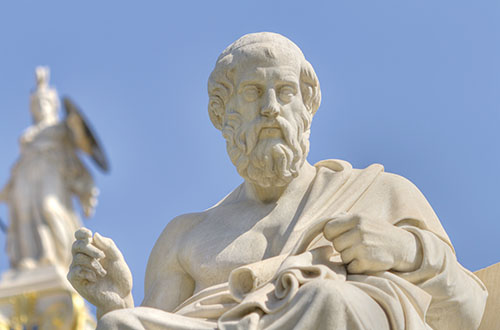
    Statue of the ancient Greek philosopher Plato outside the Hellenic Academy, Greece. Few people know Plato was skilful as a wrestler. He taught that the study of philosophy (the magician archetype), music (craftsman) and physical discipline (warrior) were all necessary. 

    While it is not surprising to find these in primitive society, it is surprising that this group reappears later on, in both East and West. The ancient Greek philosopher Plato was not only initiated into the Mysteries but was known for his skill in wrestling (his name means literally “broad-shouldered”). He taught that not only was philosophy (the magician archetype) necessary but so too was the study of music (craftsman) and physical discipline (warrior). Again, Miyamoto Musashi, Japan’s most famous warrior, spent years meditating in a cave (magician archetype) and was also known for his skill in painting, calligraphy, and gardening (craftsman). And from Confucian to classical Western education, inevitably there is a mix of the study of philosophy, ritual, and religion (magician), music, calligraphy, painting (craftsman), and fencing, wrestling, boxing, or physically demanding and dangerous sport (warrior). 

    Again, around the 12th century CE, Sufi Orders were not only influenced by Islamic chivalry (futuwwa) but began to structure themselves after the trade guild, with disciples becoming apprentices (mubtadi’), companions (sani‘), and master craftsman (mu‘allim). Roughly six hundred years later, in England, the fraternity of the Free Masons (or Freemasonry) separated from the stonemasons trade guild of Great Britain. It expanded upon the two initiation rituals of the stonemasons guild and added a third so that, in the “Craft Masonic Lodge,” a Freemason would become an Entered Apprentice, then a Fellowcraft, and finally a Master Mason. 

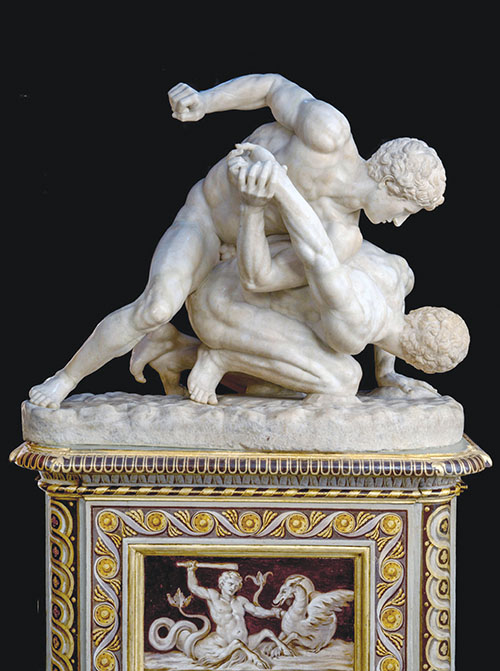
    The Wrestlers (also known as The Two Wrestlers or The Pancrastinae) is a Roman marble sculpture after a lost Greek original of the third century BCE. It is now in the Uffizi collection in Florence, Italy. At first glance, this famous statue appears to be depicting wrestlers. In reality, this is a portrayal of Pankration, a brutal and bloody Greek martial art similar to the present-day sport of mixed martial arts.

    There are also hints of chivalry in the degrees of Craft Freemasonry. The white apron, presented to every Freemason, is described in the Masonic ritual as “more honourable than the Star and Garter” – a reference to the knightly, or chivalric, Order of the Garter. However, the warrior – or more specifically the knight – is more pronounced in the so-called “higher degrees” of Freemasonry. When the Masonic fraternity spread across France and Germany a decade or so after the founding of the premier Grand Lodge in London, in 1717 CE, Masonic enthusiasts began creating new degrees. Some were influenced by alchemy, Hermeticism, or Rosicrucianism but nearly all of them were influenced by Christian chivalry.

    Although probably not aware of the division in ancient culture into craftsmen, warriors, and magicians, in his book Masonic Temples historian William D. Moore argued that American Freemasonry came to embody the craftsman, holy warrior, and mystic. For Moore, the Craft Masonic Lodge embodies the craftsman archetype, the Masonic Order of the Temple (or “Knights Templar” degree) embodies the warrior, and the Scottish Rite degrees of Freemasonry embody the magician. 

    Just as we find three levels or degrees in Sufism and Freemasonry, anthropologist David W. Anthony has suggested that, in antiquity, the vocations of craftsman, warrior, and magician (sage, priest, or elder, etc.) constituted “three age grades,” with a man passing from being a craftsman in his youth (in premodern cultures people often began work at around five or six years of age or younger), becoming a warrior during his years of peak physical strength, and a magician or tribal leader in older age. Certainly, the progression makes sense. No normal society, after all, would want old men for its protection or children for its leaders. Yet, embodying both early human society and an archetypal progression from childhood to adulthood, and from labour to spiritual guidance, perhaps it was inevitable that the craftsman, warrior, and magician (and not the jester, warrior, lover, for example) would re-emerge in later societies intended to initiate men, in particular, into manhood and into a transcendent reality beyond the daily grind. 

    Incorporating the Archetypes into Your Life

    However, like Plato and Musashi, we do not have to wait to pass from one archetype to the next. Instead, as the classical education of the East and Wests suggests, we can, and should, find ways to incorporate them into our lives right now. This is especially important today. Balanced with craftsmen, warriors, and magicians or spiritual guides, ancient society was holistic, whole; the body, brain, and spirit were balanced. Today, however, the mind and body is so severely split in the West that we have come to see the physical body as something that has no objective reality beyond what the mind (i.e., the latest intellectual theory) says it is. And as religion has declined in the West, so has a sense of the sacred and the transcendent. Yet, religious fervour is alive and well in politics. If we openly question the latest pronouncements of the political priest caste, we will be denounced as heretics.

    Miyamoto Musashi, Japan’s most famous warrior, embodied all three archetypes. (Self-portrait of Miyamoto Musashi, early 17th century.)

    How can the craftsman, warrior, and magician archetypes help us? While there are differences between them, there are, as we have suggested, also connections and overlaps. In many ancient, tribal societies, blacksmiths acted as priests or shamans, performing special rites and initiating new members into the metallurgist’s craft. The warrior, too, had his spiritual rites and traditions. In India, a shrine to the goddess Kali is kept in the traditional temple of the martial art of Kalaripayattu. In Iran, the martial tradition of Zoorkhana was strongly influenced by Sufism and Shi’ite Islam. Shaolin Kung Fu comes from the Buddhist Shaolin monastery. Again, Zen Buddhism became associated with the Samurai as well as with martial arts such as Kendo and Karate-do, and yet Zen was also taught through, or embodied in, the crafts or arts of painting, calligraphy, flower arranging, and even serving tea (chado). Unsurprisingly, perhaps, the late Samurai manual the Hagakure tells us that if a practitioner of a Way (a Do or Tao) should see another practice of the Way, he should understand his own even more clearly. 

    Despite what our education and employment systems currently push, we must not get stuck in one specialisation or one limited way of thinking. In most cases, although finding a niche might work, it is likely to work only for a limited amount of time, especially in a fast-changing world. Flexibility is necessary. Moreover, even today, leaders in any field think outside the box and bring different, seemingly incompatible things together. (Think of Steve Jobs introducing different fonts to computers inspired by his study of the ancient art of calligraphy under a Trappist monk.) Specialisation, or compartmentalisation, is an even bigger problem when it comes to our own lives. At best, it encourages us to become a fraction of who we could be. In most cases, it turns people into hobbyists, obsessive consumers of sports tv, or spiritual fantasists and pseudo-intellectuals with an overblown sense of their moral goodness and everyone else’s wickedness. 

    Instead, as I advocate in my book The Three Stages of Initiatic Spirituality: Craftsman, Warrior, Magician, we must cultivate the mind, body, and spirit – practicing some kind of art or skill, training our bodies, and having some kind of spirituality. For Plato, this meant music, wrestling, and philosophy. For us, it could mean anything from painting, writing, poetry, customising motorbikes, to learning to cook traditional, healthy food (craftsman); working out at a gym, practicing a martial art, or doing Spartan races, etc. (warrior); and practicing meditation, positive thinking, some kind of spiritual or religious ritual, or studying the symbols, myths, and archetypes embodied in the world’s ancient cultures (magician).

    Get the issue this article appears in

    How We Got Where We Are Today

    How did we get from the tribal and ancient society where its craftspeople, warriors, and magicians or elders and spiritual leaders were in harmony, to one where the different factions are at war with each other and, in some cases, at war with their own societies? Estrangement from nature might be one reason. A lack of knowledge about the past might be another. But, undoubtedly, from the Industrial to the post-Industrial era, specialisation in education and work has played a role. We do and cannot move from becoming accomplished in an art or craft, to becoming a warrior, to finally becoming a guide for the community. 

    Mythology and ancient sociology explain the transformation of society in another way. There are two contrary sets of myths that we must consider. According to one set of myths, the world and the quality of humanity is in decline, becoming ever less spiritual and ever more materialistic and self-centred. According to the other set of myths, there is natural and perhaps unstoppable progress. The former group of myths tend to focus on the society (society is in decline) whereas myths of progress tend to focus on the individual (the individual has more freedom and can be more creative). 

    One of the earlier myths of humanity’s progress was created by Joachim of Fiore (c. 1135–1202). Joachim was the founder of his own monastic Order and one of the most important historical and apocalyptic theorists of the medieval period. He conceived three great Ages: the Age of the Father, the Age of the Son, and the Age of the Holy Spirit. Accordingly, in the first of these Ages, people lived under the Law and served God. During the second Age, people lived under the Gospel though Christ had given freedom to mankind. Only in the last Age, however, would there be full freedom. A similar scheme is given by the English occultist Aleister Crowley (1875–1947), who conceived of time as divisible into the Aeons of Isis, Osiris, and Horus, with humanity finally acquiring freedom and individuality in the last.

    In contrast, according to Hindu tradition, there are four great Ages or Yugas, beginning with the Satya Yuga (the Age of Truth) and ending with the Kali Yuga (the Dark Age). Likewise, the ancient Greek poet Hesiod claimed that the gods made several “races.” The first of these was a golden race of people. They were in harmony with nature and with each other, and lived long, healthy lives. Then came a silver and a bronze race and finally an iron race. And, again, Norse myth says that in the early days of the earth the gods had plenty of gold (signifying a Golden Age). At the end, however, there is the cosmic war between the gods and giants. In all three myths, the final era was – or will be – described in almost identical terms: Brother will fight with brother; parents will be disrespected; men and women will get together only because of sexual desire; powerful and corrupt men will be respected. 

    Although not concerned with these myths, Ibn Khaldun would claim that such a decline was quite real. Born in Tunis in 1332, Ibn Khaldun is often considered the father of sociology. During his lifetime, he witnessed dynasties rise and fall across North Africa. Reflecting on this, he claimed that every dynasty goes through three stages. In the first stage, a warrior band swoops down upon a kingdom, defeats it, and takes it over. In this first stage, the warriors, though victorious, stay true to the desert values. They care nothing for luxury, and sleep on the floor. In the next stage, the people enjoy the luxury of the kingdom but hope for a return to a more rugged way of life, which they admired. In the final stage, the people love luxury, are weak, and seek protection from the ruler. Incapable of their own defence, a new warrior band swoops down and conquers them, beginning the cycle again. 

    We might find a picture of our own civilisation somewhere in Ibn Khaldun’s scheme. Wherever we might locate ourselves in it, the implication is surely that neither luxury and safety nor the warrior alone is enough to make, or sustain, a civilisation. Instead, as we find in perhaps every successful pre-modern society, it requires the harmonious relationship of the craftsman, warrior, and magician. If the civilisation around us cannot manage it, individually we can, and must, embody and unify these archetypes within our own lives.

    The Three Stages of Initiatic Spirituality: Craftsman, Warrior, Magician is available from all good bookstores.

    [alert type=”general” dismiss=”no”]This article was published in New Dawn 178.[/alert]

    [alert type=”success” dismiss=”no”]If you appreciate this article, please consider subscribing to help maintain this website.[/alert]

    Footnotes

    1. www.businessinsider.com.au/lookism-is-real-and-could-be-costing-you-your-dream-job-2013-8
    2. www.dailycaller.com/2017/07/30/police-link-meeting-someone-at-the-gym-to-right-wing-extremism/

    © New Dawn Magazine and the respective author.
    For our reproduction notice, click here.

  • Mouni Sadhu: The Adept From the West

    Mouni Sadhu: The Adept From the West

    From New Dawn 166 (Jan-Feb 2018)

    Twentieth-century Australia was a greenhouse of spirituality and occultism in their many colourful varieties, offering a revolving door to a diverse range of international teachers and practitioners who graced our shores. Among them was a mystic who drew together the threads of Hinduism, Christianity, Theosophy, Rosicrucianism and Hermeticism, assuming the nom de plume Mouni Sadhu (meaning silent monk) and spending most of the final two of his seven-odd decades in Australia. 

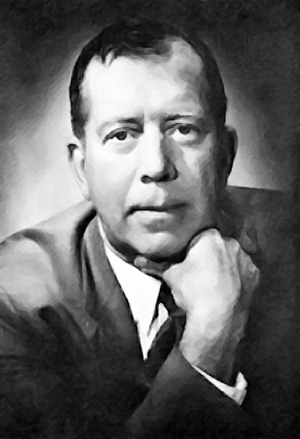
    Mouni Sadhu (1897–1971)

    Although there are conflicting opinions about his early life, mainly because he was reluctant to disclose his background, it appears he was born as Mieczyslaw Sudowski in Poland around the turn of the last century, raised as a Catholic and served in the army in World War II before leaving his homeland.1 Thereafter he spent time in France, then Brazil, before migrating to Australia in 1948. It was here in this country that he disseminated an ideology that was to gain currency in the ensuing decades: Superconsciousness.

    Mouni’s friends and followers invariably described him as a devotee of both spirituality and occultism, however he took great pains to stress that he considered these as two very distinct paths. In the foreword to his book Ways to Self-Realization: A Modern Evaluation of Occultism and Spiritual Paths he wrote, “Occultism is neither a synonymous term nor a substitute for spirituality, and spiritual men do not necessarily come from the ranks of occultists. They are two different things.”2

    Having been attracted to all pathways of an esoteric nature from an early age, Mouni earned his occult label by joining local branches of the Rosicrucian Hermetic Order and the Theosophical Society in Europe during the 1920s and 30s, while at the same time studying and writing about the Tarot. He openly expressed admiration for Theosophical luminaries Madame H.P. Blavatsky, Annie Besant and Charles W. Leadbeater.

    A Search in India

    Mouni Sadhu’s spiritual guide and Master, the great Indian sage Ramana Maharshi (1879–1950).

    After some years, he and other members became disillusioned with these groups, leading them to break away and form their own occult lodge. A turning point came for Mouni when, during the period in France at the end of the war where he was studying the works of Paul Sédir, a friend lent him a copy of Paul Brunton’s book, A Search in Secret India. This triggered his interest in Indian spirituality and philosophy, resulting in a visit to India and his enduring reverence for the teacher he described as “the last Great Indian Rishi” – Sri Ramana Maharshi. Although Brunton’s book was first released in England in 1934, it found prominence in other Western countries during the post-war years, providing many baby-boomers with a springboard into wider esoteric explorations.

    Pursuing this compelling inner urge to find his true self, or Overself as Brunton dubbed it, Mouni Sadhu sought out the Maharshi’s ashram at the foot of the sacred Arunachala Mountain in South India. Like many other devotees, he believed that just being in the presence of a genuine spiritual Master could raise one’s level of consciousness. While at the ashram Mouni claimed to have attained an enlightened state known by the Sanskrit name Nirvikalpa Samadhi, wherein duality is dissolved and the knower becomes as one with what is known. 

    While writing a number of books about his time in India, including his ‘Mystic Trilogy’ In Days of Great Peace, he did not try to recount his Master’s teachings verbatim, preferring instead to record what he called the “real experiences of an average man” in the presence of a great sage, describing the influence it had on him personally. It was at this point that he replaced the anglicised name Michael Sadau, by which he had become known to his friends, with the spiritual title Mouni Sadhu, with Mouni meaning silent and Sadhu being translated either as wandering holy man or more simply monk. His constant theme and guiding principle was the ancient maxim, ‘Know Yourself’.

    Meetings in Melbourne

    On settling back in the suburbs of Melbourne after his pilgrimage to India, Mouni found work plying his skills as an electrical engineer with the Electricity Commission of Victoria. He soon linked up with other Australian devotees of Ramana Maharshi and formed an association known as the ‘Arunachala Group’, while at the same time getting involved with yoga schools around the city where he conducted classes on meditation and Eastern spirituality. Following the placement of advertisements at branches of the Theosophical Society as well as libraries and appropriate bookshops, he began delivering lectures to public assemblies of interested people, plus smaller groups of private individuals, meeting with his more permanent pupils once a month. An ad he ran in 1963 read: “The Arunachala Group is an independent group of seekers beyond all sects and religious organisations, who accept as their spiritual guide and Master, the last Great Indian Rishi – Sri Ramana Maharshi”3

    At times Mouni was visited by devotees of Bhagavan’s maha samadhi from Brazil. During his time in that country in the late 1940s, Mouni wrote a booklet which was translated into Portuguese, titled Quem Sou Eu? (Who Am I?), and followers from those days kept in contact, considering him a guide and living link with their guru, Sri Ramana Maharshi. A mysterious incident occurred during one such visit to Melbourne when Mouni’s van was involved in an accident, after which he looked to be in serious condition with no sign of breathing. The Brazilians surrounded him and started chanting some Sanskrit slokas (Hindu prayers), and in due course, Mouni got up and carried on as if nothing had happened.4 Thus a certain aura and reputation grew around him.

    Sydney and the Occult

    Each February Mouni Sadhu would do a road-trip to Sydney in his VW campervan, and it seems, on the face of it, that he left his ‘spiritual’ label behind to revert to his more ‘occult’ side as he headed north. There he would stay at the home of his friend Nicholas Tereshchenko, who noted that Mouni met with, and gave talks to, members of the Theosophical Society, the G.I. Gurdjieff group, and students of the Tarot. He was also known to meet with the Scientologists. Tereshchenko reports that during Mouni’s 1964 Sydney visit, he helped him start a Tarot group. They developed a system whereby at each weekly meeting the person who presided over it would nominate a lecturer to speak on a chosen topic for the next meeting, and the speaker for that week would nominate the following week’s president. That way every member got to lead several meetings a year while also having to present a certain number of talks annually. “We therefore heard many different views on the Tarot, as seen by diverse people with many different occupations in life and ‘specialties’ in their interests in the occult. The meetings were held in the house of one of the librarians in the Theosophical Society,” Tereshchenko recalled.5

    In this way Mouni seemed able to vent the ‘occult side’ of his personality, which he associated with the West, while he was in Sydney, in contrast to the influence of Eastern spirituality that guided his activities back home in Melbourne. One of his close associates, Bruce W. Du Vé, wrote of him: “Mouni Sadhu was to my knowledge the last practising master in the great European tradition of occultists and White Magicians. He was thoroughly versed in the history and methods of these covert arts and when I knew him lived two parallel lives. Publicly, he was a jovial, intelligent and rather mischievous though polite and formal European gentleman of the Victorian era.… The other life was a more secret one.”6 Mouni himself elsewhere asserted that he had, “reached the firm conviction that Western adepts knew as much, if not more about the value of a one-pointed mind in spiritual achievement, than their Eastern brothers.”7

    On Superconsciousness

    To view Mouni’s contribution to our esoteric legacy through the rose-coloured glasses of 1960s’ hippiedom, à la the faddish transcendental adventures of the Beatles, would be to devalue it. The real linchpin of his life’s work was sharing his vision for ‘Superconsciousness’ as the way forward for humanity. This is a belief that, in addition to our normal waking consciousness and our subconsciousness, we possess a third higher state of awareness that is often said to be either dormant or veiled from our everyday cognition. This central theme is highlighted by the title of his 1962 book, Samadhi – The Superconsciousness of the Future (And Ways to its Achievement by Modern Man). He taught that the most effective way to achieve such a state was through samadhi, which in India was said to exist in a number of different forms, while in some Buddhist countries such as Thailand the word is defined simply as ‘meditation’.

    In his writings Mouni often referred to the philosophies not only of India but also that of Ancient Greece. It is worth noting that two and a half thousand years ago when the Buddha, Siddhartha Gautama, was attaining and teaching about enlightenment, the Ancient Greek philosophers were also considering the nature of the mind. The notion of a divided consciousness developed over a period of half a millennium, from the works of Homer down to Plato and Aristotle.8 And, just like some of the teachers in Athens in fourth century BCE, Mouni felt that the path to higher awareness should be open to the world at large, not confined to students of arcane mystery schools. He readily admitted that not everyone who sought knowledge had what it takes to persevere with it, and that Western minds often struggled to absorb Eastern traditions. He lamented that the dogmatic religions of the West were not producing the results intended by their founders. He was convinced the advancement of the human race would best be served by his ‘Superconsciousness-Samadhi’.

    Mouni believed his vision for the future could be reached most expediently by promoting spiritual meditative practices rather than the occult, which held negative connotations for many members of the public. It should not be thought that he felt conflicted or tried to deny his occult skills; in fact, he considered supernatural and magical pursuits to be very worthwhile. They were not for everyone, however, and could be a distraction to the novice setting out on his or her journey towards Superconsciousness. 

    Mouni the mystic could not be accused of creating division among the arcane disciplines, considering that he drew elements of Hinduism, Buddhism and Yoga from the East together with teachings of Theosophy, Rosicrucianism and Christianity from the West. He held himself to be a Catholic right until the end of his life, and this was most likely in respect for his beloved Maharishi, who took the position that one should never convert from one religion to another, but rather convert from ‘Ignorance to Wisdom’. In his Samadhi book, Mouni summed up this devotion to the religion of his birth by describing Christ as the ‘Master of Masters’ – an expression he said was used by both Sri Ramana Maharshi and Paul Sedir.9

    Get the issue this article appears in

    Marching to His Own Drum

    Although Mouni Sadhu never managed to meet Paul Brunton, the two corresponded for some time by mail. Sadly, that was to end on a sour note when Mouni disagreed with the British author’s change of direction later in life, which, according to Andrew Bukraba, involved drifting towards the Buddhist practice of ‘guru bhava’.10 After Mouni’s final letter expressing his disapproval, he would not even mention Brunton’s name again. His single-mindedness in adhering to his principles caused an earlier falling out with another man he admired, G.I. Gurdjieff, who he finally got to meet during the latter’s final year of life in 1949. According to friend Nicholas Tereshchenko, the famous occultist known for the Fourth Way had insulted Mouni in his native tongue, possibly using a taunt that was common between Armenians and Poles.11 Instead of letting it slide by bowing down and paying Gurdjieff the respect he thought he deserved, the offended Polish mystic stormed out of the room, thereafter renouncing his affiliation with the Fourth Way. Nevertheless, as we have seen, the incident did not prevent him from having cordial meetings with followers of Gurdjieff in Sydney in later years.

    As the eagle of the mountains, having soared high in the air above the earth,

    Wings its way back to its resting place, being fatigued by its long flight,

    So does the soul, having experienced the life of the phenomenal relative and mortal,

    Return finally unto itself, where it can sleep beyond all desires, and beyond all dreams…

    – Excerpt from the Upanishads, as quoted in Mouni Sadhu’s Concentration

    In the forty-five years since Mouni Sadhu (17 August 1897 – 24 December 1971) passed away, there has been no major organisation formed in his wake, although he remained in the hearts of his followers and friends. These days the term ‘Superconsciousness’ might well conjure up the speculations of modern quantum physics rather than Eastern mysticism. Such an association would probably not displease Mouni – after all, his stated aim was to see it carry us “beyond religion.” If anything ever unites science and religion, quantum physics would be the ideal candidate, with its claims that the observer affects the thing being observed, a close match to the ideal of samadhi, wherein duality is dissolved and the knower becomes as one with what is known.

    In one final practical legacy, Mouni’s literary estate was left to the Australian Society of Authors, of which he was a member. The royalties that have accrued from the estate now provide services to Australian authors.12

    New editions of Mouni Sadhu titles are available here: https://spirit.aeonbooks.co.uk/author/mouni-sadhu/23722

    [alert type=”general” dismiss=”no”]This article was published in New Dawn 166.[/alert]

    [alert type=”success” dismiss=”no”]If you appreciate this article, please consider subscribing to help maintain this website.[/alert]

    Footnotes

    1. The most reliable data comes from www.mounisadhu.com although other commentators such as Andrew Bukraba, Nicholas Tereshchenko and Bruce W. Du Vé all state on their websites that he was Russian.
    2. The source for this quote is en.m.wikipedia.org/wiki/Mouni_Sadhu
    3. www.mounisadhu.com/tereshchenko-on-sadhu.html
    4. From the notes of Andrew Bukraba, www.mounisadhu.com/bukraba-on-sadhu.html
    5. www.mounisadhu.com/tereshchenko-on-sadhu.html
    6. From Bruce W. Du Vé’s site: www.mounisadhu.com/duve-on-sadhu.html
    7. Source for this quote is en.m.wikipedia.org/wiki/Mouni_Sadhu
    8. For more on the Ancient Greek view of consciousness see en.wikibooks.org/wiki/Consciousness_Studies/Early_Ideas 
    9. en.m.wikipedia.org/wiki/Mouni_Sadhu
    10. www.mounisadhu.com/bukraba-on-sadhu.html
    11. www.mounisadhu.com/tereshchenko-on-sadhu.html
    12. en.m.wikipedia.org/wiki/Mouni_Sadhu

    References

    Quem Sou Eu? (Who am I?), 1948
    In Days of Great Peace – at the Feet of Sri Ramana Maharshi – Diary Leaves from India, first published in 1952, printed by Ramnarayan Press, Bangalore, India
    In Days of Great Peace – the Highest Yoga as Lived, 2nd ed. revised and enlarged, 1957, George Allen and Unwin
    Concentration – A Guide to Mental Mastery, 1959 (USA) edition published by Harper and Brothers, New York. Published in Great Britain as Concentration – An Outline for Practical Study, 1959, George Allen and Unwin
    Ways to Self-Realization – A Modern Evaluation of Occultism and Spiritual Paths, 1962, in the USA by The Julian Press, and in 1963 in Great Britain by George Allen and Unwin
    Samadhi – The Superconsciousness of the Future, 1962
    The Tarot – A Contemporary Course on the Quintessence of Hermetic Occultism, 1962
    Theurgy – The Art of Effective Worship, 1965
    Meditation – An Outline for Practical Study, 1967
    Initiations by Paul Sédir; translated from the French by Mouni Sadhu, 1967

    © New Dawn Magazine and the respective author.
    For our reproduction notice, click here.

  • Cosmic Life: Dawn of a New Paradigm

    Cosmic Life: Dawn of a New Paradigm

    From New Dawn 165 (Nov-Dec 2017)

    If it can be firmly established that we are not alone in the Universe the implications for humanity will be profound. It could be even more important if we know that alien life in the form of microbes – bacteria and viruses – exist in our midst even now and continually rains down on our planet. Such microbes may sometimes cause devastating pandemics of disease, but more positively they have the potential to augment our genomes and over long intervals of time unravel an ever-changing panorama of cosmic life. In either case – whether as alien microbes in our vicinity or alien intelligence on distant planets – the acceptance of the emerging facts of cosmic life will mark an important turning point in human history. 

    The much publicised scientific developments of recent months – the conclusion of the successful Cassini Mission to Saturn, the Rosetta Mission to comet 67P/Churyumov–Gerasimenko (Comet 67P/C-G), the New Horizons Mission to planet Pluto, and the ongoing Kepler Mission to search for habitable planets – all spell out a single cosmic truth: Homo Sapiens as a sentient species appears to be hard-wired to seek out its cosmic origins, perhaps intuitively sensing that we are not alone. 

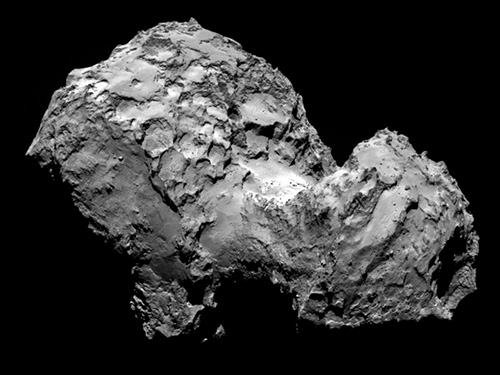
    Ingredients crucial for life on Earth, including the simple amino acid glycine and phosphorus – key components of DNA and cell membranes – were recently discovered on Comet 67P/Churyumov-Gerasimenko.

    How did life arise? Not just on the Earth, but anywhere in the Universe? Does life emerge spontaneously on every Earth-like planet by processes involving well-attested laws of physics and chemistry? Or did the first-ever origin of life involve an extraordinary unrepeatable event involving stupendous volumes of the Universe in the most distant cosmological past? These age-old questions have recently acquired a new sense of urgency.

    The primary requirement for the emergence of creatures like ourselves would be for the existence of rocky planets with water and an atmosphere generally similar to Earth. In 1995 Cambridge-based astronomer Didier Queloz together with Michel Mayor discovered definite evidence of planets outside our solar system. The first of these so-called exoplanets orbited a star 50 light years away in the constellation of Pegasus; it was a giant planet with a mass similar to Jupiter located too close to its parent star for any life to be possible. In 2009 NASA launched its orbiting Kepler telescope, which was specifically designed to discover planets that are the size of Earth. The detection process involved tracking down minute blinks (dimming) in the star’s light when a planet transited periodically in front of it during its orbit. At present nearly 4,000 definite as well as probable detections of habitable planets have been made within only a very small sampling volume of our Milky Way. Most of these planets orbit red dwarf stars that are on the average twice the age of our sun. Extrapolating from the sample of present detections, the estimated total number of habitable planets in our Milky Way galaxy is reckoned to be in excess of 100 billion. On many of these planets one might speculate that life may have begun, evolved, and perhaps long since disappeared. 

    Another related enterprise that has captured the news recently is the search for extraterrestrial intelligence using arrays of radio telescopes to scan the skies for evidence of intelligent signals. Over half a century ago Philip Morrison and Giuseppe Cocconi first drew attention to the possibility of searching the microwave spectrum of cosmic sources for intelligent signals and suggested particular frequencies as well as a set of potential targets. The SETI program (Search for Extraterrestrial Intelligence) began tentatively in 1960 and was first supported by NASA, and later by a host of private or semi-private entrepreneurs. Except for a single brief and mysterious “Wow!” signal discovered in August 1977, there has been a deathly silence across all of the prospective sources that have been scanned. 

    There could be a case for saying that the lack of progress in this venture was the result of organisations like NASA backing off. This may have been the thinking behind Russian billionaire Yuri Milner’s 100 million dollar SETI initiative that was recently announced with much pomp. Buying more telescope time, increasing the range of wavelengths, enhancing detector sensitivity and extending sky coverage have been argued as prerequisites if a breakthrough within a decade is to be achieved. But a positive result from SETI would be contingent on the emergence and widespread dispersal of primitive life capable of evolving into intelligent creatures. How often does this happen?

    The idea that microbial life springs up de novo on billions of Earth-like habitable planets is an unproven, and most likely erroneous proposition. Such a belief is an extension of the canonical “primordial soup theory” for life’s beginnings on the Earth, which is a dogma with no hard evidence to support it. The dogma, in turn, can be traced back to the Greek Philosopher Aristotle (384–322 BCE) who proposed that life arose spontaneously from inorganic, inanimate matter whenever favourable conditions prevailed, e.g. fireflies from a mixture of warm earth and morning dew! Unfortunately, because of his stature as a philosopher, Aristotle’s views prevailed and still prevail almost to the present day. Experimental demonstrations against the validity of spontaneous generation have consistently been ignored, in particular, the 19th century experiments of Louis Pasteur showing that life at a microbial level is always derived from preexisting microbial life.

    The Horsehead Nebula (also known as Barnard 33) is a dark nebula in the constellation Orion. If we are all made of stardust, then we are also organically connected to the star systems of the Universe.

    If there was a deep principle of nature that drove inorganic systems towards the emergence of primitive life – bacteria rather than fireflies – the evidence for this would have long since been discovered in the laboratory. With calculations showing grotesquely low a priori probabilities for the transition from non-life to life, only two options remain. The origin of life was an extremely improbable event that occurred on Earth (because we are here!) but will effectively not be reproduced elsewhere. In that case we would indeed be hopelessly alone. Or, a very much vaster cosmic system than was available on Earth, and a very much longer timescale was involved in an initial origination event, after which life was transferred to Earth and elsewhere by processes that the present writer and the late Sir Fred Hoyle proposed many years ago – panspermia. The essence of our theory of cosmic life is that the entire galaxy – perhaps the entire Universe – is one single connected biosphere. Physical transfer involving exchange of meteorites, comets, and dust with an intermingling of genes on a cosmological scale is far more probable than independent life origination events that are assumed in conventional science.

    The discovery of microorganisms occupying the harshest environments on Earth continues to provide indirect support for this point of view. Transport of microbial life (and viruses) from one cosmic habitat to another requires endurance of space conditions for millions of years. The closest terrestrial analogue to this latter situation exists for microbes exposed to the natural radioactivity of the Earth. Quite remarkably, microbial survival under such conditions is now well documented. Dormant microorganisms in the guts of insects trapped in amber have been revived after 25-40 million years. And some species of bacteria have even been found to thrive in the interiors of working nuclear reactors. All this goes to show that arguments used in the past to discredit panspermia on the grounds of survivability during interstellar transport are seriously flawed.

    If a single discovery is to serve as a watershed in the journey to accepting our cosmic origins, it is a recent study of two related species, the squid and the octopus. The squid has an antiquity in the geological record that goes back to the great metazoan explosion of multi-celled life 540 million years ago. The octopus apparently branches out from the squid line about 400 million years ago, presumed to evolve from an ancestral squid. Recent DNA sequencing of the squid and octopus genomes has exploded a bombshell. The squid contains a very meagre compliment of genes adequate to serve its modest survival needs. The emergent octopus, on the other hand, has over 40,000 genes (the human has only 25,000 genes) and many of these genes code for complex brain function. Others code for a highly sophisticated camouflage capability including rapid switches of colour. The octopus is incredibly more complex in structure and performance than its squid predecessor. Where did the suite of genes coding for complex brain function come from? They were not present in the ancestral squid or in any other living form that existed on the Earth at the time. The clear implication is that they came from outside the Earth – external to terrestrial biology – part of the cosmic milieu of life.

    Another lead in this story has come from the study of interstellar dust clouds conducted over several decades. The list of organic molecules present in interstellar clouds has increased dramatically in number since their first discovery in the 1970s, and also has their degree of complexity. The first astronomical discovery showing interstellar (cosmic) dust to mimic closely the infrared absorption pattern (spectrum) of bacteria was made by Dayal Wickramasinghe and David Allen using the Anglo-Australian telescope. Decisive evidence for complex aromatic and aliphatic carbon-based molecules (ring molecules and long chain molecules) now exists everywhere in our galaxy, and even beyond in galaxies as far away as 8 billion light years. While all such data still tends to be interpreted avoiding “biology” with the suggestion that we may be witnessing exceedingly improbable “primordial soup-type events” on a cosmic scale, cosmic biology remains by far the most attractive logical option. This is further evidence of panspermia in action – the organic molecules in interstellar space being degradation products of itinerant bacteria and viruses.

    Comets in our solar system have been targeted by several space missions since 1986 following ESA’s Giotto successful mission to Halley’s comet. The Giotto mission showed clearly that the prevailing theory that comets are dirty snowballs had to be abandoned in favour of comets rich in organic molecules, and most likely also containing viable bacteria and viruses. 

    Artist’s depiction of microorganisms from outer space bombarding an Earth-like planet.

    More recent explorations of comets, culminating in the Rosetta Mission to Comet 67P/C-G, have yielded a formidable body of evidence all showing consistency with the existence in comets of microbial material. Many species of fermenting bacteria are known to be able to produce ethanol from sugars, so the recent discovery that Comet Lovejoy emits ethyl alcohol amounting to 500 bottles of wine per second would appear to be a clear indication that such a microbial process is operating.

    The reluctance of some scientists to endorse these discoveries lies not in the quality of the data involved but in a desire to maintain a conservative position in relation to life on Earth and its purely terrestrial origins. It is only in this way that public funding of their research projects (and livelihoods!) can be assured. Although the Earth was demoted from its privileged position of physical centrality in the Universe over 500 years ago (and not without anguish), the trend to regard life as being centred on our home planet has persisted almost to the present day. But a paradigm shift with far-reaching consequences is imminent now, and public support also seems to be growing. 

    Get the issue this article appears in

    During the past decade, tantalising evidence of microorganisms currently entering Earth has accumulated but has been largely ignored and not pursued. This data was acquired from relatively inexpensive projects that involve balloon flights to the stratosphere and recovery of in-falling cometary dust. The first in a series of such experiments was conducted by the Indian Space Research Organisation in 2001 and 2006 with staggering results, indicating an inflow of microorganisms at the rate of a tenth of a tonne per year. Some years later a team of investigators at the University of Sheffield led by Milton Wainwright obtained very similar results. It is obviously of the utmost importance that these experiments are repeated by independent bodies, but this has not happened. More expensive and sophisticated investigations need to be carried out, even on the samples collected so far, if we are to prove beyond doubt that these microbes are unequivocally alien. The sad truth is that funding for such vitally important experiments is well-nigh impossible to secure. Compared with other Space Projects for solar system exploration, the budgets involved here are trivial, but the scientific and societal pay-off could be huge. 

    Fred Hoyle (1915–2001) and Chandra Wickramasinghe at the University of Peradeniya, Sri Lanka, 1981. The pair worked jointly for over 40 years as influential proponents of panspermia.

    Our ultimate goal must be to confirm beyond a shadow of a doubt that life is a truly cosmic phenomenon. The evolution of life takes place not just within a closed biosphere on our minuscule planet Earth but extends over a vast and connected volume of the cosmos. It is to be expected on this basis that the emergence of intelligent life is a logical consequence of the same process and must, therefore, be commonplace on a cosmic scale. 

    The author’s book Cosmic Womb: The Seeding of Planet Earth (co-authored by Robert Bauval) explores the latest findings in support of a cosmic origin for humanity. 

    [alert type=”general” dismiss=”no”]This article was published in New Dawn 165.[/alert]

    [alert type=”success” dismiss=”no”]If you appreciate this article, please consider subscribing to help maintain this website.[/alert]

    Further Reading

    Chandra Wickramasinghe, The Search for our Cosmic Ancestry (World Scientific Publishing, Singapore), 2015a
    Chandra Wickramasinghe, A Journey with Fred Hoyle (World Scientific Publishing, Singapore), 2015b
    Chandra Wickramasinghe and Robert Bauval, Cosmic Womb: The Seeding of Planet Earth (Inner Traditions, USA), 2017

    © New Dawn Magazine and the respective author.
    For our reproduction notice, click here.