New Dawn – World's Most Unusual Magazine

Category: Articles

  • William Walker Atkinson & His Legacy

    William Walker Atkinson & His Legacy

    From New Dawn Special Issue Vol 13 No 5 (Oct 2019)

    William Walker Atkinson was one of the most influential and mysterious metaphysical writers of the twentieth century. Under an array of different pseudonyms, Atkinson authored over a hundred books and close to a thousand magazine articles in a prolific career that began later in his life after a breakdown pushed him out of a successful legal career. 

    While known during his own lifetime, Atkinson’s works continued to have a remarkable and widespread influence after his death and up to the present. His pen helped to shape everything from yoga and Reiki to the Prosperity Gospel and the Law of Attraction.
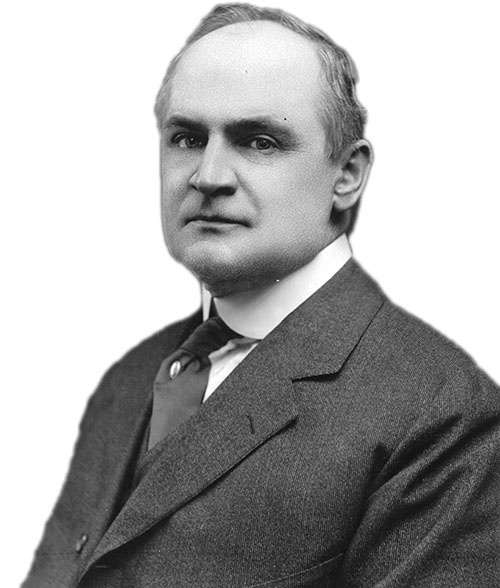
    William Walker Atkinson

    Atkinson was born in Baltimore, Maryland, USA in 1862 to a solidly middle-class family who had connections to some of the city’s more prestigious and established families. His father and grandfather both owned grocery stores, and as he grew up and worked in his father’s business, William Walker Atkinson seemed fated to join them. 

    When he was just twenty-one, Atkinson suffered a breakdown. Seemingly despondent from a case of unrequited love, the younger Atkinson disappeared from Baltimore and sent a series of suicide notes from a hotel in Philadelphia a few days later. Not long after, he started reading books on Theosophy and began a study of esotericism that not only seemed to stabilise him and give him direction in the moment, but for the next half-century.

    He then travelled throughout the eastern half of the United States for several years in search of a career that could be of his own making. Atkinson moved from one job to another and tried his hand in sales and office work without anything really taking hold, eventually finding his vocation as an attorney. In 1893, Atkinson began to study the law, serving first as an apprentice and then alongside a senior attorney in central Pennsylvania.

    Atkinson thrived as a lawyer, and not long after he moved to another city to start a practice of his own, and he was invited back to become a partner with his former mentor. The future seemed bright for Atkinson and his young family, but when the perfunctory transfer of his legal credentials from one county to another was unexpectedly denied, that future was thrown into doubt. Left with few options, Atkinson moved his family in with his brother-in-law in Philadelphia and promptly had another breakdown that saw him disappear for six weeks.

    His Great Work Begins 

    In later accounts of this time, Atkinson described being brought to the brink of collapse on all levels through overwork and anxiety. While he was coy about what exactly happened during the time of his absence, when he reappeared Atkinson quickly gathered up his family and moved to Chicago where he changed his occupation and became an enthusiastic author and proponent of New Thought – a web of beliefs and practices that hold that one’s thoughts affect health, well-being and circumstances – and he took to it with a convert’s zeal.

    Atkinson started in his new career by writing and serving as the associate editor for a magazine titled Suggestion, and by the end of 1901 he was the editor of another Chicago-based periodical titled New Thought. As he continued to write and give lectures, compilations of Atkinson’s work began to be published in book form.
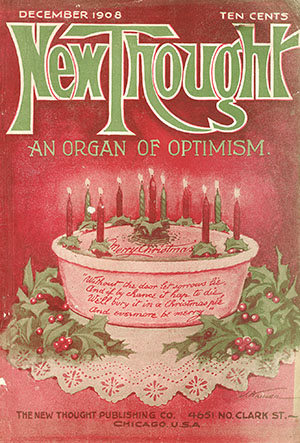
    New Thought magazine, Dec 1908 edition.

    While Atkinson’s nascent life as a writer might seem to have been a dramatic shift, it brought together much of his past. His early interest in Theosophy appears throughout his works in direct references to Helena Blavatsky and use of the term “secret doctrine,” and in a worldview indebted to its perennial philosophy that saw a validity and interconnectedness in the different spiritual traditions of the world. Atkinson incorporated the works on self-help and physical culture he absorbed during his sojourns as a clerk and salesman, and from his time as an attorney he took a fondness for describing the universe as a set of laws, as well as the ability to eloquently argue a point.

    With Atkinson as editor and chief contributor, the readership of New Thought swelled, and its total circulation doubled and then doubled again. This was no accident. Many scholars have suggested that New Thought’s popularity is best understood in the context of swift and massive changes that were happening in American society as the Gilded Age transitioned into the Progressive Era and large numbers of Americans moved into the cities to work jobs in sales or inside offices. 

    With theories that were simultaneously scientific and magical, New Thought gave explanations for why some people were successful and others were not, and it offered the possibility for advancement and improvement to those who had little more than their thoughts and desires. 

    For his part, Atkinson wrote to his audience with a voice that was simultaneously clear, authoritative, sympathetic, and profoundly democratic. Always a champion of the individual and those who worked hard, he saw the workings of New Thought as easily in the empires of newly minted industrial magnates as in the hustle of the young newspaper hawkers he admired on the streets of Chicago. Atkinson also regularly invited readers to visit him in his office and answered their letters in a regular column in New Thought with counsel that was as kind as it was direct.

    Atkinson held a view of New Thought that was both generous in theory and practical in its application. He saw little that was “new” in New Thought but understood it as only the most recent manifestation of a long and varied line of systems that extended all the way back to ancient India. At the same time, Atkinson approached New Thought like a scientist and saw the everyday world as its proving ground that could test and refine its ideas, with its ultimate value in how it could help people in their daily lives.

    Unlike many of his contemporaries and those later influenced by New Thought, Atkinson never saw its teachings as just a magical way to manifest desires, but rather as a method of strengthening and clarifying one’s aims that always needed to be paired with hard work. One of Atkinson’s sayings was “Hold the Thought and Hustle.” He also refused to see material wealth as the sole worthy aim, but instead glorified those who were creative, productive, and felt at home in the world as themselves.

    ‘Yogi Ramacharaka’ 
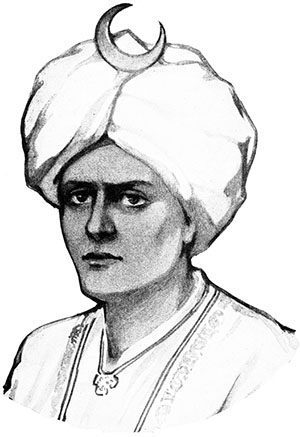
    Yogi Ramacharaka, from an
    advertisement (1903).

    While he was at the helm of New Thought, Atkinson began to author monthly mail-order lessons on yoga under the name ‘Yogi Ramacharaka’ that soon developed into a series of books published by the Yogi Publication Society, housed in Chicago’s Masonic Temple skyscraper. Atkinson did not seem to be concerned with being a conduit for the pure ancient wisdom of India. For him, the yogi was an ideal type – energetic, efficient, and attuned with nature – and the yoga he offered the public as Yogi Ramacharaka was a mixture of physical culture, contemporary science, New Thought philosophy, and self-help techniques. 

    Yogi Ramacharaka was one of the earliest of over a dozen different pseudonyms Atkinson used during his writing career that would become a source of confusion and speculation after his death. Upon close inspection, his various pen names align with different publishers and distinct periods of time. The most likely explanation for them is that they allowed someone so prolific to publish with several companies simultaneously and to do so without flooding the market. 

    Importantly, Atkinson never distanced himself from any of his writing. In the biographical entries he submitted to reference books such as Who’s Who in America, he openly claimed authorship of all his pseudonymous works, and in the personal copies of his pseudonymous books that were left to his family, he personally inscribed “I Wrote This” next to his initials on their inside covers. 
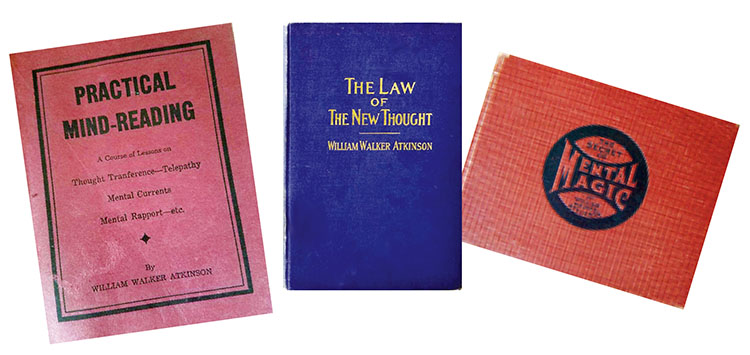
    William Walker Atkinson, one of the most influential and mysterious metaphysical writers of the twentieth century, authored over a hundred books including titles such as Practical Mind-Reading, The Law of the New Thought and The Secret of Mental Magic. He also wrote under a dozen different pseudonyms.

    As New Thought magazine became increasingly successful, its manager Sydney Flower used its pages to promote dubious products (including a health cigar) and investment schemes. Flower quickly became the target of mockery in several newspapers and ran afoul of federal postal authorities who halted New Thought magazine’s use of the mail as part of a fraud order just before Christmas in 1904. 

    Atkinson moved with his family to Southern California a few months later. It was a decision he claimed was for the climate and change of scenery, but as he had carefully distanced himself from Flower during this time – reminding readers in print that he was simply a writer and editor who had nothing to do with the “business side” of the magazine – the move undoubtedly had the added benefit of putting distance between himself and Flower’s legal troubles. 

    Relocating to Los Angeles established a pattern that would see Atkinson and his family move between Chicago and California a total of three times, staying in each city for several years at a stretch. Both cities were active hubs of metaphysical and esoteric activity, and were separately described by newspapers as claimants to the title of America’s “cult capital.” Atkinson’s presence in these locations – combined with his affable disposition and position as an author and lecturer – brought him into contact with an impressive list of important and influential figures in the metaphysical world. The heart of the Los Angeles scene was Blanchard Hall and for the next few years Atkinson regularly lectured to packed crowds in its large 800-seat auditorium and teach classes in its smaller meeting rooms. 
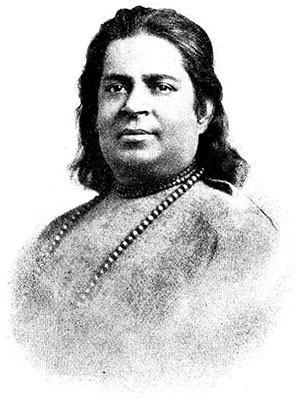
    Baba Bharati (circa 1904).

    One of the most important connections Atkinson made in Los Angeles was with Baba Bharati, a Bengali-born Krishna devotee who had recently arrived in the United States. Atkinson wrote a pair of articles for Bharati’s magazine, The Light of India, and warmly described their friendship. Bharati was also influenced by Atkinson, and after their meetings he began to describe yoga with the New Thought-inspired phrase “Thought Force.” It was likely through Bharati’s influence, if not direction, that soon after Atkinson left California and edited two volumes of Hindu sacred texts for a popular American audience – The Bhagavad Gita and The Spirit of the Upanishads – under his pseudonym Yogi Ramacharaka.

    When Atkinson returned to Chicago in late-1907 he entered into an astonishing five-year period in which he was at his most prolific and eloquent, publishing over forty books and one hundred magazine articles. One account of Atkinson’s writing process during this time claimed that he would immerse himself in the study of a topic and then, once “loaded up,” write in a rapid outpouring with the office assistant setting up the type for each page as soon as Atkinson was done writing it.1 This process not only explains Atkinson’s productivity but also the repetition of ideas and minor typos in his works during these years.

    The Kybalion
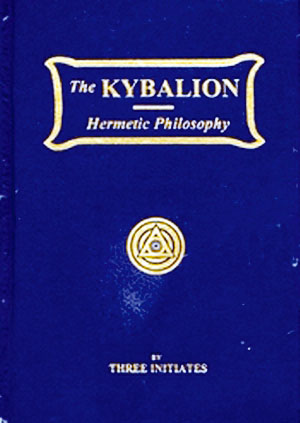
    Early in this period, Atkinson wrote a self-described “little volume” called The Kybalion under the cryptic pseudonym “Three Initiates.” At the core of The Kybalion were seven axiomatic laws – such as the Principle of Correspondence and the Principle of Vibration – that were described as originating with the mythic Hermes Trismegistus and carefully passed down through the ages from teachers to select students. While The Kybalion claimed to be ancient, Egyptian, and Hermetic, it was much more a product of modern American New Thought, one reason it resonated so strongly with its audience.

    Although he distanced himself from the business affairs of New Thought magazine, William Walker Atkinson never stopped contributing to it, and he faithfully discharged articles and regular columns to its readers as he moved around the country, and the magazine changed hands. For a short while in 1910, Atkinson even resumed his duties as editor for New Thought before the periodical dissolved. 

    Atkinson moved back to California in 1913 and settled just outside Los Angeles in the city of Pasadena for a few years. He took over noon weekday meetings in Blanchard Hall for Annie Rix Militz, the founder of the New Thought group known as the Home of Truth, at times with hundreds of people in attendance. 

    Even though Atkinson was not serving as the editor of a magazine during this time, he was a regular contributor to Elizabeth Towne’s Nautilus. Many of these pieces were reprinted in newspapers throughout the United States – from the San Francisco Chronicle and the Chicago Tribune to a host of smaller papers in the Midwest – and they were perhaps the greatest measure of visibility Atkinson received during his lifetime.

    When Atkinson returned to Chicago in 1916 he entered familiar work with old partners and took on the editorship of a new magazine titled Advanced Thought, owned by the same couple who ran the Yogi Publication Society. For four years, Atkinson was at the helm of Advanced Thought, and in many ways the magazine was a one-man operation. Atkinson served as not only its editor but through columns and articles under his own name and supplemental pieces under his various pseudonyms, he supplied nearly all of the non-advertisement copy for some issues.

    A few years before Atkinson’s return to the Midwest, the poet Carl Sandburg personified Chicago as a hard-working young man and gave it the moniker “City of Broad Shoulders.” Atkinson held Chicago in the same regard and was always at his most productive when he lived there. He fell in love with the activity and industry. He first lived there in 1900, and once told readers of New Thought that he “long(ed) to walk down State Street, seeing the native Chicagoan in all his glory,” while he was temporarily relocated in New York. 
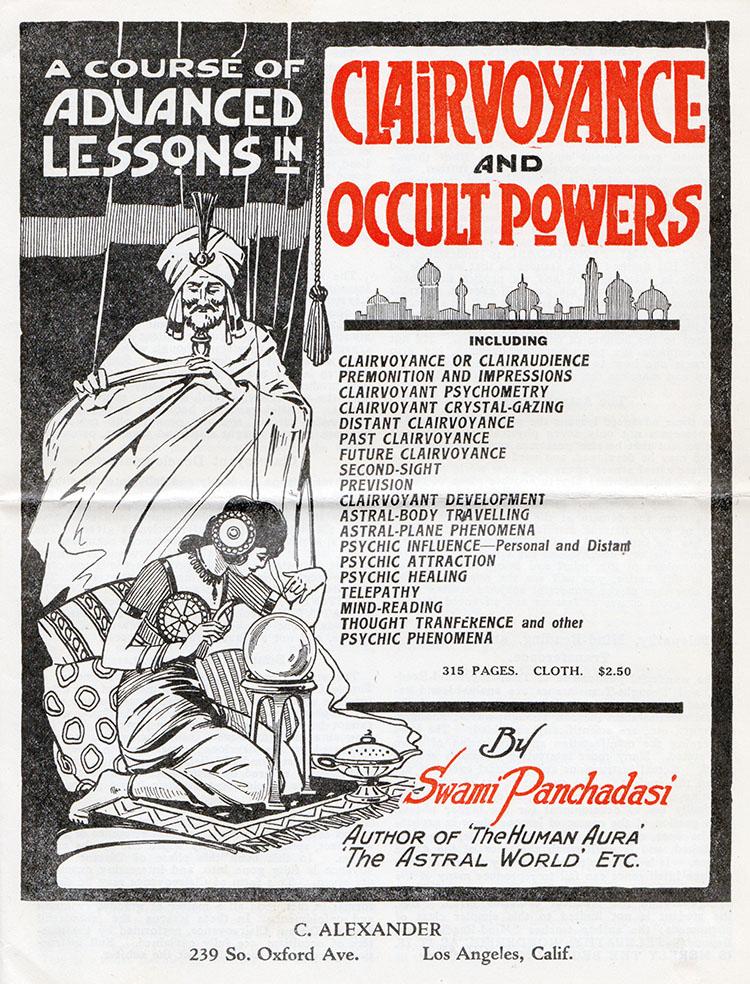
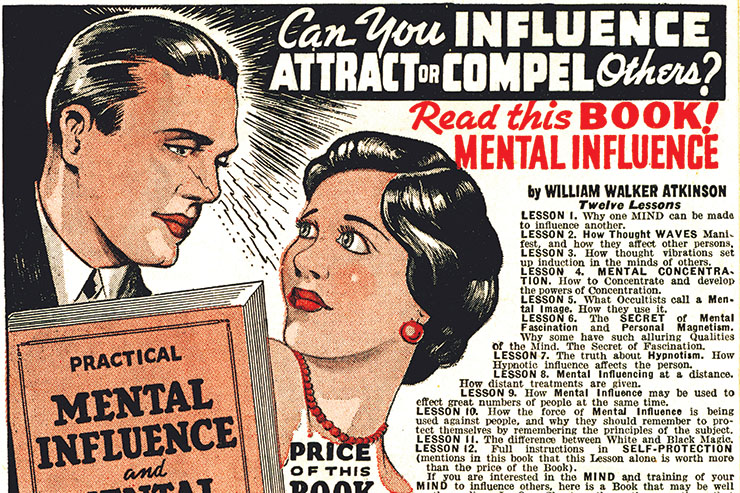
    As Swami Panchadasi and Swami Bhakta Vishita, Atkinson wrote on subjects such as the human aura, the astral world, and the development of seership and psychic powers. Advertisements such as these appeared in various publications.

    It was also during this period in Chicago that Atkinson authored the bulk of about fifteen different books under a trio of new pseudonyms. As Swami Panchadasi and Swami Bhakta Vishita, Atkinson wrote on subjects such as the human aura, the astral world, and the development of seership and psychic powers. While Atkinson frequently wrote about the dangers of the occult leading its students astray, he just as often made sense of occult phenomena through his understanding of the mind and its powers, and there is evidence that he worked with a crystal ball. The French-sounding pen name Theron Q. Dumont was used for more everyday application of mental powers: salesmanship, reading character, the development of memory, and increasing personal magnetism.

    Atkinson, ever the optimist, could find the good in other New Thought figures and often supported them by giving guest lectures for their organisations. He did the same at regional and national gatherings of the International New Thought Alliance until he chafed at the increasing “churchianity” of the organisation. 

    At their 1916 annual meeting in Chicago, the International New Thought Alliance appointed a committee of “leading New Thought workers” to consider drafting a formal declaration of principles to be shared the following year in Saint Louis. While everyone else dutifully wrote affirmative creeds and eloquent statements of belief, William Walker Atkinson gave four terse and sharp paragraphs. According to him, New Thought could not be organised or set to fixed principles, rather New Thought “takes its own wherever it finds it” and “all attempts to… institutionalise it result merely in dwarfing and stultifying it.” Unsurprisingly, the statement went over poorly and caused others to either critique Atkinson or apologise on his behalf. 
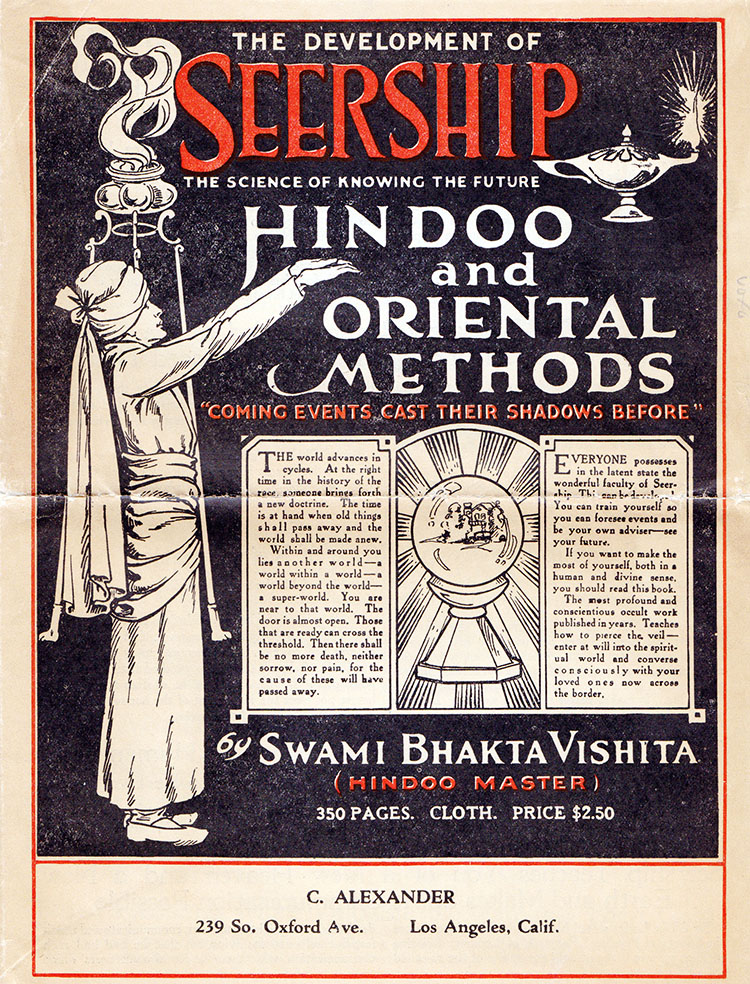
    Advertisement for advanced lessons in occultism by Swami Panchadasi (William Walker Atkinson).

    In 1922, Atkinson temporarily located to Detroit and published the twelve-volume Personal Power series of books with Edward Beals, largely a recapitulation of the main themes from Atkinson’s writing during the preceding two decades. From Detroit, Atkinson and his wife moved to Los Angeles where they remained until his death a decade later. Although age began to catch up with William Walker Atkinson during this time and his pace declined, he still gave regular lectures to New Thought congregations and lessons to small classes. 

    Atkinson only made sporadic efforts to publish his own work during the early part of his writing career and seemed to prefer leaving the business side of publishing for others to handle. While this decision left him and his heirs open to exploitation, and certainly cost him vast sums of money, it could also be seen as a reflection of his New Thought philosophy. Perhaps like his friend and mentor Helen Wilmans, Atkinson not only believed in the existence of a limitless potential supply of money and opportunity but regarded concern about money, even at the simple level of planning ahead for it in the future, to be erroneous and detrimental. For someone as prolific as Atkinson during the first decades of his career, this would have been a tenable strategy. But as his age increased and his health declined in the 1920s, it was no longer possible for him to write as he once did, and he only managed to produce a pair of unpublished manuscripts during the latter years of his life, The Seven Cosmic Laws and a primer on Theosophy. 

    In a tragic irony for the author whose words inspired so many to believe they could attain success and prosperity when William Walker Atkinson died in November of 1932 his family needed to borrow money for the funeral and burial.
    Get the issue this article appears in

    “The Other Side of Life”

    In one of his books written under the name Yogi Ramacharaka, Atkinson told his readers “that which we call death is but the other side of life.” There was no better example of this statement than his own life and legacy. After Atkinson’s physical death, his works took on remarkable lives of their own.

    William Walker Atkinson was deeply suspicious of any institution or system that would limit the freedom of the individual seeker. He was similarly distrustful of teachers who positioned themselves before the public as unquestionable authorities or objects of devotion. In his writings, Atkinson constantly counselled readers to test his teachings in their own lives, take what was useful for them, and discard what was not. In his career, Atkinson never made any serious efforts to establish his own church or institution like so many of his peers, preferring to simply write, lecture, and hold classes with small groups of students.

    These decisions, along with his liberal use of pseudonyms, profoundly affected Atkinson’s legacy. Paradoxically, they allowed for his ideas to spread widely around the world and become enormously influential in various realms, while at the same time obscuring William Walker Atkinson as their creator. 

    Even before Atkinson wrote the last of the Yogi Ramacharaka books in 1912, they began to be translated into numerous languages and disseminate around the world. Japan was particularly receptive to the works of Yogi Ramacharaka as it was in the midst of massive interest in mental healing and had recently endured a large epidemic of tuberculosis. Books like the Science of Breath and concepts like prana were translated into Japanese, finding their way into the healing system of Reiki and the work of the influential positive thinking guru Nakamura Tempu who claimed to have studied with Yogi Ramacharaka in India.

    Translations of the Yogi Ramacharaka books into Russian quickly became influential among artists and the intelligentsia, and were an important part of Konstantin Stanislavsky’s acting system which in turn influenced Lee Strasberg who trained generations of the most accomplished and celebrated actors in the United States with his ‘Method’ techniques. One young woman in Latvia, influenced by one of the Yogi Ramacharaka books translated into Russian, was Eugenie V. Peterson who would later travel to India and study with T. Krishnamacharaya. As Indra Devi, she became one of the most influential and well-travelled promulgators of yoga in the twentieth century. 

    During the interwar decades of the 1920s and 1930s, dozens of South Asian immigrants in the United States took up the profession of travelling yoga teacher and lectured to tens of thousands of people across the country after the American government declared them ineligible for citizenship. These newly-minted swamis and gurus found sets of yogic exercises and lessons lying in wait within the Yogi Ramacharaka books. In a confusing reversal, they presented the work of the American lawyer as ancient Indian wisdom to their audiences, some going so far as to sell, and even autograph, copies of the Ramacharaka books to their students.

    In the decades following his death, Atkinson’s books under his own name and several of his pseudonyms were widely distributed and republished by numerous mail-order companies. Bruce King – the man widely credited with popularising astrology under the moniker ‘Zolar’ – filled the pages of his official magazines Astrology and Horoscope during the late-Fifties to mid-Sixties with uncredited excerpts from Atkinson’s books while advertising several titles by Atkinson and Swami Panchadasi for sale directly from Zolar’s New York headquarters.

    By far, Atkinson’s most influential work was The Kybalion. The clear writing and organisation of The Kybalion made it accessible to a wide readership. The vague penname authorship by the “Three Initiates,” the name and location of the publisher (The Yogi Publication Society in the Masonic Temple Building of Chicago), and its claims to ancient Hermetic wisdom, gave the book an air of mystery and intrigue that allowed for endless speculation and for a diverse range of groups to see it as their own. 

    The hand of The Kybalion can be seen in the writings of Norman Vincent Peale, the author of The Power of Positive Thinking, and one of the key popularisers of positive thinking and the Prosperity Gospel, which holds for many Christians that God’s will is that they be physically healthy and financially well off. A 1995 article found that Peale likely took many central ideas for his best-selling work from The Kybalion, and did so by way of the metaphysical author Florence Scovel Shinn, citing among other things parallel uses of terms like “law” and “vibration” in Peale’s work and The Kybalion.2 

    William Walker Atkinson took on a new life in the late-Sixties as his books were widely rediscovered and his ideas became part of the spiritual backdrop of the era. For many Hippies who discovered yoga, the thirteen titles by Yogi Ramacharaka were a reference library in waiting. So many people wrote to the Yogi Publication Society during this time desperate for more information on Yogi Ramacharaka that the publisher produced a fallacious stock response to answer them. According to one critic, the Yogi Ramacharaka books were one of the many sources mined by Carlos Castaneda, the anthropologist whose alleged encounters with the Yaqui teacher Don Juan turned on innumerable Hippies to shamanism and ideas of magical apprenticeship.3

    The Kybalion also resonated deeply with Augustus Owsley Stanley, who mass-produced millions of doses of LSD, helped engineer the sound of the Grateful Dead, and was perhaps more responsible for the Hippie Counterculture of the 1960s than anyone else. Stanley described Atkinson’s book of Hermetic wisdom as “perfect… because it put into context all the things I had experienced on acid… Everything is connected, because it’s all being created by this one consciousness.”4

    As times changed, Atkinson’s Kybalion continued to have remarkable staying power with a wide array of seekers and aspirants. Many African American thinkers took the Egyptian origins of Hermes Trismegistus described in The Kybalion and cast it as distinctly African wisdom, using the seven Hermetic principles in works of fine art, literature, self-help, psychology, family therapy, and even bounty hunting. 

    Pagans, Wiccans, and other products of the modern revival of witchcraft also drew from The Kybalion. Figures like Laurie Cabot claimed that “the seven Hermetic Laws (were) the basis of Witchcraft.”5 One newspaper in 1989 began a multi-part series titled “Understanding the New Age” by elucidating The Kybalion’s teaching as “the basis of all esoteric principles,” and that Atkinson’s “little volume” served as an introductory and foundational text for a variety of occult groups and Freemasons.

    Some of the most striking examples of just how prolific and influential Atkinson was, and also how overlooked and under appreciated he is, come from cases in which people were influenced by several of Atkinson’s pseudonymous works without realising they came from the same hand. 
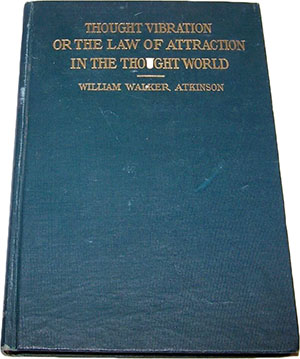
    The same overlap occurred in 2006 with the sudden and massive success of Rhonda Byrne’s self-help film turned book The Secret, which went on to sell over thirty million copies in over fifty languages and became a major cultural moment as it was feted and endorsed by Oprah Winfrey and other celebrities. While some critics and observers noted that The Secret was not much more than a repackaging of New Thought ideas, those familiar with the work of William Walker Atkinson would have seen his unspoken influence, both directly and indirectly, in Byrne’s creation through allusions to Hermetic wisdom and the constant use of “The Law of Attraction,” which Atkinson articulated over a century earlier.

    It was a testament to not only his influence but how fresh and vital William Walker Atkinson’s work has remained over time. For another author to be used and forgotten after such a prolific career would seem an insult. But for Atkinson – someone who valued placing constructive ideas into the world over constructing his own prestige and always encouraging others to use what worked for them as they found it – it was entirely fitting.

    [alert type=”general” dismiss=”no”]This article was published in New Dawn Special Issue Vol 13 No 5.[/alert]

    [alert type=”success” dismiss=”no”]If you appreciate this article, please consider subscribing to help maintain this website.[/alert]

    Footnotes

    1. From The Art and Practice of the Occult by Ophiel, Peach Publication Company, 1969
    2. “Peale’s Secret Source” by George D. Exoo and John Gregory Tweed, Lutheran Quarterly, 1995
    3. See Castaneda’s Journal: The Power and the Allegory by Richard de Mille, Capra Press, 1976
    4. “Owsley Stanley: The King of LSD” by Robert Greenfield, Rolling Stone, 2007
    5. The Power of the Witch by Laurie Cabot with Tom Cowan, Delacorte Press, 1989

    © New Dawn Magazine and the respective author.
    For our reproduction notice, click here.
  • The Strange Connection Between Science & the Occult

    The Strange Connection Between Science & the Occult

    From New Dawn 170 (Sept-Oct 2018)

    We like to think that modern science has developed as a result of rational enquiry; however, the history of science is littered with tales of bizarre experiments, eccentric characters and peculiar coincidences. 

    Many of the influential scientists responsible for the birth of modern science were not the conventional rationalists that they are often portrayed as. Although their discoveries are the result of complex mathematical workings and meticulous scientific experimentation, many of them were also heavily immersed in the esoteric world of the occult and pursued the mystical practices of alchemy, astrology and magic. 

    While the orthodox scientific community has denounced these practices as nonsensical pseudoscience, they are incredibly significant in the history of modern science. 

    This article examines three scientists who made exceptional contributions in their fields including the occult, showing the unusual and forgotten ideas that guided the course of scientific enquiry. 

    Sir Isaac Newton and the Philosopher’s Stone

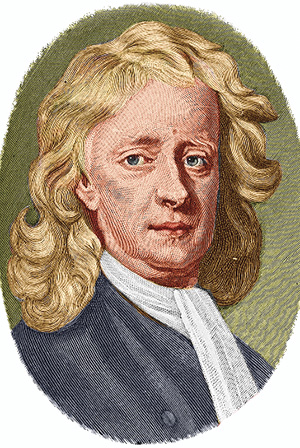
    Sir Isaac Newton is recognised as one of the most influential scientists to have ever lived and was a crucial figure in the scientific revolution during the Enlightenment period. Born in 1643, Newton is credited for developing the laws of modern physics; however, he also made discoveries in mathematics, optics, and other scientific disciplines. 

    Sir Isaac Newton, colourised engraving after Enoch Seeman’s 1726 portrait of Newton.

    His momentous book, Principia, brought him to international fame when published in 1687 and distinguished him as one of the most important scientific figures of the Renaissance. The manuscript contains information on the elementary principles of modern physics, such as the laws of motion and the theory of gravity. Newton is also credited for developing essential concepts of modern calculus, demonstrating his prodigal influence within both science and mathematics. 

    Newton’s historical legacy has come to symbolise the power of the scientific method in the development of Western civilisation, but many people are unaware that Newton was not a conventional scientist. He was a very curious individual who dabbled in the peculiar and unusual world of the occult, a realm antithetical to the narrow rationalism of science. In fact, after purchasing Newton’s manuscripts and studying his works, economist John Maynard Keynes famously stated that “Newton was not the first of the age of reason, he was the last of the magicians.”1

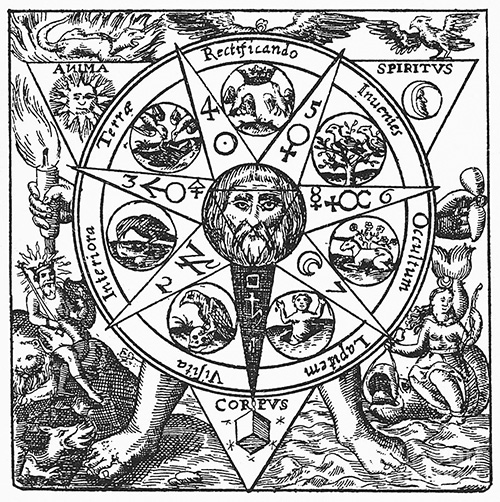
    An area of the occult that Newton extensively studied was alchemy. Alchemy was the medieval forerunner to chemistry and outwardly concerned the transmutation of base metals into gold and the discovery of a universal elixir that would bless its creator with immortality. Grounded in the discipline of hermeticism, alchemy was not only a method of chemical transmutation but also a spiritual practice by which the alchemist sought to purify their body and soul. 

    Since chemistry was in its infancy during Newton’s lifetime, many of his studies in chemical science contained language more typically associated with occultism than modern science. Unfortunately, a laboratory fire caused by his dog may have destroyed most of his works, and therefore our understanding of how much he knew about alchemy is somewhat limited. 

    Alchemical drawing rich in symbolism and hidden meaning.

    Existing works suggest Newton was heavily immersed in the hermetic discipline and his primary objective was to discover the philosopher’s stone, a mysterious substance that supposedly had the power to turn base metals into gold. The stone was central to the imagery of medieval hermetic philosophy and symbolised man’s attainment of spiritual perfection. 

    Newton’s writings suggest that he was interested in this mystical object and undertook many experiments to uncover its chemical composition. He also believed that ‘Diana’s Tree’, an alchemical process that produces a dendritic ‘growth’ of crystallised silver from a silver-nitrate solution, proved that metal “possessed a sort of life.”2

    Newton was not only interested in alchemy. He also believed the Bible contained hidden information about a future apocalypse. Unpublished documents, evidently written by Newton, indicate he thought the world would end by the year 2060 AD based on a series of mathematical calculations. It has been suggested the apocalypse he was talking about was a transformative stage in mankind’s spiritual evolution in which the human race would achieve a higher state of transcendental consciousness; however, this is mostly scholarly conjecture. 

    The original documents written by Newton are currently stored at the Jewish National and University Library in Jerusalem. It appears that they were written for personal use since Newton personally disliked date-specific biblical prophecies. This would make sense considering he provided no actual date as to when the world would end, merely predicting it would happen before the year 2060. Newton’s reasoning behind this particular date cannot be considered in cultural and historical isolation. It must be understood in the context of his antitrinitarian beliefs and Protestant views on the Papacy. His writings suggest he relied on the specific chronology of events described in the Bible, as well as the ominous prophecies described in the Book of Revelation, to calculate the date. The religious basis for his calculations is evident when he writes:

    Top:  Diagram of the Philosopher’s Stone drawn by Sir Isaac Newton, from his “Lapis Philosphicus.” Above:  Section  of the letter written by Newton where he predicts the world would end by 2060.

    “So then the time times & half a time are 42 months or 1260 days or three years & an half, recconing twelve months to a yeare & 30 days to a month as was done in the Calendar of the primitive year. And the days of short lived Beasts being put for the years of lived [sic for ‘long lived’] kingdoms, the period of 1260 days, if dated from the complete conquest of the three kings A.C. 800, will end A.C. 2060.”3

    As one can see, Newton was of the belief that biblical scripture contained encrypted knowledge about the future of humankind’s destiny; he carefully studied the chronological dates and events described in the Bible and performed complex mathematical calculations to determine the date of the apocalypse. Although he made various predictions during his lifetime, he was certain that a global cataclysm would destroy Earth before the year 2060 based on his interpretation of the Bible. 

    Although Newton’s legacy has become associated with the development of modern science, he was deeply immersed in the esoteric practices of alchemy, hermeticism and biblical prophecy. While modern science denounces these practices as irrational and absurd, Newton’s interest in the occult suggests they played a more significant role in the history of scientific enquiry than we have been led to believe. 

    Galileo and the Art of Astrology

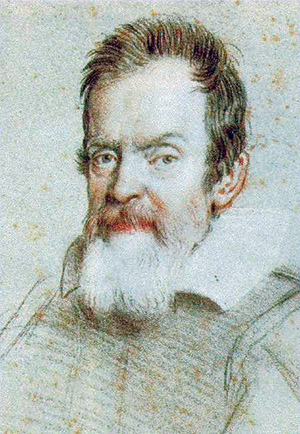
    Galileo Galilei was a mathematician, astronomer, physician and engineer during the Italian Renaissance; he is considered to have been a central figure in the transition from natural philosophy to modern science. 

    Galileo Galilei (1564–1642)

    Born in 1564, Galileo made a number of breakthrough discoveries in mathematics, optics and astronomy. In 1609, he heard about the invention of the spyglass, a device that made objects in the distance appear closer, and used mathematical knowledge to design the first working telescope. Galileo then made his first astronomical discovery when he cast the lens of his new invention upon the surface of the moon. He was also the first astronomer to observe the four moons of Jupiter, track the planetary phases of Jupiter and detect sunspots on the Sun. 

    Galileo faced fierce opposition from the Roman Inquisition since his writings promoted a heliocentric view of the universe in which the Earth rotates around the Sun. The Inquisition believed that this fundamentally questioned man’s central place within the cosmos and sentenced him on the grounds of heresy, resulting in indefinite imprisonment until his death in 1642. Ever since Galileo has become known as one of the most influential scientists to have ever lived. However, many people are unaware that he had an interest in mysticism and hermeticism as well as the mysterious world of the occult.4

    Like many scientists during the Italian Renaissance, Galileo was well practiced in the art of astrology. Although the idea of astronomers practising astrology seems alien to us in the modern age, during the Renaissance period many early scientists believed that the position of planets and stars influenced man’s destiny. In fact, it has been suggested that scepticism towards astrology only emerged during the Enlightenment period, when scientists like Rene Descartes emphasised the importance of scientific doubt. Before then, astrological beliefs were deeply embedded across European culture, and members of the aristocracy relied on its predictive power to make important political and economic decisions. 

    The Medici Family, who ruled over Florence during the 15th century, would often appoint astronomers to interpret their horoscopes. When Galileo discovered the four moons of Jupiter in 1609, he told the Medici Family that fate had reserved the planetary objects for them so each of the family’s four sons would have one to their name. In fact, when Galileo revealed knowledge of the discovery in his book, Sidereus Nuncius, he decided to name them “Medici Sidera,” meaning the Medician Stars.” When the Roman Catholic Prelate, Piero Dini, questioned how he could be so certain of the connection, Galileo replied in a letter arguing that the discovery of Jupiter’s four moons were inextricably connected with the family’s rising political and economic influence. Galileo also talks about how smaller planets might affect our destiny in ways that we are unaware and distinguishes between superior and inferior causes of planetary influence, writing:

    “If therefore, of the inferior causes, those which arouse boldness of heart are diametrically contrary to those which inspire intellectual speculation, it is also most reasonable that the superior causes (if indeed they operate on us) be utterly different from those on which courage and the speculative faculty depend; and if the stars do operate and influence principally by their light, perchance it might be possible with some probable conjecture to deduce courage and boldness of heart from very large and vehement stars, and acuteness and perspicacity of wit from the thinnest and almost invisible lights.”5

    It is easy to view Galileo’s interest in astrology as the result of social and historical circumstances. While it is undoubtedly true that astrological practice was common among the scientific elite during the Renaissance period, particularly among the aristocracy of Italian society, his writings suggest a sincere belief in the idea that planets and stars influenced humankind’s destiny. Moreover, there is evidence to indicate that he not only produced astrological readings for the Italian aristocracy but his close family as well, suggesting a personal belief in its predictive powers. 

    Although Galileo has come to symbolise the power of modern science to enhance our understanding of the cosmos and our place within it, many people forget he was deeply engaged in the mystical practice of astrology and its power to predict the economic, social and political destinies of people’s lives. Although many scientists denounce astrology as pseudoscience, there is no denying that it played an interesting and significant role in the history and development of science, particularly in regards to Galileo’s life. 

    Paracelsus and the Hermetic Tradition

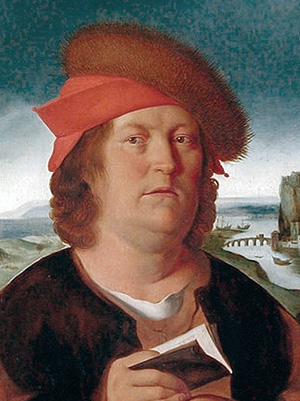
    Paracelsus, or Theophrastus von Hohenheim, was a Swiss-born physician, alchemist and astrologer. Born in 1493, Paracelsus was an influential figure in the ‘medical revolution’ during the German Renaissance and emphasised the importance of experimentation in medical science. He has been labelled the ‘father of toxicology’, one of his most notable phrases being, “The dose makes the poison.” 

    Paracelsus (1493–1541)

    Paracelsus was also one of the first people to suggest that physicians should receive an education in the natural sciences and study the basic principles of chemistry as part of their schooling. Interestingly, he is credited with giving the element ‘zinc’ its name as well as inventing chemical therapy, chemical urinalysis and early theories of digestion. 

    While the medical establishment opposed many of his ideas at the time, particularly his views on medical education, he is currently recognised as one of the most influential figures in the history of medicine. His discoveries contributed significantly to the development of natural science and transformed our understanding of chemistry and its application in relation to medicine. Saying this, however, many forget that Paracelsus was  immersed in hermetic philosophy and the mysterious world of the occult.6

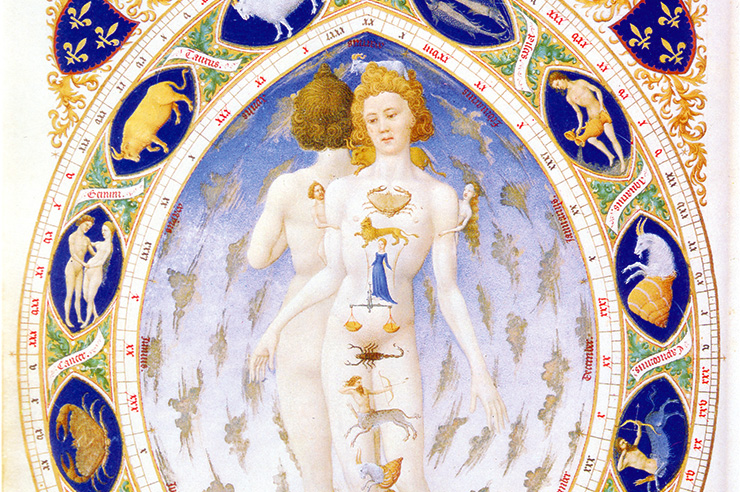
    Paracelsus had a profound interest in astrology, the art of prediction based on the position of stars and planets. Since medicine and astrology were closely connected during Paracelsus’s lifetime, he believed in the commonly held notion that each part of the body corresponds with a specific planet or zodiac sign, and therefore medical procedures should be undertaken according to the position of the solar system to ensure their effectiveness. 

    He also believed in the hermetic idea there are two worlds: the microcosm (which refers to the world of man and Earth) and the macrocosm (which is the heavenly universe or the spiritual world) and that these two worlds interact and influence each other. He states that:

    “Know that there are two kinds of stars – the heavenly and the earthly, the stars of folly and the stars of wisdom. And just as there are two worlds, a Little World [the Microcosm, man] and a Great World [the Macrocosm, the Universe] and just as the little one rules over the great one, so the stars of the microcosm rule over and govern the Stars of heaven.”7

    There has been much discussion about the historical sources of Paracelsus’s known magical beliefs. The Archidoxis Magica, for example,was supposedly written by Paracelsus in 1561 and contains information on magical talismans that can be used to cure illness and disease. Many historians dispute that he produced the manuscript since none of his other works discuss the use of talismanic objects; however, it is possible that he may have acquired a sudden interest in their magical potential. 

    While the authorship of Archidoxis Magica remains subject to scholarly debate, there is no denying that mysticism deeply influenced Paracelsus; in particular the belief that each organ corresponds with a planet and precious metal, which is central to the philosophy of hermeticism. During the medieval period, the Sun was thought to rule over the heart and its corresponding metal was gold. The Moon ruled the brain and its metal was silver. Mercury ruled the lungs and its metal was silver or quicksilver. Venus ruled over the kidneys and its metal was copper. Mars ruled over the bladder and corresponded with Iron. Jupiter governed the liver and corresponded with Tin, and Saturn ruled over the spleen and its metal was lead. Therefore, one can see that Paracelsus believed in the hermetic idea of microcosm and the macrocosm; that the body corresponds with the structure of the cosmos and that both spheres must exist in a state of harmony for man to attain earthly and spiritual perfection. 

    Saying this, however, Paracelsus was not a determinist astrologer and believed that while the planets and stars could influence human destiny, we still have some degree of free will, writing: 

    “Even if he is a child of Saturn and if Saturn has overshadowed his birth, he can still escape Saturn’s influence, he can master Saturn and become a child of the Sun.”8

    The life of Paracelsus highlights the blurred line between science and mysticism that secretly guided the history of modern science. Although he is credited with scientific innovations such as urinalysis, toxicology and chemical therapy, Paracelsus had a serious interest in the practices of astrology, alchemy and hermeticism. There is much scholarly debate regarding which manuscripts can be attributed to Paracelsus, but the evidence clearly suggests he was not a conventional scientist; he was an inquisitive mind, deeply immersed in the occult. 

    Get the issue this article appears in

    Conclusion

    The distinction between the occult and science has not always been as clear-cut as many of us like to think it is. Many of the influential scientists that we have come to associate with the birth of modern science were clearly involved in the study and practice of alchemy, astrology and biblical prophecy. Moreover, it would appear that many of these scientists believed in the power of these practices while simultaneously recognising the importance of scientific inquiry. 

    Galileo was a key figure in the transition from natural science to the scientific revolution, however, he also believed that planetary bodies could influence the destiny of humanity. Similarly, Newton used complex mathematical principles to outline his theory of gravity but also turned to biblical prophecy to predict the end of the world. Paracelsus made a number of discoveries in chemical science but also believed in hermeticism. 

    It is easy for modern science to portray its historical development as linear and coherent, but many of the individuals responsible for humanity’s greatest scientific achievements were inquisitive minds fascinated by the mysterious, peculiar and esoteric world of the occult.

    [alert type=”general” dismiss=”no”]This article was published in New Dawn 170.[/alert]

    [alert type=”success” dismiss=”no”]If you appreciate this article, please consider subscribing to help maintain this website.[/alert]

    Footnotes

    1. John Maynard Keynes (1946), ‘Newton, the Man’ [online] available at http://phys.columbia.edu/~millis/3003Spring2016/Supplementary/John%20Maynard%20Keynes_%20%22Newton,%20the%20Man%22.pdf
    2. Wikipedia (2018), Isaac Newton’s occult studies [online] available at https://en.wikipedia.org/wiki/Isaac_Newton%27s_occult_studies 
    3. Ken Ludden (2012), Mystic Apprentice Master Volume with Dictionary, lulu.com, page 413
    4. Britannica, Galileo: Italian Philosopher, Astronomer and Mathematician [online] available at www.britannica.com/biography/Galileo-Galilei 
    5. Nick Kollerstrom (2004), Galileo’s Astrology, skyscript.co.uk [online] (available) www.skyscript.co.uk/galast.html
    6. Wikipedia (2018), Paracelsus [online] available at https://en.wikipedia.org/wiki/Paracelsus 
    7. Nicholas Campion (2009), A History of Western Astrology Volume II: The Medieval and Modern Worlds, Bloomsbury, page 117
    8. www.renaissanceastrology.com/paracelsus.html

    © New Dawn Magazine and the respective author.
    For our reproduction notice, click here.
  • Ley Lines: Understanding the Hidden Streams of Energy in Your Environment

    Ley Lines: Understanding the Hidden Streams of Energy in Your Environment

    From New Dawn 171 (Nov-Dec 2018)

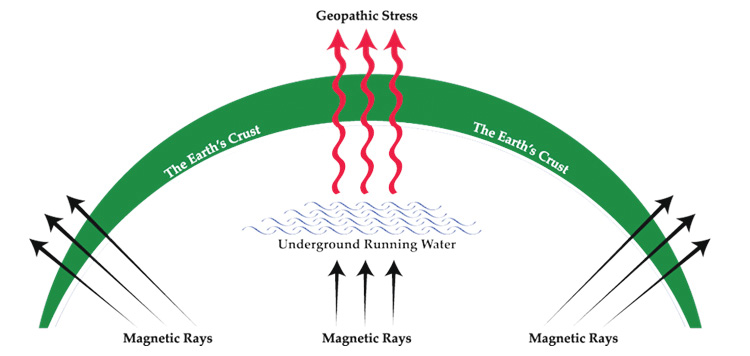
    There are a multitude of energy lines traversing the globe – some natural, others man-made. Most of these energy lines have a subtle effect on the human body as we are also made of energy. Some energy frequencies nurture and harmonise our own frequencies, while others disrupt them. 

    Collectively, earth energy lines are often connected to ‘geopathic stress’ when they are unbalanced or causing some disruption in the human energy field. These include electromagnetic lines, fault lines, water lines and ley lines. This article focuses on ley lines, a term often confused with other geopathic lines of energy. 

    Most other lines are natural to the earth, can move in a meandering way like a river, and have no intentional purpose towards humans (even though we can benefit from their energy). Ley lines can often be found in conjunction with these lines, however a ley line is always straight, is man-made in some way, and has a purpose of communication.

    There are three types of ley lines: global, local and personal. Global and local ley lines are usually created intentionally, often using physical objects to transmit energy and are focused to communicate to the wider community or environment. Personal leys tend to be unconsciously sent to an individual. Even though these leys are unintentionally sent, personal ley lines stay with the person or in the environment until intentionally cleared.

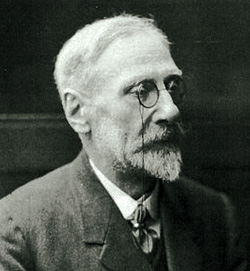
    Alfred Watkins

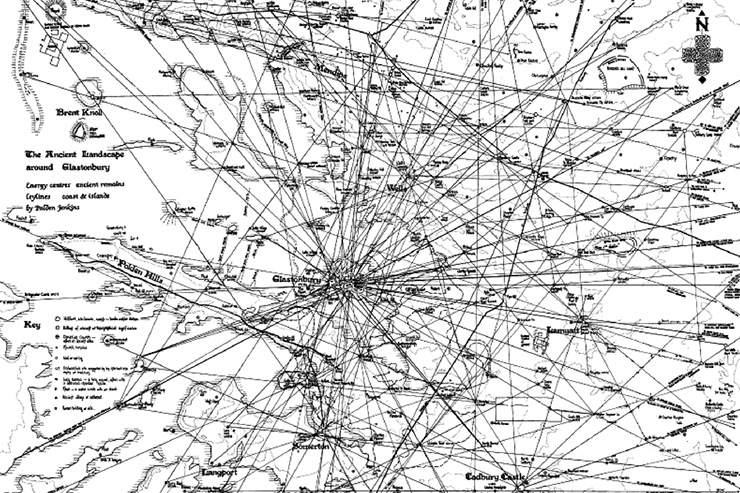
    The term ley lines was first used by Englishman Alfred Watkins in 1921, when he discovered natural features such as trees or mountain tops, connecting in straight lines with man-made features, such as old churches, sign posts and wells, spanning across the English countryside. He theorised that these man-made markers were for the purpose of travelling vast distances, like a guide map. These lines were of a more physical nature to communicate direction for travel. Since then, geomancers have discovered many leys can also be purely of an energetic nature, but still form some sort of communication purpose.

    Some global and local ley lines also follow the paths of the Earth’s natural energy lines, drawing on the natural energy for their own purpose. The ley will always be intentionally positioned and communicating something. For example, church builders may have been attracted to a building site because of the energy in the land, such as underground water lines or electromagnetic lines. The pulpit may be placed above the nature energy to boost the message, which is sent out through the man-made ley line. The ley line is built connecting the pulpit in a straight line with upright stones, other churches or the town’s well, to subtly spread the ‘word’ throughout the community. A ley line usually has a minimum of three markers relaying the message (often large quartz filled rocks, as quartz can store and transmit information). 

    The master builders of the gothic cathedrals created vast entrances using geometry to inspire awe and used sound technology to resonate chanting to evoke emotional responses. Is it that hard to believe that at some point in our past we knew how to send subtle communications and evoke emotional responses through the air and ground? (Well, we do now – it’s called the World Wide Web on Wi-Fi!)

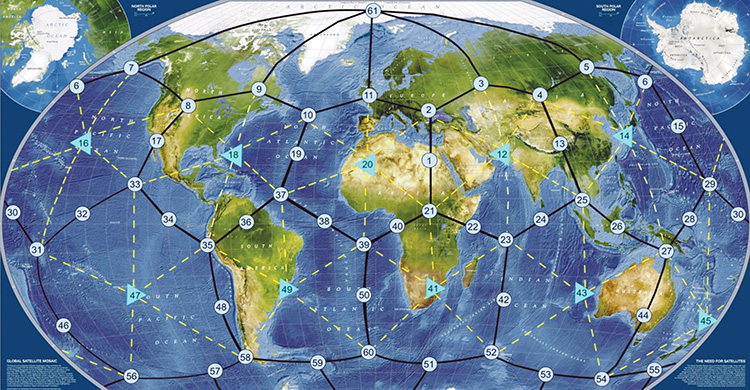
    On a global scale it is unknown who set up the ley lines or what is being communicated. In Sacred Geometry of the Earth: The Ancient Matrix of Monuments and Mountains (reviewed in New Dawn 158) authors Mark Vidler and Catherine Youngshow global alignments of natural features such as mountains and coastlines mainly forming triangular shapes. Where a natural feature didn’t form a triangle an ancient man-made structure was usually found. These included mounds, henges or buildings, as well as sacred sites, such as the Great Pyramid of Giza, Stonehenge, the Carnac stones and Angkor Wat. Why did someone want to make geometric shapes that span continents? 

    According to Hermetic literature and the Dome Theory, dome shaped energies were sent down from spaceships spreading love and light via ley lines around the world. This energy was to aid in the evolution of humanity.1 Ancient man or aliens – whoever built these leys or what they were communicating remains a mystery. 

    There is a theory that the Great Pyramid may have been an electrical power generator using the obelisks to wirelessly send electricity around the globe. The great inventor and engineer Nikola Tesla also tried to send electricity wirelessly with his power generators rumoured to be situated on ley lines. Perhaps the hundreds of quartz filled, large standing stones at Carnac, France, are just an ancient world telephone exchange!

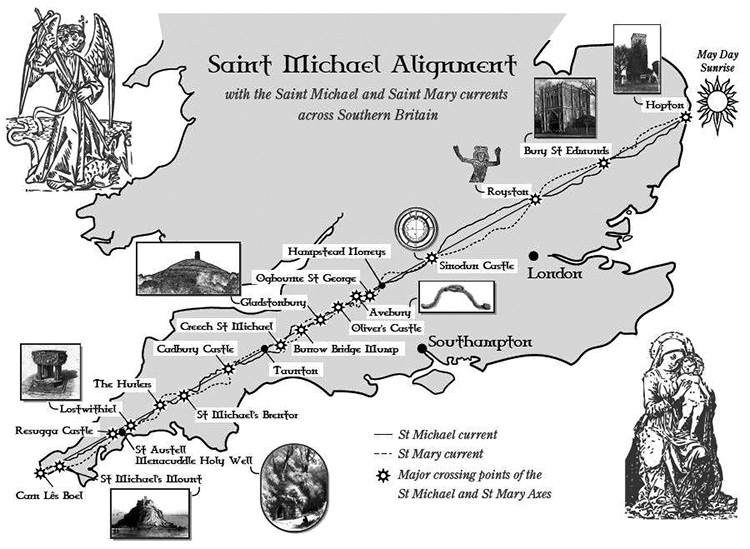
    Ley lines on a local level radiate from places of worship, town halls, governments or palaces into the community to communicate messages from the ‘powers that be’ to the unsuspecting townsfolk. The most famous local ley line is the St. Michael Ley in England. This ley connects many sites dedicated to St. Michael and follows the path of the sun on the 8th May, St. Michael’s day. This ley also intersects with leys in France and Greece. 


    St. Michael Ley in England which also matches with a St. Mary current of energy, representing the sacred union of the divine feminine and masculine.

    Both the French and the English leylines have clear signs of prehistoric activity along its path (such as the Hurlers, Glastonbury, Avebury, Waulad’s Bank, Dol-de-Breton), and also ancient traditions of celebrating with fires on beacon-hills on may-day (St. Michael’s day), all of which reinforce the idea of a ‘functional’ and operative alignment with prehistoric roots. Both alignments also include numerous churches and pilgrimage points dedicated to St. Michael (Apollo), that were ‘reinforced’ throughout the middle-ages by the church. One suspects that an ancient tradition has been passed on either knowingly or unsuspectingly during the Pagan/Christian conversion of Europe.2

    Not all local leys are used for manipulation or brainwashing; some can have a beneficial effect such as feelings of peace and for healing. For thousands of years people poured energy into these lines via the various temples and places of worships (like relay towers), making the energy lines stronger. A very spiritual place is where the Apollo and Athena leys (named as their temples lay along the line) cross at Notre Dame Sous La Terre, France.

    Australia’s Aborigines have ‘songlines’ which map out vast tracks across Australia. These help to physically navigate the landscape just as Watkins thought the purpose of leys were in England – signposts. The songlines are not straight or man-made, therefore do not fit the definition of a ley line, however the Aborigines in their sacred wisdom do have some way of sending specific messages instantly between peoples over vast distances. 

    Most local leys are hundreds of years old, however this technology is still being used today. Search the Internet for leys in Australia and you will find suspected links between Canberra to the Vatican through Pine Gap; a HAARP installation at Exmouth WA linked to its installation in Alaska and to Canberra, intentionally situated to promote mind control or for influencing the weather.3

    Many local and global ley lines have been charted (especially in England where ‘ley-hunting’ has been a craze since Watkins’s time) but they are often confused with being either part of the natural environment or simply sign posts for travel. The larger purpose of intentional communication has not been fully grasped. These ley lines may draw on the Earth’s natural lines of energy for power, but the emotion or thought they are carrying has been inputted at some time by outside influences. 

    Another characteristic of ley lines is that their energetic blueprints stay in the environment, even if the initial structures are long gone, still holding and possibly transmitting the ‘message’. 

    Global grid points (marking ley lines) based on the UVG Planetary Grid model of William Becker & Bethe Hagens. Grid point 44 links to Wilpena Pound, the Flinders Ranges, South Australia, known for its unusual geological formations.

    Energy Cords & Personal Ley Lines

    Personal ley lines can also use structures to relay messages; they tend to target a person through their bed, stove or computer. One of the main differences with personal ley lines is that they are usually unintentionally transmitted, whereas local and global ley lines are more consciously laid out (although some personal ones are conscious and may be vice versa for the larger ones).

    Energy lines between people, often referred to as ‘cords’, occur in a personal, emotional relationship, such as between lovers or parent and child. Similar to ley lines, they transmit emotions (positive and negative) and have to be energetically removed. These cords attach to the body usually through the chakra system, are created by interpersonal relationships, and can last forever. Personal ley lines can be sent from anyone, from anywhere around the world and affect the person through objects as well as being sometimes attached to the body. Personal leys usually attach to a person’s bed affecting rest and rejuvenation, the oven to restrict nourishment, or the computer to upset business or mental pursuits. Cords can be positively based, such as sharing a love bond, or negative with one person draining the energy from another. All personal ley lines I have ever found during my Geomancy work, using dowsing, have had a negative impact on the person and have to be removed. This may be a subtle draining of energy and health over a long time or have an immediate physical effect, depending on the initial event that set-up the ley and the amount of emotion fed into it.

    The most dramatic situation I encountered was with a vet nurse in her thirties who developed severe arthritis in her wrist and knee joints. She suffered with this condition for three months, trying many different remedies to no avail. I found a ley line hitting her bed and oven, which was being sent unconsciously by a lady whose cat had been put down at the vet. The vet nurse had become the focal point for the cat owner’s grief. Together we sent loving energy back down the ley to the cat owner, thus closing the ley. The next morning the arthritis was gone, never to return. 

    Other leys are more subtle; another client had a personal ley line hitting her bed and oven, sent by her ex-husband of more than twenty years ago. They had married young and weren’t together long, but the husband was obviously disgruntled at being left for her current husband, thus unknowingly creating this ley line. The ley line wasn’t very strong, but had stayed with the lady for 20 years, moving with her through a number of addresses and after having three children with her new husband. The ‘communication’ of this ley was depleting her relationship energy; six months after clearing the ley the lady felt that her relationship with her husband had become “stronger and somehow more connected.”

    Many years ago when running New Age events, I had a ley line hitting my computer from a local church group. They were against my business (not that they understood anything about what I was doing!). This ley line was unintentional as the group didn’t purposefully create the line; however they did intend to send negative energy in their prayers to shut me down. They were not targeting me personally, thus the bed and oven were not affected. I experienced a week of setbacks, miscommunications and foggy thinking about my business before I thought to dowse for some clues as to what was going on, thus finding and clearing the ley line. If this ley line had continued, whether the group kept feeding energy into it or not, it would have greatly affected my business. 

    Some personal ley lines are created by a one-off strong emotional event, but most are created by constantly feeding emotion towards a person. The worrying thing about the above situation for me was that there was a small group of people sending out negative thoughts and emotions (or asking their god to do it) intentionally to disrupt my business. I closed the ley by sending love and light back to the church group (after I had calmed down and centred myself!).

    Personal ley lines can travel with a person as they move residences and can also be left on a property from a previous resident, thus affecting the new homeowners. I’m not sure if they duplicate for this purpose or if some move and others don’t depending on the energy being sent through them. Most ley lines I have cleared from houses have been directed at past owners, therefore I am unsure if a line still connects to those people or not. Leys can also travel over any distance; time and space do not influence these energy lines. The shortest ley I have encountered was only a few meters long, starting from one desk in an open office space to another desk. The manager confirmed encountering trouble between these two workers.

    Dennis Toop, a dowser from South Australia with over 50 years experience, remotely checks for and clears personal ley lines, through his business The Property Healer (www.thepropertyhealer.com). Dennis’s focus is helping property owners balance the energy of their homes ready for sale. He defines ley lines as: 

    …set up by people’s thoughts about another person or group of people. For example, a business owner may be in conflict with an employee who thinks negatively about them, thereby setting up a dowseable negative ley line. On the other hand, a positive ley line could be set up by someone thinking fondly of their child living in another suburb. For most houses strong, personal and negative ley lines are the most problematic. I’ve found ley lines can be from a single source, e.g. any place where people are stressed; airports, hospitals, funeral homes, old folks homes, mental institutions; these just radiate out into the surroundings. If you happen to sit in your lounge chair in one of these you will feel depressed. I find that this is the chair no one sits in but have no idea why. Ley lines are so important regarding the vibe of any property and relate to past human interactions which explains what people are picking up on, once put in place they just seem to stay in place until another thought cancels it out.

    As the universal law goes, “what you send out, you get back multiplied,” therefore it is not only the recipient of the ley line that is being affected but also the sender. Ley lines become stronger when constant thoughts are channelled into them, e.g. “I hate you,” “Why did you do this to me?,” “I’ll never forgive you,” “I hope you suffer,” etc. The intention may not be to really harm a person, you’re just angry or worrying, but a ley line may occur that stays with both you and the recipient forever, draining both your energies. If you intentionally send a ley line to harm someone, then it will rebound on you as well.

    Get the issue this article appears in

    BALANCING LEY LINES

    Don’t worry about global ley lines; they are still a mystery, working on some larger scale and don’t affect us personally. If you have a local church or other authoritarian institution nearby you suspect of emitting local ley lines, you can consciously or physically place a barrier between your house, facing the institution, with the intent of stopping any subtle communications. In Feng Shui they use a bagua mirror (an eight sided shape with symbols and a round mirror in the centre, see example on right) to reflect back any negative energy. I have one in my back window facing the local church.

    To clear a personal ley line from your property (either directed at you or left by past occupants) stand at the end of your bed, oven or computer visualising a line of energy coming in. Then send loving energy back down the line with the intent of closing the ley. You do not need to know from whom the ley came from to be able to clear it. As most ley lines are sent unconsciously, without intent to harm, sometimes it is best not to know who it has come from. Dennis uses “an impeccable thought,” utilising gratitude and love to clear the ley. As Dennis mentions, if you send negativity down the ley it may not close, but make it stronger. Ley lines do not clear themselves; they are created by emotions and mental thoughts and must be cleared in the same manner, with higher frequency emotions and mental thoughts, i.e. love.

    If you suspect that you may have created a ley line in the past, visualise the ley line running from your heart chakra to the other person. Consciously send love and gratitude (and maybe an apology for setting up the ley) with the intention of closing the ley. Similar visualisations are used to clear the cords between people, e.g. in your mind’s eye, meet the person on the beach, say what you want to say, send love and thanks, see the cord connecting you both and sever it.

    Basically, pure loving energy will always cancel out the negative. There has only been once that I didn’t send love. After the publication of my first article in New Dawn, over three years ago, an intentional ley line was sent to my computer. It was sent from an organisation in America to ‘just keep tabs’ on my writing. I sent them back laughter and thanks for thinking I could be that interesting! This also demonstrates another point about personal ley lines – the sender does not need to know physically where you are to send negative energy.

    It may be difficult to imagine a world full of varying energy lines that are impacting on all areas of your life, but in another case of man imitating nature, we have the Internet. Think of global leys as the World Wide Web (they are just there), local leys as Google, Facebook or Amazon (institutions trying to spread their message to the wider community) and personal leys as text messages or Instagram (between people). By being consciously aware of ley lines and clearing them from your home allows you to stop the subtle manipulation by others impacting your life, and to maintain your own energetic integrity.

    Further Reading: Sacred Geometry of the Earth: The Ancient Matrix of Monuments and Mountains by Catherine Young & Mark Vidler & Power Places and the Master Builders of Antiquity: Unexplained Mysteries of the Past by Frank Joseph.

    [alert type=”general” dismiss=”no”]This article was published in New Dawn 171.[/alert]

    [alert type=”success” dismiss=”no”]If you appreciate this article, please consider subscribing to help maintain this website.[/alert]

    Footnotes

    1. ‘Ley Lines and The Meaning Of Adam’ by Richard Leviton and Robert Coons, www.bibliotecapleyades.net/ciencia/antigravityworldgrid/ciencia_antigravityworldgrid06.htm
    2. St. Michael, www.ancient-wisdom.com/stmichael.htm
    3. www.youtube.com/watch?v=D96yFjFe5-w

    © New Dawn Magazine and the respective author.
    For our reproduction notice, click here.
  • The Internet is Killing Your Brain & Creativity Will We Succumb to the Mindless Tech-Matrix?

    The Internet is Killing Your Brain & Creativity Will We Succumb to the Mindless Tech-Matrix?

    From New Dawn 168 (May-June 2018)

    In our industrialised societies of 24/7 connectivity and e-Everything, almost every aspect of daily life is mediated by some form of technology. The worlds of work, education, leisure, food, transport, health, media and many more are now not only extended and sometimes enhanced by technology, increasingly they are almost impossible without it. Aside from the potentially catastrophic consequences of this dependence – a subject recently explored at length in these very pages – the proliferating technologies of communication, commerce, and entertainment present particular cause for concern. Drained by chronic overstimulation, gorged on info-tainment, and drowning in a tidal wave of trivia, billions of us are increasingly lost in a lurid fantasy land of surfing, gaming, smartphones, and various other digital distractions. 

    Although critics of current trends aren’t difficult to find, their influence is no match for the global media machine that techno-evangelists such as Mark Zuckerberg, Elon Musk and Bill Gates have at their disposal. Even calmly-reasoned suggestions that we give more consideration to the future we are making are noisily drowned out by the launch of glitzy new gadgets or the latest plans to colonise Mars.

    One can, of course, argue that we are and have always been technological beings. From hammerstones to hand-axes, hominids have used tools for millions of years, so in that sense haven’t we always been cyborgs? There are two distinct points here: what it is in our nature to do, and how we actually do it. We are both creative and destructive, but even the better angels of our nature sometimes make bad decisions. We’re social animals too, so talking and listening and liking and sharing are part of what we do. Yet the sheer scale, scope and speed of information exchange in the techno-industrial age is causing some serious side-effects, and they’re getting worse.

    During the early days of mass media and communication, some worried about the increasing presence of propaganda, excessive consumerism, and vapid pop culture. The blue glow of television screens began to take over family gatherings now fallen silent. Then a TV in each room broke up such gatherings altogether. Soon, televisions in bars, restaurants, hotel lobbies, airport lounges, and train stations began to take centre stage, further sidestepping human interaction. Even hospitals and dentist waiting rooms weren’t immune. Such burning issues of the mid-to-late 20th century, however, now appear almost quaint.

    In some sense, however, we’ve always known that this day was coming. From Orwell’s 1984 to Huxley’s Brave New World – in which propaganda and mass communication play such a central role – the spectre of a near-future dystopia has loomed large in the collective consciousness, although often just beneath the surface. It was there even earlier, in fact, when some of today’s machines and mechanisms of control could only be imagined. In Fritz Lang’s 1927 movie Metropolis, for example, and in E.M. Forster’s visionary 1909 short story ‘The Machine Stops’ which anticipated the Internet with uncanny accuracy.

    The birth and growth of the Internet and modern communication technologies is transforming our daily lives, occasionally for the better. But the transformation of our minds and bodies – profoundly, rapidly, and with scant heed to the consequences – should make us stop and think. The general technological milieu of smartphones, tablets, PCs and other devices used in social media, gaming, and Web surfing produces many negative effects, from depression to loneliness, isolation to anxiety, and low self-esteem. Technology, supposedly designed to bring us together, can instead drive us apart, or to despair. And despite the vague sense of unease many of us feel about our relationship with our gadgets and gizmos, it seems we simply can’t live without them.

    Many people suffer significant distress if forced to endure network outages, no signal, flat battery or similar malfunctions. Nomophobia – or phone separation anxiety – although not officially accepted as a pathology, is real enough, and it seems that most compulsive smartphone users would rather visit the dentist than be without their little e-window on the world (although the dentist’s waiting room presumably has a TV). Phone store employees have reported customers with dead handsets displaying levels of grief normally reserved for funerals. Checking your phone during the night, during meals, while driving, while reading this article, or during sex (yes, this actually happens) may indicate that you have a problem. It can ruin your sleep, compromise your relationships, and cause all manner of mental and physical stress.

    The fact that we are social animals inevitably means that, to some extent, we all need a certain amount of validation from our peers. In a world of ‘friends’ and ‘likes’, therefore, our online activity is often reactive, dictated by the responses of others. It’s social media as popularity contest. This can quickly become anti-social, not just when it eats up time once devoted to relationships and meaningful activities in the real world, but when it attacks those who aren’t sufficiently sold on the ‘obvious’ merits of increasing and unlimited time online. In this sense, social media and modern communications technology function like religion: too many people openly opting out can cause the faithful to question the fundamental basis of their beliefs. For the techno-utopians, this clearly will not do.

    The content of all this online activity – memes, memories, and media of all kinds – also exerts enormous pressure on both the poster and the reader: those whose existence the thoughts, pictures, songs, videos and ‘life events’ supposedly represent, and those for whom these scrapbook entries either make them feel better about their own lives or appear as an idealised vision of a life of which they can only dream. This has a number of side-effects. Individuals with otherwise perfectly satisfactory lives can suffer undeserved feelings of inadequacy by comparing their own jobs, relationships or material possessions to those of others. ‘Keeping up with the Joneses’ may be nothing new but the Net lets us into the lives of others to an extent that suburbia never could. Filtered, air-brushed, photoshopped versions of reality also foster unrealistic expectations that the real world can never really hope to match. This can spawn a sense of entitlement similar to the reward-without-effort, gain-without-pain picture painted by TV ‘talent’ shows such as The X Factor – the idea that little Johnny or little Jenny are as talented as anyone else and that this conspicuous talent must be publicly recognised and rewarded. 

    Another outcome is the tremendous tide of narcissism currently sweeping tech-societies. Obviously Facebook is your face and Myspace (remember that?) is your space, but the Net broadcasts and boosts our egos instantly and everywhere, sometimes causing us to believe our own hype. This unprecedented power also has a nasty habit of emphasising and exaggerating negativity, making things seem worse than they actually are as they are copied and shared everywhere. News that would once have taken days or even weeks to wend its way around the world now goes global in seconds. Whether it’s actually true or not isn’t the main issue. And as transitory and ephemeral as stories, selfies, and all other Web froth seems, it will be preserved online forever, in theory at least. Our dreams of immortality may finally come true as profiles that cannot be deleted. 

    Isolated Individuals & Hikikomori

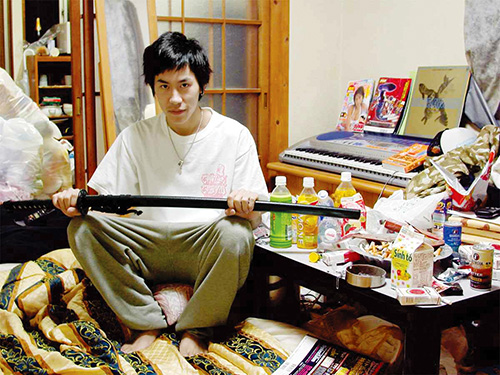
    In large part due to the isolation and lack of face-to-face contact from excessive tech use, the early 21st century is witnessing the widespread erosion of social skills. Many young people simply do not develop the ability to communicate without a digital mediator. This can leave them floundering in the endlessly-complex world of real people and real situations. Although partly due to economic factors and the wider cultural milieu, the Japanese phenomenon of hikikomori offers an ominous glimpse of the future for the rest of the industrialised world. Living with their parents well into their thirties (with no end in sight), hikikomori are reclusive misfits – mostly male – who endure lives of extreme isolation cut off from the rest of society. It’s a pattern beginning to repeat in the West where asociality and avolition are on the rise, and not just among young males. A subset of these groups is those whose feelings of inadequacy and hopelessness breed with a festering sense of entitlement and unrecognised genius to produce nihilism and even misanthropy. Left unchecked, this can result in depths of despair that have ended in desperate acts such as suicide and school shootings.

    The generalised disinhibition seen online has other unfortunate downsides. As most of us know to our cost, the Web is full of tough guys who know it all and have all the answers. It’s largely positive that pretty much anyone is now free (subject to a certain amount of self-censorship or account suspension) to express their opinions online. But the fact that so much discourse is now virtual has eroded and, in some cases, erased the emotional and physical boundaries which govern and guide human interactions – and all but dispensed with the idea that actions have consequences. Keyboard warriors hiding behind false identities are unlikely to get a punch in the face from someone they offend. Combined with anonymity, this apparent immunity and invulnerability fuels stalking and cyber-bullying which on many occasions had dire real world consequences in the form of murder and suicide. The rise of so-called ‘hate speech’ has happened for similar reasons, and this phenomenon highlights another side of the story. As so-called ‘snowflakes’ and ‘safe spaces’ proliferate, so too has rapid-fire, knee-jerk offending and being offended. Extreme over-sensitivity increasingly stifles online debate and discourse. Uploaded to the Web, political correctness has indeed gone mad, and online trends have a habit of spreading offline too. From celebrity sex scandals to transgender toilets, we will seemingly focus on just about any nonsense or nonentity rather than face much more pressing social, economic and environmental problems.

    It’s worth noting at this point that the clichéd dichotomy of digital natives (younger generations born into technology) versus digital immigrants (older people adopting technology) is often misleading. Much of the growth in social media use, for example, is among older people with younger people now showing less enthusiasm for many of the most popular platforms.

    Education & Fragmented Thinking

    One area where our tech-addicted culture does, however, detrimentally affect young people in particular is education. There are a host of factors in play, from over-reliance on technology in the classroom to the symptoms of tech-addiction which make learning itself difficult. Depending on the Internet for information recall has meant little or no need to actually memorise anything. This has contributed to both declining reading rates and declining literacy, further aggravated by a growing inability to write – not just spelling, grammar, and punctuation now transposed into text speak – but actual physical writing on paper. Numerous studies have shown that absorbing information on paper as opposed to screens leads to more immersion and better retention. We also see shrinking vocabulary among certain groups of young people and the resulting inability to express themselves generates enormous frustration. This, in turn, affects their ability to function in the real world where poor communication skills are a definite disadvantage. Overstimulation caused by tech-overload also leads to fragmented information intake and fragmented thinking. Instead of reading an entire book or listening to an entire broadcast, we get cut-and-paste snippets and sound-bites, often out of context. Although touted as necessary and even desirable in today’s fast-paced world, our tendency to multi-task is atomising our minds. This comes with an increasing inability to concentrate or remain focussed for even modest periods of time. Shortened attention spans result in shallower thinking and understanding. In some cases, we may even be losing the very capacity to think. Thinking in any meaningful way about anything much is fast becoming unfashionable.

    In response, the education system in many tech-societies has been dumbed down, with the lowest-common-denominator mentality of mainstream media now applied to schooling. That pass rates and IQ scores (a far from flawless measure of intelligence) are reportedly hitting all-time highs simply suggests a degree of manipulation to maintain the illusion of ever-upward progress. The tendency to force every activity online and use technology because we can, rather than because we should, can be seen everywhere, education being merely one of the most conspicuous examples. The disadvantages of distance learning and overemphasis on interactivity play into the psychological problems already mentioned, further exacerbated by the plagiarism that the Web encourages, and increasing the difficulty of discerning fact from fiction. Possibly the most insidious trend is that of infants with iPads – the disastrous belief that children growing up in this technological age should get the earliest possible start in engaging with gadgetry. This gives kids a dubious ‘advantage’ in a life lived through technology, but the concomitant lack of parental physical contact can have devastating consequences. Connections made or not made at this stage establish the neurology for all future communication and emotional systems of the child.

    Health Impacts on Body & Mind

    The physical fallout of our tech-addiction is no less disturbing. In many ways it’s a continuation of trends set in motion during the early days of television – sedentary lifestyles marked by overconsumption and lack of physical exercise. The resulting obesity combined with poor muscle and cardiovascular development leads to a declining ability to do physical work, and the less-recognised but equally-worrying decline of traditional manual skills and crafts. Degenerative problems normally associated with older people are increasingly showing up in the younger population. Macular degeneration, RSI and nerve compression problems, and the deleterious effects of bathing in blue light day and night, are now common. To say nothing of the carcinogenic hazards of the electromagnetic radiation now present almost everywhere.

    The natural rhythms of our bodies, closely linked to those of our minds, can also be deeply disturbed by the toxins of tech-addiction, not least the aforementioned blue light. Sleep disruption and insomnia can result when our circadian rhythm is disturbed. The circadian rhythm is an internal time clock or pattern that influences processes in the body and mind in 24-hour cycles. Few of us rise with the Sun and sleep when it sets, as our ancients ancestors did, but excess exposure to artificial light late at night from screens of all types throws our body clocks out of whack, placing us at risk from debilitating disease.

    The psychological and physical side-effects noted thus far can also combine with the ubiquity and abuse of pornography that the Internet promotes. Pornography, too, is nothing new but technology has made it available anywhere and everywhere (much of it became free as of 2008) just as it has become more explicit and extreme. What used to be called soft-core porn is now seen on billboard ads. Therapists are seeing all manner of sexual dysfunction right across populations, and it is in the very young where it is most pronounced. Many young heterosexual men in tech-societies are losing or simply never developing interest in pursuing the opposite sex. Both sexes are affected, but the decline of ‘traditional’ masculinity in young men is particularly pronounced. Waning interest in committed relationships and the responsibility that goes with them mirrors a general unwillingness to take responsibility for life in general. Just as so-called ‘herbivore men’ in Japan are indifferent and apathetic about sex, marriage, and family, growing numbers of young males elsewhere are embarking on lives of disengagement and disinterest that may profoundly reshape our collective future. From the sexualisation of ever younger children, to growing gender confusion, and the boom in ‘sexnology’ – smartphones as sex toys – the tech-matrix is mapping out some malefic new possibilities for our species.

    One immediate physical hazard resulting from our love-affair with iDevices and e-gadgets is that of accidents, sometimes fatal, as people mesmerised by their mobiles and oblivious to the world around them stumble blindly into harm’s way, usually traffic. Such dazed carelessness is only compounded by the tendency to wear headphones, further cutting us off from the five-sense external environment. Distracted walking finds its evil twin in distracted driving, and an alarming proportion of convictions for death by dangerous driving involve some form of attention-sapping activity such as texting or adjusting a Sat Nav. Stories of people falling to their deaths from balconies or cliffs whilst texting or trying to take a selfie are also all-too-common.

    Perhaps the most profound physical impact that the use and abuse of communications technology can have on our bodies is on our brains. Much has been written about mobile phones and brain tumours, but emerging discoveries in neuroplasticity – the ability of the brain to change throughout a person’s life – give most cause for concern. ‘Neurons that fire together wire together’, so they say, thus bonds and connections in the brain strengthen and weaken with use. What and how we think, what we focus on, what we choose to ignore, how often and how intensely, all cause physical brain changes which are often measurable within just a few days. Degeneration and dysfunction of cognitive skills, therefore, become compounded over time. That the same applies to expansion and improvement means that we are free to raise our own consciousness should we so choose, but only if we know that we have that choice. Where humanity goes from here remains to be seen, but one thing is certain, the rewiring of our brains currently underway is already shaping our evolution.

    Get the issue this article appears in

    What Happens when the Machine Stops?

    This poses some fascinating yet troubling questions: What happens if the majority become subsumed into this mindless tech-matrix? If global decision making becomes ever more based on instant-gratification and short-term thinking? If this ineffectual, immature, and anti-intellectual posture becomes that of world leaders? Should those in control become little more than tyrants and thugs or egomaniacs wearing ignorance like a badge of honour, then we will finally have entered the dysgenic realms of Cyril M. Kornbluth’s The Marching Morons or Mike Judge’s Idiocracy.

    There is one further question, however, which is rarely asked when discussing these matters. What happens if, as E.M. Forster wondered, The Machine Stops? What happens if the infrastructure supporting our global techno-industrial society simply goes away? It needn’t be the result of a doomsday scenario such as an asteroid strike or geomagnetic storm. Its cause could be much more mundane and – as the likes of John Michael Greer, James Howard Kunstler and Dmitry Orlov have been suggesting for years – it may already be underway. The techno-utopian view of the future assumes virtually unlimited capacity for the manufacture and consumption of technology, endless advances and improvements in said technology, and – crucially – unlimited energy to power it all. This is simply not going to happen. The question then becomes: how will we deal with the dawning realisation that the very foundations upon which our world is built are slowly falling apart? Watching people blow a fuse over poor network coverage may provide some clues.

    Technology isn’t going away, but our dreams of merging with machines, transhumanist immortality, and sailing off to the stars are being revealed as what they really are – dreams. We are faced with a choice: integration versus interference. Endless unwanted updates to already overloaded operating systems, lacklustre product launches (iPhone X anyone?), moves from smartphones back to ‘dumb’ phones, and ‘delete Facebook’ are just a few warning signs of a system gradually unravelling. Can we then recognise our techno-industrial civilisation for what it is – just another phase in our development, another chapter in the human story – and in doing so, be prepared to turn the page? Or do we continue to blindly believe that in piling layer-upon-layer of complexity we can push ever-upward on the curve of consumption, convenience, and connectivity, ignoring hard limits and the lessons of history while thinking ‘this time it’s different’?

    [alert type=”general” dismiss=”no”]This article was published in New Dawn 168.[/alert]

    [alert type=”success” dismiss=”no”]If you appreciate this article, please consider subscribing to help maintain this website.[/alert]

    © New Dawn Magazine and the respective author.
    For our reproduction notice, click here.
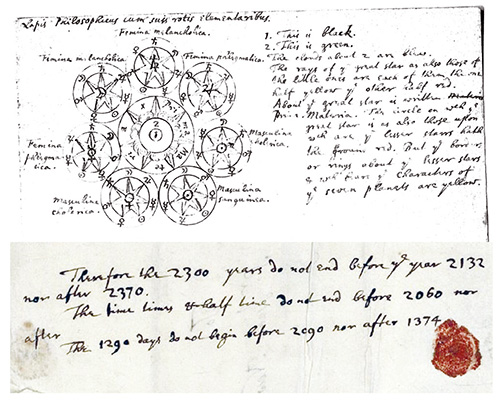
  • Mind Benders: Hollywood & Predictive Programming

    Mind Benders: Hollywood & Predictive Programming

    From New Dawn 189 (Nov-Dec 2021)

    The Millennium was a time of spiritual reflection for many people. Objectively, it was an arbitrary date on the calendar, but psychologically people invested the occasion with hope and caution about the future. 

    Media cited pseudo-science about Y2K, the fictional Millennium Bug painted as real that would shut down everything run by computers as soon as the digits exceeded 99 and reset to zero. Evangelicals preached doomsday, pointing to the Apocalypse foretold in the Book of Revelation. The prophecies of Nostradamus (Michel de Nostredame, 1503-66) were interpreted as such that the world would end. 

    In the mid-1990s, the creators of The X Files introduced Millennium, a dark detective show about an investigator connected to a secret society, whose symbol was the ouroboros: the serpent eating its own tail, signifying eternal destruction and rebirth. In “Destination Eschaton,” a pop band, The Shamen, sang to a disposable beat that “Up out of the turbulence/A better order shall emerge.” A series of movies, including Ed TV (1999) and The Truman Show (1999), gave unthinking audiences their first taste of Gnosticism: that perhaps their “reality” is not real at all. Perhaps forces outside their immediate perception orchestrate their fate: secret societies, intelligence agencies, aliens, demons, or even gods. 

    WHAT IS PREDICTIVE PROGRAMMING?

    By far the most financially successful movie in the “waking up” triptych was The Matrix (1999), written and directed by the Wachowski brothers (now sisters). In the film, the protagonist Thomas Anderson learns that “reality” is a computer simulation and that humans are actually kept in vats so that machines can feed off their energy. Born on either 11 March 1962 or 13 September 1971, depending on which of Anderson’s records are viewed by the agents, his passport was first acquired on 12 September 1991 and expires on 11 September 2001. The odds of that date being a coincidence in the context of the millenarianism surrounding the film are astronomical. Passports typically need renewing every decade, so even sticking to the year 2001, the odds are 364 to 1 that that date was randomly selected. But why 1991 for Anderson’s first passport? Why not two, three, four years prior or later? 

    Similarly, in the Coen Brothers’ classic The Big Lebowski (1998), the film consciously references the New World Order (NWO) first proposed by former CIA Director, President George H.W. Bush. In the movie, the protagonist watches Bush on a store TV talking about Iraq’s aggression against Kuwait, the context in which he mentioned a NWO in real life. The soundtrack is Bob Nolan’s “Tumbling Tumbleweeds,” performed by Sons of Pioneers. Foreshadowing the collapse of the Twin Towers, it begins: “See them tumbling down/Pledging their love to the ground.” The second verse is cut so the third is prioritised in the movie: “I know when night has gone/That a new world’s born at dawn.” The date on the cheque the protagonist gives to the clerk is 11 September 1990: the date of the President’s NWO speech in real life. 

    Shortly before the actual 9/11, an X Files spinoff called The Lone Gunman piloted (no pun intended) with an episode in which elements with the federal government turn a war-gamed crash of a large jet into the World Trade Center (“Scenario 12-D”) into the real thing to blame a Middle East country and boost the arms market. The only red herring in the script is that the real 9/11 was motivated by world domination, not just boosting arms sales. 

    The conspiracy researcher Alan Watt, who died recently, popularised the above as “predictive programming.” In his theory, the elite (whom he believed to be members of ancient cults) socially engineer society by introducing shocking new concepts into the public psyche through entertainment, i.e., when the critical guard is down, so that social responses to the impending shock are lessened and do not result in revolutionary rejection. 

    Others have taken Watt’s ideas further and suggested that occult groups operating at high levels of the entertainment industry and intelligence services reveal their plans to the uninitiated in order to attain spiritual “permission” and consent for their crimes. The theory goes that if the masses are too stupid to realise what is coming, that is their fault. They have been warned through entertainment. 

    The later trajectory of the predictive programming theory has descended into lunacy and outright lying. For instance, proponents of the theory (perhaps “trolling” as people say these days) re-edited an episode of Family Guy (a Simpsons rip-off) to make it seem as if the show had predicted the Boston Marathon bombing in 2013. 

    What can be proven, however, and is the subject of this article, is that when the state starts the slow drumbeats of war, including new cold wars, elements of the entertainment industry – which are inexorably tied to the military – produce films and TV shows that demonise the future enemy and prime domestic audiences for conflict with the new “other”: Latin American revolutionaries in ‘80s action movies, Islamic terrorists in ‘90s blockbusters, evil Russian gangsters in millennium-era thrillers, and increasingly Asians, as China becomes the new theatre of battle. 

    PROJECTING POWER: HOLLYWOOD’S WAR MACHINE

    Corporate news media have by far the greatest influence in shaping public perceptions of foreign governments and peoples. Every day, millions of people are bombarded with negative messaging about “others” in countries that are strategically significant to the US Department of Defense (DoD, a.k.a. Pentagon). But the general cultural hegemony of mass media propaganda is boosted by popular television shows and cinema.

    US military assistance to film producers dates back to at least 1915 when the Home Guard loaned equipment to D.W. Griffith for his racist silent movie, The Birth of a Nation (1915). The Hollywood-Pentagon alliance was cemented during the Second World War and Cold War. Communications expert Professor Tricia Jenkins noted more than a decade ago: “The Federal Bureau of Investigation, the Secret Service, the National Institute of Health and the Department of Homeland Security are just a few bureaus that hire entertainment industry liaisons, and some have worked with Hollywood for over 50 years.”

    In 1942, with the US entering the War, the Pentagon opened the Motion Picture Liaison Office. Hollywood producer Walter Wanger summarised the power of propaganda by describing his industry’s 120,000 movies as “American ambassadors.” As early as the 1920s, the US State Department’s Bureau of Foreign and Domestic Commerce Motion Picture Section was using American embassies to facilitate Hollywood movies, but the practice really took off during the War. US President Roosevelt’s Office of Wartime Information, founded in 1942, acted as a censor. A 1944 State Department memo, “American Motion Pictures in the Post-War World,” offered assistance to Hollywood studios for shaping the pro-American world order, assuming that the Nazis would be defeated. 

    In 1943, a memo by the Office of Strategic Services (the CIA forerunner) described cinema as “one of the most powerful propaganda weapons at the disposal of the United States.” OSS agents funded director John Ford’s company Argosy Pictures. In addition, Frank Wisner of the Office of Policy Coordination recruited the MGM agent producer Carlton Alsop. Part of his job included countering the Soviet narrative of racist America by placing into films “well dressed Negroes as a part of the American scene, without appearing too conspicuous or deliberate.” The western, Charles Marquis’s Arrowhead (1953), originally had realistic scenes of US officials abusing indigenous Americans. To make America look good, Alsop rewrote the script and even redubbed scenes. Alsop part acquired the rights to Animal Farm so that when the animated movie was made, critiques of capitalism could be minimised by the CIA’s Psychological Strategy Board. 

    A December 1955 Joint Chiefs of Staff (JCS) meeting sought to use Hollywood as a way of informing the public about “the true conditions existing under Communism in simple terms and to explain the principles upon which the Free World way of life is based.” The culture war would “awaken free peoples to an understanding of the magnitude of the danger confronting the Free World; and to generate a motivation to combat this threat.” A year later, the JCS held meetings with director John Ford, producer Colonel Merian C. Cooper, actors Ward Bond and John Wayne. 

    The OSS/CIA operative and US Air Force Officer Edward Lansdale developed a personal friendship with the South Vietnam puppet President, Ngô Đình Diệm. Graham Greene’s novel, The Quiet American, was rumoured to be based on the life of Lansdale. When director Joseph Mankiewicz wanted to adapt the novel, Lansdale suggested script rewrites omitting OSS/CIA involvement in aspects of the story. Robert Lantz, Vice President of the film production company Figaro Inc., met with CIA director Allen Dulles to secure the assistance of the South Vietnamese government in the production.

    Was this predictive programming? Not in the strict sense of The Matrix etc., noted above, but radio host and academic Pearse Redmond says: “In a broader sense, the film achieved success in preparing the American public for what soon became one of their longest and bloodiest wars.”

    In 1965, John Wayne wrote to US President Lyndon B. Johnson about his intention to make a Vietnam movie, Ray Kellogg’s The Green Berets (1968). “[It is] extremely important that not only the people of the United States but those all over the world should know why it is necessary for us to be there” in Vietnam, wrote Wayne. “The most effective way to accomplish this is through the motion picture medium.” Johnson’s adviser, Jack Valenti, later President of the Motion Picture Association of America, persuaded the President: “If [Wayne] made the picture he would say the things we want said.” The buried lead here is that the President green-lighted a film, rather like in the Soviet Union where art was approved or rejected by committee. The spate of Vietnam movies began as late as 1975 at War’s end, making Wayne a pioneer of propaganda.

    HOLLYWOOD’S WAR ON TERROR 

    Valenti later said: “[I]f things get tough [for the pro-war US image], the Democrats and Republicans know precisely what to do: Call Steven Spielberg or Arnold Schwarzenegger.” The first Hollywood movie depicting Arabs as terrorists was Sirocco (1951). The theme continues to the present and has been documented by Jack Shaheen in his book, Reel Bad Arabs (2003).

    “Circa 1995,” the CIA created a new position: the Entertainment Industry Liaison (EIL), first headed by ex-covert operations officer Chase Brandon whose work is credited in Tony Scott’s Enemy of the State (1998), Tim Matheson’s In the Company of Spies (1999), Roger Donaldson’s The Recruit (2003), and Phil Alden Robinson’s Sum of All Fears (2003). Brandon’s cousin is actor Tommy Lee Jones. The EIL follows the CIA’s Strategic Intent doctrine: to project its professed values and drive recruitment. Jenkins interviewed Brandon’s successor, Paul Barry (also ex-special ops), who explained that the Agency had a public image problem that Hollywood could fix. Barry says: “In most instances, Hollywood is the only way the public learns about the Agency and Americans frequently shape their judgments about us based on films.” He added: “The problem is compounded when we are depicted as killers and rogues in the movies.”

    Established in 1999, California University’s Institute for Creative Technology was funded by the US Army. After 9/11, a three-day summit was held in which 30 anonymous directors, screenwriters, and producers “brainstormed” ideas. Leaked names included Danny Bilson, David Engelbach, David Fincher, Spike Jonze, Randal Kleiser, Mary Lambert, Paul De Meo, and Steven E. de Souza. Supposedly, the Pentagon wanted to cull the ideas of storytellers to see if any scenarios might happen in real life. In October 2001, the State Department’s Office of Public Diplomacy and Public Affairs was given $15 million to create entertainment that counters the “poor perception” of the US in the third world.

    Today, the DoD has a Film Liaison Office. Its former head, Colonel Phil Strub (ret.), describes the relationship with Hollywood as one of “mutual exploitation.” Typically, a producer seeking access to military hardware or personnel to include in a movie will approach the DoD Project Office and sign a Production Assistance Agreement to lease tanks, aircraft, or even soldiers. Films that have been turned down for portraying the DoD in a bad light include Oliver Stone’s Platoon (1987, too antiwar), Rob Rainer’s A Few Good Men (1992, internal killing and cover-up), Robert Zemeckis’s Forrest Gump (1994, implies that only idiots join the military), Terrence Malick’s Thin Red Line (1998, too antiwar), David O. Russell’s Three Kings (1999, negative portrayal of soldiers), and Kathryn Bigelow’s The Hurt Locker (2008, makes bomb disposal units seem unprofessional).

    Following exposure that the Pentagon was “controlling” Hollywood, the Liaison Office developed a 10 percent doctrine: if just 10 percent of the script is questionable from the military’s viewpoint, the Defense Department will assist the filmmakers. After 9/11, the Defense Department’s PR manager Victoria Clarke pioneered embedding producers with soldiers for the show Profiles from the Frontline. The technique was later adopted, infamously, by journalists; a practice that led to many doubting the independence of war correspondents. 

    Professor Tom Pollard noted the Obama administration’s planned “pivot” to Asia and examined the Hollywood stereotypes of peoples from the region as a form of predictive programming. WWII and post-WWII Asian stereotypes included the yellow peril (criminals), perpetual foreigners (unassimilated), geishas (sex objects), and model citizens (polite nerds). Pollard gives no indication that he believes in a predictive programming conspiracy, but in the context of anti-Japan propaganda, notes that Michael Bay’s Pearl Harbor (2001) “arrived in theatres just weeks before the terrorist attacks on September 11, 2001. Although produced before the 9/11 attacks,” says Pollard, “Bay’s film epitomises post-9/11 movie making and anticipates the Asian/Pacific pivot in US foreign policies.” In 2012, MGM changed the villains in Dan Bradley’s Red Dawn (2012) from Chinese to North Koreans as not to alienate the potentially lucrative Chinese market. Anti-China hawks saw this as a conspiracy: that the Chinese Communist Party (CCP) had taken over Hollywood.

    THE NEW YELLOW PERIL

    The state typically targets intellectuals who shape doctrines and inform the culture. The US consulate in Shanghai screened several US films to university students. Embassy officials also met with Nanjing University students to discuss Lu Chuan’s Nanjing! Nanjing! (2009), the movie about Japanese atrocities committed in the eponymous province. In addition, the US Embassy in Beijing’s Center for Educational Exchange ran a Q&A session with Li Yang, director of Mang Shan (2007), a film controversial in China because it exposes human trafficking in the country and highlights the weakness of the CCP. 

    “Yellow Terror,” an editorial
    cartoon from 1899.

    The Yellow Peril is a racist anti-Asian slur that had its origin in late-19th century European imperialism that sought to portray those in the rival region of the world as a danger to white Christians. Novelist Arthur Henry Ward (Sax Rohmer, 1883-1959) first published his Fu-Manchu series in 1912. The eponymous character is a criminal who seeks to assassinate British diplomats in Burma. The stories and books were pro-British imperial propaganda that portrayed Asians as threats to English “values.” In the 1970s, writer Steve Englehart and artist Jim Starlin adapted the character Fu Manchu into a Marvel comic book character, Shang-Chi, the Master of Kung Fu. Marvel was seeking to profit from the Bruce Lee movies trend in the ‘70s. “The Shang-Chi series harked back to Yellow Peril comics of the Cold War 1950s,” says cultural historian Christopher Frayling.

    Produced by Marvel Studios, distributed by Disney, and directed by the American Destin Daniel Cretton, the new movie Shang-Chi and the Legend of the Ten Rings revives Yellow Peril propaganda, only this time avoiding accusations of blatant racism by making both the protagonists and antagonists Asian, as well as having a director of Japanese-European heritage. Although the name has been changed, Fu Manchu is a character in the movie. Film critic Shi Wenxue says: “Chinese audiences cannot accept a prejudiced character from 100 years ago is still appearing in a new Marvel film.” In addition, the protagonist is played by Simu Liu, a Chinese-born Canadian who has been vocally critical of the CCP. The political context in which this anti-CCP film is released is America’s ongoing military “pivot” to Asia. 

    Get the issue this article appears in

    Setting the Stage from the Top Down

    Quoting anti-China right-wingers in the US, the BBC publicised a report by PEN International, claiming that China has increasing control over Hollywood. The report appeared in the context of the global pandemic, to which those seeking to blame China refer to as the “CCP virus.” 

    Prior to the outbreak of SARS-CoV-2, US television in particular produced a number of shows priming audiences for a pandemic. Many conspiracy researchers believe these to be examples of “predictive programming.” In recent times, they point to the Netflix documentary, Pandemic: How to Prevent an Outbreak, released in January 2020 just before Covid was internationally recognised. 

    Whether predictive programming is real or not, and regardless of the extent to which it is real, we can be certain that those who dominate the culture do so as part of a nexus of control that includes economics and foreign policy.  

    [alert type=”general” dismiss=”no”]This article was published in New Dawn 189.[/alert]

    [alert type=”success” dismiss=”no”]If you appreciate this article, please consider subscribing to help maintain this website.[/alert]

    Footnotes

    1. For instance: Michael S. Hyatt (1998) The Millennium Bug: How to Survive the Coming Chaos, Regnery.
    2. Darrell L. Bock, Stanley N. Gundry and Kenneth L. Gentry (1999) Three Views on the Millennium and Beyond, Zondervan Academic.
    3. John Hogue (1987) Nostradamus and the Millennium, Doubleday.
    4. Sean Martin (2006) The Gnostics: The First Christian Heretics, Pocket Essentials.
    5. Hans Jonas (2015) The Gnostic Religion: The Message of the Alien God and the Beginnings of Christianity, Beacon Press.
    6. The Hollywood Reporter, “Boston Marathon Bombing: Seth MacFarlane Calls ‘Family Guy’ Hoax ‘Abhorrent’,” 16 April 2013, www.hollywoodreporter.com/tv/tv-news/boston-bombing-seth-macfarlane-calls-440456
    7. Matthew Alford and Tom Secker (2017) National Security Cinema: The Shocking New Evidence of Government Control in Hollywood, Drum Roll Books.
    8. Quoted in Tricia Jenkins (2009) “How the Central Intelligence Agency works with Hollywood: An interview with Paul Barry, the CIA’s new Entertainment Industry Liaison,” Media, Culture and Society, 31(3): 489–95.
    9. Quoted in Paul Moody (2017) “Embassy cinema: what WikiLeaks reveals about US state support for Hollywood,” Media, Culture and Society, 39(7): 1063-77.
    10. Moody, op. cit. 
    11. Pearse Redmond (2017) “The Historical Roots of CIA-Hollywood Propaganda,” American Journal of Economics and Sociology, 76(2): 280-331. 
    12. Ibid. 
    13. Ibid. 
    14. Quoted in Lawrence Suid, “Hollywood and Vietnam,” Film Comment, 15(5): 20-25. 
    15. Quoted in Ali Serdouk (2021) “Hollywood, American Politics, and Terrorism: When Art Turns into a Political Tool,” Arab Studies Quarterly, 43(1): 26-37. 
    16. Jenkins, op. cit. 
    17. Michael C. Frank (2015) “At War with the Unknown: Hollywood, Homeland Security, and the Cultural Imaginary of Terrorism after 9/11,” Amerikastudien, 60(4): 485-504. 
    18. Sebastian Kaempf (2019) “‘A relationship of mutual exploitation’: the evolving ties between the Pentagon, Hollywood, and the commercial gaming sector,” Social Identities, 25(4): 542-58.
    19. Quoted in Lawrence Suid, “Hollywood and Vietnam,” Film Comment, 15(5): 20-25. 
    20. Kaempf, op. cit.
    21. Tom Pollard (2017) “Hollywood’s Asian-Pacific Pivot: Stereotypes, Xenophobia, and Racism,” Perspectives on Global Development and Technology, 16: 131-44.
    22. Moody, op. cit. 
    23. Jenny Clegg (1994) Fu Manchu and the Yellow Peril: The Making of a Racist Myth, Trentham. 
    24. Christopher Frayling (2014) The Yellow Peril: Dr Fu Manchu and The Rise of Chinaphobia, Thames and Hudson.
    25. Quoted in Rhea Mogul, “Marvel’s ‘Shang-Chi’ was made with China in mind. Here’s why Beijing doesn’t like it,” NBC, 3 October 2021, www.nbcnews.com/news/china/marvel-s-shang-chi-was-made-china-mind-here-s-n1280571
    26. BBC, “Hollywood censors films to appease China, report suggests,” 6 August 2020, www.bbc.com/news/entertainment-arts-53676789

    © New Dawn Magazine and the respective author.
    For our reproduction notice, click here.