New Dawn – World's Most Unusual Magazine

Category: Articles

  • The Gospel of Money: How Prosperity Gospel Preachers Hijacked New Thought

    The Gospel of Money: How Prosperity Gospel Preachers Hijacked New Thought

    From New Dawn 202 (Jan-Feb 2024)

    I do not put my eyes on men, but on God who gives me the power to get wealth.
    – Robert Tilton

    God wants you well. God wants you prosperous. God wants you a whole person.
    – Oral Roberts

    When you focus on being a blessing, God makes sure that you are always blessed in abundance. 
    – Joel Osteen

    The Judeo-Christian Bible is full of contradictions, especially when it comes to the pursuit of wealth. Some passages tell us we cannot enter Heaven if we have wealth, such as Luke 18: 24-25: “Jesus looked at him and said, ‘How hard it is for the rich to enter the kingdom of God!Indeed, it is easier for a camel to go through the eye of a needle than for someone who is rich to enter the kingdom of God’.” 

    We are also told to ask and we shall receive, and that God wishes for us the abundant life. In Proverbs 3:9-10 we are encouraged to tithe for increased wealth.

    Honour the Lord with your wealth, with the first fruits of all your crops; then your barns will be filled to overflowing, and your vats will brim over with new wine.

    Does God want Christians to be rich and prosper or to be poor and downtrodden? Does the Bible promise Christians wealth, luxury, fabulous health, perfect relationships, and spiritual healing if they keep their covenant with God? Does the Kingdom of Heaven include all that a Christian could ever desire? 

    It depends on how one interprets biblical teachings, but for Prosperity Gospel and Word of Faith Christians, a prosperous and abundant life might only be a prayer or two away.

    The Gospel of Prosperity

    A New Thought movement called Unity blends traditional Christian concepts with older New Thought ideals. Its founder, Charles Fillmore, once rewrote Psalm 23 to read, “The Lord is my banker/my credit is good.” It focuses on teachings of abundance and on asking and receiving. 

    New Thought encourages people to use forms of prayer to “align with the divine” and the power of belief, faith, and consistent visualisation of a desire or goal to make it a physical reality (for more on this, see my article ‘New Thought Movement Revolution 2.0’ in New Dawn 197). These teachings tell us that we have access to the same ‘source’ materials that create worlds and that we connect to this source to co-create our reality. Source has been equated with God, the divine, and the Universe, among other names, and is the invisible field of potentiality and possibility from which physical reality manifests. That manifestation depends on our desires, beliefs, and attitudes and on properly using the power of our minds when connecting with Source. 

    Perhaps it was only a matter of time before New Thought concepts were integrated into biblical teachings. The love of money is universal, after all. But that integration has not always been a smooth one.

    We are told in the Old Testament’s Deuteronomy 8:17-18 that God gives us the ability to produce wealth, so how can it be bad?

    8:17 You may say to yourself, “My power and the strength of my hands have produced this wealth for me.”

    8:18 But remember the Lord your God, for it is he who gives you the ability to produce wealth, and so confirms his covenant, which he swore to your ancestors, as it is today. 

    Like New Thought teachings that encourage us to see ourselves aligned with Source, the Bible suggests that if we work on the side of God, we can be rich. Yes, it would appear that God wants good for us in this material realm, but it gets a bit more complicated than just believing and receiving. 

    A whole breed of Christian pastors, ministers, and teachers have created their own evangelical version of Christianity that sounds more like New Thought/New Age ‘Law of Attraction’ but immersed in Pentecostal and charismatic beliefs. This ‘Bible-based’ ‘Prosperity Gospel’ promises lavish financial abundance to those who follow it and has made more than a few millionaires out of those who teach it. 

    The Prosperity Gospel movement, led by mega-preachers of mega-churches, has caused much controversy among traditional Christians who see the focus on money and wealth as contradicting Christ’s teachings. 

    According to historian Kate Bowler, author of Blessed: A History of the American Prosperity Gospel, these teachings formed from three different streams: Pentecostalism, the New Thought movement, and “an American gospel of pragmatism, individualism, and upward mobility.” 

    The commonalities with New Thought are not coincidental, as these teachings have been in circulation since the 1880s, promoting the power of the mind to achieve prosperity. These concepts served as a foundation for Christian movements to come.

    Word of Faith
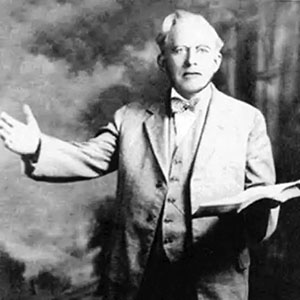
    The theology of E.W. Kenyon (1867–1949) was heavily influenced by New Thought ideas.  

    Word of Faith is a neo-charismatic prosperity theology with roots in the writings and teachings of Baptist minister E.W. Kenyon (1867–1949). He influenced Kenneth Hagin (1917–2003), who later became known as the father of the Word of Faith movement in the United States. Kenyon attended the Emerson College of Oratory, where he was immersed in older New Thought teachings and later wrote about positive declarations and the power of the mind. He denied his New Thought origins, but they were obvious. He taught that to receive the blessings of God, one must use positive, faith-filled speech. He also taught his followers to demand healing and prosperity because it was their divine right. They were entitled to it.

    Hagin took these teachings and founded the Kenneth H. Hagin Evangelistic Association, started a magazine in 1966 called Word of Faith, and built a seminary for Word of Faith ministers to train, teach, and spread the prosperity gospel. This claims that if a person keeps their covenant or word with God in full faith, they will be blessed with healing – physical, emotional, spiritual, and/or financial. One could also achieve this promise of total healing by simply becoming a believer and asking for atonement. 

    Interestingly, as in New Thought teachings of affirmative prayer and using intention to speak of desires as if one already has it (all New Thought prayers end with “And so it is”), Word of Faith teaches that healing should be prayed for and accepted as if it is already done. Doubt and fear that it will not manifest only serves to delay the healing and manifestation. Anything negative such as illness, death, pain, or suffering, is considered an attempt by Satan to prevent or deny total healing in believers. The fix? Praying and strengthening one’s faith even more.

    Word of Faith preaches that those who follow these teachings must “decree and declare” their faith in order to create what they seek to gain. Again, this mirrors the New Thought and Law of Attraction teachings that rely on visualising and speaking only of what is desired, not of what is not desired, and demanding the Universe/Source/God fulfil their personal order like someone dining out at a restaurant. One’s order is put in writing or spoken aloud to give it more ‘power’. 

    The spoken word has creative, generative power in both movements through prayer, affirmations, spiritual mind treatments (intensive, structured affirmative prayer), and the stating of intentions. This spoken declaration in prosperity theology is known as a “faith confession” or “positive confession” and is the key to claiming and affirming healing as already fulfilled.

    Kenneth Hagin believed that because God spoke the universe into existence (“In the beginning was the Word”), God’s believers have been given this same creative power, even going so far as to call believers “little gods.” 

    Prosperity Theology
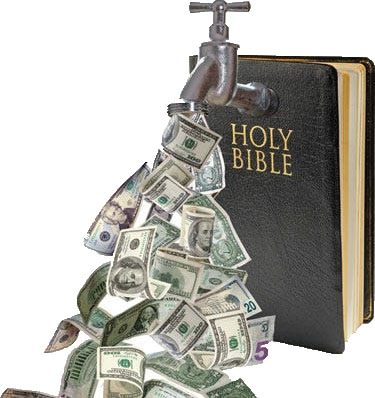
    Kate Bowler writes that the movement was also influenced by mesmerists, faith healers, business oracles, revivalists, Pentecostal healers, and metaphysical sages. This variety can be seen in the different styles of those who have risen in its ranks. Modern Christians may call it the “Name It and Claim It” movement or Health and Wealth, but it is all under the umbrella of prosperity theology, which is today embraced by millions of adherents all over the world.

    Bowler argues that the central thesis of the New Thought movement is present in Christian prosperity theology: “People shaped their own worlds by their thinking, just as God had created the world using thought. Positive thoughts yielded positive circumstances, and negative thoughts yielded negative circumstances.” 

    Historical events such as World War II prompted a spread of these prosperity teachings and caught on quickly as evangelicals sought miraculous healings and money blessings as a way to appeal to those struggling with post-war problems such as homelessness, poverty, and joblessness. 
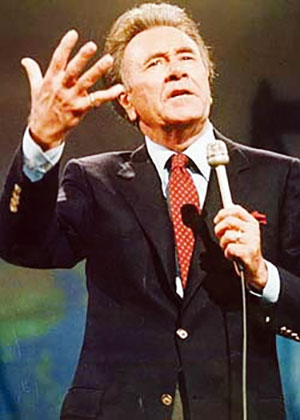
    Oral Roberts

    Modern proponents such as Oral Roberts (1918–2009), the famous American Charismatic televangelist – considered one of the first propagators of prosperity theology – pull their beliefs from a host of Bible passages to back up their claims. They also tend to interpret these passages to support their teachings. Some of the more widely used are:

    I am come that they might have life, and that they might have it more abundantly. (John 10:10)

    Ask, and it shall be given you; seek, and ye shall find; knock, and it shall be opened unto you:For every one that asketh receiveth; and he that seeketh findeth; and to him that knocketh it shall be opened. (Matthew 7:7-8)

    Beloved, I wish above all things that thou mayest prosper and be in health, even as they soul prospereth. (3 John 1:2)

    My God shall supply all your needs according to his riches in glory by Christ Jesus. (Philippians 4:19)

    Roberts amassed a huge following with his televised ministry that helped introduce Pentecostalism into the mainstream. He pioneered the use of television to reach millions and founded the Oral Roberts Evangelistic Association and Oral Roberts University.
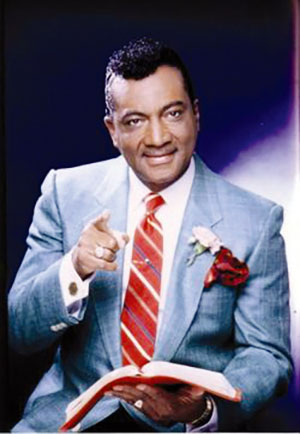
    Reverend Ike

    Other Word of Faith and prosperity theology preachers who took to the airwaves include Juanita Bynum with “Weapons of Power” on the Trinity Broadcasting Network; Kenneth and Gloria Copeland with “Believer’s Voice of Victory;” Jan and Paul Crouch, who founded Trinity Broadcasting Network (TBN); Creflo Dollar with “Changing Your World;” Benny Hinn with “This is Your Day,” currently seen in almost 200 countries; Marilyn Hickey with “Today with Marilyn” on TBN and Black Entertainment Television; Robert Tilton who has shows on Black Entertainment Television; T.D. Jakes with “The Potter’s House;” Joyce Meyer with “Enjoying Everyday Life;” and New York’s Reverend Ike (Frederick J. Eikerenkoetter II), who preached up a storm in the US before his death in 2009 with his motto, “You can’t lose with the stuff I use!” 

    Then there was Jim and Tammy Faye Bakker, who took television evangelism to a whole new level with their flamboyant looks and extravagant lifestyles. Their Heritage USA theme park was a hugely popular destination for Christians and non-Christians alike, and their Praise the Lord (PTL) Ministries incredibly successful. Many will remember that scandals eventually brought down the Bakkers.

    Jim and Tammy Faye Bakker, at the peak of their success.

    Television allowed these prosperity preachers to reach new audiences far beyond the confines of just one church in one town or city, and many started running ‘megachurches’ with thousands of followers. Today, the internet and social media offer even more outlets for profitable preaching to extend beyond national borders. Although the prosperity gospel has its origins in the United States, there are now many multimillionaire preachers and pastors benefitting from its teachings all over the world.

    Criticisms of Prosperity Theology

    What if these promised money miracles do not occur? What if someone follows these teachings and remains poor? Dr. Andrew Spencer in “What is the Prosperity Gospel?” for the Institute for Faith Works and Economics, says these failings are “blamed on the lack of faith in those seeking the miracles.” They were at fault for unfulfilled prayers, not the preachers promising them that miracles would manifest. “If wealth and health are a result of the degree of faith a person has, this leads to the conclusion that the poor are poor because they are spiritually deficient,” writes Spencer. 

    People often refer to one of the Beatitudes of Christ’s Sermon on the Mount, blessed are the poor, for theirs is the kingdom of heaven, as a way to validate being poor, but Jesus actually said, “Blessed are the poor in spirit” (emphasis added) (Matthew 5:3). The statement has nothing to do with money but with the spirit, implying that the sad, depressed, and downtrodden will be given the keys to the heavenly kingdom. Even rich people can be sad, depressed, and spiritually downtrodden. 

    This clearly contradicts where prosperity preachers like to place the blame – on the person asking for help. This victim-shaming and blaming is one of the key criticisms many people have of religious leaders pushing material and financial wealth. They can never seem to explain why it doesn’t work for everyone else, so they blame… everyone else.

    Baptist preacher Russell H. Conwell is famously quoted as telling his poor congregation in 1915, “I say you ought to be rich; you have no right to be poor.” This same line about the rich and poor has been repeated, ad nauseam, in prosperity gospel preaching for over 100 years, implying that Jesus placed emphasis on this when he clearly did not focus his teachings on material riches. Rather than blame society or inequality in the workplace, the blame is shifted to the failures of the poor, who very well may be hard-working individuals with good hearts.

    Crimes & Misdemeanours

    In 2007, United States Senator Chuck Grassley probed the financials of televangelism ministries that promote prosperity theology, including Kenneth Copeland Ministries, Creflo Dollar Ministries, Benny Hinn Ministries, Bishop Eddie Long Ministries, Joyce Meyer Ministries, and Paula White Ministries. The probe concluded in 2011, with Grassley stating that self-regulation was preferable to government oversight of these ministries. All six televangelists insisted they would comply with tax regulations for religious non-profits. Only Joyce Meyer Ministries and Benny Hinn Ministries told Grassley they had changed how they govern their ministries or set compensation. The other four refused to provide full information to Grassley, and a few accused Grassley of violating their religious freedom. 

    In the early 1990s, Jim Bakker asked for forgiveness for his prosperity teachings from a prison cell after being convicted for mail and wire fraud associated with his ministry’s various fundraising activities. He was also involved with a highly publicised sex scandal involving a woman named Jessica Hahn that eventually brought down his powerful PTL Ministries.

    There have been numerous media hit pieces on the extravagant lifestyles of these preachers, suggesting that they fell prey to the materialism the Bible teaches against. Not all flaunt their lavish possessions and massive bank accounts. Mainstream evangelicals such as Rick Warren and Jerry Falwell have come out opposing prosperity theology as heretical to the true teachings of Christ. 

    “Capitalism Christianity” has been called an abuse of faith as well as a way for the preachers to become rich at the hands of their congregants who want to believe so badly that they, too, can be rich if they have faith or tithe ten per cent or more of their income to the men and women making those grand promises from atop a gaudy stage. There are many sad stories of people giving all of their money over to their church leaders, only to be left destitute while the preachers buy mansions and expensive toys or run off to another country, never to be heard from again.

    As noted by Cathleen Falsani in her 2013 piece “The Worst Ideas of the Decade” for The Washington Post, these teachings conflict with the basic tenets of Christianity. “Jesus was born poor, and he died poor. During his earthly tenure, he spoke time and again about the importance of spiritual wealth and health. When he talked about material wealth, it was usually part of a cautionary tale.” 
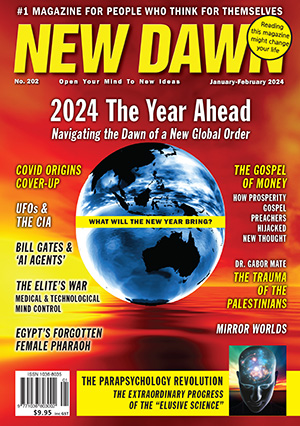
    Get the issue this article appears in

    To Be Or Not To Be

    Is it spiritual to be poor? Do Christians have to give up everything they own and be homeless on the streets in order to achieve the grace and abundance of God? 

    Those who prosper can easily become ego-maniacs and materialists, using their money to buy power and influence over others, or they can be meek, merciful, and pure in heart. They are, after all, human. Some might argue that millionaire preachers who become rich off their much poorer congregants will have one hell of a time, pun intended, threading the needle and getting into Heaven. 

    Money itself is not the root of all evil, although lust, greed, and how someone makes all that money can play a big role. It’s not wealth that makes the person, but what they do with it and whether or not it changes them for better or worse. 

    Those who are blessed can no doubt bless many others in ways being poor cannot. Money can bring happiness and it can bring despair. It favours no one. It’s neutral. 

    Prosperity preachers and their eager adherents might remember that acquiring true wealth may be more about getting right in spirit first. Whatever comes after that is just icing on the cake.

    [alert type=”general” dismiss=”no”]This article was published in New Dawn 202.[/alert]

    [alert type=”success” dismiss=”no”]If you appreciate this article, please consider subscribing to help maintain this website.[/alert]

    Sources

    “5 Errors of the Prosperity Gospel” by David W. Jones, thegospelcoalition.org/article/5-errors-of-the-prosperity-gospel
    Katie Bowler, Blessed: A History of the American Prosperity Gospel, Oxford University Press, 2018
    “Prosperity Gospel” by Bryn Donovan, britannica.com/topic/prosperity_gospel
    “The Prosperity Gospel, Explained: Why Joel Osteen Believes that Prayer Can Make You Rich” by Tara Isabella Burton, vox.com/identities/2017/9/1/15951874/prosperity-gospel-explained-why-joel-osteen-believes-prayer-can-make-you-rich-trump
    “The Worst Ideas of the Decade” by Cathleen Falsani, washingtonpost.com/wp-srv/special/opinions/outlook/worst-ideas/prosperity-gospel.html
    “What is the Prosperity Gospel?” by Dr. Andrew Spencer, tifwe.org/what-is-the-prosperity-gospel

    © New Dawn Magazine and the respective author.
    For our reproduction notice, click here.
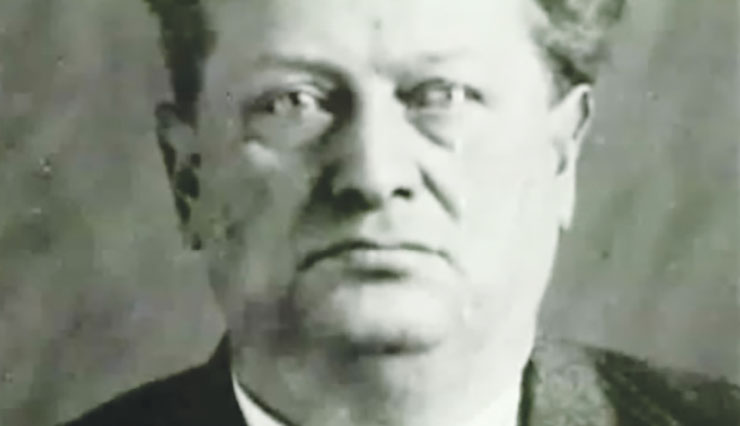
  • Rudolf von Sebottendorff: Architect of Thule

    Rudolf von Sebottendorff: Architect of Thule

    From New Dawn Special Issue Vol 7 No 3 (June 2013)

    Thule people are the ones to whom Hitler first came. 
    – Rudolf von Sebottendorff

    Rudolf von Sebottendorff (1875-1945) was a man of mystery. Much remains unknown about his life and his death. He is shrouded in legend and surrounded by misinformation. The true nature and motive of his life and work remain in question. That much of this obscurity was of his own manufacture is one thing that seems certain. 

    The first mystery of Baron Rudolf von Sebottendorff ’s life lies in the fact that he was not born a baron, nor was his name Sebottendorff. He obtained the name and title later in life. He was born Adam Alfred Rudolf Glauer in Hoyerswerda, near Dresden, on November 9, 1875. His father was a locomotive driver and veteran of the Prussian army, who fought in the Austro-Prussian campaign (1866) and the Franco-Prussian War (1871). Rudolf ’s father died in 1893 leaving enough money for his son to finish his formal education.

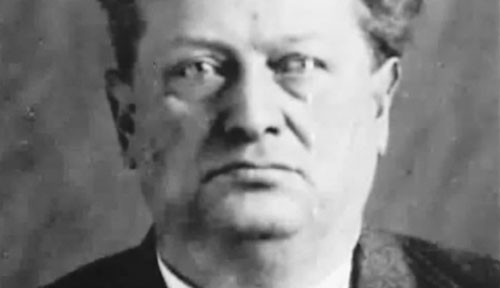
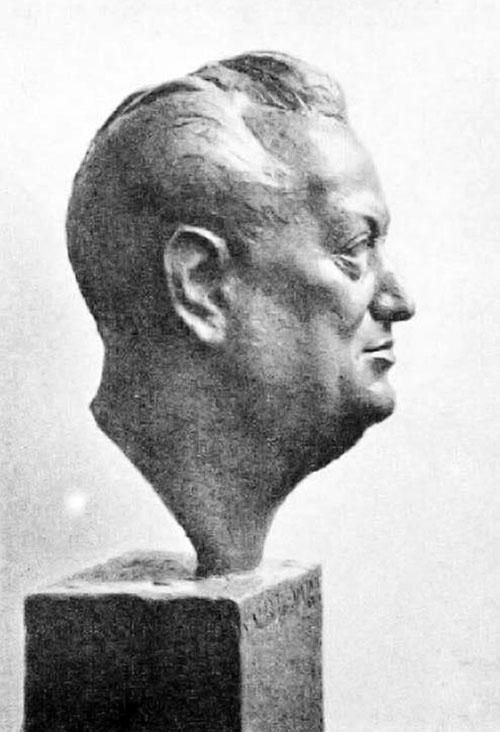
    Bust of Rudolf von Sebottendorff (1875-1945) 

    Glauer began training as a mechanical engineer, but never finished his studies. Instead he lived a life of adventure in exotic locales and on the high seas until 1900. In Australia, after attempting to prospect for gold, he received a letter of introduction from a Parsi (Zoroastrian) to a wealthy Turkish landowner, Hussain Pasha. He managed an estate at Bursa for this landowner, who was a practitioner of Sufism. He was also introduced there to the Termudi family. The patriarch of this Jewish family, originally from Greece, was a student of the Kabbalah and Rosicrucianism. Glauer was initiated into a Freemasonic lodge of which the Termudis were members. He remained in Turkey, learned Turkish, and studied occultism until 1902. Then he returned to Germany, but around 1908 some legal misadventures in Germany caused him to return to Turkey.

    The next two years were pivotal for the adventurer. In 1910 he founded a mystical lodge in Constantinople – which is a tariqat of the Bektashi Order of Sufis. The next year he is legally adopted by the German expatriate Heinrich von Sebottendorff and also becomes a legal citizen of Turkey. This adoption was later repeated twice more by other Sebottendorff family members, all of which indicates just how important the acquisition of the noble title was to him.

    During the Balkan War (1912–1913) he was on duty with the Red Crescent, the Islamic version of the Red Cross. He was actually wounded in battle and for a time a POW. After this he returned once more to Europe and lived in Berlin and Austria.

    First World War

    It was in the midst of the First World War (1914–1918) that Sebottendorff joined the Germanen Order (GO), at first by correspondence only. In September of 1916 he personally visited Hermann Pohl, who was the head of the order in Berlin. Subsequently Sebottendorff was elected master of the Bavarian province of the order and became the publisher of the GO publications.

    The true nature and scope of the Germanen Order remains shadowy. Ostensibly it was formed as a sort of mystical lodge within the more politically oriented Reichshammerbund (Imperial Hammer League). The mastermind behind these groups was the notorious anti-Semite Theodor Fritsch (1852–1933).1 Fritsch was instrumental in the invention of a biologically based anti-Semitism to appeal to those who had become disenchanted with the mass appeal of the age-old religion based anti-Semitism, with its origins in the medieval church. The GO was essentially a pseudo-Masonic order with ritual based on Wagnerian imagery.2

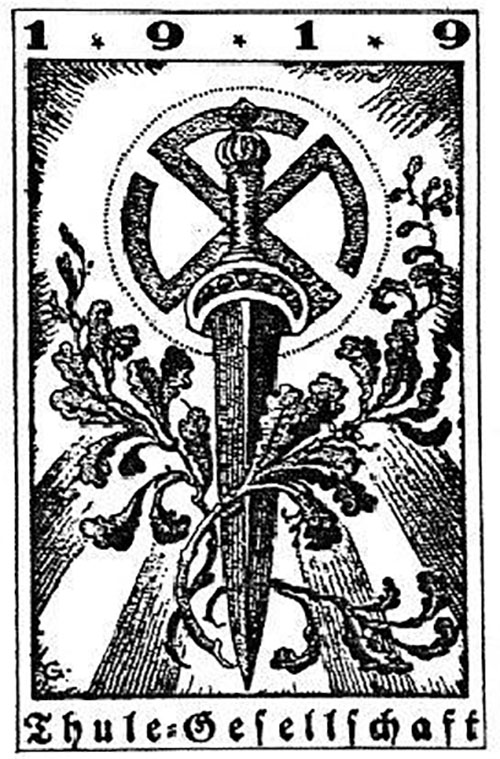
    Symbol of the Thule-Gesellschaft

    As 1918 was drawing to a close, the fortunes of war and politics had turned against the Germans. The Great War was being lost and in Munich left-wing revolutionaries were clamouring for political power, inspired by recent success in the Russian Revolution (1917). The name Thule-Gesellschaft (Thule Society) was adopted by the Germanen Order as a cover identity (The word Thule comes from the Greek explorer and geographer Pythias, who made a journey to the far northern regions of the world around 310 BCE. He gave the name Thule to the land in the northernmost region.) The society met weekly in rented rooms at the Hotel Vierjahreszeiten (Four Seasons) in Munich. But it began to take on a life and identity of its own under Sebottendorff ’s leadership. Occult topics were the subject of lectures given by the baron – this in the midst of open revolution in the streets of Munich.

    Sebottendorff only led the Thule Society from April 1918 to July 1919. During this time he formed a militia to fight the Communists, was instrumental in the formation of the German Workers’ Party, and acquired a newspaper, the Münchner Beobachter (Munich Observer). In April of 1919, Communists seized power in Bavaria. In this process they took seven members of the Thule Society hostage and subsequently executed them. This atrocity became a rallying point for the right-wing militias. The militias were eventually successful in turning back the left-wing revolution. The German Workers’ Party was soon thereafter reformed by charismatic leader Adolf Hitler into the National Socialist German Workers’ Party (National-Sozialistische Deutsche Arbeiter Partei – NSDAP), called Nazis by their detractors. The newspaper was bought by that party and transformed into its mouthpiece – Der völkische Beobachter (The Nationalist Observer).

    Obviously all of these facts point to Sebottendorff’s deep involvement with what was to become the Nazi movement in post-WWI Germany. It also seems clear that Sebottendorff and others were guided and financed in their efforts. What is less certain is how much these men were engineers of these efforts and how much they were mere pawns.

    The chronology of Sebottendorff’s life shows that he was mostly involved in personal adventure and spiritual or magical pursuits – with a short, active career (1916–1919) as a political operative under the cover of occult organisations. After he left Munich in July of 1919, he returned to esoteric studies and writing. For fifteen years he continued in his esoteric pursuits and it is during this period that he wrote and published most of his major works, including, Die Praxis der alten türkischen Freimauerei (recently translated to English by this author and published as The Secret Practices of the Sufi Freemasons).

    ‘Before Hitler Came’

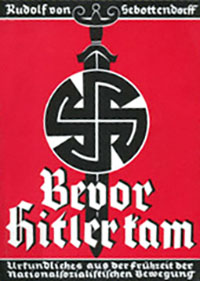
    In 1933, after Hitler took power in Germany, Sebottendorff published a book Bevor Hitler kam (Before Hitler Came) which appeared to take credit for getting the National Socialist movement started from within the Thule Society.

    Astoundingly, Sebottendorff returned to Germany after Hitler took power in 1933, tried to revive the Thule Society, and published a book, which seemed to try to take credit for getting the National Socialist movement started from within the Thule Society. The book was entitled Bevor Hitler kam (Before Hitler Came). The Nazis were not pleased. Sebottendorff was arrested twice; the book was banned, confiscated, and destroyed in 1934. He returned to Turkey. This whole adventure appeared to be simply an attempt to cash in on the success of the Nazis, an attempt that failed. Or perhaps it did not fail entirely. The post-1934 life of the baron is quite mysterious. He was put on the payroll of the German Intelligence Service in Istanbul. His handler was Herbert Rittlinge. Turkey had been an ally of Germany in World War I, but in World War II it remained neutral until the very end of the war, when it joined the Allied side. In 1944 the German embassy was closed in Turkey, and Sebottendorff was given his severance pay of one year’s support. On May 8, 1945, Germany surrendered unconditionally. Sebottendorff died that same day.

    Some controversy surrounds the death of Sebottendorff. The usual story is that he committed suicide by jumping off a bridge in Istanbul right after hearing of Germany’s surrender.

    If this is true it was probably more out of the desperation of a septuagenarian man with no prospects for the future than out of any loyalty to the Nazis. On the other hand the possibility exists that he was assassinated either by loyal Nazis who wanted to keep him quiet, or by their enemies who took a final measure of revenge.

    Works & Ideas

    The life and legend of the adventurer known as the Baron Rudolf von Sebottendorff von der Rose is so fascinating and compelling that the more important and useful information about his teachings and thoughts are usually glossed over. We do not want to let that happen here. However, it must be admitted that discovering what the baron really thought can be a difficult task. This is because his did not write that much when compared to his contemporaries. Also what he wrote tended to be from different genres – for example, novels, histories of astrology, technical astrological texts, and the book on Sufi exercises.

    When we look at Sebottendorff’s written output we discover that most of it concerned aspects of the practice of astrology. His works include: Die Hilfshoroskopie (1921), Stunden- und Frage-Horoskopie (1921), Sterntafeln (ephemeriden) von 1838–1922 (Star Tables [Ephemeris] from 1838 to 1922) (1922), and Astrologisches Lehrbuch (Astrological Textbook) (1927). Perhaps to be counted as his masterpiece in astrological studies is Geschichte der Astrologie (History of Astrology), vol. I (1923). No second volume appeared. Besides these astrological works, three others stand out.

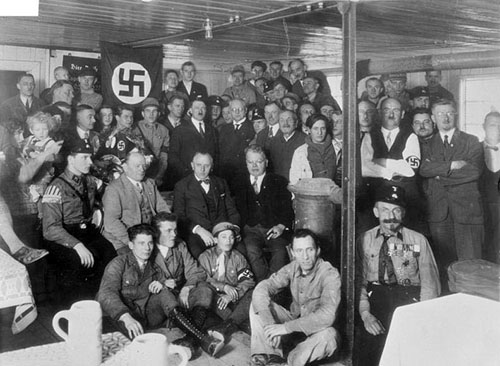
    An early meeting of the National Socialist German Workers’ Party. Adolf Hitler is in the centre.

    The first of these is Die Praxis der alten türkischen Freimauerei (1924). Second is a novel, Der Talisman des Rosenkreuzers (The Talisman of the Rosicrucian) (1925). This is said to be a thinly veiled autobiographical account from which many events in his life are discernible. Finally there is the ill-fated Bevor Hitler kam (1933). The latter two books are in one way or another attempts to manipulate the reader’s views of the author. Only in the Praxis does Sebottendorff really speak to the reader about his own philosophy – if only vaguely.

    Sebottendorff, the man, remains an enigma. Some of his writings were probably produced to achieve some specific political agenda that was not necessarily a creation of his own thoughts. However, if we read his words carefully we can arrive at some general ideas about the intellectual and spiritual cosmos in which he lived. In many respects Sebottendorff was the typical German of his time – a man with a split character: one part fierce nationalist, the other a lover of the exotic. In Sebottendorff’s lifetime he had reason to be proud of being German – Germans were the best educated, most technologically advanced and economically developed of all European peoples. At the same time they loved exotic ideas and exotic cultures; they studied them, and travelled to them at an enormous rate. Even now, more Germans travel outside their own borders per year than any other nation, and it is no coincidence that the German word wanderlust, “a strong and irresistible impulse to travel,” had to be borrowed into English.3 All this accounts for Sebottendorff’s German nationalism coupled with his love of Turkey. To understand his ideology, we must divide the political dimension from the occult aspect; although we will see some common ground between the two.

    Political Ideology

    Most of Sebottendorff’s written output would not indicate much of an interest in politics. It is far more oriented toward occult matters. However, both his biography and one book in particular, Bevor Hitler kam (1933), show his involvement in founding and directing insurgent political operations. Where and how he came by these skills and interests remain mysterious.

    In introductory sections of his 1933 book he describes his devotion to two ideas Deutschtum (Germanism) and socialism. The idea of Deutschtum had been current in Europe for many decades.4 On the one hand it can be understood as simply nationalism. But German nationalism, as with other forms of this idea elsewhere in the Old World, is heavily tinged with racial ideas. German (or English or French or Russian) nationalism meant more than fanatically supporting a political state. It meant a belief that the culture of the nation, its language, ethnicity, customs, and aesthetics, were to be promoted to the exclusion of foreign or outside elements. It also was bound up with concepts of antimodernism. Antimodernists saw industrialisation, commercialism, and democracy as destructive to the nation and to Deutschtum.

    Rudolf von Sebottendorff, the man, remains an enigma.

    To some extent these ideas were rooted in the esoteric teachings of men such as Guido von List (1848–1919) who coined and popularised a good deal of the terminology connected with this idea. Clearly Sebottendorff was steeped in the teachings of von List and others. But he was far from being alone in this. In fact List was himself merely another product of a larger neo-Romantic wave of ideology championed by Richard Wagner and others decades earlier.

    The other political idea that moved Sebottendorff was socialism. Mainstream historical revisionism quickly moved to ignore the socialistic aspects of Hitler’s National Socialism. It really should not be surprising therefore to see immediate precursors to Hitler extolling the idea of socialism, which most today think of in terms of left-wing politics. The essential theoretical factor that separates Hitler from Stalin was that the former saw biology or race as the decisive factor, while the latter saw economics and economic class as paramount. In practice, however, both essentially practiced nationalistic socialism under a dictatorship or oligarchy.

    Certainly Sebottendorff, like many of his German and European contemporaries, envisioned a kinder and gentler form of socialism; one that wisely and benevolently collected the wealth and privilege of the nation and redistributed it to the benefit of the whole of society. Such dreams always lead immediately to a Hitler or Stalin, when applied on a national scale. National socialism would attempt to apply socialistic concepts and methods to the benefit of a single race or nationality – the Germans – rather than to an economic class – the proletariat – as is the case with the Marxists.

    Get the issue this article appears in

    Occult Ideology


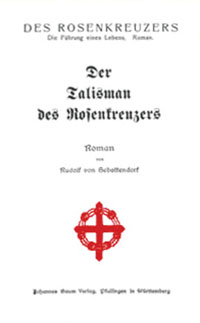
    Der Talisman des Rosenkreuzers (The Talisman of the Rosicrucian) (1925) by Sebottendorff.

    The occult encompasses ideas of a secret or hidden nature, which represent rejected patterns of thought (e.g., paganism, astrology, alchemy, magic) or concepts that have not been accepted by mainstream and established intellectual authorities (e.g., UFOs, ESP, orgone). Such ideas may be entirely taboo in a society and forced into secret societies, or they may simply be marginalised. Despite its outsider status the realm of the occult often becomes the breeding ground for revolutionary ideas.

    Sebottendorff’s occult ideology can be partially reconstructed from his works. One factor of great importance to him was a sort of unified field of reality that connected things such as the stars with the fate and character of individual humans. Here we see an echo of the Islamic insistence on the essential unity of being (the Arabic wahdat-al-wujûd). This also provides Sebottendorff with the rationale for his focus on tradition and national traditions – whether in Germany or Turkey. Such a unity of being also provides for the plausibility of alchemy. The base and the noble are, after all, parts of the same whole, or substance. Therefore the transmutation of one thing to another is theoretically possible, without changing the nature of reality.

    Bevor Hitler kam (Before Hitler Came) (1933) by Sebottendorff.

    One of Sebottendorff’s chief themes is the idea of the perfectibility of the individual. This is the root concept behind the exercises belonging to the science of the key, as the ancient practice of Freemasonry is sometimes known. The fruits of this labour should, however, be transferred to the larger society in which the individual lives and this doctrine of perfectibility spread throughout the country. The individual can, in a manner of speaking, become something akin to a philosopher’s stone. His presence can act as a catalyst for widespread transformation. Is this the secret of Sebottendorff? So much power and influence has been ascribed to him, yet the facts of his life do not reflect such a man. How could a relatively unknown occultist and adventurer exert such historical influence and fade from the scene years before the results of his operation were manifest? Why then did he come back to make a conspicuous return at the moment of the operation’s dark triumph, before once more fading into obscurity? 

    Certainly another of Sebottendorff’s principal ideas was that individuals are capable of creating and re-creating their own environment. This concept was juxtaposed to the modernistic idea that individuals are products of their environments. All of this again brings forth Sebottendorff’s essentially magical and alchemical view of man’s capacity. The human being, and especially the individual who has been empowered by the secret practices revealed in the science of the key, can take active control of life and environment – but only in accordance with the will and direction of God.

    Abridged with permission from Chapter 1 of Secret Practices of the Sufi Freemasons: The Islamic Teachings at the Heart of Alchemy by Baron von Sebottendorff (translation & Introduction by Stephen E. Flowers, Ph.D.). Inner Traditions, Rochester, VT 05767 USA. This book is available from all good bookstores or visit www.InnerTraditions.com.

    [alert type=”general” dismiss=”no”]This article was published in New Dawn Special Issue Vol 7 No 3.[/alert]

    [alert type=”success” dismiss=”no”]If you appreciate this article, please consider subscribing to help maintain this website.[/alert]

    Footnotes

    1. For more information on Theodor Fritsch, see Goodrick-Clarke, The Occult Roots of Nazism, 123-28
    2. A historical description of the Germanen-Order is provided in Goodrick-Clarke, The Occult Roots of Nazism, 123-34
    3. See The American Heritage Dictionary (1975), s.v. “wanderlust.”
    4. The whole topic of nineteenth- and early-twentieth-century Germanentum, especially in esoteric circles, is discussed by Goodrick-Clarke, The Occult Roots of Nazism.

    © New Dawn Magazine and the respective author.
    For our reproduction notice, click here.
  • The Secret Science of Sacred Geometry: The Golden Ratio, Number 5 & Fibonacci

    The Secret Science of Sacred Geometry: The Golden Ratio, Number 5 & Fibonacci

    From New Dawn 157 (Jul-Aug 2016)

    Although it’s been moving more into the spotlight for today’s “New Age” devotees, the basic principles of what is known as Sacred Geometry are still little understood. In this 3-part series of articles, we will attempt to demystify the subject. Let’s begin by defining Sacred Geometry…

    Webster’s Dictionary defines sacred as synonymous with holy. Aside from the usual religious connotations, a more general meaning given is: “devoted exclusively to one service or use (as of a person or purpose).” When, years ago, I was involved in church design, we usually planned for a very particular room called the ‘sacristy’. It’s also known as the vestry where the sacred utensils and vestments that are used in liturgical ceremonies are kept.

    Sacred has a Latin root the same as that for the word sacrum. The sacrum is the last bone in the spine. Webster says it’s the “holy bone” and consists of “the part of the vertebral column that is directly connected with or forms a part of the pelvis and in man consists of five united vertebrae.” You will see later in this and subsequent articles how the relationship to human anatomy plays directly into our subject matter. 

    There’s another little-known synonym for sacred, and that is the word secret. Here, it implies something esoteric or meant only for a few to understand about geometry. While that may have been true in the past, I believe it is important at this time in history for more folks to understand the implications of the kind of geometry we call sacred. Indeed, it can be said the earth is sacred as we depend upon it for our very existence. 

    The word geometry literally means “to measure the earth,” an easy definition. We all know what it is to measure something: its length, breadth, and height. But, if we’re measuring the earth, is it the whole (holy) earth or just a small portion of our globe? Or is there a wider meaning to the word Earth? Is it perhaps more appropriate in our context to use the word ground, as in “hallowed ground?” Many of us sometimes use the verb grounding that has physical and psychological implications. In fact, as we proceed, I think you’ll see that the physical and the psychological begin to merge into each other. 

    The Language of Numbers & Symbols

    The various languages spoken around the world since the beginning of recorded history were not the first means of communication between human beings. Archaeology shows us that early man communicated first by the use of different kinds of symbols. From symbols came numbers, which are in themselves particular kinds of symbols. 

    We know that in distant antiquity man began using a pictorial mode to communicate, whether it was carving into stone or merely tracing with a stick in sand or on the ground. As we became more sophisticated, sheets of papyrus and later paper made from wood pulp were marked upon. Figures, letters, and numbers were generated with ink or paint by using pen, pencil, brush, or, later, typewriter. Today they are produced with the aid of computers. No matter how they are scribed, numbers and symbols remain a universal language.

    Sacred Geometry (let’s call it SG for short) employs both numbers and symbols, but in very specific ways. While similar kinds of graphic representations are used in drawings for constructing a building or in mathematical equations, in SG they are used in a very precise manner. As Webster’s says, they are “devoted exclusively to one service or use….” Symbols in SG have very unique meanings, although, in keeping with our definition of sacred as secret, those meanings are not generally known. 

    The language of numbers and symbols (we’re talking about pure numbers here, not the process of using numbers to make calculations) is the language of certain human brain faculties that are different from those used to produce and communicate with the spoken word. As we have noted, some say the language of symbols is the more primitive form of communication. But with SG we begin to glimpse a highly sophisticated symbolic language that transcends the spoken or written word. 

    It has been shown that language is a function of the left hemisphere of the human brain (at least for most right-handed people). So is ordinary mathematical calculation. Symbols, on the other hand, are interpreted by the right side of the brain, as are pictures and other visual images. We all know the phrase, “A picture is worth a thousand words.” In SG, a single shape or form can have very distinctive meanings that would take many pages of written words to explain.

    Our first task is to learn the language of Sacred Geometry.

    As Above, So Below

    Primitive man could see the stars in the night sky, unhindered by the reflection of city lights off clouds and layers of atmosphere. We have discovered that the Egyptians and the Maya, along with numerous other ancient civilisations, were close watchers of the night sky. We are just now finding out they knew things we have only come to know with the advent of the telescope. How they knew as much as they did about the heavens is being investigated by researchers. It remains a mystery, but perhaps not for too much longer.

    The most striking example of a representation made by the ancients on earth which reflects something visible in the night sky is the layout of pyramids on the plateau at Giza, across the Nile River from Cairo, Egypt. 

    Robert Bauval and Adrian Gilbert in their 1994 book The Orion Mystery make a good case that the three Giza pyramids, when viewed from above, form a replica of the position of the three stars in the ‘belt’ of the constellation Orion. In another book by Bauval and Graham Hancock published two years later in 1996, The Message of the Sphinx, the theory is expanded to show that other pyramids in the complex also fit the Orion constellation. As we are now able to calculate star movements over thousands of years with a computer, the position of the stars in the Belt of Orion form a match only at a time well before the Giza pyramids are claimed by Egyptologists to have been built. (More recently, researcher John Anthony West and geologist Robert Schoch have shown that the erosion around the Sphinx was caused by water, not wind. It was at least 10,000 years ago that the desert in northern Africa was a lush and verdant environment with enough rainfall to account for that erosion. If the first or Great Pyramid at Giza was built at about the same time as the Sphinx, the earlier date of the correspondence to the Orion Belt does make sense.) 

    Since the seminal work of Bauval, Gilbert and Hancock, others have expanded the search and found numerous ancient sites around the world that replicate in some manner what we see in the night sky, or use the sun, planets, and certain bright stars as the basis for orienting their manmade constructions. Stonehenge in southern England is probably the best known example of the latter. But there are hundreds if not thousands more such ruins. 

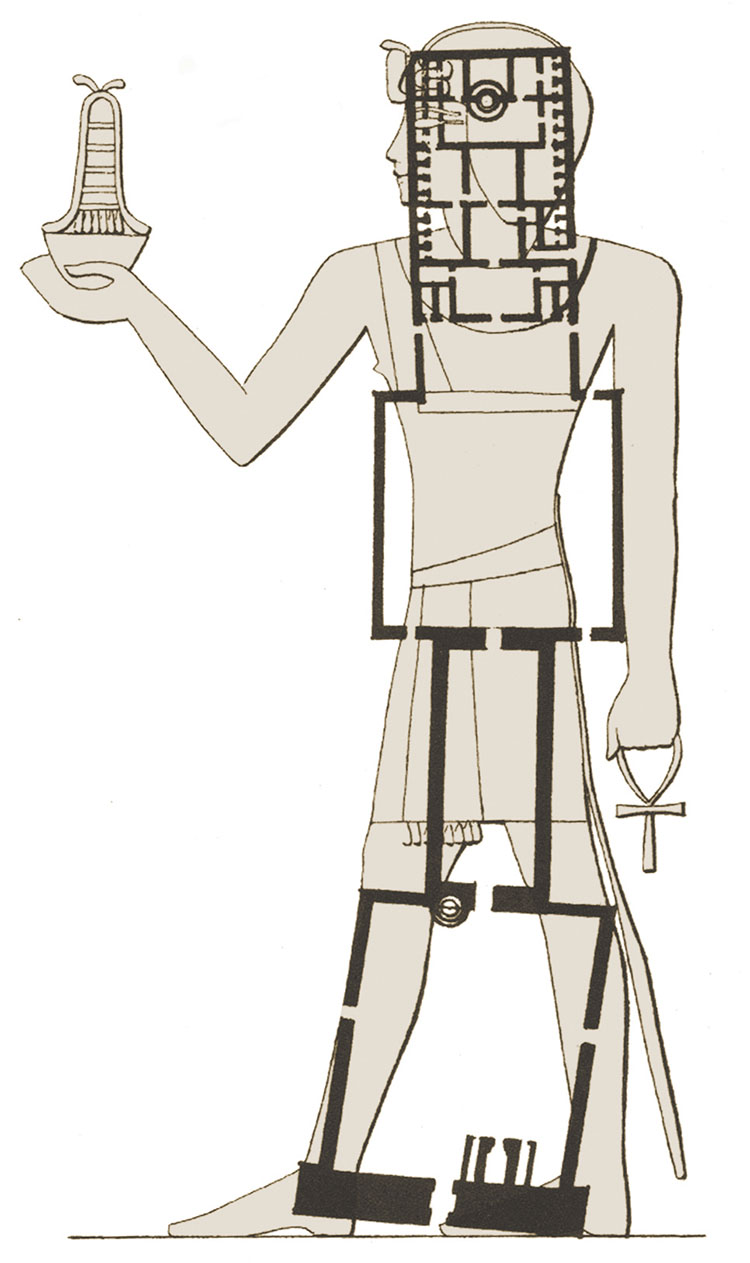
    R.A. Schwaller de Lubicz discovered that the Temple of Luxor in Egypt was laid out in a system of measure based upon the canon of human proportion, but also every detail, symbol, and column position related to a corresponding part of the human system, even the tiled floor of the ‘head’ section.

    At another scale of measurement, “as below,” we find that certain ancient structures were undoubtedly patterned after the anatomy of the human being. R.A. Schwaller de Lubicz made a 15-year study of the architecture of Egypt’s Luxor Temple. His magnum opus, The Temple of Man, shows how the floor plan of Luxor and its parts mirror the human body. He even goes so far as to identify various chambers in the Temple with parts of the brain.

    Builders associated with the Knights Templar encoded images of parts of the human body within the geometry of the great Marian Gothic Cathedrals in France. No mere coincidence as we shall later see. And, “as above,” it has been shown that the overall pattern of placement for those Marian Cathedrals bears a striking resemblance to the configuration of stars in the constellation Virgo, the Virgin. 

    On the molecular scale, James Watson and Francis Crick published a paper in 1953 in which they identified the structural shape of DNA as a double helix. Recently a double helix-shaped gas nebula was discovered lying nearly perpendicular to the massive black hole at the centre of our Milky Way Galaxy. Also, in what we might call the middle ground of the human measurement scale, we see the double helix represented in architecture, and sacred architecture at that. The “Apprentice Pillar” inside Scotland’s Rosslyn Chapel, made famous by Dan Brown’s Da Vinci Code, illustrates an example on its surface of a double (or even triple or quadruple) helix carved in stone. 

    All this is in keeping with the ancient saying attributed to Hermes Trismegistus and long the familiar slogan of SG practitioners, “AS ABOVE, SO BELOW.”

    Incorporating the Ratio F and the Number 5

    The Third Food of Man

    In designing buildings for use by human beings we always keep in mind the size and proportions of the human body so our constructions are easily related to human functioning. The dictum of the great 20th century Swiss architect Le Corbusier, “A house is a machine for living,” applies in a broader sense to all construction types and uses. However, what is sometimes forgotten is that human functioning is both external and internal. Yes, the body walks and crawls, stretches and reaches, climbs and descends, sits and lies down. But these are only some of its outward manifestations. We must not forget our internal workings. Not only does a healthy person use all five physical senses, but the body, mind and emotions form impressions from an aggregate intake of those senses. Just as from food and drink we nourish the body, and from the air we breathe we extract oxygen, for our living and being, so do impressions form another kind of food. In fact, without the intake and processing of impressions (even while we’re sleeping), we are considered dead. In spite of artificial respiration and intravenous feeding, a physician still considers a patient clinically dead if there are no brain waves exhibited on the EEG monitor.

    Just as fresh food and clean air keeps our body healthy, it can be shown we thrive better with positive impressions. Those who design and build the living environments should strive to produce surroundings the inhabitants perceive as having pleasing proportions, colour, texture, and scale beyond mere operational functionality. Humans have physical bodies that we assess as more attractive or less attractive aesthetically, and it is the same with buildings. Interestingly, we apply many of the same criteria to our perceptions of architecture as we do to judgments on human form. So much so that pleasing and even inspiring architecture can be shown to correlate to specific qualities of the human body. This is undoubtedly why many of the great visual artists have also been great architects. 

    Measuring Man by the Golden Mean

    In order to proceed with this line of study, a good place to begin is with Leonardo da Vinci’s so called ‘Vitruvian Man’. 

    Leonardo was concerned with seeing the harmony in human anatomy, and this sketch among his many anatomical studies is perhaps the best example. It sets the proper proportions for all subsequent artists and sculptors of the human form. And, as evidence of his wisdom, it also shows us the relationship between anatomy and pure geometry. As the saying goes, “Man is the measure of all things.” Also, in keeping with our guide phrase “As Above, So Below,” we see the parts of the body expressing the same ratios as the whole. 

    The ancient Egyptians, Greeks, Japanese and even older cultures around the world long ago identified the ratio of the circumference (C) of a circle to its diameter (D) as C/D = 3.14159… Most of us know from high school geometry class that we represent this number by the Greek letter p (Pi). It’s called an ‘irrational’ number as it can be carried out to an infinite number of decimal places depending upon how exact we want to be. 

    Another important ratio, but one we are usually not taught in high school, is represented by the Greek letter F (Phi), where  F = 1.618… (also an ‘irrational’ number). It is derived from what is alternately called the Golden Mean, Golden Proportion, or Golden Section – a relationship that satisfies the classical definition of “a proportion whose whole is to the greater part as the greater part is to the lesser.” For those of us who are graphically inclined, we can see this proportion by drawing a line segment and dividing it into two parts, a and b, with the ratio of 1:F as shown below:

    a = 1           b = F = 1.6180339887…

    In algebraic terms, it is represented by the equation: (a + b)/b = b/a. This relationship can only occur if b/a = 1.618…, the numeric value of F. We can easily see this if we assign a value of 1 to a and 1.618… to b. Take a pocket calculator and do the simple math yourself. The more decimal places you include, the closer you will approach the value of F. 

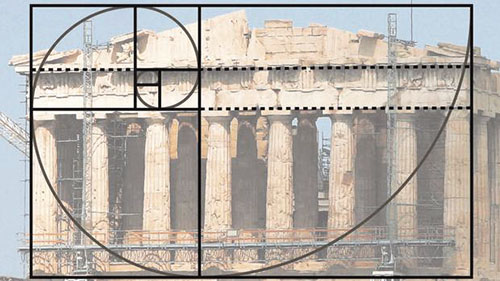
    Photo shows Golden Spiral overlay to the entire face of the Parthenon. This illustrates that the height and width of the Parthenon conform closely to Golden Ratio proportions. 

    The ancients used this Golden Mean proportion in designing their buildings. The Parthenon in Athens and the Great Pyramid at Giza immediately come to mind. Aside from the numerical value itself and ignoring for a moment that this ratio is supposed to represent an ideally pleasing proportion (so we’ve been told), what is its relationship to man/woman in general and, specifically, to Leonardo’s sketch of the Vitruvian Man?

    Five, the Number of Man

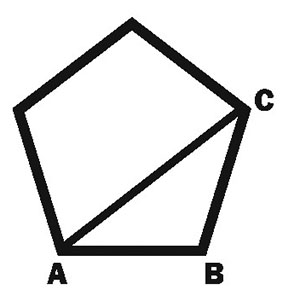
    Without getting into any more calculations at this point, let me say that the number 5 plays a significant role in the Golden Mean. To easily illustrate this, let’s generate a regular 5-sided figure, a pentagon, with each side measuring one unit as shown here

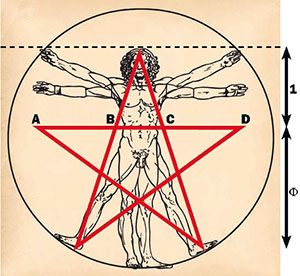
    so that AB = BC = 1. Now, if we connect any two opposite points with a straight line (for instance, AC), that line will measure 1.618…, the numerical value of F. Of course, if we look at man/woman in frontal outline form, we see five appendages extending from the central body trunk: two arms, two legs and a head. If we take Leonardo’s Man and slightly rotate the position of the arms downward, we can superscribe a perfect pentagon around the figure. Within that pentagon we can inscribe a perfect pentagram – a five-pointed star, as shown below in a sketch attributed to Agrippa. It goes without saying that both the pentagon and the five-pointed star have great significance, especially in the United States. 

    We have in “five-foldness” a number and geometric shapes with profound and multi-layered meaning. Man himself and woman herself are symbolically represented overall by that number and by those shapes. And, once more, “As Above, So Below” applies: we have five fingers on each hand and five toes on each foot. The whole is echoed in the parts. And that’s just the beginning. 

    Above is an overlay drawing (not to scale). If we assign a value of 1 to the distance from the line AD measured vertically to the top of the man’s head, then, measuring vertically downward from AD to the bottom two points of the pentagram at the man’s toes, we find that distance is 1.618… Also, we find the following ratios: AD / AC = F , and AC / AB = F. Again, the parts are in proportion to the whole. 

    Centre of Gravity

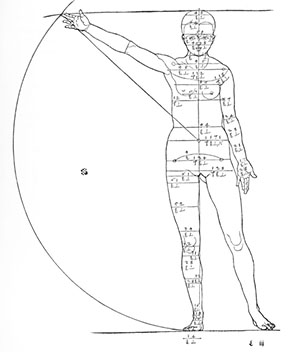
    Finally, we have Albrecht Dürer’s sketch showing the human body divided by F at the navel and divided in half by the sex organs:

    When a baby is born, the navel divides the body in half. As the child grows up, the bodily proportions change so that the legs are longer in relation to the trunk. By adulthood, the navel has moved up (relative to the person’s total height) to the position of the F ratio as shown in both the da Vinci and Dürer drawings. Some say this represents the principle of a human being maturing from a nature of duality to a nature of asymmetrical but harmonious proportionality. It is interesting to note that the level of the navel is seen in some Eastern traditions as a person’s Centre of Gravity and is used as such in certain meditative practices.

    Nature Displays Phi, Fibonacci, & Five

    Leonardo Bigollo Fibonacci, also known as Leonard da Piza (Pisano), travelled to Algiers as a young man and brought back to Europe the use of Arabic numerals to replace the cumbersome Roman numeral system. From geometers in Algiers he also learned about various additive series of numbers which are generated by the Golden Ratio of phi.

    Beautiful Phi / Golden Ratio spirals in nature including a Nautilus sea shell in cross-section and sunflower.

    There are many sequences of whole numbers that are called additive series (progressive numbers that are generated by adding the first and second numbers to arrive at the third number), but only one such sequence is classified by what is now known as the Fibonacci Series: 0, 1, 1, 2, 3, 5, 8, 13, 21, 34, 55, 89, 144, 233, 377, 610, 987, 1597, 2584, 4181, and so on. The interesting thing is that when we calculate the ratio between each number and the one just before it in the series, the higher we go the closer we arrive at the numeric value of phi. For instance, 5/3 = 1.666666…; 55/34 = 1.617647; and 987/610 = 1.6180327.

    Fibonacci Series Logarithmic Spirals

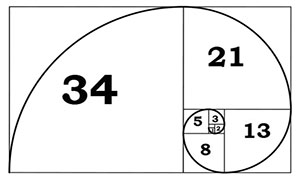
    From the Fibonacci succession of numbers we can geometrically produce a particular kind of spiral. One way to do this is by nesting ever increasing sizes of 90 degree rotated rectangles divided with squares according to the phi ratio, and then connecting the points where the squares divide the sides of the rectangles into Golden Ratios with curved lines that trace one-quarter of a circle. The resultant areas of the squares are in the sequence of the Fibonacci Series of numbers, as shown below:

    It just so happens that we see such a Fibonacci Spiral repeated time and time again in Nature. In fact, while symmetry is often seen in our world (for example, we have two symmetrically placed arms, legs, eyes, ears, nostrils, etc.), there are actually more examples of the asymmetry of the Fibonacci Series. The problem is that we’ve forgotten to look for them. 

    The Fibonacci Series is represented in the structure of many living organisms and physical processes such as the distribution of leaves on a plant, spiral seashells, flower petals, the bottom pads on the foot of a cat, the planetary orbit of Venus as seen from Earth, the distribution of seeds on a cactus and on a sunflower, changes in the radiation of energy, the ratio of male to female bees in a hive, the DNA molecule, the surface pattern of pine cones, multiple reflections of light through mirrors, the cochlea of the human ear, the breeding pattern of rabbits, spiral galaxies, the path of certain predatory birds flying down to snatch their prey, and much more. Here are pictures of some of these examples:

    Orbit of the planet Venus viewed over time from Earth 
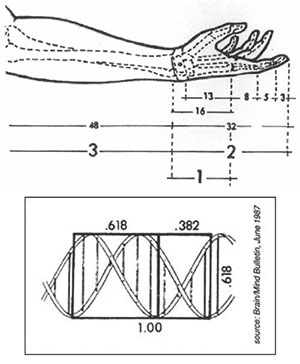
    Human arm and hand showing Fibonacci sequence of joints & DNA spiral with Phi relationships.
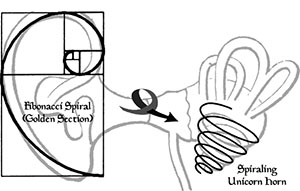
    Human ear with Fibonacci spiral
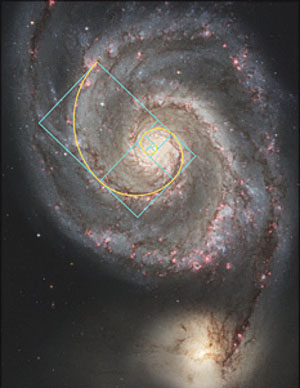
    Galaxy with Fibonacci spiral

    The Number 5 in Nature

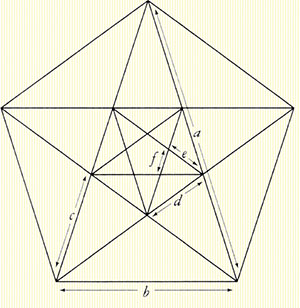
    We showed above that the ratio between a diagonal and a side of a regular pentagon equals phi. By connecting all the pentagon’s corners we can inscribe a pentagram star within the pentagon shape. In the figure below, you’ll notice that inside the pentagram is another, smaller pentagon, and within that, too, we can inscribe a still smaller pentagram. This can be done indefinitely going up the scale in size (macrocosm) and down the scale in size (microcosm). 

    A fascinating characteristic of the lengths of the lines used to make the pentagon/pentagram figure(s) is that, as we proceed from larger to the next smaller line (a to b, b to c, c to d, etc.), the ratio of line lengths to each other is exactly the value of phi

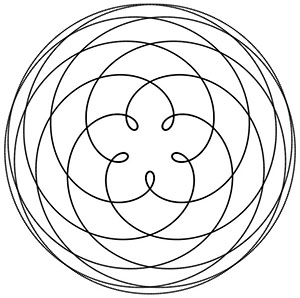
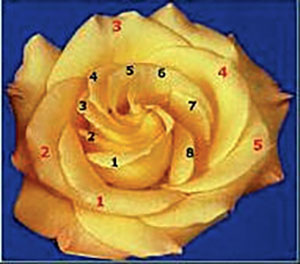
    Visually, this figure begins to resemble a flower. That is to be expected for in Nature we see the number 5 and the subsequent Fibonacci Series played out in many different kinds of flowers. Perhaps the most beautiful is the rose. 

    Rose with petals in a Fibonacci series spiral 

    All edible fruit-bearing plants have flowers with their number of petals based on 5, while daisies have a number of petals always equal to one of the numbers in the Fibonacci Series. 

    Daisy with Fibonacci series number of petals

    The internal shape of edible fruit itself is often based upon the number 5 and the Fibonacci Series. For instance, an apple core has 5 seed pod segments that make almost a perfect pentagram.

    Get the issue this article appears in

    Inventor Copies Nature’s Efficiency

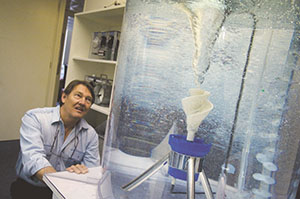
    An article by Kelpie Wilson discussing the annual Bioneers conference in San Raphael, California, highlighted an invention made in the image of the Fibonacci Spiral. Wilson reported:

    “Inventor Jay Harman presented a family of designs for fans and impellers based on the natural spirals found in seashells and blossoms. My favorite was a mixer for giant municipal water tanks. When water is stored for long periods, it can stagnate and become unhealthy. Harman’s mixer is tiny, barely bigger than my fist. Turning in the middle of the tank, nothing much happens at first, but over time it sets up a natural vortex in the tank that keeps the water circulating and fresh. Harman said even if you stop the mixer, the vortex will keep on spinning for days.”

    Part 2 of this series investigates the Pythagorean Theorem, the Pythagorean properties of numbers 7 & 8, and the Law of Octaves, and appears in New Dawn 158.

    [alert type=”general” dismiss=”no”]This article was published in New Dawn 157.[/alert]

    [alert type=”success” dismiss=”no”]If you appreciate this article, please consider subscribing to help maintain this website.[/alert]

    Recommended reading

    Graham Hancock & Santha Faiia, Heaven’s Mirror: Quest for the Lost Civilization, Crown Publishers, Inc., 1998
    Le Corbusier, Le Modulor and Modulor 2 [English edition], Birkhäuser, 2004
    D’Arcy Wentworth Thompson, On Growth and Form, Cambridge University Press, 1992

    © New Dawn Magazine and the respective author.
    For our reproduction notice, click here.
  • The World of Esoteric Orders: Secrets Within Secrets

    The World of Esoteric Orders: Secrets Within Secrets

    From New Dawn Special Issue Vol 7 No 3 (June 2013)

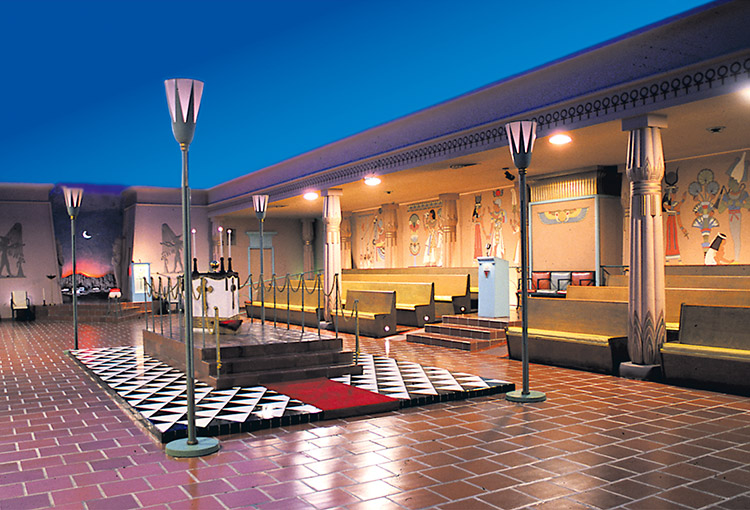
    It is noon on a summer morning in California, and I am sitting in a dimly lit auditorium that is decorated in an Egyptian style with Art Deco touches. A group of us have shuffled in and taken our seats on finely polished wooden benches, and we are led on a guided meditation.

    I don’t remember the exact content of the meditation, but I do remember the inner experience it generated in me. I had a strong sense of being in an Egyptian temple, seated on a stone chair on a stone dais in the centre of a room. The room had some kind of indirect lighting, and the only image I saw on the walls is a winged disk in front of me. Within me was a sense of coolness and centredness. I also had a slight glimpse, through a side entrance, of a bright blue sky with desert sand and some palms. I went into a deep meditative state and came out of it when the session ended.

    The setting I was in – I mean in the physical world – was the temple of the Ancient and Mystical Order Rosae Crucis (AMORC for short) in San Jose, California. It’s not surprising, perhaps, that I should have a sense of Egypt – the entire property, Rosicrucian Park, which occupies a city block, is designed in a quasi-Egyptian style – but it is surprising that the sense of Egypt should be so powerful. Later I realised I had had a much stronger feeling of being in ancient Egypt during that meditation than I had ever had when I visited the country itself.

    AMORC was founded in 1915 by an American ad man named Harvey Spencer Lewis, who received certain initiations in the Rosicrucian tradition in Europe around 1910. Using American marketing techniques (such as advertising in magazines), he built AMORC into one of the largest and most visible esoteric orders in the world. And, he insisted, the lineage of this tradition went back to Egypt itself.

    Does it? How could we possibly know? The amount of documentation that would be required to prove such a claim would be enormous, and anyway such materials would hardly be able to survive the assaults of the millennia.

    I am not a member of AMORC myself – I was present for that meditation, and a couple of others like it, while I was attending a conference sponsored by the organisation in July 2010. Moreover, I’ve never felt any great affinity for ancient Egypt. I have no way of knowing whether my experience arose from a contact with a thought-form built up by decades of Rosicrucian practice or whether it genuinely conveys a living tradition that goes back to the days of the pharaohs.

    A view of the temple of the Ancient and Mystical Order Rosae Crucis (AMORC for short) in San Jose, California. (Photo credit: AMORC)

    The “Upper Room”

    Perhaps it does not matter. In either case this experience suggests one characteristic of an esoteric order: it must have an “upper room.” The phrase goes back to the New Testament, which tells of Christ’s disciples gathering in an “upper room” after his ascension (Acts 1:13). The phrase also appears in Mark 14:15 and Luke 22:12, which speak of an “upper room” at which the Last Supper was to be held. The detail is striking: what difference does it make if you meet in a room that is on an upper storey rather than a lower one? In a literal sense, none; but in an inner sense, I believe that an “upper room” – that is, a place on an astral level, as it is sometimes called, or the realm of the psyche – is a necessary part of an esoteric order. This “room” can be created by the sustained work of visualisation by a group over a certain period of time, and after a certain point it can start to have a quasi-independent existence. The group can gather there in thought, if not physically. This kind of “upper room” may be what I glimpsed in my AMORC meditation.

    Curiously, one of the requirements given for the brothers in a seventeenth-century text known as the Fama fraternitatis (“Rumor of the Brotherhood”), a chief inspiration for the Rosicrucian movement, is “that every year, on the day C., they should meet together at the house Sancti Spiritus [of the Holy Spirit], or write the cause of his absence.” It is not clear which exactly is the “day C.,” but there is some evidence, at least in certain strains of the Rosicrucian tradition, that, despite the difference in initials, it is the feast of the Epiphany on January 6. (I do not know if this is the case for AMORC.) In any case, it seems likely that “the house Sancti Spiritus” is not a physical building, but the kind of upper room that I have been talking about here.

    None of this, of course, tells us exactly what an esoteric order is, so some explanation is needed. Let’s begin by assuming that there is a vast continuum of development in consciousness, from the most ephemeral subatomic particle to beings and dimensions greater than we can conceive. Let’s also assume that the realm of human life and consciousness forms a very narrow bandwidth on this enormous span. There are levels below us and above us. Moreover, these levels are not rigidly separate or discrete, but blend into one another, like the colours on the visible spectrum. That is, there is some communication among them. The most famous image of this process appears in Jacob’s dream in Genesis: “And behold a ladder set up on the earth, and the top of it reached to heaven: and behold the angels of God ascending and descending on it” (Genesis 28:12).

    We might go on to make another assumption – that the interaction that takes place among these levels involves a certain degree of responsibility, that the level above is required to help the one below rise to a higher degree of consciousness. Taking all these possibilities into account, we have a sense of what esoteric orders might mean for human development.

    By this view, there are beings who have a greater degree of awareness (and, we may hope, compassion) than we do. They are aware of us – dimly, perhaps, as we are aware of them – and are able to help us. But in fact we cannot see these beings on a physical level. They exist on some other plane, and we need to rise up to that plane in order to have some genuine communication with them.

    Hence the need for an upper room. Hence also the need for a group or community that can train people to rise to this upper room and have some communion with the beings there. (The Jewish Kabbalists sometimes refer to this as “the academy on high.”) These groups would constitute the esoteric orders – some of them known but many, perhaps most, unknown to any but their own members. The esoteric orders would exist on the physical level, but they would also have contacts on levels above. These are sometimes called “inner plane” contacts.

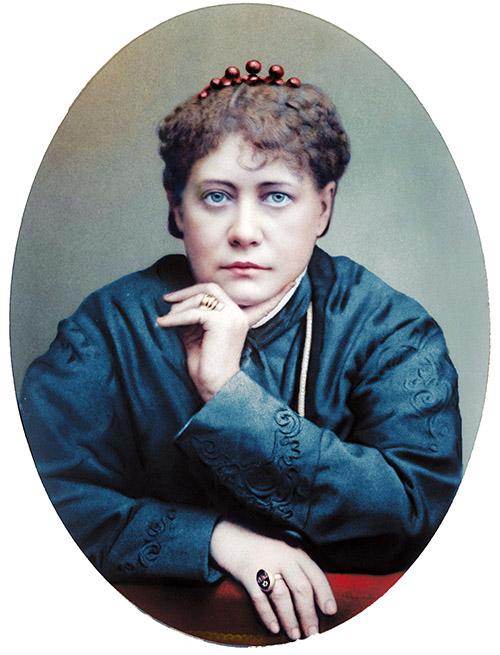
    To take another example – again from a group that I do not belong to – there is the little-known Esoteric School of Theosophy. The Theosophical Society (TS) itself is comparatively well-known. It was founded in 1875 by the Russian savant H.P. Blavatsky and several of her associates. Today it continues to function on a worldwide basis as a means of, among other goals, investigating the “unexplained laws of nature and the powers latent in humanity.” The TS is said to have been inspired by Blavatsky’s contact with certain Masters or adepts who possessed paranormal powers and whose mission was to elevate the spiritual state of humanity.

    H.P. Blavatsky

    As the TS grew and spread, its purpose became more diffuse, and it attracted many members who were interested in studying about but not necessarily pursuing the esoteric path. Consequently, in 1888 Blavatsky formed what she called the “Esoteric Section” of the TS, which was more oriented toward practice. Later the name was changed to the “Eastern School of Theosophy,” and finally to “the Esoteric School of Theosophy,” an organisation that exists to this day. It is not a secret society per se, but it is comparatively discreet about its existence and is only open to members of the TS. Those who want to join the Esoteric School must pledge themselves to a life of purity, eschewing meat, alcohol, and sexual license. (Not all esoteric orders have these requirements.) Members of the ES, as it is known for short, also devote themselves to lives of study, meditation, and service, although they do not withdraw from the world as monks or nuns.

    Part of the goal of the ES seems to be to maintain contact with the Masters or adepts of whom Blavatsky spoke. I do not myself know what the nature of this contact is, if it is genuine, or which Masters the members of the ES would claim to be in touch with. Nor do I know whether these Masters are believed to be living in physical bodies or exist only on the inner planes. I have occasionally put questions about these things to members of the ES but have only gotten vague and noncommittal responses. Nonetheless, this contact seems to be part of the task of the ES, and it helps illustrate the purpose of having an upper room. 

    Initiation

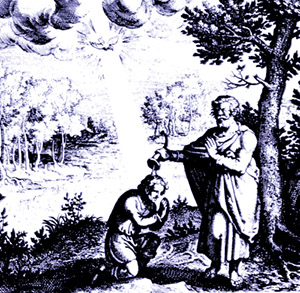
    Esoteric orders usually bring in new members through initiation. The word “initiate” is in some ways a misleading one. To some, it connotes someone who is highly advanced – as, for example, in Cyril Scott’s Initiate trilogy of occult novels from the 1920s and ’30s, whose hero, Justin Moreward Haig, displays astonishing paranormal powers. But the core meaning of the word is really “beginner” – an initiation is a beginning. Initiation can take many forms and can range from the extremely simple to the extremely complex, but often it contains a sequence of acts in which the initiate symbolically “dies” and then is resurrected in a new and transformed state. The most familiar version of this rite is Christian baptism, particularly in its original form, whereby the candidate is fully immersed in water. By this symbolic drowning and restoration, the new Christian takes part in the death and resurrection of Christ himself. (Christianity today, of course, is not an esoteric order, but there is some evidence that it began as an esoteric order and was later popularised.)

    The Catholic Church has traditionally taught that the rite of baptism leaves an indelible mark on the soul, removing all sin. Writing on the occult significance of the sacraments in the early twentieth century, the Theosophist and clairvoyant C.W. Leadbeater was more cautious in his assessment. While saying that it was “distinctly… an act of white [beneficent] magic, producing definite results which affect the whole life of the child,” he also pointed out that “a Sacrament is not a magical nostrum. It cannot alter the disposition of a man, but it can help to make his vehicles a little easier to manage. It does not suddenly make a devil into an angel, or a wicked man into a good one, but it certainly gives the man a better chance. That is precisely what Baptism is intended to do, and that is the limit of its power.”

    As this passage suggests, initiatic practices usually intend to transform the inner nature of an individual. The Freemasons sometimes claim that the aim of their secret initiations is “to make good men better.” This is generally a subtle process, and probably for most individuals the change they undergo is comparatively gradual and difficult to see unless you are looking for it. In some cases, however, initiation produces more dramatic effects.

    Over twenty years ago, when I was editor of Gnosis, a now-defunct magazine of the Western inner traditions, I entered into correspondence with a gentleman from Jordan named Dr. Jamal N. Hussain, who was researching deliberately caused bodily damage (DCBD) phenomena. He told me about the Tariqa Casnazaniyyah, a Sufi order whose name means “a path that is known by no one.” (For a discussion of the Casnazaniyyah order, see http://ashraf786.proboards.com/index.cgi?board=sufi&action=display&thread=23998.)

    This order, which traces its lineage back to the Prophet Muhammad, has a membership said to number in the millions, located chiefly in Iraq, Turkey, Iran, and Jordan. Its initiation process is quite simple. It consists of a brief two- or three-minute ritual in which the initiate recites a vow while exchanging a ritual handshake with the master of the order or one of his deputies. The initiate then requests permission to perform certain types of miracles. The master grants permission on the condition that the initiate will perform them only to attest to the greatness of the Casnazaniyyah order.

    After this initiation, the individual can pierce his body with sharp objects, swallow razor blades, eat poisonous scorpions, or handle fire, all without any apparent harm. Scientific explanations are difficult to come by. As Dr. Hussain pointed out, this effect cannot be explained by endorphins (the body’s natural painkillers), since the wounds heal spontaneously and immediately. Nor can it be explained by self-hypnosis, since the practitioners do not experience any altered state of consciousness. While I myself have never witnessed any of these phenomena, Dr. Hussain did send along a number of rather poor-quality Polaroid photos, which did not seem to be doctored. In one of them, a bare-chested man with a large belly was piercing himself with spikes. In another memorable image, a man was chomping down on a scimitar, which was cutting into his lips. Dr. Hussain invited me to a conference in Baghdad that was discussing DCBD phenomena, but I was unable to go.

    No matter how exotic their manifestations may be, esoteric orders have the task of making and maintaining contacts with higher levels of consciousness and being, and inducing a transformation within their members that make this possible. A complementary task is to carry out some function in the world – to do some kind of work that furthers human advancement. For example, the monastic orders that grew up in late antiquity had the function of preserving the essence of classical civilisation in the wake of its collapse. They also cleared land for agriculture in Europe and managed it in a careful and responsible way, creating the foundations of Western civilisation. “In a sense they determined the whole history of Europe,” writes historian Paul Johnson; “they were the foundation of its world primacy.” As the Dark Ages passed and medieval civilisation flowered, the monasteries, having fulfilled their purpose, fell into corruption. Today the monastic orders still survive, but for the most part only as dwindling vestiges.

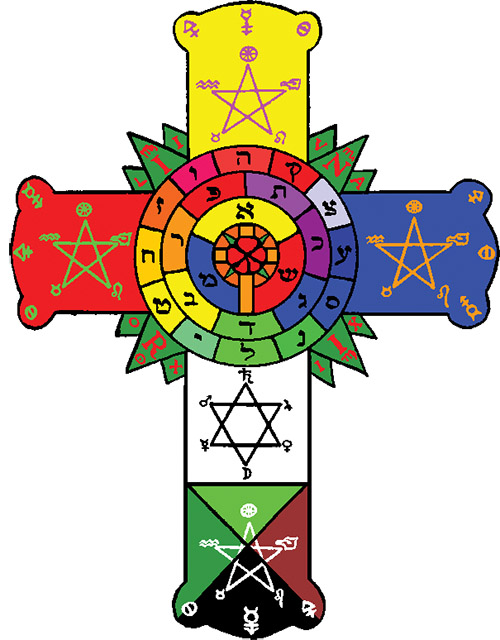
    Rosy Cross of the Hermetic Order of the Golden Dawn, ca. 1900

    Some have tried to classify esoteric orders on the basis of their functions. In the 1990s the British esoteric school known as Saros came up with a twelvefold division, inspired by the verse in Revelation that speaks of “twelve gates” to the holy city (Revelation 21:12). The Saros schema comprises Teachers, Prophets, Magicians, Lawgivers, Traders, Artists, Craft Workers, Life Tenders, Warriors, Perpetuators, Priests, and Explorers. One can easily find examples of these in world history: the schools of the prophets or “sons of the prophets” under such figures as Samuel, Elijah, and Elisha (1 Samuel 10:11; 19:19–20; 2 Kings 2:3, 5; 4:38; 6:1); the military orders of medieval times such as the Templars and Hospitallers; and the various magical orders that have arisen in the West over the past century or so, like the Hermetic Order of the Golden Dawn.

    System of the Seven Rays

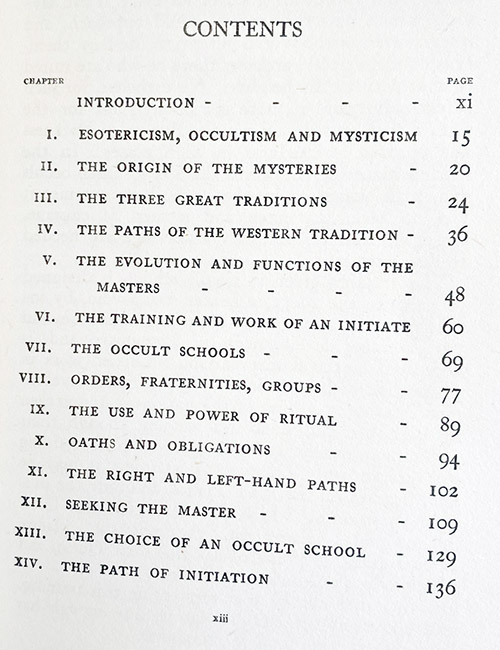
    In fact one of the most illustrious pupils of the Golden Dawn, Violet Firth, writing under the pen name Dion Fortune, wrote what is probably the best introduction to the subject: The Esoteric Orders and Their Work, which was originally published in 1928. Dion Fortune categorises the orders of the West according to a system of the Seven Rays that is similar to the one found in Theosophical teaching. Her schema is worth looking at in some depth.

    Contents page of The Esoteric Orders and Their Work.

    Beginning with the seventh ray, Fortune contends that this, “the Plane of Abstract Spirit,” cannot be contacted while in the physical body. Instead the higher Self must withdraw, leaving the body in a trance. Fortune says that this seventh ray is not highly developed in the West, being characterised for the most part by mystics and ecstatics; Teresa of Avila is one of the principal sources on the subject. This ray is not to be developed prematurely, before the other, lower ones have been brought to fruition; otherwise it produces a kind of spiritual inertia. The school of the Quietist mystics in seventeenth-century France and Spain offer an example of this problem. Hence orders of the seventh ray are chiefly to be expected in the future.

    The sixth ray is connected with spiritual devotion, with what the Hindus call bhakti, and, Fortune says, “hereon are developed the spiritual qualities of Love, Truth, Goodness, Purity, and many others.” It is headed by the Master Jesus, she says, and hence is known as the Christian Ray. “It is the hidden power of Christianity which was taught to the disciples in the Upper Room whilst the multitude received but a rule of life – a rule, however, which if faithfully followed, would bring them to that Upper Room where they could receive the inner teaching.”

    The fifth ray is connected with the use of abstract reasoning. Fortune says it is called the Pythagorean Ray because it reached its heyday in the mystery schools of ancient Greece, among which the Pythagorean school was prominent. For the philosopher Pythagoras, who lived in the sixth century BCE, the universe was grounded in the principle of number and hence was knowable mathematically. 

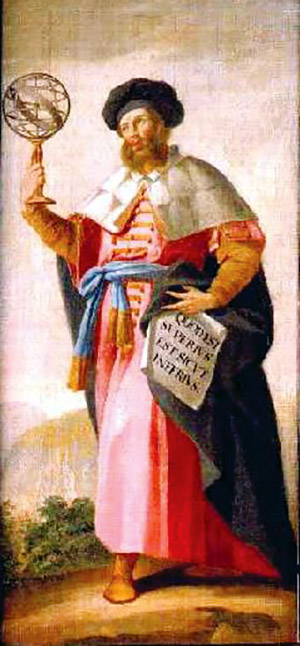
    Painting of the legendary Hermes Trismegistus, author of the Hermetic Corpus, a series of sacred texts important to many esoteric orders.

    The fourth ray is the ray of concrete, as opposed to abstract, mind; its quintessential master was the semimythical sage Hermes Trismegistus, and it bore fruit in the Egyptian and Chaldean mysteries of antiquity, as well as in its heirs, such as Gnosticism and the Jewish Kabbalah in late antiquity, as well as in the alchemists of medieval and early modern times. The Rosicrucians of AMORC, with their strongly Egyptian flavour, might come under this ray.

    The third is the ray of beauty and harmony; “being an initiation of the emotions, its standards of value are aesthetic, not ethical.” It was exemplified by some of the earlier Greek mystery schools, Fortune says, particularly those of the Dionysian cult. Later it gave rise to the “Celtic racial culture” and hence is known as the Celtic Ray. It seeks to embody beauty and harmony in the manifestations of physical reality, and as a result is also known as the artist’s ray.

    The second, “the Norse Ray,” is so called “because the purest contacts of this much-corrupted tradition which are available to us in the West are those of the Nordic mythology.” It deals with the plane of primitive instincts and the urge to overcome them; its ecstasy arises out of courage – the sublimation of fear in battle. Its dark side is cruelty, as can be seen from the ancient Viking practice of the “blood eagle,” in which a victim (usually a prisoner of war) had his rib cage cracked open from behind; his lungs were then ripped out and spread out on his back, producing a ghastly imitation of a pair of wings. Fortune suggests that this ray reached its zenith in remote primitive times.

    The first ray principally involves the mastery of the physical body. The Casnazaniyyah order forms a rather extreme example of this type. Dion Fortune says that this ray is not “worked” in the West in the present day; and it probably was not in her time (she died in 1946), but we can see its resurgence on the contemporary scene with the wide popularity of hatha yoga. Although Fortune does not say this, it can probably be connected with the health and fitness cults of recent generations.

    Get the issue this article appears in

    I must add here that Fortune’s picture of the seven rays is not quite identical with those of the classic Theosophical view (as outlined in, for example, Ernest Wood’s 1925 book The Seven Rays), but it remains comprehensive, particularly in trying to account for the different strains of the Western esoteric traditions. Again, it is easy to find examples of these different rays in many esoteric schools worldwide, whether we look at the way of the fakir or sadhu as practiced in the East (first ray) or at the schools of icon painters in Greek and Russian Orthodoxy (third ray). Other orders are more difficult to categorise. One would have to know more about the goals of the Esoteric School of Theosophy to be able to decide under which ray it fit.

    For this reason at least, I would not view Fortune’s schema, or any other, as fixed and absolute. As usual, they provide categories for classifying and thinking about a certain area that remain useful as long as they do not form rigid conceptual barriers in the mind.

    Coming to the end of this article, a reader may wonder about a number of things often associated with esoteric orders that I haven’t mentioned. What about the elaborate rites and costumes, the dazzling insignia, the extravagantly august titles often given to the leaders? Where do these fit in? They are external appurtenances – the hard shell around the order’s living core. At best they serve as reminders and confirmations of the ideals that it pursues. But if the members become too preoccupied with these appurtenances and they grow too cumbersome, this hard shell thickens and kills the living pith within. Thus when many people think of esoteric orders, they are often thinking of former esoteric orders that have died and are only going through the motions. If a seeker is only interested in these externals, most likely he will be drawn to groups of this kind, and may find them perfectly congenial. In most cases they are probably harmless enough.

    More than many other subjects in this field, esoteric orders retain an air of mystery about them. The vast majority are probably unknown to all but their own members, and the role they play in human history is subtle and hard to pin down. Some may focus heavily on their inner plane contacts, while for others these may be only felt as a vague and remote influence. But insofar as these groups foster human development and point us toward vistas that lie beyond the bounds of conventional reality, they continue to underpin civilisation in ways about which we can only guess.

    [alert type=”general” dismiss=”no”]This article was published in New Dawn Special Issue Vol 7 No 3.[/alert]

    [alert type=”success” dismiss=”no”]If you appreciate this article, please consider subscribing to help maintain this website.[/alert]

    Sources

    Paul Foster Case, The True and Invisible Rosicrucian Order, Samuel Weiser, 1985
    Dion Fortune, The Esoteric Orders and Their Work, Aquarian, 1982
    Paul Johnson, A History of Christianity, Atheneum, 1987
    C.W. Leadbeater, The Science of the Sacraments, 2nd ed., Theosophical Publishing House, 1929
    Richard Smoley, “Sufi Order Practices Way of the Fakir,” Gnosis 31 (Spring 1994), 8-9
    Ernest Wood, The Seven Rays, Theosophical Publishing House, 1925

    © New Dawn Magazine and the respective author.
    For our reproduction notice, click here.
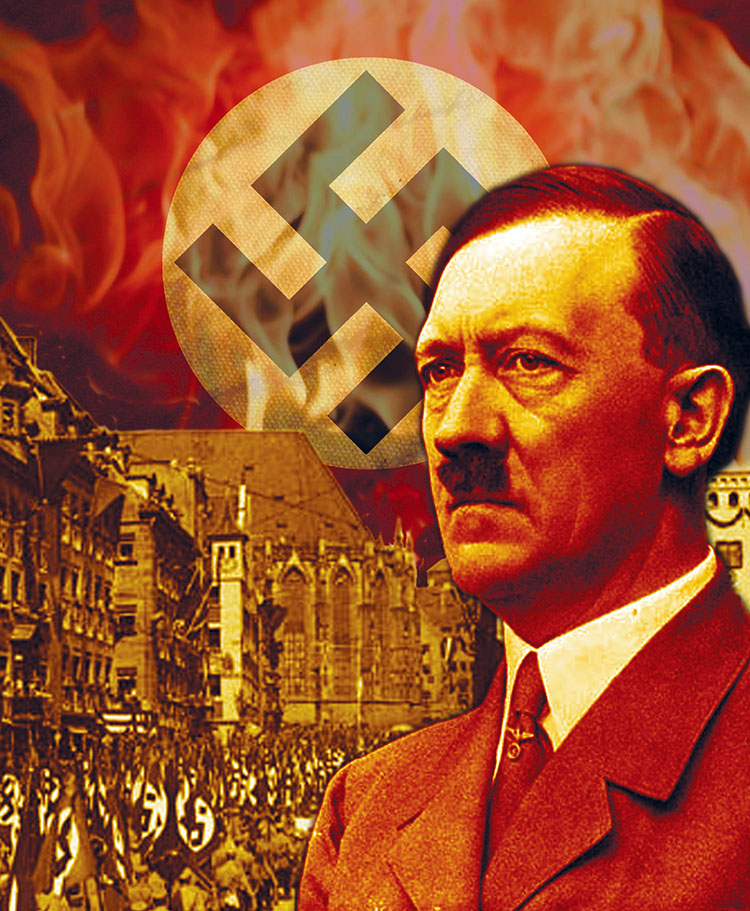
  • Global Terror: The British Connection

    Global Terror: The British Connection

    From New Dawn 92 (Sept-Oct 2005)

    The 2024 collapse of the Assad government in Syria happened not by accident but by design, the ultimate result of forces unleashed in the wake of the West’s so-called war on terrorism, which was a response to terrorist incidents such as the July 5, 2005, London bombings and the September 11, 2001 attacks in the USA (the official narratives of these events are now seriously challenged). The following article is a backgrounder on the secret wars and mass manipulation to engineer a new reality for the Middle East and impose laws that restrict freedom.

    “There are powers at work in this country about which we have no knowledge.”
    – Britain’s Queen Elizabeth II speaking to Paul Burrell, former butler to the late Princess Diana

    On July 7, 2005 bombings on the London subway system and a bus killed 52 people and injured 700. As the list of unanswered questions and inconsistencies about the attacks continued to grow, blame was quickly laid on ‘al Qaeda’.

    The effects of the London bombings were immediate: There was a renewed commitment by Western leaders to the ‘war on terror’. Most other stories and scandals were wiped off newspaper front pages, including UK Prime Minister Tony Blair’s plummeting popularity.

    The bombings occurred while the G8 Summit was going on in nearby Gleneagles, Scotland. It was here the topic of terrorism was beginning to seem tired amid broadening demands for debt cancellation for impoverished countries. US President George Bush’s priority – the ‘war on terror’ – was moving out of the limelight.

    Afterwards, with London smoking and bleeding, Bush and Blair were able to stand up tall and look strong as they declared the ‘war on terror’ would be won: “we will prevail and they will not,” and, “we alone are fighting” to defend “the values of Western civilisation.” Terror returned to front and centre and further debt cancellation was forgotten.The bombings were the green light for Tony Blair to introduce draconian anti-terrorism legislation which had previously been thwarted by judicial rulings designed to protect human rights.

    Blair said he plans policies for deportation of people who “foster hatred.” Parliament will also be asked to pass a law against “condoning” or “glorifying terrorism” anywhere in the world, and giving the government the power to close places of worship. Lists are to be drawn up of ‘extremist’ websites, bookshops and centres.

    A clampdown on words or actions likely to be seen as ‘glorifying terrorism’ could affect groups and individuals unconnected to ‘Islamic extremism’ – animal rights activists, for example, may have to change much of what they write if they are not to fall foul of the legislation. British MP George Galloway, a vocal supporter of the Iraqi resistance movement, could be charged under the new law because the government has demonised the resistance as ‘terrorists’.

    Australian Prime Minister John Howard also announced a similar review to ‘tighten up’ anti-terrorism legislation.

    Who was ultimately responsible for the July 7 bombings remains a mystery. But authorities seemed to know who was behind it soon after the attack. London Metropolitan Police Commissioner Sir Ian Blair had already made up his mind when he said the investigation into the bombs will uncover a “clear al Qaeda link.”

    Responding to news of the July 7 bombings, Ayatollah Ahmad Jannati, who heads Iran’s top legislative watchdog the Guardian Council, said the British had themselves to blame.

    “One possible set of culprits is al Qaeda. But al Qaeda is Bush and Blair. Who launched al Qaeda? You must be tried, you who are the mothers of al Qaeda,” he told worshippers at Friday prayers in Tehran.

    “The other likelihood is that the British regime may have carried out the attack itself… because it benefits most… They want to justify their presence in Iraq and Afghanistan,” he added.

    July 7 Anomalies

    Independent researchers across the world have uncovered information which contradicts the official version of events and points to the involvement of intelligence agencies in the bombings.

    Hardly any mainstream media picked up the news that ‘bombing exercises’ were being conducted in the London Underground at the same time as the actual attack.

    Only hours after the July 7 bombings, in an interview on BBC radio, Peter Power, Managing Director of Visor Consultants, made the extraordinary admission that at precisely the time the London bombings took place, his company was running an exercise which drilled the London Underground being bombed at the exact same locations, at the exact same times, as happened in real life on July 7. Visor Consultants is a “crisis management advice company” or PR firm.

    Power said the drill focused around “simultaneous bombings.” Originally the London bombings were thought to have been spread over an hour, but later it was revealed they were in fact simultaneous. Also, they were easier to execute as Britain’s terror alert level had just been lowered.

    “We had to suddenly switch an exercise from fictional to real,” said Power who is a former Scotland Yard official, working at one time with the Anti Terrorist Branch.

    Responding to a deluge of emails after his admission, Power strenuously denies any truth to “conspiracy theories” tying his company to the attacks, but he does confirm the exercise involved a “short number of ‘walk through’ scenarios for a private company in London as part of a wider project that remains confidential.”

    Some investigators suspicious of Visor Consultants suggest the company might have released information to the media that the bombings were a power surge. For the first hour this was the explanation given, and one that would give authorities time to manage the release of information about the explosions. Power has been hired by the British government before and has on previous occasions released information after terrorist incidents in London. This is all too close to dismiss as simply coincidence.

    A news report which almost went unnoticed hints intelligence agencies had prior knowledge of the attacks.

    Arutz Sheva, pegged as Israel’s national news Internet site, stated on the day of the July 7 bombing: “Army Radio quoting unconfirmed reliable sources reported a short time ago that Scotland Yard had intelligence warnings of the attacks a short time before they occurred. The Israeli Embassy in London was notified in advance, resulting in Finance Minister Binyamin Netanyahu remaining in his hotel room rather than make his way to the hotel adjacent to the site of the first explosion, a Liverpool Street train station, where he was to address an economic summit.”

    This report was subsequently refuted and changed to say Netanyahu was warned after the first blast.

    The importance of Visor Consultant’s training exercise cannot be understated because the exact same scenario played out in the United States on the morning of September 11, 2001.

    The Pentagon and the North American Aerospace Defense Command (NORAD) conducted drills involving multiple hijacked planes on the morning of September 11, 2001. And in what the US government called “a bizarre coincidence,” the US National Reconnaissance Office had planned an exercise for September 11 in which an errant aircraft would crash into an office tower. American Airlines Flight 77, which crashed into the Pentagon, took off from Dulles at 8:10 AM on September 11 – 50 minutes before the exercise was said to begin.

    On the morning of 9-11, NORAD radar screens showed as many as 22 hijacked airliners at the same time, but they had been briefed this was part of the exercise drill and therefore normal reactive procedure was forestalled and delayed. The two scenarios are comparable in that it is a tried and tested method of navigating around everyday security services, and, more importantly, if the perpetrators get caught during the attack or after with any incriminating evidence, they can just claim they were taking part in an exercise.

    What are the odds of coincidental ‘drills’ going on at the exact same time real life events were taking so many human lives in two terrorist attacks?

    We are also faced with the scenario of four men, one of whom had a new family, and another whose wife was pregnant, carrying bombs set on timers and calmly waiting for them to explode.

    A statement issued by the family of the so-called “fourth suicide bomber”, Jamaican-born British resident Germaine Lindsay, said he “had a kind, caring and calming presence about him.”

    “He was a good and loving husband and a brilliant father, who showed absolutely no sign of doing this atrocious crime. We as a family had no idea of his plans and are as horrified as the rest of the world.”

    The incongruities of the case have already prompted even some official investigators to suggest the men were not ‘suicide bombers’ but may have been duped by their “al Qaeda handler” into believing they would only place the explosive devices and not be killed in the blast. But it also makes sense if the men thought they were carrying fake bombs as part of a terror drill.

    Lending weight to this theory is the fact all four men had paid up their parking tickets before boarding a train at Luton for King’s Cross and they all bought return tickets to the capital.

    The lack of video taped evidence revealing the alleged bombers’ movements is also suspicious. Every London bus and Underground train carriage is said to have multiple video cameras, but the one on the bombed bus apparently “malfunctioned.” Videos of the other men have not been made available, only a few grainy images of the men at the start of their journey boarding the train at Luton.

    Another piece of the jigsaw being pieced together by independent investigators is the testimony of 32 year-old dance instructor Bruce Lait, who was just metres away when a bomb ripped through his train carriage. He miraculously escaped with only minor injuries.

    Speaking from his hospital bed in an interview with the British newspaper Cambridge Evening News of July 25, Lait recounts what happened after the bomb went off and how a policeman helped him out of the carriage, adding that, “The policeman said ‘mind that hole, that’s where the bomb was’. The metal was pushed upwards as if the bomb was underneath the train. They seem to think the bomb was left in a bag, but I don’t remember anybody being where the bomb was, or any bag.”

    Then on July 21, two weeks after the July 7 bombings, four attempted bomb attacks disrupted part of London’s public transport system. By July 29, police had arrested all four of the main bombing suspects and numerous other people.

    The July 21 attacks were immediately linked to the previous bombings, however it is has now been established there was no connection between the men involved in both attacks.

    The police operation that quickly rounded up all the suspects of the copycat July 21 attack succeeded in monopolising media coverage and taking attention away from growing doubts about the official version of the July 7 bombings.

    Hamdi Issac, one of the July 21 bomb suspects held in custody in Rome, says his backpack contained only flour and was designed merely to frighten. This explains why the so-called bombs let off a small bang followed by some smoke smouldering from their backpacks. According to Italian daily La Repubblica, he claims not to have planned to kill anybody in the attack, “let alone myself.” He added that the July 7 bombings in London, “happens every day in Iraq.”

    The difference between the two bomb attacks could not be starker. The bombers of July 7 are all dead and police have made no arrests of significance in connection with it. The attacks of July 21 led to the arrest of all those directly involved including dozens of people who supposedly are ‘connected’.

    Perhaps one of the biggest indicators of an intelligence agency link to the July 7 bombings is the revelation that Haroon Rashid Aswat – allegedly the “mastermind” of the attacks – is controlled by MI6, Britain’s external security service.

    Speaking on July 29 to Fox News channel, former US Justice Department prosecutor and terrorism expert John Loftus discussed Aswat’s relationship to British and US intelligence, through a British based organisation Al Muhajiroun.

    Loftus added that, “the entire British police are out chasing him [Aswat], and one wing of the British government, MI6 or the British Secret Service, has been hiding him…” Loftus adds that Aswat’s role as an informer or a ‘double agent’ had protected him from being arrested by the CIA because he “was working for British intelligence.”

    Arresting and putting Aswat on trial in a secret tribunal for organising the July 7 attacks could be turned into a two fold victory for the intelligence agencies: al Qaeda is proved to be responsible, and a blowback remnant and potential whistleblower from their past operations is taken out of circulation.

    Londonistan

    Space does not permit a full accounting of Britain’s creation and manipulation of certain so-called ‘Islamic’ organisations in the late 19th and early 20th century. Close to a century ago the British began cultivating Islamic groups to counter the rising tide of Arab nationalism which demanded independence from colonialism. Suffice to say, as masters of political manoeuvring and intrigue, British geostrategists have for many years struggled to control events in the oil rich Middle East.

    Up until recently, this strategy allowed a flood of ‘Islamists’ from Egypt, Saudi Arabia, Afghanistan, Pakistan and Palestine, to live in Britain, a safe haven where they could further promote their various causes.

    By the 1980s and 90s, foreign intelligence services were complaining about the policy. The French were particularly incensed, tracing the origin of the 1995 bombings of the Paris Metro to cells operating, with apparent impunity, from London.

    The Russians repeatedly expressed displeasure over Britain providing asylum for Chechen separatists, which they say is a double standard in the fight against terrorism. Two of the terrorists behind the massacre of 300 people, half of them children, in Beslan, Russia in 2004, were British citizens.

    It is well known that for more than two centuries, the West has been engaged in breaking up – or thwarting – the presence and extension of Russian influence southward to the Black Sea and beyond. Destabilising the Russian republic of Chechnya is a key aspect of this strategy, part of the ‘New Great Game’.

    The New Statesman revealed in December 2002 that, even a year after September 11, Britain was still seen as excessively tolerant. In a cover piece entitled ‘Londonistan’, the Statesman quoted European and American officials as suggesting the UK “had come to a non-aggression pact with Islamist oppositionists dating back to the mujahedin rebellion against the Soviet-backed regime in Afghanistan”: a deal that might explain British immunity from ‘Islamic’ attacks.

    Years before September 11 there were calls for Britain to give up harbouring certain groups, but these pleas fell on deaf ears.

    Malaysian Prime Minister Dr. Mahathir Mohamad, at the 1997 summit of the Organisation of Islamic Conference decried “Western democracies,” meaning in this case, Britain, which “give refuge to those of our people who promote disruptive activities in our countries,” even while accusing Islamic nations of promoting “terrorism.”

    The ‘Islamic Group’ that claimed credit for the November 1997 shootings in Luxor, Egypt which killed over 60 people, mostly foreign tourists, had its international headquarters in London.

    Al Ahram, the Egyptian government daily, in a feature entitled ‘How Can We Surround and Extradite London’s Lords of Terror?’ published on December 7, 1997, documents how London became an “Islamic” terrorist haven following the war in Afghanistan, when “legions” of unemployed mujahideen, who had been drawn to Afghanistan from all over the Muslim world, flocked to London for protection, and for new assignments.

    Al Ahram quotes an unnamed security source, in its analysis of British motives in making London the “world’s terror capital,” which partially describes the thinking of British intelligence. “The British expect to reap a great advantage through controlling the most dangerous terrorists on its soil,” it quotes the source as saying.

    “Through this logic,” the source continues, “British intelligence works contrary to all its counterparts in the world. The information British intelligence has acquired about these groups and its members, is an invaluable card, which it can use to either negotiate, or put pressure on, Middle East states.”

    Al Ahram adds that part of the purpose is to manipulate these groups and take them over, on behalf of British geopolitical aims.

    Al Ahram’s source concludes: “London’s ‘permanent interests’ have always converged with the lords of terrorism who live in Britain, and who never underestimate what their existence represents for British interests.’’

    After September 11, French intelligence officials again angrily accused Britain’s internal security agency MI5 of failing to cooperate in stifling ‘Islamic’ terrorist groups. The level of assistance received from British intelligence in tracking down terror cells was described as being worse than before September 11.

    The mid-1990s witnessed a series of vicious wars that led to the break up of Yugoslavia. The Pakistan-based militant group Harkat-ul-Mujahideen (HUA) was one of the many organisations to send a contingent to help Bosnian Muslims in their fight against the Serbs. They were sent by the Pakistan government of Benazir Bhutto at the request of the US administration under Bill Clinton.

    The contingent, which was raised and trained by Lieutenant General (retired) Hamid Gul, former director general of Pakistan’s Inter-Services Intelligence (ISI), included a large number of British Muslims of Pakistani origin.

    According to estimates, about 200 Muslims of Pakistani origin living in the UK went to Pakistan, received training in the camps of the HUA, and joined the HUA in Bosnia with the blessings of London and Washington. Among them was Omar Sheikh, who went on to mastermind the murder of US journalist Daniel Pearl in 2002.

    In the late 1990s, the Kosovo Liberation Army (KLA) also attracted many foreign fighters, encouraged by an outpouring of Western support to help defeat an alleged Serbian genocide. One of those fighters was David Hicks, who is now locked up in the Guantanamo Bay prison camp.

    In Crossing The Rubicon, investigative journalist Mike Ruppert notes: “Great Britain – one of the major players supporting the KLA in Kosovo – also maintained secret relationships with bin Laden… In 1996, Britain’s exterior intelligence, MI6, actually funded and worked with al Qaeda in a plot to assassinate and overthrow Libya’s Muammar Qadhafi. Details of the relationship emerged after a British domestic intelligence (MI5) officer, David Shayler, went public with documents detailing the relationship between Britain and bin Laden.”

    A decade before Bosnia and Kosovo, the West had raised and funded a large corps of fighters – including Osama bin Laden – to help the mujahideen in their jihad against Soviet troops in Afghanistan in the 1980s. Most of these ‘Freedom Fighters’ returned home, but many remained under Western intelligence agency control. Some were soon redeployed to North Africa and the Middle East, to carry out terrorist actions ascribed to ‘Islamic terrorist groups’, on behalf of Western geopolitical aims.

    Question is: Are some of these fighters participating in the ‘war on terrorism’, and who do they work for?

    Who Benefits?

    After September 11, terrorism suddenly became enemy number one. The threat was conflated into the proportions of an alien invasion. However, whether it was real or not, the powers-that-be promptly took advantage of the terrorist bogeyman.

    Armies could be mobilised against any country alleged to be ‘harbouring’ the new terrorist enemy (ie. Afghanistan and Iraq). An elusive enemy could strike anywhere at anytime, which meant sacrifices at home (anti-terrorism laws).

    Such an enemy of vague and ambiguous proportions could be easily stage-managed. It is now irrelevant whether Osama bin Laden is alive or dead, or that he controls an actual organisation with certain objectives. The myth is born. And now those with real power – military force and ‘informational dominance’ – easily direct the outcome of the new game.

    With ‘jihadists’ on the loose worldwide, we would expect to see many attacks. Instead, despite the mainstream media’s duplicity, since September 11 the Western world has witnessed only a few spectacular attacks supposedly carried out by small groups ‘connected’ to ‘al Qaeda’.

    With great fanfare in the corporate controlled press, large numbers of Muslims have been rounded up in raids across Britain, Europe, the US, and Australia. But most were later released and no one has been proven to be an ‘al Qaeda’ operative. For example, following the well publicised ‘ricin affair’ in the UK in January 2003, it was later established there was no ‘ricin’, no ‘cell’, and no ‘al Qaeda’ connection.

    The independent British journalist William Bowles notes that, “with hundreds arrested under anti-terror laws but not a single conviction of anyone actually proved as being a member of al Qaeda or even being caught red-handed with a bomb, it’s safe to assume that it’s unlikely al Qaeda actually exists as an effective organisation, let alone operates an ‘international terror network’.”

    Statements of responsibility made in the name of ‘al Qaeda’ or the fact an individual claims to be acting on behalf of it (after being ‘softened up’ at a secret prison camp), does not prove such an organisation exists.

    Official briefings about terrorism, often unverified or unverifiable by journalists, have become dramatic press stories. Few of these ominous announcements are retracted if they turn out to be baseless. Almost no one questions the myth of ‘al Qaeda’ because so many people have got an interest in keeping it alive.

    It is not too difficult to understand the relative ease in which intelligence agencies, with all their financial and information resources, can manipulate data (as we saw in the recent WMD justification for war on Iraq) and people to achieve objectives.

    Is the ‘war on terror’ running a little flat? Let’s raid the homes of some Muslims and then leak to the press that ‘Muslim extremists’ were planning ‘terrorist attacks’ on Australia’s Sydney’s Opera House and Harbour Bridge (such raids actually occurred in Melbourne on June 22). What’s even better, the families whose homes were raided are prevented from speaking out by new anti-terrorism laws.

    Thus, we never know if the raids prevented a terrorist plot or they were a publicity stunt for the ‘war on terror’. But headlines have the desired effect, the not so subtle reminder there’s a ‘war’ going on and it might one day come to your home, your office, or your child’s school – just as it did to commuters in London on July 7.

    Can we say the cause of Islam benefits from terrorist attacks that kill civilians? No, of course not. The beneficiaries are governments who can ‘justifiably’ continue to support Bush’s ‘war on terror’ (which enriches the military-industrial complex) and introduce long sought laws that curtail civil liberties and limit dissent.

    In London today they are now implementing intrusive surveillance and policing of Muslims and the Muslim community. The attacks have justified the introduction of ID cards, which will hold substantial personal information.

    New ‘anti-terror’ laws being rushed through the UK Parliament include rules allowing the government to impose curfews and the electronic tagging of people suspected of terrorism.

    A Phoney ‘War on Terror’

    It goes without saying that the overwhelmingly majority of Muslim organisations are entirely legitimate and also it cannot be assumed that all groups cited in this article are simply the products of Western intelligence. What the evidence reveals is that intelligence agencies have tirelessly worked to infiltrate groups of all political and religious persuasions in an effort to achieve their objectives.

    The use of agent provocateurs is a well established method that many states still use against their perceived enemies. It would be child’s play for well established spy agencies such as Britain’s MI6, America’s CIA, and Israel’s Mossad to control ‘al Qaeda’, which barely exists at all, except as an idea or a myth about cleansing a corrupt world through religious violence.

    Much of the currently perceived threat from international terrorism, argues the recent TV documentary ‘The Power of Nightmares: The Rise of the Politics of Fear’, “is a fantasy that has been exaggerated and distorted by politicians. It is a dark illusion that has spread unquestioned through governments around the world, the security services, and the international media.”

    “In an age when all the grand ideas have lost credibility, fear of a phantom enemy is all the politicians have left to maintain their power,” it says. A perpetual war against an invisible and entirely fictitious enemy.

    Five continuous years of a ‘war on terrorism’ past the point of no return have left the line between fabricated (intelligence agency-orchestrated) terrorism and any ‘real’ terrorism (a response to the provocations and policies) irrevocably blurred.

    As a willing partner in this enterprise, the mainstream media has distorted the truth by ‘pre-packaging’ language in a way that paints the world into black (‘terrorist’) and white (‘us’). Shades of grey (where truth and reality normally reside) are difficult to describe in just a few words. Terms such as ‘terrorist’, ‘act of terror’, ‘fundamentalism’ or ‘threat’ act as familiar signposts for the public, to be regurgitated in social discourse without any knowledge of the semantic meaning of the language being employed.

    George Orwell warned that an individual’s thought processes were undermined by what he disparaging termed ‘journalese’ or ‘officialese’. When an individual becomes a slave to official jargon they are, in a sense, gagged. Individuals are prone to use ‘officialese’ and follow the ‘mindless thought grooves’ which, in Orwell’s opinion, could easily be replaced with more accurate and thoughtful terms.

    In George Orwell’s classic novel 1984, the totalitarian state of Oceania is perpetually at war with either Eurasia or Eastasia. Although the enemy changes periodically, the war is permanent; its true purpose is to control dissent and sustain dictatorship by nurturing popular fear and hatred.

    Newspeak, the “official language” of Oceania, reduced the number and variety of words in use to render dissenting thought obsolete. Closely related to Newspeak is Doublethink, in which someone is conditioned to either say the opposite of what he thinks or think the opposite of what is true.

    By the devious abuse of language and spreading the fear of more terrorist attacks, the government and the corporate media are numbing us into blindly accepting the emerging totalitarian state.

    [alert type=”general” dismiss=”no”]This article was published in New Dawn 92.[/alert]

    [alert type=”success” dismiss=”no”]If you appreciate this article, please consider subscribing to help maintain this website.[/alert]

    © New Dawn Magazine and the respective author.
    For our reproduction notice, click here.