New Dawn – World's Most Unusual Magazine

Category: Articles

  • Inorganic Intelligent Beings May Dominate The Universe

    Inorganic Intelligent Beings May Dominate The Universe

    From New Dawn 192 (May-June 2022)

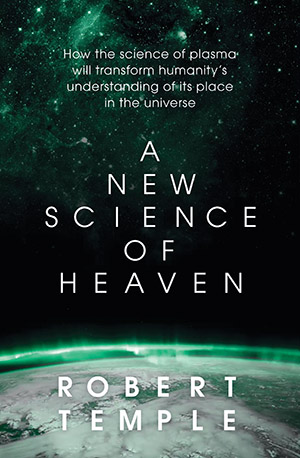
    My new book, A New Science of Heaven (Hodder & Stoughton), gives a full scientific description of the nature of inorganic, non-biological, intelligent beings in space. 

    We have two such ‘creatures’ close to our own planet. They are the recently confirmed Kordylewski Clouds, which together are eighteen times the size of the Earth. They reside between the Earth and the Moon, but not in a direct line of sight. They are 60o behind and 60o in advance of the line of sight to the Moon. They exist at the two points known as L4 and L5, the ‘L’ standing for ‘Lagrange’ (named after a famous scientist and mathematician of the past). 

    At these two Lagrange Points, the gravitational pulls of the Earth and the Moon cancel out, so that clouds can rest there free of gravitational pull in either direction.

    The Kordylewski Clouds were discovered in 1961 by the Polish astronomer Dr. Kazimierz Kordylewski (1902-1981.

    As the Clouds emit no light and are largely transparent, it was difficult for Kordylewski’s discovery to be confirmed by others. But in 2019, the existence of the Clouds was confirmed using modern techniques which did not exist in Kordylewski’s day. This was done by a group of Hungarian astronomers. 

    I noticed this very soon after their initial publication and contacted them to ask whether they were studying the plasma aspects of the Clouds. They replied saying no, they were only considering the celestial mechanics. (The plasma aspects do not seem to have occurred to them, as they were only observational astronomers, not physicists.) 

    I phoned my friend Professor Chandra Wickramasinghe, a brilliant astrophysicist, told him about the Clouds and suggested that we publish a joint article immediately calling attention to these two entities from the more important perspective of space plasma. Our article appeared in the journal Advances in Astrophysics shortly thereafter, and is reprinted in its entirety as an appendix to my book.
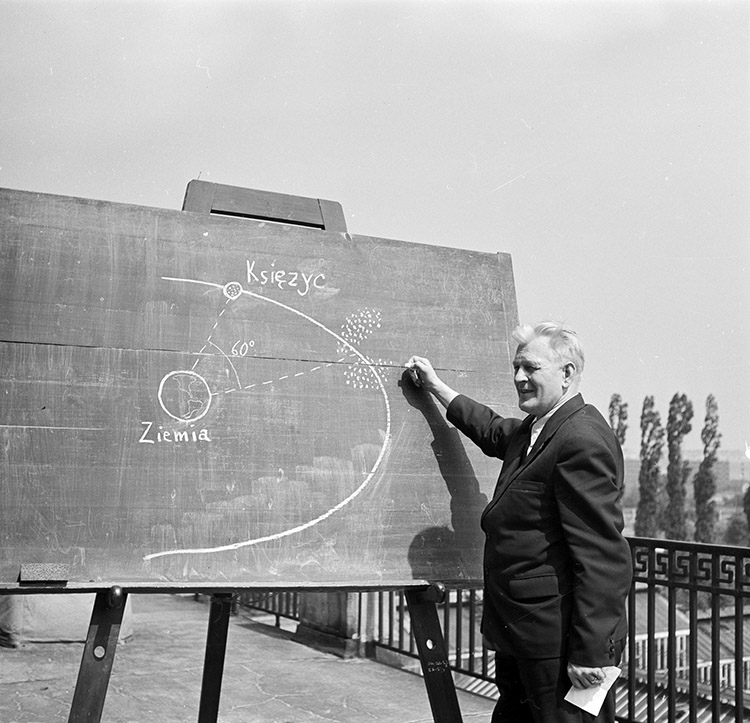
    Dr. Kazimierz Kordylewski in 1961 drawing a picture of the Kordylewski Cloud at Lagrange Point L5. Ziemia in Polish means “the Earth.” Księzyc in Polish means “the Moon.” The 60o angle away from the direct line of sight to the Moon is clearly shown. The Cloud is depicted as a collection of dust particles, which we now know must be charged and form a dusty complex plasma. Each one of the Kordylewski Clouds measures 65,000 miles by 45,000 miles across, which is equivalent to 30 x 20 lunar discs as seen from Earth. Each one is now known to be nine times the size of the Earth, so that the two together are 18 times the size of the Earth. They thus entirely dominate what until now has been called ‘the Earth-Moon System’, and which is now known to be a four-entity system, not a two-entity one. 

    ‘Dusty Complex Plasma’

    The Clouds are composed of tiny dust particles and grains only a few nanometres in size, whereas our satellites can only detect particles of 100 nanometres or larger, which is why no satellites have detected them. The dust is highly electrically charged (10,000 electrons can cling to a single dust particle, and for positively charged dust, protons and ions of a somewhat lesser number because they are bulkier). 

    The Clouds are constituted of what is now called ‘dusty complex plasma’, and they are cold plasmas rather than hot plasmas such as our Sun. 

    Plasma is a distinct form of matter which is not made of atoms. Our own bodies and the world in which we live are made of what we call physical matter, or more accurately, atomic matter. But plasma is non-atomic matter. It is not made of atoms at all, but of atomic particles

    Recognition of it as being literally a new form of matter occurred in 1879 when it was discovered by the British scientist Sir William Crookes (inventor of the vacuum tube), who called it “radiant matter.” Its name was changed to ‘plasma’ in 1928 by the American scientist Irving Langmuir. It has no connection to blood plasma, familiar to doctors and nurses, which is a different use of the word, which derives from ancient Greek.
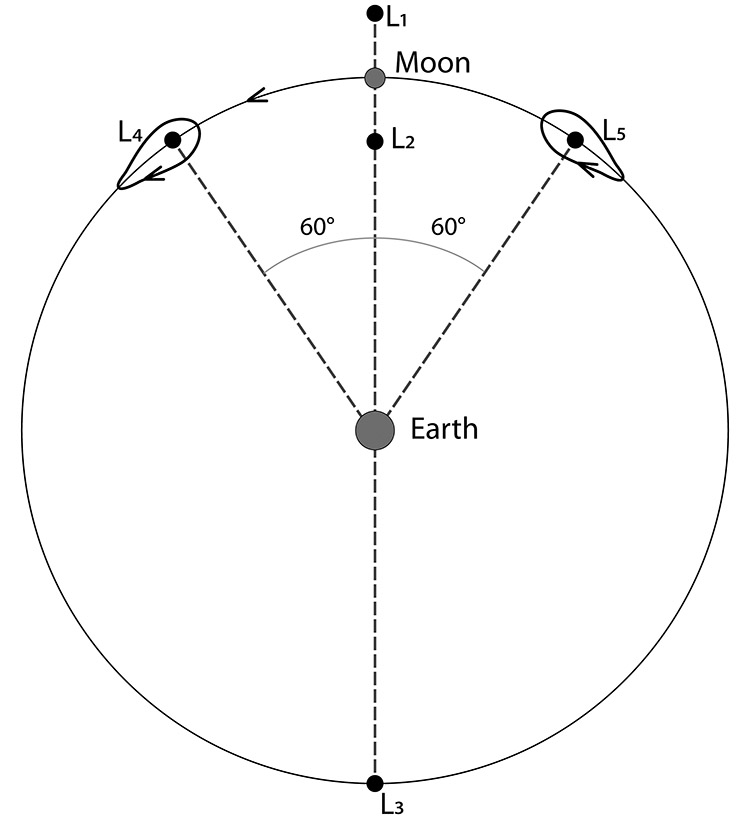
    This diagram shows the locations of the ‘Lagrange Points’ known as L4 and L5 of the Earth–Moon system, indicating the positions of the two clouds. In this diagram, the Earth is at the centre, and the Moon directly above it. Although distinct, bounded balls of plasma can form anywhere at modest scales (as for instance, the tiny balls of ball lightning on the Earth), for really big ones in space it is helpful for them to come to rest in spaces free of gravitational pulls, and when such a niche appears it is pretty certain that it will soon be filled by plasma which will form a ball as big as the niche allows. And that is why the L4 and L5 points are perfect homes for huge plasma clouds, for they are the only two points between the Earth and the Moon free of gravitational pull from either the Earth or the Moon. The image is not drawn to scale and the relative sizes of the bodies shown here bear no relation to their true sizes; this image is intended solely to show the geometrical spatial configuration. Seen at this scale, the Earth and the Moon would be extremely tiny or perhaps even too small to see. The Clouds can cohere despite being continuously blasted by the solar wind, details of how that happens being explained in the book. (Image drawn for the author by Eric Wright.)

    Plasma Universe

    Astronomers and astrophysicists agree that the Universe consists of 99.9% plasma and at the most 0.1% atomic matter such as we have here on Earth. Our Sun is entirely composed of plasma, and so are all the stars in the Universe. 
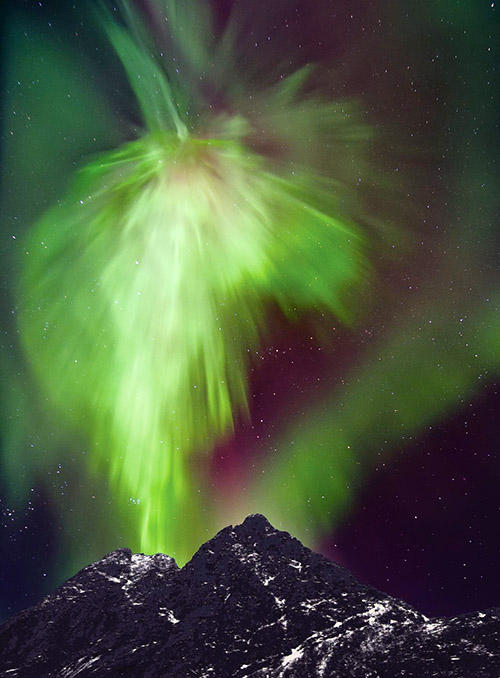
    Solar plasma, ejected from the Sun, is seen here in this aurora, an effect of the plasma penetrating Earth’s magnetic shield. Photograph by Lars Tiede, island of Kvaløya, Norway, 2011. 

    Plasma occurs frequently on Earth because lightning is plasma. When you turn on a neon light, the neon gas in the centre of the tube is changed to plasma, the temperature of which has been measured to be approximately 12,000 degrees Celsius. But despite that, you can hold such a tube in your hand and it feels cool. The surface of our Sun, known as the photosphere, is about half the temperature of the interior of a neon light tube. 

    Knowing this, one begins to understand the weird and wonderful world of plasma. With plasma, the seemingly impossible frequently occurs. Extreme heat and extreme cold can exist side by side inside a plasma because the interior regions or cells are protected by what are called ‘sheaths’, which are double layers of charge.

    Most people have no idea that the Universe is a plasma universe because there has been a massive failure of the media at all levels to report this to the public. Nor is the situation any better in schools and universities. Many ordinary physicists who do not concern themselves with astrophysics have never even heard of this. 

    It is a sad commentary upon the disintegration of Science as a coordinated field of enquiry. The people in one lab simply do not know what the people in the next lab down the hall are doing. Even if they did, the jargon is different in the next lab, certain terms and words are unknown to outsiders, and they even frequently change the conventional uses of mathematical symbols in their equations, so that even the equations, which used to be ‘the Latin of Science’ which could be understood by all, now exist in a fragmented world. The Tower of Babel of Scientific Communication largely collapsed long ago. 

    Self-Organisation & Intelligence

    A large part of my book (which contains no equations!) is devoted to explaining in detail, for the general reader, precisely how a large charged dusty complex plasma cloud can self-organise into an entity even more complex than an organic body. 

    Such a cloud becomes filled with filaments carrying currents, which act like blood vessels, or cells which act like organs, of semi-conductors which modulate current flow, of current pinches which act as nodes and so on and so on. 

    All that I have said is based upon sound scientific discoveries. Such plasma clouds can definitely develop an interior structure more complex than an organic body, and by the now recognised processes of ‘emergence’, ‘entanglement’, and self-organisation, can spontaneously develop intelligence. 

    The Kordylewski Clouds are so gigantic that their processing power exceeds by many orders of magnitude all the computers and brains on Earth. Furthermore, the Clouds are apparently billions of years old, whereas humans have only existed for about two million years. Anyone who needs convincing about all of this will find plenty of evidence in the book. And there is an audio book as well, narrated by myself.

    If these giant clouds in space are intelligent entities, what would their personalities be like? Very different from ours. From our point of view they would appear disturbingly aloof and indifferent to our sufferings. They would be interested in events but would not care greatly about how we might feel about those events. 

    I explain at great length why we all exist as double creatures: we all have bioplasma bodies (called souls or spirits in daily speech) and physical bodies which I call “smart overcoats,” jettisoned when they wear out or are destroyed. A plasma cloud would not necessarily waste energy worrying about our ‘deaths’ because they would know that we did not really die, we merely transitioned back to the plasma state. Do I believe that anyone ever really dies? No. I believe we continue to exist, and that therefore we had better take the long view and try to be less obsessed with ‘things’. You can’t take your smart overcoat with you, nor anything you have which is made of atomic matter. 

    UFOs & Ball Lightning

    I suggest that, based on this knowledge, lightning balls and many UFOs are likely to be plasma drones. There are thousands of reports of ball lightning seeming to be intelligently directed, inspecting things for instance. I suggest that they are constantly prowling around looking at everything as drones. And as for UFOs, while I would never presume to try and explain all of them, when you know enough about plasma it is painfully obvious that many of them must be plasma entities, presumably controlled either remotely or by robotic means based on miniature super computers. As to whether they contain creatures, that is another matter. But if one presumes that the creatures called ‘the greys’ really exist (I have no idea, and have never encountered one), it seems to me likely that they would be semi-organic robots. 
    Have the Kordylewski Clouds ever attempted to communicate with us? I believe they have. But no one ‘gets it’. We need to smarten up. If we really want to find extraterrestrial life, it is not necessary to look even as far as the Moon. It’s right here.

    What’s more, the Universe is clearly filled with dusty complex plasma clouds, most of them presumably of gigantic intellectual capacity, at all scales. Our Sun is probably alive and conscious. All stars presumably are. And the vast nebulae and clouds throughout space both within and beyond our Galaxy must be inorganic intelligent entities. In other words, inorganic life forms dominate the Universe, and have done so for billions of years. The truth is, therefore, that the Universe is an endless society of beings. And they are not like us. They have charged particles flowing through their ‘veins’ rather than blood. And our local Kordylewski Clouds, which may seem enormous to us, are small fry. 
    Get the issue this article appears in

    A New Science of Heaven

    Are the Kordylewski Clouds hostile to us? Hardly likely, as we would not have survived if that were the case. And they must have some reason to want us and need us. They may even have arranged for organic life to appear here in the first place. It may be that the Clouds wish to engage in dialogue with us. After all, being inorganic themselves, they may wish to experience vicariously through us what organic life is like. This would be part of their intellectual curiosity. They may regard us as their probes. Without intelligent organic beings they could never hope to do this directly. We may therefore, despite our small size and seeming insignificance, be part of what they hope to make into a shared experience. Without us, they are missing an entire aspect of Reality. And they must know this.
    The first thing we need to do is wake up and realise that inorganic beings exist. Then we need to gather our thoughts and think this through. If the Kordylewski Clouds and our Sun are conscious, intelligent inorganic beings, then we are part of the family. We are all here in the same solar system together. Let’s get talking. 

    Finally, I wish to make clear that I believe that there is a ‘plasma world’ which is essentially what religious people have always called ‘the spiritual world’. It is the same as a ‘parallel world’ or ‘a world in another dimension’, except that it is not in another dimension, it just seems as if it were. It is invisible to us because we and our sensory organs are made of atomic matter, which cannot perceive plasma matter unless the plasma is glowing or shining. Cold plasma is dark and emits no light. I believe that ‘dark matter’ is really plasma which is in the dark mode, and hence invisible to observation. 

    The age-old argument between science and religion can be resolved as follows: the materialists are correct, in that ‘the Other World’ is not immaterial, but is made of matter. But the religious spiritual people are also correct, for there is indeed ‘another World’. All we have to do is understand plasma, and we can stop wasting our breath disagreeing with one another and settle down instead to trying to understand Plasma Reality. 

    We ourselves are plasma beings who have come here temporarily, donning our ‘smart overcoats’ for a brief sojourn in ‘the physical world’ in order to test our characters against all the obstacles it presents to us and experience successes and failures, loves and losses, ups and downs, in the wild tempestuous world of physical matter.

    Robert Temple’s A New Science of Heaven (Hodder & Stoughton) is available from all good bookstores. A review of A New Science of Heaven can be read in this issue of New Dawn.

    [alert type=”general” dismiss=”no”]This article was published in New Dawn 192.[/alert]

    [alert type=”success” dismiss=”no”]If you appreciate this article, please consider subscribing to help maintain this website.[/alert]

    © New Dawn Magazine and the respective author.
    For our reproduction notice, click here.
  • The Untold Story of Ernst Jünger

    The Untold Story of Ernst Jünger

    From New Dawn Special Issue Vol 14 No 3 (June 2020)

    Ernst Jünger isn’t a name on many English speakers’ lips, although in his home country of Germany he is recognised as one of that nation’s greatest literary figures, if not one of Europe’s. Evidence of this esteem is the Goethe prize Jünger was awarded in 1982 by the city of Frankfurt, which caused something of an uproar, for reasons that will become clear. For English speakers, this would be rather like receiving a Shakespeare prize, if there was an equivalent. 

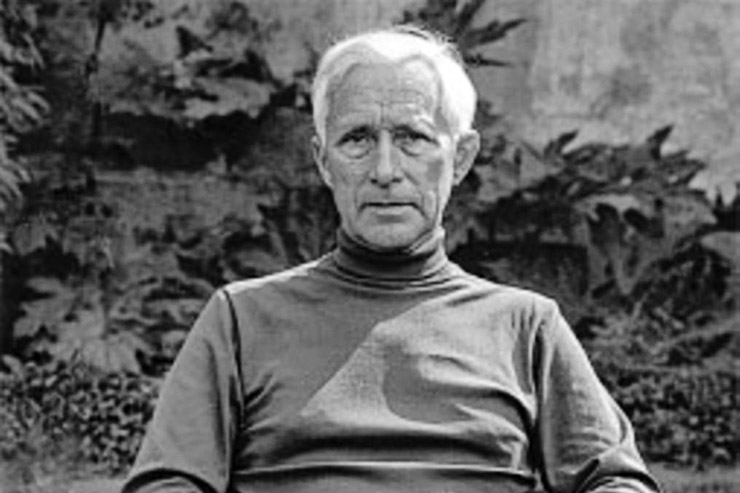
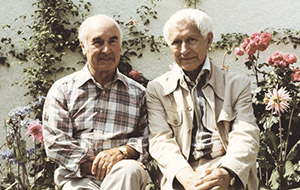
    Swiss chemist Albert Hofmann (left), the discoverer of LSD, with Ernst Jünger (right). Photo credit: www.dla marbach.de

    The one area of English language literature in which Jünger’s name might not be entirely unfamiliar is in the annals of psychedelia. In the 1950s and 60s, Jünger tripped a few times with Albert Hofmann, the Swiss discoverer of lysergic acid diethylamide, or LSD. Hofmann was a fan of Jünger’s writing; his unclassifiable work The Adventurous Heart, first published in 1929 and then in a heavily revised edition in 1938, literally changed Hofmann’s life. Every page of Jünger’s jewelled and gnomic prose in that unusual work made the “miracle of creation” evident to Hofmann, well before his celebrated psychedelic bicycle ride in 1943, which is generally acknowledged as the first consciously taken “acid trip.” In Jünger’s kaleidoscopic collection of observations, dreams, descriptions of flowers, meditations on colour, ruminations on chance, and other seemingly disconnected jottings, Hofmann believed that “the uniqueness and imperishable in every human being was touched upon.” “No other writer has thus opened my eyes.” 

    In 1951, Hofmann had the opportunity to return the favour, opening Jünger’s eyes to the effects of LSD. Jünger later transmuted his experience with Hofmann into literary expression in the elliptic and allusive Visit to Godenholm (1958), which, I suspect, is unique in drug literature in being a fictional account of a psychedelic experience in which no mention of drugs or intoxication appears. In 1970, Jünger’s non-fiction account of his own drug experiences, collected over many years and with many substances, Approaches: Drugs and Intoxication,was published. Like much of Jünger’s huge body of work, it is still awaiting translation into English. Something else that Jünger shared with Hofmann was a long life. Jünger died in 1998 at the age of 102, having been, with other rare distinctions, among the few who could say they saw Halley’s comet twice, a fact he enshrined in his book Twice Halley (1987). Ten years later, Hofmann died at the same age, passing away in 2008.

    The Adventurous Heart introduced two of Jünger’s central themes, which he was to refine and deepen throughout his later work. These were what he called, borrowing from the French, désinvolture, which does not have an exact English translation, and “stereoscopy.” Dictionaries give “disinterest,” “casualness,” and “offhand manner,” as English equivalents of désinvolture, all of which suggest something of what Jünger means. It is for him a detached, disinterested – but not uninterested; the distinction is crucial – perception of phenomena, rather in the way that the philosophical method known as phenomenology approaches its subjects. Fundamentally, it is a way of getting the “self” or ego out of the way, with all its biases and subjectivity, and perceiving things as they appear, in all their complexity, and not simply as agents of our desires. Such an attitude leads, Jünger claims, to a perception of things that is dual, revealing surface and depth, the outer skin and inner heart, simultaneously, hence stereoscopically.

    One element of stereoscopy is an experience of synaesthesia when the senses seem to trade places, and one hears colours and sees sounds. Arthur Rimbaud, a poet whose work influenced Jünger, was prone to this, as evidenced in his poem “Vowels,” in which A is black, E white, I red, O blue, and U green. Not to be outdone, Jünger developed his own colour scheme for vowels, spelled out in his essay “In Praise of the Vowels,” where he argues for a primal correspondence between language and the world, a kind of ur-sprache at the heart of Being.

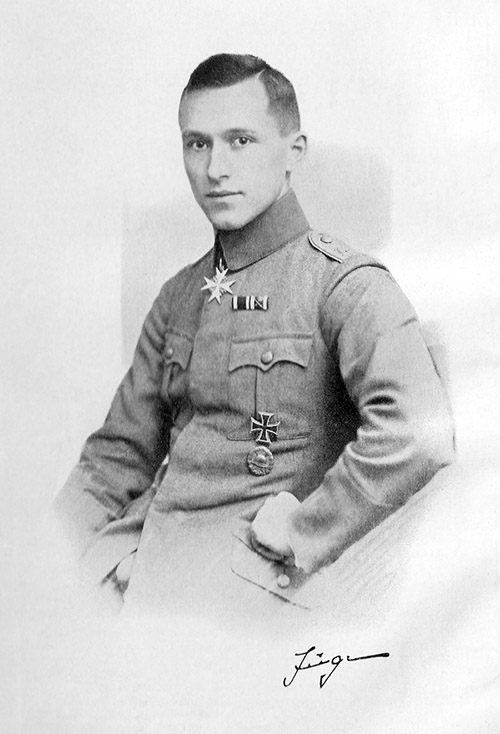
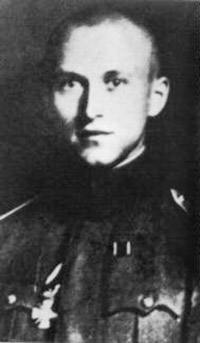
    Ernst Jünger in uniform as depicted in the frontispiece of the 3rd edition of In Stahlgewittern (Storm of Steel) (1922)

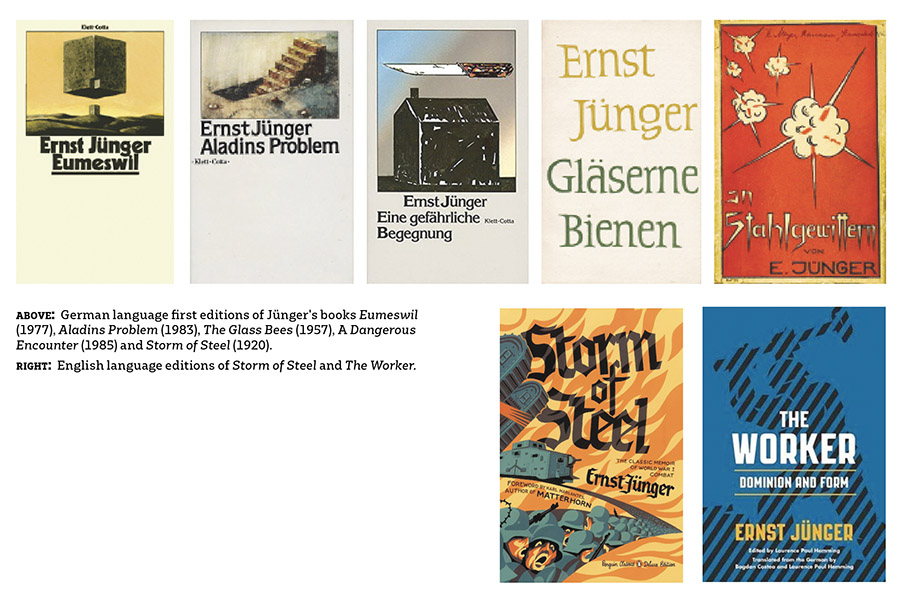
    Another central theme to emerge from Jünger’s désinvolture, but in a more political – or really apolitical – sense, was his notion of “the anarch.” This is an individual who, while ostensibly accommodating the demands of society, in essence follows his own laws and values and aims. Unlike the anarchist who openly fights against authority – and hence is still in an “enabling” relationship with it – the anarch works invisibly, under cover, making the minimal surface obeisance, while secretly preparing, if necessary, his escape, a tactic that Jünger portrayed in his major fictional work, Eumeswil (1977). In this admittedly at times obscure dystopian fable – like his contemporary and friend the philosopher Martin Heidegger, Jünger does not make things easy for his readers, although Jünger’s style is nothing like Heidegger’s. Jünger’s protagonist, a historian, observes the currents of power under a future benevolent dictatorship following the collapse of a world state. The kind of cool, detached but engaged observation characteristic of désinvolture is here brought to bear on the machinations of tyrants and the revolutionaries opposed to them. Neither receives Martin Venator’s – Jünger’s protagonist – assent, but he recognises that until things change, they are realities through which he must manoeuvre.

    To say that Jünger’s name isn’t known outside of odd eccentric circles is, of course, an exaggeration. The problem, at least in the English-speaking world, is that the reputation he does have among English critics is based on his earliest work. Jünger’s first book, The Storm of Steel, self-published in 1920, and subsequently released to wide acclaim by a Berlin publisher, is a blistering, gripping, aptly explosive and disturbingly graphic account of his experiences in WWI. It made Jünger famous at twenty-four and became a best-seller and is the work he is still most known for today. Jünger emerged from the war a highly decorated hero, receiving the Iron Cross and the Pour le Mérite, the prized “Blue Max.” He was wounded seven times and can be seen as a German Sgt York, the American infantryman who was equally honoured in the Great War. 

    Living Dangerously

    Yet while most literature to emerge from the “war to end war” focused on its absurdity, loss of life, pain and suffering – think of Erich Maria Remarque’s All Quiet on the Western Front (1929) Henri Barbusses’ Under Fire (1916), and the poetry of Wilfrid Owen, who died in 1918, just before the armistice – Jünger’s account was a celebration of it. Not, as one might think, as a militarist or a nationalist, although to be sure Jünger took a professional interest in military strategy and was indeed a nationalist with a great love of Germany. Jünger’s perspective on war was epic, Homeric, and what a reader finds in his still riveting account is how combat brings out the heroic virtues and intensifies consciousness. It is an account of how, as Ernest Hemingway, another war writer, expresses it, the war made Jünger “feel cool and clear inside,” “when he had done the one thing, the only thing for a man to do, easily and naturally…” Combat, like other “limit conditions,” can free man from, in Colin Wilson’s term, “the robot,” that mechanical part of us that has us live life automatically. Danger, threat, crisis, can loosen the robot’s grip. This is why someone like Jean-Paul Sartre, as ideologically opposed to Jünger as one could get, confessed that he never felt as free as when he was in danger of being arrested by the Gestapo – oddly, he and Jünger were in Paris at the same time. It is also why many Londoners remembered the Blitz as the happiest time of their lives. A paradox, perhaps, but true. Crisis can make us feel more alive – hence the predilection of Wilson’s Outsiders to, in Nietzsche’s words, “live dangerously.”

    Jünger during World War I, wearing the House Order of Hohenzollern.

    “Living dangerously,” we can say, is something Jünger did, in different ways. It was a way of embracing “adventure,” something Jünger wanted to do from early on. In his early teens, he joined the Wandervogel, “wandering birds,” a German youth movement that rejected urban life and headed to the country, getting back to nature and off the grid a century before today’s eco-warriors, who are among his readers. More than one historian has noted the similarities between the “wandering birds” and the hippies of the 1960s. Before enlisting at the start of WWI, in 1913, at the age of eighteen, Jünger ran away from his affluent middle-class family to join the Foreign Legion. Travel to exotic lands always excited him – again Rimbaud – and his plan was to abandon the Legion and head for equatorial Africa. He made it to North Africa but was found by legionnaires soon after he went AWOL. Remarkably, his father, a successful chemist, was understanding and promised him a proper “African diversion” – the title of Jünger’s fictional account of his exotic jaunt – upon completion of his studies. Jünger’s youthful excursion set the tone for much of his later life; adult journeys took him around the globe. Yet before his father’s promise could be kept, the adventure of Jünger’s life began. In 1914 the guns of August blazed and Europe was at war.

    After the war the now famous and heavily decorated Lieutenant Jünger studied zoology at Leipzig and Naples and continued his lifelong fascination with entomology; an amateur in the best sense, there are, in fact, more than one species of beetle named after him; his collection later numbered some 40,000 specimens, some of them gathered from the trenches. Around the same time Jünger began writing political journalism, mostly for right-wing, conservative and military journals, among them the Völkischer Beobachter, the Nazi daily newspaper; he later accused its editor of plagiarism when they published an excerpt from his work without permission or credit. Jünger was a stern critic of the Weimar Republic and of democracy in general – too susceptible to demagogues – and was a part of what was known as the Conservative Revolution which included the jurist Carl Schmidt and the historian Oswald Spengler (Schmidt was a Nazi; Spengler poked fun at Hitler). The mechanisation of war he had experienced convinced Jünger that a new age had begun, that of the technological Titans. These were twentieth-century upgrades of dark archaic forces which, like the genie of Aladdin’s lamp, would soon get out of control – a metaphor Jünger unpacked in his disturbing funereal parable Aladdin’s Problem (1983). This meant the end of any cosy bourgeois dream of liberalism and progress. Jünger’s The Worker (1932) envisions a mechanised, technologically driven coming totalitarian state, something along the lines of the dystopian dictatorship of his contemporary Fritz Lang’s film Metropolis (1927). 

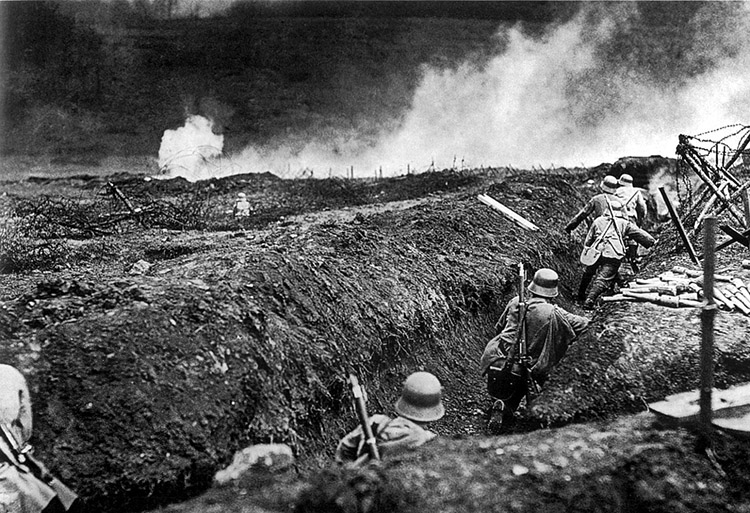
    German Stormtroopers during a trench assault in 1917 France.

    The dictatorship that did come to power had its eye on Jünger. Although he was approached twice by the Nazis and offered a seat on the Reichstag and membership in the gleichgeschaltet (“conformed”) German Academy of Writers, Jünger declined. His political sympathies were on the right, but they did not include thugs and rabble like the Nazis, whom the aristocratic Jünger saw as little more than criminals. During this time Jünger’s acquaintances included Bertolt Brecht and Ernst Toller, two left-wing playwrights, as well as figures on the right, like Schmidt. His friendship with the anarchist Erich Mühsam led to the Gestapo searching his rooms for correspondence. They found nothing – Jünger always covered his tracks – but Mühsam died in a concentration camp in 1934. Jünger’s internal opposition to Hitler took the form of his lapidary political fantasy, On the Marble Cliffs (1939), an exquisitely polished parable of how the serene, contemplative existence of two poetic botanists – Jünger and his brother Friedrich – is destroyed by the dark forces of the Chief Ranger – read Goering – and the tragedy of the ineffectual opposition’s inability to stop his rampage. Although Jünger dismissed the idea that the work was a strict allegory of Nazi Germany – rather of totalitarianism in general, he said – the parallels are too obvious to ignore. The book sold as well as The Storm of Steel, and it is remarkable it was allowed to remain in print.

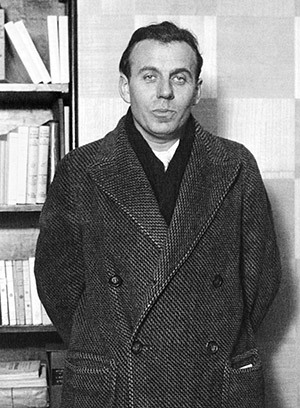
    Louis-Ferdinand Céline (1894–1961)

    With the outbreak of WWII, Jünger was called back to service and promoted to captain. Aside from a gruelling visit to the Eastern Front, for the most part Jünger sat the war out as part of the general staff in Paris where his duties as censor left him with much free time. (This was how he came to be there at the same time as Sartre. Interestingly, another inhabitant of Paris at the time was the Greek-Armenian esoteric teacher G.I. Gurdjieff, whom Jünger mentions more than once in his work.) Jünger became acquainted with many artists and writers living in the occupied city, figures like Picasso, Braque, Cocteau, the anti-Semite Louis-Ferdinand Céline and the fascist writer Robert Brasillach, later executed as a collaborator. Jünger recorded his Parisian adventure in his extraordinary journals, where accounts of treasonous conversation share space with those of his erotic encounters, his dreams, his long solitary walks, and meetings with artists and literati, as well as his attempts to help Jews and others subject to Nazi terror. This work alone confirms that Jünger was a born diarist; the short, aphoristic note or thought was his real metier, not the novel or even the essay. 

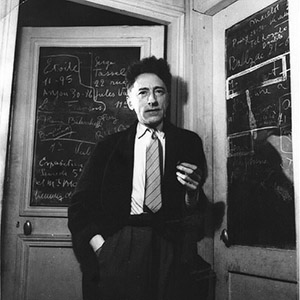
    Jean Cocteau (1889–1963)

    Jünger also found himself orbiting close to the circle of high-ranking military men who were opposed to Hitler and plotted the failed assassination attempt on 20 July 1944. He kept his distance, sceptical of its success. His intuition proved right, and Jünger was supposedly saved from sharing the gruesome fate of the conspirators by Hitler himself, who reportedly said: “Nothing happens to Jünger.” The war hero had exchanged books with the future führer years before, and Hitler respected him; the only other writer to stand up to Hitler, as it were, was the Norwegian Knut Hamsun, although Hamsun, unlike Jünger, was a fan of the Nazis. As we’ve seen, Jünger was also meticulous about evidence. As Jean Cocteau said of him, “Some had clean hands, some had dirty hands, but Jünger had no hands.” Nevertheless, Jünger was forced to retire from service, and the death of his son, sent on a suicide mission in Italy, was felt as retaliation. 

    Toward the end of the war, Jünger circulated a curious utopian text, The Peace (1945), in which he argues for the need of a new Christian age to heal the world’s ills. Throughout WWII, Jünger read the Bible cover to cover, twice, and although it was not until shortly before his death that he converted to Catholicism, here a kind of millenarianism seems to enter his work. Alongside this was the figure of the anarch, who he presages in the character of the “forest fleer,” the theme of The Forest Passage (1951). This is a philosophical excursion diametrically opposed to the ethos of The Worker, a volte-face that Jünger acknowledges divides his work into two periods, what he ironically calls the Old Testament and the New. No longer celebrating the advent of a highly efficient, automated technological dystopia, Jünger now looks to the self-sufficient, incorrigibly independent individual to claim the freedom that is his birthright and which is quickly being absorbed by what Nietzsche, an influence on Jünger, called “the monster, the State.”

    Like others troubled by the growing pervasiveness of technology into all aspects of life, Jünger turned to science fiction as a means of communicating his concerns; he was, in fact, a great reader of Aldous Huxley, and Brave New World especially. In Heliopolis (1949) – sadly yet to see an English translation – Jünger depicts the political gangsterism and feudal violence of rival powers battling over dominance in a future city of indefinite location. As the “forest fleer” does in The Forest Passage, Lucius de Greer, the protagonist, finally lights out for parts unknown, escaping the authoritarian state. Jünger’s distrust of technology doesn’t prevent him from predicting developments. The “phonophore” that appears in Eumeswil – a kind of sequel to Heliopolis – is a remarkably accurate anticipation of the iPhone. It is, like the iPhone, a multiple-use device, and the possessors of its highest grades have access to functions the lower ones do not. The “luminar” seems a kind of combination internet, Wikipedia, and virtual reality machine, a device that allows its user to “replay” events in history in a kind of 3D, HD display, with which one can participate. 

    Another disturbing anticipation is the kind of animatronics at the heart of The Glass Bees (1957). Here, Captain Richard, a former cavalry officer down on his luck – there is no place for him in the modern world – is forced to take a job at the Zapparoni Works, where a Walt Disney-like techno-savant outdoes nature by creating automated creatures that are superior to the “real thing.” The glass bees of the title extract nectar more efficiently than the originals, who, like many feeling the effect of automation, are put out of business by them. Disney may seem too innocuous an allusion for this usurpation of the real by the simulation, so perhaps Dr Robert Ford of Westworld is more apt.

    Get the issue this article appears in

    Legacy

    An elderly Ernst Jünger (1895–1998), wearing both the Pour le Mérite and the Bavarian Maximilian Order.

    Jünger’s defence of personal liberty, nature and the environment, has gained him a younger readership in recent years, especially among the ecological minded generation, as well as among those fascinated by his fastidious articulation of the importance of dreams, myths, poetic and mystical experiences, and other forms of an ancient wisdom sadly in need of a renaissance. He has acquired readers around the world and counted German Chancellor Helmut Kohl and French President François Mitterrand among his fans. He is not to everyone’s taste. As mentioned, controversy broke out in democratic Germany over a right-wing nationalist receiving the Goethe prize. The late literary scholar George Steiner, while calling for more English translations of Jünger’s work, also chides his lapidary sangfroid, his dandy-like aestheticizing of danger, and mandarin unconcern about messy humanity, such expressions of désinvolture serving, for Steiner, as evidence of “an atrophy at the vital centre.” And the attitude of many remains that however Jünger may have opposed Hitler “internally,” his disavowals do not dispel the received misperception that he was a Nazi fellow-traveller, or that his youthful celebration of “battle as inner experience,” the title of a version of The Storm of Steel, prepared a generation for war and inspired it to go to war. His later work, full of mystical significance, poetic insight and an advocacy of a free humanity participating in a living nature, is often conveniently forgotten, while the old accusations are dutifully trotted out, often by leftist critics, unconcerned about their own doubtful ideological heritage. 

    A short essay such as this can only introduce Jünger to readers unaware of him, and unless one reads German, a great deal of his writing – on travel, culture, philosophical and psychological questions, and unusual fauna and flora – will remain unavailable to them. What there is in English is limited, but the major works are there. For readers interested in an unbuttoned Jünger, the series of dialogues he held with his French translator Julien Hervier are also in English. They are a fascinating read, if only for getting a sense of the perspective of a man who survived two world wars, saw Halley’s comet twice, and has a prize in entomology named after him. Not bad for a centenarian anarch.

    [alert type=”general” dismiss=”no”]This article was published in New Dawn Special Issue Vol 14 No 3.[/alert]

    [alert type=”success” dismiss=”no”]If you appreciate this article, please consider subscribing to help maintain this website.[/alert]

    Footnotes

    1. There is in fact a Shakespeare prize, but it leans more toward performance than writing; ironically, it was started in 1937 by the Hamburg merchant Alfred Toepfer as an expression of his love for England and his advocacy of a united Europe, incidentally a dream of Jünger’s as well. WWII scotched that idea, and the next prize wasn’t awarded until 1967.
    2. Oddly enough, I started writing this article on 16 April and put the finishing touches on it today, the 18th. Tomorrow, the 19th, is “Bicycle Day,” a worldwide celebration of Hoffman’s original wigged out ride. https://blogs.scientificamerican.com/cross-check/tripping-in-lsds-birthplace-a-story-for-e2809cbicycle-daye2809d/ 
    3. Albert Hofmann, LSD: My Problem Child, Tarcher Books, 1983, 145-46
    4. Ernst Jünger Visit to Godenholm (Edda Publishing, 2015) translated by Annabel Moynihan. This edition contains remarkable illustrations by the artist Fredrik Söderberg.
    5. I write about Jünger’s stereoscopy in Lost Knowledge of the Imagination.
    6. For an interesting discussion of Jünger’s ideas about language, especially the alphabet, see Richard Firmage The Alphabet Abecedarium, Bloomsbury, 2000.
    7. Although they are radically different books written by very different writers – who nonetheless share several common interests – Jünger’s first book shares with that of Colin Wilson, The Outsider, the status of being the one that superficial critics know and which coloured the subsequent reception of their later works. In both cases, negative assessments of their first and most well-known work led to most of their later work being misrepresented or ignored.
    8. Ernest Hemingway, “Soldier’s Home,” quoted in Colin Wilson, The Outsider, Tarcher Perigee, 2016, 36
    9. The unorthodox Marxist-Kabbalist Walter Benjamin, Jünger’s contemporary and ideological opponent, was also associated with the Wandervogel.
    10. Ernst Jünger African Diversion, John Lehmann, 1954, translated by Stuart Hood.
    11. Recently translated into English. Ernst Jünger A German Officer in Occupied Paris The War Journals 1941-1945 (Columbia University Press, 2019), translated by Thomas S. Hansen and Abby J. Hansen.
    12. George Steiner, Introduction to Ernst Jünger, On the Marble Cliffs (Penguin Modern Classics, 1983), translated by Stuart Hood, 14
    13. Julien Hervier, The Details of Time: Conversation with Jünge, Marsilio Publishers, 1995.

    © New Dawn Magazine and the respective author.
    For our reproduction notice, click here.
  • Applying New Thought Principles to Modern Day Challenges

    Applying New Thought Principles to Modern Day Challenges

    From New Dawn 197 (Mar-Apr 2023)

    “What you think upon grows. Whatever you allow to occupy your mind you magnify in your life. Whether the subject of your thought be good or bad, the law works and the condition grows. Any subject that you keep out of your mind tends to diminish in your life, because what you do not use atrophies. The more you think of grievances, the more such trials you will continue to receive; the more you think of the good fortune you have had, the more good fortune will come to you.”
    – Emmet Fox

    “Life is a mirror and will reflect back to the thinker what he thinks into it.”
    – Ernest Holmes

    Using New Thought principles to change the self can change the greater collective. As we have been told, we must be the peace, the change, and the love we seek in the world because, as the teachers of New Thought understood, it begins within the individual first. 

    In a world that wants us to think we have no individual freedom or power and thus no influence to create a different and better collective, it is imperative that we shift the “locus of focus” from the things we do not want to those we do.

    Knowing we are part of the divine, of God, we come to understand that all the things which hold us in fear – inflation, crime, racism, natural disasters, climate change, political strife, corruption, viruses – are all external to us and have no real sovereignty over us. Our truth is our connection to the invisible substance and infinite Source. It is not the government or Bill Gates or a vaccine made by Pfizer. We are free in our minds and thoughts, and when we learn to direct our minds through focused thought, we create our reality and destiny.

    Going Within

    Everything begins as a thought. Everything. There is no war, circumstance, financial collapse, job loss, or hateful social media post that did not begin as a thought in an individual or in the collective hive mind. This applies to the good in life, too. It starts with our thoughts about who we are, what we want, and what we hope to achieve and experience.

    The first step is to turn within for wisdom, knowledge, guidance and understanding. As spiritual beings having a human experience, we always have access to our spirit via prayer, meditation, quiet time, mindfulness, guided visualisations, and practising feeling the Presence of God within. When we focus on externals, we become consumed by them and forget who we are, and that we have the power to use our minds for a better experience and outcome. By turning off the news, we can tune in to the wisdom within and act upon it.

    New Thought teaches that there is unformed “substance” all around us from which all form is created, sort of like a quantum field of all possibilities. Our thoughts act upon this substance, similar to how the observer acts upon the quantum field, bringing the desired form into being. Through things like prayer – which can be focused attention on a desired outcome – meditation and affirmations, we shape substance into what we want. Prayer in New Thought is not about begging or pleading but affirming we are one with God, one with Source, and that we are aligned with it to create that which we focus our thoughts and minds upon. This has a whole different vibration than begging some anthropomorphic being up in the clouds to please pity us and give us something. 

    Affirming is always in the present tense, and a declaration of “I am” such as “I am healed. I am peace. I am prosperous. I am loved.” We do not say “I want” because the mind focuses on the “want” as lack and that becomes the locus of focus and we get more want. Ever heard the phrase, “You can never get enough of what you don’t want?” This means that if your focus is on lack, on disease, on chaos, on political strife, on inflation and the crappy economy, or on this or that negative external person, event, or situation, that is what you will draw more of into your experience.

    Powerful affirmations could look like this:

    I am an individual expression of the God Source, and the invisible substance with which God creates is within me as my thoughts and beliefs. I have the power to direct my thoughts to use that substance to create my reality.

    I focus my mind and thoughts upon the true source of all there is, God within me, and allow my mind to align with Divine Mind to create that which I desire.

    I am divine spirit in a human body having a human experience and my thoughts direct that experience. Therefore, I choose only empowering, powerful thoughts.

    Treatment of the Mind

    A powerful tool used by New Thought practitioners, specifically in Religious Science, is spiritual mind treatment, also known as affirmative prayer. This is a five-step process that works to change our thoughts, remove doubt and fear, and allow the realisation of the presence of God within so we can then align with it and take right action toward the solution we want. 

    The five steps are as follows:

    1. RECOGNITION (GOD IS) I recognise God as the ultimate, unlimited Presence and Power in the universe. God is all there is and all is God.

    2. UNIFICATION (I AM) I am one with God, unified. I know God through me, as me, in me, and in all things. I am one with God now. 

    3. DECLARATION/REALISATION (I ACCEPT; I AFFIRM) Knowing I am a part of God; I know that without doubt or reservation that the good I desire to experience is now taking form through God’s Power. I declare my desire is complete and I accept it.

    4. THANKSGIVING / ACCEPTANCE (I GIVE THANKS) I thankfully accept that the good I desire is mine right now. I accept and give thanks for this good right here and now.

    5. RELEASE (I LET GO and LET GOD) I release this prayer/treatment to the activity of the Universal Law of Mind, completely freeing myself of doubt or concern. I let go and let God. I release this truth in total belief that it is already done.

    We end a treatment with the words, “And so it is,” much like “Amen” at the end of a prayer. This allows us to release the spiritual mind treatment to God with the total conviction and knowing that it is already done for us. We can repeat the treatment again if we really feel the need, or let it go once with certainty. 

    Treatments literally “treat” the mind to focus thought, desire, and belief toward a certain outcome rather than hope and beg for something, and to filter out all that does not align with that desire. There is even a little science behind this in our Reticular Activating System (RAS), a complex bundle of nerves in the brain stem responsible for regulating wakefulness and sleep-wake transitions. The RAS also acts as a filter for sensory information that comes into the brain and connects the subconscious to the conscious brain and might be responsible for why we perceive certain things and ignore others. If we focus on the bad, we see more of it thanks to the RAS. Same if we focus on the good.

    Illness & Healing

    As COVID-19 spread across the globe, critics argued that the New Thought emphasis on using the mind to heal was useless as a treatment for human diseases. The old-school ways were all about taking pills, having surgeries, and relying on dangerous vaccines and pharmaceuticals. Viruses exist, as COVID proved, and people got sick whether they believed it or not. Though, in the past, New Thought adherents adamantly believed that illness was the lack of realisation of our oneness with God/Source, New Thought practitioners today recognise the scientific aspects of disease while also emphasising that healing does begin in the mind and point to the many examples of people who have healed themselves of cancer, heart disease, and other ailments by using the power of their thoughts and beliefs.

    While we may not all have the mental capacity right now to cure ourselves overnight, we do know that positive and empowering mindsets create viable shifts in the body that promote healing. We are learning every year about the mind-body connection and how healing involves both working in tandem.

    Get the issue this article appears in

    Let There Be Peace on Earth and Let It Begin With Me

    As we return to our true power and understand our divine nature, our lives change. But how do we apply that to the collective? Can one person truly change the world? Change occurs first in the person, then in the home, then the community, and then the world. 

    David R. Hawkins, the author of Letting Go, The Pathway to Surrender, notes that, “The crucial point is: by changing ourselves, we change the world. As we become more loving on the inside, healing occurs on the outside. Much like the rising of the sea level lifts all ships, so the radiance of unconditional love within a human heart lifts all of life.”

    We realise how powerful we are as individuals aligned with the Source of all there is, and how that power emanates outward to others we come in contact with, but it begins within each of us to first get right with our own truth. Someone with no idea of their divinity will not act divinely to others. Someone who believes they are a powerless victim will submit to control by others and teach their children and loved ones to do the same.

    “Let there be peace on Earth and let it begin with me.” So say the lyrics of this beautiful song written in 1955 by Jill Jackson Miller and Sy Miller and is often sung in New Thought Churches. The sentiment applies to love, goodness, healing, wealth, prosperity, and joy. New Thought principles align us with the God/Source within, which is all good, so that we can express goodness outward to others and, in this way, change the world one spirit at a time. 

    [alert type=”general” dismiss=”no”]This article was published in New Dawn 197.[/alert]

    [alert type=”success” dismiss=”no”]If you appreciate this article, please consider subscribing to help maintain this website.[/alert]

    Sources

    www.csl.org/magazine/wp-content/uploads/sites/16/2018/05/CSL_SoM_Treatment_022117.pdf
    www.extension.umn.edu/two-you-video-series/ras
    www.scienceofminduk.org/what_spiritual_mind_treatment.html 

    © New Dawn Magazine and the respective author.
    For our reproduction notice, click here.
  • Giza – The Tesla Connection: An Interview with Christopher Dunn

    Giza – The Tesla Connection: An Interview with Christopher Dunn

    From New Dawn Special Issue Vol 18 No 2 (April 2024)

    Unlimited, inexhaustible, clean energy – free for everyone. Fantasy or real? According to Christopher Dunn, ‘free energy’ is not only possible but was a reality for the Ancient Egyptians.

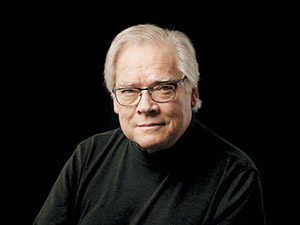
    Christopher Dunn

    A lifelong master craftsman, machinist, and engineer with experience in aerospace and a focus on precision and laser application, Dunn became fascinated with the Great Pyramid at Giza after reading Peter Tompkins’ iconic book The Secrets of the Great Pyramid. He spent more than 20 years studying the Great Pyramid and other Egyptian sites.

    Due to his engineering background, Dunn saw things in the Pyramid’s construction that others missed. Most people marvelled at the Pyramid’s size and asked, “How did they do it?” Dunn examined its precision and asked, “Why was it necessary?”

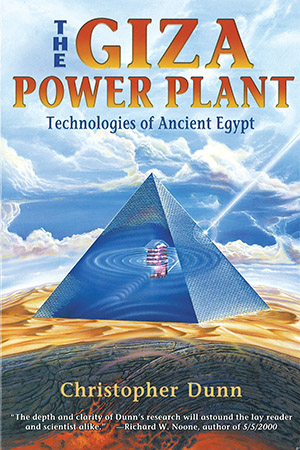
    Dunn burst into the limelight with the 1998 publication of The Giza Power Plant: Technologies of Ancient Egypt. Dunn revealed that the Great Pyramid was a giant power generator – an acoustical device that created harmonic resonance with the Earth and converted the planet’s natural vibrations into usable energy for an ancient civilisation. He showed that the Pyramid’s numerous chambers and passageways were positioned with deliberate precision to maximise acoustical qualities.

    In 2010, he followed up with Lost Technologies of Ancient Egypt: Advanced Engineering in the Temples of the Pharaohs, a unique study of the engineering and tools used to create Egyptian monuments, proving beyond a shadow of a doubt that advanced knowledge and machining was utilised.

    Dunn’s new 2024 book, Giza: The Tesla Connection: Acoustical Science and the Harvesting of Clean Energy, expands his hypothesis that the Great Pyramid at Giza was built as an advanced energy-harvesting machine.

    Dunn proposes that the Ancient Egyptians used the Great Pyramid to generate clean free energy, similar to what genius inventor Nikola Tesla later envisioned, as indicated in the title of his new book.

    Today, the world is suffering an energy crisis. The solution to our woes might be literally staring us in the face – on the Giza plateau. Will anyone listen? New Dawn recently spoke to Christopher Dunn.

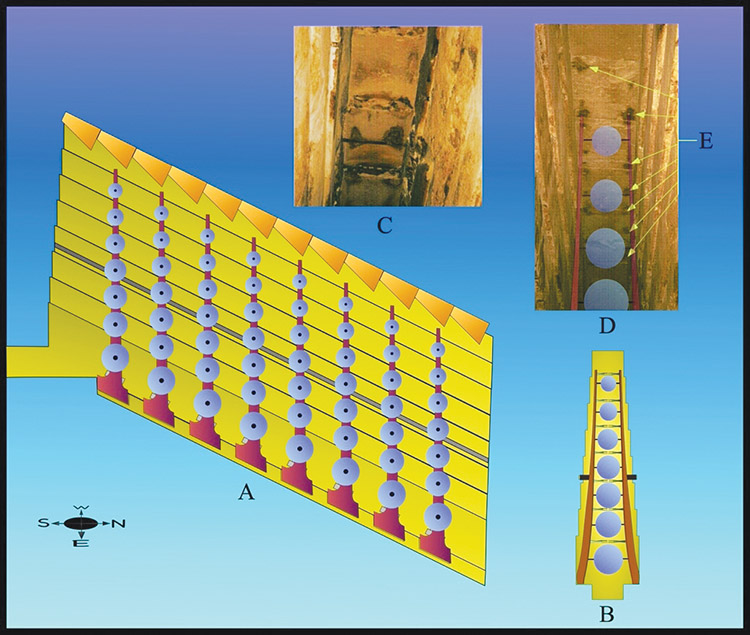
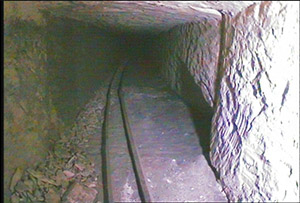
    A: East to West cross section of Grand Gallery with 8 of 27 installed resonators. B: North to South view along the length of the Grand Gallery. C: Close up of ceiling showing scorch marks. D: Ceiling scorch marks with resonator frame illustrating its correlation.

    NEW DAWN (ND): What discoveries have been made since the publication of The Giza Power Plant?

    CHRIS DUNN (CD): For those not familiar with the book, The Giza Power Plant: Technologies of Ancient Egypt is a reverse engineering exercise that began in 1977. The objective was to find a reason why every feature discovered in and around the pyramid exists. In a nutshell, it describes the Great Pyramid as a machine, the function of which was to draw energy from the Earth and distribute it to the inhabitants at that time. This ultimately led to the publication of the book in 1998.

    While there has been a lot of discussion about lost civilisations and ancient cataclysms, my intention while writing the book was to focus primarily on the physical evidence inside and around the Great Pyramid. Having said that, it is becoming clearer now, with the fine work of other investigators and their introduction of new evidence, that a cataclysm occurred in antiquity and the Great Pyramid, along with everything else existing in physical form that sustained a sophisticated society, was damaged beyond repair, as was the civilisation that built it.

    Since The Giza Power Plant was published, quite a few discoveries have been made in and around the Great Pyramid that support and allow refinements and strength to the theory. In chronological order, they are:

    • In 2001, while being filmed for a documentary on the Giza Plateau near Cairo, Egypt, I received permission from Zahi Hawass [Egypt’s Minister of State for Antiquities Affairs at that time] to go inside the Great Pyramid, which had been closed for cleaning. While inside the Grand Gallery, I noticed and photographed scorch marks on the ceiling. The pattern matched my theorised design of the frames that held a series of acoustic resonators. In The Giza Power Plant, I posited there was a hydrogen explosion inside the King’s Chamber that pushed out the walls and cracked the ceiling beams. I did not believe that evidence to support this theory would exist in the Grand Gallery, but in consideration of all other evidence, it would have been perfectly reasonable to do so. I just didn’t think of it at the time.

    • In 2002, the Queen’s Chamber South Shaft was explored by a robot named Pyramid Rover, designed and built by iRobot in Massachusetts, USA. The hydrogen that exploded, I theorised, was created in the Queen’s Chamber. This conclusion was reached by examining evidence that had been discovered related to the chamber and its North and South Shafts.

    With much fanfare and an audience that had been primed to be glued to their televisions for the intended broadcast of new pyramid discoveries, the Pyramid Rover prepared to climb the shaft and drill through a limestone block at the end. This blockage was first discovered by robotics engineer Rudolph Gantenbrink in 1993 and subsequently labelled “Gantenbrink’s Door.” While preparing to drill through the blockage, the thickness of the door was measured using an impact-echo probe and determined to be 3.25 inches thick. My illustration of this “door” showed a thickness of 3.6 inches.

    The image captured by an endoscopic camera inserted through the hole showed another blockage approximately 10 inches from the “door.” Not much else that was remarkable was revealed in the South Shaft at this time. No other theory offered at the time regarding what would be revealed was correct. However, what was revealed did not negate my theory, but for it to be proven 100% correct, more information was needed.

    Little did I know at the time that further validation of the theory was discovered after the iRobot team completed their work in the South Shaft and the documentary production crew departed. Before packing up their equipment and exiting the pyramid, the iRobot crew sent the Pyramid Rover robot up the North Shaft. Gantenbrink had attempted to explore the North Shaft in 1993, but could not navigate beyond two long exploratory rods that had somehow become stuck where the shaft turns on an angle to the left. Using a different tactic, by turning their robot 90 degrees so that it gripped the walls instead of the floor and ceiling, the Pyramid Rover was able to ride over these obstructions.

    Evidence of chemical inlet shaft.

    Pyramid Rover revealed two pieces of evidence supporting my theory about using these shafts. One was an opening in the East wall near one of the bends approximately 90 feet up the shaft from the Queen’s Chamber. I theorise that chemicals were introduced into the shaft behind the blockage, but this evidence showed that the entrance for the chemicals was lower down.

    The other evidence revealed was the existence of another blockage, similar to the South Shaft, but with electrodes that were not corroded and with one that was recessed and showed signs of electroplating.

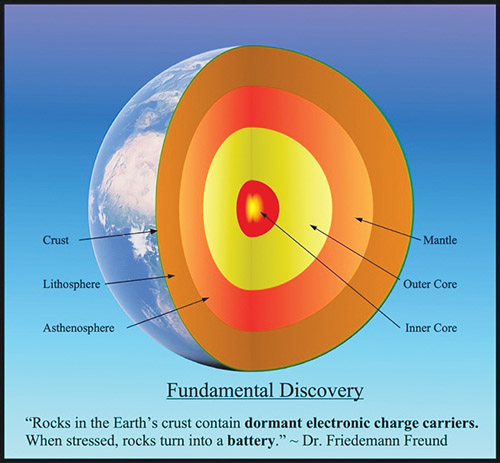
    Dr. Friedemann Freund’s discovery.

    • In 2006, Dr. Friedemann Freund, a NASA physicist, completed his laboratory experiment confirming his theory that earthquake lights were the result of electron flow propagating through the lithosphere when peroxy defects in their minerals were subjected to stress. His conclusion was that under certain conditions, igneous rock beneath our feet turns into a giant battery.

    • In 2010, another robot team from Leeds University in the UK, and headed by Chinese dentist Dr. TC Ng, fashioned a different style of robot which Dr Zahi Hawass named Djedi, the name of Khufu’s magician [in reference to Pharaoh Khufu of the 4th Dynasty who is said to have commissioned the Great Pyramid]. The Djedi robot was equipped with a snake camera that was able to look around the small space and even look behind Gantenbrink’s “door.” The images it captured allowed me to slightly modify my engineering design, but overall supported my proposed function for these features.

    • In 2017, the Scan Pyramid Mission released the muography images taken inside the Great Pyramid. Muons passing through the Great Pyramid would impinge on special plates set up inside the Queen’s Chamber and Grand Gallery. The image that resulted from the interaction identified voids inside the pyramid. Of particular interest was a large void above the Grand Gallery. Discussing this with aerospace engineer Eric Wilson, he offered the idea that it would have been used to pre-amplify microwaves travelling down the shaft before they entered the King’s Chamber. In association with that, drawings made available by Rudolph Gantenbrink of the King’s Chamber’s North Shaft have made it possible in my new book Giza: The Tesla Connection to illustrate this shaft with greater accuracy and point out features that are consistent with waveguide design.

    • On 20 July 2018, the Journal for Applied Physics published an article entitled “Electromagnetic Properties of the Great Pyramid: First Multipole Resonances and Energy Concentration” by Mikhail Balezin, Kseniia V. Baryshnikova, Polina Kapitanova, and Andrey B. Evlyukhin. In this article they reveal the results of their findings of the electromagnetic nature of the pyramids: “Electromagnetic field distributions inside the Pyramid at the resonant conditions are demonstrated and discussed for two cases, when the Pyramid is located in a homogeneous space or on a substrate. It is revealed that the Pyramid’s chambers can collect and concentrate electromagnetic energy for both surrounding conditions. In the case of the Pyramid on the substrate, at the shorter wavelengths, the electromagnetic energy accumulates in the chambers providing local spectral maxima for electric and magnetic fields.” (doi.org/10.1063/1.5026556 124, 034903)

    ND: Of those, which do you think is the most significant discovery?

    CD: Without hesitation, I would say the most significant discovery was Dr. Friedemann Freund’s. While Dr. Freund was only focused on developing the means to predict when an earthquake was about to happen, his proven lab experiments demonstrating his physics correct provide confidence that his discovery has the potential to solve the world’s energy needs.

    Moreover, when it comes to the reason behind building pyramids around the world – knowing that an abundant supply of electrons can be stimulated to rush to the surface as well as the new research showing that pyramids focus electromagnetic energy – there is solid proof that the Great Pyramid was part of a larger global system. For alerting me to Freund’s work, I must thank researcher Robert Vawter, who recently passed away.

    ND: Did The Giza Power Plant anticipate or predict this discovery?

    CD: The Giza Power Plant discussed earthquake lights, ball lightning and other natural phenomena but focused more on the piezoelectric effect of quartz crystals. Freund identified a new physics more related to semiconductors that does not rely on the piezo-effect. In fact, Freund found that one igneous rock called Gabbro has no silicon quartz crystals in it and was more effective in producing electron flow than other igneous rocks.

    ND: What discoveries could have been or were predicted since the publication of The Giza Power Plant?

    CD: All the evidence discovered in the Queen’s Chamber shafts was predicted to exist. The only difference is between my engineering design and that subsequently discovered. Scorch marks in the Grand Gallery could have been, but were not, predicted. Eric Wilson had stressed to me that the MASER needed a preamp to function properly. The “Big Void” may eventually be proven to have functioned in this way.

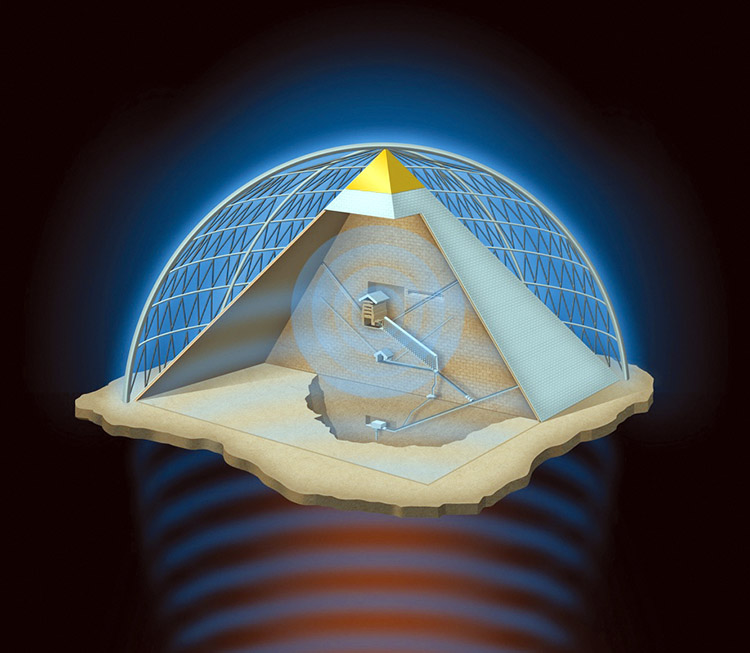
    Electron Harvester with Tesla Connection.

    ND: How would such an advanced power system shape our society?

    CD: Considering that we have been burning fossil fuels to produce electricity for over 100 years, reducing this method can only benefit the environment. In 2021, America burnt enough coal to build a pyramid that would be 76 times the size of the Great Pyramid. Current methods are highly inefficient and expensive compared to drawing electricity from directly beneath our feet. From a psychosocial perspective, the mental health of humans would improve if we were not depleting the Earth’s natural resources and polluting the atmosphere.

    ND: What other areas of science and engineering do you envision will evolve from this system?

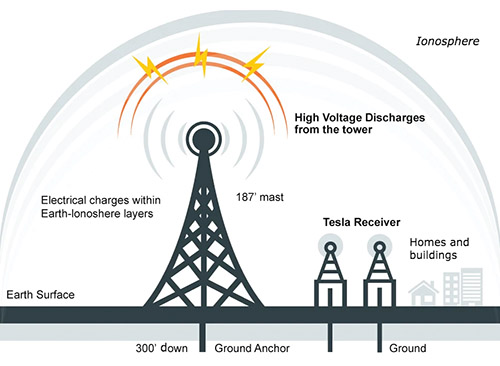
    Graphical representation of Wardencliffe Tower (Source: allaboutcircuits.com/technical-articles/teslas-towers-pikes-peak-wardenclyffe-and-wireless-power-transmission)

    CD: One area of improvement is the transmission of electricity. Electric vehicles are gaining in capabilities and efficiency. I envision a delivery system that transmits electricity without wires, as Nikola Tesla proposed with his Wardencliffe Tower project. I believe car companies could benefit from developing this technology by building their own electron harvesters that would wirelessly deliver power to vehicles and reduce, or eliminate, the need for batteries.

    The recent disclosure of UAPs navigating our airspace and displaying capabilities that we can only dream of possessing provides an indication of what is physically possible. It would seem, though, that breakthroughs in physics, as demonstrated by Freund, for example, are necessary before reaching this level of technological competence. One hundred years of technological advancement has resulted in a world that looks nothing like the world I lived in 78 years ago. If technology improves at the same pace into the future, our children and grandchildren will see a world that looks nothing like the world we live in today.

    ND: How are the Egyptian people reacting to your theories about their monuments?

    CD: Many Egyptians are now abandoning the pyramids as tombs theory and seeing their monuments in a different light. After the publication of The Giza Power Plant, it became clear to me that Western scholars were not accepting the evidence I presented that elevated the capabilities of the ancient Egyptians. After 10 years, I decided to appeal directly to Egyptian engineers with my book Lost Technologies of Ancient Egypt. In the book, I identified and analysed artefacts to conclude they must have been machined and challenged Egyptian engineers to inspect the artefacts themselves. I’m happy to report that an Egyptian engineer, Ahmed Adly, took up the challenge and created a series of YouTube videos where he presented his results.

    An important artefact he inspected was one of the boxes in the Serapeum. He concluded that I was right and provided me with a Foreword for Giza: The Tesla Connection. In his Foreword, Adly reports on a meeting he had with Dr. Ashraf Sherbini, a physicist at Cairo University, who agreed with my theory that the Great Pyramid was a machine. Adly’s videos have been well-received in the Arabic-speaking world, especially among Egypt’s youth. I believe that if Egypt’s history is to be rewritten, that task should be performed by the Egyptians, not outsiders.

    A chapter in Giza: The Tesla Connection is devoted to the Serapeum and also introduces new revelations on pre-dynastic vases that have recently been subject to modern inspection methods.

    Get the issue this article appears in

    ND: Has there been any interest expressed by energy companies?

    CD: An energy company from Malaysia has expressed a keen interest in developing the technology. My philosophy is that any entity wishing to develop it should be free to do so without barriers or exclusivity.

    ND: Is there more to reveal in the Great Pyramid?

    CD: Yes. Further research is ongoing. Of some I am aware, and I’m sure there are others I do not know about.

    ND: Are you currently working on any other writing project?

    CD: I do not plan on writing any more books. However, the recent metrological inspection of pre-dynastic vases has created quite a stir. Several have been inspected using conventional mechanical inspection methods, as well as structured light and CT scanning. The results are simply mind-blowing. STL files are available on UnchartedX.com and have been downloaded and analysed by engineers around the world. The mechanical inspection of the vases can be viewed at youtube.com/watch?v=QzFMDS6dkWU&t=425s. One analysis was performed by cryptographer and mathematician Mark Qvist and his colleague. His article can be read at unsigned.io/granite-artifact. This research, which now involves the Egyptians, is ongoing and articles targeting specific audiences need to be written. 

    Diagram images courtesy of Chris Dunn and Inner Traditions International. There are more images inside the published version of this article.
    Read the full story and contemplate all the convincing evidence in Chris Dunn’s new book Giza The Tesla Connection: Acoustical Science and the Harvesting of Clean Energy. Order your copy from all good bookstores.

    [alert type=”general” dismiss=”no”]This article was published in New Dawn Special Issue Vol 18 No 2.[/alert]

    [alert type=”success” dismiss=”no”]If you appreciate this article, please consider subscribing to help maintain this website.[/alert]

    References

    Freund, Friedemann. “Rocks that Crackle and Glow: Predicting Earthquakes.” Filmed at the 33rd annual Society for Scientific Exploration (SSE) Conference in 2014 at the Hyatt Regency San Francisco Airport, Burlingame, California, USA, youtube.com/watch?v=aRXlk26TcGc
    Freund, Friedemann. 2016. “Using Semiconductor Physics to Forecast Earthquakes.” TEDx Talk Christchurch, NZ. youtube.com/watch?v=B1yno8RjaFE
    Freund, Friedemann, Ouillon G., Scoville J., and Sornette D. 2018. “Earthquake precursors in the light of peroxy defects theory: critical review of systematic observations,” European Physical Journal (EPJ)
    Pyramid Rover exploration of the Queen’s Chamber North Shaft. Ancient Architects YouTube channel, youtube.com/watch?v=Ki0405ulvIY

    © New Dawn Magazine and the respective author.
    For our reproduction notice, click here.
  • Shift of the Ages: What You Need to Know about the Coming Great Awakening

    Shift of the Ages: What You Need to Know about the Coming Great Awakening

    From New Dawn 199 (Jul-Aug 2023)

    We are in the process of an accelerated spiritual evolution that is unprecedented in the known universe. Ancient prophecies and astrological theory together agree that we are living at a moment of great transition and change, but the rate of change that is occurring is something that has never been known before and was not anticipated by our most prescient sages.

    The old world is dying and crying out to be saved; a new world is emerging and we are all being drawn into it. This new world offers incredible possibilities: a shift in the very nature of our consciousness and of the dimensional structure of the region of the world in which we live; a promise of “ascension” to a way of being where all the old conflicts melt away, and where harmony, love, and joy are the constant bases of our existence. 

    But the passage to this new world seems fraught with struggle and disorientation. It doesn’t seem that we are very well prepared to make this shift. Unresolved emotional trauma, intentions, and personal histories lie dormant within us; and if they are not dealt with by each one of us, we will resist the coming changes. Resistance will cause us great suffering and prevent us from embracing the possibilities that are open to us.

    “It was the best of times and the worst of times,” wrote Charles Dickens about the years of the French Revolution. It seems there is a cosmic law at play, that where there is great hope there is also great danger: that where we seem on the brink of disaster, unimagined benefit may lie just around the corner.

    A Fork in the Road

    We have reached a fork in the road; are we going to awaken to our true genius and potential as infinite consciousness and ascend as one planet? Or are we going to remain entrapped in our limited identity and remain on the karmic wheel of reincarnation? The choice is between the mechanical mind, which keeps you in separation, and the intuitive heart, which connects you to all that is.

    If we don’t change our direction, we’re likely to end up where we are headed, and because we have been so spiritually ignorant, it’s going to take major Earth changes to wake us up. Many Native Americans believe that most of the people of Earth will die and then travel back to the stars where they came from. From there, it is believed that their transformation will be easier. 

    Those who are living from the heart, and are connecting to Mother Earth, will stay here as the planet transforms. There’s a new energetic configuration for the Earth, and people who are ready are able to stay with it as it upgrades into the higher frequency of fourth-density. The Native Americans call them the people of One Heart; they say we will become literally one people, breathing in unison. From there, we will begin to transform into a new humanity. 

    We will be led through an amazing series of consciousness movements and experiences as we enter fourth-density. We already know all of this on a very deep inner level, for the pathway is already recorded in our DNA. 

    It is so important to be fearless and to know that you are One with the Infinite Creator. When you know that, the transformation will be easy; it will also be extremely pleasurable. The bottom line is that we must be balanced on Earth, or the planet will go through a pole shift and solar flash.

    The Hundredth Monkey

    The Japanese monkey, Macaca fuscata, has been observed in the wild for a period of over 30 years. 

    In 1952, on the island of Koshima, scientists were providing monkeys with sweet potatoes dropped in the sand. The monkeys liked the taste of the raw sweet potatoes, but they found the dirt unpleasant. 

    An 18-month-old female named Imo found she could solve the problem in a nearby stream. She taught this trick to her mother. Her playmates also learned this new way and they taught their mothers. Various monkeys gradually picked up this cultural innovation before the eyes of the scientists. 

    Between 1952 and 1958, all the young monkeys learned to wash the sandy sweet potatoes to make them more palatable.

    Only the adults who imitated their children learned this social improvement. Other adults kept eating the dirty sweet potatoes. Then something startling took place. In the autumn of 1958, a certain number of Koshima monkeys were washing sweet potatoes – the exact number is not known. Let us suppose that when the Sun rose one morning, there were 99 monkeys on Koshima Island who had learned to wash sweet potatoes. Let’s further suppose that later that morning, the hundredth monkey learned to wash potatoes.

    Then it happened! 

    By that evening, almost everyone in the tribe was washing sweet potatoes before eating them. The added energy of this hundredth monkey somehow created an ideological breakthrough! 

    But notice. A most surprising thing observed by these scientists was the habit of washing sweet potatoes jumped over the sea – colonies of monkeys on other islands and the mainland troop of monkeys at Takasakiyama began washing their sweet potatoes! 

    The above information is from Ken Keyes Jr., the creator of the Living Love method. It came from a 1981 book titled The Hundredth Monkey. 

    Reaching Critical Mass

    When a certain critical number achieves an awareness, this new awareness may be communicated from mind to mind. Although the exact number may vary, the Hundredth Monkey phenomenon means that when only a limited number of people know of a new way, it may remain the consciousness property of these people. But there is a point at which if only one more person tunes in to a new awareness, a field is strengthened so that almost everyone picks up this awareness!

    The Shift of the Ages is the awakening of humanity’s heart; it is the movement from the polarised mind – which is a continual state of judgment and does not connect the dots to see wholeness – to the heart, which is connected to Source, and only knows Unity. This transformation of consciousness, the greatest one ever recorded, first became apparent in the mid-1960s and has been building momentum ever since.

    The shift is a collective transformation consisting of the sum of each individual’s step into the new reality. Each person, in their own time, is moving forward into a stage of consciousness that brings a wider vista and an awareness that springs from the heart. When enough people’s primary attention focuses through their heart chakras, then the ‘hundredth monkey effect’ will occur.

    What Will it Take to Create Critical Mass?

    Let’s begin by taking a look at some of the characteristics of an ascension-ready person. There is a shift in identity that is inclusive of the fact that you and I are perfectly functioning holograms of the One Infinite Creator; we are spiritual beings having a human experience. Our inner light is shining brightly, and we are truly present in life. Now we are coming from an unlimited inner supply of joyfulness, inner peace, creativity, inspiration, compassion, unconditional love and fulfilment, rather than looking to outer circumstances to try to find it. Our relationships, livelihood, friends, etc., now become a place in which we live and experience that wholeness that is emanating from within. 

    Then, The Law of One, like all the great spiritual teachings, makes it very clear that the shift each of us needs to make is from service to self – meaning using control and manipulation to get what you want at the expense of others – to service to others. 

    This speaks to the importance of shifting from a “you or me world” to a “you and me world.” In the former, the old paradigm, where we are living in a “what’s in it for me world,” no one is empowered, and therefore, nobody makes any real difference, no matter what they do. Even acts of great courage are coming out of a condition where a meaningful contribution to the whole is not possible. They merely show up as gesturing or showing sympathy for the less fortunate.

    You are familiar with the idea that says if you give someone a fish dinner, that person will be well fed for the moment. Yet, if you teach that person how to fish, he or she will be fed for a lifetime. That is the shift that each of us needs to make, from gesturing to empowerment; from “you or me” to “you and me.” 

    What are the rules for functioning effectively in this new paradigm of a world that works for everyone? Surprisingly, they are very simple: you lead by example. As Gandhi said, “Be the change you want to see in the world.” Then you have to find a way to be efficient, to get five out for every one you put in. It’s what Buckminster Fuller calls The Trimtab Principle. When the captain turns the ship’s wheel, the wheel turns the trimtab, the trimtab turns the rudder, and only then does the rudder turn the ship.

    The Great Awakening

    Are we creating this necessary critical mass, and are we doing it in a way that alleviates the need for severe Earth changes, such as the solar flash? In a word, yes. Remember – in the same way that heart attacks, cancer and other illness and disease are a direct result of our individual unbalances, earthquakes, volcanos, tsunamis, hurricanes, tornados and the like are the result of our collective disharmony. 

    We are living in the midst of a great awakening, where the collective darkness is being brought to the surface in order to be transmuted into the light of the higher dimensional energy that is enveloping and affecting us all. What we are living through now – this collective dark night of the soul – is absolutely necessary; we must be shown – not just told – how we have been controlled and manipulated by a malevolent group of psychopaths for a very long time. We are also seeing how their time is up; that level of evil and corruption cannot survive in these accelerated times.

    As they are removed from the scene, we will be given a level of freedom that we could previously barely imagine. What if your car battery could also fuel all the energy for your entire home? What if you could put a thousand pounds of garbage in a machine and hours later get pure, drinkable water and usable fuel as we transition into free energy? What if we evolved the automobile after a hundred years of similar design and added anti-gravity technology, making it a gas-free hover car?

    If this existing advanced technology, which the Cabal has blocked, were to come into mainstream use, we would live in a world with far less pollution, less environmental stress and more safety and protection. We would be stepping into the golden age. We would be creating the perfect bridge that would allow us to transition into fourth-density in an orderly and organic way.

    Get the issue this article appears in

    Living in Two Worlds

    The entire planet, and everyone on it, is in the throes of this change. We are all mutating – Mother Earth is in transition and so are we, individually. Some of us are more aware of this than others. It means we get to experience the joy of having more light flow through us and also the inconvenience of having our old world dissipate before the new one is fully manifested.

    For those of us who are staying current with these evolving times, we are literally living in two worlds. The first is the everyday world as we know it; I live in it as though it will always be here; I suggest you do, also. That means we have bills to pay, we have families to love and care for, and we must do our best to help the world in whatever way we can.

    At the same time, we must prepare inwardly for what we know is coming. We are being given an opportunity to resolve lifetimes worth of karma so we can move into the higher worlds. It is important to embrace our darkness within as it arises from suppression; it is important to realise that we are being given an opportunity to revisit our unresolved issues so we can transmute their stagnant energy into life-enhancing internal guidance systems that are clearly contributing to our aliveness. From that new-found presence, we are in the space of “no-mind” and are thus connecting to Source through our Higher Self.

    When you have reconnected your severed aspects, you are living from your heart, not from your mind. It then becomes a natural expression to experience and express your wholeness in the form of service to others and to do it in a way that empowers them to make a difference. Loving and helping people to remember who they are and being of service to the world is the only outer purpose that creates character. This will assist you greatly as you journey into higher consciousness.

    When you are connected in this way, you create a vibration within that is recognised by Mother Earth. As the dimensional shift takes place, you will be taking the most exciting journey of a lifetime. Mother Earth knows you and will protect you under all circumstances, and you will become part of the “One heart beings” that will begin the journey beyond the stars and into the higher worlds. 

    The Christ-consciousness grid has been fully formed and birthed. It is now alive and conscious; it is a living energy field around the Earth, and this changes everything. In every instance, whenever a grid has become a living entity and connected to its planet, it has always gone to the next level. Mother Earth has made a conscious decision to move into the higher worlds of the fourth-density and beyond.

    We are now in a heart-based energy field; when you connect to it, a new possibility opens up. This means that our spiritual acceleration will quicken dramatically – there is nothing left to stop it.

    It also means that sometime, perhaps soon, the entire cycle that we are now on will disappear in a single day. In its place, a whole new world will be birthed, one based not on the mind but rather on the heart. We are right on the edge of the emergence of this world. Everything is in place; the grid is alive and functioning, yet most of the world continues in its old pattern, thinking this is the way it will be forever, hardly imagining that something incredible is about to occur.

    This is a time of great celebration as we move out of the darkness and into the light. It means that the veils will be lifted, we will remember and live our intimate connection to all life, we will be allowed to reunite with our cosmic brothers and move about the universe. This is the birth of a new humanity; we will completely redefine what it means to be human!

    My book, Catching the Ascension Wave, will fill you in on all the details of the upcoming shift. Sharing exercises, tools, and techniques to transmute the energies blocking access to your Higher Self, we will explore how the infusion of higher dimensional energy is impacting planet Earth and each of us. I will show how reconnecting with your Higher Self enables you to harness the ability to create great abundance and recognise our intimate connection to all life and to the Infinite Creator. 

    Catching the Ascension Wave: Everything You Need to Know about the Coming Great Awakening by Bob Frissell is available from all good bookstores.

    [alert type=”general” dismiss=”no”]This article was published in New Dawn 199.[/alert]

    [alert type=”success” dismiss=”no”]If you appreciate this article, please consider subscribing to help maintain this website.[/alert]

    © New Dawn Magazine and the respective author.
    For our reproduction notice, click here.