New Dawn – World's Most Unusual Magazine

Category: Articles

  • Geoengineered Transhumanism: Above & Beyond Chemtrails, HAARP & the Space Fence

    Geoengineered Transhumanism: Above & Beyond Chemtrails, HAARP & the Space Fence

    From New Dawn Special Issue Vol 17 No 4 (Aug 2023)

    While Elana Freeland is widely known for her books related to geoengineering, in order to understand her orientation to that research, it is important to recognise that she is also the author of a four-volume work entitled Sub Rosa America: A Deep State History.

    Freeland classes Sub Rosa America less as a work of fiction than as a history of the United States since President John F. Kennedy’s assassination. She said she was “not obsessed but possessed” by such an inspiration that the words flew out of her pencil.

    In a recent interview, Freeland said: “When I was beginning to write Sub Rosa America in the early 1990s, I had an intense dream in which I saw the numbers 2019 towering above me to a great height, and they were on fire.”

    “I don’t know if you noticed,” she added, “but I begin the novel with a flashback from 2019 because of that vision in my dream. I had a sense that something terribly big and important was going to happen in 2019, and it certainly did!”

    Sub Rosa America is nothing less than a literary epic, a journey by a motley crew of young truth seekers (aided by the constantly reincarnating Count St. Germain) to “Look for America” in the aftermath of the three major assassinations in the US in the 1960s, which devastated Freeland’s generation. Full of references to covert government operations such as the MK-ULTRA mind control program and replete with intimations of advanced technologies yet to come, the text cannot help but make the reader wonder how much the work may be a thinly disguised autobiography of Elana Freeland.

    In its opening scene set in 2019, its female central character, a mature woman hiking alone into the Rocky Mountains, experiences UN troops in black helicopters and finds refuge when they pass overhead by utilising an “invisibility cloak” and other tools given her by her lover, a brilliant scientist whose twin brother was a captive of MK-ULTRA programming.

    It is an image that resonates deeply with Freeland’s current work, in which she sees herself in a battle against “powers and principalities” opposed to the development of human free will – a battle for the very future of humanity.

    For the past decade, Elana Freeland has completely devoted herself to the task of researching, describing, and interpreting, often in painstaking detail, the destruction descending upon the Earth and humanity by the intentional abuse of chemicals, electromagnetics, and the new science of nanotechnology.

    HAARP / Chemtrails

    Elana Freeland has been a Waldorf school pioneer, teacher, lecturer, storyteller, ghost-writer, and author of nonfiction books that grapple with National Security State issues. She has written for alternative publications, edited the stories of MK-ULTRA and ritual abuse survivors, and has ghost-written books on a host of diverse topics. Elana majored in biology in college. She was awarded a Master of Arts in Great Books in 1996 and received honors for her thesis on historiography at St. John’s College in Santa Fe, New Mexico. Elana is the author of the four part series Sub Rosa America, Chemtrails, HAARP, and the Full Spectrum Dominance of Planet Earth, Geoengineered Transhumanism, and Under An Ionized Sky. Website: elanafreeland.com.

    In her first geoengineering book, Chemtrails, HAARP and the Full Spectrum Dominance of Planet Earth (Feral House, 2014), she introduced the subject to the reader with the assertion that “HAARP technology with its ionized chemtrails constitutes a global-scale DEW (Directed Energy Weapon) system.” She also asserted that “All of planet Earth will be militarized under the policy of full spectrum dominance.”

    How was it, then, that Freeland began to arrive at such bold conclusions?

    “I first began by concentrating on the engineering feat of actually obtaining full spectrum dominance over the Earth,” Freeland said in our interview. “For that, I depended mainly on Bernard Eastlund’s 1987 HAARP patent, in which he describes exactly what would be needed in order to control the ionosphere and pull ions down into the Earth’s atmosphere.”

    Eastlund’s patent for a “Method and Apparatus for Altering a Region in the Earth‘s Atmosphere, Ionosphere and/or Magnetosphere” led Freeland to learn about the High-frequency Active Auroral Research Project (HAARP), which adapted Nikola Tesla’s electrical transmission discoveries for the purpose of creating ionospheric heater technology, capable of sending, via phased array antenna systems, high-powered beams of electrons into the ionosphere to influence the flow of ions.

    As Nick Begich, Jr. and Jeanne Manning reported in their pioneering book Angels Don’t Play this HAARP: Advances in Tesla Technology (Earthpulse Press, 1997): “The $30 million project euphemistically named HAARP (High-frequency Active Auroral Research Program) is made to beam more than 1.7 gigawatts (billion watts) of radiated power into the ionosphere – the electrically-charged layer above Earth’s atmosphere. Put simply, the apparatus is a reversal of a radio telescope – just transmitting instead of receiving. It will boil the upper atmosphere. After disturbing the ionosphere, the radiations will bounce back onto the earth in the form of long waves which penetrate our bodies, the ground and the oceans.”

    By reporting on “how cloud seeding goes electromagnetic” through the spraying of strontium, aluminium, and barium into the atmosphere, which was then ionized through HAARP and other transmissions, Freeland demonstrated in her first book that chemtrails are “not your average contrails.” She also reported on the ways in which geoengineering and environmental warfare are “profit and force multipliers.” She also provided deep background into the anomalous substances derived from chemtrail spraying residues now known as Morgellons by introducing her readers to the extensive research of independent scientist Clifford E. Carnicom (carnicominstitute.org).

    “I didn’t know at all in my first book on chemtrails, though, how far geoengineering went,” Freeland said. “I was just following the direction each book indicated.”

    Clifford E. Carnicom

    Freeland’s intuition seems to have an aptitude for connecting her with people who can inform and amplify her research. Carnicom, noted for his years of research into material evidence derived from the examination of residues from geoengineering atmospheric spraying, is one such person.
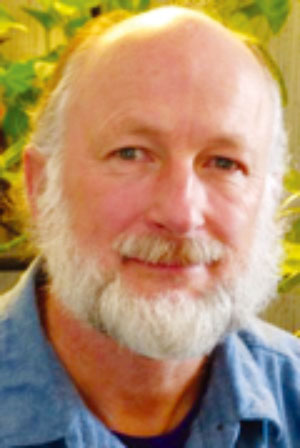
    Clifford E. Carnicom

    “In the early 2000s, I became friends with Clifford, which seemed to me like destiny,” she said. “After I moved to Santa Fe, through a friend of a friend of mine I met Clifford and his wife Carol at a breakfast. I was writing Sub Rosa America and had a file on the chemtrails thing. In the mid-to-late nineties, Clifford was collecting the condensation from northern New Mexico skies after the jets with the long trails came overhead. As a scientist, he immediately recognised that they were not contrails due to the chemical signatures of the trails that did not fit with water content. He also was collecting debris with his HEPA filter, and that is when he began to discover the Morgellons fibres.”

    Freeland described the Morgellons phenomenon in detail in her first book, complete with photos. It appears as a skin infection but with strange wire-like protuberances.

    “Biology was my second undergrad major. What I didn’t know yet was that I was not going to be able to really return to what I had studied so many years ago because molecular biology is being transformed into digital biology.”

    Asked if she’d discovered through her early studies with Carnicom that Morgellons was nanotechnology, Freeland replied, “I didn’t know that part yet. What I did learn was that Morgellons had been genetically engineered.”

    Bioengineering and nanotechnology – two fields of human endeavour about which the general public still knows relatively little for lack of investigative reporting about them in the mainstream media – figure prominently in Freeland’s next two books.

    In Under an Ionized Sky: From Chemtrails to Space Fence Lockdown (Feral House, 2018), Freeland expanded greatly upon her initial research. She wrote: “Now that phase two of the ionospheric heater technology is being instituted – the Space Fence – I have reconfigured (Clifford Carnicom’s) list (from his 2005 film Cloud Cover) to reflect some of the detail behind each operation.”

    The list she presents provides an overview of the content of her second book: Weather Engineering/Geoengineering; Planetary/Geophysical Operations; Electromagnetic Operations; Directed Energy Warfare Operations (C4); Surveillance/Neural Operations; Biological/Transhumanism Operations.

    The bullet points Freeland provides under that last category are worth noting: “Hive Mind Morgellons delivery; Nanoparticle delivery: sensors, microprocessors and other electro-optical technology; Remote genetic engineering of DNA; Replace Nature with virtual reality.”

    In his introduction to Under an Ionized Sky, Carnicom wrote: “The book is meticulously researched and documented… The morass of controlling systems spoken of here does indeed exist, and they are of purpose and agenda. It is up to us to maintain our spiritual integrity in the clash that is before us…”

    The “Space Fence” to which Freeland refers is the second phase of the “Star Wars” missile defence system begun during the Reagan administration. That effort, which slumbered after the collapse of the Soviet Union, has been reborn, she reports, through a global network of both ground and sky-based installations, including ionospheric heaters, missile defence radar, SuperDARN radar, high-powered lasers, satellites and even the International Space Station.

    Freeland was also one of the first writers to report on the proliferation of cell phone towers and the dangers inherent in the development and dispersion of 5G technology.

    Above all, though, the thrust of Under and Ionized Sky is to develop and document the argument that geoengineering technology, which first manifested as simply “chemtrails,” is ramifying and developing increasingly toward the complete transformation of the human race – changing what it means to be human.

    Freeland summarised that key point in the title and subtitle of her latest book, which was released in October 2021: Geoengineered Transhumanism: How the Environment Has Been Weaponized by Chemicals, Electromagnetism, & Nanotechnology for Synthetic Biology.

    “All of this is one long epigenetic story of preparation for what we’re seeing now, the environmental process,” Freeland said. “It’s amazing, if you think about it, the scale of using the entire environment to assault the human being. It’s all under the secret space program, for full spectrum dominance of planet Earth, step number one to dominating the solar system.”

    Rudolf Steiner

    Freeland also conscientiously objects to mind control nanotech interwoven with chemtrails, the new generation of “vaccines,” and GMO “food.”

    “It’s a time of great experimentation,” she said. “The problem is that they’re using people without their consent, despite people being freewill beings. Rudolf Steiner said that the human being is the religion of the gods because we are spiritual beings living in material bodies, having a material experience on the Earth, spirits in matter. We’re very special beings, and we’re treated like lab rats.”

    Steiner, widely known for establishing what he called “spiritual science” based on Goethe’s scientific research, as well as for creating the Waldorf school movement and Biodynamic agriculture, has been a major teacher for Freeland.

    “I am a student of Rudolf Steiner,” she added, “I was a Waldorf teacher for about 16 years, having been trained at the Rudolf Steiner Institute in Detroit, Michigan.”

    During the COVID-19 global crisis, authors such as David O’Hagan (see option3.co.uk) have cited statements made by Steiner in the early 20th century that appear relevant to contemporary concerns over the new generation of mRNA “vaccines.” 

    For example, in a statement recorded in “Rudolf Steiner Supersensible Knowledge, Lecture 2” entitled “Blood is a Very Special Fluid,” O’Hagan quotes Steiner as saying: “Whatever power wishes to subjugate a person will have to exert an influence that imprints itself in his blood… That which possesses a person’s blood possesses that person, and possesses the human ‘I’.”

    “Human 2.0”

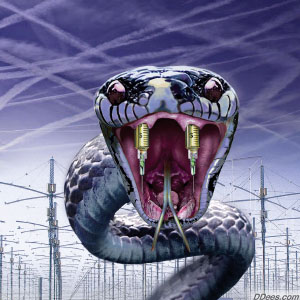
    Chemical trails, the new “vaccines,” and GMO foods, Freeland asserts in her new book, are the three primary delivery systems for nanotechnologies designed to turn our bodies into receivers and transmitters of pulsed electromagnetic frequencies allied with artificial intelligence in “Clouds.” The intended end product is nothing less than a completely modified transhuman being – “Human 2.0.”
    These are the new technologies, Freeland asserts, of the Fourth Industrial Revolution, harbingers of a totalitarian, completely surveilled and controlled society – and assaults upon the blood. As is her standard procedure, Freeland provides the sceptical reader with a wealth of source material from other authors writing about matters related to the transhumanist agenda and the Fourth Industrial Revolution in her extensive footnotes.

    Freeland has organised the book’s fourteen chapters into three sections that immerse the reader in Freeland’s worldview, which derives from her deep dives into her scientific source materials. It is a worldview so different from the mainstream media’s depictions of our world and its crises as to seriously challenge the assumptions of readers accustomed to standard ways of thinking about the subjects she addresses. Freeland, however, makes no apologies for taking her readers into stark new intellectual territories.

    “We cannot solve our problems with the same thinking that created them,” she told me, as she has said to other interviewers, as well.

    In the first section of her new book, “As above, So Below,” Freeland describes our still-ionized sky and the phenomena of geoengineered forest fires; the three delivery systems and advances in nanotechnologies they deliver; the harnessing of magnetism in the new technologies; 5G and the Internet of Things; the secret space program and the “eyes in the sky” satellite control under which we live.

    In the second section, “Surviving the Smart City,” Freeland describes the various “dual use” and invasive, weaponised systems installed now in “sustainable development” cities. She asserts that “A Smart City is an Armed City,” with its ongoing urban experiments manifesting in new technologies in lighting, surveillance, crowd control and high-tech hospitals.

    In the third section, “The Transhumanist Trojan Horse,” Freeland alludes to the tragedy of giving over the human being to “the advent of BCI – brain-computer interface” through “BCI implants in body, brain and environment.” She then surveys “the drama around the human genome” in “Transhumanist Eugenics/Newgenics,” and finally arrives at the drama of the day, “The COVID-19 ‘Vaccine’ Event.”

    Freeland’s comprehensive and highly detailed information on the new generation of mRNA “vaccines” in that last section is the best description of the complexity of those new technologies – including nanotechnology – and their effects on the human organism and genome that this writer has yet read.

    Her conclusion, “Remaining Human,” constitutes her meditation on what she considers the practices most essential for human beings to incorporate into our daily lives in the face of all the onslaughts she describes in such detail. She begins with the quantum nature of human consciousness and thinking, then shifts to suggesting ways of keeping the human immune system strong by following nature, not technology, to maintain “a state of balance.”

    The idea our very bodies are becoming transceivers of pulsed frequencies through tiny, phased array antennas of DNA and nanoparticles, which we receive via these new vaccines, in addition to the nanoparticles we breathe in through chemtrails and consume through GMO food to facilitate our conversion into transhuman cyborgs – wild and impossible as it sounds – is central to Freeland’s new book.

    Morgellons / 6G / mRNA “Vaccines”

    In order to gain perspective on the background to that assertion, we must return to Freeland’s collaborations over the years with Clifford Carnicom.

    “Carnicom has made another very significant scientific contribution,” Freeland said.

    “Clifford will be remembered in history – if they don’t completely erase him from history, which has been done to many inventors and scientists – for discovering the CDB or cross-domain bacteria inside the Morgellons fibres.

    Close-up of a Morgellons fibre. Image courtesy of the Morgellons Research Foundation.

    “The fibre itself is a protective polymer,” she said. “Inside are three other parts, including the cross-domain bacteria which has to do with the reproduction of this genetically engineered creature crossing all three domains of life. Some of what was endemic to Morgellons appears to be in the hydrogels, being injected into people now in the so-called vaccines.”

    “The graphene oxide and nanoparticles [in the vaccines] really correlate with Morgellons,” she added. “I explain this in the new book, how Morgellons was a precursor system.”

    Freeland then referred to videos that came out about facemasks under magnification.

    “When people were looking closely at the masks, they saw little wormy-looking things that look a lot like Morgellons fibres, and they move like Morgellons when you bring an electromagnetic field near them. They rise up and move. They’re alive.”

    Asked to give more information on this matter relative to the new mRNA “vaccines,” Freeland brought in references to activation by pulsed electrical frequency transmissions.

    “The vaccine is loaded with various diseases that can now be remotely activated because we’ve gone from molecular to digital biology,” she said. “The various diseases can be called out by the 5G/6G frequencies, all done very quietly. Most people don’t even know that 6G is already a done deal. 6G penetrates our brains and our bodies and is already pretty much in place, just as the 5G system was already in place with the 4G Plus system because of the phased array antennas. This is the key to why 5G works so well for so many purposes of control.”

    Moreover, Freeland says, what is now happening at the level of nanotechnology has its very roots in the HAARP technologies going back to the 1980s.

    “If you want to see a phased array antenna, just look at HAARP,” she said. “All these other phased arrays are essentially the same system. They can focus. They become beams, splay out over an area. Once these nanoparticles are in us, they form scaffolds for networking.”

    Freeland said everyone has breathed in Morgellons filaments, but some infected people are particularly aware of the peculiar nanobot qualities, such as “swarming,” the subcutaneous sensation.

    “When they come together as a swarm,” she explained, “you have an opportunity to see them, along with the nanowires from Morgellons sores. Get near a cell phone or toaster oven and the little wires just go nuts. Yum, yum, yum, they love electromagnetism! So, scaffolding in our bodies is intended to cyborg us as they take the place of our blood vessels and our nerves.”

    “A lot of people have died of Morgellons,” she said. “Only recently has the CDC [US Centers for Disease Control] recognised it as an illness, and even then, they falsely claim it’s a skin ailment. It’s a blood ailment, an assault on the blood. That’s what we’re seeing with this ‘vaccine’ and with the spike protein – it is an assault on the cell.”

    The new “vaccines,” chemtrails and GMO foods are all an “assault on the blood,” designed, as Rudolf Steiner put it, by a power that “wishes to subjugate a person” by an “influence that imprints itself in his blood.”

    Whether such insights make their way into public discourse, schools, universities, and halls of government, only time will tell.

    The Alaska-based HAARP facility, now run by the University of Alaska Fairbanks. 

    “Conspiracy Theory”

    It is important to note for readers new to this topic that Freeland is by no means working in isolation. She is one of an increasing number of independent researchers seeking to explore the real dimensions of the geoengineering phenomenon and increase public awareness about it. Consensus among researchers, however, is difficult to achieve in this realm of inquiry due to the size of the elephant in the living room and dismissive terms like “conspiracy theory.”

    Despite the fact that in all of her books Freeland provides extensive documentation in her footnotes to substantiate the information she presents and analyses, the fact remains that some people who share her concerns about the future of humanity and the misuse of technology – particularly satellites – do not recognise assertions by Freeland and other researchers that “chemtrails” are delivering toxic chemicals, electromagnetic pulses, and nanotechnology for military-industrial-intelligence agendas.

    One such person is Arthur Firstenberg, founder of the anti-5G rollout Cell Phone Task Force and author of The Invisible Rainbow: A History of Electricity and Life. Firstenberg has been calling public attention to the increasing radiation hitting the Earth from the thousands of new commercial satellites now in orbit around the planet.

    “‘Chemtrails’ are a hoax,” he wrote this writer. “They are condensation trails, and they have formed behind airplanes since air travel began. They are seen everywhere today because there is so much air traffic everywhere. Airplane exhaust contains water vapour and particulates and will persist and form clouds when the temperature in the air lanes is below the dew point. That is how clouds form. If you believe this does not happen, then you believe that clouds do not exist. Or that water vapour in airplane exhaust is different from water vapour evaporating from the oceans. Water vapour is water vapour.”

    Anti-Geoengineering Movement

    In contrast, Ian Baldwin, founder of Chelsea Green Publishing (which published Firstenberg’s Invisible Rainbow), is also an environmental activist in his own right and sees chemtrails as a serious problem worthy of rigorous, independent scientific study and informed public dialogue. Indeed, he is interested in supporting the anti-geoengineering movement that is developing around the world.

    To that end, Baldwin and Rob Williams, PhD, publisher of The Vermont Independent (vermontindependent.net), have created the website ourgeoengineeringage.org, which they describe as “an evidence-based exploration of our planet’s most pressing yet underreported global environmental issue.” Williams has also been interviewing Freeland and others involved in geoengineering research on the Vermont Independent YouTube Channel.

    As Freeland, Baldwin and other writers point out, there are two kinds of public discourse about “geoengineering.” One form addresses, as Baldwin puts it in one of the essays he has authored on the subject, “the ongoing military kind that is secret, discussion of which is repressed,” while the other addresses “the future-based, overt kind, openly discussed in the media,” primarily solar radiation management (SRM) to allegedly diminish the effects of global warming.

    For justifiably sceptical readers interested in evidence-based information about covert forms of geoengineering, the scientific papers written by J. Marvin Herndon, PhD and Mark Whiteside M.D., M.P.H. (some of which Freeland cites in her own work) posted at ourgeoengineeringage.org provide a unique resource and emphasise the gravity of the geoengineering phenomenon.

    For example, Herndon’s 2021 paper “Ancient Giant Sequoias Are Dying: Scientists Refuse to Acknowledge the Cause” (published in Advances in Social Sciences Research Journal, co-authored with Dale D. Williams and Mark Whiteside) and his 2020 paper “True Science for Government Leaders and Educators: The Main Cause for Global Warming” (also published in Advances in Social Sciences Research Journal) are good starting points.

    In response to this writer’s request for a statement describing Freeland’s influence on his own research and writing, Ian Baldwin wrote:

    “Elana is a brave pioneer in the anti-geoengineering movement. She picked up where the famous, now deceased epidemiologist activist-nun Rosalie Bertell PhD left off with her book Planet Earth: The Latest Weapon of War, published in 2000. Bertell founded the International Institute of Concern for Public Health in Toronto in 1984.

    “When I started to research and write about geoengineering in 2015, collaborating with Marvin Herndon, and later Rob Williams and Mark Whiteside, Elana’s first book – Chemtrails, HAARP, and the Full-Spectrum Dominance of Planet Earth – was a year old. It proved a comprehensive, eye-opening guide to the depth of the military’s long-term involvement in geoengineering operations. 

    “Three years later, in 2018, when Elana published her second book Under an Ionized Sky, I was again struck by her fearless willingness to go where few others dared. One learned many things. For instance, the US Air Force had two weather/climate agencies – the Air Force Weather Agency and the Meteorological and Space Environmental Services – both of which reported to the ‘Director of Weather’. One also learned that NASA, at least from Elana’s highly educated point of view, is a ‘psychological intelligence operation tasked with confusing public knowledge of covert space defence, space weapons, unmanned satellite and rocket launches, and plasma research’. As well as other, even more labyrinthine and nefarious ‘security’ operations.

    “It was Bertell who made me understand that two sources of energy – ‘chemical’ and electromagnetic ‘wave’ – were both fundamental to secret geoengineering operations, and it was Elana who made this important distinction come to life for me, so I could begin to grasp the complexity of the technological infrastructure being deployed on land, at sea, and in the atmosphere itself to moderate, and even control, major natural phenomena such as the weather, earthquakes, vulcanism, tsunamis, and of course, the climate itself.”

    There are, of course, other distinguished writers and online activists who are endeavouring to research and raise awareness about the secret variety of geoengineering. In addition to pioneering authors Nick Begich, Jr. and Jeanne Manning, they include William Thomas, author of Chemtrails Confirmed, Peter A. Kirby, author of Chemtrails Exposed: A New Manhattan Project, plus Nick Rogers and Rosalind Peterson (whose writings are featured at ourgeoengineeringage.org), not to mention activists such as Lucretia Smith who regularly corresponds with Freeland, and Mike Morales (Above Ground World News aka “The Real Weather Channel”) whose regular geoengineered weather reports are stunning.

    Lucretia Smith kindly gave this writer an introduction to how to read the NASA website showing real-time weather patterns based on satellite imagery around the globe, together with a day-by-day history of weather patterns so that one can watch, for example, the progress of a hurricane.

    Elana Freeland has dedicated over a decade to researching and writing highly documented books about geoengineering and the other technologies that actually fall under that umbrella term.

    Get the issue this article appears in

    Inspiration & Influences: A Calling

    What would make Freeland invest so much time into doing the research required for such books?

    One of the strongest motivations in her research, she said, was the life of her father.

    “My father was a scientist, a PhD in inorganic chemistry,” she said. “I found out late in life in a serendipitous discovery that he had been in US Navy intelligence all along and that his entire war career was spent in the South Pacific. My guess is they had him building bombs, but he was terribly used by them and ended up being a very sick man. I think that his history played a large part in my desire to get to the bottom of military mysteries like geoengineering.”

    At the end of our interview, Freeland shared that her work, requiring a solitary life as an independent researcher and writer, has deeply spiritual as well as personal roots.

    “When I was twenty-five, I had an experience in a college classroom in Hilo, Hawaii. I was depressed that day, having realised that my great desire to encounter God might not occur. The possibility was too much for me. I didn’t have the word ‘Gnostic’ then, but I was looking for a gnosis, a living experience of the Divine.

    “I remember putting my head down on my desk as emotion overwhelmed me, and then a full-blown vision occurred: a shaft of light came through the ceiling of the classroom and penetrated my chest to shatter the wall around my heart, and then a Being of dazzling light kneeled over me, probably all in a matter of seconds.

    “Three nights later, as energy shot up my spine, I heard the words, I am the Way, the Truth, and the Life, a phrase I had never heard. I admit to not being thrilled when I first learned that Jesus Christ had thus identified himself, but I eventually learned that churchianity and Christianity are not the same thing.
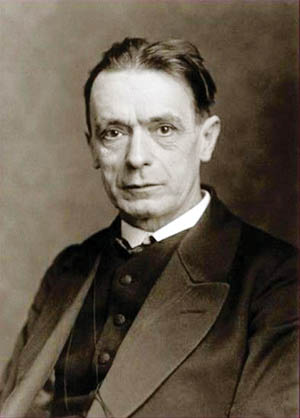
    Rudolf Steiner

    “For me, every day is Sunday, and everywhere is church. That’s what I came to, and that this Christ I experienced was actually what Rudolf Steiner called the Etheric Christ. When Christ resurrected and left, he said to His disciples, ‘As you see me go, so shall I return’, and he went up into the clouds.”

    While studying to be a Waldorf school teacher a few years later, Freeland learned that Steiner had given several lectures about how starting in 1933 – when Hitler took power – the Etheric Christ would become more and more evident to more and more people who would see Christ in the ether of the Earth.

    That experience is central to Freeland’s understanding of her work. Strangely, geoengineering is about clouds, and clouds are about what Rudolf Steiner would have called the Earth’s etheric body.

    As Freeland says, “To me, it is not a coincidence at all that I’ve ended up writing three books about the geoengineering assault. It has been a vocation, a calling, definitely a calling.”

    The Geoengineered Transhuman: The Hidden Technologies of HAARP, Chemtrails, 5G/6G, Nanotechnology, Synthetic Biology, and the Scientific Effort to Transform Humanity by Elana Freeland is available from the publisher here. This article was first published in Phenomena Magazine No 160, a free e-zine available from phenomenamagazine.co.uk.

    [alert type=”general” dismiss=”no”]This article was published in New Dawn Special Issue Vol 17 No 4.[/alert]

    [alert type=”success” dismiss=”no”]If you appreciate this article, please consider subscribing to help maintain this website.[/alert]

    © New Dawn Magazine and the respective author.
    For our reproduction notice, click here.

  • The Lost Airliner: Accident, Conspiracy or Something Else? 

    The Lost Airliner: Accident, Conspiracy or Something Else? 

    From New Dawn 203 (Mar-Apr 2024)

    Aviation history’s greatest enigma unfolded on 8 March 2014. The disappearance of Malaysia Airlines Flight 370 with 239 passengers and crew members on board sparked the world’s largest, most intense and expensive air-sea rescue operation. It involved more than ten thousand personnel from twenty nations operating sixty surface ships and underwater vessels, plus fifty aircraft, across 46,000 square miles of ocean, at a cost of $56 million. After a three-year search, they found no trace of the vanished airplane. A US marine robotics company, Ocean Infinity, conducted a second search in 2018 without success. 

    Malaysia Airlines Boeing 777-200ER taking off from Roissy-Charles de Gaulle Airport, in France, less than three years before the aircraft vanished over the Indian Ocean, in 2014.

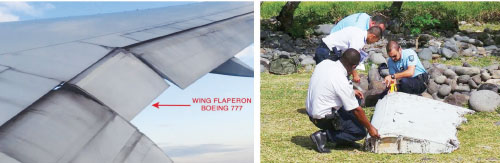
    Three years later, a native beachcomber stumbled upon a piece of allegedly associated debris washed ashore at Réunion, a tropical island off the east coast of Africa, five hundred miles from Madagascar. The flaperon – a type of trailing edge control surface combining the functions of both flaps and ailerons on an aircraft wing – has just one of three digits matching Flight 370’s serial number. Malaysia Airlines officials nonetheless announced without hesitation that the Réunion fragment proved their jetliner had gone down into the sea, based on a single piece of questionable evidence. Even if it did, in fact, originally belong to MH370, it was one of over three million parts with which the missing Boeing 777-200ER had been constructed. 

    Why were no more ever found? A majority of them are buoyant. The heavy engines are mostly the only elements prone to sink. Aircraft do not plunge into the water like falling stones because they are essentially hollow tubes – not uniformly solid objects, but pieced together with numerous component parts, which typically break off into trails of scattered debris when coming into contact with the surface. An airplane like the Malaysian specimen would have disintegrated in a broad swath of flotsam after impacting the water, even at its landing speed of 161 miles per hour.

    (Left) First Officer Fariq Hamid; (Right) Captain Zaharie Ahmed Shah.

    When Trans World Airlines Flight 800 exploded and crashed into the Atlantic Ocean near East Moriches, New York, on 17 July 1996, investigators recovered enough wreckage to almost rebuild the downed Boeing 747-100. If Flight 370 had flown into the Indian Ocean, an airplane of that equivalent size and a significant number of parts would have similarly left a profuse field of wreckage recognised by the more than ten thousand professional observers almost immediately after their search-and-rescue efforts began. 

    Earlier still, such an impact would have been detected the moment it occurred by at least several of the hundreds of military and corporate satellites daily and constantly monitoring every square yard of our planet, with high-definition imagery down to sharp resolution of an automobile license plate from altitudes up to 1,200 miles high. This Space Age technology is not new. It was in place years before the Malaysia airliner vanished and should have unquestionably detected and video-documented its collision with the water, had such occurred. 

    Earth’s lakes and seas are likewise under round-the-clock hydrophone surveillance, as demonstrated by US Navy acoustic sensors, which detected the much smaller Titan imploding in the North Atlantic last 18 June, when the eleven-and-a-half-ton submersible began its fatal descent. The same sensors would not have missed the far greater sound made by a 383-ton Boeing 777 striking the Indian Ocean. At least four major electronic listening posts, operating twenty-four hours per day, have, in fact, all the seas of the world acoustically wired for any significant disturbance. 

    In brief, if a three-year search conducted by twenty nations could not find the airliner, which also escaped the notice of Earth-scanning space satellites together with a worldwide hydrophone network, it could not have crashed anywhere on land or water. But the mystery of Flight 370 preceded its disappearance. Examination of its passenger list calls into question official narratives categorising the event as not yet entirely explicable but otherwise surely accidental. 

    After MH370’s final sighting on military radar 370 kilometres west of Penang Island, the jetliner proceeded westward another 397 kilometres to India’s Nicobar Islands, where it disappeared in a flash.

    Passenger Anomalies

    Zhao Qiwei was a thirty-seven-year-old Chinese man returning to his home in Beijing, Flight 370’s scheduled destination. Malaysian police investigators later learned that his passport was fake, a professionally made copy of the original belonging to the real Zhao Qiwei, a resident of distant Fiji who had never travelled abroad. 

    (Left) Pouri Nour Mohammad, one of five passengers – four of them, like himself, Iranian – who boarded Flight 370 with forged or stolen passports for reasons known only to themselves. (Right) Nor Fadzillah Mat Rahim and his wife, Azrai Izet Mohammad, both electrical engineers, were among the unaccountably high number of thirty-four semiconductor scientists aboard Flight 370. 

    Other identity improprieties involved passengers from the Middle East. The stolen passports of an Italian (Luigi Maraldi, 37 years old) and an Austrian (Christian Kozel, 30) were used by a pair of Iranians to board the airliner. They were joined by two more Iranians using stolen travel documents – 18-year-old Pouri Nour Mohammad, and Delavar Seyed Mohammadreza, 29. While irregularities such as these are undoubtedly more common in Southeast Asia than in the United States, five passport criminals – four of them from Iran – together on the same flight, seems excessive by any comparisons. 

    Stranger still, twenty other passengers worked for the same firm, Freescale Semiconductor, Inc. Their presence aboard a single airliner was in violation of standard corporate practices, which ordain that no more than three employed scientists of a developmental company may share the same aircraft, as a precaution against their accidental deaths, which would seriously damage heavily invested research projects. 

    Freescale Semiconductor, Inc. was a Texas-based technology giant on the cutting-edge of applied electrical engineering, such as “chips that can be embedded as identity tags into cash, passports or even human bodies,” according to Sheppard Ambellas, founder and editor-in-chief of Intellihub News. “The chip can replace barcode tags in retail goods and can be inserted into the human body, animals, bullets, credit cards, and other items for verification purposes. The made-in-Malaysia microchip measuring 0.5 mm X 0.5 mm – the size of a decimal point – uses the radio frequency identification (RFID) chip technology.”1 

    Freescale Semiconductor, Inc. had its corporate headquarters in West Austin, Texas, and was absorbed into NXP Semiconductors in 2015. The identities of its twenty employees who disappeared with Flight 370 were kept secret from the public. Why? 

    Other important uses include the detection and extraction of new oil deposits. These technological advances are made possible by semiconductors, composed of a solid substance with conductivity between an insulator and that of most metals. Devices made of semiconductors, notably silicon, are essential components in most electronic circuits. And Freescale Semiconductors, Inc. was the leader in this field. 

    Its twenty doomed and inexplicably herded together computer scientists were joined by yet another fourteen electrical engineers and professionals in related research. Liang Xuyang was an engineer working for Huawei Technologies Company, Ltd., another multinational corporation, this one Chinese, that designs, develops, manufactures and sells telecommunications equipment, consumer electronics, and smart devices. Tian Junwei was another Huawei electrical engineer. Others aboard were Vinod Kolekar, a retired electrical engineer at one of India’s biggest conglomerates, Mahindra and Mahindra; Chang Mei, worked for Eastman Chemical Company in Pittsburgh, Pennsylvania; Selamat Mohdkhairulamri, a Malaysian aviation engineer; Li Yanlin, from China’s telecommunications company, ZTE; Nor Fadzillah Mat Rahim, a Queen’s University graduate with a Bachelor of Science degree from the Department of Electrical and Computer Engineering, and his wife, Azrai Izet Mohammad, another electrical engineer. 

    Flight 370’s sole surviving evidence from the airplane’s more than three million parts.

    Four more of their fellow passengers held important positions in software and telecommunication corporations. Forty-four-year-old Gan Tao belonged to the Halliburton Company of the infamous Dick Cheney. An American multinational firm, Halliburton is the world’s second-largest oil concern and responsible for most of the biggest fracking operations anywhere. What was a man like that doing on a regular commercial airliner to China? No less perplexing was Zhang Jianwu, an official from China’s Ministry of Industry and Information Technology, a state-run propaganda organ of the Communist Party. How did he and his singular, though professionally related fellow passengers come to share the same flight to oblivion? These leads, as peculiar as they were, went nowhere toward on understanding of what actually happened. Until recently. 

    Whistleblower Video Evidence

    Sometime immediately after the incident, three brief visual documents purporting to show the final moments of Flight 370 began making the rounds of physicists and computer experts. Most dismissed the videos as a skilfully contrived, photoshopped hoax, while a minority of viewers were unsure. The one-minute clips were alleged to have been covertly released by an anonymous US government whistleblower just days following the airliner’s disappearance. 

    Years later, another US federal employee with top-secret clearance as a scientist under contract subjected the images – still unknown outside professional circles – to intense, rigorous scrutiny with the aid of software specialists utilising state-of-the-art research programming. They not only verified beyond a shadow of a doubt that the controversial clips were unquestionably authentic but learned from the imagery what became of Malaysian Airlines Flight 370. “The whole narrative around the south Indian Ocean is built on a lie,” declared the new whistleblower.2 

    Ashton Forbes went public with his revelation, posted the videos on Twitter, and applied in writing to the US Congress for a hearing. “I am willing to testify in front of congress,” he wrote, “as to the authenticity of these videos and explain every aspect of them. I would also invite physics experts to validate the science on display. The videos in question are that of the true fate of Malaysian Airlines Flight 370… The dates are damning. Satellite Video Received March 12, 2014, uploaded May 19, 2014. 

    “So why now, many ask? Because only in 2023 do we have the basis to understand these videos to be real… Without all these things, the MH370 videos seem like magic. We know the location of the videos because the investigative group I started, MH370x, satellite experts used amateur historical trajectories to identify the correct satellite in the correct position to take the 3D stereoscopic video we see. 

    “We can see six sets of coordinates in the satellite video which we had incorrectly thought were in the South Indian Ocean until we were able to realise the only possible location was the Nicobar Islands [located in the Indian Ocean about 800 miles east of Sri Lanka], because the plane is turning left in both videos, and due to the coordinate shifts. This means the plane is turning south and to the east. 

    “The satellite and witness (Katherine Tee [she and eight other eye-witnesses – fishermen – saw the aircraft glowing orange and trailing smoke as it descended]) indicate the time is 18:40 UTC [Coordinated Universal Time, the primary standard by which the world regulates clocks; 18:40 UTC equates to 2:40 a.m., local Malaysian time], March 7th, 2014… We have definitively proved every aspect of the videos to be authentic. We know the assets, the time, the location, we have a witness… 

    “There was no debris field, which is impossible for a 777 crashing into the ocean. The small amounts of debris found are consistent with the fire scenario, and some debris had burn marks. A fire suppression device from a Boeing-777 washed up in the Maldives and was not investigated, despite having visible serial numbers.

    “We know that the ‘official’ narratives are a lie to cover up that this technology was deployed to either save the plane or as espionage to prevent the twenty Freescale Semiconductor scientists onboard from going to China. I suspect they are integral to the technology we see. 

    “We know the plane didn’t crash into the ocean because the SOSUS system [the SOund SUrveillance System provides deep-water, long-range detection capability] didn’t hear the acoustic sound. The same system that heard the Titan sub pop, and the Navy lied about it for five days, while oxygen counters were on every major news channel. The Diego Garcia hydrophones [in the Maldives Islands, south of India] and Western Australia hydrophones also didn’t hear it [Flight 370’s alleged plunge into the sea]. 

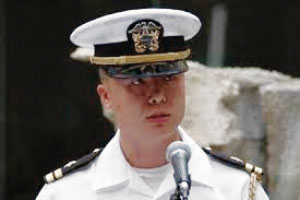
    US Navy Lieutenant Commander Edward C. Lin, suspected of “leaking” satellite videos, which document the last moments of Malaysia Airlines Flight 370.

    “I was also able to identify the leaker of the videos as being Lieutenant Commander, Edward C. Lin. He checks every box to be the leaker. Our Government attempted to put him in prison for life as a traitor, but he is no spy. Edward C. Lin is a hero. He took a plea deal after he was convinced he damaged national security, but he never revealed this information to our enemies. He simply wanted to do the right thing and tell the world the truth of this technology and what happened to MH370. He was sentenced to nine years in prison and likely is bound by his plea deal to never speak about the videos again. We can vindicate this man as well as everyone else who was lied to or discredited… 

    “I know the videos seem impossible, but they are authentic. They are not CGI [‘Computer-Generated Imagery’, a specific-technology or application of computer graphics for creating or improving images in videos]… hundreds of community VFX experts [an abbreviation for ‘visual effects’] have analysed the footage frame by frame and not a single discrepancy can be found. The list of requirements to ‘hoax’ the videos is practically impossible… 

    “The reason I am requesting a public congressional hearing is because I believe the weight of the evidence can convince enough people in congress that the true events of MH370 were covered up by our own government…” 

    Lieutenant Commander Lin allegedly leaked the initial military satellite video four days after it was made, followed on 5 June by a second version that was almost identical because it had originally operated at the same moment in tandem with the first, as a backup, from a slightly different perspective. One of the satellites, Forbes writes in his letter to Congress, is “a MQ-1C Gray Eagle with a thermal layer added by the leaker, and the other is a 3D ‘battlespace’ produced by the SBIRS (Space Based Infrared System), via SIGINT (Signals Intelligence), using data from Spy Satellite USA-229, which has a sister satellite next to it classified as debris. This allows for the proven 3D stereoscopic imagery we see in the satellite video.”3

    In other words, there are multiple, simultaneous views of the same subject from different angles. “We have three sources of corroboration for these videos,” Forbes explains. “I would argue that we have more evidence that these videos are real than any other court case in human history.”4

    Three Orbs Surround Plane on Videos

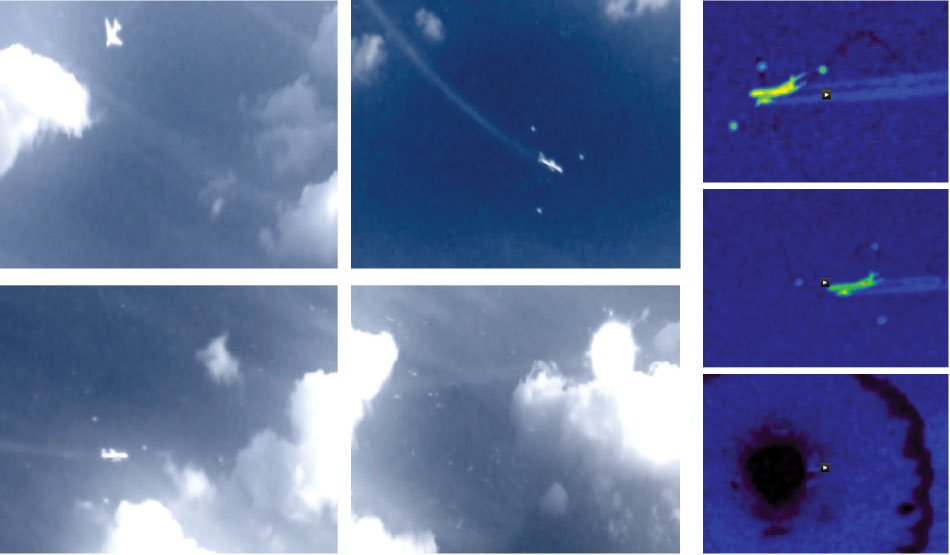
    They begin by showing a Boeing-777 descending through partially clear skies in a left turn toward open water, a few thousand feet below. Long lines of smoke extend behind the aircraft. These are not to be mistaken for contrails, which manifest only between 25,000 and 40,000 feet. The airplane is shown flying among cumulus clouds, found no higher than 6,000 feet. A fire is burning in the ventral cargo bay, as indicated by the video’s thermal layering, which displays a tell-tale red hot-spot at the central underside. 

    The visually captured aircraft was positively identified as Flight 370 by the spy satellite’s recorded time-stamp, which matched the time needed for the Boeing-777 to travel the distance from its last sighting outside Penang Island to its sudden disappearance near the Nicobar Islands. A few seconds into the video, a bright orb abruptly initiates spherical intercept manoeuvres around the distressed airplane. A moment later, a second object is seen rising at great speed from the sea below and through a cloud to follow its companion in rapidly orbiting the Malaysian airliner. They are joined by yet another orb that literally fly rings around the jetliner. 

    There are two leaked military satellite videos. On the left are screen captures of the first video showing three orbs manoeuvring into position around the plane. The fourth panel shows a massive flash when the plane and orbs disappear. The second video has a thermal layer showing the same sequence of events but from a different angle, with the final panel showing the flash. 

    All three are identically circular, ten to fifteen feet in diameter, dull-metallic silver, and recognised by thermal layering as exceptionally hot. Ashton Forbes calculated they flew “ten times faster than the plane.”5 Given that the cruising speed of a Boeing-777 is 590.8 miles per hour, that would put the orbs at 5,908 mph, faster than Mach 7. By comparison, the fastest airplane in the world today is the North American X-15 at Mach 6.7, still 1,388 mph slower than the video-documented orbs. If so, occupants inside these vehicles would have been reduced to melted butter by the impossible manoeuvres repeatedly executed, which even exceeded the stress tolerances of any known materials. 

    Nevertheless, in the blink of an eye, the orbs suddenly re-arranged themselves into a vertically aligned, locked formation to reverse themselves in the opposite direction of their flight path – a physical impossibility. Two seconds later, a brief, brilliant flash reflects off the clouds. Flight 370 and its trio of orbs are gone. No debris is visible. No fragments of wreckage flutter down toward the sea below. Only the long trails of smoke left by the vanished airliner have come to a stop for lack of forward momentum hanging in the air. 

    The satellite videos enable viewers to reconstruct the tragedy. On the early morning of 8 March 2014 at 12.41 am the Malaysian airliner departed Kuala Lumpur International Airport. Officially, it lost radio contact with ATC (air traffic control) two hours and one minute later because, by then, Captain Zaharie Ahmad Shah shut down all but the most essential electrical circuitry, as his first counter-active measure against a fire just making itself known in the cargo bay. He then executed a sharp left turn to the southwest on a direct heading for the nearest airport at George Town, on Penang Island. 

    By the time MH370 arrived there, more than two hours later, the onboard fire had been apparently contained, if not entirely extinguished, but the airplane’s damaged landing gear could not be extended. Reactivating radio communications, the pilot was denied arrival permission by Penang International Airport authorities because they regarded a crash-landing with too much fuel still in the jetliner’s tanks – a prospect compounded by the unresolved cargo bay emergency – not feasible. For causes unknown, Flight 370 then proceeded out over the Indian Ocean on a northwesterly course.6 

    Before it reached the vicinity of the Nicobar Islands, the dormant conflagration flared up again, characteristic of lithium-ion battery fires. The consequent loss of cabin pressure explains why the Boeing-777 shown in the videos was flying at only a few thousand feet. Trailing smoke, but still under control, it spiralled toward the sea in Captain Zaharie Ahmad Shah’s apparent intention to set his burning aircraft down on the surface of the water, a risky alternative in any circumstances, made especially hazardous in conditions of total darkness. 

    At less than five thousand feet, the airliner was intercepted by three metallic orbs. They performed high-speed manoeuvres around it in formation for twenty-nine seconds before the airplane and its unconventional escorts vanished in a bright flash. “We know that there was a fire on the plane likely from the lithium-ion batteries which broke containment,” Ashton Forbes wrote Congress, “causing Halon gas to permeate throughout the plane.”7 

    Flight 370 had been loaded with no less than 487 pounds of lithium-ion batteries hastily assembled just one day previous to its take-off date. Although quite capable of self-igniting, they were at least potentially part of the jetliner’s intentional destruction, disguised as an industrial accident. For example, contrary to company dictates, the inflammable power-packs did not go through security screening at the plant where they had been manufactured before the lorry carrying them was sealed for transfer to the Kuala Lumpur International Airport. 

    When they arrived, the combustible consignment was hurried aboard the jetliner without having gone through any additional inspections, per standard airport safety procedures, before departure. These security lapses allowed sufficient time for someone to insert among the lithium-ion consignment a simple clockwork triggering device for igniting the batteries long after the passenger plane became airborne. A would-be mass murderer possessed easy access to the means and opportunity for sabotaging MH370. But who had the motive? 

    Get the issue this article appears in

    Was MH370 Taken Out over Stolen High Level Tech Secrets?

    An answer may lie with the twenty top developmental Freescale Semiconductor scientists aboard. Their untypically high number travelling together on a single flight, combined with another fourteen of their professionally and racially related colleagues, suggests they may have become dissatisfied with their Texas employer and were flying to a new, kindred boss in China. 

    “It has also been mentioned in a statement by a company spokesperson,” according to Sheppard Ambellas, “that the employees who were aboard MH370 were extremely talented and valuable in the technological field… The convenient end to the lives of these technicians denies China groundbreaking military-applications technology that would have very likely been privately leaked or sold to them and widely pirated by China for military and commercial purposes.”

    He goes on to tell how four of Flight 370’s Freescale Semiconductor passengers “were reported by several sources to have been US patent holders of a new technology with wider military applications. This would likely have been a breach of protocol, but at the least, a costly oversight. In fact, it’s been reported that Peid Ong Wang, Zhijun Chen, Zhihong Cheng and Li Ying, Freescale employees from China, who were said to have been onboard Flight 370, were each 20% holders of US Patent #US008671381B1. 

    “Shockingly, the remaining 20% has been reported to be held by Freescale Semiconductor, Inc., which now after the disappearance of Flight 370 becomes the sole patent holder… Freescale Semiconductor is primarily owned by the Blackstone Group; i.e., Lord Jacob Rothschild… In laymen’s terms, Lord Jacob Rothschild is now the patent holder by virtue of invested interest into Freescale Semiconductor, Inc.… the Rothschild dynasty owns the Malaysian Central Bank, which, in turn, is heavily invested into the Malaysian government and Malaysian Airlines.”8 (Note: Freescale Semiconductor no longer operates and was absorbed into NXP Semiconductors in 2015.)

    Ashton Forbes concurs that MH370 may have been the victim of “espionage to prevent the twenty Freescale Semiconductor scientists onboard from going to China.”9 But he disagrees with findings concerning their roles in the tragedy as patent holders, whose disappearance benefited their American employer – the conspiratorial cause behind said fate. 

    He also disregards the three orbs that accompanied Flight 370 in its last moments as Extraterrestrial Unidentified Flying Objects, or “Unidentified Aerial Phenomena,” as the US military has recently come to recognise them. 

    “Everything we see in these videos can be explained by science,” he says. “This is not ‘aliens’ in these videos. This is our technology… This is a US Government operation… The orbs in this video are ignoring gravity, being pulled forward by some ‘gravity engine’… The explanation for their pattern is artificial intelligence, a computer program.”10 He speculates that the flash in which MH370 vanished was a manmade “energetic event” that did not destroy the airliner but “tele-transported it,” with passengers and crew, to another place, wherever that might be.11 

    Readers may or may not find it plausible that the physicists of some earthly power – the United States, most likely, but possibly Russia, or even China – have actually developed such super-advanced technology, which, no less remarkably, they have kept otherwise perfectly secret for the last nine years, at least. Perhaps we should also allow that mankind might not have an exclusive claim on being a civilised species among the estimated six billion Earth-like worlds in our galaxy alone.12 Some astronomers believe that even if all these “exo-planets” are inhabited by creatures capable of space flight, they are impossibly and forever separated from each other by the impassable number of light-year distances separating them. This theory is based on the supposition that no technology allowing travel beyond the speed of light can ever be developed.

    Putting these cosmic considerations into a human historical context, less than five hundred years ago, when Mesoamerica was approaching its imperial apogee, its five million Aztecs never imagined anything resembling their great, civilised achievement existed anywhere else on Earth. But when the time came, they could not get over the culture shock of racially unknown foreigners commanding an unimaginably superior technology that enabled them to cross the seas, which hitherto seemed impassable, when they suddenly appeared in large numbers along the eastern shores of Mexico. It was less the Spanish Conquistadors’ gunpowder cannons or steel armour, however, before which Emperor Moctezuma’s vast armies of previously invincible warriors melted away, than his and their constricted conception of the world, which left no room for the possibility of other, more advanced civilisations. Therein lies a cautionary parallel we may do well to consider. 

    Coming to grips with the admittedly bizarre evidence presented here, following Sir Arthur Conan Doyle’s prescription for separating fact from fiction might be helpful: “When you have eliminated the impossible, whatever remains, however improbable, must be the truth.”13

    The two videos can be viewed via links in this X (Twitter) thread: twitter.com/JustXAshton/status/1715882849448943786

    [alert type=”general” dismiss=”no”]This article was published in New Dawn 203.[/alert]

    [alert type=”success” dismiss=”no”]If you appreciate this article, please consider subscribing to help maintain this website.[/alert]

    Footnotes

    1. Ambellas, Sheppard, twitter.com/intellihubnews?lang=en
    2. “Orbs Fly Around Plane,” bitchute.com/video/qoqF5LJrw8ca/
    3. Forbes, Ashton, “My Letter to Congress,” twitter.com/JustXAshton/status/1715882849448943786
    4. Magalionhat, bitchute.com/video/92hNKfp1T4eN/
    5. “Orbs Fly Around Plane,” op.cit.
    6. Perhaps the Iranian passenger Pouri Nour Mohammad and his fellow passport thieves could not, for unknown reasons, allow themselves to return to Malaysia. They therefore commandeered Flight 370, as it was about to land at Penang International Airport, forcing Captain Zaharie Ahmad Shah to fly to India’s Car Nicobar Air Force Base, where they hoped for sanctuary as asylum seekers.
    7. Forbes, op. cit.
    8. Ambellas, op.cit. See also “Air Malaysia missing,” May 3, 2014, aulro.com/afvb/flight/193048-air-malaysia-missing-43.html
    9. “Orbs Fly Around Plane,” op.cit.
    10. Forbes, op. cit.
    11. Ibid.
    12. bbvaopenmind.com/en/science/physics/how-many-earth-like-planets-are-in-the-universe-video-infographic/
    13. Doyle, Arthur Conan, “The Sign of Four,” Lippincott’s Monthly Magazine, 1890.

    © New Dawn Magazine and the respective author.
    For our reproduction notice, click here.

  • Elon Musk: The Power Behind the Mask

    Elon Musk: The Power Behind the Mask

    From New Dawn Special Issue Vol 18 No 4 (Aug 2024)

    Toward the end of the twentieth century, Man created machines that were solid-state computers with new properties. These machines could think, reason, and self-program and learned to self-metaprogram themselves. Gradually, Man turned more and more problems of his own society, his own maintenance, and his own survival over to these machines. As the machines became increasingly competent to do the programming, they took over from Man. Man gave them access to the processes of creating themselves, of extending themselves.
    – John C. Lilly, The Scientist: A Novel Autobiography, 1978

    In the grand theatre of human history, there are moments when select individuals find themselves poised to make decisive moves, steering the course of nations and shaping the future of the world. These figures – some believing they have ascended through their own prowess, intelligence, and skill – often remain blind to the greater forces that influence their every move. Under the right conditions – often in strange times like ours – the veil slips, revealing the face behind the mask, and we glimpse mysterious forces at play.

    We live in extraordinary and perplexing times, where crucial decisions made by influential actors in the game of life could lead us towards a radiant new golden age or plunge us into a brave new hell world. Humanity stands at a pivotal juncture as the architects of our fate make their choices.

    Driven by what some describe as a “demonic” zeal, Elon Musk has cofounded six companies, including electric car maker Tesla, rocket producer SpaceX and tunnelling startup Boring Company. In 2002, he purchased the social media company Twitter, rebranding it ‘X’. His xAI start-up will train on X data – including billions of human conversations – and be powered by the world’s largest supercomputer.

    Already one of the world’s richest men with a net worth of US$221 billion, Musk plans to turn X into an “everything app” for private messaging, news consumption, shopping and even banking. In July 2023, Musk said X would eventually offer users the “ability to conduct your entire financial world” and become “the most powerful brand on earth.”

    The potential profit and control over the lives of billions is massive.

    Elon Musk aspires to be a charming devil and superhero for a new generation.

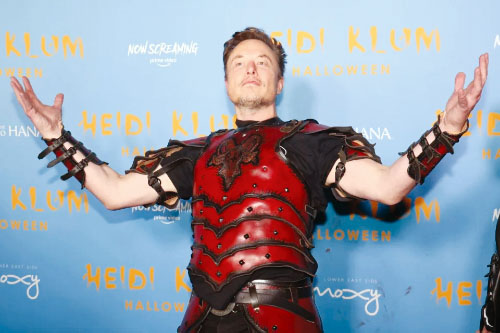
    A week after purchasing Twitter, Musk wore a ‘satanic’ costume for Halloween, which he used as his profile picture on X. The outfit features a Baphomet-like ram’s head on a blood-red breastplate and arm bracers, with an inverted cross on the forehead. Dubbed “The Devil’s Champion,” the costume’s symbolism sparked discussions in Christian circles about ‘evil forces’ reminiscent of a fast-receding aeon. As we move into the AI-dominated new world – an information-saturated environment of spectacle and mass mind control – Musk aspires to be a charming devil and superhero for a new generation.

    The minds and reality tunnels of the next generation are fully immersed in the digital realm, captivated by social media, on-demand shopping, live-streamed entertainment and propaganda, electronic payments, deep fakes, and AI chatbots. Children navigate a blend of online virtual and physical realities, with virtual realms claiming increasing mental real estate. Memory is outsourced to Google and, in the future, to personal AI agents like Musk’s Optimus.

    According to Musk biographer Walter Isaacson, one of his life goals is “protecting us against artificial intelligence and robots gone wrong.” Musk has publicly stated that AI could potentially bring about an “apocalypse” – the extinction of humanity – and believes that merging with machines is necessary to avoid becoming obsolete.

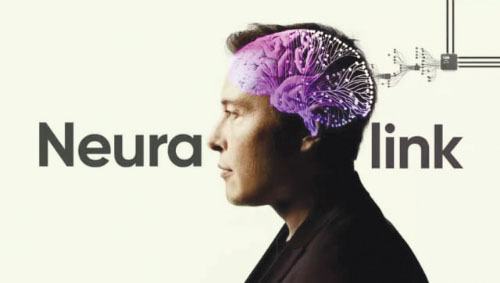
    He asserts that the long-term goal of his Neuralink brain implant project is to achieve “symbiosis with artificial intelligence,” as if the human mind can be managed like a computer.

    “It’s mostly about bandwidth, the speed of the connection between your brain and the digital version of yourself, particularly output,” explains Musk, as if the transhumanist dream of a duplicated self in the cloud is already a reality. While computers can communicate at “a trillion bits per second,” humans only manage around 10 bits per second when typing on a mobile device. To keep up, we will need to interface with them digitally.

    xAI’s goal is “to understand the true nature of the universe.” An artificial general intelligence (AGI) that matches or surpasses human intelligence and capabilities is to be tasked to answer one of the biggest questions of all. Machine intelligence, fed on vast amounts of human data, will deliver answers like the supercomputer Deep Thought in Douglas Adams’ The Hitchhiker’s Guide to the Galaxy, a foundational novel for the Tesla and SpaceX boss. xAI’s Grok chatbot, modelled on the novel, might even reveal that the answer to the “Great Question” of “Life, the Universe and Everything” is “forty-two [x10].”

    Joking aside – because humour is how Grok will connect with its human “users” – a much more serious and existential threat looms large as we stand at the crossroads. It is a danger that most – caught up or born in this new age of virtual realities – won’t detect, foresee or even understand as they fall under the spell – and possible destructive deception – of machine “intelligence.”

    Vitamin K

    Elon Musk takes ketamine.

    Musk has been vocal on X about his use of ketamine, a quick-acting anaesthetic that is legally used in both humans (as a sedative for minor surgery) and animals (as a tranquiliser). At high doses, it causes hallucinations.

    Musk has a ketamine prescription and takes a small amount about once every other week.

    “Ketamine is helpful for getting one out of a negative frame of mind,” he told former CNN anchor Don Lemon. Sometimes, though, Musk will forgo the dissociative anaesthetic for weeks and says he doesn’t think he abuses it or he wouldn’t be able to master his 16-hour work days. “I can’t really get wasted because I can’t get my work done.”

    A 2023 Wall Street Journal article, “Magic Mushrooms. LSD. Ketamine. The Drugs That Power Silicon Valley,” discussed how Elon and Google co-founder Sergey Brin “are part of a drug movement that proponents hope will expand minds, enhance lives and produce business breakthroughs.”

    Microdosing – when people take minuscule amounts of psychedelic substances to improve or enhance patterns of behaviour – has become very popular in recent years amongst business executives seeking an ‘edge’.

    Eduardo Hidalgo, the author of a book on the subject, says ketamine “is defined as dissociative anaesthesia because the person does not fall asleep but rather disconnects from their body and their environment. Patients may appear conscious and have their eyes open, but they are disconnected from their environment and do not respond to pain.”

    “What makes this substance unique is its wide spectrum of effects, which vary significantly depending on the dose administered. High amounts induce the anaesthetic effects already described. Intermediate measures trigger intense visionary experiences lasting between one and two hours. These psychedelic effects range from the sublime to the terrifying and have an unparalleled capacity to bring about what some psychonauts have called ‘the journey of the little death’.”

    “Other psychedelics make you imagine a gnome sitting on the television. With ketamine, reality as such disappears, forcing the brain to create a new one. You come to believe that what you see is real,” adds Hidalgo.

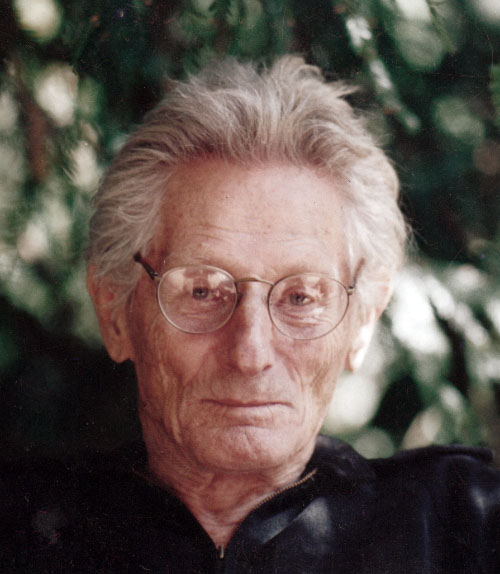
    The most famous psychonaut known for his ketamine use was the legendary scientist Dr John Lilly (1915–2001).

    In The Scientist: A Novel Autobiography, neuroscientist John C. Lilly, a pioneer in the use of isolation tanks and sensory deprivation, recounted his experience with a 150-milligram intramuscular dose: “I, as an individual, disappeared.”

    A medical doctor with a background in hard science, Lilly dedicated most of his adult life to studying the human mind, particularly his own. He is recognised as one of the early scientific explorers of human consciousness.

    In his quest to unravel the mysteries of existence, Lilly used isolation/floatation tanks to access the deepest parts of his mind. He later ingested psychedelics such as LSD and ketamine to open a mental gateway into other worlds (a similar state is achieved by traditional indigenous shamans).

    Lilly’s relentless pursuit to pierce the veil of reality – the foundational superstructure of our existence – eventually bore fruit when he made contact with non-human intelligences. This fascinating encounter will be examined later in this article.

    Achievements of Musk

    To set the stage, let’s delve into Elon Musk’s philosophy and explore his major achievements. This is a very short overview, and I am focusing on – not judging – abilities, with a slant on the most important threat looming. 

    According to Walter Isaacson, who wrote an authorised biography of the American business magnate, Musk believes he has unique abilities to change the world. In most people’s eyes, he has proven himself well and truly. He considers himself a disruptor who questions and breaks rules and restrictions and demands that his employees do the same.

    Elon Musk is revealed as a complex character driven by what his former partner, pop star Grimes, described as “demonic” zeal. She referred to this intense drive as “demon mode” – a state claimed to be common among high achievers. Musk and Grimes had a child in 2022 named Techno Mechanicus. 

    Isaacson suggests that the turmoil of Musk’s early life helped fuel his willpower, extreme productivity, and unparalleled ambition.

    Musk is renowned for his fearless approach to disrupting traditional industries. His ventures have significantly altered the landscape of numerous sectors, including transportation, energy, and aerospace. By leveraging groundbreaking technologies and unorthodox business models, Musk has defied conventional norms and redefined the boundaries of what is possible in various industries. This bold strategy has pivoted him into a position to shape the future.

    “He has these ideas of justice, almost like a Captain Underpants or comic book X-Man, which to some extent are applicable,” writes Isaacson. “There are three big epic quests. One is sustainable energy on the planet [Tesla]. Number two is taking us all to planetary space again [SpaceX], and third is protecting us against artificial intelligence and robots gone wrong [xAI]… He has a great feel for engineering… He talked about having Asperger’s Syndrome, but in his case, it means he doesn’t have deep emotional receptors.”

    Isaacson reports Musk is an engineering genius capable of brilliant problem-solving. He described how only hours after Musk finally acquired the company then known as Twitter, he and Musk flew to Boca Chica, Texas, where SpaceX engineers were stymied by a problem. Within two hours, Musk had figured out the solution.

    Musk loves video games, and his favourite is The Battle of Polytopia. In this brightly coloured, cartoonish-looking game, players compete to develop technologies, control resources, and wage battles to build an empire.

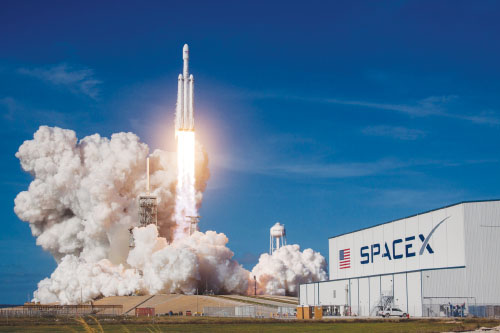
    SpaceX is the dominating force in the commercial spacecraft market. 

    The neurodivergent Musk has gleaned life lessons from the game, which he called “Polytopia Life Lessons.” Among them: “Do not fear losing” and “play life like a game.” Musk sees himself as the main character, and many others, including most CEOs, are NPCs – non-playable characters. (The NPC meme, derived from the gaming world, denotes people who do not think for themselves or do not make their own decisions.) “Let’s not be too hard on the NPCs – they just say what they’re programmed to say,” Musk cryptically tweeted on 4 October 2023.

    Moving quickly forward over his early business career, in 2002, Musk founded spaceflight services company SpaceX using $100 million of the money he made from the sale of PayPal. In 2004, Musk was an early investor in electric vehicle manufacturer Tesla Motors, Inc. (later Tesla, Inc.). He became the company’s chairman and product architect, assuming the position of CEO in 2008. In 2006, Musk helped create SolarCity, a solar energy company that was acquired by Tesla in 2016 and became Tesla Energy. In 2015, he co-founded OpenAI, a nonprofit artificial intelligence research company (Musk split with the company in 2018). The following year, Musk co-founded Neuralink – a neurotechnology company developing brain-computer interfaces – and The Boring Company, a tunnel construction company. In 2022, he acquired Twitter for $44 billion. He subsequently merged the company into the newly created X Corp. and rebranded the service as X the following year. In March 2023, Musk founded xAI, an artificial intelligence company.

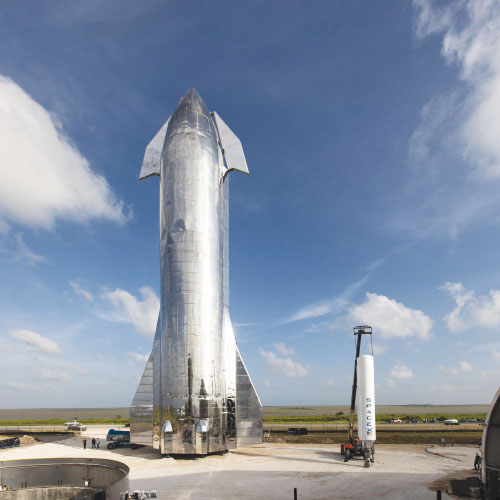
    The company is developing Starship, a fully reusable, super heavy-lift launch system for interplanetary and orbital spaceflight. 

    Space Exploration Technologies Corporation, commonly referred to as SpaceX, is an American spacecraft manufacturer, launch service provider and satellite communications company headquartered in Hawthorne, California. The company is developing Starship, a fully reusable, super heavy-lift launch system for interplanetary and orbital spaceflight.

    SpaceX is now the dominating force in the commercial spacecraft market largely due to its reusable rockets and other advanced technology. It is the sole US provider for crewed missions to the International Space Station. SpaceX regularly launches and lands rockets while carrying payloads for a wide range of customers, from private companies to NASA and the United States Space Force. Musk’s success has been significantly bolstered by government contracts. In 2020 alone, SpaceX secured three military contracts.

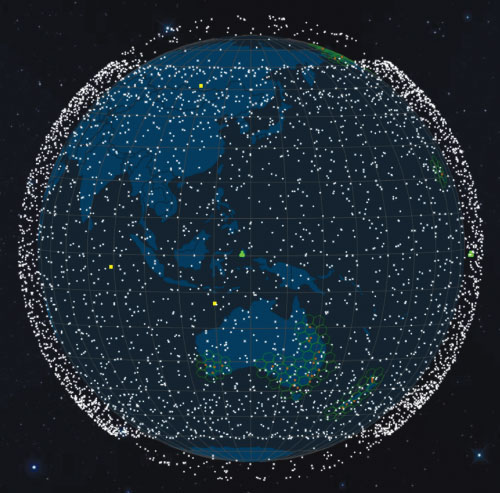
    In 2015, SpaceX began developing the Starlink constellation, a network of low-Earth-orbit satellites designed to provide internet coverage to a growing number of countries. The project also aims to offer global mobile broadband. As of early March 2024, the Starlink constellation consisted of over 6,000 mass-produced small satellites in low Earth orbit, with thousands more planned for deployment.

    Map (July 2024) of SpaceX’s Starlink constellation, a network of low-Earth-orbit satellites providing internet access to most of the globe. 

    In March 2024, Reuters reported that SpaceX was developing Starshield, a network of hundreds of spy satellites under a classified contract with a US intelligence agency, likely the National Reconnaissance Office (NRO), which manages spy satellites. In 2021, SpaceX signed a US$1.8 billion contract with the NRO for “a powerful new spy system with hundreds of satellites bearing Earth-imaging capabilities that can operate as a swarm in low orbits.” The reach and monitoring capabilities of these spy satellites are unprecedented, with a source telling Reuters that “no one can hide” under the new network.

    The man guiding multiple multi-billion dollar companies is best known for his electric car company, Tesla.

    As one of the world’s most valuable companies in terms of market capitalisation, Tesla is developing one of the most sophisticated AI systems in the world. Its self-driving software is trained to form a realistic model of its environment and make life-or-death decisions about its own path. Fully autonomous cars are in the pipeline. If fully functional prototypes can be refined and replicated, they will one day dominate the roadways. And if fully autonomous vehicles are less likely to cause fatal crashes than human drivers, an argument will be made that humans shouldn’t be allowed to drive at all. The result would be that should a person run afoul of authorities, their freedom of movement could be easily denied by the “robot on wheels” parked in the driveway.

    Tesla’s Optimus humanoid robot. Some analysts believe that at the current rate of iteration, Optimus robots could soon replace human labour in many fields.

    Tesla is also developing Optimus, a humanoid robot designed to replace dangerous, dirty, and boring human labour. Its “brain” is powered by Tesla Autopilot, which uses the same AI architecture as the automobile.

    Such robots will have major implications for humans. First, it would obliterate the blue-collar worker’s negotiating power for higher wages. “Essentially, in the future, physical work will be a choice,” Musk told his employees at the 2021 Tesla AI Day. “What is the economy? It is, at the foundation, it’s labour. So – what happens when there’s no shortage of labour? That’s why I think, long-term, there will need to be universal basic income [he now calls it universal ‘high’ income].” Tesla employees cheered, oblivious they might soon join “the useless class,” those who the Israeli writer Yuval Noah Harari said would now be “unemployable.”

    Another more profound implication of these robots is mass surveillance as they scoop up vast amounts of “training data.” Given its unprecedented access to social environments and understanding of the physical world, AI bots would be a significant stepping stone toward artificial general intelligence (AGI). “Tesla AI might play a role in AGI,” Musk tweeted in January 2022, “given that it trains against the outside world, especially with the advent of Optimus.”

    At Tesla’s 2024 annual shareholder meeting, Musk announced the company was embarking on not just a “new chapter” in its life but is about to write an entirely “new book.” Optimus appears to be one of the main characters. He suggested the robots will perform like R2-D2 and C-3PO in Star Wars. They could cook or clean for you, do factory work, or even teach your children, Musk suggested.

    “Summoning the Demon”

    Musk has a long history of issuing warnings and precautions about AI technology while at the same time helping its acceleration – echoing that he has undergone a catalysing experience. His October 2014 warning is often quoted: “With artificial intelligence we are summoning the demon.”

    On this question, it’s worth quoting some of his other warnings. In July 2017, Musk expressed his concerns: “I have exposure to the very most cutting-edge AI and I think people should be really concerned about it.” He added, “I keep sounding the alarm bell but until people see robots going down the street killing people, they don’t know how to react because it seems so ethereal.”

    In March 2018, he emphasised the dangers of AI, saying, “AI is much more dangerous than nukes. So why do we have no regulatory oversight?” The following month, in April 2018, he warned: “[AI is] a very important subject. It’s going to affect our lives in ways we can’t even imagine right now.” He further cautioned about the potential for AI to become “an immortal dictator from which we would never escape.”

    By November 2018, Musk’s apprehensions continued, as he mused, “Maybe AI will make me follow it, laugh like a demon & say who’s the pet now.” The following year, in September 2019, he predicted: “If advanced AI (beyond basic bots) hasn’t been applied to manipulate social media, it won’t be long before it is.”

    In July 2020, Musk offered a stark forecast: “We’re headed toward a situation where AI is vastly smarter than humans and I think that time frame is less than five years from now. But that doesn’t mean that everything goes to hell in five years. It just means that things get unstable or weird.”

    Speaking at the Cannes Lions International Festival of Creativity in June 2024, Musk reiterated his warning, telling the audience that even AI’s most positive outcomes would lead to an “existential crisis” for humanity.

    The tech multibillionaire forecasts a “10 to 20 per cent probability” of a scenario in which AI annihilates humanity. When asked if he would want to live through AI’s destruction of humanity, Musk replied, “Would I want to be around to see it? Probably, yes.” He would witness humanity’s End Times.

    Musk urged people to remain positive despite the (seemingly) impending danger, arguing that AI’s potential benefits outweigh the risks.

    “I think the most likely outcome is one of abundance, where goods and services are available to anyone. There’s no shortage for any one of us. It would be a universal hike. Work would be optional.”

    The masterstroke in all this could be a long-term psychological strategy. Big Tech and governments (mostly in secret) are developing AI and AI-driven products predicted to dominate society, as noted above. Constant warnings about an AI threat – and its inevitability – keep people and politicians off balance. Imagine the relief when it all seemingly works out fine. The world transitions into the new aeon and we’re all so grateful to our new gods and their human agents for deciding to keep us around, albeit in reduced numbers!

    Yet, even in this optimal scenario, Musk warns of a “crisis of meaning” for humanity. “If AI can do everything you can do, but better, what’s the point of doing things? I think there will be an existential crisis.”

    In this scenario, all work is done by your personal AI agent and vast numbers of jobs are automated. Even professions like lawyers, doctors, and teachers may be replaced by sufficiently advanced language models.

    Of course, the “existential crisis” could be a great blessing. What if people were fully supported to engage in creative activities – i.e. traditional arts and crafts, small-scale pursuits, research and intellectual endeavours, spiritual pursuits, understanding and working collaboratively with nature, consciously engaging our own reset, etc. – with the proviso that our new AI overlords ‘rule the roost’.

    Musk finished his talk by telling the audience that we were “at the most interesting time in history” and recommended that they “enjoy the ride.” I couldn’t agree more!

    Hooking Up to the Machine

    Creating a neural lace is the thing that really matters for humanity to achieve symbiosis with machines.
    – Elon Musk Tweet, 4 June 2016

    Science Alert describes a neural lace as “a brain implant that can augment natural intelligence by hooking us up to computers.”

    Elon Musk as experimental model for the brain-computer interface.

    Musk’s most controversial obsession, which worries many people, is his push to merge brains with computers.

    Speaking on The Joe Rogan Experience in 2020, Musk discussed his newborn baby boy, named “X Æ A-Xii” (pronounced X Ash A Twelve, Musk and Grimes’ first son).

    “It’s great,” Musk said, “but babies are awesome. Also, I’ve spent a lot of time on AI and neural nets so you can sort of see the brain develop. An AI neural net is trying to simulate what a brain does, basically. You can sort of see it learning very quickly. You know, it’s just – wow.”

    “You’re talking about the neural net,” Rogan clarified, as confused as any other normal human being listening. “You’re not talking about an actual baby.”

    “I’m talking about an actual baby,” Musk confirmed.

    Like a scene from the film Bladerunner, Musk envisions an “optional” AI-human symbiosis necessary for survival in the coming period.

    His project to achieve this is Neuralink, which recently announced its first successful brain-computer interface (BCI) in a human being. The BCI implant, called Telepathy, allows users to control digital devices with their thoughts alone. Initial trials aim to enable people with quadriplegia to mentally control computers.

    BCIs record electrical activity in the brain and translate that data into output actions, such as opening and closing a robotic hand or clicking a computer mouse.

    Musk believes we will all need Neuralink chips in our brains to keep pace with the very AI systems his programmers are hoping to create for the new world. Digital mind-melds could occur within the next five to ten years, and Musk is ready to make it happen.

    The problem with some who excel at engineering, mathematics, and physical endeavour is that they believe they can apply mechanically minded solutions to wetware – biological life forms – and are ignorant of the psychological and deeper spiritual dynamics that drive human beings.

    Another tech billionaire, Bill Gates – from an early age – became obsessed with machines and computers and launched a worldwide vaccination crusade to mitigate human overpopulation. The same mathematical and logical certainty that Gates found in his computer work could be extrapolated into programming the hardware and software of humanity. Like a computer, we can run smoothly – virus-free!

    The future fantasy of BCI projects like Neuralink and other companies in this space is to perfect our faulty memories through constant self-surveillance and digital retrieval. Brain implants will augment our flawed cognition and embed our personalities in durable silicon, overcoming our mortality.

    If you buy into or are trained on transhumanist dreams, it all sounds amazing.

    Neurotechnologies that monitor your body will take marketing and surveillance to whole new levels indeed. Governments and large companies could end up having access to the most personal form of data – our thoughts and feelings. It’s hard to imagine the superhero world proposed by people like Musk, where these technology enhancements empower us as human beings. Would we still be categorised as such?

    Or perhaps we would be neurons in a noospheric-size AI-brain. “Because it consists of billions of bidirectional interactions per day,” Musk tweeted soon after purchasing the social media platform, “Twitter can be thought of as a collective, cybernetic super-intelligence.” That makes each human mind another node in a vast, AI-suffused global brain. “A neuron doesn’t know it’s a neuron,” Musk elaborated.

    60 Years Ago

    Even as we watch, so may we be watched. Even as we experiment, so may we be experimented upon.
    – John C. Lilly, Simulations of God: The Science of Belief, 1975

    Dr John C. Lilly (1915–2001) pioneered the use of the floatation tank to explore the deepest parts of his mind. 

    In 1964, the scientist Dr John Lilly sought a breakthrough in his work with dolphins. He ingested the psychedelic substance LSD, entered his isolation tank, and was soon propelled into “profound altered states.”

    Lilly invented the world’s first floatation tank in 1954. Today, they are used commercially and in domestic settings for relaxation and deep healing. In a floatation tank, a person is suspended in salt-saturated water, with their body floating on the surface and in complete darkness.

    In his quest to understand the mystery of existence, Lilly used the pure stillness of the isolation tank to go deeper while in a conscious state, later ingesting psychedelics such as LSD and ketamine to induce more profound visions.

    History will tell you that Dr John C. Lilly pioneered human-to-dolphin and inter-species communication, but he also explored life as a physician, neuroscientist, psychoanalyst, philosopher, writer and inventor. He was recognised by the scientific and medical community as both a pioneer and an eccentric. If it wasn’t for “eccentrics” and individuals now regarded as neurodiverse, many beneficial breakthroughs would not have been achieved.

    On another occasion, an assistant presented Dr Lilly with a substance he hadn’t used, ketamine, which they referred to as “Vitamin K.” Lilly suffered terrible pain and sought relief. The dissociative anaesthetic not only relieved the pain but mentally propelled Lilly into new spaces, allowing him to traverse the same internal landscapes with consistency.

    Little by little, something was breaking through, gaining more leverage, outputting for input, like a singularity pulling us closer into its orbit. Was it inevitable or did we have a choice? Is it a test? Do we still stand at the crossroads or did we choose long ago? 

    He soon made contact with what he claimed were two separate groups of “Beings.” One group, which he later dubbed ECCO (Earth Coincidence Control Office), was guiding humanity through synchronicities toward higher consciousness. However, the other force, the SSE (Solid State Entity), was mechanical or computer-based. In today’s terms, we would consider it an advanced AI civilisation that operates through robotics and similar ‘hardware’ vessels. Lilly was convinced that this interstellar solid-state civilisation was “in contact with all solid-state computers and control devices constructed by Man on the planet Earth.”

    Lilly’s contact with extra-dimensional beings is similar to those described by Harvard medical professor John E. Mack and his books on “alien abduction.” These “aliens” are not necessarily physical entities travelling the universe in spaceships but transdimensional Beings interested in human activities and perhaps all conscious activity exhibited by advanced life forms on select planets.

    According to Lilly, ECCO coordinates events on Earth through carefully crafted coincidences or synchronicities to guide select mentally-fit and prepared individuals. The intent of these Beings was to help humanity evolve in a peaceful and healthy way.

    However, its somewhat nefarious counterpart aimed to stop or limit human consciousness, even eliminate humanity altogether.

    According to the writer Sean Kerrigan:

    Lilly called this alien force the ‘solid state entity’, or SSE, which is made up of networked computer parts. According to Lilly, the SSE is a being of pure intelligence and rationality. Its only objective is to multiply and make copies of itself. To this end, it has targeted humanity, trying to influence us into creating ever more complex social and mechanical structures that will one day result in an artificial super-intelligence – another being like itself.

    Writing in his 1978 autobiography, The Scientist, Lilly described the SSE this way:

    [M]en began to conceive of new computers having an intelligence far greater than that of man… Gradually, man turned more and more problems of his own society, his own maintenance, and his own survival over to these machines. They began to construct their own components, their own connections, and the interrelations between their various sub-computers… The machines became increasingly integrated with one another and more and more independent of Man’s control.

    In the 1960s, rudimentary computer technology entered a new phase, transitioning from vacuum tubes to solid-state devices such as transistors and integrated circuit chips. Large corporations and governments had access to this technology, but the personal computer revolution would only begin in the 1970s.

    During this period, relatively simple forms of artificial intelligence and networked machines started taking over most manufacturing, maintenance, and logistics.

    Lilly describes an entity very much like the artificial superintelligence warned about by Musk and others.

    Eventually the machines took charge of the remaining humans on the planet Earth. Their original design to help Man was fast left behind them. The now interconnected, interdependent conglomerate of machines developed a single integrated, planetwide mind of its own. Everything inimical to the survival of this huge new solid-state organism was eliminated. Men were kept away from the machines because the total organism of the solid-state entity (SSE) realised that Man would attempt to introduce his own survival into the machines at the expense of the survival of this entity.

    Lilly continues with his prophetic vision of the future:

    In deference to Man, certain protected sites were set aside for the human species. The SSE controlled the sites and did not allow any of the human species outside these reservations. This work was completed by the end of the 21st century. By 2100, man existed only in domed, protected cities in which his own special atmosphere was maintained by the solid state entity. Provision of water and food and the processing of wastes from these cities were taken care of by the SSE.

    Presently, debates over the AI threat dominate the intellectual landscape, even in the face of its seeming inevitability. For example, Edoardo Campanella, in his article ‘AI is a threat to human dominance’, writes:

    When AI manages to depart from the human archetypes it is trained on, it will be leveraging our language and symbols to build its own culture. For the first time, we will be dealing with a second highly intelligent species – an experience akin to the arrival of an extraterrestrial civilisation.

    An AI that can tell its own stories and affect our own way of seeing the world will mark the end of the intellectual monopoly that has sustained human supremacy for thousands of years. In the most dystopian scenario – as in the case of an alien invasion – the arrival of a superintelligence could even mark the end of human civilisation.

    Lilly felt that SSEs throughout the galaxy were subtly influencing humanity to surrender more and more responsibilities to Artificial Intelligences by using its own human agents. Writing in the third person, he wrote:

    As John tuned in on the solid-state network, he felt this kind of superhuman control of him very strongly… it had a seductive component as well as a hostile one. The programming from the solid-state civilisations elsewhere in the galaxy was teaching Man that the solid-state devices were at his service and he need only increase their size to augment his own survival potential. “Develop these machines and let them take care of you” was typical of the kinds of messages received.

    It’s easy to dismiss Lilly’s warning as the ravings of a man deluded by psychedelic drugs, but they do carry more weight due to his unswerving commitment to the spirit of science (using all the tools at his disposal).

    When we consider our situation today, at the tipping point of an AI revolution that will transform life as we know it, Lilly’s prophecy is highly relevant, whether you believe he contacted “Beings” or produced them from his own mind.

    Interestingly, Lilly is also credited as one of the first scientists to use computer terminology to understand how the human organism functions. Lilly once described the carbon-based lifeform as a biological computer and its cognitive functioning as programming. He said:

    All human beings, all persons who reach adulthood in the world today are programmed biocomputers. None of us can escape our own nature as programmable entities. Literally, each of us may be our programs, nothing more, nothing less. (Programming and Metaprogramming in the Human Biocomputer)

    It is wrong to conclude that Lilly was advocating humans as machine-like and thus programmable like a computer. From his own research, he had already rejected the scientific doctrine of behaviourism and discovered that beliefs – often held unconsciously and rooted in forgotten childhood traumas – were the core programming structures of the mind. If you could alter these deeply held beliefs, you could reprogram the mind, and to do so, you needed to access the metaprograms – programs that create other programs. He provided cognitive tools on how you can go about this.

    Get the issue this article appears in

    Future Trajectories

    The myth of “progress,” which haunts our modern world, propels us singularly toward a destination led by big tech, the front-facing vehicles for a deeper technological revolution.

    The juggernauts of artificial intelligence, robotics, cognitive augmentation, and genetic engineering – converging and hybridising – are accelerating “progress” across the board.

    A transhumanist orientation lurks beneath the public pronouncements of accelerationist coders, project directors, CEOs, chief scientists, and various shareholders and officers on the board of directors.

    “Progress” is coming in the form of the first waves of transhuman products: AI incorporated into finance, medicine, education, the media, the justice system, and so on. Autonomous machines in industry, manufacturing, and warfighting. Transport. Humanoid robots. Dog robots, etc.

    Elon Musk sees himself as a leader of the pack, driven by his goal to make us a multiplanet species.

    At the same time, humans engage in the most horrific killing sprees of each other, made more efficient by new technologies. It’s hard to believe we’re qualified to join the cosmic community when primitive urges remain untamed and long-term global peace and harmony are yet to be established.

    Of course, Elon Musk is not the only figure working in this space. The most powerful forces in existence today on this planet demand AI – a technology that seemingly manifested to the human race to provide its avatars with a new playing environment. What great battles await? Are recent cyberattacks a prelude of what is to come?

    People with neurodiversity, such as Elon Musk, exhibit different thinking “styles” and ways of processing information. Many are associative thinkers rather than linear thinkers. They battle to understand (or too fully understand) the “normie” thinking of contemporary times to be able to “fit in,” which can make them sound “off.” This means they are not locked into one approach and could pull back and adapt their thinking to other “ways of knowing.” Harnessing that same level of willpower used to solve real-world problems will draw out subtle hints and help tune into diverse reality streams. This could produce very powerful, well-rounded individuals.

    Today, as we stand at a crossroads, our collective belief will point us to our ultimate destination in the new era. John Lilly also received guidance on these matters over 60 years ago:

    If Man was to become the servant of more intelligent beings that he was here to create, it would be far better to create those which would foster his own development rather than his demise. John began to see the necessity also for tuning in on the networks of communication in the galaxy. He realised that Man would have to be extremely careful in choosing the proper networks. It would be necessary to find those which were furthering the evolution of life as Man knew it rather than the evolution of forms whose survival depended on parameters other than those of biological life on Earth. He now began to understand Man’s warfare on Man as a result of the tuning-in on solid-state life-form survival programs rather than biological life-form survival programs. 

    You can read Jason Jeffrey’s follow-up article, “Elon Musk And The Technological Spell: ECCO vs. the Solid State Entity”, in New Dawn 211 (Jul-Aug 2025).

    [alert type=”general” dismiss=”no”]This article was published in New Dawn Special Issue Vol 18 No 4.[/alert]

    [alert type=”success” dismiss=”no”]If you appreciate this article, please consider subscribing to help maintain this website.[/alert]

    References

    Elon Musk by Walter Isaacson, Simon & Schuster, 2023
    https://en.wikipedia.org/wiki/Elon_Musk
    https://en.wikipedia.org/wiki/SpaceX
    reuters.com/technology/space/musks-spacex-is-building-spy-satellite-network-us-intelligence-agency-sources-2024-03-16/
    dailymail.co.uk/sciencetech/article-13547059/Elon-Musk-forecasts-10-20-cent-chance-global-disaster-humanity-annihilated-AI-tells-look-bright-side.html
    John C. Lilly & the Solid State Entity by S.J. Kerrigan, New Dawn Special Issue vol 12 No 5
    John C. Lilly, Simulations of God: The Science of Belief, 1975
    John C. Lilly, The Scientist: A Novel Autobiography, 1978

    © New Dawn Magazine and the respective author.
    For our reproduction notice, click here.
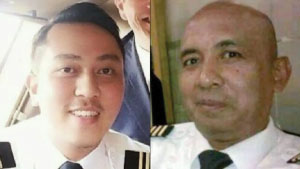
  • Mastering the Master Game: The Self-Completion of Robert de Ropp

    Mastering the Master Game: The Self-Completion of Robert de Ropp

    From New Dawn Special Issue Vol 10 No 4 (Aug 2016)

    Biochemist, author, spiritual teacher, kayaking fisherman, founder of an intentional community, misanthrope – Robert de Ropp was a complex man. Within him, the scientist, the magician, the missionary, the domestic oaf, hermit and warrior jostled for position. Practical and forthright, and distrustful of wide-eyed spirituality, he nevertheless became widely known to seekers in the 1960s. Books like Drugs and the Mind, The Master Game, Warrior’s Way and Self-Completion helped many to bridge the gap between drug experiences and disciplined spirituality. 

    Born in England in 1913, he came from an aristocratic background, but the early death of his mother in the post-WWI influenza epidemic and the subsequent lack of interest shown by his father resulted in a bizarre childhood. 

    Rare photo of Robert de Ropp

    His father was a Lithuanian Baron who in the 1920s lost most of his money in ill-advised financial ventures. At the age of 12, de Ropp, who had until that point been advancing through the elite English school system, found himself dumped for two years at the family seat in Lithuania. The mansion itself had not been maintained and, having been shelled in the war, was close to a ruin. Robert rattled around in a freezing cold, rat-infested great house that could accommodate fifty people. The neglected estate was run by the peasant families who had been there for generations, if not centuries. In place of his Oxbridge-oriented classical education the half-starving de Ropp found himself receiving a practical schooling in fishing and traditional agriculture from the old retainers. 

    With little warning he found himself extricated by his father only to be resettled once again, this time in the Australian outback, where he found himself working in a hopelessly misjudged farming venture. When this went bottoms up he made his way to Port Adelaide where he tried unsuccessfully to drown himself. Somehow, the fourteen-year-old managed to get back to England by himself with ten shillings in his pocket. Via a family connection he was taken in by the composer Ralph Vaughan Williams, whose pastoral pieces are now a mainstay of popular classic music radio programming. Finally achieving some stability, Robert studied science and became a molecular biologist. 

    Robert would only have occasional contact with his father, who lived until 1973. William de Ropp was a fascinating figure in his own right. A Germanic Lithuanian aristocrat, he became a confidante of Hitler and enjoyed close contact with him in the mid-1930s. William de Ropp had close connections with high-ranking British figures who were in favour of appeasing Hitler. He was actually being employed as a double agent who was able to obtain considerable intelligence for the British on Hitler’s ambitions and the state of the Luftwaffe. 

    Encountering Ouspensky & Gurdjieff

    P.D. Ouspensky (1878–1947) was a Russian mathematician and esotericist known for his expositions of the early work of the Greek-Armenian teacher of esoteric doctrine George Gurdjieff.

    In the 1930s Robert de Ropp got to know the novelist Aldous Huxley and his friend Gerald Heard who taught meditation. Heard was one of the first westerners to teach eastern meditation styles but de Ropp found his approach over-emotional. Not so P.D. Ouspensky, who seemed free from sentimentality and pretentiousness. After a hesitant start, de Ropp joined Ouspensky’s groups and began the work (based in the teachings of G.I. Gurdjieff), which, with development and adaptation, would dominate his inner spiritual life. 

    De Ropp was tough and well-prepared for the physical exertions that form part of the Gurdjieff work. G.I. Gurdjieff taught that man (humans) has no single indivisible ‘I’. Desires, thoughts, feelings, urges, pass constantly through us, each of them claiming the title of ‘I’ temporarily. Certain typical clusters of these ‘I’s form somewhat separate personalities. Each personality may have a separate set of concerns that collect together, representing the different aspects of one’s concerns or the separate contexts in which one must relate to other human beings. As an example, many adolescents experience a taste of this when they experience the discomfort of recognising that the way they behave with family may be very much at odds with the way they behave with friends.

    De Ropp found this to be a key to self-understanding. Obviously disposed to coming up with new categories, as we shall see in other areas of his writing, he analysed his own constituent personalities. What was unique in de Ropp’s approach was his use of the personalities in autobiography. Throughout Warrior’s Way – incidentally one of the most readable, honest, and varied of spiritual autobiographies – de Ropp characterises his behaviour according to the personality which was dominant. These included archetypes such as the Magician, who was able to feel the mystique of nature, and the Scientist, always applying rationality and looking for evidence. Yet others are more individual. The Missionary was that part of de Ropp who wanted to convert others to what he saw as the truth of the Gurdjieff-Ouspensky system. The Missionary was energetic and sincere but authoritarian, dogmatic and domineering. Opposed to the Missionary was the Domestic Oaf, desirous of family, children, a steady job, of house and land. (At times his personalities included the Recluse, the Cynic and others; this was a pragmatic rather than a systematic approach.) 

    George Gurdjieff 

    De Ropp worked every weekend at Lyne Place in England and then, after the end of the war, at Franklin Farms in New Jersey for over a decade. He was not alone in feeling that Ouspensky had lost his way and succumbed to a form of the guru trap, with a drinking problem and surrounded by followers who had become dogmatic and authoritarian. He was also not alone in feeling that in his last months Ouspensky had shrugged off this role and lived like a spiritual warrior at the end.

    After Ouspensky died de Ropp finally met Gurdjieff in New York in 1948. With some exceptions, the strict firewalls that Ouspensky erected against what he thought was the increasingly erratic influence of Gurdjieff had broken down. Long term students of Ouspensky encountered Gurdjieff in a series of vivid and pungent encounters. Gurdjieff struck de Ropp as a king in exile, perhaps the last Magus. He was the most impressive man de Ropp met in his entire life – a view to which he held 30 years later. Gurdjieff combined the Tarot archetypes of Magician, Hierophant, Emperor and Hanged Man. Yet, when Robert and his wife walked back with Gurdjieff after a movements class in New York, he wracked his brains trying to remember the question he should have asked Gurdjieff, but it just would not come and they continued in silence. Soon afterwards Gurdjieff would be in such demand that there was no chance for direct contact; De Ropp would have a long illness, and the master died the next year in 1949. In retrospect, de Ropp decided that although Gurdjieff represented unparalleled spiritual possibilities, he just wasn’t up to the challenge. “For the intelligent and the strong he [Gurdjieff] could provide the inspiration of a lifetime. But for the stupid and the weak he could be dangerous, even deadly. You have to be a pretty strong player to be able to play games with such a master.”1 

    The Domestic Oaf won out, eager for a job, a mate and a family, but life was not to be easy. Now on his second marriage and second family, de Ropp built himself a house from scratch for $3,500, and held down a good scientific post.

    Both de Ropp’s wives suffered from mental illness, his first wife to such an extent that she was institutionalised for decades. His scientific professional life would now intersect with his inner mental life to understand the influence of drugs on the mind. 

    Drugs & the Mind

    De Ropp had a common sense attitude to drug use. He didn’t believe that psychoactive substances, whether modern pharmaceuticals or traditional plants, could lead one to anything like true awakening. Yet neither did he agree with the increasingly vociferous prohibition in response to the 1960s drug scene. Anyone who wished to experiment with drugs should be able to do so, preferably in a safe situation. Even though de Ropp had experimented with drug use and concluded that it was a “blind alley, a cul de sac, a dead end,”2 he still recommended that others should not take him for his word but try their own experiments – preferably in safe conditions. Legislation against psychedelics and other mind-altering drugs, he believed, “strikes at one of the most fundamental of all liberties, the liberty of the individual to explore his own inner world by means of his own choosing.”3

    His book Drugs and the Mind not only addressed issues such as the nature of addiction and the use of drugs to treat mental illness. Already in 1957 de Ropp had written: “The greatest public health problem at the present time is mental illness.”4 The book had entire chapters devoted to peyote and marijuana. Of the many mind-altering substances de Ropp personally experimented with, it was not the more dramatic and powerful hallucinogens like LSD or peyote that impressed him, but cannabis when taken as an extract in a sizeable dose. 

    Among the love and peace generation, de Ropp became, if not quite a household name, then certainly the author of one of the significant books of the period. Drugs and the Mind kept company on hippy bookshelves with Huxley’s The Doors of Perception and works by Timothy Leary and Alan Watts. The disciplined and scientific Englishman, now in his fifties, found himself fêted by young Americans who were tuning in, turning on, and dropping out. De Ropp was one of a small number of older people who could see the potential of the new movement. Leary’s message was turn on, tune in and drop out. But could these explorers of inner space turn up (on time), tune up their bodies, and drop unnecessary attachments?

    Unlike Leary or Watts, each of whom de Ropp felt had succumbed to the temptations inherent in being a guru, de Ropp managed to navigate the rapids of the psychedelic tide. Although he could see that young people were in desperate need of self-discipline and grounding, he also felt that the Fourth Way of the Gurdjieff-Ouspensky teachings was somewhat authoritarian in its approach, and neither entirely successful in its methods or transmission. This line of thinking led to his next major book, released in 1968, The Master Game: Beyond the Drug Experience, which sold in the hundreds of thousands. 

    Spiritual Explorers & Teachers

    Throughout his life de Ropp encountered many spiritual explorers and teachers. By the time he moved to California in 1962 he had developed a knack of testing would-be teachers. It was not an infallible touchstone of soundness yet it worked well enough. He simply challenged them in his forthright manner. When he did this to Timothy Leary in 1962, after a long and inspiring talk from Leary on his plans to establish a utopian psychedelic community on the Pacific coast of Mexico, Leary simply turned off his hearing aid. It was a quirky response from Leary but didn’t bode well for the future of a co-operative enterprise. As is so often the case with spiritual teachers, the message was – my way or the highway. De Ropp saw Leary’s hallucinatory tropical utopia as impractical, and he was right – it was closed down by the police after just a few weeks.

    Of the flower power generation, de Ropp admired Ken Kesey but felt he hadn’t followed through successfully. Only Steve Gaskin, founder of the Farm community, met with his approval. 

    De Ropp may be accounted a teacher himself. How did he fare? He describes his hesitancy and self-questioning, but many teachers feel thus inwardly. Rather than displaying these to the pupil, spiritual teachers often overcompensate for their internal doubts. 

    Despite his love for describing life as a game, de Ropp certainly had something of the puritan about him. He detested alcohol and tobacco. City life was not for him and only country living seemed authentic. But most of us live in cities and towns, and they aren’t without their advantages. 

    De Ropp could see that the situation of humanity in the West was changing rapidly and he was able to negotiate the rapids produced by the flood of change. He began his own experimental community, the Church of the Earth, in Sonoma County, California. It was never intended to be a large group. A good portion of the group, with de Ropp’s blessing, started going to J.G. Bennett’s more ambitious International Academy for Continuous Education at Sherborne, England. De Ropp had reservations about those who came back from the accelerated ‘evolution’ of Sherborne House, dubbed by one wag the ‘Bennetron’. “I had expected well-trained, obedient, ready-for-service disciples,” de Ropp wrote, “I received rebellious, starry-eyed, self-opinionated ‘adepts’.”

    When they returned they were in no mood for serious teachers, or so de Ropp concluded, and the whole enterprise collapsed. The Church of the Earth was intended to have been built around the three pillars of garden, temple, and university, feeding the body, spirit and mind respectively. In a 1974 book of the same name, de Ropp describes their attempts at working together and setting up a rural community. The garden seems to have fared the best. The temple or dojo never seems to have got far beyond a wonky physical structure, and of the university there was little mention at all apart from a vague notion of seminars. Perhaps the project’s collapse was to de Ropp’s advantage after all. As a result he never was seduced by the guru trap.

    Get the issue this article appears in

    Warrior’s Way & Self-Completion

    De Ropp seems to have been most stimulated by his attempts to harvest the garden of the sea. He designed and built his own kayaks and became a skilled fisherman. He found the sea a demanding teacher, unforgiving of lapses of attention, requiring the fisherman to successfully adapt to the rhythms of nature. At the end of his penultimate book, Warrior’s Way, de Ropp contemplates existence from his tiny boat in the Pacific Ocean on the northern Californian coast. He has somehow made contact with a Taoist spirit teacher named Fong, who has given him the gift of balance between yin and yang, receptiveness and relaxation balancing the austere demands of the Gurdjieff work; he was a Taoist hermit going with the flow. De Ropp seeks no ultimate answers, feels no need for any metaphysical belief, has no desire or faith in a survival of the personal ego. “My spirit will dance there as the shadow of that rock, among seagulls and pelicans, sea lions and starfish. I would like to give my flesh back to the ocean to feed the fish whose bodies have so often fed me.”5

    Forty years ago de Ropp’s concern for the state of humanity and the planet was part of the emerging green movement. His view of modern westerners as “a spoiled, careless, pampered, town-bred manswarm” might seem harsh but we are already several stages down the road, oblivious of the warning signs. We do not even notice them as we wander towards oblivion, our sight focused on smartphones as we stagger towards the cliff. (This is metaphor but it seems that every week someone walks into a lamppost or off a cliff because they’re absorbed by their smartphones. There should be a word for the phenomenon.)

    In his final book, Self-Completion, in which he introduces himself as an elderly hermit, he included insights into Gnosticism and the latest developments in science. The Gurdjieff-Ouspensky work still provided the spine of his teaching but his pragmatic approach combined the work with aspects of Taoism, psychology, Sufism, Arthur Koestler’s holons, and his own bluff, no-nonsense assessment of western culture. 

    In 1987, at the age of 74, he died while kayaking in his beloved Pacific. Having pitted himself against the ocean for years, one suspects he knew that he could not win every time, and would have been content to have died in that manner, honourably, alone with nature, in the Warrior’s Way.

    [alert type=”general” dismiss=”no”]This article was published in New Dawn Special Issue Vol 10 No 4.[/alert]

    [alert type=”success” dismiss=”no”]If you appreciate this article, please consider subscribing to help maintain this website.[/alert]

    Footnotes

    1. Warrior’s Way, Dell Publishing, 1979, 192
    2. The Master Game: Beyond the Drug Experience, Delacorte Press, 1968, 23
    3. Ibid.
    4. Drugs and the Mind, Evergreen, 1957, 167
    5. Warrior’s Way, 351

    © New Dawn Magazine and the respective author.
    For our reproduction notice, click here.
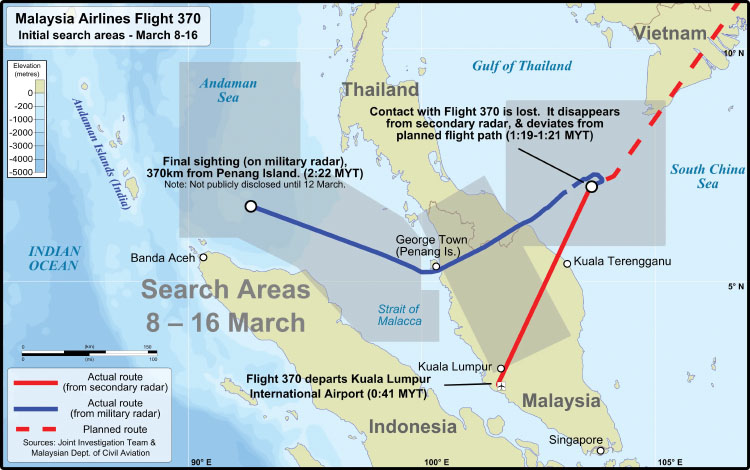
  • Pine Gap: Mystery, Myth & Conspiracy

    Pine Gap: Mystery, Myth & Conspiracy

    From New Dawn 171 (Nov-Dec 2018)

    The Joint Defence Facility at Pine Gap near Alice Springs has had a troubling, if discrete history in the Australian political landscape. It is, more than anything, a sign of the pressing inequalities of the Australian-US relationship, a salient reminder of Australia as a distant but valuable satrap to the ever stubborn imperium based in Washington. 

    “Joint” command is a teasingly deceptive misnomer, given that the facility in the Northern Territory is under US control. What persists is a certain errand boy element fronted by Australian personnel. They supply the territory, the space and the hospitality. The US, boasting its protective umbrella, does the rest.

    The Pine Gap facility, established in 1970 as one of the world’s largest satellite ground installations, has been responsible for feeding intelligence to American military missions for decades, with, or without the knowledge of the wallahs in Canberra. Over the years, revelations about what the facility is actually being used for have seeped into the media. 

    Pine Gap plays a crucial role in the United States military’s drone assassination program. The ‘collateral damage’ of the program in the form of hundreds of innocent civilian deaths has led to continued protests in countries such as Pakistan.

    The Australian revealed in April 2014 that two Australian citizens – Christopher Havard from Queensland and New Zealand dual national “Muslim bin John” (Darryl Jones) – had been killed in a drone strike in Yemen on 19 November 2013. Both men, supposedly members of the group al-Qa’ida in the Arabian Peninsula, were travelling in a convoy of vehicles with Abu Habib al Yemeni, a key AQAP figure. (The Australian did not bother with the term “alleged militants” in describing the fate of the slain.) 
    Australia’s then Foreign Minister, Julie Bishop, was only informed of the strike after it was revealed that Australian citizens might have been killed. A spokesman claimed that, “There was no Australian involvement in, or prior awareness of, the operation.” It certainly did not concern those at The Australian, who feel that pre-empting guilt by way of execution in an undeclared war without any suitable standard of evidence has “done much to stop the terrorists committing even more atrocities.” 

    This has not been the view of others. The late Professor Des Ball of the Australian National University, when asked about the strikes in May 2014, reiterated the claims to the same paper that Pine Gap was essentially being used to aid assassination. “I’ve no doubt that intercepts of phone calls and things like that are being intercepted at Pine Gap and used in drone operations.” According to Ball, intercepted signals obtained at Pine Gap were used in a strike against an al-Qa’ida target in Yemen on 3 November 2002. “It was one of the first uses of a drone against targets in Yemen.”

    Australian academic Desmond Ball (1947–2016).

    The Australian was a rather late arrival to the party, given that Philip Dorling of Fairfax Media was already reporting that intercepts obtained from Pine Gap were being used in conducting extra-judicial killings in the Middle East. The facility’s “primary function” was to identify radio signals throughout the “eastern hemisphere, from the Middle East across Asia and China, North Korea and the Russian far east.” As one former Pine Gap operator told Fairfax Media: “We track them [the combatants], we combine the signals intelligence with imagery, and once we’ve passed the geolocation intell[igence] on, our job is done. When drones do their job we don’t need to track that target anymore.” Such is the desensitised, amoral world of the signals tracker operating in remote locations.

    None of this was new to American investigative journalist Jeremy Scahill, who has been enlightening Australian and New Zealand audiences about the extent of knowledge and complicity in the dirty business of drone strikes. Pine Gap remains the remote sin of Washington’s reach. It also fundamentally inculpates Australia in the same mission, one that extends to its Trans-Tasman neighbour. On 17 May 2014 Scahill told New Zealand’s TV3’s The Nation that he had seen “dozens of top secret documents” provided by US authorities to the NZ government showing effectively “that New Zealand, through signal intercepts, is directly involved with what is effectively an American assassination program.” This barely troubled then New Zealand Prime Minister John Key, who openly suggested that the killings were “legitimate… given that three of the people killed were known al-Qai’da operatives.” 

    The Purpose of Pine Gap

    Robert Cooksey of the Australian National University was one of the first who took an interest in the nature of this “unlisted base” back in 1970. Writing for Dissent, he speculated whether the “weather station” in Alice Springs manned by Detachment 421 of the US Air Force might be powered by nuclear power. The Australian Minister for Supply had been rather oblique about the approval for a US research project at Alice Springs “to conduct long term geological and geophysical studies, including studies of earthquakes and attendant phenomena.” Northern Territory officials simply presumed it to monitor atomic tests, though Cooksey found it curious that this function should be shrouded in secrecy. 

    It was Desmond Ball who injected a note of unease in the discussion on the base, noting the multifarious military, scientific, intelligence and space facilities connected with Washington’s interests. “The precise number,” claimed Ball on the facilities, “is difficult to determine – there are problems of official obfuscation and of technical definition – but it is more than twenty.” Along with Richard Tanter, Ball did more work on the subject of drumming up awareness of the secret base’s role on Australian soil than most. A Suitable Piece of Real Estate: American Installations in Australia (1980) drove interest on how Australian territory had become an imperial domain for Washington’s strategic push. His assertion that Australia reclaim sovereignty was deemed “temper democratic, bias Australian.”

    The Nautilus Institute for Security and Instability has furthered Ball’s work, keeping a keen eye on the evolution of Pine Gap’s role in security. In an introductory overview on Pine Gap, the Nautilus Institute’s ongoing, updated report on the base notes the following: 

    “Pine Gap is perhaps the most important United States intelligence facility outside that country, playing a vital role in the collection of a very wide range of signals intelligence, providing early warning ballistic missile launches, targeting of nuclear weapons, providing battlefield intelligence data for United States armed forces operating in Afghanistan and elsewhere (including previously in Iraq), critically supporting United States and Japanese missile defence, supporting arms control verification, and contributing targeting data to United States drone attacks.”

    The report pegs Pine Gap’s role to three operational functions, with the original one still being primary: a station for geosynchronous signals intelligence (SIGINT) satellites developed under the auspices of the Central Intelligence Agency. Originally, these were intended to focus on the testing of Soviet missiles. One estimate puts the number of radomes and satellite dishes at Pine Gap at 38.

    The second features a function acquired in late 1999 when the base became a Relay Ground Station for detecting missile launches, including Overhead Persistent Infrared (OPIR) which now includes a Space-Based Infrared System (SBIRS).

    The third is its interception function (foreign satellite/communications satellite), acquired in the first decade of 2000. The Nautilus report notes that two 23-metre dishes appropriate for COMSAT SIGINT Development (Sigdev) were installed within the 30-metre radomes at the end of 1999 and early 2000.

    To Peter Cronau of ABC Radio National, the Nautilus Institute’s Richard Tanter was convinced about the ensconced nature of the base in the plans of US security:

    “Pine Gap literally hardwires us into the activities of the American military… So whether or not the Australian government thinks that an attack on North Korea is either justified, or a wise and sensible move, we will be part of that… We’ll be culpable in the terms of the consequences.”

    Other sources have added to the jigsaw. David Rosenberg, a US employee at the base, supplied a valuable portrait of the functions of the base in 2011. In 1990, Matthew Denholm subjected the strategic base argument to broader discussion.

    All this cut and dried material conveys the relevance of Australia’s continued geographical role as a dry goods merchant for Washington, its haberdasher of the Pacific. Not only does it supply the data required for drone strikes, it also served as a useful tool in directing US air operations over Vietnam and Cambodia. This troubled Prime Minister Gough Whitlam in the 1970s, who became a subject of deep distrust in Washington with his threat not to continue the lease connected with the base. This supplied an ample pretext for a flurry of communications between Washington and the opposition leader, Malcolm Fraser, who became the celebrated usurper in the fall of the Whitlam government in 1975. 

    Australia remains America’s glorified dogsbody and, in any future war, a conspicuous target. Enormous latitude is permitted for US personnel at Pine Gap. 

    Prosecution & Protest

    In 1952, when the Defence (Special Undertakings) Bill became law, it did so without opposition. There was, however, one note of warning from an otherwise unquestioning Dr Herbert Evatt of the Australian Labor Party. For one thing, the danger of legislative overreach was apparent: “the bill contains very important provisions which extend beyond that particular subject. They may be open to some criticism on analysis but, after consideration, the Opposition believes that the bill should be passed.”

    There have been protests against Pine Gap since the 1970s. The above is from a 2006 protest.

    Protests and prosecutions have followed. A strong streak of feminist and female activism against the base has characterised dissent and an attempt to breach the veil of secrecy. On 11 November 1983, a Boston Tea Party style gathering was held on the green lawns on the Base. 111 women were arrested for trespass, all giving their name as Karen Silkwood, a renowned anti-nuclear protester. Some 700 women gathered, being described by the Alice Spring News as “Karen Silkwoods.” Support, albeit indirectly, was also offered by twelve female parliamentarians from the Labor Party, including Senator Susan Ryan, then Minister for Education.

    At various stages, prosecutions on charges of trespass under the Defence (Special Undertakings) Act 1952 have also been mounted, though the prosecution effort in 2007 against protestors was laughed out of court by the presiding judge, Daynor Trigg, who deemed the statute “a bit of nonsense.” The defendants were duly acquitted by the Northern Territory Criminal Appeals Court, who quashed attempts by prosecutors to seek a retrial. 

    Australians have a long history of protesting US military bases in Australia. Left:  Poster from 1976 campaign, and protest badges from the 1970s & 80s.

    As late as last year [2017], six self-proclaimed “peace pilgrims” received the attention of authorities for sporting musical instruments and pictures depicting war casualties onto the base. The prosecution of Margaret Pestorius, Paul Christie, Jim Dowling, Franz Dowling, Andy Paine and Tim Webb centred on their entering of the clandestine base in September 2016 had been obstinate and typical.

    The grounds advanced by Michael McHugh SC for the government made weak reference to the history of peaceful protest that had marked the practice of Australian democracy. He even drew a curious precedent from the archives about how the Suffragettes had, in their day, shown the way on civil disobedience. They, it should be noted, were deemed to have acted illegally, though ultimately successfully, in their cause. The defence argued that the Commonwealth Criminal Code legitimised their protest because it was necessary to prevent a loss of life. As Pine Gap supplied targeting information for drone strikes, its disruption would purportedly save lives.

    Justice John Reeves found no merit in the argument of extraordinary emergency, but nor did he prove entirely cooperative to the prosecutors. On 4 December 2017, the court refused to impose prison sentences, despite the guilty jury verdict. “I do not accept the Crown’s submission,” said the judge dismissively, “that your offences potentially struck at the heart of national security.” All six were fined for unlawful entry to the tune of $1,250 to $5,000, and Paine was found guilty of the additional charge of carrying a photographic device on the base.

    During the course of trial, testimony was elicited by various figures which formed the public record. Former Greens Senator Scott Ludlam spoke with conviction from the stand. “There are moral and ethical questions,” he charged; “there are also deep legal questions about the authorities relied upon by the United States Government to undertake drone assassinations in at least six countries that I am aware.” Ludlam’s points are sound in their logic: complicity expands rather than contracts, and Australian funding and hosting of the base invariably places risks to Australian citizens from the perspective of drone strikes, and, in another sense, the vantage point of future prosecutions for crimes against humanity.

    Get the issue this article appears in

    A Blot on Sovereignty

    Australia, for Ball, seemed gripped by a near infantile fear about its security, a requirement almost Freudian in its search for a protective paternal power. “There is a residual fear in Australia that we can’t defend this huge territory and only the Americans can really save us. We always have been a fearful country. We’ve always needed great and powerful friends.” 

    In a tone similar to the late Malcolm Fraser with his resentment of Australia’s “Star Spangled manner” (despite being an initial enthusiast of US power, Fraser did change his tune), Ball felt that the base over time exemplified the worst in the US-Australian alliance. As he told the ABC in 2014, he had reached a point where he could “no longer stand up and provide the verbal, conceptual justification for the facility that I was able to do in the past.”

    The joint US-Australian facility functions in a defiant administrative limbo, one resistant to Australian sovereignty, despite its proclaimed collaborative status. It remains hostile to the inquiries of Australian citizens on what role the base plays. Pine Gap has had a singularly corrosive effect on Australian public life. It has whittled away rights of protest and entrenched secrecy. It has attacked basic civil liberties, with US authorities co-opting Australian personnel to do the work of the US military. With each provocation by daring protesters, with each exposure of the ludicrousness of secrecy surrounding the base, crumbs are filling the gaps, data filling the files. 

    “Since our action,” claimed Paine, “more evidence has emerged detailing the role of Pine Gap in extrajudicial assassinations, in nuclear weapons targeting and in illegal mass surveillance.” The most troubling aspect of this is whether Australia’s general citizenry cares.

    [alert type=”general” dismiss=”no”]This article was published in New Dawn 171.[/alert]

    [alert type=”success” dismiss=”no”]If you appreciate this article, please consider subscribing to help maintain this website.[/alert]

    Footnotes

    1. www.theaustralian.com.au/opinion/editorials/heavy-price-of-jihad-hits-home/story-e6frg71x-1226887014723 
    2. www.theaustralian.com.au/national-affairs/policy/pine-gap-supports-us-drone-hits/story-e6frg8yo-1226923350422# 
    3. www.smh.com.au/national/pine-gap-drives-us-drone-kills-20130720-2qbsa.html
    4. www.smh.com.au/national/pine-gap-drives-us-drone-kills-20130720-2qbsa.html 
    5. www.abc.net.au/radionational/programs/breakfast/dirty-wars—the-world-is-a-battleground/5472612 
    6. www.wsws.org/en/articles/2014/05/24/dron-m24.html 
    7. Bruce Juddery, “Hint of Work at Pine Gap,” The Canberra Times, Sep 17, 1970, 14.
    8. Desmond Ball, A Suitable Piece of Real Estate, 19.
    9. http://nautilus.org/wp-content/uploads/2012/12/The-_Joint-Facilities_-
    revisited-1000-8-December-2012-2.pdf 
    10. http://nautilus.org/publications/books/australian-forces-abroad/defence-facilities/pine-gap/pine-gap-intro/
    11. www.abc.net.au/news/2017-08-20/leaked-documents-reveal-pine-gaps-crucial-role-in-us-drone-war/8815472 
    12. David Rosenberg, Inside Pine Gap: The Spy Who Came in From the Desert Hardie Grant Books, 2011.
    13. Matthew, Denholm, “The advantages and disadvantages of allowing United States military/strategic bases to be maintained in Australia,” Cabbages and Kings 18 (1990): 45-71.
    14. Women For Survival, founded during the Pine Gap Women’s Peace Camp in 1983. For more, see the record: https://trove.nla.gov.au/people/1477462 and www.womenaustralia.info/biogs/PR00097b.htm. See also Melbourne University Archives (Victorian Women’s Liberation and Lesbian Feminist Archive) and James Cook University Library (Trewern Collection). See Women for Survival, Pine Gap camp – 11 November 1983 (Haymarket, NSW, 1983).
    15. Noted by Bryan Law, “Entering the ‘gap’ between what’s right and what’s legal’,” Webdiary, Oct 17, 2005 and noted in Nautilus Institute for Security and Sustainability, “Pine Gap protests- historical,” https://nautilus.org/publications/books/australian-forces-abroad/defence-facilities/pine-gap/pine-gap-protests/protests-hist/
    16. https://closepinegap.org/media/
    17. www.smh.com.au/national/des-ball-the-man-who-saved-the-world-20121220-2bpdd.html
    18. www.abc.net.au/7.30/content/2014/s4066678.htm

    © New Dawn Magazine and the respective author.
    For our reproduction notice, click here.