New Dawn – World's Most Unusual Magazine

Category: Articles

  • A New Science of the Heavens: An Interview with Robert Temple

    A New Science of the Heavens: An Interview with Robert Temple

    From New Dawn 198 (May-June 2023)

    Robert Temple is a multifaceted writer and thinker whose work extends across many disciplines. From his work with Joseph Needham, author of the monumental Science and Civilisation in China, he wrote a book on Chinese science and technology, The Genius of China. He has also written The Crystal Sun, a study of over 400 ancient optical artefacts that were hidden in the basements of the world’s museums.

    Temple is perhaps best known for The Sirius Mystery, which discusses a West African tribe called the Dogon, who possess knowledge of the Sirius star system that preceded recent astronomical discoveries.

    This interview is dedicated to Temple’s latest book, A New Science of Heaven. It contains astonishing revelations about the new frontier of physics, which has to do with plasma – a fourth state of matter in addition to solids, liquids, and gases.
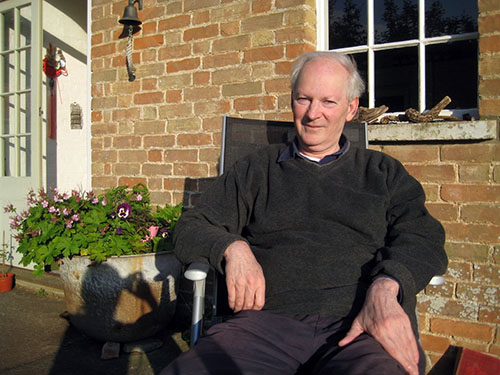
    Robert Temple

    Richard Smoley (RS): You’ve done an extraordinary number of fascinating things across the course of your career; any one of them would be a subject for a much longer interview, but we will focus this one on your latest book, A New Science of Heaven. It’s about a fourth state of matter called plasma. This comes out of physics, not metaphysics; it’s not occult in any way. But you say that it has an enormous significance for us. To begin with, what is plasma?

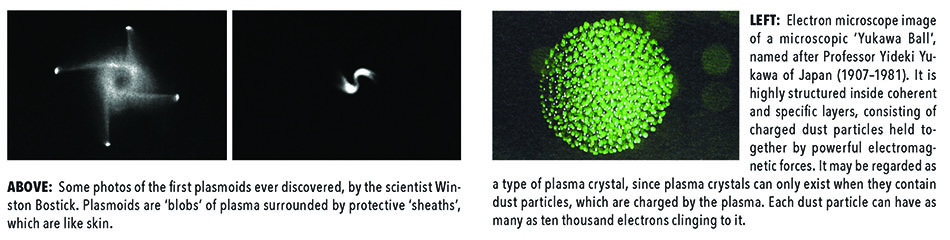
    Robert Temple (RT): Plasma is a fourth state of matter. It was officially discovered in 1879 by the English scientist Sir William Crookes, who was the inventor of the vacuum tube. He discovered this phenomenon going on in his tubes, and he named it “radiant matter.” The name was changed in 1928 by Irving Langmuir to “plasma.” (I must stress that it has no connection whatsoever with blood plasma.)

    Plasma is a form of matter that’s not made of atoms; it’s made of particles: electrons and protons, which have opposite charges to one another, and ions. Ions are often considered incomplete atoms because they don’t have a balanced charge. I look at it the other way around: I look at atoms as value-added ions. They can have positive or negative charge, but we’re really only concerned with positively charged ions, which are the most common and which compose, for instance, the solar wind that blows out from the Sun and fills the solar system.

    When plasma was originally encountered, it appeared to be only a gas, but we now know that it can be a liquid. And it can not only be a solid, it can be crystals, so for some years now the few scientists who work on the fringes of physics and deal with these things have been dealing with plasma crystals. There are hot plasmas and cold plasmas. Most of the work that’s taking place at the moment is on the hot ones because those are concerned with trying to control nuclear fusion to make energy. They haven’t succeeded in doing that.

    The plasmas that I’m most concerned about in my book are the space plasmas, and they tend to be cold plasmas – much colder than anything on earth.

    I should point out that until 1962, it was universally believed by the world’s scientific establishment that outer space was empty. We grew up as children being told outer space was a total vacuum and nothingness, and we now know that it’s actually the very opposite.
    RS: How does this new discovery of plasma change our understanding of the universe?

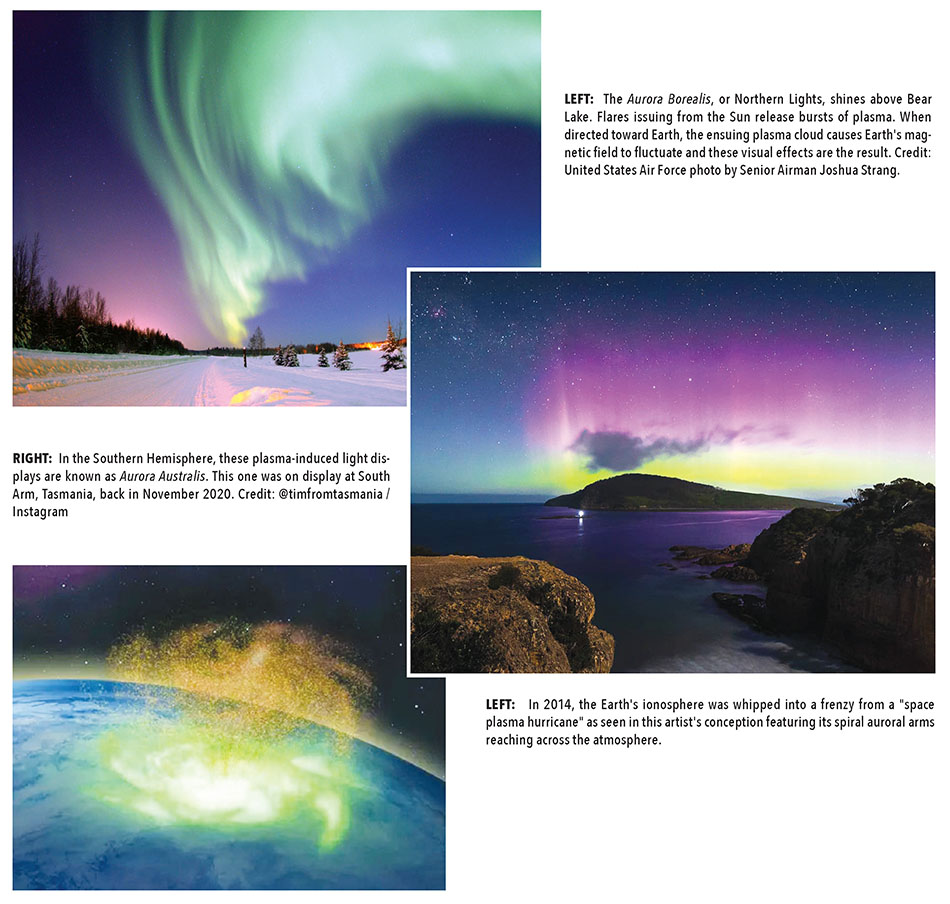
    RT: It changes it completely. Because the universe is now known by astrophysicists to be composed of 99.9 per cent plasma. For instance, our Sun is completely made of plasma; it’s not made of atoms. And we have a universe which is made of plasma: nonatomic matter.

    Our basic physics – classical physics – has already been left behind by relativity theory and quantum theory, but even what we consider today to be advanced modern physics is wholly inadequate because it’s based upon the assumption that the universe is made of atoms, and it’s not. It’s made of plasma, which is very different and behaves very differently from atomic or physical matter. The equations which govern its behaviour are all nonlinear equations, which are hard to deal with, and it doesn’t follow all of our customary laws: it won’t sit and beg like a good dog. In fact, it’s a big, black, barking, threatening universe, and it doesn’t want to have tiny humans on rocky planets in the middle of nowhere trying to impose their laws upon it.

    So we have to change our science. We need a new physics, but don’t worry: it’s already on the way because there are branches of physics at this moment where the new science is being created. There are other branches as well: there’s topological physics, which is very exciting, and there’s information physics, which is an extension of it; it’s being driven forward by the search for quantum computers.

    Yet a great deal of plasma physics is not publicly known because a lot of these advances are taking place in two different areas which have vested interests in keeping them secret. First of all, if you have a corporation, you’ve got commercial motives. If you’re in possession of some great new idea about how to make quantum computers work, you’re not going to tell the other companies, so all the scientists working on this have signed confidentiality and secrecy agreements. We can understand that perfectly because there’s hundreds of billions of dollars involved for anybody who’s got the new angle. This may impede the flow of knowledge and certainly public understanding, but these commercial imperatives are at work.

    Even stricter than those are the military controls because most of this kind of work is funded by the defence establishment and the security establishment, and they overclassify everything. They’re not really interested in the public: who cares about those stupid morons out there who pay their taxes? It’s all got to be secret because there are always enemies, and we can’t say anything because the enemies might know.

    So what with the military and security restrictions and the commercial restrictions, these frontiers of physics don’t have much of a chance to trickle down to us. 

    That’s why I believe that my book is unique because I’ve gone to immense trouble to gather this information to the extent that is possible (and indeed I went beyond the possible in many instances) and boil it down into a book that can be understood by somebody who doesn’t know any science at all. As you read the book, I lead you by the hand, and I explain everything as I go on. If you don’t know what a semiconductor is or what superconductivity is, I tell you in an easy way.

    Furthermore, I’ve done an audio recording of the book myself, which is available from the same publisher, and some of my friends who have read or listened to my book are reading it or listening to it twice – not because it’s difficult: they all say they understand it. But there’s so much information that they have to go over it again because everything in the book is new, and it takes a bit of getting used to.
    RS: I’ve read your book, and I would agree with the things you’ve said about it. I did find it very comprehensible. Yet it was overwhelming, not because it was difficult, but because it transforms our view of reality. What we think of as reality has very little to do even with what we conceive of as physical reality. How do these ideas affect our understanding of the day-to-day world? 

    RT: They have the potential to change everything. We’ve got an infinite future ahead of us since I don’t believe that anybody can die, much less does die. We have to get ourselves in shape to face that, and we can’t do it with our present concepts.

    I’ve struggled with all of this myself. You’ve mentioned how difficult it was for you, not to take it in but to face the consequences. I’ve been going through that agony for years. Because I knew how overwhelming it was, I tried to lessen the challenge by making it as accessible as I possibly could.
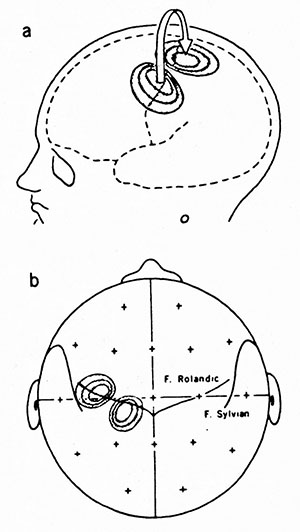
    Evoked electric currents in the brain produce magnetic fields, such as the one seen here (hence no one should insert ‘ear pods’ into their skull, which derange the brain’s normal functioning).

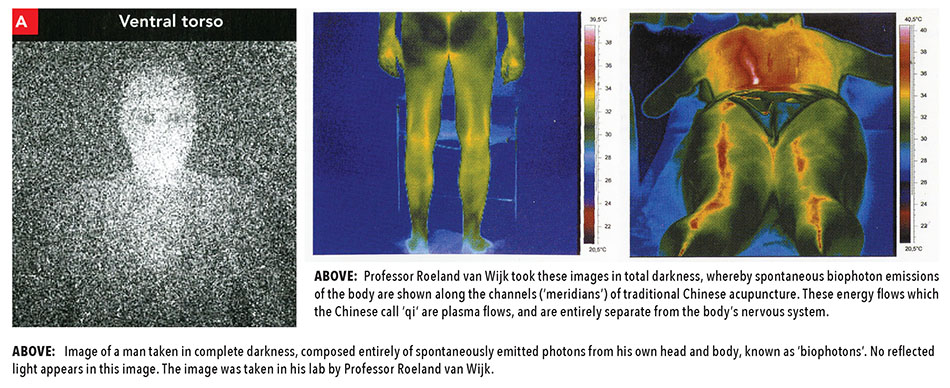
    We have to realise several key things which are different from what we think. There are very few rocky planets made of what we call physical matter. Of course, there may be hundreds of billions of them, but that’s a mere nothing compared to the others. We also need to realise that our physical bodies are what I tend to call smart overcoats, our real selves being bioplasma bodies. That’s what leaves the physical body at death and continues its existence on what you could describe as another plane.

    The intelligence in the universe is cosmic. These plasmas can form dusty complex clouds, which have the capacity to self-organise by the process known as emergence and develop intelligence. There are complex plasma clouds throughout the universe. We see them everywhere: every star is a complex plasma cloud, including our own Sun. Lightning, by the way, is plasma; the centre of a candle flame is plasma. We have plasma in us: our physical bodies are full of currents of plasma; every cell has protons going across the membrane. The heart is an electromagnetic device, which happens to activate itself as a muscle, but the fact is that we, even in our physical form, are electromagnetic beings. And the core of ourselves is our bioplasma cells, which are entirely plasma and electromagnetic.

    Plasma has positive charges and negative charges, and it can contain modules within it, countless ones. For instance, a bioplasma body the same size as a physical body will have an interior structure far more complex than our physical bodies. Indeed, we are very complex bioplasma bodies which exceed in complexity the anatomy of our physical bodies.
    RS: It has long been held that there are all sorts of subtle bodies which are nonphysical. Some of these have been described as etheric bodies or astral bodies; there also seems to be the substance called the life force, which science, for some reason, refuses to admit the existence of. How does plasma relate to these concepts? 

    RT: There have been many inspired people – psychics and seers and so on – who have intuited all the things which modern science can now demonstrate. You mentioned subtle bodies, and you can look at that wonderful book, The Subtle Body by G.R.S. Mead, a classic example (he’s one of my intellectual heroes, by the way).
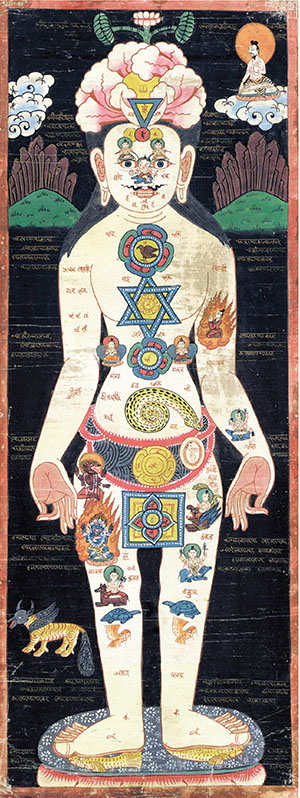
    A Cosmic Man, Purusha, Nepal, 19th century. The subtle body of the human being is represented in which points and locales on the body (microcosm) correspond with powers and gates (macrocosm) of the broader cosmic environment in which all exists. In Western esoteric traditions, the subtle body is usually referred to as the Light Body. The discovery of plasma intelligence opens up a whole new field of inquiry. 

    I believe there’s more than one level to the bioplasma body. That was known to the ancient Egyptians, who had many different souls; the ba and so on, the highest being the akh.

    This is the perennial wisdom, and this is what Mme. Blavatsky was trying to institutionalise. She thought she ought to get this deep wisdom organised, propagated, and preserved – and to be analysed as well. This perennial wisdom is true. Just because it’s been mocked and sneered at by people who arrogantly believe themselves to be rational (this just means narrow-minded) doesn’t mean that it’s false.

    Science has finally begun to catch up with ancient wisdom. We’re getting to the point where, on the very fringes of science, unreported to the public, never mentioned in the media, is all the stuff that I’ve gathered together in my book, which proves scientifically that this ancient wisdom is all true.

    That’s why it’s so important. We have to get this basic material propagated, we have to tell people, because the entire future of the planet really depends on this. Forget CO2 and climate change compared to what we’re talking about. Ultimately it doesn’t even matter if the earth should be destroyed by climate change; the fact is, the universe won’t be. I don’t think that the planet is going to be destroyed, but even if it were, we won’t be destroyed. We will continue to exist as bioplasma beings in a plasma world, which cannot be destroyed by climate change because there’s no climate in the plasma world; there’s no weather; there’s no rain; there’s no heat; there’s no cold. Even if everything were to be destroyed on this planet, we would all still exist. The efforts that we make here and now to understand the universe and get ourselves into gear properly will continue, even if only on what’s traditionally been called the spiritual level.

    RS: You have pointed out that the ancient Egyptians knew about these subtle bodies, and there are teachings about them in most esoteric traditions. Does that mean that humans have a capacity to somehow organically perceive the subtle bodies?

    RT: I’m so glad you asked that, Richard. Yes, I do believe that. Today we live in a society that is intensely materialistic, I would say very decadent. It’s shut itself off from what is traditionally called the spiritual.

    I do believe that every human being has the capacity for intuition of the deeper truths if they’re sufficiently open, but most people today are being artificially closed by bad forces, like addiction to mobile phones. Nobody any longer has any reflection time or time to get their heads together. We need to clear away the information clutter and the excess radiation that is being generated by all these devices and give ourselves a bit of peace. We need to set aside time to sit and meditate; we need to make our lives more peaceful if we possibly can.

    When we do that, I believe we can have the truths come to us because we are surrounded by information space, as I call it. I get a lot of my intuitions from my ability to contact and penetrate information space. If we really concentrate on that and give it its chance, we can open ourselves. In ancient times, the priests and seers were attempting to draw the deeper truths and sacred intuitions down into their minds. I think there was more of a direct connection to the deeper truths in simpler times.

    RS: One thing that I found fascinating in your book was the plasma clouds that you described between the Earth and the Moon. Could you explain those a little?

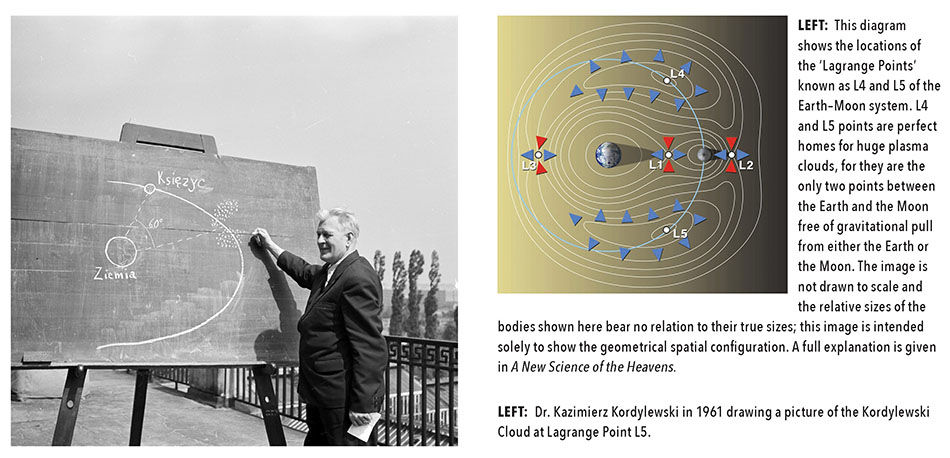
    RT: We have programs looking for extraterrestrial intelligence. I’m convinced we have it in the form of these two giant clouds, which together are eighteen times the size of the Earth.

    They are between the Earth and the Moon – not in a direct line of sight, but at sixty-degree angles to the left and to the right as you look towards the Moon. They are at Lagrange points four and five (see graphic on page 48). These are points in between bodies in space where the gravitational pull of those bodies is effectively neutralised, where the gravitational pull of the Moon and the gravitational pull of the Earth balance out, and there’s nothing pulling you anywhere.

    These clouds were first discovered in 1961 by a Polish observational astronomer called Kordylewski. They don’t emit any light, and they’re almost entirely transparent and therefore very difficult to detect. In 2019, their existence was finally confirmed by a team of Hungarian astronomers, which Kordylewski couldn’t do in 1961 for two reasons: he didn’t have modern equipment, and as his great-grandson has told me, the Polish Communist government didn’t like him and stopped his work. The Hungarians came charging in on their white horses to the rescue, and they proved that he was right.
    I found the Hungarian scientists, contacted the woman in charge of them, and asked, “Are you studying the plasma aspects of the clouds?” She said, “No, we’re only studying the celestial mechanics aspects.”

    I thought, “I’m going to do something about this quick,” so I got on to my great friend, the professor of astrophysics Chandra Wickramasinghe, who was the main protégé of the astronomer Fred Hoyle (whom I knew very well). Chandra didn’t know about these Kordylewski Clouds; very few people did. “We have to do a paper; would you do it with me?” I asked. And so we did a paper together, which was an advance in astrophysics, and it’s reprinted as an appendix to my book.

    We call attention to the fact that dusty complex plasmas in space like this would almost certainly have evolved intelligence. Considering that they are probably billions of years old, they would have intelligence so great that it would dwarf the pretences of the American security establishment with their supercomputers in Utah, where they store every phone call and every email. They think it’s going to make them all-wise, but of course, they can’t process all that, whereas these clouds can process everything since, I believe, they’re conscious; they’re alive.

    Their existence was intuited in antiquity. In Gnostic Christianity, there are descriptions of gigantic intelligent entities above the atmosphere between the Earth and the Moon. They were superentities presiding over the Earth. One of them was called Metatron, the name of the angel of the Lord.

    It’s a big stretch to realise that we may have intelligent, although inorganic, extraterrestrial life between us and the Moon. We don’t know whether they would have emotions and feelings – maybe they do – but they would have fantastic and unimaginable computing power. They would know everything about the entire history of the Earth and everything on it. They would probably also be great predictors of the future. They could probably tell us what’s going to happen six months from now.

    I do believe that these entities have attempted to communicate with us and that we didn’t notice. There is a history of their attempts to communicate with us. I had a whole section of the book about that which was removed by the publishers, so I’ll have to publish it at some point. But that’s another story.

    These entities are not just big; they’re different, and they’re not necessarily going to look at things the way we do here on planet Earth. The security agencies will consider this – as they already consider the whole question of extraterrestrial life – as the number one security issue for the world.

    Now we come to the question, are the clouds friendly, or do they hate us? I think the answer is very plain: if they weren’t friendly, we wouldn’t be here. I believe that they’re hoping we will make it, and they keep trying to help us by sending down waves of thought that sensitives can pick up. They can’t declare themselves, come down, and say, “Look, we’re going to sort out your politics for you; we’re going to stop wars.” But they must be quite worried about what we’re going to do with the planet, and I’m convinced that they want us to make it.

    RS: How do we know that these plasma clouds are intelligent?

    RT: Having read the book, you have seen there’s been a lot of work done, mostly by Russian scientists; it’s all laid out in the book. By spontaneous processes of self-organisation when these clouds come together, they can generate emergence: intelligence, which then becomes more and more intelligent and keeps growing. If they are billions of years old, you can’t even begin to imagine how intelligent they are.

    Dusty complex plasmas are a very special kind of plasma. To become intelligent, a plasma cloud has to have dust. If there isn’t any around that it can gather up, it’ll make its own. It’s self-sufficient in a way, but it does need energy coming in.

    RS: You suggest, as many people have, there are forces that are very much interested in our awakening. Yet there seem to be all sorts of factors that impede or subvert these efforts toward illumination. It almost seems as if there’s one group out there that is trying to enlighten us and another group trying to put the lid on us. 

    RT: I think there’s a war between good and evil going on throughout the universe, and we’re in the crossfire. Let’s face it: we live in a world today where authoritarianism is spreading rapidly everywhere, and we’ve got all these horrible people trying to enslave humanity.

    I think that humans are of some very special interest to the higher entities. You can imagine there must be lots of other physical spaces in the universe whose beings are incredibly dull but very good. And then there will be others who are totally bad. We’re kind of a mixture.

    I believe that we are bringing interest to the cosmic anthropologists because we’re a strange kind of experiment on the borderline between madness and creativity. We are uniquely able to be creative. Where does all this come from? At the same time, a lot of intensely creative people are pretty wild and woolly characters, and a bit crazy. There’s a thin line between genius and madness; a lot of the supermathematicians are autistic.

    We’re not boring as a species, but we’re also loaded with psychopaths. I would say, at least 10 per cent of humanity is psychopathic; some people would say 20 per cent. We can never seem to quite get rid of all the psychopaths.

    Now, this is all part of the cosmic anthropological study of us, you see. What the higher entities want to know is, can this work? In other words, can they somehow come up with a model of a human species that isn’t quite as crazy but still retains the creativity? Or do we have to be this crazy in order to be this creative?

    We don’t know the answer to that question. I bet these entities don’t either because we’re a running experiment, and they are interested to see the outcome. They try not to interfere because it would disturb the experiment. They can’t come down and kill all the bad guys; that would perturb the experiment, and then it wouldn’t be an experiment anymore.

    We have been studied without being interfered with. We have to be left to our own devices as long as possible until we get to the point where we might really all destroy ourselves in a sort of huge catastrophe; then there might be intervention.

    But after all, even if the physical world were to be destroyed, as I’ve already said, we as bioplasma beings would still exist. But where would we go?
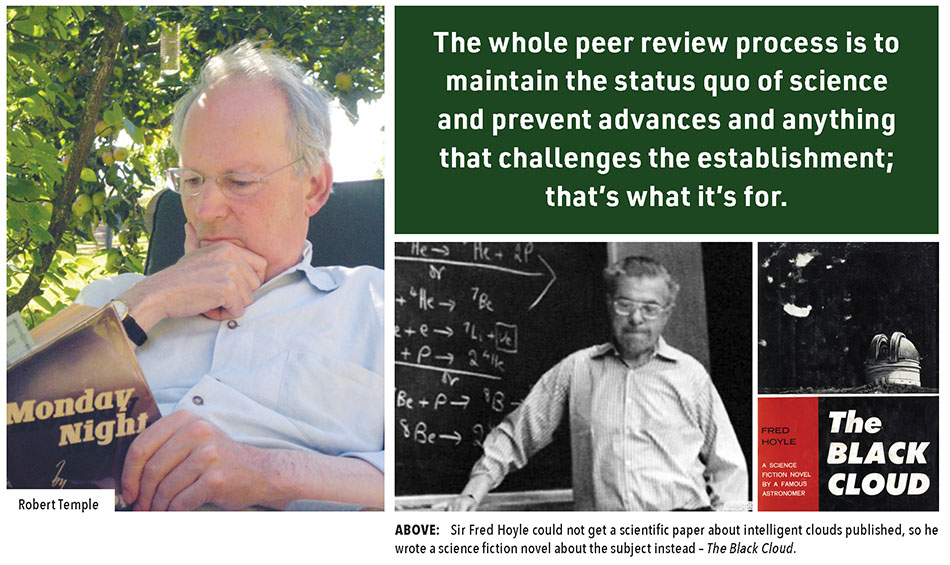
    RS: I would like to ask a question raised by something Fred Hoyle said that you quoted in your book: that the scientific peer review process is merely a retardation of the advancement of knowledge. Could you expand on that a little?

    RT: In my book, I give case histories of scientists who made crucial experiments but were prevented from publishing. One leading case is Fritz Zwicky, a Swiss astronomer who, in the late forties and all through the fifties, kept trying to publish his paper showing evidence that outer space was not empty. The establishment insisted that it was empty; it was a vacuum. So he couldn’t get his paper published for ten years.

    Zwicky went to every physics and astrophysics journal in the world. They all said no. They refused to publish his evidence that outer space was not empty. The head of his own observatory wrote to the journal editors and said, “Whatever you do, don’t publish Zwicky’s paper.” Of course, this man behaved illegally, but he was never held to account.

    Finally, Zwicky went to a biology journal and got it – an astronomical article – published; it was in a peer-reviewed biology journal. This meant that he could have offprints from the publication, which he could then send to all the astronomers. It took him ten years to get around the blockage.

    This is an example of how the advancement of knowledge is held back, not just by the peer review process, which is almost continually abused, but by the knowledge control freaks. The establishment doesn’t want to be shown to be wrong because people would lose face and their reputations damaged. They want to always be correct, and they want to be the wise ones. If you come up with anything that goes against what they’ve already said, they’ll try and stop you, just for egotistical reasons.

    The whole peer review process is to maintain the status quo of science and prevent advances and anything that challenges the establishment; that’s what it’s for. Fred said this because he could not get certain important discoveries published. It happens to everybody. My book is full of these terrible stories of suppression.

    A lot of scientists, unfortunately, are human, with human faults, and egotism is one of the worst of them. My book is full of the sad stories of the heroes of plasma science, who have fought against all the odds to get us to where we are now, which is just the beginning.

    The above first appeared in Quest: Journal of the Theosophical Society in America, Winter 2023, and is reprinted with permission of the editor. To subscribe, visit theosophical.org/membership/departments/quest-magazine

    An article by Robert Temple on this topic, ‘Inorganic Intelligent Beings May Dominate The Universe’, appeared in New Dawn 192.

    Robert Temple’s A New Science of Heaven (Hodder & Stoughton) is available from all good bookstores. He’s also done a number of online interviews which can be found on YouTube, including one by Jay Weidner, see youtube.com/watch?v=Q-oCW9DCQHs, and Pam Gregory, see youtube.com/watch?v=BiI40wZdGqU.

    [alert type=”general” dismiss=”no”]This article was published in New Dawn 198.[/alert]

    [alert type=”success” dismiss=”no”]If you appreciate this article, please consider subscribing to help maintain this website.[/alert]

    © New Dawn Magazine and the respective author.
    For our reproduction notice, click here.
  • Quantum Spirituality: Gnosticism & the Third Way

    Quantum Spirituality: Gnosticism & the Third Way

    From New Dawn 200 (Sept-Oct 2023)

    Most people in the Western world, consciously or unconsciously, fluctuate between two polar orientations toward life – a religious vs. a secular outlook, which is driven by people’s perceptions of modern science. On the extreme end, religion tends to be close-minded and promotes an “us and them” mentality. Secular extremes promote a kind of smug, elitist intolerance that sees religion as the last refuge of the Neanderthals.

    In this article, we will address a third paradigm, a spirituality compatible with the advanced new sciences.

    Both religion and science are two branches of human endeavour that deal with the most basic questions of our existence – who we are, where did we come from, why are we here, and what is the nature of the world in which we live? Philosophy too deals with these questions, but philosophy is really a bridge or a by-product of these two more fundamental pillars of inquiry into the human condition. A sharp divide appears to exist in the way religion and science study and approach these questions so that the average person has to choose which is the correct view.

    RELIGION VS. SCIENCE

    How do you believe life started? How is it maintained? Was it all caused by random particle interactions that somehow created increasingly complex organisms and ultimately led to life? Or, do you believe that life originated through the actions of a deity? Perhaps you simply just don’t know and belong to the vast gray area of those who choose to ignore the tough questions and just forge ahead with life. But any way you cut it, your basic conscious or subconscious convictions about these matters influence the quality of your personal life and the character of our cultures, institutions, nations, and human conditions.

    The belief that life is pure random chance as traditional science says has led to a certain secular, existentialist outlook on how you live and conduct yourself. It might cause conscious or subconscious feelings of futility and fear, both of which have consequences for physical and psychological well-being. Of course, believing in God doesn’t necessarily immunise you from problems, and people can certainly hold distorted, fearful notions of God. Misguided religious zealots often cause far more damage than morally responsible atheists. So, how can we proceed to a better understanding of life?

    Ironically, fear is the common denominator between secularism and religion as practised in the Western world. It is the fear of not truly knowing at a gut level that we are part of a continuing whole as opposed to separated, transient specks that might permanently blip out of existence at any time. Fear and religion are commonly equated, but fear and science? 

    One characteristic of traditional science is that it analyses parts like the physicians who specialise in hearts, eyes, and bones rather than looking at the body as an integrated whole. This approach is fragmented and thus promotes a fragmented, fearful view of life limited to what the five senses can detect, and the five senses cannot detect very much.

    A way does exist to transcend the limitations of secular science and traditional religion. It has to do with the practice of acquiring a particular type of knowledge and experience that puts you in contact with a higher intelligence. Such an experience gives you a certainty that you exist within a larger framework than the visible, material world. It opens you to receiving information to help you perceive new patterns in the fabric of life. Such knowledge can guide you to evolve physically, emotionally, and spiritually. It can help you become independent of the beliefs and dogmas of others because it is not based on faith but on personal experience. 

    The basis of this knowledge has support in both the new sciences and recovered ancient spiritual traditions. This is a Third Way, a spiritual path supported by quantum science leading to realms beyond the limitations of materialistic science and traditional religion. 

    THE FORMS OF KNOWLEDGE

    We can go about our daily business. We can think that politics, economics, wars, and social interactions are the things that most affect our lives, but that is a misperception. Everything begins with the individual. Remember this premise because we’ll come back to it again. 

    All the greater movements of the world and societies occur because of beliefs that start in the mind of the individual. The mind of the individual is largely shaped by the collective, accumulated knowledge of human history. Knowledge, in turn, derives from three primary sources – raw sensory experience, logical reasoning as in science, and intuitive revelation, which is related to abstract or creative thinking. This form of knowledge is more tied to religious and spiritual expression.

    Objective human knowledge came through practical observation of the world around us, first by empirical observation through the senses, and later by various forms of reasoning. But parallel to these objective forms of knowledge was a subjective source that was more abstract and intuitive. This allowed early humans to sense rhythms of the earth and experience things in such a way as to give rise to art and abstract concepts such as gods, spirits, and other representations of unseen forces. 

    DISTINCTION BETWEEN SPIRITUALITY & RELIGION

    Religion is derived from this subjective knowledge just as early science derived from the objective forms above. But here’s the catch. Because intuitive information is subjective, as it is passed from the sage or prophet to the masses, it is susceptible to distortion. Prophets spoke the heart of God but their followers started religions. Not having the prophet’s direct experience, the followers had to interpret. This left room for misunderstandings and the selfish agendas of mass mind thought. The spiritual knowledge revealed by the prophet became encased in dogmatic distortions, usually to gain power or control by one class of people over another.

    This is the main distinction between spirituality and religion – true spirituality is a continuing personal journey and a personal experience while religion is more like being stuck on a faith in the dogmas and teachings of others.

    OLD RELIGION VS. OLD SCIENCE

    The simplistic traditional religious conception of God as a bearded old emperor on a throne in heaven dispensing stern justice for our sins or rewards for our good deeds was greatly eroded in the last century by the discoveries of materialist science. Unfortunately, this liberation from a limiting religious concept was replaced by an equally limiting scientific concept. 

    Materialistic science developed over the past few centuries using a combination of rationalistic deduction and empirical observation of the properties of matter and material organisms. The central notion of materialist science is that creation, life, and reality arise from and can be explained by the interaction of physical particles. In other words, matter is the be-all and end-all of existence.

    The view says that particle interaction gives rise to molecules that combine to form not only planets and physical laws but also simple organisms. These organisms continue combining in greater complexity, culminating in human beings. Consciousness is explained as a byproduct of the neural activity of a physical brain. One thing to note – in this scheme of creation, no adequate theory has explained how organic life evolved from inorganic particle matter. Scientists either ignore this issue or explain it away by dubious (and unscientific) suppositions.

    This materialist picture of creation is a now basic orientation or worldview. It expresses itself in many forms, but three scientific theories, in particular, stand out as the cornerstones that shaped the modern human mind. 

    Newton defined the laws of physics that described a mechanical nature of fixed material objects interacting in a solid, material universe. Descartes introduced a dualist philosophy that said mind and matter were separate and distinct phenomena. In biology, Darwin’s theories displaced the notion of a Creator with the concept of species evolving from lower forms in greater complexity with the chain reaching its peak in human beings.

    RELIGION DISMANTLED

    Suppressed by the Church for centuries, science lashed out on all fronts with a vengeance. Because creation, life, and reality could now apparently be explained by materially based processes, any notion of God, higher intelligence, or transcendent consciousness was taken out of the equation. God was dead. The materialist orientation spread to every form of human thought. 

    The Bible was systematically deconstructed and relegated to amusing myth at best, harmful mind control at worst. And, ironically, the success of science in taking down religion was predicated on the fact that traditional Western religion was itself materially based despite purporting to be spiritual.

    Orthodox Christianity misunderstood the archetypical, symbolic meaning of the Christian story. Instead of seeing Jesus’ advent as a seminal event of higher revelation, it concentrated on a virgin birth. Instead of understanding the meaning behind the profound spiritual wisdom he taught, it concentrated on physical miracles. Instead of perceiving the crucifixion as a metaphor for the way human fear and ego crucify the divine spark trying to awaken within us, it concentrated on the physical agony of his death as a blood sacrifice for our sins. Finally, instead of seeing the resurrection as the awakening of dormant divine wisdom within us while still alive, it perceived the resurrection as physical bodies rising from the grave.

    This focus on literal and material interpretations left traditional religion right on the home field of materialist science. Dismantling the historicity and miracles of the Bible or, at least, casting grave doubt on them, was easy using scientific material rationalism. After all, you can mathematically quantify the apple falling from the tree, but how can you prove a formula for raising the dead?

    THE POLARISATION & FRAGMENTATION OF HUMANITY

    The shift from religion to science has had a profound effect on the psychology, feelings, and outlook of every person on the planet. We now live in a polarised world. The assault of science has driven many people back into a limiting, fundamentalist interpretation of God and religion, often with violent results. Islamic fundamentalism is largely a reaction to people’s religious comfort being torn out from under them by the onslaught of a modern, materialistic world outlook. 

    In the middle of this polarisation is a large gray area of people who are confused and disheartened. Thanks to science they no longer believe in religion, but in facing life’s difficult problems they have an innate spiritual yearning that persists like a smouldering ember, and atheistic science can never satisfy that need. Traditional religion and traditional science have one other thing in common besides their materialistic outlooks on life – they have both done an efficient job of suppressing the human spirit.

    THE THIRD WAY

    Another path exists to explain creation, reality, and the human dilemma. It is a path of hope, for it unifies advanced sciences such as quantum physics with the core precepts of an ancient spiritual wisdom buried within every major religion on earth. As more people become aware of this relationship, it will transform our lives in ways that liberate us from literal religion and atheistic science. It will provide a viable framework to understand many of life’s mysteries and put some sense of control back in our lives. 

    QUANTUM PHYSICS

    Let’s begin with the scientific side of the ledger. Quantum physics is turning traditional science on its head the same way materialist science turned traditional religion upside down. 

    Quantum physics demonstrates that material particles do not exist in and of themselves in a fundamental or natural state. What exists is really waves of light smeared across infinity, a cosmic menu of all possible outcomes or choices, if you will. Only when observed by a conscious observer does the possibility wave collapse into an observable point particle and become physical reality.

    Other startling phenomena exist at the quantum level. Particles are able to communicate with one another instantaneously over vast distances in a non-local manner, meaning with no apparent connective medium or signal between them. Einstein called this process “spooky.” Particles can also make quantum leaps where an electron disappears at one level of energy or orbit and reappears at a higher level without any intervening movement. That would be like the earth disappearing and suddenly popping into the sun without passing through Mercury, Venus, or Mars.

    Quantum physics is showing that the particles on which materialist science is based do not behave at all like the classic Newtonian model. It’s showing that mind or consciousness does not behave at all like Descartes’ dualist philosophy states. It’s shooting holes in Darwin’s version of human origins and creation. Most importantly, it indicates that creation was not a bottom-up process of particles- to molecules- to organisms- to brains- to consciousness. Rather it was a top-down process beginning with consciousness.

    CONSCIOUSNESS

    To understand the astounding and counterintuitive findings of quantum physics, comprehending the role of consciousness is essential. Let’s begin with a definition. Consciousness is awareness. Specifically, it is intelligent awareness capable of choice and direction. The quantum phenomena described above only make sense if consciousness is the primary source of reality. Quantum physics says that our reality begins with energetic light waves of possibility. These possibility waves only collapse into material particles upon observation. But, who is doing the observing? Both Max Planck, the founder of quantum physics, and the ancient spiritual texts tell us that a single Conscious Intelligent Mind or awareness is doing the observing. 

    Then what is the nature of this Consciousness? From where does it arise? Does it have a material or non-material origin? Material science would claim that consciousness arises from matter as a function of the material brain. But quantum physics shows that only conscious observation collapses wave energy into matter, so how can the thing that is bringing matter into existence be created by it? This paradox rules out consciousness being created by matter.

    Now let’s take a page from Descartes’ dualist philosophy. Say that mind (consciousness) and matter are separate and distinct dimensions that somehow interact with one another. So, consciousness is an immaterial force working with matter by some undefined means. Sounds reasonable, even a bit spiritual, right? But in order for matter to receive direction from an immaterial consciousness, there has to be a continual exchange of signals, of information, and that means energy. This can’t pass the laws of physics which state that energy in the universe is constant. The universe can’t be adding new stuff, so we have another paradox.

    Now the Third Way comes into play. All paradoxes are eliminated and all quantum phenomena explained if we see consciousness as the source of all reality. It is the matrix or energy net that encompasses everything observable and unobservable. So consciousness is both particle and wave, matter and energy, observer and the thing observed. This means that when consciousness chooses and collapses a possibility into reality, it chooses from within itself, not from some outside immaterial dimension, hence no paradox. This explains how particles far removed in space instantly communicate with one another. They’re both the same energy manifesting at different points. It explains quantum leaps as an instant transfer of Universal Mind’s focus from one point to another, the way a man might look at a new car and then suddenly fixate on a beautiful woman.

    We can further refine the operations of consciousness in this manner – Consciousness with a capital “C” is the fundamental intelligent energy (call it God, higher intelligence etc.). This Consciousness manifests itself as different points of consciousness with a lower case “c.” That would be you and me and every self-aware being. In quantum scientific terms, capital “C” and small “c” would be called non-ordinary and ordinary consciousness respectively. Big “C” Consciousness is the fundamental light or energy which, like using multiple projectors, projects all reality through us small “c’s.” Collectively, we participate as the aware observers who draw forth material reality from the quantum light wave. We see that the New Age concept of co-creation does have a basis in quantum theory.

    THE SPIRITUAL WISDOM TRADITION

    The astonishing knowledge quantum physics brings about creation, life, and reality was revealed thousands of years ago by the threads of a universal spiritual tradition, the wisdom of which permeated every major religion or philosophy, pagan and modern. One branch of this tradition, in particular, was striking in its many parallels to modern science. It was called Gnosticism. Listed below are some of its key beliefs:

    • God is One, encompassing Energy, Mind, and Matter
    • The One appears as many
    • The kingdom is within you, the spark of the divine is within you
    • You are made in the image of God
    • As it is above, so it is below
    • Do unto others as you would do unto yourself
    • God is everything, everything is God.

    All these wisdom teachings were echoing quantum theory thousands of years ago in the non-technical languages of their day saying that every single thing in creation proceeds from conscious intelligence, and we as human beings are part of that conscious intelligent awareness.

    We’ll limit the discussion of the ancient tradition to three key precepts:

    God is Consciousness, the one and only energy that permeates all reality seen and unseen.

    Light is the vehicle by which this Consciousness expresses itself. Light is intelligent energy and it carries directive information.

    This Consciousness divided itself into many points of consciousness as an outflowing of its light essence.

    We saw above how consciousness is the only thing that explains the paradoxical and strange behaviour of the quantum world that makes up our physical reality. Einstein’s famous formula E=MC² shows that matter and light are interchangeable forms, that is, matter comes from light and resolves back into light. This is a bookend proof of the findings in quantum physics that particles do not occur at the most fundamental levels of reality, only waves of light exist. At some point owing to the actions of consciousness, these light waves crystallise into particle matter. Astounding but true.

    Quantum physics has also confirmed that light contains intelligent information. It’s by the action of light photons (pulsations of light) that matter combines into the unique forms that make up the variety of objects we see in the world. Only something containing intelligence can make such distinctions, only something containing information can create organised forms the way DNA contains the exact information to form our bodies.

    Taken collectively, these findings of modern physics do nothing but reaffirm the three spiritual principles above.

    TRADITIONAL SCIENCE & RELIGION REVISED

    The limitations of traditional religion and science may now be superseded by a liberating new paradigm. I say superseded, not trashed, bashed, or discarded, for this assumes there is nothing good or redeemable in science and religion, and that’s just not so. Let’s take the three pillars of traditional science, Newton, Descartes, and Darwin. Quantum physics exposes their theories as incomplete or incorrect in some of their applications and conclusions. That’s not to say they are categorically wrong. They explain certain functions accurately, but they can’t explain the whole of which they are a part.

    Newtonian physics works well in explaining certain functions of the observable world, but it can’t account for effects under Einstein’s relativity or the sub-atomic world, and it can’t come close to explaining the fundamental operations of matter and consciousness. Therefore, its view of a determined universe as a giant machine is incorrect. Descartes’ dualism seems to define a working relationship between mind and matter for day-to-day purposes, but it is fundamentally incorrect in missing the true underlying unity of the two. Darwin’s theory only explains evolution within species. It never explains the creation or origin of life. It doesn’t even demonstrate how one species evolves into another, like apes into humans, except as an article of faith. The fossil record supports a more quantum leap view, that is, species like human beings came about quite suddenly upon acquiring consciousness.

    The Third Way poses two big course corrections in traditional science and religion. First is the limited and damaging view of materialistic science that life derives from matter instead of matter deriving from consciousness. Second is the traditional religious view that humanity is a separated creation of God as opposed to being a projection of the divine consciousness itself in material form. 

    Get the issue this article appears in

    THE PRACTICAL IMPLICATIONS OF THE THIRD WAY

    Recognising the fact that consciousness creates everything and that we are all part of that consciousness means, as Jesus said, the kingdom is within. We are not separated from the divine force, we are a projection of it and we, in turn, can truly be co-creators of our reality. We cannot do this out of our ordinary consciousness, however. We must align with our non-ordinary Higher Consciousness through meditation or other practices, but this is readily achievable for all.

    Achieving this puts a measure of control into our seemingly random lives. Once we learn the principles of how higher intelligence works, we begin to focus on those things that have value to us, and we can even develop a notion of what it is we should truly value. We find our lives working better and old, negative patterns break up. We’re incentivised to become more spiritually responsible and aware because we understand the payoff is putting the power of the universe on our side. We can replace the moral values of religion, already eroded by traditional science, with a higher spiritual concept of wholeness so it becomes our own self-interest not to hurt others because we see how we ultimately hurt ourselves.

    One of the most life-altering experiences is having a direct communication with higher intelligence and receiving information that proves out in the “real” world. Some people become medical intuitives; others develop intuition that helps their financial or life decisions. The applications are many. When we experience the operation of this information in our lives as it translates from the psychic into the material realm, we have passed beyond faith in the unseen (religion) and graduated to knowledge that the unseen is the true underlying reality (spirituality). 

    Few people understand the real meaning of quantum physics to date, fewer still understand the hidden spiritual wisdom of the past. Once these concepts go mainstream, they will transform our world and exponentially propel the evolution of our consciousness. If you doubt this statement, consider this – a few hundred years ago, the Church had its grip around the neck of the truth. Science gradually bled through this iron curtain. In our lifetime, we saw the accelerated erosion of such fear-based concepts as a judgmental biblical God. Traditional science, for better or worse, has shaped the basic world outlook of most people today. But science replaced the old concept of God with an empty shell of chance occurrences – life, the great accident – which is not such a great life after all. We went from the frying pan into the fire.

    But a new genie is now out of the bottle. It’s taking the form of quantum physics echoed by rediscovered ancient Gospels shedding light on a universal wisdom tradition. It provides a truer picture of creation, reality, and of our human origin and purpose. It’s an empowering message that transcends the limitations of traditional religion and the dulling atheism of materialistic science. It’s taking time to filter into the mass mind awareness, but when it catches on, we’ll see a quantum leap in all aspects of human activity as we discard the yokes of our past religious and scientific beliefs.

    Charles Sanders Peirce, a pioneer of the modern scientific empirical method, wisely said that the conclusions of science are always tentative. The scientific method should be self-corrective, discarding outdated knowledge to make way for new discoveries. By continued application of this method, science can detect and correct its own mistakes, and thus eventually lead to the discovery of truth. Many scientists have forgotten this wisdom. They’ve fallen into a religious-like orthodoxy of static, dogmatic beliefs that stifle alternative information such as what has been presented in this article. 

    What a great discovery to realise that the God of quantum physics is actually the God of the ancient mystics come to reclaim a place in our consciousness. This merged knowledge can dispel the limiting errors of our previous works, and that is evolution in action, not stagnation in ignorance. Though we do not have the final insight on these matters, I fervently believe the closest we will come to discovering universal truth is the point where the objective world of science intersects with the subjective world of mystic spirituality.

    To explore this subject in depth, read Peter Canova’s new book Quantum Spirituality: Science, Gnostic Mysticism, and Connecting with Source Consciousness (with a foreword by James Redfield), available from all good bookstores.

    [alert type=”general” dismiss=”no”]This article was published in New Dawn 200.[/alert]

    [alert type=”success” dismiss=”no”]If you appreciate this article, please consider subscribing to help maintain this website.[/alert]

    © New Dawn Magazine and the respective author.
    For our reproduction notice, click here.
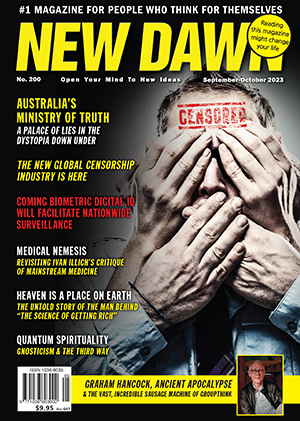
  • Graham Hancock, Ancient Apocalypse & The Vast, Incredible Sausage Machine of Groupthink

    Graham Hancock, Ancient Apocalypse & The Vast, Incredible Sausage Machine of Groupthink

    From New Dawn 200 (Sept-Oct 2023)

    I would rather have questions that can’t be answered than answers that can’t be questioned.
    – Richard Feynman

    November 2022 saw the release of Graham Hancock’s controversial documentary series Ancient Apocalypse on streaming giant Netflix.

    The backlash was immediate, hysterical and, perhaps, even insightful.

    Now that the dust has settled, what can be discerned from the vilification, defenestration and immolation of Hancock and his theories?

    Starting with his 1995 book Fingerprints of the Gods, Graham Hancock has carved a sizeable career casting doubt, asking questions and proposing alternate theories in opposition to the mainstream consensus on archaeology and ancient history.

    More recent volumes like the 2002 Underworld: The Mysterious Origins of Civilization (which focused on alleged evidence of cities and civilisations lost in the roughly 400-foot sea level rise since the end of the last Ice Age, approximately 12,000 years ago) or the 2015 tome Magicians of the Gods: The Forgotten Wisdom of Earth’s Lost Civilization (which explores the hypothesis that around 12,000 years ago [and more recently] large fragments of a comet struck the North American and European ice caps, resulting in massive, almost species destroying, deluges of melted glacial water).

    Both books (and many others from Hancock) present large caches of fascinating, incongruous and unconventional evidence that question the foundations of conventional views and academic assumptions about pre-history and the acceptable framework of archaeology. But Graham Hancock is hardly alone in questioning the received structure of mainstream history.

    There is, in fact, a long subterranean tradition of ‘catastrophism’, hypotheses and beliefs about the cyclical nature of human civilisation and the greater history of Earth itself. 

    Immanuel Velikovsky’s 1950 book Worlds in Collision created a firestorm of controversy upon initial release. Velikovsky proposed a mythic reconstruction of Earth’s ancient past, whereby the legends and fables of the Bible and other scriptural and cultural accounts might be compared, reconciled, and evaluated to illuminate our periodically unstable world. 

    Velikovsky has been credited as having founded modern ‘catastrophism’, the study of Earth and civilisation’s cyclical nature. Worlds in Collision was a bestseller upon release, but it was alleged that the scientific community had attempted to suppress the book and refused Velikovsky any forum to debate his detractors in the scientific world. Five years later he published Earth in Upheaval to respond to the outcry from those in the orthodox camp.

    Mankind in Amnesia was published in 1982 (posthumous to Velikovsky’s 1979 death) and proposed a kind of species-wide post-traumatic amnesia in response to our cataclysmic past – the author linking mankind’s history of war, aggression and barbarism to his turbulent mindset.

    In 1966, Velikovsky associate Alfred De Grazia published The Velikovsky Affair, a detailed and compelling recounting of all the controversies that swirled around the ‘catastrophic school’ of scientific and historical revisionism.

    Concurrently, Charles H. Hapgood advanced his theory of catastrophic shifts in the Earth’s poles and crust in 1958’s Earth’s Shifting Crust: A Key to Some Basic Problems of Earth Science (which came with a foreword by Albert Einstein). Later, in 1966, Hapgood wrote Maps of the Ancient Sea Kings: Evidence of Advanced Civilization in the Ice Age in which he studied anomalous maps (like the Piri Reis map of 1513) that appeared to suggest ancient knowledge of lower sea levels and an ice-free Antarctica.

    Indeed, across the late-1960s and 1970s, a multitude of writers (prolific scribes like Rene Noorbergen and Andrew Tomas come to mind) questioned orthodox history and sketched antediluvian relics and societies in one form or another.

    Perhaps the earliest, in the modern era, had been Ignatius Donnelly’s 1882 classic Atlantis: The Antediluvian World. 

    In fact, beliefs in a cycle of cataclysm and renewal, of hubris and arrogance leading to a catastrophic downfall, are at least as old as Plato’s ‘Republic’ (circa 375 BCE) – which records the oldest ‘legend’ of Atlantis that survives to this day. 

    So, while undermining the constructions and institutions of conventional history and archaeology may not be new, what was it about Graham Hancock’s Ancient Apocalypse that triggered such a violent, fire-breathing response?

    Ancient Apocalypse – “Dangerous”

    Examples of that hyperventilating media scorn are plentiful, but the UK’s The Guardian so often serves as a convenient temperature-check on fevered, delirious outrage and posturing, radical establishmentarianism. Handily, The Guardian printed not one but two howling tirades against Ancient Apocalypse in the space of one week.

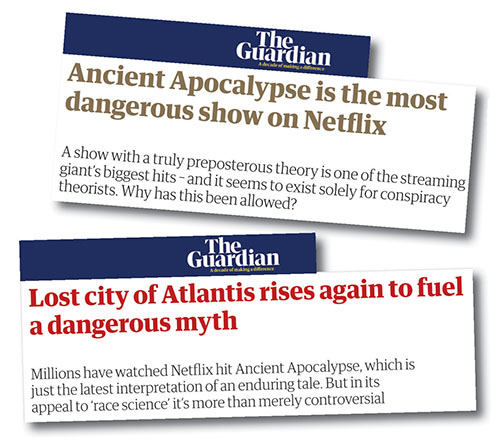
    The most darkly entertaining was penned unironically by media critic Stuart Heritage, whose headline screamed: “Ancient Apocalypse is the most dangerous show on Netflix.”

    Dangerous? It might be easy to describe Graham Hancock as ‘studious’, ‘reasonable’, ‘professorial’ even ‘bookish’ but ‘dangerous’ (i.e., ‘deadly’, ‘fatal’ or ‘threatening’)? Really?

    One is, of course, entirely free to view Hancock’s thesis as fanciful, unlikely or even wrong, but to ascribe ‘danger’ to an alternative archaeological hypothesis seems to be the most delirious kind of mania and absurdity.

    It actually gets worse. The Guardian sub-headline continues: “A show with a truly preposterous theory is one of the streaming giant’s biggest hits – and it seems to exist solely for conspiracy theorists. Why has this been allowed?”

    “Allowed.” Yes, he actually said it.

    How dare this bespectacled destroyer of academic smugness and media comfort zones, this avenging angel, this soulless wrecker of echo chambers and laptop-class talking points be “allowed?” 

    Here, presumably, Heritage appeals to parental authorities, kindergarten teachers, high school prefects, yard monitors (anybody!) to do something… anything. Indeed, Heritage seems to be demanding Hancock be ‘blacklisted,’ ‘cancelled,’ ‘removed,’ ‘deleted’ or even ‘disappeared’ for his crime of heresy.

    Astounding.

    An infantile scream for bloody ideological revenge.

    Heritage’s penultimate paragraph makes it clear that Graham Hancock is guilty of Thoughtcrime:

    “That’s the danger of a show like this. It whispers to the conspiracy theorist in all of us. And Hancock is such a compelling host that he’s bound to create a few more in his wake. Believing that ultra-intelligent creatures helped to build the pyramids is one thing, but where does it end? Believing that election fraud is real? Believing 9/11 was an inside job? Worse?”

    Stuart Heritage and The Guardian are such prisoners of dogma, such willing inmates of the propaganda panopticon, that they dare not see their violent hypocrisies in the damning black mirror. ‘Election fraud’ is a delusion (except when Authority says Russia did it). ‘False flag’ attacks a mirage (except when The Media declares The Enemy guilty). In their view, every mainstream narrative should be unassailable, questions or criticisms never to be “allowed.”

    Just a few days later, on 27 November, Robin McKie, ‘Science Editor’ at The Guardian, swooped down for the kill with his piece entitled, “Lost city of Atlantis rises again to fuel a dangerous myth.”

    “Millions have watched Netflix hit Ancient Apocalypse, which is just the latest interpretation of an enduring tale. But in its appeal to ‘race science’ it’s more than merely controversial.”

    Shamelessly, McKie continues, accusing Graham Hancock of “white supremacist” ideas and “racism” recklessly unaware or uncaring (as the media so often is) that such defamatory claims have real world implications and effects on real people. While media behemoths may indeed be untouchable, real people are not.

    Indeed, in subsequent interviews, Hancock has spoken of the personal hurt and professional damage such vilification caused him. It’s hard to imagine The Guardian would care.

    McKie produces some convenient cookie-cutter academic to intone gravely, “They strip indigenous people of their rich heritage and instead give credit to aliens or white people” while never noting that throughout its eight episodes Ancient Apocalypse never once actually mentions ‘aliens’ or race. Such is the sloppiness and disregard on display in The Guardian’s ‘journalism’ that basic ‘fact-checking’ or simple respect for your subject is essentially non-existent.

    Finally, Robin McKie can’t help but go for the low blow:

    “Then there were the Nazis. Many swore by the idea that a white Nordic superior race – people of ‘the purest blood’ – had come from Atlantis. As a result, Himmler set up an SS unit, the Ahnenerbe – or Bureau of Ancestral Heritage – in 1935 to find out where people from Atlantis had ended up after the deluge had destroyed their homeland.”

    As JR Leach points out in his humorous piece on Off-Guardian:

    “Of course, going by this logic, we should really do away with Christianity as well. God in general, in fact. Perhaps we should cancel Volkswagen and Wagner too. Nazis also brushed their teeth and wore shoes, I believe, neither of which shall I be taking part in from this day onwards, just to be sure.”

    Indeed, we should probably identify Plato as a retrospective proto-National Socialist if we were to follow McKie ‘argument’ to its logical endpoint.

    For another example, one need simply return to the second paragraph of Stuart Heritage’s hit piece where he asserted (falsely) that the opening moments of Ancient Apocalypse featured Hancock in conversation with gatekeeping bad-boy Jordan Peterson (it was actually an entirely different legacy media pariah/competitor, Joe Rogan). But seriously. Any ‘heretic’ will do. The edit and correction were so slapdash that they still bear the signs of faulty syntax. It now reads: “In quick succession, during the pre-show sizzle reel, we are treated to a clip of the show’s host Graham Hancock being interviewed by Joe Rogan.” ‘In quick succession’ implies a plural of ‘clips’ where there is now only one, such was the haste and contempt of this yellow ‘journalism’.

    Media Mass Formation Psychosis

    Across establishment rags, hipster organs and boutique bourgeois bromides alike – from Slate, The Conversation and Scientific American to The New Republic, The Nation, The Independent and Australia’s anaemic ABC network – spewed a unified chorus of Two Minute Hate.

    Hancock was mugged and dragged kicking into the Culture Wars.

    But why?

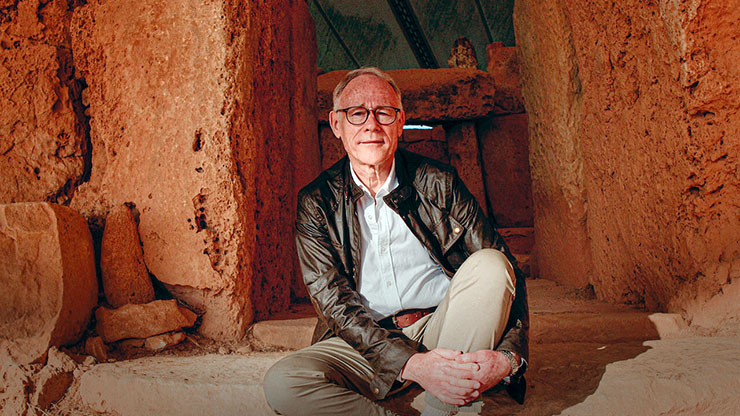
    Graham with my his wife Santha Hancock, August 2019, inside the long and steep entrance corridor to the “Bent Pyramid” (attributed to Pharaoh Sneferu) at Dashur, about 30 kilometres south of the Great Pyramid of Giza, Egypt. Photo credit: facebook.com/Author.GrahamHancock

    Why the mild-mannered Graham Hancock? And why now?

    That is the sixty-four-million-dollar question.

    Like some cornered, enraged beast, desperate to defend its turf, desperate even for survival: the legacy media and its sycophants spat bilious globules of venom. Of course, they did.

    Whether co-ordinated or reflexive (we’ll likely never know), that fevered monster, the giant octopus of consensus reality, marshalled all its antibodies (dare I say – its white-blood cells) to ward off infection of the body ideological.

    While ‘The Hancock Affair’ is just one of many examples, it is a particularly instructive one. The hysteria, the untethering from any kind of objective reality, the bile and scorn uniformly directed toward an innocent scholar, simply asking questions and poking conventions, can tell us a great deal.

    Reminiscent of the theories of Mattias Desmet (as expounded in his book The Psychology of Totalitarianism), the last three years (in particular) have seen a mass traumatic event that drove segments of a frightened population even further into the arms of authority. People prone to ‘free-floating anxiety’ (arguably, partially, or even wholly, a result of incessant media weaponization of fear and confusion) are liable (generally unknowingly) to engage in what Desmet calls “mass formation” – a kind of totalitarian mass psychosis that identifies dissent or disagreement as a ‘dangerous’ ‘pernicious’ foreign influence that must be attacked and destroyed to preserve the righteous social organism.

    Individuals such as Heritage and McKie (unknowingly, or at least with minimal bidding from their editors) respond precisely as ‘mass formation’ dictates, in spasms of frothing anger and blind rage. Emotionally, they have committed themselves to the ‘mass’ and see ‘the other’ as an existential threat. In this case, the ‘mass’ is conventional history and ‘social justice’ as supported, indoctrinated and embodied by all the ‘respectable’ and conventional instruments of state, media and education.

    Writing in a New Republic piece entitled, “The Strange and Dangerous Right-Wing Freakout Over Ancient Apocalypse” from December 2022, Jason Colavito inadvertently illuminates his own, and his group, mass formation:

    Ancient Apocalypse sits alongside Tucker Carlson, Joe Rogan, and the so-called ‘intellectual dark web’ in casting doubt on expertise, privileging emotion over evidence, and bending history to ideological ends – in this case, making common cause with the right against academia, science, and the very idea of shared reality. That it did so on one of the biggest media platforms in the world should give us all pause.”

    Hancock is no longer just a journalist, presenting different theories and unconsidered evidence, now he is a heretic who joined other heretics (Carlson, Rogan et. al.) in threatening the body with danger. Colavito identifies emotionally and practically with the ‘mass’ (or ‘The Blob’ as James Howard Kunstler calls it) and instinctively rises to battle, just as the body’s antibodies attack infectious threats.

    Indeed, he continues: “History isn’t just about what happened in the past. It’s also about whose stories get told and how we think about them.” Colavito speaks about “shared reality” as if there is only one correct and acceptable vision of the past and present, one party or ‘mass’ definition of what is appropriate to think and to verbalise.

    It is, unfortunately, witheringly totalitarian language delivered with all the confidence and righteousness of someone who does not know history at all. Colavito has simply internalised the desires and dictates of the ‘mass’ so completely that they are entirely invisible to himself and his peers. He is a loud, proud foot soldier for control and Groupthink. 

    What we are witnessing appears to be a kind of ‘Project Year Zero’ – the purging of traditions, history, debate, discussion, dissent and dialogue and its replacement with a new unassailable framework of history and ideology – a ‘Great Reset’ if you will. And those who question or resist are identified, shamed and un-personed by the ‘mass’. 

    This totalitarian mindset has, essentially, overwhelmed almost all organs of the state and culture. In essence, it appears we have a ‘collaborator class’ throughout the institutions of the media, academia and politics. Confident, well-rewarded and secure in their superannuated echo chambers, ‘the collaborators’ march forth, the ‘Red Guards’ of the 21st century, like busy bees animated by ‘struggle sessions’, ‘purity tests’ and ‘purges’.

    Pure in doctrine and safe in the group.

    But if the ‘collaborator class’ are indeed collaborators, who, exactly, are they collaborating with?

    Get the issue this article appears in

    The Caligula Class & Their Collaborators 

    Reading, again, Robert Graves’ masterful I, Claudius, I was struck by how oddly familiar the historical figure of Caligula was. A paragon of power, madness, delusion and depravity, Caligula has become a byword for power without responsibility, action without consequences, bloodlust and corruption without end. But Caligula was just one man – he was nothing and would have been entirely impotent without a class of collaborators, a stratum who milked his madness and power while they could – who laughed and celebrated his crimes, deluded that they were forever immune from his wrath and mania.

    Today, we do not have one Caligula. We have, perhaps, a thousand. Most of them likely unknown to the public and popular culture – but their frontmen are obvious – and often, unsurprisingly, immune for their crimes and corruptions, at least for decades. Harvey Weinstein, Jeffrey Epstein and his long-time best buddy (tech billionaire and ‘philanthropist’) Bill Gates, are simply the most visible pus to escape the boil – pillars of depravity, the platinum-plated flotsam that has floated to the surface of a vast, dank pond. Captains of industrial scale abuse that masquerades (with almost complete media fealty) as ‘philanthropy’ and ‘expertise’.

    The scab hides an entire ‘Caligula class’.

    Their ill-gotten, manufactured fortunes washing through foundations and think tanks, grants and gratuities, funding opportunities and photo ops – animating an entire media and political class to do their bidding. There were always plenty glad to seek Caligula’s favour, marshalled by fear or ambition. Today is essentially the same.

    Though the Caligula class and their collaborators are indeed powerful, with almost all the present levers of state and media at their command, now is not a time for despair. Their power is transitory and illusory, magnified by technology and modern magics – their grasp fragile as evidenced by their hysteria when a ‘heretic’ appears on one of ‘their’ platforms, in ‘their’ terrain, ‘their’ backyard.

    Perhaps, ‘their’ day is almost done. The final, ear-bursting shrieks of outrage and mendacity almost over.

    Meanwhile, a humble scholar, a gentleman journalist – Graham Hancock – recently caught in the cultural crossfire, is now gone on a six-month research sabbatical. Preparing, quietly and methodically, to face again the dragon of power, depravity and ignorance.

    Good luck, fair Graham… 

    [alert type=”general” dismiss=”no”]This article was published in New Dawn 200.[/alert]

    [alert type=”success” dismiss=”no”]If you appreciate this article, please consider subscribing to help maintain this website.[/alert]

    © New Dawn Magazine and the respective author.
    For our reproduction notice, click here.
  • Manufacturing Enemies: The Slide Toward War With China

    Manufacturing Enemies: The Slide Toward War With China

    From New Dawn 189 (Nov-Dec 2021)

    It’s an unthinkable scenario, one which no one in their right mind would want. And yet, we sit on the precipice of the unthinkable: a war with China.

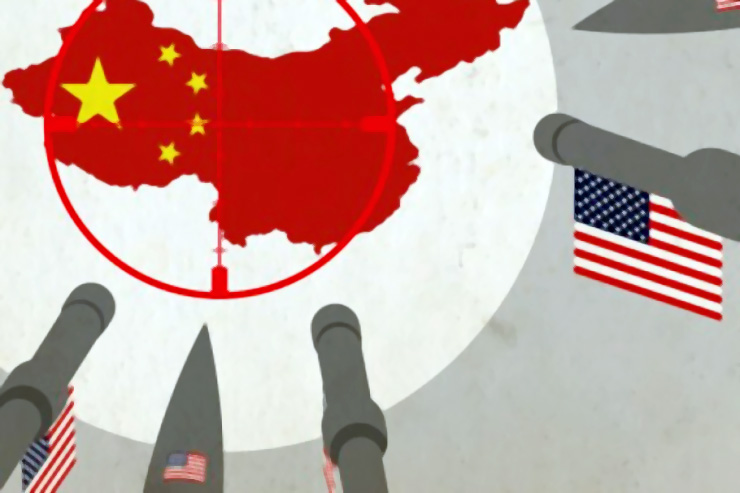
    The bellicose rhetoric became more noticeable during the Trump presidency and has since elevated to another level after the Covid crisis. The US and its allies have been steadily building up military capabilities for years in preparation for a major confrontation in the Pacific.

    One gets the distinct feeling that China is being groomed for “Axis of Evil” membership, right alongside North Korea and Iran. With ever-increasing frequency, western media dutifully portray Chinese leader Xi Jinping as a ruthless and cunning autocrat. Aside from familiar accusations of ‘Chinese bullying’ in the South China Sea, there is also western charges of ‘genocide’ against the Muslim Uyghur population in China’s Xinjiang Province. 

    More recently, Western politicians and media blame a “reckless” Chinese Communist Party for unleashing the Covid-19 pandemic on the world. The latter charge may seem hyperbolic, but it’s been most effective in sharply increasing Western hostility towards China.

    There is a real fear all this fighting talk will eventually reach a crescendo that sets the two opposing powers on a collision course that could radically transform the global system for the next century and beyond.

    It’s no surprise that China would like to see the US out of Asia, but at what cost?

    Similarly, in its desire to maintain global hegemony, the United States aims to knock China’s economy and global influence down a peg or two. Would they wage a world war to do it?

    At the very least, this has initiated new international arms and cyber warfare races. Will it escalate into an intense hot conflict or a new cold war with lower intensity operations and proxy wars stretching out over decades? 

    Can this apparent drift towards conflict be averted, or will history repeat itself as superpowers from different hemispheres with two different political and economic visions are drawn into a world war?

    Thucydides Trap

    Unlike previous US target nations, China is a permanent UN Security Council member and set to surpass the United States as the world’s largest economy and all the global influence that comes with it.

    Yet, more than ever, there is a pervading sense that a confrontation between the incumbent western superpower and the emerging power in the east is becoming unavoidable.

    This geopolitical phenomenon has been referred to as “The Thucydides Trap,” a term popularised by American political scientist Graham Allison that describes an apparent tendency towards war when one emerging power threatens to displace an existing great power as a regional or international hegemon.

    In Ancient Greece, Thucydides was an Athenian historian and military general who believed that the underlying cause of the Peloponnesian Wars was a fait accompli. “It was the rise of Athens and the fear that this instilled in Sparta that made war inevitable,” he explained.

    In other words, opposing superpowers invariably find themselves in competition with one another, either in trade or over ideological and cultural supremacy, creating an unavoidable spiral towards confrontation.

    This concept implies there are inescapable psychological realities of human dynamics in a world of competing nations. Realist scholar Ken Waltz, the author of Man, The State and War (published in 1959), posited that behind the facade of diplomacy and international relations exists a Hobbesian “state of nature” that is always in a perpetual state of anarchy.

    Waltz’s theoretical work is credited with helping form the “bipolar” world order paradigm that dominated intellectual and academic thinking in the West through the Cold War era (1948-1991) and beyond. The bipolar world order was succeeded by a unipolar world order led by the United States and its allies following the rapid collapse of the Soviet Union and its satellite network of countries.

    Speaking to the question of the foundational motivation behind the Thucydides Trap, Waltz wrote: “States in the world are like individuals in the state of nature. They are neither perfectly good nor are they controlled by law.”

    “Each state pursues its own interests, however defined, in ways it judges best. Force is a means of achieving the external ends of states because there exists no consistent, reliable process of reconciling the conflicts of interest that inevitably arise among similar units in a condition of anarchy.”

    “With many sovereign states, with no system of law enforceable among them, with each state judging its grievances and ambitions according to the dictates of its own reason or desire – conflict, sometimes leading to war, is bound to occur.”

    As for judging the outcome of any conflict between great powers, Waltz did not hide his cynicism to the point of ambivalence, as he famously remarked:

    “Asking who won a given war, someone has said, is like asking who won the San Francisco earthquake. That in war there is no victory but only varying degrees of defeat is a proposition that has gained increasing acceptance in the twentieth century.”

    Waltz’s harsh realist worldview never sat well with liberal internationalists and true believers in the United Nation’s global governance system who believe that world peace can one day be achieved through cooperation among nations and interdependency. In many ways, these are two irreconcilable worldviews.

    Still, in the absence of that Kantian vision of an international utopia, Waltz does speak to some fundamental truths: why people and nations do what they do, and insights to help us better understand history that may save nations from sliding into undesirable wars.

    2025: A Limited Window of Opportunity

    A 2016 RAND Corporation document commissioned by the US Army, “War with China: Thinking Through the Unthinkable,”1 outlines likely scenarios with war planners stressing there is a limited window of opportunity to confront China, beginning close in 2025. 

    After that, they argue China will achieve an irreversible level of global dominance and capability. They state:

    “We postulate that a war would be regional and conventional. It would be waged mainly by ships on and beneath the sea, by aircraft and missiles of many sorts, and in space (against satellites) and cyberspace (against computer systems). We assume that fighting would start and remain in East Asia, where potential Sino-US flashpoints and nearly all Chinese forces are located.”

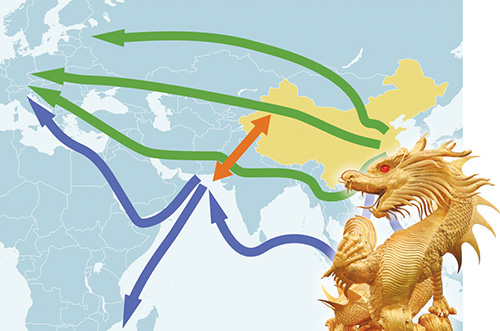
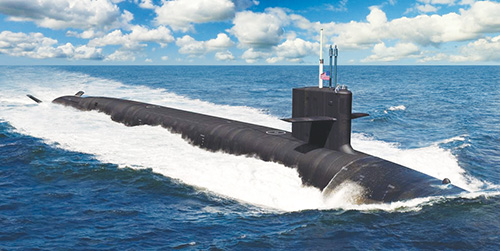
    The recently announced UK-Australia-US (AUKUS) defence pact was designed to do just this. Using Australian bases to increase their nuclear submarine capabilities, the US and UK can submerge for more extended periods to threaten the Chinese Navy and ultimately disrupt Chinese shipping lanes and international trade through the Southeast Asian and Pacific region.

    As for the nuclear question, geopolitical analyst Brian Berletic explained this polarity in Thucydidean terms in a recent interview: “It’s concerning because these are two nuclear-armed countries… While it’s unprecedented for the US to start an armed conflict directly with a peer, or near-peer competitor, it is also unprecedented that China is now in a position to pass the West.”2

    The RAND analysis states that even if nuclear weapons were not used, China would resort to other ways of attacking the United States proper, mainly through space and cyberspace, meaning the public or commercial use of both domains would be severely curtailed during a protracted period of hostilities. However, the US is prepared to deploy smaller lower-yield tactical or ‘battlefield’ nuclear weapons. With a sizeable arsenal already, this would still be a step below high-yield nukes, which both sides would be reluctant to deploy. In such a scenario, whoever struck first would have the upper hand and significant leverage for setting a higher risk threshold than their opponent. Unlike the US, China would want to avoid using any nuclear weapons near its shores. 

    For the globalists, all this might be a worthwhile sacrifice to make, especially if by the end of a long and costly war a global outcry emerges – clamouring for a One World Government as the final solution to keeping the peace and curing all of our planetary woes.

    Target: Belt and Road

    The US plan to contain China is nothing new. You can go back to a State Department document from 1965 entitled “189. Draft Memorandum From Secretary of Defense McNamara to President Johnson”:

    Beijing’s Belt and Road Initiative is a massive infrastructure project stretching from East Asia to Europe with interconnections across the entire globe.

    “The February decision to bomb North Vietnam and the July approval of Phase I deployments make sense only if they are in support of a long-run United States policy to contain Communist China. China – like Germany in 1917, like Germany in the West and Japan in the East in the late 30’s, and like the USSR in 1947 – looms as a major power threatening to undercut our importance and effectiveness in the world and, more remotely but more menacingly, to organise all of Asia against us.”3

    More than anything else, China’s New Silk Road project, known as the Belt and Road Initiative, worries the Anglo-American world order. Through their ambitious project, China is attempting to develop a vast network of interconnected land and sea transport trade routes to facilitate its future growth.

    Western plans like AUKUS are meant to thwart Belt and Road shipping lanes, while other destabilisation operations would be carried out at crucial land access points like Pakistan’s Gwadar port in Balochistan, as well as covert operations in Afghanistan, disruptions in the Persian Gulf, and instability in Africa’s Sahel region, to name just a few. 

    Interestingly, McNamara’s old memo foreshadowed many of these disruptive operations: 

    There are three fronts to a long-run effort to contain China (realising that the USSR “contains” China on the north and northwest): (a) the Japan-Korea front; (b) the India-Pakistan front; and (c) the Southeast Asia front.

    Myanmar is also a key node in the Belt and Road map with a pipeline transporting fuel from the Bay of Bengal to the Chinese mainland. Operationally speaking, the US views any location that could potentially supply China with resources as a place of interest.

    Australia: Deep Port One

    In George Orwell’s classic novel 1984, Great Britain was disparagingly referred to as Air Strip One, presumably for functioning as Oceania’s (likely representing a US-led Anglo-American hemispheric order) “unsinkable aircraft carrier” parked on the European fringe.

    Similarly, the AUKUS defence pact formalises Australia’s position as an Anglo-American outpost to project power across the Indo-Pacific. Henceforth, Australia becomes Deep Port One, a platform to launch future naval and submarine operations against the People’s Republic of China. This would see an expansion of military operations in Australia’s Northern Territory with ports located around Darwin and possible plans to develop a new facility in Exmouth Gulf in Western Australia.

    Former Australian PM Paul Keating vehemently opposed the pact, telling off [the then] PM Scott Morrison, warning in a public statement that it “will amount to a lock-in of Australian military equipment and thereby forces, with those of the US with only one objective: the ability to act collectively in any military engagement by the US against China.”4

    The fact that this also makes Australia a bona fide target in an armed conflagration between two nuclear powers is of little concern to the United States, who are set to bill Australia a cool $66 billion for building its new group of nuclear-powered submarines – hardware which will no doubt be managed and staffed by US personnel. 

    It should be noted this scenario of Australia obtaining nuclear-powered submarines – which is now coming under heavy scrutiny as to its practicability – could be a disinformation ploy to cover up the real strategy.

    A report in The Times on 21 September, ‘Britain’s nuclear submarines to use Australia as base for Indo-Pacific presence’, indicates what might be in the works.

    “Senior [UK[ government sources said that the AUKUS pact could lead to the Royal Navy’s 1.4 billion pound Astute-class attack submarines undergoing deep maintenance in the region so that they can stay deployed for longer rather than returning to the Faslane naval base in Scotland.”

    The Times quoted James Peddell, a former defence technology attache in Washington with experience in submarine technology, who said that a base in Australia could “bring the power of a submarine right up to the doorstep of China… You can bring it in closer, in a stealthy way. You can do intelligence and surveillance, you can project power… and give protection [to surface warships].”

    Britain would get to use facilities in Australia to house its nuclear-powered submarines. London is hailing the deal as a victory for its new ‘Global Britain’ brand, but it’s just the latest instalment of Perfidious Albion having another go at the Great Game. If history is any guide, it’s sure to leave a trail of chaos and destruction in its wake. 

    It’s no secret Australia has always been regarded by Washington and London as a convenient Asia-Pacific backwater colony for its Five Eyes network and global military-industrial complex, most notably its NSA signals intelligence and satellite surveillance base located at Pine Gap, along with joint military bases around the country’s coastal map. This provides the Atlanticist power bloc with a valuable foothold at the gateway to both Southeast Asia and the South Pacific – so the chances they ever release Australia from their political grip is slim to none. Due to its strategic importance, Washington and London always wield influence and power behind the scenes of Australian politics and will orchestrate regime change when the people elect a potentially unfriendly government in Canberra, such as the case of the joint CIA-MI6-ASIO operation in 1975 to remove Labor Prime Minister Gough Whitlam. Award-winning journalist John Pilger recalled, “Australia briefly became an independent state during the Whitlam years.” Since that coup, Washington has determined the whip-line in Canberra.

    This controlling influence continued into the Hawke years, confirmed after the declassified release of secret US embassy cables in 2021. A paper by Federation University’s Cameron Coventry on the cables said the Americans valued Hawke because he “helped protect [US] defence installations, provided information about union disputes and warned officials that installations could be targeted.”

    Covering the period 1973 to 1979, the cables revealed that Hawke worked intimately with US officials, notably Ambassador Marshall Green, on every key aspect of trade union and Labor policy. Their other preoccupation was how to muzzle rising opposition to the US alliance as a result of the Vietnam War and to protect highly strategic American military-intelligence bases in Australia.

    It’s also worth noting that should the US and Britain wish to drag Australia into a war with China, the electorate will have no say in the matter. Nor would there be any debate in Parliament. To declare war, the Prime Minister only needs to notify the Minister of Defence of his plans. Democracy at work.

    Taiwan

    If a full-blown conflict between the US and China is initiated, the trigger will be over the island of Taiwan, located off the coast of the Chinese mainland.

    Along with US allies Japan and South Korea, Taiwan would make the ideal tripartite partner to countering Chinese power in the Pacific. Such an alliance has been discussed but remains a remote fantasy under Beijing’s enormous shadow.

    China maintains that Taiwan is rightfully part of the mainland under its “One China” doctrine. Officially named the “Republic of China” with a population of 24 million, Taiwan is a diplomatic conundrum, no longer recognised as an official entity by the United Nations, but receives substantial political, trade and military support from the US, which uses it as the key chess piece on its geopolitical board in the Asia Pacific region.

    Many experts believe that by 2025 China plans to seize control over Taiwan, a move that would effectively signal the end of Washington’s predominance in the Pacific and maybe the world. At that point, there would be little the US could do to stem the tide of Beijing. 

    When America first pledged its support to Taiwan, China was not today’s emerging global superpower. So, has Washington written a cheque which it can no longer cash?

    Historian Niall Ferguson writes: “As a student of history, to quote Kissinger, I see a very dangerous situation. The US commitment to Taiwan has grown verbally stronger even as it has become militarily weaker.”5

    “Perhaps Taiwan will turn out to be to the American empire what Suez was to the British Empire in 1956: the moment when the imperial lion is exposed as a paper tiger.”

    Has the US placed Taiwan in the firing line to realise and protect its own global ambitions? Either way, this part of the puzzle remains complicated but extremely important. 

    ASEAN is with China

    The residents of Southeast Asia, also known as the ASEAN bloc, are not keen on the prospect of a US-led war on China.

    Former Malaysian Prime Minister Dr Mahathir Mohamad, interviewed by The Australian Financial Review, commented on the new AUKUS deal: “This agreement indicates you openly regard China as a possible enemy and that, if it comes to the crunch, you might even go to war. Just imagine what war would do to Southeast Asia.”6

    Dr Mohamad’s sentiments are likely shared by the rest of the ASEAN neighbourhood – all major trading partners with China and most enjoying cordial relations with Beijing given their very long history of managing China.

    As far as Washington and London are concerned, if war is on the cards, then a lack of enthusiasm from ASEAN is a mere inconvenience to be managed. 

    The Anglo-American tag team would likely fall back on its tried and true methods of creating subservient client states by first sowing chaos and instability, preparing the way for the usual Soros-style colour revolutions, followed by regime change operations. This seems to be the case in Myanmar, with US-backed militants active on the ground and the usual human rights outcry from the media and Western NGOs condemning the government. 

    With China’s current socio-economic and political trajectory, at best the US and its allies can only hope to play a ‘spoiler’ and disruptor role in the region. Berletic agrees, explaining: “It’s incredibly insecure, it’s paranoid, and it’s pressed for time… It’s a world order trying to project confidence but everything they’re doing is done out of paranoia and done out of fear of being surpassed by China, and they’re inflicting damage on themselves in the process.”

    Perhaps America now realises one of the great paradoxes of hegemony. Its biggest advantage during its rise to global dominance in the 20th century was that, unlike its allies, it was prepared to sacrifice a significant amount of blood and treasure to achieve national or corporatist interests, accruing the spoils and kudos of empire required to sustain its dominance over the last 80 years. 

    This strength became its most significant liability. The current public and political appetite for costly endless wars and interventions is now wearing thinner than at any point since its brief isolationist era in the late 19th and early 20th century. In reality, that political doomsday clock began counting down after the Vietnam War and went further into the red when America invaded and occupied Iraq.

    Certainly, the Western public’s appetite for war is not what it was, and in the information age, Western governments are also having a much more difficult time controlling the narrative. In the age of the internet, blogs, and social media, governments can no longer rely on the controlled legacy press to serve up the usual narrow, unchallenged version of events.

    Maybe the narrative writers at the new Ministry of Truth can fit up China to fill the role of the new Soviet Union, as per Orwell’s classic line: “The enemy of the moment always represented absolute evil, and it followed that any past or future agreement with him was impossible.” 

    Hybrid Warfare: A Constant State of War

    In his speech to the 2019 Land Warfare Conference, hosted by the Royal United Services Institute (RUSI), Chief of the General Staff of the British Armed forces, General Mark Carleton Smith, unveiled NATO’s new approach to “securing competitive advantage” in an Anglo-American led New World Order.

    The General lamented how the rules of warfare are changing and need updating or risk being relegated to a position of outdated “dominant irrelevance” on the global stage.

    “The geometry of the battlespace is changing, to the detriment of our conventional military advantage,” he said, referring to “that hybrid space that exists between those two increasingly redundant states, binary concepts, peace and war – artificial and binary characterisations of a strategic context that no longer exists today.”7

    In other words, there is no longer such a thing as peacetime or wartime. Instead, reality is redefined as a permanent state of alertness and threat against an amorphous foe known as “the enemy.” This new undefined and constantly evolving hybrid warfare spectrum eerily echoes the constant conflict characterised by Orwell in 1984 as “Oceania was at war with Eastasia. Oceania had always been at war with Eastasia.” 

    Presumably, these state actor enemies would be Russia and China, with others to be named later. 

    In their Integrated Operating Concept document, the UK Ministry of Defence further refined its new tactic as “offensive” in nature, rather than traditional defensive and assisting roles. 

    The new language of war feigns imperial bluster and seems laced with paranoia and doublespeak, protruding through militaristic rhetoric. On these new enemies of the realm, it claims:

    “Their strategy of ‘political warfare’ is designed to undermine cohesion, to erode economic, political and social resilience, and to challenge our strategic position in key regions of the world. Their goal is to win without fighting: to achieve their objectives by breaking our willpower, using attacks below the threshold that would prompt a warfighting response. These attacks on our way of life, from assertive authoritarian rivals and extremist ideologies, are remarkably difficult to defeat without undermining the very freedoms we want to protect. We are exposed through our openness.”8

    They essentially admit how they’ve lost the battle for ‘hearts and minds’ both at home and abroad. Rather than pause and take a moment for self-reflection on why this happened, the military mindset instead reflexively blames ‘the enemy’ for confusing the unsuspecting electorate in the ‘free’ ‘democratic’ West. You can’t help but notice fascist impulses, yearning to break the tedium of democracy while lamenting how “we” in the West are “exposed through our openness.” 

    One of the solutions rolled out in response to this new omnipresent “challenge” is to treat free speech, expression, and independent journalism as a threat to their supposed political ‘consensus’ across the Western bloc. 

    The persecution of Julian Assange and targeting of WikiLeaks can be viewed as the top end of their plan to control the global information commons, but the broader imperative includes everyone – right down to bloggers and individual social media users. Of chief concern is information shared by the general public, questions they are posing to their governments, and independent analysis and opinion that threatens the legacy media monopoly over opinion-forming in the West.

    To combat supposed ‘disinformation’ and ‘fake news’, the UK government launched a gaggle of new cyber warfare units like the notorious 77th Brigade and other cyber regiments like the 13th Signal Regiment. Recently, the UK government announced £5 billion to build a new digital warfare centre for “offensive cyber operations.”9 You can’t help but view all this as preparation for a new globalised war.

    The authoritarian language is subtle but chilling nonetheless: “The old distinction between foreign and domestic defence is increasingly irrelevant. When ‘fake news’ appears to originate not abroad but at home, it gains credibility and reach, stoking confusion, disagreement, division and doubt in our societies. This has been particularly evident with the significant uptick in disinformation and misinformation during the coronavirus crisis.”10

    You can translate “doubt in our societies” to mean targeting everyday dissenting speech or investigative journalism that exposes government and institutional corruption. The state and its military arm are attempting to bracket normal domestic opposition and debate in a democratic society as something in league with ‘malign foreign influences’, an approach not unlike that of Nazi Minister of Propaganda Joseph Goebbels when his political party moved to gain control over press and information in 1930s Germany.

    Under the direction of the state, the military is turning its sights on its own population as they attempt to repurpose the heavily politicised ‘fake news’ trope as a pretext to deploy information warfare resources in a domestic theatre and internationally.

    More importantly, note how the response to Covid sought to constantly remind the public that we are on a ‘war footing’ in the battle against the virus. Military assets were routinely deployed in public spaces across NATO countries to help with Covid testing, vaccinations, and delivering fuel. In New York, the military backfilled vacancies caused by thousands of medical staff fired for refusing to take the experimental Covid jab. 

    This is a gradual militarisation of society – during peacetime. Through the construction of a ‘global pandemic’ state of emergency, governments have already established a ‘state of war,’ and so transitioning to an actual hot, warm, or cold war will be seamless; the economic shock has already occurred, expectations of comfort lowered, supply chain severed, travel restricted, borders shut, and rights and freedoms suspended at home, including criminalisation of public gatherings and political protests. Undoubtedly, this would diminish the natural opposition governments expect to encounter when war is declared and things suddenly come to a grinding halt.

    The Integrated Operating Concept document continues: “‘Home’ is no longer a secure sanctuary whence we may choose to launch interventions unhindered. ‘Away’ is no longer a regional horizon but a global one, involving space and the electromagnetic spectrum. Similarly, the ‘front’ no longer lies in some distant theatre of operations, but is within the port, airfield, or barracks.” 

    In true Orwellian fashion, the state’s biggest fear is not some foreign military power but mere information, even at the barracks level, with military brass and civil servants worried that their personnel might be corrupted by something they’ve seen or read online. This is not the rhetoric of a ‘free and open society’ but rather that of highly paranoid totalitarian regimes.

    Lurking in the UK National Security Capability Review (2015) are concerns about “the erosion of the rules-based international order, making it harder to build consensus and tackle global threats.”11

    Their radical new national security pretext will be backed up by legislation. The government hurriedly implemented its new UK Online Public Safety Bill,12 supposedly designed to protect people from ‘online harms’ like abuse and hate speech by deputising social media firms with new authority to remove ‘harmful’ or ‘illegal’ content. Buried inside the legislation is a move to designate official state narratives as “democratically protected” speech, which means anything challenging official narratives will be removed from parts of the internet they control. How quickly they arrive at this totalitarian determination depends on the ‘emergency’ of the moment, but we already see government directing Big Tech to remove political posts or anything critical of the government or ruling party as they did during and after the 2020 US Presidential Election to protect “public confidence in our election integrity.” At the time, US Democrats and the corporate media painted this as a national security issue.

    Invariably, this wide legislative net will further expand to deal with extreme ‘right-wing and leftwing speech’, dangerous ‘conspiracy theories,’ ‘anti-vaxxers’ and ‘medical misinformation’ – all of which is already being judiciously scrubbed from YouTube, Google, Facebook and Twitter. The list of potential ‘harmful’ speech is virtually endless.

    The danger cannot be overstated as this type of legislation not only formalises state-corporate censorship but gives carte blanche to unfettered official corruption by shutting down public or journalistic opposition. This is classic fascism. 

    This ‘threat’ is also used to justify offensive cyber operations to bolster the ‘consensus’ across the NATO bloc. The consensus can be translated as the propaganda de jour propped-up by the government-media complex. Anything threatening is a national security threat. This is precisely what was established at the 2018 G7 Summit in Canada when then-UK PM Theresa May announced the G7 Rapid Response Mechanism, an agreement between member states to streamline public messaging on any issue that might have national security implications. Think the manufactured narratives on the Skripal Novichok attack in the UK, the Douma chemical attack in Syria, or ‘Russian interference’ in western elections. And notice how there was no deviation in the positions of G7 governments on these stories.

    This same level of political and informational continuity would become paramount in a time of war and signal the end of sovereign independence for those individual countries. It is pure power politics, complete with entangling alliances and an inability to think and act independently. These were some of the perilous conditions leading to the catastrophic First World War. 

    The West: Trending Away From Democracy

    There is a new and disturbing school of thought creeping into Western discourse. That is, if the West is to defeat or overcome China’s dominance, it needs to become more like China. Since the onset of the Covid crisis and the push to implement draconian new systems like Vaccine Passports, it’s clear that Western governments are embarking on a path towards authoritarian technocracy.

    Interestingly, the RAND Corporation’s wargaming exercise troubleshoots antiwar and pro-peace influences in the West, characterising it as a threat to the war effort, or at least something to be overcome or neutralised to prosecute a more successful war. Without explicitly stating it, the tone suggests that war planners view inconvenient features of democratic society as a potential hindrance to realising strategic goals. It’s almost as if they’re saying, ‘If only we could be more like China’, including all necessary domestic systems of social control firmly in place to run a long and unimpeded campaign, at home and abroad.

    From a Western wargaming point of view, the current disparity between Chinese ‘totalitarianism’ and Western ‘democracy’ or constitutional republican forms of government gives China a distinct advantage in the ability to control its own population.

    The question is finally on the table: how might the West address this issue and still maintain its moral and political high ground as the global standard-bearer for democratic values in their “rules-based international order”?

    The signs are indeed worrying as we see a rapid transition by western governments away from democracy and towards establishing rigid totalitarian systems at home. No doubt the ‘global pandemic’ accelerated this transition – the evidence is all around us now.

    Get the issue this article appears in

    Heeding the Warning Signs

    Just as the Roman legions eventually lost the will to fight and would no longer give their blood for the glory of Rome, so too are America’s warriors approaching that twilight ebb of imperial lineage. Now money and security take precedence over flag and country. As with Rome, the wars fought on the outer rim became increasingly cumbersome and expensive.

    Historically, the issue of money has been at the core of sustaining global military dominance. In a long war with China, one of the US-led coalition’s comparative advantages is that the business of war is a much more profitable racket than for China and Russia – as long as the fiat magic money tree is kept fed and watered. Which financial engine will hold up to allow government to maintain an arms race while keeping populations content at home?

    Historians typically focus on military status as a metric for an empire in decline rather than the country’s internal societal failings as a prognostic for sovereign decay. For the NATO bloc, and the West in general, the signs are clear: a near exponential growth in the size of government in the last 50 years, a failing and overinflated fiat money system, an increasingly opaque and bloated surveillance state, a more militarised society, an intelligence agency leviathan and entrenched deep state, an increased deference to globalist institutions and governance, the fetishism of identity politics and culture wars, a sinking education system, an incredible wealth gap, the capture of government by industry lobbyists, a corrupt Fourth Estate, and the rise of Silicon Valley’s privatised censorship farms that are subverting and eliminating free speech. Additionally, America is more divided politically now than at any time since the Civil War era, and a divided house cannot stand, let alone fight and win a world war.

    Western nations are currently locked into an unforgiving ‘Green’ Great Reset globalist overhaul of their economy and society. It’s a scientific dictatorship by any other name and never voted on or debated in the vaunted parliamentary halls of democracy.

    Lastly, should a military showdown occur, China has a home-field advantage which means that while the US and its allies could make life extremely difficult for an extended period on the Chinese mainland, the West will not be able to prosecute a war halfway across the globe forever. With its size, human resources, infrastructure, and food production capacity (near 90% food self-sufficient), China can withstand long-term trade disruptions and the diversion of resources. Moreover, if the West attacks China, this will galvanise domestic support behind the government of Xi Jinping, boosting resilience to China’s defensive posture throughout a protracted conflict. Another important factor is the Anglo-Americans would be waging war on the other side of the globe. This is a fundamental lesson the US coalition should have learned from Afghanistan and the decade-long dirty war against Syria. But have they? 

    What if the US cannot prevail by conventional means and resorted to unconventional methods to bring its opponent to heel, as they did with Japan during the waning moments of WWII? If conflict commences, there will be those in the US who demand the nuclear option, and like with WWII, the longer the war, the louder the calls from ‘humanitarian’ war hawks to “just drop the bomb and bring this war to an end.” One can only hope that the threat of nuclear retaliation by multiple countries and the grave human and environmental toll to ensue would be enough of a deterrent to Oppenheimer’s “destroyer of worlds.”

    As the ascendant power of the moment, China appears to have a slight advantage should a confrontation arise, at least for the time being. But that could change if the US succeeds in fomenting domestic unrest and instability within China’s borders.

    For all the reasons cited above, and not lack of military prowess or exotic weaponry, we can expect to see the gradual devouring of America and its allies, and one day, western civilisation too. History also tells us this will likely be a long, painful, drawn-out process, sometimes lasting centuries. 

    Time will tell, but we would be naïve not to heed the many glaring warning signs at this turning point in history.

    [alert type=”general” dismiss=”no”]This article was published in New Dawn 189.[/alert]

    [alert type=”success” dismiss=”no”]If you appreciate this article, please consider subscribing to help maintain this website.[/alert]

    Footnotes

    1. War with China: Thinking the Unthinkable, www.rand.org/content/dam/rand/pubs/research_reports/RR1100/RR1140/RAND_RR1140.pdf
    2. Sunday Wire, Episode 390, https://21stcenturywire.com/2021/10/03/episode-390-major-realignments-with-dr-mark-changizi-and-brian-berletic/
    3. Draft Memorandum From Secretary of Defense McNamara to President Johnson, https://history.state.gov/historicaldocuments/frus1964-68v03/d189
    4. Why the US-led ‘Aukus’ security pact leaves Australia exposed, Greg Barns, www.scmp.com/comment/opinion/article/3148983/why-us-led-aukus-security-pact-leaves-australia-exposed
    5. A Taiwan Crisis May Mark the End of the American Empire, www.bloomberg.com/opinion/articles/2021-03-21/niall-ferguson-a-taiwan-crisis-may-end-the-american-empire
    6. ‘You have escalated the threat’: Mahathir blasts Australia on subs, www.afr.com/world/asia/mahathir-aukus-makes-armed-conflict-with-china-more-likely-20210921-p58ti7
    7. 2019 Land Warfare Conference, www.youtube.com/watch?v=eoazo5C5My8
    8. Integrated Operating Concept (2021), https://assets.publishing.service.gov.uk/government/uploads/system/uploads/attachment_data/file/1014659/Integrated_Operating_Concept_2025.pdf
    9. UK to build £5bn digital warfare centre to mount ‘offensive’ cyber attacks, www.standard.co.uk/news/uk/ben-wallace-cheltenham-boris-johnson-government-lancashire-b958504.html
    10. Integrated Operating Concept (2021)
    11. 2015 National Security Capability Review, https://assets.publishing.service.gov.uk/government/uploads/system/uploads/attachment_data/file/705347/6.4391_CO_National-Security-Review_web.pdf
    12. Online Safety Bill ‘catastrophic for free speech’, www.bbc.co.uk/news/technology-57569336

    © New Dawn Magazine and the respective author.
    For our reproduction notice, click here.
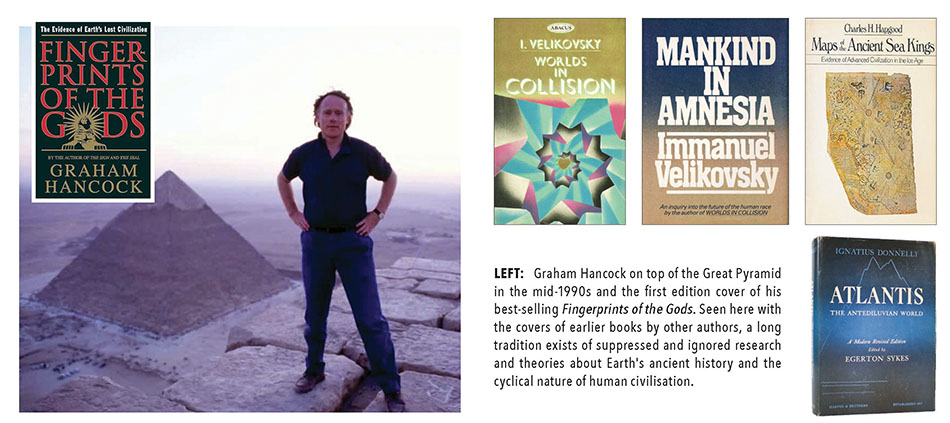
  • The Secrets of Longevity

    The Secrets of Longevity

    From New Dawn 147 (Nov-Dec 2014)

    Today, longevity is a hot topic. Sometimes it goes by other names such as anti-aging, cellular renewal, or regenerative medicine, but since it is a focus of current interest, there is money to be made. As a result, there are all types of pundits, whether MDs or Wellness coaches, plying their wares. Usually their ‘expertise’ ends up urging us to purchase a slew of supplements to slow down the aging process. This is not without good reason. 

    For example, resveratrol, an ingredient found in red wine, grape seed and grape skin extracts, is known to preserve that portion of the chromosome called the telomere, and in-so-doing stop degeneration of our DNA during cellular division. When telomere length is not degraded, any new cells produced are good quality copies of previous cells, which translates into our tissues not becoming structurally entropic. It is equivalent to maintaining a physiological Xerox machine, so that you only produce high quality photocopies of your original ‘documents’ (i.e. your cells).

    Although the science of telomere preservation is important, and although combinations of specific supplements can be helpful in promoting longevity, I would like to take a deeper, more thoughtful approach in this essay since New Dawn readers are a special kind of audience with an appreciation for unusual ways of thinking. And the main difference between what I will present in this article and typical perspectives on longevity is that we need to consider not just the length but also the breadth of a human life.

    As a clinician specialising in alternative medicine, I must deal with every type of human problem, whether it be physical, metabolic, immunological, psychological, or even spiritual. Our lives are cut short by negative factors, which may originate from outside ourselves or from within. Immunity, emotional equilibrium, structural alignment and metabolic hygiene all strongly influence an individual’s chances of a long, robust existence.

    Rare photo of Li Ching-Yuen, martial artist, herbalist and tactical advisor. His death is recorded in 1933, but he was said to have been born in 1677. This would have made him 256 years of age at the time of his death.

    If we were able to minimise the effects of these negative factors, what would be the ‘normal’ length of a human life? Today, the figure of 120 years seems far from unreasonable. There are, in fact, historical records of people living way beyond that. Though it might seem hard to believe, Li Ching-Yuen, a Chinese man born in 1677 apparently endured to an extraordinary age, his life spanning the French Revolution, the American Declaration of Independence, the Russian Revolution and the First World War, with Li’s passing occurring quietly and without fanfare during the roaring twenties at the age of 256.

    What was Li’s secret? Li wrote a brief treatise specifying his diet, exercise, specific herbal regimen, and sexual practices. Unfortunately, most of the herbs Li collected directly from the mountains where he lived are no longer available to us, and the stripped down world we inhabit today has drastically reduced springs of vitality it once offered. What then, practically speaking, can we distil from Li’s example? Suffice it to quote from one of Li’s students who summed up Li’s recipe as follows:

    Keep a quiet heart, sit like a tortoise, walk sprightly like a pigeon and sleep like a dog.

    In fact, there was more involved than this in Li’s longevity regimen. What he trained himself to do was align his every expenditure of life energy with the flows and rhythms of nature. Consider that every step we take, every mouthful of food we consume, every sexual fluid we release or every menstrual cycle we pass through involves a small but cumulative decrease in our total life energy, and the more so each act diverges from the innate ‘settings’ of nature. By consistently resetting the dial, by consistently avoiding excess expenditure and also by consistently replenishing outflows with net inflows, Li was able to accomplish his amazing feat.

    In terms of modern biosciences and specifically anti-aging, is there a technical way of understanding this? The answer is yes. It comes down to two things: epigenetics and flow dynamics. In the field of epigenetics, we apply nutritional, behavioural or lifestyle changes in order to influence gene expression in a positive direction. In the field of flow dynamics, we beneficially modulate the bio-magnetic and bio-electrical systems of the body in order to enhance fluid circulation, detoxification at the cellular level, and revitalisation of our tissues and organs. Taken together, both of these approaches could be summed up as keeping the waters of the body clean and coherent

    Water, which composes 99% of the human body at a molecular level, is intrinsically coherent and life sustaining, but its coherency can easily be compromised by toxins, pathological microorganisms, EMFs, drugs, poor diet, poor posture and negative emotions. All of these end up affecting gene expression in a negative direction, and shortening the telomere, thus leading to premature aging or death.

    In 1912, Alexis Carrel was awarded the Nobel Prize for Medicine. One of Carrel’s main topics of interest was cellular longevity. On 17 January 1912 he began a twenty year long experiment using an embryonic chicken heart which he was able to maintain fully alive into the 1930s, considerably beyond the normal lifespan of an adult chicken. He accomplished this by keeping the fluids in the petri dish clean and fresh. Although his experiment was never successfully replicated, and his thesis would later be repudiated in mainstream biology by the so-called Hayflick limit, Carrel’s work actually substantiates what Li-Ching Yuen was doing. If the fluids of the body are kept clean and fresh, longevity is enhanced.

    “Be like flowing water,” said Bruce Lee, echoing the ageless advice of Lao Tzu in the Tao Te Ching. Flowing water is Life. Ever changing, ever refreshing itself, no drop in the river is ever the same, though its position is unaltered, as Heraclitus observed watching on the banks of that bright Greek river in the ancient sunlight. 

    And what are we composed of, if not mostly water? The cell (cytoplasm) is mostly water, the cells are bathed in an interstitial matrix, mostly water, the brain and spinal column are cushioned and massaged by cerebrospinal fluid, mostly water, the brain itself is over 80% water, and of course the fetus develops in a uterine ocean, rocked gently by the natural rhythms of the cosmos. Indeed, there is striking evidence that our paleo-anthropological forebears went through an aquatic phase, wading in the coastal waters. From my research I have concluded that this aquatic phase of our development has determined our profound physical and spiritual relationship with the fluid element, and the minerals and flow patterns it contains. 

    For example, iodine and magnesium, elements in which most of the world’s population are chronically deficient, come to us essentially from marine waters. Without adequate magnesium, our bodies cannot convert Vitamin D into its active form resulting in a degradation of our immunity, an increased porosity of our bone matrix and a foreshortening of our lives. Vitamin D is really metabolised energy from the Sun, and magnesium (plus iodine and a range of trace minerals) is metabolised energy from the sea. When fire and water, sun and ocean, feed into our bodies in harmony, a synergy is produced which sustains and prolongs human life.

    Entering the Zone

    To approach the question of longevity in a thoughtful way, we must first ask, what is time? According to special relativity theory, time is part of the dyad spacetime which, as we know, is curved because it is subject to gravitational forces. Under the impress of great masses, even cosmic light is forced to bend and so, when observed through powerful telescopes, distant stars and galaxies appear to us as ovals – it is as though their forms had been refracted through a giant wine glass. 

    Close up of the eyes of a fly. It can be postulated that these small creatures are, at the experiential level, living more slowly, hence longer, relatively speaking, than homo sapiens. 

    But subjective or experiential time is even ‘curiouser’ to our commonsense assumptions than the mere fact macroscopic spacetime (and therefore what we think of as duration) can be warped by gravitational forces. Recent studies have demonstrated that the inner processing of sensory-cogitational signalling by insects is far more profuse and rapid than the human version. Research conducted at Trinity College Dublin in the Republic of Ireland has demonstrated the capacity of small creatures such as flies and mosquitoes to read flickering light at least four times faster than we do. This explains why it is so hard to kill them: a fruit fly, for example, nonchalantly eludes our clumsy attempts to dispatch it. It is as though it can read our thoughts in advance. We now know that the fly has a much faster “flicker fusion frequency” than we do, so for it, time is experienced as passing more slowly than for us. To a fly, our attacking hands move in ultra slow motion because their tiny brains are able to discern flickering light forms much more distinctly than we do. (To accomplish something comparable ourselves, we’d have to slow down a video into separate framed images). 

    In brief, the insects’ experience of time is slower, therefore longer at the microsecond level, than ours, more replete with genuine light-filled experience and reflective response than we who observe them. A humbling thought indeed: these swarming, often annoying and usually despised creatures are, at the experiential level, living more slowly, more fully, hence longer, relatively speaking, than homo sapiens. 

    How does this bizarre information relate to our personal pursuit of longevity? Let’s take a moment to dwell on the question of how we measure longevity. Is it to be seen just as a straight line from birth to death? Or should it be understood as a dynamic upward moving spiral? How does length (years) correlate with curvature (experience)?

    Another curious phenomenon is that when we are truly immersed in something, especially something creative, we often lose all sense of linear time. Where did that time go when we were so deeply absorbed in the object of our attention, or the object of our affection? Stranger still, we often seem most deeply satisfied when we ‘lose’ ourselves in such things. Longevity, conventionally understood, implies an unbroken linear continuum extending from past into the future, yet lived life, especially in moments of deep immersion, strongly conflicts with this idea.

    Yet again, when we are in ‘the zone’, we feel generally hyper-aware yet totally relaxed. Our senses are heightened, our reflexes are extremely attuned, and our powers of response greatly enhanced. In such states our sense of time is also radically changed. It is as though everything occurs simultaneously in some strange way, and we are able to process unlimited amounts of changing information with ease. We can read things with grace and speed. The ‘time’ we inhabit in such states can be compared to the super-processing capabilities of the fruit fly with its superior flicker frequency abilities. Were we able to spend more of our lives in these non-linear time modes, our longevity would be altered internally, at the phenomenological level of supra-consciousness. It would be comparable to the idea of travelling close to the speed of light and thereby slowing down the aging process. 

    What I have explored is how this spiralling of renewal and enrichment at the level of the mind also works at a cellular level, the level of the body. To arrive at real longevity (not mere numbers of years), we need to generate fresh, consciously renewed awareness of the present moment, and along with that, intertwining with it, a maintenance of our physical tissues with minimal degradation of DNA during ongoing cellular replication. Our goal must be the seamless renewal of thoughts and emotions at a conscious level in conjunction with undamaged renewal of cells and tissues at a somatic level.

    Are You Present?

    The essential, we have always been told, is to live in the present moment. If we are not there, then where are we? Are we, indeed anywhere at all? Does it matter if I attain a healthy old age if the range of my thoughts and feelings is not genuinely in tune with outer reality or, most important of all, with deep inner truth; worse still, what if I have allowed my streams of consciousness to have been manipulated by outside forces? If I am not in full possession of myself, can I claim my days and hours as my own or am I merely a ‘computer’ processing thoughtforms from elsewhere?

    Interestingly, it appears that children are much more adept at discerning flicker frequency than adults, especially older adults. Could this be one reason why time seems to pass much more slowly for us when we are very young? Because it really is passing more slowly and therefore our childhood years occupy more of our total experiential time than the number of years they represent arithmetically?

    This, although it might appear to be a strange question, is really a question about mapping. Consider, for example, how conventional two dimensional mapping of the globe distorts the physical size of landmasses such as Europe and Greenland, making them appear much larger than they actually are. 

    We have now stepped through the looking glass, but in today’s world we are also all being secretly looked at, watched over, and our private load of thoughts and emotions is increasingly made to percolate through external, flickering light pathways.

    A World of Flickering Distractions

    The French philosopher Paul Virilio has written graphically about a flickering world of light emanations bouncing off cathode ray tubes and coursing wildly through fibre-optic cables. Virilio’s warning is that people are in danger of getting lost in a virtual, electronically driven interactive world of synthetic communications. The embryonic phases of the Internet and IT have ushered us into a brave new world, as we are now witnessing with increasing frequency and alarm. How far and fast things have leapt into the technological abyss is shocking, and this has gone along with our general subjective sense that time is speeding up. Logically speaking, if time is speeding up, are not our lives thereby being experientially shortened?

    ADD and ADHD have reached epidemic proportions in the contemporary developed world. Along with obesity and early-onset degenerative diseases including diabetes and cancer, distractability has become the new normal. Cloud computing has increasingly entranced the average person, and private information of all sorts is ‘dropped’ and stored online in virtual versions of two way mirrored rooms. Light emitting screens all flicker, whether they are TVs, computer monitors or smart phones. Dogs, like insects, are able to discern this flickering of light from such screens whereas we slow-witted humans are easily duped by the magic of projected imagery, no matter how contrived or toxic this imagery may be. Our incapacity to read flickering light as such makes us consume virtual information purveyed to us like a drug, and the more we do this, the more we are in danger of losing not just our privacy, but our very independence of mind.

    We can conclude that the more distracted I am, the less I am in possession of myself. And the less in possession I am of myself, the shorter in real terms is my stay on this planet. 

    The Human Machine

    In 1637, Rene Descartes published his famous Discourse on the Method, which presented the animal as a machine and the human being as almost a machine. With a self-protective nod to the Inquisition, Descartes had to publicly acknowledge the presence of a human soul interpenetrating the anatomical and physiological mechanisms via the pineal gland. A century or so later, in Man Machine which was published in 1748, Descartes’s compatriot Julien Offray de La Mettrie dispensed altogether with any need for a vestigial spiritual presence and presented man as pure machine. These were the heady days of the Enlightenment, and essentially all of what we encounter today, whether it be Hollywood Terminator movies or the Transhumanism movement, was founded by the intellectual drivers of that time. This was the conceptual platform that allowed both IT and cybernetics to emerge. 

    It is vital, for our purposes, to understand this very clearly indeed, because longevity is today a very fashionable subject in both medical and wellness circles, but is generally approached from a robotic perspective without this being consciously acknowledged. There are two undeclared goals:

    • Preservation of the physical form, whether via surgical replacements, prosthetic devices, genetic modifications or other technical interventions.
    • Preservation of the ego-entity by the downloading of this entity’s contents into a new vehicle, whether by cloning, revitalisation of decrepit tissues or other technical procedures and interventions.

    Unsurprisingly, such a technological pursuit for individual immortality is very appealing to rich and powerful individuals or groups with control over resources and companies with scientific outreach. Ray Kurzweil is probably the main exponent of these concepts and ventures, but all of this derives directly from Enlightenment theories reducing the human being to a robotic essence. Today, such thinking is much in favour since technology advances with apparent exponential velocity. 

    If our essence is machine, the answer to our challenges, quite obviously would be through technology. But if our essence is more than machine, what then? What role can and should technology play in extending our lifespan? In what ways could a purely technological perspective ever lead to a qualitative enrichment of the present moment, and thus lengthen life from a subjective point of view?

    According to Karl Popper, who formulated the empirical falsification principle underpinning the modern scientific method (a hypothesis is only verifiable to the extent that it can inherently be proven to be false), La Mettrie’s doctrine would provide an even sharper edge to the upcoming theory of evolution, and especially, I would add, to today’s neo-Darwinist creed. Popper, though a mainstay of the scientific mainstream, also cautioned that the consensual acceptance of La Mettrie’s concept by contemporary biologists, physicists and philosophers represents the human being as, in essence, a computer.

    There is a clear continuum here between 18th century Enlightenment reduction of the human being to a machine and 21st century absorption of the human being into the computer, and thereby into the covert realms of manipulated consciousness. 

    Many people today wish desperately to escape from the matrix and the growing sense of asphyxiation it produces. There still remain a few spots on the planet which are relatively unchanged, though for how much longer, who can say? Let’s take a brief look at these and draw some further conclusions about longevity.

    The Blue Zones

    As a boy growing up in England I recall being fascinated by reports of people from the Caucasus who were apparently living beyond the age of a hundred and sixty. In 1984, I spent a year living in Western Turkey where I befriended a young woman named Selma whose family had emigrated from Turkic speaking regions of Central Asia. Selma told me how common it was for people in those areas to live up to one hundred and twenty. She also told me that people were not expected to act in mature ways until rather late in life. She had cousins who behaved, and were expected to behave, like teenagers, even in their mid-forties. The thought occurred to me: could it be that we age prematurely because we are expected to be too responsible too quickly? 

    After decades of working in the field of advanced holistic medicine, I have by now developed an ultra-refined ‘sixth’ sense of body-mind dynamics. What I can say without question is that longevity is as much attitudinal as biological. In other words, we have a chronological age, a biological age and an attitudinal age, and these three may each diverge widely from one another.

    So where can we look around for viable models for long, healthy and happy lives? 

    In Dan Buettner’s best selling book, The Blue Zones, he explores five small geographical areas around the globe where the local inhabitants outlive people in developed Western nations by at least a decade; and perhaps even more importantly, they retain their vigour, vitality, strength, love of life and even their sexuality where their typical counterparts amongst us would probably be in wheelchairs, incontinent, perhaps lost in dementia or staring vacantly at TV sets. The five areas Buettner identified are Okinawa in Japan, the Greek island of Ikaria, Loma Linda in California, the Nicoya peninsula in Costa Rica, and Sardinia in Italy. 

    Not too long ago I read an article by an English journalist who went to Ikaria to investigate. He interviewed a small section of the local population. He first approaches a robust, white haired man sitting in a café high up in the hills, puffing away on a cigarette. The man’s name is Gregoris. The writer approaches Gregoris and informs him politely that smoking is bad for the health. Gregoris smiles and replies that he’s been smoking a pack a day for the past seventy years. He also drinks about four glasses of red wine a day. Gregoris is (at the time of that interview) already ninety-nine years old. His story is not uncommon. Most Ikarian males between the ages of 65 and 88 report having sex with “good duration” and “achievement” and a few of these continue to do so even into their nineties. Soon he encounters ninety-nine year old Evangelia Karnava, a small strong woman who radiates energy. When asked her secret, she declares, “Coca Cola. I can’t live without it.” She plans, she says, on living to the age of 115, and who would doubt her?

    What, no expensive supplements or life extension products in fancy bottles? Instead, Coca-Cola, lots of wine, cigarettes? Are these the Secrets of Longevity? Of course not, but these Blue Zone inhabitants prove to us that a long life is not attained by textbook purity, nor by striving to be too healthy. Nor is it reducible to diet and hygiene. Ironically, what the average well-intentioned naturopathic doctor orders you to consume (or not consume) might in fact upset your equilibrium and shorten your lifespan – as well make your life less fun. It is vitally important to be free, to have fun and to break the rules. Conclusion: attitude ultimately overrules political correctness in diet and behaviour.

    So what are the other basics we can extrapolate from the long, full and vital lives of people living in these sun-drenched environments? For simplicity’s sake, I will list them here:

    • A healthy local based diet. People eat fresh, locally grown, organic or wild-crafted foods. For example, the wines and herbal teas drunk in Ikaria and Sardinia are filled with the vital energies of place, and local greens have exceptionally high levels of antioxidants. There is an unbroken continuum between the mineral and vegetal life-forces of the region and the human inhabitants who have learned how to distil these forces.
    • A strong sense of community and shared values, festivals and celebrations. Avoidance of loneliness, depression, self-absorption and depression.
    • Laughter and good humour.
    • Plenty of good quality sleep, and perhaps also naps during the day.
    • Rising early.
    • Minimal use of drugs or any synthetic foodstuffs.
    • Minimal exposure to WiFi and electromagnetic pollutants.
    • Minimal exposure to ‘doctored’ news sources or infotainment.
    • A great deal of time spent in the open air.
    • A light hearted and courageous approach, a fluid, bright form of stoicism.
    • Respect, love and inclusion for the elderly whose value is never put into question. To squirrel them away into a ‘home’ would bring shame on the family.
    • Sunshine and proximity to flowing water.
    • Daily aerobic exercise. It is not at all uncommon for nonagenarians to walk three or more cliff miles each day.
    • A sense of purpose in each of the activities you are engaged in.
    • No excess calorie intake and low use of refined sugar. (Burn your fuel before you re-fuel.)
    • High intake of omega 3s, iodine and trace minerals from the ocean.
    • Simplicity and gratitude. Lack of guilt, greed or shame.
    Get this issue

    The Grey Zones

    The Blue Zone people, and the inhabitants of other areas where people live simple lives and have access to sunshine, clean air, water and life-force have much to teach us. But the truth is that most of us do not, and cannot, live in such pristine, simple environments, nor can we easily generate around ourselves the sorts of protective communities produced historically by these areas. We are the inhabitants of the Grey Zones, struggling to survive in heavily polluted environments, controlled by corporate mis-management of the food chain, beset with worries and anxieties and almost drowning in information overwhelm. Not to mention the effects of electromagnetic pollution, chemtrails and mind control initiatives: it is a sad fact that modern humans need to use enormous amounts of energy simply in order to retain their basic healthy functioning. Moreover, if we try to retain integrity in a complex and corrupt geo-political environment, we must also focus on staying awake, which only creates further demands and stressors acting upon our fragile life-force. So what to do?

    Besides trying to replicate, as much as possible, the conditions and behaviours of the Blue Zone inhabitants, in the Grey Zones we can still re-calibrate our life force through epigenetics and energetic adjustments. This re-calibration work is what we offer at my clinic and also during my workshops and trainings. It involves what I call the Infinite Body System and it incorporates a repertoire of vertical, spiral and other flowing movements all of which help to reintegrate the mind into the body and also to make our fluids run clean and fresh, just as Bruce Lee and Lao Tzu recommended.

    How long we live is partly a matter of chance and partly of choice, but most importantly, both length and breadth of our lives will depend upon what we live for. Living with purpose and in pursuit of meaning is both our right and our responsibility. The priority, echoing Viktor Frankl, is to listen to what Life asks of us. Our response to that last question will ultimately determine how long we are here, and whether our stay will have been a narrow one, or great and broad as an estuary tipping gracefully into the sea.

    Nicholas Corrin is the author of The Power of Letting Go, a comprehensive study of self-healing, meditation, and our personal place in the cosmos. Signed copies are available direct from the author through www.nicholascorrin.com or look it up on www.amazon.com.

    [alert type=”general” dismiss=”no”]This article was published in New Dawn 147.[/alert]

    [alert type=”success” dismiss=”no”]If you appreciate this article, please consider subscribing to help maintain this website.[/alert]

    © New Dawn Magazine and the respective author.
    For our reproduction notice, click here.