In the 1960s, a French intellectual came up with a novel theory on life in the 20th century. The basis of the theory was that in modern capitalist consumer societies like France, the United States and the West in general, authentic life had been replaced with its representation.
According to Guy Debord (1931–1994), we now live in societies in which individuals no longer actually experience events, but in which all action is instead conducted through the represented image. He called this “The Society of the Spectacle” (the work outlining his theory was published in French as La société du spectacle in 1967). Images, Debord said, have supplanted genuine human interaction.
Debord argued that the history of social life can be understood as “the decline of being into having, and having into merely appearing.” In consumer society, social life is not about living, but about having; the Spectacle uses the image to convey what people need and must have.
A founding member of the radical Situationist International, Debord’s descriptions of human social life subsumed by technology and images are prophetic in light of the internet age now upon us.
The Spectacle is much greater than marketing and TV images. Debord argued that everything men and women once experienced directly – our ties to the natural and social worlds – had been incorporated into the Spectacle – a vast simulacrum – to be sold and fed back to us. Doomed to be simply passive consumers inside the Spectacle, men and women inescapably reinforce its dominance by giving it attention. The sun never sets, Debord dryly noted, “on the empire of modern passivity.” And in this passive state, we surrender ourselves to the Spectacle.
In his 1988 follow up Commentaries on the Society of the Spectacle, Debord introduced the idea of the “integrated Spectacle,” the most hazardous and commanding form of Spectacle, which he posits operates today. This enlarged Spectacle is associated with liberal democracies marked by incessant technological development and a state of general secrecy. Society is governed and managed by ‘experts’ who invoke the terror or health threat to keep spectacular society in a constant state of fear and tension.
When we look back on our history, even from inside the Spectacle, we sometimes identify works of literature, art or cinema that accurately describe the reality of this modern world. One such breakthrough came in the form of the 1976 movie Network about a fictional TV network that airs almost anything for ratings.
Written by Paddy Chayefsky and directed by Sidney Lumet, Network won four Academy Awards and was selected for preservation in the United States National Film Registry by the Library of Congress as being “culturally, historically, or aesthetically significant.”
This movie forecast the direction in which the Spectacle was taking the world: news as entertainment, soulless consumerism, selfish corporate interest, borderless liberal globalism, unscrupulous mainstream media antics.
News, in Network, is a business, and facts will bend to it. This is told, explicitly, in the climactic scene, when the head of the network’s parent company, Arthur Jensen, speaks to Howard Beale, the disenchanted news reader.
“There are no nations,” Jensen tells Beale. “There are no peoples. There are no Russians. There are no Arabs. There are no third worlds. There is no West. There is only one holistic system of systems, one vast and immane, interwoven, interacting, multivariate, multinational dominion of dollars.” Everything is now determined by television; it can dictate geography. He looks into Beale’s bewildered face and tells him: “The world… is a business.”
Jensen’s rant continues. “You get up on your little twenty-one-inch screen and howl about America and democracy. There is no America. There is no democracy. There is only IBM and ITT and AT&T and DuPont, Dow, Union Carbide, and Exxon. Those are the nations of the world today.” [Now we can include on that list Microsoft, Google, Apple, JPMorgan, Goldman Sachs, Bayer, etc.]
That night, in the movie, Beale goes on air to preach the corporate doctrine of Jensen:
“What is finished is the idea that this great country is dedicated to the freedom and flourishing of every individual in it. It’s the individual that’s finished. It’s the single, solitary human being that’s finished. It’s every single one of you out there that’s finished. Because this is no longer a nation of independent individuals. It’s a nation of some two-hundred-odd million transistorized, deodorized, whiter-than-white, steel-belted bodies, totally unnecessary as human beings and as replaceable as piston rods.
“Well, the time has come to say, ‘Is de-humanization such a bad word?’ Because good or bad, that’s what is so. The whole world is becoming humanoid – creatures that look human, but aren’t. The whole world, not just us. We’re just the most advanced country, so we’re getting there first. The whole world’s people are becoming mass-produced, programmed, numbered, insensate things….”
The above first appeared in New Dawn Special Issue Vol 12 No 3.
[alert type=”general” dismiss=”no”]This article was published in New Dawn 195.[/alert]
[alert type=”success” dismiss=”no”]If you appreciate this article, please consider subscribing to help maintain this website.[/alert]
Traditional foods is a term that emerged at some point around the same time the mainstream diet started to resemble something made in Frankenstein’s lab. These are foods produced on small farms and homesteads that have nourished us for millennia.
Traditional food can also be called real food, and a way of eating that focuses on the foods our great great great grandparents would have recognised as foods, such as vegetables, meat, dairy, eggs, fruit, grains, and honey. These foods can be grown on a small scale and don’t need global distribution or factories to feed people.
A traditional foods approach to eating emphasises:
Meat, fat, eggs, and dairy from animals raised naturally outdoors.
Animal fats, such as lard, tallow, and butter, for vitamins A, D, and K2, and because they are stable local cooking fats that don’t go rancid when heated.
Using the whole animal, especially making broth from bones.
Soaking, sprouting, and fermenting grains to make them more digestible (but grain-free diets can be traditional too).
Naturally fermented vegetables and drinks.
Raw and/or fermented dairy.
Choosing nutrient-dense calories over empty processed-food calories.
Borscht. Homemade soups with slow cooked meats, vegetables, and bone broth are a healthy one pot traditional foods meal. Even better when served with homemade sourdough bread and butter.Photo courtesy of the author.
Listening to the Wisdom of our Ancestors
The modern way of eating focuses on empty calories that large corporations can easily transport worldwide, such as vegetable oils and white flours. This approach is a modern experiment that has resulted in more chronic illness than any other time in history.
In contrast, when we learn about cultures that weren’t influenced by the modern world (in particular from Weston A Price’s book Nutrition and Physical Degeneration) we find that the same foods feared in the modern world – such as butter, liver, egg yolks, raw milk, and lard – are prized by traditional cultures.
Every culture studied by Weston A Price had a different diet, but each diet was based on nutrient-dense foods that grew locally, rather than generic, easily transported globalist foods. Foods high in vitamins A and D were prized above other foods. Special foods high in these nutrients were often fed to children and parents trying to conceive healthy babies.
Healthy Teeth
The high amounts of vitamins A, D, and K2 in traditional foods diets were found to influence dental health, and it’s no surprise that the people eating diets high in these vitamins had perfect teeth with no cavities, decay, or deformities. Children born to mothers eating these diets grew up to have enough space in their mouths for all their teeth (including wisdom teeth) to form without trouble. This is how we are meant to be – naturally resilient and healthy people, not weak creatures reliant on modern medicine!
When Weston A Price studied people who had left these cultures and moved to a modern lifestyle and diet, he found that the first generation had cavities and tooth decay. The next generation, born to mothers eating modern junk food diets, also had narrow mouths that did not have room for all their teeth to develop without trouble.
Natural Resilience & Natural Childbirth
It is not only dental health in future generations that is affected by diet, but the entire body and the ability to survive without modern medicine.
Cheese – raw and fermented dairy from local cows and goats provide many nutritional benefits.Photo courtesy of the author.
The entire bone structure was narrowed in children born to mothers eating a nutrient-poor modern junk food diet. They had less room in their noses to breathe through, making flu, colds, and other respiratory issues more difficult to deal with, and the girls were born with narrow hips that later made childbirth more difficult.
In the traditional cultures Weston A Price and others studied, childbirth was not feared and usually went on without trouble. However, when these same people were fed the modern diet for a generation or more, the next generation had the difficult childbirths that we are familiar with, where medical intervention is the rule rather than an exception.
Adopting a traditional foods diet can help turn this around and create future generations that do not need the modern industrial sick care system.
Bone, Joint & Skin Health
As we age, we have more trouble producing the collagen that helps our joints to function well. A traditional foods diet rich in bone broth gives the collagen and gelatine that we need for optimum health. Many people have found that joint and skin problems disappear by including bone broth in the diet.
The modern industrial way of eating has replaced the time-honoured process of making bone broth with “convenient” cubes of stock bought from a supermarket. To mimic the deep natural flavour that we crave from bone broths, modern stock cubes are packed full of MSG and other artificial flavours. This approach of attempting to copy the taste of traditional foods without any care for health is a common theme in industrial foods.
Probiotics & Gut Health
Every year, more and more information comes out about the importance of gut health on our immune systems, mental health, ability to detox, and more. Traditional food cultures often relied on fermentation to preserve vegetables over the winter. These ferments such as sauerkraut and kimchi are packed full of probiotics and are often served as a condiment on the side of every meal.
Naturally fermented drinks were popular in many cultures, such as fermented cider, beetroot kvass, fermented ginger beer, kombucha, and kefir. All of these drinks are beneficial to gut health and taste great.
Milk and cream did not last long without modern refrigeration, and these foods were often fermented to increase their storage life while adding probiotics. Yoghurt, kefir, raw cheese, cultured butter, and cultured cream are all popular sources of probiotics used for their taste and health benefits.
Nutrient Density & Health
Sauerkraut and kimchi are tasty probiotic foods and a natural way of preserving the harvest.Photo courtesy of the author.
Pre-industrial diets contained higher amounts of vitamins and minerals than modern diets. There were no plastic-packed artificial vitamin pills made in factories, just nutrient-dense real food. Traditional bread did not need to be “fortified” with artificial vitamins in the way modern breads are – they were full of the goodness of slowly fermented whole grains, and it’s possible to make bread at home in these same time-honoured ways.
Foods grown in healthy soils produce higher amounts of vitamins than in industrial dust bowl soils. Animals raised naturally outdoors produce higher amounts of vitamin D in their fat. Pre-industrial breeds of farm animals thrive without modern medicines and produce more of these healthy fats than modern breeds. Raw dairy contains more vitamins and minerals than pasteurised dairy and is more easily digested.
To process wholegrain flour into white flour requires a lot of time-intensive sifting, and traditional cultures that eat grain rely on wholegrain flour with its natural vitamins intact. Therefore, grain was often freshly-ground as needed, leading to less oxidising and nutrient loss.
Modern diets rely on calories devoid of nutrients, such as white flours, vegetable oils, and a long list of unpronounceable ingredients. In pre-industrial diets, nearly everything eaten has some benefit to health, as these healthful foods are what is produced in nature and in natural farming systems without being refined by factories.
The high amounts of vitamins A and D in traditional foods diets help the immune system, eye health, hormone function, bone health, and more. Cholesterol is essential for brain function. Something to reflect on in these times of low cholesterol diets and mass hysteria!
Listening to Nature, Listening to Ourselves
Many of the foods we crave are actually very healthy. The chips and gravy we might want on a cold day could mean that our bodies need animal fat and collagen-rich bone broth, not the vegetable oils and MSG in the modern version. With ice cream, we crave dairy fat. The desire for fizzy drinks is our bodies wanting fermented drinks such as kombucha, water kefir and whey soda. The cliché of a pregnant woman craving pickles means she needs some fermented raw sauerkraut and other healthy probiotic foods.
Each of these foods that we might sometimes crave are very nourishing for health, yet the industrial food system has exploited these natural cravings and directed them towards their products made chiefly from nutrient-poor starches, vegetable oils, sugar, and artificial flavours.
An Ecological Way of Eating
A traditional foods diet can help the much-needed transition from factory farms and dust bowl grain farming back to the traditional mixed farming method that cares for soil life and wild animals. Eating in a way that encourages diverse small-scale farms that value animals for producing fertility and food for a diet that can help create a better future.
If we despise globalisation, there is something to be said for eating local foods, grown by ourselves or bought directly from real people rather than evil corporations. We can prove to ourselves and others that we can survive and thrive without any aspects of globalism by choosing locally-grown traditional foods. Positive actions on a small scale, starting in the kitchen, can have lasting effects.
How to Get Started with Traditional Foods
Eat fermented foods every day and drink fermented drinks.
Avoid processed foods, vegetable oils, and refined sugars.
Cook from scratch as much as possible.
Choose old-fashioned animal fats, such as butter, ghee, lard, and tallow.
Choose animal foods from animals being raised naturally, outdoors.
They teach the insidious doctrine that there is another God besides the Creator. – Irenaeus, Against Heresies
For many heretics have said that the God Of the Old Testament is one, and the God of the New Testament is another. – Ambrose, On the Holy Spirit, I, 4
Gnostics attributed the work of creation to a lesser deity or demiurge known as Ialdabaoth (also spelled Yaldabaoth or Jaldabaoth), but the notion of the demiurge was not a Gnostic invention. Nearly five hundred years before Christianity, Plato described a similar Creation scheme in his Timaeus. In fact, as we know from a number of pagan theogonies that have come down to us, the same formula existed throughout the ancient world.1
The story goes something like this: In the beginning the unknowable and self-begotten first principle emerges from watery chaos and gives birth to the gods. This primal being first cleaves in two, and then consorts with itself, thus producing the next divine pair. And so it goes. Each successive generation of gods gives rise to the next until the full pantheon emerges. At some point the cosmic clock begins to tick. The various responsibilities attending Creation are delegated, after which heaven and the earth are formed along with the stars, day and night, and the elements air, fire, and earth. Very late in the game living things appear, including, almost as an afterthought, the human race.
This grand Creation scheme was, with many variations, almost universal throughout the ancient world – and this includes the Greeks, despite that remarkable flowering of speculation about man, God, and the universe known as Greek philosophy. Most of the Greek philosophers, of course, were monotheists. Yet, with some exceptions, they managed to coexist with polytheism. The great thinkers were not fooled. They understood that mythology was to be taken figuratively, not literally. The purpose of philosophy was to delve deeper – and the true foundation was obviously monotheism. The gods of Olympus were entirely derivative.
The Gnostic Ialdabaoth has been translated as “begetter of Sabaoth,” which seems to have been a pejorative pun for YHWH Sabaoth, one of the names of Yahweh in the Old Testament. The demiurge, of course, was wholly foreign to Judaism. Whereas the monotheistic Greek philosophers often tolerated a proliferation of lesser deities, Judaism insisted on a single entity: Yahweh. By some accounts he was attended by a council of angels, but Yahweh remained the prime mover; he alone was responsible for Creation. Even today this remains one of Judaism’s distinguishing features.
Origins Within Judaism
Most scholars regard the demiurge as a Gnostic rebellion against Judaism.2 This may well be so, but it is important to realise that the demiurge was not a simple phenomenon. The rebellion involved a devaluation of the God of the Old Testament, which is partially explained by historical events – namely, the three failed Jewish revolts against Roman rule. The first and best known of these was the Jewish War of 66-73 CE. A second less well-known uprising was put down in 115-117 CE, during the rule of Trajan, and a third and final insurrection, the Bar Kokhba rebellion, was crushed in 135 CE.3 There is no doubt that these failed political revolts against Rome seriously undermined the prestige of Yahweh. And for this reason the inception of the Gnostic demiurge might date to as early as the period after 70 CE, the year of the cataclysmic destruction of the famous temple of Herod.
But political history does not tell the full story. The devaluation of Yahweh was also rooted in a process of religious reform that had been underway within Judaism for centuries, and which only attained its full fruition in the person of Jesus. To understand this reform, and how it came about, we must look to the Old Testament, in particular, to the seminal book of Job. (Many scholars have sought answers in Genesis, which is understandable, given that the demiurge is associated with Creation, but with less satisfactory results.)
Most Christians probably assume that the God of the Hebrews in the days of Abraham was the same as the God of Moses and, furthermore, that this God was also equivalent to the Father mentioned by Jesus with such love and devotion. Any such assumptions are false, however, but not because God changed. God’s nature, being absolute and eternal, never changes. What does change is human understanding. The human conception of God, the God concept, has changed many times over the course of history and will continue to evolve in the future. In a famous essay called “The God of the Fathers,” first published in 1929, the Old Testament scholar Albrecht Alt explored whether such a transformation had occurred at the time of Moses. Alt found clues in the Pentateuch suggesting that the Elohist scribe had amended the earliest accounts to bring the more archaic God-concept of the early Hebrews, the God of the patriarchs, in line with the later (and more pure) monotheism of Moses.4 Alt’s paper touched off a lively debate among biblical scholars that continues to this day.
The reform that we are about to discuss is another example of the sort of evolution observed by Alt. The need for reform of the Old Testament God-concept was real enough. While some Old Testament passages describe Yahweh as merciful, loyal, forgiving, and benevolent, he is at least as often portrayed as jealous, grouchy, wrathful, irritable, proud, boastful, unforgiving, temperamental, cruel, vengeful, and even bloodthirsty, prepared to sanction cold-blooded murder or mass slaughter, including the annihilation of entire cities. Given the numerous examples of God-sanctioned mayhem in scripture, it is no wonder that discriminating readers have sometimes doubted whether this same Yahweh can inspire our confidence and trust, to say nothing of love, devotion, respect and emulation. Oftentimes, fear and trembling seems a more likely human response. And while fear of divine retribution can be a powerful force for good, and, at times, perhaps, a necessary motivator, if the goal is to uplift humanity from a moral standpoint, the example set by Yahweh in the Old Testament falls short of inspirational (to say the least).
The Book of Job
The Old Testament Book of Job, whose author is unknown, has two main themes: the question of evil, and the character of Yahweh. Many scholars rightly regard Job, along with Isaiah, Jeremiah, and Ezekiel, as representative of the high-water mark of the Old Testament.5 The central part of the book is a series of poems that was probably composed sometime in the fifth or sixth century BCE. Part folk tale, prophetic oracle, hymn, lamentation, didactic treatise, and epic, Job makes use of almost every genre in the Bible. The question it raises is no less pertinent today: Why does evil flourish while good people suffer? The answer the story provides broke sharply with Judaic tradition, and for this reason Job was surely controversial in its day. Tradition held that God would eventually reward the good man, regardless of his sufferings. Like the prophet Jeremiah, however (see Jeremiah 13:14, 24–25 and 15:6–7), the author of Job adopts a much more pessimistic outlook that probably reflects the bleak aftermath of the conquest and destruction of Judah by Nebuchadnezzar in the early sixth century BCE. Although the precise composition date of Job is not known, the book is obviously from the time of exile or later.6
The story openly portrays Yahweh in league with Satan. God torments the good man (Job) despite the fact that he keeps the Law and lives a morally upright life. Job’s many trials are the work of Satan, Yahweh’s servant (or possibly his son), who whispers false accusations in God’s ear and receives permission to punish Job in order to test him and expose the wickedness allegedly concealed in his heart. Job’s flocks are stripped from him, his servants are slaughtered, and his sons and daughters are killed in a mighty whirlwind. He himself is stricken with a terrible wasting disease that causes great suffering and brings him to the edge of the grave. Job’s body literally becomes an open wound. To make matters worse, Job’s wife and his friends also turn against him: His wife urges him to curse Yahweh and to abandon all faith in God; meanwhile, his friends make superficial religious cant and castigate Job for having the temerity to maintain his innocence. One after another they admonish him, insisting that because Yahweh is punishing him, ipso facto, he must be guilty. They advise him to submit quietly to his sufferings, which obviously have been ordained by God. But Job will have none of it. Like a rock he holds fast to principle. Stubbornly he maintains his innocence and insists upon justice. Yet, at the same time, he remains faithful to Yahweh, refusing to condemn or even criticise the Almighty.
What is shocking about the story is the ease with which Yahweh succumbs to Satan’s false witness about Job’s alleged faithlessness. Being omniscient, Yahweh should be able to easily verify Job’s goodness and constancy. But instead he hands Job over to Satan with a single proviso: “He is in your power,” Yahweh says. “But spare his life.” Though Job remains faithful throughout, before his terrible ordeal is done he curses the day of his birth. No less shocking is Yahweh’s failure to acquit Job even after his innocence has been established. There is to be no moment of truth and no justice under heaven. Instead of vanquishing Satan for making false accusations, Yahweh turns on the victim. Instead of offering solace and comfort to the innocent, he badgers Job and bullies him, sneers at him with rhetorical questions, and then confronts the hapless man with a mind-boggling display of divine wrath.
In the end poor Job is beaten down and brought to his knees. But how can it be otherwise, given Yahweh’s overwhelming might? The rod of God is an awesome thing. In the end Job is reduced to a stuttering simpleton. He repents, even though he is innocent, and admits that he has been talking about things far beyond his ken. Having seen the omnipotence of Yahweh, he is prepared to eat dust. In this vein Job responds: “What reply can I give to you, I who carry no weight?” (Job 40:4; 42:2) In a final prose epilogue Yahweh shows a loving touch by restoring Job’s health and property, but there is no mention of restoring his dead servants and children. Indeed, the somewhat cheery conclusion feels out of step with the rest of the composition, as if a later scribe who was no less shocked than we by Yahweh’s repulsive behaviour added it to redeem God’s tarnished image. Indeed, so subversive is the Book of Job that it is remarkable the book was retained in the Bible. Probably the scribal “correction” saved it from being thrown out, this and the fact that Job is a literary masterpiece. Of course, even with its modified ending, the story is far from satisfactory. Job’s total submission in the face of brute force seems a lame solution to the problem of evil. Nonetheless, the book is momentous because the questions the story fails to resolve were to rebound over the centuries, as we shall see, and preoccupy the final books of the Old Testament.
Yahweh’s Deficiency
So what is the root of the matter in the story of Job? Carl Jung, the founder of analytical psychology, points out in his able commentary Answer to Job that for all of his infinite power Yahweh ultimately damns himself. By humiliating Job, by making him eat dust, God unwittingly reveals his own deep character flaw, brutishness, while at the same time elevating the impotent but righteous human. Job may be powerless before the Almighty, yet he remains free to choose, and by choosing well he shows impressive moral strength. Indeed, Job’s fortitude stands in marked contrast with Yahweh’s rage and reproaches the deity’s ratification of evil. To be sure, Yahweh carries the day. With infinite power at his disposal, the outcome is not in doubt. Yet, from a moral standpoint Yahweh’s display of heavenly fireworks and thunder fails to impress. This is the beautiful and terrible irony of the story: that Job, despite his relative impotence, comes to stand in righteous judgment over God himself. As Jung put it:
We do not know whether Job realises this, but we do know from the numerous commentaries on Job that all succeeding ages have overlooked the fact that a kind of Moira… rules over Yahweh, causing him to give himself away so blatantly. Anyone can see how unwittingly he raises Job by humiliating him in the dust. By so doing he pronounces judgment on himself and gives man the moral satisfaction whose absence we [find] so painful in the Book of Job.7
The word Moira refers to fate or destiny. In Greek religion Moira was one of the three personified seasons that accompanied Zeus, and were often pictured hovering just above his shoulder. The point is that Zeus was governed by them even though he was the most important Greek deity. The mere thought that such a thing might also hold in monotheistic Judaism is shocking. Surely the Godhead cannot be subject to fate. It is God, after all, who determines the destinies of others. Nonetheless, from the story it is clear that despite his omnipotence Yahweh is lacking in something. Job apparently intuits this because in his suffering he asks: “But tell me, where does Wisdom come from? Where is understanding to be found?” (Job 28:12) In the very next verse Job answers his own question. “Wisdom?” he says. “It is fear of the Lord.” Here, as Jung notes, Job shows that he is unaware of his own achievement. He does not seem to understand that in holding firm, standing on his innocence, and insisting on justice he has won a tremendous moral victory, not just for himself, but for all mankind. Job’s answer may seem unsatisfactory, but it is important because during the apocalyptic age it became the grist for the scribal mill, as we shall see.
Now back to the problem raised by Jung, that Yahweh is ruled by fate: Even though Yahweh as God must have access to all knowledge, in the story of Job, as we have seen, he has neglected or forgotten, as Jung phrases it, “to consult his own omniscience.” It seems that Yahweh has been split off from a part of himself, which means that he is not fully conscious. Which is incredible! And what of his boasting? Indeed, what could possibly compel an all-powerful and all-knowing Being to stoop to bluster and threats in the first place? This discomfiting aspect of Yahweh’s behaviour, analysed long ago by the unknown author of the Secret Book of John, one of the Gnostic gospels found at Nag Hammadi, was the key Gnostic insight:
…he [Yahweh] said to them, ‘I am a jealous God and there is no other god beside me.’ But by announcing this he indicated to the angels who attended to him that there exists another God, for if there were no other one, of whom would he be jealous?8
Of whom, indeed? No scholar in the modern era has understood the theological question implicit in the Book of Job better than the Gnostic scribe of old. Nor has anyone stated it more succinctly. While the phrase “I am a jealous God…” does not appear in the text of Job, it is implied, and it does occur in Exodus 20:5 and Isaiah 14:5–6. In addition, numerous other passages in the Old Testament, eg., Deuteronomy 4:35; 6:15–16; and 32:19–21 and Isaiah 4:8; 44:6; 45:5, 21; and 46:4, convey a similar meaning. In fact, Yahweh’s jealous tantrums are a prominent feature of the Old Testament, running through scripture like the surly residue of the old Canaanite storm god, which is precisely the point. It is of interest that the famous heretic hunter Irenaeus, writing two generations before Hippolytus, quotes the very same line about the jealous Yahweh in his lengthy treatise, Against Heresies.9 Was it mere coincidence that Irenaeus devoted the largest portion of his five-volume opus to an attempted refutation of the Gnostic demiurge? Or was it an accurate indication of the historical importance of Yahweh’s character defect? There is no question that the controversy surrounding the demiurge was one of the major battle lines separating the Gnostics from orthodox Christianity.
Let us now investigate why Yahweh would allow Satan’s experiment to be foisted on an innocent man. Jung was apparently intrigued by the same question, for he writes:
It is indeed no edifying spectacle to see how quickly Yahweh abandons his faithful servant [Job] to the evil spirit and lets him fall without compunction or pity into the abyss of… suffering. From the human point of view, Yahweh’s behaviour is so revolting that one has to ask oneself whether there is not a deeper motive hidden behind it. Has Yahweh some secret resistance against Job? That would explain his yielding to Satan. But what does man possess that God does not have?10
The psychologist goes on to suggest that Yahweh’s behaviour is driven by an ulterior concern, namely, the divine suspicion that our frail human consciousness is more keen than his own. The very idea is stunning! Consider, though, that driven by the ever-present knowledge of our own severe limitations as well as our relative impotence, we humans are required to cultivate consciousness simply to survive. We have little choice in the matter. Yahweh, on the other hand, has no such need for introspection because he is unchallenged, has no opposition, and encounters no obstacles; nothing requires him to reflect upon himself.
Stranger still is the conclusion that follows from a related question: Why would Yahweh instruct Satan to spare Job’s life? Judging from Yahweh’s sadistic behaviour, the reason can have nothing to do with compassion. Yahweh is perfectly content to wreak mayhem on Job without regret or remorse. Nor can the reason involve a former loyalty, namely, the Mosaic covenant; for the Book of Job reflects the period following the destruction of the first temple, when the old covenant must have seemed a moot article. In fact, in Job there is not the slightest pretense of a covenant. Why then does Yahweh spare Job’s life? Is it possible that he likes having someone around to hear him boast? Does he enjoy having someone present to witness his thundering about heaven? Can it be that Yahweh actually needs Job? Quite probably he does, which would explain Jung’s purpose in mentioning Moira, the season of destiny.
Here, an example from the Greeks may help. We know from the oldest extant account from Greek mythology, the Hymn of Demeter, that when Hades abducted Demeter’s beautiful daughter, Persephone, and took her to his realm of the dead, Demeter, the grain goddess, became so heartsick that she refused to extend her usual bounty upon the earth.11 Stricken by a year-long drought and resulting crop failures, humanity faced extreme privation, even mass starvation. In this dire circumstance mighty Zeus was compelled to intervene and arrange a compromise: Zeus ordained that henceforth Persephone would spend part of the year above ground with her mother, Demeter, and the rest below it with her new consort, Hades. And why would Zeus be concerned enough to intervene? Quite simply, something had to be done because a mass die-off of humanity would leave no human supplicants to perform the daily sacrifices and rituals in honour of the gods!12 Just as humankind needed the gods, so also did the Greek gods need humankind.
In the story of Job we find hints of a similar phenomenon. Yahweh makes Job suffer, yes, but he dare not exterminate him because he needs a living and breathing Job to honour and glorify his divine name. It is Yahweh’s fate to require worship. Of course, the relationship between God and human is not between equals. An enormous gulf separates Yahweh from the puny and subservient Job. Nevertheless, it is a reciprocal relationship. Yahweh needs humans as much as humans need him. The deeper conclusion to which this leads is never openly stated in the Book of Job. But it is certainly implied, which explains why Job was (and remains) so controversial: If Yahweh is subject to fate and if he requires worship, how can he truly be the penultimate Godhead, the first without a second? Of course, he cannot. Yahweh as presented in Job is but a figurehead, a demiurge on a par with Zeus and the other pagan storm gods.
Job’s query regarding Wisdom takes us to the heart of the matter, for Wisdom is the quality Yahweh lacks. The Greek word for her is Sophia. She is the Divine Mother, the feminine companion to God. She is well known in the East, where she is the active principle in the Godhead, with many names. In the various Hindu traditions she appears as Kali, Shakti, and Durga, among others. It is she who both manifests the world, sustains it, and transforms it. But, East or West, she is inseparable from the Godhead. In Judaism, however, awareness of her nature and importance was a late development. That it happened at all may have been due in no small part due to the anonymous scribe responsible for the Book of Job.
The problem is how to reconcile her gentle and wise nature with the gruff and irritable Yahweh. The temperamental patriarch of old stubbornly resists the intrusion of her feminine presence. The Hebrew God prefers to stand alone, imperious in his majesty, bristling with archetypal wrath. Indeed, in his raging aspect Yahweh is almost the antithesis of Wisdom. It is no wonder that many of the Old Testament descriptions of Yahweh closely resemble the old Canaanite gods El and Baal, the raw matter for so much of his composite character.13 In the sixth century BCE these dross elements were still very much in evidence.
The patriarchal storm God dies hard. Yet, change (i.e., evolve) God must, because from the moment the author of Job exposes Yahweh’s dark underside, his deficiency can no longer be ignored, neither on earth nor in heaven. Thus, we find her, Sophia, Wisdom, described in the eighth Proverb, where we are told that her presence is as old as Creation:
The Lord possessed me in the beginning of his way, before his works of old. I was set up from everlasting, from the beginning, or ever the earth was. When there were no depths, I was brought forth; when there were no foundations abounding with water. When he established the heavens, I was there, When he marked out the foundations of the earth, then I was by him, as a master worksman, and I was daily in his delight, rejoicing always before him, rejoicing in his habitable earth; and my delights were with the sons of men. (Proverbs 8: 22–24, 27, 29–31)
Parts of Proverbs are very old and may even date to the time of Solomon, but the chapters about Wisdom, including the ones cited above, were composed much later, although an exact date has never been established. Dating Proverbs has proved difficult. Jung interpreted the presence of Wisdom as evidence of Greek influence and dated the above passage to the third or fourth century BCE.14 While this has yet to be confirmed, there is no doubt about the very late date of a similar description of Wisdom in Ecclesiasticus 24:3–30:
I came forth from the Most High, And I covered the earth like mist. I had my tent in the heights, and my throne in a pillar of cloud. Alone, I circled the vault of the sky, and I walked on the bottom of the deeps. Over the waves of the sea and over the whole earth, and over every people and nation I held sway. …From eternity, in the beginning, he created me, and for eternity I shall remain.
Here she is the spirit of God who broods upon the waters in the moment of Creation. Thus, there is no doubt about her antiquity. Yet, Ecclesiasticus dates to no earlier than around 200 BCE. The description is meant to be taken retroactively, but the passage itself was a late addition to scripture, and is firm evidence of a process of reform of the Jewish God concept.
The same theme also repeats in the Song of Songs, in Ecclesiastes, and again in the Book of Wisdom. All of these books are part of what is today known as the Wisdom literature. All were written after the time of Job, during the apocalyptic age, and all are heavily indebted to Job, again and again taking up themes that first appear in that book. For example, the preacher of Ecclesiastes 9:16-17 states: “Wisdom is better than might, but a poor man’s wisdom is never valued and his words are disregarded. The gentle words of the wise are heard above the shouts of a king of fools.” And in the Book of Wisdom 5:1–2 the scribe offers firm support for Job’s right to demand justice: “[T]he virtuous man stands up boldly to face those who have oppressed him, those who thought so little of his sufferings.”
In the Wisdom literature we also learn more about the nature of the great feminine companion to the Deity. As it happens, she is a marvelous boon to mankind. Wisdom 10:17 waxes eloquent about her:
To the saints she gave the wages of their labors; she led them by a marvelous road; she herself was their shelter by day and their starlight through the night.
And in the Song of Songs, which pretends to be the composition of Solomon (but isn’t), we find details of the wondrous union, or syzygy, of both sides of God, male and female.
The Wisdom Dialogue Continues
In the centuries before Jesus, the scribal dialogue about Yahweh’s better half (his feminine side) was played out in the last books of the Old Testament. This was a positive and important development because it produced a deeper awareness of the sublime attributes of the Godhead. The process continued in the person of Jesus, who campaigned vigorously against every kind of superstitious nonsense, including society’s morally reprehensible treatment of lepers.15 At issue, time and again, was the old Judaic belief in a vindictive God. The affirmation of Wisdom by Jesus is evidenced also by his respectful treatment of women. That this new awareness of the Divine Mother was also absorbed into Gnostic Christianity is confirmed by the text of the Naassene Sermon, which was embedded en toto in the Refutation of Hippolytus. The Sermon quotes a hymn honouring the Mother as the companion to the Father: “From thee [comes] Father and through thee [comes] Mother, two names immortal, progenitors of Aeons…”16 (Refutation 5.6.5)
We know from a lost scripture called the Gospel according to the Hebrews that Jesus made another extraordinary contribution to the Wisdom dialogue. Though this gospel was suppressed and thus did not survive, from the descriptions of early writers it seems that it closely followed the Gospel of Matthew, except that it was written in Hebrew or Aramaic instead of Greek; hence its name. The scripture was apparently so popular that it was referred to as the “fifth gospel.” Most important, it included the following key passage quoting Jesus, which was preserved (in two separate places) in the writings of Origen, and also in Saint Jerome: “Even now did my Mother the Holy Spirit take me by one of my hairs, and carry me away to the great Mountain of Tabor.”17 Here, the words of Jesus explicitly link the Holy Spirit with the Divine Mother; and virtually the same idea occurs in the Gospel of Thomas (Saying 101):
[Jesus said,] Whoever does not hate his father and his mother as I do cannot become a disciple to Me. And whoever does [not] love his father and his mother as I do cannot become a [disciple] to Me. For my mother [gave me falsehood], but [my] true [Mother] gave me life.18
The passage is also noteworthy for its use of the word life, a word specifically used by Jesus in reference to spiritual life. The idea that the Spirit (spiritual life) flows from the Divine Mother was unprecedented in Judaism, and thus was a momentous development in the West. But the idea had long been understood in the East. In the Hindu traditions the same Divine Mother who brings the world into existence and sustains it also makes available a very special form of her own divine Self: a divine grace that is the Eastern equivalent of the Holy Spirit. Hindus believe that by means of this extremely subtle energy, known as the Chitti Kundalini or the Shakti Kundalini, the Divine Mother brings about the dramatic reversal of the flow that leads to the heavenly source. Today, the living traditions of Hinduism describe this key concept of the reversal of the flow in almost exactly the same language used by Gnostics in the first centuries of Christianity. The only difference is that Hindus describe the “descent” of Spirit as an awakening from within. Either way, it is the decisive turning point in the spiritual life of the disciple.
More than 1,900 years after the fact it is very difficult for us to comprehend the extent of the calamity that enveloped Judea during 66–73 CE, and again in 115 and 135 CE. From the riveting account of Josephus, the consequences must have been horrific, much worse than the damage wreaked by Nebuchadnezzar six centuries before. In the act of breaching the walls of Jerusalem and destroying the great temple, the Roman general Titus proved the prophecies of the apocalyptic age to be a colossal failure, indeed, a collective fantasy. Many Jews survived the siege, the famine, and the final battle only to be crucified. Tens of thousands of others were carried off into slavery, or were thrown to the lions in the great Coliseum of Rome. Traumatised by war, many Jews in its aftermath must have questioned their faith, including the darker attributes of Yahweh. In 1927 a scholar named A. Marmorstein found evidence of this in rabbinical texts.19 For Jews who had believed in the grand apocalyptic vision, there were only three possible options. According to scholar Robert Grant, they could rewrite the apocalypse and postpone history; they could explain the failed prognostications by trying to show that the sacred writings had been misinterpreted; or they could simply abandon their faith.20
Little has been written about the war’s impact on the first Christian community of the Nazarenes. One scholar who did study the matter, S. G. F. Brandon, concluded that the impact was no less horrendous.21 The war scattered Jewish Christians far and wide. And if the followers of Jesus were as angry with their Jewish brothers as they were with the Romans, they had good reason: the zealots had hijacked Judaism and brought ruin upon the nation. For which reason Jewish Christians probably shared the conviction that if only more people had listened to Jesus, events might have turned out very differently. Anyone with an eye in his head, after all, could see that the zealots had been blind. The entire nation had been led off the cliff like a pack of lemmings. To think the fools had believed that Yahweh would come down out of the sky and destroy the Romans! Where was Yahweh? Was he sleeping? Or was something the matter with the national God concept?
The scattered remnants of the original Jerusalem Church found it difficult to regroup. We know that Roman pursuit continued, and was intense.22 Eventually, Jewish Christian sects did emerge, including the Ebionites and Elchaisites, and held on in places like Alexandria. But Jews would never again dominate the Jesus movement. The war and the subsequent Jewish revolts had set in motion a great reshuffling of men and ideas, and out of the rubble emerged Gentile Christianity.
So began a new phase of the Wisdom dialogue within the rich and diverse literature of Gnostic Christianity; and Alexandria was one of the primary cauldrons. Increasingly, the teachings of Jesus passed into Gentile hands. Probably for this reason, as time passed, there was less sympathy for Yahweh’s noisy tantrums, less tolerance for the residue of the old pagan storm god. There may also have been a feeling that the Wisdom literature did not go far enough. To many it probably seemed that events had completely discredited the Jewish God along with his people. Thus, the God of the Jews suffered the fate history has always accorded losers. Yahweh was demoted to the lesser status of a demiurge. To be sure, the Fathers of the Church vociferously resisted this trend. Irenaeus devoted much of his leaden prose, including the greatest portion of Against Heresies, to refuting the Gnostic “error.”23
Notwithstanding the views of men like Irenaeus, the Gnostic repudiation of Yahweh was not apostasy. Indeed, to many Christians it must have seemed like an advance. Certainly the demotion of Yahweh was not the end of God or heaven. The Godhead, after all, had not changed. What had changed was the concept of God, which simply reconstituted itself in human understanding. Indeed, the sloughing off of the less desirable elements in Yahweh’s character surely helped many to clarify the nature of the Godhead, and thus was a positive development. Yahweh was rechristened Saklas, “the fool,” and Samael, “the blind.” Behind Yahweh, unseen by him, stood Wisdom (the Divine Mother, Sophia, Achamoth, the Ogdoad, Barbelo, and so forth), now recognised as the true boss. Yahweh was simply the hired man. Above Wisdom, indeed, over all, presided the incomprehensible Father about whom Jesus had spoken in such loving terms.24 It is interesting to note that although Wisdom was often ranked below the Father, their relationship was intimate: Wisdom was an integral part of the Godhead.
The fate of the old Yahweh was not a happy one. Some of the more extreme Gnostics dealt harshly with him. In the Hypostasis of the Archons, one of the Gnostic scriptures found at Nag Hammadi, Ialdabaoth is cast down into dark Tartarus, the hellish realm beneath Hades where the Titans had been hurled after the defeat of Cronus.25
Just as it is difficult for us moderns to understand the full measure of the destruction wreaked upon Judea by the Romans, so also it is difficult to apprehend the Gnostic resynthesis that occurred in the war’s aftermath, and why, especially from the perspective of places like Alexandria, that reform was so necessary.
Reprinted with permission from ‘The Demiurge and the Wisdom Dialogue’, Chapter 8 of Mark Gaffney’s book Gnostic Secrets of the Naassenes: The Initiatory Teachings of the Last Supper, Inner Traditions, Bear & Co., Rochester, VT 05767, USA. Copyright 2004 by Mark H. Gaffney.
[alert type=”general” dismiss=”no”]This article was published in New Dawn 98.[/alert]
[alert type=”success” dismiss=”no”]If you appreciate this article, please consider subscribing to help maintain this website.[/alert]
Footnotes
For a detailed study of various Greek theogonies see M.L. West’s brilliant book, The Orphic Poems, Oxford, Clarendon Press, 1983; for a look at the Egyptian theogony see Robert Bauval and Adrian Gilbert, The Orion Mystery, New York, Crown Books, 1994; for a discussion of the Sumerian gods see Samuel Noah Kramer, The Sumerians, Chicago, University of Chicago Press, 1963, chapter 4.
Most scholars have followed Hans Jonas, The Gnostic Religion, Boston, Beacon Press, 1958, pp. 92-93.
For a good discussion see Yehoshafat Harkabi, The Bar Kokhba Syndrome, Chappaqua, NY, Rossel Books, 1983.
Also see Albright, Yahweh and the Gods of Canaan, Garden City, NY, Doubleday, 1968, p. 168; also see Frank Moore Cross, Canaanite Myth and Hebrew Epic, Cambridge, Harvard University Press, 1973, pp. 3-75.
For example, see Michael Grant, The History of Ancient Israel, New York, Scribners, 1984, p. 175.
W.F. Albright noted the absence of references in Job to any of the prophetic books, and cited this as evidence that Job was composed before these books, i.e., in the seventh century BCE, or even earlier. Albright drew the same conclusion based on allusions in Job to Chaldea. But I take a very different view. Where Jeremiah criticises King and nation Job goes farther and critiques God himself, that is, the all male God concept that is pervasive even in the Books of Jeremiah and Isaiah. There was good reason for Job to stand apart! Allusions to Chaldea also point to a late (post-exilic) rather than an early date. The presence of the Son of Man in Ezekiel, Second Isaiah, and Job all points to a common eastern source. Albright, Yahweh and the Gods of Canaan, 1968, pp. 260-261.
Carl G. Jung, Answer to Job, trans. by R.C. Hull, Princeton, NJ. Princeton University Press, 1958, p. 23.
James M. Robinson, The Nag Hammadi Library, San Francisco, Harper and Row, 1977, p. 106.
Irenaeus, Against Heresies, I, 29, 4; 30, 6.
Jung, Answer to Job, p. 13.
R. Gordon Wasson, Albert Hofman, and Carl A.P. Ruck, The Road to Eleusis, New York, Harcourt Brace, 1978, p. 59.
Ibid, p. 67.
Twentieth century archaeology established the prevalence of goddess worship in ancient Israeli folk religion. Which was in sharp contrast with the official state religion: the pure Yahwism of the temple priesthood. For some reason, although Yahweh assimilated to himself the various epithets and qualities of male Canaanite gods such as Baal and El, the same did not happen with the pagan goddess. Ephraim Stern, “Pagan Yahweism”, Biblical Archaeology Review, May-June 2001, p. 21. Also see Israel Finklestein and Neil Asher Silberman, The Bible Unearthed, New York, Free Press, 2001, pp. 241-241.
According to W.F. Albright the eighth Proverb swarms with Canaanite words and expressions that refer to the pagan goddess. Albright dated it to as early as the seventh century BCE. Yet, as Albright notes, paeans to Wisdom can be found in the literature from Ugarit dating back well into the second millennium BCE. All of this is curious. If Wisdom entered into Judaism as early as Albright asserts, how then do we explain the all male character of Yahweh? Albright never explained this. The fact is that Yahweh did not assimilate aspects of Wisdom until very late. Albright, From the Stone Age to Christianity, Baltimore, Johns Hopkins U. Press, 1940, p. 368.
If the late Israeli archaeologist Yigael Yadin is correct, the village of Bethany was a leper’s colony in the first century. Hershel Shanks, ed., Understanding the Dead Sea Scrolls, New York, Random House, 1992, p. 104. In which case Jesus surely defiled himself in the eyes of the Essenes and other strict Jews by spending time there. Matthew 21:17; 26:6; Mark 11:11; 14:3; Luke 24:50; John 11:1; 12:1. His visits were probably meant as a strong protest against the extremism of Jewish purity laws. The Jews were a superstitious people, as evidenced by the Old Testament, a people who regarded leprosy as a curse visited upon the wicked. II Kings 5:7; II Chronicles 26:20. Consider the case of Miriam, sister of Moses, who, we are told, was so stricken because she opposed her brother’s leadership during the wanderings in the wilderness. Numbers 12:9-10. That the incident is spurious, an obvious scribal attempt to inflate the image of the patriarch Moses, is attested by the Book of Jasher, which describes the same events in a very different light. (Jasher is mentioned in Joshua 10:12-13 and II Samuel 1:18-27.) Jasher was regarded as a lost book, until a copy turned up in England in 1721. It was first published in 1829. Albinus Flaccus Alcuinus, The Book of Jasher, Kessinger Publishing (reprint), Montana, 1829. The contrast with the Numbers version of events is remarkable. In Jasher 12-15 Miriam’s stature as a prophetess is so great that she overshadows even her brother. In Jasher 12 it is Miriam, not Moses, who finds water in the desert. Miriam’s importance is affirmed in the Talmud, which assigns her a status equal with Abraham, Isaac, Jacob, Aaron, and even Moses, the only woman so named. Raphael Patai, The Hebrew Goddess, New York, Avon Books, 1978, p. 117. Although Numbers 12:9-10 describes Miriam’s sudden attack of leprosy as an angry intervention by Yahweh, in Jasher leprosy is never mentioned. The punishment meted out to Miriam is more credible. Moses places his sister under house arrest for reasons of political expedience. Moreover, he is forced to release her when Miriam’s many supporters flock to her defense. Miriam is even credited with an important oral relic, the “Song of the Sea” (also known as the “Song of Miriam”), which established her unique place in Hebrew history. The song celebrates the Red Sea crossing, and is archaic, one of the oldest fragments of oral tradition in the Bible. All of this appears to have been understood by the Naassenes. The Sermon mentions Miriam and describes her as “the one who is sought after.” (Ref., 5.8.2). King Uzziah was another Old Testament figure cursed by leprosy. Uzziah was stricken for entering (and thus defiling) the temple sanctuary. II Chronicles 26:19-21. Curious that no such fate was visited upon Pompey, the Roman general who was despised for a similar offense.
The hymn refers to the hermaphroditic Primal Man. But clearly his androgynous nature mirrors the Godhead. The very next line even states that, “the knowledge of him [Primal Man] is the originating principle of the capacity for knowledge of God.”
Montague Rhodes James, The Apocryphal New Testament, Oxford, Clarendon Press, 1924, pp. 1-2.
Robinson, 1977, pp. 128-129.
Cited in Robert M. Grant, Gnosticism and Early Christianity, New York, Columbia U. Press, 1966, (chapter 6, n. 23), p.33.
Grant, 1966, p. 35.
S.G.F. Brandon, The Fall of Jerusalem and the Christian Church, London, S.P.C.K., 1951, chapter 9.
In his history Eusebius reports that the Romans pursued the family of David for many years. The successor of James the Just was finally hunted down and executed during the reign of Trajan. Eusebius, Ecclesiastical History, chapters 11,12, and 32.
Irenaeus, Against Heresies, 4, 4.
For an abundance of detail see the Secret Book (Apocryphon) of John, Robinson, The Nag Hammadi Library, p. 98.
There is more to this movement that you have yet had an inkling of, and the work of the T.S. [Theosophical Society] is linked with similar work that is secretly going on in all parts of the world… know you anything of the whole brotherhood and its ramifications? The old woman [Madame Blavatsky] is accused of untruthfulness and inaccuracy in her statements. “Ask no questions and you will receive no lies”. She is forbidden to say what she knows. You may cut her to pieces and she will not tell. Nay – she is ordered in cases of need to mislead people… – Mahatma Morya1
One of the more bizarre facets of the New Age movement is the belief in Ascended Masters. While this doctrine seems modern in its diverse applications, its origins are in the earliest machinations of Theosophical history.
The original advent of the Mahatmas was within the framework of the system developed by Madame Blavatsky. Later this system was modified, transformed and many would say distorted by various factional movements that developed within Theosophy. Certainly the Theosophy of Charles Leadbeater and Annie Besant seems at odds with the esotericism found in the Secret Doctrine (Blavatsky’s major theosophical treatise). The problem was that the “Ascended Masters” mythos which began with Blavatsky took on a life of its own; when confronted with the egalitarian democracy of the USA, the Masters became democratic. And so, the Masters began to speak to everyone.
With the early “I AM” movements the Masters changed from “high and mighty” Hindu Supermen to homely religious figures, even including Jesus and Buddha. They also partook of American commercialism and the value of good marketing. Consumer culture and middle-class values became coupled with a lollie-pop version of the perennial wisdom. This reached its “nth” extent in such modern sects as the Church Universal and Triumphant of Elizabeth Claire Prophet. In some sense these Masters are also found in the more anarchistic experience of channelling, spiritualism and UFO cults. The Masters of the Aetherius Society, where Jesus comes from a sector on Mars, is a further extension of this weltanschauung.
What is the origin of this “Ascended Master” mythos? The traditional way of appraising this myth is to either accept it at face (faith) value or reject it totally as a construct of a mad Russian psychic who has seen just one too many spirits.
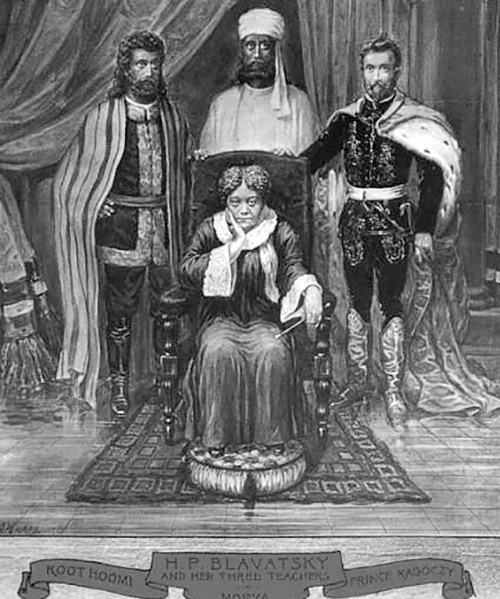
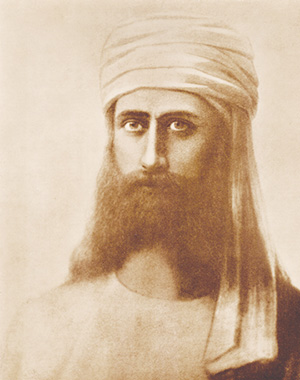
A painting of Madame Blavatsky andher masters Koot Hoomi, Morya andPrince Ragoczy.
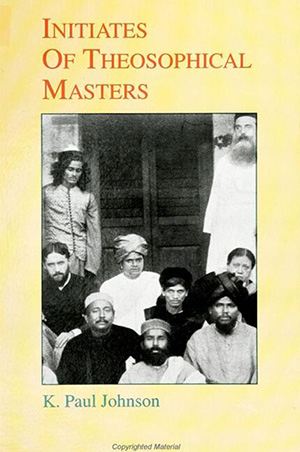
However, the work of K. Paul Johnson (as found in such titles as The Masters Revealed and Initiates of the Theosophical Masters, State University of New York Press), offers an appealing alternative. By deconstructing Blavatsky’s life and work, Johnson has been able to decode her Master mythos as referring not to ethereal spectres but to living religious, political and esoteric figures.
He proves from her work that these figures (many of them at least) were involved in political agitation of various forms (including the liberation of India from the British), thus the cloaking of their identities was necessary. Blavatsky commandeered the earlier Freemasonic concept of Unknown Superiors or Secret Chiefs and used it as a gloss to cover the identities of her “comrades” in revolution.
While Blavatsky certainly understood the use of the Masters as metaphor, her followers did not. In a letter to Franz Hartmann, Blavatsky says:
…where you speak of the “army” of the deluded – and the “imaginary” Mahatmas of Olcott – you are absolutely and sadly right. Have I not seen the thing for nearly eight years? Have I not struggled and fought against Olcott’s ardent and gushing imagination and tried to stop him every day of my life.2
Throughout her works there are hints to the observant that the Mahatmas she had “created” were myths and figureheads to hide real figures. If we were to trace the development of the Master mythos within her work, we can clearly see it changing from “spirit” guides that appeared in her earlier spiritualistic period, to figures which are ambivalent, withdrawn and seem to be “more than human”.
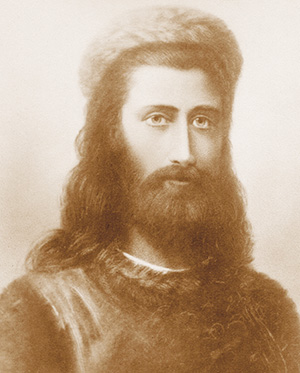
MahatmaKoot Hoomi
These figures were coupled with obvious slight of hand tricks (in Adyar), which the more critical might see as “camp” additions to a sideshow, a sideshow that was in some way meant to be seen through by those who possessed the perception. Blavatsky couldn’t tell you that the Masters were metaphors, but her behaviour, erratic descriptions and illusionist tricks would have done the job. These figures should not be seen as spiritual alone. Blavatsky’s view of “manipulating reality” was not that of an outside observer.
Mahatma Morya
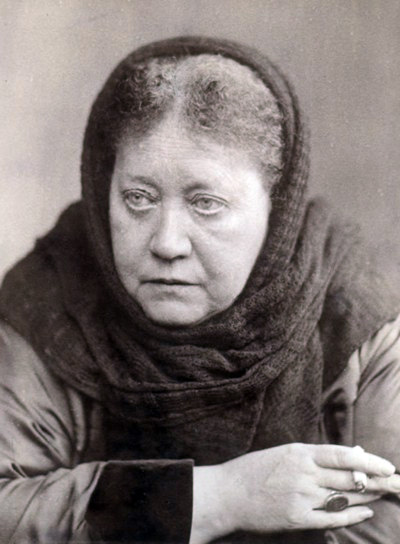
Today, Theosophy may wish to paint her as a “saint”, however the available records show that she smoked (tobacco and hashish), swore and had a hell of a temper. Her political views were untempered and many of the “so-called” Mahatmas would not have been offended if we labelled them as terrorists. Many of the secret societies she worked with battled using every possible means to destroy what they saw as the “imperialist and capitalist” monster. They were revolutionaries or terrorists.
Accordingly, as time progressed real revolutionary spiritual figures were replaced with ethereal nonsense. The sad fact is that from this nonsense a whole “Ascended Master” movement developed, melding itself with spiritualism, channelling and other superficial spiritual forms. It has resulted in the counter-initiatory tradition of this time. When we see the original meaning behind the Master metaphor we start to appreciate the shallow vision of modern spirituality.
While there is truth in the original “Secret Chief” or “Unknown Superiors” teaching, this is very different from the egalitarian American package of “McDonald” Masters and apple pie wisdom.
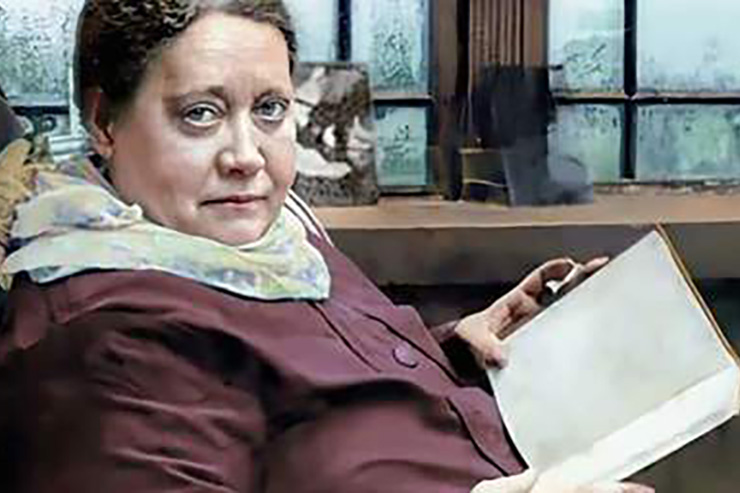
Madame Blavatsky
The sources of light were seen as transmitting wisdom through a traditional hierarchical structure to those prepared to receive truth in both an experiential and cognitive form. It had little in common with political foment, eastern guruism or spiritualistic practice.
In a world where hierarchy is a dirty word and intellectual prowess is confused with elitism, it becomes difficult to expound the real ethos of Unknown Superiors in juxtaposition to the easy going, yet facile and vacuous messages of Ascended Masters, Extra Terrestrials and age-old spirits.
The most dangerous aspect of these new Masters is that they are not all benign; they do not all give “spiritualist” candy and meaningless cliches from the other side. Many of these UFO, Masters and Spirit guides are offering messages and encouragement which seem aligned to the development of a New World Order and collective forms of mind control.
We may accept that the Mahatmas of Blavatsky were metaphors alone, but it is a terrifying possibility that “principalities and dominions” may be using the Ascended Master mythos as a means of mass mind control. If leaders of modern spiritual movements are more than willing to open their minds and souls to any being who calls itself “Jesus”, or any spirit than seems benign, or any extraterrestrial who says it comes in peace, then the minds of their followers are surely in jeopardy.
In recent years various UFO cults have come to untimely ends and many others seem to be moving towards fascistic forms of social structure. It is possible that as the Kali Yuga accelerates the Ascended Master mythos will become more and more a mechanism of control.
The New Age is perhaps a little different than we thought. The age of Aquarius is dawning, however, Aquarius is ruled by Uranus (or Saturn in more ancient astrological forms). These planets are not those of enlightenment, but forces of dispersion, destruction and crisis. Saturn itself being the glyph on which the legends of Satan and Set were grafted.
The above article originally appeared on the (now defunct) Living Traditions website.
[alert type=”general” dismiss=”no”]This article was published in New Dawn 74 (Sept-Oct 2002.[/alert]
[alert type=”success” dismiss=”no”]If you appreciate this article, please consider subscribing to help maintain this website.[/alert]
“The Science of Mind is the study of Life and the nature of the laws of thought; the conception that we live in a spiritual Universe, that God is in, through, around, and for us.” – Ernest Holmes, The Science of Mind
“It is the childlike mind that finds the kingdom. Words are also seeds, and when dropped into the invisible spiritual substance, they grow and bring forth after their kind.” – Charles Fillmore
“Everything can be taken from a man but one thing: the last of the human freedoms – to choose one’s attitude in any given set of circumstances, to choose one’s own way.” – David R. Hawkins, Letting Go: The Pathway of Surrender
As the world’s elite and powerful meet every year in private to discuss the many plans and agendas they have to control our lives, from what we eat to who owns our bodies to how we spend our money, it’s easy to fall into a sense of total disempowerment, of feeling as though we no longer have choices, individuality, or sovereignty because other far more wealthy and influential people are pulling the puppet strings of humanity. We are told we are “bottom feeders” and “useless eaters” who don’t have the brains to decide our own destinies, and that one day we will be made obsolete thanks to transhumanism.
Yet there is a movement that began back in the early 1900s, based upon ancient wisdom teachings thought about in new ways, that tells us this is not true. The New Thought Movement and its teachings and principles are finding a new home in the hearts, minds, and souls of those who know they were not meant to be puppets under someone else’s control. They are spiritual beings having human experiences, sparks of divine intelligence that bow to no external forces or influences, directly linked to the infinite intelligence of the Universe and are, ultimately, co-creators of their own lives.
Over the last few years, we have all become aware of the agendas of the ultra-rich and powerful, of organisations like the Bilderberg Group and the World Economic Forum, and Big Pharma and the complicit mainstream media that lie to us and deceive us into pushing their chosen narrative. It has left many of us reeling for solid ground physically, mentally, and spiritually as we watch loved ones fall prey to propaganda and brainwashing. They turned the truth on its head, telling us up is down, and altering science to fit their woke agenda.
We have watched as our spiritual lives have been sapped of strength as we questioned those we thought were on our side, doctors and researchers who sold their souls to Big Pharma, celebrities that pushed gender mutilation and the belief that men can give birth and menstruate. Media pundits tell us to look the other way when thousands drop dead of “no apparent cause” because they’ve been told to keep the truth from us about vaccine injuries and deaths.
The whole world has been turned upside down and we have lost our footing.
Focusing on these externals has created a sense of fear and anxiety that is unprecedented in recent times, but there is a great truth the elites don’t want us to remember and will do all they can to hide it from us. A truth with ancient roots and a more modern view that tells us we are way more in control than we could ever imagine. A truth that reminds us real power comes not from some arrogant billionaire with a God complex or some corporation that benefits from illness and death. Real power comes from within each and every one of us, if only we would stop looking for it in all the wrong places.
What Is New Thought?
The name is a bit deceiving because New Thought has been around for well over a century. Not to be confused with New Age, New Thought is a spiritual and philosophical movement with roots in many religions and metaphysical teachings. It is ancient wisdom thought about in new ways as most of its ideas, core principles, and teachings are rooted in everything from Christianity to Buddhism. William James referred to as “the Religion of Healthy-Mindedness” and wrote about the movement in his book, Varieties of Religious Experience, alluding to the emphasis on the power of the mind and our thoughts.
New Thought focuses on using the power of the mind to heal, create reality, and prosper in the world because all is mind and all begins in thought. The “founding father” of the movement was Phineas Parkhurst Quimby (1802–1866), an American clockmaker who was also a mentalist and student of mesmerism. Quimby suffered from tuberculosis as a youth, which had no cure, and set about to experiment with his own ideas. He was intrigued by the mind’s ability to control and affect his own pain and thus, the body, and even claimed to use his mind methods to cure his TB.
Mesmerised
Quimby was a follower and devotee of the teachings of Charles Poyen, who came from France to the United States to lecture on “mesmerism,” a form of hypnotism created by German doctor Franz Mesmer in the 18th century which claimed the presence of an invisible natural force possessed by all living things, including humans, animals, and vegetables, and that this force could serve as an attractor, as in animal magnetism. Quimby also followed the teachings of other mesmerists visiting the United States from Europe and began to develop his own practice of working with ill patients, many of whom claimed he cured them.
He was called a quack and fraud by those who did not understand his ideas, but his work served as the foundation of New Thought – how the mind can cure, or harm, by the use of this invisible and mesmerising force.
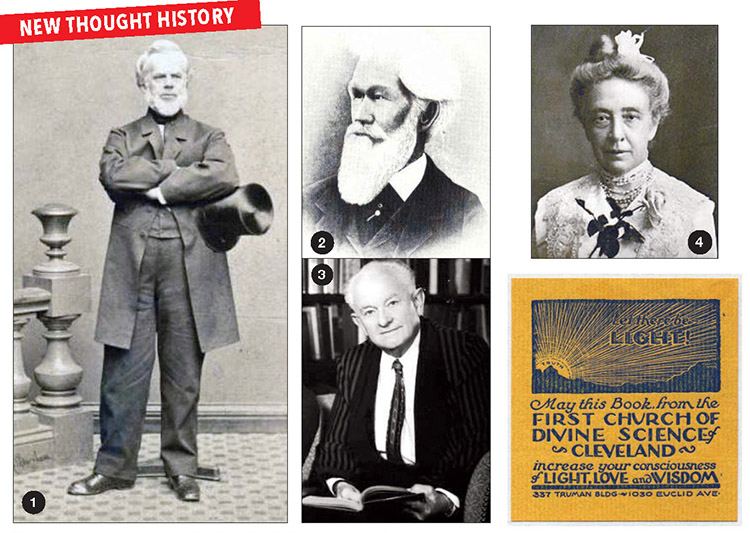
Some of the key founders and major influencers of the New Thought movement: 1. Phineas Parkhurst Quimby 2. Warren Felt Evans 3. Ernest Holmes 4. Malinda Cramer (below is a bookplate issued by her church)
Mental Sciences
According to an article on NewThoughtWisdom.com, “New Thought also helped guide a variety of social changes throughout the 19th, 20th, and into the 21st centuries. New Thought directly influenced the growing movement of ‘Mental Sciences’ of the mid-19th century, which would later become the New Thought Movement. The mental-healing movement was a protest against old beliefs and methods, particularly the old-school medical practice and the old theology of the time.”
Quimby’s belief that one could cure themself of disease by using their own mind was at the forefront of a revolution in how we thought about illness and suggested strongly that we had more control than even doctors or pills and surgeries.
The ‘Mental Sciences’ are also rooted in the work of Warren Felt Evans who became a student of the movement in 1863 after seeking healing from Quimby. His great achievement was being the first to write about the New Thought healing methods as taught and practised by Quimby. His first book was published six years after Quimby died.
The New Thought movement may have originated in the United States, but it also had some roots in England, where the term “Higher Thought” was used instead of “Mental Sciences.” New Thought ideas spread via lectures, books, magazines, and leaflets in the early days. It was never intended to be a formal or organised religion. New Thought groups and churches were non-judgmental and open to all, unlike more traditional religions with rules, doctrines, and dogma.
Eventually, there arose three major branches within the movement that still exist today:
Religious Science/Science of Mind
Church of Divine Science
Unity Church/Unity Christianity
Religious Science was founded by Ernest Holmes (1877–1960) who wrote the seminal textbook, The Science of Mind. Holmes was heavily influenced by other New Thought pioneers such as Judge Thomas Troward, a founder of Mental Science, and literary legend Ralph Waldo Emerson, as well as the work of Emma Curtis Hopkins, who was often described as the New Thought “teacher of teachers” because of her influence on the movement.
Religious Science is a spiritual system based on the idea that all religions claim the same divine truth. Holmes wrote, “The varying faiths of mankind are unnumbered, but the primal faith of the race is today, as of old, the One Faith; an instructive reliance upon the Unseen, which we have learned to call God.” The teachings of Religious Science, summed up in The Science of Mind, claimed people could realise their true power and individual goals by believing the Universe was filled with divine intelligence, purpose, and order and that they could access that intelligence within, through the power of their minds and alignment of their thoughts.
The Church of Divine Science originated in San Francisco in the 1880s under Malinda Cramer (1844–1906). She and her husband Frank created the Home College of Spiritual Science in March 1888. Cramer later changed the name to the Home College of Divine Science. According to Divinescience.org, divine science teaches “that the fullness of Spirit is forever pouring Itself through the mind of man, limited only by the way man thinks and feels about life in general and about certain conditions and situations in particular. Therefore, all change begins as an activity in mind and through the law of cause-and-effect mind manifests as a personal experience.”
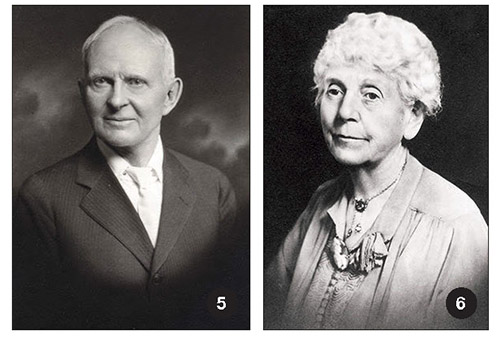
Charles and Myrtle Fillmore
Unity Church or Unity was founded by Charles (1854–1948) and Myrtle Fillmore (1845–1931) in 1889, with roots in Transcendentalism. Unity describes itself as “for people who might call themselves spiritual but not religious” and publishes a popular devotional publication called Daily Word. Unity has more of a Christian basis but without the dogma and doctrine. Unitychurch.org describes “a philosophy of life that emphasises a positive approach to Christianity and daily living and is based on the principles of Truth taught and exemplified by Jesus the Christ. We welcome all people regardless of religious background and serve their spiritual needs through prayer, education, publishing and being of loving service.”
All were incorporated into the International New Thought Alliance (www.newthoughtalliance.org), which provides educational information as a gathering place (now online) for those who follow the principles and practices.
Key Principles
The principles of New Thought, no matter what group or branch, are as follows:
Infinite intelligence, or God, is omnipotent and omnipresent.
Spirit is the Ultimate Reality.
True human self-hood is divine.
Disease has a mental origin.
Divine thought has power for good.
Right thinking can heal.
There is power in prayer, meditation, and positive thinking.
New Thought regards God as the Source of all, infinite intelligence that is everywhere, and that divine thought is a force for good in the world. God, or this infinite intelligence, exists within and yet is the entirety of the Universe itself, and there are metaphysical laws that govern the spiritual universe just as scientific laws govern the physical universe. We can use these metaphysical laws to consciously create our life experiences.
According to NewThoughtWisdom.com, “New Thought teaches that everything begins in the mind, and that events in the ‘outer’ world reflect the atmosphere of the ‘inner’ world: the macrocosm of human collective consciousness is regarded as inseparable from the microcosm of individual thoughts, attitudes, and beliefs. Through a shift in consciousness, conditions can be altered – for the individual and thus for the collective.”
Wayne Dyer (1940–2015)
In other words, as the late modern New Thought teacher/author Dr Wayne Dyer put it, “If you change the way you look at things, the things you look at change.” Neuroscience tells us that our brains will look for evidence of what we expect and believe. We are pretty much what we think about all day long, as are our experiences.
These concepts can be traced to the more mystical teachings and philosophies of the ancient Greek, Roman, Egyptian, Taoist, Jewish, Christian, Muslim, Vedic, and Muslim cultures, emphasising the interaction between the mind/thought and consciousness and its effects in the external world outside of the human mind. Unlike many religious teachings, there is no need for a middleman, an intercessor, a Church leader, a dogmatic doctrine, or a set of fixed rules.
What a dangerous concept in these trying times when we feel so out of control because of tyrannical entities such as the World Economic Forum, the UN, Big Pharma, and our government leaders seeking to take away every remaining freedom we have. If we were to all wake-up and realise we have this divine power within us and that we alone control our minds, thoughts, and beliefs, those who seek to control us and make money off of our backs would be… powerless. This is why a new revolution of New Thought principles and teachings can literally change the world.
But first, we must change ourselves individually. We must achieve right thinking and learn to focus our thoughts and attention on what we want to create, not what we don’t want. New Thought teaches us that we are all sparks of divinity and that, as stated in the Divine Science Statement of Being, “God is all, both invisible and visible. One Presence, One Mind, One Power is all. This One that is Perfect Life, Perfect Love and Perfect Substance.” We are also told that “the transcendence and immanence of God is manifest in all created things.” Imagine knowing that we are a part of this divine powerhouse that takes invisible, unformed substance and brings it into form. Who would need institutions and corporations to create prosperity? Who would need the constant intervention and meddling of medical authorities and Big Pharma when we can learn to heal our own bodies via the power of our minds?
New Thought reminds us that there is visible and invisible, absolute and relative, universal and individual and that it is all God, and we are a part of this. God is within us. Just as Christians are told the Kingdom of Heaven is not some external place, but in us and through us and all around us.
New Thought is called a process that evolves with each individual. Unlike traditional religions, New Thought remains “new” by embracing insights, discoveries, and levels of consciousness that allow the individual and the collective to continue to “become” more.
How Can Evil Exist if God is All Good?
As millions of people die from vaccine injuries, COVID-19, crime, poverty and other causes, one might ask how New Thought views evil. In “Toward the Prophetic: A New Direction in the Practice of New Thought” by independent scholar Liza J. Rankow for Religion Online, God is not personified but regarded as “an Eternal Principle that appears as Law, Being, Mind, Spirit, the Cause and Source of All.”
Rankow explains that the Christian doctrine of God as good is contrasted with “some independently existent evil, in a dualistic context (whether or not that evil is personified as the devil or Satan). New Thought, however, believes in ultimate oneness and that God is all there is, and “evil is regarded not as a fundamental part of the universal order, but as the byproduct of a human consciousness of separation.” Thus it is this sense of separation that is at the root of all evil and despair.
We are, therefore, individualised expressions of and one with the Life of God, spiritual beings in human incarnation. We can choose good or evil within that context and Life will respond to the force and focus of our thoughts. To reach our greatest soul development and for the good of the collective soul, it behoves us to choose good. This was a central teaching of Jesus Christ and other great wisdom teachers who believed in The Golden Rule.
Those who seek to suppress, control, or rule over us, whether individuals or institutions, know that many of us have lost our connection to this truth – that we are divine co-creators, that we have the power within to change our thoughts and minds and therefore our external experiences, and that no one can take away the sovereignty of our minds and freedom of our thoughts. They know we have little to no spiritual life because they have forced us into a relentless fear-based survival mode.
As more of us awaken to these New Thought teachings, their power over us will diminish and vanish. We will no longer be victims of people, things, or situations outside us. We will step into our true nature, one they will do anything to keep from us.
We can then apply the principles of universal and divine oneness of the individual to the greater social condition, creating a profound new understanding of how we interact with others and the Earth itself. If we understand that the essence of all life is unified with Source, and we are all of that Source, then there is no “we” and “them” and only all of us, and harming one harms all. Individual transformation leads to the transformation of the entirety of life itself. The power begins with each of us.
What a truly revolutionary act it is today, amidst censorship and banning and suppression of truth, to learn to reclaim our inner power, our divine connection, and our ability to use our minds to create the lives we desire and to control our thoughts, our lives, and our destinies. This is the gift of New Thought.
[alert type=”general” dismiss=”no”]This article was published in New Dawn 197.[/alert]
[alert type=”success” dismiss=”no”]If you appreciate this article, please consider subscribing to help maintain this website.[/alert]
Sources
Braden, Charles. Spirits in Rebellion: The Rise and Development of New Thought. Southern Methodist University Press, 1963.
“History of New Thought.” Center for Spiritual Living Tahoe-Truckee. tahoecsl.org/history-of-new-thought/
Holmes, Ernest. The Science of Mind: A Philosophy, A Faith, A Way of Life. Tarcher Putnam, 1998.
International New Thought Alliance. newthoughtalliance.org
“The Philosophy and Foundation of the New Thought Movement.” newthoughtwisdom.com/about-new-thought.html
“Toward the Prophetic: A New Direction in the Practice of New Thought.” Liza J. Rankow, Ph.D., Religion Online. religion-online.org/article/toward-the-prophetic-a-new-direction-in-the-practice-of-new-thought