New Dawn – World's Most Unusual Magazine

Category: Articles

  • Awakening the God Within: Secret Teachings of Richard, Duc de Palatine & The Brotherhood & Order of the Pleroma

    Awakening the God Within: Secret Teachings of Richard, Duc de Palatine & The Brotherhood & Order of the Pleroma

    From New Dawn Special Issue Vol 18 No 2 (Apr 2024)

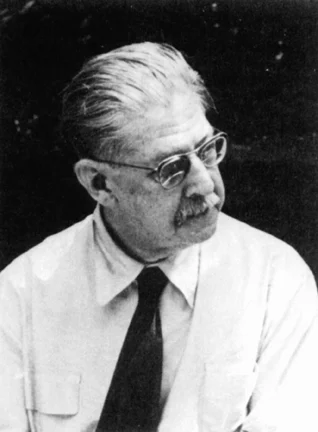
    One of the most remarkable spiritual teachers of modern times, Richard, Duc de Palatine (1916-1977), is little known today outside of a handful of modern Gnostic churches and initiatory orders.

    His biography was capably summarised by Mehmet Sabeheddin in an earlier article in New Dawn, which was the first introduction many people have had to de Palatine’s work.1 The teachings he handed down are even less well-known than the man himself. Yet the spiritual path de Palatine taught in his public writings and the private lessons passed on to his students is as relevant now as it was in his own time. It shows a way past the corrupt hierarchies of politicised religion to a spirituality founded squarely on individual human freedom.

    Many of those who knew de Palatine personally were profoundly impressed by the authority and the sense of “knowingness” that shaped his public presence even when he was a young man. His own writings confirm the impression of a man guided by inner certainties rooted in spiritual experience. Though his core insights were always his own, those insights were shaped in important ways by the esoteric traditions he studied and the initiatory lineages that were communicated to him. A brief survey of de Palatine’s own spiritual journey will therefore help set the stage for an outline of the teachings themselves.
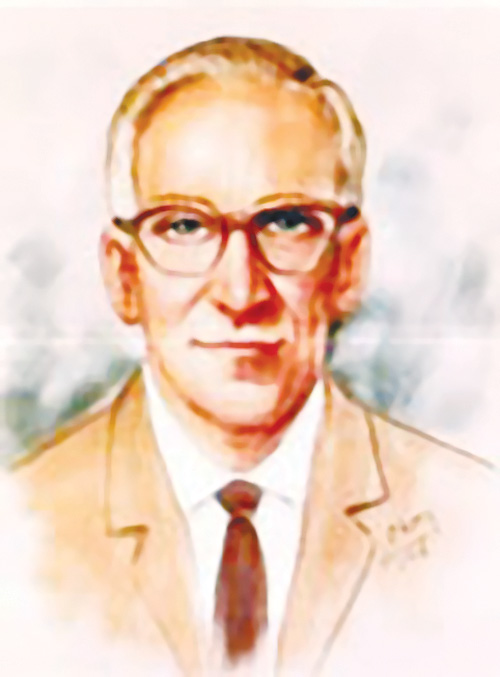

    Richard, Duc De Palatine was born on 4 July 1916 as Roland (Ronald) John Powell in the Melbourne (Australia) suburb of North Fitzroy, the son of William John Powell and Annie Powell (Hancock). He studied at Melbourne University, serving with Australian military intelligence in WWII. He legally changed his name to Richard John Duc de Palatine after relocating to England from Australia in the late 1940s.

    A Quest For The Light

    His birth name was Ronald Powell, and he was born in Melbourne in 1916. From earliest childhood, he had a sense that some unseen power guided and protected him. Raised as a Christian, he dabbled briefly in rationalism, then entered the Catholic Church and attended Mass regularly for some years. By 1935, however, his disagreements with Catholic doctrine had become impossible to ignore, and he left the Church and began a period of spiritual seeking.

    In 1938 he joined the Theosophical Society, then an influential presence in the alternative spirituality scene in Australia and elsewhere. Theosophical teachers Geoffrey Hodson and John A. Farquharson guided Powell through the Society’s teachings. At least as influential was the Melbourne Theosophical Lodge’s library, which included G.R.S. Mead’s groundbreaking translations of surviving Gnostic literature and a wealth of works on the Essenes and the ancient Mysteries – subjects that would be central to Powell’s teachings later in life. The evidence of his later writings shows that he studied books by all the important Theosophical authors as well as the works of two American Rosicrucian teachers, Max Heindel and George Winslow Plummer.

    Collins St, Melbourne, in the 1930s.

    Probably by way of the Melbourne Theosophical library he also encountered the works of another extraordinary teacher, George Washington Carey. Born in 1845, Carey was an American mystic and healer whose work focused on the twelve biochemic tissue salts, a form of homeopathic medicine that uses the mineral salts found in the human body. Carey’s handbook of the tissue salts was for many years a standard text in this branch of alternative medicine. However, his interest in the tissue salts was not limited to their healing powers. Later in his life, he came to focus on one of the inner secrets of esoteric spirituality: the role played by hidden aspects of human biology in the quest for transcendence.
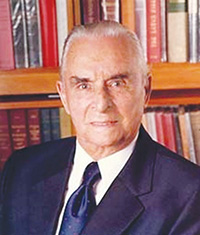
    For over 70 years, Geoffrey Hodson (1886–1983) was a leading light in the Theosophical Society.

    Carey’s work also drew on Christian tradition in a fascinating way. Having studied the work of many earlier writers, Carey came to understand that the Christian Gospels were not historical documents meant to be taken literally but skilfully crafted parables based on a deep understanding of the subtle anatomy of the human body. Through the myth of the birth, life, death, and resurrection of Jesus, they communicated a powerful system of personal spiritual transformation. Carey’s works, especially his last book God-Man: The Word Made Flesh, had a profound impact on Powell, who quoted Carey at length in his own writings and included material on the biochemic cell salts in his private lessons for students.
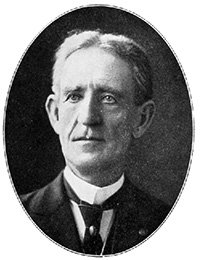
    George Washington Carey

    By 1948 Powell had become a teacher in his own right in the Melbourne area, with a circle of committed students. However, the “invisible presence” that guided him had other plans for him, and he travelled to London that year, settling in Kensington. Frequent visits to France brought him into contact with a wide range of European esoteric orders, and he received initiation into a series of potent spiritual lineages.

    The sources of some of these lineages may raise hackles in today’s alternative culture, as they were preserved in European royal and aristocratic families. It needs to be remembered, however, that the old aristocracies of Europe were never monolithic. To borrow a metaphor from Dune, there were plenty of Harkonnens amid European nobility but there were also equivalents of the Atreides. Over the centuries, it was by and large the Harkonnen-equivalents that triumphed, but some of the others survived in relative obscurity.

    It was from certain of these latter lineages that Powell received a series of initiations passed down for centuries from the Knights Templar and other initiatory bodies that preserved the ancient wisdom. In the course of these initiations, he was ennobled, taking the new name Richard Jean Chretien, Duc de Palatine. He was also consecrated as a bishop in 1953 by Mar Georgius (Hugh de Willmott Newman), Patriarch of Glastonbury, one of the most influential figures in the movement of free bishops, then evolving a sacramental Christianity independent of established religious hierarchies.

    All these influences came together in 1953. Late in that year, Bishop Richard, Duc de Palatine founded the Pre-Nicene Gnosto-Catholic Church to restore the Gnosis of the Soul – the secret teachings of the Gnostics and their heirs – to the Christian Churches. He also received a charter from the Fratres Lucis (Brothers of Light), an esoteric order that traces its origins to the fifteenth century, authorising him to establish an initiatory order alongside the church. Thereafter he devoted his time to teaching and writing, publishing a monthly magazine and a series of booklets on the Gnosis of the Soul through his Pre-Nicene Publishing House, and writing and circulating correspondence lessons to students throughout the world. In 1971, he relocated to the United States and remained there, always busy, until his death in 1977.

    The Gnosis of the Soul

    In the course of his work, de Palatine wrote more than two dozen essays of various lengths, as well as two correspondence courses for his students. These still survive and are available to students of the Gnostic churches and initiatory lineages he set in motion. As with most of the old traditions of initiation, some aspects of the work are kept private by their current custodians, just as they were by de Palatine himself. The first steps in the teachings can be outlined readily enough.
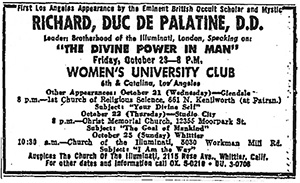
    In October 1959 – on the eve of the 1960s ‘occult explosion’ in the US – Richard, Duc de Palatine commenced his historic lecture tour of North America, as announced in the Los Angeles Times (from the archives of the Brotherhood & Order of the Pleroma – Australia). 

    The first and in many ways the most crucial point about de Palatine’s teachings is that he never claimed that they were original. In his view, one Wisdom Religion has been passed on by enlightened saints and sages since human beings first incarnated on this planet. That tradition has never died, though it has been obscured in some ages by corrupt priesthoods and tyrannical governments, and it is endlessly renewed by emissaries from the inner realms of being – human souls who have passed beyond the need for incarnation but return to material existence to help their fellow humans find their way to the path of the spirit.

    Central to the Wisdom Religion that de Palatine taught is a clear sense that God is not “out there” somewhere, an external presence exercising an arbitrary despotism over all things. “The Kingdom of God is within you,” said Jesus. Turn within and you will find that behind your personality, or Personal Soul, is the individuality or Higher Ego, the self that passes from life to life in the course of reincarnation. Behind the Higher Ego, in turn, is the Higher Self or Christos Body, an inseparable ray of the One Life which is God. Thus the spiritual quest always leads within, and seeks to awaken that inner knowing that brings the Personal Soul into harmony with the Higher Ego and the Higher Ego into harmony with the Higher Self.
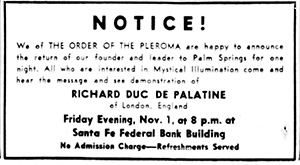
    Richard, Duc de Palatine regularly lectured across the United States in the 1960s, before relocating to California in 1971. 

    The Christos Body, in turn, is the Christ that matters in terms of personal salvation. In his book Christ or Jesus? de Palatine argued that the life of Christ in the four canonical Gospels is an invented narrative meant to communicate a path of spiritual transformation. It was based to some extent on the life of the Jewish spiritual teacher Jeshu ben Pandira, who lived and died around 100 BC. But the “Jesus Christ” of the canonical Gospels never actually existed as a living person, and the cult of Jesus as a historical person promulgated by the mainstream Christian churches is based on a cascade of misunderstandings circulated by early Christian teachers too literal-minded to grasp the profound metaphors of the Gospel myth.

    The life of Christ, in de Palatine’s teachings, thus has to be understood not as the story of one divine person but as a guide to the transformation of each individual soul. Just as there are five traditional stages in the Gospel narrative, there are five stages along the path to complete enlightenment. We can examine them one at a time.

    1. Birth. This is not the physical birth of the individual but the birth of the Christos, the radiant presence of divinity in the self, within the individual heart. This is the beginning of genuine spirituality, the replacement of outward forms with inward transformation. Inevitably the lower or animal self pushes back. Its instruments are the “images of menace,” parasitic forms created by unbalanced thoughts, feelings, and cravings, which reside in the subconscious and are stirred up by any effort at spiritual growth. These parasitic forms try to suppress the newborn spiritual potential of the individual; this is the real meaning of King Herod’s attempt to slaughter the infant Christ.

    2. Baptism. In the myth of the Christos, the baptism of Jesus by John the Baptist was the beginning of Christ’s earthly ministry. In the Gnosis of the Soul, it is the awakening of the power to perceive the inner regions. Psychic potentials such as telepathy begin to manifest themselves, and these powers unfold step by step until the individual becomes a risen Son of God emerging from the sepulchre of his own material body.

    3. Transfiguration. The narrative of Christ’s transfiguration is enacted by the individual seeker when the light of the higher self begins to illuminate the vestures or subtle bodies that surround it. In order to achieve this stage, the last vestiges of egoistic desire must be released. Once that has been accomplished, the individual becomes aware of his unity with the Supreme Soul, and he begins to function on the abstract planes of being where all things are perceived as one.

    4. Crucifixion. The animal self has not yet been wholly defeated, however, and the final battle between it and the awakening soul remains to be fought. This is the equivalent, in the path of the individual, of the crucifixion in the mythic narrative of the Christos. This final struggle completes the soul’s earthly pilgrimage; after this, there is no need to reincarnate further in a body of flesh, for the soul has learned everything this planet can teach it.

    5. Ascension. Having completed the journey set out symbolically in the Gospel narratives, the soul then ascends to become one with its own Divine Soul in those higher realms of being that traditional Christian mythology calls “heaven.” Having become an adept of the Gnosis and a member of the communion of saints, the fully awakened soul may then choose either to descend again to earth to help other souls complete the great journey or labour in other, subtler spheres of existence for the betterment of all.
    Get the issue this article appears in

    Beginning the Path

    The system of spiritual development passed on by the ancient Gnostic Christian churches, before they were driven into hiding by the political religion of Constantine and his successors, was called the Disciplina Arcani or the Arcane Discipline. This was the name de Palatine used for the system of training he passed on to his students.

    In de Palatine’s vision, religion was always a way of life and not just a set of beliefs. Students of the Arcane Discipline are given a set of ideals to embody in their lives. The hard work necessary to enact these ideals develops the inner capacities needed to proceed on the path. What are these ideals? First and most essential, control of thought; next, purity of mind, emotions, and body; third, compassion toward all beings. As these three qualities become habitual, the aspirant begins to receive attention from his or her inner Teacher, the spiritual being who will supervise that person’s training. Much of this training will take the form of trials and tests in everyday life. According to the aspirant’s response to these trials and tests, new lessons will be forthcoming.

    The ideals just listed are the most important capacities to develop in the early stages of the path, but certain others can also be pursued at the same time. The lessons de Palatine wrote for his students specify the ideals needed for the path as discrimination; indifference to worldly objects; control of the mind, the body, and the senses; tolerance; endurance; faith; equilibrium; and the desire for liberation. In addition, training in concentration and meditation also plays an important part in the practical work. One basic meditation from de Palatine’s writings is included here (see page 37). There are many others the aspiring student receives as the lessons proceed.

    At present, the teachings passed on by Richard, Duc de Palatine are still preserved by a handful of small organisations, as noted earlier, and interested students must make an effort to find them. He liked to point out that truth ever reveals itself to the sincere seeker. The basic elements of training summarised here are suitable for beginners. Those who practice them and set out in quest of more light are unlikely to be left in darkness for long.

    To read a Meditation Exercise by Richard, Duc de Palatine and see the additional informational graphics of this article, purchase a paper or digital copy of this magazine by clicking here.

    Recommended reading: “Meeting with a Magus: The Untold Story of Richard, Duc de Palatine & The Brotherhood and Order of the Pleroma” by Mehmet Sabeheddin in New Dawn Special Issue Vol. 13 No. 2, available as a digital download at www.newdawnmagazine.com/product/new-dawn-special-issue-vol-13-no-2.

    [alert type=”general” dismiss=”no”]This article was published in New Dawn Special Issue Vol 18 No 2.[/alert]

    [alert type=”success” dismiss=”no”]If you appreciate this article, please consider subscribing to help maintain this website.[/alert]

    Footnote

    1. Mehmet Sabeheddin, “Meeting with a Magus: The Untold Story of Richard, Duc de Palatine & The Brotherhood and Order of the Pleroma,” New Dawn Special Issue Vol. 13 No. 2, 65-70.

    © New Dawn Magazine and the respective author.
    For our reproduction notice, click here.
  • The ‘Fourth Turning’ in an Ages-Long Struggle

    The ‘Fourth Turning’ in an Ages-Long Struggle

    From New Dawn Special Issue Vol 15 No 6 (Dec 2021)

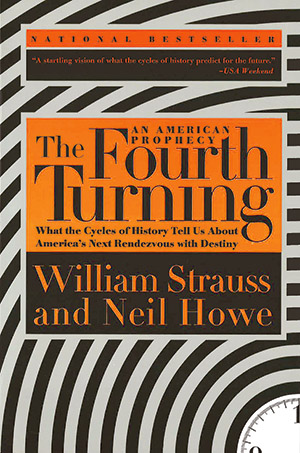
    The remarkable 1997 book The Fourth Turning: An American Prophecy by William Strauss and Neil Howe argues that the familiar linear approach to history taught in most western education and academia is a fairly recent paradigm containing dangerous flaws. They argue, instead, that seeing history in terms of recurring cycles provides insights that modern linearity obscures – “one year’s (or one saeculum’s) winter is more like the prior winter than like the autumn that came right before it,” they explain.1

    The authors state that by perceiving these cycles, we can perhaps become more aware of impending change. On the contrary, linear or straight-line thinking often causes its adherents to be completely blindsided. Using American history as an example, they point out that as late as December 1773, the idea that the American Revolution would begin in the near future seemed nearly impossible. The same can be said about November 1859 regarding the impending start of the American Civil War that broke out in 1861. Or early October 1929 when virtually nobody expected the sudden end to the Roaring Twenties caused by a catastrophic crash of the stock market that started on October 24 (“Black Thursday”), accelerating from October 29 (“Black Tuesday”).2

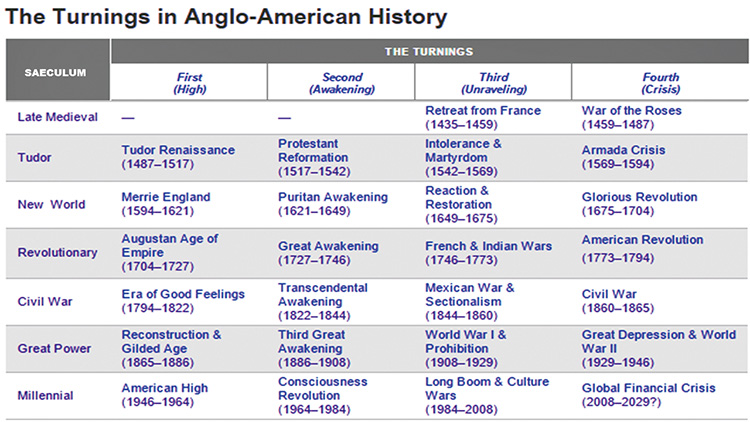
    Building upon their observation of generational cycles occurring every four generations going back through history for millennia, Strauss and Howe predicted that the current mood of pessimism and disillusionment is typical of a specific point in the cycle. This inevitably precipitates a major crisis which the authors, writing in 1997, predicted would arrive sometime between 2005 and 2025:

    Around the year 2005, a sudden spark will catalyse a Crisis mood. Remnants of the old social order will disintegrate. Political and economic trust will implode. Real hardship will beset the land, with severe distress that could involve questions of class, race, nation, and empire. Yet this time of trouble will bring seeds of social rebirth. Americans will share a regret about recent mistakes – and a resolute new consensus about what to do. The very survival of the nation will feel at stake. Sometime before the year 2025, America will pass through a great gate in history, commensurate with the American Revolution, Civil War, and twin emergencies of the Great Depression and World War II.3

    In 2011, I wrote an essay regarding these pronouncements of Strauss and Howe, in the process of my reflecting on the tenth anniversary of September 11, 2001. At that time, I said:

    It is clear that many of these predictions are coming true, particularly the prediction that “political and economic trust will implode.” It would appear, however, that so far, no “great Crisis” as momentous as the Revolution or the Second World War has yet been sparked. The two authors’ warnings that those living in 1929 or 1859 or 1773 did not see the impending Crisis of their age should give us cause for concern that such a Crisis may yet be around the corner, and cause to pay attention to the cycles that the authors outline in their book.4

    Almost exactly ten years later, it certainly feels as though the Crisis that Strauss and Howe predicted has either arrived or very much “around the corner.” The way we choose to act over the coming months and years will be critical for our future and that of generations to come.

    Descent into Linearity

    Whether you agree with all the conclusions and predictions in The Fourth Turning, one of the most noteworthy features of the book is the authors’ demonstration that the peculiar modern faith in linear progress is a historical anomaly. They find evidence that “nearly all non-Western cultures accept the periodic regularity of time” – meaning by “periodic regularity” the view that time operates in cycles, with a kind of circular rhythm, in contrast to the view that time is linear, which is a relatively modern development in their analysis.5

    Strauss and Howe argue that this modern linear view of time is a product of the Enlightenment that dominated the eighteenth century, during which this approach grew into “a complementary secular faith… – the belief in indefinite scientific, economic, and political improvement.”6 They posit that this faith in linear progress reached its height at the end of the nineteenth century, and that it has always been strongest in America where a widespread belief developed that mankind had finally broken away from “any risk of cyclical regress.”7

    Strauss and Howe state: 

    Triumphal linearism has shaped the very style of Western and (especially) American civilisation. Before, when cyclical time reigned, people valued patience, ritual, the relatedness of parts to the whole, and the healing power of time-within-nature. Today, we value haste, iconoclasm, the disintegration of the whole into parts, and the power of time-outside-nature.8 

    These are broad generalisations, and any book of this nature will test the reader’s patience with such sweeping categorisations, but these overviews do appear to capture some truths worth considering.

    Interestingly, this very belief in unbroken linear progress that has gripped western thought since the Enlightenment is reinforced by the dogmas of Darwinism and modern official teachings on our ancient history. It theorises that we have supposedly evolved in a generally unbroken upward line from the “ape-like progenitors” Darwin describes in Descent of Man9 all the way to modern humans, who then progressed from early hunter-gatherers to pastoral herders living a nomadic life, to basic planters and harvesters capable of organising simple villages, and who then made it in a linear fashion to create increasingly complex civilisations.

    Although virtually all academia today still enforces some version of the above linear paradigm of humanity’s ancient history, the evidence overwhelmingly suggests this view of the ancient past cannot possibly be correct. Instead, compelling evidence supports the conclusion that humanity was highly advanced in the distant past (long before ancient Greece and Rome) and, for some reason, fell into relative ignorance for millennia thereafter – a very nonlinear view of ancient history.

    Cycling Back to the Ancient World

    Archaeological evidence around the world points to advanced capabilities which even today we barely understand, including the quarrying and transportation of massive blocks weighing over a hundred tons at sites such as Pumapunku in South America, the Osirion in Egypt, or blocks weighing well over a thousand tons at Baalbek in modern-day Lebanon, and the remarkable level of precision displayed on certain ancient artefacts (including on some of the massive blocks at Pumapunku).

    Author Christopher Dunn, a professional engineer and craftsman with extensive experience in the aerospace industry, compiled an overwhelming amount of evidence demonstrating beyond any possible dispute that archaeological artefacts found throughout Egypt and available for detailed examination today exhibit evidence of advanced precision machining. These could not have been manufactured any other way, certainly not with hand tools such as the chisels and pounding-stones on display in many museums, right next to the amazing artwork supposedly produced with such crude implements. 

    He explores several examples in his groundbreaking 2010 book, Lost Technologies of Ancient Egypt: Advanced Engineering in the Temples of the Pharaohs, establishing beyond doubt that artefacts in Egypt display manufacturing precision built on a knowledge base which was later completely lost for thousands of years. Modern engineers would, in many cases, have a difficult time duplicating these artefacts today (in fact, they could not have done this with tools available just fifty years ago, before advances of recent decades).

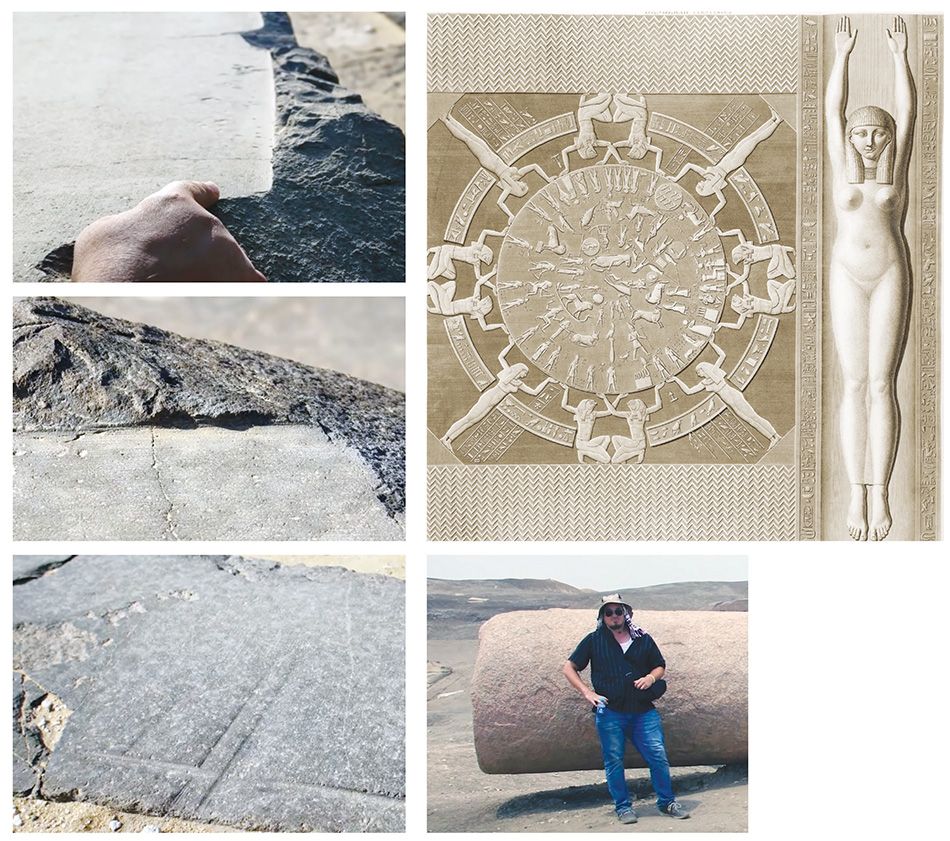
    (Above right) Cyclical time in ancient Egypt. Rendition of the Dendera zodiac on the ceiling of the temple of Hathor in Dendera, Egypt. (Other images) Researcher and documentary film-maker Ben Van Kerkwyk of UnchartedX has filmed hundreds of hours of footage of marks made by ‘high tech’ circular saws on hard stone in ancient Egypt. See www.youtube.com/channel/UC2Stn8atEra7SMdPWyQoSLA

    Building on the work of Christopher Dunn, and in some instances travelling to Egypt with him, as well as travelling on his own to other ancient sites around the globe, researcher and documentary film-maker Ben Van Kerkwyk of UnchartedX has filmed hundreds of hours of footage allowing viewers of his videos to see with their own eyes these ancient artefacts and ancient tool-marks. Dunn and Van Kerkwyk’s research demonstrates undeniable evidence of advanced technologies, suggesting that sophisticated civilisation existed before dynastic Egypt, capable of producing artwork and objects that even the ancient Egyptians could not duplicate.

    The interested reader (or the sceptic who still doubts the existence of advanced technologies that upend the conventional timeline of human history taught in academia) is strongly encouraged to visit Ben’s website at www.unchartedx.com and his associated YouTube channel. Watch two or three of his videos and see the evidence which speaks for itself. The most compelling proof involves ‘mistakes’ where marks and cuts on ancient artefacts reveal that the person operating a cutting tool made an error. Judging by the cuts that can be seen today, the tool continued its incision further than would have been the case with simple hand tools. These ‘mistakes’ show that some kind of high-powered equipment was employed that carried on with the cut before the operator stopped it.

    Our Shared Body of Myth

    In addition to the physical archaeological evidence scattered around the globe, which we can still examine today, there is another amazing body of evidence in the world’s surviving myths, from cultures on every inhabited continent and island of our earth. As I have been documenting for over a decade, this body of myth can be shown to be based on a common system of celestial metaphor and closely related in a way that explodes the conventional paradigm of humanity’s ancient history.

    The very existence of a worldwide system of this nature, in which specific mythical characters are associated with specific constellations – and in which certain characteristics accompany constellations and the mythical figures associated with those constellations across mythologies in cultures separated by enormous distances and by vast oceans – cannot be explained within the timeline of history promoted by conventional academia. 

    How can we explain obvious parallels in sacred stories preserved among the cultures of the Americas as well as in well-known myths of ancient Greece, for example, or between biblical stories and the myths of the cultures of the Pacific Islands, the civilisations of ancient Mesopotamia, the Ko-Ji-Ki of early Japan, and the Sanskrit epics of ancient India?

    These connections suggest the existence of some predecessor culture (or cultures), now completely ignored or denied by today’s official paradigm, prior to the most ancient civilisations known to academia. This system of celestial metaphor in myth was already fully developed in the earliest surviving texts of ancient Egypt, ancient India, and ancient Mesopotamia.

    Even beyond those connections, which cannot be explained using the conventional paradigm of human history, the myths of cultures around the world preserve evidence of an extremely sophisticated understanding of celestial mechanics, including an understanding of the rate of precession (whose mythological importance is discussed in my accompanying article on page 51). 

    Conventional history holds that precession (a very subtle celestial phenomenon, and one that requires many years and even centuries of careful observation and record-keeping and analysis to even detect) was not discovered until the time of the Greek astronomer Hipparchus (190–120 BCE). The rate of precession of one degree every approximately 72 years was not even known when Ptolemy wrote his Almagest in the second century CE. Yet, the precessional number 72 and its multiples (including 108, 216, and 432) appear over and over in ancient myths and sacred stories around the world – and in contexts which can be shown to metaphorically relate to the observable effects that precession has on the constellations of the night sky!

    The myths, in other words, demonstrate that precession was understood in the distant past, long before it was ‘discovered’ (actually re-discovered) by Hipparchus. Far from a linear progression, humanity realised enormous levels of understanding and achievement in very ancient times (more ancient than any civilisation known to conventional history), only to lose that knowledge for thousands of years. The evidence indicates we have yet to come close to regaining those levels of understanding and ability – a shocking proposition for the adherents of the linear model of human progress!

    Although this evidence (both mythical and archaeological) is easy to examine, abundant, and very difficult to dispute, conventional academia has – in remarkable lockstep – roundly rejected anyone arguing that the current paradigm is gravely flawed and in need of radical revision. Instead, they have continued to cling to the dogmas of linear progress. In my 2011 article exploring The Fourth Turning and the tenacity of the linear dogma, I wrote:

    It is quite likely that the faith in linearity that Strauss and Howe detail in their book has blinded scholars and others to the possibility of an ancient advanced civilisation and created a bias towards the acceptance of Darwinian biological theories, which in turn lead to linear anthropological theories as well.10

    Re-visiting the question after ten more years of work, and after the discovery of much more evidence showing beyond doubt the existence of a worldwide system of metaphor operating at the foundation of the world’s ancient myths, I am less inclined to take such a charitable view in describing the ongoing propagation of historical paradigms that cannot possibly be true, and which are roundly refuted by overwhelming evidence. 

    Indeed, there is now plenty of evidence that the truth of our ancient history has been actively suppressed as part of a conspiracy reaching back thousands of years to empower some at the expense of the vast majority of humanity. Keeping this history secret makes it easier to keep us divided and from the ancient wisdom preserved in the myths.

    Cyclical Time & Patterns

    Interestingly enough, in The Fourth Turning, Strauss and Howe note that ignorance of the cyclical nature of time, or even massive attempts to deny these cycles and live as though cycles do not exist, does not free us from the cyclical nature of time at all. On the contrary, their findings suggest that cultures embracing cyclical time are less buffeted by the waves of the changing cycles, while cultures ignoring cycles exacerbate their effects so that they experience even greater volatility – all the more painful because it is unexpected (unlike the cycles experienced by cultures that expect and respect the cyclical nature of time).

    The analysis of Alsatian scholar R.A. Schwaller de Lubicz uncovered numerous cyclical patterns and harmonies between generations living hundreds or even thousands of years apart (at similar distances from precessional turning points). He points this out in his books such as Sacred Science:

    R.A. Schwaller de Lubicz  (1887-1961)

    Since the Middle Ages, our Occident [the West] has been blinded, particularly by the cerebration of the Greek Eleatics who preferred reasoning to experimentation. The beginning of this disquieting period of “arguers” can be situated with the Eleatic school around 550 or 500 BC, a school founded at about the same time as the Pythagorean order, of mystico-religious character. Those five centuries before the precessional passage from Aries to Pisces stand in curious correspondence with our sixteenth century, also five centuries before the next precessional passage from Pisces to Aquarius: Toward the year 1500, with the Renaissance, ancient Greece was again raised to honour in the West.11

    Later in the same book he writes:

    Their [the Stoics’] champion was Zeno of Citium, who lived from 362 to 260 BC, which is about two hundred years before the precessional transition from the vernal point of the sign of Aries to that of Pisces. In the Stoic pursuit of freedom, we find a curious similarity to the ideal of the revolutionaries of 1789, a revolution which was also situated about two centuries before the new precessional transition of the vernal point from the sign of Pisces to that of Aquarius. This brings to mind a similar great revolution which took place at the end of the Old Empire of the Pharaohs, about 2400 BC, two centuries before the passage of the vernal point of the sign of Taurus into that of Aries.12

    In light of these and other apparent harmonies, de Lubicz declared, “The history of the world is strangely cyclical.”13

    Get the issue this article appears in

    Facing the next ‘Crisis’

    While Strauss and Howe seem to indict the European Enlightenment for starting the modern dogmatic cult of unbroken linear progress, it should be noted that the Enlightenment was at its core a virulent rejection of the stifling institutions of feudalism dominating Europe throughout the Middle Ages. It was an attempt to free Europe, intellectually and economically, from those ongoing feudal patterns – patterns that grew directly out of the destruction of the ancient ways by the proponents of literalist Christianity, by whom the Roman Empire was taken over and then broken apart, ushering in centuries of brutal oligarchy supported by the teachings of the Church.

    As I have demonstrated in my examination of the stories of the Bible totalling many hundreds of pages, overwhelming evidence proves that those stories are based on the same system of ancient metaphor that formed the foundations for the myths and stories of other cultures around the world. Literalistic interpretations of the Bible are mistaken and only leads to misinterpretation of the scriptures. Thus, the rejection of lingering remnants of feudalism – and oppressive literalistic religious dogmas abetting feudal oppression – appears to have led to a (perhaps understandable) mistake when this rejection of the literalist Church and its flawed teachings offered in its place the ‘secular faith’ described by Strauss and Howe, with uncritical belief in unending and inevitable “scientific, economic, and political improvement.”

    As American economist Michael Hudson, author of numerous books and essays including the newly-revised third edition of his original 1972 book Super Imperialism – now subtitled in this current edition The Economic Strategy of the American Empire – has explained at length, the oligarchical beneficiaries of the feudalist system did not passively accept the philosophical, political, and economic attacks on the structures of oligarchy launched during the eighteenth century and which gained ground throughout most of the nineteenth: they struck back quite forcefully and managed to erect numerous powerful neo-feudal structures to preserve their exploitative racket.

    Moving into the danger zone. US presidential elections in 2024 and 2028 are certain to exacerbate
    geopolitical tensions across the globe and further societal division in the United States.

    I suggest that the Crisis predicted by Strauss and Howe, which may now be unfolding before our very eyes, along with virtually all other “Crisis” examples offered by these authors (including the American and French Revolutions, the American Civil War, the Great Depression and Second World War), can best be understood in light of this centuries-old struggle against the proponents of feudalism (and, in the modern era, neo-feudalism – complete, it seems, with draconian restrictions on movement and travel reminiscent of the condition of serfs in Medieval Europe).

    Feudalism can be seen to be the system established by those opponents of the ancient wisdom preserved in the myths – myths testifying (along with overwhelming archaeological evidence) to the cyclical nature of the human story, and to the existence of a now-forgotten predecessor culture (or cultures) whose very existence is vehemently denied by academia and by the proponents of the modern ‘science’ cult and unending linear ‘progress’.

    We find ourselves in the midst of one battle in a very, very old war.

    [alert type=”general” dismiss=”no”]This article was published in New Dawn Special Issue Vol 15 No 6.[/alert]

    [alert type=”success” dismiss=”no”]If you appreciate this article, please consider subscribing to help maintain this website.[/alert]

    Footnotes

    1. William Strauss and Neil Howe, The Fourth Turning: An American Prophecy, Crown, 1997, 21 
    2. Ibid., 5-6
    3.Ibid., 6
    4. David Warner Mathisen, “The Fourth Turning and cyclical time and history,” Mathisen Corollary blog, 11 September, 2011
    5. Fourth Turning, 32
    6. Ibid., 9
    7. Ibid., 10
    8. Ibid.
    9. Charles Darwin, The Descent of Man and Selection in Relation to Sex, Volume One of Two Volumes, Appleton, 1871, 94, 133
    10. Mathisen, “The Fourth Turning and cyclical time and history.”
    11. R. A. Schwaller de Lubicz, Sacred Science: The King of Pharaonic Theocracy, Inner Traditions, 1982, 18
    12. Ibid., 43
    13. Ibid., 30

    © New Dawn Magazine and the respective author.
    For our reproduction notice, click here.
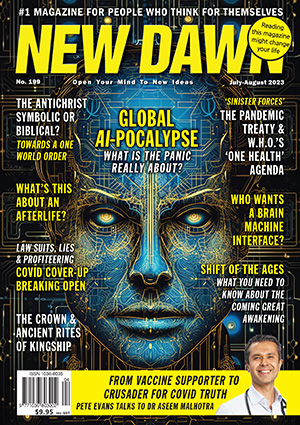
  • What’s This About An Afterlife?

    What’s This About An Afterlife?

    From New Dawn 199 (Jul-Aug 2023)

    So you think the continuity of consciousness after physical death is just a bunch of faith-based woo-woo? 

    You think it’s something cooked up to make us feel better about our inevitable journey from the womb to the rubbish heap of physical decay? 

    You think the notion of a timeless existence outside the framework of the physical universe is too vague and slippery ever to be taken seriously by our culture’s arbiters of reality – the sciences?

    Please think again. 

    Until recently, the belief that the whole of reality is based in matter has dominated our modern understanding of space, time, life and death. Most tellingly, our consciousness has been viewed as little more than an illusory by-product of mechanistic brain activity. 

    But over the past half-century, Western science – traditionally hemmed in by materialistic assumptions – has begun to wriggle free of this centuries-old ideological straitjacket and is breaking some astonishing new ground. In fact, there are now at least fifteen promising avenues of post-materialist scientific investigation currently underway, quite apart from modern physics’ excursions into the mysterious quantum realm!

    The majority of these inquiries point distinctly toward the possibility, if not the near-certainty, of a “greater reality” in nature that includes what we call the “afterlife.”

    My new book, A New Science of the Afterlife: Space, Time, and the Consciousness Code (Inner Traditions, 2023), delves into each of these intriguing fields of inquiry. 

    I peek behind the “veil” to ask, “What is the veil, anyway?” and venture a strikingly clear and simple answer. I also take a critical look at the language we use in connection with the afterlife, exposing the militant cult of scepticism that has delayed bonafide afterlife research for decades and that has scoffed at the succinct accounts, from a variety of sources, of the transition to the “next life” and of what one might expect when one arrives there. 

    How Did I Come to Write this Book? 

    I was born in 1942, raised in the New York City area in a nonreligious family, and at an early age zeroed in on the arts and sciences. I attended Brooklyn’s Pratt Institute, intending to pursue a career in Industrial Design, but soon latched onto a similar marriage of art and technology: documentary filmmaking. My first such effort, a film titled SUNDAY (www.bit.ly/1961sunday), garnered nine international awards and launched my lifelong career in media production, interrupted only by three semesters at Harvard University in the early 1960s. 

    Parallel to my creative and professional life I’ve maintained a lifelong fascination with the so-called paranormal. (“So-called” because persistent cultural taboos have made it impossible to gauge its actual degree of normalcy!) It all started when, in my early childhood, I experienced a number of precognitive dreams. These suggested that there might be hidden or denied aspects of reality that beg to be better understood and perhaps befriended. Later in life I experienced a variety of inexplicable events – UFO-related experiences, materialisations, and other “culturally unauthorised” phenomena – which persistently piqued my curiosity about the deeper nature of reality.

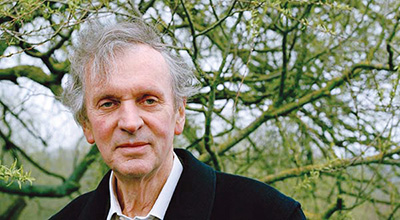
    British biologist Dr Rupert Sheldrake

    In the early 1980s, I met British biologist Dr Rupert Sheldrake and produced a radio documentary, as well as writing the first American reviews and articles about his ground-breaking book A New Science of Life. Sheldrake points out the still-unexplained gap between the DNA code and the actual three-dimensional forms, developmental stages and habits of living organisms. He proposes that the gap might be bridged by an as-yet unacknowledged field phenomenon, which he termed morphogenetic or simply morphic. Morphicfields, Sheldrake suggests, retain and pass on information from previously existing forms and situations. In this view, the DNA acts as a sort of “tuning device” that invokes the morphic fields appropriate to the particular developmental stages of an organism.

    Sheldrake also speculated that such fields, rather than fixed laws, might be responsible for a broad spectrum of other patterns in nature.

    So revolutionary were Sheldrake’s insights that the editor of the prestigious British journal Nature suggested that Sheldrake’s book should be burned! 

    This motivated me to write “Zen.. .and the Art of Debunkery” (www.bit.ly/debunkery) – a lengthy, tongue-in-cheek essay that skewers some of the absurdly unscientific sceptical attitudes that can prevail within our academic and nominally scientific establishments. Later I produced a short computer-animated film, I’M A SKEPTIC (www.bit.ly/imaskept), which pokes a different kind of fun at the thoughtless rhetoric and arrogance of self-styled debunkers and nay-sayers.

    In the early 1990s, I discovered the books of Robert Monroe. Monroe had been a mainstream New York radio producer back in the 1950s who began spontaneously experiencing out-of-body states. Eventually, he mastered the art of “astral travel” and founded the Monroe Institute, which offers practical training in this intriguing ability of the inner self.

    This then led me to the work of other explorers in what had become known as the “New Science” movement. This included research into the Crop Circle mysteries, ET contact experiences, and breakthroughs in Remote Viewing. It also encompassed afterlife studies and a host of other practical and visionary pursuits at the borderline where the physical and metaphysical meet in an increasingly comfortable embrace.

    My particular fascination with afterlife communication came to a sharp focus when, in 1995, I met Mark Macy. Mark had been one of the pioneering investigators and practitioners of Instrumental Trans-Communication, in which voices and images from the afterlife are received via modern electronic systems. 

    At first, I was a tad sceptical of Mark’s claims, but after meeting enough ITC practitioners – from ordinary folks to scientists and academics – and collecting and analysing enough samples of their work, I became convinced that this mode of communication across the veil was indeed a reality. It was, and is, a practice that apparently can be pursued and developed by folks with keen desire, some simple recording equipment, and perhaps a strong emotional bond with someone who has passed over to the other side of life.

    In the early 2000s I teamed up with co-producer Tim Coleman to produce a series of independent documentary films about modern afterlife research and communications. Over a decade later, having crisscrossed the US and visited five European countries, we had at last completed a pair of unique feature documentaries that can be viewed for free on Vimeo.

    CALLING EARTH (www.bit.ly/callearth) runs for 95 minutes and focuses on electronic communications from the other side – both audio and visual. It includes dozens of examples of this form of afterlife communication and includes conversations with some of its pioneering developers and most successful practitioners. It rebuts the popular sceptical arguments against ITC point by point, documents an international conference devoted to ITC, and reports on a group of mothers who use electronic devices to receive communications from their deceased children. The film also provides basic instructions on how to do one’s own ITC experimentation and includes a short sequence on the Scole Experiment, which is elaborated on in our second documentary.

    SCOLE: THE AFTERLIFE EXPERIMENT (www.bit.ly/scolemovie) is an 85-minute film documenting the most extraordinary experiment in physical mediumship ever attempted. (The practice of physical mediumship goes far beyond simple communication with the other side and seeks to produce physical evidence that can be recorded or preserved for study and analysis.) Conducted in the tiny English hamlet of Scole over a five-year period in the late 1990s, the Scole Experiment is widely acknowledged as the most fruitful and most rigorously controlled and meticulously documented exercise in the history of physical mediumship [you can read more about this experiment on pages 8-9 of New Dawn 196].

    My involvement in these film projects pointed me to other influential sources of afterlife-focused information, notably including the works of Dr Julia Assante, Dr Kenneth Ring, and the International Association of Near Death Studies. Soon IANDS chapters in the San Francisco Bay Area and across the US in Chicago and Atlanta invited me to present screenings of these documentaries, which were followed by lively Q&A sessions.

    These, in turn, directed my attention toward modern reincarnation research, which has been pursued over a half-century at the University of Virginia Medical School’s Department of Perceptual Studies. Perhaps the most compelling, exhaustively researched and widely known reincarnation case of modern times is that of a young American, James Leininger, who recalled in considerable detail his life and death as an American fighter pilot who was shot down by the Japanese during World War II.

    In 2018 I made the acquaintance of a remarkable team of mediums. Together we created a website, Cosmic Voices Network (www.bit.ly/covoice), which posts extraordinarily inspiring and thought-provoking channelled messages from dozens of individuals, both well-known and obscure, who now reside in the Greater Reality.

    By 2019 I had begun pulling together these seemingly disparate threads into a series of essays that eventually became the core of my 2023 book, A New Science of the Afterlife. My purpose was to encourage a more relaxed, comfortable and rational conversation about what awaits us all sooner or later on the other side.

    A New Science of the Afterlife

    The book’s introduction asks why a new understanding of the afterlife is important in these times. It suggests that many of our mounting planetary challenges (notably including those caused directly or indirectly by the compulsive accumulation of wealth) spring partly from a universal undercurrent of fear that ultimately comes down to a fear of death. 

    As religious doctrines about life and death prove increasingly unsatisfying, mainstream science (our modern world’s “gold standard of truth”) has largely failed to step in and fill this yawning gap in our understanding… though that has begun to change.

    I hope, in concert with so many other such efforts now underway, to contribute to a conscious course correction in our individual and collective priorities and, ultimately, in our very experience of life.

    My new book is divided into three main parts.

    Part I: Getting Oriented. This opening part points out that, while science is often equated with materialism, they are entirely separate concepts: Science is basically a method of inquiry – essentially “organised curiosity.” Materialism, on the other hand, is a belief system about reality

    It also points out that our popular belief in a “material” world tends to be based on an overriding focus on matter that ignores the other three indispensable ingredients of physical reality: energy, space, and time

    As well, it touches on the problem of pseudoscientific scepticism and argues that a paradigm shift into post-materialist thinking is already underway.

    I survey the landscape of afterlife research, including Near-Death Experience research, reincarnation research, Instrumental Trans-Communication research and practice, mental mediumship research and practice, physical mediumship research and practice, Out-of-Body Experience research and practice, and diverse avenues of research represented by the twenty-nine award-winning essays in an unusual contest established by the Bigelow Institute in 2022.

    Examining a range of supportive studies in related phenomena, including the abilities of autistic savants, Terminal Lucidity, the Shared-Death Experience, psychedelics, the placebo effect, lucid dreaming, precognition and pre-sentiment, Remote Viewing, map dowsing and telepathy.

    It asks, “What is the consciousness Code?” (Spoiler alert: The answer hides in plain sight!) Finally, it takes a deep dive into the problem of language, which tends to frame our worldview in terms dictated by the traditions of our culture rather than enabling fresh perspectives.

    PART II: Some of the Best Evidence for the Continuity of Consciousness. This section is based on the two documentaries mentioned above – CALLING EARTH and SCOLE: THE AFTERLIFE EXPERIMENT, as well as an extensive report on the contemporary American reincarnation case of young James Leininger.

    PART III: The Nature of the Afterlife. Part III offers some answers to five questions: What’s the afterlife made of? Where’s it located? How does it work? What’s it like? and What’s it for? Sorry, no spoilers here. To find out the answers, you’ll have to read the book! 

    But here’s a consolation prize: The complete Epilogue.

    Get the issue this article appears in

    What Do We Know, and Where Do We Go from Here? 

    If the evidence offered in this book is valid, the existence of a Greater Reality – a matrix in which our awareness and sense of self apparently dwell between our physical lives and in which our entire physical universe may itself be embedded – appears to be beyond question. 

    The fact that this matrix exists beyond the reach of our narrow senses, our current scientific instruments, and our language, does not rule it out. Meanwhile, mounting objective evidence for its existence rattles the gates – and gatekeepers – of our academic, scientific, and cultural institutions.

    Breakthroughs are being made in psychic and electronic communication with the “other side.” Stringent academic research is being conducted into reincarnation, mediumship, terminal lucidity, and other previously neglected fields of inquiry. Newly developed or rediscovered techniques and practices are building bridges between this world and the next. All these and more are inexorably forcing the question of an afterlife into the light of day, following centuries of passive neglect and active avoidance or suppression by our dominant academic, scientific, and religious institutions. 

    This book is only one small contribution to the emerging flood of science-based afterlife-related literature… 

    And if you are so inclined, gently broach the subject to others. You may be surprised at how many will welcome sharing their own thoughts and experiences relating to the afterlife. 

    I hope this rising tide of awareness maintains its momentum toward a courageous, responsible approach to answering the eternal questions surrounding the deeper experience and meaning of birth, life and death.

    Readers can obtain Daniel Drasin’s new book A New Science of the Afterlife: Space, Time, and the Consciousness Code from all good bookstores.

    [alert type=”general” dismiss=”no”]This article was published in New Dawn 199.[/alert]

    [alert type=”success” dismiss=”no”]If you appreciate this article, please consider subscribing to help maintain this website.[/alert]

    © New Dawn Magazine and the respective author.
    For our reproduction notice, click here.
  • Permacrisis: The New Normal 

    Permacrisis: The New Normal 

    From New Dawn Special Issue Vol 17 No 6 (Dec 2023)

    What are the main characteristics of this “new normal” of enduring crisis? First and foremost, a generalised acceptance of the idea that we can no longer afford to organise our societies around a stable set of rules, norms and laws. Rather, the constant stream of new threats – terrorism, disease, war, natural disasters – means that we must be constantly ready to rapidly adapt to an ever-changing scenario of permanent instability.
    – Thomas Fazi

    Permacrisis signals not only a loss of faith in progress but also a new realism in relation to what people can cope with and achieve. Our crises have become so complex and deep-seated that they can transcend our capacity to understand them. Any decision to tackle them risks only making things worse.
    – Neil Turnbull

    Never let a good crisis go to waste.
    – Attributed to Winston Churchill

    There has never been a time in history free from crisis. But the last several years have introduced a relentless parade of crises, one after another, with less and less time to recover, in an all-out snowballing assault on the mind, body, and spirit that leaves people drained, depressed, exhausted, and in a permanent state of high-cortisol fight-or-flight.

    Welcome to the new normal of “permacrisis.”

    Energy crisis. Financial crisis. Housing crisis. Drug crisis. Unemployment crisis. Homelessness crisis. Disaster crisis. Food crisis. Climate crisis. Geopolitical crisis. Immigration crisis….

    If it’s not one thing, it’s another.

    Permacrisis

    The Cambridge English dictionary defines permacrisis as, “A long period of great difficulty, confusion, or suffering that seems to have no end.” Permacrisis was voted the ‘2022 Word of the Year’ by Collins Dictionary to recognise that year’s numerous challenges. Although there have always been difficult times, recent years have seen more of them occurring more often, and the toll on humanity is physical and psychological.

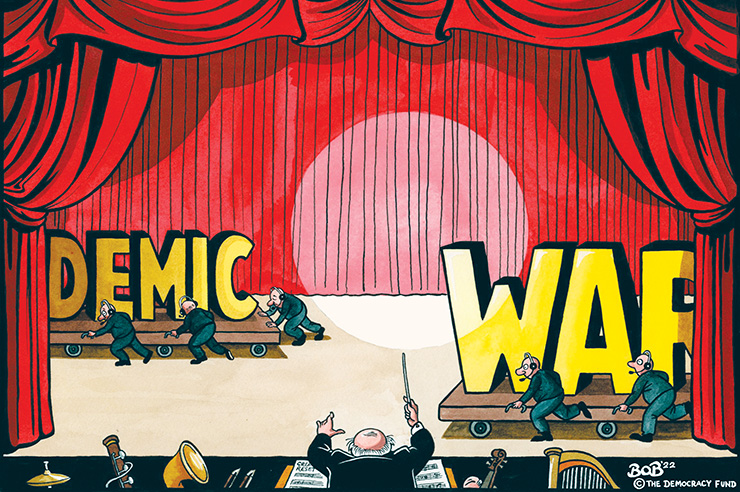
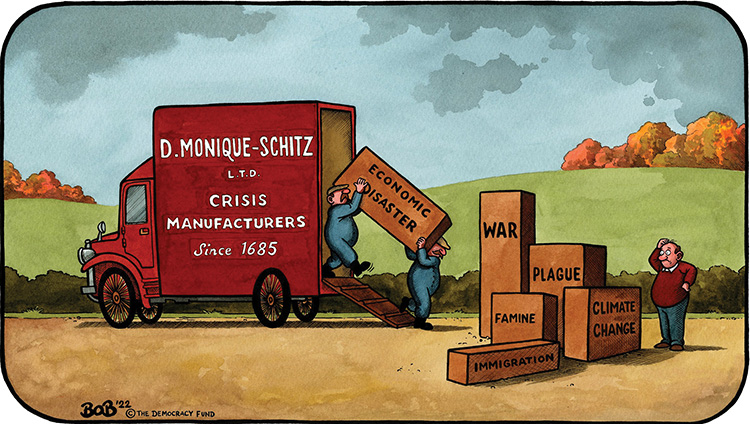
    Each crisis also appears to be a means to an end for some group of power players. Mass shootings in the United States predictably lead to pushes to disarm the public. Virus outbreaks lead to forced lockdowns, vaccine mandates, and the suppression and censoring of information that questions official narratives to protect key government and corporate players. Geopolitical conflicts lead to governments overtly and covertly plotting against other countries – and using your tax dollars to do so – while ignoring national issues. Natural disasters lead to cries of horrific climate change and a push for zero carbon footprints and programs that benefit the elites more than the environment.

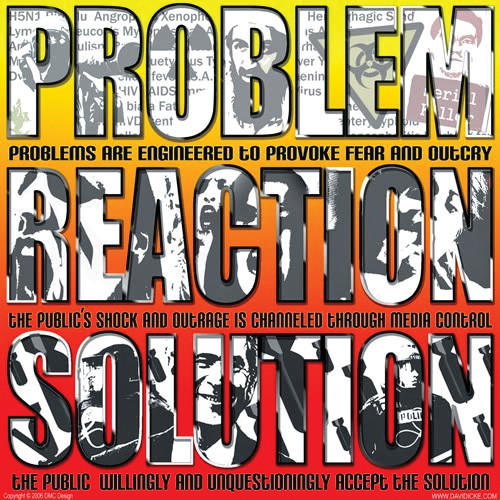
    Never – ever – let a good crisis go to waste, especially when the public is now conditioned to the “new normal” of permacrisis that cannot be put back into the Genie’s bottle. It’s the Hegelian Dialectic on steroids, with the cycle of problem, reaction, solution on an exponentially snowballing loop. They create the problem, engineer the reaction, and force their solution. We have little to no say in it all.

    It’s a permanent state of suffering made up of a bubbling cauldron of ingredients, a recipe for disaster for everyone except the powerful elites behind what many say are manufactured crises or who take advantage of every natural disaster they can milk something out of.

    They feast from the cauldron while we slowly starve.

    Crisis: Why Choose Just One?

    • COVID-19
    • Ukraine/Russia
    • Natural disasters
    • Energy squeeze for net zero
    • Interest rates/financial instability
    • China/Taiwan
    • Mass immigration/migration
    • Climate change fear-mongering
    • Animal viruses, mass cullings & food shortages
    • Trump on trial in the US
    • Mass shootings
    • War between Israel and Palestine

    Add a complicit mainstream media, including social media platforms, acting in lockstep as mouthpieces for an agenda that seems hell-bent on total destruction, with crises piling on top of each other and burying the populace beneath the weight.

    It’s no longer just one natural disaster, geopolitical conflict, or viral outbreak with a few months or years for recovery before the next thing hits.

    Polycrisis

    “Polycrisis” is when several events occur in tandem with much less time in between for people to catch their breath. Nothing will ever return to normal because these crises happen so often that the public is already immersed in the next one by the time the truth seeps out.

    Who cares if COVID was leaked from a lab or that the “safe and effective vaccines” are causing untold injuries and death? Who cares if the World Health Organisation has a 10-year pandemic plan, of which COVID is part of their quest for global health domination?

    COVID was “so yesterday’s news.” We are too busy now fearing for our lives from this, that, and the other thing and virtue signalling our support for the crisis du jour on social media to pay attention to new facts and information or demand justice be served for the sins of the past.

    Bye-bye Ukraine/Russia, hello Israel/Palestine. Epstein’s client list? Who’s Epstein?

    Two Types of Crisis

    There are two main types of permacrisis/polycrisis.

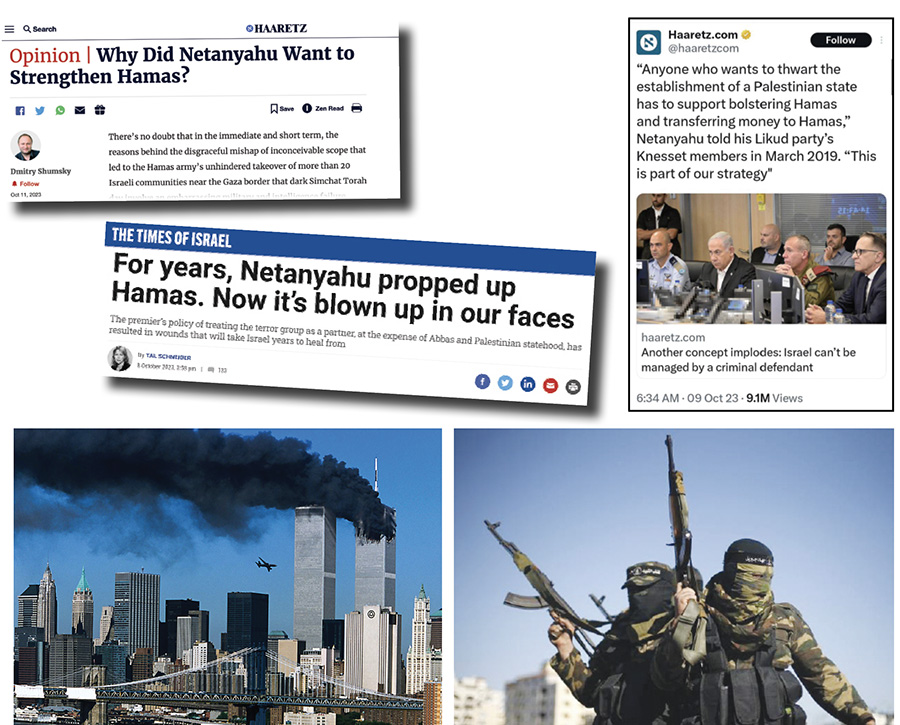
    Events that may be engineered for a specific outcome – think of the 9/11 terrorist attacks in the United States. Information that contradicted the official narrative, with revelations about Building 7’s mysterious collapse, passports found unscathed in the rubble, CIA connections to the terrorists, covered-up connections to Saudi Arabia, no weapons of mass destruction in Iraq, and much more. The clear evidence that US President George Bush and VP Dick Cheney – following the strategy of the neoconservative think tank The Project for the New American Century (PNAC) – used the horrific attacks to invade not only Afghanistan but also Iraq to take down Saddam Hussein despite his total lack of involvement in the 9/11 attacks. There were so many unanswered questions to suggest the US government knew of the attacks and may have been complicit in allowing them to happen.

    9/11 ushered in an unprecedented period of surveillance, curtailing of freedoms, and a push for tyranny in the United States with The Patriot Act, which never would have passed into law had the public not first been terrorised and traumatised – so much so that they willingly begged for their freedoms to be restricted to keep them safe and secure. That push for tyranny is only getting worse, and on a global scale, simply because the public accepted it the first time.

    Israel and Palestine are currently doing the war dance after the brutal attack by Hamas on 7 October. As the leaders of Western nations rushed to defend Israel, massive pro-Palestine protests were occurring in every city across the globe. Both sides have been wrapped in a long-range conflict. Few understand it was the Israeli government and Mossad (their version of the CIA) that helped create Hamas in the late 1980s to fight their primary threat at the time, the Palestine Liberation Organization (PLO). While there is no excuse whatsoever for the horrific October 2023 attacks, Israeli Prime Minister Benjamin Netanyahu spent years bolstering up Hamas in the Gaza Strip to cripple the power of Palestinian Authority President Mahmoud Abbas or anyone else in the Palestinian Authority’s West Bank government from succeeding in establishing a Palestinian state.

    In this case, a problem (Abbas et al.) created a response (empower Hamas) that led to a solution (Hamas turns against you) that drastically backfired for Israel – and the end result may be World War III and no doubt a boon to the coffers of the military-industrial complex.

    The only difference between this and 9/11 may be the intention. While 9/11 felt engineered with a specific intention in mind, the Israeli/Palestinian conflict seems rooted in a domino effect of terrible past power plays and decisions pitting one enemy against another, proving that “the enemy of my enemy” isn’t always my friend… for long.

    Writing in his Badlands Media Substack, Erik Carlson wrote of the recent Hamas attacks: “Some believe no one has been killed and it is all fake. Some believe all of it is real. Others believe some of it is real and some is propaganda. While yet others, like me, believe some is real, some is propaganda, and all of it is a contrived effort to create a bigger war.” Add into this mix the onset of new artificial intelligence-generated fake images and videos, which will make it doubly hard in the future to decipher the truth of events in faraway places.

    Another type of permacrisis is when events unfold naturally but are taken advantage of for a specific end goal. These are the natural disasters used to forward a not-so-green agenda or global pandemics that bring about forced vaccination and lockdowns to curtail freedoms.

    Sadly, larger crises outweigh smaller crises when governments point the propaganda machine at threats to their long-term interests. Who cares about a small-town chemical spill that poisoned an entire town (which recently happened in the US), when China – we are told – might invade Taiwan? Local, regional, and national instability takes a back seat to global instability, not because our leaders are looking out for the population at large, but because they are looking out for vested economic, military, political, and corporate interests.

    It’s this exact instability that keeps people sick, stressed, and distracted from the World Economic Forum’s attempts to force upon us their Great Reset with its digital wallets, CBDCs, total surveillance, climate lockdowns, forced vaccinations, SMART city prisons, social media censorship, mass media lies and deceptions, and landgrabs so that we will own nothing and need them for everything.

    Crises that concurrently impact us at the same time leave people reeling and drained, emotionally and physically. People lose loved ones, lose livelihoods, and suffer the fight-or-flight stress of always being hypervigilant and at the ready. With non-stop surges of cortisol and adrenaline, it’s a wonder we can still function. This may be why depression, anxiety, and other stress-related diseases like heart attacks, strokes, cancers, and auto-immune disorders have skyrocketed in the last few years.

    We are at the precipice with nothing to do but jump or perish. Our psyches are taxed to the point of no return. We cannot take much more until we are forced, and the cycle repeats.

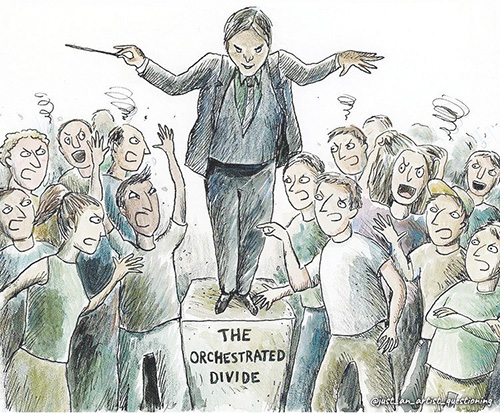
    They want us divided and angry. They purposely ratchet up the violent rhetoric between two sides and push us to choose one, even if both are awful choices. Then, they can swoop in to save the day and claim they are “uniters, not dividers,” even though they divided us all in the first place.

    If there is peace and quiet for too long, they fear we might regroup, restrengthen, and revolt. If we have ample time to gather our thoughts and enough of us share notes, the danger for the powers that be is that we will wake up, en masse, when too many of us have worked out how we are manipulated by this insidious cycle.

    Historical Examples

    It’s not hard to look back at historical events and see the problem, the reaction, and the solution and how it all played out for a certain goal or agenda of the involved parties. Given enough time and water under the bridge – and if we care to scrutinise the facts when they eventually come out – we can clearly see how crises are engineered for some goal.

    Operation Northwoods

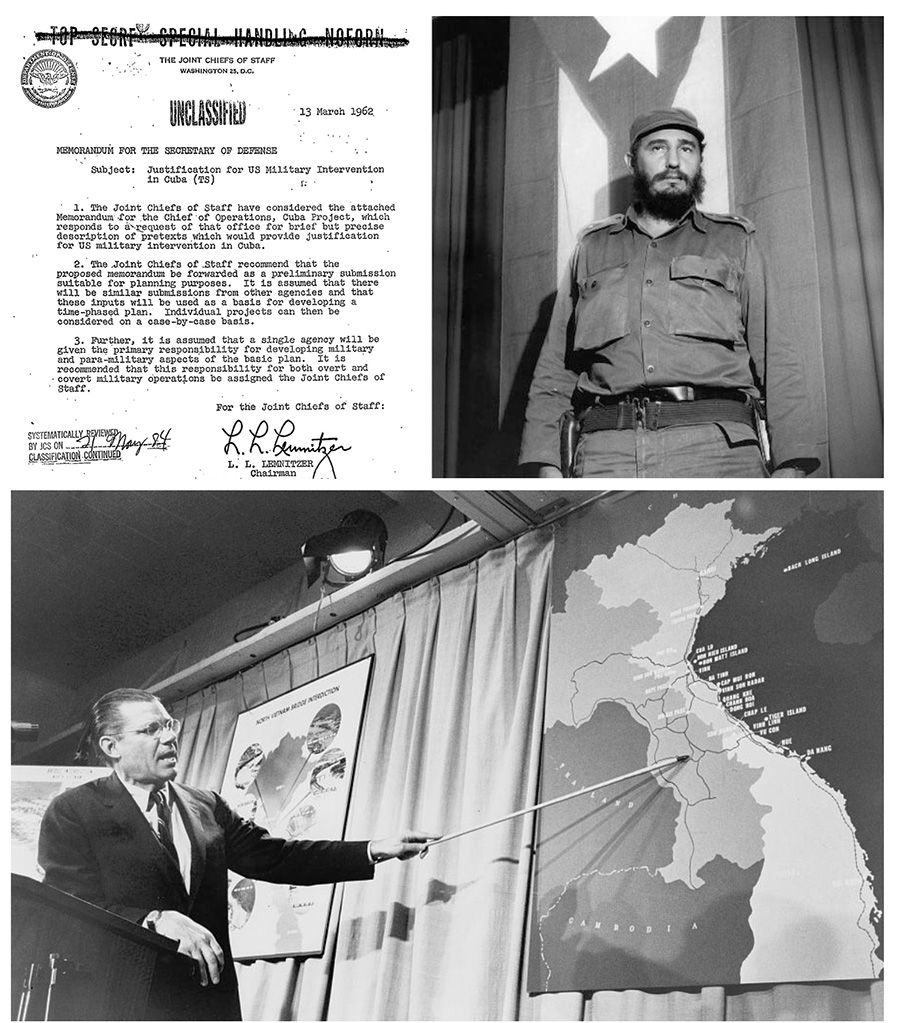
    Operation Northwoods is a perfect example of how a crisis is used as a means to an end, in this case, in the form of a false flag event.

    False flags are often at the heart of permacrisis because they work so well to fool the public into complicit behaviour and acceptance of acts by their own governments that they might never otherwise have gone along with. For example, a terrorist attack coordinated by a country’s leaders against their own citizens to place blame on a country they want to trigger a war with.

    According to PublicIntelligence.net, Operation Northwoods involved a US government plan in 1962 to stage false flag terrorist attacks inside the United States and abroad to justify military intervention in Cuba.

    “The plan called for Central Intelligence Agency (CIA) or other operatives to commit genuine acts of terrorism in US cities and elsewhere. These acts of terrorism were to be blamed on Cuba in order to create public support for a war against that nation, which had recently become communist under Fidel Castro. One part of the Operation Northwoods plan was to ‘develop a Communist Cuban terror campaign in the Miami area, in other Florida cities and even in Washington’,” explains PublicIntelligence.net.

    The document was signed by Chairman of the Joint Chiefs of Staff Lyman Lemnitzer and presented to US Secretary of Defense Robert S. McNamara on 13 March 1962, who then presented it to President John F. Kennedy, who promptly shot the entire plan down. Kennedy was assassinated some months later. Decades later, the top-secret report was declassified as part of the John F. Kennedy Assassinations Records Review Board in 1997.

    (Top left) The US Joint Chiefs of Staff 1962 memorandum outlining Operation Northwoods which was rejected by President John F Kennedy. (Top right) Cuban President Fidel Castro. (Above) US Secretary of Defense Robert S. McNamara during the Vietnam War. 

    Vietnam War

    While Northwoods was not given the go ahead to trigger war with Cuba, Vietnam was a different story.

    US Secretary of Defense Robert S. McNamara was in charge of the Pentagon during the Vietnam War. He wrote about US foreign policy decisions in his book, In Retrospect: The Tragedy and Lessons of Vietnam, admitting that the dangers the Vietnamese presented were exaggerated and that the loss of South Vietnam never truly threatened US interests. McNamara also explained that the theory about the fall of Vietnam causing a domino effect of countries falling prey to communism was entirely false.

    “We of the Kennedy and Johnson administrations who participated in the decisions on Vietnam acted according to what we thought were the principles and traditions of this nation. We made our decisions in light of those values. Yet we were wrong, terribly wrong,” wrote McNamara.

    Those wrong decisions altered US strategy in late 1967, but it was too late for President Lyndon Johnson’s presidency to overcome the damage.

    McNamara also referenced a false flag incident that took place in the Gulf of Tonkin, which gave him a blank check for the escalation of US involvement in the war, an escalation that would send tens of thousands of young American soldiers to fight, only to return home dead and wounded.

    The question remains: did McNamara and others know they were “terribly wrong” at the time and let the crisis unfold anyway because war is always good for the pocketbook? And was the fact that Kennedy wanted to pull US forces out of Vietnam, not get more involved, the reason why the CIA had him assassinated?

    At the time, anyone questioning the official narratives about the Vietnam War was labelled a communist sympathiser, and later a “conspiracy theorist.” Decades later, with all the new information coming out, it makes a lot more sense that conspiratorial forces did work behind the scenes to make sure the war continued – no matter what lies and manipulation were forced upon the public. In his dying days, McNamara had the guts to admit it. Of course, we also now know the CIA was running Operation Mockingbird, a large-scale program that began in the early years of the Cold War to manipulate domestic news media organisations for propaganda purposes.

    The Power of Instability

    The state of permacrisis and polycrisis create conditions of fear and instability that undermine a person’s physical, emotional, and economic security. There is no firm ground beneath our feet when we are rocking and reeling from one horrible situation after another. This leads to heightened hyper-vigilance and fear-based responses, a constant state of fight-or-flight from some external threat we have zero control over. The result is a compliant and submissive populace who will do just about anything to feel safe and secure again.

    One of the most powerful ways permacrisis controls the masses is through reinforcement, which encourages particular behaviours. Positive reinforcement alone may be too nice to get the job done, and negative reinforcement, such as punishment, is too harsh for controlling people who might otherwise rebel. Intermittent reinforcement works like a charm by putting its victims in a sort of hypnotic ‘spell’, creating cognitive dissonance using doubt, fear, anxiety, expectation, and hope as weapons against the mind.

    By mixing a tiny bit of positive reinforcement in with the negative, the person is kept unbalanced. Those small periods of general peace between crises, where we celebrate returning to normal, give us hope and breathing room again before the next round of negative reinforcement in the form of more fear, anxiety, and instability. This give-take and push-pull is what creates things like cult mentality, mob behaviour of going along to get along, trauma bonding with our ‘captors’, and Stockholm Syndrome.

    The pain and suffering during each crisis leave us begging for just one crumb of relief to the point where we begin to side with our captors and abusers, even making excuses for their actions. In this manner, we accept even more abuse and crises if we can just get them to toss us a crumb of normalcy now and then.

    This coercive persuasion creates a population of mindless zombies, numb yet holding onto a tiny sliver of hope deep inside that things will level off and get better. It succeeds in modifying human behaviour on a grand scale so that it is far easier for the powers behind the crises to execute their plans and reap the rewards without too much of a fight.

    Until it doesn’t work anymore.

    Stepping Out of the Crisis Matrix

    Using the Hegelian Dialectic (thesis, antithesis, synthesis, or problem, reaction, solution), we can see that the problem is the collective of puppet masters behind the permacrisis: the central bankers, too big-to-fail corporations like Blackrock and Vanguard, the royal families and old money with its privileges and power, the military-industrial complex, billionaire oligarchs like Bill Gates and George Soros, Klaus Schwab and his WEF minions, and the complicit mainstream media and the Deep States of all governments. The usual suspects.

    The reaction is our succumbing to the fear they impose upon us, and the loss of freedoms as the elites push their thumbs down hard upon our heads. One only has to turn on the news to see how we are reacting to the problem of looming tyranny, fascism, and total control of our lives. We turn against each other instead of the ones oppressing us.

    The solution to the problem we are reacting to is in our hands. It really is, and they know it. We are not powerless against the permacrisis agenda. We can do much to keep ourselves sane, healthy, and empowered. We can step outside the crisis matrix and create a new reality. We can demand our leaders remember who they work for and vote out those who have forgotten. We can boycott and protest and put our money where our mouths are.

    We can spend less time on our mobile phones and social media exchanging barbs with those who think differently and more time cultivating our dreams and fulfilling our goals.

    Hating and fighting those different from us or who hold different opinions keeps us weak and distracted. This is their plan. Right vs. left, black vs. white, male vs. female. The key is to learn to observe what is going on and take right action when needed, but not to engage in the emotional drainsuck – to be in the world but not of it. Instead of fighting against something, find out what you stand for. Instead of engaging in word and meme warfare, spread humour and happiness.

    Staying healthy is the most revolutionary act we can partake in. When we care better for our bodies and minds and love ourselves and the people around us, we empower the world. We can do spiritual work like prayer and meditation, eat healthier, move our bodies, laugh more, volunteer, and create stronger communities. The elites hate it when we build community and support local businesses, farms, programs, and services because it means we don’t need them as much. They hate when we strengthen our human bonds. That’s why they tested us with COVID-19 lockdowns and hint at doing it again in the name of climate change. Locking us down in isolation makes us miserable, scared, and compliant.

    Get the issue this article appears in

    Another Perspective

    There is another way to look at permacrisis. What if it’s more like the labour pains of a pregnant woman that get stronger and more frequent just before the baby moves down the birth canal to be born? The permacrisis/polycrisis we are dealing with might be intensifying labour pains of the dying of the old guard and the pending birth of a new world – not the one the elites dream of but the one that we, the people, know is possible when we take back our power and sovereignty.

    Maybe we are already winning, and they know it. As Thomas Fazi writes, “Our desperate rulers are clinging on to a dying world…. aside from being a ‘method of government’, permacrisis neatly encapsulates the panic of the Western elite: it is their global order, their dominant position in the global food chain, that is under threat.”

    While imprisoned in 1930 after speaking out against Mussolini, Italian philosopher and journalist Antonio Gramsci famously wrote: “The crisis consists precisely in the fact the old is dying and the new cannot be born; in this interregnum a great variety of morbid symptoms appear. The old world is dying away, and the new world struggles to come forth. Now is the time of monsters.”

    It is up to us to slay the monsters.

    [alert type=”general” dismiss=”no”]This article was published in New Dawn Special Issue Vol 17 No 6.[/alert]

    [alert type=”success” dismiss=”no”]If you appreciate this article, please consider subscribing to help maintain this website.[/alert]

    Sources

    badlands.substack.com/p/the-hitler-or-obama-youth
    cnet.com/culture/dont-stress-but-permacrisis-is-the-2022-word-of-the-year
    ft.com/content/937c4eb1-7240-481d-9775-71de7b8bb171
    Marie D. Jones, Disinformation and You: Identify Propaganda and Manipulation, Visible Ink Press, 2021
    Marie D. Jones & Larry Flaxman, Mind Wars: A History of Mind Control, Surveillance, and Social Engineering by the Government, Media, and Secret Societies, New Page Books, 2015
    mckinsey.com/mgi/overview/in-the-news/is-the-world-on-the-brink-of-a-new-era
    Robert S. McNamara, In Retrospect: The Tragedy and Lessons of Vietnam, Vintage Books, 1996.
    publicintelligence.net/operation-northwoods
    resilience.org/stories/2023-01-03/from-polycrisis-to-permacrisis
    theconversation.com/permacrisis-what-it-means-and-why-its-word-of-the-year-for-2022-194306
    tfazi.substack.com/p/challenging-the-permacrisis-paradigm
    timesofisrael.com/for-years-netanyahu-propped-up-hamas-now-its-blown-up-in-our-faces
    unherd.com/2023/09/why-the-wests-elites-invented-a-permacrisis

    © New Dawn Magazine and the respective author.
    For our reproduction notice, click here.
  • What the Technocratic Elitists Plan for Your Future

    What the Technocratic Elitists Plan for Your Future

    From New Dawn Special Issue Vol 17 No 6 (Dec 2023)

    We are currently living through one of the most important periods in human history, as the ruling class biofascists move to transform the world into something out of a science fiction novel.

    The following piece looks at some of the most pressing world-altering agendas currently on the horizon for the future of society – and what we can do to fight back.

    The End of Cash?

    The world is changing and changing quickly. Most of society remains blissfully unaware – through targeted propaganda campaigns – of the reality that awaits them (if allowed) across this decade.

    Perhaps the most pressing transition that countries will see in the foreseeable future is major shakeups to our financial institutions and economies.

    The collapses in March 2023 of Silicon Valley Bank and Signature Bank in the US led some to wonder if the world may be headed for a new widespread banking crisis.

    Switzerland’s Credit Suisse also collapsed in March and was purchased shortly by UBS in a deal approved by Swiss regulators without shareholder approval.

    As a result, Australian financial regulators recently called for an urgent review of the nation’s preparedness and management for “future banking turmoil” following the speed of lender runs.1

    Experts put the odds of a recession before July 2024 at 59 per cent. Emergency meetings held by regulators of late show they are keeping a keen eye on any further instability.

    The timing couldn’t come at a more ‘convenient’ moment for those in power.

    As they say, ‘never let a good crisis go to waste’, and to combat this ‘turmoil’, the state is already looking to transition from this financial model into a new, centralised, digital dystopia.

    For years, Australia has been phasing out cash. In 2021, financial experts forecasted that this country would become “functionally cashless” in 2024.2

    Now, as we enter this crucial timeframe, we see many changes begin to unfold.

    In July 2023, it was announced that cash is no longer available over the counter at a number of Commonwealth Bank locations, with a move to focus on “more complex banking needs.”3

    This was soon followed by Macquarie Bank, our fifth largest, announcing it will “phase out” cash, cheque and phone payments for customers from 2024.

    In a policy notice update, the bank stated that by November 2024, customers will be unable to write or deposit cheques (including bank cheques), deposit or withdraw cash over the counter at branches, or make a super contribution or payment with a cheque.4

    The changes come after Australia’s Federal Treasurer Jim Chalmers announced in June 2023 that cheques will be phased out nationwide by 2030 in a government shake-up of Australia’s payments system.5

    It is not only at the cashless point where they intend to stop with this vision. The removal of cash is just one piece of an even bigger puzzle that will slowly emerge afterwards.

    Bank branches are becoming a thing of the past – disappearing at “alarming” rates – with ATMs also being removed nationwide.6

    The ‘Big 4’ banks are already following the Reserve Bank’s plan to introduce Central Bank Digital Currencies (CBDCs), with pilots currently being tested in the industry.7

    Cases are being researched to see how a CBDC future can ‘enhance’ digital payments.

    Let’s not forget that COVID-19 lockdowns helped accelerate the shift away from cash in a social environment trained to accept and desire such ‘convenience’.

    Pandemic Treaty

    The upheaval of society is not set to end there, however, with several moves being made (and predictions propagated) that suggest more ‘crises’ are on the way.

    The ‘pandemic’ changed the world in ways we are yet to realise fully, and governments across the globe are now coming together to form a unified response to prepare for any future ‘outbreaks’.

    In September 2023, the Australian government released a consultation paper detailing their adherence to a “global accord” on “pandemic prevention, preparedness and response.”8

    As was the concern, this will come from negotiating an international agreement to “protect nations and communities from future pandemic emergencies.”

    To date, member states of the World Health Organization (WHO) have met to discuss priorities for a new worldwide “pandemic instrument,” as well as changes to International Health Regulations (IHR). 

    The new paper details two “important processes” being worked on to “strengthen the international community” as a means to “prevent, prepare for, and respond to pandemics.”

    Implementing a pandemic treaty would make any future ‘pandemic’ responses faster and more efficient, allowing for a seamless, centralised international process.

    What is the timeline? The consultation paper says member states have agreed to establish an Intergovernmental Negotiating Body (INB) to draft the final instrument for consideration by May 2024 [Editor’s Note: As of May 30, negotiations were ongoing].

    The concern by many since word broke of these discussions is that any finalised treaty will likely include the condition that international ‘health troops’ can be quickly deployed to any nation to assist outbreak responses in a unified fashion.

    Such a treaty will effectively bypass our national sovereignty and decision-making processes.

    What raises even more eyebrows is the news that Bill Gates has proposed setting up a “pandemic prevention team” called ​​Global Epidemic Response and Mobilization or GERM!9

    This has left many wondering what may be lying around the corner in the not-too-distant future, with the Big Pharma monopoly enjoying record profits during the recent COVID period.

    If signed, future ‘outbreaks’ would be managed entirely by offshore entities rather than at home in the face of scrutiny from the taxpaying public.

    But, if that doesn’t work, one thing also being discussed heavily is the potential for a manufactured ‘water crisis’ that could transform how we consume this resource over the coming decades.

    Water ‘Crisis’

    By 2025, the United Nations says that two-thirds of the world may face water shortages as unelected world bodies again look to step in with ‘solutions’.10

    Researchers suggest that combinations of drought, environmental pollution and population growth have the potential to create instability in the Indo-Pacific region by 2030.

    Sydney’s drinking water is unlikely to remain healthy over the coming decade, according to a report handed to the New South Wales government.11

    After a three-year audit, the scathing assessment of the city’s water supply found seven of the 18 key indicators for the water system’s health were “worsening.” The audit also found there is a risk that the city’s main water catchment will be unable to continue providing adequate, good-quality water to the greater Sydney area.

    Here’s the thing: are we really facing a ‘shortage’ of water? Or is it just a shortage of ‘free water’?

    Massive corporate behemoths have bought and privatised much of the world’s freshwater over the past few decades, including in Australia.

    We witnessed a glimpse of this during the 2019-20 bushfire season, when water from Tamborine Mountain in Queensland was unable to be used to assist firefighting efforts due to it being owned by Coca-Cola Amatil.12

    If we look at the Register of Foreign Ownership of Water Entitlements, Australia has spawned a massive water marketplace, with more than $3 billion worth of rights at play.

    One report shows the proportion of total water entitlements with a level of foreign ownership is 10.4 per cent, making up a total volume of 4,035 gigalitres across Australia (as of 2018).

    So, it’s not the fact that there isn’t any water. The concern is over the water allocated to us.

    World Economic Forum contributor Mariana Mazzucato recently indicated this is the direction the global elites are turning. The Italian economist noted that the coming water crisis is something that everyone could get on board with.13

    We must all keep our eyes on this evolving story on the road to Agenda 2030.

    mRNA Expansion

    Vaccines have become one of the most polarising topics in recent years, and following record profits during the COVID-19 era, biopharmaceutical giants look to expand their mRNA product catalogue.

    It seems the vision is to eventually transition all vaccines to this experimental technology.

    Last year, Moderna announced the construction of a new state-of-the-art mRNA manufacturing facility to be based in Melbourne, which will act as the ‘central hub’ for their products.14

    Following suit, the Queensland government – one of the “world’s largest vaccine innovators” – partnered with two Australian universities to collectively commit $280 million towards establishing the ‘Translational Science Hub’.15

    This ‘science hub’ will be a biomedical research centre focused on developing mRNA technology.

    Paris-based Sanofi will connect Australian scientists with researchers in France and the United States to focus on developing mRNA vaccines for all sorts of health conditions including sexually transmissible diseases.

    In addition, the University of Queensland has struck a critical deal with Atlanta’s Emory University to develop “groundbreaking” next-generation vaccines at home.16

    CSL, a group that knowingly released millions of contaminated polio vaccines to the Australian public in the 1960s,17 is also looking to bring mRNA flu vaccines to Australia.18

    Flu has become a major focus of the mRNA community, with the US National Institutes of Health (NIH) currently undertaking trials for a “universal” vaccine.19

    And it’s not just humans set to ‘benefit’ from the technology, either. Scientists also want mRNA vaccines to replace traditional vaccines for Australian livestock.20

    No wonder Moderna is popping up on our screens yet again with their new TV spot, “Welcome to the mRNAge,” designed to let people know that mRNA vaccines are “not just a one-trick pony.”

    This promotional piece is a 90-second TV ad created that “artfully showcases some of the possibilities mRNA has to offer.” Let’s just say it is pretty eerie!21 Throughout the video, young children are frequently highlighted as the company describes how mRNA is the “code of life,” pondering “endless possibilities” when “unlocked.”

    Full steam ahead for the biofascists, despite the trail of destruction left in their wake already.

    Representatives from Pfizer and Moderna were recently called before a Federal Senate hearing and handed a number of serious questions surrounding the COVID-19 vaccination program.22

    These companies also face legal action by one Victorian MP who alleges that genetically modified organisms (GMOs) can be found in the vaccines that the national regulator did not pick up.23

    In addition, a class action has been launched in the NSW Federal Court against the Therapeutic Goods Administration (TGA), the Health Department and public servants by those claiming vaccine harm.24

    The class action, organised and crowd-funded by Queensland GP Dr Melissa McCann, alleges negligence, breach of statutory duty, and misfeasance in public office.

    The Victorian government also faces a class action lawsuit from more than 1,300 businesses over COVID-19 lockdowns. They are seeking damages for being forced to shut their doors for an extra 112 days due to the mishandling of the hotel quarantine system.25

    Accountability doesn’t matter to these people, nor our government ‘representatives’.

    In August, the combined force of the Labor-Greens Federal Senate majority defeated a vote for a Royal Commission into government handling of the COVID ‘pandemic’.26

    What will we see when a new mRNA vaccine wave is unleashed onto humanity?

    Synthetic Food & Milk

    Returning to natural resources – our food (plus the supply chains that support them) is also at risk of being fundamentally altered in the near future as part of the ‘sustainable’ push.

    Many have heard about the push for ‘bug protein’ (eat ze’ bugs), but this is just the tip of the iceberg.

    Cultivated meat, also known as lab-grown meat, has been cleared for sale in the United States.

    Two companies that make what they call ‘cultivated chicken’ have received approval from the US Department of Agriculture to start producing “cell-based proteins” for the marketplace.27

    Many may scoff at the notion of lab-grown meat replacing traditional meat industries, but now scientists have figured out ways to compete with them at scale.

    Companies already have patent applications for genetically modified fruit flies engineered to grow animal cells at scales to rival agricultural meat production.28

    Technology powered by the new CRISPR-Cas has allowed this to occur. We should not be surprised to see the industry rapidly expand in the future as a ‘solution’ to resource depletion.

    In response, the Italian government recently approved a bill banning the use of laboratory-produced food and animal feed as it aims to safeguard the country’s agricultural heritage.29

    Italian industry will not be permitted to produce food or feed “from cell cultures or tissues derived from vertebrate animals,” according to reports.

    Italy is just one country, practically alone, in a sea of emerging support for ‘Frankenstein foods’.

    The biotech industry is waging an ongoing battle to get its newly advanced methods of genetic modification excluded from European GMO regulations.30

    This would mean that plants, animals and micro-organisms artificially created using genome-editing techniques like CRISPR-Cas would not be subject to safety checks, monitoring or consumer labelling.

    One report shows that 64 per cent of the members of the EPSO working group on Agricultural Technologies and 32 per cent of EU-SAGE members have a vested interest in the commercialisation of GM plants.

    Bill Gates has been the funder and public shaper behind the push to move the world towards synthetic meat production for years, pouring resources into initiatives in hopes of it spreading.31

    To this end, Australians have recently been told we need to give up our steaks and turn ‘flexitarian’ to ‘meet climate change targets’ and hit net zero by 2050, according to academics.

    Can we expect to see similar approvals in this country shortly?

    If the CSIRO has anything to say about it, which they inevitably will, we can bet on this being the case.

    CSIRO-backed start-up Eden Brew has worked out how to “brew” milk in a lab in a way that “emulates the natural fermentation process that happens in cows” and is working on industrialising the process. They expect to have their products on the market by 2024.32

    The government organisation also released the report, Reshaping Australian Food Systems, which sets a new path for how Australia can “secure a more sustainable, productive, and resilient future for its food, environment, and people.”33

    Food supply chains, already transformed by decades-long globalisation in the move away from national production, became heavily disrupted by the impacts of COVID-19 lockdowns.

    What would happen if, say, another ‘virus’ or ‘water crisis’ soon emerged? Would this lay the foundation for laboratory-based diets as a ‘solution’?

    Indeed, there has never been a more crucial time to become food independent and break free of corporate chains, networking with other like-minded people to make this happen.

    But, if you have anything to say in opposition to the plans, just be mindful of the ‘eyes and ears’ that may be watching when you do. This brings us to another key agenda that has almost arrived.

    Digital ID Systems

    In my previous pieces for New Dawn, I heavily focused on the biometric surveillance dystopia creeping across Australia in the post-9/11 world.

    In recent years, smart cities and mass-tracking systems have emerged in all facets of life. As we move forward, digital identity profiles are the ‘natural’ progression to link all this together.

    What was once called a ‘conspiracy’ is almost a done deal here in Australia.

    In 2021, the federal government moved behind the scenes to establish an oversight body to ‘regulate’ plans for a national digital identity system.34

    In August 2023, a detailed strategy was released explaining the rollout of this digital ID framework, both in the near future and long-term, and the challenges it will face.35

    The National Strategy for Identity Resilience outlines the “seamless integration” of commonwealth, state, and territory digital ID systems, “inclusivity” in accessing services, and the roles of individuals, industry, and government in “building resilience” in a future world.

    The strategy states there will be a “need” for new identity management systems to “evolve alongside emerging risks,” considering “the importance of privacy and strong security measures.” It also praises the role of digital credentials and biometrics in “enhancing identity resilience.”

    The strategy aligns with the nation’s ambition to become “the most cyber-secure nation by 2030.”36

    Other Australian industries, particularly the banking sector, are also moving to introduce digital identity frameworks, with “secure checking services” set to be rolled out.

    State governments are incorporating these plans into their services apps, following the federal myGov framework that lets users create their digital ID for “easy login.”

    Australian job seekers will soon be able to “store and share verified job skills and qualifications with employers” through a newly announced “National Digital Skills Passport.”37

    This passport would function as a digital ID for job qualifications.

    Together, state systems will merge with the federal government’s oversight body and national strategy of implementation, centralising the data of millions of Australians in the name of ‘security’.

    Australians once rallied in the tens of thousands to resist a national ID card, understanding how the move could become a track-and-trace gateway to total control.

    It may be time for citizens to again take to the streets to resist such Orwellian moves.

    WEF’s Own Forecasts

    It is worth looking at the World Economic Forum’s (WEF) list of emerging technologies developed in 2023 that will “benefit society in three-to-five years.”

    The views of more than 90 ‘experts’ from 20 countries were sought for this year’s ‘Top 10 Emerging Technologies’ report, assessing “the impact on people, the planet, prosperity, industry and equity.”38

    WEF expects these trends to “revolutionise the world” over the coming few years:

    • AI-facilitated healthcare
    • Sustainable computing
    • Flexible neural electronics (brain-machine interfaces)
    • Wearable plant sensors
    • Metaverse for mental health
    • Designer phages (the engineering of microbiomes for human, animal and plant health)
    • Sustainable aviation fuel
    • Generative artificial intelligence (AI)
    • Flexible batteries

    Some interesting predictions here with many transhumanist undertones, including the merging of man-and-machine and the mechanical symbiosis with nature.

    Artificial intelligence, tipped to decimate many jobs and becoming more advanced with each passing day, is predicted to play a pivotal role in the future.

    In a note posted online, Greta Keenan, WEF’s lead for strategic communications, said that ‘experts’ behind previous reports had been “spot on” with impact forecasting.

    Given the final direction these mad scientists plan to take humanity, we should have no reason to suspect these technologies won’t continue their current trajectory. A trajectory that has been generations in the making.

    The ‘Final Revolution’

    In my important feature piece for New Dawn #194 (September-October 2022), I detailed what I describe as The Epsilon Agenda – the intergenerational creation of a posthuman slave class.

    This article covered ‘natural selection’ and the influence of the Huxley family, the modernisation of eugenics through social programs, birthing technologies, and much more.

    Beginning in the in-utero stages of development, human beings are being targeted like never before, combined with systematic programs of mass somatisation, chemical poisoning (food and environment), social engineering and more, in a bid to ‘transform’ the species forever.

    A ‘Brave New World’ indistinguishable from the 1932 novel written by Aldous Huxley himself.

    Here, I will provide some updates that expand upon that analysis, and trust me, the bizarre news stories keep coming.

    Scientists are now going public with their plans to genetically engineer human embryos.

    Following his release from prison, controversial Chinese scientist He Jiankui re-emerged into the public eye to call for the “modifying of embryos” to “help the process of aging” in future populations.39

    In addition, just recently, it was revealed that a team of doctors were able to successfully perform brain surgery in-utero on a foetus to “repair a potentially fatal developmental condition.”40

    Back at home, we have seen Queensland researchers publish a new study that highlights the “need” to “map the brains of children” as a way to “identify and intervene” early in mental health problems.41

    It all sounds nice, but the consequences of such actions could be devastating.

    One 2020 study warned that using CRISPR technologies to gene-edit human embryos can cause “unwanted changes” in them, including cell damage so great they will lose entire chromosomes.42

    The Epsilons are the dumbed-down slave class of Huxley’s novel.

    But it doesn’t end there.

    Perhaps the most dystopian news to emerge since our last examination is that synthetic embryo-like structures with intestinal tracts, beginnings of a brain, and a beating heart have already arrived.

    Using what they call “post-gastrulation ex-utero” methods, scientists claim to have created “the world’s first synthetic embryo.” Yes, synthetic embryo.43

    Going forward, ‘health experts’ claim techniques like this may “give a chance to kids who would otherwise have very little possibility of survival.”

    It seems future generations may not have a choice in the matter, either.

    The latest data to be released shows that one in 18 babies born in Australia are conceived via IVF. 102,157 cycles of IVF were performed in 2021, a 17 per cent increase from 2020, with an average of two cycles needed for each woman.44

    In addition, the number of babies born in public hospitals has dropped to its lowest level in more than a decade in some states, highlighting our plummeting national fertility rates.45

    Once again, this is not some distant science fiction vision – this is the here and now.

    Indeed, the future – even in their own words – is set to become an environment almost unrecognisable to previous generations. But only if it is allowed.

    Will the bio-fascists have enough ‘gas left in the tank’ to get this vision over the ‘finish line’?

    Get the issue this article appears in

    You Don’t Have to Fall Victim

    As you read this, we sit at a pivotal crossroads in human history: One that sees our species prosper free and long into the future or one that conjures visions of the worst forms of tyranny.

    We are not ‘there’ just yet, and free-thinking individuals have identified how the ruling classes hope to fulfil their totalitarian visions. They are pushing back, protesting, petitioning.

    There is still time to turn this around, or at the very least, ensure in your own personal reality that these agendas don’t significantly impact you, your friends, and your family.

    Ensuring you have like-minded networks for food and water is the first key priority. From seed banks to farmers and everything in between, you have the power to disconnect from corporate chains.

    Privacy is also the next step that every concerned individual must familiarise themselves with, arming oneself with knowledge on the best ways to avoid a biometric surveillance state.

    If everyone focuses on refining their skills and resources in both of these areas, combined with the communities formed in the bizarre pandemic period, we will be ready for whatever is thrown at us.

    To understand this, we need only look to history to learn how others survived.

    During the Great Depression, people lived hand-to-mouth, unemployment skyrocketed, and inflation became a big problem. However, although much of society could be considered ‘poor’ during this period, the reality shows a nation of street food banks, community spirit, and mateship.

    In her latest book, Australia’s Great Depression, Joan Beaumont offers a deeply conservative history animated by the neo-liberal transition of our age.46

    Beaumont’s powerful book tells the story of a “resilient nation,” a people whose values of “stoicism, independence, self-reliance and personal responsibility” defined their response to the worst economic crisis of the 20th century.

    “Their endurance and survival,” Beaumont writes, “provides one of the most impressive narratives of resilience in the nation’s history.”

    Noting that “starvation did not stalk the streets of Depression Australia,” Beaumont draws heavily on David Potts’ earlier analysis, The Myth of the Great Depression (2006), to discuss the concept of a “positive culture of poverty” where people “knew how to value simpler things.”

    Although they had ‘nothing’, Australians who lived through this period discovered they had everything they needed inside their neighbourhoods and networks.

    And, although communities and family networks are no longer the same (by design), the connectivity of the internet has allowed us to find our new ‘tribe’ in ways they never could have imagined.

    So, much like these individuals – who similarly lived through financial changes, war and inflation – we need to break ourselves away from the centralisation of power creeping to take control.

    We are in a fantastic position because unlike most we can see what is coming and adequately prepare for it. That is a better place to be than blissfully unaware and taken off guard.

    The choice is yours, Australians. I know readers of this magazine will choose wisely. 

    [alert type=”general” dismiss=”no”]This article was published in New Dawn Special Issue Vol 17 No 6.[/alert]

    [alert type=”success” dismiss=”no”]If you appreciate this article, please consider subscribing to help maintain this website.[/alert]

    Footnotes

    1.tottnews.com/2023/06/14/financial-regulators-banking-turmoil/
    2. news.com.au/finance/economy/australian-economy/australia-to-be-functionally-cashless-by-2025/news-story/be06a51f917fe42d5fc2f49f23df6d02
    3. 7news.com.au/business/banking/cash-no-longer-available-over-the-counter-at-some-commonwealth-bank-branches-in-sydney-melbourne-and-brisbane-c-11320293
    4. tottnews.com/2023/09/24/macquarie-bank-cashless-2024/
    5. tottnews.com/2023/06/12/cheques-to-be-phased-out/
    6. tottnews.com/2023/01/12/australian-banks-closing/
    7. tottnews.com/2023/03/08/reserve-bank-australia-cbdc/
    8. consultations.health.gov.au/health-systems-policy-division/preparing-for-pandemics-and-health-emergencies/user_uploads/consultation-paper_3-august-upload-version.pdf
    9. tottnews.com/2022/09/11/bill-gates-rapid-response-team/
    10. press.un.org/en/2016/sgsm17610.doc.htm
    11. tottnews.com/2023/09/05/water-crisis-sydney/
    12. theguardian.com/australia-news/2019/dec/24/tamborine-mountain-residents-in-queensland-told-they-cannot-access-emergency-water
    13. twitter.com/wideawake_media/status/1708082741370139037
    14. tottnews.com/2023/10/15/welcome-to-the-mrnage/
    15. statements.qld.gov.au/statements/96732
    16. tottnews.com/2023/06/09/uq-home-grown-vaccine-deal/
    17. tottnews.com/2020/04/16/infected-polio-vaccine-australia/
    18. tottnews.com/2022/11/03/csl-mrna-flu-jabs-australia/
    19. tottnews.com/2023/05/16/universal-mrna-flu-vaccine-trials/
    20. theland.com.au/story/8095119/big-step-towards-vaccine/
    21. tottnews.com/2023/10/15/welcome-to-the-mrnage/
    22. tottnews.com/2023/08/05/pfizer-moderna-grilled-senate/
    23. tottnews.com/2023/08/30/covid-vaccines-gmo-court-case/
    24. ausdoc.com.au/news/gp-spearheads-covid-19-vaccine-injury-class-action/
    25. tottnews.com/2023/02/07/victoria-lockdown-class-action-lawsuit/
    26. tottnews.com/2023/08/09/royal-commission-covid-response/
    27. tottnews.com/2023/06/24/lab-grown-meat-cleared-for-sale/
    28. tottnews.com/2023/03/10/gm-fruit-flies-fake-meat/
    29. reuters.com/world/europe/italy-moves-ban-lab-grown-meat-drive-protect-home-products-2023-03-28/
    30. corporateeurope.org/en/2023/07/eu-commission-proposes-deregulate-new-gmos-spectacular-submission-biotech-industry
    31. technologyreview.com/2021/02/14/1018296/bill-gates-climate-change-beef-trees-microsoft/
    32. smh.com.au/business/entrepreneurship/lab-grown-milk-to-hit-shelves-by-2024-minus-the-cow-and-the-carbon-20220905-p5bfji.html
    33. csiro.au/en/work-with-us/services/consultancy-strategic-advice-services/csiro-futures/agriculture-and-food/reshaping-australian-food-systems
    34. tottnews.com/2021/10/11/australia-digital-id-oversight-body/
    35. tottnews.com/2023/08/14/revealed-australias-national-digital-id-strategy/
    36. homeaffairs.gov.au/about-us/our-portfolios/cyber-security/strategy/2023-2030-australian-cyber-security-strategy
    37. tottnews.com/2023/09/29/australia-national-skills-passport/
    38. weforum.org/agenda/2023/06/emerging-technologies-innovation-2023/
    39. edition.cnn.com/2023/07/03/china/he-jiankui-gene-editing-proposal-china-intl-hnk-scn/index.html
    40. advisory.com/daily-briefing/2023/05/10/brain-surgery
    41. tottnews.com/2022/08/08/brain-fingerprinting-children/
    42. nytimes.com/2020/10/31/health/crispr-genetics-embryos.html
    43. technologyreview.com/2022/08/04/ 1056633/startup-wants-copy-you-embryo-organ-harvesting/
    44. theguardian.com/australia-news/2023/sep/22/babies-born-via-ivf-australia-how-many-stats-data
    45. 9news.com.au/national/australia-birth-rate-pregnancy-statistics-births-average-age-of-mothers-caesarean/57707065-54ea-4a6b-a0e8-9ad84650e759
    46. allenandunwin.com/browse/book/Joan-Beaumont-Australia’s-Great-Depression-9781761068874

    © New Dawn Magazine and the respective author.
    For our reproduction notice, click here.