New Dawn – World's Most Unusual Magazine

Category: Articles

  • Meditations on Valentin Tomberg: Tarot, Spirituality, Mysticism, Hermeticism & the Occult

    Meditations on Valentin Tomberg: Tarot, Spirituality, Mysticism, Hermeticism & the Occult

    From New Dawn 184 (Jan-Feb 2021)

    The twentieth-century esoteric philosopher Valentin Tomberg was born in 1900 in St. Petersburg to a Russian father and an Estonian mother. Little is known about his early life; indeed, Tomberg seems to have gone out of his way to draw as little attention to his life as possible. As his editor and translator Robert Powell remarked, Tomberg himself “attached no significance whatever to the biographical details concerning him.”1 In fact, the main reason he is known today is that he is recognised as the author of a remarkable book, Meditations on the Tarot, that was and still is published anonymously. Ironically, the very steps Tomberg took to obscure his identity led to a great deal of interest in it.
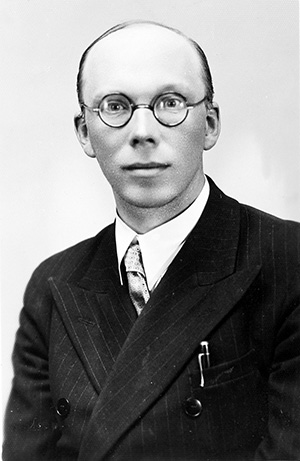
    Valentin Arnoldevitch Tomberg (1900–1973). Photo: National Archives of Estonia

    What we do know about him is that by his late teens he had become deeply interested in Theosophy and the spiritual philosophy of Vladimir Soloviev, as well as in the more mystical aspects of the Russian Orthodox Church. 

    Russia in the early twentieth century was a remarkable time for a young man with spiritual interests to come of age. Soloviev, Russia’s first philosopher, who has found a new reader in Vladimir Putin, was one of the major philosophical and religious figures of a period in Russian history known as the Silver Age. This stretched from around 1890 to 1917, the year of the Bolshevik revolution, a historical eruption that devastated Tomberg’s family, as it did many others. 

    As I show in my book The Return of Holy Russia, the Silver Age was a time of deep interest in and almost obsession with religion, spirituality, mysticism and the occult, and it produced a powerful surge of creativity in literature, music, philosophy, and art. For a young man of Tomberg’s inclinations, having his spiritual awakening at this time no doubt made an impression on him that remained for the rest of his life.

    A New Cultural Epoch

    Although Madame Blavatsky, one of the founders of the Theosophical Society, was Russian, her focus on Eastern sources of wisdom, continued by her successors, alienated many Russians, who were deeply Christian. Tomberg was one of them, and soon after joining the Theosophical Society he left, turning his allegiance to the work of Rudolf Steiner. 
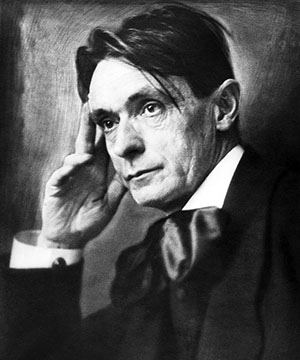
    Rudolf Steiner

    Steiner was immensely popular in Russia in the years leading up to the revolution, his highly Christianised version of Theosophy – which he would soon rechristen Anthroposophy – appealing to the generation of “God Seekers” that characterised the Silver Age. As I show in my book, both Steiner and the God Seekers had great hopes for a new “cultural epoch” to emerge from Russia at this time. In the view of Steiner and others, including Soloviev, Russia was charged with the mission of uniting the scientific knowledge of the west with the mystic intuition of the east, their integration giving birth, it was hoped, to a new creative consciousness that would transcend the limits of its parents.

    Sadly, this marriage between east and west was precluded by the revolution and, as we know, something radically different emerged from Russia. Lenin’s adamantly anti-spiritual ideology put paid to any notion of a new “cultural epoch,” and the chaos of the revolution cost Tomberg dearly. His family’s fortunes were lost, as were his father – who had a position in the czar’s government – mother, and brother. One story has it that during the chaos, Tomberg’s mother ventured into the streets. She never returned, and Tomberg later found her and their dog, both shot dead and tied to a tree. Like many who escaped the terror, Tomberg was unquestioningly anti-communist for the rest of his life.

    Upstart Anthroposophist

    In 1920, Tomberg made his way to Tallinn, Estonia. From there, he wrote several letters to Rudolf Steiner, asking if he could become his student. His letters went unanswered; it is unclear if Steiner ever read them or simply ignored them. Steiner’s silence evidently did not put Tomberg off Anthroposophy; in 1925, the year of Steiner’s death, Tomberg joined the Estonian branch of the Anthroposophical Society, eventually becoming its secretary-general. But friction soon appeared between Tomberg and the society; he was too individual a mind to remain merely a good anthroposophist. 

    Throughout the 1930s he wrote many articles for Anthroposophical journals, on a variety of subjects; many had to do with what Steiner called “the return of Christ in the etheric,” and the “mission” of different nationalities. Tomberg claimed that these articles were informed by an experience he had in 1931 when he was put in contact with the “angelic world.” This, no doubt, set him further apart from his fellows, and eventually he was asked to leave the society. At around this time he had also tried to find a place for himself at the Goetheanum, the society’s headquarters in Switzerland, but was denied this by Steiner’s widow.

    In 1938, Tomberg moved to Holland; after the Nazis invaded in 1940, he joined the resistance. His relations with the Anthroposophical Society in Holland ran into the same problems as before. It seems the essence of the trouble was that Tomberg’s esotericism was even more Christocentric than Steiner’s; if you know Steiner’s work, you’ll know this is no easy feat. After the war, Tomberg moved to Cologne where he earned a degree in jurisprudence and became deeply engaged with Catholicism. It is unclear if he actually converted, but he become alienated from the Russian Orthodox Church because its leadership had seemed sympathetic to Hitler.
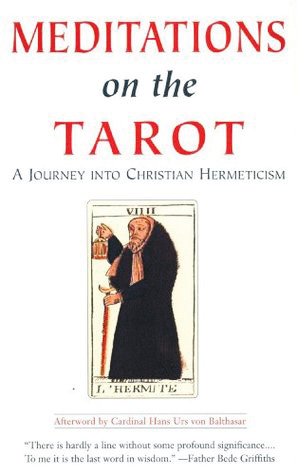
    In 1948, Tomberg moved again, this time to England, where friends found him work with the BBC as a translator; he was a polyglot and would later monitor Soviet broadcasts. In 1960 he retired, devoting himself to study and writing. He died in 1973, from a heart attack while on holiday with his wife and their son in Majorca. Aside from his early essays, practically all his work appeared only after his death, and one work in particular was designed by Tomberg himself to appear in precisely that way.

    The work in question is Tomberg’s magnum opus, Meditations on the Tarot, subtitled “A Journey into Christian Hermeticism.” This was first published in French – the language in which it was written – in 1980, seven years after Tomberg’s death and nearly twice that long after the work’s completion, which Tomberg noted as 21 May 1967, the “Festival of the Holy Trinity.” German and English translations soon followed, but it was not until 2002 that a full English edition appeared through a mainstream American publisher, bringing Tomberg’s work to a wider reading public, albeit still a marginal one with a taste for the arcane and esoteric. It was also at this point that it became known Tomberg was the author of this work. And although by now his authorship is well known, as mentioned the book is still published anonymously, as was Tomberg’s wish.

    Letters From Beyond the Grave

    Meditations on the Tarot consists of twenty-two “letters to the Unknown Friend,” sent “from beyond the grave,” dispatched, that is, well after Tomberg’s death. The reason for these tardy communiques is that Tomberg wanted to mute any personal element in them, to have the reader of these letters focus on their message, not on the messenger. Tomberg himself insists that he has “said more about himself” in these letters than he “would have been able to in any other way.”2 The unknown friend to whom Tomberg is writing is the reader, and Tomberg’s letters are long, discursive, deeply pondered and occasionally meandering essays on the twenty-two trumps of the Tarot, filled with references to Steiner, Teilhard de Chardin, Bergson, Nietzsche, Gurdjieff, the Corpus Hermeticum, Catholic dogma, and many other writers, philosophers, mystics, and saints. (I should point out that the Meditations run to more than 600 pages.) Tomberg’s letters do not touch upon the divinatory character of the Tarot. Nor does he relate the trumps to the usual astrological or cabbalistic correspondences, as do most books on the Tarot, although both Cabbala and astrology make appearances.3 Instead, the Meditations are illuminating, insightful, and not infrequently baffling excursions into the meaning of the symbols presented in the trumps, which Tomberg tells his unknown friends are arcana

    Arcana

    Arcana, Tomberg tells us, are more than secrets, which are merely facts that are hidden from us, or allegories, which are figurative representations of abstract ideas. Arcana are “authentic symbols,” “magic, mental, psychic, and moral operations” that can awaken “new notions, ideas, sentiments and aspirations,” and which require more than an intellectual understanding for their power to be felt.4 

    One way of recognising authentic symbols, and of differentiating them from mere signs, Tomberg tells us, is that they have the power to “conceal and reveal their sense at one and the same time according to the depth of meditation” one reaches in their contemplation.5 A sign is nothing more than an indicator of what it points to. An arrow pointing to a door shows you the way out, but it does not share in you taking it. A symbol participates in the reality it presents, and its meaning, when grasped, should have an almost visceral effect on us. That is, it should affect us in such a way that it effects a change in our consciousness, our awareness, adding not only an intellectual knowledge but offering an existential encounter with hitherto unknown dimensions of Being. It introduces us to a bit of reality of which we were unaware.

    This “transformational” power of symbols lead Tomberg to speak of the trumps as “enzymes” that enable us to be “fruitful in a given spiritual domain.” The trumps “ferment” the knowledge necessary for spiritual experience. This is why Tomberg speaks of them as “spiritual exercises,” whose aim is “to awaken from sleep… deeper layers of consciousness.”6 They are definite encounters with esoteric realities, through which we, the unknown friends, are changed. 

    In this way, the trumps are similar to great works of art. According to Tomberg, the symbols of the Tarot should have the same effect on us as the “archaic torso of Apollo” had on the poet Rilke when he saw it while living in Paris. In its presence, Rilke knew that he “must change his life.”7 A true encounter with the Tarot’s symbolism, Tomberg tells us, should make us feel the same. His aim is to get us to think Hermetically, to allow the rich symbolism of the trumps to reach into our imagination and trigger our faculty for seeing connections between things which we would otherwise ignore. For Tomberg, the essence of Hermeticism is the ability to perceive “the totality of things,” “the One, the All,” as the ancient alchemists called it, the deep, underlying unity at the heart of the multiplicity of Being.

    The French Connection

    I should point out that Tomberg is writing in the French tradition of the Tarot – he bases his letters on the Tarot de Marseilles – and that this connection brings in the central theme of the book: to show how Roman Catholicism is an indubitable repository of Hermetic wisdom. Hence the subtitle, “A Journey into Christian Hermeticism.” Understandably, this may be sufficient reason for some unknown friends to forgo that journey. Yet we need not accept Tomberg’s thesis in order to profit from his book. 
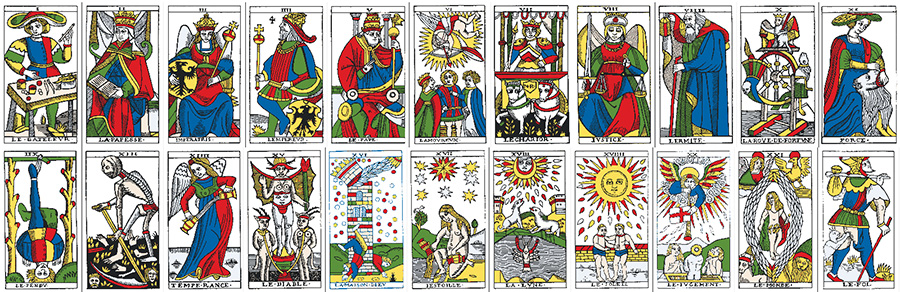
    Valentin Tomberg used the Tarot de Marseilles, a pattern from which many subsequent tarot decks derive.

    I can respect the high regard Tomberg has for Catholicism, without agreeing with him that “the more one advances on the way of free research… the more one approaches the Church.”8 After much spiritual searching, the author of these meditations found a home in the Catholic church, but that does not mean that for us to learn from him we must take up residency there too. What strikes me as most important about the Meditations is not the arguments Tomberg makes for, say, the Ten Commandments as instructions in Hermetic philosophy or his belief that the fundamental virtues of the Christian faith – obedience, poverty and chastity – are the sine qua non of any esoteric pursuit, ingenious and thought-provoking as they are. We can embrace these dicta, take them with as many grains of salt as needed, or simply reject them. What strikes me as important about Tomberg’s Meditations for the non-Christian reader is the way Tomberg approaches the Tarot, his understanding of what we can call a Hermetic “way of knowledge.”

    Christ and Hermes

    Having said this, a look at history shows that Christ and Hermes are not such strange bedfellows as we may think. For a time during the Renaissance, Hermes Trismegistus, the legendary founder of the tradition which bears his name, was seen as a figure of equal importance with Christ, and vigorous attempts were made to incorporate the Hermetic teachings, found in the Corpus Hermeticum, into Catholic dogma.9 In France there is a long tradition of a kind of “Catholic occultism,” reaching back to the nineteenth-century French mage Eliphas Levi, and leading on to characters like the eccentric Saint-Yves d’Alveydre and his disciple Gérard Encausse, who wrote under the pseudonym Papus; all three turn up in the Meditations. It is also true that there is a long tradition of literature on the Tarot in French. Indeed, it was Levi himself who first hit on the idea of linking the twenty-two trumps with the twenty-two “paths” on the Cabbalistic Tree of Life, a correspondence that is at the heart of practically all modern magic. 

    Hermetic Syncretism

    This linkage has subsequently been discredited, and most modern historians of the Tarot accept that there is no historical connection between the Tarot and the Cabbala.10 Nor, for that matter, does there seem to be one with Egypt, which many occultists regarded as the Tarot’s source, seeing it as the so-called “Book of Thoth,” the Egyptian god of magic with whom Hermes Trismegistus is associated. 

    Yet for all his historical inaccuracy, Levi’s inspired howler has proved remarkably effective for the many occultists who have worked with his ideas. These include the members of the Hermetic Order of the Golden Dawn and its most notorious associate, Aleister Crowley, as well as their many epigone. This seems to suggest that purists, who eschew such “romantic” notions as Levi’s and reject much that has accreted around the Tarot as nonsense, ignore the syncretic, synthesising character of Hermeticism. This was with it from the start, ages ago, when Thoth met the Greek god Hermes in ancient Alexandria, their fusion creating the “thrice great” one. This syncretic approach continued during the Renaissance when figures like Pico della Mirandola and others developed the notion of a “perennial philosophy,” which allowed for a Christian Cabbala – “culturally appropriating” a radically Jewish tradition – and, as mentioned, even a Christian Hermeticism. In this light, Levi seems merely to have done what Hermetic thinkers had been doing all along.

    Analogy

    Although Tomberg is aware of the historical appearance of the Tarot in the late Middle Ages – he does argue, though, for a kind of “archetypal” link to an Egyptian source; Jung makes many appearances throughout the book – a similar syncretic approach is taken in his Meditations. This makes perfect sense. For Tomberg, Hermeticism itself is a synthesis of magic, gnosis, mysticism, and philosophy, and its aim is not to supplant science or to uncover new facts, but to perceive the facts we already possess from a different perspective, and to infuse them with an additional depth, the kind of depth we discover through our encounter with the arcana of the Tarot. 

    For Tomberg, analogy is the fundamental mode of acquiring knowledge in the Hermetic tradition, which proceeds through a process of synthesising the known and the unknown. The “open recognition of the relationship of all things and beings has engendered an exactly corresponding method of knowledge,” he writes.11 That method is analogy, through which the “sympathy of all things” becomes apparent, not as a concept, or an idea or belief, but through a perception of it “in action” as it were, through the “fermenting” effect of the symbolic “enzymes” produced by our meditations on the trumps.12

    This transformative effect is perhaps best seen in the Magician, the trump that Tomberg says is “the key to all the other Major Arcana.”13 By understanding and performing the “spiritual exercise” the Magician presents, Tomberg tells us that we will be able to work our way through to the knowledge and experience contained in the arcana that follow. As I do not have space to more than touch on some of the insights that the Magician presents, I trust the unknown friends that read this article will be encouraged to accept Tomberg’s invitation to journey with him and perform some of these spiritual exercises themselves. 

    Concentration Without Effort
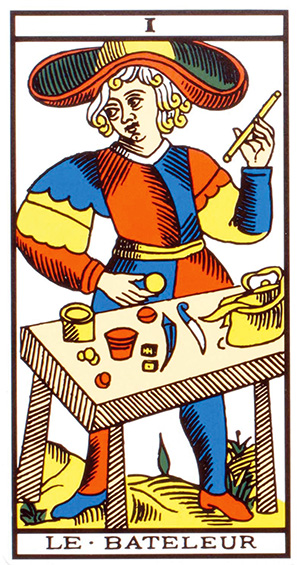
    The Magician, Tarot of Marseilles

    The spiritual exercise of the Magician, Tomberg tells us, is aimed at developing two essential abilities, necessary for any successful Hermetic work. They are “concentration without effort” and “turning work into play.”14 

    “Concentration without effort” – what he also calls “active relaxation” – is achieved, Tomberg tells us, when we can direct our attention to whatever occupies us, without the constant chatter of the care-ridden ego leading our minds elsewhere. When we can achieve an inner silence, free from the distractions of thought – the basic requirement of any inner work – the kind of concentration that would usually cost strenuous efforts can be reached “effortlessly.” 

    As an example, Tomberg suggests a tightrope walker – an aptly symbolic choice. He is certainly concentrating on his actions; if he wasn’t, he would fall. But Tomberg asks: “Do you believe that his thought and his imagination are occupied with what he is doing?”15 The tightrope walker does not “calculate” or “plan” his next step because he has shifted his consciousness from his head – the worrying ego – to what Tomberg calls his “rhythmic system,” which possesses an intelligence of its own, the “intelligence of the heart” I have written about elsewhere.16

    This shift from head to heart, Tomberg says, is symbolised by the lemniscate, or horizontal 8, that is formed by the Magician’s hat. This is the symbol of infinity, but, Tomberg tells us, it is also the symbol of “eternal rhythm,” the natural “flow” – as the psychologist Mihaly Csikszentmihalyi calls it – that our ever-worrying mind interferes with. When we have quieted our inner monologue, we can enter this flow. If we think of the “concentration without effort” we achieve when we are deeply “into” a book we are reading, we can get an idea of what Tomberg means. Our concentration is so focused we forget our surroundings. Yet it requires no effort at all; in fact, we enjoy it.

    This is the arcanum of “transforming work into play,” which is a result of achieving this kind of concentration.17 When we enter the “zone of perpetual silence,” we can not only concentrate our consciousness “effortlessly;” any task we may be obliged to perform can become a source of delight.18 Because we can draw from a “secret and intimate respiration,” he “who finds silence in the solitude of concentration without effort, is never alone.”19 

    He or she is never alone, because the Magician who has achieved this has “attained harmony and equilibrium between the spontaneity of the unconscious… and the deliberate action of the conscious,” the “I” or ego.20 The Magician symbolises a state that is the “synthesis of the conscious and the unconscious,” or, as I have suggested, between our left and right brains.21 Tomberg says this is equivalent to what Jung speaks of as “individuation,” which can result in what Marie-Louise von Franz calls “conscious spontaneity,” a paradoxical state in which one is “consciously active and still spontaneous,” in which the conscious and unconscious minds have an equal say.22
    Get the issue this article appears in

    Tulpas and Egregores

    This brief account of Tomberg’s interpretation of the Magician should give the reader an idea of what he may find if he dips into the Meditations. One other trump that I should at least mention is the Devil, the theme of Letter XV. This trump, Tomberg tells us, introduces us to the secrets and dangers of what he calls “counter-inspiration.” It presents a warning about the “intoxication” we experience when we become aware of our own power to “engender demons.”23 The demon before whom the man and the woman stand enchained, Tomberg tells us, is one of their own making. It is a result of their misuse of the powers of will and imagination, the Magician’s tools in trade.
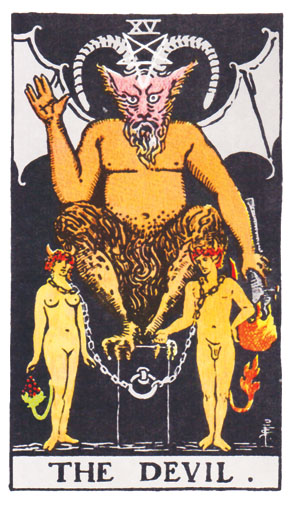
    The Devil, Rider-Waite Tarot

    The specific demons Tomberg speaks of are tulpas and egregores. Tulpas are part of the esoteric psychology of Tibetan Buddhism. They are thought-forms created by a single individual, through prolonged efforts of visualisation. Eventually, after much mental work, the tulpa can take on a life of its own, much to the dismay of its creator. As I point out in my book, Dark Star Rising: Magick and Power in the Age of Trump, both the traveller Alexandra David-Neel and the occultist Dion Fortune had experiences creating tulpas, and both write of their difficulties in regaining control of and eventually dissolving them.24 

    An egregore – which means “watcher” in ancient Greek – is a thought-form brought into existence by a group. As Tomberg tells us, there are no “good” egregores, only “evil” ones.25 They can be “engendered by the collective will and imagination of nations,” Tomberg writes, but the aims of an egregore are always selfish, centred exclusively on gaining power and growing stronger at the expense of its creators. Once brought into existence, an egregore is harder to “dissolve” than a tulpa, given that it is the work of a group. This can be a cabal of occultists, or a political party – hence their inclusion in Dark Star Rising, which looks at the resurgence of a kind of “occult politics” in recent times. This seems to have raised its head during the run-up to the 2016 US presidential election and has remained on the scene since. It has also been at work in Russia. 

    Should we take tulpas and egregores seriously? A good question. Tomberg certainly did, and as he tells us, the Devil is one trump we should clearly keep an eye on.

    [alert type=”general” dismiss=”no”]This article was published in New Dawn 184.[/alert]

    [alert type=”success” dismiss=”no”]If you appreciate this article, please consider subscribing to help maintain this website.[/alert]

    Footnotes

    1. Robert Powell, introduction to Valentin Tomberg, Lazarus Come Forth! (Great Barrington, VT: Inner Traditions, 2006) p. ix.
    2. Anonymous, Meditations on the Tarot (New York: Tarcher/Penguin, 2002) p. ix.
    3. The question of where and with whom Tomberg studied the Tarot is an interesting one. He speaks of a work, The Sacred Book of Thoth – The Major Arcana of the Tarot, by an “engineer” named Schmakov, published in 1916 which was “twice as large as Oswald Wirth’s” book on the Tarot (p. 590). He also says he read Ouspensky’s The Symbolism of the Tarot (1917). He tells his unknown friends that after the Bolshevik revolution, and presumably before going to Estonia, he became friends with members of a group of esoteric students that had been led by a mathematics professor, Gregory Ottonovitch Mebes. Mebes was the author of a book, The Course of Encyclopaedia of Occultism that is said to have influenced Tomberg. In 1926, Mebes was sent to a gulag, where he died. The group had been dispersed by the revolution, but the members he met “transmitted all they knew and recounted everything concerning the work of their group” to Tomberg. (Ibid.) The group seemed to have studied the Tarot in the traditional French way, relating it to Cabala, magic, astrology, etc. Tomberg says that through the “forty-five years” of his own study, he has “surpassed” what he learned from them and that throughout the Letters – aside for one exception – he does not draw on it. Another esoteric thinker who wrote about the Tarot, Mouni Sadhu, is said, like Tomberg, to have been in contact with members of this group, and influenced by Mebes’ book. Some have seen similarities between Sadhu’s The Tarot (1962) and the Meditations, which the link with Mebes may explain.
    4. Ibid. p.4.
    5. Ibid.
    6. Ibid. p. 91
    7. https://poets.org/poem/archaic-torso-apollo 
    8. Ibid. p. 283
    9. See my book The Quest for Hermes Trismegistus (Edinburgh: Floris Books, 2011) pp. 154-56.
    10. Robert M. Place, The Tarot (New York: Tarcher/Penguin, 2005) p. 73.
    11. Anonymous p. 12.
    12. Ibid. p. 4.
    13. Ibid. p. 3.
    14. Ibid. p. 8.
    15. Ibid. p. 9.
    16. Gary Lachman, Lost Knowledge of the Imagination (Edinburgh: Floris Books, 2017) pp. 52-53.
    17. Anonymous p. 11. This is an arcana evidently known to Mark Twain, who makes good use of it in Tom Sawyer. There the wily Tom convinces his friends to paint a fence because he pretends to be enjoying it. Yet the trick is really on Tom because his friends actually do enjoy it; they have transformed work into play, by telling themselves it is play.
    18. See my article “Getting Beyond the Robot” in New Dawn 182 (Sept–Oct 2020).
    19. Ibid.
    20. Ibid. p. 20.
    21. Gary Lachman, The Secret Teachers of the Western World (New York: Tarcher/Penguin, 2015). In this book I argue that such a harmony is at the heart of the western esoteric tradition.
    22. Marie-Louise von Franz, Alchemy (Toronto: Inner City Books, 1980) p. 238.
    23. Anonymous p. 401.
    24. Gary Lachman, Dark Star Rising: Magick and Power in the Age of Trump (New York: Tarcher Perigee, 2018) pp. 90-92.
    25. Ibid. pp. 419-20.

    © New Dawn Magazine and the respective author.
    For our reproduction notice, click here.
  • The Empires of Atlantis

    The Empires of Atlantis

    From New Dawn Special Issue Vol 16 No 2 (Apr 2022)

    Most people will be familiar with Plato’s story of Atlantis. Written in the 4th Century BCE, it is the wonderful account of a mighty and splendid empire whose island homeland sunk beneath the waves of the Atlantic Ocean 11,600 years ago. It is truly one of the foundational myths of western civilisation and one that does not cease to fascinate and prompt questions about the reality and location of the fabled lost continent.

    Plato’s story, however, is also a cautionary tale about how even the most splendid civilisation that the world had ever known could fall prey to vice and corruption, eventually leading to its downfall. At its core, it is the story of the fall of a primeval, golden and divine humanity into the depths of materialism. The metaphysical idea of the “Fall” of man from an original divine state is projected against the idea of cyclical time and the myth of a lost Golden Age.


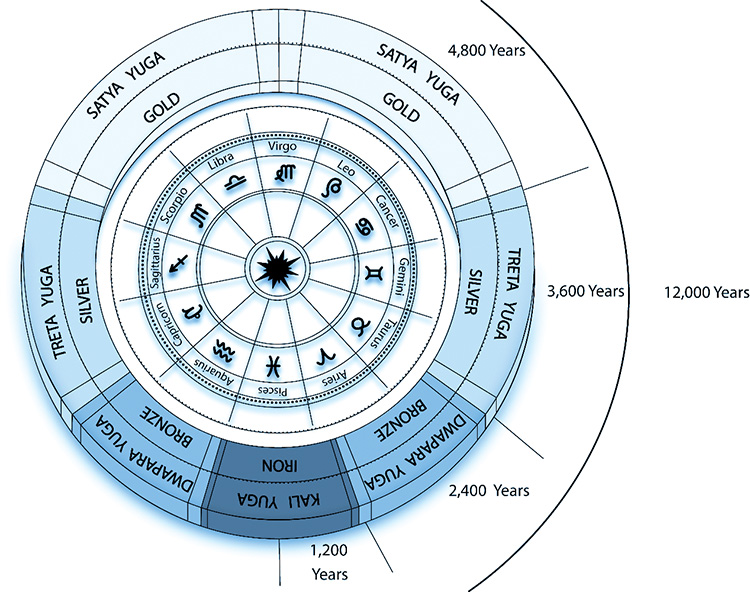
    The sequence of the four Yugas or World Ages according to metaphysical cosmologies.

    Esoteric Atlantology & the Ages of Man

    Three hundred years before Plato, the Greek poet Hesiod spoke of the five Ages of Man, tracing the descent of Mankind through five different Ages or “Races.” A primeval Golden Age gave way to the Silver Age, the Bronze Age, the Age of Heroes and, finally, the dreaded Iron Age in which we now live, representing the lowest point of the cycle. A similar worldview probably inspired the system of the Hindu Yugas and the Mesoamerican Legend of the Suns, according to which the world has already undergone four previous cycles of creation or Suns.

    This is a view radically different from that of contemporary evolutionary theory, which is based on the idea of a constant progression of humanity in the arts of civilisation since the appearance of the first anatomically modern humans in East Africa about two hundred thousand years ago.

    Ancient worldviews maintain the idea of a descent of Man, a process of spiritual and material degradation from an original divine state. It is to these ancient worldviews that Plato conforms himself when he describes the fall of Atlantis as the result of the “divine portion” of its inhabitants fading away and becoming “diluted too often and too much with the mortal admixture.” According to Esoteric Tradition, this is the fate of every civilisation. However, there is hope because the end of a cycle invariably marks the beginning of a new cycle. This whole system can also be described by the idea of cosmic seasons in which the Golden Age, Silver Age, Bronze Age and Iron Age follow each other in cyclical repetition. One only needs to know the starting point of the present cycle to draw a complete chronology and predict the beginning of a new Golden Age.

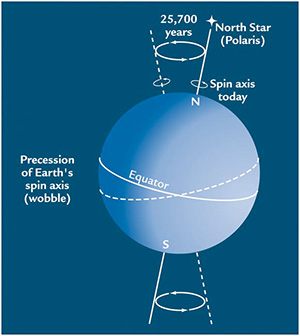
    Ancient sources assign a fixed duration to the entire cycle and each of the cosmic seasons that together make up the Great Year. The critical number is 25,920 years, a duration all but identical to the fabled period of the revolution of the zodiac (see graphic on right), known as the Precession of the Equinoxes.

    How exactly a tiny wobble in the Earth’s axis, causing its tilt to change slightly over thousands of years, could have such deep effects on the cycles of life and civilisation on our planet is a question that few in the modern scientific community will consider. Yet it was paramount to ancient cosmologies and worldviews, as shown by the great interest that nearly every ancient civilisation on the planet placed on the movements of the sky – an interest certainly going beyond the basic needs of planting and agriculture.

    It was only with the advent of Christianity that ancient worldviews based on the concept of cyclical time and multiple cycles of creation were replaced by linear time, the belief in a single revelation and a single divine incarnation leading uniformly toward salvation. In the much shorter Christian and biblical chronology, the totality of human experience was effectively limited to the span of the present Iron Age or Kali Yuga. According to Puranic sources, this began in the year 3102 BCE, leaving no space for previous cycles of creation, least for the idea of a lost world ruled by the gods. It was based on the authority of the Bible that the Archbishop of Ireland, James Ussher, famously stated in 1650 that “the world was created at nightfall, preceding Sunday, October 3, 4004 BCE.

    Thousands of years before Ussher, the Brahmins of India had realised time computations covering the enormous period of 4.32 billion years, while the Chaldean priests could boast of keeping accurate astronomical observations dating back 720,000 years. Ancient Egyptian records similarly spoke of primeval dynasties of gods and demigods ruling for tens of thousands of years before the beginning of recorded history.

    The Calendars of Atlantis

    When comparing these ancient chronologies and king lists, a most interesting pattern emerges. Despite all their internal inconsistencies, gaps in information and incredibly long durations of time, these documents – some of which date back almost to the beginning of modern recorded history in ancient Mesopotamia and Sumer – appear to be in substantial agreement when it comes to portraying a sequence of world ages related to astronomical cycles and the consecutive rule of divine, semi-divine, and finally purely human dynasties. This makes it possible to reconstruct a tentative picture of the origins of the present cycle and the succession of different world ages through the last 432,000 years.

    A fascinating feature of these ancient chronologies is the reference to not just one but multiple cataclysms periodically befalling human civilisation, forcing the survivors, just like Plato’s Atlanteans, to “begin over again as children, knowing nothing of what had happened in ancient times.

    In order of time, the last of these cataclysms would have occurred about thirteen thousand years ago, in 10,961 BCE, following an even earlier cataclysm in 35,335 BCE – the two being separated by almost precisely an entire precessional cycle. While the date of 10,961 BCE may be fixed astronomically, over half a dozen ancient chronologies point to at least one major cataclysm between 11,500 and 9,200 BCE.

    It is undoubtedly a remarkable coincidence that this set of dates, derived from ancient chronologies, also remarkably agree not only with the date assigned by Plato to the final sinking and destruction of Atlantis but also with the timescale of a mysterious cold spell accompanied by megafaunal extinctions known as the Younger Dryas.

    It is now widely believed that a massive cometary impact triggered the Younger Dryas about thirteen thousand years ago. A second impact was possibly responsible for its abrupt ending almost 1,500 years later. The memory of the cataclysm was preserved in hundreds of myths worldwide that describe a fiery conflagration followed by a Great Flood and a sudden cooling of the Earth’s climate.

    A Lost Mid-Atlantic Continent

    Unlike previous mass extinction events, the Younger Dryas cataclysm was not without witnesses, for modern humans had already been walking the planet for thousands of years by then. This cataclysm may have been responsible for destroying an advanced Ice Age society whose survivors would later spread their civilisation and culture throughout the world.

    Bathymetric chart of the Mid-Atlantic Ridge (Image courtesy of NOAA – PMEL Acoustic Program)

    Geological and oceanographic evidence from the bottom of the Atlantic Ocean confirms the possibility that a sizeable landmass may have existed above water in the region of the Mid-Atlantic Ridge and near the present-day Azores until comparatively recent times, in the same approximate location suggested by Plato and the Esoteric Tradition for Atlantis.

    Excluding the recent hypotheses of a polar location of Atlantis either in Greenland or Antarctica, the Mid-Atlantic Ridge has been the most frequently proposed location for the Lost Continent. Drained of the ocean’s waters, the Mid-Atlantic Ridge would appear as a continuous mountain range stretching nearly from Pole to Pole, extending for a length comparable to that of the combined Andes and Rocky Mountains and with heights similar to the Himalayas.

    The present-day Azores and Madeiras represent but the highest peaks above water of this submerged mountain range. Evidence collected from the Atlantic seafloor reveals the presence of extinct riverbeds continuing underwater for over 300 kilometres off the coast of Sao Miguel Island in the Azores, at a time when this portion of the Atlantic seafloor was still dry land. This evidence alone suggests the cataclysmic sinking of a large landmass measuring at least 450 miles across from East to West and 300 miles from North to South, by at least 3,300 meters in the recent geological past.

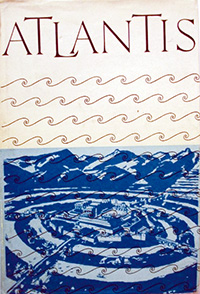
    Atlantis, Atlantology: Basic Problems by Nikolai Zhirov (front cover).

    In his monumental tome Atlantis, Atlantology: Basic Problems, Russian scientist Nikolai Zhirov collected hundreds of pages of geological, climatological and botanical evidence pointing to the former existence above water of a sizeable Mid-Atlantic landmass, certainly as late as the end of the last Ice Age, and possibly also much later during the European Bronze Age, in the third and second millennium BCE. The rising and subsidence of the Mid-Atlantic Ridge over tens of thousands of years may also explain the cycles of glaciation and deglaciation in the northern hemisphere, as well as the abrupt ending of the Younger Dryas in about 9,600 BCE. According to Zhirov and other scientists, the sinking of the Mid-Atlantic Ridge, an event possibly triggered by a cometary impact, effectively ended the last Ice Age by allowing the warm Gulf Current to reach the coasts of western and northern Europe.

    The Neo-Atlantean Empires

    If Zhirov is correct, Atlantis did not sink in a single day and night. Rather, the subsidence of the Mid-Atlantic Ridge spanned hundreds of thousands of years, alternating long periods of gradual subsidence with truly cataclysmic episodes of sinking by hundreds or even thousands of metres.

    The events of the Younger Dryas and the end of the last Ice Age may have been catastrophic, but Atlantean civilisation did not vanish overnight. Evidence shows that Atlantean civilisation did, in fact, survive the cometary impacts at the beginning of the Younger Dryas. During what I call the Neo-Atlantean period between 10,961 and 9,600 BCE, Atlantean missionaries visited virtually every corner of the world in an attempt to re-establish pre-cataclysmic civilisation.

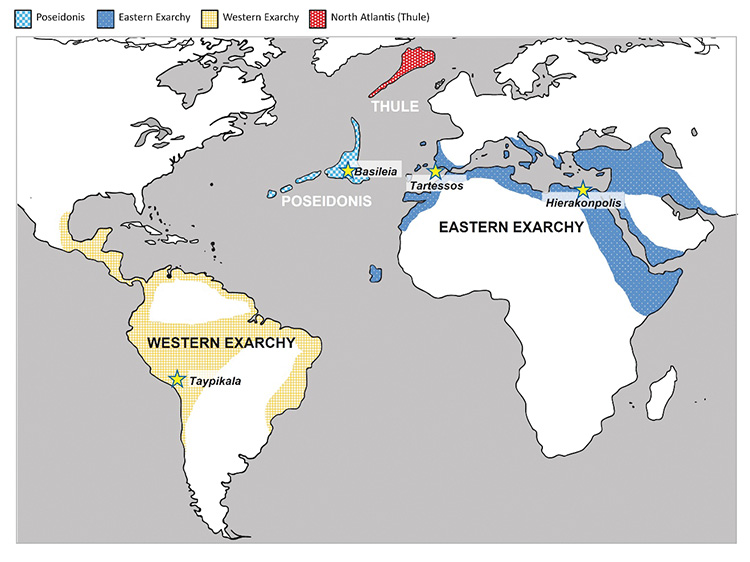
    Two main centres of Neo-Atlantean civilisation emerged around this time, in Egypt and South America. From these two primary centres and their various colonial outposts, a colossal building program was undertaken, aimed at no less than reconstructing the lost world of the gods. This is the essence of many mythical accounts describing the arrival in various parts of the planet of seemingly divine beings, possessing a civilisation and culture far in advance of the local indigenous populations.

    The extent of Atlantean colonisation and main centres of culture of the Neo-Atlantean period.

    The Edfu Building texts, a set of cosmological records covering the walls of the Temple of Edfu in Upper Egypt, describe how after a great and terrible cataclysm that plunged the world into darkness and destroyed the primeval island-homeland of the gods, a new generation of gods sailed from the primeval island, eventually settling in Egypt, where they became known as the Shemsu-Hor, the “Companions of Horus.” These semi-divine beings were responsible for the rise of the first Egyptian civilisation of the prehistoric period and may have been the original builders of the Great Pyramid and many other colossal megalithic structures of unknown date whose ruins are found throughout Egypt and the Middle East. Very similar accounts can be gathered throughout Mexico, Central and South America to explain the origin of sacred sites and other mysterious structures.

    The immense surge of construction and accelerated technological evolution that characterised the Neo-Atlantean period was short-lived. Within a few centuries, the grand edifice of Neo-Atlantean civilisation lay in ruins, plunging the world again into the depths of a new Dark Age. The causes of the collapse are unclear. Whether a result of climatic and environmental factors, the pressures of an expanding population against a small, albeit technologically advanced elite, or a second cometary impact at the end of the Younger-Dryas, the main centres of Neo-Atlantean civilisation were abandoned. In many cases, it is as if the builders simply dropped their tools and left, leaving behind only the shells of their unfinished structures, like a great Tower of Babel.

    Over the following centuries, global sea levels rose by an estimated 120 metres, submerging an area of land roughly equivalent to the combined extent of Europe and the continental United States. The consequence of this rise in global sea levels would have been particularly severe for any coastal maritime civilisation, submerging its major cities and trade centres under rising waters within the span of just a few generations.

    The Atlantean Diaspora

    The events of the end of the last Ice Age would have caused a massive diaspora and exodus of people from the now doomed islands of Atlantis and the coastal centres of Neo-Atlantean civilisation towards higher ground and the interior of continents. But it was the disintegration and fragmentation of Neo-Atlantean civilisation that triggered one of the most remarkable stages of accelerated cultural and technological evolution in the whole of human history.

    As Atlantean survivors scattered through vast areas of the Middle East, western Europe, central and South America, they brought an extensive knowledge of agriculture, architecture, and astronomy, which effectively gave rise to the Neolithic Revolution. At this time, we witness the sudden emergence of agriculture and sophisticated lithic technology in places like Göbekli Tepe, Jericho and Çatal Höyük, as well as in the highlands of Mexico, Bolivia and Peru.

    Classical Greek writers referred to their ancestors as the Pelasgians. Researcher Marco M. Vigato suggests they formed the Atlantean diaspora. 

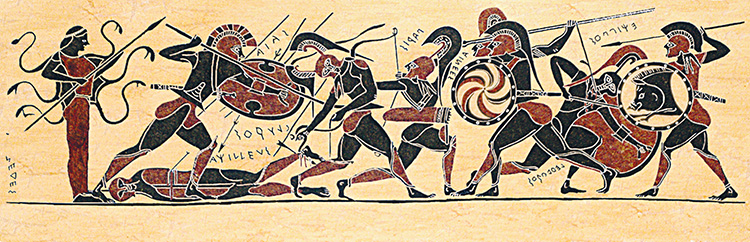
    At the same time, the sinking of the last islands of Atlantis, a process that extended well into the European Bronze Age, sent wave after wave of “Sea Peoples” to the coasts of Europe and Africa. These peoples were the originators of what has since become known as the Atlantic megalithic culture, through at least three different waves of migration in approximately 5,000 BCE, 3,500 BCE and 1,200 BCE. These post-Atlantean “Sea Peoples,” or Pelasgians, as they would be known to the classical authors, penetrated as far as the western and eastern Mediterranean, where they remained a powerful force until at least the second millennium BCE, leaving evidence of their distinctive megalithic architecture over a very large area extending from the Orkney Islands in the north to western France, southern Spain, Italy and Greece in the south and east. The last of the “Sea Peoples” invasions in the 12th century BCE became memorialised in contemporaneous Egyptian records from the Temple of Medinet Habu.

    Get the issue this article appears in

    The Legacy

    Despite their decadence and the loss of much of their civilisation and culture, Atlantean survivors were nevertheless able to preserve the principles of a specific type of sacred knowledge that still forms the basis of many esoteric and religious traditions throughout the world.

    Monuments as far away as the great Egyptian temples of the Pharaonic period, the mountain temples of Angkor in Cambodia and the Gothic cathedrals of medieval Europe all testify to the survival of a Sacred Science of Atlantean origin through countless millennia. It is difficult to speak of fortuitous coincidences when, throughout the millennia and on entirely separate continents, one finds the same images and symbols used repeatedly to convey the same esoteric truths and designate the same abstractions.

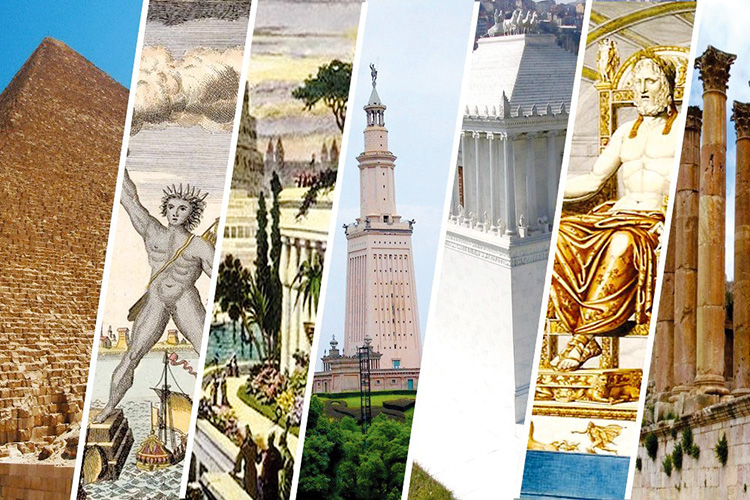
    The technological know-how to build the Seven Wonders of the Ancient World may have derived from Atlantis, transmitted by the survivors of the lost continent before it met its end.

    Moreover, this vast body of knowledge appears complete and fully-formed since the earliest dynasties, knowing no period of development or evolution. It must have thus existed at some point as a preconceived plan, directed by powerful masterminds whose only purpose seems to have been the unadulterated transmission of knowledge through the ages that separate us from the fall of the last Atlantean Empire.

    Ultimately, this very long chain of transmission appears to be the continuation of the Neo-Atlantean project, which was left interrupted by the events of the end of the last Ice Age and the Atlantean diaspora. This project calls for no less than the resurrection of the lost world of the gods, which alone will bring forth a new Golden Age for Mankind.

    The author Marco M. Vigato has written a book that establishes the historical and geological reality of Atlantis and reveals its continuing influence worldwide. Readers can obtain The Empires of Atlantis: The Origins of Ancient Civilizations and Mystery Traditions throughout the Ages from all good bookstores.

    [alert type=”general” dismiss=”no”]This article was published in New Dawn Special Issue Vol 16 No 2.[/alert]

    [alert type=”success” dismiss=”no”]If you appreciate this article, please consider subscribing to help maintain this website.[/alert]

    © New Dawn Magazine and the respective author.
    For our reproduction notice, click here.
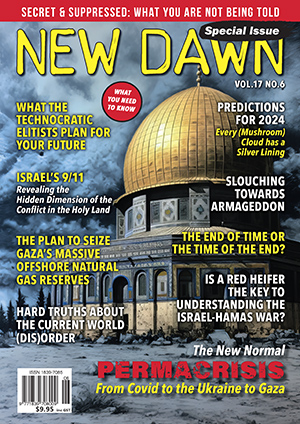
  • The End of Time or the Time of the End? The Armageddon Agenda Exposed

    The End of Time or the Time of the End? The Armageddon Agenda Exposed

    From New Dawn Special Issue Vol 17 No 6 (Dec 2023)

    I recall many years ago looking through an old Catholic missal. It was one from the halcyon days of the Tridentine Mass and contained a variety of colour plates designed to help the faithful believer better understand the Mass and the sacraments.

    Of the more memorable images from that book was a colour plate illustrating the meaning and origin of the seven sacraments of the Roman Catholic Church. It was a collage of images depicting Jesus Christ administering each sacrament: Jesus baptising someone, Jesus hearing confessions, Jesus confirming a young boy and girl, that sort of thing.

    Now, I am sure the authors of that missal did not actually believe that Jesus of Nazareth really did those things, but I am certain that millions of faithful Catholics probably did believe it. And they believed Jesus directly instituted each of the seven sacraments because of what they saw in that missal and because of what their Church taught them.1

    One of the problems inherent within traditional Christian orthodoxy is a kind of myopia.

    Those with the ocular medical condition known as myopia typically can see nearby objects clearly but distant objects appear blurred.

    In terms of Christianity, as illustrated from the missal story above, there is a tendency to think that what a person believes now as “true Christianity” is precisely what Jesus taught, what the apostles taught, and what every faithful and true Christian has ever believed.

    This way of thinking blurs the vision when it attempts to look down the corridors of time, back to the distant past and into cultures very different from those of modern times.

    Christianity has never been “one thing” or “one true set of doctrines,” as much as some may wish to comfort themselves with such beliefs.

    Even in modern times and among the strictest of traditionalist Christian denominations, there are varieties of theological and doctrinal positions, even if those positions are made to look less diverse by institutional unity, as with Roman Catholicism, or by a kind of cultural unity, as with Protestant fundamentalism.

    From the earliest days of Christianity, diversity, not uniformity, characterised the movement.2 So, for example, there never was, and is not today, one “official” view of such matters as prophecy, the “end times.”

    But not everyone understands or believes this and so, for example, there are many evangelical and fundamentalist Christians who cannot conceive of anyone being a Christian and not believing in the “rapture” or end-of-the-world scenarios of the Left Behind book series.

    Someone wisely observed that ideas have consequences. The consequences of ideas are especially evident in the field of religion.

    If supporting evidence for such a claim is required, one need only consider how the world today has been affected by the religious ideals of solitary individuals such as Moses, Jesus, or Muhammad.

    Religious ideals and the movements they inspire do not have to be pervasive or widespread to have far-reaching consequences.

    This is nowhere more obvious than in the strange beliefs of a relatively small sect of Christians who teach a form of Protestant Christianity generally known as “dispensationalism.”3

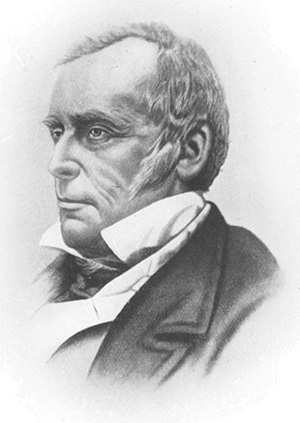
    John Nelson Darby

    Originating from the work of John Nelson Darby, an Anglican clergyman of the 19th century, and systematised by American followers such as C.I. Scofield, dispensationalism had a tremendous influence on English-speaking Protestant Christianity.4

    Dispensationalism is best known for its literalist interpretation of highly symbolic verses of the Bible, its emphasis on the immediacy of the second coming of Christ, the distinction it makes between ethnic Israel and the largely Gentile church, and its belief that God’s ultimate goal of history is the restoration of the Jews as a kingdom nation ruling the world from Jerusalem.

    In the way they interpret the Bible, God has divided human history into seven ages or dispensations, and we now find ourselves on the verge of entering into the last age, an age that will, according to them, witness the literal physical return of Jesus to the Earth.

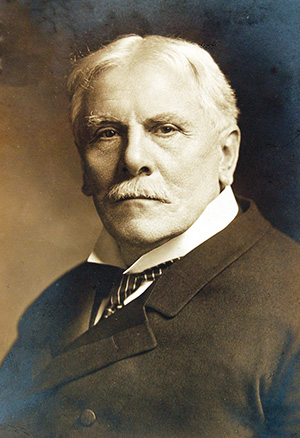
    Cyrus I. Scofield, the father of dispensationalism, has been described as a self-taught lawyer, convicted forger, wife deserter, and alcohol abuser turned preacher who became the world’s most published Bible commentator.

    Indeed, in their theological system, Jesus Christ cannot return until the Jews are gathered in their ancestral homeland.

    And so, according to them, the founding of the modern state of Israel in 1948 was part of a larger, prophetic plan revealed in the Bible.

    All of this would be nothing more than an adventure in religious doctrinal trivia were it not for the fact that the dispensational worldview has, like all ideas, consequences for the rest of us.

    There is perhaps no better example of this than the United States’ constant support for the state of Israel.

    To be sure, no US president has been an open believer in dispensational Christianity, but many of them have recognised that a large bloc of voters are such believers and have therefore patterned US foreign policy to cater to that bloc.

    Leaving aside the improprieties of US foreign policy, the fact is dispensationalism is bad theology. This can be seen in both its history of fear-mongering and end-of-the-world predictions and in the way it misreads the Bible.

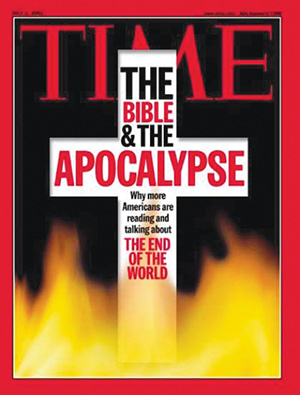
    On 1 July 2003, TIME magazine’s cover story was “The Bible and the Apocalypse: Why more Americans are reading about the end of the world.”

    Back in the early 1970s, dispensational prophecy author Hal Lindsey predicted the second coming of Christ would occur in 1988 since that was forty years (in biblical chronology, forty years equals a generation) from the time the modern state of Israel came into existence.

    Hal Lindsey was wrong, but that has not stopped him from writing many more prophecy books, and it has not stopped Christians and non-Christians from reading them.

    From 1998-99, dispensationalists poured over their Bibles for evidence of the “rapture” and the end of all things as the year 2000 dawned. Many books, tapes, and videos were written, produced, recorded, and bought by millions of people, many of whom were convinced the end was at hand.

    But, as with the year 1988, so too with the year 2000, the dispensationalists were wrong again.

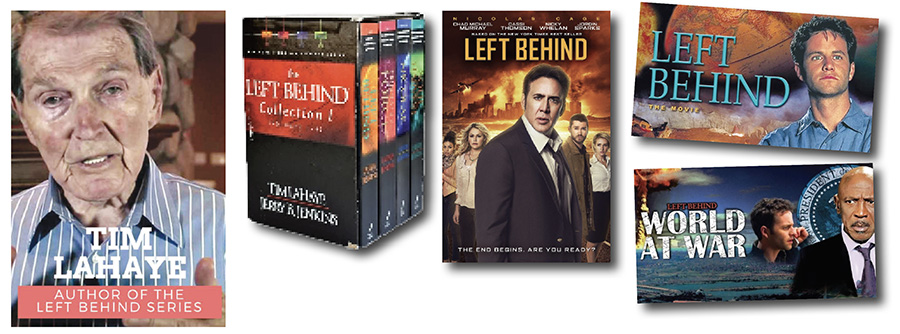
    The events of 11 September 2001 again saw people wondering about the end of all things, and Tim LaHaye’s popular Left Behind book series (the first volume of which was originally published in 1995) profited immensely from both the Y2K hysteria and a year later, from the events of 9-11.

    Indeed, the Left Behind book series has sold over 40 million copies. That doesn’t include the motion picture adaptation of the Left Behind novel or the many other spin-offs, such as “Left Behind for Kids,” the “Left Behind” board game, music, movies, etc.

    The Left Behind series by Tim LaHaye helped revive dispensationalism or ‘rapture theology’.

    Fear-mongering about the end of the world and the return of Christ have made millions of dollars for men like LaHaye, Lindsey, and John Hagee.5 These men quote many, many Bible verses to support their claims. Quoting Bible verses does not, however, make something a true biblical doctrine.

    Historically, large numbers of Christians have believed that all of the events dispensationalists have pointed to as evidence we are “closer than ever” to the end times were events that the Bible itself says were to take place in the generation of the apostles and the First Century church. For most of the history of Christianity, such prophetic statements were looked upon as either being fulfilled in the past or applying not to a restored Israeli state but to the church.

    Consider these passages and notice that in every case, the words and predictions are addressed not to people living in the 21st century but exclusively to the people to whom Jesus was speaking at the time, the people of that generation, and notice that for them, these things were near, at hand, soon to come (note: I have used italics to emphasise this in the text):

    Matthew 10:23: When they persecute you in one town, flee to the next, for truly, I say to you, you will not have gone through all the towns of Israel before the Son of Man comes (ESV).6

    Matthew 16:27-28: ‘For, the Son of Man is about to come in the glory of his Father, with his messengers, and then he will reward each, according to his work. Verily I say to you, there are certain of those standing here who shall not taste of death till they may see the Son of Man coming in his reign.’(Young’s Literal Translation of the Bible)

    Matthew 26:63-64: But Jesus remained silent. And the high priest said to him, “I adjure you by the living God, tell us if you are the Christ, the Son of God.” Jesus said to him, “You have said so. But I tell you, from now on you will see the Son of Man seated at the right hand of Power and coming on the clouds of heaven.”(ESV)

    Matthew 24:34: Truly, I say to you, this generation will not pass away until all these things take place.(ESV)

    James 5:7-8: Now be patient, brothers, until the Lord’s coming. Think of a farmer: how patiently he waits for the precious fruit of the ground until it has had the autumn rains and the spring rains! You too must be patient; do not lose heart, because the Lord’s coming will be soon. (New Jerusalem Bible)

    1 John 2:18: Children, it is the last hour, and as you have heard that antichrist is coming, so now many antichrists have come. Therefore we know that it is the last hour. (ESV)

    Get the issue this article appears in

    Notice the verb tenses, notice the immediacy and the urgency in these exhortations, and notice, most importantly, that they were addressed to specific people at a specific time and place!

    For Christians who believe in the infallible truth of the Bible, logically, there are only two possibilities for correctly understanding these statements.

    Either Jesus was right, and all the things that the dispensational/Christian Zionists claim are to happen in our immediate future have, in fact, already happened, or Jesus, as he speaks from the pages of the New Testament, was wrong!

    So, then, “all the things” that the dispensationalists claim are to happen in the future have been misunderstood and misinterpreted by them.

    They have managed to find everything from helicopters and atomic bombs to computer chips lurking below the surface of the words of Scripture, but the one thing they seem not to be able to find is the ability to interpret things like “coming on the clouds,” “the moon not giving its light,” and “wars and rumours of wars” in light of what the Bible itself says about those things.

    The biblical evidence and especially the time indicators associated with these prophetic statements all show that both Jesus and the authors of the New Testament were all expecting the “Last Days” and the “coming of the Lord” to occur in their generation.

    Reading the Bible in its cultural and historical context will show that such concepts, themes and ideas as “the Day of the Lord,” the “Last Days,” and the “coming of the Lord” are usually not associated at all with what has come to be known in our time as “the end of the world and the return of the Lord” but rather with the covenantal judgment of God against the nation of Israel.

    According to this traditional Christian interpretation of the Bible, that judgment did occur in CE 70 with the fall of Jerusalem at the hands of the Roman armies of Titus and Vespasian.7

    From this Christian perspective, the “last days” were the last days of the Old Covenant era with its Temple sacrifices in the city of Jerusalem and with its High Priests and Scribes.

    According to this view, the covenantal judgment of God against Israel was manifest in the destruction of Jerusalem and the Temple. Hence, it was to the Jewish mind of that time “the end of all things,” and it was, as Jesus himself said in Luke 21:23, “…the days of vengeance, that all things which are written may be fulfilled.”

    Vengeance? Vengeance against who?

    According to those Christians who argue for the past fulfilment of these prophecies, it was against Israel for rejecting the Messiah and for saying that they had no King but Caesar and for saying that they would not have “this man [Jesus] to rule over us!”

    According to the Gospel accounts, Jesus claimed in CE 30 that within a generation all of those things mentioned in Matthew 24, Mark 13, and Luke 21 would come to pass.

    And so, from this perspective, it is obvious why the prophecy pundits and end-of-the-world rapture specialists are, and will always be, wrong.

    They are projecting into the future things that have long since passed. 

    [alert type=”general” dismiss=”no”]This article was published in New Dawn Special Issue Vol 17 No 6.[/alert]

    [alert type=”success” dismiss=”no”]If you appreciate this article, please consider subscribing to help maintain this website.[/alert]

    Footnotes

    1. Similar examples among Protestant evangelicals or fundamentalists would be envisioning the apostles as speaking only in King James English or thinking of Jesus as a “Christian” in the same sense they think of themselves as Christians. Jesus was, of course, a very devout Jew and not a Baptist, Anglican, or Roman Catholic!
    2. The classic study that proved this to be the case was German historian Walter Bauer’s Orthodoxy and Heresy in Earliest Christianity.
    3. Most of the world’s 2.1 billion Christians are Roman Catholic, Eastern Orthodox, Anglican, or mainline (i.e. theologically liberal) Protestant. Most of these Christians do not hold to the dispensationalist form of fundamentalist Christianity.
    4. For an excellent analysis and history, see George Marsden, Fundamentalism and American Culture, Oxford University Press, 1980.
    5. Hagee, an independent fundamentalist pastor, has even articulated what he calls “Christian Zionism” and has formed an organisation called “Christians United for Israel.” At one of that organisation’s events, Hagee and his group gave 7 million dollars to Israeli officials for various causes in support of the state of Israel. One wonders if Hagee has been as concerned to support his fellow Christians living in Israel. For more information, see the group’s website at www.cufi.org.
    6. ESV is the English Standard Version of the Bible.
    7. This is known as the “preterist” view, from the Latin term meaning “past.”

    © New Dawn Magazine and the respective author.
    For our reproduction notice, click here.
  • Hyperreality, Synchromysticism & Simulation

    Hyperreality, Synchromysticism & Simulation

    From New Dawn 195 (Nov-Dec 2022)

    We are the first digital inhabitants of a universe of pure symbolic media exchange, living in an empty space of virtuality, where subjectivity and objective truth have intertwined together.

    At the core of this collective experience, we find a fabricated system of meaning that limits human participation to that of mindless spectator, while a digital hyperreality is slowly born.

    Follow The Signs

    Images serve as a symbolic system through which people communicate and culture is transmitted. Some images contain a system of symbols and are used for various types of communication.

    Societies often share common symbols, and many symbols contain the same basic elements. Taken together, these symbols convey specific meanings. 

    For example, we are all born into a society with a written system of some kind, made of symbolic shapes called language which refer to spoken sound. None of us were the engineers of this system to begin with.

    A study of synchromysticism and numerological exploration can help uncover secret languages encoded inside the realm of reality, and which can be used to decipher meaning in unique ways.

    A feature that makes synchromysticism unique to other forms of synchronicity is its focus on esoteric mystical symbolism and the use of communications technology to document, share and compare synchronicities related to such symbols – from ancient traditions to mass media.

    By utilising cryptic understandings of symbols, we can decode, map, and predict future world events. How? Symbols channel a form of collective mass unconscious in the human species in which the subconscious realm can be influenced and dictated, hence altering the conscious sphere.

    Not only are symbols used to pre-program major world events on our television screens, but they are in fact a present reality in every single element of everyday life. We are living a fairy-tale dream.

    We have become so overwhelmed with symbols (translated as ‘information’) in the modern world that objective truth has been blanketed to the point it cannot be identified authentically.

    Analyses of objectivation, institutionalisation and legitimation are directly applicable to the problems of the sociology of language, the theory of social action and institutions, and of religion. 

    A vast, simulated experience has taken over the world, and reality itself is being sucked in with it.

    Simulated Reality

    We live in a world of signs where almost everything around us has become a matter of signification, connected with explosive growth in media and related to changes in the conduct of everyday life.

    Our current society has replaced all reality and meaning with symbols and signs, and human experience has become akin to a simulation of reality.

    You may be familiar with the term simulation – no doubt it has been said many times right here in New Dawn. But just exactly what does it mean? 

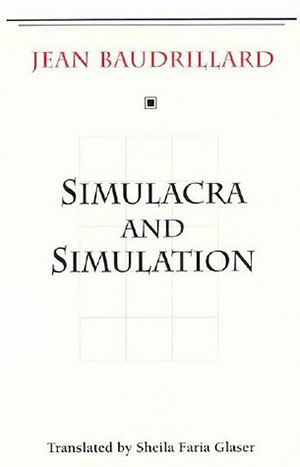
    The Baudrillardian concept of‘simulation’ refers to the idea of creating a reality; reproduced and based on a foundation of widely interpreted symbols.1

    Simulated reality appears so real that one cannot separate the ‘real’ from simulation. 

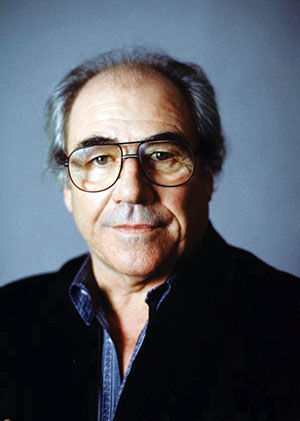
    Jean Baudrillard (1929–2007)

    In fact, simulation dominates the real, and never again will the real have the chance to produce itself because simulation is all there is, according to the French sociologist, philosopher and cultural theorist Jean Baudrillard (1929–2007). 

    Simulated reality is not a singular concept. The simulation itself is made up of infinite imitations of the operations of real-world processes or systems over time. These are known as simulacra.

    Simulacra are copies that depict things that either had no reality to begin with, or that no longer have an original. Representations stand in place of a perceived real or are simply the ‘real’ itself.2

    Inside the control structure, these simulacra are not merely mediations of reality nor even deceptive mediations – they are not based in a reality at all. No attempt to hide a ‘reality’ is made.

    Instead, all we see is a process of how symbolism in culture and media constructs perceived reality, programming false understandings and making lives and shared existences illegible. 

    Society has become so saturated with simulacra, and lives so saturated with the constructs of society, that all meaning has long been rendered meaningless by being infinitely mutable.

    The onslaught of television, media growth and the constant bombardment of images, are now intended to represent reality. From birth, humanity communicates and understands this way.

    Importantly, the simulacra are never that which conceals the truth. The truth which is concealed is that there is no truth. The simulacra, or untrue, is the truth.

    To better understand what this means, let’s look at key concepts found in studies describing the nature of symbols, simulacra, and interactions with collective perceptions of reality.

    Psychology of Illusion

    Not only does simulacra refer to ‘copies without an original’ but it can also be used to explain the lack of depth, meaning or ‘realness’ behind signs that penetrate our technological lives.

    Philosopher Walter Benjamin, as early as 1936, argued that “the presence of the original is the prerequisite to the concept of authenticity,” and that this was missing from a world of mass-produced commodities.3

    However, in a modern, technology-driven digital age, this has developed even further to the point that no original even exists from which to draw the authentic from.

    Prof. Frank Webster, author of Theories of the Information Society, once gave the example of when a user downloads a song to their phone. The notion of an original is meaningless as the downloaded song has no physical original – it is a copy of a song downloaded from a digital platform.

    In his essay The Ecstasy of Communication, Baudrillard explains that Western technological society revels in its over-exposure to images. He defines this visual overstimulation as “obscene,” when “everything is exposed to the harsh and inexorable light of information and communication.”

    Researcher Steven Connor summarises Baudrillard’s concepts of simulacra by stating: “All of contemporary life has been dismantled and reproduced in scrupulous facsimile.”4

    This refers to simulacra; the reproduction of signs of reality that are, in fact, created.

    Connor also discusses how simulation of “the real and referential” then “takes the form of manufactured objects and experiences which attempt to be more real than reality itself.”

    For example, violence is disconnected from ‘real’ world destruction and recorded in cyberspace as signs and images to be consumed through mass media, gaming, and digital outlets.

    Death as a tragic event has also been eliminated, and any event surrounding this theme is surrendered to media representations of it.

    Whatever the event may be, it is experienced as an ‘image event’ and consumed through symbolic exchange. Put simply, the image precedes the real, is consumed, and forms the reality itself.

    War images on TV form the actual perception of warfare, while real events on-the-ground – whatever they may be – are masked in a sea of digital simulations.

    Simulacra is the psychological concept that drives many other vast deceptions. From 9/11 to shooting events, the COVID scamdemic – symbolic images are programmed daily.

    Let’s take a deeper dive into how these messages are transmitted and what is responsible.

    In the world in which we now live, the image precedes the real, is consumed, and then forms reality – what is deemed by the mind to be the ‘real’. TV has been the primary generator of images, which are manufactured by unknown operators. War images projected on TV – and all electronic screens – form the actual perception of warfare, while real events on-the-ground – whatever they may be – are masked in a sea of digital simulations.

    Symbolic Exchange

    We are now more wired to our interfaces. We react to the television news rather than the world, to a computer program rather than social interaction, to email rather than vocal communication.

    In all these, we react to simulations rather than the immediate environment. Simulation supersedes ‘real’ interactions and has done so now for generations. 

    Andrew Murphie and John Potts argue in their book Culture and Technology that the media can never convey the ‘real’, and with the ever-increasing reliance on the internet, simulations are only becoming more prevalent, thus reiterating how simulacra erase and dominate the ‘real’.5

    The internet is a simulacra creator, highlighting the importance of symbolic exchange in cyberspace. It is a copy-making machine, a tool that effortlessly replicates things and passes them along. A digital realm in which nothing is authentic and everything is vastly produced.

    This ‘creation’ allows for artificial place-markers for real items or events. The uniqueness of objects and situations marks them as irreproducible real, and signification gropes towards this reality.

    This process is known as ‘symbolic exchange’ – a form of value exchange that maintains and organises social relations and hierarchies. The difference with other forms of exchange is that the value of an exchanged object does not value the act of exchanging it.6

    Let’s think about a designer brand t-shirt vs a regular t-shirt. Is there really any difference between the two? Is the designer brand actually worth $200 of raw materials, or is it simply the marketplace of value symbols (brands) that drives the worth of this shirt?

    Symbolic exchanges are not aimed at establishing equivalence (equal value) between two exchanged tokens, as with other forms of exchange. The opposite of a resource-based system.

    This psychological game allows for creators of said object to influence and dictate (false) worth, and it is this framework that powers why humans value grand deceptions over critical analysis.

    How on earth did humanity get to this point?

    It all began with the beginning of ‘modernity’ following the Industrial Revolution.

    Here, distinctions between representation and reality began to break down due to the proliferation of mass-reproducible copies of items, turning them into commodities.

    The commodity’s ability to imitate reality immediately threatened to replace the authority of the original version because the copy is just as ‘real’ as its prototype.

    This continued until the birth of postmodernity in which this process expanded with newer technology to the point the simulacrum now precedes the original, and the distinction between reality and representation vanishes. There is only the simulacrum; originality has been buried.

    Baudrillard theorises that the lack of distinctions between reality and simulacra produces several outcomes including (but not limited to) the following:

    Contemporary media, including television, film, print, and the internet, blur the line between products needed (to live a life) and products for which commercial images create a need.

    Exchange value in which the value of goods is based on money (denominated fiat currency) rather than usefulness. Moreover, usefulness comes to be quantified and defined in monetary terms to assist exchange.

    Multinational capitalism which separates produced goods from the plants, minerals and other original materials, and the processes (including the people and their cultural context), used to create them. Think of medicine and plants as an example of this.

    Urbanisation which separates humans from the non-human world, and re-centres culture around productive throughput systems so large they cause alienation.

    Language and ideology in which language increasingly becomes caught up in the production of power relations between social groups, especially when powerful groups institute themselves at least partly in monetary terms.

    Through these primary methods, collective values of a society, object, event, or story are directed and engineered. Disconnection from reality to simulacra until the ‘real’ is forgotten.

    Next, let us examine the long-lasting inter-generational effects of this level of mass illusion.

    Here we go beyond many authors’ work and adapt this information to the digital age.

    The Birth of the Hyperreal

    In the modern world, we have moved from the ability to reflect our reality truthfully to the ability to mask and distort this reality, and to masking the simulated reality altogether.

    Finally, with the dawn of the Fourth Industrial Revolution, humanity has already begun the transitional stage to an era in which simulation asserts precedence over reality.

    Hyperreality refers to a simulation of reality that acts as more real than the real or a created heightened reality. In this hyperreal cyberspace, signs for consumption are constantly in production, and this creates a new reality, as virtual reality cannot be completely known.7

    We are already witnessing the building blocks of this era. There is a sharp connection between nature and technology in terms of what becomes an icon for the ‘lost real’ in hyperreality. Almost all forms of online media act as a hyperreal experience.

    As an example of social media, Facebook markets itself as a connecting tool; a user posts updates of their life to their friends who can react and comment as they wish. 

    This platform acts as a digital reproduction of real life – a heightened version of real communication between friends, but it does not reflect real-life interaction.

    This is the hyperreal, a digital simulation of reality, where a person ultimately uses Facebook to form an online identity and persona more vivid than the ‘real self’.

    Twitter is hyperreality as well, as it bears no reflection to real life and creates a sublime cyberspace where a user, once a rational subject, becomes decentred in online communication.

    As subjectivity becomes detached from materially fixed, embodied contexts, it is dispersed and multiplied continuously through digitisation.

    In this hyperreal setting, traditional social settings are erased as a real human being is re-signified as a digital representation for Twitter users to consume. 

    The pure symbolic media exchange of cyber interactivity is understood as the opposite of social.

    The subject does not experience ‘increased interactivity’ but instead experiences ‘subtle death’. Interaction dies in this hyperreal cyberspace and becomes merely a simulation of communication.

    Chat rooms, for example, allow users to function as floating signifiers capable of becoming anything that is describable. Thus, online, communication is replaced by sign consumption, and subjects become merely ‘floating signifiers’.

    If we replace ‘chat rooms’ with Twitter, we may conclude that power becomes a signifier of hatred.

    Going beyond this space, the phone itself is a hyperreal product – a product of pure simulated society which acts almost as an extension of ourselves. 

    Astra Taylor, author of The People’s Platform: Taking Back Power and Culture in the Digital Age, has explained the ways that “big media,” through search engine algorithms and data collecting, can “absorb who we are” by gathering detailed demographic information, geographic information, behavioural information, and social information.8

    Absorbed from the real to a digital representation.

    In the future, with the introduction of AR and VR systems such as the Metaverse, enhanced by AI and 5G underliers, almost all observable reality will soon fall under the spell of the hyperreal.

    The gamification of society and the introduction of controlling technologies as a trojan horse of mind-numbing pleasure means that humans are wilfully creating the end of their realities.

    There is no original that created the rest, no seed planted. Everything will soon be automated, and this automation produces a series of new symbols for humanity to absorb.

    Baudrillard stated that representation stems from the principle of the equivalence of the sign and of the real, but “simulation envelops the whole edifice of representation itself as a simulacrum.” Therefore, the concept of a ‘real’ underneath the simulation relies on the principle of the real.

    Hyperreality is the absorption of the real – whatever it may have been – into an ocean of simulated, digital representations. Infinitely created and replicated until the real is long forgotten.

    Get the issue this article appears in

    Science Fiction Comes to Life

    The postmodern world in which we live and the approaching post-postmodern hyperreal timeframe are argued to go hand-in-hand with famous science fiction works of our time.

    In his book Exploring the Limits of the Human through Science Fiction, Gerald Alva Miller suggests that “science fiction increasingly proves the genre that is necessary to grasp the postmodern world around us.”9

    Baudrillard notes that science fiction “is no longer anywhere, and it is everywhere, in the here and now, in the very principle of the surrounding simulation.” In other words, he argues science fiction is hardly fictional at all, it is merely waiting “in its crude state” to emerge.

    Are we really ‘waiting’ for this change to come? Or is it already here?

    Miller believes this wait is over and the technology of contemporary science fiction now “occurs in realistically depicted versions of the present or even the past.” He calls television “a viral, endemic.”

    Baudrillard sees radical action such as destroying the system as no longer a real possibility.

    This is because there is no system. It is a simulated, collective experience driven by symbols and images and programmed by those who are controlling those very mechanisms.

    We are slowly welcoming the immorality of consuming death as a media spectacle.

    Marleen S. Barr discusses the concept of post-postmodernism, which she says exposes “the hitherto science fictional impact of technology on society and culture… when what was once science fictional comprises the very definition of reality.”10

    Cyberspace becomes a space of pure symbolic exchange where humanity disappears and subjects become nothing more than a sign or image to be consumed.

    Technology has been engineered as a weapon in which the human subject is reduced to a mere sign for consumption. This consumption of a person is represented by reducing a subject to a mere symbol for exchange, and even the event of death is consumed by hyperreal media. 

    Dehumanisation in the media, or reducing the subject to the object, happens in hyperreality. This is currently perpetuated by online users who are still human beings themselves. 

    This important analysis of simulacra and hyperreality draws attention to the need to see the human behind the image, to see the subject behind the object, and re-humanise the subject in cyberspace.

    We must do everything we can to disconnect ourselves as much as possible from the hyperreal that is currently birthing a world of endless simulated experiences (the Metaverse is an emerging example).

    By doing so and looking beneath the surface, we can resist. How? Because we recognise the ‘system’ that controls us does not physically exist at all – it is an illusion.

    Almost everything is an unauthentic copy of a copy, masking the fact there is no original base.

    Everything we have been told is a lie. Therefore, I recommend you throw away anything you have ever been told about the world and begin to form an independent perspective from scratch.

    When you do, and you also take this information into consideration, you will uncover startling truths.

    The above is an updated version of an article that originally appeared on the website of TOTT News: https://tottnews.com.

    [alert type=”general” dismiss=”no”]This article was published in New Dawn 195.[/alert]

    [alert type=”success” dismiss=”no”]If you appreciate this article, please consider subscribing to help maintain this website.[/alert]

    Footnotes

    1. www.en.wikipedia.org/wiki/Simulacra_and_Simulation
    2. www.en.wikipedia.org/wiki/Simulacrum
    3. www.ceasefiremagazine.co.uk/walter-benjamin-art-aura-authenticity/
    4. www.amazon.com.au/Postmodernist-Culture-Introduction-Theories-Contemporary/dp/0631200525
    5. www.books.google.com.au/books/about/Culture_and_Technology.html
    6. www.oxfordreference.com/view/10.1093/oi/authority.20110803100546755
    7. www.en.wikipedia.org/wiki/Hyperreality
    8. www.youtube.com/watch?v=vMwyZbS4JTU
    9. https://link.springer.com/book/10.1057/9781137330796
    10. www.tandfonline.com/doi/full/10.1080/08854300600950285

    © New Dawn Magazine and the respective author.
    For our reproduction notice, click here.
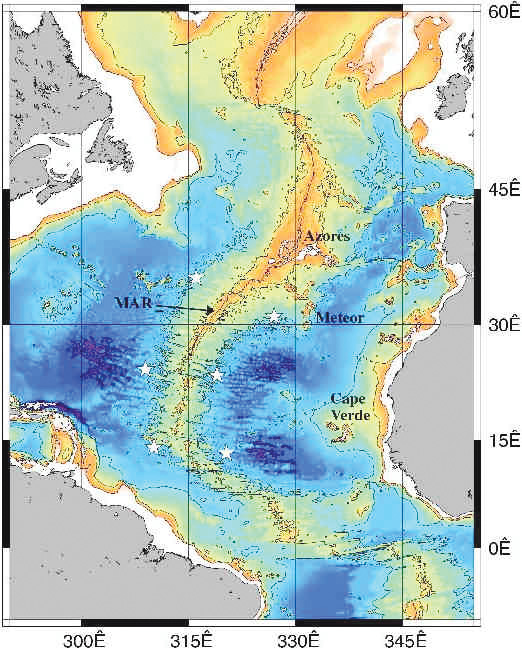
  • To Be or Not to Be: Daria Dugina’s Vision of the Apocalypse

    To Be or Not to Be: Daria Dugina’s Vision of the Apocalypse

    From New Dawn Special Issue Vol 18 No 1 (Feb 2024)

    In the year and a half since 29-year-old Daria Dugina was killed in a car bombing near Moscow, the question “Who is Daria Dugina?” has not gone away. On the contrary, as the smoke cleared, this question only intensified and broadened.

    This is perhaps one of the reasons why, just this past October [2023], The Washington Post released an “exposé” admitting what most sober people already knew: Dugina’s young life was cut short in an act of state-sponsored terrorism carried out by Ukrainian spec-ops created, trained, armed, and funded by the CIA.1 Of course, the US and Ukrainian officials who confirmed this to the Post “spoke on the condition of anonymity citing security concerns as well as the sensitivity of the subject,” as Kiev and Washington still officially refuse to comment. In other words, it is the “same old story” with the same old actors now playing with their latest “junior partners.”

    These assassins still find themselves at a loss for words out of “concern” for the “sensitivity” of what they have done: killing a young thinker, writer, and activist, whose death opened a Pandora’s box into the real Daria Dugina – her thoughts and writings, and what her activism and death mean for many people around the world.

    Daria Dugina

    Following the publication of her posthumous book, Eschatological Optimism, Daria ‘Platonova’ Dugina – the philosopher – emerged into the spotlight.2 Readers across the entire planet now know what many in her native Russia already did: Dugina was not only the daughter of the leading Russian philosopher, Aleksandr Dugin, but a profound, radical philosopher in her own right.

    On the eve of her death, Dugina was working on a PhD in ancient political philosophy and beginning to present key ideas to the public.

    She was a lifelong activist of the International Eurasian Movement, whose vision advocates the (re)establishment of a multipolar world in which diverse civilisations and cultures are not subordinated to the diktat of the US imperialist bloc and the Modern West.

    Hand in hand with her (geo)political activism, Dugina’s young yet far-flung and veteran career as a daring journalist and analyst has been revealed. Daria was also a woman of the arts: she had a music project (Dasein May Refuse), authored poetry, and frequented and curated art exhibitions and theatre.3 She planned to try her hand at film.

    On a more personal note, those who read Russian can learn from her recently published diaries that Daria was a human being who constantly struggled with melancholy and exhaustion. She constantly pushed herself to be the best she could be for others and a higher purpose.

    The same Western media that rushed to celebrate her death as a loud and clear “message” have begun to complain about a rising “Daria Dugina cult” and worry about the actual message that her life and death now signify.

    Indeed, perhaps they should be concerned because one of Dugina’s messages rings loud and clear in our days: We are on the brink of the abyss. In one of her most significant public lectures delivered just days before COVID-19 lockdowns began in March 2020, Dugina emphasised: “We are likely living in the era of the end of the world – this can be seen in the pandemic, in the various natural disasters that have become more frequent, and in the fundamental shifts in politics, geopolitics, and philosophy.”4

    In a talk a year later, Dugina spoke of a “sharp apocalyptic feeling of an approaching end,” and she referred to our age as the Kali-Yuga, the final “dark age” in the Hindu cycle.5 When an audience member asked what dissidents could draw from modern culture, Dugina quipped sceptically: “Through modern culture? Which one? Through the culture of object-oriented ontology, cyborgs, and mutants?”6

    In another talk on post-feminist philosophy, Dugina spoke of the need to “save humankind from approaching death,” and she proceeded to warn of the consequences of the advent of Transhumanism in no uncertain terms: “When the feminine and the masculine are finally abolished and replaced by cyborgs, it will signal the End of the World… Together with the loss of man and women, we will lose being itself.”7

    In other words, the young woman whose life was heinously taken while driving home one night saw her life – and all of ours – as facing an apocalyptic dusk on the eve of a doomsday-midnight.

    According to Daria, the end rushing towards us entails none other than the end of humanity, of humankind as such. The most glaring aspect of this end is the rise of an omnipotent technological matrix in which, in her words, “modern man finds himself under the destructive influence of matter, under the clichés of the consumer society, under the proliferating pressure of technology, which represses him and dictates to him the need to follow its intrusive, alienating algorithms.”8

    The human of the “high-tech” 21st century is a creature that finds itself “thrown into a space in which technology and matter essentially destroy him, in which he loses his axis of rebellion and sovereignty in the face of materiality and illusoriness.”9

    Soon enough – and Dugina was by no means the first nor the last person to forecast this – the technology that increasingly governs our lives will drown out our ability to think, act, and even exist. Everything we understand or suspect to define the human being – mortality, thought, freedom, will, heart, soul, the capacity for relationships with others, as well as relationships with the sacred and the beyond – is slated to be controlled, simulated, replaced, or displaced by the technological forces we unleashed and which we naively think we can stably control.

    Dugina sought to uncover the roots of our technologically aligned apocalypse in Modern and Postmodern philosophy. She saw herself as a reconnaissance scout in the cosmic War of the Mind(s) (“Noomakhia”): One of her missions was intensely studying and exposing the thinking that enables and prefigures this, on that subtle philosophical plane too few pay attention.

    The central concept of her philosophy is eschatological optimism. Daria Dugina’s vision of the apocalypse was revolutionary in the original sense of this word – a “turning around” or transforming our way of being in the world. 

    Dugina insisted that Postmodern philosophising – which most people dismiss as mere “word salads” or idle “theorising” confined to academic departments and so-called “identity politics” – is the incubation chamber, laboratory, and Achilles’ heel of the outward apocalyptic crisis.

    Decades before Transhumanism, one of the godfathers of Postmodern philosophy, Gilles Deleuze, argued that because the human being is too hierarchical, oppressive, and problematic of a subject, it therefore needs to be transformed – or deformed – into a mucus-like slime-web that randomly spreads out and coagulates like a rhizome.

    “Object-oriented ontology,” one of the latest ‘fashionable’ trends in philosophy, claims that existence needs to be liberated from human thought so that the real nexus of being can be “returned” to the inanimate objects and machines around us. Daria Dugina did not mince words when she said: “This is the real end of philosophy.”10 Of course, “philosophy” here should be understood as Dugina meant it: not as superfluous thought experiments but as a radical, essential capacity of being human, as the spiritual architecture of the “software” behind the “hardware” – and even, as in her case, a matter of life and death.

    Two anecdotes illustrate Daria’s daring forays into the dark trends of our Zeitgeist.

    During the launch of the Russian edition of Iranian-American philosopher Reza Negarestani’s Cyclonopedia (about a demon in the Earth’s core that is increasingly empowered and released by oil extraction), an audience member seized the opportunity to ask for Dugina’s hand in marriage. She responded by stating she would agree only if he learned Cyclonopedia by heart in English. In other words: “Know thy enemy.”

    On another occasion, Dugina attended an exhibition by English-American philosopher Timothy Morton, during which Morton yelled at his hand for not living its own separate life and rising up against its human oppressor.

    Dugina spent her time thinking with the likes of Negarestani and Morton because she believed – or rather knew – that they represent the thinking and way of (not-)being behind the technological, Transhumanist, “object-oriented” dystopia into which we are dragging and (not-)thinking ourselves into. For probing this territory and philosophical “no-man’s-land,” for naming names and exposing certain ideas, Daria’s philosophical activism posed a real threat.11

    Yet, this rising philosopher of the end times – cut down before her time – was not merely a deep thinker and observer. The central concept of her philosophy is eschatological optimism. Daria Dugina’s vision of the apocalypse was revolutionary in the original sense of this word – a “turning around” or transforming our way of being in the world. Turning around and seeing what is happening around us, turning around and seeing that others in the past and present have alternative orientations to offer, turning around all the preconceptions and ideologies that reigned over our age and now lead us towards doom.

    In a time when we are fixated on screens, plugged into so-called ‘social media’, and bound (“connected”) to forces and signals beyond our wanting and doing, Dugina says there is only one way out for the conscientious human being, the dissident, the authentic thinker: accept the challenge – the fate – of living, thinking, and speaking out, here and now, at this point in time. By so doing, our being reflects and attunes to the same stream of dissidents and thinking in societies, systems, and situations before and elsewhere; we are profoundly human at this last moment when emasculated, thoughtless, clicking-and-scrolling human entities are slated for “troubleshooting.”

    Dugina offers a simple but brutal truth as the starting point: “Everyone has their own place in the world, their spiritual Homeland… What is certain is that wherever we find ourselves in the modern world, we are in the centre of hell. It is difficult to see authenticity anywhere. We are cursed. But this is no reason not to rush toward salvation.”12

    We are challenged to seize the opportunity to be radicals in an age of machines, bots, algorithms, and the rise of the non-human and the inhumane.

    Of course, none of the above is found in any mainstream journalism or AI-assisted news reports on Daria Dugina’s life, thoughts, and death. All they can repeat is that Dugina was a Russian “propagandist” whose “aggressive rhetoric” against Ukraine justified civilian assassination.

    Get the issue this article appears in

    Dugina had insisted that Russia’s “Special Military Operation” in Ukraine was a daring offensive-defensive manoeuvre to stop the Postmodern virus and apocalyptic deluge, already consuming the West, from overtaking one of Russia’s historical and cultural heartlands (or borderlands). Regardless of one’s interpretation of the conflict, it nevertheless fits into Dugina’s eschatological optimism concept: against all the odds, no matter what, we are obliged to wage a final struggle against the “End of History,” which, as we now can foresee, will no longer include humans – not to mention cultures and peoples like Russians, Ukrainians, Americans, Australians, etc.

    Daria Dugina’s favourite, oft-recited quote comes from René Guénon, an author of prophetic eschatological works: “The end of a world never is and can never be anything but the end of an illusion.”13

    According to Dugina, the scenarios ahead of us are the apocalyptic culmination of a deep, perfidious illusion. Our task is to end this illusion by and in ourselves, reclaim reality, and do so against all odds as humble, daring, inspired, aspiring eschatological optimists. For this reason, this young woman with a grand, startling awakening message was assassinated, and her death and life are of the utmost significance to us all.

    Daria Platonova Dugina’s Eschatological Optimism is available from Prav Publishing at pravpublishing.com/product/eschatological-optimism.

    [alert type=”general” dismiss=”no”]This article was published in New Dawn Special Issue Vol 18 No 1.[/alert]

    [alert type=”success” dismiss=”no”]If you appreciate this article, please consider subscribing to help maintain this website.[/alert]

    Footnotes

    1. Greg Miller, Isabelle Khurshudyan, Shane Harris, and Marya Ilushina, “Ukrainian spies with deep ties to CIA wage shadow war against Russia,” The Washington Post, washingtonpost.com/world/2023/10/23/ukraine-cia-shadow-war-russia
    2. Daria Platonova Dugina, Eschatological Optimism, trans. Jafe Arnold, ed. John Stachelski (PRAV Publishing, 2023); Jafe Arnold, “Life in the End: The Message of Daria Dugina,” Continental-Conscious, 19 December 2023, continentalconscious.com/2023/12/19/life-in the-end-the-message-of-daria-dugina
    3. Daria was close with Alexey Belyaev-Guintovt, on whom see David Herbst, “Alexey Belyaev-Guintovt: Court Painter of the Eurasian Empire,” New Dawn Special Issue Vol 15 No 3 (2021)
    4. Dugina, Eschatological Optimism, 39
    5. Ibid., 73-74
    6. Ibid., 107-108
    7. Ibid., 137-138
    8. Ibid., 55
    9. Ibid., 54
    10. Ibid., 39
    11. See: Askr Svarte, Tradition and Future Shock: Visions of a Future that Isn’t Ours (PRAV Publishing, 2023)
    12. Dugina, Eschatological Optimism, 114
    13. René Guénon, The Reign of Quantity and the Signs of the Times, trans. Lord Northbourne (Hillsdale: Sophia Perennis, 2004), 279

    © New Dawn Magazine and the respective author.
    For our reproduction notice, click here.