New Dawn – World's Most Unusual Magazine

Category: Articles

  • The Countdown Begins: Two Years to Transform or Be Transformed

    The Countdown Begins: Two Years to Transform or Be Transformed

    In honour of John L. Petersen – founder of the Arlington Institute – who passed away in August 2025, we are posting his article which recently appeared in New Dawn Special Issue Vol 19 No 2.

    It’s like a movie – for example, Star Wars – where suddenly we find ourselves in an existential situation with a very short time to respond… and it’s for the whole game. Everything. It’s almost surreal – the stuff they make movies of! That’s where we are. Right now.

    There’s a lot about the world these days that is surreal. Honesty, integrity, logic, commonsense – all suddenly seemed to walk away within less than a decade. The underpinnings of how we understood reality to work – our paradigm – made their way to the door and departed. Now we can’t even tell what’s real for sure. Technology can duplicate every major characteristic of an individual within a digital environment with such fidelity that you don’t know for sure if it’s Donald Trump or Elon Musk (or anyone) really saying or doing what you just saw them say and do.

    It’s one thing to fixate on the extraordinary eruption of information technologies with all of the nano, bio, genetic, cogno, AI and social subsets of the explosion; they’re all clearly the major driving force of this planetary upheaval. But it’s more than that. Much more than that.

    AN ANCIENT STAGE HAS BEEN SET

    The stage for these present months and years was systematically set throughout the last century – if not longer. Some three hundred thousand years ago (say the Pleiadians by way of Barbara Marciniak), a major force (reptilians or archons, see the Gnostic Gospels) captured this planet. The humans, with their then 12 strands of DNA, were extraordinarily capable, connected and on their way to greatness. The controller reptilians felt it was inevitable that the humans would overtake them and become a threat.

    Something had to be done. The solution was to genetically disable ten of the dozen DNA strands. Break them up, but leave the broken strands in there such that they can’t operate – and be sure to manipulate the genetics to generate fear, pain, hate and terror – all of which produce the negative energy (loosh) that nourishes the reptilians/archons.

    Why have humans constantly killed each other and produced extraordinary injustices to each other for millennia? That’s why. It’s been designed into us to sustain the vitality of the controller/suppressor force that coexists with us on this planet.

    Those controllers have spent the last millennia working to incrementally shape this 3D reality so that we humans, exercising our “free will,” decision-by-decision, increasingly choose or “allow” the growth of conditions and initiatives designed to systematically constrain and suppress us to the point where these non-human forces can completely subsume humans into Matrix-like power sources (perhaps even housed in cells). At the very least, they want us to be afraid, powerless, dependent, docile, obedient and certainly amused and uninformed. Nothing sovereign or powerful here.

    It’s literally the elimination of humanity as we have known it.

    How is it working? Quite well, actually.

    We don’t think of all the antagonists as non-human. The names and terms are well known: Microsoft, Gates, Musk, quantum computing, AI, Google, Starlink, CIA, NSA, NSF, Amazon, ChatGPT, large language models, etc. It’s just not generally clear what they’re all up to or how far along in their plan they have progressed.

    The current conditions were spawned after WWII: they put fluoride into the water. And then came injections, cancer-causing chemicals in the soil, genetically modified seeds (and who knows what else) and chemicals, particles and nanobots in the skies.

    They began working on the electromagnetic spectrum of the space we inhabit that now includes towers everywhere, broadcasting radio signals that influence how our bodies operate and, in some applications, resonate specifically with the cells in our brains.

    A BRILLIANT 360-DEGREE STRATEGY

    It’s almost like they sat down and said, “What are all of the major external inputs that affect human well-being? Let’s target each of them so that when we’re finished, we control every aspect of their lives.”

    Let’s start working on child education to ensure conformity and make sure they only learn what we want them to learn. Don’t teach them to think for themselves, be creative in solving problems and question any aspects of “reality.” No, let’s produce workers for the industrial economy. Make sure they don’t know how powerful and capable they are. Tell them why they need to conform and what will happen if they don’t. Make sure the reward system enforces their obedience.

    How do we control their health? Well, we could introduce devices (like nanobots, for instance) into their bodies that would respond to outside signals to monitor and influence how their bodies operate. Let’s think about having them ingest it from the air or food or injections. That way, these sensors would be everywhere in their bodies: heart, brain and immune system. We could then tell how they’re doing and influence their health.

    Oh, and then there’s their money. Let’s design a monetary system that causes their money to decrease in value – guaranteed – every month, and we’ll make it so that our banks (but not the people) can manufacture money out of thin air so that WE can flourish even though surrounded by never-ending poverty.

    Even better, we’ll take the money out of their pockets and convert it to intangible digits that reside on computers (that can be manipulated) so that if we need to, we can shut off anyone’s access to money.

    Let’s figure out how their brains work, where and how they derive satisfaction, what engenders fear, etc. (by the way, let’s do love while we’re at it) so that we can influence them with the media (that’s a good idea, we need to control all of the media), and orchestrate their perceived reality to make sure they’re docile good citizens. Make sure there are plenty of sports, entertainment and drugs (of all kinds) that will keep their minds from wandering.

    You know, we’ll need some individuals who will do exactly what we want them to do that otherwise might be “unsavoury” to them, like killing a bunch of people, setting off a bomb, or something. For these select people, let’s learn how to fragment human minds and access and control one of the personalities of these people’s brains such that they’ll be available to us when we need them for a particular operation. And let’s be sure they don’t remember what they did.

    Better yet, if we could identify each human’s unique electromagnetic signature, we could monitor it in real time using all these towers we’re putting up. Oh, yeah, we could also do it from satellites if we had enough to cover every place on the planet. (Note to self: Contact Elon and see if we can do that with Starlink.)

    Hey, this is a good idea. Maybe that research that shows how you can extract the thoughts that individuals are thinking and insert desired thoughts from afar would be useful here. If we could do that from satellites, then we’d be able to know where they are, what they’re thinking, how their body is functioning (we should think about how we can control that from a distance). Come to think of it, you could control their access to money and what they buy (things like food) – and whether their car runs or not – from this kind of system. How about universal IDs? Maybe chips in bodies or digital passports? Now we’re getting somewhere!

    Now, this is opening doors to great opportunities! Let’s fund a capability (at, say, Purdue University) and call it the Sentient World Simulation, where we can build an extraordinary computer-based capability that has identified and describes every individual on the planet and aggregates everything we know about each person: their interests, desires, habits, friends, problems, inclinations, etc. and use a quantum computer system to model all of this behaviour (talk to DWave) and all of the possible/likely ways in which all these people might behave. We could call it the big effort, the Human Mind Project.

    Where can we get all of that information? Oh yeah, there are those new things called search engines and social media – and pornography. Let’s fund them and extract all of that behaviour (Note to self: call NSA and see if we can use their telephone and internet communication data for this) and feed it to the Purdue facility. If we can pull this off, we could run all kinds of scenarios about how individuals, organisations, governments, and countries would likely respond to any given situation – and what could be done to encourage or discourage those responses.

    You know, we can really utilise Artificial Intelligence (AI) in this scenario. We can integrate AI decision making into key points in the systems and processes such that much of the whole thing becomes automated – the machines make the decisions. They evaluate on the fly what you write, see, say and where you go and decide if it’s acceptable. We can write algorithms that do all of this without any oversight. Who knows where that could go!

    You know, at some point, if we’re lucky, we’d have complete control of the whole planet! Wow! That would be a significant accomplishment!

    REALITY CHECK

    This is not a game or a sci-fi movie concept. All of this is real. And most certainly, there is more that we don’t know about. What can they do with all of this? This all-digital system would allow “them” to know everything about you and your behaviour, who all of your friends and acquaintances are, where you are specifically located, and control where you can go and what you can buy. They have the ability to insert thoughts into your brain and extract what you are thinking. At will, they can decide whether you live or die – or are sick or well – anonymously from a distance.

    The rate of progression of all this is exponential. Eric Schmidt, former president of Google, recently said that AI could effectively eliminate humans in ten years. About six to seven years ago, he predicted that within ten years, 85 per cent of jobs then in existence would be obsolete. Clearly, the comfortable, familiar world we all were raised in is ending. But how soon?

    THE FINAL NAILS

    The final nails in the coffin are CBDC – Central Bank Digital Currency and universal digital identification. CBDCs and digital IDs provide the keys for collapsing the dollar and issuing a new digital currency and knowing who is trying to access money, services, travel, buy things, etc. – and control all of those from a distance. Once these are in place, there will be nowhere for anyone to hide. The system will absolutely control every aspect of your life… if “they” want to.

    Both are on a fast track for global implementation. Certainly by the end of 2026.

    The incentive driving this is the sovereign debt crisis, the huge amounts owned by governments ($36 trillion in the US alone) that will never be repaid, coupled with the looming certainty that countries will not be able to service the debt for the underlying obligations. The system will hit the wall in two or fewer years, at which time the US will not be able to pay Social Security, Medicare, and pensions, to say nothing about funding the continued operation of the government. (Think national revolution.)

    If they are not able to launch WWIII and use it as a pretext for collapsing the dollar and issuing the new currency, there is a direct path toward a revolution. The problem is common in countries across the planet.

    Couple that with the very high probability that all the converging technological capabilities mentioned above are on a clear trajectory of integration within about two years and you now have an inbound freight train on the track on which we are camped.

    There are also wildcards associated with incoming events of huge significance – like connecting with extraterrestrial life, a potential earth-facing solar flare, the planet’s magnetosphere flipping and attendant major earth changes – all in the context of the planet rapidly growing colder. It’s an epochal recipe for extraordinary disruption.

    We don’t have much time at all.

    WHAT CAN WE DO?

    What can those of us who believe there must be an alternative to the direction of this digital, dystopian, technocratic world do about this?

    In concept, it is clear – and obvious. Whether you’re camped on a train track (for whatever strange reason) and can hear the whistle of the now visible locomotive, or you’re at a party with some friends and you’re not having a good time, the solution is the same: Move – go somewhere else.

    We need to leave this game and play another one. In this case, we need to design and launch a new playing field – an alternative to the civilisation that has given us these looming, existential problems.

    This may sound logically coherent but wildly impossible. I know. But I’d suggest it’s doable. We just need to get at it. Soon.

    One note. More than anything else, what is needed for those of us who resonate with these ideas is a framework – a path forward – that engenders hope in the middle of some of the most uncertain and chaotic times that humans have seen. We all need a vision that instantaneously generates the response, “That’s a good idea – and we can do it.”

    MAKING IT HAPPEN

    If we wanted to manifest a new world – or a new country, for that matter – then we should probably utilise the principles that underpin the process of manifestation in all other aspects of life. Build a clear vision of what it is that you’d like to manifest, then put a lot of intention behind that vision, coupled with a major sense of urgency.

    If we could mount a vision – held by many people from around the world – the compounding effect of entrainment of all of those minds, focused on a common goal, would activate the Law of Attraction, generating the precipitation of many synchronistic, contributing solutions for achieving the goal.

    The process should be a grassroots one – not primarily driven by a small group of self-selected “visionaries.” With today’s technology we can do that – it could literally be a global, crowd-sourced solution.

    The purpose of the project would include three goals:

    Generate a worldwide active effort to develop the framework for a new world.

    Encourage the international development of local community groups significantly committed to the emergence of a new world.

    Encourage local cultures to flourish underneath a new set of human organising ideas.

    This approach would not only produce a great deal of focused thinking about an alternative world but would result in a necessary critical mass of people who would be ready to “build” the new world and certainly live in it, starting in their own communities.

    Here’s how it might work.

    Warning: We are building a NEW world here. It is not a variation of the old world. It assumes that this new place is populated by denizens who are themselves NEW humans and do not see themselves and this emergent world in the terms from whence they came.

    THE IDEA

    The basic idea is to initiate a curated, global conversation focused specifically on developing the intellectual and functional architecture of a prospective new world. We think it should be a global, grass-roots initiative by organised an international network of groups focusing on a specific existing country or culture, but with locally-coloured conversations having the same basic principles and objectives, generating a common conversation from different perspectives.

    To accomplish this, we would implement a global collaboration platform – a custom-built virtual space that manages an international conversation around a new set of values, principles, assumptions, and objectives, ultimately adapted to local traditions and cultures. The platform – we call it TransitionNet– would connect an international network of local “chapters,” all contributing to a central model core that manages and aggregates inputs from around the world.

    The centre node would house the rapidly evolving model and the support staff required to “care and feed” it. They would also task the chapters with generating specific ideas and solutions needed to grow and develop the model through its lifetime through a series of specific exercises.

    There would be a built-in recursive function in the process that would allow regular reassessment of the direction that the model was going and take into consideration the necessarily changing external environment.

    The model would be a very sophisticated integration of all of the collected ideas related to major sectors of human activity, e.g., healthcare, government, energy, etc. It would use advanced visualisation and communication capabilities to generate a necessarily complex image of the whole new world idea network.

    We see it as a multi-coloured network with a great many nodes, each related to one or more of the major sectors. One sector – coloured green, perhaps – would be, say, the global environment; another, perhaps transportation, would be a collection of blue nodes, etc.

    Each node would be an idea, solution or issue integral to the larger sector (or subsector). As a viewer navigated through the model, it could be expanded, rotated, drilled into, etc., allowing one to see all of the contributing ideas related to a particular subject, like “air transportation,” for example. Clicking on a node would open up all of the supporting docs, videos and source material related to that idea.

    Oversight of the project would be under the guidance of a Global Futures Network composed of perhaps 50 carefully selected individuals from around the world who were accomplished, thoughtful, open-minded, cross-disciplined and able to work effectively with others in this very important project. Their role would be to oversee the model-building project, assess the progress and shape the global conversation to ensure that major and critical issues were addressed on a day-to-day basis.

    Get the issue this article appears in

    THE PROCESS

    First, there needs to be a commonly agreed-upon understanding of the principles, values, assumptions and objectives that will animate the new world. These are the fundamentals that will provide the lens through which all of the citizens of this emergent civilisation will operate. In practice, they may not all be explicit, but they are the fabric from which the new world is constructed.

    Objectives would hopefully be dominated by the vision of the desired new world – how it works, what is needed to manifest it, how it is designed to deal with incoming issues of great significance, etc. Thinking through how this new world would be organised (how does it work, how does it effectively integrate inputs from different areas and cultures, etc.) would be a part of this.

    Once these are worked out, they could probably be integrated into local constitutions (or similar types of documents) that guide, shape, and colour all further conceptual and design work for the new world and would provide an interconnected framework for living that was logically understood and agreed to across the planet.

    What would follow would be a series of sequential projects to crowdsource the operating frameworks for the essential functional sectors of the new world – energy, education, transportation, science, healthcare, government, etc. Each of these projects would be conducted such that the contributions to the model were consistent with the Principles, Values, Assumptions and Objectives.

    In each case, an extended, curated, planet-wide conversation would be facilitated within an international network of local groups focused around each sector. The education groups in Berlin, San Francisco and Tokyo, for example, would work together on specific issues related to the design of the educational system in the new world. The transportation groups, etc., would also collaborate similarly.

    In the end, this process would result in an intellectual framework for understanding the basic structure of an integral concept for evolving a new world while allowing many cultures to operate within the larger structure. It would also generate a significant support population that would deeply understand the organising concepts as they relate to local cultures and would be primed to translate the vision into reality.

    Most of the world will obviously not resonate with these ideas. The majority of the planet’s denizens are headed in a significantly different direction. What we would need to do is gather up a small but critical mass of like-minded individuals who were ready to actively contribute to designing a new world and take advantage of the extraordinary leverage that many people with a common vision would generate.

    We are at a place where the tools that would enable this type of project exist (and will become increasingly capable). The urgency of the situation is obvious and pressing, the current environment is collapsing, and there is a significant, growing awareness that a new world is required.

    So, let’s go build it.

    Start your journey to a new world by visiting arlingtoninstitute.org/transitionnet. The Arlington Institute (founded by John L. Petersen) offers talks on the transition to a new world. See transitiontalks.org.

    [alert type=”general” dismiss=”no”]This article was published in New Dawn Special Issue Vol 19 No 2.[/alert]

    [alert type=”success” dismiss=”no”]If you appreciate this article, please consider subscribing to help maintain this website.[/alert]

    © New Dawn Magazine and the respective author.
    For our reproduction notice, click here.

  • Suppressed Economic Systems

    Suppressed Economic Systems

    From New Dawn Special Issue Vol 17 No 4 (Aug 2023)

    Listen to debates about economic systems in today’s corporate media and you can count on hearing that the only possible options are capitalism, socialism, or some ungainly hybrid of the two.

    You have to pay close attention to figure out that by “capitalism” and “socialism,” the media’s talking heads mean something much more specific than the dictionary definition of these words. There are many kinds of capitalism and many kinds of socialism, but you won’t hear that mentioned these days. Nor will any of the approved voices in schools or the media admit for a moment that there might be other choices outside the two officially approved options.

    Gimmicks like this are standard practice in today’s disinformation-rich mental environment. The strategy is always the same. From an entire alphabet of options, the talking heads insist that L and M are the only two that matter and then tell half the population about all the problems with L while the other half hears all about how bad M is. Before long, the people who are afraid of L will rally around M, the people who are afraid of M will rally around L, and nobody will notice there’s a whole world of options from A to Z that they could choose instead. Meanwhile, the people who profit just as easily from L as from M are laughing all the way to the bank.

    That’s the delusion that has our economic life in its grip. The only kind of capitalism that gets talked about in the media, the schools and the conventional wisdom is corporate capitalism – a system in which vast corporate bureaucracies control the economy. The only kind of socialism you can expect to hear about, in turn, is state socialism – a system in which vast government bureaucracies control the economy. Since elite insiders circulate freely from corporate to government bureaucracies and back again, it’s a distinction without a difference.

    Genuine alternatives would take economic activity out of the hands of both sets of bureaucrats and put it back into the hands of individuals where it belongs. Does that seem hopelessly utopian? For most of human history, that’s how economic affairs were managed. The Tweedledum and Tweedledee of corporate capitalism and state socialism is a very recent creation. Less than a hundred years ago, most people knew there were other possibilities. It’s past time for a reminder that things can be different.

    In the paragraphs below I’ll discuss a few of the alternatives.

    Three Alternative Systems

    Cooperativism. This approach has already been put to work over much of the world with excellent results. The only reason you haven’t heard about it is that the people who profit from society as it is don’t want you to. As the name suggests, cooperativism is a system in which cooperatives – voluntary associations of individuals – own and control the mainsprings of economic life. There are two categories of cooperatives in a cooperativist system, worker cooperatives and consumer cooperatives, and they each deserve a few words of explanation.

    Worker cooperatives are already found all through the world’s industrial nations; most worker-owned companies (and there are a lot of those) are run this way. In a worker cooperative, the employees own the business and elect a board of directors that hires and fires the people who fill corner-office roles. There are many ways to run a worker cooperative, each with its own strong and weak points. If you look into the print and online literature on cooperative organisation you can find ample information on the options, and many countries have associations of cooperatives that are eager to help new co-ops get started.

    Consumer cooperatives are less common than they used to be, but you can still find them, and you can also start them. The simplest form of consumer cooperative is a buyers club, in which a group of people buy groceries and other wholesale products and split the cost, cutting out as many middlemen as possible. Once a consumer co-op gets going, if its members want it to expand, it can add members, raise the money to open a storefront and mutate into a consumer-owned store. Again, the members elect the board of directors, which does the hiring and firing.

    A cooperativist system would look almost identical to what we see in the industrial world today, except that it would be run for the benefit of everybody. There would still be factories, stores, and the rest of it – but the profits would go to the people who work in the factories and shop in the stores, not to a kleptocratic elite, and management would be answerable to the workers and shoppers, not to the same elite class. The result? Economic democracy.

    Distributism. This system was created by Christian thinkers who paid attention to the way that centralisation of the means of production leads to economic problems. Distributists recognised that Marx was right to criticise the idea of putting ownership of the economy in the hands of a tiny minority of rich people but wrong in thinking that things would improve by handing control of economic assets to a tiny minority of well-connected government officials. The distributist idea is that the best way to get the engines of economic activity into the hands of workers is to see to it that each worker owns his or her own means of production.

    The main focus of distributism is using public policy to maximise the number of small businesses in the economy. In a distributist system, farming is in the hand of small-scale family farms, and most businesses are sole proprietorships or small partnerships. That spares businesses the need to pay for the corporate bureaucracies that eat up so much value these days, and it also maximises job creation – small businesses on average are far better engines of job creation than big ones. All this may sound thoroughly retro, but these days there’s a movement of technodistributists who argue that modern technology makes factories an anachronism and propose a radical decentralisation of work empowered by the latest technology.

    How best to encourage the distribution of the means of production is a topic that’s generated a great deal of debate in distributist circles. E.F. Schumacher, the dissident economist whose book Small is Beautiful was a central guide to economic alternatives before it got memory-holed by the system, pointed out that much of the problem lies in the deliberate production of excess complexity, which keeps small businesses from competing with the big corporate players. A focus on simpler technologies, less bureaucratic regulation (which always favours big firms over small ones), and an end to government subsidies for big firms – these steps can tilt the playing field in favour of small firms and distribute the means of production to the producers.

    Social Credit. This has nothing to do with the Chinese “social credit” system, and it wouldn’t surprise me if the Chinese system was given its English name to keep people from looking into the original. A century ago, everyone knew about social credit. It was the most promising alternative economic system being discussed at the time, and its fans ranged across the political spectrum from Catholic socialist Dorothy Day on the left to arch-conservative author J.R.R. Tolkien on the right.

    Social credit was worked out by a British economist and engineer, C.H. Douglas, who paid attention to the role of debt and credit in driving the wildly unbalanced distribution of wealth in capitalist societies. He showed that businesses under corporate capitalism inevitably pay out less in wages, salaries, and dividends than the value of the goods and services they produce. Add that up across the board, and it’s mathematically impossible for consumers to buy everything the economy produces without running up unpayable debt. That’s what drives economic crises and makes corporate capitalism hopelessly unstable.

    There’s a great deal more to the system, but a rough sketch of the practical consequences is that under social credit, banking is a public utility rather than a for-profit industry; banks are publicly owned, and they provide money the way public utilities provide water and electricity, without generating debt in the process. (Do we really want the government to pay rich people for the privilege of issuing currency? That’s what today’s system of money creation amounts to.) Under social credit, there’s also a national dividend paid out annually in equal shares to every citizen to make up for the imbalance in purchasing power so that consumers can afford to consume everything that producers produce.

    Are cooperativism, distributism, and social credit the only alternatives to the mess we have now? Not at all. There are many others. Put a little time into researching alternative economic systems and you’ll find plenty of options other than corporate capitalism and state socialism. The sooner that fact starts to filter through the crawlspaces of today’s society, the sooner the momentum for change will start to build.

    Worlds Beyond Money

    The systems we’ve discussed all assume a money-based economy like the one we have today. A more radical option starts with recognising that too much economic activity depends on money. At most other points in history, the majority of people produced much of what they consumed by their own labour, using resources and tools they owned and controlled, and so most economic activities went on without money being involved. The household economy is one good example of this. If you cook for yourself, grow your own vegetables, and do your own home repairs, for example, that contributes mightily to your welfare but it doesn’t involve money changing hands.

    That’s why industrial nations have done everything they can think of to convince people to abandon the household economy. If a transaction involves money, after all, the government can demand its share, and plenty of corporations have a chance to extract a profit from it as well. If you produce goods and services for your own use, by contrast, nobody profits from your labour but you. If you do the same thing for your family, again, government and corporate grifters are cut out of the loop. In most economically healthy societies, something like half of all value is produced in the household economy: that’s a lot of production freed from the grip of a corrupt and abusive bureaucratic system.

    We can take things further than this, however. In The Wealth of Nations, Adam Smith criticises the notion – as common in his time as in ours – that money is the same thing as wealth. He points out that a country’s wealth consists of the product of its natural resources and collective labour. In another place, though, he defines wealth as anything that can be valued in money. These definitions don’t conflict with one another; rather, they make the crucial point that money is not wealth. It’s the yardstick by which modern cultures measure wealth. This ought to be the first thing we teach children about money, though of course it isn’t.

    One major problem we face in today’s industrial economies is that the yardstick has been fiddled with to prop up the power of a bureaucratic elite. It may well be possible to come up with a yardstick less vulnerable to fiddling – that’s what the cryptocurrency movement is trying to do. It’s also possible, however, to carry on a great deal of economic activity without bringing money into the picture at all.

    This is something that every economic textbook in print tries to trick you out of realising. That’s what lies behind the explanation for why we use money, which appears in textbooks somewhere near page 6. It runs like this. There’s a plumber and a pig farmer who want to do business with one another, see, but the plumber’s Muslim and the pig farmer has nothing to trade but pork. Add money, and voila! The farmer sells his pork to other people and uses the proceeds to pay the plumber, who uses it to buy halal meat. Everyone’s happy – well, except for the pigs.

    It all seems very logical until you think about it for ten seconds. Notice how the explanation assumes that the plumber, the pig farmer, and everyone else only have a single economic function. The plumber doesn’t, as most people did a century ago, grow some of his own food in his own back garden. The pig farmer doesn’t, as most people did until even more recently, do most of his household repairs himself. Both of them are defined by a single function: the pig farmer can only produce pork, the plumber only plumbing. That’s why the pig farmer somehow never thinks of raising lambs in a spare pasture so that he has something to trade to the local Muslim community, and the plumber never thinks of having his share of pork sent to a non-Muslim doctor, say, to pay for his family’s medical care.

    All the textbook explanation proves, in other words, is that if you have a money economy, it probably does need some kind of money to make it work. It’s not surprising that this isn’t the explanation textbooks draw from it, of course. Whenever you use money, you pay rent for the privilege; some of the rent is called interest, some is called taxation, and there are plenty of other forms that the rent takes, but it all amounts to the elites and their bureaucracies taking an unearned cut of every economic transaction, and getting rich on the proceeds. Thus the schools and media have every reason to try to convince people that there are no alternatives.

    Get the issue this article appears in

    From Here to There

    Corporate capitalism, state socialism, and the uneasy mix of the two that’s standard in most industrial countries these days have a tight grip on most economic activity. Getting free of them won’t be a quick or easy process. However, most of us can take some steps away from the current system right now, and many of those have an immediate payoff.

    The first and most important of these is to pay attention to your own economic choices and notice how often you’re being tricked into spending money. Remember that when you do something for yourself, you get all the value produced by your labour; if you spend money for it instead, other people extract a cut. Put a few minutes into calculating how much time you spend working to earn a dollar, and then ask yourself – is what they’re trying to talk you into buying worth that many minutes or hours at your job? Most of the time, no, it’s not.

    It’s also worth finding out what skills your friends, family members, and other people you know have, and see if it’s possible to barter with them for goods and services. In healthy societies, a huge amount of economic activity takes place by exactly this sort of informal exchange – person A does garden work for person B in exchange for a haircut, person C cleans person D’s house once a week in exchange for bottles of homebrewed beer, and so on. While you’re at it, if you’re short on skills that will give you something to barter, learn one and get good at it.

    Many people are convinced they can’t do this sort of thing because they have so little free time outside of work. I’ll give you a hint: working for an employer isn’t your best bet since employers profit by giving you as tiny a share of the value of your labour as they can get away with. If you work for yourself, you’ve got a much better chance of keeping the value of your labour. During the Covid shutdowns, many people figured this out, which is why the authorities in so many countries are yelling about labour shortages right now. Contribute to the labour shortage by finding a way to make a living without being somebody’s employee, and you’ll also be contributing to a better world.

    You can also use your own choices to help support alternative economics. There are plenty of worker-owned cooperatives these days; you can buy from one instead of handing over your money to their corporate rivals. There are plenty of sole proprietorships and small businesses along the distributist model, too; support those instead of big corporations and everyone but the kleptocrats benefit. For that matter, a buyers club can enable you, your family, friends, and neighbours to get things at wholesale prices, cutting another batch of corporate grifters out of your life. Social credit isn’t scalable in the same way, but it and the other alternatives can be pursued in another way: by getting the word out.

    The most important step, after all, is to help other people find alternatives to the mindless drudgery and exploitation that the current economic system provides to its inmates. Corporate capitalism and state socialism aren’t the only possible economies; they’re the options that allow today’s elites to rake in the most unearned wealth, but that’s only an advantage to the elites. Look into other options, learn about them, and spread the word. That way lies a less abusive, more creative, and more humane form of economic life.

    [alert type=”general” dismiss=”no”]This article was published in New Dawn Special Issue Vol 17 No 4.[/alert]

    [alert type=”success” dismiss=”no”]If you appreciate this article, please consider subscribing to help maintain this website.[/alert]

    © New Dawn Magazine and the respective author.
    For our reproduction notice, click here.
  • Death By Plasticide? How Microplastics Threaten Our Health, Organic Agriculture & Fertility

    Death By Plasticide? How Microplastics Threaten Our Health, Organic Agriculture & Fertility

    From New Dawn 205 (Jul-Aug 2024)

    The amount of microplastic I found in the biosolids was really high… and that means they are all going to our agricultural soil.
    – Shima Ziajahromi, Griffith University, Australia

    Some scientists have estimated the average person might eat 5 grams of microplastics in a week – about the weight of a credit card. Another study breaks that down to up to 52,000 particles annually from various food sources. These figures, which only take into account microplastic particles, are likely underestimated.
    – Phoebe Stapleton, PhD, assistant professor of pharmacology and toxicology, Rutgers University

    The statistics are staggering. By 2060, humans will produce over one billion tons of plastic waste, much of that in the form of microplastics and nanoplastics – plastic particles smaller than five millimetres long. According to “Human Consumption of Microplastics,” a 2022 research analysis of 26 studies published in Environmental Science & Technology, the average person eats, drinks, and breathes between 78,000 and 211,000 microplastic particles every year – and that is considered a vast underestimation.

    Microplastics are found in ever-increasing amounts in our air, water, food, clothing, products, and soil. They pollute our skies, fill our oceans and landfills, and have even been found beneath polar ice and in remote rainforests. We cannot escape them or the detrimental effects they pose to human health. While the global media proclaims climate change as the coming end of humanity, we are slowly being poisoned to death by a far more insidious, immediate threat working its way into our bodies and wreaking havoc with humanity’s future.  

    A Surprising Source

    We once believed that organic soil and fertilisers, and thus, organic farms and the food grown there, were environmentally safe from these tiny plastic particles. However, a new study out of Australia has rung alarm bells within the nation’s agriculture industry and raised public concern. 

    On 17 May 2024, Sky News investigations reporter Jonathan Lea released the shocking results of a study by researchers at Australia’s Griffith University. Tests revealed that a popular organic fertiliser contained microplastics “full of chemicals that could potentially leach into crops and plants.” Two farms that use the fertiliser were found to have these plastic contaminants in their soil. The research team believes this study proves toxic plastics “are not only being transported to farms but may end up back on our dinner plates,” according to Lea’s report.

    The Griffith University study, led by researcher Dr Shima Ziajahromi from the ARI-TOX research group at the Australian Rivers Institute, found thousands of microplastics in small fertiliser samples taken from Queensland, New South Wales, and South Australia. Known as “biosolids,” this type of fertiliser was once considered environmentally friendly because it was made from filtered wastewater from sewage treatment plants. The new study showed much greater amounts of microplastics than expected in the biosolids samples analysed.

    Australian wastewater treatment plants produce tonnes of treated sewage sludge annually, which is dried to make these “biosolids.” Two-thirds of the 340,000 tonnes produced annually are used on farms to improve soil quality and stimulate plant growth. 

    When asked if Australia was unwittingly fertilising its fields and farms with microplastics and chemicals, Dr Ziajahromi answered, “Yes.” The study’s results are a shock to the expanding organic agricultural market and its claims of products that are “green, plentiful, and cheap.” Dr Ziajahromi went on to say, “This is the contamination we (humans) produce and it’s coming back to us.”

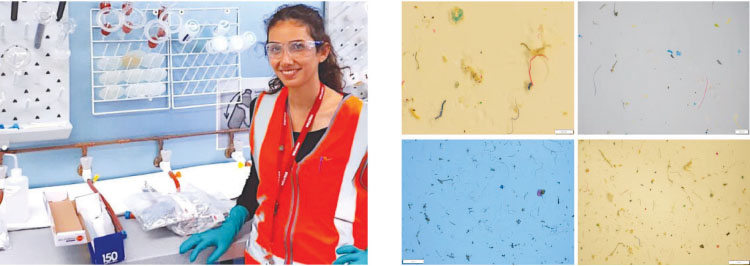
    Dr Shima Ziajahromi, an Advance Queensland Research Fellow and lecturer at Australian Rivers Institute, Griffith University, led the study that found microplastics in biosolids, as seen under microscope in these images (RIGHT).

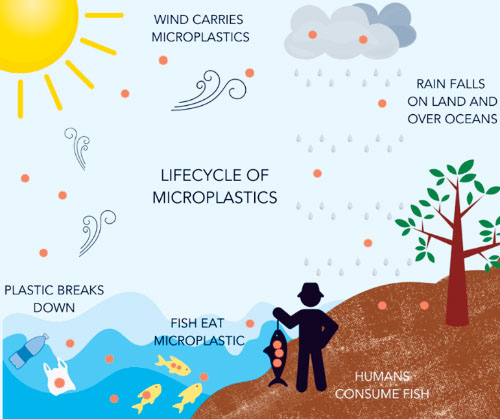
    Microplastics get into wastewater via clothing, food containers, and cosmetics washed down through sinks and showers. Because these tiny contaminants do not degrade easily, they have the potential to leach into our soil, which is then consumed by plants and animals and passed down the food chain to humans. 

    The lack of chemical regulation in Australia is a huge problem, with less than 0.3% of the thousands of chemicals produced daily having regulatory oversight. The call has now gone out to examine Australia’s growing organic farming industry and the need for tighter regulations to protect consumers and farmers who may have used contaminants “by accident” and not with harmful intent. Organic foods Australians consume may not be as healthy as claimed if treated with biosolids filled with microplastics, and consumers deserve to know this.

    The Griffith University study was conducted over multiple seasons using a purification method to accurately identify and quantify microplastics (MPs) from complex samples. It revealed that every Australian releases between 0.7 and 2.1g of MPs into wastewater every year, with New South Wales ranking the lowest and South Australia ranking the highest per capita for concentration of MPs.

    Current Australian regulations control the amount of heavy metals, nutrients, pathogens, and some emerging contaminants allowed in biosolids, but Dr Ziajahromi said there was currently no guideline for microplastics concentrations.

    These findings “underscored the urgent need for a greater understanding of the risks of MPs in biosolids to our agricultural soils as they can accumulate in soils and breakdown into smaller micro and nano-sized particles which can cause more harmful effects to our soil ecosystem.”

    The use of plastics expanded after World War 1 and exploded in the 1970s. According to 2022 OECD data, 460 million metric tonnes of plastic is produced worldwide every year – and growing.

    We now move to other recent reports about microplastic contamination and the price society and the planet are now paying for this love affair with industrial synthetics. 

    A Bite of Plastic

    A BBC report by Isabelle Gerretsen discusses how microplastics have already infiltrated our food. Plastic pollution, she writes, is “one of the defining legacies of our modern way of life, but it is now so widespread it is even finding its way into fruit and vegetables as they grow.”

    MPs are everywhere: buried in the Antarctic sea ice, in the guts of marine animals, in wastewater and drinking water around the world – even on the beaches of the most remote and uninhabited islands. 

    “One study estimated that there are around 24.4 trillion fragments of microplastics in the upper regions of the world’s oceans,” notes Gerretsen. Microplastics then get into the food we eat. “Unwittingly, we may be consuming tiny fragments of plastic with almost every bite we take.”

    A 2022 study by the Environmental Working Group found that sewage sludge had contaminated approximately 20 million acres of US cropland alone. These contaminants are plastic-based “forever chemicals” that do not break down under normal environmental conditions. Europe doesn’t fare any better, as the study showed an estimated 8-10 million tons of sewage sludge produced in Europe each year, with about 40% used on farmlands, which means, according to another study by Cardiff University, between 86 trillion to 710 trillion MP particles could be contaminating European farmland annually.

    Another report by the UK’s Environment Agency showed that sewage waste destined for English farmland was contaminated with pollutants, including dioxins and polycyclic aromatic hydrocarbons at levels that may risk human health. 

    According to a 2020 experiment done by Kansas University agronomist Mary Beth Kirkham, plastic can serve as a vector for plant uptake of toxic chemicals such as cadmium. “In the plants where cadmium was in the soil with plastic, the wheat leaves had much, much more cadmium than the plants that grew without plastic in the soil.”

    We might expect MP contaminants in large, industrialised farms and in the food we buy at big supermarkets but they have also been detected in fruits and vegetables sold by local street sellers in Sicily, Italy. Apples appeared to be the most contaminated fruit, with carrots having the highest levels of MPs among vegetable samples. Analysis revealed that the plastics accumulated in the plant roots, meaning that root vegetables such as carrots, turnips, and radishes have more microplastics when consumed.

    Even when soil is not as highly contaminated, these persistent chemicals will continue to accumulate until they become a real risk to human health. Numerous studies already show strong negative impacts of microplastics on human health, causing cell damage, infertility, heart disease, cancers, disruptions to the endocrine and thyroid systems, autoimmune disorders, and poor foetal development. 

    The toxicological impact of MPs is not a conspiracy theory. Solid research abounds, but industry regulators either won’t address this or can’t keep up with the damage already done. One researcher, Willie Peijnenburg, told BBC that, “It will take decades before plastics are fully removed from the environment.”

    Sewage Sludge

    The Netherlands banned spreading sewage sludge in 1995 and instead exported it to the UK, where it was used as farm fertiliser. Switzerland banned using sewage sludge as fertiliser in 2003 after finding harmful substances and pathogens. In the US, Maine banned the practice in 2023. 

    Biosolids from sludge lagoons in South Australia. Image: SA Water.

    However, some people see a total ban on using sewage sludge or biosolids for fertiliser as problematic because the alternative might be even more detrimental to the environment. Instead, there needs to be more research and development into ways of managing the plastic contaminants found in existing biosolids, and there are many great ideas on how to do that if industry cooperates across the board. Countries like Greece and Italy dispose of their sludge in landfill sites but admit that MPs leaching into surrounding lands is still possible.

    There are benefits to the use of “municipal biosolids,” which are produced at wastewater treatment plants by the process of settling and stabilising the solid fraction of the municipal wastewater inflow. According to an article in The Conversation, “How microplastics are making their way into our farmland,” municipal biosolids improve agricultural farmland soil because they are rich in nutrients to assist plant growth. Canada carefully regulates their municipal biosolid applications for everything but microplastics. Although wastewater treatment plants are efficient at removing up to 90% of MPs, the removed MPs have to end up somewhere, which is in the concentrated, settled sludge that becomes the biosolids then used to fertilise crops. 

    “Wastewater treatment plants are well-equipped to remove large plastics like bottle caps and plastic bags from municipal wastewater. However, microplastic particles are so small they can’t be caught by current treatment infrastructure, so they end up concentrating in wastewater sludge,” the article states. 

    Proposed solutions often involve decreasing the overall use of plastic products, especially single-use plastics like water bottles, which could help minimise the amount of plastic breakdown that gets into wastewater streams and/or into our soil via landfills. New technologies that could be built directly into wastewater treatment facilities could also filter out microplastics through chemical or physical means, although one might again wonder what happens to the stuff that’s filtered out.

    An Unavoidable Risk?

    The authors of an extensive study, Microplastic Sources, Fate and Solution, say plastic mulch waste is a growing problem that poses challenges for abatement. 

    “Residues from plastics and plastic elements used in agriculture for crop protection can harm the environment after use if not properly managed, as over time and with exposure to the sun, plastic decomposes into smaller particles that are absorbed by the soil, transported by water or wind, and also ingested by vertebrate and invertebrate animals.” 

    The study points out that “Mulch film is creating a major environmental problem that is of concern to sector and public administrations. Plastics elimination is both laborious and costly because it is a material composed mainly of low-density polyethylene (LPDE) and takes a long time to biodegrade. It is also often heavily contaminated with soil and plant residues, making it difficult to recycle.” 

    Plastic mulch film used for numerous crops is a major source of MP contamination. 

    Farmers use plastic mulch film on numerous crops during the growing season. However, there are no consistently accessible mechanisms for sustainably disposing of plastic mulch film at the end of its life. 

    According to an article for Modern Farmer, “The use of plastic in agriculture, known as ‘plasticulture’, is expansive. The United States agriculture sector uses one billion pounds of plastic mulch every year. When it comes to disposal, the vast majority of this film gets taken to the landfill or is buried or incinerated.”

    “We always talk about this on the student farm – it’s kind of like the dirty secret of organic agriculture and agriculture in general, is just the amount of waste – the amount of single-use plastic,” agricultural teacher Katherine Myrvold told Modern Farmer. “So, that’s something that we’re very open to finding an alternative to.”

    Ocean Contamination

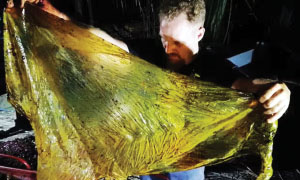
    Darrell Blatchley pulling plastic out of a Cuvier’s Beaked Whale.

    MP contamination of the oceans not only impacts the ocean environment itself, but compromises food safety and security and, ultimately, collective human health. MPs are changing the gut microbiomes of seabirds according to a University of Trento, Italy study led by Gloria Fackelmann. She and her colleagues sampled gut microbiomes from two gull-like species in the North Atlantic Ocean. They found high levels of MPs, which makes sense since the world’s oceans have become dumping grounds for plastic waste.

    According to Fackelmann, these pollutants congregate in marine environments and are consumed by marine birds, mammals, and fish. Marine biologist Darrell Blatchley found an astonishing 40 kilos of plastic in the gut of a Cuvier’s Beaked Whale that died along the shores of the Philippines. Researchers in Britain found MPs in the guts of over 50 marine animals representing 10 different species.

    Spermageddon

    For decades, scientists have grappled with the true cause of declining fertility in human populations. The sad reality is that microplastics – which are made up of toxic chemicals – could be directly responsible.

    MPs have been called a “significant” potential cause of male infertility, a study published by the US National Library of Medicine says.

    A May 2024 study published in Toxicological Sciences found MPs in every human testicle examined, pointing to “potential consequences on male fertility,” according to the authors.

    Polyethylene – the type of plastic used in bags and bottles – was the most common type of plastic found, followed by PVC.

    “PVC can release a lot of chemicals that interfere with spermatogenesis and it contains chemicals that cause endocrine disruption,” University of New Mexico professor Xiaozhong Yu, one of the study’s co-authors, told The Guardian.

    “At the beginning, I doubted whether microplastics could penetrate the reproductive system,” Yu told the outlet. “When I first received the results for dogs I was surprised. I was even more surprised when I received the results for humans.”

    The human testicle samples had nearly three times the amount of MPs as the canine samples. The samples were taken in 2016 from men ranging in age from 16 to 88 – and since time has passed, Yu told The Guardian, “The impact on the younger generation might be more concerning” now, given the proliferation of plastic pollution.

    Another study published in Environmental Science and Technology Letters showed disturbing amounts of plastic found in baby poop, with evidence showing a higher presence of polyethylene terephthalate in the faeces of infants than in adults. It was even found in the first stool taken from newborn babies. As infants grow, they are exposed to even more plastics via baby bottles.

    It would appear no life form can escape this onslaught. Tested samples from remote regions of the Amazon rainforest suggest that plastic pollution travels in atmospheric particles over long distances. There is no such thing as “a pristine zone” on the planet. 

    A 2023 Newsweek article by Pandora Dewan, “‘Plastic Rainfall’ Contaminating Nearly Everything People Eat and Drink,” explained that 50-75 trillion pieces of microplastics are found in the world’s oceans, many of which end up in our food and waterways.

    “With so many of these tiny particles in the ocean, it is perhaps unsurprising that some have been drawn up into the atmosphere. However, their presence in high altitude environments has been largely unstudied – until now.”

    Dewan cited a study published in Environmental Chemistry Letters by researchers from Waseda University, Japan. The researchers analysed cloud water from the summits of Mount Fuji and Mount Oyama to investigate whether MPs were found at such high altitudes. 

    Indeed, that was the case. They were highly fragmented but contained molecules that could bond with water, “suggesting they may play a role in cloud formation, acting as the seed at the centre of the cloud around which water vapour can condense.” The scientific name for this is “cloud condensation nucleus,” and it has the potential, according to the study, to influence global weather patterns.

    “Microplastics in the free troposphere are transported and contribute to global pollution,” according to lead researcher Hiroshi Okochi. “If the issue of ‘plastic air pollution’ is not addressed proactively, climate change and ecological risks may become a reality, causing irreversible and serious environmental damage in the future.”

    Get the issue this article appears in

    Human Cyborgs & Plastic People

    Though there are solutions on the table, it could be years, if not decades, before a viable way to decrease MP exposure becomes a reality. In the meantime, people must do what they can to reduce plastic consumption in their own lives: use quality filters for tap water instead of buying cases of plastic bottled water, seek out local farms that use manure-based fertilisers, research products from salt to clothing to cosmetics that have been tested for MP levels, and vote for policies and programs that take this threat seriously.

    Researchers at Columbia and Rutgers universities found that the average litre of bottled water has nearly a quarter million invisible pieces of nanoplastics.

    Still, it may be too late. According to a new documentary titled “We’re All Plastic People Now,” we may have reached the tipping point of becoming “human cyborgs.” Produced and directed by Rory Fielding, the documentary looks at the devastating impact on marine life from MPs and dives into how plastic pollution is harming human life. Researcher David A. Davis, PhD from the University of Miami, states in the film, “Water is life, so if the water is polluted and we have sentinel species like dolphins and sea turtles, if they’re also sick, we can anticipate that we’ll be sick, too.” 

    Dr Antonio Ragusa refers to humans as “cyborgs” because the human body is no longer purely biological and has become part plastic. 

    “When I saw for the first time microplastics in the placenta, I was astonished,” said Dr Ragusa, who is Director of the Department of Obstetrics and Gynecology at San Giovanni Calibita Fatebenefratelli Hospital, Rome, Italy. “It is like having a cyborg baby, no longer composed only of human cells, but a mixture of biological and inorganic entities.” 

    Producer/director Fielding had four generations of his family’s blood tested for plastic-derived chemicals. The blood was sent to Rolf Halden, PhD, an environmental engineer at Arizona State University, who found Fielding and his family carried over 80 different chemicals in their bodies. 

    “What we detected in the blood of all these participants are precursors of plastics, plastic constituents themselves, as well as degradation products of consumer plastics. These chemicals are known to be carcinogens, endocrine-disrupting chemicals, obesogens, and neurodegenerative agents.”

    Halden emphasised the implications of decreasing sperm counts and loss of fertility, and that “we could be playing with the future of humanity.” Dr Ragusa echoed this concern: “Plastics can be the future for big oil companies. But not for us, not for humanity. For humanity, plastic is the end of the future.”

    An Inconvenient Truth

    Plastic is all about convenience, making our lives easier in many ways, but that convenience has now become a dire threat to our health – maybe even our survival. People in Australia have had no clue that the organic produce they buy is contaminated with tiny bits of plastic. Knowledge is power, and the people must take back their power and demand change because industry will rarely, if ever, change on its own unless ample profit is involved.

    [alert type=”general” dismiss=”no”]This article was published in New Dawn 205.[/alert]

    [alert type=”success” dismiss=”no”]If you appreciate this article, please consider subscribing to help maintain this website.[/alert]

    Sources

    skynews.com.au/australia-news/fears-for-australias-agricultural-industry-as-concerning-study-finds-large-amount-of-microplastics-in-organic-fertiliser-and-soil/news-story/ac446c5d8c02d78bbb22ac7cf988f707
    news.griffith.edu.au/2024/02/21/biosolids-containing-microplastics-used-on-farm-lands/
    bbc.com/future/article/20230103-how-plastic-is-getting-into-our-food
    Khan, Anish, Chongqing Wang, Abdullah M. Asiri, Editors. Microplastics Sources, Fate and Solution, Springer Nature Singapore, 2023.
    nature.com/articles/s41591-024-02968-x
    ncbi.nlm.nih.gov/pmc/articles/PMC9134445/
    newscientist.com/article/2366045-microplastics-are-changing-the-gut-microbiomes-of-seabirds/
    modernfarmer.com/2023/08/plastic-mulch-is-problematic/
    newsweek.com/microplastics-found-clouds-1830714
    articles.mercola.com/sites/articles/archive/2023/07/27/microplastic-particles-in-human-stool-samples.aspx
    articles.mercola.com/sites/articles/archive/2024/05/25/plastic-people.aspx
    theconversation.com/how-microplastics-are-making-their-way-into-our-farmland-208346 
    theguardian.com/environment/article/2024/may/20/microplastics-human-testicles-study-sperm-counts
    academic.oup.com/toxsci/advance-article-abstract/doi/10.1093/toxsci/kfae060/7673133

    © New Dawn Magazine and the respective author.
    For our reproduction notice, click here.

  • Unidentified Spectres: How Suppressed Secrets are Used as Paranormal Control Mechanisms

    Unidentified Spectres: How Suppressed Secrets are Used as Paranormal Control Mechanisms

    From New Dawn Special Issue Vol 17 No 4 (Aug 2023)

    What could paranormal phenomena control? I suggest that it is human belief that is being controlled and conditioned.
    – Jacques Vallee

    The human mind does not operate within a unified wholeness but rather through the fragments of a piecemeal story. These fragments are constantly rearranged to tell a different story according to the dominant narrative. The arrangement of these fragments of storytelling form part of the generally unknown or suppressed mechanisms and processes of the deliberate management and conditioning of human consciousness. One of these lucrative sites of targeting is through the medium of the paranormal; this is also a secret realm of the infliction of trauma upon the individual and collective mind.

    In past eras, this has been maintained through narratives of myth, legend, mystic-themed paradigms, occultism, and the sustained secrecy of certain ‘secret societies’.

    The thoughts, beliefs, and opinions that were ‘available for use’ within the social collective of the masses have always been limited by regulation. For such a long time, information came from localised sources and was heavily governed by those same sources.

    However, as the general level of conscious awareness rises, the control systems also become more complex and sophisticated. Not only do such conditioning mechanisms operate through well-known social-cultural institutions – education, politics, law, the media, and many more (as have been well-documented) – they also work more stealthily through paranormal phenomena.

    Jacques Vallee

    As the author, scientist and paranormal investigator Jacques Vallee stated: “I propose the hypothesis that there is a control system for human consciousness… Human life is ruled by imagination and myth. These obey strict laws and they, too, are governed by control systems… What could paranormal phenomena control? I suggest that it is human belief that is being controlled and conditioned.”1

    Over an extended period of time, new mythologies are formed and planted into mass human consciousness, functioning as conductors controlling human beliefs, ideas and ideals – which then develop into ideologies. These modulating factors then gain a controlling influence over the relationship between human consciousness and physical reality.

    Such mechanisms have been in force throughout a great span of human history and operate to manipulate human minds by sources largely external to us. These are deliberate attempts to diminish our sense of reality, making people more suggestible and open for programming and creating a psychic numbness that restricts the range of human perception.

    Recently, such programming has been applied to paranormal, metaphysical, and spiritual phenomena and experiences.

    Socio-Spiritual Engineering

    Socio-spiritual engineering can be regarded as a form of ‘culture-making’ prevalent throughout many cultural events and iconic movements. Some of these strategies were developed and implemented through high-level institutes establishing themselves as credible social enterprises (such as the Tavistock Institute in the UK).

    The structures that uphold physical reality (including belief structures) are diametrically positioned against phenomena that may substantiate a spiritual or metaphysical reality. That is, the tangibility of the physical domain and the intangibility of the metaphysical realm are not only placed in opposition, but their potentials are fragmented. This once clandestine method operates so that phenomena and events are orchestrated to break down the wholeness or credibility of each realm. In this, the ‘unidentified spectre’ plays the perfect role.

    Mysterious or so-called unexplained phenomena act as a direct challenge to the established consensus reality or narrative. Consensus reality is the ultimate secret society, with most people unaware of its existence or that they have been inducted as members. To introduce rapid programming and psychological fluctuations into the mass mind, it is best to maintain a series of ‘anomalies’ within the system that can be utilised to create episodes of fragmentation and disassociation. This is when spectres are brought out from behind the veil.

    Mystification has long been a highly effective weapon of psychological warfare. Such elements have also played into the creation of myths as a form of social engineering. Social myths and mystification can be used as channels for the directing of, and influence of, the human psyche and psychic energies. Manipulated and/or controlled events have the power to affect and influence both the conscious and the unconscious mind.

    This can be utilised to create a split between what we are told to believe through our conditioning and what may be experienced in the metaphysical realm. This discrepancy can create a rift in the human psyche and fragment our ‘sense of reality’, which can then sow the seeds of psychological imbalance.

    Paranormal phenomena can be exploited to create an ambiguity that produces a state of ‘deferred closure’. That is, because the conditioned rational mind cannot create a closure (i.e., there is no ultimate solution), this creates dissonance. This dissonance is further reinforced through the dissemination and circulation of alternative and differing answers that, while promising to satisfy, end up confusing the human mind by not allowing a consistent view of reality. This produces a state of ‘closure-starvation’ that will likely persuade a person to accept an explanation offering closure relief.

    This procedure of mind programming and manipulation utilises aspects of the ‘secret’ and the ‘suppressed’ to create further programs within consensus reality. The medium of psycho-spiritual phenomena allows conditioning to be implanted more deeply and directly, bypassing much of the conscious mind. In this way, methods of psychological splintering and trauma can be employed. The fact that such implanting can occur with relatively no knowledge or awareness of it shows how little we know about the psychic world of the human being.

    In recent years there has been a significant shift in people’s belief patterns regarding the concept of the paranormal. The external layering of the dominant consensus reality works upon the meta-logical level and seeks to program the conscious mind of the individual and the collective. Yet the subconscious (collective) mind is influenced more upon the metaphysical level (as was well known to Carl Jung). And in this space, many of our mythological structures have been changing and/or reprogrammed – especially by introducing various psychic phenomena.

    Life experience in consensus reality is often programmed through ritual, the intentional design and correspondences of symbols, words, and coordinated actions. It is ceremonial action performed according to a prescribed order. Humanity, for the most part, is immersed within a medium of ritual. Rituals are manipulated practices to obtain a defined outcome. The spectres and spooks that keep popping up in our cultures most likely represent the agents of subterfuge and deception.

    Through socio-spiritual engineering, it becomes increasingly difficult to distinguish between the imaginary, the deception, the quasi-reality, and the lesser reality, as people’s reality tunnels are continuously manipulated. Without most people’s awareness, fragmentation and splintering of the human psyche is in effect. What is often perceived as one’s general reality is actually a controlled environment fragmented and stitched together through narratives, stories, and conditioning programs that serve to exert a metaphysical uncertainty and imbalance within many unsuspecting minds.

    Paranormal phenomena, such as the UFO spectacle of the last seventy years or so, allow the more transcendental part of the human psyche to intervene and ‘rescue’ us from mundane reality by ‘abducting’ us into its realm. This realm is real enough, albeit a dissociated one. In this way, certain paranormal and/or psycho-spiritual encounters and experiences – whether ‘real’ or not – may serve as a form of initiation into a type of social trauma. This trauma acts on a subtle level, integrating itself into the socio-cultural psyche in a way that splinters the wholeness of the collective mind without pushing it beyond the bounds of social functionality. In this way, says Jasun Horsley, UFO encounters and alien abduction experiences “may be a way for some of us to allow such traumatic material into our awareness in a more ‘magical’ (transcendental) guise.”2

    Voices of authority, such as national governments, have been heavily involved in manipulating how psychic phenomena are presented to the public, especially regarding UFOs. For their part, they have been officially denying its existence while at the same time covertly leaking stories confirming that UFOs do exist. This form of ‘subliminal contradiction technique’ has massively increased in the last few years as many top-level sources, including the Pentagon, have gone on record to disclose UFO activity.

    Jasun Horsley

    Further, in what can be seen as another form of cognitive programming, the United States authorities have begun to refer to UFO phenomena as Unidentified Aerial Phenomena (UAP) in an attempt to control the new phase of the narrative. These forms of ongoing denial, followed by bouts of official or ‘unofficially leaked’ disclosure of suppressed secrets, create a subconscious contradiction that establishes an extreme form of cognitive dissonance within the public mindset. This ongoing inconsistency between two beliefs does not resolve but solidifies uncertainty and dissonance through well-placed subliminal contradictions.

    When a subliminal contradiction is accepted without initial resistance, the critical faculty is deactivated, leaving the mind vulnerable and receptive to suggestion. If, at any later point, an official admission claims to give the ‘official version’ of UFO events, then the general public is more likely to accept it with the relief that an answer has finally been found. This ‘relief’ comes as a ‘resolution response’ within the programmed mind.

    UFO phenomena is slyly blended here with psychic, paranormal, and metaphysical aspects to colonise and reprogram the ‘spiritual’ domain. These are cunning manoeuvres as many people tend to confuse psychic experience with spiritual attainment. The tendency to willingly indulge in certain psychic or paranormal experiences may work to strengthen false spiritual programming rather than strengthen the inner self.

    There is a great need and/or longing within the human condition to access non-visible realms, transcendental states, and similar experiences. This longing, or need, can be a weakness if a person does not show discernment. Belief and imagination can easily be flipped into ideology, insecurity, and doubt.

    In recent years, especially, there has been a dramatic rise in insecurity alongside paranormal and psycho-spiritual activity. This is the perfect recipe for splintering the collective psyche and exercising subtle programs of conscious and unconscious trauma.

    A Traumatised Reality

    Modern societies tend to go through a form of psychological reorganisation of the social system, now and again, which acts as a form of recalibration to keep the social realm from settling down too much.

    Whether we are aware of it or not, trauma has always been incorporated into the ‘norm’ in human society, from medical birthing procedures, random acts of violence, institutionalised madness, authoritarian fear strategies, population indoctrinations, religious-cult programming, conditioned education, and more. All these elements combine to create variations upon a divided consciousness. Carl Jung referred to this state as dissociation which acts as a polarising force against psychic integration.

    The human psyche is already fragile and hence vulnerable to further triggers toward dissociation. It is suggested that these triggers have been arriving through paranormal experiences; the top of the list is the ‘extra-terrestrial issue’ and UFO phenomena.

    This is significant given that there has been a recent increase in UFO-related material within mainstream media. Once regarded as a subject of mainstream ridicule or avoidance, major news outlets (in the US especially) have been carrying reports about ‘credible’ verified sightings. There is speculation that this sudden rise in mainstream reporting (orchestrated through intelligence agencies) belongs to an engineered propaganda operation for preparing the collective mindset for a new ‘paranormal narrative’. That is, another ‘reality-tunnel’ is being constructed for mass release.

    For a long time, the subject of ‘aliens’ belonged to a historical lineage of phenomena that included fairies, ‘little people’, nature spirits, djinns, demons, etc. Jungian psychoanalyst Donald Kalsched notes that the word ‘daimonic’ comes from daiomai, which means to divide, and that it originally referred to moments of divided consciousness. Kalsched studied trauma in relation to mytho-poetic manifestations and psycho-spiritual development. Triggers from the mytho-spiritual realm, which includes paranormal experience, can cause a fragmentation of the consciousness (especially in less-grounded individuals). In this case, the external event fuses with a person’s inner psychological state. As Kalsched notes: “The full pathological effect of trauma requires an outer event and a psychological factor. Outer trauma alone doesn’t split the psyche. An inner psychological agency – occasioned by the trauma – does the splitting.”3 Jung referred to these states as ‘splinter-psyches’ where one of the splinter complexes, after the initial trauma, attempts to protect the regressed part like a guardian. This may prevent further psychic integration as the psyche cannot fully integrate or process the experience. The person may try to re-enact or regain the traumatic experience as a way of gaining closure. This may explain some of the obsessive behaviour of paranormal experiencers after the event to keep searching for repeat experiences.

    The nefarious agenda of psycho-spiritual programming through metaphysical events is that these ‘inhibited programs’ bypass the conscious mind almost immediately and attach themselves to the parts of the subconscious. That is, the programming bypasses the usual gatekeepers of our minds. Once these mechanisms are in place, they can then be activated whenever there is a need to trigger a part of the collective psyche.

    The UFO phenomenon has been gradually sown into our cultural soils for at least the past seven or eight decades. At the same time, the seeds of trauma have scattered throughout various extra-terrestrial contact experiences. It is possible that the ‘alien question’ has been developed as a form of programming to mimic spiritual realities on the psycho-physical level and so prepare the way for something even more traumatic.

    The French mystic-philosopher Rene Guenon wrote several books warning that increased materialism and physical trappings will lead to a “solidification of the world,” resulting in “fissures” opening up through which “infra-psychic” forces can enter.4 These forces, amongst others, impact the human psychosphere and rewire our internal programming.

    There may indeed be some physical brain rewiring going on. As infamous UFO contactee Whitley Streiber says: “If you actually wanted people to increase the use of the right brain, then stressing them would be a way to do it. If you apply trauma in the right way, what you are actually doing is reengineering the brain.”5

    Get the issue this article appears in

    The unidentified spectres presented to us as ‘suppressed secrets’ may trigger an expansion of consciousness and be a vehicle for traumatic brain programming. Jasun Horsley questions whether splitting the human psyche could be a way of allowing or letting through certain ‘hostile forces’ that may be a part of the shadow psyche. These shadows might then be materialised, or at least experienced, by the psyche as material phenomena.6

    Letting through these unidentified spectres may be just some of the secret programs operating to splinter the collective human psyche and steer it further away from psychic integration and wholeness.

    Interestingly, much of metaphysical phenomena is classed as part of the ‘new paradigm’ and suchlike, as if these elements are part of a new reality consciousness. And yet the very notion of paradigms – and hence, the concept of a ‘new paradigm’ – is an alternative emergence from within existing structures.

    As such, metaphysical phenomena and experiences may serve to deceive if they are utilised for simply rearranging the pre-existing furniture of our minds rather than breaking out of these programmed reality-boxes. This deception causes people to believe it is a ‘new reality’ when in fact it is yet another layer within the multi-faceted Matrix.

    Another aspect to consider is that metaphysical experiences tend to take the experiencer away from their bodily presence. As the metaphysical and paranormal threads become increasingly woven into the mainstream narrative, we may be witnessing a new programmed reality unfolding that requires a subconscious rejection of the body.

    Is the controlling program now intent on rejecting the bodily-physical as part of the rising human-machine narrative? In this, and so much more, we must apply our perceptive awareness and discernment as never before. The Game is On. 

    For more on this subject, check out the author’s book The Inversion: How We Have Been Tricked into a False Reality, available from all good booksotres.

    [alert type=”general” dismiss=”no”]This article was published in New Dawn Special Issue Vol 17 No 4.[/alert]

    [alert type=”success” dismiss=”no”]If you appreciate this article, please consider subscribing to help maintain this website.[/alert]

    Footnotes

    1. Vallee, Jacques (2015), The Invisible College: What a Group of Scientists Has Discovered About UFO Influences on the Human Race, Anomalist Books, 199
    2. Horsley, J. (2018), Prisoner of Infinity: UFOs, Social Engineering, and the Psychology of Fragmentation, Aeon Books, 135
    3. Kalsched, Donald (1996), The Inner World of Trauma: Archetypal Defences of the Personal Spirit, Routledge, 14
    4. See Guenon’s The Crisis of the Modern World, and The Reign of Quantity and the Signs of the Times
    5. Cited in Horsley, Prisoner of Infinity, 104
    6. Horsley, Prisoner of Infinity, 223

    © New Dawn Magazine and the respective author.
    For our reproduction notice, click here.

  • Freemasons from Outer Space!

    Freemasons from Outer Space!

    From New Dawn Special Issue Vol 18 No 5 (Oct 2024)

    My interest in the connection between Freemasonry and extraterrestrial encounters dates back to February 17, 1998, when I had a rather vivid and peculiar dream involving a Masonic Lodge, the very same Lodge in which I would eventually be initiated. I should point out that this dream preceded my initiation into Freemasonry by about four years. In fact, when the dream occurred I had no interest in joining Freemasonry or any other fraternal organisation. My knowledge of Freemasonry was limited to a select number of books I had read on the subject while in college and very little else.

    This was the dream:

    I walk into the Masonic Lodge on Cabrillo Avenue in Torrance, a building I have never before entered. I find myself sitting in a waiting room that contains a lot of empty wooden chairs. I look up at the walls. I see a very realistic painting depicting the face of a white owl. I glance back at the empty chairs, then turn to look once more at the painting. Now the white owl has changed. Its face has merged seamlessly with the attributes of an owl and that of an alien Gray as seen on the cover of Whitley Strieber’s 1987 book, Communion. (In 2015 a UFOlogist named Mike Clelland published a book called The Messengers: Owls, Synchronicity and the UFO Abductee, in which Clelland reports that many abductees often first see their abductors in the form of owls, but in 1998 I had no knowledge that anyone believed owls and extraterrestrials were in any way connected.)

    In the dream I am not surprised by this shift. I simply continue staring at the empty chairs. After a while, I glance back at the painting. Now the owl is gone, and the impassive face of a Gray alien has taken its place. At this point, I rise from that uncomfortable little chair in the waiting room, stroll into the hall, and approach a pair of ornate wooden doors above which are carved the words: MASONIC RESEARCH CENTER. I push the doors open and see a vast library of old, rare books on the other side. I very much want to begin reading them all. One particular volume stands out at the bottom of the shelf. I pull out the hefty tome and lift it. In the dim light the title on the cover is unusually clear and is rendered in gothic, golden lettering: THE FREEMASONS & THE GUFFEY CLAN THROUGH THE AGES.

    A  photograph of Robert Guffey taken in July of 2003 only a few hours after he underwent the third degree of Freemasonry. (Author’s note: “Given the subject matter of this article, it’s weirdly appropriate that I’m standing in front of a painting of a white owl. This was not done on purpose. In fact, I didn’t even recall the presence of the owl in the image until I decided to dig up the photo in order to scan it for use in this article.”)

    I don’t get a chance to read the book or even open it. Suddenly, I notice that strange, surreal creatures are wandering around in the musty, dust-speckled aisles. They weave in and out of the crowds of normal-looking humans (all of them elderly men) who are standing in the stacks looking at old books as well. The creatures appear to have emerged from a surrealist painting by the likes of a Max Ernst or a Remedios Varo, some mad visionary with a bent imagination. The creatures become aware of my presence and begin to hone in on me. So I put the book back on the shelf and run.

    I find a staircase and traverse the steps two at a time. I pass the second floor, then the third floor (even though the Masonic Lodge in Torrance only has two floors). I press my palms against a metal door and emerge onto the roof. It’s nighttime. To my surprise, there’s a helipad on the roof. A helicopter, its blades spinning faster and faster, is waiting for me. For a moment I think I’ve escaped the angry creatures in the library. I start moving towards the helicopter, then pause abruptly. An eyeless stone dog stands between me and the helicopter. It’s motionless. I know it doesn’t want me to pass. Its grey, craggy, stone flesh morphs into real skin. The dog (a greyhound) turns bright red. Then it moves towards me, its crimson eyes growing larger and larger. I turn away from the hound and begin to clamber over the side of the roof. Fortunately, in the complete darkness, my palms discover thick hemp ropes down which I climb to the sidewalk below. I’m confident I’ve escaped… and then I wake up.

    This oddly detailed dream, which I jotted down as soon as I awoke, places a picture of an alien in a Masonic antechamber, but the alien’s face is hidden behind a seemingly innocuous portrait that one might find in a waiting room in any doctor’s office in America.

    Seventeen years after this unusual dream, during the summer of 2015, I spent several days camping in San Simeon, not far from Hearst Castle and Piedras Blancas. Hearst Castle, of course, was built by William Randolph Hearst, the main inspiration for Orson Welles’ Citizen Kane (1941), considered by numerous film scholars to be the greatest film ever made. Piedras Blancas was the site of the infamous B-flick, The Monster of Piedras Blancas (1958), which is all about a cryptozoological reptilian beastie that regularly emerges from the Pacific Ocean to behead the locals and feast on their remains when he’s not trying to abduct the lighthouse keeper’s nubile young daughter.

    Perhaps it was the polar opposite extremes of these two cinematic influences that determined my equally schizophrenic reading material for this particular camping trip: Journey to the East by Herman Hesse, an acknowledged classic of Western literature redolent with extremely sophisticated esoteric symbolism, and Flying Saucer Occupants by Coral and Jim Lorenzen, which would appear to the casual observer to be little more than a lurid paperback collecting dubious claims of encounters with alien beings. Indeed, the front cover bears certain similarities to the layouts of supermarket tabloids like the late, lamented Weekly World News: a sensationalistic black and white photo depicting a glowing flying saucer hovering behind an electrical tower is juxtaposed with carnival-barker-style come-ons emblazoned in bold, orange letters:

    In July of 1967, when this book was published, most reasonable people glancing at this cover at their local bookstore or newsstand would have immediately dismissed the contents of the book as outlandish trash, not worthy of their time or attention. How many literature professors, intimately familiar with the complex symbolism woven into Herman Hesse’s well-respected novel, would ever have deigned to open a copy of the Lorenzens’ book for even a few seconds? And yet, if this hypothetical literature professor had done so, he or she might have been pleasantly surprised to discover significant overlaps between the two works.

    Hesse’s Journey to the East is steeped in hermetic, Masonic, kabbalistic, and alchemical symbolism. The book is a phantasmagorical allegory about an initiate (a young man named H.H.) in an ages-old secret society known as “The League.” Hesse employs layers upon layers of symbolism to chronicle the man’s physical and psychic journey from ignorance to illumination. Because I’m a 32nd Degree Scottish Rite Freemason, it was not difficult for me to recognise the numerous Masonic symbols embedded in Hesse’s novel. There’s no doubt in my mind that Hesse was a Freemason himself.

    What did surprise me, however, is that such symbolism can also be found in the Lorenzens’ book about alien encounters – though I suspect the Lorenzens were not aware of this symbolism themselves. Such symbolism is not present throughout the book. Indeed, it appears only in a single chapter, Chapter Three, entitled “Report on the Villas-Boas Incident.”

    The main feature of this chapter is an extensive scientific report regarding the first alien abduction investigation in modern history, now generally known as “the Villas-Boas Incident.” The report was written in 1958 by Dr. Olavo Fontes, at the time a Professor of Medicine at the National School of Medicine of Brazil, and a journalist named Joao Martins. The Antonio Villas-Boas case predates the far more famous 1961 Betty and Barney Hill abduction, the subject of a bestselling book entitled The Interrupted Journey by John G. Fuller. Fuller’s book became the basis for Richard A. Colla’s 1975 made-for-TV-movie The UFO Incident starring James Earl Jones and Estelle Parsons. The Villas-Boas case never quite received the same amount of attention as the Hill abduction, perhaps because it did not occur in the United States.

    Villas-Boas was a twenty-three-year-old Brazilian farmer whose life abruptly turned upside down at 1:00 A.M. on Wednesday, October 16, 1957, when a metallic, oval-shaped object descended from the sky and landed in the very same soil Villas-Boas was in the process of tilling with the help of his family’s tractor. Nonhumans emerged from the craft, abducted Villas-Boas, and dragged him into the ship where they took blood samples from his chin, then forced him to have sex (twice) with a nude, humanoid blonde who certainly did not appear to be from Earth.

    As I read the details of this encounter, I recalled a passage from Dr. Jacques Vallee’s 1988 book Dimensions: A Casebook of Alien Contact, in which Vallee commented that many of the most confusing and absurd details associated with the testimonies of alien contactees sometimes reminded him of the seemingly inexplicable initiation rites practised by secret societies throughout the ages:

    Is this confusion technique deliberately used to effect change on a major scale? Answering such questions could also help us to understand the strong resemblance that anyone who has examined the beliefs of esoteric groups could not fail to note between certain UFO encounters and the initiation rituals of secret societies. This “opening of the mind” to a new set of symbols that is reported by many witnesses is precisely what the various occult traditions also try to achieve.

    Antonio Villas-Boas was a twenty-three-year-old Brazilian farmer whose life abruptly turned upside down in 1957 when he was abducted by strange beings and forced to have sex with a humanoid blonde. In the case report, Villas-Boas described the craft as metallic and oval-shaped and also recalled the etching over its door.

    The Initiation of Antonio Villas-Boas

    Many of the details reported by Villas-Boas mirror Masonic initiation rites. From an esoteric perspective, Villas-Boas’ name itself is of considerable interest. Names (both proper and place names) have always been intertwined with esoteric Fortean phenomena. For example, the late James Shelby Downard has written extensively about the connections between hermeticism and toponymy, or the study of place names, in such essays as “The Call to Chaos: From Adam to Atom By Way of the Jornada del Muerto” and “Sorcery, Sex, Assassination and the Science of Symbolism.” Loren Coleman, in his 1983 book Mysterious America, calls this line of research “the Name Game”:

    As you travel about in this Mysterious America, be it on your way to work or play, or to some vacation destination, you pass many streets, or transit many towns with names we all have come to take for granted. How often have we paused to think about the meaning behind the names? Was the word of some special significance? Was this location named for a person, another place or an event? And if it was named for a person, what did their name originally mean? And who and why was it tacked on to this place? Are there some harmonic insights we can gain from looking a little deeper? Why do some places or even people seem to be the focus of inexplicable events while others are the host of more mundane incidents?

    In Chapter 3, I have discussed devils’ names and Fortean places. The fact that some areas had strange and weird vibrations or events connected to them gave native Americans and later settlers enough evidence to actually label these locales after the Ruler of Hell. In America, the use of the name “devil” regarding certain geographical fixtures, therefore, gives some indication of a history of mystery surrounding these spots.

    There is indeed a power in place names that can be traced back much farther than the arrival of the Europeans in North America. Other researchers have noted the undeniable significance of this power. Former police officer David Paulides, author of the Missing 411 series of books regarding a slew of mysterious disappearances in our National Forests, recently commented on this Name Game himself while being interviewed about his 2014 book, Missing 411—The Devil’s in the Detail:

    The word “devil” and other names that have negative connotations seem to come up with disappearances an abnormal amount of time, as this “Devils Nest” [in the Rocky Mountains] did, as in the name The Devil’s in the Detail, this latest book. So that title has double meanings, meaning that the “devil” name is used a lot in locations where these people disappear […] and the detail is important. If we could really know why [these locations] were named that way, that would be fascinating.

    Related to toponymy is anthroponomastics, or the study of proper names. Charles Fort, the father of paranormal research, commented on anthroponomastics several times throughout his four books. For example:

    In the New York Herald, Nov. 26, 1911, there is an account of the hanging of three men for the murder of Sir Edmund Berry Godfrey on Greenberry Hill, London. The names of the murderers were Green, Berry, and Hill. It does seem that this was only a matter of chance. Still, it may have been no coincidence, but a savage pun mixed with murder…

    There is a view by which it can be shown, or more or less demonstrated, that there never has been a coincidence. That is, in anything like a final sense. By a coincidence is meant a false appearance, or suggestion, of relations among circumstances. But anybody who accepts that there is an underlying oneness of all things accepts that there are no utter absences of relations among circumstances – or that there are no coincidences, in the sense that there are no real discords in either colours or musical notes…

    This diagram is replete with Masonic symbolism including the two pillars of Boaz and Jachin, along with lesser known third pillar.

    The name “Villas-Boas” is loaded with such coincidental/non-coincidental Masonic significance. In every Masonic Lodge stands two pillars: Boaz and Jachin. According to Albert Pike, who designed the thirty higher degrees of Scottish Rite Masonry as they are performed today, “Unity is Boaz, and the Binary is Jachin. The two columns, Boaz and Jachin, explain in the Kabalah all the mysteries of natural, political, and religious antagonism.” According to scientist Richard Schowengerdt, a 33rd Degree Scottish Rite Freemason, Boaz and Jachin “are the twin pillars of equilibrium.” Unity is Boaz. Boaz is unity. And what could be more symbolic of “unity” than people from two different worlds bonding together in sexual union in order to produce offspring, which is what ostensibly occurred aboard an interplanetary spacecraft in Brazil in 1958, according to the testimony of Villas-Boas.

    Of course, Boas’ is only the first of many similar reports that will follow throughout the decades. In Latin, the word “villas” translates as “houses.” Therefore, his name might be translated as “Houses of Unity.” This is exactly what Masonic Lodges were intended to be from their very inception – temporary autonomous zones where members of various religions, cultures and social classes could unite under a single banner, i.e., the melding of various “worlds” into one.

    It’s interesting to note that Villas-Boas’ encounter occurred in the early morning hours of October 16, 1957, less than two weeks after the launch of the first artificial Earth satellite, Sputnik 1. Symbolically, Sputnik pierced the veil between worlds, initiating the slow deterioration of the artificial boundaries between nations, a natural evolution of the universalist philosophies of Freemasonry.

    As if on purpose, Masonic symbolism is woven throughout Villas-Boas’ encounter. After initially being pursued by a lone five-foot-tall humanoid wearing gray overalls and a helmet, Villas-Boas is subsequently attacked by “three men” who proceed to subdue him. This mirrors the third degree initiation in which the candidate is attacked by “three ruffians” who use violence in an attempt to wrest a sacred object from the initiate. As even the most casual student of Freemasonry knows, the number three recurs throughout the various degrees of Masonry. As I wrote in my first book, Cryptoscatology: Conspiracy Theory As Art Form:

    [N]ot only are there three original Grand Masters, three assassins, and a total of thirty-three degrees of the Masonic hierarchy, but there are also three Principal officers, three symbolic steps […], three obligations, three lights upon the Altar, three “pillars” that support the Lodge, and three knocks that gain the candidate admission into the Lodge, followed by three more knocks to summon the Brethren.

    The number three recurs throughout Villas-Boas’ tale as well. Not only is he attacked by the aforementioned three humanoids, but at one point he mentions that the “weird men” were wearing “three-cornered” metal plates on their helmets, from the forehead of which “sprouted three round silvery metal tubes.” What appears to be a clock inside the craft keeps time in three-hour increments: “There was a hand on it and a black mark that corresponded to our 6 o’clock. Other markings of the same kind were to be seen where our 9 o’clock and 3 o’clock stand.” He also mentions “three metal poles” affixed to a windowless room in the craft (just as a Lodge room has no windows). These “poles” must have been important as one of the humanoid men points at them as if wanting Villas-Boas to take special note of them. Villas-Boas describes them as appearing to be “on fire” even though he can’t “feel any warmth coming from them.” These “poles” are analogous to the three pillars of Freemasonry. Beyond Jachin and Boaz, there is indeed a third pillar. Richard Schowengerdt has said:

    [T]here’s a third pillar which is not mentioned in Masonry much but it’s alluded to when they talk about the three lights of Masonry – the Master, Senior Warden, and Junior Warden – that the central pillar is the Master who harmonises these two streams of the two pillars. Wisdom, Strength, and Beauty. And […] the Master is considered to be Beauty, in the centre, and there’s Strength and Wisdom, the other two poles.

    Not only does Villas-Boas mention “three legs” of a tripod that hold up the craft many times throughout his account, but he goes out of his way to stress that sleep eluded him for several days after his encounter; not until “the third night” did sleep return.

    Villas-Boas describes being guided up “a ladder” that leads him to his experiences with the people of the stars or the heavens; the path of the Masonic initiate has been illustrated in this way, symbolically, for centuries. (See William Steven Burkle’s essay “The Masonic Ladder and the Great Chain of Being,” available at Freemasons-freemasonry.com, for more information about the esoteric symbolism of the Masonic Ladder.)

    Villas-Boas describes his arms being “held fast by two of the men,” which is what occurs in the third degree. The ruffians undress him, which also happens in the third degree, then “make signs” at him.

    The Masonic square and compass.

    Even more important than the ladder in Freemasonry is the “square.” The central symbol of Freemasonry has always been the square and compass. The question, “Are you on the square?” became a surreptitious method of asking a stranger if he was a fellow Freemason. Of course, over time, this eventually filtered down into popular slang as the question “Are you being square with me?” (i.e., “Are you being honest with me?”). Villas-Boas mentions squares throughout his account. Not only is he led into a “small square room” by the three ruffians, but he also notes “many little square lamps fitted into the border where the walls met and circling it entirely.”

    The core of the ship is described as an egg-shaped oval bordered on either side by two small, square rooms. The outside of the craft itself is described as an egg held up by three poles or pillars. The egg symbolism is suggestive on several different levels, as Villas-Boas’ entire purpose for being taken aboard the craft is to fertilise the eggs of the female entity with whom he is compelled to have sexual relations. As Albert Pike notes in his influential Masonic book, Morals and Dogma, the letter “G” circumscribed by the square and compass, a symbol found in every Masonic Lodge, is representative of “the generative principle,” i.e., the act of sexual union, the ultimate symbol of “unity” or balancing “the cosmic she and he,” which was the principle goal of the ancient kabbalistic alchemists.

    The symbolism continues as the three ruffians extract DNA samples from Villas-Boas and collect his blood in a “chalice-shaped vessel.” A blood-filled chalice immediately evokes images of the Holy Grail, which has been tied into Masonic lore in such popular books as Holy Blood, Holy Grail by Michael Baigent, Richard Leigh and Henry Lincoln. These three authors believe that “the Holy Grail” is symbolic of a particular bloodline, not a physical chalice. Was Villas-Boas chosen at random by these beings, or was there something about his bloodline – his heritage, his DNA – that made him an ideal candidate for this ritualistic ceremony to balance “the cosmic she and he”?

    As in any mind-expanding ritual, Villas-Boas’ body undergoes extreme stress before the moment of illumination. After being exposed to some kind of strange-smelling smoke, Villas-Boas vomits. In The Teachings of Don Juan: A Yaqui Way of Knowledge, Carlos Castaneda reports that “an effortless sensation of vomiting without the contraction of the diaphragm” preceded his own initial mystical experience induced by the consumption of the sacred peyote plant. This experience is quite similar to the age-old folktales of a hapless villager being abducted by fairies and dragged down into subterranean caverns where the human is given strange-tasting pieces of bread or cake imbued with an otherworldly aroma that causes the abductee to undergo a mind-altering experience and fall asleep for many years, as happens to the title character of Washington Irving’s classic 1819 short story, “Rip Van Winkle.” The connection couldn’t be clearer when Villas-Boas mentions that the shoes of his abductors look “like those described in the fairy tales of old.”

    Albert K. Bender and a drawing of the Man in Black.

    It’s also worth noting that one of the three ruffians “spread a liquid all over” his skin with an object “that looked like a wet sponge.” The liquid “was clear as water but much thicker and odourless,” which parallels the story Albert K. Bender tells in his 1962 book Flying Saucers and the Three Men. Since his tale was first released, Bender’s account of being abducted by a trio of otherworldly “men in black” has filtered into mass consciousness via a steady stream of blockbuster films, TV shows, cartoons, and science fiction novels. Before the “men in black” became a household phrase, it was known only to a select group of UFOlogists familiar with Bender’s odd tale. Bender insisted three extraterrestrial beings dressed in black materialised in his bedroom, then whisked him away to a subterranean laboratory beneath Antarctica where, with “great efficiency,” “[t]hree beautiful women, dressed in tight white uniforms”:

    …removed every stitch of clothing, leaving me naked as the day I was born. For a moment all three of them stood there, looking at my body, but I believe the motive was not one of curiosity – they probably were checking to see if they missed anything, for one of them then removed my watch.

    Two of them remained beside me as the other walked into the shadows and returned with a metal vial containing a liquid which they poured over my body. Then the three massaged the liquid into my skin. As they did so my body became warm as if heat were being applied. They massaged every part of my body without exception, turning me over on my stomach and my sides. They expressed no emotion, neither that of revulsion nor enjoyment, as they carried out the matter.

    Villas-Boas’ claims about being similarly anointed by three supernal beings was reported to Fontes and Martins in February 1958 but did not appear in print until the publication of the June 1962 issue of a Brazilian UFO periodical entitled SBESDV Bulletin, by which point Bender’s book would already have been written, if not published. Villas-Boas’ story wasn’t widely reported in the United States until the release of the Lorenzens’ aforementioned 1967 book, Flying Saucer Occupants.

    Consider the significance of such peculiar recurring details, and not just the ritualistic baptism in water – which is described by both Bender and Villas-Boas in such a blatantly sexual context that the whole ceremony comes off as a surreal distortion of the Catholic sacrament, or perhaps a return to the sacrament’s original source, as Masonic scholar C.W. Leadbeater claims the Catholic baptism has its roots in the Ancient Mysteries from which Masonry itself emerged – but also the Masonic recurrence of the number three. What are the chances of these details overlapping between two different reports from two very different people dwelling in two separate countries? Also worthy of note is the fact that Bender claims his abduction occurred in 1953, four years before Villas-Boas’ encounter.

    Reopening the Investigation

    Antonio Villas-Boas, who was a lawyer later in his life, died in 1991.

    In 2000, almost ten years after Villas-Boas’ death in 1991 at the relatively young age of fifty-two, UFOlogist Pablo Villarrubia Mauso reopened the investigation into Villas-Boas’ abduction and uncovered fascinating information never reported by the Lorenzens in Flying Saucer Occupants or elsewhere. Mauso went to the trouble of visiting the original landing site in Brazil and interviewed Villas-Boas’ nephew, Joao Francisco de Queiroz, who informed Mauso that the scene of Villas-Boas’ abduction had been a nexus for paranormal phenomena as long as the local inhabitants could remember:

    “During the night, right there at Hacienda Aldeia o Mata [the phrase ‘Aldeia o Mata’ translates roughly from Portuguese as ‘Village in the Woods’], we would all listen in terror to the sound of a hand beating the handle of a large corn-grinding mortar inside a shack. When we went to check, there was no one around and the handle remained tied, suspended, and the mortar’s opening was covered by a large clay urn.” And there was more. Joao Queiroz also said that they could hear the sound of a galloping horse that couldn’t be seen, while the farm hands told stories of a “black-hooded phantom horseman” […]. We returned to Queiroz’s house. His wife, Maria Olimpia, told us that her husband’s parents had committed suicide in 1947 and that the local peasants attributed the tragedy to the fact that the area was bewitched.

    Even more intriguing, perhaps, is the fact that Villas-Boas was abducted more than once – the second time by members of official government agencies in the United States. According to Villas-Boas’ seventy-year-old sister, Odercia Villas-Boas, soon after telling his story to Dr. Olavo Fontes and Joao Martins, Antonio received a visit from “five men dressed in green uniforms” who compelled him to travel with them to the United States:

    “Some [of these men] spoke Portuguese; others English. I think they were from NASA. They kept visiting several times over eight or ten years. […]. He was subjected to questioning and the lie detector in California. He was taken to an open area where the remains of a flying saucer could be found. They then showed him another, in good condition, inside an enclosed area like a museum, asking him if it was identical to the one he had seen. He told me that it was very similar. He was always accompanied by a journalist who had a foreign name and acted as an interpreter, and was always surrounded by uniformed American personnel.”

    “He was in the United States for three days,” Odercia told us. “They later gave him two properties near San Francisco and San Rafael. I managed to see the deeds. They sent him back to Rio, where he spent between fifteen and twenty days in a hospital, undergoing new examinations and tests. This affected him greatly, it seems. According to the medical report, Antonio was in excellent mental health and not crazy.”

    Did US authorities try to purchase Antonio’s silence by giving him properties in California? Why was he not allowed to speak publicly?

    Even if the general scientific community did not take Villa-Boas’ story seriously, it seems that someone in a position of authority was taking it quite seriously indeed. The reason I myself took Villa-Boas’ story seriously when I first encountered it is because I recognised the obvious Masonic symbolism contained within it. It’s more than possible that certain initiated individuals in the corridors of power had a similar reaction back in the late 1950s and responded accordingly.

    Get the issue this article appears in

    Freemasonry & Extraterrestrial Encounters

    In 2003, between undergoing the first and second degrees of Freemasonry in the very same building that featured so prominently in my February 17, 1998 dream, a fellow initiate lent me a book entitled At the Sign of the Square and Compasses by Freemason Geoffrey Hodson that also seems to connect Masonic rituals with the manifestation of entities just as diminutive as the extraterrestrials described by so many abductees. In Section 3 of the book, “The Lesser Mysteries Continue to be Enacted,” Hodson describes – in a rather nonchalant manner – how “little people” or “gnomes” would sometimes appear in his Lodge during the enactment of the initiatory degrees:

    If the [Junior Deacon] does not command [the] respect [of these little people], they will laugh and mimick him and the candidate. In fact the gnomes are amused by most of the ceremony, except at those times when its force arrests them, when they become serious for the time being. The gnomes play about the temple floor, march with grotesque and absurd mimicry behind the procession, and follow the journeys, thoroughly enjoying themselves all the time and really getting much fun out of the ceremony. They are a superior kind of gnome – in a way probably representatives of their race, sent by their superiors in that capacity…

    These gnomes might be called “ceremonial” gnomes. They are dressed in an imitation of our [Masonic] clothes, generally in bright colours, vivid red and green being the most common… The same is true of apron, collar, and jewels, which they assume on occasion. Apparently some of these little people stay in the temple, as I have noticed them, before the ceremony starts, and frequently join the procession on entrance, following the [Rightful Worshipful Master] through the two lines of officers – sometimes with a R.W.M. of their own, with [Deacons] and staff complete…

    I have not usually noticed more than three gnomes at a time in the temple, though there may be more…

    It could be significant that Hodson often noticed the “little people” appearing in the Lodge in groups of three. If we extend this line of thinking further, it might be equally significant that Whitley Strieber, the aforementioned author of Communion, has discussed the importance of the number three in his own otherworldly encounters. According to Peter Levenda, author of Sinister Forces: A Grimoire of American Political Witchcraft, Strieber has often spoken of:

    […] hearing “nine knocks” associated with visits by his alien stalkers […]. The “nine knocks” of Whitley Strieber’s experience is related both in Transformation and in his later book, Breakthrough. They took place on the evening of August 27, 1986 while he was at his upstate New York cabin. There was a definite series of three distinct sets of three knocks, for a total of nine knocks, coming from a corner of the ceiling. Strieber seemed to understand this as an invitation to go outside and meet “the visitors”… an invitation he declined, from fear. His cats also reacted in terror, staring at the spot the knocks came from.

    Then, as he relates in Breakthrough, exactly eighteen months to the day from his experience of nine knocks, an entire town – Glenrock, Wyoming – was awakened at 2:45 A.M. on February 27, 1988 by the same phenomenon: nine knocks in three groups of three on the sides of their houses, their cars, their doors. This was related in the local newspaper, but no one ever discovered the cause of this bizarre event.

    And when Strieber wrote The Secret School in 1997, it contained nine “lessons” divided into three “triads.”

    Rocket engineer Jack Parsons, co-founder of the Jet Propulsion Laboratory, claimed to have communed with an alien being in the Mojave Desert in February of 1945; significantly, this close encounter was followed by mysterious knocks that arrived in three sets of three on January 10, 1946 while Parsons performed magic rituals in his home in Pasadena.

    What could be the significance of frequently discredited, dubious phenomena like UFO sightings and alien encounters being in some way connected to Masonic symbolism that dates back to antiquity? Why would superior beings from lightyears away feel the need to mimic esoteric rituals enacted for centuries by Freemasons and other related secret societies? Of course, it could be that these are the wrong questions. Perhaps these “superior beings” aren’t mimicking anything at all of human origin. Perhaps the Freemasons are mimicking them. Perhaps these beings are the source of the symbolism in the first place.

    Consider this passage from Anthony Roberts and Geoff Gilbertson’s little-known 1980 book, The Dark Gods:

    A bold acknowledgement of the supernatural, ultraterrestrial element at the roots of Masonry was made by a certain Dr. George Oliver, writing in 1823. Dr. Oliver was a historian of the masonic tradition and he openly recognised that the inner secrets of Masonry were not only confined to this planet. He wrote: “The ancient masonic tradition – and I have good reasons for believing this – says that our secret science existed before the creation of this globe and that it was widespread throughout other solar systems.” The “good reasons” that Dr. Oliver professed stemmed from the archives of the masonic order to which he belonged.

    Therefore, the speculations laid out here regarding the connections between Masonic symbolism and alleged extraterrestrial encounters are not at all new; in fact, they date back almost two hundred years, if not more.

    It might be worthwhile for dedicated UFOlogists to revisit classic abduction reports aside from that of Antonio Villas-Boas and see if such blatant Masonic symbolism appears in those cases as well. This could very well be the key to unlocking essential aspects of what has come to be known as the alien abduction phenomenon. 

    [alert type=”general” dismiss=”no”]This article was published in New Dawn Special Issue Vol 18 No 5.[/alert]

    [alert type=”success” dismiss=”no”]If you appreciate this article, please consider subscribing to help maintain this website.[/alert]

    Footnotes

    1. Robert Guffey, “Dream (2-17-98),” Black Book Vol. 1 (n.p.), p. 43.
    2. It’s worth noting that this abduction occurred on a Wednesday. According to Chapter One of John Keel’s 1970 book UFOs: Operation Trojan Horse (see pp. 19-20), most UFO sightings occur on Wednesday: “If the UFO phenomenon had a purely psychological basis, then there should be more sightings on Saturday night when more people are out of doors, traveling to and from entertainments, etc. Instead we find that the greatest number of sightings are reported on Wednesday, and then they slowly taper off through the rest of the week. The lowest numbers occur on Tuesday […]. This does not mean that flying saucers are out in force every Wednesday night. But when there is a large flap, it nearly always takes place on Wednesday.”
    3. Jacques Vallee, Dimensions: A Casebook of Alien Contact (Chicago: Contemporary Books, 1988), p. 188.
    4. Loren Coleman, Mysterious America (Winchester, MA: Faber & Faber, 1983), p. 235.
    5. “David Paulides Missing 411 Devil’s in the Details Part 1 of 2—December 13, 2014,” YouTube.com (accessed 20 Jan. 2018).
    6. Charles Fort, The Books of Charles Fort (New York: Henry Holt, 1957 [1941]), pp. 848-50.
    7. Albert Pike, Morals and Dogma (Richmond: L.H. Jenkins, 1956 [1871]), p. 772.
    8. Robert Guffey, “Rosicrucianism, Freemasonry, and Esoteric Science,” Nexus Vol. 23, No. 4 (June/July 2016), p. 41.
    9. Coral and Jim Lorenzen, Flying Saucer Occupants (New York: Signet Books, 1967), p. 46.
    10. Robert Guffey, Cryptoscatology: Conspiracy Theory as Art Form (Walterville, OR: TrineDay, 2012), p. 172.
    11. Lorenzen, Flying Saucer Occupants, p. 51.
    12. Ibid. p. 55.
    13. Ibid. p. 57.
    14. Guffey, “Rosicrucianism, Freemasonry, and Esoteric Science,” p. 41.
    15. Lorenzen, Flying Saucer Occupants, p. 59.
    16. Ibid. p. 67.
    17. Ibid. p. 49.
    18. Ibid. p. 47.
    19. Pike, Morals and Dogma, p. 632.
    20. James Shelby Downard, “The Call to Chaos,” in Adam Parfrey (ed.), Apocalypse Culture: Expanded & Revised Edition (Portland: Feral House, 1990), p. 309.
    21. Lorenzen, Flying Saucer Occupants, p. 50.
    22. Carlos Castaneda, The Teachings of Don Juan: A Yaqui Way of Knowledge (New York: Pocket Books, 1975 [1968]), p. 40.
    23. Lorenzen, Flying Saucer Occupants, p. 52.
    24. Ibid. p. 49.
    25. Albert K. Bender, Flying Saucers and the Three Men (Clarksburg: Saucerian Books, 1962), pp. 153-55.
    26. C.W. Leadbeater, Ancient Mystic Rites (Wheaton, IL: The Theosophical Publishing House, 1986 [1926]), p. 32.
    27. Pablo Villarrubia Mauso, “Antonio Villas-Boas: Total Abduction,” Inexplicata: The Journal of Hispanic Ufology, Inexplicata.blogspot.com, November 5, 2007 (accessed 20 Jan. 2019).
    28. Ibid.
    29. Geoffrey Hodson, At the Sign of the Square and Compasses (Madras, India: Vasantra Press, 1976), pp. 66-67.
    30. John A. Keel would definitely want me to mention that August 27, 1986 was a Wednesday.
    31. Peter Levenda, Sinister Forces Book Three: The Manson Secret (Walterville, OR: TrineDay, 2006), pp. 273-74.
    32. Jacques Vallee, Messengers of Deception: UFO Contacts and Cults (Brisbane, Australia: Daily Grail Publishing, 2008 [1979]), p. 12.
    33. John Carter, Sex and Rockets: The Occult World of Jack Parsons (Port Townsend, WA: Feral House, 2004 [1999]), p. 126.
    34. Anthony Roberts and Geoff Gilbertson, The Dark Gods (London: Panther Books, 1985 [1980]), p. 235.

    © New Dawn Magazine and the respective author.
    For our reproduction notice, click here.